


Genes, Circadian Clocks and Vesicular RNA Cargo in Female Reproductive Disorders
This special issue belongs to the section "Biochemistry, Molecular and Cellular Biology".
Special Issue Information
Dear Colleagues,
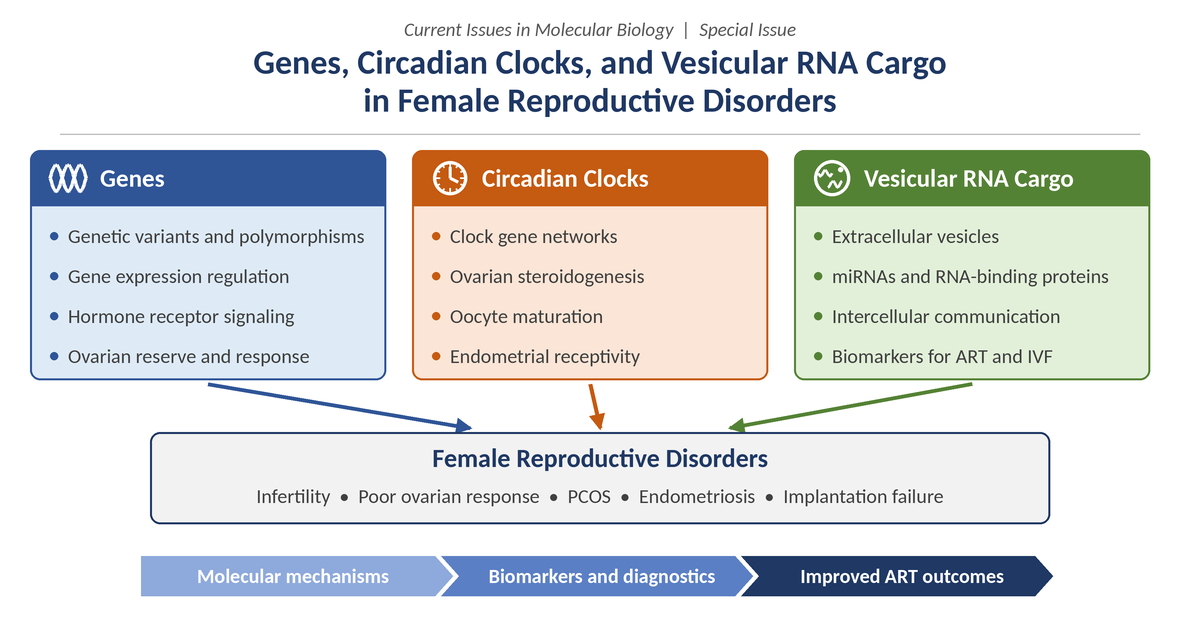
Female infertility often has a molecular basis. Poor ovarian response, PCOS, endometriosis and repeated implantation failure are clear examples. Some women carry gene variants that change how the ovary responds to stimulation. Others show changes in how genes are expressed in the oocyte, the granulosa cells or the endometrium. Both levels matter for IVF outcome.
Extracellular vesicles help explain part of this. They are present in follicular fluid, in uterine fluid and in embryo culture media. They move RNAs and proteins between cells. RNA-binding proteins decide which non-coding RNAs end up inside them. In obesity, PCOS and endometriosis, vesicle content is altered. Since these fluids are collected during IVF anyway, vesicles could be used as biomarkers of oocyte quality and endometrial receptivity.
The ovary and the endometrium also follow their own daily rhythms. Clock genes influence hormone production, ovulation and decidualization. Metabolic signals interact with these clocks. Obesity and night-shift work can disturb them.
Oocyte ageing is another key issue. As women get older, oocytes lose mitochondrial function and make more chromosome errors. The RNA cargo of follicular vesicles changes as well. Many of these processes are still poorly understood.
We welcome original research and review articles on these topics. Clinical, animal and cell culture studies are all of interest. Work with a direct link to assisted reproduction is especially welcome. Possible topics include the following:
- Gene variants and ovarian response to stimulation;
- Extracellular vesicles in the follicle and the endometrium;
- Vesicle signalling between the embryo and the mother;
- Non-coding RNAs in ovarian and endometrial disease;
- RNA-binding proteins and RNA sorting into vesicles;
- Circadian and metabolic regulation of ovarian function;
- Oocyte and ovarian ageing;
- Mitochondria and oxidative stress in the oocyte;
- Vesicle and RNA biomarkers of IVF success.
Dr. Charalampos Voros
Guest Editor
Manuscript Submission Information
Manuscripts should be submitted online at www.mdpi.com by registering and logging in to this website. Once you are registered, click here to go to the submission form. Manuscripts can be submitted until the deadline. All submissions that pass pre-check are peer-reviewed. Accepted papers will be published continuously in the journal (as soon as accepted) and will be listed together on the Special Issue website. Research articles, review articles as well as short communications are invited. For planned papers, a title and short abstract (about 250 words) can be sent to the Editorial Office for assessment.
Submitted manuscripts should not have been published previously, nor be under consideration for publication elsewhere (except conference proceedings papers). All manuscripts are thoroughly refereed through a single-anonymized peer-review process. A guide for authors and other relevant information for submission of manuscripts is available on the Instructions for Authors page. Current Issues in Molecular Biology is an international peer-reviewed open access monthly journal published by MDPI.
Please visit the Instructions for Authors page before submitting a manuscript. The Article Processing Charge (APC) for publication in this open access journal is 2400 CHF (Swiss Francs). Submitted papers should be well formatted and use good English. Authors may use MDPI's English editing service prior to publication or during author revisions.
Keywords
- female infertility
- assisted reproduction
- gene polymorphisms
- extracellular vesicles
- non-coding RNAs
- RNA-binding proteins
- circadian clock
- ovarian ageing
- endometrial receptivity
- oxidative stress
Benefits of Publishing in a Special Issue
- Ease of navigation: Grouping papers by topic helps scholars navigate broad scope journals more efficiently.
- Greater discoverability: Special Issues support the reach and impact of scientific research. Articles in Special Issues are more discoverable and cited more frequently.
- Expansion of research network: Special Issues facilitate connections among authors, fostering scientific collaborations.
- External promotion: Articles in Special Issues are often promoted through the journal's social media, increasing their visibility.
- Reprint: MDPI Books provides the opportunity to republish successful Special Issues in book format, both online and in print.
Published Papers


Curr. Issues Mol. Biol. - ISSN 1467-3045