
 Open Access
 - Article

25 Pages
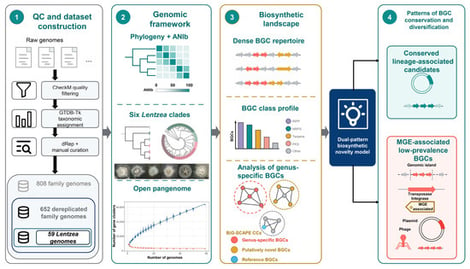
Background/Objectives: Rare actinomycetes are considered underexplored reservoirs of bioactive natural products, yet genus-level evolutionary processes underlying diversity and novelty in specialized metabolite biosynthetic potential remain poorly understood. Methods: We analyzed 652 high-quality, non-redundant Pseudonocardiaceae genomes, including 59 Lentzea genomes, using phylogenomics, pangenome analysis, antiSMASH, BiG-SCAPE/MIBiG comparisons, orthogroup-informed BGC conservation analysis, and five genomic context criteria for MGE association. Results: Phylogenomics confirmed the monophyly of Lentzea spp. and resolved six intrageneric clades. Pangenome analysis revealed an open architecture with core–accessory functional differentiation. Comparative genome mining revealed a rich BGC repertoire in Lentzea spp., with no significant correlation between BGC abundance and genome size. Family-scale BiG-SCAPE clustering identified numerous Lentzea-specific, putatively novel GCFs in RiPP, terpene, and NRPS classes. Six lineage-associated BGC groups retained conserved biosynthetic backbones alongside local gene content and domain architecture variation, whereas MGE-associated BGCs were enriched among lower-prevalence GCFs. Sensitivity analyses supported conservation and mobility association patterns. Conclusions: Findings support a dual-pattern model of BGC conservation and mobility-associated diversification in Lentzea, providing complementary criteria for prioritizing biosynthetic candidates and a practical framework for genome-guided natural product discovery in rare actinomycetes.
Antibiotics
30 September 2026