


Abstract
Background/Objectives: The emergence of plasmid-mediated mcr genes has enabled horizontal dissemination of resistance to colistin, a last-resort antibiotic against multidrug-resistant Enterobacterales. In Tunisia, genomic data on mcr-positive Escherichia coli are still limited. This study reports the genomic characterization of human clinical mcr-positive E. coli isolates from the Military Hospital of Tunis. Methods: Between August 2023 and March 2025, seven E. coli isolates with low-level colistin-resistance (MIC = 4–8 µg/mL) were collected from six patients. They were characterized by antibiotic susceptibility testing and WGS to determine resistome, MLST, genetic relatedness, and plasmid content. Results: The E. coli isolates belonged to diverse sequence types (STs), except for two isolates collected from the same patient 2.5 months apart, which were highly related. Overall, this pattern is consistent with a polyclonal spread. The mcr-1.1 gene was located on IncI2 (n = 5) or IncX4 (n = 2) plasmids, which exhibited high similarity both among themselves and in comparison with plasmids previously reported in human and livestock isolates. Most isolates were multidrug-resistant, harboring acquired resistance genes to multiple antibiotic classes, and chromosomal mutations conferring fluoroquinolone resistance. Three isolates additionally carried chromosomal insertions of the blaCTX-M-55 gene. Resistance to cefiderocol was observed in one isolate and was associated with CirA and Fiu truncation. Conclusions: These findings highlight ongoing dissemination of mcr-1.1-positive E. coli isolates in Tunisia, primarily driven by plasmid transfer. Continuous genomic surveillance and One Health-oriented antibiotic stewardship are essential to limit the spread of colistin-resistance and the emergence of resistance to newer agents such as cefiderocol.
Keywords:
Escherichia coli; mcr-1.1; colistin resistance; plasmid-mediated resistance; Tunisia; IncI2; IncX4; CirA; Fiu; TonB; cefiderocol resistance 1. Introduction
Colistin remains a last-resort antibiotic to treat human infections caused by multidrug-resistant (MDR) Gram-negative bacteria, particularly carbapenemase-producing Enterobacterales [1]. Since the discovery in China in 2015, the plasmid-mediated mcr-1 gene, and to a lesser extent a few of its mcr-2 to mcr-10 variants, have been reported from humans, animal, and environmental sources, making it a One Health issue [2,3]. Nevertheless, while the proportions of mcr-positive E. coli in livestock animals reached alarming levels worldwide, the occurrence of these isolates in human clinical isolates remained limited [4,5].
In Tunisia, colistin has been used in veterinary medicine for decades, leading to the emergence and dissemination of mcr-1-positive E. coli in several livestock sectors [6,7,8]. In most cases, the mcr-1 gene was found co-localized with the blaCTX-M-1 gene on IncHI2 plasmids, even though IncP carriage was also reported. In Tunisian hospitals, colistin remains a last-resort therapeutic option for the treatment of infections caused by carbapenem-resistant bacteria. In clinical settings, mcr-1-positive E. coli was first reported in Tunisia in 2019 through a multicentric study describing four isolates associated with urinary tract infections [9]. However, the first detailed characterization of an mcr-carrying plasmid in Tunisian hospitals only dates back to 2023, when an mcr-1-harboring E. coli isolate recovered from a prosthetic joint infection at Sahloul Hospital in Sousse was described [10]. The isolate belonged to ST224 and carried the mcr-1.1 gene on an IncI2 plasmid lacking the typical ISApl1 flanking elements, suggesting increased stability of the resistance cassette [10].
Given the importance of colistin in human medicine, especially in countries without access to novel antibiotics such as cefiderocol or novel ß-lactam/inhibitor combinations, clinical microbiology laboratories are monitoring the emergence of mcr-positive Enterobacterales. Cefiderocol is a novel siderophore cephalosporin that exploits bacterial iron transport systems to enter the periplasmic space, thereby overcoming several resistance mechanisms, including reduced outer membrane permeability and efflux pumps [11]. Owing to its stability against most clinically relevant β-lactamases, including carbapenemases, cefiderocol has become an important last-line therapeutic option for severe infections caused by multidrug-resistant Gram-negative bacteria [12]. However, reports of reduced susceptibility and resistance to cefiderocol have increasingly emerged worldwide, even among isolates without prior exposure to the drug, raising concerns regarding the preservation of its clinical efficacy [13]. Therefore, continuous surveillance of cefiderocol susceptibility, particularly among strains harboring transferable resistance genes such as mcr-1, is becoming increasingly important.
Here, a retrospective study conducted at the Military Hospital of Tunis between 2023 and 2025 revealed seven mcr-positive E. coli isolates recovered from six patients. WGS was used to characterize the mcr-1-positive E. coli isolates, determine the genetic context of the mcr genes, and identify potential routes of dissemination within the hospital.
2. Results
2.1. Clinical Characteristics
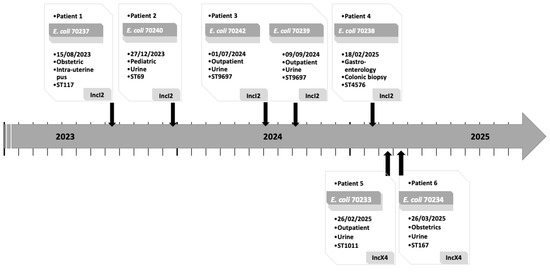
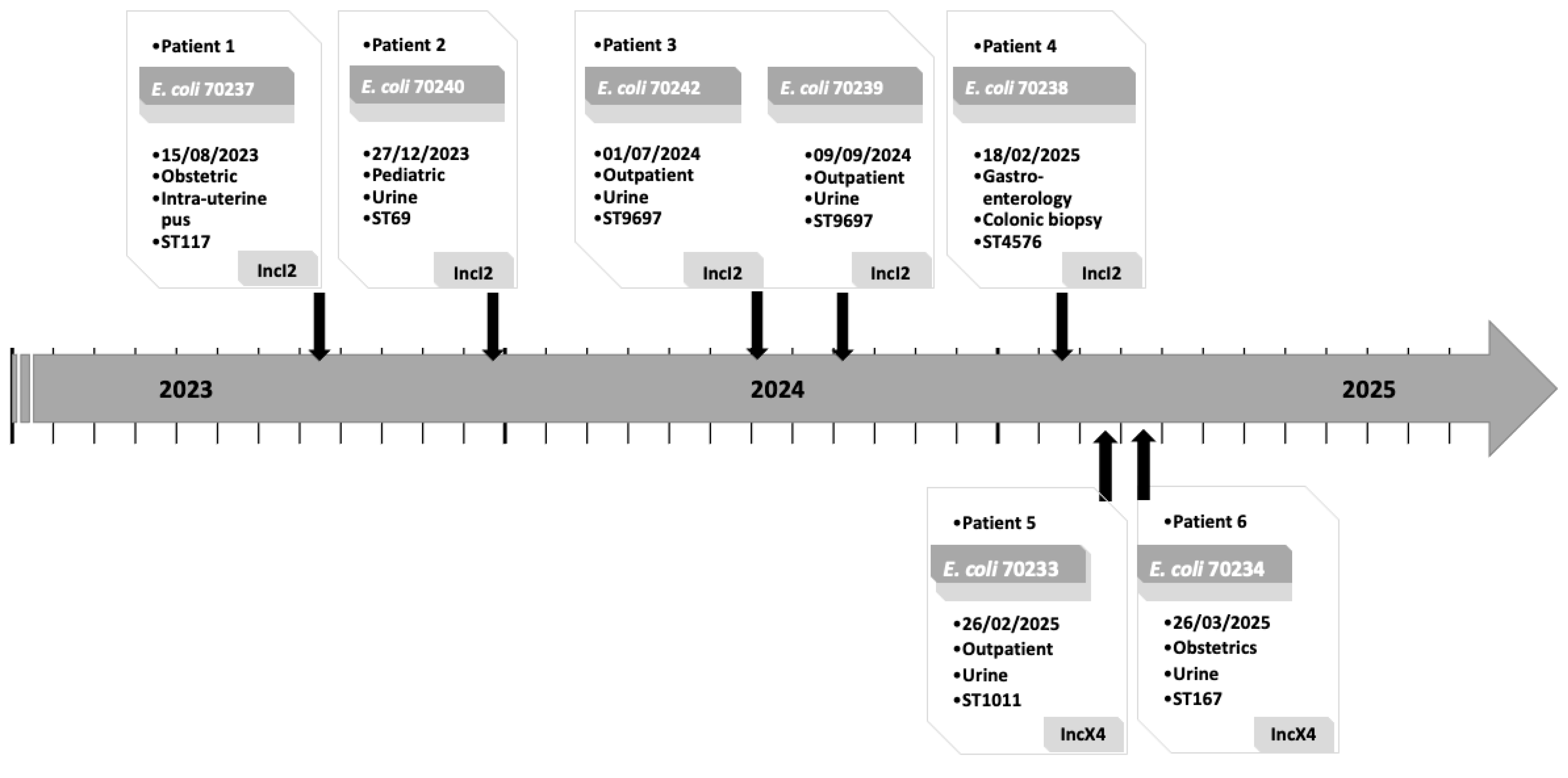
Between August 2023 and March 2025, a total of 3104 E. coli isolates were recovered from clinical specimens processed at the Laboratory of Bacteriology of the Military Hospital of Tunis, Tunisia. Among these, seven isolates (7/3104; 0.2%) that were isolated from six patients exhibited low-level resistance to colistin (MIC = 4–8 μg/mL) (Figure 1).
Figure 1.
Timeline of mcr-1-positive E. coli isolates recovered from six patients in a military hospital in Tunisia (August 2023–March 2025). Dates of isolation, patient identifiers, isolate numbers, STs, and hospital wards are indicated. The plasmid carrying the mcr-1 gene (IncI2 or IncX4) is indicated for each isolate.
As two isolates were collected from the same patient 2.5 months apart, both were retained for characterization. Colistin-resistant isolates originated from diverse clinical samples, including urine, intra-abdominal pus, tissue biopsy, and blood cultures (Table 1). Patients were from different wards, namely pediatrics (n = 1), gynecology/obstetrics (n = 2), gastroenterology (n = 1), and outpatient settings (n = 2). Two patients originated from urban areas and four from rural regions. Five out of the six patients reported having contacts with livestock animals and none reported a recent trip abroad. Clinical review indicated that the recovered isolates were associated with clinically relevant infections rather than incidental colonization. Urinary isolates originated from patients diagnosed with symptomatic urinary tract infections or presenting with significant urological disorders, including bladder cancer requiring surgical management. Most patients had underlying comorbidities such as diabetes mellitus, chronic kidney disease, hypertension, hypothyroidism, inflammatory bowel disease, or malignancy, and several had recent healthcare exposure or previous hospitalization. Appropriate antimicrobial therapy was initiated according to the clinical presentation, including cefixime, amoxicillin-clavulanate, piperacillin-tazobactam combined with metronidazole, or cefotaxime-based regimens, while one patient required surgical intervention. Clinical outcomes were favorable in all evaluable patients, underscoring the clinical relevance of the recovered isolates. (Table S1).
Table 1.
Epidemiological and WGS data of the seven mcr-1-positive E. coli.
2.2. Antimicrobial Susceptibility Patterns
Susceptibility testing by BMD using a large panel of 47 antibiotics showed that six out of the seven isolates exhibited an MDR phenotype (Table 2) [14]. Isolates remained susceptible to piperacillin/tazobactam, all carbapenems, aminoglycosides (amikacin, gentamicin, tobramycin), fosfomycin, tigecycline, eravacycline and to the new β-lactam/β-lactamase inhibitor combinations, including meropenem–vaborbactam, ceftazidime–avibactam, and aztreonam–avibactam. Three isolates were resistant to ceftolozane/tazobactam, while resistance to cefiderocol (MIC = 16 mg/L) was observed in one isolate (# 70237), and reduced susceptibility (MICs = 0.5–2 mg/L) was observed in three isolates (# 70239, 70242 and 70240) (Table 2).
Table 2.
Antimicrobial susceptibility patterns and minimum inhibitory concentrations (MICs) of mcr-1-producing E. coli strains using the broth microdilution method (Sensititre, ThermoFisher, LesUlis, France) and UMIC Cefiderocol® kit (Biocentric, Bandol, France) for Cefiderocol.
2.3. Molecular Characterization of Isolates
E coli isolates belonged to six different STs (ST69, ST1011, ST117, ST167, ST4576, and ST9697 (n = 2) and to distinct phylogroups and serogroups, including phylogroup D (serogroups O160:H16, O51:H42, and O17/O44:H18), phylogroup A (O89:H21), phylogroup G (O45:H4), and phylogroup B1 (O8:H10), reflecting antigenic diversity (Table 1).
Analysis of the resistome confirmed the presence of the mcr-1.1 allele in all isolates (Table 1). In addition, resistance to several other antibiotic families was observed, such as β-lactams (blaTEM-1B (n = 4), blaCTX-M-55 (n = 2)), tetracyclines (tet(A)), trimethoprim (dfrA12, dfrA14, dfrA17), sulfonamides (sul1, sul2) and chloramphenicol (floR) (Table 1). Six out of seven isolates also carried amino acid changes in GyrA (four with the combination S83L/D87N, and one with S83L alone) and ParC (S80I) enzymes, conferring resistance to fluoroquinolones. In addition, one isolate (70234) carried the plasmid-mediated qnrS1 gene. In contrast, E. coli isolate 70238, characterized by a rare ST4576, displayed the mcr-1 gene but no other antimicrobial resistance gene or point mutation associated with resistance, in accordance with the observed phenotype (Table 1).
The two isolates recovered from the same patient (70239 and 70242) belonged to the same ST, differed only by 17 SNPs (based on core-genome SNP analysis), and displayed the same resistome and antimicrobial susceptibility profile, suggesting the persistence in the host of a single clone.
2.4. Cefiderocol Resistance
Three of the seven isolates displayed cefiderocol MICs of ≤0.03 mg/L, consistent with the low MICs typically reported for wild-type E. coli strains (approximately 0.06–0.12 mg/L) [15]. In contrast, four isolates exhibited elevated cefiderocol MICs compared with those expected for wild-type E. coli. Although three of these isolates remained within the clinical susceptibility breakpoint, one was classified as resistant.
Because cefiderocol enters Gram-negative bacteria via TonB-dependent iron transport systems, alterations affecting TonB or TonB-dependent siderophore receptors including CirA and Fiu in Enterobacterales can impair antibiotic uptake and reduce susceptibility [16,17]. Additional resistance mechanisms include alterations in penicillin-binding protein 3 (PBP3), which decrease cefiderocol affinity. When combined with β-lactamases exhibiting even weak cefiderocol hydrolytic activity, these alterations may act synergistically to confer clinically relevant reductions in susceptibility or frank resistance [16]. To investigate the molecular basis of these elevated MICs, the ftsI, tonB, Fiu and cirA genes, encoding, respectively the PBP3, TonB energy transducer, and the two catecholate siderophore receptors Fiu and CirA, were analyzed.
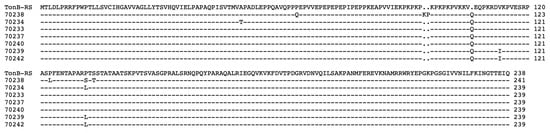
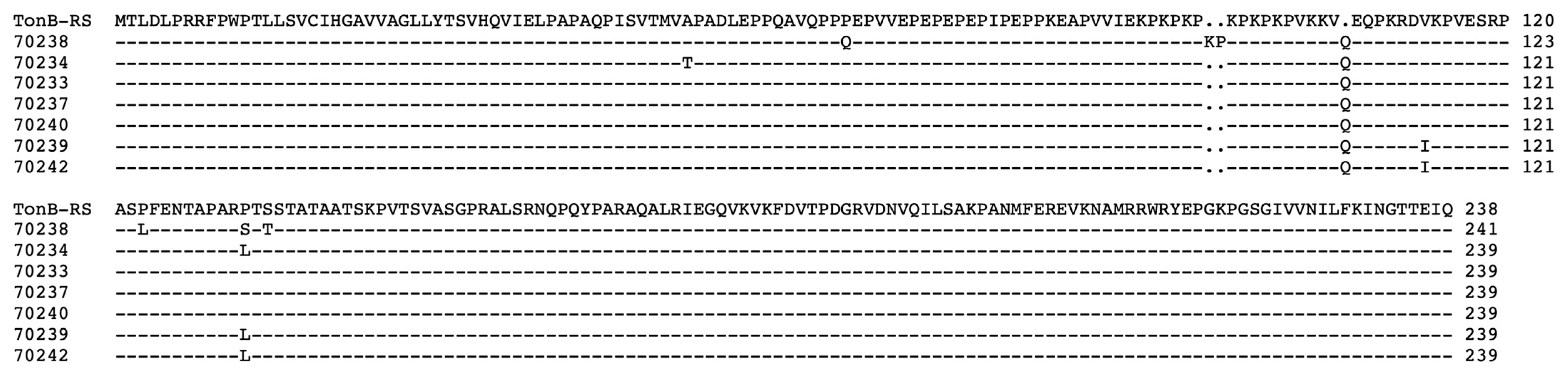
No mutation was found in the ftsl gene, as compared to that of E. coli MG1665 (RefSeq: GCF_056500995.1). Similarly, only a limited number of amino acid changes were identified in TonB compared with the reference sequence of E. coli ATCC 25922 (CP009072) (Figure 2). In isolate 70238, which remained fully susceptible to cefiderocol, a two-amino-acid insertion (KP) after residue 96 was observed. The preservation of cefiderocol susceptibility in this isolate suggests that this insertion is unlikely to have a major impact on antibiotic uptake or susceptibility.
Figure 2.
Amino acid sequence alignment TonB from mcr-1 producing Escherichia coli isolates from this study with that of the Escherichia coli ATCC 25922 strain (RS: RefSeq; GenBank accession no. CP009072). Identical amino acids are indicated by dashes, and missing ones by dots.
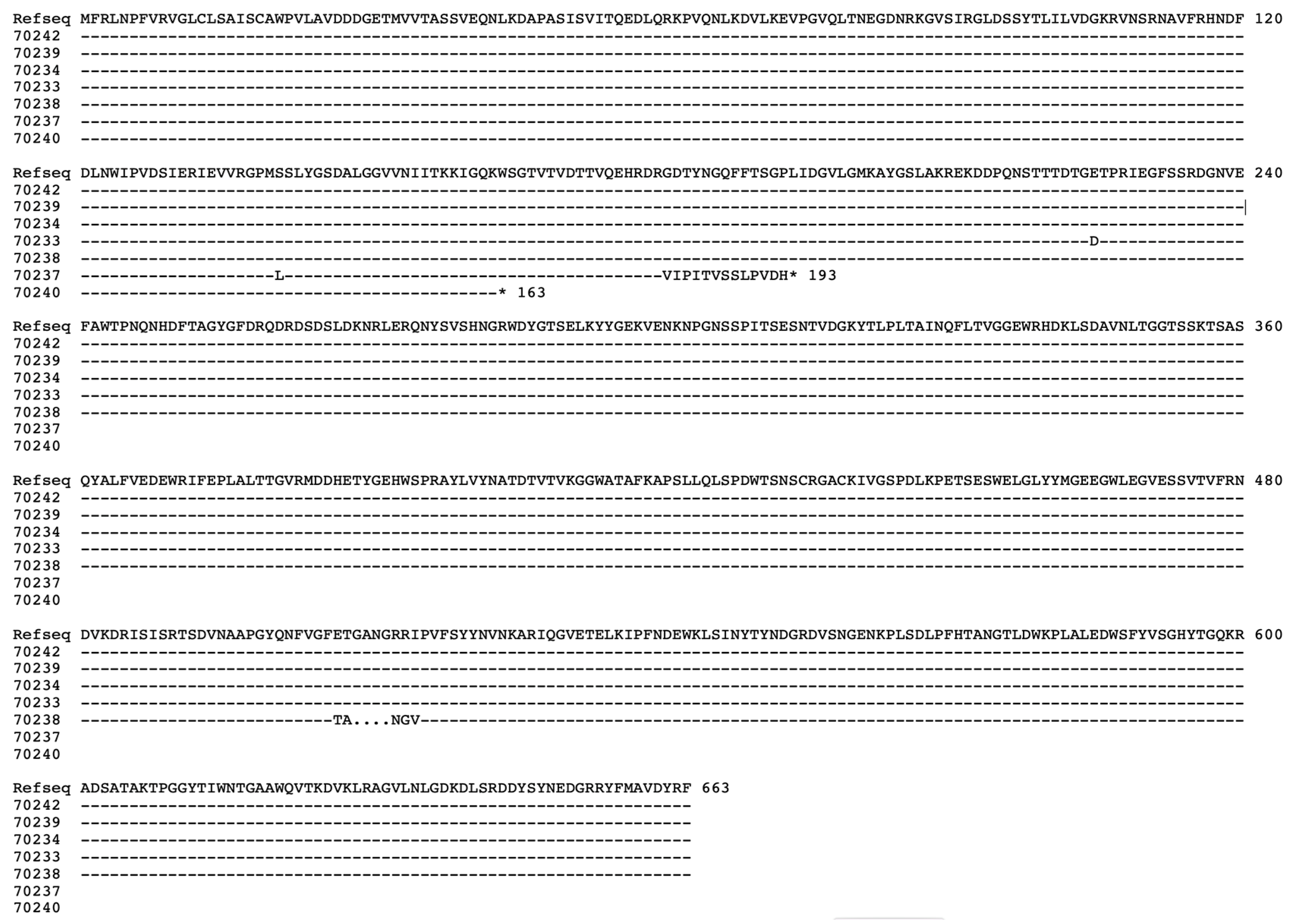
Compared to strain E. coli ATCC 25922, cirA nucleotide alterations resulting in premature stop codons were identified in one cefiderocol-resistant isolate (70237; MIC, 16 mg/L) and one isolate with reduced susceptibility (70240; MIC, 0.5 mg/L) (Figure S1, Table 2). These mutations resulted in truncated proteins of 163 and 193 amino acids (aa) respectively (Figure 2), and may contribute to the increased cefiderocol MICs observed in these isolates. In the isolates 70239 and 70242 (MIC = 0.5 and 2 mg/L, respectively), no mutation in cirA were found. In isolate 70238, a deletion of four aa at the C-terminus of CirA was also observed, however this isolate was fully susceptible to cefiderocol; suggesting that this deletion is unlikely to contribute to cefiderocol resistance (Figure 3).
Figure 3.
Amino acid sequence alignment of catecholate siderophore receptor CirA protein from mcr-1-producing Escherichia coli isolates from this study with that of the Escherichia coli ATCC 25922 strain (RefSeq; GenBank accession no. CP009072). Identical amino acids are indicated by dashes, gaps by dots and premature interruptions by asterisks (*).
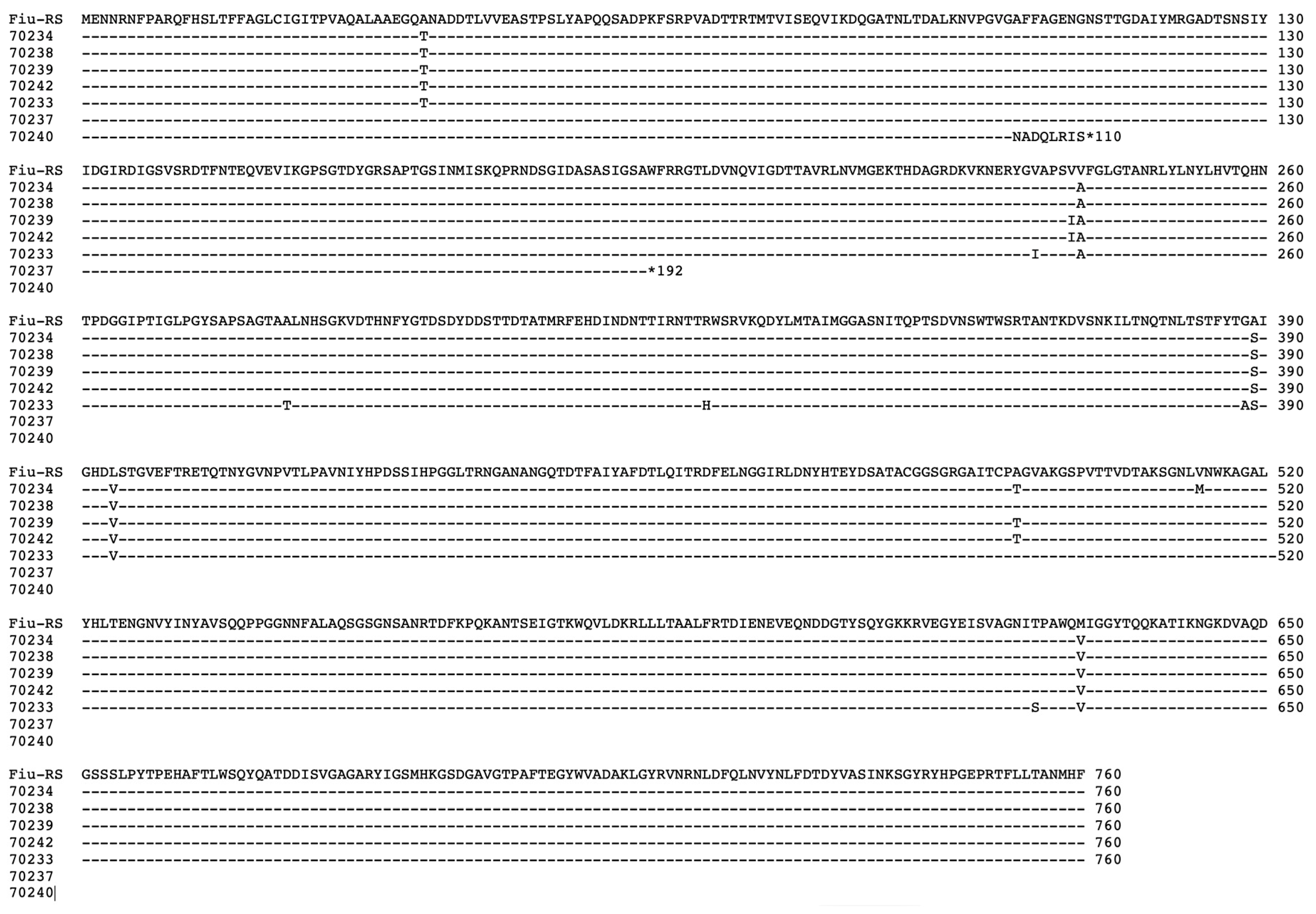
Compared with E. coli ATCC 25922, fiu nucleotide alterations predicted several amino acid substitutions as well as premature stop codons in the cefiderocol-resistant isolate 70237 (MIC, 16 mg/L) and in isolate 70240 (MIC, 0.5 mg/L), both of which also harbored cirA-inactivating mutations (Figure S2, Table 2). These premature stop codons resulted in truncated Fiu proteins of 110 and 192 amino acids, respectively (Figure 4), likely contributing to the increased cefiderocol MICs by impairing antibiotic uptake. In contrast, isolates 70239 and 70242 (MICs, 0.5 and 2 mg/L, respectively) harbored only amino acid substitutions in Fiu. Because these substitutions were also identified in fully cefiderocol-susceptible isolates, they are unlikely to be sufficient, on their own, to explain the reduced cefiderocol susceptibility observed in these isolates (Figure 4).
Figure 4.
Amino acid sequence alignment of Fiu protein, a TonB-dependent outer membrane receptor for catecholate-type siderophore uptake from mcr-1-producing Escherichia coli isolates from this study with that of the Escherichia coli ATCC 25922 strain (RS: RefSeq; GenBank accession no. CP009072). Identical amino acids are indicated by dashes, missing ones by dots and premature interruptions by *.
2.5. Genetic Support of mcr-1.1 and blaCTX-M-55 Genes
Among the seven E. coli isolates, five carried the mcr-1.1 genes on IncI2 plasmids (including three isolates co-harboring the blaCTX-M-55 gene) and two on IncX4 plasmids (Figure 1). IncI2 plasmids were identified in the five oldest isolates (August 2023 to March 2025), while IncX4 were identified in the two most recent ones (February–March 2025).
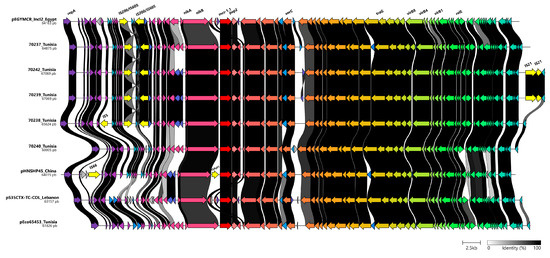
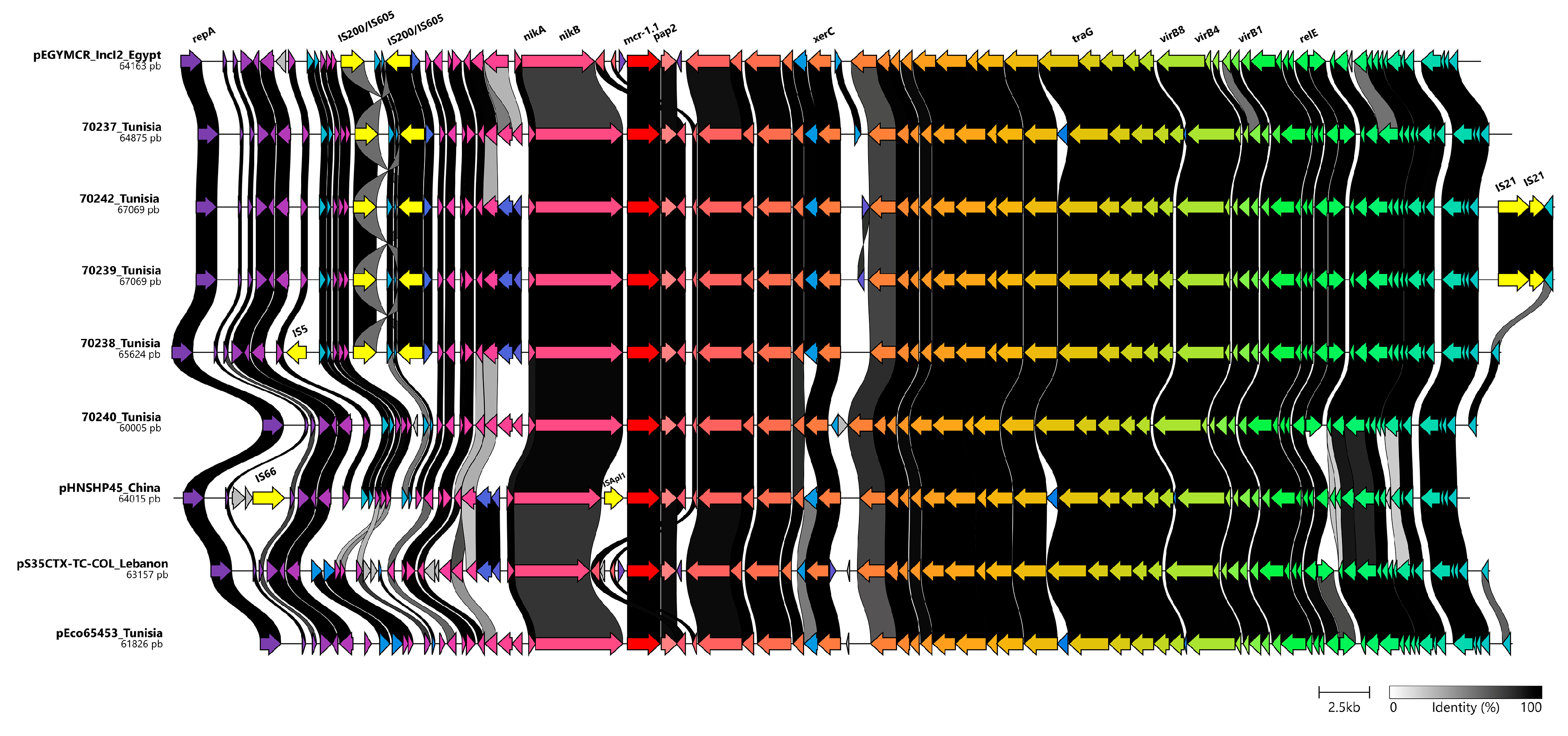
The five IncI2 plasmids were highly similar to each other (95 to 100% coverage and 99 to 100% identity) and were also closely related to the original plasmid reported by Liu et al. (pHNSHP45, [KP347127] [3]) and those previously reported in humans from Tunisia (pECO-TUN-65453 [PRJNA1238567] [10]) and from broilers in Egypt (pEGYMCR_IncI2 [MT499885.1] [18]) and Lebanon (pS35CTX-TC-COL [OZ026767.1] [19]) (Figure 5). The IncI2 plasmid identified in isolate 70240 shared higher homologies with the pECO-TUN-65453 plasmid isolated in 2023 at the Sahloul hospital (Sousse, Tunisia) than with the three other IncI2 plasmids from this study, which shared more similarities with a plasmid from Egypt, notably due to the presence of a 3.9 kbp element bracketed by IS200/IS605 family transposases [18].
Figure 5.
Comparison of mcr-1-carrying plasmids belonging to the IncI2 type. The name and size of each plasmid are indicated in front of each sequence. The nucleotide sequence identity between each coding region is represented with a color gradient ranging from white (0% identity) to black (100% identity). A few genes of interest are also specified: repA, TraG, virB4, relE, mcr-1, pap2. IncI2 plasmids corresponded to pHNSHP45 (GenBank: KP347127) [3], plasmid pECO-TUN-65453 (GenBank: PRJNA1238567) [10], previously reported in humans from Tunisia plasmid pEGYMCR_IncI2 (GenBank: MT499885.1) from Egypt [18] and plasmid pS35CTX-TC-COL (GenBank: OZ026767.1) from Lebanon [19].
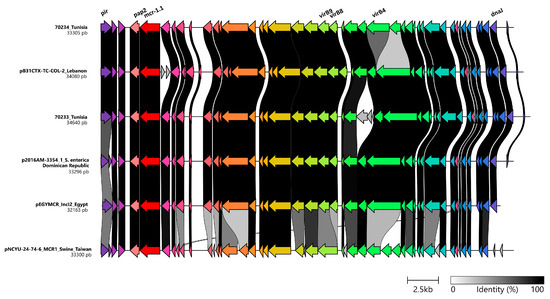
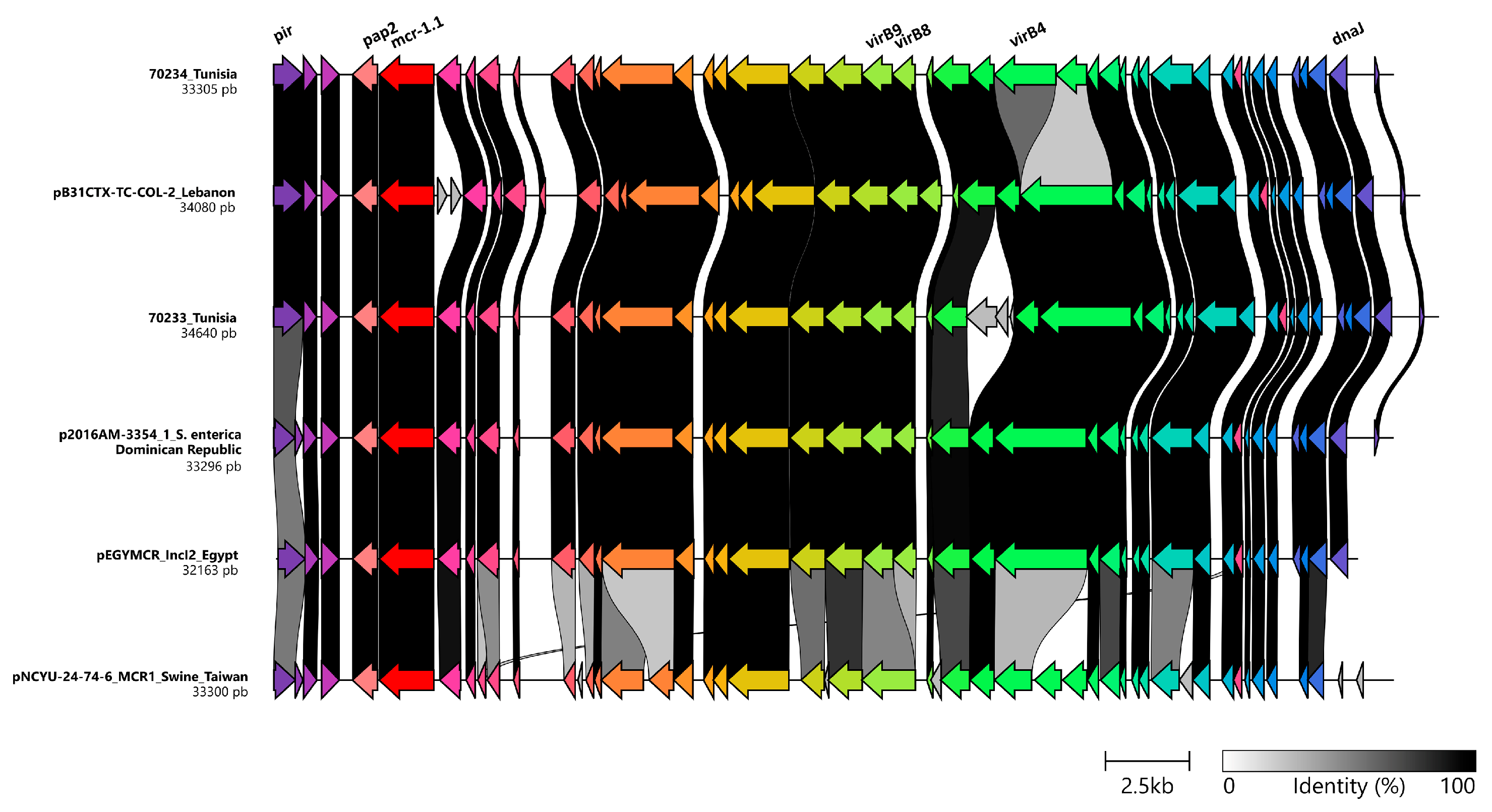
Likewise, the IncX4 plasmids identified here shared high similarities with reported from broilers in Egypt (pEGYMCR_IncI2 [MT499886] [18]) and Lebanon (pB31CTX-TC-COL-2 [OZ026879] [19]) (Figure 6), but also with plasmids from a Salmonella enterica isolate (p2016AM-3354_1 [CP092291.1] [20]) collected from a US traveler and from an E. coli (pNCYU-24-74-6_MCR1 [CP042644.1] isolate collected in swine in Taiwan [21]. Only the Lebanese isolate [OZ026879] harbored an IS element upstream of the mcr-1.1 gene.
Figure 6.
Comparison of mcr-1-containing plasmids belonging to the IncX4 type. The name and size of each plasmid are indicated in front of each sequence. The nucleotide sequence identity between each coding region is represented with a color gradient ranging from white (0% identity) to black (100% identity). A few genes of interest are also specified: repA, TraG, virB4, relE, mcr-1, pap2. IncX4 plasmids corresponded to p2016AM-3354 (GenBank: CP092291) from a Salmonella enterica isolate [20], pEGYMCR_IncX4 (GenBank: MT499886) from Egypt [18], pB31CTX-TC-COL-2 (GenBank: OZ026879) from Lebanon [19] and pNCYU-24-74-6_MCR1 (GenBank: CP042644.1) from swine in Taiwan [21].
Isolates 70237, 70239 and 70242, belonging to two different STs (ST117 and ST9697) and harboring an IncI2 plasmid-borne mcr-1.1 gene, additionally carried the ESBL blaCTX-M-55 gene. In these three E. coli isolates, the blaCTX-M-55 gene was located on a mobile element made of an ISEcp1 element, located 45 bp upstream of the blaCTX-M-55 gene, and the wbuC gene located 46 bp downstream, which was inserted at the same locus on the chromosome of both strains. However, in the E. coli 70237 ST117 isolate, ISEcp1 was truncated (∆ISEcp1).
3. Discussion
Given the low number of mcr-1-positive E. coli isolates reported in human medicine, the detection of six patients with such isolates in a single Tunisian tertiary care center over three years represents an epidemiological signal whose significance needs to be assessed.
Two isolates (70239 and 70242) were recovered from the same patient during outpatient visits 2.5 months apart and were analyzed to assess genetic relatedness and explore potential resistance selection over time. The isolates differed by only 17 SNPs, confirming close genetic relatedness, and exhibited identical antimicrobial susceptibility profiles, suggesting that these SNPs had no impact on resistance phenotypes. Although it is possible that these SNPs accumulated during the 2.5-month colonization period, this appears unlikely. Given an estimated evolutionary rate of approximately 6–7 SNPs per year in the E. coli genome, it is more plausible that the patient had been colonized by the mcr-1.1-positive strain for a longer period or that colonization involved an already genetically diverse bacterial population.
Five out of the six patients reported having contact with livestock animals, supporting an extra-hospital source of contamination, possibly from a non-urban environment. This hypothesis is further supported by the identification of six different STs suggesting community acquisition and importation into the hospital. Four out of the six identified STs (167, 1011, 117, 69) have recognized zoonotic or global epidemiological importance and have been recurrently associated with mcr carriage. ST167 is a globally distributed clone, which seems prone to interspecies transmission [22]. In France, it has recently been described as the main mcr-1-carrying E. coli lineage in the bovine sector [22,23]. ST1011 is a zoonotic lineage originally associated with environmental and poultry sources, but rarely with humans [22,23,24,25,26]. In Lebanon, mcr-1-positive E. coli ST1011 was detected in poultry, a patient, and a farm worker, suggesting cross-species transmission [27]. ST117 also has avian origins even though it has now spread to multiple hosts including livestock and humans [28]. It often harbours resistance genes such as blaTEM, cat1, tetB and sul1/sul2; similar profiles occurred in poultry isolates from Poland, Egypt, and Switzerland [28]. In Tunisia, E. coli ST117 carrying mcr-1 and blaCMY-2 have been found in healthy chickens, confirming poultry as a reservoir [29]. ST69 is globally distributed and considered as a pandemic high-risk clone, which has only been reported in Tunisia from two wildlife isolates carrying blaCTX-M-15 and qnrS1 [30].
Although the presence of mcr-1.1 did not influence the immediate therapeutic management of the patients included in this study, since all isolates remained susceptible to several clinically relevant antimicrobial agents, its detection remains epidemiologically important. The principal concern is the dissemination of plasmid-mediated colistin resistance, which can readily spread between bacterial populations and jeopardize one of the last-resort therapeutic options for multidrug-resistant Gram-negative infections. In Tunisia, only isolated reports of clinical mcr-1-positive E. coli have previously been described from another geographical region [10]. Therefore, our findings suggest that plasmid-mediated colistin resistance is no longer geographically restricted and may be spreading at the country level. Given the widespread use of colistin in Tunisia, these findings should be considered as an early warning supporting the implementation of continuous surveillance and infection control measures to limit further dissemination.
Alterations or inactivation of the CirA and/or Fiu iron transporter have previously been associated with cefiderocol resistance in clinical isolates [15,31,32]. In the present study, only one isolate exhibited cefiderocol resistance according to EUCAST criteria. Interestingly, truncating cirA and fiu mutations were identified in both the resistant isolate (70237; MIC = 16 mg/L) and an isolate with reduced susceptibility to cefiderocol (70240; MIC = 0.5 mg/L), suggesting that cirA and/or fiu disruption alone is insufficient to confer a resistant phenotype. These findings suggest that additional resistance mechanisms, such as alterations in other iron uptake systems, β-lactamase activity, or as-yet unidentified mechanisms, contribute to the high cefiderocol MIC observed in isolate 70237 [17].
In two additional isolates, 70239 and 70242, no CirA alterations were identified, and only a few amino acid substitutions were detected in Fiu, despite elevated cefiderocol MICs of 0.5 and 2 mg/L, respectively. These Fiu substitutions are unlikely to account for the increased cefiderocol MICs, as they were also observed in fully susceptible isolates; however, their potential contribution cannot be excluded and warrants further investigation (Figure 4).
Although high-level cefiderocol resistance is generally thought to result from the accumulation of multiple mechanisms, including reduced uptake, β-lactamase-mediated hydrolysis, and/or decreased target susceptibility (for example through PBP3 alterations), the role of individual β-lactamases remains incompletely defined [16,33]. In contrast to β-lactamases such as NDM, certain PER, VEB, and GES variants, or hyperproduced AmpC enzymes, CTX-M-55 has not been established as a major cefiderocol resistance determinant. Nevertheless, CTX-M-55 may have contributed to the reduced cefiderocol susceptibility observed in these isolates. This enzyme displays enhanced catalytic efficiency (kcat/Km) against expanded-spectrum cephalosporins compared with CTX-M-15 [34], and its contribution may be amplified in the context of impaired siderophore-mediated uptake. This could partly account for the higher cefiderocol MIC observed in E. coli 70237 (MIC, 16 mg/L) compared with E. coli 70240 (MIC, 0.5 mg/L), as E. coli 70237 carried both truncated cirA/fiu genes and the blaCTX-M-55 gene. Further functional studies are required to confirm this hypothesis.
Alterations or inactivation of the cirA gene have previously been reported to arise during cefiderocol therapy [15,31,32]. In some cases, these mutations have been described even in the absence of cefiderocol selection pressure and despite their potential fitness cost [34]. In addition, cefiderocol resistance has increasingly been reported outside clinical settings, with resistant strains detected in aquatic environments such as surface waters in Ghana and the Baltic Sea [35,36].
While clonal transmission could be ruled out in our collection of isolates, dissemination of the plasmids most likely occurred, either inside or outside the hospital. Indeed, five strains carried the mcr-1.1 gene on highly similar IncI2 plasmids, and two on IncX4 plasmids, suggesting the spread of two distinct plasmid backbones carrying mcr-1 colistin resistance determinants. This finding extends our previous observation from Sahloul hospital [10], where the mcr-1.1 gene was located on an IncI2 plasmid. Here, a highly related IncI2 plasmid was identified in four isolates, while the fifth one was slightly different, suggesting persistence and/or reintroduction of plasmid lineages within Tunisian healthcare environments.
Both IncI2 and IncX4 plasmids have been widely reported to be highly transferable across bacterial species [2,4]. Globally, the IncI2 plasmid type was the earliest and remains the most frequently encountered vehicle, followed by IncX4 and IncHI2, together accounting for over 90% of reported mcr-1-bearing plasmids [37,38]. Despite their widespread distribution, the reasons for their dominance and their effects on host fitness remain poorly understood. The usually high transfer capacity of both IncX4 and IncI2 may probably explain their wide geographical dissemination and their occurrence in humans and in a large variety of animal hosts [27]. In Tunisia, mcr-1-positive E. coli have been described in animal, environmental, and human sources [9,39], but detailed plasmid characterizations were scarce until the report of an isolate from the Sahloul hospital [10].
Additionally, three E. coli isolates (belonging to ST9697 and ST117) carried the blaCTX-M-55 gene, which remains scarce in Tunisian E. coli isolates of human and animal origin [7,40]. The gene was chromosomally embedded through the integration of an ISEcp1-blaCTX-M-55-wbuC (orf477) element at the same genetic locus. This configuration mirrors previous findings in Tunisia, where two studies reported similar genetic environments among CTX-M-ESBL-producing E. coli from chicken faeces, retail meat, and urban and industrial wastewater, indicating a conserved chromosomal integration pattern of this resistance determinant [7,40]. The presence of ISEcp1 upstream of blaCTX-M-55 suggests its role in mobilization and high-level expression of blaCTX-M alleles [41]. The truncated ISEcp1 (∆ISEcp1) found in the ST117 strain likely results from recombination or partial deletion events mediated by other insertion sequences. The conservation of orf477 downstream of blaCTX-M-55 supports the existence of a common ancestral module involved in chromosomal capture of this gene. Collectively, the chromosomal localization of blaCTX-M-55 in similar genetic contexts across distinct sequence types highlights its potential for stable vertical transmission, complementing the global plasmid-mediated spread of this resistance determinant.
This study has several limitations. First, the number of positive isolates was small, and all isolates were collected from a single tertiary-care hospital, which may limit the generalizability of our findings to other healthcare settings or geographic regions. Second, isolate selection was based on phenotypic colistin resistance rather than systematic molecular screening of all E. coli isolates, potentially underestimating the prevalence of mcr-harboring isolates. Finally, contemporaneous animal, food, or environmental isolates were not available for comparison, precluding direct investigation of potential reservoirs and transmission pathways within a One Health framework. Nevertheless, the complete genomic characterization of all isolates and their associated plasmids, together with the detailed clinical data presented, provides valuable insights into the emergence and dissemination of plasmid-mediated mcr-1.1 among clinical E. coli isolates in Tunisia.
4. Materials and Methods
4.1. Bacterial Isolates and Identification
Between August 2023 and March 2025, E. coli isolates with reduced susceptibility to colistin, as revealed by an automated VITEK 2 system (AST357 card; bioMérieux, Marcy l’Etoile, France), recovered from clinical specimens processed at the Laboratory of Bacteriology of Military Hospital of Tunis, Tunisia, were included. Inclusion criteria were one isolate per patient per month. MICs were interpreted according to EUCAST 2026 guidelines (https://www.eucast.org/; accessed on 30 June 2026). Colistin resistance was subsequently confirmed using the broth microdilution reference method, in accordance with EUCAST guidelines (https://www.eucast.org/eucastguidancedocuments, accessed on 30 June 2026). Identification of colistin-resistant E. coli isolates was confirmed using MALDI-TOF Biotyper (Bruker, Hamburg, Germany).
4.2. Antimicrobial Susceptibility Testing
Susceptibility profiles of mcr-1-positive bacteria were determined by broth microdilution (BMD) (Seq2Diag plates 1, 2, 3, Sensititre, ThermoFisher, Les Ulis, France) for 47 antibiotics, including novel beta-lactam and non-beta-lactam antibiotics of clinical and veterinary interest and interpreted according to EUCAST 2026 breakpoints (https://www.eucast.org/), except for veterinary-restricted agents interpreted using veterinary breakpoints set by CA-SFM vétérinaire 2023 criteria (https://www.sfm-microbiologie.org/2023/06/15/casfm-veterinaire-2023/; accessed on 30 June 2026). Tigecycline MICs were interpreted using EUCAST 2026 epidemiological cut-off values, ECOFFs, cefiderocol MICs were determined by BMD using the UMIC Cefiderocol® kit (Biocentric, Bandol, France) under iron-depleted conditions and interpreted according to EUCAST 2026 guidelines.
4.3. Molecular Characterization
PCR screening for the mcr-1 to mcr-9 genes was performed [42,43]. Genomic DNA of the mcr-positive isolates was extracted using the NucleoSpin Microbial DNA extraction kit (Macherey-Nagel, Hoerdt, France) and libraries were prepared using the ligation sequencing kit (SQK-LSK114). Sequencing was performed on an Mk1B MinION sequencer using a R10.4.1 flow cell (FLO-MIN114, Nanopore, Oxford, UK), and basecalling was performed with Dorado v0.4.2. Mean sequencing depth ranged from 46x to 120x, and all genomes (chromosomes and plasmids) were fully circularized.
Reads were assembled using a previously described pipeline [44]. SQUAT was used to assess the quality of the assemblies and the contig circularization was assessed from the Autocycler output. Sequence types (STs) were obtained using MLST version 2.23.0 (https://github.com/tseemann/mlst; accessed on 30 June 2026) and gene annotation was performed with PROKKA version 1.14.5 [45,46]. Antimicrobial resistance motifs and plasmid incompatibility groups were determined using Abricate version 1.0.1 (https://github.com/tseemann/abricate; accessed on 30 June 2026) with the Resfinder v4.7.2, NCBI AMRFinder 4.2.7, CARD v4.0.1 and PlasmidFinder v2.0.1 databases. Virulence gene detection was performed using the Center for Genomic Epidemiology tools (https://www.genomicepidemiology.org/; VirulenceFinder v2.0.3; accessed on 30 June 2026). Phylogenetic analyses based on core-genome single nucleotide polymorphisms (SNPs) were performed using CSI Phylogeny 1.4.
Plasmids were compared to similar plasmids retrieved from the NCBI database using BLAST analysis (BLAST+ 2.15.0; https://blast.ncbi.nlm.nih.gov/Blast.cgi; accessed on 30 June 2026) and visualized using clinker version 0.0.29-1 (https://cagecat.bioinformatics.nl/tools/clinker; accessed on 30 June 2026) [47].
4.4. Nucleotide Sequence Accession Number
This whole genome shotgun project was deposited at DDBJ/ENA/GenBank under the BioProject PRJNA1392031 (see Table 1, for individual accession numbers).
5. Conclusions
Our study documents the silent dissemination of plasmid-mediated colistin resistance in Tunisia, with the identification of seven clinical E. coli isolates carrying mcr-1.1 at the Military Hospital of Tunis between 2023 and 2025. Our findings support the hypothesis that Tunisia has entered a phase of sustained plasmid circulation, rather than sporadic introductions of mcr-1. The lack of ISApl1 flanking mcr-1.1 in both IncX4 and IncI2 plasmids likely contributes to plasmid stability and persistence. The implementation of rapid diagnostic tools, such as lateral flow immunoassays [48], could facilitate timely infection control measures and help prevent nosocomial transmission.
Globally, strengthening genomic surveillance within a One Health framework, together with systematic screening upon admission to healthcare settings, is essential to prevent the spread of colistin-resistant isolates in hospitals. Notably, despite the absence of prior exposure to cefiderocol, which has not yet been approved for clinical use in Tunisia, the identification of E. coli isolates resistant to both colistin and cefiderocol is particularly concerning and warrants further investigation to elucidate the selective pressures driving this emergence.
Supplementary Materials
The following supporting information can be downloaded at https://www.mdpi.com/article/10.3390/antibiotics15080802/s1, Figure S1: Nucleotide sequence alignment of catecholate siderophore receptor cirA genes from mcr-1 producing Escherichia coli isolates; Figure S2: Nucleotide sequence alignment of catecholate siderophore receptor fiu genes from mcr-1 producing Escherichia coli isolates; Table S1: Clinical data of patients.
Author Contributions
Conceptualization, N.J., F.B. and T.N.; methodology, N.J. and M.H.; validation, T.N., F.B. and M.H.; formal analysis, N.J., S.F., P.C., A.B., P.F., L.D.F., N.A.A.L., B.I.I., L.T. and W.M.; investigation, N.J., S.F., P.C., A.B., P.F., L.D.F., N.A.A.L., B.I.I., L.T. and W.M.; resources, B.I.I., T.N., and M.H.; writing—original draft preparation, N.J., M.H. and T.N.; writing—review and editing, all; supervision, M.H. and T.N.; project administration, M.H., F.B. and T.N.; funding acquisition, T.N., W.M. and M.H. All authors have read and agreed to the published version of the manuscript.
Funding
This work was supported by the French Agency for Food, Environmental and Occupational Health Safety (ANSES) and by the International Center for Antimicrobial Resistance Solutions (ICARS)—Project ID: 200005; ENVIRE Project—13th JPIAMR transnational co-funded call for research projects within the ERA-NET JPIAMR-ACTION: “One Health interventions to prevent or reduce the development and transmission of antimicrobial resistance (AMR)” and Campus France through its international cooperation programs. This work was also supported by the Assistance Publique—Hôpitaux de Paris (AP-HP), the University Paris-Saclay, the Institut National de la Santé et de la Recherche Médicale (INSERM), and the Seq2Diag project supported by a grant from the French National Research Agency [ANR-20-PAMR-0010]. SF is supported by the SAFAR Doctoral Scholarship (Lebanese University and French Embassy in Lebanon).
Institutional Review Board Statement
The study was approved by the Ethics Committee of the Military Hospital of Tunis under the reference number 138/2026/CLPP on 19 January 2026 and conducted according to national ethical standards.
Informed Consent Statement
Patient consent was waived as this study was a retrospective investigation of bacterial isolates.
Data Availability Statement
Whole-Genome Sequences are available at DDBJ/ENA/GenBank under the BioProject PRJNA1392031.
Conflicts of Interest
The authors declare no conflicts of interest.
References
- Wang, T.; Liu, H.; Huang, H.; Weng, Y.; Wang, X. Colistin monotherapy or combination for the treatment of bloodstream infection caused by Klebsiella pneumoniae: A systematic review and meta-analysis. BMC Infect. Dis. 2024, 24, 161. [Google Scholar] [CrossRef] [Scilit] [PubMed]
- Liu, J.H.; Liu, Y.Y.; Shen, Y.B.; Yang, J.; Walsh, T.R.; Wang, Y.; Shen, J. Plasmid-mediated colistin-resistance genes: Mcr. Trends Microbiol. 2024, 32, 365–378. [Google Scholar] [CrossRef] [Scilit] [PubMed]
- Liu, Y.Y.; Wang, Y.; Walsh, T.R.; Yi, L.X.; Zhang, R.; Spencer, J.; Doi, Y.; Tian, G.; Dong, B.; Huang, X.; et al. Emergence of plasmid-mediated colistin resistance mechanism MCR-1 in animals and human beings in China: A microbiological and molecular biological study. Lancet Infect. Dis. 2016, 16, 161–168. [Google Scholar] [CrossRef] [Scilit] [PubMed]
- Bastidas-Caldes, C.; de Waard, J.H.; Salgado, M.S.; Villacis, M.J.; Coral-Almeida, M.; Yamamoto, Y.; Calvopina, M. Worldwide Prevalence of mcr-mediated Colistin-Resistance Escherichia coli in Isolates of Clinical Samples, Healthy Humans, and Livestock-A Systematic Review and Meta-Analysis. Pathogens 2022, 11, 659. [Google Scholar] [CrossRef] [Scilit] [PubMed]
- Khedher, M.B.; Baron, S.A.; Riziki, T.; Ruimy, R.; Raoult, D.; Diene, S.M.; Rolain, J.M. Massive analysis of 64,628 bacterial genomes to decipher water reservoir and origin of mobile colistin resistance genes: Is there another role for these enzymes? Sci. Rep. 2020, 10, 5970. [Google Scholar] [CrossRef] [Scilit] [PubMed]
- Grami, R.; Mansour, W.; Ben Haj Khalifa, A.; Dahmen, S.; Chatre, P.; Haenni, M.; Aouni, M.; Madec, J.Y. Emergence of ST147 Klebsiella pneumoniae Producing OXA-204 Carbapenemase in a University Hospital, Tunisia. Microb. Drug Resist. 2016, 22, 137–140. [Google Scholar] [CrossRef] [Scilit] [PubMed]
- Hassen, B.; Abbassi, M.S.; Ruiz-Ripa, L.; Mama, O.M.; Hassen, A.; Torres, C.; Hammami, S. High prevalence of mcr-1 encoding colistin resistance and first identification of bla(CTX-M-55) in ESBL/CMY-2-producing Escherichia coli isolated from chicken faeces and retail meat in Tunisia. Int. J. Food Microbiol. 2020, 318, 108478. [Google Scholar] [CrossRef] [Scilit] [PubMed]
- Saidani, M.; Messadi, L.; Sahmin, E.; Zouaoui, S.; Soudani, A.; Daaloul-Jedidi, M.; Mamlouk, A.; Chehida, F.B.; Madec, J.Y.; Haenni, M. ESBL- and mcr-1-producing Escherichia coli in veal calves in Tunisia. J. Glob. Antimicrob. Resist. 2019, 19, 104–105. [Google Scholar] [CrossRef] [Scilit] [PubMed]
- Ferjani, S.; Maamar, E.; Ferjani, A.; Meftah, K.; Battikh, H.; Mnif, B.; Hamdoun, M.; Chebbi, Y.; Kanzari, L.; Achour, W.; et al. Tunisian Multicenter Study on the Prevalence of Colistin Resistance in Clinical Isolates of Gram Negative Bacilli: Emergence of Escherichia coli Harbouring the mcr-1 Gene. Antibiotics 2022, 11, 1390. [Google Scholar] [CrossRef] [Scilit] [PubMed]
- Jaidane, N.; Naas, T.; Boughattas, S.; Fraysseix, L.D.; Tilouche, L.; Souguir, M.; Francois, P.; Chermiti, W.; Trabelsi, A.; Madec, J.Y.; et al. Occurrence of mcr-1.1-producing Escherichia coli in clinical settings in Tunisia. J. Glob. Antimicrob. Resist. 2025, 44, 149–151. [Google Scholar] [CrossRef] [Scilit] [PubMed]
- McCreary, E.K.; Heil, E.L.; Tamma, P.D. New Perspectives on Antimicrobial Agents: Cefiderocol. Antimicrob. Agents Chemother. 2021, 65, e0217120. [Google Scholar] [CrossRef] [Scilit] [PubMed]
- Domingues, S.; Lima, T.; Saavedra, M.J.; Da Silva, G.J. An Overview of Cefiderocol’s Therapeutic Potential and Underlying Resistance Mechanisms. Life 2023, 13, 1427. [Google Scholar] [CrossRef] [Scilit] [PubMed]
- Wang, L.; Zhu, J.; Chen, L.; Du, H. Cefiderocol: Clinical application and emergence of resistance. Drug Resist. Updat. 2024, 72, 101034. [Google Scholar] [CrossRef] [Scilit] [PubMed]
- Magiorakos, A.P.; Srinivasan, A.; Carey, R.B.; Carmeli, Y.; Falagas, M.E.; Giske, C.G.; Harbarth, S.; Hindler, J.F.; Kahlmeter, G.; Olsson-Liljequist, B.; et al. Multidrug-resistant, extensively drug-resistant and pandrug-resistant bacteria: An international expert proposal for interim standard definitions for acquired resistance. Clin. Microbiol. Infect. 2012, 18, 268–281. [Google Scholar] [CrossRef] [Scilit] [PubMed]
- Jousset, A.B.; Poignon, C.; Yilmaz, S.; Bleibtreu, A.; Emeraud, C.; Girlich, D.; Naas, T.; Robert, J.; Bonnin, R.A.; Dortet, L. Rapid selection of a cefiderocol-resistant Escherichia coli producing NDM-5 associated with a single amino acid substitution in the CirA siderophore receptor. J. Antimicrob. Chemother. 2023, 78, 1125–1127. [Google Scholar] [CrossRef] [Scilit] [PubMed]
- Bianco, G.; Boattini, M.; Cricca, M.; Diella, L.; Gatti, M.; Rossi, L.; Bartoletti, M.; Sambri, V.; Signoretto, C.; Fonnesu, R.; et al. Updates on the Activity, Efficacy and Emerging Mechanisms of Resistance to Cefiderocol. Curr. Issues Mol. Biol. 2024, 46, 14132–14153. [Google Scholar] [CrossRef] [Scilit] [PubMed]
- Karakonstantis, S.; Rousaki, M.; Kritsotakis, E.I. Cefiderocol: Systematic Review of Mechanisms of Resistance, Heteroresistance and In Vivo Emergence of Resistance. Antibiotics 2022, 11, 723. [Google Scholar] [CrossRef] [Scilit] [PubMed]
- Sadek, M.; Ortiz de la Rosa, J.M.; Abdelfattah Maky, M.; Korashe Dandrawy, M.; Nordmann, P.; Poirel, L. Genomic Features of MCR-1 and Extended-Spectrum beta-Lactamase-Producing Enterobacterales from Retail Raw Chicken in Egypt. Microorganisms 2021, 9, 195. [Google Scholar] [CrossRef] [Scilit] [PubMed]
- Mikhayel, M.; Praud, K.; Leclercq, S.; Karam Sarkis, D.; Doublet, B. Genomic insights into epidemic plasmids carrying bla (CTX-M) and mcr-1 genes in Escherichia coli from Lebanese broiler production. JAC Antimicrob. Resist. 2024, 6, dlae149. [Google Scholar] [CrossRef] [Scilit] [PubMed]
- Webb, H.E.; Kim, J.Y.; Tagg, K.A.; Kapsak, C.J.; Tobolowsky, F.; Birhane, M.G.; Francois Watkins, L.; Folster, J.P. Fourteen mcr-1-Positive Salmonella enterica Isolates Recovered from Travelers Returning to the United States from the Dominican Republic. Microbiol. Resour. Announc. 2022, 11, e0011822. [Google Scholar] [CrossRef] [Scilit] [PubMed]
- Hsu, C.Y.; Chen, F.J.; Huang, W.C.; Liao, Y.C.; Lauderdale, T.L.; Kuo, S.C. Plasmid- and chromosome-located mcr-3 in mcr-1-positive Escherichia coli in Taiwan. Int. J. Antimicrob. Agents 2020, 56, 105996. [Google Scholar] [CrossRef] [Scilit] [PubMed]
- Pan, S.; Liu, S.; Tai, S.; Yu, J.; Yuan, E.; Duan, Y. Genomic Analysis of an Escherichia coli Sequence Type 167 Isolate Harboring a Multidrug-Resistant Conjugative Plasmid, Suggesting the Potential Transmission of the Type Strains from Animals to Humans. Infect. Drug Resist. 2023, 16, 5077–5084. [Google Scholar] [CrossRef] [Scilit] [PubMed]
- Haenni, M.; Chatre, P.; Beyrouthy, R.; Drapeau, A.; Francois, P.; Madec, J.Y.; Bonnet, R. No genetic link between E. coli isolates carrying mcr-1 in bovines and humans in France. J. Glob. Antimicrob. Resist. 2025, 41, 111–116. [Google Scholar] [CrossRef] [Scilit] [PubMed]
- Elnahriry, S.S.; Khalifa, H.O.; Soliman, A.M.; Ahmed, A.M.; Hussein, A.M.; Shimamoto, T.; Shimamoto, T. Emergence of Plasmid-Mediated Colistin Resistance Gene mcr-1 in a Clinical Escherichia coli Isolate from Egypt. Antimicrob. Agents Chemother. 2016, 60, 3249–3250. [Google Scholar] [CrossRef] [Scilit] [PubMed]
- Guenther, S.; Falgenhauer, L.; Semmler, T.; Imirzalioglu, C.; Chakraborty, T.; Roesler, U.; Roschanski, N. Environmental emission of multiresistant Escherichia coli carrying the colistin resistance gene mcr-1 from German swine farms. J. Antimicrob. Chemother. 2017, 72, 1289–1292. [Google Scholar] [CrossRef] [Scilit] [PubMed]
- Liang, G.; Rao, Y.; Wang, S.; Chi, X.; Xu, H.; Shen, Y. Co-Occurrence of NDM-9 and MCR-1 in a Human Gut Colonized Escherichia coli ST1011. Infect. Drug Resist. 2021, 14, 3011–3017. [Google Scholar] [CrossRef] [Scilit] [PubMed]
- Al-Mir, H.; Osman, M.; Azar, N.; Madec, J.Y.; Hamze, M.; Haenni, M. Emergence of clinical mcr-1-positive Escherichia coli in Lebanon. J. Glob. Antimicrob. Resist. 2019, 19, 83–84. [Google Scholar] [CrossRef] [Scilit] [PubMed]
- Cwiek, K.; Wozniak-Biel, A.; Karwanska, M.; Siedlecka, M.; Lammens, C.; Rebelo, A.R.; Hendriksen, R.S.; Kuczkowski, M.; Chmielewska-Wladyka, M.; Wieliczko, A. Phenotypic and genotypic characterization of mcr-1-positive multidrug-resistant Escherichia coli ST93, ST117, ST156, ST10, and ST744 isolated from poultry in Poland. Braz. J. Microbiol. 2021, 52, 1597–1609. [Google Scholar] [CrossRef] [Scilit] [PubMed]
- Maamar, E.; Hammami, S.; Alonso, C.A.; Dakhli, N.; Abbassi, M.S.; Ferjani, S.; Hamzaoui, Z.; Saidani, M.; Torres, C.; Boutiba-Ben Boubaker, I. High prevalence of extended-spectrum and plasmidic AmpC beta-lactamase-producing Escherichia coli from poultry in Tunisia. Int. J. Food Microbiol. 2016, 231, 69–75. [Google Scholar] [CrossRef] [Scilit] [PubMed]
- Hamzaoui, Z.; Kilani, H.; Ferjani, S.; Maamar, E.; Fakhfakh, A.; Kanzari, L.; Boubaker, I.B.-B. NGS-Based Genomic Characterization of ESBL/AmpC-Producing Extraintestinal Pathogenic Escherichia coli from Captive Wildlife in Tunisia. Antibiotics 2026, 15, 449. [Google Scholar] [CrossRef] [Scilit] [PubMed]
- Klein, S.; Boutin, S.; Kocer, K.; Fiedler, M.O.; Storzinger, D.; Weigand, M.A.; Tan, B.; Richter, D.; Rupp, C.; Mieth, M.; et al. Rapid Development of Cefiderocol Resistance in Carbapenem-resistant Enterobacter cloacae During Therapy Is Associated With Heterogeneous Mutations in the Catecholate Siderophore Receptor cirA. Clin. Infect. Dis. 2022, 74, 905–908. [Google Scholar] [CrossRef] [Scilit] [PubMed]
- Kriz, R.; Spettel, K.; Pichler, A.; Schefberger, K.; Sanz-Codina, M.; Lotsch, F.; Harrison, N.; Willinger, B.; Zeitlinger, M.; Burgmann, H.; et al. In vitro resistance development gives insights into molecular resistance mechanisms against cefiderocol. J. Antibiot. 2024, 77, 757–767. [Google Scholar] [CrossRef] [Scilit] [PubMed]
- Le Terrier, C.; Nordmann, P.; Buchs, C.; Poirel, L. Effect of modification of penicillin-binding protein 3 on susceptibility to ceftazidime-avibactam, imipenem-relebactam, meropenem-vaborbactam, aztreonam-avibactam, cefepime-taniborbactam, and cefiderocol of Escherichia coli strains producing broad-spectrum beta-lactamases. Antimicrob. Agents Chemother. 2024, 68, e0154823. [Google Scholar] [CrossRef] [Scilit] [PubMed]
- Wang, C.; Yang, D.; Wang, Y.; Ni, W. Cefiderocol for the Treatment of Multidrug-Resistant Gram-Negative Bacteria: A Systematic Review of Currently Available Evidence. Front. Pharmacol. 2022, 13, 896971. [Google Scholar] [CrossRef] [Scilit] [PubMed]
- Eger, E.; Homeier-Bachmann, T.; Adade, E.; Dreyer, S.; Heiden, S.E.; Lubcke, P.; Tawiah, P.O.; Sylverken, A.A.; Knauf, S.; Schaufler, K. Carbapenem- and cefiderocol-resistant Enterobacterales in surface water in Kumasi, Ashanti Region, Ghana. JAC Antimicrob. Resist. 2024, 6, dlae021. [Google Scholar] [CrossRef] [Scilit] [PubMed]
- Lübcke, P.; Heiden, S.E.; Homeier-Bachmann, T.; Bohnert, J.A.; Schulze, C.; Eger, E.; Schwabe, M.; Guenther, S.; Schaufler, K. Multidrug-resistant high-risk clonal Escherichia coli lineages occur along an antibiotic residue gradient in the Baltic Sea. npj Clean. Water 2024, 7, 94. [Google Scholar] [CrossRef] [Scilit]
- Doumith, M.; Godbole, G.; Ashton, P.; Larkin, L.; Dallman, T.; Day, M.; Day, M.; Muller-Pebody, B.; Ellington, M.J.; de Pinna, E.; et al. Detection of the plasmid-mediated mcr-1 gene conferring colistin resistance in human and food isolates of Salmonella enterica and Escherichia coli in England and Wales. J. Antimicrob. Chemother. 2016, 71, 2300–2305. [Google Scholar] [CrossRef] [Scilit] [PubMed]
- Ye, H.; Li, Y.; Li, Z.; Gao, R.; Zhang, H.; Wen, R.; Gao, G.F.; Hu, Q.; Feng, Y. Diversified mcr-1-Harbouring Plasmid Reservoirs Confer Resistance to Colistin in Human Gut Microbiota. mBio 2016, 7, e00177. [Google Scholar] [CrossRef] [Scilit] [PubMed]
- Landolsi, S.; Selmi, R.; Hadjadj, L.; Ben Haj Yahia, A.; Ben Romdhane, K.; Messadi, L.; Rolain, J.M. First Report of Extended-Spectrum beta-Lactamase (bla(CTX-M1)) and Colistin Resistance Gene mcr-1 in E. coli of Lineage ST648 from Cockroaches in Tunisia. Microbiol. Spectr. 2022, 10, e0003621. [Google Scholar] [CrossRef] [Scilit] [PubMed]
- Ncir, S.; Haenni, M.; Chatre, P.; Drapeau, A.; Francois, P.; Chaouch, C.; Souguir, M.; Azaiez, S.; Madec, J.Y.; Mansour, W. Occurrence and persistence of multidrug-resistant Enterobacterales isolated from urban, industrial and surface water in Monastir, Tunisia. Sci. Total Environ. 2024, 926, 171562. [Google Scholar] [CrossRef] [Scilit] [PubMed]
- Hu, X.; Gou, J.; Guo, X.; Cao, Z.; Li, Y.; Jiao, H.; He, X.; Ren, Y.; Tian, F. Genetic contexts related to the diffusion of plasmid-mediated CTX-M-55 extended-spectrum beta-lactamase isolated from Enterobacteriaceae in China. Ann. Clin. Microbiol. Antimicrob. 2018, 17, 12. [Google Scholar] [CrossRef] [Scilit] [PubMed]
- Borowiak, M.; Baumann, B.; Fischer, J.; Thomas, K.; Deneke, C.; Hammerl, J.A.; Szabo, I.; Malorny, B. Development of a Novel mcr-6 to mcr-9 Multiplex PCR and Assessment of mcr-1 to mcr-9 Occurrence in Colistin-Resistant Salmonella enterica Isolates From Environment, Feed, Animals and Food (2011-2018) in Germany. Front. Microbiol. 2020, 11, 80. [Google Scholar] [CrossRef] [Scilit] [PubMed]
- Lescat, M.; Poirel, L.; Nordmann, P. Rapid multiplex polymerase chain reaction for detection of mcr-1 to mcr-5 genes. Diagn. Microbiol. Infect. Dis. 2018, 92, 267–269. [Google Scholar] [CrossRef] [Scilit] [PubMed]
- Fayad, S.; Daaboul, D.; Girlich, D.; Hamze, M.; Mallat, H.; Dortet, L.; Dabboussi, F.; Kassem, I.I.; Iorga, B.I.; Oueslati, S.; et al. Enterobacter roggenkampii ST422 with highly conjugative IncP plasmid carrying bla (KPC-2) gene from Lebanon: A case report. ASM Case Rep. 2026, 2, e00239-25. [Google Scholar] [CrossRef] [Scilit] [PubMed]
- Seemann, T. Prokka: Rapid prokaryotic genome annotation. Bioinformatics 2014, 30, 2068–2069. [Google Scholar] [CrossRef] [Scilit] [PubMed]
- Yang, L.A.; Chang, Y.J.; Chen, S.H.; Lin, C.Y.; Ho, J.M. SQUAT: A Sequencing Quality Assessment Tool for data quality assessments of genome assemblies. BMC Genom. 2019, 19, 238. [Google Scholar] [CrossRef] [Scilit] [PubMed]
- Gilchrist, C.L.M.; Chooi, Y.H. Clinker & clustermap.js: Automatic generation of gene cluster comparison figures. Bioinformatics 2021, 37, 2473–2475. [Google Scholar] [CrossRef] [Scilit] [PubMed]
- Volland, H.; Dortet, L.; Bernabeu, S.; Boutal, H.; Haenni, M.; Madec, J.Y.; Robin, F.; Beyrouthy, R.; Naas, T.; Simon, S. Development and Multicentric Validation of a Lateral Flow Immunoassay for Rapid Detection of MCR-1-Producing Enterobacteriaceae. J. Clin. Microbiol. 2019, 57, 10–1128. [Google Scholar] [CrossRef] [Scilit] [PubMed]

Disclaimer/Publisher’s Note: The statements, opinions and data contained in all publications are solely those of the individual author(s) and contributor(s) and not of MDPI and/or the editor(s). MDPI and/or the editor(s) disclaim responsibility for any injury to people or property resulting from any ideas, methods, instructions or products referred to in the content. |
© 2026 by the authors. Licensee MDPI, Basel, Switzerland. This article is an open access article distributed under the terms and conditions of the Creative Commons Attribution (CC BY) license.