


You are currently viewing a new version of our website. To view the old version click .

Journal of Functional Morphology and Kinesiology, Volume 5, Issue 3

September 2020 - 26 articles

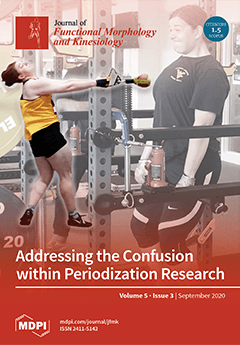
Cover Story: Recently, several discussions and, in some cases, disagreements have occurred in the literature related to the study and application of periodization. In this editorial, we discuss several aspects related to the multifaceted nature of periodization and, even more generally, conducting training research within competitive sport. Specifically addressed are recent problematic developments in sport science and periodization research including (1) historical aspects and the importance of appreciating periodization’s rich history, (2) considerations for training studies and the importance and value of athlete-monitoring studies, (3) the development and usefulness of concepts, and (4) the potential peril of using overly flexible, programming-driven training models. View this paper
  • Issues are regarded as officially published after their release is announced to the table of contents alert mailing list .
  • You may sign up for email alerts to receive table of contents of newly released issues.
  • PDF is the official format for papers published in both, html and pdf forms. To view the papers in pdf format, click on the "PDF Full-text" link, and use the free Adobe Reader to open them.

Articles (26)

  • Review
  • Open Access
65 Citations
11,997 Views
13 Pages

Beneficial Effects of Physical Activity in Diabetic Patients

  • Francesca Cannata,
  • Gianluca Vadalà,
  • Fabrizio Russo,
  • Rocco Papalia,
  • Nicola Napoli and
  • Paolo Pozzilli

One of the main goals of diabetic therapy is to achieve the best metabolic control to prevent the development and progression of potential complications. A multidisciplinary approach characterized by the combination of diet, physical activity (PA) an...

  • Commentary
  • Open Access
5 Citations
6,839 Views
20 Pages

COVID-19 Surveillance and Competition in Sport: Utilizing Sport Science to Protect Athletes and Staff during and after the Pandemic

  • Joshua Hagen,
  • Jason D. Stone,
  • W. Guy Hornsby,
  • Mark Stephenson,
  • Robert Mangine,
  • Michael Joseph and
  • Scott Galster

The ongoing Coronavirus 2 (COVID-19) pandemic abruptly halted athletic competition and standard training practices, consequently generating great confusion surrounding when and how to safely reintroduce sports. Therefore, tangible solutions dissemina...

  • Communication
  • Open Access
11 Citations
11,653 Views
7 Pages

Addressing the Confusion within Periodization Research

  • W. Guy Hornsby,
  • Andrew C. Fry,
  • G. Gregory Haff and
  • Michael H. Stone

In this editorial, we focus on recent problematic developments in sport science, and more specifically, problems related to periodization research. Primary areas discussed are (1) appreciation of history, (2) considerations for training studies, (3)...

  • Article
  • Open Access
12 Citations
6,310 Views
10 Pages

Effects of Dehydration on Archery Performance, Subjective Feelings and Heart Rate during a Competition Simulation

  • Alexandros Savvides,
  • Christoforos D. Giannaki,
  • Angelos Vlahoyiannis,
  • Pinelopi S. Stavrinou and
  • George Aphamis

This study aimed to investigate the effect of dehydration on archery performance, subjective feelings and heart rate response. Ten national level archers performed two archery competition simulations, once under euhydration (EUH) and once in a dehydr...

  • Article
  • Open Access
7 Citations
4,941 Views
13 Pages

The First Lactate Threshold Is a Limit for Heavy Occupational Work

  • Patrick Fasching,
  • Stefan Rinnerhofer,
  • Georg Wultsch,
  • Philipp Birnbaumer and
  • Peter Hofmann

Long-term heavy physical work often leads to early retirement and disability pension due to chronic overload, with a need to define upper limits. The aim of this study was to evaluate the value of the first lactate threshold (LTP1) as a physiological...

  • Article
  • Open Access
18 Citations
4,040 Views
9 Pages

Human Dental Pulp Tissue during Orthodontic Tooth Movement: An Immunofluorescence Study

  • Giovanna Vermiglio,
  • Antonio Centofanti,
  • Giovanni Matarese,
  • Angela Militi,
  • Marco Matarese,
  • Alba Arco,
  • Fabiana Nicita and
  • Giuseppina Cutroneo

The orthodontic tooth movement is the last step of several biological processes that take place after the application of external forces. During this process, dental pulp tissue is subjected to structural and protein expression modifications in order...

  • Brief Report
  • Open Access
8 Citations
3,810 Views
6 Pages

A 47-Year Comparison of Lower Body Muscular Power in Spanish Boys: A Short Report

  • Iván Chulvi-Medrano,
  • Manuel Pombo,
  • Miguel Ángel Saavedra-García,
  • Tamara Rial Rebullido and
  • Avery D Faigenbaum

Much of the evidence examining temporal trends in fitness among youth has found a decrease in measures of muscular strength and muscular power over recent decades. The aim of this study was to examine trends in lower body muscular power in Spanish bo...

  • Viewpoint
  • Open Access
15 Citations
5,578 Views
9 Pages

Generalized Approach to Translating Exercise Tests and Prescribing Exercise

  • Carl Foster,
  • James D. Anholm,
  • Daniel Bok,
  • Daniel Boullosa,
  • Giancarlo Condello,
  • Cristina Cortis,
  • Andrea Fusco,
  • Salvador J. Jaime,
  • Jos J. de Koning and
  • Alejandro Lucia
  • + 3 authors

Although there is evidence supporting the benefit of regular exercise, and recommendations about exercise and physical activity, the process of individually prescribing exercise following exercise testing is more difficult. Guidelines like % heart ra...

  • Article
  • Open Access
12 Citations
5,787 Views
13 Pages

Effects of a Supervised Nordic Walking Program on Obese Adults with and without Type 2 Diabetes: The C.U.R.I.A.Mo. Centre Experience

  • Roberto Pippi,
  • Andrea Di Blasio,
  • Cristina Aiello,
  • Carmine Fanelli,
  • Valentina Bullo,
  • Stefano Gobbo,
  • Lucia Cugusi and
  • Marco Bergamin

Exercise is a convenient non-medical intervention, commonly recommended in metabolic syndrome and type 2 diabetes (DM2) managements. Aerobic exercise and aerobic circuit training have been shown to be able to reduce the risk of developing DM2-related...

  • Article
  • Open Access
17 Citations
5,289 Views
10 Pages

Effects of Hoverboard on Balance in Young Soccer Athletes

  • Stefano Moffa,
  • Angelica Perna,
  • Gabriele Candela,
  • Alessandro Cattolico,
  • Carmine Sellitto,
  • Paolo De Blasiis,
  • Germano Guerra,
  • Domenico Tafuri and
  • Angela Lucariello

Hoverboards are always more popular among children. Hoverboards are to them like a game or a mean of transport, but they could be used as a valid and useful instrument in children’s training programs to improve their performance. In this study,...

of 3

Get Alerted

Add your email address to receive forthcoming issues of this journal.

XFacebookLinkedIn
J. Funct. Morphol. Kinesiol. - ISSN 2411-5142