


You are currently viewing a new version of our website. To view the old version click .

Journal of Functional Morphology and Kinesiology, Volume 5, Issue 4

December 2020 - 30 articles

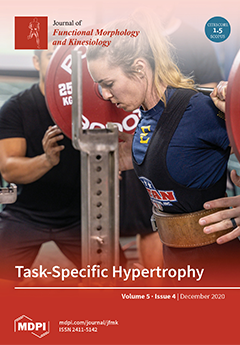
Cover Story: Training for hypertrophy is often associated with athletes such as bodybuilders who use training regimens aimed at achieving maximal hypertrophy. While bodybuilders have balanced and symmetrical physiques, muscle function differs compared to strength and power athletes. For instance, bodybuilders are likely to have larger, more abundant type I muscle fibers, whereas strength and power athletes have greater type II muscle content. Therefore, strength and power athletes possess a greater capacity to produce higher forces and power outputs relative to sport-specific tasks. Thus, task-specific hypertrophy should be programmed within a periodized training model for those who want hypertoric adaptions to carry over to sequential strength and power performances later on. View this paper
  • Issues are regarded as officially published after their release is announced to the table of contents alert mailing list .
  • You may sign up for email alerts to receive table of contents of newly released issues.
  • PDF is the official format for papers published in both, html and pdf forms. To view the papers in pdf format, click on the "PDF Full-text" link, and use the free Adobe Reader to open them.

Articles (30)

  • Article
  • Open Access
2 Citations
3,949 Views
14 Pages

Dynamic postural control is challenged during many actions in sport such as when landing or cutting. A decrease of dynamic postural control is one possible risk factor for non-contact injuries. Moreover, these injuries mainly occur under loading cond...

  • Article
  • Open Access
41 Citations
6,464 Views
9 Pages

Prevalence of Low Energy Availability in Collegiate Women Soccer Athletes

  • Meghan K. Magee,
  • Brittanie L. Lockard,
  • Hannah A. Zabriskie,
  • Alexis Q. Schaefer,
  • Joel A. Luedke,
  • Jacob L. Erickson,
  • Margaret T. Jones and
  • Andrew R. Jagim

(1) Background: Limited information exists on the prevalence of low energy availability (LEA) in collegiate team sports. The purpose of this study was to examine the prevalence of LEA in collegiate women soccer players. (2) Methods: Collegiate women...

  • Article
  • Open Access
3 Citations
3,658 Views
12 Pages

The purpose of this preliminary study was to describe changes in physical function and torque capacity in adults with chronic kidney disease (CKD) in response to a novel progressive eccentric-overload resistance exercise (ERE) regime. Participants in...

  • Article
  • Open Access
2 Citations
4,110 Views
6 Pages

Function of the Distal Part of the Vastus Medialis Muscle as a Generator of Knee Extension Twitch Torque

  • Yoshitsugu Tanino,
  • Takaki Yoshida,
  • Wataru Yamazaki,
  • Yuki Fukumoto,
  • Tetsuya Nakao and
  • Toshiaki Suzuki

The distal part of the vastus medialis (VM) (VM obliquus: VMO) muscle acts as the medial stabilizer of the patella. However, it has been known to facilitate VMO contraction during training of the quadriceps femoris muscle in knee joint rehabilitation...

  • Article
  • Open Access
3 Citations
3,622 Views
9 Pages

Mixed versus Focused Resistance Training during an Australian Football Pre-Season

  • Lachlan P. James,
  • Jade Haycraft,
  • Anthony Pierobon,
  • Timothy J. Suchomel and
  • Mark Connick

The purpose of this investigation was to determine the effect of a focused versus mixed-methods strength-power training plan on athletes undertaking high volumes of concurrent training. Fourteen junior elite male Australian football players were rand...

  • Review
  • Open Access
83 Citations
31,107 Views
15 Pages

Achilles Tendon Rupture: Mechanisms of Injury, Principles of Rehabilitation and Return to Play

  • Domiziano Tarantino,
  • Stefano Palermi,
  • Felice Sirico and
  • Bruno Corrado

The Achilles tendon is the thickest, strongest and largest tendon in the human body, but despite its size and tensile strength, it frequently gets injured. Achilles tendon ruptures (ATRs) mainly occur during sports activities, and their incidence has...

  • Article
  • Open Access
10 Citations
4,278 Views
11 Pages

Beneficial Effects of Physical Activity on Subjects with Neurodegenerative Disease

  • Laura Vizzi,
  • Elvira Padua,
  • Agata Grazia D’Amico,
  • Virginia Tancredi,
  • Giovanna D’Arcangelo,
  • Ida Cariati,
  • Manuel Scimeca,
  • Grazia Maugeri,
  • Velia D’Agata and
  • Michela Montorsi

Studies on the effectiveness of physical exercise to treat and/or prevent mental disorders are essential and particularly appropriate, given the rapid growth of the elderly population and the consequent increase in the prevalence of neurodegenerative...

  • Article
  • Open Access
5 Citations
3,040 Views
9 Pages

Potential Use of Wearable Sensors to Assess Cumulative Kidney Trauma in Endurance Off-Road Running

  • Daniel Rojas-Valverde,
  • Rafael Timón,
  • Braulio Sánchez-Ureña,
  • José Pino-Ortega,
  • Ismael Martínez-Guardado and
  • Guillermo Olcina

(1) Background: This study aimed to explore wearable sensors′ potential use to assess cumulative mechanical kidney trauma during endurance off-road running. (2) Methods: 18 participants (38.78 ± 10.38 years, 73.24 ± 12.6 kg, 172.1...

  • Article
  • Open Access
5 Citations
3,398 Views
11 Pages

We investigated whether a 4-min sprint interval training (SIT) protocol had an acute effect (15 min after) on improving alertness, mood, and memory recall in female students. Sixty-three children and 131 adolescents were randomly assigned to either a...

  • Article
  • Open Access
6 Citations
4,787 Views
8 Pages

Histological and Immunofluorescence Study of Discal Ligaments in Human Temporomandibular Joint

  • Michele Runci Anastasi,
  • Antonio Centofanti,
  • Alba Arco,
  • Giovanna Vermiglio,
  • Fabiana Nicita,
  • Giuseppe Santoro,
  • Piero Cascone,
  • Giuseppe Pio Anastasi,
  • Giuseppina Rizzo and
  • Giuseppina Cutroneo

The temporomandibular joint (TMJ) is a bilateral synovial articulation stabilized by several anatomical structures such as ligaments. The existence of articular capsule reinforcement structures have been described in the lateral and medial sides of d...

of 3

Get Alerted

Add your email address to receive forthcoming issues of this journal.

XFacebookLinkedIn
J. Funct. Morphol. Kinesiol. - ISSN 2411-5142