
You are currently viewing a new version of our website. To view the old version click .

Recycling, Volume 7, Issue 6

December 2022 - 10 articles

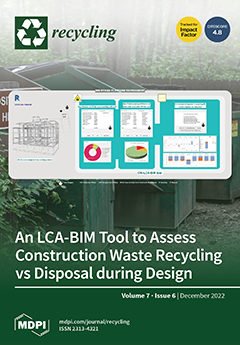
Cover Story: The life cycle assessment (LCA) method is useful for quantifying and comparing the environmental impact of construction waste management scenarios. However, due to its complexity, LCA is seldom used by technicians during the design phase, which constitutes a crucial stage in the prevention of environmental impacts. This paper proposes an LCA-based tool, integrated into the building information modeling (BIM) methodology, which helps designers to automate the environmental assessment of recycling versus disposal. The CW-LCA-BIM tool was applied to the structural system of a building in Spain. Up to 99% of non-hazardous waste was recyclable or reusable. Recycling could prevent 1.4 times the emissions of the disposal scenario and could save 85 times its energy consumption. The results can help policy makers in waste prevention policies. View this paper
  • Issues are regarded as officially published after their release is announced to the table of contents alert mailing list .
  • You may sign up for email alerts to receive table of contents of newly released issues.
  • PDF is the official format for papers published in both, html and pdf forms. To view the papers in pdf format, click on the "PDF Full-text" link, and use the free Adobe Reader to open them.

Articles (10)

  • Article
  • Open Access
11 Citations
4,945 Views
12 Pages

Washing Post-Consumer Flexible Polyethylene Packaging Waste

  • Ezgi Ceren Boz Noyan,
  • Abhijit Venkatesh and
  • Antal Boldizar

14 December 2022

The mechanical and thermal properties of injection-molded recycled polyethylene were studied, specifically with respect to the influence of large-scale washing and melt-compounding of polyethylene from post-consumer packaging waste. Three types of ma...

  • Communication
  • Open Access
9 Citations
3,062 Views
8 Pages

30 November 2022

Bio-composites have been formulated by exploiting post-industrial PLA derived from thin film production and silver skin, a by-product of the coffee’s roasting process. The mix design for the compounds exploits the effects of regrading and tough...

  • Article
  • Open Access
22 Citations
9,504 Views
17 Pages

Evaluation of Construction and Demolition Waste Management in Kuwait

  • Mohammed Baqer Hasan Almusawi,
  • Ahmad Tarmizi Bin Abd Karim and
  • Saleem Ethaib

24 November 2022

This research aimed to evaluate Kuwait’s current construction and demolition waste (C&D waste) situation by focusing on C&D waste generation and management issues. This work also investigated the causes and factors affecting C&D was...

  • Review
  • Open Access
20 Citations
25,621 Views
16 Pages

Healthcare Waste Management in Nigeria: A Review

  • Obiora B. Ezeudu,
  • Tochukwu S. Ezeudu,
  • Uzochukwu C. Ugochukwu,
  • Imokhai Theophilus Tenebe,
  • Agbaji P. Ajogu,
  • Uchenna V. Nwadi and
  • Charles C. Ajaero

21 November 2022

Healthcare waste management has become an important aspect of medical care delivery globally. This is simply because of its hazardous and infectious components that have greater potential for adverse health and environmental impacts. As such, certain...

  • Article
  • Open Access
17 Citations
5,142 Views
14 Pages

Kinetics of Zn–C Battery Leaching with Choline Chloride/Urea Natural Deep Eutectic Solvents

  • Irlanda G. Cruz-Reyes,
  • Jorge A. Mendoza-Pérez,
  • Rosario Ruiz-Guerrero,
  • Dulce Y. Medina-Velázquez,
  • Luis G. Zepeda-Vallejo and
  • Ángel de J. Morales-Ramírez

18 November 2022

A choline chloride/urea natural deep eutectic solvent (ChCl NADES) was prepared via a green chemistry method and used to leach Zn and Mn oxides from conventional Zn–C scrap batteries. FTIR and 1H NMR spectroscopy were used to characterize the N...

  • Article
  • Open Access
11 Citations
4,044 Views
11 Pages

Asbestos Waste Treatment—An Effective Process to Selectively Recover Gold and Other Nonferrous Metals

  • Omirserik Baigenzhenov,
  • Alibek Khabiyev,
  • Brajendra Mishra,
  • Indira Aimbetova,
  • Sultan Yulusov,
  • Inkar Temirgali,
  • Yerzhan Kuldeyev and
  • Zhanar Korganbayeva

17 November 2022

We investigated the potential of tailings generated from chrysotile asbestos fiber production as a source of iron, nonferrous metals, and gold. We proposed the use of granulometric separation and systematically examined different enrichment processes...

  • Communication
  • Open Access
7 Citations
3,388 Views
16 Pages

Mineral Carbonation of Basic Oxygen Furnace Slags

  • Daniel Vollprecht and
  • Dominik Wohlmuth

7 November 2022

Mineral carbonation is a method in carbon capture and utilization (CCU) in which carbon dioxide reacts with natural or synthetic mineral phases to form carbonates. In this study, BOF slag consisting of alite, Ca3SiO5, belite, Ca2SiO4, melilite, (Ca,N...

  • Article
  • Open Access
33 Citations
8,426 Views
27 Pages

How Do Industrial Ecology, Energy Efficiency, and Waste Recycling Technology (Circular Economy) Fit into China’s Plan to Protect the Environment? Up to Speed

  • Sasmoko Sasmoko,
  • Muhammad Zaheer Akhtar,
  • Haroon ur Rashid Khan,
  • Sriyanto Sriyanto,
  • Mohd Khata Jabor,
  • Awais Rashid and
  • Khalid Zaman

7 November 2022

The challenges of environmental protection are especially prevalent in South and Southeast Asian nations, which adversely affects their sustainable developmental goals. During the last two decades, increased industrialization and urbanization have ca...

  • Article
  • Open Access
18 Citations
7,041 Views
18 Pages

7 November 2022

The scientific community has revealed the environmental benefits of recycling construction waste (CW) versus its disposal, and its contribution to circularity. The Life Cycle Assessment (LCA) method enables the environmental impact of CW management t...

  • Review
  • Open Access
26 Citations
11,979 Views
17 Pages

7 November 2022

Global pollution of the environment is one of the most challenging environmental problems. Electronic-based population and anthropogenic activity are the main reasons for dramatically increasing the scale of waste generation, particularly battery was...

Get Alerted

Add your email address to receive forthcoming issues of this journal.

XFacebookLinkedIn
Recycling - ISSN 2313-4321