

You are currently viewing a new version of our website. To view the old version click .

Fermentation, Volume 6, Issue 2

June 2020 - 24 articles

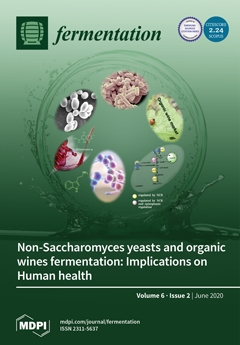
Cover Story: A relevant trend in winemaking is reducing the use of chemical compounds in both vineyards and wineries. In organic productions, synthetic chemical fertilizers, pesticides, and genetically modified organisms must be avoided, aiming to achieve the production of a “safer wine”. The perceived increase in sensory complexity and superiority of successful uninoculated wine fermentations, as well as a push from consumers looking for a more “natural” or “organic” wine options, produced with fewer additives and with perceived health attributes has led to more investigations into the use of non-Saccharomyces yeasts in winemaking, namely in organic wines. This review aims to provide an overview of organic wine safety, when using indigenous and/or non-Saccharomyces yeasts to perform fermentation, with a special focus on certain metabolites of microbial origin, namely, Ochratoxin A (OTA) and other mycotoxins, biogenic amines (BA), and ethyl carbamate (EC).
  • Issues are regarded as officially published after their release is announced to the table of contents alert mailing list .
  • You may sign up for email alerts to receive table of contents of newly released issues.
  • PDF is the official format for papers published in both, html and pdf forms. To view the papers in pdf format, click on the "PDF Full-text" link, and use the free Adobe Reader to open them.
  • Articles (24)

    • Article
    • Open Access
    12 Citations
    4,231 Views
    13 Pages

    Alterations in Yeast Species Composition of Uninoculated Wine Ferments by the Addition of Sulphur Dioxide

    • Kathleen Cuijvers,
    • Steven Van Den Heuvel,
    • Cristian Varela,
    • Mark Rullo,
    • Mark Solomon,
    • Simon Schmidt and
    • Anthony Borneman

    Uninoculated wine fermentations are conducted by a consortium of wine yeast and bacteria that establish themselves either from the grape surface or from the winery environment. Of the additives that are commonly used by winemakers, sulphur dioxide (S...

    • Article
    • Open Access
    25 Citations
    5,595 Views
    21 Pages

    The fermentation of synthesis gas, or syngas, by acetogenic bacteria can help in transitioning from a fossil-fuel-based to a renewable bioeconomy. The main fermentation products of Clostridium ljungdahlii, one of such microorganisms, are acetate and...

    • Article
    • Open Access
    44 Citations
    7,195 Views
    15 Pages

    Sequential Non-Saccharomyces and Saccharomyces cerevisiae Fermentations to Reduce the Alcohol Content in Wine

    • Margarita García,
    • Braulio Esteve-Zarzoso,
    • Juan Mariano Cabellos and
    • Teresa Arroyo

    Over the last decades, the average alcohol content of wine has increased due to climate change and consumer preferences for particular wine styles that resulted in increased grape sugar levels at harvest. Therefore, alcohol reduction is a current cha...

    • Article
    • Open Access
    123 Citations
    32,872 Views
    12 Pages

    Production, Characterization, and Industrial Application of Pectinase Enzyme Isolated from Fungal Strains

    • Sudeep KC,
    • Jitendra Upadhyaya,
    • Dev Raj Joshi,
    • Binod Lekhak,
    • Dhiraj Kumar Chaudhary,
    • Bhoj Raj Pant,
    • Tirtha Raj Bajgai,
    • Rajiv Dhital,
    • Santosh Khanal and
    • Niranjan Koirala
    • + 1 author

    Pectinases are the group of enzymes that catalyze the degradation of pectic substances. It has wide applications in food industries for the production and clarification of wines and juices. The aim of this study was to isolate, screen and characteriz...

    • Article
    • Open Access
    37 Citations
    8,260 Views
    11 Pages

    Global View of Biofuel Butanol and Economics of Its Production by Fermentation from Sweet Sorghum Bagasse, Food Waste, and Yellow Top Presscake: Application of Novel Technologies

    • N. Qureshi,
    • X. Lin,
    • S. Liu,
    • B. C. Saha,
    • A. P. Mariano,
    • J. Polaina,
    • T. C. Ezeji,
    • A. Friedl,
    • I. S. Maddox and
    • K. T. Klasson
    • + 2 authors

    Worldwide, there are various feedstocks such as straws, corn stover, sugarcane bagasse, sweet sorghum bagasse (SSB), grasses, leaves, whey permeate, household organic waste, and food waste (FW) that can be converted to valuable biofuels such as butan...

    • Review
    • Open Access
    15 Citations
    9,193 Views
    15 Pages

    The fermentation industry is known to be very conservative, relying on traditional yeast management. Yet, in the modern fast-paced world, change comes about in facets such as climate change altering the quality and quantity of harvests, changes due t...

    • Article
    • Open Access
    31 Citations
    8,241 Views
    12 Pages

    Increasing beer quality demands from consumers have put pressure on brewers to target specific steps within the beer-making process to modify beer styles and quality traits. However, this demands more robust methodologies to assess the final aroma pr...

    • Communication
    • Open Access
    55 Citations
    6,093 Views
    17 Pages

    The management of the alcoholic fermentation (AF) in wine is crucial to shaping product quality. Numerous variables (e.g., grape varieties, yeast species/strains, technological parameters) can affect the performances of this fermentative bioprocess....

    • Review
    • Open Access
    18 Citations
    7,408 Views
    16 Pages

    A relevant trend in winemaking is to reduce the use of chemical compounds in both the vineyard and winery. In organic productions, synthetic chemical fertilizers, pesticides, and genetically modified organisms must be avoided, aiming to achieve the p...

    • Review
    • Open Access
    55 Citations
    13,641 Views
    26 Pages

    Gluten-Free Brewing: Issues and Perspectives

    • Nazarena Cela,
    • Nicola Condelli,
    • Marisa C. Caruso,
    • Giuseppe Perretti,
    • Maria Di Cairano,
    • Roberta Tolve and
    • Fernanda Galgano

    Celiac disease (CD) is an immune-mediated gluten-sensitive enteropathy. Currently, it affects around 1% of world population, but it is constantly growing. Celiac patients have to follow a strict gluten-free (GF) diet. Beer is one of the most consumed...

    of 3

    Get Alerted

    Add your email address to receive forthcoming issues of this journal.

    XFacebookLinkedIn
    Fermentation - ISSN 2311-5637