
Skip to Content

ChemEngineering, Volume 9, Issue 1

2025 February - 20 articles

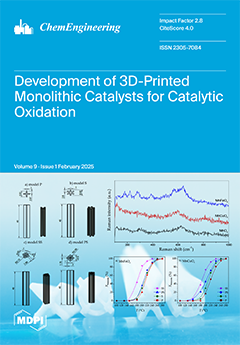
Cover Story: Stereolithography technology was used to develop novel monolithic catalysts with different geometries. Four differently shaped ceramic monolithic catalyst supports were prepared, and two catalytically active mixed oxides, MnFeOx and MnCuOx, were deposited on the monolithic supports using the impregnation technique. It was found that the obtained catalyst has excellent mechanical stability and a rough but homogeneous catalyst layer consisting of the double oxides FeMnO3 and CuMn2O4, as well as the single oxides of Mn, Fe, and Cu. The catalytic activity of the catalysts produced for the catalytic oxidation of a gaseous mixture of benzene, toluene, ethylbenzene, and o-xylene (BTEX) was investigated. The monolithic support with the most complex shape and, consequently, the largest surface area proved to be the one with the highest efficiency. View this paper
  • Issues are regarded as officially published after their release is announced to the table of contents alert mailing list .
  • You may sign up for email alerts to receive table of contents of newly released issues.
  • PDF is the official format for papers published in both, html and pdf forms. To view the papers in pdf format, click on the "PDF Full-text" link, and use the free Adobe Reader to open them.

Articles (20)

  • Article
  • Open Access
1,750 Views
28 Pages

Model fitting of laboratory-generated experimental data is a foundational task in engineering, bridging theoretical models with real-world data to enhance predictive accuracy. This process is particularly valuable in batch dynamic experiments, where...

  • Article
  • Open Access
1,575 Views
23 Pages

Catalytic Hydrothermal Production of Platform Chemicals from Coffee Biomass Using Organic Acids as Catalysts

  • Alejandra Sophia Lozano Pérez,
  • Valentina Romero Mahecha and
  • Carlos Alberto Guerrero Fajardo

Coffee cherry waste, a byproduct of coffee production, presents significant environmental challenges due to its large volume—approximately 20 million tons annually. The disposal of this waste, which includes pulp and mucilage, often leads to po...

  • Article
  • Open Access
1,768 Views
17 Pages

Experimental Data and Thermodynamics Modeling (eNRTL and mUNIFAC) of the (Cyclohexane + Benzene + N,N-Dimethylformamide + Sodium Thiocyanate) Systems

  • Stephanie Lenhare,
  • Beatriz Fernanda Bonfim de Souza,
  • Fernanda Viana Miyasaki,
  • André Zuber,
  • Pedro Arce,
  • Leandro Ferreira-Pinto,
  • Stéphani Caroline Beneti,
  • Lúcio Cardozo-Filho and
  • Andréia Fátima Zanette

This study investigates the liquid–liquid equilibrium (LLE) of a cyclohexane (1) + benzene (2) + [N,N-dimethylformamide + sodium thiocyanate] (3) system. Experimental tie-line data were obtained at 298.15 K and 318.15 K under atmospheric pressu...

  • Article
  • Open Access
5 Citations
2,053 Views
14 Pages

Lentil-Husk-Mediated Green Synthesis of Silver Nanoparticles: Characterization and Antibacterial Activity

  • Kshama Parajuli,
  • Lekha Nath Khanal,
  • Ganga GC,
  • Samjhana Koju,
  • Shushan Bhujel,
  • Devendra Khadka,
  • Motee Lal Sharma,
  • Bishweshwar Pant and
  • Bhoj Raj Poudel

Plant-based preparation of nanomaterials has become a recent global research focus due to its cost-effectiveness, sustainability, and environmentally friendly approach. This study aims to synthesize silver nanoparticles (HAgNPs) using red lentil husk...

  • Article
  • Open Access
3 Citations
3,199 Views
12 Pages

The current electrolytes used for metal electrodeposition mostly use aqueous solutions that limit the range and quality of possible coatings. Also, some of these solutions may contain toxic and corrosive chemicals. Thus, the importance of ionic liqui...

  • Feature Paper
  • Article
  • Open Access
1 Citations
1,985 Views
18 Pages

Pyrolysis-GCMS of Plastic and Paper Waste as Alternative Blast Furnace Reductants

  • Eurig Wyn Jones,
  • Julian Steer,
  • Fawaz Ojobowale,
  • Richard Marsh and
  • Peter J. Holliman

This paper reports studies on the thermal chemistry of the flash pyrolysis (heating rate of 20,000 °C/s up to 800 °C) of non-fossil fuel carbon (NFF-C) waste (or refuse-derived fuel, RDF) in the context of using this as an alternative reducta...

  • Article
  • Open Access
1,279 Views
12 Pages

Hyaluronic acid (HA), a natural polymer produced through biotechnological processes, is initially synthesized with a high molecular weight, which is subsequently reduced for specific applications. This work aims to develop an experimental laboratory...

  • Review
  • Open Access
19 Citations
13,250 Views
30 Pages

A Review of Air Pollution from Petroleum Refining and Petrochemical Industrial Complexes: Sources, Key Pollutants, Health Impacts, and Challenges

  • Ronan Adler Tavella,
  • Flavio Manoel Rodrigues da Silva Júnior,
  • Mariany Almeida Santos,
  • Simone Georges El Khouri Miraglia and
  • Renato Dutra Pereira Filho

Petroleum refining and petrochemical complexes are significant sources of air pollution, emitting a variety of harmful pollutants with substantial health risks for nearby populations. While much of the information regarding this issue and the potenti...

  • Article
  • Open Access
2 Citations
2,173 Views
20 Pages

Terephthalic-co-glycerol-g-fumaric Acid: A Promising Nanopolymer for Enhancing PPSU Membrane Properties

  • Harith A. Alani,
  • Qusay F. Alsalhy,
  • Saad Al-Saadi,
  • Faris H. Alani,
  • Hicham Meskher,
  • Raed A. Al-Juboori,
  • Francesca Russo,
  • Giampiero Chiappetta,
  • Giuseppe Di Luca and
  • Alberto Figoli

This study introduces an innovative approach to modifying polyphenylsulfone (PPSU) membranes for wastewater treatment applications. Terephthalic-co-glycerol-g-fumaric acid (TGF) was used as an innovative nanopolymer pore former. By incorporating TGF...

  • Article
  • Open Access
1 Citations
1,153 Views
14 Pages

Influence of Oil-Soluble Catalyst on Composition and Structure of Heavy Oil from Samara Region Field

  • Mohammed O. N. Ali,
  • Irek I. Mukhamatdinov,
  • Boudkhil Affane,
  • Rezeda E. Mukhamatdinova,
  • Vladimir E. Katnov and
  • Alexey V. Vakhin

In this study, an examination was conducted of the influence of iron tallate on the composition and properties of highly viscous oil from the Strelovskoye deposit in the Samara region under thermal–catalytic treatment (TCT). The research reveal...

  • Article
  • Open Access
2,338 Views
11 Pages

Tetrafluoromethane (CF4) is the simplest perfluorocarbon, a class of compounds with very high greenhouse gas potential. Catalytic hydrolysis offers an opportunity to convert these compounds to manageable CO2 and HF. Recently published data showed the...

  • Article
  • Open Access
1 Citations
1,785 Views
16 Pages

Development of Novel Monolithic Catalyst for BTEX Catalytic Oxidation Using 3D Printing Technology

  • Filip Car,
  • Vjeran Gomzi,
  • Vesna Tomašić,
  • Domagoj Vrsaljko and
  • Stanislav Kurajica

Four differently shaped monolithic catalyst supports were made using 3D printing technology. Two catalytically active mixed oxides, MnFeOx and MnCuOx, were applied to the monolithic supports using the impregnation technique. Catalysts were characteri...

  • Article
  • Open Access
1 Citations
2,256 Views
21 Pages

Many designs of industrial reactors stem from designs from the 1960s–1970s. For a wide range of reactions, these designs lead to suboptimal reaction configurations due to limitations in heat- or mass-transfer. Process intensification has come u...

  • Article
  • Open Access
3 Citations
2,618 Views
15 Pages

Effect of Alkyl Chain Length of Quaternary Ammonium Surfactant Corrosion Inhibitor on Fe (110) in Acetic Acid Media via Computer Simulation

  • Mohd Sofi Numin,
  • Khairulazhar Jumbri,
  • Kee Kok Eng,
  • Almila Hassan,
  • Noorazlenawati Borhan,
  • Nik M. Radi Nik M. Daud,
  • Azmi M. Nor A,
  • Firdaus Suhor and
  • Nur Nadia Dzulkifli

Density functional theory (DFT) and molecular dynamics (MD) simulations were employed to investigate the inhibition mechanism of cationic quaternary ammonium surfactant corrosion inhibitors (CIs) with varying chain lengths in 1.0 M HCl and 500 ppm ac...

  • Article
  • Open Access
2 Citations
3,137 Views
21 Pages

Municipal solid waste incineration (MSWI) fly ash, containing substantial amounts of calcium (Ca), chloride (Cl), and other valuable elements, offers promising potential as a raw material for carbon capture, utilization (CCU), and alkali production....

  • Article
  • Open Access
5 Citations
3,651 Views
26 Pages

Parametric CFD Study of Spray Drying Chamber Geometry: Part I—Effects on Airflow Dynamics

  • Jairo Andrés Gutiérrez Suárez,
  • Carlos Humberto Galeano Urueña and
  • Alexánder Gómez Mejía

Internal airflow dynamics play a crucial role in spray drying engineering by governing particle transport and, consequently, the quality of dried products. For this application, airflow dynamics represent short- and long-timescale behaviors across th...

  • Article
  • Open Access
3 Citations
6,592 Views
17 Pages

Fuel blending plays a very important role in petroleum refineries, because it directly affects the quality of the end products, as well as the overall profitability of the refinery. This process of blending involves a combination of various hydrocarb...

  • Article
  • Open Access
1 Citations
1,656 Views
16 Pages

Power plants are one of the main sources emitting the CO2 that is responsible for climate change consequences. Post-combustion carbon capture (PCC), particularly using an aqueous solution, is highly recommended to be used as a mitigation solution to...

  • Article
  • Open Access
3 Citations
2,475 Views
21 Pages

Mechanical Properties of Faecal Sludge and Its Influence on Moisture Retention

  • Arun Kumar Rayavellore Suryakumar,
  • Sergio Luis Parra-Angarita,
  • Angélique Léonard,
  • Jonathan Pocock and
  • Santiago Septien

The mechanical properties of faecal sludge (FS) influence its moisture retention characteristics to a greater extent than other properties. A comprehensive fundamental characterisation of the mechanical properties is scarcely discussed in the literat...

  • Article
  • Open Access
1,583 Views
24 Pages

This study investigates the tribological effects of nano-sized metal oxides (ZrO2, CuO, Y2O3 and TiO2) in Group III type base oil containing 0.3% pour point depressant (PPD) and 5% viscosity modifier (VM) to enhance friction and wear performance. The...

XFacebookLinkedIn
ChemEngineering - ISSN 2305-7084