



Next Issue
Volume 13, July
Previous Issue
Volume 13, May


Photonics, Volume 13, Issue 6 (June 2026) – 96 articles
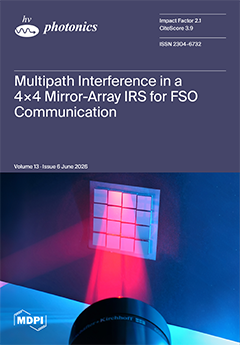
Cover Story (view full-size image): Intelligent reflecting surfaces (IRSs) are promising for expanding free-space optical (FSO) communication coverage by bypassing urban blockages. Beyond simple redirection, they may manipulate laser properties like phase, amplitude, or polarization to compensate for atmospheric turbulence. To realize a cost-effective, highly scalable IRS, we present a centimeter-scale, high-fill-factor macro mirror array enabling high-precision beam steering and beam forming. We analyze multipath interference arising from the array geometry, which can limit data rates. Our simulations align perfectly with experimental measurements, validating a model that predicts these bandwidth constraints. This work establishes a vital foundation for future data transmission studies, paving the way toward practical IRS deployment. View this paper
  • Issues are regarded as officially published after their release is announced to the table of contents alert mailing list.
  • You may sign up for e-mail alerts to receive table of contents of newly released issues.
  • PDF is the official format for papers published in both, html and pdf forms. To view the papers in pdf format, click on the "PDF Full-text" link, and use the free Adobe Reader to open them.
Order results
Result details
Section
Select all
Export citation of selected articles as:
37 pages, 3389 KB  
Review
Fiber Bragg Grating Accelerometers: A Review from Single-Axis to Multi-Dimensional Vector Sensing
by Jiahe Dai, Rui Zhou and Xueguang Qiao
Photonics 2026, 13(6), 602; https://doi.org/10.3390/photonics13060602 - 22 Jun 2026
Viewed by 871
Abstract
Precise monitoring of vibration signals is crucial for early fault warning and localization in industrial applications. Traditional electromagnetic accelerometers are often unsuitable for harsh environments characterized by high temperatures, high pressures, and strong electromagnetic fields. Fiber Bragg grating (FBG) accelerometers have become a [...] Read more.
Precise monitoring of vibration signals is crucial for early fault warning and localization in industrial applications. Traditional electromagnetic accelerometers are often unsuitable for harsh environments characterized by high temperatures, high pressures, and strong electromagnetic fields. Fiber Bragg grating (FBG) accelerometers have become a major research topic in this field due to their unique advantages, including resistance to high temperature and pressure, immunity to electromagnetic interference, and ease of wavelength division multiplexing. This paper provides a systematic review of FBG accelerometers, covering their fundamental principles, classification, performance enhancement strategies, and applications. We focus on reviewing the research progress of FBG accelerometers from two main aspects, single-axis and multi-dimensional vector types, and offer an outlook on future development to provide a reference for the research and application of FBG accelerometers. Full article
(This article belongs to the Special Issue Emerging Technologies and Applications in Fiber Optic Sensing)
Show Figures

Figure 1

17 pages, 12223 KB  
Article
Integrated Design and Fabrication of Refractive–Diffractive Hybrid Lenses for Myopia Control
by Chuang Li, Chongxing Liu, Changxi Xue and Bo Dong
Photonics 2026, 13(6), 603; https://doi.org/10.3390/photonics13060603 - 21 Jun 2026
Viewed by 379
Abstract
As the prevalence of myopia among adolescents continues to increase, the design and fabrication of myopia control lenses have become an important research direction in modern optics. Existing myopia control lenses mostly adopt purely refractive structures, which suffer from limited design freedom, insufficient [...] Read more.
As the prevalence of myopia among adolescents continues to increase, the design and fabrication of myopia control lenses have become an important research direction in modern optics. Existing myopia control lenses mostly adopt purely refractive structures, which suffer from limited design freedom, insufficient chromatic aberration suppression, and relatively large lens thickness, thereby restricting further improvement of optical performance. This paper proposes a refractive–diffractive hybrid design and fabrication method for myopia control lenses. Centered on a harmonic diffractive optical element (HDOE), an optimization model is established to balance achromatization performance and fabrication feasibility. To address the challenges of small period width, tool shadow effect, and sensitivity to machining tolerances in diffractive lenses with large-aperture and high-additional-power, harmonic design is employed to increase the period width, thereby reducing fabrication difficulty and mitigating the influence of shadowing errors on diffraction efficiency. On this basis, two lenses with different phase structures are designed: one adopts a conventional diffractive correction phase to verify the role of HDOE in achromatization and edge-thickness reduction, while the other adopts a high-degree-of-freedom smooth phase to achieve a continuous multifocal visual effect. Both lenses are fabricated by single-point diamond turning (SPDT), and the effects of surface profile and machining parameters on performance are analyzed. Simulations and measurements show that the proposed method provides stable diffraction efficiency and effective chromatic aberration correction across the design band, while reducing the edge thickness by approximately 37.85% without additional thinning of the aspheric substrate. The results indicate that the refractive–diffractive hybrid design provides a feasible design and fabrication approach for functionally more complex myopia control lenses. Full article
(This article belongs to the Special Issue Recent Progress in Optical System Design)
Show Figures

Figure 1

26 pages, 8518 KB  
Article
CVA-Net: Multi-View 3D Reconstruction for Fringe Projection Profilometry via Cross-View Attention and Sim2Real Learning
by Zuqiong Chen, Xiaopin Zhong and Yibin Tian
Photonics 2026, 13(6), 601; https://doi.org/10.3390/photonics13060601 - 21 Jun 2026
Cited by 1 | Viewed by 530
Abstract
Fringe projection profilometry (FPP) is widely used for 3D reconstruction, but conventional single-view FPP systems suffer from inherent occlusions and shadow regions, leading to incomplete surface recovery. In this study, we propose CVA-Net, an end-to-end deep learning framework with cross-view attention (CVA) that [...] Read more.
Fringe projection profilometry (FPP) is widely used for 3D reconstruction, but conventional single-view FPP systems suffer from inherent occlusions and shadow regions, leading to incomplete surface recovery. In this study, we propose CVA-Net, an end-to-end deep learning framework with cross-view attention (CVA) that directly reconstructs dense depth maps from multi-view fringe patterns. CVA-Net simultaneously processes four fringe images acquired from orthogonal projection directions and leverages a CVA module to explicitly model inter-view dependencies, enabling adaptive fusion of complementary information. A 3D U-Net backbone with attention gates, atrous spatial pyramid pooling (ASPP), and an auxiliary parameter estimation branch further enhances reconstruction accuracy and structural consistency via multitask learning. To support Sim2Real network training, we build a Blender-based digital twin of a multi-view FPP system and generate a large-scale synthetic dataset with perfect ground truth. Extensive experiments on both synthetic and real-world objects demonstrate that CVA-Net significantly outperforms state-of-the-art single-view methods. With a symmetric four-view configuration and fringe period of 8, CVA-Net achieves an MAE of 0.0359 mm, an MSE of 0.0379 mm2 and an RMSE of 0.1947 mm, reducing the MAE, MSE, and RMSE by 32.8%, 54.1%, and 32.2%, respectively, compared to the best single-view competitor. Ablation studies validate the contribution of each architectural component, while real-system experiments demonstrate the feasibility of transferring a network trained purely on synthetic data to practical FPP measurements without domain adaptation. Although further improvements are required to enhance reconstruction accuracy under real imaging conditions, the proposed framework provides an effective initial step toward bridging the gap between digital-twin-based training and real-world multi-view FPP applications. CVA-Net provides a robust, occlusion-aware solution for multi-view FPP reconstruction. Full article
Show Figures

Figure 1

16 pages, 6839 KB  
Article
Multidimensional Optimization of Radio-over-Fiber Links Based on Tunable Carrier-to-Sideband Ratio
by Weile Zhai, Jinyuan Ye, Ruihao Wang, Zhong’ao Yang, Jiajun Tan, Xiaoyan Pang, Wanzhao Cui and Yongsheng Gao
Photonics 2026, 13(6), 600; https://doi.org/10.3390/photonics13060600 - 21 Jun 2026
Viewed by 328
Abstract
In radio-over-fiber (RoF) links, optical single-sideband (OSSB) modulation is an effective method to mitigate power fading caused by chromatic dispersion. However, its low modulation efficiency leads to suboptimal link performance. To address this, we propose a tunable optical carrier-to-sideband ratio (OCSR) OSSB modulation [...] Read more.
In radio-over-fiber (RoF) links, optical single-sideband (OSSB) modulation is an effective method to mitigate power fading caused by chromatic dispersion. However, its low modulation efficiency leads to suboptimal link performance. To address this, we propose a tunable optical carrier-to-sideband ratio (OCSR) OSSB modulation scheme based on a dual-electrode Mach–Zehnder modulator (DEMZM) in a Sagnac loop. Firstly, by adjusting the OCSR, higher radio-frequency (RF) transmission efficiency can be achieved. The experimental results demonstrate that the proposed link provides a 6 dB improvement in received RF power compared to conventional SSB modulation schemes. Furthermore, this approach effectively optimizes nonlinear distortions in the link, achieving a 12.14 dB enhancement in spurious-free dynamic range (SFDR). For tests conducted with a broadband signal featuring a 15 GHz carrier frequency and 500 MHz bandwidth, the optimal error vector magnitude (EVM) reaches 4.88%. Additionally, the link performance can be flexibly improved by adjusting the polarization controller configurations for each channel, making it suitable for multi-user application scenarios. Full article
(This article belongs to the Special Issue Optical Signal Processing for Advanced Communication Systems)
Show Figures

Figure 1

19 pages, 4732 KB  
Article
YOLO-OBB and Two-Stage Geometric Correction for RGB-LED Array Optical Camera Communication
by Jiaqi Ju, Pan Qiu, Yipeng Tan and Zhengguang Shi
Photonics 2026, 13(6), 599; https://doi.org/10.3390/photonics13060599 - 20 Jun 2026
Viewed by 398
Abstract
In Optical Camera Communication (OCC), precise localization of LED arrays under complex tilt conditions is a core challenge for reliable decoding. This paper proposes an OCC reception scheme for RGB-LED arrays that integrates YOLO-OBB rotated object detection with two-stage geometric correction. The system [...] Read more.
In Optical Camera Communication (OCC), precise localization of LED arrays under complex tilt conditions is a core challenge for reliable decoding. This paper proposes an OCC reception scheme for RGB-LED arrays that integrates YOLO-OBB rotated object detection with two-stage geometric correction. The system first employs a YOLOv8n-OBB model to extract a quadrilateral region of interest that tightly encloses the LED array boundary. This effectively suppresses background interference caused by superimposed perspective tilt and in-plane rotation. A coarse-to-fine two-stage correction framework is then applied. The first stage rapidly eliminates the dominant perspective distortion based on the detected bounding-box corners. The second stage performs a refined correction using the actual LED center positions. Two homography matrices are cascaded into a combined transformation, achieving two-stage correction accuracy through a single coordinate mapping. In the corrected image, K-Means clustering constructs a 16 × 16 LED topological grid. A locking strategy is adopted so that subsequent frames skip repeated LED detection and clustering. The steady-state per-frame processing time is reduced to approximately 78.9 ms. Experiments covered 16 cross-combinations of vertical tilt from 0° to 45° (0°, 15°, 30°, 45°) and in-plane rotation from 0° to 40° (0°, 15°, 30°, 40°). The uncorrected scheme and the horizontal-box scheme experienced severe bit errors or complete failure under complicated distortion. The proposed scheme maintained error-free transmission under all 16 tested conditions. The ratios of opposite sides of the corrected LED grid remained stable between 0.997 and 1.004. The system simultaneously achieves high reliability and low-latency real-time processing under complex geometric distortions. Full article
Show Figures

Figure 1

36 pages, 2557 KB  
Review
Light-Emitting Diodes: Advances, Challenges and Applications in Musculoskeletal Pain
by Laura Marinela Ailioaie, Constantin Ailioaie, Georgiana Diana Ungureanu, Cristinel Ionel Stan, Anca Sava and Dragos Andrei Chiran
Photonics 2026, 13(6), 598; https://doi.org/10.3390/photonics13060598 - 20 Jun 2026
Viewed by 890
Abstract
Musculoskeletal pain is a major cause of disability and long-term analgesic use, increasing interest in safe non-pharmacological interventions. This focused narrative review examines light-emitting diode (LED)-based photobiomodulation (PBM) for musculoskeletal pain, integrating molecular, mechanistic, clinical, and translational evidence. Red and near-infrared LED-PBM may [...] Read more.
Musculoskeletal pain is a major cause of disability and long-term analgesic use, increasing interest in safe non-pharmacological interventions. This focused narrative review examines light-emitting diode (LED)-based photobiomodulation (PBM) for musculoskeletal pain, integrating molecular, mechanistic, clinical, and translational evidence. Red and near-infrared LED-PBM may act through mitochondrial and non-mitochondrial photoacceptors, modulation of ATP production, reactive oxygen species, nitric oxide, calcium signaling, inflammatory pathways, oxidative stress responses, and extracellular matrix repair. Clinical evidence suggests a potential benefit in selected conditions, particularly temporomandibular disorders, fibromyalgia, cervical and myofascial pain, tendon and plantar fascia disorders, knee osteoarthritis, and mild-to-moderate peripheral nerve compression, while findings for non-specific low back pain remain inconsistent. The reviewed literature indicates that therapeutic response depends less on emitter identity alone than on wavelength, irradiance, radiant exposure, treatment geometry, target depth, timing, disease phenotype, and protocol quality. LED-based PBM appears generally well tolerated and clinically promising as an adjunct to rehabilitation, but current evidence is limited by heterogeneous devices, incomplete dosimetry, variable comparators, and short follow-up. Future studies should prioritize standardized reporting, depth-aware dosing, phenotype-based recruitment, biomarker-linked outcomes, and direct laser–LED comparisons under dosimetrically matched conditions. Full article
Show Figures

Graphical abstract

9 pages, 2178 KB  
Article
Switchable Multi-Wavelength Nd:Lu2SiO5 Laser Based on a Wedge Birefringent Filter for the 4F3/24I13/2 Transition
by Haotian Huang, Yuzhao Li, Nguyentuan Anh, Jing Xia and Yanfei Lü
Photonics 2026, 13(6), 597; https://doi.org/10.3390/photonics13060597 - 19 Jun 2026
Viewed by 354
Abstract
We report, for the first time, a continuous-wave (CW) switchable multi-wavelength Nd:Lu2SiO5 (Nd:LSO) laser using two wedge birefringent filters (WBFs) operating on the 4F3/24I13/2 transition. The threshold equivalence condition was calculated via the two [...] Read more.
We report, for the first time, a continuous-wave (CW) switchable multi-wavelength Nd:Lu2SiO5 (Nd:LSO) laser using two wedge birefringent filters (WBFs) operating on the 4F3/24I13/2 transition. The threshold equivalence condition was calculated via the two intracavity WBFs to achieve the simultaneous multiple-wavelength operation. Three dual-wavelength pairs (1332/1344 nm, 1344/1359 nm, and 1359/1363 nm), two triple-wavelength combinations (1332/1344/1359 nm and 1344/1359/1363 nm), and a four-wavelength set (1332/1344/1359/1363 nm) were further experimentally demonstrated. These wavelength combinations are mutually switchable via tuning of the WBF. Under an incident pump power of 20 W at 808 nm, the total output powers for the dual-wavelength pairs (1332/1344 nm, 1344/1359 nm, and 1359/1363 nm) were measured to be 1.55 W, 2.17 W, and 3.40 W, respectively. The triple-wavelength outputs at 1332/1344/1359 nm and 1344/1359/1363 nm delivered 1.57 W and 1.91 W, respectively. The four-wavelength emission at 1332/1344/1359/1363 nm reached 913 mW. Full article
(This article belongs to the Special Issue Advanced Lasers and Their Applications, 3rd Edition)
Show Figures

Figure 1

11 pages, 5541 KB  
Article
Aperiodic Frequency-Agile Optoelectronic Hybrid Oscillator
by Tong Yang, Tengfei Hao, Yiwen Lu, Feifei Yin, Kun Xu, Ming Li and Yitang Dai
Photonics 2026, 13(6), 596; https://doi.org/10.3390/photonics13060596 - 19 Jun 2026
Viewed by 432
Abstract
In modern radar and electronic countermeasure systems, frequency-agile (FA) signal generators with low phase noise are of vital importance. The optoelectronic oscillator (OEO) is restricted by the periodic boundary condition (PBC), despite its superior performance in phase noise and frequency tunability. This paper [...] Read more.
In modern radar and electronic countermeasure systems, frequency-agile (FA) signal generators with low phase noise are of vital importance. The optoelectronic oscillator (OEO) is restricted by the periodic boundary condition (PBC), despite its superior performance in phase noise and frequency tunability. This paper proposes a new FA optoelectronic hybrid oscillator scheme, which employs a reconfigurable aperiodic FA filter and a dynamic frequency compensation module to collaboratively break the PBC limitation. It achieves fast switching and fine-grained frequency hopping at the 100 kHz level while maintaining low phase noise. Theoretical and experimental verification show that the system can generate arbitrary FA radio frequency (RF) signals from 1.95 GHz to 2.05 GHz with a tuning range of 103 times the free spectral range (FSR), and the phase noise reaches −120 dBc/Hz at 10 kHz offset. This study provides a novel technical route for generating narrow-step frequency-agile signals and effectively improves target detection accuracy and anti-jamming performance in electronic warfare applications. Full article
Show Figures

Figure 1

20 pages, 570 KB  
Article
Interpretable Microwave Sensing Using E-Band Commercial Links: Physics-Aware Deep Learning for Rainfall Detection
by Lukasz Pawlik and Jacek Lukasz Wilk-Jakubowski
Photonics 2026, 13(6), 595; https://doi.org/10.3390/photonics13060595 - 18 Jun 2026
Viewed by 330
Abstract
Accurate rainfall monitoring is vital for hydrology and environmental sensing. This study presents a physics-aware deep learning framework using E-band (71–86 GHz) commercial microwave links (CMLs). Using the extensive urban CML dataset and methodology, a bi-directional Long Short-Term Memory (Bi-LSTM) model is developed [...] Read more.
Accurate rainfall monitoring is vital for hydrology and environmental sensing. This study presents a physics-aware deep learning framework using E-band (71–86 GHz) commercial microwave links (CMLs). Using the extensive urban CML dataset and methodology, a bi-directional Long Short-Term Memory (Bi-LSTM) model is developed to classify wet and dry periods under a temporal generalization framework across heterogeneous link configurations. The approach integrates physical signal decomposition, including baseline estimation, gaseous attenuation correction, and wet antenna attenuation (WAA) modeling, with sequence-based learning. Results demonstrate that the temporal deep learning model outperforms classical threshold-based and physical kR approaches when evaluated over independent temporal validation blocks, effectively reducing sensitivity to path-length-related variability on heterogeneous paths. The model maintains stable performance (loss < 3%) under moderate signal-level noise. SHapley Additive exPlanations (SHAP) confirm the model relies on physical features, such as signal volatility and temporal trends, to reliably differentiate rainfall from WAA. This framework highlights the potential of E-band infrastructure as a distributed sensing network for integrated sensing and communication (ISAC) architectures. Full article
(This article belongs to the Special Issue Microwave Photonics: Devices, Systems and Emerging Applications)
Show Figures

Figure 1

20 pages, 8064 KB  
Article
Centroid Extraction Method Based on Multi-Scale Gaussian Fitting and Subpixel Edge Reconstruction
by Bing Han, Yuanzhang Song, Zhijing Fang, Hangyu Yue, Hongtao Ma, Yuegang Fu and Jian Song
Photonics 2026, 13(6), 594; https://doi.org/10.3390/photonics13060594 - 18 Jun 2026
Viewed by 543
Abstract
Accurate spot-centroid localization is fundamental for determining optical metrics such as modulation transfer function (MTF) and effective focal length (EFL). Conventional methods struggle under non-ideal conditions—asymmetric spots, high noise, and vibration—and mid-wave infrared (MWIR) vibration has received little attention. To address these gaps, [...] Read more.
Accurate spot-centroid localization is fundamental for determining optical metrics such as modulation transfer function (MTF) and effective focal length (EFL). Conventional methods struggle under non-ideal conditions—asymmetric spots, high noise, and vibration—and mid-wave infrared (MWIR) vibration has received little attention. To address these gaps, we propose multi-scale Gaussian fitting with subpixel edge reconstruction (MSGF-SER), combining image pyramid fitting, Zernike-moment edge extraction, and adaptive eccentricity-weighted fusion. Validated on simulated spots with varying SNRs and experimental sequences (visible off-axis aberration, long-wave infrared (LWIR) high-noise, MWIR micro-vibration), MSGF-SER achieved a noise-free RMSE of 0.03 pixel and 0.84 pixel at 5 dB SNR. On real MWIR vibration sequences, the Y-direction standard deviation (STD) dropped to 0.098 pixel, and the trajectory displacement variance was more than an order of magnitude lower than that of conventional methods. MTF deviations remained within 0.01, and the deviation of the measured mean EFL from the nominal focal length was better than 0.05 mm, and the STD was below 0.02 mm. These results demonstrate that MSGF-SER substantially improves centroid localization accuracy, repeatability, and smoothness under challenging conditions, providing reliable support for high-precision optical system parameter measurement. Full article
Show Figures

Figure 1

15 pages, 4372 KB  
Article
High-Resolution Broadband Ptychography with an EUV Continuum
by Nicholas W. Jenkins, Wilhelm Eschen, Will Hettel, John Gallagher, Benjamin Shearer, Gabriella Seifert, Yunzhe Shao, Clay Klein, Drew Morrill, Grzegorz Golba, Michaël Hemmer, Henry Kapteyn and Margaret Murnane
Photonics 2026, 13(6), 593; https://doi.org/10.3390/photonics13060593 - 18 Jun 2026
Viewed by 1265
Abstract
Ptychography implemented with coherent high-harmonic (HHG) sources enables high-resolution, high-fidelity imaging of nanostructures and biosystems. However, when driven by mid-infrared lasers to generate light at higher photon energies, HHG inherently produces a broadband quasi-continuum, which is less suited for coherent imaging compared with [...] Read more.
Ptychography implemented with coherent high-harmonic (HHG) sources enables high-resolution, high-fidelity imaging of nanostructures and biosystems. However, when driven by mid-infrared lasers to generate light at higher photon energies, HHG inherently produces a broadband quasi-continuum, which is less suited for coherent imaging compared with a single harmonic order. Consequently, experiments typically select a narrow bandwidth of ≈1%, leaving most of the HHG photons unused, increasing exposure times. In this work, we demonstrate broadband ptychography utilizing an extreme UV (EUV) continuum centered at 92 eV, with a bandwidth of up to 7.9 eV (a relative bandwidth of ~9%). By focusing the HHG beam to a sub-micrometer spot size to relax the temporal coherence constraints, and utilizing a multi-wavelength ptychographic reconstruction algorithm, we achieve a spatial resolution of 42 nm, which is near the diffraction limit of ~30 nm for our setup. To the best of our knowledge, this represents the broadest spectral bandwidth successfully employed to date for EUV ptychography, with the potential to increase the usable photon flux by up to an order of magnitude relative to previous approaches. In the future, broadband soft X-ray ptychography can be used to image hydrated samples around the carbon K-edge and magnetic textures at the L-edges of transition metals. Full article
Show Figures

Figure 1

15 pages, 1655 KB  
Article
Time-Delay Signature Suppressed Broadband Chaos for Dual-Polarization Bidirectional Chaotic Communication with Synchronized VCSELs
by Xingyu Huang, Zhuqiang Zhong, Jianjun Chen, Yipeng Zhu, Jinzhi Xu, Haiyang Yang, Chuanyi Tao and Yanhua Hong
Photonics 2026, 13(6), 592; https://doi.org/10.3390/photonics13060592 - 18 Jun 2026
Viewed by 426
Abstract
We propose a time-delay signature suppressed broadband chaotic (TSBC) carrier generation scheme and theoretically investigate its performance in a dual-polarization bidirectional chaotic communication system based on synchronized vertical-cavity surface-emitting lasers (VCSELs). The TSBC scheme is implemented by combining fiber Bragg grating (FBG) feedback [...] Read more.
We propose a time-delay signature suppressed broadband chaotic (TSBC) carrier generation scheme and theoretically investigate its performance in a dual-polarization bidirectional chaotic communication system based on synchronized vertical-cavity surface-emitting lasers (VCSELs). The TSBC scheme is implemented by combining fiber Bragg grating (FBG) feedback with an external electro-optic (EO) phase modulation loop to introduce synergistic nonlinear perturbations. The results demonstrate that the proposed TSBC scheme effectively suppresses the time-delay signature (TDS) to less than 0.03 while significantly enhancing the chaotic carrier bandwidth to over 23 GHz for each polarization channel. Meanwhile, high-quality chaotic synchronization can be achieved with laser parameter mismatches of approximately 30%. Finally, an aggregated 46 Gbit/s dual-polarization bidirectional chaotic transmission is demonstrated, which confirms the effectiveness and the potential of the TSBC dual-polarization bidirectional scheme for secure optical communication applications. Full article
(This article belongs to the Special Issue Recent Advances in Optical Communication and Networks)
Show Figures

Figure 1

11 pages, 2313 KB  
Article
LiNbO3:RE3+ (RE = Yb, Ho) Crystals as Radiation-Balanced Laser Materials in Infrared Region
by Gagik Demirkhanyan, Narine Babajanyan, Ninel Kokanyan, Marco Bazzan and Edvard Kokanyan
Photonics 2026, 13(6), 591; https://doi.org/10.3390/photonics13060591 - 18 Jun 2026
Viewed by 434
Abstract
Based on the analysis of the emission spectra of LiNbO3:Ho3+ and LiNbO3:Yb3+ crystals in the infrared region, the feasibility of radiation-balanced (RB) lasing in the infrared region at room temperature has been investigated. The parameters of RB [...] Read more.
Based on the analysis of the emission spectra of LiNbO3:Ho3+ and LiNbO3:Yb3+ crystals in the infrared region, the feasibility of radiation-balanced (RB) lasing in the infrared region at room temperature has been investigated. The parameters of RB lasing were calculated, and the optimal pump and laser wavelengths were determined as follows: λOP = 2015.2 nm and λOL = 2072.3 nm for LiNbO3:Ho3+ crystals, and λOP = 1004.7 nm and λOL = 1060.8 nm for LiNbO3:Yb3+ crystals. The dependence of RB lasing intensity on pump intensity, ensuring radiation balance, was established. For representative values of intracavity losses (γi = 0.1%, 0.4%, 0.8%) and output coupler transmission losses (T2 = 2%), the expected output powers of RB lasing were estimated. Full article
Show Figures

Figure 1

21 pages, 3094 KB  
Article
Neural-Network-Assisted Compensation for Enhanced High-Temperature Pressure Measurement Accuracy Using a Silica-Diaphragm Fiber-Optic Fabry–Perot Sensor
by Zhaoyi Li, Shanmin Gao, Rui Liang, Zhengyang Zhong, Hongtian Zhu, Enbo Wang, Qi Zhang, Zhichun Liu, Zhenyin Hai and Chenyang Xue
Photonics 2026, 13(6), 590; https://doi.org/10.3390/photonics13060590 - 17 Jun 2026
Viewed by 459
Abstract
Accurate pressure measurement under high-temperature conditions is challenging for silica-diaphragm-based fiber-optic Fabry–Perot (F-P) sensors because temperature causes both optical cavity length (OCL) baseline drift and pressure-sensitivity variation. In this work, a structurally simple and readily fabricated silica-diaphragm-based fiber-optic F-P pressure sensor was developed, [...] Read more.
Accurate pressure measurement under high-temperature conditions is challenging for silica-diaphragm-based fiber-optic Fabry–Perot (F-P) sensors because temperature causes both optical cavity length (OCL) baseline drift and pressure-sensitivity variation. In this work, a structurally simple and readily fabricated silica-diaphragm-based fiber-optic F-P pressure sensor was developed, and a neural-network-assisted compensation strategy was proposed to suppress the residual errors of conventional analytical compensation. A temperature-dependent response model was established to describe OCL drift and sensitivity variation. The OCL was demodulated from reflection spectra using an FFT-assisted dual-peak and MMSE refinement method, and static pressure measurements were performed over 25–400 °C and 0–2.4 MPa. Based on the experimentally verified response characteristics, a fitting-based compensation method considering both OCL drift and sensitivity variation was first implemented. A lightweight neural network was then constructed using the OCL variation, ΔOCL, and ambient temperature as physically meaningful input features. Compared with fixed-sensitivity compensation and drift-and-sensitivity fitting compensation, whose maximum full-scale errors were 7.10% F.S. and 2.74% F.S., respectively, the proposed method reduced the maximum error to 0.90% F.S. with an RMSE of 0.0045 MPa. Additional validation at the independent intermediate temperatures of 150, 250, and 350 °C further confirmed the generalization capability of the proposed NNC model between calibrated temperature gradients, achieving an overall RMSE of 0.0055 MPa and a maximum full-scale error below 0.77% F.S. The proposed approach provides a high-accuracy and practical solution for high-temperature pressure monitoring using simple fabricated silica-diaphragm F-P sensors. Full article
(This article belongs to the Special Issue Recent Advances in Precision Optical Measurement)
Show Figures

Figure 1

40 pages, 742 KB  
Review
Cross-Platform Neuromorphic Photodetectors: From Organic and Oxide to Perovskite, Wide-Bandgap, and Si-CMOS
by Martin Weis
Photonics 2026, 13(6), 589; https://doi.org/10.3390/photonics13060589 - 17 Jun 2026
Cited by 2 | Viewed by 745
Abstract
Conventional photodetectors and image sensors deliver high-fidelity digital outputs but face a growing data-movement bottleneck: the energy and latency cost of transferring raw pixel streams to off-chip memory and processors increasingly dominates over both sensing and computation in modern machine-vision pipelines. An emerging [...] Read more.
Conventional photodetectors and image sensors deliver high-fidelity digital outputs but face a growing data-movement bottleneck: the energy and latency cost of transferring raw pixel streams to off-chip memory and processors increasingly dominates over both sensing and computation in modern machine-vision pipelines. An emerging response is the neuromorphic photodetector, a class of optoelectronic device that converts incident light into an electrical signal while simultaneously storing, modulating, and pre-processing that signal in a manner inspired by biological synapses and retinas. Over the past decade, demonstrations have spanned at least eight material platforms—organic semiconductors, organic–carbon-nanotube hybrids, perovskite and perovskite hybrids, metal oxides (including ultra-wide-bandgap and printable variants), wide-bandgap III-nitrides and 4H-SiC, two-dimensional materials, photo-memristors, and silicon CMOS in-sensor compute architectures—and have been realised through four distinct architectural families: phototransistor synapses, photo-memristors, heterojunction in-sensor compute, and linear photovoltaic neural networks. Here, we provide a quantitative cross-platform benchmark across forty in-scope articles, identify persistent photoconductivity as a near-universal device-physical substrate underlying synaptic functionality, characterise the responsivity–speed–energy trade-off structure observed across platforms, and present a critical assessment of energy-reporting practice in the field. We further identify three best-practice exemplars from three independent material platforms that converge on operating biases of 0.01–0.1 V and energies of 0.07–0.8 fJ per event, and we propose a unified reporting framework to enable meaningful cross-platform benchmarking of next-generation neuromorphic photodetectors. Full article
(This article belongs to the Special Issue New Perspectives in Photodetectors)
Show Figures

Graphical abstract

17 pages, 4096 KB  
Article
A Hybrid Iterative Algorithm for Generating Polygonal Flat-Top Beams with High Energy Utilization Rate
by Xiaohua Zeng, Hui Pang, Cheng Xu, Axiu Cao, Yongqi Fu and Qiling Deng
Photonics 2026, 13(6), 588; https://doi.org/10.3390/photonics13060588 - 17 Jun 2026
Viewed by 421
Abstract
Flat-top beams with uniform intensity distribution and well-defined profiles have broad application prospects. However, current design methods can only achieve circular or square beam shaping. Recently, a method enabling the generation of polygonal flat-top beams has been proposed, yet its energy utilization rate [...] Read more.
Flat-top beams with uniform intensity distribution and well-defined profiles have broad application prospects. However, current design methods can only achieve circular or square beam shaping. Recently, a method enabling the generation of polygonal flat-top beams has been proposed, yet its energy utilization rate is limited at the 70% level only. To solve this issue, we propose a hybrid iterative algorithm for the purpose of generating polygonal flat-top beams with high diffraction efficiency while maintaining excellent uniformity. The hybrid algorithm combines the advantages of the mixed-region amplitude freedom (MRAF) algorithm and the overcompensation (OC) algorithm. The MRAF is firstly employed to achieve high diffraction efficiency. Subsequently, the OC algorithm is adopted to optimize uniformity. In addition, a more convenient convolution-based method is used to construct the descending edge of the target flat-top beam. A series of polygonal flat-top beams, such as triangular, square, pentagonal, and hexagonal, are obtained, and comparisons with the original methods are also carried out by means of simulations and experiments. Our experimental data demonstrate that an average diffraction efficiency above 97% is achieved. Full article
(This article belongs to the Special Issue Diffractive Optics and Its Emerging Applications)
Show Figures

Figure 1

17 pages, 3909 KB  
Article
Hybridized Concentric-Ring VO2/SiO2/Au Metasurface for Tunable Long-Wave Infrared Thermal Emission
by Thanh Son Pham, Xuan Bach Nguyen, Bui Xuan Khuyen, Vu Dinh Lam, Liangyao Chen and Youngpak Lee
Photonics 2026, 13(6), 587; https://doi.org/10.3390/photonics13060587 - 17 Jun 2026
Viewed by 504
Abstract
Reconfigurable photonic metasurfaces enable tunable thermal-emission engineering in the long-wave infrared (LWIR), particularly within the 8–13 μm atmospheric window. This work includes the investigation on a concentric-ring VO2/SiO2/Au metasurface for LWIR spectral-emissivity modulation. Full-wave simulations showed that, in the [...] Read more.
Reconfigurable photonic metasurfaces enable tunable thermal-emission engineering in the long-wave infrared (LWIR), particularly within the 8–13 μm atmospheric window. This work includes the investigation on a concentric-ring VO2/SiO2/Au metasurface for LWIR spectral-emissivity modulation. Full-wave simulations showed that, in the metallic phase (σ = 2 × 10⁵ S/m where σ is conductivity), the structure exhibited an absorption over 90% across the 9.3–15 μm sub-band, with two near-unity resonances near 10.2 and 13.3 μm. Control structures, gap-dependent spectra, E-field maps, and current-density Cartesian multipole decomposition supported a hybridized-ring mechanism in which both dominant resonances were predominantly electric-dipole-like ring branches whose spectral positions and field localizations were modified by inter-ring coupling. Across the conductivity sweep, the normal-incidence band-averaged 8–13 μm emissivity changed from 0.0184 to 0.8844, corresponding to a switching ratio of 48.06. The four-fold symmetry of unit cell also yielded polarization-insensitive and angularly robust LWIR absorption, while the simplified endpoint thermal-balance estimate indicated a metallic-state net cooling power of 49.3 W m−2 at T = Tamb = 300 K, where Tamb was the ambient temperature, and an estimated equilibrium temperature drop of 4.4 K below the ambient for the metallic-state endpoint, whereas the insulating-state one suppressed this response. These results identify concentric VO2 ring metasurfaces as promising candidates for switchable LWIR thermal-emission control. Full article
(This article belongs to the Special Issue Photonic Metasurfaces: Advances and Applications)
Show Figures

Figure 1

21 pages, 4758 KB  
Article
Phase Shift Effects in Chiral Plasmonic Nanohole Arrays
by Franco Marabelli, Giovanni Pellegrini, Luca Zagaglia, Konstantins Jefimovs, Dimitrios Kazazis and Francesco Floris
Photonics 2026, 13(6), 586; https://doi.org/10.3390/photonics13060586 - 16 Jun 2026
Viewed by 613
Abstract
The interaction between light and chiral plasmonic metasurfaces provides a powerful mechanism for controlling polarization states at the nanoscale. Utilizing displacement Talbot lithography for large-area fabrication, we characterized the chiroptical response by measuring the evolution of Stokes parameters to quantify phase retardation between [...] Read more.
The interaction between light and chiral plasmonic metasurfaces provides a powerful mechanism for controlling polarization states at the nanoscale. Utilizing displacement Talbot lithography for large-area fabrication, we characterized the chiroptical response by measuring the evolution of Stokes parameters to quantify phase retardation between orthogonal polarization components. To elucidate the underlying physical mechanism, we employ a hybrid finite element method and rigorous coupled-wave analysis approach to investigate the behavior of the far-field and local-field configurations. Our results reveal that the phase shift is highly sensitive to symmetry-breaking features, where the interplay between different modes dictates the overall circular dichroism signal. Furthermore, the analysis of local field plots suggests specific contributions of plasmonic modes to the chiroptical response. We conclude that the phase shift effects, characterized via Stokes parameters and modal analysis, provide a robust metric for engineering chiroptical properties in these systems. This work establishes a fundamental framework for developing compact polarization-control elements and enhances the understanding of phase-modulated light-matter interactions in chiral plasmonic metasurfaces. Full article
(This article belongs to the Section Optoelectronics and Optical Materials)
Show Figures

Figure 1

15 pages, 1804 KB  
Article
Wide-Temperature-Range Stability of a Compact LNOI Hybrid Plasmonic TE-Pass Polarizer for Fiber-Optic Gyroscope Applications
by Hanyi Zhang, Rong Fan, Yinzhou Zhi, Lulu Fang, Wenxuan Cheng, Yujie Wang, Jianfeng Bao and Lijing Li
Photonics 2026, 13(6), 585; https://doi.org/10.3390/photonics13060585 - 15 Jun 2026
Viewed by 321
Abstract
In this study, we present a thermal-aware design of a compact hybrid plasmonic grating (HPG) TE-pass polarizer on X-cut lithium niobate on insulator (LNOI) for fiber-optic gyroscopes (FOGs). In a three-dimensional simulation, the optimization of the trapezoidal sidewall angle (θ = 78°) [...] Read more.
In this study, we present a thermal-aware design of a compact hybrid plasmonic grating (HPG) TE-pass polarizer on X-cut lithium niobate on insulator (LNOI) for fiber-optic gyroscopes (FOGs). In a three-dimensional simulation, the optimization of the trapezoidal sidewall angle (θ = 78°) and the thickness of the Ag grating (13 nm) yield a polarization extinction ratio of 36.2 dB at 1550 nm (with a peak of 41.4 dB at 1548 nm) within a sub-10 μm grating length. This represents a ~3–8 dB improvement over prior LNOI HPG polarizers at the same footprint. A multiphysics thermo-optic analysis over the wide industrial FOG envelope (from −45 to +85 °C) demonstrates that the operating-wavelength polarization extinction ratio remains within the range of 24.7–36.2 dB across the entire 130 K span (worst case 24.7 dB at −25 °C), constrained solely by a modest 10 pm/K Bragg detuning stemming from the pronounced (~5) thermo-optic anisotropy of LN. The insertion loss exhibits a negligible drift of merely 0.73 dB. A fabrication tolerance study identified the Ag thickness as the predominant budgetary constraint (±1 nm tolerance, PER dropping ~10 dB at the resonance edge), while the ridge width and oxide buffer demonstrated comparatively greater flexibility. The device, therefore, fulfills the criteria for FOG-grade polarization suppression across most of the operational temperature range. The −25 °C point is established at the 25 dB threshold, thereby providing concrete design guidelines for ensuring environmentally stable on-chip polarization control on LNOI. Full article
Show Figures

Figure 1

12 pages, 3603 KB  
Article
Nonlinear Optical Properties of Tellurene Nanosheets for Harmonic Soliton Operations in an Er-Doped Fiber Laser
by Nannan Xu, Mengyu Zong, Lianzheng Su, Zhe Wang, Weiyi Yu, Weiyu Fan, Linguang Guo, Shuai Fu, Xinxin Shang and Huanian Zhang
Photonics 2026, 13(6), 584; https://doi.org/10.3390/photonics13060584 - 15 Jun 2026
Cited by 1 | Viewed by 550
Abstract
Tellurene has a wide bandwidth and low propagation loss at near-infrared wavelengths due to its nonlinear absorption coefficient. Therefore, we prepared tellurene–polyvinyl alcohol (Te-PVA) film as a saturable absorber in an Er-doped fiber laser by liquid phase exfoliation and spin-coating. The modulation depth [...] Read more.
Tellurene has a wide bandwidth and low propagation loss at near-infrared wavelengths due to its nonlinear absorption coefficient. Therefore, we prepared tellurene–polyvinyl alcohol (Te-PVA) film as a saturable absorber in an Er-doped fiber laser by liquid phase exfoliation and spin-coating. The modulation depth was 5.25% and the saturation intensity was 17.02 MW/cm. The nonlinear optical properties of the film and its application in high-stability mode-locked operation were studied. A mode-locked pulse with a fundamental frequency of 8.48 MHz and a central wavelength of 1560.10 nm was obtained, with a signal-to-noise ratio which was greater than 75 dB. A traditional soliton mode-locked operation with a pulse width of 1.41 ps was achieved. In addition, eighth- and 19th-harmonic mode-locked operations were obtained by adjusting the pump power and polarization controller. Our results show that Te-PVA film functioned as a saturable absorber which enabled harmonic mode-locking with an SNR of 75 dB in an Er-doped fiber laser. It is thus an excellent ultra-fast photonics material. Full article
Show Figures

Figure 1

10 pages, 2315 KB  
Article
Surface-Enhanced Raman Scattering Enabled by a Hybrid Microfiber–Plasmonic Structure with Monolayer MoS2
by Xiaodong Zhao, Kaixiang Zhang, Chunlei Yu and Ning Zhou
Photonics 2026, 13(6), 583; https://doi.org/10.3390/photonics13060583 - 15 Jun 2026
Viewed by 408
Abstract
We demonstrate a mechanism-oriented Surface-Enhanced Raman Scattering (SERS) platform based on a hybrid structure integrating monolayer molybdenum disulfide (MoS2) and gold nanospheres (AuNSs) on an optical microfiber (MF). The microfiber serves as a whispering-gallery-mode (WGM) microcavity. Monolayer MoS2, grown [...] Read more.
We demonstrate a mechanism-oriented Surface-Enhanced Raman Scattering (SERS) platform based on a hybrid structure integrating monolayer molybdenum disulfide (MoS2) and gold nanospheres (AuNSs) on an optical microfiber (MF). The microfiber serves as a whispering-gallery-mode (WGM) microcavity. Monolayer MoS2, grown directly on the microfiber surface via chemical vapor deposition (CVD), provides a chemically active interface for molecular adsorption and charge-transfer-related chemical enhancement. Subsequently deposited AuNSs couple with the microfiber-supported WGM, leading to the formation of hybrid photonic–plasmonic modes. This coupling results in a narrowed scattering resonance and a localized electromagnetic hotspot near the AuNS–microfiber interface. The combined contribution of electromagnetic enhancement from the microfiber–AuNS hybrid cavity and chemical enhancement from the MoS2 layer produces discernible Raman enhancement for Rhodamine 6G (R6G) molecules under proof-of-concept measurement conditions. This work provides a useful platform for studying SERS enhancement mediated by hybrid photonic–plasmonic modes and offers guidance for the future development of optimized fiber-based SERS sensors. Full article
Show Figures

Figure 1

17 pages, 6443 KB  
Article
Exceptional Points in Hermitian Media, and Density of States Singularities in Anisotropic, Tellegen, Chiral, Moving-Medium, Omega and Other Isotropy-Broken Materials
by Maxim Durach
Photonics 2026, 13(6), 582; https://doi.org/10.3390/photonics13060582 - 14 Jun 2026
Viewed by 508
Abstract
Anisotropic, Tellegen, chiral, moving-medium-type, omega, gyrotropic, hyperbolic, and multi-hyperbolic materials form an important class of isotropy-broken photonic media in which wave propagation can no longer be characterized by the Fresnel wave surface alone. Here we show that Fresnel wave surfaces can be converted [...] Read more.
Anisotropic, Tellegen, chiral, moving-medium-type, omega, gyrotropic, hyperbolic, and multi-hyperbolic materials form an important class of isotropy-broken photonic media in which wave propagation can no longer be characterized by the Fresnel wave surface alone. Here we show that Fresnel wave surfaces can be converted into propagation maps that organize positive- and negative-phase-velocity propagation together with attenuation and amplification. In Hermitian media, the boundary between forward and backward propagation forms the orthogonal-phase-velocity separatrix. This separatrix is also a continuous locus of orthogonal-phase-velocity exceptional points, where the index-of-refraction operator becomes defective even though the material medium remains Hermitian. In non-Hermitian media, the attenuation–amplification boundary forms the loss–gain separatrix. The associated loss–gain singularities occur where the handedness remains continuous while the gain–loss character changes sign. Their physical importance is revealed by the momentum-resolved density of states: at these points, the Lorentzian linewidth of the non-Hermitian momentum-resolved density of states (DOS) collapses, producing sharp DOS peaks whose sign reverses across the separatrix. Thus, loss–gain singularities are threshold-like singularities of the Fresnel wave-surface propagation map, generated by non-Hermitian linewidth collapse. The result is a compact geometric language for describing how handedness, degeneracy, loss, gain, and momentum-resolved DOS are organized in isotropy-broken electromagnetic materials. Full article
(This article belongs to the Special Issue Plasmonic Metasurfaces and Metamaterials)
Show Figures

Figure 1

22 pages, 1479 KB  
Article
Silicon-Thickness-Dependent Optimization of Ultra-Thin SOI Graphene–Plasmonic Slot Electro–Optic Modulators
by Amr G. AbdElKader and Kazutoshi Kato
Photonics 2026, 13(6), 581; https://doi.org/10.3390/photonics13060581 - 14 Jun 2026
Viewed by 406
Abstract
Graphene–plasmonic electro–optic (EO) modulators have attracted significant interest for compact and energy-efficient integrated photonic systems due to their electrically tunable optical response and strong light–matter interaction. In this work, an ultra-thin silicon-on-insulator (SOI) graphene–plasmonic slot modulator (G-PSM) is investigated using a combined semi-analytical [...] Read more.
Graphene–plasmonic electro–optic (EO) modulators have attracted significant interest for compact and energy-efficient integrated photonic systems due to their electrically tunable optical response and strong light–matter interaction. In this work, an ultra-thin silicon-on-insulator (SOI) graphene–plasmonic slot modulator (G-PSM) is investigated using a combined semi-analytical and numerical framework. The analysis integrates finite-temperature Kubo conductivity modeling, perturbation-based effective-index analysis, overlap-factor evaluation, eigenmode analysis, and full-wave simulations to study the influence of silicon thickness on the EO performance of the proposed structure. The obtained results demonstrate that geometry engineering strongly affects modal confinement, overlap enhancement, effective-index perturbation, transmission characteristics, extinction ratio (ER), insertion loss (IL), energy-per-bit consumption, and EO bandwidth. Under optimized operating conditions, the proposed G-PSM achieves an effective refractive-index variation of approximately 3.1×10³, an ER of approximately 3.5 dB, an IL of 1.5–2 dB, an energy-per-bit consumption of approximately 7.5 fJ/bit, and a 3 dB EO bandwidth approaching 200 GHz. Strong electromagnetic confinement is achieved inside the plasmonic slot region near the graphene-active layer, enabling efficient electro–absorptive and electro–refractive modulation. Excellent agreement between the semi-analytical calculations and numerical simulations validates the developed framework and confirms the suitability of the proposed ultra-thin SOI G-PSM for compact broadband EO modulation in future integrated photonic systems. Full article
Show Figures

Figure 1

27 pages, 53491 KB  
Article
Form Error Compensation for Freeform Mirrors Made of Aluminum Silicon Alloy in Ultra-Precision Diamond Turning
by Yao Peng, Han Ding, Lin Miao, Qinru Chen, Yuan Yao, Miao Luo, Fang Fang and Dong Zhang
Photonics 2026, 13(6), 580; https://doi.org/10.3390/photonics13060580 - 14 Jun 2026
Viewed by 357
Abstract
A complex curved reflector made from a 40% silicon–aluminum alloy (AlSi40) can meet the requirements of optical systems operating across the infrared, near-infrared, and visible bands. It enables an athermalization design with simplified alignment and assembly, while offering high manufacturing efficiency and low [...] Read more.
A complex curved reflector made from a 40% silicon–aluminum alloy (AlSi40) can meet the requirements of optical systems operating across the infrared, near-infrared, and visible bands. It enables an athermalization design with simplified alignment and assembly, while offering high manufacturing efficiency and low costs. This makes it ideal for widespread use in high-end optical systems. As an enabling technology for the fabrication of AlSi40 freeform mirrors, error compensation in ultra-precision (UP) diamond turning is currently a research hotspot; however, current error compensation methods still have considerable room for improvement in terms of both accuracy and manufacturing efficiency. To address this issue, this study proposes an efficient and highly accurate method: a polar grid is defined in the machining coordinate system, and the corresponding surface point cloud is calculated. Using measured point clouds from reference spheres and freeform form error in the measurement coordinate system, mounting pose errors and form error with measurement error removed are determined via least squares. Machining error at grid points is then calculated via coordinate transformations and bicubic spline interpolation, and applied to correct cutter contact points (CCPs). Cutter location points (CLPs) are finally obtained using piecewise cubic spline fitting and a bisection method. With this method, average form error of four AlSi40 substrates improved from RMS 114.8 nm to 47.9 nm, and for four AlSi40 substrates with nickel–phosphorus (NiP)-plated surfaces, from RMS 71.3 nm to 31.1 nm. The compensated accuracy meets near-infrared stellar tracker requirements without polishing, greatly enhancing freeform mirror manufacturing efficiency. Full article
(This article belongs to the Special Issue Advances in Optical Precision Manufacturing and Processing)
Show Figures

Figure 1

11 pages, 3477 KB  
Article
Stark Effect and Valley Polarization of Interlayer Excitons in 3° Twisted Bilayer WSe2
by Haohan Zhou and Koustav Pal
Photonics 2026, 13(6), 579; https://doi.org/10.3390/photonics13060579 - 13 Jun 2026
Viewed by 433
Abstract
Twist-angle engineering in van der Waals bilayers enables excitonic and valley phenomena that are not accessible in naturally stacked crystals. In a dual-gated 3 twisted bilayer WSe2 device, low-temperature polarization-resolved photoluminescence spectroscopy reveals a pronounced Stark shift of the interlayer exciton, [...] Read more.
Twist-angle engineering in van der Waals bilayers enables excitonic and valley phenomena that are not accessible in naturally stacked crystals. In a dual-gated 3 twisted bilayer WSe2 device, low-temperature polarization-resolved photoluminescence spectroscopy reveals a pronounced Stark shift of the interlayer exciton, yielding an effective electron–hole separation of 0.26 nm and indicating a strongly hybridized interlayer excitonic state. The degree of circular polarization (DOCP) is strongly doping-dependent but only weakly affected by the vertical electric field: at zero magnetic field, the DOCP is about 30% in the electron-doped regime and about 18% in the hole-doped regime. An out-of-plane magnetic field of 9 T sharpens this contrast to about 35% and 13%, respectively, suggesting distinct intervalley depolarization dynamics in the two doping regimes. Together, these results show that an electric field primarily tunes exciton energy, whereas doping and a magnetic field control valley polarization, highlighting small-angle twisted bilayer WSe2 as a promising platform for tunable excitonic and valley-optoelectronic functionalities. Full article
(This article belongs to the Section Optoelectronics and Optical Materials)
Show Figures

Figure 1

26 pages, 2433 KB  
Article
Free-Space Optical Heterodyne Interferometric Readout with SNR-Guided Adaptive Demodulation for Nanoscale Displacement Sensing
by Yuyao Pan, Xincai Xu, Yanfeng Liu, Nan Li, Xiangtao Yu, Wenqiang Li, Xingfan Chen, Cheng Liu and Huizhu Hu
Photonics 2026, 13(6), 578; https://doi.org/10.3390/photonics13060578 - 13 Jun 2026
Viewed by 348
Abstract
Accurate nanoscale displacement readout is essential for optical inertial sensors, precision positioning, and micro-vibration characterization. In this work, we develop a free-space optical heterodyne interferometric readout system for low-frequency nanoscale displacement sensing and establish an SNR-guided adaptive demodulation framework. Two complementary demodulation strategies [...] Read more.
Accurate nanoscale displacement readout is essential for optical inertial sensors, precision positioning, and micro-vibration characterization. In this work, we develop a free-space optical heterodyne interferometric readout system for low-frequency nanoscale displacement sensing and establish an SNR-guided adaptive demodulation framework. Two complementary demodulation strategies are integrated: Bessel-function-based frequency-domain sideband extraction for small-amplitude low-SNR motion and IQ quadrature phase tracking for larger-amplitude displacement. The experimentally demonstrated framework maps the applicability regimes of the two methods and enables wavelength-referenced displacement readout over a range from sub-nanometer narrowband detection to 250 nm under the present experimental conditions. The implemented system achieves a repeated-measurement repeatability of 0.40 nm under a 10 Hz excitation condition, and spectral SNR analysis is consistent with time-domain statistical evaluation. Finally, the readout system is applied to a quartz pendulum inertial structure, demonstrating its potential for photonic displacement sensing and optical inertial sensor characterization. Full article
(This article belongs to the Section Lasers, Light Sources and Sensors)
Show Figures

Figure 1

12 pages, 2599 KB  
Article
Spectral Fluorescence Foundations for a Promising UV LED-Based Milk Analyzer
by Alexey V. Shkirin, Egor I. Nagaev, Dmitry N. Ignatenko, Leonid L. Chaikov, Andrey N. Lobanov, Pavel P. Sverbil, Svetlana E. Dimitrieva, Maria A. Shermeneva, Sergey N. Chirikov and Nikolai V. Suyazov
Photonics 2026, 13(6), 577; https://doi.org/10.3390/photonics13060577 - 13 Jun 2026
Viewed by 347
Abstract
Fluorescence emission-excitation matrices for cow milk samples with different fat contents in the range of 0.05–10% and a constant protein content of 3%, as well as for butter and extracted milk components such as casein and lactose, have been measured using a spectrofluorometer. [...] Read more.
Fluorescence emission-excitation matrices for cow milk samples with different fat contents in the range of 0.05–10% and a constant protein content of 3%, as well as for butter and extracted milk components such as casein and lactose, have been measured using a spectrofluorometer. The influence of the increased fat content on the shape of the fluorescence spectra of milk has been studied. In addition, fluorescence spectra measured for serial dilutions of high-fat milk with water and skim milk, along with aqueous dilutions of skim milk, have shown that the fluorescence diagnostics of fat and protein content in milk can be implemented using excitation at only two wavelengths: 280 and 320 nm. The optimal spectral ranges proposed for detecting the content of milk components via fluorescence measurements can be useful when designing UV LED-based fluorescence analyzers of milk composition. Full article
(This article belongs to the Special Issue Optical Sensors and Devices)
Show Figures

Figure 1

11 pages, 1806 KB  
Article
High-Performance Fiber Optic Gyroscope Based on a Silicon Photonic Integrated Circuit
by Xinran Zhao, Yuefeng Shen, Yi Zhang, Ziqiang Zhao, Cui Liang, Yilan Zhou and Tengchao Huang
Photonics 2026, 13(6), 576; https://doi.org/10.3390/photonics13060576 - 13 Jun 2026
Viewed by 959
Abstract
Fiber optic gyroscopes (FOGs) are core sensors in inertial navigation systems, and their miniaturization and integration are currently hot research topics. This work presents an FOG system driven by a silicon photonics integrated circuit (PIC). The PIC, based on a 90 nm silicon-on-insulator [...] Read more.
Fiber optic gyroscopes (FOGs) are core sensors in inertial navigation systems, and their miniaturization and integration are currently hot research topics. This work presents an FOG system driven by a silicon photonics integrated circuit (PIC). The PIC, based on a 90 nm silicon-on-insulator (SOI) process, integrates core components such as polarizers, 3 dB couplers, and phase modulators within a compact footprint of 3 × 0.45 mm2. These components exhibit excellent performance over a wide spectral range and play a crucial role in high-performance FOG systems. Experimental results show that the proposed FOG system can definitively measure the small angular velocity of the Earth’s rotation (±7.5 °/h). Further Allan variance analysis reveals that the FOG system has an angular random walk (ARW) of 0.00358 °/h1/2 and a bias instability (BIS) of 0.1185 °/h. These results demonstrate the application potential of silicon photonics-based FOG systems. Full article
Show Figures

Figure 1

37 pages, 6067 KB  
Article
SCISA-Net: Scene-Constrained Inverse-to-Subband Attention for Semantic Inference from Wall-Mediated Indirect Observations
by Jihao Dai, Hongshuai Qin, Guowen Li, Jin Liu, Xiaoshuai Zhang, Huiyu Qi, Zhiwen Zheng and Xingru Huang
Photonics 2026, 13(6), 575; https://doi.org/10.3390/photonics13060575 - 11 Jun 2026
Viewed by 463
Abstract
We study whether the semantic category of a hidden display terminal can be inferred from a wall-mediated indirect observation when the display remains outside the camera field of view under a controlled and calibrated scene configuration. This setting provides a security-motivated feasibility test [...] Read more.
We study whether the semantic category of a hidden display terminal can be inferred from a wall-mediated indirect observation when the display remains outside the camera field of view under a controlled and calibrated scene configuration. This setting provides a security-motivated feasibility test for indirect optical semantic leakage, but it remains challenging for two reasons. First, indirect propagation makes the wall pattern dominated by the occluder contour, while category-bearing evidence survives only as weak radiometric variations, making stable extraction difficult. Second, even after front-end recovery, low-frequency support is relatively stable, whereas the mid- and high-frequency details required for class separation remain weak and distortion-prone; as a result, the classifier may drift toward dominant but weakly informative coarse-grained patterns and fail to consistently accumulate fine-grained discriminative cues. We propose SCISA-Net, which combines scene-constrained inversion with multi-stage Haar-subband attention to reorganize indirect observations, compensate residual feature degradation, and aggregate class-relevant subband evidence. Experiments on a paired 31-class benchmark show stable recognition, robustness to illumination attenuation and ambient background interference, matched scene-operator re-parameterization capability, and clear degradation when key inverse or subband components are disrupted. These results support the feasibility of category-level semantic inference from calibrated wall-mediated indirect observations. Full article
Show Figures

Figure 1

14 pages, 24503 KB  
Article
Algebraic Absorption in Non-Hermitian Photonic Lattices
by Stefano Longhi
Photonics 2026, 13(6), 574; https://doi.org/10.3390/photonics13060574 - 11 Jun 2026
Cited by 1 | Viewed by 574
Abstract
Non-Hermitian photonic lattices offer unconventional control over light evolution owing to modal non-orthogonality and the resulting non-normal dynamical response. In this work, we show that a uniform passive waveguide lattice with dissipation confined to one or a few sites near an edge can [...] Read more.
Non-Hermitian photonic lattices offer unconventional control over light evolution owing to modal non-orthogonality and the resulting non-normal dynamical response. In this work, we show that a uniform passive waveguide lattice with dissipation confined to one or a few sites near an edge can exhibit an algebraic(nearly linear) decay of optical power—an absorption law forbidden in orthogonal (normal-mode) dissipative systems, where any superposition of eigenmodes yields purely multi-exponential attenuation. We demonstrate that algebraic absorption arises when the input excitation is appropriately tailored to exploit non-orthogonal modal interference, effectively channeling energy toward the dissipative boundary. In particular, under the condition of coherent perfect absorption (CPA) associated with a spectral singularity of the semi-infinite lattice, nearly complete light absorption accompanied by algebraic decay of the optical power can be achieved. Starting from the minimal configuration of a single lossy edge site, we derive compact analytical expressions for the dynamics and identify the conditions under which linear-like absorption emerges. We then extend the analysis to multiple edge-proximal lossy sites. Our results show that simple dissipative photonic lattices, when driven by suitably prepared input states, enable robust sculpting of absorption laws through non-normal dynamics, providing a new route to programmable attenuation. Full article
(This article belongs to the Special Issue Non-Hermitian Photonics for Enhanced Light Control and Sensing)
Show Figures

Figure 1

Previous Issue
Next Issue
Back to TopTop
