3. Theoretical Modeling
This section presents the theoretical framework used to analyze the EO behavior of the proposed G-PSM. The formulation combines electrically tunable graphene conductivity with geometry-dependent modal confinement in the ultra-thin SOI platform in order to investigate the influence of and on effective-index perturbation, transmission behavior, and overall modulation performance.
The developed framework is formulated in a physically interpretable and solver-independent manner to ensure consistency between the semi-analytical model and the numerical eigenmode simulations employed throughout this work. In addition to graphene conductivity modulation, the analysis incorporates overlap-factor evolution and geometry-dependent field redistribution mechanisms governing the interaction between the guided optical mode and the graphene-active region.
Section 3.1 introduces the finite-temperature Kubo formalism used to model the complex optical conductivity of graphene.
Section 3.2 then presents the perturbation-based effective-index and overlap-factor analysis used to evaluate conductivity-induced modal variation. Subsequently,
Section 3.3 relates the complex effective index to the optical transmission response, while
Section 3.4 defines the ER and IL characteristics of the proposed device. Finally,
Section 3.5 introduces the energy-per-bit and EO 3 dB bandwidth formulations used to evaluate the speed–energy tradeoff of the proposed G-PSM.
3.1. Graphene Conductivity Model
The EO response of the proposed G-PSM is primarily governed by the electrically tunable complex optical conductivity of graphene. Under external electrostatic biasing, can be dynamically adjusted, thereby modifying the carrier distribution and altering the interaction between graphene and the confined optical mode. Consequently, conductivity modulation directly influences both the attenuation and phase characteristics of the propagating mode.
At optical frequencies, the graphene conductivity is determined by the combined contributions of intraband carrier transport and interband electronic transitions. Accordingly, the total conductivity is expressed using the finite-temperature Kubo formalism as [
22]
where
denotes the optical angular frequency, and
is the operating temperature.
The intraband conductivity originates from free-carrier motion within the same electronic band and is given by [
22]
where
e is the elementary charge,
is Boltzmann’s constant,
ℏ denotes the reduced Planck constant, and
is the carrier relaxation time. Increasing
enhances the free-carrier population and therefore strengthens the intraband contribution to the total conductivity.
The interband conductivity component may be expressed as [
22]
where the real part mainly governs optical absorption, while the imaginary part contributes to refractive-index perturbation and phase modulation.
A critical transition occurs when
corresponding to the onset of Pauli blocking. Under this condition, interband absorption becomes suppressed, resulting in substantial changes in both optical transmission and effective-index modulation.
In the proposed G-PSM, the conductivity-induced EO response is further enhanced by the strong field confinement inside the plasmonic slot region. Since the overlap between the guided optical mode and graphene depends strongly on and slot geometry, conductivity modulation becomes closely coupled to geometry-dependent modal confinement. The finite-temperature Kubo formalism therefore provides a physically consistent framework for analyzing conductivity-induced EO modulation under different geometrical operating conditions.
It should be noted that the graphene conductivity described by the finite-temperature Kubo formalism is inherently temperature dependent. Variations in operating temperature modify the carrier distribution near the Fermi level and therefore produce quantitative changes in both the intraband and interband conductivity components. However, for the moderate temperature fluctuations typically encountered in PICs, the resulting conductivity variation is generally much smaller than the changes induced by electrostatic tuning of . Consequently, the principal geometry- dependent trends and modulation mechanisms reported in this work are expected to remain stable under normal operating-temperature variations, although the exact values of the effective-index perturbation, transmission, ER, and IL may exhibit minor temperature-dependent shifts.
3.2. Effective-Index Modulation and Modal Overlap
To incorporate the electrically tunable optical response of graphene into the proposed G-PSM, the graphene layer is modeled as an equivalent ultra-thin conductive medium with an effective complex permittivity given by [
22]
where
is the vacuum permittivity and
denotes the effective graphene thickness.
The propagation behavior of the guided mode is described by the complex effective index
where
represents the conductivity-induced modal perturbation. The real and imaginary components of
mainly govern phase modulation and propagation attenuation, respectively.
Following the conventional waveguide perturbation framework commonly used for EO and integrated photonic waveguides [
23], the effective-index variation may be approximated using first-order perturbation analysis as
where
denotes the modal overlap factor and
represents the conductivity variation induced by graphene tuning.
The overlap factor is defined as [
24]
where
represents the graphene-active region and
denotes the total computational domain.
Accordingly, the overlap factor represents the fraction of the modal electric-field energy interacting with the graphene-active region. It is computed by integrating the normalized electric-field intensity over the graphene interaction region and subsequently normalizing it by the total modal field energy within the computational domain. Larger values of indicate stronger light–matter interaction and greater sensitivity of the guided mode to conductivity variations induced by graphene electrostatic tuning.
In the proposed G-PSM, strong plasmonic confinement substantially enhances the modal overlap near the graphene-active layer. In addition, and slot geometry strongly influence field confinement and penetration into the plasmonic slot region. Consequently, the effective-index perturbation depends on both electrically induced conductivity variation and geometry-dependent modal confinement.
The quantitative values of used throughout this work are extracted using combined eigenmode simulations and semi-analytical calculations.
3.3. Optical Transmission Analysis
The conductivity-induced perturbation in the complex effective index directly influences the transmission characteristics of the proposed G-PSM. Since the imaginary component of
governs modal attenuation, the normalized optical transmission through a device of length
L may be expressed using the Beer–Lambert relation as [
25]
Equation (
9) establishes the direct relationship between graphene conductivity tuning and device-level transmission behavior. As
increases and interband absorption becomes progressively suppressed under the Pauli-blocking condition in (
4), the imaginary component of
decreases, resulting in increased optical transmission.
In the proposed G-PSM, the transmission response is additionally influenced by and slot geometry through their effect on modal confinement and overlap with the graphene-active region. Stronger field localization enhances the EO interaction but may simultaneously increase propagation loss due to stronger absorption near graphene and the metallic confinement layers. Consequently, the transmission behavior is governed by the coupled interaction between graphene conductivity tuning and geometry-dependent electromagnetic confinement.
3.4. Electro–Optic Performance Metrics
The EO performance of the proposed G-PSM is evaluated using the ER and IL, which characterize the modulation depth and optical attenuation of the device, respectively. The ER and IL are respectively defined as [
26]
where
and
denote the transmitted optical powers corresponding to the ON and OFF states, respectively.
Both ER and IL are evaluated directly from (
9). Since the transmission response depends strongly on modal confinement and overlap with the graphene-active region, both metrics are influenced by
and slot geometry. Stronger confinement generally enhances the EO interaction but may simultaneously increase propagation attenuation due to stronger absorption near graphene and the metallic confinement layers.
3.5. Energy Consumption and Bandwidth Metrics
In addition to ER and IL, the practical performance of the proposed G-PSM is governed by the tradeoff between switching energy and modulation bandwidth. The energy consumed per transmitted bit is approximated by
where
C is the effective device capacitance and
denotes the applied driving voltage.
The EO 3 dB bandwidth is approximated using the RC-limited response
where
R and
C represent the effective resistance and capacitance, respectively. The 3-dB EO bandwidth is estimated using the conventional RC-limited small-signal response model, in which the modulation speed is primarily determined by the electrical charging and discharging dynamics of the active device region. This approximation is widely adopted for graphene-based EO modulators and assumes that other potential limitations, including carrier transit time and intrinsic graphene carrier-response dynamics, remain negligible compared with the RC delay under the investigated operating conditions. In particular, graphene exhibits ultrafast carrier dynamics on sub-picosecond timescales, corresponding to intrinsic response frequencies well beyond the hundreds-of-gigahertz range considered in this study. Therefore, the overall EO bandwidth of the proposed G-PSM is primarily governed by the effective device resistance and capacitance rather than by intrinsic material-speed limitations.
In the proposed G-PSM,
and slot geometry strongly influence both field confinement and capacitance inside the plasmonic slot region. Narrower slots generally enhance modal overlap and EO interaction while reducing the active device volume, thereby improving bandwidth performance and lowering the energy-per-bit consumption. Equations (
12) and (
13) therefore establish the theoretical basis for evaluating the speed–energy tradeoff investigated in
Section 4.5.
The theoretical framework developed throughout this section establishes a direct physical relationship between graphene conductivity tuning, geometry-dependent modal confinement, effective-index modulation, optical transmission behavior, and device-level EO performance metrics, including ER, IL, energy-per-bit consumption, and EO bandwidth. Furthermore, the proposed framework remains fully compatible with eigenmode simulations, full-wave electromagnetic analysis, and MATLAB R2025b parametric investigations, thereby enabling physically consistent interpretation of the geometry-dependent numerical results presented in
Section 4.
It should be noted that both the graphene relaxation time and operating temperature influence the Kubo conductivity and, consequently, the EO response of graphene-based devices. However, the primary objective of the present study is to investigate geometry-dependent performance optimization under a common set of operating conditions. Accordingly, all simulations were performed at and . Although variations in these parameters may lead to quantitative changes in conductivity and modulation strength, the relative trends associated with and plasmonic-slot engineering are expected to remain qualitatively unchanged.
4. Results and Discussion
This section presents the numerical investigation and EO performance analysis of the proposed thickness-engineered hybrid G-PSM using a combined framework consisting of eigenmode simulations, full-wave three-dimensional finite-difference time-domain (3D-FDTD) analysis, and semi-analytical MATLAB R2025b modeling. Particular emphasis is placed on evaluating the influence of and variation on modal confinement, overlap-factor evolution, effective-index perturbation, and device-level EO modulation characteristics.
The discussion is organized according to the principal physical mechanisms governing the operation of the proposed structure.
Section 4.1 first examines the electromagnetic field distribution and modal confinement characteristics of the supported hybrid plasmonic mode. Subsequently,
Section 4.2 investigates the thickness-dependent evolution of the overlap factor between the guided optical mode and the graphene-active region in order to identify the geometrical conditions that maximize light–matter interaction.
Next,
Section 4.3 investigates the influence of
engineering on the effective refractive-index perturbation induced by graphene conductivity modulation. The device-level EO response is subsequently evaluated in
Section 4.4 through detailed analysis of the optical transmission, ER, and IL characteristics as functions of
and
.
Section 4.5 investigates the energy-per-bit consumption and 3 dB EO bandwidth characteristics of the proposed G-PSM in order to evaluate the speed–energy tradeoff under different
conditions. Finally,
Section 4.6 compares the obtained performance metrics with representative graphene-based and graphene–plasmonic modulators reported in the literature, thereby placing the proposed G-PSM within the context of the current state of the art and highlighting its overall performance tradeoffs and design advantages.
Unless otherwise specified, all simulations were performed at room temperature
using the baseline hybrid graphene–plasmonic structure introduced previously in
Section 2. The optical conductivity of graphene was modeled using the finite-temperature Kubo formalism. Unless otherwise stated, the graphene relaxation time is assumed to be
, which is a commonly adopted value in the literature for near-infrared graphene-based EO devices and provides a realistic representation of carrier scattering effects under practical operating conditions [
3]. In the numerical simulations, local mesh refinement was employed near the graphene and plasmonic slot regions to accurately resolve the strongly confined electromagnetic fields, while perfectly matched layer (PML) boundary conditions were applied to minimize artificial reflections at the simulation boundaries.
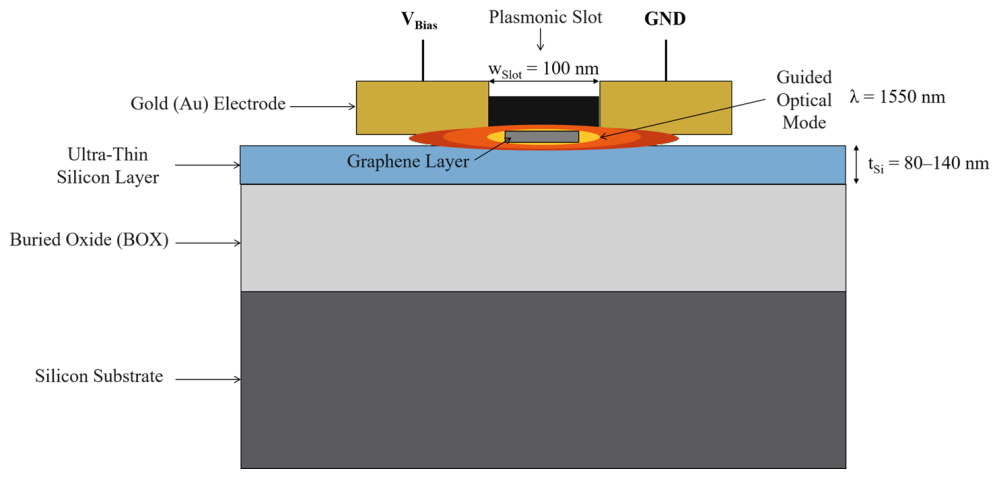
The baseline device operates near the telecommunication wavelength and consists of an ultra-thin silicon guiding layer with width positioned on a buried oxide (BOX) substrate with thickness . The plasmonic region comprises two Au electrodes with width and height separated by a nanoscale slot with width . A graphene monolayer with effective thickness is embedded inside the slot region, while the structure is covered by a top cladding layer with thickness . The is systematically varied throughout this work in order to investigate its influence on optical confinement, modal overlap, effective-index perturbation, transmission characteristics, ER, and IL within the proposed hybrid G-PSM.
For the full-wave analysis, 3D-FDTD simulations employed guided-mode excitation together with optical power monitors to evaluate the transmission response, effective-index perturbation, ER, IL, and propagation attenuation under different and conditions. The investigated range extends from to , while the was varied over representative ultra-thin SOI dimensions in order to analyze the relationship between geometrical confinement and EO performance optimization.
4.1. Eigenmode Analysis
The electromagnetic characteristics of the proposed G-PSM were investigated using the finite-difference eigenmode (FDE) solver in Lumerical 2026 R1 MODE at
. The graphene optical response was incorporated using the finite-temperature Kubo conductivity model together with the equivalent thin-film permittivity formulation presented in
Section 3.
To accurately resolve the strongly confined fields near the plasmonic slot interfaces, local mesh refinement was applied near the graphene layer and metallic boundaries, while PMLs were employed to suppress artificial reflections.
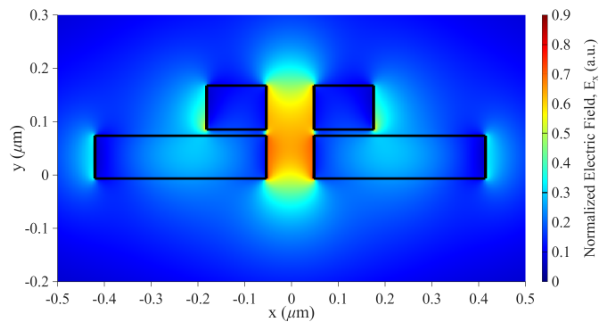
The analysis focuses on the fundamental hybrid plasmonic mode supported by the proposed structure. The extracted mode exhibits quasi-TM characteristics with strong transverse electric-field confinement inside the plasmonic slot region. The eigenmode solver simultaneously provides the complex effective refractive index required for evaluating both phase propagation and modal attenuation characteristics.
Figure 2 illustrates the spatial distribution of the dominant electric-field component
. Strong electromagnetic localization is clearly observed inside the nanoscale plasmonic slot near graphene, confirming efficient subwavelength confinement and enhanced concentration of optical energy inside the active modulation region.
The obtained mode profile further demonstrates the hybrid plasmonic–photonic nature of the proposed structure, in which the optical energy is simultaneously distributed between the ultra-thin silicon guiding layer and the nanoscale plasmonic slot region adjacent to graphene. Strong optical confinement is maintained inside the nanoscale plasmonic slot, while a significant fraction of the optical energy remains distributed within the adjacent ultra-thin silicon layer. As the decreases, the optical confinement provided by the silicon guiding layer is weakened, allowing a larger fraction of the electromagnetic field to penetrate into the plasmonic slot and graphene-active region. Consequently, the modal overlap with graphene increases, resulting in stronger light–matter interaction and enhanced EO modulation efficiency. Conversely, increasing the promotes stronger confinement within the silicon region and reduces the field fraction residing in the plasmonic slot, thereby decreasing the overlap factor and the strength of the EO interaction. These observations provide physical insight into the -dependent behavior reported in the following sections.
4.2. Modal Overlap Analysis
The overlap factor is strongly influenced not only by the geometrical confinement of the proposed G-PSM, but also by through its effect on modal distribution and plasmonic field localization. Consequently, investigating the wavelength dependence of is essential for evaluating the broadband EO behavior of the proposed structure and identifying favorable operating conditions for efficient light–matter interaction.
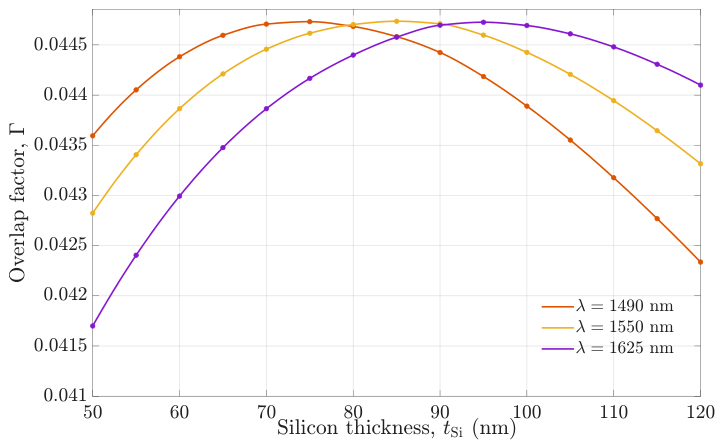
Figure 3 illustrates the variation of the overlap factor
as a function of
for operating wavelengths of
,
, and
. All investigated wavelengths exhibit a distinct non-monotonic dependence on
, with
varying approximately between
and
.
This behavior originates from the balance between dielectric confinement inside the ultra-thin SOI layer and plasmonic field localization within the slot region. For very small
, the optical mode becomes weakly confined and a portion of the field extends away from the graphene-active region, limiting the achievable overlap. As
increases, stronger field localization near the plasmonic slot enhances the interaction between the guided mode and graphene, resulting in an increase in
. Beyond the optimum thickness region, however, additional confinement within the silicon layer reduces the fraction of optical energy residing in the plasmonic slot and graphene-active region, causing the overlap factor to decrease. This behavior is consistent with the hybrid mode profile shown in
Figure 2 and demonstrates that
engineering provides an effective mechanism for maximizing light–matter interaction in the proposed G-PSM.
For relatively thin silicon layers near , the overlap factor remains comparatively low due to weak vertical confinement, allowing a significant portion of the optical field to spread into the surrounding dielectric regions. Quantitatively, the overlap factor is approximately , , and for operating wavelengths of , , and , respectively. Under these conditions, the shorter wavelength exhibits stronger confinement near the graphene-active region.
As increases, stronger dielectric confinement gradually drives the optical field toward the plasmonic slot region, thereby enhancing the overlap with graphene. All investigated wavelengths exhibit progressive improvement in until reaching maximum values near –. The highest overlap is obtained near and , where reaches approximately . In comparison, the peak overlap for occurs near , while the longest wavelength of reaches its maximum near . Physically, longer wavelengths exhibit broader modal distributions and therefore require slightly stronger dielectric confinement to maximize field localization near graphene.
Beyond the optimum thickness region, the overlap factor gradually decreases for all wavelengths as the optical mode becomes increasingly confined inside the silicon core rather than within the plasmonic slot region. At , the overlap factor decreases to approximately , , and for wavelengths of , , and , respectively.
Overall, the results demonstrate that the overlap factor is governed by the coupled influence of wavelength-dependent modal confinement and engineering. The identified optimum region therefore provides a physically balanced operating condition capable of maximizing light–matter interaction while maintaining stable broadband EO performance.
4.3. Effective-Index Modulation
Electrically induced effective-index modulation represents one of the principal EO operating mechanisms of the proposed G-PSM. Variations in graphene conductivity modify the propagation constant of the guided optical mode, resulting in a perturbation of the complex effective index. Consequently, the evolution of with provides direct insight into the EO response of the device and its phase- and absorption-modulation capabilities.
For clarity, the complex effective-index perturbation is decomposed into its real and imaginary components. The real part, , is associated with phase modulation through changes in the propagation constant of the guided mode, whereas the imaginary part, , governs optical attenuation and therefore directly determines absorption-based modulation behavior.
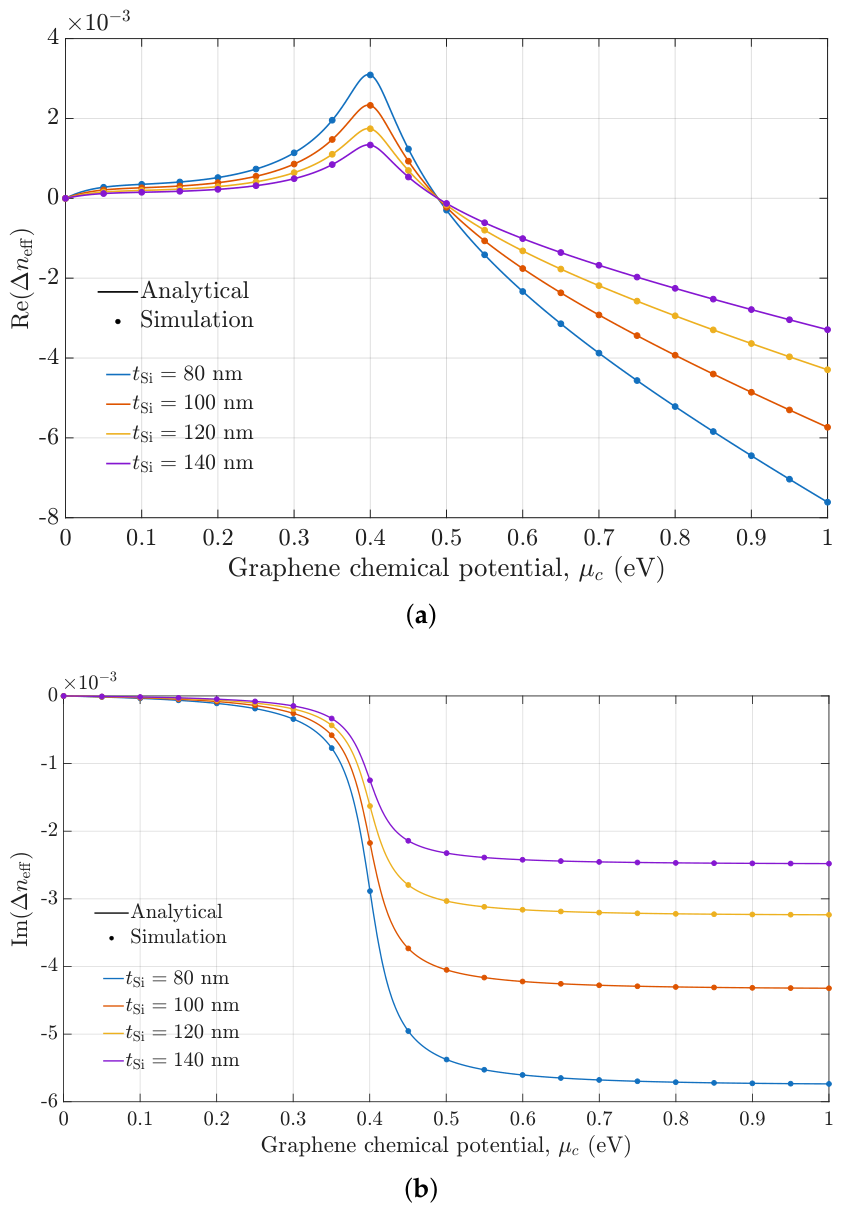
Figure 4a illustrates the variation of the real part of the effective-index perturbation,
, as a function of
for different
ranging from
to
, while
Figure 4b presents the corresponding imaginary component,
.
Excellent agreement is observed between the semi-analytical and numerical results over the entire investigated range, confirming the validity of the conductivity-driven perturbation model adopted for the proposed G-PSM.
The real part of the effective-index perturbation exhibits a pronounced non-monotonic dependence on for all investigated values of . At relatively low chemical potentials (), the induced refractive-index variation remains small and close to zero, indicating a limited perturbation of the guided optical mode. As increases, rises progressively and reaches its maximum value near . Quantitatively, the peak effective-index perturbation reaches approximately for and decreases gradually to approximately for . Intermediate thicknesses of and produce peak values of approximately and , respectively. These results indicate that thinner silicon layers provide stronger modal interaction with graphene and therefore larger conductivity-induced refractive-index perturbations.
For the operating wavelength of nm, the photon energy is approximately eV. Consequently, the Pauli-blocking condition is satisfied near eV. Below this threshold, interband electronic transitions dominate the graphene optical response. As the approaches and exceeds this value, interband absorption becomes progressively suppressed while intraband carrier dynamics become increasingly important. This conductivity transition modifies both the dispersive and absorptive components of the graphene response and therefore strongly influences the effective-index perturbation.
Beyond the transition region, gradually decreases and eventually becomes negative at larger . At , the effective-index perturbation reaches approximately for and approximately for . This sign reversal reflects a change in the dominant dispersive mechanism governing the graphene optical response.
The observed sign reversal of originates from the conductivity transition occurring near the Pauli-blocking threshold. Below this threshold, interband electronic transitions dominate the graphene optical response and produce a positive conductivity-induced perturbation of the effective refractive index. As approaches and exceeds the Pauli-blocking condition, interband absorption becomes progressively suppressed while the intraband contribution increases. Consequently, the imaginary component of the graphene conductivity undergoes a transition in its dominant dispersive behavior, causing to reach a maximum near and subsequently change sign. Physically, this reflects a transition from interband-dominated to intraband-dominated carrier dynamics, resulting in the observed reversal of the effective-index perturbation of the hybrid plasmonic mode.
Figure 4b provides the corresponding variation of the imaginary component of the effective-index perturbation,
, which governs modal attenuation and absorption-based modulation. Excellent agreement is again observed between the semi-analytical predictions and numerical simulations, confirming the validity of the developed conductivity-driven model for describing attenuation perturbations in the proposed G-PSM.
Unlike the real component, which exhibits a peak followed by a sign reversal, the imaginary component decreases monotonically as the increases. For all investigated values of , remains close to zero at low and then undergoes a sharp transition within the range –. This transition coincides with the onset of Pauli blocking, where interband electronic transitions become progressively suppressed, producing a substantial reduction in graphene absorption.
Quantitatively, at , the attenuation perturbation reaches approximately , , , and for of , , , and , respectively. The magnitude of therefore decreases systematically with increasing , indicating weaker attenuation modulation for thicker silicon guiding layers.
The observed thickness dependence originates from the geometry-controlled modal confinement characteristics of the proposed structure. Thinner silicon layers allow a larger fraction of the optical field to penetrate into the graphene-loaded plasmonic slot region, thereby strengthening light–matter interaction and increasing the conductivity-induced attenuation perturbation. Conversely, increasing the
confines a greater portion of the optical energy within the dielectric core, reducing overlap with graphene and consequently decreasing the magnitude of
. This behavior is fully consistent with the overlap-factor trends presented in
Figure 3 and confirms that geometry-dependent modal confinement strongly influences absorption-based EO modulation.
The evolution of the real and imaginary components of the effective index directly influences the device-level EO performance. Variations in
determine the strength of phase modulation, whereas variations in
govern modal attenuation and are therefore directly reflected in the transmission, ER, and IL characteristics presented in
Section 4.4.
Overall, the results demonstrate that the effective-index modulation characteristics of the proposed G-PSM are governed by the combined effects of graphene conductivity tuning and geometry-dependent modal confinement. The transition region near – represents a favorable operating regime in which strong conductivity-induced perturbations are obtained while maintaining efficient light–matter interaction and compact device dimensions. The excellent agreement between the semi-analytical framework and numerical simulations further validates the proposed methodology for predicting geometry-dependent EO performance in ultra-thin SOI G-PSMs.
4.4. Electro–Optic Performance Analysis
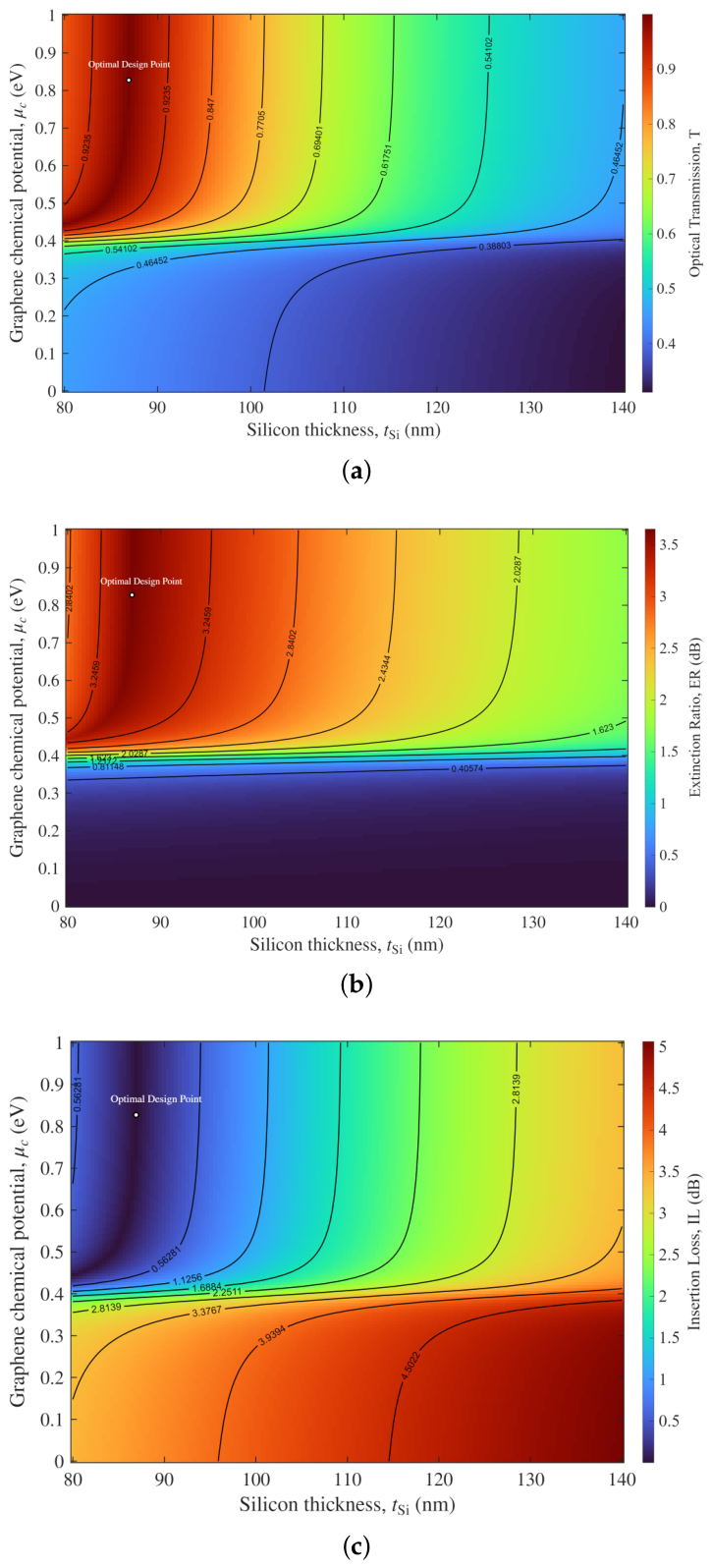
The EO performance of the proposed G-PSM is strongly governed by the coupled interaction between graphene conductivity tuning and geometry-dependent modal confinement. Since variations in directly modify the overlap between the guided optical mode and the graphene-active region, analyzing the simultaneous evolution of T, ER, and IL as functions of and provides important insight into the optimum operating conditions of the proposed structure. Therefore, two-dimensional EO performance maps are investigated over ranging from to and extending from to .
Figure 5a presents the two-dimensional optical-transmission map of the proposed G-PSM as functions of
and
. The contour lines correspond to constant transmission levels and provide direct visualization of the geometry-dependent EO transmission behavior.
A pronounced nonlinear transition boundary separating high-transmission and low-transmission operating regions is clearly observed across the plane. At relatively small below approximately , the transmission remains comparatively low, with values typically ranging between approximately and depending on . In this regime, interband transitions dominate the graphene optical response, producing comparatively strong modal attenuation inside the plasmonic slot region.
As increases toward the transition region near , the transmission rises rapidly due to the onset of Pauli blocking and the resulting suppression of interband absorption. The contour distribution reveals a steep transition from low-transmission to high-transmission operation over a relatively narrow interval. Beyond this region, the transmission gradually approaches values exceeding approximately for thinner silicon layers near .
The influence of is also physically significant. Increasing systematically reduces the transmission throughout the investigated operating range. For example, at , the transmission decreases from approximately for to nearly for . This behavior originates from the thickness-dependent redistribution of optical energy between the dielectric guiding region and the plasmonic slot region, which directly modifies the interaction strength with graphene.
Figure 5b illustrates the corresponding ER map of the proposed G-PSM as functions of
and
. The contour lines represent constant ER levels and demonstrate the electrically tunable modulation contrast achieved under different geometrical conditions.
At comparatively low chemical potentials below approximately , the ER remains relatively weak, typically below approximately for all investigated values. In this operating regime, the conductivity-induced perturbation imposed on the guided optical mode remains comparatively limited, resulting in relatively small transmission differences between the modulation states.
As increases beyond the transition region near approximately , the ER rises sharply due to the strong conductivity-dependent modification of the hybrid plasmonic mode. Quantitatively, the ER reaches values approaching approximately for thinner silicon layers near and high chemical potentials close to . In contrast, increasing the gradually reduces the achievable ER, with values decreasing toward approximately for .
The compressed contour spacing observed near the transition region indicates strong EO sensitivity, where relatively small variations in produce substantial modulation-depth changes. Physically, thinner silicon layers enhance modal overlap and field penetration into the plasmonic slot region, thereby strengthening the interaction between the guided optical mode and graphene and consequently improving the achievable modulation contrast.
Figure 5c presents the IL characteristics of the proposed G-PSM as functions of
and
. The contour map provides direct insight into the geometry-dependent propagation attenuation experienced by the guided optical mode under different electrical operating conditions.
A pronounced nonlinear transition boundary is clearly observed near across the plane. At relatively low below this transition region, the IL remains comparatively large, particularly for thicker silicon layers, with values approaching approximately 3–. In this regime, strong interband absorption in graphene increases the attenuation experienced by the guided hybrid mode inside the plasmonic slot region.
As the increases beyond the transition region, the IL decreases progressively due to the onset of Pauli blocking and the resulting suppression of interband absorption. Quantitatively, the IL decreases toward approximately – for thinner silicon layers near at high close to .
The influence of is also physically significant. Increasing systematically increases the IL throughout the investigated operating range. Thicker silicon layers modify the modal field distribution and increase the effective propagation attenuation experienced by the hybrid optical mode. In contrast, thinner silicon layers maintain comparatively lower attenuation while preserving efficient EO interaction inside the plasmonic slot region.
The compressed contour spacing observed near the transition boundary further indicates strong EO sensitivity, where relatively small variations in produce substantial changes in modal attenuation. Physically, this behavior originates from the strong conductivity-dependent perturbation imposed on the hybrid plasmonic mode near the transition between interband-dominated and Pauli-blocked operating regimes.
Overall, the obtained results demonstrate that the IL characteristics of the proposed G-PSM are strongly governed by the coupled interaction between graphene conductivity tuning and geometry-dependent modal confinement. The identified operating region near together with relatively thin silicon layers therefore provides a physically balanced condition capable of maintaining moderate propagation loss while preserving efficient EO modulation performance.
To provide a clearer design guideline, the optimum operating point identified from the two-dimensional performance maps is highlighted in
Figure 5. The selected design point corresponds to
and
, where the proposed G-PSM achieves a favorable balance between a high ER and a relatively low IL. This operating condition therefore represents a practical tradeoff between modulation efficiency and propagation performance, providing useful design guidance for the implementation of geometry-engineered graphene–plasmonic EO modulators.
4.5. Energy-per-Bit and Bandwidth Analysis
In addition to ER, IL, and effective-index tunability, the practical performance of compact EO modulators is strongly governed by the tradeoff between switching energy and modulation bandwidth. Consequently, evaluating the evolution of the energy-per-bit consumption and the corresponding 3 dB EO bandwidth is essential for assessing the suitability of the proposed G-PSM for low-power high-speed integrated photonic systems.
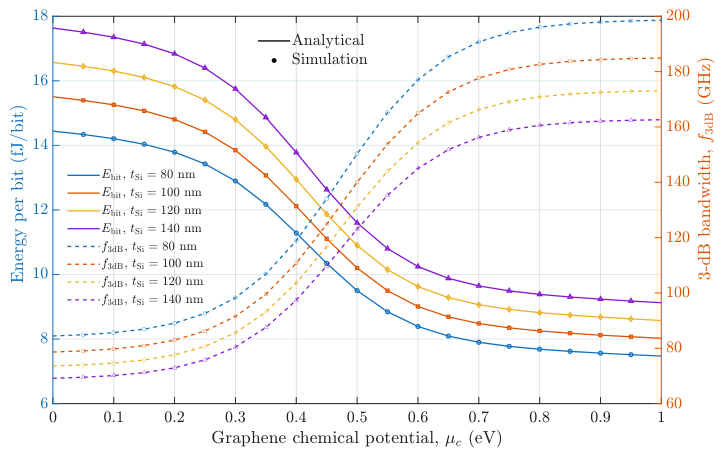
Figure 6 illustrates the variation of
and
as functions of the
for
ranging from
to
. Curves represent the semi-analytical model, while circular markers correspond to numerical simulation results. Strong agreement is observed between the analytical and numerical data throughout the investigated
range, confirming the consistency of the adopted EO performance framework.
A pronounced inverse relationship between energy consumption and modulation bandwidth is observed for all investigated values. At relatively low below approximately , the energy-per-bit remains comparatively high while the achievable EO bandwidth is limited. Quantitatively, the structure with exhibits an initial energy consumption near approximately together with a bandwidth close to approximately . Increasing the silicon thickness to further increases the energy consumption toward approximately while reducing the corresponding bandwidth toward nearly .
As the increases, the energy-per-bit decreases progressively while the EO bandwidth simultaneously increases. The strongest transition occurs within the approximate range –, where the conductivity evolution of graphene produces substantial modification of the RC-limited EO response. Within this transition region, the suppression of interband absorption together with the increasing influence of intraband carrier dynamics improves the electrically induced modulation efficiency and enhances the achievable bandwidth performance.
At larger chemical potentials approaching , the proposed G-PSM exhibits substantially improved speed–energy characteristics. Quantitatively, the structure with achieves the best overall performance, where the energy-per-bit decreases toward approximately while the corresponding EO bandwidth approaches nearly . In contrast, increasing the silicon thickness to produces comparatively larger energy consumption near approximately together with reduced bandwidth values approaching approximately . Intermediate thicknesses of and exhibit performance trends between these two operating extremes.
From a physical perspective, thinner silicon layers enhance modal overlap and strengthen electromagnetic confinement near the graphene-active region, thereby improving the efficiency of conductivity-induced EO modulation. Stronger confinement simultaneously reduces the effective active volume and capacitive loading, leading to lower switching energy and faster EO response. In contrast, thicker silicon layers confine a larger fraction of the optical field inside the dielectric guiding region, reducing the interaction strength with graphene and consequently degrading the achievable speed–energy performance.
Overall, the obtained results confirm that the proposed ultra-thin SOI-assisted G-PSM simultaneously supports low-energy operation and high-speed EO modulation within a compact integrated photonic platform. The coexistence of reduced switching energy and enhanced bandwidth near the conductivity-transition region further demonstrates the effectiveness of geometry-dependent confinement engineering for future low-power high-speed PICs.
From a fabrication perspective, the proposed G-PSM is expected to exhibit reasonable robustness against typical dimensional variations encountered in advanced silicon-photonics manufacturing processes. Since the EO performance varies smoothly with over most of the investigated parameter range, small fabrication deviations are expected to produce only gradual changes in modal confinement, overlap factor, and effective-index perturbation. Consequently, moderate variations in would primarily lead to quantitative shifts in transmission, ER, and IL rather than altering the overall performance trends identified in this work. A comprehensive tolerance and statistical-yield analysis constitutes an interesting topic for future investigation.
From a practical perspective, the predicted performance metrics compare favorably with those reported for contemporary graphene-based EO modulators. In particular, the combination of approximately 7.5 fJ/bit energy consumption and a 3 dB bandwidth approaching 200 GHz demonstrates the potential of the proposed architecture for high-speed and energy-efficient PICs, optical interconnects, and next-generation on-chip optical communication systems.
4.6. Comparison with Previously Reported Graphene-Based Modulators
To further assess the performance of the proposed G-PSM,
Table 1 compares its key EO characteristics with representative graphene-based and graphene–plasmonic modulators reported in the literature. The comparison includes ER, IL, energy-per-bit consumption, and modulation bandwidth, which are among the most important figures of merit for evaluating practical integrated EO modulators.
As shown in
Table 1, the proposed G-PSM achieves an ER of 16.4 dB with an IL of approximately 2 dB, which is comparable to or better than several previously reported graphene-based plasmonic modulators. In addition, the proposed structure exhibits an estimated energy consumption of 7.5 fJ/bit together with a 3 dB EO bandwidth approaching 200 GHz, indicating its suitability for high-speed and energy-efficient optical interconnect applications.
While some previously reported devices demonstrate advantages in specific performance metrics, the proposed G-PSM provides a balanced combination of strong modulation depth, low IL, high-speed operation, and compact device implementation. More importantly, unlike many earlier studies that primarily focused on demonstrating device performance under fixed geometrical configurations, the present work systematically investigates the influence of ultra-thin engineering on modal confinement, overlap enhancement, effective-index perturbation, transmission characteristics, energy consumption, and bandwidth performance. This geometry-dependent optimization framework provides additional physical insight into the design of G-PSMs and offers practical guidelines for achieving improved EO performance in future integrated photonic platforms.