Article

Nonlinear Optical Properties of Tellurene Nanosheets for Harmonic Soliton Operations in an Er-Doped Fiber Laser


1
School of Medical Imaging, Qilu Medical University, Zibo 255300, China
2
School of Physics and Optoelectronic Engineering, Shandong University of Technology, Zibo 255049, China
3
State Key Laboratory on Tunable Laser Technology, Department of Electronics and Information Engineering, Harbin Institute of Technology (Shenzhen), Shenzhen 518055, China
4
China United Network Communications Co., Ltd. Shandong Branch, Jinan 250000, China
5
Zhejiang Deeper Celler Medical Equipment Co., Ltd., Wenling 317500, China
*
Authors to whom correspondence should be addressed.
Photonics 2026, 13(6), 584; https://doi.org/10.3390/photonics13060584 (registering DOI)
Submission received: 30 April 2026 / Revised: 27 May 2026 / Accepted: 13 June 2026 / Published: 15 June 2026

Abstract

Tellurene has a wide bandwidth and low propagation loss at near-infrared wavelengths due to its nonlinear absorption coefficient. Therefore, we prepared tellurene–polyvinyl alcohol (Te-PVA) film as a saturable absorber in an Er-doped fiber laser by liquid phase exfoliation and spin-coating. The modulation depth was 5.25% and the saturation intensity was 17.02 MW/cm. The nonlinear optical properties of the film and its application in high-stability mode-locked operation were studied. A mode-locked pulse with a fundamental frequency of 8.48 MHz and a central wavelength of 1560.10 nm was obtained, with a signal-to-noise ratio which was greater than 75 dB. A traditional soliton mode-locked operation with a pulse width of 1.41 ps was achieved. In addition, eighth- and 19th-harmonic mode-locked operations were obtained by adjusting the pump power and polarization controller. Our results show that Te-PVA film functioned as a saturable absorber which enabled harmonic mode-locking with an SNR of 75 dB in an Er-doped fiber laser. It is thus an excellent ultra-fast photonics material.

1. Introduction

With advantages including high conversion efficiency, good beam quality and a simple and compact structure, the introduction of ultra-fast lasers has set off an upsurge in the fields of industrial micromachining, medical imaging, material manufacturing and processing, and national defense security [1,2,3,4]. An important development direction in laser technology is obtaining laser output with a narrower pulse width [5,6]. The mode-locking technique is the most important and most effective method for generating ultra-short laser pulses. To obtain ultra-short pulses in lasers, two methods have mainly been adopted, namely, the active mode-locking technique and the passive mode-locking technique. The active mode-locking technique mainly involves adoption of an active modulation device in the laser cavity, such as an acousto-optic modulator or an electro-optic modulator, with light being periodically modulated by external means to achieve increased energy and a more stable pulse output. Passive mode-locking refers to the use of the saturable absorption characteristics of passive devices to modulate the laser to obtain pulses. Compared with the active mode-locking technique, passive mode-locking technology does not require additional modulation devices, and is more compact, flexible and convenient in terms of pulse acquisition with saturable absorbers (SAs) [7,8,9,10]. With SAs, absorption or loss changes with the input light intensity, loss in the high light intensity part is small, and loss in the low light intensity part is large, so that compression pulse is achieved and noise pulse is eliminated. The saturated absorption device is the core of passive mode-locking technology. Real SAs include commonly used semiconductor saturable absorption mirrors (SESAMs), as well as new SAs based on carbon nanotubes, two-dimensional (2D) materials, etc. [11].
With the development of two-dimensional (2D) nanomaterials, a new road has been opened up for the production of new materials. In recent years, various 2D materials with the advantages of strong nonlinear saturation absorption, fast recovery time, and simple preparation have greatly boosted investigation of optical solitons within mode-locked fiber lasers [12,13]. In 2009, Bao et al. were the first to use atomic-layer graphene as an SA to obtain ultra-short pulses in fiber lasers [14]. Since then, 2D materials have been widely used in passively mode-locked fiber lasers. Due to their natural structural advantages and excellent optical properties, such as atomic layer thickness, high carrier mobility and high optical absorption, 2D materials have attracted extensive attention among researchers, offering a good choice for the new SAs with ultra-short pulse output in passive mode-locked lasers. At present, new 2D-layered materials (graphene [15,16,17,18], black phosphorus (BP) [19,20,21], topological insulators (Tls) [22,23,24], transition metal dihalides (TMDs) [25,26,27,28,29,30], ferromagnetic insulators [31,32,33], Xenes [34,35,36,37,38], etc.) are widely used in mode-locked fiber lasers. However, the various 2D materials have their own advantages and disadvantages in terms of pulse output characteristics and the thermal stability of SAs. Therefore, the search for 2D materials with excellent optical properties for use as SAs is an essential aspect of current research [39].
Xenes are 2D materials of atomic thickness, with X referring to the possible groups elements from IIIA to VIA, and ene being a Latin word for nanosheets [40]. Xenes are of great interest to researchers due to their outstanding characteristics; these include wide absorption bandwidth, an ultra-high surface volume ratio, strong light absorption, and high carrier mobility. In 2017, Song et al. prepared antimonene by liquid phase exfoliation (LPE) for the first time, and obtained a passively mode-locked pulse with a pulse width of 550 fs [41]. In the same year, Xing et al. obtained a mode-locked pulse with a repetition rate of 13.68 MHz and a pulse width of 3.1 ps based on Selenene as a SA [36]. In 2018, Guo et al. used microfiber-based bismathene as an SA in an Er-doped fiber laser (EDFL) for the first time, and obtained a stable pulse near 1561 nm, the shortest pulse width being about 193 fs [35]. In 2019, Guo et al. obtained a mode-locked pulse based on tellurene as an SA; this had a repetition rate of 15.45 MHz and a pulse width of 829 fs [42]. In 2020, Liu et al. obtained a passively mode-locked EDFL with a central wavelength of 1531.48 nm and a repetition rate of 3.35 MHz through a tapered fiber using silicene as an SA [43]. Research into use of Xenes as SAs to generate mode-locked pulse is still in its infancy, so it is very important that optical research into new Xenes is expanded.
Tellurene (Te), a member of the chalcogen element family, has attracted significant attention due to its fascinating physical and chemical properties, such as hydration and oxidation catalytic activity, thermoelectricity, and photoconductivity [44]. It is one of the 2D mono-elemental materials (group-III, -IV and -V elements), elements near the border between metals and nonmetals which have garnered tremendous interest owing to their unique electronic, optical, and chemical properties. As a narrow-bandgap semiconductor, few-layer Te has a narrow band gap of 0.325 eV, and it has numerous potential applications in the fabrication of many modern devices [45,46]. Due to its chain-like structure, Te has a strong tendency to grow into a one-dimensional nanoarchitecture. In 2014, Wang et al. produced 2D hexagonal tellurium nanoplates on flexible mica sheets [47]. Huang et al. obtained Te films of monolayer and few-layer thickness by molecular beam epitaxy on a graphene/6H-SiC (0001) substrate. With thickness controlled at an atomic scale, they further demonstrated potential application in the fields of electronics and optoelectronics [48]. Lately, study of 2D Te has gained in popularity. Promising air-stable performance at ambient temperature, ultralow lattice thermal conductivity (2.16 W m−1 K−1), high hole mobility (almost 3000 cm2/vs at low temperature), and outstanding photo response have all been demonstrated by 2D Te [42].
In this work, Te-polyvinyl alcohol (Te-PVA) SA with a modulation depth of 5.25% and a saturation intensity of 17.02 MW/cm2 is inserted into an EDFL, and stable mode-locked pulses are successfully obtained. Under the fundamental frequency of 8.48 MHz, the center wavelength of the mode-locked pulse is 1560.10 nm, and the signal-to-noise ratio (SNR) is greater than 75 dB. By adjusting the state of the laser cavity, high order mode-locked operation is also realized. These experimental outcomes show that Te has outstanding saturable absorption behavior and has broad potential in the development of ultra-fast photonics devices.

2. Preparation and Characterization of Te-PVA SA

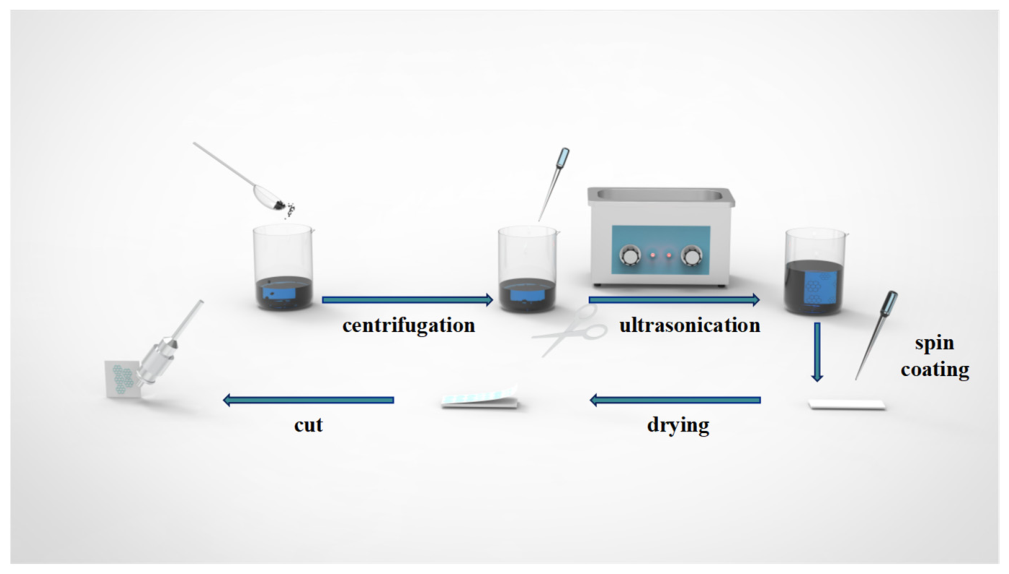
Polyvinyl alcohol was adopted as the host matrix owing to its excellent film-forming capability, high optical transparency at 1.5 μm, good chemical stability, and low-cost fabrication process, which enables uniform dispersion of Te nanosheets and low-loss integration into the fiber laser cavity. In this section, we describe the whole process of preparing the Te-PVA SA using LPE and spin-coating. This method is usually used to prepare nanosheet SAs with small amounts of 2D materials dissolved in organic solvents. Compared with other film preparation methods, it is simpler and more economical, and the film produced is easier to peel. As shown in Figure 1, in the first step, 0.1 g of Te powder was added to 50 mL of 75% alcohol solution. The combination was centrifuged at 2000 rpm for 30 min and put into an ultrasonic cleaner for 6 h. In the second step, the initially obtained Te solution was mixed with PVA liquid in a 1:1 volume ratio. Sonication then continued for another 6 h to obtain a uniform Te-PVA dispersion solution. Then, 100 μL dispersion was uniformly spread onto the substrate, with rotation, and allowed to stand at 30°C for 48 h, forming Te-PVA films. Finally, the Te-PVA SA was prepared by cutting film into 1 × 1 mm2 pieces which were then placed on the ends of fiber optic patch cords.
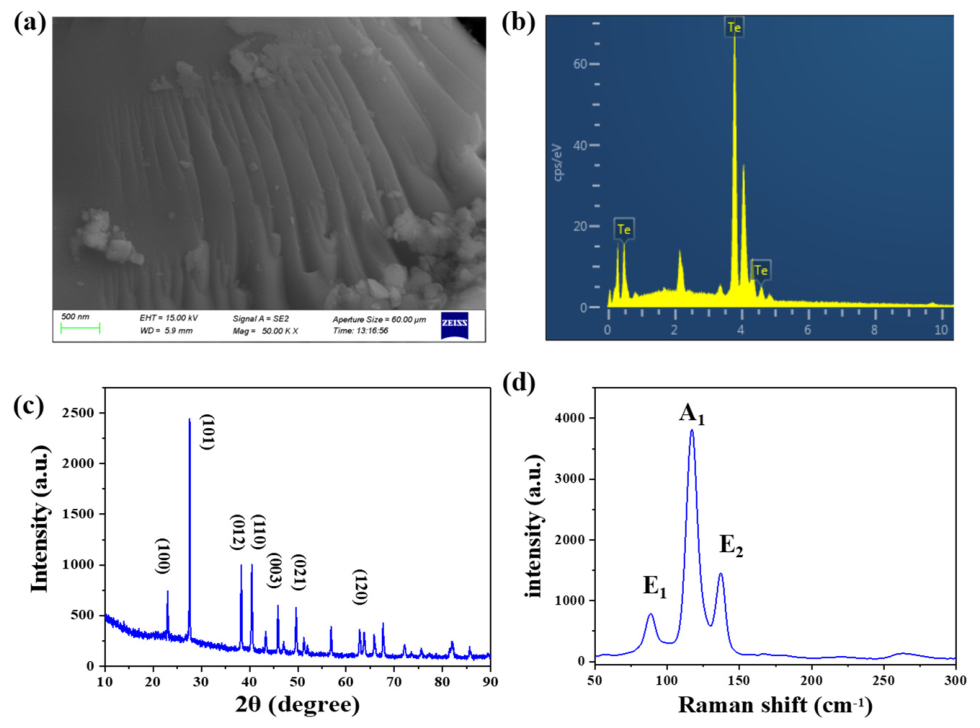
Figure 2a shows the surface analysis of the Te obtained by scanning electron microscopy (SEM) (Sigma 500, ZEISS, Oberkochen, Germany). A distinct layered structure is evident in the image. The corresponding energy dispersive spectroscopy (EDS) (QUANTAX EDS, Bruker, Germany) is shown in Figure 2b, which clearly shows the peaks of Te, and better records the distribution of the elements, using an estimated Te. In addition, X-ray diffraction (XRD) (D8 Advance, Bruker, Billerica, MA, USA) spectra are provided in Figure 2c. As may be seen in the figure, obvious diffraction peaks at (100), (101), (012), (110), (003), (021) and (120) were recorded, consistent with previously reported works. The structural characteristics of Te excited by a 532 nm laser were also studied. As illustrated in Figure 2d, three Raman shift peaks of E1, A1 and E2 modes were characterized at 90 cm−1, 120.02 cm−1 and 138 cm−1, respectively, which corresponded well with the previous results [44]. Raman spectra and AFM images for different intensities of laser power irradiation were presented in our previous report [34]. The results indicate that tellurium nanosheets of uniform thickness, with negligible oxidation or structural degradation, were successfully prepared.
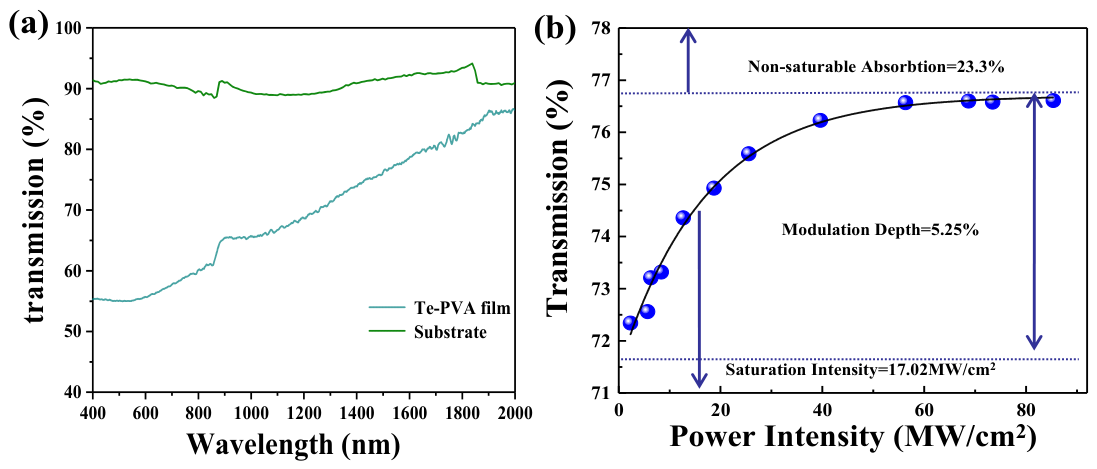
Figure 3a illustrates the linear transmittance of the Te-PVA film and the control substrate. The results show that transmission of the Te-PVA film at 1560 nm is about 77.47%. For the control experiment, we measured the linear transmittance of a pure PVA film at 1560 nm. The pure PVA film exhibits a linear transmittance of 93.9%, corresponding to a linear optical loss of only 6.1%. This confirms that the majority of the insertion loss in the Te-PVA film arises from the nanosheets rather than the polymer host. The nonlinear absorption properties of the Te-PVA film-type SA are obtained by adopting a balanced twin-detector measurement system. A homemade ultrafast fiber laser (1564.8 nm, 353 fs, 10 MHz) is employed as a laser source, a variable optical attenuator (VOA) is adopted to adjust the input laser power, these being separated in a ratio of 1:1 by an OC, with power at both ends tested by a power meter. The obtained experimental data are fitted by Equation (1) as follows:
T I = 1 T n s T × e x p ( I / I s a t )
where T(I) and ∆T represent the transmission velocity and modulation depth, respectively; I and Isat stand for incident light intensity and saturation intensity; and Tns is non-saturable absorbance. The experimental fitting results are given in Figure 3b, where non-saturable loss, saturation intensity, and modulation depth of 23.3%, 17.02 MW/cm2 and 5.25%, respectively, may be seen. The smaller modulation depth is beneficial for long-term stability, but reduces the pulse narrowing effect during mode locking.

3. Experimental Setup

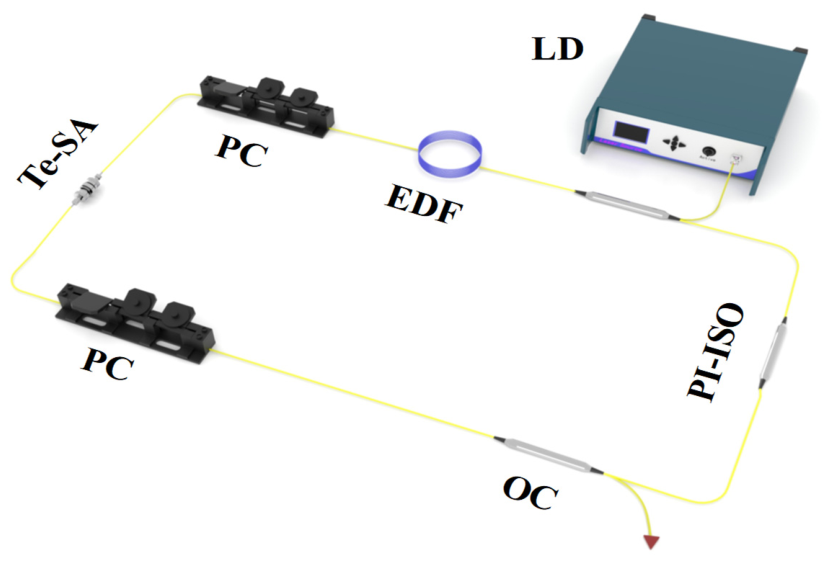
The experimental setup for an Er-doped mode-locked optical fiber laser based on Te-PVA SA is shown in Figure 4. A 30 cm Er-doped fiber (LIEKKI Er110, nlight, Vancouver, WA, USA) was used as the gain medium to control the overall cavity dispersion, lower the mode-locking threshold, reduce thermal effects, and achieve an appropriate fundamental repetition rate for stable soliton mode-locking. The pump light was supplied by a 980 nm single mode laser diode (LD) (Taizhou Tonghe Laser technology Co., Ltd., Wenling, China) and coupled to a ring cavity by a 980/1550 nm wavelength division multiplexer (WDM). The feedback loop of the ring laser was made by connecting the 90% interface of the optical coupler (OC) to another interface of the WDM. A total of 10% of output energy was used to record the output features of the experiment. Two polarization controllers (PCs) and a polarization insensitive isolator (PI-ISO) were also incorporated into the resonant cavity to optimize the laser state inside the cavity and enforce unidirectional laser operation. A 23.93 m single-mode fiber (SMF) with a dispersion parameter of −21.68 ps2/km lengthened the entire cavity length. Thus, the overall length of the resonant cavity was ~24.23 m and the calculated total net cavity dispersion was −0.63 ps2. The pulse sequence parameters, the radio frequency (RF) spectrum, the output power, and the optical spectrum of the mode-locked fiber laser were measured by a digital oscilloscope (Wavesurfer 3054z, Teledyne LeCroy, New York, NY, USA), an RF spectrum analyzer (MXA Signal Analyzer N9020A, Agilent, Santa Clara, CA, USA), an intensity autocorrelator (FR-103XL, Femtochrome, CA, USA), power meter (D50, BAGGER, Bergkirchen, Germany) and optical spectrum analyzer (MS9710C, Anritsu, Tokyo, Japan), respectively.

4. Results and Discussion

To verify that the Te-PVA SA has superior nonlinear saturable absorption characteristics, in this experiment we recorded the output characteristics of the EDFL without the Te-PVA film-type SA before the experiment began. By carefully adjusting the pump power and the PC machine, only continuous waves could be output, and no mode-locked pulses, harmonic mode-locking or pulse-like modulation were obtained, eliminating the possibility of mode-locking being caused by nonlinear polarization rotation or by the Fabry–Perot cavity effect. Then, the Te-PVA modulator was added to the laser cavity, and a stable mode-locked phenomenon was observed by finely adjusting the PC machine, indicating that the ultra-fast modulation effect was induced by the Te-PVA SA. The pulse train, optical spectrum, and RF spectrum all exhibited typical soliton mode-locking characteristics. The mode locking operation is not self-starting. When the pump power exceeds 80 mW, the mode locking operation can be achieved by adjusting the angle of the PC. This behavior is typical for fiber lasers with saturable absorbers based on 2D materials, where the intracavity polarization state directly influences the effective saturable absorption and the balance between gain, loss, dispersion, and nonlinearity.
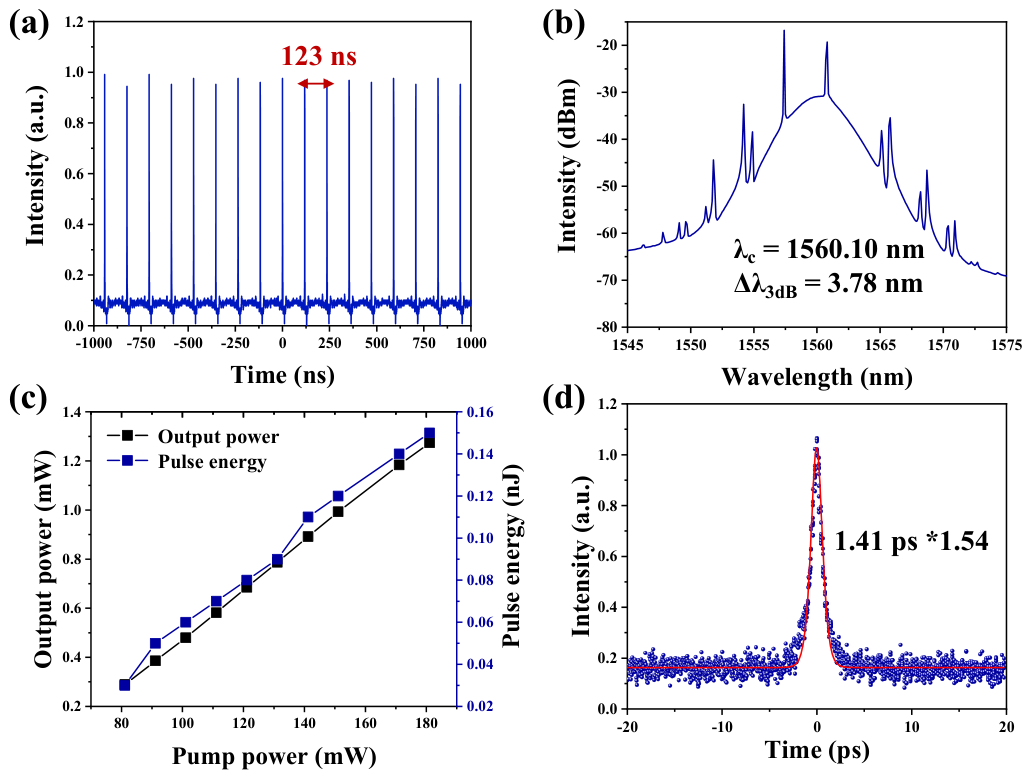
When pump power increases from 80 to 180 mW, a stable pulse sequence can be obtained by carefully rotating the PC. Figure 5a shows the pulse sequence obtained at 144.7 mW, with a pulse interval of 123 ns which matches the round-trip time of the cavity. The typical optical spectral shape is shown in Figure 5b. A conventional soliton spectrum with distinct and symmetric Kelly sidebands was attained, and a spectral diagram with a central wavelength of 1560.10 nm is obtained at a resolution of 1 nm. Figure 5c depicts the relationships between output power, pulse energy, and pump power. It can be seen from the figure that the output power is linearly related to the pump power. At the maximum input power, the power conversion efficiency reaches 0.72%, indicating that the influence of SA on the whole laser cavity is relatively great. Therefore, improving power conversion efficiency is one of our future research objectives. In brief, then, we obtained a typical conventional soliton due to Kelly sidebands and single pulse energy. Furthermore, it was clear that pulse energy and output power were linearly related to pump power. An intensity autocorrelator was used to test the real pulse width of the mode-locked pulse, and the autocorrelation data were fitted by sech2 function. As shown in Figure 5d, the real pulse width was calculated to be 1.41 ps. The time–bandwidth product (TBP) of the mode-locking pulse can be calculated as follows:
T B P = τ × c Δ λ λ c 2
where c is the speed of light, Δλ is the 3 dB bandwidth, and λc is the center wavelength. The ideal transform-limited TBP of a sech2-shaped soliton is ~0.315. Because the calculated TBP = 0.657, the pulse is not transform-limited. There is a positive chirp, and the pulse is broadened by frequency modulation.
The soliton area is invariant in the anomalously dispersive cavity. The combined effect of net cavity dispersion, gain clamping, and saturable absorption determines the equilibrium between pulse duration and spectral width. The non-transform-limited state reflects the joint influence of cavity loss, finite modulation depth, and multi-pulse harmonic operation. The single pulse energy is calculated to be is 0.14 nJ; this is greater than 0.1 nJ, the theoretical limit of soliton area, indicating the existence of positive chirp in the pulse.
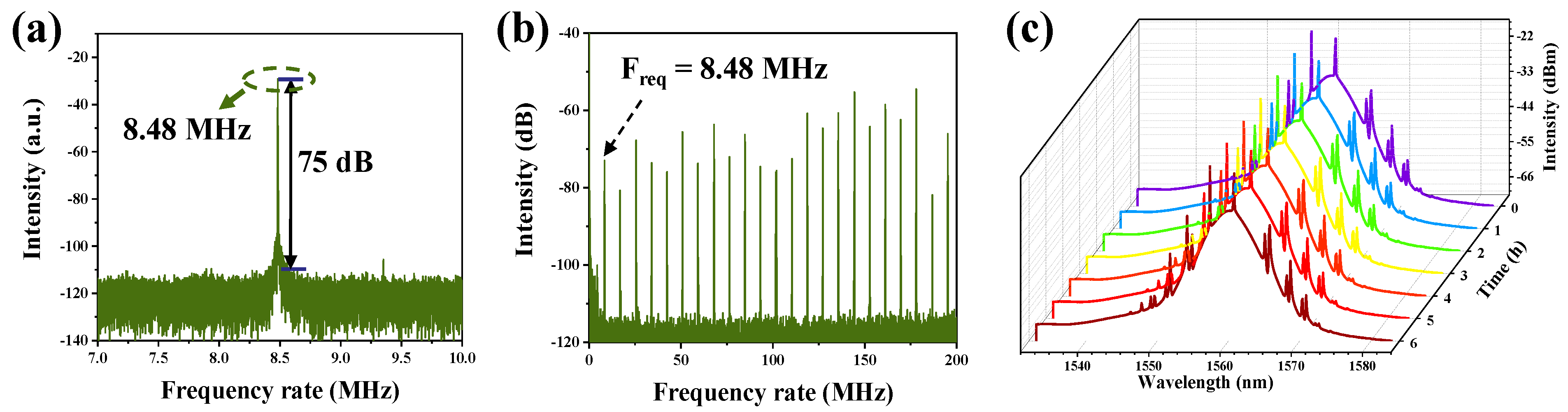
Figure 6a shows the RF spectrum with a SNR of ~75 dB at a fundamental frequency of 8.48 MHz. Figure 6b depicts the RF spectrum over a bandwidth of 200 MHz, which was used to study the long-term stability of the mode-locked fiber laser. Figure 6c records the spectra of the mode-locked states at one-hour intervals over a six-hour period. There was little change in the shape or intensity of the spectrum. The experimental results show that stability of mode-locked pulse is successfully realized.
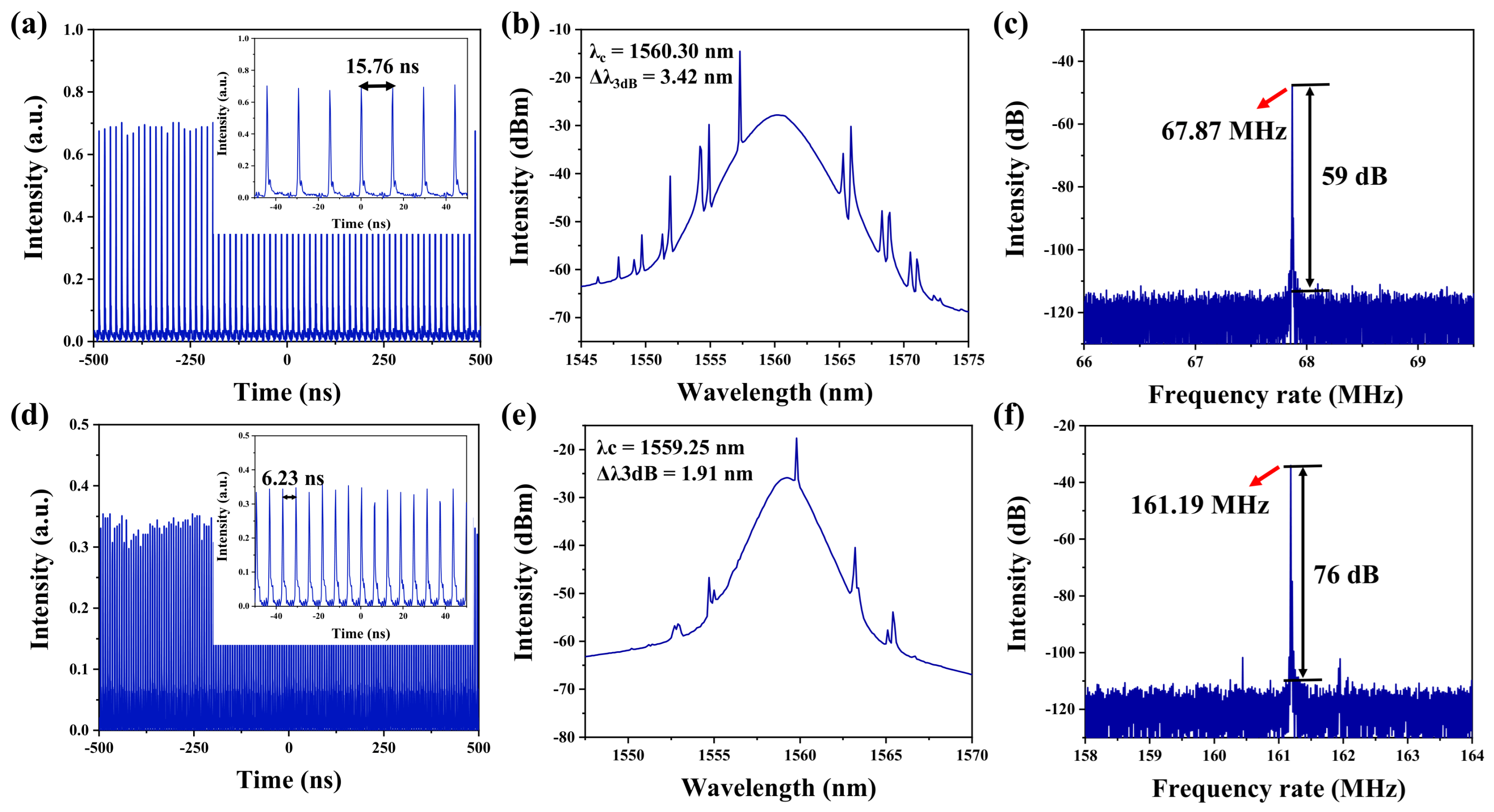
In addition, it is valuable to explore the potential of tellurium mode-locked fiber lasers to operate in higher repetition frequency patterns in many applications. When the pump power in a fiber laser is high, a single pulse cycling in the cavity splits into multiple pulses due to the principle of energy limitation. Consequently, when other factors in the fiber laser are changed, it is possible to achieve a pulse sequence which is stable and well-ordered. In this case, the repetition frequency of this pulse sequence is far higher than the pulse spacing of the fundamental mode-locking [49,50]. Therefore, we used an integrated adjustment method to adjust the pump power and polarization controller to make the tellurium mode-locked laser work in a harmonic mode-locked system. When we increased the pump power to 141 mW, an eighth-harmonic mode-locked system was obtained. The results are shown in Figure 7a–c. Figure 7a shows the pulse sequence of the eighth-harmonic mode-locked system with a pulse separation time is 15.76 ns. The pulse train exhibits a constant repetition rate of 67.87 MHz, with no amplitude modulation or pulse dropouts over the measured time window. The power monitoring results over 30 min remain stable at ~0.89 mW, with fluctuations < 2%. Figure 7b demonstrates a typical spectrum of a harmonic mode-locked state: the central wavelength is located at 1560.3 nm, and the 3 dB bandwidth is 3.42 nm. Figure 7c shows the RF spectrum of an eighth-harmonic mode-locked state where the central frequency is 67.87 MHz, approximately eight times that of the fundamental frequency mode-locked state. The SNR is about 59 dB, indicating that the mode-locked state is operating stably at this time. Meanwhile, when we further increase the pumping power to 151 mW, the pulse sequence is no longer stably arranged. However, we obtained a stable 19th-harmonic mode-locked state by carefully adjusting the PC. Figure 7d shows a pulse sequence where the pulse separation is 6.23 ns. The illustration shows that the pulses remain equally spaced with consistent intensity, confirming stable multi-pulse distribution in the cavity. Output power is maintained at ~0.99 mW, with negligible variation (<1%). These data demonstrate the excellent long-term stability of the harmonic mode-locking operation. Figure 7e depicts the spectrum of the 19th-harmonic mode-locked state, in which the central wavelength and 3 dB bandwidth are 1559.25 nm and 1.91 nm, respectively. Figure 7f illustrates the RF spectra recorded for the harmonic mode-locked operation with a central frequency of 161.19 MHz and an SNR of 76 dB. The higher SNR shows that we obtained a stable 19th-harmonic mode-locked state. As harmonic mode-locking arises from intracavity pulse spacing rather than changes in pulse shaping, the pulse width remains unchanged at ~1.41 ps (sech2fit) for both harmonics, consistent with the fundamental mode-locking state.
As mentioned, various Xenes have been used as SAs to demonstrate pulsed fiber laser operations. In order to more intuitively express the material properties of Te SA, we compare Te with existing material research results. Table 1 summarizes typical output characteristics of mode-locked fiber laser operations based on Xenes and on other 2D materials. Key parameters are compared, including modulation depth, saturation intensity, non-saturable loss, pulse width, frequency rate, center wavelength, and signal-to-noise ratio. The Te-PVA composite film is prepared by a simple liquid-phase exfoliation and spin-coating method, which has the advantages of simple process, low cost, and high scalability. Compared with the complex synthesis and transfer processes of other 2D material-based SAs, this preparation method is more suitable for large-scale production and practical device integration. As shown in the table, Te-based SA in fiber laser exhibits a high SNR of 75 dB, indicating its good stability.

5. Conclusions

To sum up, a Te-PVA SA was successfully made; this had a saturation intensity of 17.02 MW/cm2 and a modulation depth of 5.25%, and it was successfully applied in the study of a passive mode-locked EDFL. Stable mode-locked operation was realized in a fiber laser based on the Te-PVA SA. In this fiber laser, a mode-locked pulse was obtained with a fundamental frequency of 8.48 MHz, an SNR greater than 75 dB, a pulse energy of 0.15 nJ, and a pulse width of 1.41 ps. Eighth- and 19th-harmonic mode-locked operations were also obtained in this fiber laser. The experimental results show that Te nanosheets have good nonlinear absorption characteristics, providing an important reference for future research into Xenes.

Author Contributions

Conceptualization, M.Z. and L.G.; methodology, N.X.; validation, H.Z.; formal analysis, L.S. and S.F.; investigation, Z.W. and W.F.; writing—original draft preparation, W.F., X.S. and W.Y.; writing—review and editing, X.S.; supervision, H.Z.; funding acquisition, N.X. All authors have read and agreed to the published version of the manuscript.

Funding

This work was supported by the Shandong Province Natural Science Foundation (Grant nos. ZR2025QC23).

Data Availability Statement

Data underlying the results presented in this paper are not publicly available at this time but may be obtained from the authors upon reasonable request.

Conflicts of Interest

Author Shuai Fu was employed by the company China United Network Communications Co., Ltd. Author Huanian Zhang was employed by the company Zhejiang Deeper Celler Medical Equipment Co., Ltd. The remaining authors declare that their research was conducted in the absence of any commercial or financial relationships that could be construed as a potential conflict of interest.

References

  1. Ge, Y.-Q.; Wang, W.-L.; Wang, M.; Zhang, S.-K.; Zhong, Y.-J.; Zhang, Y.-L.; Wei, S.-R.; DU, B.-W.; Wang, H.-D.; Qiu, M.; et al. All-optical logic processing unit using Kerr nonlinearity of MXene. Nat. Commun. 2026, 17, 4078. [Google Scholar] [CrossRef] [PubMed]
  2. Zhang, L.; Tang, P.-H.; Zhu, J.-H.; Zhou, Z.-X.; Wu, H.-T.; Wang, Z.-H. Dynamic Behaviors of Pulsating Noise-like Pulses in an Ultrafast Fiber Laser. Photonics 2025, 12, 937. [Google Scholar] [CrossRef]
  3. Wang, Z.-Q.; Nithyanandan, K.; Coillet, A.; Tchofo-Dinda, P.; Grelu, P. Optical soliton molecular complexes in a passively mode-locked fibre laser. Nat. Commun. 2019, 10, 830. [Google Scholar] [CrossRef] [PubMed]
  4. Fermann, M.E.; Hartl, I. Ultrafast fibre lasers. Nat. Photonics 2013, 7, 868–874. [Google Scholar] [CrossRef]
  5. Bai, Z.-X.; Zhao, Z.-G.; Tian, M.-H.; Jin, D.; Pang, Y.-J.; Li, S.-S.; Yan, X.-S.; Wang, Y.-L.; Lu, Z.-W. A comprehensive review on the development and applications of narrow-linewidth lasers. Microw. Opt. Technol. Lett. 2022, 64, 2244–2255. [Google Scholar] [CrossRef]
  6. Backus, S.; Durfee, C.G., III; Murnane, M.M.; Kapteyn, H.C. High power ultrafast lasers. Rev. Sci. Instrum. 1998, 69, 1207–1223. [Google Scholar] [CrossRef]
  7. Shang, X.-X.; Xu, N.-N.; Guo, J.; Sun, S.; Zhang, H.-N.; Wageh, S.; Al-Ghamdi, A.A.; Zhang, H.; Li, D.-W. Niobium telluride absorber for a mode-locked vector soliton fiber laser. Sci. China Phys. Mech. 2023, 66, 254211. [Google Scholar] [CrossRef]
  8. ul Abedin, Z.; ul Haq, A.; Ahmed, R.; Alrebdi, T.A.; Alshehri, A.M.; Irfan, M.; Asghar, H. On the Synthesis of Graphene Oxide/Titanium Dioxide (GO/TiO2) Nanorods and Their Application as Saturable Absorbers for Passive Q-Switched Fiber Lasers. Nanomaterials 2024, 14, 1682. [Google Scholar] [CrossRef]
  9. Shang, X.-X.; Xu, N.-N.; Zong, M.-Y.; Yu, W.-Y.; Guo, L.-G.; Gao, G.-G.; Zhang, Z.-Q.; Zhang, H.-N.; Su, L.-Z. ZrGeTe4 nanoparticles as a saturable absorber for mode-locked operations at 1 and 1.55 µm. Photonics 2026, 13, 305. [Google Scholar] [CrossRef]
  10. Chen, Y.; Jiang, G.-B.; Chen, S.-Q.; Guo, Z.-N.; Yu, X.-F.; Zhao, C.-J.; Zhang, H.; Bao, Q.-L.; Wen, S.-C.; Tang, D.-Y.; et al. Mechanically exfoliated black phosphorus as a new saturable absorber for both Q-switching and mode-locking laser operation. Opt. Express 2015, 23, 12823–12833. [Google Scholar] [CrossRef] [PubMed]
  11. Woodward, R.I.; Kelleher, E.J. 2D saturable absorbers for fibre lasers. Appl. Surf. Sci. 2015, 5, 1440–1456. [Google Scholar] [CrossRef]
  12. Guo, B.; Xiao, L.-Q.; Wang, H.-S.; Zhang, H. 2D layered materials: Synthesis, nonlinear optical properties, and device applications. Laser Photonics Rev. 2019, 13, 1800327. [Google Scholar] [CrossRef]
  13. Xu, N.-N.; Sun, S.; Shang, X.-X.; Zhang, H.; Li, D.-W. Harmonic and fundamental-frequency mode-locked operations in an Er-doped fiber laser using a Cr2Si2Te6-based saturable absorber. Opt. Mater. Express 2022, 12, 166–173. [Google Scholar] [CrossRef]
  14. Bao, Q.-L.; Zhang, H.; Wang, Y.; Ni, Z.-H.; Yan, Y.-L.; Shen, Z.-X.; Loh, K.P.; Tang, D.-Y. Atomiclayer graphene as a saturable absorber for ultrafast pulsed lasers. Adv. Funct. Mater. 2009, 19, 3077–3083. [Google Scholar] [CrossRef]
  15. Zhao, N.; Xu, W.-C.; Luo, Z.-C.; Liu, H.; Liu, M.; Zhang, X.-W.; Liu, L.; Liao, J.-H.; Wang, X.-D.; Luo, A.-P. Trapping of soliton molecule in a graphene-based mode-locked ytterbium-doped fiber laser. IEEE Photon. Technol. Lett. 2014, 26, 2450–2453. [Google Scholar] [CrossRef]
  16. Popa, D.; Sun, Z.; Torrisi, F.; Hasan, T.; Wang, F.; Ferrari, A.C. Sub 200 fs pulse generation from a graphene mode-locked fiber laser. Appl. Phys. Lett. 2010, 97, 203106. [Google Scholar] [CrossRef]
  17. Bao, Q.; Zhang, H.; Ni, Z.-H.; Wang, Y.; Polavarapu, L.; Shen, Z.-X.; Xu, Q.-H.; Tang, D.-Y.; Loh, K.P. Monolayer graphene as a saturable absorber in a mode-locked laser. Nano Res. 2011, 4, 297–307. [Google Scholar] [CrossRef]
  18. Haris, H.; Harun, S.W.; Anyi, C.L.; Muhammad, A.R.; Ahmad, F.; Tan, S.-J.; Nor, R.M.; Zulkepely, N.R.; Ali, N.M.; Arof, H. Generation of soliton and bound soliton pulses in mode-locked erbium-doped fiber laser using graphene film as saturable absorber. J. Mod. Opt. 2015, 63, 777–782. [Google Scholar] [CrossRef]
  19. Sotor, J.; Sobon, G.; Kowalczyk, M.; Macherzynski, W.; Paletko, P.; Abramski, K.M. Ultrafast thulium-doped fiber laser mode locked with black phosphorus. Opt. Lett. 2015, 40, 3885–3888. [Google Scholar] [CrossRef]
  20. Hisyam, M.B.; Rusdi, M.F.M.; Latiff, A.A.; Harun, S.W. Generation of mode-locked ytterbium doped fiber ring laser using few-layer black phosphorus as a saturable absorber. IEEE J. Sel. Top. Quantum Electron. 2016, 23, 39–43. [Google Scholar] [CrossRef]
  21. Gao, B.; Guo, W.; Huo, J.; Wu, G.; Ma, C.-Y.; Li, J.-X.; Wang, J.L. Dissipative solitons characteristics in passively mode-locked Er-doped fiber laser based on black phosphorus as a new saturable absorber. Opt. Commun. 2018, 406, 192–198. [Google Scholar] [CrossRef]
  22. Luo, Z.-C.; Liu, M.; Liu, H.; Zheng, X.-W.; Luo, A.P.; Zhao, C.-J.; Zhang, H.; Wen, S.-C.; Xu, W.-C. 2 GHz passively harmonic mode-locked fiber laser by a microfiber-based topological insulator saturable absorber. Opt. Lett. 2013, 38, 5212–5215. [Google Scholar] [CrossRef]
  23. Sotor, J.; Sobon, G.; Macherzynski, W.; Abramski, K.M. Harmonically mode-locked Er-doped fiber laser based on a Sb2Te3 topological insulator saturable absorber. Laser Phys. Lett. 2014, 11, 055102. [Google Scholar] [CrossRef]
  24. Liu, H.; Zheng, X.-W.; Liu, M.; Zhao, N.; Luo, A.-P.; Luo, Z.-C.; Xu, W.-C.; Zhang, H.; Zhao, C.-J.; Wen, S.-C. Femtosecond pulse generation from a topological insulator mode-locked fiber laser. Opt. Express 2014, 22, 6868–6873. [Google Scholar] [CrossRef]
  25. Liu, J.-S.; Li, X.-H.; Guo, Y.-X.; Qyyum, A.; Shi, Z.-J.; Feng, T.-C.; Liu, X.-F. SnSe2 nanosheets for subpicosecond harmonic mode-locked pulse generation. Small 2019, 15, 1902811. [Google Scholar] [CrossRef]
  26. Shang, X.-X.; Xu, N.-N.; Zhang, H.; Li, D.-W. Nonlinear photoresponse of high damage threshold titanium disulfide nanocrystals for Q-switched pulse generation. Opt. Laser Technol. 2022, 151, 107988. [Google Scholar] [CrossRef]
  27. Xu, N.-N.; Wang, H.-F.; Zhang, H.-N.; Guo, L.-G.; Shang, X.-X.; Jiang, S.-Z.; Li, D.-W. Palladium diselenide as a direct absorption saturable absorber for ultrafast mode-locked operations: From all anomalous dispersion to all normal dispersion. Nanophotonics 2022, 9, 4295–4306. [Google Scholar] [CrossRef]
  28. Li, L.; Pang, L.-H.; Wang, Y.; Liu, W.-J. WxNb(1−x)Se2 nanosheets for ultrafast photonics. Nanoscale 2021, 13, 2511–2518. [Google Scholar] [CrossRef]
  29. Pang, L.-H.; Sun, Z.-L.; Zhao, Q.-Y.; Wang, R.-F.; Yuan, L.-R.; Wu, R.-Q.; Lv, Y.; Liu, W.-J. Ultrafast Photonics of Ternary RexNb(1-x)S2 in Fiber Lasers. ACS Appl. Mater. Interfaces 2021, 13, 28721–28728. [Google Scholar] [CrossRef] [PubMed]
  30. Li, L.; Pang, L.-H.; Wang, R.-F.; Zhang, X.-G.; Hui, Z.-Q.; Han, D.-D.; Zhao, F.; Liu, W.-J. Ternary Transition Metal Dichalcogenides for High Power Vector Dissipative Soliton Ultrafast Fiber Laser. Laser Photonics Rev. 2022, 16, 2100255. [Google Scholar] [CrossRef]
  31. Yang, F.-H.; Sun, S.; Chen, S.; Wang, Y.-J.; Sui, Z.-Q.; Zhu, M.-X.; Hong, Z.-F.; Xu, J.-H.; Tang, S.-Q.; Lu, C.; et al. Passively mode-locked Er-doped fiber laser based on a ferromagnetic insulator Cr2Si2Te6 as a saturable absorber. Appl. Opt. 2022, 61, 898–903. [Google Scholar] [CrossRef]
  32. Sui, Z.-Q.; Zhu, M.-X.; Chen, S.; Yang, F.-H.; Wang, Y.-J.; Sun, S.; Hong, Z.-F.; Fan, W.-Y.; Zhang, H.-N.; Chen, X.-H.; et al. Generation of bright-dark soliton pairs based on a ferromagnetic insulator Cr2Si2Te6 as a modulator in an Er-doped fiber laser. Appl. Opt. 2022, 61, 3254–3259. [Google Scholar] [CrossRef] [PubMed]
  33. Guo, L.-G.; Shang, X.-X.; Zhao, R.; Zhang, H.; Li, D.-W. Nonlinear optical properties of ferromagnetic insulator Cr2Ge2Te6 and its application for demonstrating pulsed fiber laser. Appl. Phys. Express 2019, 12, 082006. [Google Scholar] [CrossRef]
  34. Xu, N.-N.; Ma, P.-F.; Fu, S.-G.; Shang, X.-X.; Jiang, S.-Z.; Wang, S.-Y.; Li, D.-W.; Zhang, H. Tellurene-based saturable absorber to demonstrate large-energy dissipative soliton and noise-like pulse generations. Nanophotonics 2020, 9, 2783–2795. [Google Scholar] [CrossRef]
  35. Guo, B.; Wang, S.-H.; Wu, Z.-X.; Wang, Z.-X.; Wang, D.-H.; Huang, H.; Zhang, F.; Ge, Y.-Q.; Zhang, H. Sub-200 fs soliton mode-locked fiber laser based on bismuthene saturable absorber. Opt. Express 2018, 26, 22750–22760. [Google Scholar] [CrossRef]
  36. Xing, C.-Y.; Xie, Z.-J.; Liang, Z.-M.; Liang, W.-Y.; Fan, T.-J.; Ponraj, J.S.; Dhanabalan, S.C.; Fan, D.-Y.; Zhang, H. 2D nonlayered selenium nanosheets: Facile synthesis, photoluminescence, and ultrafast photonics. Adv. Opt. Mater. 2017, 5, 1700884. [Google Scholar] [CrossRef]
  37. Zhang, H.-N.; Sun, S.; Shang, X.-X.; Guo, B.; Li, X.-H.; Chen, X.-H.; Jiang, S.-Z.; Zhang, H.; Agren, H.; Zhang, W.-F.; et al. Ultrafast photonics applications of emerging 2D-Xenes beyond graphene. Nanophotonics 2022, 11, 1261–1284. [Google Scholar] [CrossRef]
  38. Li, B.; Pan, H.; Pan, Z.-B.; Chu, H.-W.; Li, Y.; Zhao, S.-Z.; Li, D.-C. Two-dimensional violet phosphorus as a broadband saturable absorber for mid-infrared photonics. Opt. Express 2025, 33, 21328–21338. [Google Scholar] [CrossRef]
  39. Guo, B.; Guo, X.-Y.; Tang, L.-G.; Yang, W.-L.; Chen, Q.-M.; Ren, Z.-Y. Ultra-long-period grating-based multi-wavelength ultrafast fiber laser. Chin. Opt. Lett. 2021, 19, 071405. [Google Scholar] [CrossRef]
  40. Khan, K.; Tareen, A.K.; Aslam, M.; Khan, M.F.; Shi, Z.; Ma, C.-Y.; Shams, S.S.; Khatoon, R.; Mahmood, N.; Zhang, H.; et al. Synthesis, propertiesand novel electrocatalytic applications of the 2D-borophene Xenes. Prog. Solid State Chem. 2020, 59, 100283. [Google Scholar] [CrossRef]
  41. Song, Y.-F.; Liang, Z.-M.; Jiang, X.-T.; Chen, Y.-X.; Li, Z.-J.; Lu, L.; Ge, Y.-Q.; Wang, K.; Zheng, J.-L.; Lu, S.-B.; et al. Few-layer antimonene decorated microfiber: Ultra-short pulse generation and all optical thresholding with enhanced long term stability. 2D Mater. 2017, 4, 045010. [Google Scholar] [CrossRef]
  42. Guo, J.; Zhao, J.-L.; Huang, D.-Z.; Wang, Y.-Z.; Zhang, F.; Ge, Y.-Q.; Song, Y.-F.; Xing, C.-Y.; Fan, D.-Y.; Zhang, H. Two-dimensional tellurium-polymer membrane for ultrafast photonics. Nanoscale 2019, 11, 6235–6242. [Google Scholar] [CrossRef]
  43. Liu, G.-W.; Yuan, J.-J.; Lyu, Y.-D.; Wu, T.-G.; Li, Z.-W.; Zhu, M.-X.; Zhang, F.; Zhang, W.-F.; Zhang, H.-N.; Fu, S.-G. Few-layer silicene nanosheets as saturable absorber for subpicosecond pulse generation in all-fiber laser. Opt. Laser. Technol. 2020, 131, 106397. [Google Scholar] [CrossRef]
  44. Lin, Y.; Wu, Y.; Wang, R.; Tao, G.; Luo, P.-F.; Lin, X.; Huang, G.-M.; Li, J.; Yang, H.-H. Two-Dimensional Tellurium Nanosheets for Photoacoustic Imaging-Guided Photodynamic Therapy. ChemComm 2018, 54, 8579. [Google Scholar] [CrossRef]
  45. Wu, B.-Z.; Liu, X.-H.; Yin, J.-R.; Lee, H. Bulk β-Te to Few Layered β-Tellurenes: Indirect to Direct Band-Gap Transitions Showing Semiconducting Property. Mater. Res. Express. 2017, 4, 095902. [Google Scholar] [CrossRef]
  46. He, Z.; Yang, Y.; Liu, J.-W.; Yu, S.-H. Emerging Tellurium Nanostructures: Controllable Synthesis and Their Applications. Chem. Soc. Rev. 2017, 46, 2732. [Google Scholar] [CrossRef]
  47. Wang, Q.-S.; Safdar, M.; Xu, K.; Mirza, M.; Wang, Z.-X.; He, J. Van Der Waals Epitaxy and Photoresponse of Hexagonal Tellurium Nanoplates on Flexible Mica Sheets. ACS Nano 2014, 8, 7497. [Google Scholar] [CrossRef] [PubMed]
  48. Huang, X.-C.; Guan, J.-Q.; Lin, Z.-J.; Liu, B.; Xing, S.-Y.; Wang, W.-H.; Guo, J.-D. Epitaxial Growth and Band Structure of Te Film on Graphene. Nano Lett. 2017, 17, 4619. [Google Scholar] [CrossRef] [PubMed]
  49. Sobon, G.; Krzempek, K.; Kaczmarek, P.; Abramski, K.M.; Nikodem, M. 10 GHz passive harmonic mode-locking in Er–Yb double-clad fiber laser. Opt. Commun. 2011, 284, 4203–4206. [Google Scholar] [CrossRef]
  50. Amrani, F.; Haboucha, A.; Salhi, M.; Leblond, H.; Komarov, A.; Grelu, P.; Sanchez, F. Passively mode-locked erbium-doped double-clad fiber laser operating at the 322nd harmonic. Opt. Lett. 2009, 34, 2120–2122. [Google Scholar] [CrossRef]
  51. Pan, H.; Chu, H.-W.; Li, Y.; Pan, Z.-B.; Zhao, J.; Zhao, S.-Z.; Huang, W.-C.; Li, D.-C. Bismuthene quantum dots integrated D-shaped fiber as saturable absorber for multi-type soliton fiber lasers. J. Mater. 2023, 9, 183–190. [Google Scholar] [CrossRef]
  52. Ahmad, H.; Nizamani, B.; Samion, M.Z.; Yusoff, N.; Ismail, M.F. Antimonene-based saturable absorber for a soliton mode-locked and Q-switched fiber laser in the 2 μm wavelength region. Chin. Phys. B 2023, 32, 064205. [Google Scholar] [CrossRef]
  53. Zhao, R.; Qiu, J.-F.; Sun, S.; Sui, Z.-Q.; Yang, F.-H.; Zhang, H.-M.; Zhao, X. The nonlinear optical property of germanium saturable absorber and its application in normal dispersion Er-doped fiber laser. Infrared Phys. Technol. 2022, 127, 104445. [Google Scholar] [CrossRef]
  54. Mu, H.; Liu, Y.; Bongu, S.R.; Bao, X.; Li, L.; Xiao, S.; Zhang, J.; Liu, C.; Huang, Y.; Dong, Y.; et al. Germanium nanosheets with dirac characteristics as a saturable absorber for ultrafast pulse generation. Adv. Mater. 2021, 33, 2101042. [Google Scholar] [CrossRef]
  55. Li, Z.; Long, H.; Wen, M.-R.; Dong, H.-F.; Tao, L.-L.; Wu, F.-G.; Chen, L. Femtosecond mode-locked laser at 1.5 μm region using topological semimetals NbAs nanosheets. Opt. Laser Technol. 2024, 175, 110784. [Google Scholar] [CrossRef]
  56. Zhang, H.-J.; Gu, S.; Long, H.; Wen, M.-R.; Dong, H.-F.; Tao, L.-L.; Zhang, X.; Wu, F.-G.; Chen, L. Mode-locked erbium-doped fiber laser based on stable narrow-gap semiconductor Nb2SiTe4 quantum dots. Opt. Laser Technol. 2025, 181, 112034. [Google Scholar] [CrossRef]
  57. Gu, S.; Zhang, H.-J.; Long, H.; Wen, M.-R.; Dong, H.-F.; Tao, L.-L.; Zhang, X.; Wu, F.-G.; Chen, L. Generation and dynamics of soliton from GaGeTe quantum dots based erbium-doped fiber lasers. Opt. Laser Technol. 2025, 181, 112027. [Google Scholar] [CrossRef]
Figure 1. The experimental process of the Te-PVA film-type SA.
Photonics 13 00584 g001
Figure 2. (a) SEM image of Te nanosheets. (b) EDS image of Te nanosheets. (c) XRD shift of Te nanosheets. (d) Raman shift of Te nanosheets.
Photonics 13 00584 g002
Figure 3. (a) Linear transmission curves of the Te-PVA film and the substrate as a function of the wavelength. (b) The nonlinear absorption characteristics of the Te-SA.
Photonics 13 00584 g003
Figure 4. The experimental setup of the Er-doped mode-locked fiber laser.
Photonics 13 00584 g004
Figure 5. (a) The mode-locked pulse train at fundamental frequency. (b) The typical optical spectral shape. (c) Output power and pulse energy as a function of pump power in the mode-locked fiber laser. (d) Autocorrelation trace.
Photonics 13 00584 g005
Figure 6. (a) RF spectrum at fundamental frequency of 8.48 MHz. (b) RF spectrum within a bandwidth of 200 MHz. (c) Optical spectral stability over six hours.
Photonics 13 00584 g006
Figure 7. (a) The mode-locked pulse train at 8th-harmonic mode-locked operation. (b) The corresponding optical spectra. (c) Corresponding RF spectrum at 67.87 MHz. (d) The mode-locked pulse train at 19th-harmonic mode-locked operation. (e) The corresponding optical spectra. (f) Corresponding RF spectrum at 161.19 MHz.
Photonics 13 00584 g007
Table 1. Comparison of Xene-based mode-locked fiber lasers.
MaterialsT (%)IsatTns (%)τ (fs)f (MHz)SNR (dB)λc (nm)Ref.
Tellurene2778.14 GW/cm225.982915.45531556.57[42]
Bismuthene5.1209.1 MW/cm270.98359.23521530.6[51]
Antimonene150.11 MW/cm234130012.6641897.4[52]
Silicene205.07 MW/cm210.059373.35431531.48[43]
Germanium6.1711.69 MW/cm2251.07 ns6.66751568.85[53]
Germanium13.92.266 GW/cm211.909014.8601569.7[54]
NbAs3.920.96 MW/cm232.964021.2853.161569.07[55]
Nb2SiTe49.562.36 KW/cm239.7974721.5050.81574.43[56]
GaGeTe10.6113.9 KW/cm29.3283020.3146.121573.72[57]
Tellurene5.2517.02 MW/cm223.314108.48751560.10This work
Disclaimer/Publisher’s Note: The statements, opinions and data contained in all publications are solely those of the individual author(s) and contributor(s) and not of MDPI and/or the editor(s). MDPI and/or the editor(s) disclaim responsibility for any injury to people or property resulting from any ideas, methods, instructions or products referred to in the content.