Review

Light-Emitting Diodes: Advances, Challenges and Applications in Musculoskeletal Pain


by
Laura Marinela Ailioaie
1,
Constantin Ailioaie
1,*,
Georgiana Diana Ungureanu
1,
Cristinel Ionel Stan
2,
Anca Sava
2 and
Dragos Andrei Chiran
2,*
1
Department of Medical Physics, Alexandru Ioan Cuza University, 11 Carol I Boulevard, 700506 Iasi, Romania
2
Grigore T. Popa University of Medicine and Pharmacy Iasi, 16 Universitatii Street, 700115 Iasi, Romania
*
Authors to whom correspondence should be addressed.
Photonics 2026, 13(6), 598; https://doi.org/10.3390/photonics13060598
Submission received: 13 May 2026 / Revised: 16 June 2026 / Accepted: 17 June 2026 / Published: 20 June 2026

Abstract

Musculoskeletal pain is a major cause of disability and long-term analgesic use, increasing interest in safe non-pharmacological interventions. This focused narrative review examines light-emitting diode (LED)-based photobiomodulation (PBM) for musculoskeletal pain, integrating molecular, mechanistic, clinical, and translational evidence. Red and near-infrared LED-PBM may act through mitochondrial and non-mitochondrial photoacceptors, modulation of ATP production, reactive oxygen species, nitric oxide, calcium signaling, inflammatory pathways, oxidative stress responses, and extracellular matrix repair. Clinical evidence suggests a potential benefit in selected conditions, particularly temporomandibular disorders, fibromyalgia, cervical and myofascial pain, tendon and plantar fascia disorders, knee osteoarthritis, and mild-to-moderate peripheral nerve compression, while findings for non-specific low back pain remain inconsistent. The reviewed literature indicates that therapeutic response depends less on emitter identity alone than on wavelength, irradiance, radiant exposure, treatment geometry, target depth, timing, disease phenotype, and protocol quality. LED-based PBM appears generally well tolerated and clinically promising as an adjunct to rehabilitation, but current evidence is limited by heterogeneous devices, incomplete dosimetry, variable comparators, and short follow-up. Future studies should prioritize standardized reporting, depth-aware dosing, phenotype-based recruitment, biomarker-linked outcomes, and direct laser–LED comparisons under dosimetrically matched conditions.

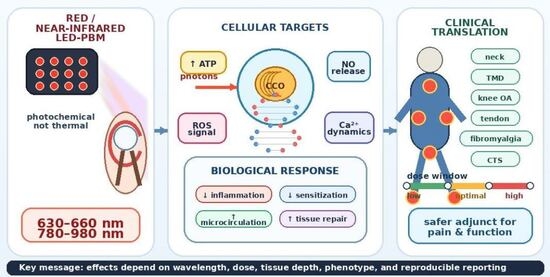
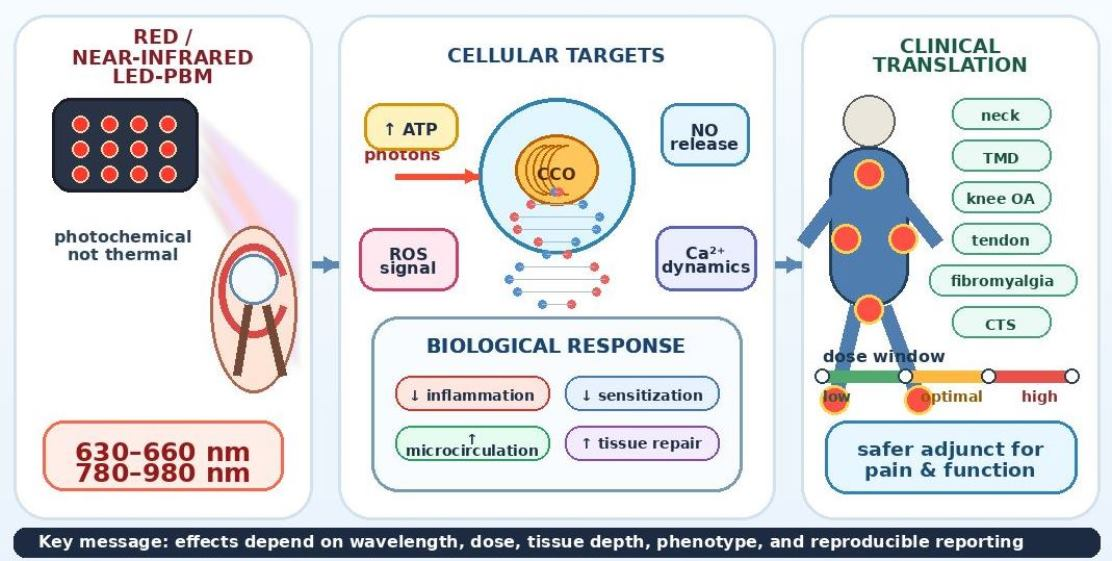
Graphical Abstract

1. Introduction

Musculoskeletal pain is among the most prevalent reasons for seeking medical care and a major driver of disability, work loss, and long-term analgesic use [1,2,3].
A true multimodal approach that combines cognitive, physical, and pharmacological strategies can improve comfort while maintaining patient safety in case of musculoskeletal injuries. Some guidelines offer practical, evidence-based recommendations for clinicians to manage musculoskeletal pain, while also evaluating the strength of the evidence and highlighting priorities for future research [4].
Because pharmacological pain control (opioid analgesics) may be limited by adverse effects and risks such as tolerance, abuse, and misuse, interest in and use of non-pharmacologic pain treatments have increased substantially over time [5,6,7]. Photobiomodulation (PBM), formerly known as low-level laser therapy (LLLT), uses non-ionizing red or near-infrared light produced by semiconductor sources, delivered either as coherent laser radiation or as non-coherent light-emitting diode (LED) emission [8,9]. LED-based PBM aims to trigger photochemical and photobiological responses rather than heat-mediated tissue effects [10].
The scope and methodological approach of this review are described below.

2. Materials and Methods

This manuscript was prepared as a focused narrative review of the literature addressing photobiomodulation (PBM) for musculoskeletal pain, with particular emphasis on LED-based approaches and with relevant comparisons to laser-based PBM where appropriate. The review was conceived to integrate molecular, mechanistic, clinical, and translational evidence relevant to the effects of red and near-infrared light on pain modulation, inflammation, tissue repair, and functional recovery in musculoskeletal disorders of interest to rehabilitation and pain medicine.
The aim of this work was to critically examine the current evidence supporting the use of LED-based PBM in musculoskeletal pain, with particular emphasis on mechanistic plausibility, clinical relevance, dosimetric interpretation, and translational limitations. More specifically, the analysis aimed to identify the musculoskeletal conditions in which PBM appears most promising, assess whether reported therapeutic effects are consistent with current biological knowledge, and determine to what extent heterogeneity between studies may be explained by differences in wavelength selection, irradiance, radiant exposure, treatment timing, anatomical target depth, device design, comparator choice, and overall protocol quality.

2.1. Literature Search Strategy and Study Selection

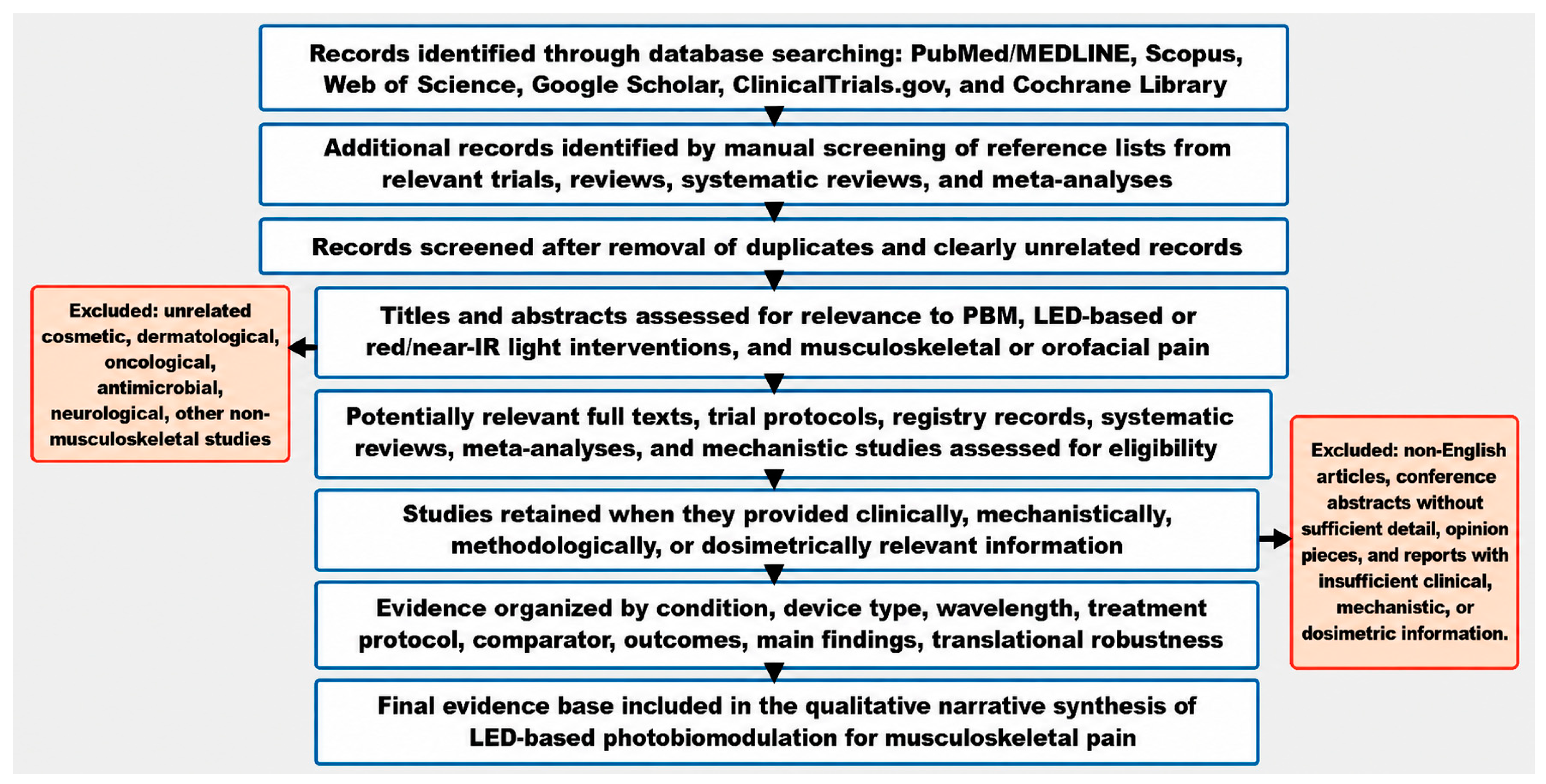
A structured literature search was conducted to identify relevant clinical, translational, and mechanistic studies on PBM for musculoskeletal pain, with emphasis on LED-based devices. The search was performed in PubMed/MEDLINE, Scopus, Web of Science, Google Scholar, ClinicalTrials.gov, and the Cochrane Library. The main search terms included combinations of the following keywords: “photobiomodulation,” “PBM,” “low-level light therapy,” “LLLT,” “LED,” “light-emitting diode,” “red light,” “near-infrared light,” “musculoskeletal pain,” “chronic pain,” “neck pain,” “low back pain,” “knee osteoarthritis,” “temporomandibular disorder,” “fibromyalgia,” “tendinopathy,” “plantar fasciitis,” “shoulder pain,” and “carpal tunnel syndrome.” Boolean operators were used where appropriate, including combinations such as “photobiomodulation AND musculoskeletal pain,” “LED AND photobiomodulation AND pain,” and (“red light” OR “near-infrared light”) AND “chronic pain.”
The literature search focused primarily on studies published between 2021 and 2026 in order to capture recent developments in LED-based PBM and related clinical applications. Earlier publications were also considered when they provided important mechanistic background, methodological guidance, dosimetric information, reporting standards, or foundational context relevant to PBM biological plausibility. Reference lists of relevant trials, reviews, systematic reviews, and meta-analyses were also screened manually to identify additional eligible sources.
After completion of the electronic and manual searches, records were screened in sequential narrative-review stages. First, titles and abstracts were examined for topical relevance to PBM, low-level light therapy, LED-based or red/near-infrared light interventions, and musculoskeletal or orofacial pain. Records clearly unrelated to the review question were removed at this stage, including studies focused exclusively on cosmetic, dermatological, oncological, antimicrobial, dental-hard-tissue, neurological, or other non-musculoskeletal applications without direct relevance to pain modulation, inflammation, tissue repair, or rehabilitation. Duplicate or overlapping records were also checked, and when multiple reports referred to the same study population or intervention, the most complete and methodologically informative source was preferentially considered.
In the second stage, potentially relevant full texts, trial protocols, registry records, systematic reviews, meta-analyses, and mechanistic or experimental studies were assessed for eligibility and relevance to the objectives of this focused narrative review. Studies were considered eligible when they addressed PBM or low-level light-based therapy in musculoskeletal or musculoskeletal-adjacent pain conditions, including chronic neck pain, chronic low back pain, knee osteoarthritis, temporomandibular disorders, fibromyalgia, tendinopathies, plantar fasciitis, shoulder pain, carpal tunnel syndrome, delayed-onset muscle soreness, or related rehabilitation contexts. Eligible interventions included LED-based PBM, laser-based PBM, combined laser–LED devices, whole-body LED systems, wearable LED devices, and red or near-infrared light interventions when their mechanisms, treatment parameters, or clinical outcomes were relevant to LED-based PBM interpretation.
The inclusion process prioritized studies that reported clinically or biologically meaningful outcomes, such as pain intensity, disability, function, range of motion, pressure pain threshold, quality of life, inflammatory markers, tissue repair variables, cartilage- or tendon-related outcomes, and safety. Particular weight was given to randomized controlled trials, sham- or placebo-controlled studies, comparative clinical studies, systematic reviews, meta-analyses, clinical trial protocols, registry records, and selected experimental studies that provided mechanistic or dosimetric context. Studies reporting essential PBM parameters, including wavelength, irradiance or power output, radiant exposure or fluence, treatment area, exposure time, number of sites, treatment frequency, and total treatment schedule, were considered especially informative because these variables are critical for reproducibility and interpretation of PBM effects.
Studies were excluded when they did not involve PBM, low-level light therapy, LED therapy, or red/near-infrared light exposure; when the clinical condition was unrelated to musculoskeletal or orofacial pain; when the intervention was primarily thermal, surgical, pharmacological, cosmetic, or dermatological without relevance to the review question; or when the report lacked sufficient methodological, clinical, mechanistic, or dosimetric information to support meaningful interpretation. Non-English articles, conference abstracts without adequate methodological detail, editorials, opinion pieces, and publications with only marginal relevance to LED-based PBM for musculoskeletal pain were not retained as core evidence. Foundational or earlier publications outside the primary 2021–2026 search window were retained selectively when they provided important background on PBM mechanisms, dosimetry, reporting standards, or biological plausibility.

2.2. Evidence Synthesis

The final selection was based on relevance, methodological informativeness, and interpretability rather than on exhaustive systematic inclusion. The selected evidence was organized according to clinical condition, device type, wavelength, treatment protocol, comparator, outcome measures, main findings, dosimetric reporting, and methodological or translational robustness. Clinical trial protocols and registry records were used to characterize ongoing or emerging research directions, but they were not interpreted as completed efficacy evidence.
The review focused on musculoskeletal pain conditions for which LED-based PBM has been most frequently investigated or appears clinically relevant, namely chronic neck pain, chronic low back pain, knee osteoarthritis, temporomandibular disorders, fibromyalgia, tendinopathies, plantar fasciitis, shoulder pain, and carpal tunnel syndrome. The selected evidence was analyzed qualitatively across three main domains: mechanistic rationale, condition-specific clinical efficacy, and methodological or translational robustness. Particular attention was given to dose–response relationships, the plausibility of light delivery relative to tissue depth and anatomical target, the adequacy of sham design, and concordance with recommended reporting standards, including World Association for Laser Therapy guidance when applicable.
Because the available literature is highly heterogeneous with respect to device characteristics, irradiation parameters, comparator groups, patient populations, and outcome measures, the evidence was synthesized narratively rather than by pooled quantitative analysis. This approach was chosen to allow a more clinically and biologically grounded interpretation of the field, with emphasis on explanatory patterns underlying both positive and negative findings rather than on a simple aggregation of trial outcomes.
Accordingly, the purpose of this review was not only to summarize the available evidence, but also to provide a mechanism-informed and dosimetry-aware framework for interpreting the therapeutic role of LED-based PBM in musculoskeletal pain, while identifying key priorities for future reproducible and translationally relevant research.
Figure 1 summarizes the search, screening, eligibility assessment, and evidence-selection process used to construct the qualitative narrative synthesis. Records were identified through database searching and supplementary manual screening, then progressively filtered according to relevance to PBM, LED-based or red/near-infrared light interventions, and musculoskeletal or orofacial pain. The final evidence base was organized according to clinical condition, device characteristics, wavelength, treatment protocol, comparator, outcomes, principal findings, and translational robustness.

3. Molecular Evidence for Why LED-Based PBM May Reduce Musculoskeletal Pain

Semiconductor diodes commonly emit in the red to near-infrared spectrum, typically around 630–660 nm and 780–980 nm. These spectral bands are widely used because they offer acceptable tissue transmission with low thermal burden, although penetration depth is strongly affected by wavelength, spot size, skin pigmentation, subcutaneous thickness, and local vascularity. One of the best-known mechanistic models proposes that photons are absorbed by cytochrome-c oxidase and related photoacceptors, increasing mitochondrial respiration and ATP production while transiently modulating reactive oxygen species and nitric oxide bioavailability [10].
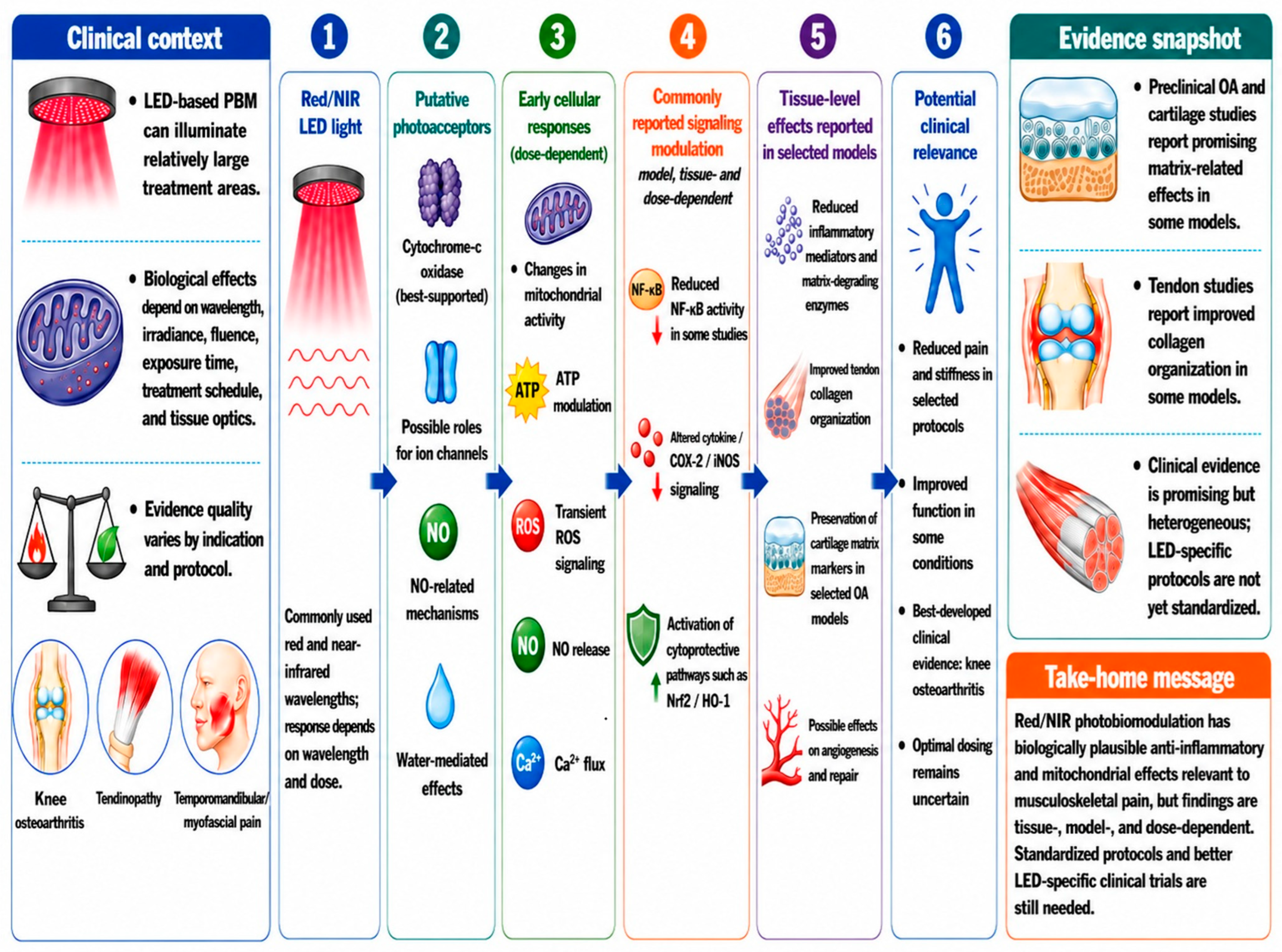
Figure 2 summarizes the proposed molecular rationale and current evidence for LED-based PBM in common musculoskeletal pain disorders. Red and near-infrared LED light may act through putative photoacceptors, particularly cytochrome-c oxidase, with possible contributions from ion channels, nitric oxide-related mechanisms, and water-mediated effects. These interactions can induce dose-dependent cellular responses, including modulation of mitochondrial activity, ATP, transient ROS signaling, nitric oxide release, and calcium flux. The figure further illustrates commonly reported, but model-, tissue-, and dose-dependent, downstream effects involving NF-κB, cytokine/COX-2/iNOS signaling, and cytoprotective Nrf2/HO-1 pathways. These molecular changes may contribute to reduced inflammatory mediators and matrix-degrading enzymes, improved tendon collagen organization, preservation of cartilage matrix markers in selected osteoarthritis models, and possible angiogenic or repair-related effects. Clinically, LED-based PBM is presented as a plausible intervention for reducing pain and stiffness and improving function in selected protocols, with the strongest clinical evidence currently related to knee osteoarthritis, while optimal dosing and standardized LED-specific protocols remain uncertain [11,12,13,14,15,16,17].
Although these pathways provide a biologically plausible framework for LED-based PBM, they should not be interpreted as a single validated sequence from photon absorption to analgesia. Current evidence suggests that PBM responses are context-dependent and may vary according to wavelength, irradiance, radiant exposure, tissue optical properties, inflammatory phenotype, anatomical target, and timing of outcome assessment. Therefore, the molecular events summarized in Figure 2 should be viewed as proposed interacting mechanisms requiring further validation in human musculoskeletal pain models.
Recent LED-focused studies suggest that near-infrared LED exposure can increase human chondrocyte viability and cartilage matrix synthesis, including collagen II, aggrecan, and glycosaminoglycans. In knee osteoarthritis models, optimized LED parameters have been associated with reduced cartilage matrix degradation and pain-related behavior. In tendon models, LED-mediated PBM has improved collagen organization and fiber parallelism, while a 2026 study specifically linked LED effects in tendinopathy to modulation of the IL-6/STAT3 axis [18]. From a pain perspective, PBM may operate through several overlapping mechanisms: attenuation of local inflammatory signaling, reduction in peripheral sensitization, improved microcirculation, mitigation of edema, and facilitation of tissue recovery after mechanical loading. A critical concept is biphasic dose response. Under-dosing may fail to activate relevant pathways, whereas excessive irradiance or energy may reduce therapeutic benefit. This phenomenon probably explains a substantial part of the heterogeneity in musculoskeletal PBM trials.
Overall, Figure 2 supports the interpretation that LED-based PBM may reduce musculoskeletal pain through a combined bioenergetic, anti-inflammatory, antioxidant, and tissue-reparative mechanism. Its main translational limitation remains dosimetry: wavelength, irradiance, fluence, pulse structure, treatment frequency, tissue depth, and disease phenotype all influence outcomes. Therefore, future clinical studies should combine clinical endpoints with molecular biomarkers to identify which patients and tissue states are most likely to respond [11,12,13,14,15,16,17,18,19,20,21].

4. Evidence Across Musculoskeletal Pain Conditions

4.1. LED-Based PBM for Musculoskeletal Pain: A Clinical Evidence Perspective

Condition-specific evidence is summarized below in Table 1. Importantly, positive findings are not interchangeable across diagnoses, because target tissue depth, chronicity, pain phenotype, and co-interventions differ substantially.
Table 1 synthesizes recent literature on LED-based PBM for musculoskeletal and musculoskeletal-adjacent pain conditions published or registered between 2021 and 2026. The table covers a heterogeneous set of painful disorders, including chronic neck pain, multisite musculoskeletal pain, knee osteoarthritis/gonarthrosis, temporomandibular disorder, fibromyalgia, chronic low back or back pain, delayed-onset muscle soreness, and patellofemoral pain. Across these conditions, the reported PBM systems mainly use red and near-infrared wavelengths, most frequently 660 nm and 850 nm, although other configurations are also represented, including mixed LED/laser clusters and a blue-light device for chronic back pain. Protocols vary substantially in treatment setting, exposure duration, number of sessions, anatomical targets, and follow-up intervals. The evidence presented includes different levels of clinical maturity. Several randomized, controlled and blinded trials report reductions in pain and, in some cases, improvements in pressure pain threshold, quality of life, mobility, psychological variables, or tissue-related measures. The most consistent positive signals are observed in temporomandibular disorder and fibromyalgia studies using red/near-infrared LED-based PBM, including whole-body PBM protocols. For the whole-body fibromyalgia studies, the reported 967 W denotes the estimated total optical/radiant output of the LED system distributed over a total emitting surface of 34,544 cm2. It should not be interpreted as focal power delivered to a single anatomical site. The local irradiance was 28 mW/cm2 and the radiant exposure was 25.2 J/cm2 over 1200 s (or 20 min), corresponding to non-thermal large-field PBM exposure [29].
By contrast, the chronic nonspecific low back pain trial did not demonstrate clinically important superiority over placebo, and the blue-light back-pain study showed pain reduction without meeting its predefined superiority target. These findings indicate that therapeutic response may depend on condition, wavelength, dose, device design, treatment schedule, comparator, and outcome domain.
The table also distinguishes completed efficacy studies from protocols, feasibility studies, registry records, and systematic reviews. Protocol and registry entries document active research directions but should not be interpreted as efficacy evidence. Feasibility and single-arm studies provide information on acceptability, safety, and implementation, but they cannot establish comparative effectiveness. Systematic reviews suggest potential benefits of PBM in selected musculoskeletal pain contexts; however, they also emphasize heterogeneity of devices, parameters, and study quality, particularly when LED-only effects cannot be separated from mixed laser/LED interventions. Overall, the table supports LED-based PBM as a generally safe and promising noninvasive modality for selected musculoskeletal pain conditions, while highlighting the need for standardized dosimetry, larger well-controlled trials, longer follow-up, and clearer separation of LED-specific effects.

4.2. Therapeutic Light in Action: Evidence in Focus for Musculoskeletal Pain Disorders: Translational Dosing Principles

This section synthesizes clinical and translational evidence relevant to PBM in musculoskeletal pain, with explicit distinction between LED-specific evidence, combined laser–LED evidence, low-level laser therapy (LLLT) evidence, and high-intensity laser therapy (HILT) evidence. Because the primary focus of this review is LED-based PBM, studies using LED-only or LED-dominant devices are considered the most directly relevant clinical evidence. Studies using combined laser–LED devices are discussed as partially relevant, provided that the LED component and treatment parameters are sufficiently described. Studies using laser-based LLLT or HILT are not treated as direct evidence for LED-based PBM, but are included only when they provide useful contextual information regarding photobiological mechanisms, wavelength-dependent tissue interaction, dose–response relationships, target depth, treatment geometry, or methodological limitations.
This distinction is important because LED and laser devices differ in coherence, beam divergence, irradiance distribution, tissue contact geometry, treatment field size, and potential depth of energy delivery. Therefore, clinical outcomes obtained with laser or HILT devices cannot be directly extrapolated to LED-based PBM without careful consideration of wavelength, irradiance, radiant exposure, treatment area, application mode, and anatomical target depth. In this review, laser and HILT studies are used to inform the broader PBM framework, but LED-specific conclusions are drawn primarily from LED-based or combined laser–LED studies.
The studies discussed below are grouped by clinical indication and translational relevance: cervical and myofascial pain, low back pain, tendon and enthesis disorders, knee osteoarthritis and knee pain, temporomandibular disorders and fibromyalgia, and carpal tunnel syndrome. For each indication, the level of relevance to LED-based PBM is interpreted according to device type, dose reporting, target depth, and similarity of treatment geometry to clinically feasible LED applications.

4.2.1. Why LED-Based PBM Requires a Broader Clinical Evidence Frame

LED-based PBM therapy has matured from a peripheral alternative to laser-based low-level light therapy into a clinically relevant platform for non-thermal neuromusculoskeletal rehabilitation. The central translational premise is that therapeutic benefit depends less on the engineering identity of the emitter than on the biologically delivered optical dose: wavelength, irradiance, radiant exposure, pulse structure, treatment area, treatment frequency, tissue optical properties, and the spatial distribution of energy. The literature supplied here is therefore best interpreted as a continuum of PBM evidence. It includes systematic reviews of low-level laser therapy, randomized trials using laser or combined laser–LED devices, LED/light-therapy trials, and high-intensity laser therapy reviews. Although these modalities differ technically, each contributes to the practical question that matters for LED-based PBM: how can light be dosed, positioned, and integrated with the usual care to modulate pain, inflammation, function, and tissue recovery without relying on heat as the primary mechanism?
Across musculoskeletal disorders, the evidence base is heterogeneous but clinically instructive. A broad systematic review and meta-analysis reported analgesic effects of low-level laser therapy across musculoskeletal disorders, establishing an important foundation for PBM as a pain-modulating intervention [38]. However, later reviews and trials also demonstrate that outcomes are highly condition-specific and parameter-sensitive. This is particularly important for LED platforms, which often have lower coherence and different beam geometry compared with lasers, but can treat larger areas, improve uniformity over curved anatomy, and support wearable or cluster-device configurations. In LED-PBM, negative or equivocal findings should not be read simply as evidence against light therapy; they often indicate that diagnosis, depth of target, dose, comparator, and co-interventions must be matched more rigorously.

4.2.2. Cervical and Myofascial Pain: Localized Analgesia, Trigger-Point Biology, and Multimodal Rehabilitation

Neck pain and cervical myofascial pain provide one of the clearest examples of how PBM evidence can inform LED-based protocols. Dundar et al. evaluated gallium–aluminum–arsenide laser therapy for cervical myofascial pain in a double-blind placebo-controlled trial, placing early emphasis on trigger-point irradiation and localized analgesia [39]. More recently, Tehrani et al. synthesized randomized trials in myofascial neck pain and concluded that low-level laser therapy can influence pain, disability, pressure pain threshold, and range of motion, while also emphasizing variation in trial quality and treatment parameters [40]. These findings are relevant for LED-PBM because superficial and moderately deep cervical muscle targets are accessible to red and near-infrared arrays, especially when treatment heads are designed to conform to the trapezius, levator scapulae, suboccipital, and paraspinal regions.
The comparison between PBM and other electro-physical modalities is also clinically important. Rampazo et al. compared PBM and transcutaneous electrical nerve stimulation in chronic neck pain using a double-blind, randomized, sham-controlled design [41]. Such work moves the field beyond a simple active-versus-placebo framework and toward pragmatic decisions about which modality, or sequence of modalities, should be selected for a patient with chronic pain sensitization, postural overload, or myofascial dysfunction. For LED-based PBM, these studies collectively suggest that the cervical region is a plausible target when treatment is dosed over both painful points and functionally relevant muscle fields. They also caution against extrapolating directly from focal laser parameters to broad LED arrays without recalculating delivered radiant exposure and accounting for tissue contact, treatment area, and anatomical depth.

4.2.3. Low Back Pain: Inconsistent Efficacy and the Importance of Dose, Phenotype, and Comparator Selection

Non-specific low back pain (LBP) illustrates the interpretive difficulty of PBM research. The Cochrane review by Yousefi-Nooraie et al. assessed low-level laser therapy for non-specific low-back pain and framed the intervention as potentially useful but limited by the quantity and quality of evidence available at that time [42]. Huang et al. later reported effectiveness of low-level laser therapy for non-specific chronic LBP in a systematic review and meta-analysis, indicating potential benefits under selected conditions [43]. In contrast, Tomazoni et al. proposed a randomized placebo-controlled trial designed to examine the effects of PBM therapy on inflammatory mediators in patients with chronic non-specific low back pain, reflecting the need to move beyond clinical pain scores alone and to clarify whether PBM produces measurable biological effects in this population [44]. Tomazoni et al. subsequently concluded that PBM therapy did not decrease pain and disability in people with non-specific low back pain, underscoring the persistent uncertainty and the risk of overgeneralization [45]. This uncertainty also explains why later LBP protocols have emphasized combined and multimodal rehabilitation strategies. Dos Santos et al. proposed a randomized controlled trial evaluating PBM therapy combined with exercise in patients with chronic low back pain, reinforcing the view that PBM may be more appropriately investigated as an adjunct to active rehabilitation rather than as an isolated analgesic modality [46]. Similarly, Barbosa da Silva et al. described a multimodal therapeutic intervention program associated with PBM therapy for chronic non-specific neck pain, which, although focused on the cervical region rather than the lumbar spine, supports the broader translational principle that PBM should be embedded within phenotype-informed, multimodal conservative care [47]. The comparative study by Tantawy et al., in which laser PBM was more effective than ultrasound therapy for chronic non-specific low back pain, adds a pragmatic rehabilitation perspective [48]. Yet the overall body of evidence implies that LED-PBM for LBP should not be treated as a uniform indication. LBP can involve superficial myofascial pain, facet-mediated pain, discogenic pain, radicular features, central sensitization, or mixed mechanical and inflammatory phenotypes. LED arrays may be particularly appropriate for broad paraspinal or lumbopelvic applications, but their success depends on matching wavelength and irradiance to the intended biological target. The contradictory findings across reviews also make sham design, blinding, and co-intervention control central methodological priorities. In practice, LED-PBM for LBP should be investigated as a phenotype-specific adjunct to exercise, education, and graded activity rather than as a stand-alone universal analgesic.

4.2.4. Knee Osteoarthritis and Nonspecific Knee Pain: Cluster Devices, Combined Emitters, and Recommendation-Sensitive Interpretation

Knee osteoarthritis is a major clinical field for LED-PBM because the joint is accessible to multi-diode cluster devices and because symptoms are strongly influenced by local inflammation, periarticular muscle function, and pain sensitization. Leal-Junior et al. examined a combination of super-pulsed laser and light-emitting diodes for non-specific knee pain, directly connecting LED emitters with clinical phototherapy research [49]. Vassão et al. tested PBM delivered by a cluster device in association with physical exercise in middle-aged and older women with knee osteoarthritis, evaluating pain and muscle strength in a placebo-controlled randomized design [50]. These studies are particularly relevant because LED-based PBM is often implemented through clusters combining red and near-infrared sources, sometimes alongside laser diodes, to enlarge the therapeutic field and address complex periarticular anatomy.
The systematic review and meta-analysis by Oliveira et al. on knee osteoarthritis reported effects of PBM on pain and disability, providing a contemporary synthesis for this indication [51]. At the same time, Stausholm and Bjordal criticized neglect of relevant treatment recommendations in the conduct and reporting of a knee osteoarthritis laser trial, reminding the field that PBM outcomes are highly vulnerable to underdosing, inappropriate treatment points, incomplete reporting, and failure to follow established dose guidance [52]. This point is critical for LED-PBM. Because LEDs differ in divergence, output stability, irradiance distribution, and contact characteristics, reporting only treatment duration or device class is inadequate. Trials should specify wavelength, optical power per diode, total power, irradiated area, irradiance, energy per point or field, radiant exposure, treatment frequency, anatomical sites, and whether the device was used in contact or non-contact mode. Without such reporting, positive trials cannot be replicated and negative trials cannot be interpreted fairly.

4.2.5. Temporomandibular Disorders, Orofacial Pain, and Fibromyalgia: Pain Phenotypes and Systemic Sensitization

Temporomandibular disorders (TMDs) are another clinically important area for LED-based PBM because masticatory muscles, temporomandibular joints, and trigger points are superficially accessible and because treatment can be localized with relatively low risk. Leal de Godoy et al. conducted a blinded randomized pilot study of low-level laser therapy in adolescents with TMD, supporting the feasibility of PBM in younger populations [53]. Khalighi et al. compared low-level laser therapy with pharmacotherapy for myofascial pain disorder syndrome, positioning PBM as a non-pharmacological option for orofacial myalgia [54]. Al-Quisi et al. directly compared light therapy with laser for pain reduction in TMDs, which is especially relevant to LED-based implementation because it addresses whether non-laser light sources can achieve clinically meaningful analgesia [55].
For LED-PBM in TMD, the literature suggests that device design should account for distinct anatomical treatment targets: the fleshy contractile portion of masticatory muscles such as the masseter or temporalis, the temporomandibular joint line, and localized myofascial trigger points, rather than treating TMD as a single anatomical target. It also suggests that endpoints should include pain intensity, mandibular range of motion, pressure pain threshold, functional limitation, and medication use.
Fibromyalgia expands the discussion from local tissue pathology to systemic pain amplification. Yeh et al. reviewed low-level laser therapy for fibromyalgia and reported meta-analytic evidence relevant to pain modulation [56]. Martín Pérez et al. reviewed PBM for fibromyalgia management, reflecting sustained interest in light therapy for widespread pain and fatigue-related syndromes [57]. LED-based PBM may be particularly attractive in fibromyalgia because large treatment areas, home-use designs, and lower-cost arrays are feasible; however, systemic conditions require cautious claims. In fibromyalgia, PBM should be investigated as a component of multimodal management, with attention to central sensitization, sleep, fatigue, exercise tolerance, and patient-reported global improvement rather than only local pain scores.

4.2.6. Tendon, Enthesis, Plantar Fascia, and Shoulder Disorders: From Inflammation Control to Load-Tolerance Restoration

Tendinopathy and enthesis-related pain are particularly relevant to LED-PBM because treatment goals extend beyond short-term analgesia. Tripodi et al. synthesized randomized trials of red and near-infrared PBM for tendinopathy, supporting the idea that light-based interventions can influence pain and function when parameters and clinical context are appropriate [58]. These data are highly relevant to LED arrays, which can cover tendon–bone interfaces and surrounding muscle–tendon units more evenly than a narrow beam when the target is broad or anatomically irregular.
Plantar fasciitis has a comparatively rich PBM literature. Systematic reviews and meta-analyses by Wang et al. and by Dos Santos et al. reported clinical effects and parameter-related considerations for low-level laser therapy/PBM in plantar fasciitis [59,60]. Ortiz-Romero et al. further updated the plantar fasciitis evidence through a meta-analysis of local laser therapy [61]. For LED-PBM, plantar fascia disorders are attractive because the target is relatively superficial, the treatment field is well defined, and a cluster or pad device can irradiate the medial calcaneal tubercle, fascia band, and related soft tissues.
Shoulder tendinopathy and impingement require more nuanced translation. Haslerud et al. reviewed low-level laser therapy for shoulder tendinopathy and found evidence that depends on appropriate dosing and diagnosis [62]. Martins et al. compared therapeutic ultrasound and PBM for rotator cuff tendinopathy, situating PBM within routine rehabilitation choices [63]. Castaldo et al. reviewed low-level laser therapy for shoulder impingement syndrome, reinforcing both promise and methodological variability [64]. LED-based PBM may be useful for superficial rotator cuff insertions, periarticular soft tissues, and pain-modulating applications, but deeper subacromial targets may require careful wavelength selection, contact technique, and treatment geometry. Across tendon-related indications, PBM should be paired with progressive loading because light may alter pain and inflammatory signaling, whereas tendon capacity is restored primarily through graded mechanical adaptation.

4.2.7. Carpal Tunnel Syndrome and Peripheral Nerve Applications: Analgesia, Function, and Perioperative Recovery

Carpal tunnel syndrome (CTS) is a compelling peripheral nerve indication because the median nerve is anatomically localized, symptoms are measurable, and function can be assessed with validated scales and electrophysiological outcomes. A Cochrane review by Rankin et al. also assessed low-level laser therapy for CTS, offering a rigorous appraisal of trial certainty and clinical relevance [65].
Cheung et al. performed a systematic review and network meta-analysis of low-level laser therapy for CTS, situating PBM among competing conservative interventions [66]. Güloğlu et al. compared low-level laser therapy with corticosteroid injection in a randomized prospective study, highlighting the need to compare PBM against established treatments rather than only sham controls [67]. Chuah et al. evaluated PBM in the context of carpal tunnel release surgery, suggesting a possible perioperative role for light therapy in pain, healing, or functional recovery [68].
Lauxen et al. reviewed PBM in CTS with analysis of pain, strength, and functionality, providing a newer synthesis that is directly relevant to rehabilitation outcomes [69].
High-intensity laser therapy (HILT) has also been examined in systematic reviews by de la Barra Ortiz et al. across several conditions: neck pain, where it informs the evidence base on deeper, higher-power optical delivery [70]; temporomandibular joint disorders, where it broadens the therapeutic laser spectrum beyond conventional low-power approaches [71]; and carpal tunnel syndrome [72].
HILT appears effective for patients with CTS, reducing pain and disability while improving electrophysiological parameters. However, the certainty of evidence is only low to moderate, so future randomized trials should standardize outcomes and compare HILT directly with low-level laser therapy to clarify its clinical value [72].
Clinical comparisons further refine interpretation. For LED-PBM, CTS presents both opportunity and challenge. Red and near-infrared LEDs can be placed over the carpal tunnel and distal forearm, but effective treatment requires sufficient penetration to influence neural, vascular, synovial, and connective tissue components. Outcomes should therefore include symptom severity, functional status, grip and pinch strength, nerve conduction when feasible, and durability of response. The CTS literature also encourages stratification by severity, because mild and moderate cases may respond differently from severe compression neuropathy requiring surgical decompression.

4.2.8. Methodological and Translational Implications for LED-Based PBM Therapy

Taken together, the supplied references support a cautious but constructive interpretation of LED-based PBM. The most consistent clinical logic appears in superficial or moderately deep musculoskeletal conditions where pain, inflammation, microcirculation, and tissue repair are plausible therapeutic targets: cervical myofascial pain, TMD-related myalgia, plantar fasciitis, selected tendinopathies, knee osteoarthritis, and mild-to-moderate CTS. The evidence is less uniform for non-specific low back pain, where anatomical heterogeneity and inconsistent dosing complicate synthesis. The field also shows that device identity cannot substitute for photobiological reasonableness. LED therapy should not be assumed equivalent to laser therapy merely because both emit red or near-infrared light; conversely, laser-based evidence should not be dismissed for LED development when dose, wavelength, target depth, and treatment geometry can be rationally translated.
For academic and clinical purposes, LED-PBM protocols should be reported with enough precision to permit replication: wavelength or wavelength combination, spectral bandwidth, optical power per emitter, number of emitters, array geometry, beam divergence, irradiance at the skin, treatment area, delivered energy, radiant exposure, pulse mode if present, session duration, number and frequency of sessions, anatomical landmarks, skin contact conditions, and co-interventions. Trials should also distinguish immediate analgesic responses from medium-term functional recovery. Pain reduction alone may not demonstrate disease modification, whereas improved load tolerance, range of motion, strength, nerve function, or disability may better reflect rehabilitation value.
A final implication concerns integration. LED-based PBM is best understood not as a replacement for exercise therapy, manual therapy, pharmacological care, injection, surgery, or education, but as a biologically plausible adjunct whose role depends on diagnosis and treatment phase. In acute inflammatory or postsurgical settings, PBM may support tissue recovery and pain control. In chronic pain, it may create a therapeutic window for movement, desensitization, and strength restoration. In degenerative or compressive conditions, it may reduce symptoms while definitive mechanical or behavioral interventions address the underlying load environment. This integrated model respects both the promising findings and the limitations present across the reference set, and it provides the most defensible investigation framework for future LED-based PBM research.
The reviewed evidence supports a balanced position: LED-based PBM is neither a generic remedy for all pain disorders nor a marginal technology lacking biological plausibility. Its strongest rationale is found where tissue depth, diagnosis, and treatment field match the optical capabilities of LED arrays. Future LED-PBM studies should prioritize transparent dosimetry, condition-specific phenotyping, clinically meaningful comparators, longer follow-up, and integration with exercise or usual care. Under these conditions, LED-PBM can be developed as a reproducible, scalable, and patient-friendly adjunct in musculoskeletal, orofacial, and selected peripheral nerve rehabilitation.
Therefore, throughout this review, conclusions specifically concerning LED-based PBM are based primarily on LED-only or combined laser–LED studies, whereas laser-only and HILT studies are interpreted as indirect, contextual evidence rather than as direct clinical support for LED-based protocols.

5. Laser Versus LED and Why Coherence Is Not the Whole Story

The term “diode-emitted light” is useful because it includes both low-power laser diodes and LEDs, which are now widely used within PBM. From a physical standpoint, lasers generate light that is more coherent, monochromatic, and often more collimated than LED emission, whereas LEDs are non-coherent and usually more divergent. However, this distinction should not be overinterpreted clinically. Contemporary PBM literature increasingly emphasizes that, once light enters biological tissue, coherence is rapidly degraded by reflection, refraction, scattering, and absorption, so the therapeutic response is more likely to depend on wavelength selection, irradiance, beam geometry, treatment area, repetition schedule, and the energy actually delivered to the target tissue than on coherence itself [73,74,75].
This distinction has practical consequences for protocol design. LED arrays may be particularly attractive when the treatment target is broad, superficial, or anatomically irregular, because they can illuminate larger areas more easily and often at lower cost. By contrast, laser diodes may be preferable when precise point application, smaller treatment fields, or more focused beam delivery are required. In other words, the clinically relevant question is usually not whether the source is a laser or an LED in isolation, but whether the optical and dosimetric profile of the device is well matched to the anatomy, depth, and biological behavior of the target tissue. This helps explain why studies that compare emitter classes without adequately matching wavelength, spot size, irradiance, pulse structure, and dose at the tissue level can be misleading. The broader PBM literature therefore supports a shift away from a simple “laser versus LED” disjunction toward a more translational framework centered on target engagement and dose equivalence [74,75].
Direct comparative clinical evidence between LEDs and lasers remains still limited. For future research, laser and LED interventions should not be pooled indiscriminately unless dosimetric equivalence is plausible and clearly documented. Trials should report not only nominal device output, but also spot size, irradiance, fluence, pulse pattern, treatment area, treatment duration, number of sessions, and the rationale for choosing those parameters relative to tissue depth and pathology. Without that level of reporting, negative or inconsistent results may reflect poor protocol matching rather than a genuine failure of diode-emitted light as a therapeutic modality. Overall, coherence remains an interesting physical property, but it is not sufficient to explain clinical PBM efficacy on its own; wavelength, dose delivery, and anatomical fit are usually the more decisive variables [73,74,75,76].
Although tissue scattering provides a strong theoretical basis for questioning whether optical coherence alone determines PBM efficacy, current clinical evidence remains insufficient to conclude that laser and LED devices are therapeutically equivalent when all other parameters are matched. Direct head-to-head clinical trials comparing laser and LED PBM under the same wavelength, irradiance, radiant exposure, irradiation area, treatment schedule, and anatomical target are still limited. Therefore, the present review interprets coherence as one physical variable among several, while emphasizing that clinical conclusions should remain centered on documented dose delivery, treatment geometry, and target engagement rather than on emitter classification alone.
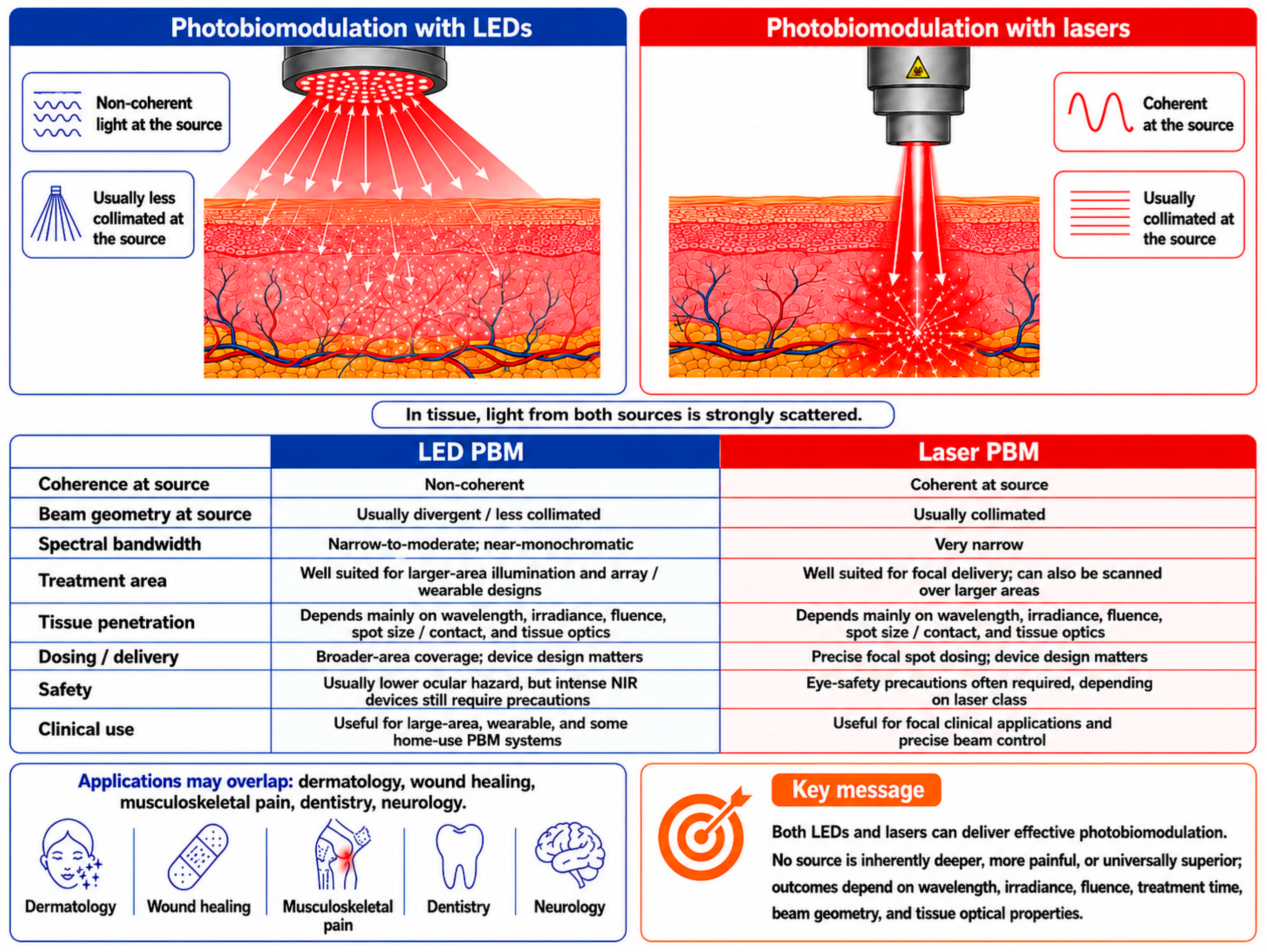
Table 2 provides a concise overview of the main clinically relevant distinctions between laser diodes and LEDs in PBM. Although these light sources differ in coherence and beam collimation, such physical characteristics alone do not appear to fully account for therapeutic effects at the tissue level. Instead, clinical efficacy is more likely to depend on parameters such as wavelength, irradiance, beam geometry, treatment area, treatment schedule, and the energy delivered to the target tissue. Accordingly, the table is intended to support a dosimetry-oriented interpretation of PBM and to emphasize that laser- and LED-based interventions should not be regarded as interchangeable unless dosimetric equivalence is adequately demonstrated.
Figure 3 provides a schematic comparison between LED- and laser-based PBM, highlighting the principal physical differences in coherence, beam collimation, spectral characteristics, power distribution, and tissue penetration. Although LEDs and lasers differ at the source in all the parameters mentioned above, these differences should not be interpreted as indicating that one modality is intrinsically superior for all musculoskeletal indications. Once light enters biological tissue, both LED and laser radiation undergo substantial scattering, absorption, reflection, and refraction; therefore, clinical efficacy is more plausibly determined by the extent to which an adequate dose reaches the intended target tissue.
Importantly, the figure also illustrates the central translational concept discussed in this review, namely that therapeutic efficacy is unlikely to depend on coherence alone and is more plausibly determined by wavelength, irradiance, beam geometry, treatment area, and dosimetric adequacy at the target tissue.
For musculoskeletal pain, the practical distinction between LED and laser PBM is therefore mainly related to treatment geometry and target selection. LED arrays may be particularly useful when the therapeutic field is broad, superficial, curved, or anatomically diffuse, such as in myofascial pain syndromes, delayed-onset muscle soreness, diffuse cervical or lumbar pain, temporomandibular muscle pain, fibromyalgia-related widespread pain, superficial periarticular pain, and larger soft-tissue regions surrounding symptomatic joints. In contrast, laser PBM may be advantageous when more focal or point-specific irradiation is required, including trigger points, tendon insertions, entheses, ligamentous pain, joint-line applications, carpal tunnel region treatment, small-joint pain, and selected deeper periarticular targets where precise beam delivery and controlled spot dosing are desirable. Thus, Figure 3 is intended to support clinical interpretation of PBM source selection in musculoskeletal pain, rather than to present a generic hierarchy between LEDs and lasers.
The LED side shows diffuse, incoherent, and divergent light that spreads over a wider area and has variable wavelengths, lower power density, scattered energy, and shallower tissue penetration. It is presented as generally safe and commonly associated with dermatology therapy, wound healing, rejuvenation, musculoskeletal pain and so on. The LASER side shows coherent, same-phase, organized light with parallel rays and a collimated, focused beam. It is characterized by targeted monochromatic light, higher power density, focused energy, and deeper tissue penetration, but it also carries ocular risk and requires protective goggles. However, laser light scatters in tissues, including reflection and refraction processes.
Therefore, the clinical relevance of Figure 3 lies not in a generic laser-versus-LED distinction, but in matching the optical source and dosimetric profile to tissue depth, treatment area, and musculoskeletal pain phenotype.

6. Safety, Reporting Quality, and Dosing Challenges

PBM is generally well tolerated and has shown a low rate of adverse effects across musculoskeletal trials and reviews, with reported side effects usually being mild, transient, and not clearly different from placebo when appropriate parameters are used [75,77].
Nevertheless, prudent clinical use still requires appropriate eye protection, strict avoidance of direct retinal exposure, and caution in situations such as pregnancy, active malignancy, hemorrhagic conditions, or impaired sensations, where treatment decisions should remain anatomically and clinically context-specific rather than purely device-driven [78,79].
More importantly, the central problem in this field is often not safety, but reproducibility. Multiple methodological sources have emphasized that PBM studies frequently omit critical irradiation details such as spot size, beam area at the skin, irradiance, pulse parameters, treatment duration, contact technique, number of treatment sites, interval between sessions, and actual delivered energy, making between-study comparison difficult and weakening the interpretability of meta-analyses [80,81,82,83].
This concern is especially relevant because PBM follows a biphasic dose–response pattern, meaning that insufficient dosing may fail to activate the intended biological pathway, whereas excessive dosing may reduce or abolish the therapeutic effect rather than improve it [84,85].
Accordingly, future trials should define more explicitly whether the protocol is designed primarily for analgesia, tissue repair, or exercise recovery, since these goals may require different dose windows, treatment timing, and anatomical delivery strategies; in exercise-related applications, for example, systematic review evidence suggests that the magnitude of benefit depends not only on whether PBM is used, but also on the moment of application and the parameters selected within the exercise protocol [14,86].
Overall, the field would benefit from stricter protocol reporting, better dosimetric standardization, and clearer biological framing of treatment objectives, because without that methodological discipline, negative or inconsistent findings may reflect suboptimal protocol design rather than true lack of PBM efficacy.

7. Translational Priorities for Mechanism-Guided and Reproducible PBM Research

A major translational priority in PBM research is the move away from broad diagnostic categories toward biologically and clinically defined phenotypes. Labels such as osteoarthritis, neck pain, or myofascial pain are often too heterogeneous to serve as sufficient treatment classifiers, because they can include patients with markedly different inflammatory activity, pain sensitization profiles, structural pathology, and exercise responsiveness.
Future trials would therefore benefit from stratifying participants into more meaningful subgroups, such as inflammatory-dominant osteoarthritis, trigger-point dominant myofascial pain, postsurgical pain states, or centrally amplified pain phenotypes, so that treatment effects can be interpreted in relation to mechanism rather than diagnosis alone.
Such phenotyping is especially important in pain research, where identical symptom locations may reflect substantially different peripheral and central drivers of pain persistence [87].
A second priority is the direct testing of whether coherence contributes independently to clinical efficacy when wavelength and target dose are matched. The longstanding tendency to distinguish lasers from LEDs primarily on the basis of coherence is increasingly challenged by the view that, at the tissue level, therapeutic response is driven more by wavelength, irradiance, beam profile, treatment area, and energy delivery at the biological target than by coherence itself. For that reason, future comparative trials should match laser and LED devices as closely as possible for wavelength, beam area, exposure time, and estimated target dose, rather than comparing commercially available devices with fundamentally different optical outputs and then attributing differences to coherence alone. This issue is not only theoretical; it has direct implications for device design, regulatory interpretation, and the pooling of evidence in systematic reviews [88,89].
A third priority is the routine incorporation of mechanistic biomarkers into clinical trials. Pain intensity and disability remain clinically essential endpoints, but they are not sufficient on their own to establish how or why PBM works in a given phenotype. Trials should increasingly integrate inflammatory mediators, pressure pain thresholds, quantitative sensory testing, ultrasound or magnetic resonance imaging (MRI)-derived structural measures, and responder analyses capable of identifying which patients actually benefit. This direction is supported by clinical and preclinical evidence showing that PBM can influence inflammatory signaling, cartilage biology, oxidative stress, and neurosensory parameters, but the field still lacks adequately powered biomarker-linked trials that connect those mechanistic effects to patient-level outcomes [87,90].
A fourth translational need concerns optical depth, dose estimation, and device engineering for deeper tissues. Surface fluence cannot be assumed to represent the dose actually reaching lumbar paraspinals, hip-associated tissues, or intra-articular targets. Recent model-based work in knee osteoarthritis has shown that divergence angle, wavelength, and irradiation location substantially affect the amount of light that reaches articular structures, illustrating why optical modeling and Monte Carlo simulation should become more central to PBM protocol design in anatomically deep or optically complex tissues.
For Translational Priorities for Mechanism-Guided and Reproducible Photobiomodulation Research (TPMGRPR) oriented research, this is a particularly attractive area because it links photophysics, tissue optics, and clinical trial design in a genuinely mechanistic way [91,92].
A fifth priority is the explicit distinction between stand-alone efficacy and adjunctive efficacy. Across several musculoskeletal applications, PBM often appears most clinically persuasive when used together with exercise-based rehabilitation rather than as a fully isolated intervention. This pattern has been observed in knee osteoarthritis and chronic neck pain, where systematic review evidence suggests that PBM may improve pain and function when combined with therapeutic exercise, although the certainty of evidence and protocol consistency remain variable.
Future trials should therefore state clearly whether the aim is to test PBM as a stand-alone treatment, as an exercise primer, as a recovery-enhancing adjunct, or as part of a broader multimodal package, because these are different translational questions and should not be interpreted interchangeably [90,93,94].
Finally, reproducibility must become a primary endpoint of the field rather than an afterthought. Even now, many PBM papers do not report beam area, spot size, pulse structure, treatment pressure, number of sites, or estimated dose at depth with sufficient clarity to permit replication. This weakens evidence synthesis and slows translational progress. TPMGRPR-oriented work could make a distinctive contribution by publishing studies that combine rigorous dosimetry, phenotype-based recruitment, mechanistic biomarker panels, and transparent protocol reporting. That combination would move PBM research away from heterogeneous efficacy claims and toward a more mature, mechanism-guided translational science [95,96,97].
Table 3 summarizes key translational priorities intended to improve the quality, interpretability, and reproducibility of future PBM research. These include phenotype-based recruitment, direct laser–LED equivalence testing, mechanistic biomarker integration, depth-aware dosimetry, clear differentiation between adjunctive and stand-alone efficacy, and comprehensive reporting of irradiation parameters. In areas where PBM-specific evidence remains limited, recent review, protocol, and consensus sources were used to support the relevant methodological priorities. Overall, current evidence continues to show substantial protocol heterogeneity, insufficient parameter standardization, and the need for transparent dosimetry and mechanistic biomarker integration across musculoskeletal PBM studies.

8. Key Irradiation Parameters in LED-Based Photobiomodulation

The clinical and biological effects of PBM are strongly dependent on the physical parameters of light delivery. Therefore, interpretation of LED-based PBM studies should not rely only on the type of emitter used, but also on the dosimetric conditions under which the tissue is irradiated. The most relevant parameters include wavelength, optical power, irradiance, radiant exposure, total energy delivered, exposure time, treatment area, number of irradiation sites, treatment frequency, total number of sessions, and anatomical target depth [10,74,81,84,109,110,111,112,113,114,115].
Wavelength determines the optical interaction between light and tissue. In musculoskeletal PBM, red and near-infrared wavelengths are most frequently used, especially around 630–660 nm and 780–980 nm. Red light is generally more suitable for superficial tissues, whereas near-infrared light may be preferable when deeper structures such as tendons, joint capsules, periarticular tissues, or peripheral nerves are targeted. However, penetration depth is also influenced by tissue thickness, skin pigmentation, vascularity, local anatomy, and treatment geometry [10,76,77,78,88,92,105,114,115].
Irradiance, usually expressed in mW/cm2, represents the optical power delivered per unit area. This parameter is important because insufficient irradiance may fail to stimulate relevant photobiological pathways, whereas excessive irradiance may reduce the therapeutic effect or shift the response outside the optimal biological window. Radiant exposure, or fluence, expressed in J/cm2, describes the energy delivered per unit area and is central for comparing protocols across studies. Total energy, expressed in joules, should also be reported, especially when cluster devices or large LED arrays are used [10,19,75,85,86,109,114,115].
Exposure time and treatment area must be interpreted together with irradiance and radiant exposure. A longer exposure time does not automatically imply a higher-quality treatment unless the delivered energy and irradiated area are clearly specified [10,81,84,109,113,114].
Similarly, LED arrays may illuminate broader anatomical regions than laser probes, but this advantage is meaningful only when the spatial distribution of energy and the distance from the skin are adequately controlled [74,101,109,115].
Beam size, irradiated area, and spatial energy distribution should also be clearly distinguished from beam shape in the strict optical sense. In most clinical LED-based PBM protocols, the relevant variables are spot size, beam radius, irradiated area, beam divergence, source-to-skin distance, and the spatial distribution of irradiance over the treatment field. These parameters determine how much optical energy reaches the skin surface and how uniformly the anatomical target is covered. In laser-based PBM, the emitted beam is often approximated as Gaussian, whereas non-traditional structured beams, such as Bessel beams, may show different propagation characteristics, including reduced diffraction and altered axial intensity distribution. Such beam profiles may be relevant for specialized optical applications, but they are rarely reported in clinical musculoskeletal PBM studies and are not directly comparable with broad-field LED arrays. Therefore, in the present review, terminology related to “beam geometry” was interpreted and revised to distinguish beam/spot size and irradiated area from beam shape as a specific optical property [10,74,108,115].
The number of irradiation points or treated fields is particularly relevant in musculoskeletal disorders, where pain may involve joints, tendons, muscles, fascia, trigger points, or peripheral nerves. For example, temporomandibular disorders may require irradiation of the temporomandibular joint region and masticatory muscles, whereas knee osteoarthritis may require coverage of periarticular and intra-articular projection areas. Therefore, anatomical landmarks and contact or non-contact application mode should be described in detail [22,26,27,50,51,56,77,78].
Treatment frequency and the total number of sessions are also essential because PBM effects are cumulative and may depend on the timing of repeated exposures. Protocols should clearly report the number of sessions per week, the total treatment duration, and the follow-up interval. These details are necessary to distinguish immediate analgesic effects from longer-term functional or tissue-related outcomes [20,21,81,82,84,109,113,114].
Finally, PBM follows a biphasic dose–response pattern. Both under-dosing and over-dosing may lead to weak or inconsistent outcomes. This may explain part of the heterogeneity observed across musculoskeletal PBM studies. For this reason, future clinical trials should provide complete dosimetric reporting and should justify parameter selection according to wavelength, target depth, disease phenotype, tissue optical properties, and treatment objective. Such reporting would improve reproducibility, allow more meaningful comparison between LED and laser studies, and strengthen the translational value of PBM research [19,20,21,81,84,85,86,96,109,113,114].

8.1. Radiation Power and Power Density Ranges

Because PBM efficacy depends on the optical dose delivered to tissue, radiation power and power density/irradiance should be reported together with wavelength, treatment area, exposure time, and radiant exposure (Table 4). Across LED-based and mixed laser–LED PBM protocols for musculoskeletal pain, reported values vary substantially according to device geometry, anatomical target, contact mode, and whether the intervention is delivered through a focal probe, cluster head, wearable device, or whole-body system [10,19,20,21,50,51,74,81,84,109,114,115].
For localized red or near-infrared LED/laser–LED applications, optical power is commonly reported from the milliwatt range per emitter to several hundred milliwatts for multi-diode cluster devices. In practical terms, many musculoskeletal PBM protocols fall approximately within 5–100 mW per diode or emitter, while total optical output from cluster devices may range from about 100 mW to more than 1 W depending on the number of emitters and the irradiated area. Power density/irradiance is frequently reported in the approximate range of 5–200 mW/cm2 for non-thermal PBM, although both lower and higher values may be encountered depending on the device and treatment field. For broad-field LED arrays and whole-body PBM systems, total device output may be much higher than in focal devices because the illuminated area is larger; therefore, total power alone should not be interpreted without irradiance and treatment area. Conversely, a focal device with lower total power may deliver a higher local irradiance if the beam or array area is small. For this reason, power, irradiance, radiant exposure, exposure time, treatment area, and total energy should be reported as a set rather than as isolated parameters [10,20,21,24,50,51,81,109,114].
Approximate ranges should also be interpreted in relation to tissue depth. Superficial targets such as trigger points, temporomandibular regions, plantar fascia, or superficial tendons may require different irradiance and exposure geometry than deeper structures such as knee periarticular tissues, lumbar paraspinal regions, or peripheral nerves. Therefore, the present review now reports available power and power-density information and explicitly marks missing values when original studies did not provide sufficient technical detail. This approach is intended to improve transparency and to emphasize that incomplete power/irradiance reporting remains a major limitation in PBM research [22,26,27,50,51,77,78,92,93,105,109].

8.2. Practical Parameter-Selection Considerations for Clinical LED-PBM

For clinical translation, LED-PBM parameter selection should be guided by target depth, tissue type, treatment geometry, and the dose range used in controlled studies. As a general principle, red wavelengths around 630–660 nm are more appropriate for superficial targets, including superficial myofascial pain, trigger-point regions, superficial tendons, and shallow periarticular tissues. Near-infrared wavelengths, commonly around 780–980 nm, may be preferable for moderately deeper targets such as tendons, joint capsules, periarticular tissues, and peripheral nerves, although effective penetration also depends on skin pigmentation, adipose thickness, vascularity, local anatomy, beam divergence, source-to-skin distance, and contact mode.
Clinicians should not select irradiation time in isolation. Irradiance, radiant exposure, treatment area, exposure time, total delivered energy, number of treatment sites, and session frequency should be reported and interpreted together. Low-to-moderate irradiance should be used to maintain a non-thermal PBM approach, and protocols should avoid assuming that higher power or longer exposure necessarily produces better outcomes. Because PBM responses may follow a biphasic dose–response pattern, both underdosing and overdosing may reduce clinical benefit.
In practical terms, superficial targets may be approached with red or combined red/NIR LED arrays using reproducible contact geometry and clearly reported irradiance and fluence. Moderately deep structures may require NIR-dominant or combined red/NIR arrays, longer exposure within a non-thermal range, larger treatment fields, or repeated sessions integrated with exercise-based rehabilitation. For deep joints or high-BMI patients, surface dose alone may be insufficient to estimate target dose; therefore, protocols should be interpreted cautiously and, where possible, supported by optical modeling, device calibration, or trial-based parameter selection.
These considerations are intended as pragmatic guidance rather than universal dose prescriptions. At present, LED-PBM should be implemented using condition-specific evidence when available, transparent dosimetry, careful monitoring of thermal comfort and adverse effects, and integration with rehabilitation strategies targeting mobility, strength, load tolerance, and pain modulation.

9. Limitations

This review has several limitations. First, it was conducted as a focused narrative review rather than as a formal systematic review or meta-analysis, and therefore did not follow a predefined protocol, PRISMA-based reporting pathway, or quantitative risk-of-bias framework [110]. Second, the available literature is markedly heterogeneous in terms of clinical populations, musculoskeletal conditions, device characteristics, irradiation parameters, comparators, and outcome measures, which limits direct comparability across studies [111]. Third, incomplete reporting of key dosimetric variables remains a major constraint in the field and reduces the reproducibility and interpretability of published findings [108,112,113]. In addition, although this review considers both laser- and LED-based interventions within the broader concept of LED-based PBM, direct comparative evidence between emitter classes remains limited and context-dependent [114,115].
Modern LED arrays can partially substitute lasers in PBM when broad, superficial or moderately deep fields and lower safety constraints are prioritized, but the literature does not support the claim that they can completely replace high-intensity laser systems where high spatial power density, beam collimation and reliable deep-tissue photon delivery are required, because penetration and efficacy depend on wavelength, irradiance, fluence, beam geometry and tissue optical properties rather than on total emitted power alone; therefore, LEDs should be presented as complementary rather than fully equivalent substitutes for high-intensity lasers in deep-penetration applications [115,116,117].
Finally, because the review emphasizes mechanistic interpretation and translational relevance, some degree of narrative judgment was unavoidable. These limitations should be taken into account when interpreting the conclusions of this manuscript.

Blinding and Expectation Effects

The adequacy of blinding is a critical methodological issue in PBM trials. Even when light exposure is non-therapeutic, the visual appearance of the device, perceived illumination, warmth, treatment duration, contact with the applicator, and therapist–patient interaction may influence expectations and contribute to placebo responses. Therefore, sham PBM should ideally reproduce the appearance, sound, handling, duration, and treatment context of active irradiation, while avoiding biologically active irradiance or radiant exposure. Studies using visually identical placebo devices, inactive emitters, minimal-output visible light, blinded assessors, and double- or triple-blind designs provide stronger protection against expectation bias. Conversely, when sham procedures are poorly described or when participant and assessor blinding are not verified, the magnitude of the reported analgesic effect should be interpreted cautiously.

10. Conclusions

LED-based PBM represents a biologically plausible and generally safe non-invasive approach for selected musculoskeletal pain conditions. The available mechanistic evidence supports a combined bioenergetic, anti-inflammatory, antioxidant, neuromodulatory, and tissue-reparative model, involving mitochondrial photoacceptors, nitric oxide signaling, reactive oxygen species modulation, calcium-dependent signaling, inflammatory pathway regulation, and extracellular matrix remodeling. These mechanisms are consistent with possible analgesic and functional effects, but they do not justify treating LED-PBM as a universal pain therapy.
The clinical evidence reviewed in this manuscript is encouraging but heterogeneous. More consistent positive signals are observed in temporomandibular disorders, fibromyalgia, cervical and myofascial pain, plantar fascia and tendon-related disorders, knee osteoarthritis, and mild-to-moderate carpal tunnel syndrome. In contrast, evidence for chronic non-specific LBP remains inconsistent, probably because this diagnosis includes multiple pain phenotypes, tissue depths, structural contributors, and sensitization profiles. Therefore, LED-PBM should be interpreted as a condition- and phenotype-dependent adjunct rather than as a stand-alone treatment applicable to all musculoskeletal pain disorders.
A central conclusion of this review is that the therapeutic relevance of LED-PBM depends on biologically delivered optical dose rather than on the emitter label alone. Coherence distinguishes lasers from LEDs physically, but coherence is rapidly reduced by tissue scattering, and clinical outcomes are more likely to depend on wavelength, irradiance, radiant exposure, beam or array geometry, treatment area, target depth, session schedule, and anatomical fit. Consequently, laser and LED studies should not be pooled or compared indiscriminately unless dosimetric equivalence is plausible and transparently documented.
The major limitations of the current evidence base are incomplete parameter reporting, variable sham designs, heterogeneous protocols, limited long-term follow-up, and insufficient integration of mechanistic biomarkers with clinical outcomes. These limitations make it difficult to distinguish true inefficacy from inadequate dosing, poor target engagement, inappropriate patient selection, or weak trial design. Future studies should report all essential irradiation parameters, use depth-aware dosimetry or optical modeling when relevant, stratify patients by clinically meaningful pain phenotypes, and include outcomes that capture pain, function, tissue status, and responder characteristics.
Overall, LED-based PBM should be developed as a reproducible, scalable, and patient-friendly adjunct within multimodal rehabilitation. Its most defensible role is to create a therapeutic window for movement, tissue recovery, symptom control, and functional restoration when the optical parameters, anatomical target, and clinical phenotype are appropriately matched. Progress in this field will depend on rigorous dosimetry, transparent reporting, well-controlled trials, and mechanism-guided translation from experimental findings to clinically meaningful musculoskeletal pain management.

Author Contributions

Conceptualization of the review article, L.M.A., C.A. and D.A.C.; validation, L.M.A. and C.A.; writing—original draft preparation, C.A., L.M.A., D.A.C. and G.D.U.; software for Figs., L.M.A. and C.A.; writing—review and editing, C.A. and L.M.A.; reorganization and management, G.D.U., C.I.S., A.S. and D.A.C.; supervision, L.M.A. and C.A. All authors have read and agreed to the published version of the manuscript.

Funding

This research received no external funding.

Institutional Review Board Statement

Not applicable.

Informed Consent Statement

Not applicable.

Data Availability Statement

The data (selected literature) presented in this review article are available on request from the first author.

Acknowledgments

During the preparation of this manuscript, authors Laura Marinela Ailioaie and Constantin Ailioaie used ChatGPT 5.3 (OpenAI) for linguistic editing, paraphrasing of selected paragraphs, and assistance in generating technical figures based on the authors’ original concepts. All authors reviewed and edited all results and assume full responsibility for the content of this publication.

Conflicts of Interest

The authors declare no conflicts of interest.

Abbreviations

ATPadenosine triphosphate
Ca2+calcium ion
CCOcytochrome c oxidase
COX-2cyclooxygenase-2
CTScarpal tunnel syndrome
DOMSdelayed-onset muscle soreness
eelectron
ECMextracellular matrix
GAGsglycosaminoglycans
HILThigh-intensity laser therapy
HO-1heme oxygenase-1
IL-1βinterleukin-1 beta
IL-6interleukin-6
iNOSinducible nitric oxide synthase
KOAknee osteoarthritis
LBPlow back pain
LEDlight-emitting diode
LED-based PBMLED-based photobiomodulation
LED-PBMLED-based photobiomodulation
LEDslight-emitting diodes
LLLTlow-level laser therapy
MMPmatrix metalloproteinase
MRImagnetic resonance imaging
NF-κBnuclear factor kappa B
NIRnear-infrared
nmnanometer
NOnitric oxide
Nrf2nuclear factor erythroid 2-related factor 2
O2superoxide anion
OAosteoarthritis
PBMphotobiomodulation
PBMTphotobiomodulation therapy
PGE2prostaglandin E2
PRG4proteoglycan 4 (lubricin)
red/NIRred/near-infrared
ROSreactive oxygen species
STAT3signal transducer and activator of transcription 3
TENStranscutaneous electrical nerve stimulation
TMDstemporomandibular disorders
TNF-αtumor necrosis factor alpha
TPMGRPRTranslational Priorities for Mechanism-Guided and Reproducible Photobiomodulation Research
TRPtransient receptor potential
WALTWorld Association for Laser Therapy
Increasing
Decreasing

References

  1. Guy, G.P., Jr.; Miller, G.F.; Legha, J.K.; Rikard, S.M.; Strahan, A.E.; Mikosz, C.; Florence, C.S. Economic Costs of Chronic Pain-United States, 2021. Med. Care 2025, 63, 679–685. [Google Scholar] [CrossRef] [PubMed]
  2. Stretanski, M.F.; Kopitnik, N.L.; Matha, A.; Conermann, T. Chronic Pain. In StatPearls [Internet]; StatPearls Publishing: Treasure Island, FL, USA, 2026. Available online: https://www.ncbi.nlm.nih.gov/books/NBK553030/ (accessed on 28 September 2025).
  3. Delaney, L.D.; Clauw, D.J.; Waljee, J.F. The management of acute pain for musculoskeletal conditions: The challenges of opioids and opportunities for the future. J. Bone Jt. Surg. Am. 2020, 102, 3–9. [Google Scholar] [CrossRef]
  4. Hsu, J.R.; Mir, H.; Wally, M.K.; Seymour, R.B. Orthopaedic Trauma Association Musculoskeletal Pain Task Force. Clinical practice guidelines for pain management in acute musculoskeletal injury. J. Orthop. Trauma 2019, 33, e158–e182. [Google Scholar] [CrossRef] [PubMed]
  5. Hargett, J.L.; Criswell, A.C. Non-pharmacological interventions for acute pain management in patients with opioid abuse or opioid tolerance: A scoping review protocol. JBI Database Syst. Rev. Implement. Rep. 2019, 17, 1283–1289. [Google Scholar] [CrossRef] [PubMed]
  6. Qaseem, A.; McLean, R.M.; O’Gurek, D.; Batur, P.; Lin, K.; Kansagara, D.L.; for the Clinical Guidelines Committee of the American College of Physicians and the Commission on Health of the Public and Science of the American Academy of Family Physicians. Nonpharmacologic and Pharmacologic Management of Acute Pain from Non–Low Back, Musculoskeletal Injuries in Adults: A clinical guideline from the American College of Physicians and American Academy of Family Physicians. Ann. Intern. Med. 2020, 173, 739–748, Erratum in Ann. Intern. Med. 2023, 176, 584. https://doi.org/10.7326/L23-0043. [Google Scholar] [CrossRef] [PubMed]
  7. Pritchard, K.T.; Baillargeon, J.; Lee, W.-C.; Raji, M.A.; Kuo, Y.-F. Trends in the use of opioids vs nonpharmacologic treatments in adults with pain, 2011–2019. JAMA Netw. Open 2022, 5, e2240612. [Google Scholar] [CrossRef] [PubMed]
  8. Anders, J.J.; Lanzafame, R.J.; Arany, P.R. Low-level light/laser therapy versus photobiomodulation therapy. Photomed. Laser Surg. 2015, 33, 183–184. [Google Scholar] [CrossRef] [PubMed]
  9. Cotler, H.B.; Chow, R.T.; Hamblin, M.R.; Carroll, J. The use of low level laser therapy (LLLT) for musculoskeletal pain. MOJ Orthop. Rheumatol. 2015, 2, 00068. [Google Scholar] [CrossRef] [PubMed]
  10. Chung, H.; Dai, T.; Sharma, S.K.; Huang, Y.-Y.; Carroll, J.D.; Hamblin, M.R. The nuts and bolts of low-level laser (light) therapy. Ann. Biomed. Eng. 2012, 40, 516–533. [Google Scholar] [CrossRef] [PubMed]
  11. Chu, Y.-H.; Chen, S.-Y.; Hsieh, Y.-L.; Teng, Y.-H.; Cheng, Y.-J. Low-level laser therapy prevents endothelial cells from TNF-α/cycloheximide-induced apoptosis. Lasers Med. Sci. 2018, 33, 279–286. [Google Scholar] [CrossRef] [PubMed]
  12. Tomazoni, S.S.; Costa, L.O.P.; Joensen, J.; Stausholm, M.B.; Naterstad, I.F.; Ernberg, M.; Leal-Junior, E.C.P.; Bjordal, J.M. Photobiomodulation therapy is able to modulate PGE2 levels in patients with chronic non-specific low back pain: A randomized placebo-controlled trial. Lasers Surg. Med. 2021, 53, 236–244. [Google Scholar] [CrossRef] [PubMed]
  13. Yam, M.F.; Loh, Y.C.; Tan, C.S.; Khadijah Adam, S.; Abdul Manan, N.; Basir, R. General Pathways of Pain Sensation and the Major Neurotransmitters Involved in Pain Regulation. Int. J. Mol. Sci. 2018, 19, 2164. [Google Scholar] [CrossRef] [PubMed]
  14. Vanin, A.A.; Verhagen, E.; Barboza, S.D.; Costa, L.O.P.; Leal-Junior, E.C.P. Photobiomodulation therapy for the improvement of muscular performance and reduction of muscular fatigue associated with exercise in healthy people: A systematic review and meta-analysis. Lasers Med. Sci. 2018, 33, 181–214. [Google Scholar] [CrossRef] [PubMed]
  15. Lawrence, J.; Sorra, K. Photobiomodulation as Medicine: Low-Level Laser Therapy (LLLT) for Acute Tissue Injury or Sport Performance Recovery. J. Funct. Morphol. Kinesiol. 2024, 9, 181. [Google Scholar] [CrossRef] [PubMed]
  16. Fan, T.; Xia, P.; Ahmed, S.; Tsang, Y.H.; Li, Y.; Fu, S.N. Optimizing LED Photobiomodulation Parameters to Prevent Cartilage Matrix Degradation in Knee Osteoarthritis: In Vitro and In Vivo Study. J. Orthop. Surg. Res. 2025, 20, 933. [Google Scholar] [CrossRef] [PubMed]
  17. Oliveira, S.; Ferreira, D.; Padrão, J.; Catarino, S.O.; Monteiro, F.; Zille, A.; Rodrigues, L.R.; Silva, F.S.; Hinckel, B.B.; Carvalho, Ó.; et al. Near-Infrared Photobiomodulation Stimulates Viability and Cartilage Matrix Synthesis in Human Chondrocytes. Sci. Rep. 2025, 15, 44885. [Google Scholar] [CrossRef] [PubMed]
  18. Xia, P.; Fan, T.; Wang, X.; Hwang, U.; Yao, Z.; Wang, D.; Zhu, Z.; Cui, G.; Pang, M.Y.C.; Li, Y.; et al. Parameter-Screened LED Therapy Targets STAT3/IL-6 Axis to Attenuate Tendinopathy via Dual Modulation of Inflammation and ECM Remodeling. J. Orthop. Surg. Res. 2026, 21, 264. [Google Scholar] [CrossRef] [PubMed]
  19. Huang, Y.-Y.; Chen, A.C.-H.; Carroll, J.D.; Hamblin, M.R. Biphasic dose response in low level light therapy. Dose-Response 2009, 7, 358–383. [Google Scholar] [CrossRef] [PubMed]
  20. World Association for Laser Therapy (WALT). Recommended Treatment Doses for Low Level Laser Therapy: Laser Class 3B, 780–860 nm GaAlAs Lasers; WALT: Bergen, Norway, 2010; Available online: https://waltpbm.org/wp-content/uploads/2021/08/Dose_table_780-860nm_for_Low_Level_Laser_Therapy_WALT-2010.pdf (accessed on 22 April 2026).
  21. World Association for Laser Therapy (WALT). Recommended Treatment Doses for Low Level Laser Therapy: 904 nm; WALT: Bergen, Norway, 2010; Available online: https://waltza.co.za/wp-content/uploads/2012/08/Dose_table_904nm_for_Low_Level_Laser_Therapy_WALT-2010.pdf (accessed on 22 April 2026).
  22. Jiang, H.; Qin, H.; Xiang, J.; Zhang, X.; Wang, J.; Yao, Y.; Liu, M.; Zhou, X. Efficacy of a wearable 660 nm red light therapy device in alleviating neck pain and enhancing neck function. Lasers Med. Sci. 2025, 40, 274. [Google Scholar] [CrossRef] [PubMed]
  23. Lauand, D.C.K.; Silva, A.S.; Gomes, K.S.; Lauand, F.K.; Bussadori, S.K.; Duran, C.C.G.; Fernandes, K.P.S.; Horliana, A.C.R.T.; Mesquita-Ferrari, R.A. Effects of Pompage Treatment Associated or Not with Photobiomodulation on Pain, Range of Motion, and Quality of Life in Patients with Neck Pain: A Controlled, Randomized and Double Blinded Study Protocol. J. Adv. Med. Med. Res. 2024, 36, 90–100. [Google Scholar] [CrossRef]
  24. Maguluri, S.P.; Penubakala, V.K.; Anne, S.L.; Navaladi, S.A.; P, C.; Aseer, A.L.; B K, A.K.; M, M.S.; Soanker, R.; Sharma, V. Assessing the Safety and Efficacy of a Noninvasive Device in the Management of Musculoskeletal Pain Using Low-Level Light Therapy: Double-Blinded, Randomized, Placebo-Controlled, Multicentric Study. JMIR Biomed. Eng. 2026, 11, e87566. [Google Scholar] [CrossRef] [PubMed]
  25. ClinicalTrials.gov. Photobiomodulation Therapy to Reduce Pain and Inflammation in Patients with Gonarthrosis. ClinicalTrials.gov Identifier: NCT05975957, 2023. Available online: https://clinicaltrials.gov/study/NCT05975957 (accessed on 11 May 2026).
  26. Trindade, L.P.; Urruty, M.J.; Hermida Bruno, L.; Bussadori, S.K.; Motta, L.J.; Fernandes, K.P.S.; Horliana, A.C.R.T.; Mesquita-Ferrari, R.A. LED Photobiomodulation for Pain Reduction in Temporomandibular Disorder: A Randomized, Controlled, and Blinded Clinical Trial. J. Biophotonics 2026, 19, e70243. [Google Scholar] [CrossRef] [PubMed]
  27. de Sousa, D.F.M.; Malavazzi, T.C.d.S.; Deana, A.M.; Horliana, A.C.R.T.; Fernandes, K.P.S.; Bussadori, S.K.; Mesquita-Ferrari, R.A. Simultaneous red and infrared light-emitting diodes reduced pain in individuals with temporomandibular disorder: A randomized, controlled, double-blind, clinical trial. Lasers Med. Sci. 2022, 37, 3423–3431. [Google Scholar] [CrossRef] [PubMed]
  28. Navarro-Ledesma, S.; Carroll, J.; González-Muñoz, A.; Pruimboom, L.; Burton, P. Changes in Circadian Variations in Blood Pressure, Pain Pressure Threshold and the Elasticity of Tissue after a Whole-Body Photobiomodulation Treatment in Patients with Fibromyalgia: A Tripled-Blinded Randomized Clinical Trial. Biomedicines 2022, 10, 2678. [Google Scholar] [CrossRef] [PubMed]
  29. Navarro-Ledesma, S.; Gonzalez-Muñoz, A.; Carroll, J.; Burton, P. Short-Term Effects of Whole-Body Photobiomodulation on Pain, Quality of Life and Psychological Factors in a Population Suffering from Fibromyalgia: A Triple-Blinded Randomised Clinical Trial. Pain Ther. 2023, 12, 225–239. [Google Scholar] [CrossRef] [PubMed]
  30. Navarro-Ledesma, S.; Carroll, J.D.; González-Muñoz, A.; Burton, P. Outcomes of whole-body photobiomodulation on pain, quality of life, leisure physical activity, pain catastrophizing, kinesiophobia, and self-efficacy: A prospective randomized triple-blinded clinical trial with 6 months of follow-up. Front. Neurosci. 2024, 18, 1264821. [Google Scholar] [CrossRef] [PubMed]
  31. Fitzmaurice, B.; Heneghan, N.R.; Rayen, A.; Soundy, A. Whole-body photobiomodulation therapy for chronic pain: Protocol for a feasibility trial. BMJ Open 2022, 12, e060058. [Google Scholar] [CrossRef] [PubMed]
  32. Fitzmaurice, B.C.; Heneghan, N.R.; Rayen, A.T.A.; Grenfell, R.L.; Soundy, A.A. Whole-Body Photobiomodulation Therapy for Fibromyalgia: A Feasibility Trial. Behav. Sci. 2023, 13, 717. [Google Scholar] [CrossRef] [PubMed]
  33. Guimarães, L.S.; Costa, L.C.M.; Araujo, A.C.; Nascimento, D.P.; Medeiros, F.C.; Avanzi, M.A.; Leal-Junior, E.C.P.; Costa, L.O.P.; Tomazoni, S.S. Photobiomodulation therapy is not better than placebo in patients with chronic nonspecific low back pain: A randomised placebo-controlled trial. Pain 2021, 162, 1612–1620. [Google Scholar] [CrossRef] [PubMed]
  34. Baron, R.; Morlion, B.; Dahan, A.; Überall, M.; von Basum, G.; Wild, I. A prospective, randomized, controlled, double-blind, multi-center study to evaluate the efficacy and safety of a blue light device for the treatment of chronic back pain. Front. Pain Res. 2024, 5, 1444401. [Google Scholar] [CrossRef] [PubMed]
  35. Tsou, Y.-A.; Chang, N.-J.; Chang, W.-D. Effects of Photomodulation Therapy for Delayed Onset Muscle Soreness: A Systematic Review and Meta-Analysis. J. Funct. Morphol. Kinesiol. 2025, 10, 277. [Google Scholar] [CrossRef] [PubMed]
  36. Alayat, M.S.; Sroge, R.A.; Awali, A.; Fadil, A.; Malibari, O.B.; Ajawi, R.H.; Wali, E.N.; Hafiz, S.; Yamani, S. The Effectiveness of Photobiomodulation Therapy on Pain and Function in Patients with Patellofemoral Pain Syndrome-A Systematic Review and Meta-Analysis. J. Clin. Med. 2025, 15, 20. [Google Scholar] [CrossRef] [PubMed]
  37. Ferreira, L.M.A.; Oliveira, A.B.C.; Mendes, J.J.B.; Costa, G.V.; Silva, I.R.; Santos, G.N.; Pereira, G.S.; Silva, M.L. Photobiomodulation in chronic pain: A systematic review of randomized clinical trials. Front. Integr. Neurosci. 2026, 20, 1717372. [Google Scholar] [CrossRef] [PubMed]
  38. Clijsen, R.; Brunner, A.; Barbero, M.; Clarys, P.; Cabri, J.; Bolliger, M.; Huggenberger, R.; Tender, G.C.; Taeymans, J. Effects of low-level laser therapy on pain in patients with musculoskeletal disorders: A systematic review and meta-analysis. Eur. J. Phys. Rehabil. Med. 2017, 53, 603–610. [Google Scholar] [CrossRef] [PubMed]
  39. Dundar, U.; Evcik, D.; Samli, F.; Pusak, H.; Kavuncu, V. The effect of gallium arsenide aluminum laser therapy in the management of cervical myofascial pain syndrome: A double blind, placebo controlled study. Clin. Rheumatol. 2007, 26, 930–934. [Google Scholar] [CrossRef] [PubMed]
  40. Tehrani, M.R.; Nazary-Moghadam, S.; Zeinalzadeh, A.; Moradi, A.; Mehrad-Majd, H.; Sahebalam, M. Efficacy of low-level laser therapy on pain, disability, pressure pain threshold, and range of motion in patients with myofascial neck pain syndrome: A systematic review and meta-analysis of randomized controlled trials. Lasers Med. Sci. 2022, 37, 3333–3341. [Google Scholar] [CrossRef] [PubMed]
  41. Rampazo, É.P.; de Andrade, A.L.M.; da Silva, V.R.; Back, C.G.N.; Madeleine, P.; Liebano, R.E. The effects of photobiomodulation and transcutaneous electrical nerve stimulation on chronic neck pain: A double-blind, randomized, sham-controlled trial. Braz. J. Phys. Ther. 2024, 28, 101124. [Google Scholar] [CrossRef] [PubMed]
  42. Yousefi-Nooraie, R.; Schönstein, E.; Heidari, K.; Rashidian, A.; Pennick, V.; Akbari-Kamrani, M.; Irani, S.; Shakiba, B.; Mortaz-Hejri, S.; Jonaidi, A. Low level laser therapy for nonspecific low-back pain. Cochrane Database Syst. Rev. 2008, 2, CD005107. [Google Scholar] [CrossRef] [PubMed]
  43. Huang, Z.; Ma, J.; Chen, J.; Shen, B.; Pei, F.; Kraus, V.B. The effectiveness of low-level laser therapy for nonspecific chronic low back pain: A systematic review and meta-analysis. Arthritis Res. Ther. 2015, 17, 360. [Google Scholar] [CrossRef] [PubMed]
  44. Tomazoni, S.S.; Costa, L.O.P.; Joensen, J.; Stausholm, M.B.; Naterstad, I.F.; Leal-Junior, E.C.P.; Bjordal, J.M. Effects of photobiomodulation therapy on inflammatory mediators in patients with chronic non-specific low back pain: Protocol for a randomized placebo-controlled trial. Medicine 2019, 98, e15177. [Google Scholar] [CrossRef] [PubMed]
  45. Tomazoni, S.S.; Almeida, M.O.; Bjordal, J.M.; Stausholm, M.B.; Machado, C.S.M.; Leal-Junior, E.C.P.; Costa, L.O.P. Photobiomodulation therapy does not decrease pain and disability in people with non-specific low back pain: A systematic review. J. Physiother. 2020, 66, 155–165. [Google Scholar] [CrossRef] [PubMed]
  46. Dos Santos, F.F.; Braga, M.L.; Barroso, M.M.F.; Oliveira, V.C.; Oliveira, M.X. Effects of Photobiomodulation Therapy Combined With Exercise in Patients Who Have Chronic Low Back Pain: Protocol for a Randomized Controlled Trial. Phys. Ther. 2021, 101, pzab201. [Google Scholar] [CrossRef] [PubMed]
  47. Barbosa da Silva, A.C.; Santana, G.N.; Santos, I.S.; Dos Santos, P.G.; de Oliveira, A.R.; Filho, A.V.D.; de Paula Gomes, C.A.F. Multimodal therapeutic intervention program associated with photobiomodulation therapy for individuals with chronic nonspecific neck pain: Protocol for a clinical trial. Trials 2024, 25, 442. [Google Scholar] [CrossRef] [PubMed]
  48. Tantawy, S.A.; Abdelbasset, W.K.; Kamel, D.M.; Alrawaili, S.M.; Alsubaie, S.F.; Nambi, G. Laser photobiomodulation is more effective than ultrasound therapy in patients with chronic nonspecific low back pain: A comparative study. Lasers Med. Sci. 2019, 34, 793–800. [Google Scholar] [CrossRef] [PubMed]
  49. Leal-Junior, E.C.P.; Johnson, D.S.; Saltmarche, A.; Demchak, T.; Adjutor-Rivera, M.; Leal, F.J.; Albertini, R.; Bjordal, J.M. Adjunctive use of combination of super-pulsed laser and light-emitting diodes phototherapy on nonspecific knee pain: A double-blinded randomized placebo-controlled trial. Lasers Med. Sci. 2014, 29, 1839–1847. [Google Scholar] [CrossRef] [PubMed]
  50. Vassão, P.G.; de Souza, M.C.; Silva, B.A.; Junqueira, R.G.; de Camargo, M.R.; Dourado, V.Z.; Tucci, H.T.; Renno, A.C.M. Photobiomodulation via a cluster device associated with a physical exercise program in the level of pain and muscle strength in middle-aged and older women with knee osteoarthritis: A randomized placebo-controlled trial. Lasers Med. Sci. 2020, 35, 139–148. [Google Scholar] [CrossRef] [PubMed]
  51. Oliveira, S.; Andrade, R.; Valente, C.; Espregueira-Mendes, J.; Silva, F.S.; Hinckel, B.B.; Carvalho, O.; Leal, A. Effectiveness of photobiomodulation in reducing pain and disability in patients with knee osteoarthritis: A systematic review with meta-analysis. Phys. Ther. 2024, 104, pzae073. [Google Scholar] [CrossRef] [PubMed]
  52. Stausholm, M.B.; Bjordal, J.M. Neglect of relevant treatment recommendations in the conduct and reporting of a laser therapy knee osteoarthritis trial: Letter to the editor. BMC Musculoskelet. Disord. 2021, 22, 71. [Google Scholar] [CrossRef] [PubMed]
  53. Leal de Godoy, C.H.; Motta, L.J.; Fernandes, K.P.S.; Mesquita-Ferrari, R.A.; Deana, A.M.; Bussadori, S.K. Effect of low-level laser therapy on adolescents with temporomandibular disorder: A blind randomized controlled pilot study. J. Oral Maxillofac. Surg. 2015, 73, 622–629. [Google Scholar] [CrossRef] [PubMed]
  54. Khalighi, H.R.; Mortazavi, H.; Mojahedi, S.M.; Azari-Marhabi, S.; Abbasabadi, F.M. Low level laser therapy versus pharmacotherapy in improving myofascial pain disorder syndrome. J. Lasers Med. Sci. 2016, 7, 45–50. [Google Scholar] [CrossRef]
  55. Al-Quisi, A.F.; Jamil, F.A.; Abdulhadi, B.N.; Muhsen, S.J. The reliability of using light therapy compared with LASER in pain reduction of temporomandibular disorders: A randomized controlled trial. BMC Oral Health 2023, 23, 91–99. [Google Scholar] [CrossRef] [PubMed]
  56. Yeh, S.-W.; Hong, C.-H.; Shih, M.-C.; Tam, K.-W.; Huang, Y.-H.; Kuan, Y.-C. Low-Level Laser Therapy for Fibromyalgia: A Systematic Review and Meta-Analysis. Pain Physician 2019, 22, 241–254. [Google Scholar] [CrossRef]
  57. Martín Pérez, S.E.; Rodríguez Niebla, J.; Giraud Pérez, L.; Campo León, R.; López Mejías, A.; Morales Tejera, D.; Martín Pérez, I.M. Effectiveness of Photobiomodulation Therapy in the Management of Fibromyalgia Syndrome: A Systematic Review. Appl. Sci. 2025, 15, 4161. [Google Scholar] [CrossRef]
  58. Tripodi, N.; Feehan, J.; Husaric, M.; Sidiroglou, F.; Apostolopoulos, V. The effect of low-level red and near-infrared photobiomodulation on pain and function in tendinopathy: A systematic review and meta-analysis of randomized control trials. BMC Sports Sci. Med. Rehabil. 2021, 13, 91. [Google Scholar] [CrossRef] [PubMed]
  59. Wang, W.; Jiang, W.; Tang, C.; Zhang, X.; Xiang, J. Clinical efficacy of low-level laser therapy in plantar fasciitis: A systematic review and meta-analysis. Medicine 2019, 98, e14088. [Google Scholar] [CrossRef] [PubMed]
  60. Dos Santos, S.A.; Sampaio, L.M.; Caires, J.R.; Fernandes, G.H.C.; Marsico, A.; Serra, A.J.; Leal-Junior, E.C.; de Carvalho, P.T.C. Parameters and Effects of Photobiomodulation in Plantar Fasciitis: A Meta-Analysis and Systematic Review. Photobiomodul. Photomed. Laser Surg. 2019, 37, 327–335. [Google Scholar] [CrossRef] [PubMed]
  61. Ortiz-Romero, M.; Gijón-Noguerón, G.; Rodríguez de Vera-Gómez, P.; Rodríguez de Vera-Gómez, D.; Escribano-Rodríguez, N.; Gordillo-Fernández, L.M. Effect of Local Laser Therapy on Plantar Fasciitis: A Meta-Analysis. J. Clin. Med. 2026, 15, 1307. [Google Scholar] [CrossRef] [PubMed]
  62. Haslerud, S.; Magnussen, L.H.; Joensen, J.; Lopes-Martins, R.A.B.; Bjordal, J.M. The efficacy of low-level laser therapy for shoulder tendinopathy: A systematic review and meta-analysis of randomized controlled trials. Physiother. Res. Int. 2015, 20, 108–125. [Google Scholar] [CrossRef] [PubMed]
  63. Martins, J.P.S.; Procópio, L.A.; Pinto Neto, O.; Villaverde, A.B. Analysis of pain relief and functional recovery in patients with rotator cuff tendinopathy through therapeutic ultrasound and photobiomodulation therapy: A comparative study. Lasers Med. Sci. 2022, 37, 2901–2910. [Google Scholar] [CrossRef] [PubMed]
  64. Castaldo, M.; de D’Ossat, A.A.; Gnessi, P.; Galeoto, G. A systematic review on low-level laser therapy in the management of shoulder impingement syndrome. Appl. Sci. 2023, 13, 3536. [Google Scholar] [CrossRef]
  65. Rankin, I.A.; Sargeant, H.; Rehman, H.; Gurusamy, K.S. Low-level laser therapy for carpal tunnel syndrome. Cochrane Database Syst. Rev. 2017, 8, CD012765. [Google Scholar] [CrossRef] [PubMed]
  66. Cheung, W.K.W.; Wu, I.X.Y.; Sit, R.W.S.; Ho, R.S.T.; Wong, C.H.L.; Chung, V.C.H. Low-level laser therapy for carpal tunnel syndrome: Systematic review and network meta-analysis. Physiotherapy 2020, 106, 24–35. [Google Scholar] [CrossRef] [PubMed]
  67. Güloğlu, S.B.; Bilgilisoy Filiz, M.; Kılıç, K.K.; Koldaş Doğan, Ş.; Toslak, İ.E.; Toraman, N.F. Treatment of carpal tunnel syndrome by low-level laser therapy versus corticosteroid injection: A randomized, prospective clinical study. Lasers Med. Sci. 2022, 37, 1235–1243. [Google Scholar] [CrossRef] [PubMed]
  68. Chuah, J.P.; Khoo, S.S.; Chung, T.Y.; Jayaletchumi, G. Photobiomodulation therapy in carpal tunnel release: A randomized controlled trial. Photobiomodul. Photomed. Laser Surg. 2023, 41, 502–509. [Google Scholar] [CrossRef] [PubMed]
  69. Lauxen, A.C.; Machado, D.R.; Pereira, D.S.; de Medeiros, L.B.; Bertoncello, D.; Buzanello, M.R.; Bertolini, G.R.F. Photobiomodulation in carpal tunnel syndrome with pain, strength, and functionality analysis: A systematic review and meta-analysis. Lasers Med. Sci. 2025, 40, 12. [Google Scholar] [CrossRef] [PubMed]
  70. de la Barra Ortiz, H.A.; Arias, M.; Liebano, R.E. A systematic review and meta-analysis of randomized controlled trials on the effectiveness of high-intensity laser therapy in the management of neck pain. Lasers Med. Sci. 2024, 39, 124. [Google Scholar] [CrossRef] [PubMed]
  71. de la Barra Ortiz, H.A.; Arias, M.; Meyer von Schauensee, M.; Liebano, R.E. Efficacy of High-intensity laser therapy in patients with temporomandibular joint disorders: A systematic review and meta-analysis. Lasers Med. Sci. 2024, 39, 210. [Google Scholar] [CrossRef] [PubMed]
  72. de la Barra Ortiz, H.A.; Avila, M.A.; Parizotto, N.A.; Liebano, R.E. A systematic review and meta-analysis of the effectiveness of high-intensity laser therapy in patients with carpal tunnel syndrome. Physiotherapy 2025, 128, 101780. [Google Scholar] [CrossRef] [PubMed]
  73. Anders, J.J.; Arany, P.R.; Baxter, G.D.; Lanzafame, R.J. Light-Emitting Diode Therapy and Low-Level Light Therapy Are Photobiomodulation Therapy. Photobiomodul. Photomed. Laser Surg. 2019, 37, 63–65. [Google Scholar] [CrossRef] [PubMed]
  74. Su, C.-T.; Chiu, F.-C.; Ma, S.-H.; Wu, J.-H. Optimization of Photobiomodulation Dose in Biological Tissue by Adjusting the Focal Point of Lens. Photonics 2022, 9, 350. [Google Scholar] [CrossRef]
  75. Gendron, D.J.; Hamblin, M.R. Applications of photobiomodulation therapy to musculoskeletal disorders and osteoarthritis with particular relevance to Canada. Photobiomodul. Photomed. Laser Surg. 2019, 37, 408–420. [Google Scholar] [CrossRef] [PubMed]
  76. Fan, T.; Li, Y.; Wong, A.Y.L.; Liang, X.; Yuan, Y.; Xia, P.; Yao, Z.; Wang, D.; Pang, M.Y.C.; Ding, C.; et al. A Systematic Review and Network Meta-Analysis on the Optimal Wavelength of Low-Level Light Therapy (LLLT) in Treating Knee Osteoarthritis Symptoms. Aging Clin. Exp. Res. 2024, 36, 203. [Google Scholar] [CrossRef] [PubMed]
  77. De Oliveira, M.F.; Johnson, D.S.; Demchak, T.; Tomazoni, S.S.; Leal-Junior, E.C. Low-intensity LASER and LED (photobiomodulation therapy) for pain control of the most common musculoskeletal conditions. Eur. J. Phys. Rehabil. Med. 2022, 58, 282–289. [Google Scholar] [CrossRef] [PubMed]
  78. Lawrence, J. Photobiomodulation as Medicine: Low-Level Laser Therapy and Other Light Biointerventions. Biomedicines 2024, 12, 2301. Available online: https://pmc.ncbi.nlm.nih.gov/articles/PMC11503318 (accessed on 22 April 2026).
  79. de la Barra Ortiz, H.A.; Parizotto, N.A.; Liebano, R.E. Comparison of the effectiveness of high-intensity laser therapy versus low-level laser therapy in musculoskeletal disorders: A systematic review and network meta-analysis. Lasers Med. Sci. 2026, 41, 30. [Google Scholar] [CrossRef] [PubMed]
  80. Bjordal, J.M. Low Level Laser Therapy (LLLT) and World Association for Laser Therapy (WALT) Dosage Recommendations. Photomed. Laser Surg. 2012, 30, 61–62. [Google Scholar] [CrossRef] [PubMed]
  81. World Association for Laser Therapy (WALT). WALT Recommendations: Dosage Recommendations. 2010. Available online: https://waltpbm.org/documentation-links/recommendations (accessed on 22 April 2026).
  82. World Association for Photobiomodulation Therapy (WALT). Recommended Anti-Inflammatory Dosage for Photobiomodulation (PBM/Low Level Laser Therapy): Laser Class 3B, 904 nm GaAs Nanosecond Pulse Lasers; Revised October 2022; World Association for Photobiomodulation Therapy: 2022. Available online: https://waltpbm.org/wp-content/uploads/2022/11/Dosage-recommendation-904nm-REVISED-OCTOBER-2022.pdf (accessed on 16 June 2026).
  83. Lopes-Martins, R.A.B.; Marcos, R.L.; Leal-Junior, E.C.P.; Bjordal, J.M. Low-Level Laser Therapy and World Association for Laser Therapy Dosage Recommendations in Musculoskeletal Disorders and Injuries. Photomed. Laser Surg. 2018, 36, 457–459. [Google Scholar] [CrossRef] [PubMed]
  84. Walski, T.; Grzeszczuk-Kuć, K.; Mehl, J.; Bohara, R.; Trochanowska-Pauk, N.; Detyna, J.; Komorowska, M. Biphasic dose-response and effects of near-infrared photobiomodulation on erythrocytes susceptibility to oxidative stress in vitro. J. Photochem. Photobiol. B 2024, 257, 112958. [Google Scholar] [CrossRef] [PubMed]
  85. Nie, F.; Hao, S.; Ji, Y.; Zhang, Y.; Sun, H.; Will, M.; Han, W.; Ding, Y. Biphasic dose response in the anti-inflammation experiment of PBM. Lasers Med. Sci. 2023, 38, 66. [Google Scholar] [CrossRef] [PubMed]
  86. Bezerra, L.O.; de Macedo, L.E.S.; da Silva, M.L.A.; de Oliveira, J.M.P.; de Morais Gouveia, G.P.; de Andrade, P.R.; Micussi, M.T.A.B.C. Effects of photobiomodulation therapy on the functional performance of healthy individuals: A systematic review with meta-analysis. Lasers Med. Sci. 2024, 39, 17. [Google Scholar] [CrossRef]
  87. Zhang, R.; Qu, J. The Mechanisms and Efficacy of Photobiomodulation Therapy for Arthritis: A Comprehensive Review. Int. J. Mol. Sci. 2023, 24, 14293. [Google Scholar] [CrossRef] [PubMed]
  88. Shivappa, P.; Basha, S.; Biswas, S.; Prabhu, V.; Prabhu, S.S.; Pai, A.R.; Mahato, K.K. From light to healing: Photobiomodulation therapy in medical disciplines. J. Transl. Med. 2025, 23, 1430. [Google Scholar] [CrossRef] [PubMed]
  89. Frankowski, D.W.; Ferrucci, L.; Arany, P.R.; Bowers, D.; Eells, J.T.; Gonzalez-Lima, F.; Lohr, N.L.; Quirk, B.J.; Whelan, H.T.; Lakatta, E.G. Light buckets and laser beams: Mechanisms and applications of photobiomodulation (PBM) therapy. Geroscience 2025, 47, 2777–2789. [Google Scholar] [CrossRef] [PubMed]
  90. Vassão, P.G.; de Souza, M.C.; Silva, B.A.; Junqueira, R.G.; de Camargo, M.R.; Dourado, V.Z.; Tucci, H.T.; Renno, A.C. Effects of Photobiomodulation and a Physical Exercise Program on Functional Capacity, Pain, and Serum Inflammatory Markers in Women with Knee Osteoarthritis: A Randomized Blind Study. BMC Sports Sci. Med. Rehabil. 2021, 13, 155. [Google Scholar] [CrossRef]
  91. Feng, Z.; Wang, P.; Song, Y.; Wang, H.; Jin, Z.; Xiong, D. Photobiomodulation for Knee Osteoarthritis: A Model-Based Dosimetry Study. Lasers Surg. Med. 2023, 14, 1800–1817. [Google Scholar] [CrossRef] [PubMed]
  92. Cassemiro, A.; Motta, L.J.; Fiadeiro, P.; Fonseca, E. Predictive Model of the Effects of Skin Phototype and Body Mass Index on Photobiomodulation Therapy for Orofacial Disorders. Photonics 2024, 11, 1038. [Google Scholar] [CrossRef]
  93. da Silva Júnior, J.E.F.; Dibai-Filho, A.V.; de Santana, G.N.; da Silva, A.C.B.; Politti, F.; Biasotto-Gonzalez, D.A.; de Paula Gomes, C.A.F. Association of Photobiomodulation Therapy and Therapeutic Exercises in Relation to Pain Intensity and Neck Disability in Individuals with Chronic Neck Pain: A Systematic Review of Randomized Trials. Lasers Med. Sci. 2022, 37, 1427–1440. [Google Scholar] [CrossRef] [PubMed]
  94. Vassão, P.G.; Credidio, B.M.; Balão, A.B.; Santos, T.I.R.; Carvalho, C.; Ribeiro, D.A.; Parisi, J.R.; Franco, F.S.; Laakso, E.L.; Avila, M.A.; et al. Effects of photobiomodulation and an aerobic exercise on the level of pain and quality of life in women with fibromyalgia. Lasers Med. Sci. 2024, 39, 189. [Google Scholar] [CrossRef] [PubMed]
  95. Bjordal, J.M.; Lopes-Martins, R.A.B.; Iversen, V.V. Standards for the Design and Conduct of Systematic Reviews with Low-Level Laser Therapy for Musculoskeletal Pain and Disorders. Photomed. Laser Surg. 2006, 24, 759–760. [Google Scholar] [CrossRef] [PubMed]
  96. Ferlito, J.V.; Silva, C.F.; Almeida, J.C.; Dos Santos, A.F.; Tomazoni, S.S.; Leal-Junior, E.C.P.; De Marchi, T. Effects of Photobiomodulation Therapy (PBMT) on the Management of Pain Intensity and Disability in Plantar Fasciitis: Systematic Review and Meta-Analysis. Lasers Med. Sci. 2023, 38, 163. [Google Scholar] [CrossRef] [PubMed]
  97. Kelini, K.I.S.; Saleh, M.S.M.; Abbas, M.A.M.; Bayoumi, M.B.I.; Ahmed, S.M. High-intensity laser therapy can improve pain, health status and quality of life in women with fibromyalgia: A single blinded-randomized controlled trial. Lasers Med. Sci. 2025, 40, 123. [Google Scholar] [CrossRef] [PubMed]
  98. Saxer, F.; Hollinger, A.; Bjurström, M.F.; Conaghan, P.G.; Neogi, T.; Schieker, M.; Berenbaum, F. Pain-Phenotyping in Osteoarthritis: Current Concepts, Evidence, and Considerations towards a Comprehensive Framework for Assessment and Treatment. Osteoarthr. Cartil. Open 2024, 6, 100433. [Google Scholar] [CrossRef] [PubMed]
  99. Hunter, D.J.; Deveza, L.A. Deconstructing the “Types” of Osteoarthritis. Osteoarthr. Imaging 2025, 5, 100257. [Google Scholar] [CrossRef]
  100. Miranda, M.B.; Barros, A.C.S.; Rocha, R.B.D.; Magalhães, A.T.; Cardoso, V.S. Qualitative Comparison of LED and LASER Effects on Cutaneous Wound Healing: A Systematic Review of Experimental Studies. Cell Biochem. Funct. 2026, 44, e70161. [Google Scholar] [CrossRef] [PubMed]
  101. Xia, P.; Fan, T.; Huang, Y.; Zheng, H.; Ma, R.; Zhou, W.; Yao, Z.; Wang, D.; Cui, G.; Pang, M.; et al. Photobiomodulation for the Treatment of Knee Osteoarthritis: Therapeutic Effects and Molecular Mechanism. Front. Cell Dev. Biol. 2026, 14, 1744761. [Google Scholar] [CrossRef] [PubMed]
  102. Martins, D.O.; Rocha, I.R.C.; Watkins, L.R.; Chacur, M. Photobiomodulation Therapy in Neuropathic Pain: Mechanisms, Evidence, and Future Directions. Front. Photonics 2025, 6, 1730347. [Google Scholar] [CrossRef]
  103. Kunimatsu, R.; Nakatani, A.; Sakata, S.; Tanimoto, K. Effects of Photobiomodulation on Osteoarthritis from In Vivo and In Vitro Studies: A Narrative Review. Int. J. Mol. Sci. 2025, 26, 8997. [Google Scholar] [CrossRef] [PubMed]
  104. Van Lankveld, H.; Mai, A.Q.; Lim, L.; Hosseinkhah, N.; Cassano, P.; Jean Chen, J. Simulation-based dosimetry of transcranial and intranasal photobiomodulation of the human brain: The roles of wavelength, power density, and skin tone. Biomed. Opt. Express. 2025, 16, 3295–3314. [Google Scholar] [CrossRef] [PubMed]
  105. Altuhafy, M.; Ahmed, S.; Jabr, L.; Khan, J. Effectiveness of Photobiomodulation and Orofacial Myofunctional Therapy in Orofacial Pain Disorders. A Systematic Review of Randomized Control Trials. Lasers Med. Sci. 2024, 39, 127. [Google Scholar] [CrossRef] [PubMed]
  106. Tay, Y.L.; Ahmad, M.A.; Mohamad Yahaya, N.H.; Ajit Singh, D.K. Effects of Photobiomodulation Combined with Rehabilitation Exercise on Pain, Physical Function, and Radiographic Changes in Mild to Moderate Knee Osteoarthritis: A Randomized Controlled Trial Protocol. PLoS ONE 2025, 20, e0314869. [Google Scholar] [CrossRef] [PubMed]
  107. Cabreira, L.M.B.; Merlo, J.K.; Jacinto, J.L.; Nunes, J.P.; Ribeiro, A.S.; Aguiar, A.F. Photobiomodulation therapy with light-emitting diode does not improve lower-body muscle performance and delayed-onset muscle soreness in resistance-trained women: A randomized, controlled, crossover trial. Sci. Sports 2022, 37, 635.e1–635.e9. [Google Scholar] [CrossRef]
  108. Shurrab, K. Proposed Guidelines for Reporting Parameters and Procedures of High- and Low-Level Laser Therapy in Medical Research Articles. Med. Devices Evid. Res. 2025, 18, 495–505. [Google Scholar] [CrossRef] [PubMed]
  109. Son, Y.; Lee, H.; Yu, S.; Kim, H.J.; Park, J.; Woo, S.; Lee, H.; Fond, G.; Boyer, L.; Rahmati, M.; et al. Effects of Photobiomodulation on Multiple Health Outcomes: An Umbrella Review of Randomized Clinical Trials. Syst. Rev. 2025, 14, 160. [Google Scholar] [CrossRef] [PubMed]
  110. Page, M.J.; McKenzie, J.E.; Bossuyt, P.M.; Boutron, I.; Hoffmann, T.C.; Mulrow, C.D.; Shamseer, L.; Tetzlaff, J.M.; Akl, E.A.; Brennan, S.E.; et al. The PRISMA 2020 Statement: An Updated Guideline for Reporting Systematic Reviews. BMJ 2021, 372, n71. [Google Scholar] [CrossRef] [PubMed]
  111. Huang, Z.; Chen, J.; Ma, J.; Shen, B.; Pei, F.; Kraus, V.B. Effectiveness of Low-Level Laser Therapy in Patients with Knee Osteoarthritis: A Systematic Review and Meta-Analysis. Osteoarthr. Cartil. 2015, 23, 1437–1444. [Google Scholar] [CrossRef] [PubMed]
  112. World Association of Laser Therapy. Consensus Agreement on the Design and Conduct of Clinical Studies with Low-Level Laser Therapy and Light Therapy for Musculoskeletal Pain and Disorders. Photomed. Laser Surg. 2006, 24, 761–762. [Google Scholar] [CrossRef] [PubMed]
  113. Saleh, M.S.; Shahien, M.; Mortada, H.; Elaraby, A.; Hammad, Y.S.; Hamed, M.; Elshennawy, S. High-Intensity versus Low-Level Laser in Musculoskeletal Disorders. Lasers Med. Sci. 2024, 39, 179. [Google Scholar] [CrossRef] [PubMed]
  114. de Freitas, L.F.; Hamblin, M.R. Proposed Mechanisms of Photobiomodulation or Low-Level Light Therapy. IEEE J. Sel. Top. Quantum Electron. 2016, 22, 7000417. [Google Scholar] [CrossRef] [PubMed]
  115. Heiskanen, V.; Hamblin, M.R. Photobiomodulation: Lasers vs. Light Emitting Diodes? Photochem. Photobiol. Sci. 2018, 17, 1003–1017. [Google Scholar] [CrossRef]
  116. Zein, R.; Selting, W.; Hamblin, M.R. Review of light parameters and photobiomodulation efficacy: Dive into complexity. J. Biomed. Opt. 2018, 23, 120901. [Google Scholar] [CrossRef] [PubMed]
  117. Lanzafame, R.J. Light dosing and tissue penetration: It is complicated. Photobiomodul. Photomed. Laser Surg. 2020, 38, 393–394. [Google Scholar] [CrossRef] [PubMed]
Figure 1. Literature Search Strategy and Study Selection Flow Diagram. Note: This diagram documents the structured search and selection logic of a focused narrative review rather than a formal systematic review or meta-analysis. Therefore, the diagram should not be interpreted as a PRISMA flow diagram, and no pooled quantitative synthesis was performed.
Photonics 13 00598 g001
Figure 2. Proposed Molecular Pathways of LED-Based Photobiomodulation in Musculoskeletal Pain. Legend: Conceptual schematic of proposed and partially supported PBM-related mechanisms linking photon absorption to bioenergetic, inflammatory, oxidative-stress, reparative, and analgesic responses. The timing, dose dependence, tissue specificity, and relative contribution of these pathways to clinical analgesia in human musculoskeletal pain remain incompletely established. LED = light-emitting diode; PBM = photobiomodulation; red/NIR = red/near-infrared; ATP = adenosine triphosphate; ROS = reactive oxygen species; NO = nitric oxide; Ca2+ = calcium ion; NF-κB = nuclear factor kappa B; COX-2 = cyclooxygenase-2; iNOS = inducible nitric oxide synthase; Nrf2 = nuclear factor erythroid 2-related factor 2; HO-1 = heme oxygenase-1; OA = osteoarthritis.
Photonics 13 00598 g002
Figure 3. LED versus Laser PBM: A Schematic Summary of Key Physical and Therapeutic Differences.
Photonics 13 00598 g003
Table 1. Dosimetric Parameters and Clinical Outcomes for LED-based PBM in Musculoskeletal Pain [22,23,24,25,26,27,28,29,30,31,32,33,34,35,36,37].
ConditionStudy ReferenceWavelength (nm)Irradiance (mW/cm2)Irradiation Area (cm2)/Device Emitting Surface Area (cm2)Fluence (J/cm2)Irradiation Time (s)Total Energy (J)/Total Device Emitted Energy (J)WALT Dosage ComplianceEmitter/Wavelength Protocol SummaryComparatorMain Finding
Chronic neck pain[22]660 reportedNRNRNRNR; continuous wearable use for 4 weeks reported, but per-session exposure time NRNRNot assessable. Essential dose variables required for WALT comparison are NR; protocol is a wearable continuous LED intervention rather than a standard point-based WALT LLLT protocol.Wearable 660 nm LED red-light PBMContinuous home/wearable PBM for 4 weeks; outcomes at baseline and 2-week intervals.Self-controlled pilot studyReduced neck pain after 2 weeks; improved pressure pain threshold, sleep quality and later neck mobility; no adverse symptoms reported.
Chronic neck pain[23]660 + 850 reported16 reported per LED; optical output 8 mW per LED reported separately0.51 calculated from reported energy/reported fluence9.6 reported; internally consistent with 0.016 W/cm2 × 600 s600 reported4.89 reported per LEDPartially assessable. Per-emitter energy exceeds the WALT minimum per-point range for cervical-region anti-inflammatory PBM; however, this is a mixed red/NIR LED-cluster protocol, so direct WALT laser-dose compliance is not exact.LED cluster device: 132 red LEDs at 660 nm and 132 infrared LEDs at 850 nm; 264 LEDs totalPompage/manual therapy with or without LED PBM; 10 sessions, 3 times/week; LED application for 10 min.Pompage alone/sham LED plannedStudy protocol only; useful as a current LED-specific trial design, not as efficacy evidence.
Multisite musculoskeletal pain: neck, shoulder, back, knee, arm, leg[24]660 + 850 reportedNR18.54 reported per device/podNR1800 reportedNRNot assessable. Wavelength, area and treatment time are available, but irradiance/fluence/energy are NR; multisite wearable LED use is not directly classifiable against WALT point-dose tables.CURAPOD device; 7 LEDs emitting visible red and infrared lightOne 30 min session; acute and chronic MSK pain; 240 participants; multicenter trial.Placebo/control device emitting visible red lightGreater short-term VAS reduction in active group; relief reported up to 20–24 h; no significant adverse events; limitations include single-session design and short follow-up.
Knee osteoarthritis/gonarthrosis[25]NR; near-infrared PBM stated, but exact wavelength NRNRNRNRNRNRNot assessable. Registry/protocol record does not provide sufficient dosimetric parameters for WALT comparison.PBM device; red/NIR parameters to be verified in the primary registry protocolMulticenter randomized double-blind placebo-controlled clinical trial intended to assess knee pain and inflammatory outcomes in gonarthrosis.Placebo/sham PBMRegistry/protocol record; not yet a published efficacy study.
Temporomandibular disorder/orofacial musculoskeletal pain[26]660 + 850 reported8.92 calculated from total irradiated power/irradiated area14.13 reported5.35 reported; internally consistent with 75.6 J/14.13 cm2600 calculated from reported energy/reported total irradiated power75.6 reported per pointNot compliant/outside WALT point-dose range if interpreted as per-point TMJ dosing, because 75.6 J per point substantially exceeds WALT anti-inflammatory point-dose recommendations. Direct comparison remains limited because the intervention used an LED cluster, not a standard WALT laser probe.Red + infrared LED cluster: 18 red LEDs at 660 nm and 18 infrared LEDs at 850 nm; total irradiated power 126 mW reportedPBM applied to TMJ region, masseter, temporal, scalene and trapezius muscles over six non-consecutive sessions across 2 weeks.Control/placebo groupPain reduction was reported only in the LED group post-intervention; mandibular/cervical mobility outcomes were also assessed.
Temporomandibular disorder (TMD): orofacial pain involving the temporomandibular joint and masticatory muscles[27]660 + 850 reportedNR; total irradiated power 126 mW reported separatelyNRNRNR75.6 reported per pointNot compliant/above WALT point-dose window if treated as TMJ point dosing. WALT comparison is limited by NR area/fluence and by the LED-cluster design.LED cluster combining 18 red LEDs at 660 nm and 18 infrared LEDs at 850 nm; total irradiated power 126 mW; energy 75.6 J per pointRandomized, controlled, double-blind clinical trial in 18 participants. The LED device was applied to the TMJ region and masticatory muscles once per day, three times per week, for 2 weeks, for six sessions. Outcomes included pain intensity by VAS and mandibular range of motion by digital calipers.Control group receiving the same study assessments without active LED PBMSimultaneous red and infrared LED PBM significantly reduced pain intensity versus control at the end of treatment and versus baseline, but did not significantly improve mandibular range of motion.
Fibromyalgia[28]660 + 850 reported; 50:50 red/NIR LEDs28 reported34,544 reported; 34,536 calculated from total emitted power/irradiance25.2 reported; 33.6 calculated from irradiance × time1200 reported1,160,400 calculated from 967 W × 1200 sNot directly applicable. WALT dose tables are site-specific point-dose recommendations for LLLT/PBM; this is whole-body LED PBM, so WALT compliance cannot be assigned despite available device-level dosimetry.Whole-body LED PBM, red/NIR 660/850 nm, NovoTHOR XL systemWhole-body sessions for 20 min, 3 times/week for 4 weeks; 12 sessions total.Sham/placebo PBMImproved pain-pressure threshold and tissue elasticity measures; changes in circadian blood pressure patterns were reported.
Fibromyalgia[29]660 + 850 reported; 50:50 red/NIR LEDs28 reported34,544 reported; 34,536 calculated from total emitted power/irradiance25.2 reported; 33.6 calculated from irradiance × time1200 reported1,160,400 calculated from 967 W × 1200 sNot directly applicable. Whole-body LED PBM is not a point-based WALT indication-specific protocol; WALT compliance cannot be validly classified.Whole-body red/NIR LED PBM, NovoTHOR XL systemWhole-body PBM course over 4 weeks; short-term assessment after treatment and follow-up.Sham/placebo PBMSignificant pain reduction and improved quality of life; psychological factors such as kinesiophobia and self-efficacy also improved.
Fibromyalgia[30]660 + 850 reported; 50:50 red/NIR LEDs28 reported34,544 reported; 34,536 calculated from total emitted power/irradiance25.2 reported; 33.6 calculated from irradiance × time1200 reported1,160,400 calculated from 967 W × 1200 sNot directly applicable. Whole-body PBM uses large-field exposure rather than WALT anatomical point dosing.Whole-body red/NIR LED PBM, NovoTHOR XL systemTriple-blinded randomized clinical trial; 12 sessions over 4 weeks; follow-up to 6 months.Placebo whole-body PBMSignificant pain reduction and improved quality of life; kinesiophobia and self-efficacy improved in short- and long-term assessments; pain catastrophizing improved at 6 months.
Chronic pain/fibromyalgia protocol[31]660 + 850 reported; 50:50 red/NIR LEDs28 reported26,740 reported; 24,786 calculated from total emitted power/irradiance33.6 reported; internally consistent with irradiance × time1200 reported for full 20 min sessions832,800 calculated from 694 W × 1200 s for a full 20 min sessionNot directly applicable. Protocol-level whole-body PBM; WALT is not directly designed for this large-field exposure format.Whole-body LED PBM, red + NIR, NovoTHOR systemProtocol for feasibility trial; planned 18 sessions over 6 weeks using whole-body PBM.No placebo in feasibility protocol/feasibility designProtocol only; suitable for the LED PBM evidence pipeline, not as final efficacy evidence.
Fibromyalgia[32]660 + 850 reported; 50:50 red/NIR LEDs28 reported26,740 reported; 24,786 calculated from total emitted power/irradiance33.6 reported; internally consistent with irradiance × time1200 reported for full 20 min sessions832,800 calculated from 694 W × 1200 s for a full 20 min sessionNot directly applicable. Whole-body feasibility protocol does not map to WALT point-dose recommendations.Whole-body LED PBM, red + NIR, NovoTHOR systemSingle-center, single-arm feasibility trial; 18 sessions over approximately 6 weeks using whole-body PBM.No comparator; single-arm feasibility designFeasibility and safety signal with improvements in participant-reported fibromyalgia outcomes; not definitive efficacy evidence.
Chronic non-specific low back pain[33]905 super-pulsed laser reported; 640 red LEDs reported; 875 infrared LEDs reportedSE25 per emitter reported: 905 nm, 17.05; 640 nm, 16.67; 875 nm, 19.44. LaserShower per emitter reported: 905 nm, 2.84; 640 nm, 16.67; 875 nm, 19.44SE25 aperture 4 reported; LaserShower aperture 20 reported; laser spot 0.44 reported; LED spot 0.9 reported0.51–3.5 reported per emitter180 per site reported; 1620 total/session reported as 27 min/session24.75 reported per site with SE25; 24.30 reported per site with LaserShower; 220.05 reported per session; 2640.6 reported over 12 sessionsCompliant. The authors state that the PBMT parameters were based on WALT-recommended LBP dosage, and they further describe the intervention as adhering to WALT recommendations.Multi-diode PBMT cluster containing LEDs: 4 red LEDs at 640 ± 10 nm and 4 infrared LEDs at 875 ± 10 nm, plus super-pulsed infrared laser diodes at 905 nmProspectively registered RCT; 148 participants randomized to active PBMT or placebo. Twelve sessions, 3 times/week for 4 weeks; educational booklet in both groups; outcomes followed to 12 months.Placebo PBMT with same visual appearance; 905 nm laser and 875 nm LEDs off, and 640 nm LEDs reduced to very low outputNo clinically important between-group differences in pain or disability at 4 weeks; no adverse events reported.
Chronic musculoskeletal back pain, including lower back sites[34]453 ± 7 reported20 ± 1 reportedNR36 calculated from reported irradiance × reported time1800 reportedNRNot applicable. WALT red/NIR LLLT/PBM musculoskeletal dose tables do not apply to a blue-light 453 nm phototherapy/heat device.Pain relief patch with 40 integrated blue LEDs, peak wavelength 453 ± 7 nm, mean power density 20 ± 1 mW/cm2; applied via lower-back belt or upper-back harnessProspective, randomized, double-blind, controlled, parallel-group multicenter trial; full analysis set n = 171; five supervised sessions over 10–14 days, each 30 min; follow-up 2–3 weeks after final session.Identical control device with green LEDs at 531 ± 7 nm, activated for 5 s while worn for 30 min; goggles used to preserve maskingVAS pain intensity decreased significantly after active blue-light PRP, but the superiority target was not met; no significant disability change; erythema/skin discoloration occurred as expected in active group.
Exercise-induced muscle pain/DOMS[35]NR at review-summary levelNRNRNRNRNRNot assessable at review level. WALT compliance requires extraction of the individual included trials and their device-specific dosimetry.Photomodulation/PBM; mixed devices across included studiesSystematic review and meta-analysis of photomodulation/PBM interventions for DOMS.Not applicableSuggests PMT may help manage DOMS, but individual included trials should be screened before claiming LED-only effects.
Patellofemoral pain/knee-related pain[36]NR at review-summary levelNRNRNRNRNRNot assessable at review level. WALT compliance cannot be assigned without study-by-study PBM parameters.PBM trials; mixed laser/LED devices across included studiesSystematic review and meta-analysis of PBM for patellofemoral pain syndrome.Sham/control/exercise comparators across trialsPBM combined with exercise improved pain and knee function, but certainty was very low due to study limitations, imprecision and inconsistency.
Broad chronic MSK pain evidence map[37]NR at review-summary levelNRNRNRNRNRNot assessable at evidence-map/systematic-review level. Device- and trial-specific extraction would be required for WALT compliance.Laser or LED PBM; includes LED systems and whole-body LED PBMSystematic review of randomized clinical trials in chronic pain, including fibromyalgia, neuropathy, orofacial pain and musculoskeletal pain.Sham/placebo/usual care comparators across trialsFourteen RCTs included; PBM showed analgesic potential and a favorable safety profile, but device/dose heterogeneity limits standardization.
Note: NR, not reported; PBM, photobiomodulation; WALT, World Association for Photobiomodulation Therapy; MSK, musculoskeletal; TMD, temporomandibular disorder; DOMS, delayed-onset muscle soreness. Values labeled as reported were extracted from the cited sources, whereas values labeled as calculated were derived by the authors using standard dosimetric relationships: fluence (J/cm2) = irradiance (W/cm2) × irradiation time (s); total energy (J) = total emitted power (W) × irradiation time (s); and irradiation area (cm2) = energy (J)/fluence (J/cm2) or irradiation area (cm2) = total emitted power/irradiance, using unit-compatible values, i.e., W with W/cm2 or mW with mW/cm2. Irradiance values reported in mW/cm2 were converted to W/cm2 when calculating fluence in J/cm2. Calculations were performed only when the relevant parameters referred to the same emitter, treatment site, or irradiation field. For localized PBM protocols, area and energy are presented as treatment-level dosimetric descriptors when sufficient information is available. For whole-body NovoTHOR-type systems in references [28,29,30,31,32], the corresponding values are identified as device-level parameters only: Device Emitting Surface Area (cm2) and Total Device Emitted Energy (J). These values do not represent patient-level dosimetric parameters, i.e., patient irradiated body surface area or patient-level received energy, because the actual exposed body surface area varies with patient size, body geometry, positioning, and the fraction of the body exposed to the emitted radiation. Accordingly, patient-level total delivered energy cannot be derived from the available reports, and comparisons across whole-body PBM protocols should primarily rely on wavelength, irradiance, irradiation time, and fluence.
Table 2. Laser Versus LED in Photobiomodulation: Clinically Relevant Distinctions.
ParameterLaser DiodeLEDClinical Interpretation
CoherenceCoherent emissionNon-coherent emissionIn tissue, coherence is rapidly degraded by scattering, so it is usually not the main determinant of response.
Beam profileTypically, narrower and more collimatedTypically, broader and more divergentLaser delivery may suit point treatment; LED arrays may suit wider superficial areas.
Treatment fieldSmall, focused application is easierLarge-area coverage is easierEmitter choice should match anatomy, treatment area, and accessibility of the target tissue.
Depth strategyCan be useful for precise local deliveryOften practical for superficial and extended targetsDepth reached depends more on wavelength, irradiance, and tissue optics than on coherence alone.
Key dosimetry variablesWavelength, irradiance, spot size, exposure timeWavelength, irradiance, array geometry, exposure timeThe decisive issue is energy delivered to the target tissue, not the emitter label by itself.
What matters most clinicallyProtocol qualityProtocol qualityWavelength selection, dose, treatment schedule, beam geometry, and target engagement outweigh coherence alone.
Bottom lineUseful when precise point application is neededUseful when broad superficial coverage is neededLaser and LED should not be pooled indiscriminately unless dosimetric equivalence is plausible.
Table 3. Key Translational Priorities for Improving the Mechanistic Rigor, Dosimetric Precision, and Clinical Reproducibility of Photobiomodulation Research.
Priority AreaWhy It MattersExample of Improved Study Design
Phenotype-based recruitmentBroad diagnostic labels such as “OA” or “myofascial pain” may combine biologically and clinically distinct pain phenotypes, including nociceptive, inflammatory, centrally sensitized, and structurally discordant subgroups, thereby diluting treatment effects [98,99].Stratify participants into inflammatory-dominant OA, trigger-point dominant pain, postsurgical pain, or centrally amplified pain.
Laser–LED equivalence testingCoherence, beam geometry, irradiance distribution, and delivery mode should be tested directly rather than assumed to explain clinical differences between laser- and LED-based PBM [100,101].Compare laser and LED devices matched for wavelength, beam area, exposure time, irradiance, radiant exposure, and estimated target dose.
Mechanistic biomarker integrationClinical scales alone do not establish whether PBM modifies inflammation, nociceptive processing, oxidative stress, cartilage catabolism, or tissue repair pathways [102,103].Add cytokines, pressure pain thresholds, quantitative sensory testing, ultrasound/MRI outcomes, cartilage-degradation biomarkers, and responder analyses.
Depth-aware dosimetry and optical modelingSurface dose does not necessarily reflect dose at the biological target, especially in deeper tissues where skin phototype, BMI, wavelength, beam geometry, and tissue optical properties affect penetration [104,105].Use Monte Carlo simulation, optical phantoms, tissue-specific optical coefficients, or anatomy-specific device redesign for deep targets.
Adjunctive versus stand-alone efficacyPBM may perform differently as a stand-alone modality than as an adjunct to exercise or rehabilitation, and combined protocols can obscure the independent contribution of light therapy [106,107].Predefine whether PBM is being tested as stand-alone treatment, exercise adjunct, or multimodal component.
Reporting for reproducibilityIncomplete reporting of wavelength, power, irradiance, beam area, fluence, pulse structure, exposure time, treatment sites, and session schedule prevents replication and weakens meta-analysis [108,109].Report wavelength, power, irradiance, spot size, pulse mode, treatment time, number of sites, session schedule, contact/non-contact mode, calibration method, and estimated delivered dose.
Table 4. Approximate radiation power and power density ranges reported or inferable in LED-based PBM studies [10,19,20,21,50,51,74,81,84,109,114].
ParameterApproximate Value Range to ReportClinical InterpretationReporting Note
Optical power per emitter~5–100 mW per diode/emitter
[20,21,50,51,109,114]
Determines available photon flux at the source level.Report per emitter, when possible, not only total device output.
Total optical power~100 mW to >1 W for cluster/array devices
[24,28,29,30,31,32,50,51]
Depends strongly on number of emitters and treatment area.Should not be interpreted without treatment area and irradiance.
Power density/irradiance~5–200 mW/cm2 for many non-thermal PBM protocols
[10,19,20,21,75,109,114,115]
Relevant to tissue stimulation and biphasic dose response.Specify whether measured at the aperture, skin surface, or estimated at target depth.
Radiant exposure/fluence~1–60 J/cm2 in many localized PBM protocols
[20,21,81,82,84,96,114]
Allows comparison between protocols when area and time are known.Report together with exposure time and irradiance.
Exposure timeSeconds to minutes per point/field; commonly ~30 s to 10 min depending on device
[10,20,21,109,113,114]
Influences delivered energy and clinical practicality.Longer time is not meaningful without power and area.
Application geometryPoint, cluster, pad, wearable, or whole-body array
[22,24,26,27,28,29,30,31,32,50,51,109,115]
Determines spatial distribution of energy.Report contact/non-contact mode, distance from skin, and anatomical landmarks.
Disclaimer/Publisher’s Note: The statements, opinions and data contained in all publications are solely those of the individual author(s) and contributor(s) and not of MDPI and/or the editor(s). MDPI and/or the editor(s) disclaim responsibility for any injury to people or property resulting from any ideas, methods, instructions or products referred to in the content.