

You are currently viewing a new version of our website. To view the old version click .

Aerospace, Volume 4, Issue 2

June 2017 - 16 articles

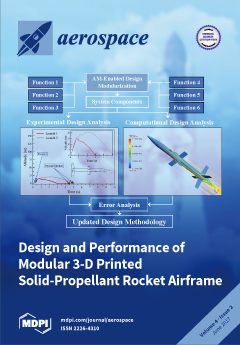
Cover Story: Solid-propellant rockets are used for many applications, including military technology, scientific research, entertainment, and aerospace education. This study explores a novel method for design modularization of rocket airframes, utilizing additive manufacturing. This method replaces part subsystems with complex multi-function parts to improve customization, design flexibility, performance, and reliability. To verify the value of this method in the design of rocket airframes, computational and experimental techniques were used to test a set of generated designs. The methods and the study results were examined in detail for sources of error, which would then be addressed on subsequent iterations of the design. View Paper here
  • Issues are regarded as officially published after their release is announced to the table of contents alert mailing list .
  • You may sign up for email alerts to receive table of contents of newly released issues.
  • PDF is the official format for papers published in both, html and pdf forms. To view the papers in pdf format, click on the "PDF Full-text" link, and use the free Adobe Reader to open them.

Articles (16)

  • Article
  • Open Access
11 Citations
11,561 Views
17 Pages

We propose a robust approach to detecting and tracking moving objects for a naval unmanned aircraft system (UAS) landing on an aircraft carrier. The frame difference algorithm follows a simple principle to achieve real-time tracking, whereas Faster R...

  • Article
  • Open Access
64 Citations
11,909 Views
26 Pages

This paper discusses the derivation and implementation of a nonlinear model predictive control law for tracking reference trajectories and constrained control of a quadrotor platform. The approach uses the state-dependent coefficient form to capture...

  • Article
  • Open Access
4 Citations
14,287 Views
23 Pages

Multi-Mode Electric Actuator Dynamic Modelling for Missile Fin Control

  • Bhimashankar Gurav,
  • John Economou,
  • Alistair Saddington and
  • Kevin Knowles

Linear first/second order fin direct current (DC) actuator model approximations for missile applications are currently limited to angular position and angular velocity state variables. Furthermore, existing literature with detailed DC motor models is...

  • Article
  • Open Access
1 Citations
7,005 Views
26 Pages

This paper presents the development of a fourth-order finite difference computational aeroacoustics solver. The solver works with a structured multi-block grid domain strategy, and it has been parallelized efficiently by using an interface treatment...

  • Article
  • Open Access
27 Citations
12,774 Views
19 Pages

The aim of this paper is to provide a realistic stochastic trajectory generation method for unmanned aerial vehicles that offers a tool for the emulation of trajectories in typical flight scenarios. Three scenarios are defined in this paper. The traj...

  • Article
  • Open Access
5 Citations
7,860 Views
24 Pages

It is shown that replacing the sinusoidal chip in Golay complementary code pairs by special classes of waveforms that satisfy two conditions, symmetry/anti-symmetry and quazi-orthogonality in the convolution sense, renders the complementary codes imm...

  • Article
  • Open Access
34 Citations
11,737 Views
14 Pages

Development of Hollow Cathodes for Space Electric Propulsion at Sitael

  • Daniela Pedrini,
  • Tommaso Misuri,
  • Fabrizio Paganucci and
  • Mariano Andrenucci

Hollow cathodes are electron sources used for the gas ionization and the beam neutralization in both ion and Hall effect thrusters (HETs). A reduction of power and propellant consumption from the cathode is particularly needed in small satellite appl...

  • Article
  • Open Access
23 Citations
10,113 Views
18 Pages

The goal of this study is to assess CFD capability for the prediction of shock wave laminar boundary layer interactions at hypersonic velocities. More specifically, the flow field over a double-cone configuration is simulated using both perfect gas a...

  • Article
  • Open Access
3 Citations
8,272 Views
22 Pages

High-lift devices are commonly modelled using potential flow methods at the conceptual design stage. Often, these analyses require the use of prescribed wake shapes in order to avoid numerical stability issues. The wake type used, however, has an imp...

  • Article
  • Open Access
16 Citations
10,819 Views
20 Pages

Vortex Lattice Simulations of Attached and Separated Flows around Flapping Wings

  • Thomas Lambert,
  • Norizham Abdul Razak and
  • Grigorios Dimitriadis

Flapping flight is an increasingly popular area of research, with applications to micro-unmanned air vehicles and animal flight biomechanics. Fast, but accurate methods for predicting the aerodynamic loads acting on flapping wings are of interest for...

of 2

Get Alerted

Add your email address to receive forthcoming issues of this journal.

XFacebookLinkedIn
Aerospace - ISSN 2226-4310