
- Article
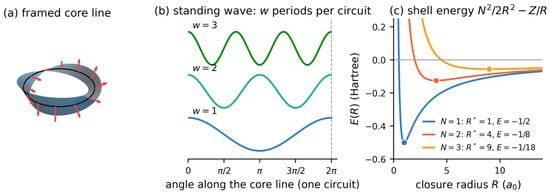
Resonant Vacuum Theory (RVT) is a working hypothesis in which matter consists of topologically bound solitons in a single nonlinear vacuum medium that also carries light; the electron is a closed, framed soliton, and the atomic field is a physical standing wave, not a probability amplitude. For hydrogen, this paper takes three steps. First, a closure model: the standing envelope wave on the core line carries integer azimuthal and radial node counts
19 November 2026
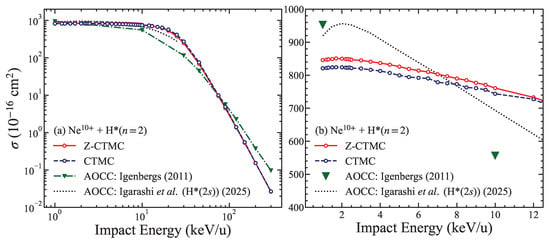
![Electron-capture total cross-section as a function of impact energy for Ne10+ H*(
n
=
2
) collisions in (a) log scale and (b) linear scale. AOCC results from Refs. [11,14].](https://mdpi-res.com/atoms/atoms-14-00086/article_deploy/html/images/atoms-14-00086-g001-550.jpg)


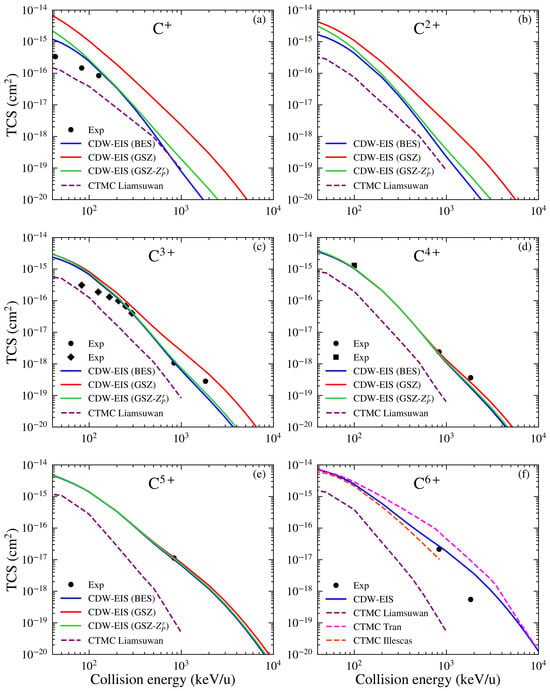
![TCS for electron capture by (a)
C
+
, (b)
C
2
+
, (c)
C
3
+
, (d)
C
4
+
, (e)
C
5
+
, and (f)
C
6
+
from water molecules as function of impact energy. Present theoretical calculations (solid lines): CDW-EIS (BES) (blue), CDW-EIS (GSZ) (red) and CDW-EIS (GSZ-
Z
P
r
) (green). Others theories (dashed lines): CTMC (purple) [12], CTMC (magenta) [38], and CTMC (orange) [39]. Experimental data from [37] (Bragg’s rule) (circles), [24] (diamonds) and [17] (square).](https://mdpi-res.com/atoms/atoms-14-00061/article_deploy/html/images/atoms-14-00061-g001-550.jpg)