



Next Issue
Volume 15, April
Previous Issue
Volume 15, February


Resources, Volume 15, Issue 3 (March 2026) – 15 articles
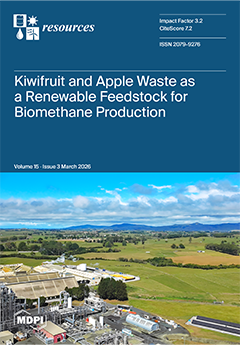
Cover Story (view full-size image): Could Morrinsville be the centre of a hydrogen revolution? Surrounded by prime agricultural land of the Waikato region, Evonik (pictured) has operated one of New Zealand’s only steam-methane reformers for the conversion of natural gas to hydrogen. With natural gas reserves depleting, and hydrogen as a vital commodity for the future of industry, comes the pressure to keep this pilar of the economy running into the latter half of this century. Biomethane derived from waste is one option that is being considered. New Zealand is home to several commercial-scale anaerobic digestors that benefit from curbside collection of domestic organic waste. In this study, we go one step further and look at the viability of biomethane from waste produced by New Zealand’s highly successful fruit industries. View this paper
  • Issues are regarded as officially published after their release is announced to the table of contents alert mailing list.
  • You may sign up for e-mail alerts to receive table of contents of newly released issues.
  • PDF is the official format for papers published in both, html and pdf forms. To view the papers in pdf format, click on the "PDF Full-text" link, and use the free Adobe Reader to open them.
Order results
Result details
Select all
Export citation of selected articles as:
14 pages, 2775 KB  
Article
Urban Tree Pruning as a Stable Biomass Platform for Bioethanol Production: A Year-Round Compositional Characterization Study in Mérida, Mexico
by Andres Canul-Manzanero, Jorge Carlos Trejo-Torres and Edgar Olguin-Maciel
Resources 2026, 15(3), 48; https://doi.org/10.3390/resources15030048 - 20 Mar 2026
Viewed by 2924
Abstract
Global energy demand relies heavily on fossil fuels, which produce greenhouse gas emissions. Additionally, municipal solid waste, driven by population growth, represents another source of emissions. In Mexico, organic waste contributes 61 million tons of CO2eq annually due to inadequate disposal. [...] Read more.
Global energy demand relies heavily on fossil fuels, which produce greenhouse gas emissions. Additionally, municipal solid waste, driven by population growth, represents another source of emissions. In Mexico, organic waste contributes 61 million tons of CO2eq annually due to inadequate disposal. In Mérida, Yucatan, over 231,000 tons of organic waste are generated yearly, including Urban Tree Pruning (UTP) from 760 public spaces—a significant, undervalued lignocellulosic resource. This study presents a comprehensive, year-round compositional characterization of Mérida’s UTP to establish its chemical profile and assess its seasonal stability as a precursor for bio-based products (i.e., bioethanol). Characterizing local and stable feedstocks, such as UTP, is a fundamental step to enabling Mexico’s compliance with biofuel policies like the 5.8% gasoline blend mandate (NOM-016-CRE) and the Alcohol-to-Jet strategy, supporting progress toward SDGs 7, 11, and 13. Based on a stratified random sampling, monthly analysis (May 2024–April 2025) revealed a consistent biochemical profile with mean annual contents of 23.32% lignin and 62.46% holocellulose. Statistical analysis (Tukey’s test) confirmed its structural homogeneity throughout the year. This uniformity is a key operational attribute, as it allows for the use of standardized industrial pretreatment parameters. Furthermore, the characterized composition supports a theoretical ethanol yield of 170 g/kg of dry biomass, a value competitive with traditional feedstocks like sugarcane bagasse. Consequently, Mérida’s UTP is characterized as a reliable and consistent biomass resource, supporting a transition from linear waste disposal to a circular bioeconomy model. Full article
Show Figures

Figure 1

30 pages, 7873 KB  
Article
Drought Dynamics and Climate Drivers in Kien Giang Province, Vietnam: A 33-Year SPI Analysis for Adaptation Planning
by Dang Thi Hong Ngoc, Ngo Thi Hieu, Tran Van Ty, Nigel K. Downes, Nguyen Thi Hong Diep and Huynh Vuong Thu Minh
Resources 2026, 15(3), 47; https://doi.org/10.3390/resources15030047 - 19 Mar 2026
Cited by 1 | Viewed by 1242
Abstract
Drought is an increasing threat to livelihood security and sustainable development in the Vietnamese Mekong Delta (VMD), particularly in Kien Giang Province. This study examines the spatiotemporal dynamics of meteorological drought from 1992 to 2024 using daily rainfall data from 10 rain gauges. [...] Read more.
Drought is an increasing threat to livelihood security and sustainable development in the Vietnamese Mekong Delta (VMD), particularly in Kien Giang Province. This study examines the spatiotemporal dynamics of meteorological drought from 1992 to 2024 using daily rainfall data from 10 rain gauges. The Standardized Precipitation Index (SPI) was calculated at 3-, 6-, and 12-month timescales to assess short-, medium-, and longer-term precipitation deficits across the province. The results show that the most severe drought events were concentrated in the most recent decade, especially during the 2015–2016 and 2019–2020 dry seasons. Spatial analysis identified clear drought hotspots: the northern coastal zone, including Ha Tien and Hon Dat, exhibited the strongest long-timescale drought signal, while central inland areas such as Go Quao experienced more frequent short-timescale drought conditions. A significant negative relationship was also observed between SPI and the Oceanic Niño Index (ONI), indicating that El Niño conditions intensified drought severity, particularly in coastal areas. These findings highlight the need for spatially differentiated drought adaptation in Kien Giang Province, with stronger emphasis on water storage and water-use efficiency in inland districts and on early warning and integrated drought–salinity management in high-risk coastal zones. Full article
Show Figures

Figure 1

41 pages, 2311 KB  
Review
Keratinolytic Fungi for Poultry Feather Waste Valorization: Mechanisms, Biotechnological Applications, Economic Feasibility, and Future Perspectives
by B. Lokeshwari, P. Saranraj, Hawraa F. H. Al-Abedi, Semaa F. H. Al-Abedi, Haider H. E. Al-Magsoosi, Mohammed T. Jaafar, Israa M. Essa, Hasanain A. J. Gharban, K. Gayathri and Alexander Machado Cardoso
Resources 2026, 15(3), 46; https://doi.org/10.3390/resources15030046 - 18 Mar 2026
Cited by 2 | Viewed by 2264
Abstract
The rapid expansion of the poultry industry has led to the large-scale generation of feather waste, creating serious environmental and public health concerns due to the recalcitrant nature of keratin. Poultry feathers are composed mainly of highly cross-linked keratin proteins stabilized by numerous [...] Read more.
The rapid expansion of the poultry industry has led to the large-scale generation of feather waste, creating serious environmental and public health concerns due to the recalcitrant nature of keratin. Poultry feathers are composed mainly of highly cross-linked keratin proteins stabilized by numerous disulfide bonds, which confer resistance to conventional proteolytic enzymes and natural degradation processes. This review examines the potential of keratinolytic fungi and their enzymes as sustainable, eco-friendly, and value-added strategies for poultry feather waste management and resource recovery. It discusses the environmental and health risks associated with improper feather disposal, such as pathogen proliferation, odor generation, and ecosystem contamination. Conventional management approaches, steam pressure hydrolysis, mechanical grinding, thermal treatment, acid–alkali hydrolysis, and oxidation, are critically evaluated in terms of efficiency and environmental impact. The review further highlights biological degradation pathways mediated by keratinolytic fungi and enzymes, with emphasis on fungal genera such as Aspergillus and Chrysosporium. Key mechanisms of fungal keratin degradation, including sulfitolysis, proteolysis, deamination, hyphal penetration, enzyme secretion, and biofilm formation, are discussed. Finally, industrial, agricultural, and feed applications of keratinases, along with advances in strain improvement, omics technologies, synthetic biology, and associated biosafety and regulatory considerations, are addressed. Full article
Show Figures

Figure 1

33 pages, 4729 KB  
Article
Molded Rigid Single-Use Containers from Cassava Residue, Sugarcane Bagasse, and Bacterial Cellulose Obtained from Low-Complexity Aqueous Processing
by Cláudio José Galdino da Silva Junior, Anantcha Karla Lafaiete de Holanda Cavalcanti, Clécio José de Lacerda Lima, Italo José Batista Durval, Attilio Converti, Andréa Fernanda de Santana Costa and Leonie Asfora Sarubbo
Resources 2026, 15(3), 45; https://doi.org/10.3390/resources15030045 - 17 Mar 2026
Viewed by 2200
Abstract
Agro-industrial waste-derived materials are promising candidates for short-cycle packaging applications. Here, we report a proof-of-concept for biodegradable biocomposites formulated with cassava residue (CR), sugarcane bagasse (SCB), and bacterial cellulose (BC) produced by symbiotic fermentation (SCOBY). This approach addresses the mechanical limitations typically associated [...] Read more.
Agro-industrial waste-derived materials are promising candidates for short-cycle packaging applications. Here, we report a proof-of-concept for biodegradable biocomposites formulated with cassava residue (CR), sugarcane bagasse (SCB), and bacterial cellulose (BC) produced by symbiotic fermentation (SCOBY). This approach addresses the mechanical limitations typically associated with cassava starch-based matrices by introducing natural reinforcements to improve structural integrity and cohesion. A set of formulations with varying CR/BC/SCB ratios was processed and assessed through tensile and flexural testing, elongation at break, thermal analysis, and water-related behavior (sorption, absorption, and contact angle). Among the evaluated blends, formulation F1 (80% CR, 5% BC, 15% SCB) delivered the best overall balance between performance and moldability, achieving a tensile strength of 11.97 MPa and showing good dimensional stability. Biodegradability was confirmed by composting, reaching 72.74% mass loss after 84 days. Overall, BC incorporation improved matrix cohesion and enabled control of mechanical integrity and wettability in the blends, as highlighted for F1 (tensile strength 11.97 MPa; peak force 560.32 N; contact angle 65°; water absorption rate, WAR, 58.68%; sorption time 5.4 s). Given the abundance of sugarcane and cassava residues in Northeast Brazil, this low-complexity route leverages locally available feedstocks to add value to regional waste streams and support the partial replacement of synthetic polymers. Full article
Show Figures

Figure 1

28 pages, 851 KB  
Article
AI-Enabled Remote Sensing Assessment of Cultivated Land Quality and Sustainability Under Climate Stress: Evidence from Saudi Arabia
by Amina Hamdouni
Resources 2026, 15(3), 44; https://doi.org/10.3390/resources15030044 - 15 Mar 2026
Cited by 6 | Viewed by 1486
Abstract
This study investigates the dynamic and causal effects of climate stress and Artificial Intelligence-enabled agricultural monitoring on cultivated land quality, productivity, and sustainability in Saudi Arabia. Using a balanced panel of region–crop observations covering 13 administrative regions and six major crops over the [...] Read more.
This study investigates the dynamic and causal effects of climate stress and Artificial Intelligence-enabled agricultural monitoring on cultivated land quality, productivity, and sustainability in Saudi Arabia. Using a balanced panel of region–crop observations covering 13 administrative regions and six major crops over the period 2010–2024, the analysis integrates high-resolution climate variables with remote sensing-based indicators, including the Normalized Difference Vegetation Index, Enhanced Vegetation Index, Net Primary Productivity, Water-Use Efficiency, and crop water productivity. A comprehensive econometric framework combining the System Generalized Method of Moments, Difference-in-Differences, and event-study approaches is employed to address persistence, endogeneity, and causal identification. The results show that water availability—captured by soil moisture and precipitation—significantly enhances cultivated land outcomes (coefficients ≈ 0.05–0.11), while heat stress and wind speed exert strong negative effects (coefficients ≈ −0.04 to −0.12), highlighting the vulnerability of arid agricultural systems. Artificial Intelligence-enabled monitoring and smart irrigation adoption consistently improve land quality and productivity, with the largest gains observed in water-use efficiency and crop water productivity. Artificial Intelligence adoption increases water-use efficiency and crop water productivity by approximately 8–10%, while heat stress reduces vegetation indicators by about 9–12%. Event-study evidence confirms that these effects emerge after adoption and persist over time, supporting a causal interpretation. Overall, the findings demonstrate that AI technologies mitigate climate stress primarily through improved water management and adaptive decision-making. The study provides policy-relevant insights aligned with Saudi Vision 2030, emphasizing digital agriculture as a key instrument for sustainable cultivated land governance, climate adaptation, and food security in water-scarce environments. Full article
Show Figures

Figure 1

4 pages, 167 KB  
Editorial
Assessment and Optimization of Energy Efficiency
by Crescenzo Pepe and Silvia Maria Zanoli
Resources 2026, 15(3), 43; https://doi.org/10.3390/resources15030043 - 6 Mar 2026
Viewed by 994
Abstract
In order to pursue the energy goals defined for 2030 and 2050 [...] Full article
(This article belongs to the Special Issue Assessment and Optimization of Energy Efficiency)
18 pages, 1712 KB  
Review
Environmental Challenges on Olive Mill Wastes in Albania: Sustainable Management and Circular Economy Opportunities
by Dritan Topi and Aleksander Petre
Resources 2026, 15(3), 42; https://doi.org/10.3390/resources15030042 - 5 Mar 2026
Cited by 3 | Viewed by 1649
Abstract
The olive oil extraction industry produces large amounts of olive pomace and wastewater, both of which contain high levels of pollutants. In Albania, olive oil production has increased, while by-product challenges persist. Uncontrolled wastewater discharge and pomace burning have caused environmental issues and [...] Read more.
The olive oil extraction industry produces large amounts of olive pomace and wastewater, both of which contain high levels of pollutants. In Albania, olive oil production has increased, while by-product challenges persist. Uncontrolled wastewater discharge and pomace burning have caused environmental issues and inefficient resource use. This study combines published data with field information to examine country pomace utilization and wastewater management. The regional distribution of extraction units and production volumes was analyzed to identify mismatches between processing capacity and output. The findings reveal discrepancies between official statistics and field data. Regional analysis highlights notable imbalances between the number of olive mills and their production volumes, especially in Elbasan, Fier, Vlora, and Berat. Projections, assuming three-phase technology, indicate increased generation of olive pomace and wastewater, thereby raising environmental risks associated with wastewater disposal. The potential for olive pomace oil production was estimated to reach up to 1600 tons. While progress has been made in establishing a pomace oil extraction plant, infrastructure gaps, weak regulation, and limited producer awareness need to be addressed to convert by-products into valuable resources and help Albania’s olive oil sector achieve sustainability goals. Full article
Show Figures

Figure 1

19 pages, 1532 KB  
Article
Agro-Industrial Kiwifruit and Apple Waste as a Renewable Feedstock for Biomethane Production—A Study of Feedstock Viability
by Enola Brecht and Peter Kovalsky
Resources 2026, 15(3), 41; https://doi.org/10.3390/resources15030041 - 4 Mar 2026
Viewed by 2640
Abstract
New Zealand’s kiwifruit and apple industries generate substantial quantities of organic residues during thinning and harvest, much of which is composted or disposed of in landfills due to logistical constraints. This study evaluates the potential of these residues as feedstock for biomethane production [...] Read more.
New Zealand’s kiwifruit and apple industries generate substantial quantities of organic residues during thinning and harvest, much of which is composted or disposed of in landfills due to logistical constraints. This study evaluates the potential of these residues as feedstock for biomethane production via anaerobic digestion (AD), followed by hydrogen generation through steam methane reforming (SMR). Two feedstock mixtures were examined: a 50:50 kiwifruit–apple blend and a 40:40:20 kiwifruit–apple–potato mixture, designed to mitigate acidification. Cow manure served as a cost-effective inoculum. Physicochemical analysis confirmed high moisture and volatile solids content, indicating strong biodegradability, although low nitrogen content suggests the need for co-digestion in full scale systems. Biomethane potential (BMP) tests yielded up to 45 mL CH4/gVS at an ISR of 4, corresponding to 46.5% carbon conversion. Scaling to an annual waste volume of 476 t suggests a potential biomethane yield of approximately 18,000 m3. SMR simulations demonstrated technical feasibility, with methane conversion increasing from 46% under baseline conditions to >85% under optimized steam to carbon ratios and residence times. Hydrogen yields of ~7600 m3/year were estimated. This study provides a practical foundation for valorizing fruit waste into renewable biomethane and hydrogen, supporting New Zealand’s circular economy and decarbonization goals. Full article
Show Figures

Figure 1

24 pages, 6172 KB  
Article
Optimizing Sowing Calendars for Climate-Resilient Common Bean Production in Central-Southern Brazil: A Functional Data Analysis Approach
by Ludmilla Ferreira Justino, Alexandre Bryan Heinemann, David Henriques da Matta, Luís Fernando Stone, Felipe Waks Andrade and Silvando Carlos da Silva
Resources 2026, 15(3), 40; https://doi.org/10.3390/resources15030040 - 4 Mar 2026
Viewed by 2175
Abstract
Addressing the intertwined challenges of food security and climate vulnerability requires robust and regionally tailored strategies for staple crops such as common beans. Although adjusting sowing dates is a key adaptive practice, spatio-temporal climate variability complicates the identification of optimal planting windows. This [...] Read more.
Addressing the intertwined challenges of food security and climate vulnerability requires robust and regionally tailored strategies for staple crops such as common beans. Although adjusting sowing dates is a key adaptive practice, spatio-temporal climate variability complicates the identification of optimal planting windows. This study integrates crop modeling with Functional Data Analysis (FDA) to quantify sowing-date-dependent yield losses for rainfed common beans across Central-Southern Brazil. The CSM-CROPGRO-Dry Bean model, driven by long-term climate data (1980–2016), soil properties, and management practices, was used to simulate yields for the BRS Estilo cultivar. FDA was subsequently applied to cluster yield-loss curves across municipalities and growing seasons, generating representative regional risk profiles. The results reveal clear spatial patterns. During the wet season, earlier sowing minimizes losses in Goiás, Minas Gerais, and western Paraná, whereas later sowing is beneficial in São Paulo, Santa Catarina, and eastern Paraná. In the dry season, earlier sowing consistently reduces losses across most regions. These patterns are primarily driven by water deficits and suboptimal temperatures during critical phenological phases. The resulting spatio-temporal sowing calendar provides an evidence-based decision-support tool to help farmers mitigate climatic risks. Moreover, it offers a scientific foundation for policymakers to refine sustainable management practices, improve crop insurance design, and enhance agricultural resilience and productivity under increasing climate uncertainty. Full article
Show Figures

Figure 1

17 pages, 1425 KB  
Article
Perception of Fishers Regarding Pollution in Lake Chapala and the Risks Associated with the Consumption of Charal (Chirostoma spp.)
by Marcela Mariel Maldonado-Villegas, Alondra del Pilar Castillo-Gutiérrez, Blanca Catalina Ramírez-Hernández, Paulina Beatriz Gutiérrez-Martínez, Eduardo Juárez-Carrillo, Javier García-Velasco, Sara Villanueva-Viramontes, Héctor Leal-Aguayo, Jonathan Manuel López, Carlos Alvarez-Moya and Mónica Reynoso-Silva
Resources 2026, 15(3), 39; https://doi.org/10.3390/resources15030039 - 28 Feb 2026
Viewed by 1603
Abstract
Lake Chapala is the main freshwater reservoir in Mexico and faces notable environmental pressure associated with urban, industrial, and agricultural activities, with documented evidence of heavy metal contamination. Thus, the artisanal fishers from Lake Chapala occupy a strategic position for understanding the socio-environmental [...] Read more.
Lake Chapala is the main freshwater reservoir in Mexico and faces notable environmental pressure associated with urban, industrial, and agricultural activities, with documented evidence of heavy metal contamination. Thus, the artisanal fishers from Lake Chapala occupy a strategic position for understanding the socio-environmental dynamics of this lacustrine system. The objective of this study was to analyze their perceptions of pollution in Lake Chapala and the health risks associated with heavy metal contamination, with particular emphasis on the consumption of charal (Chirostoma spp.). Based on the results, 70% of fishers agreed that Lake Chapala is polluted, and 50% identified solid waste as the main source of contamination. Regarding water quality, 41% considered that it had not changed in recent years, while 37% perceived that it had deteriorated. With respect to heavy metals, 50% reported being aware of their presence in the lake; however, slightly more than 50% expressed concern about the possibility that charal could be contaminated. Fishers acknowledged the environmental pressure faced by Lake Chapala but prioritized risks based on visibility and their everyday experiences. Incorporating the perceptions of key stakeholders is essential for addressing socio-environmental problems, strengthening environmental communication and public health strategies, and effectively managing this lacustrine system. Full article
Show Figures

Figure 1

33 pages, 1358 KB  
Article
Artificial Intelligence-Driven Integrated Water Management and Agricultural Sustainability: Evidence from Saudi Arabia
by Amina Hamdouni
Resources 2026, 15(3), 38; https://doi.org/10.3390/resources15030038 - 26 Feb 2026
Cited by 9 | Viewed by 2961
Abstract
Water scarcity poses a critical challenge to sustainable agricultural development, particularly in arid regions such as Saudi Arabia. This study examines whether AI-compatible smart irrigation, digital water monitoring, and integrated water resource management (IWRM) are associated with improvements in agricultural water sustainability. Using [...] Read more.
Water scarcity poses a critical challenge to sustainable agricultural development, particularly in arid regions such as Saudi Arabia. This study examines whether AI-compatible smart irrigation, digital water monitoring, and integrated water resource management (IWRM) are associated with improvements in agricultural water sustainability. Using a regional–crop panel dataset covering 13 Saudi administrative regions and six major crops over the period 2010–2024, the analysis evaluates their relationships with water-use efficiency, crop water productivity, and crop yield. To address persistence, endogeneity, and unobserved heterogeneity, the study employs a comprehensive multi-method empirical strategy combining dynamic panel models (System GMM), difference-in-differences, and event-study designs. The results provide internally consistent and empirically robust evidence in support of the proposed hypotheses. AI-compatible smart irrigation is positively and significantly associated with improvements in agricultural water efficiency and productivity, with effects that strengthen over time, reflecting gradual technology assimilation and learning processes. These findings capture the performance gains from irrigation modernization that enables data-driven and algorithm-supported decision-making, rather than the direct causal impact of autonomous artificial intelligence deployment. Integrated water resource management independently exhibits a positive association with higher agricultural performance, underscoring the importance of coordinated governance alongside technological adoption. Digital water monitoring shows a positive and statistically significant relationship with all outcome measures and appears to reinforce the effectiveness of both AI-compatible irrigation and integrated water governance. Robustness analyses excluding extreme drought years confirm that these relationships reflect persistent efficiency patterns rather than transitory climatic shocks. Overall, the findings provide context-specific and methodologically rigorous evidence that AI-compatible irrigation, digital monitoring, and integrated water governance operate as complementary components of agricultural water sustainability in a highly water-scarce economy, offering evidence-informed and policy-relevant insights, aligned with Saudi Vision 2030. Full article
(This article belongs to the Special Issue Sustainable Water Management for Agriculture)
Show Figures

Figure 1

18 pages, 2907 KB  
Article
Delonix regia Seed Germ as an Underutilized Biomass Resource: Nutritional Value, Safety, and Potential for Sustainable Protein Supply for Food Systems
by Valentino Mukthar Sandoval-Peraza, Octavio Ramos-Ocharán, Karla Itzél Alcalá-Escamilla, Magdalena Yunuen Molina-Rosas, Luis Chel-Guerrero and David Betancur-Ancona
Resources 2026, 15(3), 37; https://doi.org/10.3390/resources15030037 - 25 Feb 2026
Viewed by 1411
Abstract
Global challenges in food security and sustainable biomass management highlight the need to diversify resource streams that can supply accessible, safe, and environmentally responsible protein. Delonix regia (flamboyant) seed germ (FG) represents an abundant but largely underutilized biomass resource in tropical and subtropical [...] Read more.
Global challenges in food security and sustainable biomass management highlight the need to diversify resource streams that can supply accessible, safe, and environmentally responsible protein. Delonix regia (flamboyant) seed germ (FG) represents an abundant but largely underutilized biomass resource in tropical and subtropical regions, where its seeds are routinely discarded as green waste. This study assesses the resource potential of FG by evaluating its nutritional composition, safety profile, and suitability for integration into sustainable protein provision strategies. The FG fraction was recovered from locally available seed residues and analyzed to determine their proximate composition, essential amino acid profile, and antinutrient content, providing insights into the qualitative attributes of this emerging resource. Safety was examined through in vivo acute toxicity assays and detailed histopathological evaluation of hepatic and renal tissues of CD1/ICR strain female mice, which revealed no morphological indicators of toxicity, inflammation, or cellular damage. The results indicate that FG contains a high protein concentration (78.35%) with a favorable essential amino acid pattern, supporting its potential as a renewable and locally accessible plant-based protein source. Beyond its nutritional value, the valorization of FG contributes to resource efficiency, waste-to-value pathways, and circular economy approaches by transforming an abundant municipal biomass residue into a functional component for sustainable food systems. Overall, the study underscores the feasibility of integrating FG into resource diversification strategies, enhancing protein availability while reducing environmental burdens associated with biomass disposal. Full article
20 pages, 2582 KB  
Article
Management of Common Land in the Context of Climate Change: A Multi-Scenario Simulation
by Katarzyna Kocur-Bera
Resources 2026, 15(3), 36; https://doi.org/10.3390/resources15030036 - 25 Feb 2026
Viewed by 1096
Abstract
Reducing greenhouse gas emissions and promoting biodiversity are currently among the key orientations of European climate policy. The increase in atmospheric greenhouse gas concentrations (including carbon dioxide) is caused, among others, by the environmental impacts of human activities. Carbon capture and storage are [...] Read more.
Reducing greenhouse gas emissions and promoting biodiversity are currently among the key orientations of European climate policy. The increase in atmospheric greenhouse gas concentrations (including carbon dioxide) is caused, among others, by the environmental impacts of human activities. Carbon capture and storage are at the heart of climate and energy security. This study aimed to analyze scenarios that assume various ways of using and managing common land. Common land is found in many countries. However, the legal status of these lands varies. This status often determines how the land can be managed. The article uses online surveys (CAWI), the land morphology concept (LMC), the scenario method, and an analysis of precedent events. The scenarios considered the stakeholders in the process. The results demonstrated that the optimal approach is to use regenerative agriculture with cover cropping. The diagnosis of precedent events showed that this method of use may be difficult to apply under local conditions due to low social involvement in the process of obtaining autonomy and self-determination by the parties entitled to common land, as well as by national-level authorities. Full article
Show Figures

Figure 1

19 pages, 1490 KB  
Article
Fats, Oils, and Grease (FOG) Management in the Restaurant Sector of the Guadalajara Metropolitan Area, Mexico
by Rosaura Hernández-Montelongo, Humberto Gutiérrez-Pulido, Juan Paulo García-Sandoval and Abraham Gabriel Alvarado-Mendoza
Resources 2026, 15(3), 35; https://doi.org/10.3390/resources15030035 - 25 Feb 2026
Cited by 1 | Viewed by 2048
Abstract
The improper management of fats, oils, and grease (FOG) from food services is a major cause of sewer blockages and environmental damage. This study examines FOG management in the restaurant sector of the Guadalajara Metropolitan Area, Mexico, from three complementary perspectives: the performance [...] Read more.
The improper management of fats, oils, and grease (FOG) from food services is a major cause of sewer blockages and environmental damage. This study examines FOG management in the restaurant sector of the Guadalajara Metropolitan Area, Mexico, from three complementary perspectives: the performance of the authorized formal collection system, management practices in food establishments, and the physicochemical characteristics of grease trap residues. These perspectives were addressed using official administrative records and reports from environmental authorities, structured surveys applied to kitchen staff, and laboratory analyses of grease trap samples collected in restaurants. The results reveal important institutional and structural constraints affecting FOG management. Only a limited number of authorized collectors operate actively, serving a small fraction of potential generators, while most food service establishments are micro- or small-sized businesses with limited technical and financial capacity to comply with regulations. A large portion of the sector consists of small, low-cost food service establishments with intensive oil use (e.g., street food vendors, sandwich shops, and set-menu restaurants), which contribute to widespread oil reuse and inadequate disposal practices. Laboratory analyses showed a high free fatty acids (FFAs) content and compositional profiles consistent with repeated oil use, with negative implications for sewer systems and waste management. Overall, the findings highlight the need for stronger regulatory enforcement, collection schemes tailored to micro-scale generators, and awareness campaigns while also indicating opportunities for FOG valorization within circular economy approaches, particularly through energy recovery pathways. Full article
Show Figures

Figure 1

16 pages, 1411 KB  
Article
Life Cycle Assessment of Plywood Using Thermally Modified Birch Veneers Bonded with Suberinic Acids Adhesive
by Anete Meija, Uldis Spulle, Ignazia Cuccui, Aigars Paze and Janis Rizikovs
Resources 2026, 15(3), 34; https://doi.org/10.3390/resources15030034 - 24 Feb 2026
Viewed by 1511
Abstract
This study evaluates the environmental performance of plywood manufactured from thermally modified birch veneers using the Thermovuoto® process, bonded with a birch bark–derived suberinic acids adhesive. Framed within the context of sustainable materials development and the circular bioeconomy, the research examines the [...] Read more.
This study evaluates the environmental performance of plywood manufactured from thermally modified birch veneers using the Thermovuoto® process, bonded with a birch bark–derived suberinic acids adhesive. Framed within the context of sustainable materials development and the circular bioeconomy, the research examines the potential of bio-based adhesive systems as alternatives to conventional phenol–formaldehyde resins. A cradle-to-grave life cycle assessment (LCA) was performed, encompassing birch bark harvesting, adhesive production, veneer thermal modification, plywood manufacturing, distribution to the customer, and end-of-life management. Environmental impacts were modelled using openLCA 2.4 in combination with the Ecoinvent 3.11 database, in accordance with ISO 14040 and ISO 14044, applying the ReCiPe 2016 v.1.03 (H) midpoint life cycle impact assessment method. The results indicate that the birch bark extraction stage, particularly ethanol use derived from potato fermentation, constitutes the dominant contributor across all assessed impact categories. Overall, the LCA outcomes suggest that thermally modified, suberinic-acid-bonded birch plywood represents a promising niche bio-based material, with clear potential for further environmental improvement through process optimization. Full article
Show Figures

Figure 1

Previous Issue
Next Issue
Back to TopTop
