


Abstract
This study evaluates the environmental performance of plywood manufactured from thermally modified birch veneers using the Thermovuoto® process, bonded with a birch bark–derived suberinic acids adhesive. Framed within the context of sustainable materials development and the circular bioeconomy, the research examines the potential of bio-based adhesive systems as alternatives to conventional phenol–formaldehyde resins. A cradle-to-grave life cycle assessment (LCA) was performed, encompassing birch bark harvesting, adhesive production, veneer thermal modification, plywood manufacturing, distribution to the customer, and end-of-life management. Environmental impacts were modelled using openLCA 2.4 in combination with the Ecoinvent 3.11 database, in accordance with ISO 14040 and ISO 14044, applying the ReCiPe 2016 v.1.03 (H) midpoint life cycle impact assessment method. The results indicate that the birch bark extraction stage, particularly ethanol use derived from potato fermentation, constitutes the dominant contributor across all assessed impact categories. Overall, the LCA outcomes suggest that thermally modified, suberinic-acid-bonded birch plywood represents a promising niche bio-based material, with clear potential for further environmental improvement through process optimization.
1. Introduction
Life cycle assessment (LCA) is a method used to evaluate the environmental impacts associated with the stages of a product’s life cycle. International standards regulate it, ISO 14040 [1] and ISO 14044 [2]. The process consists of four stages: goal and scope definition, life cycle inventory, life cycle impact assessment (LCIA), and interpretation. To unify the impact on environmental categories, product category rules are developed for specific products. For construction products, the role of product category rules is standard EN 15804+A2 [3], and the environmental information is discovered using third-party environmental declarations—environmental product declarations (EPD) that are made according to standard ISO 14025 [4]. LCIA methods can be divided into midpoint and endpoint methods. Midpoints are considered links in the cause-and-effect chain (environmental mechanism) of an impact category, preceding the endpoints at which characterization factors or indicators can be derived to reflect the relative importance of emissions or extractions [5]. ReCiPe 2016 v.1.03 (H) midpoint [6] is an LCIA method that translates emissions and resource extractions into a limited set of environmental impact scores using so-called characterization factors. Midpoint indicators focus on a single environmental problem. In this method, there are 18 impact categories such as acidification: terrestrial (AP); climate change (GWP); ecotoxicity: freshwater (ETF); ecotoxicity: marine (ETM); ecotoxicity: terrestrial (ET); energy resources: non-renewable, fossil (ERF); eutrophication: freshwater (EF); eutrophication: marine (EM); human toxicity: carcinogenic (HTC); human toxicity: non-carcinogenic (HT); ionizing radiation (IR); land use (LU); material resources: metals/minerals (MR); ozone depletion (OD); particulate matter formation (PM); photochemical oxidant formation: human health (POH); photochemical oxidant formation: terrestrial ecosystems (POT); and water use (WU). Each category has its own reference unit. This LCIA method considers three distinct cultural perspectives: individualist (I), hierarchist (H), and egalitarian (E) archetypes reflect different ideologies, social relations, and moral convictions. Individualists have weak group coherence, few social prescriptions, and view nature as stable and resilient, trusting human adaptability through technology and short-term perspectives. Hierarchists emphasize strong group coherence and prescribed social order, see nature as balanced, and rely on regular management and scientific consensus. Egalitarians also value strong group coherence but view nature as fragile, prioritize long-term perspectives, and argue for considering worst-case scenarios [7].
In the context of circular bioeconomy and sustainable material innovation, the development of bio-based adhesives offers a promising alternative to fossil-derived synthetic resins such as phenol–formaldehyde (PF) [8], widely used in plywood production. Among emerging bio-based materials, suberinic acids—derived from birch bark—have attracted interest for use in adhesive formulations [9] and wood impregnation [10] due to their availability from industrial side streams. LCA of suberinic acids adhesives derived from birch bark, using a slightly different process, has been investigated by Yadav et al. [11]. They concluded that a hot spot in suberinic acids adhesive manufacturing is the use of ethanol in the process and the process efficiency itself. In the production of plywood adhesives, ethanol is employed solely in the pre-extraction stage, with suberin depolymerization conducted in an aqueous medium [9].
Wood-based materials are considered materials of the future; however, similar to any other material, they have certain disadvantages, such as anisotropy, fungal-induced biodegradation, and swelling and shrinkage. Plywood is a material whose structure addresses the problem of anisotropy, while thermal modification of wood is often used to improve dimensional stability [12], and biological resistance can also influence the overall environmental profile of modified wood products [13]. Among all TM processes available on the market, the Thermovuoto® is the most suitable for hardwood veneer thermal modification because it has less mass loss during the process compared to the Thermowood® process [14]. LCA of thermally modified wood has been conducted to establish EPDs of the commercial products [13] and also investigate various aspects of thermally modified wood [15]. LCA of poplar plywood manufactured in South China, glued with melamine-urea-formaldehyde resin, revealed that the manufacturing of veneers has the highest impact on the environment due to the drying stage of the veneers [16]. While gate-to-gate LCA in India concludes that plywood production offers a net environmental benefit through long-term carbon sequestration and material substitution, its sustainability depends on reducing chemical emissions, managing wood waste, improving energy efficiency, and adopting cleaner technologies and effective effluent treatment [17]. Those aspects are important also when assessing LCA of other wood-based panels [18]. The Termovuoto process modified softwood cladding LCA results revealed that these claddings are better for human health and the resources category than preservative-treated wood [19].
The novelty of the manuscript lies in the fact that life cycle assessment has not previously addressed the combined use of thermally modified veneers and suberinic acids–based adhesives, as this material system is novel, not yet commercially available, and has remained unexplored from an LCA perspective.
At first glance, the composition of such a material appears green and environmentally friendly; however, whether this is truly the case can only be determined by conducting a complete life cycle assessment. This study presents an LCA of the work reported in our previous manuscript, in which we developed plywood bonded with suberinic acids adhesive and produced thermally modified veneers using the Thermovuoto® process at 217 °C for three hours. The resulting material, intended for outdoor applications (bonding class 3 according to EN 314-2 [20]), is hereafter referred to as TMSA-plywood [21].
2. Materials and Methods
2.1. Goal and Scope
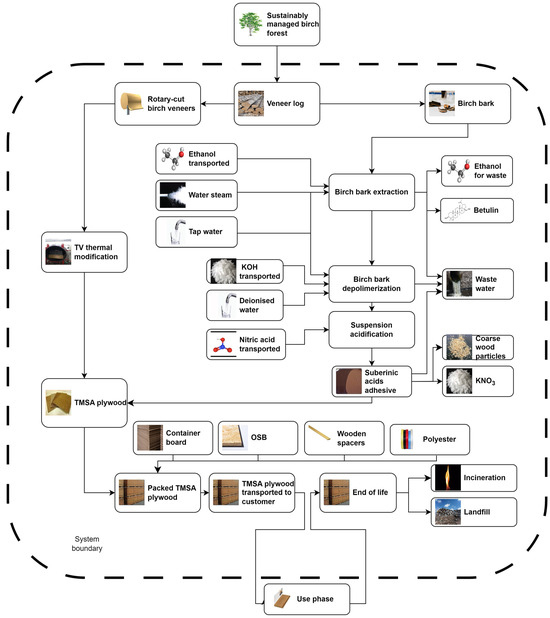
The objective of this study is to evaluate the environmental performance of thermally modified and suberinic acids adhesive-glued (TMSA) plywood (see Figure 1) through a cradle-to-grave LCA, excluding the use phase, due to the diverse potential applications of plywood. The declared unit is defined as 1 m3 of finished and packed 3-ply plywood with a density of 615 kg/m3 for outdoor use (bonding class 3, 30 years service life).
Figure 1.
TMSA plywood.
2.2. System Boundaries
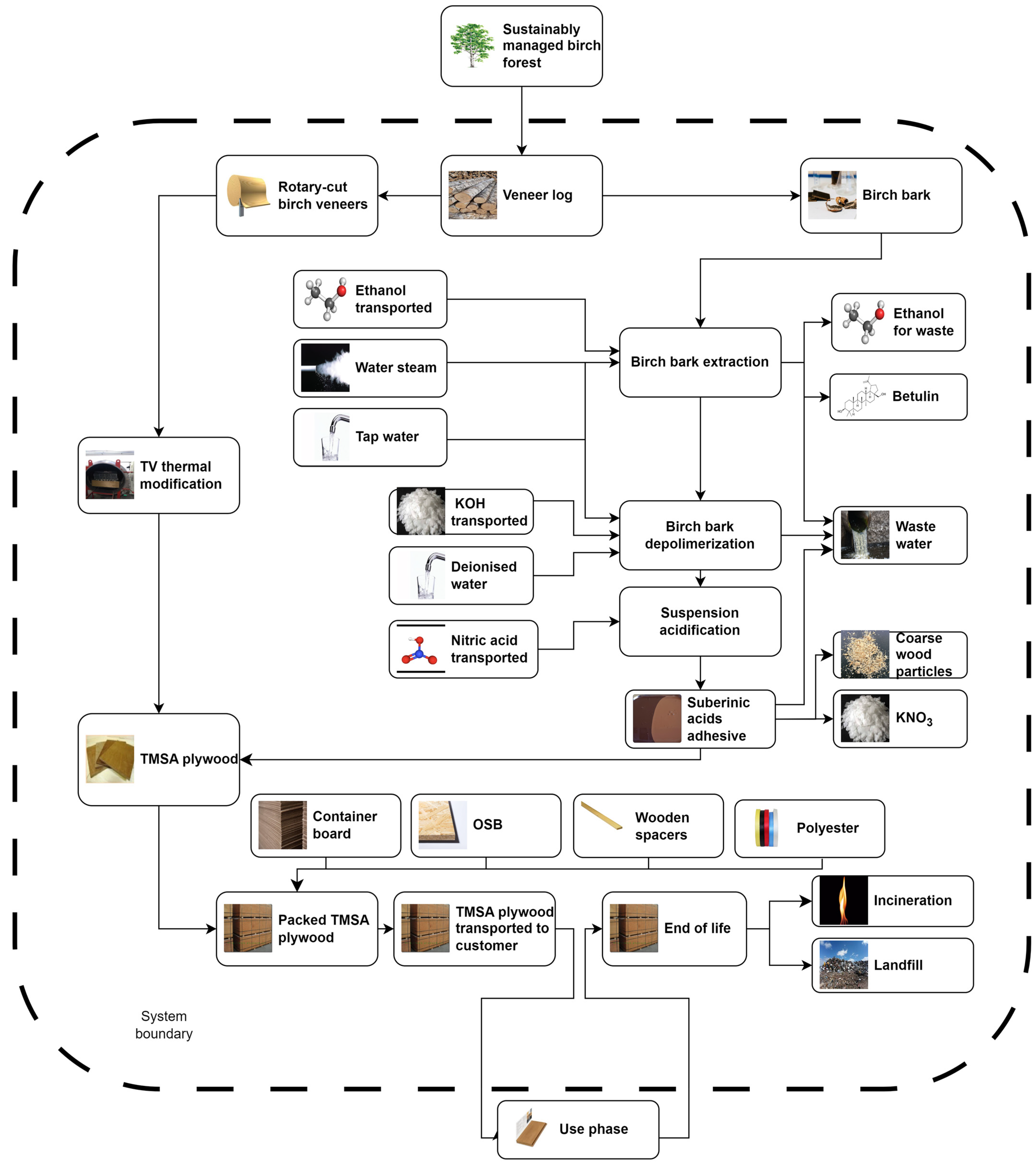
TMSA-plywood system: includes birch bark harvesting as a by-product of industrial debarking, birch bark extraction, birch bark depolymerization, suspension acidification and filtration to obtain suberinic acids adhesive, transportation of all raw materials, veneer thermal modification, and final plywood production and packaging of the final product, delivery to the customer, and end-of-life stage. The system boundary for TMSA plywood production is shown in Figure 2.
Figure 2.
System boundary.
A brief description of a system boundary: The main raw material is birch logs from a sustainably managed birch forest that undergoes a debarking process. A debarked log is subjected to peeling, while the birch bark is used as raw material for adhesive manufacturing. Rotary-cut birch veneers undergo thermal modification in the Thermovuoto process, and afterwards the plywood is glued with suberinic acids adhesive. Outer birch bark is extracted with ethanol; in the process, betulin as a product is obtained, and the residue that contains suberinic adhesive acids is depolymerized, using KOH. Afterwards, the suspension is acidified with nitric acid, and the suberinic acids adhesive is obtained and is used for the plywood production process. The TMSA plywood is packed using container board, OSB, wooden spacers, and polyester straps. Packed plywood is transported to the customers, then the use phase is omitted, and the end-of-life scenario is defined as 50% going to incineration and 50% to landfill.
2.3. Allocation
Two allocation points were identified in the system.
The first occurs during birch bark extraction, which yields two co-products: a triterpene extract (betulin) and the extracted birch bark intended for depolymerization. A mass-based (physical) allocation was applied using experimental data, where betulin accounts for 11.51 wt% of the total output and the extracted birch bark accounts for 88.49 wt%. Per functional unit, this corresponds to 526.01 kg of ethanol-extracted birch outer bark mixture and 68.40 kg of betulin and extractives mixture, giving a total of 594.41 kg. As betulin is a commercially valuable compound widely used in cosmetics, it cannot be considered as waste.
The second allocation point occurs at the end-of-life stage. It is assumed that, for a total panel mass of 615 kg, 307.5 kg is sent to landfill and 307.5 kg to incineration.
No allocation was required in the remaining processes, as only waste streams without economic value were generated.
2.4. Life-Cycle Inventory
Primary data for the production of suberinic acids adhesive was sourced from lab-scale experiments conducted by Rizikovs and his team at the Latvian State Institute of Wood Chemistry [9]. Primary data for the production of thermally modified veneers was sourced from lab-scale experiments conducted by Allegretti and his team at the National Research Council of Italy, Institute of BioEconomy. Primary data from plywood pressing comes from Spulle and his team at the Latvia University of Life Sciences and Technologies, Institute of Civil Engineering and Woodworking [21]. For packaging, secondary data is used from the Ecoinvent 3.11. database, but the amounts of packaging materials are calculated from JSC “Latvijas Finieris” EPD [22]. The amounts for the inputs and outputs used can be seen in Table 1.
Table 1.
Inputs and outputs per 1 m3 of TMSA plywood.
Transportation distances are shown in the assumptions and limitations section. Type of the lorry used—EURO5.
2.5. Life-Cycle Impact Assessment
For modeling and calculating environmental impacts, open-source software openLCA 2.4 was used, along with the Ecoinvent 3.11. database. For environmental impact, the LCIA method ReCiPe 2016 v.1.03 (H) midpoint was used. Environmental impact categories, indicators, and their reference units can be seen in Table 2. For comparison of the A1–A3 product life cycle stage to the existing common plywood manufacturer’s EPD, the LCIA method EN 15804+A2 (EF.3.1.) was used. The product system was made from packed TMSA plywood before delivery to the customer.
Table 2.
Environmental impact categories, indicators, and reference units according to the ReCiPe 2016 v.1.03 (H) midpoint LCIA method.
2.6. Assumptions and Limitations
- Assumptions:
To model the LCA of TMSA plywood, several assumptions were made. Please refer to Table 3.
Table 3.
Assumptions.
- Limitations:
The primary limitation was the availability of secondary data in the Ecoinvent database. Please refer to Table 4.
Table 4.
Limitations.
2.7. Eco-Cost
Eco-cost is an LCA-based indicator and translates environmental impacts into monetary terms. Eco-cost expresses the cost required to prevent or offset the environmental burden of a product, reflecting the expenditures needed to reduce emissions and resource use to a sustainable level. It is calculated according to Equation (1).
Eco-cost = environmental burden × environmental price,
The environmental prices used in this study were taken from the Environmental Prices Handbook [24].
3. Results and Discussion
3.1. Environmental Impacts of TMSA Plywood
In Table 5, the LCA impact category results for TMSA plywood manufacturing on a laboratory scale are presented.
Table 5.
Environmental impacts of experimental TMSA plywood.
The contribution analysis indicates that upstream agricultural processes dominate the environmental profile across most impact categories. In particular, AP is overwhelmingly driven by conventional potato production, which accounts for 39.76 kg SO2-eq, corresponding to 89.33% of the total impact. In contrast, the contribution of TM veneer production to AP is marginal (3.53%).
A similar dominance of agricultural processes is observed for GWP. Potato production contributes 55.57% of the total GWP, while ethanol production represents 71.16%. TM veneer production contributes 16.34%, almost entirely attributable to electricity consumption (16.09%), highlighting the relevance of energy demand in the thermal modification stage.
For ETF, ethanol production is the primary hotspot, contributing 88.51%, followed by the potato market (82.99%), which is identified as the dominant contributor within this category. Comparable trends are observed for ETM, where ethanol production contributes 83.06% and the potato market 75.10%, whereas TM veneer production plays a secondary role (8.13%). ET follows the same pattern, with contributions of 90.18% from ethanol production and 86.74% from the potato market, while TM veneer production contributes only 1.94%.
In the ERF, TM veneer production contributes more prominently (18.69%) than other categories; however, potato production (46.63%) and ethanol production (67.17%) remain the dominant sources. For EF, ethanol production again represents the primary contributor (76.42%), followed by the potato market (69.76%). TM veneer production contributes 13.60%, with electricity use accounting for nearly the entire share (13.54%).
Emissions in the EM category are almost exclusively driven by potato production (94.85%), while the contribution from TM plywood production is negligible (0.35%). Human toxicity indicators show consistent trends: in the HTC, ethanol production contributes 79.91%, the potato market 68.85%, and TM veneer production 9.96%, primarily due to electricity consumption (9.52%). For HT, ethanol production dominates (88.23%), followed by potato production (82.58%), whereas TM veneer production contributes 5.52%, again linked mainly to electricity use (5.42%).
An exception is observed for IR, where electricity consumption associated with TM veneer production represents a substantial share (38.70%), exceeding the contributions of the potato market (22.21%) and ethanol production (35.49%). Despite plywood being a wood-based product, LU impacts are predominantly associated with agricultural activities: potato production contributes 89.22%, ethanol production 89.44%, and TM veneer production only 9.51%, of which 9.23% is related to forestry operations.
For MR, ethanol production is the principal contributor (86.29%), followed by the potato market (77.17%), while TM veneer production contributes 6.16%, mainly due to electricity demand (5.88%). OD impacts are almost entirely driven by ethanol production (96.12%) and the potato market (94.33%), with TM veneer production accounting for only 1.50%.
Similarly, PM is dominated by ethanol production (88.51%) and potato production (79.84%), whereas TM veneer production contributes 5.99%, primarily associated with electricity consumption (5.82%). The same tendency is observed for POH and POT, where ethanol production (84.12% and 83.98%, respectively) and the potato market (75.59% and 75.18%, respectively) dominate, and TM veneer production remains below 9%.
Finally, WU impacts are almost exclusively attributable to agricultural and bioethanol systems, with contributions of 98.67% from the potato market and 99.27% from ethanol production.
Across most impact categories, potato cultivation and ethanol production emerge as the primary contributors. This is particularly evident for acidification, eutrophication, ecotoxicity, land use, and water use, where agricultural activities are known hotspots due to fertilizer application, pesticide use, irrigation, and associated emissions to soil and water [11]. The substantial contribution of potato production to AP and EF aligns with findings by Yadav et al. [11], who identified agricultural inputs and ethanol processing as the dominant sources of environmental burden in suberin-based product systems.
Similarly, the high contribution of ethanol production to global warming potential, fossil resource use, and human toxicity categories reflects both the energy intensity of fermentation–distillation processes and the agricultural origin of the feedstock. Although ethanol is often considered a renewable solvent, its environmental benefits are highly context-dependent and sensitive to feedstock choice, process efficiency, and energy mix [11]. In the present study, ethanol derived from potatoes imposes substantial burdens, particularly when evaluated using midpoint indicators that are sensitive to agricultural emissions.
The environmental profile of TMSA plywood is strongly influenced by the use of potato-based ethanol, which carries substantial agricultural burdens. Alternative ethanol sources—such as lignocellulosic ethanol, ethanol from industrial waste streams, or bioethanol produced using renewable electricity—would likely reduce impacts in categories such as climate change, eutrophication, and land use [25]. Furthermore, industrial-scale adhesive production would incorporate solvent-recovery systems capable of recapturing 70–95% of ethanol, significantly lowering both material demand and upstream agricultural impacts. Including such recovery in future scenarios would therefore be expected to reduce the dominance of ethanol-related processes in the overall impact profile.
While thermally modified veneer production contributes less than agricultural processes in most categories, electricity consumption plays a critical role in specific impact categories, notably ionizing radiation, human toxicity, and mineral resource use. The relatively high contribution of TM veneer production to ionizing radiation is directly linked to the Latvian electricity mix, which includes electricity imports and upstream nuclear-related processes in the European grid, as reflected in the Ecoinvent database. Similar observations have been reported in LCAs of thermally modified wood products, where electricity demand rather than wood modification chemistry was identified as the leading environmental driver [13]. Emissions generated during the thermal modification process—such as CO2, CO, CH4, VOCs, and organic acids released during wood cell components and extractives degradation—were not included due to a lack of experimental measurements. Their exclusion likely leads to an underestimation of impacts in categories such as climate change, photochemical ozone formation, and human toxicity [26]. Previous studies [15] on thermally modified wood have shown that VOC emissions can be significant, particularly during the initial drying and heating stages, and may shift the relative contribution of the TM veneer stage upward in these categories. However, the overall dominance of agricultural and ethanol-related processes in the present study suggests that including TM emissions would not alter the identification of the main hotspots but would refine the magnitude of impacts associated with the veneer modification stage.
All primary data were obtained under laboratory conditions, which typically exhibit lower process efficiency and higher specific material and energy consumption than industrial systems. In an industrial setting, several improvements would be expected:
- (1)
- Solvent recovery systems would enable partial or near-complete ethanol recycling, substantially reducing the upstream impacts of ethanol production [27].
- (2)
- Heat integration and continuous processing would lower energy demand for depolymerization and thermal modification [28].
- (3)
- Industrial emission-control systems (e.g., condensers, scrubbers, afterburners) would capture and treat VOCs and pyrolysis gases, reducing direct environmental burdens [29].
- (4)
- Process optimization and scale economies would reduce waste generation and improve overall resource efficiency [30].
Consequently, the laboratory-scale results likely overestimate absolute impacts, although the relative ranking of hotspots (agriculture, ethanol production, and electricity use) is expected to remain consistent.
3.2. Scenario Without Using Ethanol
Our recent publication demonstrated that plywood adhesive can be produced without pre-extracting betulin from birch outer bark, using ethanol, as the LCA showed the highest impact on all of the impact categories due to this production step [9]. A higher extractive content (mainly the triterpene betulin) in the adhesive had a broadly neutral effect on plywood shear strength. The results showed only minor differences in binder performance between extracted and non-extracted birch outer bark when the feedstock particle fraction was 2 ≥ d > 1. Therefore, if the primary concern is reducing ethanol use, adhesive production without organic solvents is feasible. However, the economic return from birch outer bark processing would likely be lower, as betulin commands a much higher market price than the adhesive itself. A balance should, therefore, be sought between economic and environmental benefits.
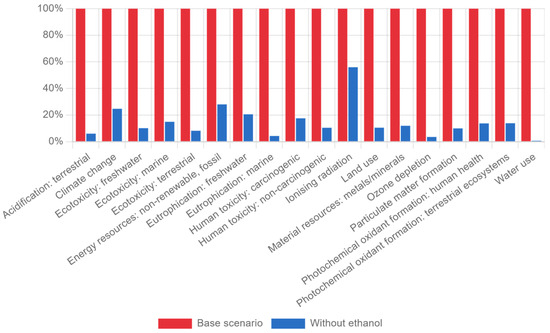
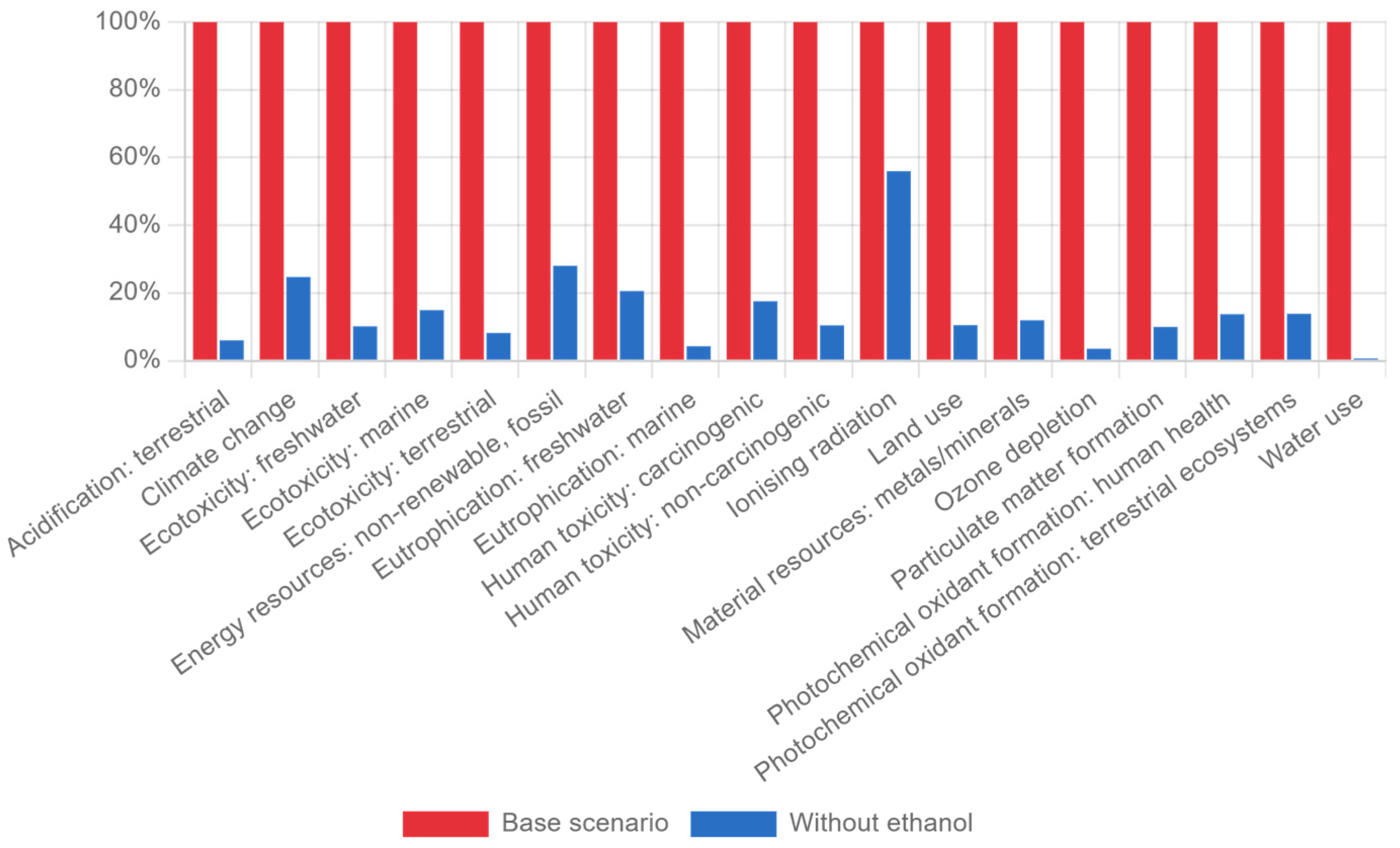
Therefore, the LCA for the alternative scenario without ethanol was conducted, and the results are shown in Figure 3.
Figure 3.
Scenario comparison with or without ethanol.
The scenario analysis without ethanol clearly demonstrates a substantial reduction across all impact categories. This confirms earlier experimental and LCA-based findings indicating that ethanol pre-extraction is a major environmental hotspot in suberinic acids adhesive production [9,11]. Importantly, mechanical testing has shown that eliminating ethanol does not significantly compromise adhesive performance when appropriate bark particle fractions are used [9]. From an environmental perspective, solvent-free adhesive production therefore represents a highly effective mitigation strategy. However, this improvement introduces a trade-off between environmental and economic performance. Betulin extraction is a high-value co-product, and its removal may reduce the overall financial viability of bark valorization [9,11]. Consequently, future optimization should focus on identifying process configurations that balance environmental benefits with economic returns, potentially through solvent recovery.
3.3. Scenario with Shorter Supply Distances for KOH and HNO3
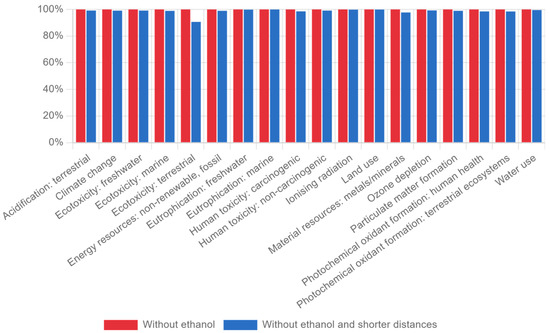
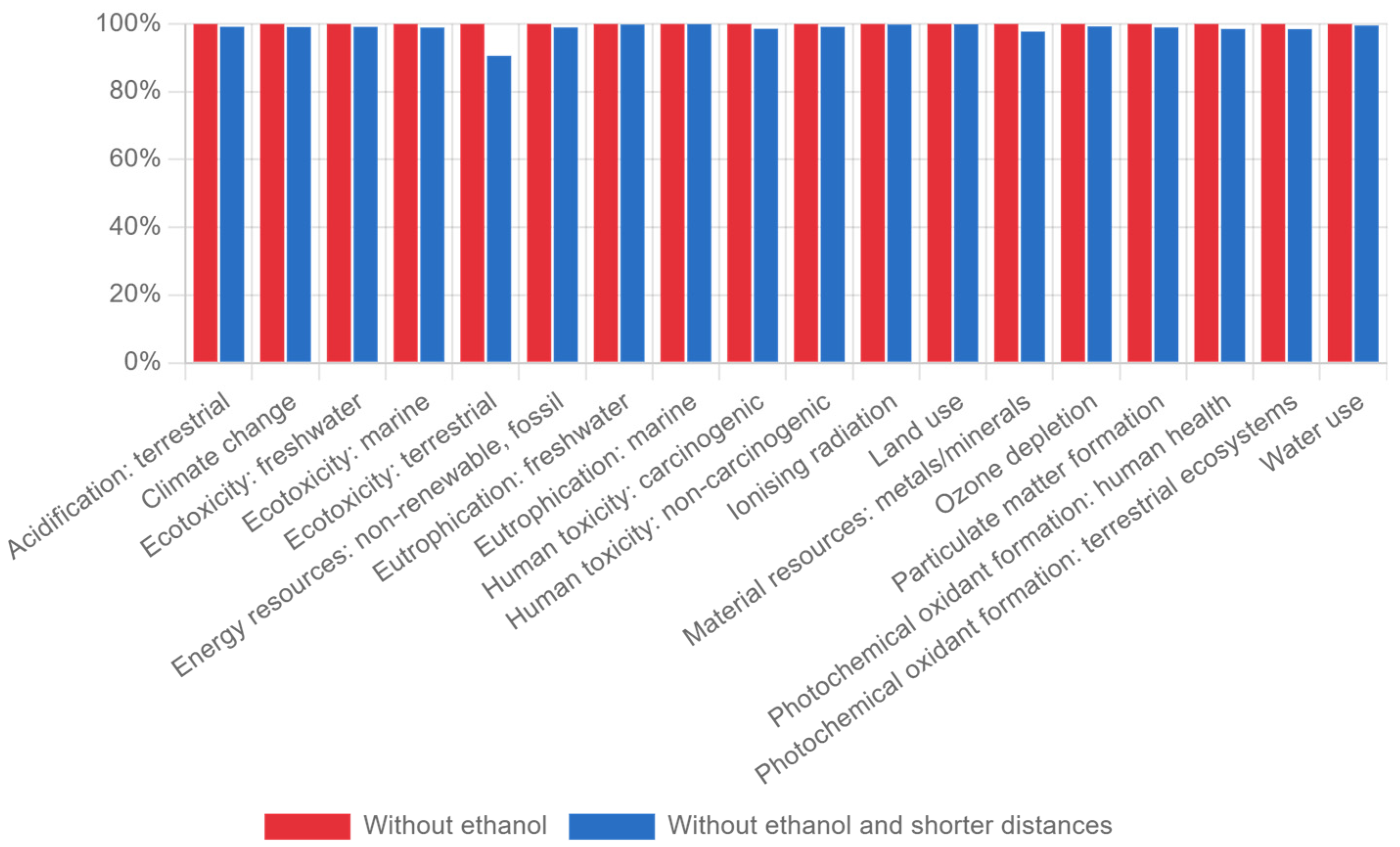
As transport can be a significant source of pollution, it is vital to assess the parameter sensitivity to that factor; therefore, the KOH and HNO3 delivery distances were reduced to 300 km, and the results are shown in Figure 4.
Figure 4.
Parameter sensitivity check distances.
If comparing the scenario without ethanol to the same scenario but with reduced delivery distances for KOH and HNO3 delivery, the results are very similar, except for the ET category, which decreases when the delivery distances are shorter. The sensitivity analysis on transport distances for KOH and HNO3 demonstrates that logistics play a secondary but non-negligible role, particularly for terrestrial ecotoxicity. While the overall impact reductions are modest, the results confirm that long-distance transport of chemicals contributes disproportionately to toxicity-related categories, driven by fuel combustion emissions and upstream chemical production burdens. This finding is consistent with general LCA literature, which shows that transport becomes increasingly relevant for impact categories linked to emissions of heavy metals, NOₓ, and particulate matter [13].
Local sourcing of chemicals or the development of alternative alkaline and acidic reagents with lower environmental footprints could further reduce these impacts, especially in large-scale production scenarios.
The end-of-life scenario could potentially be more favorable, as TMSa plywood contains no harmful substances and can be reused as a raw material for particleboard manufacturing.
3.4. Comparison with PF-Bonded Plywood
Two existing common plywood manufacturers in Latvia EPD’s results [22,31] in the life cycle stage A1–A3 were compared with the results from TMSA plywood using LCIA method EN 15804+A2 (EF.3.1.). The results can be seen in Table 6.
Table 6.
Common plywood and TMSA plywood A1–A3 comparison.
As shown in Table 6, TMSA plywood has a lower environmental impact across all categories.
3.5. Eco-Cost Analysis
The eco-costs are shown in Table 7.
Table 7.
Eco-costs of experimental TMSA plywood.
The total investment required to offset the environmental impact of TMSA plywood amounts to 6976.28 EUR/m3. In the scenario without ethanol use, the eco-costs decrease substantially to 1032.91 EUR/m3, as the environmental burden is reduced across almost all impact categories. When ethanol is removed and transportation distances are reduced, the eco-costs further decline to 1020.52 EUR/m3, confirming that transport contributes only marginally to the overall environmental impacts of TMSA plywood.
The results of this study demonstrate that the environmental performance of TMSA plywood is primarily governed by upstream agricultural and energy-intensive processes rather than by wood-based components themselves. This finding is consistent with previous LCA studies on bio-based materials, which frequently report that auxiliary inputs—such as solvents, energy carriers, and agricultural feedstocks—can outweigh the impacts associated with renewable raw materials [11,13].
4. Conclusions
This study presents a cradle-to-grave LCA of plywood made from thermally modified birch veneers bonded with bio-based suberinic acids adhesive, demonstrating its potential as a more sustainable alternative to conventional phenol–formaldehyde plywood. The results identify adhesive production—particularly upstream agricultural and bioethanol-related processes—as the dominant environmental hotspot across most impact categories, whereas thermal modification of veneers contributes only marginally, except for ionizing radiation associated with electricity use. It should be noted that VOC emissions during the thermal modification process are not included in this study and may increase the environmental impact. Scenario and sensitivity analyses show that eliminating ethanol from the adhesive production chain significantly reduces environmental impacts, whereas transport plays a secondary role. Overall sustainability improvements, therefore, depend primarily on solvent-free adhesive formulations, energy efficiency, and low-carbon electricity supply. Although laboratory-scale results are promising, uncertainties related to process efficiency, energy demand, and emissions at the industrial scale remain, underscoring the need for pilot- and full-scale studies to validate environmental and economic performance before commercialization. This is a preliminary study.
Author Contributions
Conceptualization, A.M. and U.S.; methodology, A.M., U.S., A.P. and J.R.; software, A.M.; investigation, A.M., U.S., I.C., A.P. and J.R.; resources, U.S., I.C., A.P. and J.R.; writing—original draft preparation, A.M. writing—review and editing, A.M., U.S., I.C., A.P. and J.R.; visualization, A.M.; supervision, U.S.; project administration, J.R.; funding acquisition, U.S. and J.R. All authors have read and agreed to the published version of the manuscript.
Funding
This research was conducted within the Latvian State research program project No. VPP-ZM-VRIIILA-2024/2-0002, “Innovation in Forest Management and Value Chain for Latvia’s Growth: New Forest Services, Products and Technologies (Forest4LV)”.
Data Availability Statement
The dataset is available upon request from the authors.
Conflicts of Interest
The authors declare no conflicts of interest. The funders had no role in the design of the study, in the collection, analysis, or interpretation of data, in the writing of the manuscript, or in the decision to publish the results.
Abbreviations
The following abbreviations are used in this manuscript:
| LCA | Life cycle assessment |
| PF | Phenol–formaldehyde resin |
| EPD | Environmental product declaration |
| TMSA-plywood | Plywood produced from thermally modified veneer, bonded with suberinic acids adhesive |
| LCIA | Life cycle impact assessment |
| AP | Acidification: terrestrial |
| GWP | Climate change |
| ETF | Ecotoxicity: freshwater |
| ETM | Ecotoxicity: marine |
| ET | Ecotoxicity: terrestrial |
| ERF | Energy resources: non-renewable, fossil |
| EF | Eutrophication: freshwater |
| EM | Eutrophication: marine |
| HTC | Human toxicity: carcinogenic |
| HT | Human toxicity: non-carcinogenic |
| IR | Ionizing radiation |
| LU | Land use |
| MR | Material resources: metals/minerals |
| OD | Ozone depletion |
| PM | Particulate matter formation |
| POH | Photochemical oxidant formation: human health |
| POT | Photochemical oxidant formation: terrestrial ecosystems |
| WU | Water use |
| I | Individualist |
| H | Hierarchist |
| E | Egalitarian |
| CFC-11 | Trichlorofluoromethane |
| 1,4-DCB | 1,4 dichlorobenzene |
| TAP | Terrestrial acidification potential |
| GWP100 | Global warming potential |
| FETP | Freshwater ecotoxicity potential |
| METP | Marine ecotoxicity potential |
| TETP | Terrestrial ecotoxicity potential |
| FFP | Fossil fuel potential |
| FEP | Freshwater eutrophication potential |
| MEP | Marine eutrophication potential |
| HTPc | Human toxicity potential (carcinogenic) |
| HTPnc | Human toxicity potential |
| IRP | Ionizing radiation potential |
| LOP | Agricultural land occupation |
| SOP | Surplus ore potential |
| ODPinfinite | Ozone depletion potential |
| PMFP | Particulate matter formation potential |
| HOFP | Photochemical oxidant formation potential: humans |
| EOFP | Photochemical oxidant formation potential: ecosystems |
| WCP | Water consumption potential |
| TM | Thermal modification |
| GWP-total | Total global warming potential |
| GWP-fossil | Global warming potential caused by fossil sources |
| GWP-biogenic | Global warming potential biogenic removals and emissions |
| GWP-luluc | Global warming potential caused by land use and land use changes |
| ODP | Ozone depletion potential |
| AP* | Acidification potential |
| EP-freshwater | Eutrophication potential aquatic freshwater |
| EP-marine | Eutrophication potential fresh marine |
| EP-terrestrial | Eutrophication potential terrestrial |
| POCP | Photochemical ozone formation |
| ADPE | Abiotic depletion—minerals and metals |
| ADPF | Abiotic depletion—fossil fuels |
| WDP | Water depletion potential |
References
- ISO 14040:2006; Environmental Management—Life Cycle Assessment—Principles and Framework. International Organization for Standardization: Geneva, Switzerland, 2006.
- ISO 14044:2006; Environmental Management—Life Cycle Assessment—Requirements and Guidelines. International Organization for Standardization: Geneva, Switzerland, 2006.
- EN 15804:2012+A2:2019; Sustainability of Construction Works—Environmental Product Declarations—Core Rules for the Product Category of Construction Products. iTeh: San Francisco, CA, USA, 2019.
- ISO 14025:2006; Environmental Labels and Declarations—Type III Environmental Declarations—Principles and Procedures. International Organization for Standardization: Geneva, Switzerland, 2006.
- Bare, J.C.; Hofstetter, P.; Pennington, D.W.; Udo De Haes, H.A. Midpoints versus Endpoints: The Sacrifices and Benefits. Int. J. Life Cycle Assess. 2012, 5, 319–326. [Google Scholar] [CrossRef] [Scilit]
- Huijbregts, M.A.J.; Steinmann, Z.J.N.; Elshout, P.M.F.; Stam, G.; Verones, F.; Vieira, M.; Zijp, M.; Hollander, A.; Zelm, R. ReCiPe2016: A harmonised life cycle impact assessment method at midpoint and endpoint level. Int. J. Life Cycle Assess. 2017, 22, 138–147. [Google Scholar] [CrossRef] [Scilit]
- Wolfova, M.; Estokova, A.; Ondova, M.; Monokova, A. Comparing of the external bearing wall using three cultural perspectives in the life cycle impact assessment. IOP Conf. Ser. Mater. Sci. Eng. 2018, 385, 012064. [Google Scholar] [CrossRef] [Scilit]
- Bastani, A.; Militz, H.; Rohumaa, A. Development of bonding strength of modified birch veneers during adhesive curing. Wood Res. 2016, 16, 205–214. [Google Scholar]
- Bērziņš, R.; Paze, A.; Sosins, G.; Godiņa, D.; Vēvere, L.; Rižikovs, J. Improvement of the birch outer bark plywood binder: The impact of the bark fractional composition and the binder preparation methodology. J. Renew. Mater. 2024, 12, 2095–2113. [Google Scholar] [CrossRef] [Scilit]
- Godina, D.; Sosins, G.; Paze, A.; Rizikovs, J.; Makars, R.; Treu, A. Evaluating the potential of birch bark suberinic acids for solid wood impregnation. J. Renew. Mater. 2025, 13, 147–161. [Google Scholar] [CrossRef] [Scilit]
- Yadav, P.; Korpinen, R.; Raty, T.; Korkalo, P.; Rasanen, K.; Tienaho, J.; Saranpaa, P. Life cycle assessment of suberin and betulin production from birch bark. J. Clean. Prod. 2024, 474, 143570. [Google Scholar] [CrossRef] [Scilit]
- Hill, C.; Altgen, M.; Rautkari, L. Thermal modification of wood—A review: Chemical changes and hygroscopicity. J. Mater. Sci. 2021, 56, 6581–6614. [Google Scholar] [CrossRef] [Scilit]
- Hill, C.; Hughes, M.; Gudsell, D. Environmental impact of wood modification. Coatings 2021, 11, 366. [Google Scholar] [CrossRef] [Scilit]
- Jebrane, M.; Cuccui, I.; Allegretti, O.; Uetimane, E., Jr.; Terziev, N. Thermowood ® vs Termovuoto process—Comparison of thermally modified timber in industrial conditions. In Proceedings of the 9th European Conference on Wood Modification, Arnhem, The Netherlands, 17–18 September 2018. [Google Scholar]
- Candelier, K.; Dibdiakova, J. A review on life cycle assessments of thermally modified wood. Holzforschung 2021, 75, 199–224. [Google Scholar] [CrossRef] [Scilit]
- Jia, L.; Chu, J.; Ma, L.; Qi, X.; Kumar, A. Life cycle assessment of plywood manufacturing process in China. Int. J. Environ. Res. Public Health 2019, 16, 2037. [Google Scholar] [CrossRef] [Scilit] [PubMed]
- Prakash, V.; Nath, S.K.; Sujatha, D.; Uday, D.N.; Mamatha, B.S.; Kiran, M.C.; Narasimhamurthy. Gate to gate life cycle assessment of plywood manufacturing in India. Ecomaterials 2025, 5, 2798. [Google Scholar] [CrossRef] [Scilit]
- Costa, D.; Serra, J.; Quinteiro, P.; Dias, A.D. Life cycle of wood-based panels: A review. J. Clean. Prod. 2024, 444, 140955. [Google Scholar] [CrossRef] [Scilit]
- Marra, M.; Allegretti, O.; Guercini, S. Life Cycle Assessment of ThermoVacuum treated softwood timber with comparison to untreated and preserved cladding. In Proceedings of the COST Action FP1407 1st Conference, Koper, Slovenia, 25–26 August 2015. [Google Scholar]
- EN 314-1:1993; Plywood—Bonding quality—Part 2: Requirements; CEN/TC 112. iTeh: San Francisco, CA, USA, 1993.
- Meija, A.; Spulle, U.; Ramata, L.; Cuccui, I.; Allegretti, O.; Paze, A.; Rizikovs, J. Gluability of thermally modified aspen, birch, and poplar rotary cut veneers with suberinic acids adhesive. Sustainability 2025, 17, 1990. [Google Scholar] [CrossRef] [Scilit]
- A/S Latvijas finieris. Raw Birch Plywood. EPD International AB. EPD-IES-0013275:001 (S-P-13275). 2024. Available online: https://www.environdec.com/library/epd13275 (accessed on 8 February 2026).
- Kuka, E.; Cirule, D.; Andersone, I.; Miklasevics, Z.; Andersons, B. Life cycle inventory for currently harvested birch roundwood. Eur. J. Wood Wood Prod. 2020, 78, 859–870. [Google Scholar] [CrossRef] [Scilit]
- Environmental Prices Handbook 2024: EU27 version. Available online: https://cedelft.eu/publications/environmental-prices-handbook-2024-eu27-version/ (accessed on 29 December 2025).
- Cherubini, F.; Strømman, A.H. Life cycle assessment of bioenergy systems: State of the art and future challenges. Bioresour. Technol. 2011, 102, 437–451. [Google Scholar] [CrossRef] [Scilit] [PubMed]
- Esteves, B.M.; Pereira, H.M. Wood modification by heat treatment: A review. Bioresources 2009, 4, 370–404. [Google Scholar] [CrossRef] [Scilit]
- Azapagic, A.; Clift, R. The application of life cycle assessment to process optimisation. Comput. Chem. Eng. 1999, 23, 1509–1526. [Google Scholar] [CrossRef] [Scilit]
- Klemeš, J.J.; Varbanov, P.S.; Kravanja, Z. Recent developments in Process Integration. Chem. Eng. Res. Des. 2013, 91, 2037–2053. [Google Scholar] [CrossRef] [Scilit]
- Sandberg, D.; Kutnar, A.; Mantanis, G. Wood modification technologies—A review. IForest 2017, 10, 895–908. [Google Scholar] [CrossRef] [Scilit]
- Peters Max, S.; Timmerhaus, K.D. Plant Design and Economics for Chemical Engineers, 4th ed.; McGraw-Hill: Columbus, OH, USA, 1991. [Google Scholar]
- Stiga, R.M. Birch Plywood from Stiga RM. EPD International AB. EPD-IES-0017548:003. 2025. Available online: https://www.environdec.com/library/epd17548 (accessed on 8 February 2026).



Disclaimer/Publisher’s Note: The statements, opinions and data contained in all publications are solely those of the individual author(s) and contributor(s) and not of MDPI and/or the editor(s). MDPI and/or the editor(s) disclaim responsibility for any injury to people or property resulting from any ideas, methods, instructions or products referred to in the content. |
© 2026 by the authors. Licensee MDPI, Basel, Switzerland. This article is an open access article distributed under the terms and conditions of the Creative Commons Attribution (CC BY) license.