


Next Issue
Volume 15, September
Previous Issue
Volume 15, July


Arts, Volume 15, Issue 8 (August 2026) – 26 articles
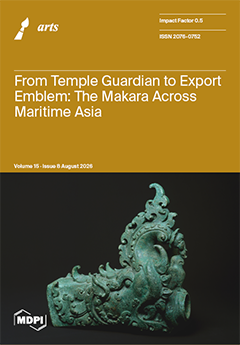
Cover Story (view full-size image): The Makara, a hybrid aquatic guardian rooted in Indian religious and architectural traditions, travelled across Asia and was transformed as it entered new media, markets, and cultural settings. Focusing on ninth-century Changsha ceramics and evidence from the Belitung shipwreck, we trace how the monumental three-dimensional guardian was reduced to a fluid, two-dimensional painted motif suited to rapid ceramic production and maritime export. Rather than viewing this change as a loss of meaning, it is interpreted as a process of visual and material translation, showing how Chinese artisans adapted selected features of the Makara for long-distance circulation across the Maritime Silk Road. View this paper
  • Issues are regarded as officially published after their release is announced to the table of contents alert mailing list.
  • You may sign up for e-mail alerts to receive table of contents of newly released issues.
  • PDF is the official format for papers published in both, html and pdf forms. To view the papers in pdf format, click on the "PDF Full-text" link, and use the free Adobe Reader to open them.
Order results
Result details
Section
Select all
Export citation of selected articles as:
16 pages, 5290 KB  
Article
“Cats Will Be Cats”: Exploring the Negotiated Gaze in Belle Johnson’s Feline Photography
by J. Keri Cronin
Arts 2026, 15(8), 194; https://doi.org/10.3390/arts15080194 - 21 Aug 2026
Viewed by 406
Abstract
This article focuses on a series of cat photographs taken by Belle Johnson, a photographer from Monroe City, Mo., in the early years of the 20th century. These photographs were included in a project called With Other Photographers, an initiative from 1909–1910 [...] Read more.
This article focuses on a series of cat photographs taken by Belle Johnson, a photographer from Monroe City, Mo., in the early years of the 20th century. These photographs were included in a project called With Other Photographers, an initiative from 1909–1910 which showcased the studio set-ups and techniques of professional photographers. Through this set of photographs we see not only the finished results but also process shots of Johnson working with the cats in her studio. In this article I explore how these photographs were part of a larger discussion around two very different approaches to photography in the United States at this time while also insisting on seeing these cats as individual subjects with agency who played an active role in the creation of these images. Full article
(This article belongs to the Special Issue Human-Animal Interactions in Western Art)
Show Figures

Figure 1

34 pages, 98434 KB  
Article
Mystical Inner Vision: Daoist Inner Contemplation in the Mediumistic Paintings of Guo Fengyi
by Zhilong Yan and Manyi Pei
Arts 2026, 15(8), 193; https://doi.org/10.3390/arts15080193 - 20 Aug 2026
Viewed by 227
Abstract
This study examines the mediumistic paintings of Guo Fengyi (郭鳳怡 1942–2010) through the lens of Daoist inner contemplation (neiguan 內觀) and traditional Chinese medicine. Guo developed distinctive self-cultivation techniques, including Ziran Chaoneng Gong (自然超能功 Natural Superpower Qigong), Qi’e Gong (企鵝功 [...] Read more.
This study examines the mediumistic paintings of Guo Fengyi (郭鳳怡 1942–2010) through the lens of Daoist inner contemplation (neiguan 內觀) and traditional Chinese medicine. Guo developed distinctive self-cultivation techniques, including Ziran Chaoneng Gong (自然超能功 Natural Superpower Qigong), Qi’e Gong (企鵝功 Penguin Qigong 氣功), and Liu Ling Shuzi Gong (劉陵數字功 Liu Ling Numerology Qigong), which resonate with ancient Chinese practices of Zhouyi (周易) divination, shamanic ritual, and Daoist visualization. Through sustained spiritual practice, she experienced what she understood as mystical revelations transmitted by the High Masters. Vivid visionary images repeatedly emerged in her consciousness, accompanied by an overwhelming sense of being guided by an unseen spiritual agency to depict an unknown transcendent realm. Following these experiences, she created nearly one thousand mediumistic paintings. Her work delves into inner landscapes of consciousness and energetic experience, expanding visual art research into the domain of “inner vision”. This study argues that Guo’s art challenges ocular-centric creative paradigms: her mode of “seeing” operates through the supersensory “eye of spirit” rather than physical sight, and artistic creation becomes a process of receiving higher-dimensional messages rather than singular self-expression. Her practice offers a critical reference for recovering the spiritual dimension in contemporary art and provides theoretical perspectives for comparative studies of international mediumistic artists such as Hilma af Klint (1862–1944) and Georgiana Houghton (1814–1884). Full article
Show Figures

Figure 1

13 pages, 4098 KB  
Article
From Spectacle to Regeneration: Animal Performance, Dominion, and the Environmental Imagination in British Visual Culture
by Farah Benbouabdellah
Arts 2026, 15(8), 192; https://doi.org/10.3390/arts15080192 - 19 Aug 2026
Viewed by 246
Abstract
Britain’s historical spectacles of animal performance, from Victorian circuses and travelling menageries to early visual media, did more than entertain, they shaped how humans imagined, controlled, and valued nonhuman life. Animals were transformed into objects of fascination and domination, while hunting and poaching [...] Read more.
Britain’s historical spectacles of animal performance, from Victorian circuses and travelling menageries to early visual media, did more than entertain, they shaped how humans imagined, controlled, and valued nonhuman life. Animals were transformed into objects of fascination and domination, while hunting and poaching practices reinforced imperial authority over wildlife. These performances codified visual and moral frameworks that positioned Britain as arbiter of “wildness,” embedding hierarchies of power and ethical order into the cultural imagination. This paper draws on performance studies, postcolonial ecocriticism, and visual anthropology to trace how circus rings, menageries, and early animal films laid aesthetic and ideological foundations that resonate in contemporary British environmental art and regeneration discourse. By historicising these visual legacies, it reveals how dominion, spectacle, and exploitation persist as underlying structures in Britain’s engagement with nature. Yet contemporary environmental arts are not merely reactive, they reinterpret these histories, transforming frameworks of control into imaginative possibilities for ethical, regenerative, and multispecies representation. By linking past and present, this study demonstrates that understanding the visual politics of historical animal performance is essential to imagining sustainable and inclusive futures for human and nonhuman life in Britain. Full article
(This article belongs to the Special Issue The Visual Arts and Environmental Regeneration in Britain)
Show Figures

Figure 1

35 pages, 104222 KB  
Article
On Presence, Three Artists and Their Practice (1938 to 2026)
by Maureen Kendal and Alana Lake
Arts 2026, 15(8), 191; https://doi.org/10.3390/arts15080191 - 18 Aug 2026
Viewed by 277
Abstract
This paper examines the practices of three women artists working across the twentieth and early twenty-first centuries. Drawing on Martin Buber’s philosophy of relation and Vilém Flusser’s analysis of technological mediation, it considers how their practices respond to changing conditions of production across [...] Read more.
This paper examines the practices of three women artists working across the twentieth and early twenty-first centuries. Drawing on Martin Buber’s philosophy of relation and Vilém Flusser’s analysis of technological mediation, it considers how their practices respond to changing conditions of production across analogue and digital technologies. The methodological approach is informed by autoethnography, using situated first-person experience to extend broader social and cultural critique. While one practice spans the transition between analogue and emerging digital modes, the other two operate within post-digital conditions in which material and technological processes are increasingly entangled. Across these contexts, the artists share recurring concerns with relation, ethics, embodiment, and a renewed emphasis on materiality and the tangible. Rather than treating technology as a determining force, the paper argues that changing technological conditions sharpen philosophical questions of presence, relation, and mediation. Through close attention to materials, processes of making, and artistic encounter, it proposes three interconnected ways of understanding presence as encounter, trace, and mediation. Together, these perspectives demonstrate how relationships become materially tangible through forms of embodiment, residual marks, and technologically mediated environments. In doing so, this paper positions presence as a relational and material site of meaning, showing how contemporary artistic practice can produce encounters that resist the reduction of the other. Full article
(This article belongs to the Special Issue Presence and Media)
Show Figures

Figure 1

23 pages, 1532 KB  
Article
Bodies on Edge and Bodies in Transit: Romanian Contemporary Dance in an Age of Uncertainty, a Fragile Present, and a Contested Future
by Camelia Lenart
Arts 2026, 15(8), 190; https://doi.org/10.3390/arts15080190 - 13 Aug 2026
Viewed by 347
Abstract
On 24 February 2022, Russia’s invasion of Ukraine intensified a broader sense of precarity across Eastern Europe, including Romania, and longstanding anxieties related to threat, instability, and loss—rooted in the Cold War past—resurfaced with renewed urgency. This article examines how, since 1989, Romanian [...] Read more.
On 24 February 2022, Russia’s invasion of Ukraine intensified a broader sense of precarity across Eastern Europe, including Romania, and longstanding anxieties related to threat, instability, and loss—rooted in the Cold War past—resurfaced with renewed urgency. This article examines how, since 1989, Romanian contemporary dance has responded to these conditions, functioning as a site for expressing and processing the physical and emotional “edginess” of the body and psyche in the post-socialist present. Drawing on archival research, audiovisual materials, and interviews, the study argues that Romanian contemporary dance operates across multiple temporalities. Looking to the past, it preserves and reactivates the memory of bodies that shaped its history, resisting their erasure amid shifting national and transnational identities. Rooted in the present, dancers and institutions navigate a fragile social terrain marked by regional conflict, migration, economic instability, and ongoing debates surrounding diversity and gender. At the same time, they confront the resurgence of nationalist, xenophobic, and exclusionary discourses within Romanian society. Through performance, pedagogy, institutional initiatives, and collaborative projects, contemporary dance in Romania emerges as a critical space of reflection and intervention, actively engaging social tensions while contributing to the reimagining of political and cultural futures. Full article
(This article belongs to the Special Issue Bodies on Edge in a Globalized World)
Show Figures

Figure 1

34 pages, 201271 KB  
Article
Iconographic Analysis of Panthera Depictions on Cylinder Seals from the British Museum
by Yucel Yazgin
Arts 2026, 15(8), 189; https://doi.org/10.3390/arts15080189 - 11 Aug 2026
Viewed by 301
Abstract
This study presents an iconographic analysis of cylinder seals from the British Museum’s collection belonging to ancient Near Eastern cultures that depict big cats. A total of 542 cylinder seals were examined, from which 171 big cat representations on 101 seals were selected [...] Read more.
This study presents an iconographic analysis of cylinder seals from the British Museum’s collection belonging to ancient Near Eastern cultures that depict big cats. A total of 542 cylinder seals were examined, from which 171 big cat representations on 101 seals were selected as the sample. The sample was analyzed using the visual analysis method. Data obtained from the analyses were coded with the MAXQDA 2024, version 24.7 software, thematic and sub-thematic categories were established, and content analysis was conducted. The results indicate that only one of the big cat figures can be identified as a leopard, while the remainder represent lions. In terms of formal characteristics, lion figures predominate, followed by hybrid forms such as griffin-lions. Most of the big cats are depicted standing upright on their hind legs with open mouths in aggressive or attacking postures, emphasizing the lion’s ferocity. The figures are generally highly stylized and possess strong representational qualities. Lions also appear in protective forms, such as sphinxes and griffins, symbolizing strength and guardianship. Additionally, heroes and rulers shown defeating lions function as visual expressions of political authority. Overall, big cat imagery on cylinder seals served as a symbolic medium conveying power, authority, protection, and sacredness within ancient societies. Full article
(This article belongs to the Section Visual Arts)
Show Figures

Figure 1

14 pages, 4070 KB  
Article
Breathing Images: Representing Smoke in the Era of Record Wildfires
by Andreas Rutkauskas
Arts 2026, 15(8), 188; https://doi.org/10.3390/arts15080188 - 11 Aug 2026
Viewed by 435
Abstract
This article examines wildfire smoke as a critical yet disproportionately represented subject within ecocritical photography, arguing that its diffuse, persistent, and atmospheric qualities challenge dominant modes of landscape representation and environmental imagery. While photographic and artistic depictions of wildfire have frequently privileged the [...] Read more.
This article examines wildfire smoke as a critical yet disproportionately represented subject within ecocritical photography, arguing that its diffuse, persistent, and atmospheric qualities challenge dominant modes of landscape representation and environmental imagery. While photographic and artistic depictions of wildfire have frequently privileged the spectacle of flame—emphasizing destruction, immediacy, and sublime encounter—smoke operates through ambiguity, duration, and embodied experience. Drawing from my own photographic practice, archival research, and critical engagements with environmental history, this paper investigates how smoke disrupts aesthetic conventions rooted in clarity, distance, and visual mastery. Through a case study of the 2023 McDougall Creek wildfire in British Columbia’s Okanagan Valley, I consider how smoke functions simultaneously as material condition, photographic subject, and representational problem. The paper situates these questions within the broader context of the Pyrocene, examining how colonial fire suppression practices and contemporary climate change have shaped both wildfire regimes and their visual representation. By analyzing historical archives, contemporary photographic practices, and artistic responses to atmospheric crisis, I argue that smoke offers a critical alternative to spectacular images of burning landscapes. Rather than representing wildfire as a discrete event, attention to smoke reveals fire as an ongoing atmospheric condition—one that complicates the boundaries between landscape, image, and lived experience. In foregrounding smoke, this paper proposes new possibilities for environmentally engaged visual culture that move beyond spectacle toward more embodied and ethically attentive forms of representation. Full article
(This article belongs to the Special Issue Ecocritical Lens: Photography, Environment, and the Anthropocene)
Show Figures

Figure 1

13 pages, 289 KB  
Article
John Cage’s 4′33″ as a Zen Experience: Interpreting Experimental Music Through Mahāyāna Concepts
by Yingjie Chen
Arts 2026, 15(8), 187; https://doi.org/10.3390/arts15080187 - 11 Aug 2026
Viewed by 383
Abstract
This paper explores the relationship between John Cage’s seminal work 4′33″ and the philosophies of Zen and Mahāyāna Buddhism, while reflecting on the limitations of Western philosophical frameworks in cross-cultural musical analysis. Existing scholarship has primarily focused on musical structure, performance practice, audience [...] Read more.
This paper explores the relationship between John Cage’s seminal work 4′33″ and the philosophies of Zen and Mahāyāna Buddhism, while reflecting on the limitations of Western philosophical frameworks in cross-cultural musical analysis. Existing scholarship has primarily focused on musical structure, performance practice, audience perception, and interpretations through Western theories such as those of Ludwig Wittgenstein and postmodernism, with limited attention to the influence of Eastern philosophy on Cage’s creative thought. Drawing on Mahāyāna concepts including emptiness, dependent origination, and the Two Truths, this study argues that the work’s use of silence encourages contemplation of the impermanence and relational nature of all phenomena. The paper further critiques the tendency to impose Western theoretical models upon Eastern thought, advocating instead for an experience-centred approach to cross-cultural analysis. It contends that 4′33″ is not merely an experimental musical work, but also a practical manifestation of Zen philosophy at the auditory and perceptual levels. Full article
(This article belongs to the Section Visual Arts)
10 pages, 195 KB  
Article
“Every Tool Is a Weapon If You Hold It Right”: Curating Feminist and Queer Listening Experiences in the Work of Ani DiFranco
by Seán Mac Risteaird
Arts 2026, 15(8), 186; https://doi.org/10.3390/arts15080186 - 11 Aug 2026
Viewed by 434
Abstract
Widely associated with third- and fourth-wave feminism, Ani DiFranco’s artistic practice creates and curates queer and feminist musical experiences through the tools of songwriting and spoken-word poetry. Since the release of her eponymous debut album in 1990, DiFranco has carved out a distinctive [...] Read more.
Widely associated with third- and fourth-wave feminism, Ani DiFranco’s artistic practice creates and curates queer and feminist musical experiences through the tools of songwriting and spoken-word poetry. Since the release of her eponymous debut album in 1990, DiFranco has carved out a distinctive voice within American folk and popular music and has cultivated communities of affiliation across feminist and queer communities. Drawing on Judith Butler’s theory of performativity and David Halperin’s conception of queerness as a form of non-normative identity, this article offers close, textual readings of a selection of DiFranco’s earlier songs and spoken-word poems, including “The Whole Night”, “In or Out”, “Lost Woman Song”, and “Self Evident”. In doing so, the article demonstrates how DiFranco’s performances extend beyond musical expression to function as sites of queer and feminist cultural production, where audiences are invited to participate in broader conversations about identity, community, and social change. Full article
(This article belongs to the Special Issue Creating Musical Experiences)
23 pages, 6078 KB  
Article
Autonomous Ornament: The Structural Homology Between Alphonse Mucha’s “Q Formula” and the Eastern Mandala
by Xuezi Zhang and Wonhwa Kim
Arts 2026, 15(8), 185; https://doi.org/10.3390/arts15080185 - 11 Aug 2026
Viewed by 279
Abstract
Alphonse Mucha’s oeuvre is frequently categorized as a formalist paradigm of ornamentation within the Art Nouveau movement. This study, however, contends that Mucha’s signature Q Formula is far from a mere aesthetic redundancy or a utilitarian embellishment; rather, it manifests as Autonomous Ornament—an [...] Read more.
Alphonse Mucha’s oeuvre is frequently categorized as a formalist paradigm of ornamentation within the Art Nouveau movement. This study, however, contends that Mucha’s signature Q Formula is far from a mere aesthetic redundancy or a utilitarian embellishment; rather, it manifests as Autonomous Ornament—an autonomous generative process and an inherent rhythm. Adopting a synchronic structural perspective that transcends linear historical causality, this research frames ornament as a dynamic relational medium connecting individual perception with collective evolution across geocultural boundaries. With Theosophy serving as a historical mediation and synthesizing Rudolf Arnheim’s psychology of visual perception with Gilles Deleuze’s philosophy of the ornamental refrain (ritornello), this paper traces the cross-cultural construction of the Q Formula—from Mucha’s Moravian Catholic roots to the avant-garde Theosophical milieu of Paris. Through a horizontal comparative analysis with contemporary fin-de-siècle artists—specifically contrasting Gustav Klimt’s ornamental dissolution and Aubrey Beardsley’s ironic fragmentation—the study underscores Mucha’s distinct integrative strategy. Furthermore, it demonstrates a profound structural homology in topological energy between the Q Formula and the Eastern Kālacakra Mandala. Within this pure and vital ornamental logic, the circular main body acts as a centripetal anchor referencing Emptiness (Śūnyatā), while the boundary-crossing media serve as a metaphor for centrifugal Dependent Origination (Pratītyasamutpāda) and worldly manifestation through clothed repetition. Such ornamental rhythms collapse the classical hierarchy between structure and surface. Amidst the pervasive anxiety of fin-de-siècle industrialization, these forms exerted a visual soothing function, providing deep emotional and psychological efficacy. Mucha’s ornamental schemata reveal how repetitive and structural rhythms successfully transmuted traditional religious paradigms into channels for the internal integration of the modern subject. The paper thus reaffirms ornament as a form of critical imagination and an independent artistic force, which not only reshapes the psychological homeostasis of the modern subject but also constructs a profound resonance between form and life within a cross-cultural context. Full article
Show Figures

Figure 1

16 pages, 35746 KB  
Article
Multipla Gallery (1972–2011) and the History of Multiples in Brazil: An Affaire de Femmes
by Ana Paula Cavalcanti Simioni
Arts 2026, 15(8), 184; https://doi.org/10.3390/arts15080184 - 10 Aug 2026
Viewed by 327
Abstract
This article examines the contribution of the Multipla Gallery—founded in 1972 by two women, Teresa Nazar and Edla Van Steen—to the introduction of a new artistic modality in Brazil: the multiples. The “motherhood” of this artistic modality was, at the time, attributed to [...] Read more.
This article examines the contribution of the Multipla Gallery—founded in 1972 by two women, Teresa Nazar and Edla Van Steen—to the introduction of a new artistic modality in Brazil: the multiples. The “motherhood” of this artistic modality was, at the time, attributed to a third woman: the French gallerist Denise René. This case reveals female presence and agency in the Brazilian art market during the 1970s, a period when women played a significant leading role. The feminization of the role of gallery owners is a topic that has yet to be thoroughly explored in Brazil from a historical and sociological perspective. The third part of the article also aims to discuss, based on the case of Teresa Nazar, the extent to which such female agency was not completely immune to gender inequalities. Full article
Show Figures

Figure 1

31 pages, 89761 KB  
Article
One Head, Two Bodies: A Double-Bodied Sphinx with in a 4th Century BC Scythian Culture as a Phenomenon of Selective Borrowing
by Sergei Polin and Marina Daragan
Arts 2026, 15(8), 183; https://doi.org/10.3390/arts15080183 - 7 Aug 2026
Viewed by 680
Abstract
The appearance and spread of the image of the bicorporate sphinx in Scythia of 4th century BC can be regarded as an example of selective borrowing from ancient iconography. In the Greek world, this type is encountered rarely, but it gained considerable currency [...] Read more.
The appearance and spread of the image of the bicorporate sphinx in Scythia of 4th century BC can be regarded as an example of selective borrowing from ancient iconography. In the Greek world, this type is encountered rarely, but it gained considerable currency among the Scythians of the Northern Black Sea region. Its spread coincides with the period of expansion of the fantastic bestiary among the Scythians and the increasing complexity of the funerary rite of the Scythian elite. The predominance of finds in female burials indicates that this image was part of the circle of signs associated specifically with women’s high social status. The doubling of the body enhanced the image’s visual expressiveness and protective nature. More complex interpretations of the worldview are not supported by the sources and cannot be considered proven. Full article
Show Figures

Figure 1

30 pages, 5868 KB  
Article
Glass Beads from Burial and Household Contexts of the Bilsk Hillfort in the Dnipro Forest-Steppe (Late 7th to 4th Century BC)
by Stanislav Zadnikov
Arts 2026, 15(8), 182; https://doi.org/10.3390/arts15080182 - 6 Aug 2026
Viewed by 396
Abstract
Bilsk hillfort (or gorodishche in Ukrainian) is the largest fortified settlement of the Early Iron Age in Eastern Europe. Long-term excavations made it possible to determine that it was a powerful industrial, political, religious, and trade center of the forest-steppe populations. Thanks to [...] Read more.
Bilsk hillfort (or gorodishche in Ukrainian) is the largest fortified settlement of the Early Iron Age in Eastern Europe. Long-term excavations made it possible to determine that it was a powerful industrial, political, religious, and trade center of the forest-steppe populations. Thanks to trade relations with the ancient cities of the Northern Black Sea region, wine in amphorae, ceremonial tableware, and glassware came to the settlement. The latter were mainly represented by beads of various shapes and ornaments. In this article, for the first time, 61 unique (or 135, taking similar ones into account) glass beads found during the excavations at the Bilsk hillfort are analyzed. To establish their chronology and the assortment of receipts in the different periods of the settlement’s existence, only beads from burials and various economic complexes with reliable dating were considered. It was established that glass beads reached the Bilsk settlement through Greek-mediated exchange networks from the last quarter of the 7th century BC. Their arrival continued continuously until the end of the 4th century BC, that is, during the entire Scythian period of the fortified settlement’s existence. The beads most likely reached Bilsk through exchange networks linking the settlement with the Greek cities of the Northern Black Sea region. Three overland routes may have been involved: the Olbian, Muravsky and Chersonesan routes. Evidence from Greek ceramics and other Mediterranean or Olbian imports suggests that the Olbian route was probably the dominant channel. Full article
Show Figures

Figure 1

25 pages, 8921 KB  
Article
Rediscovery of a 5th-Century BCE Burial Assemblage of the Dnipro Forest-Steppe Region
by Yuriі Polidovych and Evgenia Velychko
Arts 2026, 15(8), 181; https://doi.org/10.3390/arts15080181 - 4 Aug 2026
Viewed by 443
Abstract
This article discusses an unknown Scythian burial discovered by Serhiy Mazaraki near the village of Velyki Budky (Sumy Oblast, Ukraine) at the end of the 19th century and previously unknown to researchers. An assemblage of gold objects from this burial is identified, including [...] Read more.
This article discusses an unknown Scythian burial discovered by Serhiy Mazaraki near the village of Velyki Budky (Sumy Oblast, Ukraine) at the end of the 19th century and previously unknown to researchers. An assemblage of gold objects from this burial is identified, including a ring and seven plate appliqués depicting a scene in the Scythian “animal style,” dated to the second or third quarter of the 5th century BCE. The objects have numerous parallels, which help illuminate broader aspects of Scythian culture. The ring belongs to a small group of high-conical-shielded rings, likely crafted by Bosporan jewelers catering to a Scythian clientele; it is suggested that they were common in the northern Black Sea region throughout the 5th century BCE. The image of a curled-up predator on the gold appliqués corresponds, in both compositional and stylistic features, to the artistic tradition of the “animal style” of the 5th century BCE. Unique is the depiction of another image—the head of an antelope with a straight horn on the plaques. The assemblage of artifacts enables us to explore various aspects of the artistic traditions of the northern Black Sea region, the Kuban, the Cis-Urals, and even Western Asia. Full article
Show Figures

Figure 1

23 pages, 2620 KB  
Review
From Art Therapy to Art Healing: Solutions for College Students’ Mental Health: A Review
by Yingqiu Song, Caiyan Chen and Zhengdong Wang
Arts 2026, 15(8), 180; https://doi.org/10.3390/arts15080180 - 4 Aug 2026
Viewed by 631
Abstract
Depression, anxiety disorders and sleep disorders are becoming increasingly prevalent among college students. While psychotherapy and pharmacotherapy remain important interventions, their practical implementation in university settings may be constrained by factors including limited service accessibility, scheduling constraints, privacy concerns, stigma, and poor long-term [...] Read more.
Depression, anxiety disorders and sleep disorders are becoming increasingly prevalent among college students. While psychotherapy and pharmacotherapy remain important interventions, their practical implementation in university settings may be constrained by factors including limited service accessibility, scheduling constraints, privacy concerns, stigma, and poor long-term adherence. As a low-threshold supportive intervention that can be readily integrated into campus environments, art healing offers a complementary approach to promoting college student mental health. This review includes 20 studies retrieved from the Web of Science and PubMed databases. These studies provide evidence for the mental health benefits of auditory art, visual art, and integrated art healing. The findings indicate that music-based interventions (the primary form of auditory art) have relatively robust supporting evidence for alleviating stress and anxiety; visual art and integrative art healing also yield measurable positive mental health outcomes. However, existing research is limited by heterogeneous intervention delivery protocols, small sample sizes, short follow-up periods, and substantial variation in methodological quality. Current evidence supports art healing as a complementary strategy for mental health promotion in higher education settings, rather than an alternative treatment modality. Future work should test standardized protocols in multi-site student samples. Long-term follow-up designs to further clarify its target populations, underlying mechanisms, and sustained efficacy. Full article
Show Figures

Figure 1

17 pages, 229 KB  
Article
From Alignment to Evocation: On the Capability Boundaries and Collaborative Paths of AI Art Creation—A Framework Based on the Neuroaesthetic “Ring Scale” and Prompt Engineering
by Xianqun Yi and Hongsheng Li
Arts 2026, 15(8), 179; https://doi.org/10.3390/arts15080179 - 3 Aug 2026
Viewed by 368
Abstract
Recent generative art outputs across music, literature, painting and moving-image media have attracted extensive scholarly and public interest, yet evaluations of their creative capacities are mostly limited to informal observational accounts. Drawing on neuroaesthetic reasoning, this paper puts forward a dual-layer analytical framework [...] Read more.
Recent generative art outputs across music, literature, painting and moving-image media have attracted extensive scholarly and public interest, yet evaluations of their creative capacities are mostly limited to informal observational accounts. Drawing on neuroaesthetic reasoning, this paper puts forward a dual-layer analytical framework that differentiates two distinct modes of aesthetic reception: Alignment, defined as statistical template matching, and evocation, referring to the novel association of scattered embodied memory fragments. Building on this binary categorization, the study introduces the tentative Ring Scale taxonomy—a figurative target-shooting metaphor rather than quantitative metric—as a purely descriptive tool for stratifying relative aesthetic evocation intensity. This framework further unpacks the neurocognitive underpinnings of auditory, visual and textual aesthetic pathways, alongside their combined multimodal interactions within film and television works. It tentatively accounts for why generative systems tend to deliver more cohesive aesthetic outcomes within the auditory domain, and hypothesises a present functional limitation of current large models: these systems perform comparatively well within Alignment-driven aesthetic effects, while layered high-order evocation remains constrained by inherent structural limitations of statistical training architectures. From this diagnostic observation, three directional paradigm shifts for human–AI collaborative creation are outlined: shifting from human substitution to human–machine complementarity, shifting from exhaustive template imagery generation to targeted latent fragment elicitation, and shifting from optimising figurative Ring-tier descriptive labels to pursuing transformative aesthetic fission effects. The study frames imaginative cognition as the central driving force behind fruitful human–AI co-creation, and positions prompt engineering as the actionable operational bridge connecting human imaginative thought to machine-executable generative parameters. Three tentative prompt design tactics are then elaborated: physiological arousal framing, multisensory scenario simulation prompts, and intentional strategic blank-leaving. Additionally, this work discusses the plausible constructive functions of model hallucination phenomena when viewed through the lens of high-tier aesthetic evocation, rather than merely framing such outputs as technical errors. All judgments and tier comparisons raised throughout the paper are framed as unvalidated observational hypotheses open to empirical testing. To facilitate follow-up empirical scrutiny, the paper collates a full set of testable hypotheses derived from its theoretical reasoning and outlines feasible experimental validation pipelines, with an open call for controlled empirical research to corroborate or refine the proposed qualitative framework. Full article
18 pages, 7889 KB  
Article
Pedagogical Heritage Across Borders: A Structural and Cultural Analysis of Reichert’s 7 Exercices Journaliers pour la Flûte, Op. 5
by Seçil Soytok Nalçacı and Kutup Ata Tuncer
Arts 2026, 15(8), 178; https://doi.org/10.3390/arts15080178 - 3 Aug 2026
Viewed by 417
Abstract
The nineteenth century witnessed a significant transnational movement of European musicians and their pedagogical traditions across continents. Among the figures who contributed to this process, the Belgian flutist and composer Mathieu-André Reichert (1830–1880) occupies a distinctive position—trained in the Franco-Belgian tradition, he emigrated [...] Read more.
The nineteenth century witnessed a significant transnational movement of European musicians and their pedagogical traditions across continents. Among the figures who contributed to this process, the Belgian flutist and composer Mathieu-André Reichert (1830–1880) occupies a distinctive position—trained in the Franco-Belgian tradition, he emigrated to Brazil, where he introduced the Boehm-system flute and produced pedagogical materials that continue to be used in flute education across a range of national traditions. This study examines Reichert’s method, 7 Exercices Journaliers pour la Flûte, Op. 5, from dual perspectives: a structural–pedagogical analysis of the seven exercises and a cultural–historical contextualization of the method’s transnational circulation. Designed as a qualitative research study, this work employed document analysis as the data collection tool and thematic analysis as the method for data analysis and interpretation. The B. Schott’s Söhne (Mainz) edition of the method was examined as the primary source; secondary data was obtained from articles, theses, books, and digital sources. Each exercise was examined in terms of structural characteristics—including meter, metronome speed, melodic patterns, and harmonic structure—and the technical demands and potential pedagogical applications associated with articulation, tongue–finger coordination, lip flexibility, and breath control. The findings reveal that the method possesses a distinctive structural organization that systematically cycles through all keys, employs a different melodic pattern in each exercise, and consistently embeds technical demands within harmonic and melodic contexts. Beyond its pedagogical content, the study traces the method’s cultural trajectory—from its composition in nineteenth-century Brazil through its adoption by French school luminaries, such as Marcel Moyse, Michel Debost, and Trevor Wye, to its current use in music education programs across diverse cultural contexts, including Türkiye. The convergence of structural–pedagogical and cultural–historical analysis suggests that the method’s continued relevance across diverse teaching traditions reflects not only its coherent structural design but also broader processes of cultural transfer, the mobility of musicians and their pedagogical ideas, and the formation of transnational pedagogical networks in instrumental music education. Full article
Show Figures

Figure 1

16 pages, 23270 KB  
Article
Queer Aesthetics and Its Others: Human Autonomy and Nonhuman Subjugation in the Passy Cravat (1864)
by Mal Meisels
Arts 2026, 15(8), 177; https://doi.org/10.3390/arts15080177 - 1 Aug 2026
Viewed by 518
Abstract
In 1864, four French artists—Nathalie Micas, Rosa Bonheur, Isidore Bonheur, and Paul Chardin—gathered at Rosa Bonheur’s château in By-Thomery, a hamlet adjacent to the Fontainebleau forest. At the château’s main studio, the community members—connected through romance, blood, and friendship—crafted the Passy Cravat, [...] Read more.
In 1864, four French artists—Nathalie Micas, Rosa Bonheur, Isidore Bonheur, and Paul Chardin—gathered at Rosa Bonheur’s château in By-Thomery, a hamlet adjacent to the Fontainebleau forest. At the château’s main studio, the community members—connected through romance, blood, and friendship—crafted the Passy Cravat, or Parody of By’s Inhabitants, an experimental multi-media work in gouache, ink, and black pencil on canvas. In 1860, Rosa Bonheur, a celebrated animal painter, and Nathalie Micas, an amateur painter, engineer, and medical practitioner, moved to By from Paris with Micas’s mother and a menagerie of nonhuman animals used as pets and artist models. Red bands divide the Passy Cravat into rhombuses and triangles, each constituting a space on the estate, which the artists filled with irreverent caricatures of By’s human and nonhuman residents. This paper argues that the Passy Cravat, a work that has thus far been overlooked by art historians, is a prime example of nineteenth-century queer aesthetics because it constitutes a historically specific movement away from institutional classifications of genre and medium by a community that tinkered with the limitations of heteronormative life. The paper contends that queer aesthetics in the Passy Cravat are reliant upon the artists’ approaches to citizenship and human–animal relations. Ultimately, the Passy Cravat reveals By-Thomery to be a messy nexus of human autonomy and nonhuman subjugation bound to conceptions of belonging in the Second Empire (1852–1870). Full article
(This article belongs to the Special Issue Queerness in 18th- and 19th- Century European Art (2nd Edition))
Show Figures

Figure 1

29 pages, 50999 KB  
Article
The Structure of a Memory Landscape Based on the Analysis of Monuments and Memorial Sites in Southeastern Poland (Bieszczady Region and Bieszczady Foothills)
by Magdalena Czalczynska-Podolska and Wojciech Bal
Arts 2026, 15(8), 176; https://doi.org/10.3390/arts15080176 - 31 Jul 2026
Viewed by 416
Abstract
This article examines the memory landscape of the Bieszczady Mountains and Bieszczady Foothills region in south-eastern Poland, based on an original concept of its structural organization and a comparative analysis of selected sites of memory located in Sanok, Zagórz, Lesko, Baligród, Cisna, and [...] Read more.
This article examines the memory landscape of the Bieszczady Mountains and Bieszczady Foothills region in south-eastern Poland, based on an original concept of its structural organization and a comparative analysis of selected sites of memory located in Sanok, Zagórz, Lesko, Baligród, Cisna, and Solina. The aim of the study was to identify the role of individual sites of memory in shaping the regional memory landscape and to explore the relationships between its constituent elements. The research employed an interdisciplinary approach combining memory studies, cultural geography, cultural landscape studies, and conflict heritage research. Case-study analysis, field investigations, historical-interpretative research, and qualitative comparative assessment were applied. The analysis was conducted across five interrelated dimensions: memory types, functions of sites of memory, historical layers, memory narratives, and the significance of sites within the memory landscape structure. The results demonstrate that the regional memory landscape constitutes a multi-layered, polyphonic, and dynamic structure. National, local, traumatic, transnational, landscape-related, and absence-based memories coexist, forming a complex network of narratives and meanings. The findings confirm that the region can be interpreted as a palimpsestic borderland memory landscape in which successive historical and narrative layers do not replace one another but coexist and remain subject to continuous processes of reinterpretation. Full article
Show Figures

Figure 1

17 pages, 24635 KB  
Article
Sacred Masks and Queer Longing: Paul Hoecker’s Visual Negotiation of Desire
by Nicholas Maniu
Arts 2026, 15(8), 175; https://doi.org/10.3390/arts15080175 - 31 Jul 2026
Viewed by 399
Abstract
This article examines the art of Paul Hoecker (1854–1910) as a visual negotiation of queer desire, repression, and transgression in late 19th-century Germany. One of the first progressive professors at the Munich Art Academy, Hoecker remains an understudied figure in queer art history. [...] Read more.
This article examines the art of Paul Hoecker (1854–1910) as a visual negotiation of queer desire, repression, and transgression in late 19th-century Germany. One of the first progressive professors at the Munich Art Academy, Hoecker remains an understudied figure in queer art history. In a private letter to the sexologist Magnus Hirschfeld, he acknowledged his same-sex desire. Focusing on his recurrent depictions of handsome young men—often in the guise of Pierrot—alongside his numerous images of nuns, this article reads Hoecker’s work as a site of tension between desire, Catholic imagery, and social constraint. It further addresses the allegations surrounding the use of a male sex worker as a model for a depiction of the Virgin Mary. Finally, Hoecker’s later, more overtly erotic works, mostly produced for Jacques d’Adelswärd-Fersen, will also be considered, interrogating their problematic aspects, particularly the sexualization of youthful bodies. This research is conducted as part of the Paul Hoecker research group at the Forum Queeres Archiv München. Full article
(This article belongs to the Special Issue Queerness in 18th- and 19th- Century European Art (2nd Edition))
Show Figures

Figure 1

39 pages, 4299 KB  
Article
The Future of Human–AI Worldbuilding in Art
by Sun Park and Dragana Ćirić
Arts 2026, 15(8), 174; https://doi.org/10.3390/arts15080174 - 31 Jul 2026
Viewed by 1446
Abstract
The convergence of artistic practices and AI system development has introduced novel forms of artistic worldbuilding. This paper theoretically discusses how human artists (will) perceive and involve AI systems in their artistic worldbuilding. Adopting a qualitative foresight methodology to explore the artistic autonomy [...] Read more.
The convergence of artistic practices and AI system development has introduced novel forms of artistic worldbuilding. This paper theoretically discusses how human artists (will) perceive and involve AI systems in their artistic worldbuilding. Adopting a qualitative foresight methodology to explore the artistic autonomy and artistic authority with which humans and AI systems engage, this paper presents three scenarios of human–AI interaction in macro art worlds (art societies) and micro artworlds (worlds within artworks). Drawing on a review of the generative art approach as the current use of AI systems in art-making, the other two futuristic scenarios of human–AI interaction illustrate the shifting roles of humans and AI systems in artistic worldbuilding. The hypothetical scenarios of human–AI interaction in art-making provide a theoretical test bed for recognising diverse types of artistic contribution ranging from human inspiration and curation to non-human decision-making. Full article
(This article belongs to the Topic Artificial Intelligence and the Future of Art)
Show Figures

Figure 1

31 pages, 212994 KB  
Editorial
The Unfinished Avant-Garde Modernity and the Idea of Tékhnē: The One Hundred Years’ Revolution, 1850–1950
by Dennis Ioffe
Arts 2026, 15(8), 173; https://doi.org/10.3390/arts15080173 - 29 Jul 2026
Viewed by 298
Abstract
In what follows below I reconceptualize the relationship between the European avant-garde(s) and technology across the longer century from 1850 to 1950 through the classical notion of tékhnē, understood as the inseparability of making and knowing [...] Full article
Show Figures

Figure 1

23 pages, 23784 KB  
Article
Makara Across Waters: Visual and Material Adaptation of a Mythical Motif from Indian Guardianship to Chinese Ceramic Export
by Majid Rahmandoust and Renke He
Arts 2026, 15(8), 172; https://doi.org/10.3390/arts15080172 - 29 Jul 2026
Viewed by 390
Abstract
The Makara, a potent hybrid guardian figure from Indian architectural sculpture, poses a question for the study of artistic exchange: how did this complex motif travel across Asia and transform into a simplified painted emblem on Chinese export ceramics? We address this question [...] Read more.
The Makara, a potent hybrid guardian figure from Indian architectural sculpture, poses a question for the study of artistic exchange: how did this complex motif travel across Asia and transform into a simplified painted emblem on Chinese export ceramics? We address this question by analyzing a corpus of textual sources, sculptural reliefs, and ceramic assemblages, with a focused case study on ninth-century Changsha kiln production and the pivotal evidence from the Belitung shipwreck. The analysis reveals a profound morphological and functional shift. In stone, the Makara appears as a powerful, three-dimensional guardian in complex crocodilian or elephantine forms. In contrast, on mass-produced Changsha bowls, it is abbreviated to a stylized, two-dimensional head, often paired with a pearl. We argue that this transformation was not a simple degradation but a sophisticated act of modular translation. The shift in medium from stone carving to swift underglaze painting and the demands of a global market forced a functional reinvention: the static, architectural guardian became a portable, commercial emblem. Ultimately, the analysis frames the Changsha artisan as an active cultural translator and the Makara bowls as an early, successful example of customized export design for a global audience. Full article
Show Figures

Figure 1

20 pages, 321 KB  
Article
Seeking Authenticity: ‘Method’ Production Design in Narrative Screen Practice
by Juliet John
Arts 2026, 15(8), 171; https://doi.org/10.3390/arts15080171 - 27 Jul 2026
Viewed by 420
Abstract
In contemporary narrative filmmaking, emerging technologies such as virtual production and generative artificial intelligence are impacting production workflows. Yet one central element of the practice remains unchanged: filmmakers seek to create relatable characters who are situated within believable dramatic scenarios. When achieved, narrative [...] Read more.
In contemporary narrative filmmaking, emerging technologies such as virtual production and generative artificial intelligence are impacting production workflows. Yet one central element of the practice remains unchanged: filmmakers seek to create relatable characters who are situated within believable dramatic scenarios. When achieved, narrative authenticity supports audience immersion, which in turn affects the work’s impact. Characters are constructed through a complex matrix of meaning expressed on screen by actors and contributed to by writers, directors, costume designers, production designers, cinematographers, editors, composers and sound designers. Over the last century, the Method technique has been a widely recognised practice used by many actors to find authenticity in their performances. Like actors, production designers rely on developing an understanding of a character’s inner life as a path to designing authentic fictional worlds. Is there an implicit approach in production design practice that aligns with the Method approach used in performance? Are there similarities between the way a production designer prepares a character’s environment and the way an actor prepares to perform in it? And once created, does the design itself perform authenticity? If so, can making this practice more explicit assist with the development and broader understanding of how designers contribute to screen works? As a way of elucidating the comparatively less visible contribution of the production designer, this article compares selected Method techniques used by actors with those used by production designers in seeking authentic characterisations. By placing these practices in dialogue, this article proposes production design as a form of performative practice that implicitly draws on a Method approach to effectively solve the design problem in narrative screen practice. Full article
18 pages, 271 KB  
Article
From Nietzsche and Scheler’s Concept of Ressentiment to Jean Genet’s Resentful Characters: The Maids
by Aziz Tamer Güler and Ramazan Bilge
Arts 2026, 15(8), 170; https://doi.org/10.3390/arts15080170 - 27 Jul 2026
Viewed by 774
Abstract
Associated with Nietzsche’s nihilism, the concept of ressentiment—the resentment felt by the slave toward the master—is defined by Max Scheler, following Nietzsche’s line of thought, as the self-poisoning of the mind. This emotion frequently appears in cinema and the performing arts, which are [...] Read more.
Associated with Nietzsche’s nihilism, the concept of ressentiment—the resentment felt by the slave toward the master—is defined by Max Scheler, following Nietzsche’s line of thought, as the self-poisoning of the mind. This emotion frequently appears in cinema and the performing arts, which are nourished by conflict. Theatre does not merely reflect the calm moments of life; it also incorporates its complexity, tensions, and distortions. This study examines Jean Genet’s The Maids through the concept of ressentiment. Situated at the intersection of underground literature and absurd theatre, The Maids offers a particularly suitable context for examining the dynamics of ressentiment. Ressentiment emerges as one of the principal forces shaping the characters’ actions and relationships. Their resentment is directed toward the woman for whom they work and functions as a central force that generates dramatic conflict. While the characters attempt to transform their resentment into violence, they simultaneously enact what Scheler describes as the self-poisoning of the mind. Dramatic and post-dramatic theatre, sustained by conflict, operates in close relation with negative emotions. Accordingly, this article examines ressentiment as the central affect structuring conflict in The Maids, drawing on Nietzsche’s and Scheler’s accounts of ressentiment. Full article
(This article belongs to the Section Musical Arts and Theatre)
12 pages, 201 KB  
Article
Why Look at Endangered Animals? Dualism, Archival Desire, and the Visual Culture of Extinction
by Philip Charrier
Arts 2026, 15(8), 169; https://doi.org/10.3390/arts15080169 - 27 Jul 2026
Viewed by 307
Abstract
This article examines endangered-animal photography as a prominent and often unquestioned form of conservation visual culture. Focusing on the IUCN Red List of Threatened Species and Joel Sartore’s Photo Ark, it considers how photographs of endangered animals move between scientific documentation, emotional appeal, [...] Read more.
This article examines endangered-animal photography as a prominent and often unquestioned form of conservation visual culture. Focusing on the IUCN Red List of Threatened Species and Joel Sartore’s Photo Ark, it considers how photographs of endangered animals move between scientific documentation, emotional appeal, archival preservation, and conservation publicity. Framed through Val Plumwood’s analysis of human/nature dualism and its objectifying structures, this analysis argues that such images can render nonhuman life knowable as an object of human classification and intervention. While conservation photography can generate attention and concern, it can easily reproduce dualistic patterns by isolating animals from ecological relations, framing them as passive objects of visual knowledge and management, and substituting symbolic preservation for ecological understanding and protection. A less dualistic conservation visuality would not abandon endangered animals as photographic subjects, but instead situate them within the damaged, interdependent, and politically produced worlds that shape their vulnerability. Full article
(This article belongs to the Special Issue Ecocritical Lens: Photography, Environment, and the Anthropocene)
Previous Issue
Back to TopTop
