


Abstract
The convergence of artistic practices and AI system development has introduced novel forms of artistic worldbuilding. This paper theoretically discusses how human artists (will) perceive and involve AI systems in their artistic worldbuilding. Adopting a qualitative foresight methodology to explore the artistic autonomy and artistic authority with which humans and AI systems engage, this paper presents three scenarios of human–AI interaction in macro art worlds (art societies) and micro artworlds (worlds within artworks). Drawing on a review of the generative art approach as the current use of AI systems in art-making, the other two futuristic scenarios of human–AI interaction illustrate the shifting roles of humans and AI systems in artistic worldbuilding. The hypothetical scenarios of human–AI interaction in art-making provide a theoretical test bed for recognising diverse types of artistic contribution ranging from human inspiration and curation to non-human decision-making.
1. Introduction
1.1. Research Subject
Art and building of an art world have traditionally been regarded as an exclusive domain of humans, with tools and technologies being assigned passive roles. More recently, certain technologies have reached a higher level of performance and interactivity with humans, invisibly engaging in intellectual and creative collaboration (Bentley and Corne 2002; Ciric and Park 2025; Cho 2002; Lehman et al. 2020). Those intelligent systems influence the framework for understanding art creation, creators, artistic authorship, authority, and autonomy. The transitional perception of AI systems, from technological tools to creative agents (Morris et al. 2024), is accompanied by concerns about their societal and cultural harms, such as breaches of human values or fundamental rights and freedoms (High-Level Expert Group on Artificial Intelligence 2019), and the loss of human creativity and critical thinking (AI, Algorithmic and Automation Incidents and Controversies 2024). Additionally, art creation using data-based AI systems, rather than human emotion, challenges artistic positions and frameworks whose performative value and creative motives are drawn from the latter, inducing a responding question of whether or how human psychological drivers and well-being are addressed, integrated, and computed by AI systems in artistic creative processes.
Considering the tension between the persistent anxiety about AI art and its rapid growth, it is necessary to explore how the future of art will evolve in the context of human–AI interaction and what new forms of art creation and artwork will be valuable to artists and society. This paper therefore aims to explore what diverse roles AI systems can attain in human–AI art creation and how it will affect the understanding of art world building. The conventions in the art society should be considered in addressing this central question. The art society artistically and socially regards certain work as valuable only when it serves a particular function, such as providing aesthetic satisfaction, socio-cultural insights, social psychological benefits, clues to addressing future problems, and even political functions (Belfiore and Bennett 2008; Bourdieu 1984; Gilmore 2011; Landau et al. 2010; Mastandrea et al. 2019). This applies to the results of human–AI collaboration in the arts, too. In the case of AI-generated works, a randomly generated image by an AI system would not be regarded as a ‘valuable’ output unless it possesses a unique philosophical intention or distinctive technological modus operandi of its creation. Moreover, given that, in cases of artworks generated through human–AI co-creative frameworks, only a part of such works that is recognised as an original human contribution may be granted copyright protection, the situation becomes more complex. The fact that exclusively AI-generated outputs, regardless of their value, cannot be protected by copyright or be assigned authorship—neither that of a human agent (either because they have not been created by a human agent, or since a human agent might not be able to discern how an AI system created the resulting outputs within a collaborative framework), nor that of an AI agent (since AI systems are not considered natural persons)—raises fundamental questions concerning the nature of the creative work and artworks, the concepts of creation, creator, artist, and author, as well as authorship, ownership, origin, originator, and originality (United States Copyright Office 2025; Visanich 2025, pp. 170–71). The possibility that an artwork might not be recognised in its entirety and protected as such but solely with respect to the parts that can be assigned to a human agent (United States Copyright Office 2023, 2025) dissolves the integrity of artistic results arrived at through human–AI interaction; the copyright framework can register and protect as valuable only human contributions present in these works, or the ‘material that is the product of human creativity’ (United States Copyright Office 2023, p. 2). Therefore, this article draws further concerns from these issues. Firstly, it asks which aspects of human and AI contributions will be considered valuable in art world building, and then whether these valuable outputs can eventually be recognised as such in their entirety and as related to the concept of authorship. To respond to the first question, the research turns to art theory and art history, relating them to the sociology of art. Although different eras in art history have valued artworks in various ways, the concepts of ‘meaningful’ and ‘proper’ art remain important. In this regard, the values of human–AI art world building are examined from two intertwined perspectives: (1) the perspective of individual artists, thereby discussing ‘meaningful art’, and (2) the perspective addressing possible social perceptions of human–AI art among critics and audiences (Becker 1982, 2008), exploring human–AI art as ‘proper art’. The concepts of ‘micro’ and ‘macro’ worldbuilding in the arts are constructed to detail what is artistically and socially valuable in human–AI art co-creation. In response to the second question, this study introduces the concepts of ‘artistic autonomy’ and ‘artistic authority’, relying on their direct connection to the assessment of creative work and its results, as well as creators and authorship. A broad scholarship involving the fields of philosophy, specifically ethics, legal studies, and policies, has been consulted to support explanations and scenarios through which investigated artworks are created.
Building on the discussion of proper art and meaningful art in the context of human–AI co-creation, this paper explores the extent to which AI systems can be granted artistic autonomy and artistic authority. The varying degrees of AI systems’ artistic autonomy and artistic authority are presented in three scenarios of the future of art. Since human and AI creativity, stemming from their collaboration, is demonstrated in invisible conceptual spaces (Boden 1994) rather than material forms, it is imperative to examine what happens and what will happen in intellectual and imaginary spaces in art-making—i.e., thought-making spaces for artworks where the human and non-human entities exert their creativity. To broaden the discussion of the proposed scenarios to other related areas, we conclude by exploring new types of authorship. This examination offers a pathway to address the ethical and legal questions related to fostering a desirable human–AI art ecology.
1.2. Major Research Gaps
There are several critical research gaps that this article addresses. The first one is the lack of a theoretical framework to investigate human–AI co-creative artwork through the concepts of ‘artistic authority’ and ‘artistic autonomy’, indicating thereby specific roles that can be assigned to human and AI agents in the co-creative work and relationships that can be established between them. Although foundational literature addressing concepts of autonomy and authority at the broadest level remains well represented (Arendt 1961; Agich 1994; Kant 1996; Lustig et al. 2016; Oshana 2016; Killmister 2018; Laceulle 2018; Lobo and Del Ser 2024; Issak et al. 2025), the existing examples of human–AI collaborative artwork did not offer enough evidence of application of this theoretical framework in the field of the arts as being related to human–AI interaction and shared creativity. Few sources stood out in investigating artistic autonomy in AI art (Issak and Varshney 2022), autonomy and intentionality in computational creativity (Ventura 2019), and HCI literature on autonomy and agency (Bennett et al. 2023), only to be regarded as insufficient with respect to the critical amount of such studies that would be required to claim complete coverage of the field of interest. The literature on artistic authority related to human–AI interaction also appeared underrepresented without applying the existing theories (Gover 2018) to human–AI co-creative artwork in particular.
Conversely, concepts of ‘worldbuilding’, ‘worldmaking’, or ‘worlding’ are well represented in literature and across different art fields (Goodman 1978, 1996a, 1996b, 1996c; Becker 1982, 2008; McAuley 1999; Kattenbelt 2010; Nünning and Nünning 2010; Nünning et al. 2010; Wolf 2012, 2020; Dunne and Raby 2013; Boni 2017; Cheng 2018; Bakk 2019; Carter 2019; Zaidi 2019; Lioret and Hennou 2024; Calleo and Vignali 2025). In reference to these concepts, firm foundations existed for their further development and adjustments to the conceptual framework of this article, involving the following: deployment of concepts of micro and macro worldbuilding relying on the sociology of art to build an original perspective, matrix of concepts, and research methods.
Finally, to outline the current state and future development of human–AI co-creative frameworks in the arts, the ‘scenario building’ was formalised through the corresponding methodology. Foresight and future studies have been employed to methodologically ground the analysis and projections of possible futures of human–AI co-creative artistic practice. The scenarios were developed using a qualitative foresight methodology, thereby addressing the identified methodological gap: current examination of human–AI co-creative systems or AI agency in the arts without the proper methodological framework for developing an interdisciplinary perspective on their possible future. Thus, the interdisciplinary reach of this article’s main argument and the novelty of applying foresight scenario methods to the AI art domain became the study’s genuine strengths. This is particularly visible in the applied mode of foresight methodology. The standard protocols were transformed into forms that uncover unusual features of proposed scenarios and the main reasons their development in the future—their implementation in reality—might be questioned. As the broadest result, this article offers novel conceptual and methodological frameworks, creating a perspective on human–AI co-creative artwork, which reveals much deeper problems underlying such artistic practice, art theory related to it and its future, as well as its wider dependence on current societal goals and values.
2. Theory and Methodology
2.1. Theoretical Modelling and Structure of Argumentation
The main argument in this paper addresses a theoretical question of the future of arts initiated by human–AI interaction, focusing on different roles of humans and AI systems within an artistic co-creative framework. This argument is based on building theoretical models. Drawing on the claim that ‘true hypotheses are revealed by their ability to predict phenomena before they are known’ (Giere 1983, p. 274), we propose new speculative models of human–AI artistic co-creation. The models include currently identifiable human–AI artistic practices as well as their future projections as a specific theoretical contribution. In cases of models of yet unachieved states of human–AI artistic collaboration, one could require an empirical tests or practice-based proofs as a ‘hypothesis testing’ (Chang in Vaesen and Houkes 2021, p. 7) for practical knowledge implementation (Vaesen and Houkes 2021, p. 8). However, the used theoretical modelling as ‘hypothesis building’ expresses the pragmatic value in being able to foresee the future (Giere 1983, p. 276), not to actually enact it. It has been widely suggested that successful predictions or projections are sufficient for the confirmation of a hypothesis (Giere 1983, p. 284), providing the grounding for our study. Therefore, the theoretical modelling of this article aims to provide defined scenarios with criteria (the relationship between the ‘artistic autonomy’ and ‘artistic authority’ of human and AI agents), against which current and future empirical artistic practices can be measured, tested, refined, detailed, and transformed (Giere 1983; Vaesen and Houkes 2021) along with the continuous development of human–AI art co-creation. The article aims to build a framework for addressing the impact of human–AI interaction in worldbuilding in the arts, demonstrating how selected roles of involved human and AI agents influence new artistic forms and creative processes. This framework develops through epistemologically relevant arguments with support from the corresponding empirical or speculative examples related to artistic practices. We begin by explaining the concept of ‘worldbuilding’ in the field of the arts, where we distinguish a ‘macro art world’ (the society of an art field) and a ‘micro artworld’ (the world within an artistic piece). Then, we focus on human–machine/AI interaction, observing the concepts of ‘artistic autonomy’ and ‘artistic authority’ to define the relationship between the human and non-human agents in an artistic co-creative process. With reference to the degree of ‘artistic autonomy’ and ‘artistic authority’ that each agent in interaction exerts, we propose three scenarios of human–AI worldbuilding in macro art worlds and micro artworlds as theoretical models of hypothesised future of art. The scenarios illustrate a spectrum of artistic possibilities in the future, ranging from the most AI-restrictive case defined by full human control over AI performance, through the case of shared human and AI autonomy and authority, to the case of full AI autonomy and authority.
2.2. Foresight Methodology and Scenario Building
The explained theoretical modelling relies on qualitative foresight methodology (Cuhls et al. 2024, pp. 89–90; Giaoutzi and Sapio 2013; Karlsen and Karlsen 2013; UNDP Global Centre for Public Service Excellence 2018; UNDP 2022; UNESCO Chair on Future Studies n.d.). Differentiated from the quantitative approaches in ‘putting forward narratives rather than numbers’ (Karlsen and Karlsen 2013), qualitative methods involve ‘explorative empirical-analytical’ and ‘normative-intuitive’ approaches (Lüdeke 2013, p. 58), expressing both descriptive/explorative and normative design potentials in responding to the question of the purpose of foresight (Amer et al. 2013, p. 26; Karlsen and Karlsen 2013, p. 35; Steinmüller 2018, p. 26). In addressing societal transformations driven by AI technologies, methodology follows major socio-technological and cultural shifts and theories. From the industry 4.0 and 5.0 frameworks that are aligned with the human-centred approach to technologies and anthropocentric cultural theory, we enter the field of posthumanism, moving from weak-anthropocentrism towards non-anthropocentrism (Li et al. 2025). Each of these frameworks possesses a specific plot with which we have a different degree of familiarity through experience, demanding a range of research techniques—factual, predictive, projective, explorative, and speculative (Cabanes et al. 2023)—in order to be hypothesised and exemplified.
In reference to that, we apply scenario building and analysis (Amer et al. 2013; Cabanes et al. 2023; Han 2011; Karlsen and Karlsen 2013, pp. 35–36, 51; Li et al. 2025; Miles 1981; Sapio and Nicolò 2013, pp. 178–81; Sardesai et al. 2021; UNDP Global Centre for Public Service Excellence 2018, pp. 31–33; UNDP 2022, pp. 25–27) as the most suitable qualitative foresight methods to respond to necessary requirements for the defined theoretical modelling and outline ‘future-oriented imaginaries of society’ grounded on AI as the major driving force of posthuman transformations (Li et al. 2025, p. 2). Scenarios enable us to define developmental directions of ‘co-evolutionary relationship between humans and [AI, emphasis added] technology’ (Li et al. 2025, p. 2) in the context of the arts in the long term. We note that ‘the scenario method is effective for predicting technological changes and supplementing studies conducted using other techniques’ (UNESCO Chair on Future Studies n.d.), but also for theorising such changes as possible.
Future scenarios we build are, besides being speculative, also ‘firmly anchored in observable technological and legal trends’ (Li et al. 2025, p. 2) or a ‘combination of trends and policies’ (Amer et al. 2013, p. 23), containing projections. Yet, they differ from prognosis and forecast (Sardesai et al. 2021, pp. 36, 56), or any firm prescription and predictive model regarding described future situations. This implies that, before adoption, scenarios are assessed in terms of plausibility (Sardesai et al. 2021, p. 38) to ensure their reasonable technological grounds and societal projections, but that they still involve uncertainty, without warranting themselves the status of a definitive future reality. Such conditions are emphasised through the assigned scenario types—probable, possible, and speculative—all of which imply a certain degree of unpredictability and uncertainty. Therefore, scenarios possess the capacity to influence the future by either sharpening people’s and decision-makers’ attitudes regarding scenarios’ implications, or by mapping assumed future states onto the blueprint of societal awareness and knowledge, as well as concrete strategic plans of different actors (UNDP Global Centre for Public Service Excellence 2018, p. 33). In both mentioned cases, they express the power of shaping social mindset.
The type of scenarios used in this paper is mostly explorative, responding to the question of ‘what can happen?’ (Sardesai et al. 2021, p. 36), at times somewhat inclining towards a predictive style, or rather projective for scenarios whose certain aspects are already present in reality. In such form, scenarios balance between the ‘foresight-as-invention’ and ‘foresight-as-prediction’ (Karlsen and Karlsen 2013, pp. 33–34) with greater emphasis on the former by combining projection, exploration, and speculation within the span from plausible to possible future (Cabanes et al. 2023). Scenarios can be classified as global ones, while applied to specific topics (Amer et al. 2013, p. 26; Sardesai et al. 2021, p. 36), for example, the field of art creation or art world building. Regarding the difference between learning scenarios and decision scenarios (Han 2011, pp. 47–48), our proposals lean towards decision scenarios, as we have already considered the plausibility of the investigated and presented future of art through scenario verification method, without ignoring their critical uncertainties.
To note everything thematically in more detail, this paper builds scenarios on the future of art by exploring human–AI worldbuilding in the arts. Considering that described versions of the future must originate from the current state of development (Meinert 2014 in Sardesai et al. 2021, p. 36), we start with the situation in the art fields that is already taking place, as a fact (Scenario 1). Along with the relevant literature, we offer empirical support through examples to confirm its conceptual validity, demonstrating the ways in which existing artistic practices fit Scenario 1 as a theoretical model. For other scenarios derived from this state (Scenario 2 and Scenario 3), we rely on storylines as thought experiments, explorations of alternatives, and extrapolations, hypothesising about societal art-based reasonable imaginaries. Scenarios 2 and 3 remain within the speculative realm and still outside the scope of the existing artistic practices. However, as projective theoretical models, they represent frameworks against which future practices, such as real-world occurrences, designed research and art experiments, and artefacts could be tested. Within these models, selected concepts provide a set of criteria on human–AI relationships, enabling artists, curators, critics, societies, audiences, scientists, and researchers to shape their opinions, experiments, or practices against them. This scenario-design method illustrates the creation of alternative or fictional worlds (Dunne and Raby 2013, pp. 69–88; Zaidi 2019, p. 16), i.e., ‘worldbuilding’ as a foresight-based research method (Lioret and Hennou 2024; Zaidi 2019). We combine science-based ‘narrative scenarios’ (Steinmüller 2018) and ‘wild cards’ (Aguilar-Millan 2013; Hauptman and Steinmüller 2018, pp. 57–60; UNDP Global Centre for Public Service Excellence 2018, pp. 13, 14, 27) from foresight and future studies with art-based ‘science fiction scenarios’ (Hauptman and Steinmüller 2018, pp. 51–57), ‘scenario design methods’ (Dunne and Raby 2013), ‘science fiction prototyping’ (Johnson 2011), and ‘fictionalised scenarios as thought experiments’ (Steinmüller 2018, p. 29). The explained approach can be traced in ‘unexpected origins’ of ‘historical emergence of foresight’ through which Pantzerhielm (2026, pp. 15–18) grounds the speculative mode of foresight methodology, and thus justifies it. However, it is important to note that contemporary foresight possesses far more advanced scientific framework, ensuring clear aims and function of each scenario construction.
In conclusion, foresight methodology enables us to think about the future of the arts in a both structured and creative manner, considering the dynamic nature of societal transformations and unpredictability posed by AI systems. By choosing scenario construction as a ‘tool to anticipate an unknown future and achieve practical purposes ahead of time’ (Han 2011, p. 49), we posit that this study clarifies new forms of collaborative human–AI artwork. It informs artists about their foreseeable future against which they should take a critical and practice-based stance. Our study can also provide clues to proactive art policy-making at the art world’s macro level. Relying on ‘forward reasoning’ as a method at the intersection between social sciences and futures studies or foresight (Cuhls et al. 2024; Giaoutzi and Sapio 2013; Han 2011; UNDP Global Centre for Public Service Excellence 2018), we emphasise its power to ‘analyse critical unknowns and assess different possibilities’ (Han 2011, p. 52) while, at times, being assisted by imagination (or design) grounded on reasonable indicators of future development.
2.3. Scenario Plausibility Assessment and Type Assignment
After the adoption of the appropriate foresight framework1, we have proceeded with the scenario type assignment, following the steps explained in the research protocol (Figure 1). The relevance of the scenario type assignment lies in specification of whether certain scenario is (1) already present in artistic practice or theory, (2) has fair chances of becoming applied in the near future, (3) might be developed in the long term, or (4) has no chances of ever being realised in reality, with high degree of unpredictability and surprise keeping it at the level of speculation and an experimental theoretical modelling (as a thought experiment or an assumption). There exist several criteria for scenario classification. The first classification addresses the applicative context where one distinguishes learning scenarios from decision-making scenarios (Han 2011, pp. 47–48). The second division is based on modality (or an aim of a scenario), implying types of normative and explorative scenarios (Steinmüller 2018, pp. 26–27), which have also been interpreted in terms of ‘uncertainty’2 by involving a predictive type as well (Sardesai et al. 2021, p. 36). Next, one finds a division between synchronic and diachronic scenarios, followed by the classification into abstract and narrative scenarios (Steinmüller 2018, pp. 25–27). Finally, we address the classification of scenarios that organises them across the range from documentary to imaginary situations. Herewith, the main subject criterion combines ‘complexity’and ‘uncertainty’, according to the values of which (from low to high), one is able to define a scenario as a fact, prediction, projection, exploration, or speculation (Cabanes et al. 2023). We have adopted this latter classification for our theory building, aiming to audit scenarios’ conduciveness to real-world implementation.
Figure 1.
Research protocol. Source: Authors 2026.
In order to clarify how scenarios were assigned a specific type, we present our detailed analysis. The methodological protocol (Figure 1) was defined through the following sequence: ‘scenario type and descriptor definition/assumption > driver definition > scenario and type consistency evaluation (specification of drivers’ impact on scenarios’ certainty and plausibility) > scenario type confirmation or anticipated modification > representative scenarios > detailed description of representative scenarios. It relied on standard forms (Dhami et al. 2022), but also on their adaptation to the context and the main objectives of this research, presenting an original approach to the issues that were relevant for verification. Correspondingly, the main part of the protocol—the evaluation and verification of consistency of the scenarios and their types (Figure 2)—likewise implied innovation. The drivers that influence the scenario implementation were divided into the following categories: social drivers, psychological drivers, technological drivers, economic and financial drivers, political drivers, legal drivers, ethical drivers, demographic drivers, and environmental drivers. We have added arts and culture drivers to the mentioned set, separating them within the category of our major field of research. Although these latter drivers were distinguished within their own group, each category also contained several art-specific drivers along with the general ones. The list of drivers was considered non-exhaustive, being susceptible to refinements. It was not mandatory for each case, since drivers’ impact might have largely depended on a particular situation, implying the corresponding drivers’ selection. Nevertheless, the list provided us with the most comprehensive starting outline, from which it was much easier to proceed with all the improvements and research steps. The human–AI collaborative scenarios were defined according to major attributes that could have been assigned to human and AI agents—‘artistic autonomy’ and ‘artistic authority’. The agents’ attributes were variously present in scenarios, and this was indicated through the lines explaining the combination of attributes that defined each scenario. Three major groups of scenarios (higher-order scenarios) were respected (Scenario 1, Scenario 2, and Scenario 3), while subtle differences were indicated through the ratio between the attributes of ‘artistic autonomy’ and ‘artistic authority’ with respect to both agents. With reference to these latter nuances, second-order scenarios were defined and assigned auxiliary numbers (1a, 1b, 1b2a, 2a, 2b, 3a, 3b, and 3c). The unresolved bordering conditions (scenarios) were given numbers of both neighbouring scenario groups (e.g., Scenario 1b2a) with the possibility of being specified after the evaluation. Qualitative nuances between the scenarios have thus been addressed. Scenarios have also been given several descriptors: (1) scenario type descriptor (real, probable, plausible, and possible), (2) documentary-imaginary range descriptor (fact, prediction, projection, exploration, and speculation, including ‘wild card’), (3) state descriptor (practiced, developed, and uncertain), and (4) performance descriptor (controlled, regulated, conditioned, and unpredictable). Descriptors were used to explain starting assumptions related to scenarios, being further subjected to a verifying procedure. They appear in the first lines of the matrix and in its concluding lines, resulting from the evaluation and verification processes. The impact of each driver to possible implementation of scenarios has been evaluated as (+) positive (supportive of the scenario), (−) negative (impeding of the scenario), (o) neutral (with no particular influence or no correlation with the scenario), (oo) unresolved (with existing and identifiable impact, but currently undetermined), and not available (where impact data were not accessible or known). In certain situations, the presence of conflicting impacts in the same driver was marked with both positive and negative attributes (+/−). This situation has not been considered neutral since each sub-driver within the analysed higher-order driver required assignment of a separate value, not necessarily resulting in a zero sum. The results pertaining to the particular driver across all scenarios were given textual explanations, too. Each smaller remark at the end of the horizontal line of the matrix corresponding to a specific driver had a form of conclusion on how the driver conditions scenarios, emphasising the most important consequence of the driver’s influence. The resulting drivers’ impact was derived both through the sum of assigned impact values and qualitative assessment (consulting each description in detail) and, finally, the starting assumption about scenario types was verified (either confirmed or moderated). Since the demonstrated complexity of scenario building against a large number of external drivers and their own attributes implied even more subtle differences among scenarios’ subcategories, we have adopted only higher-level scenarios (Scenarios 1, 2, and 3) for detailed explanation.
Figure 2.
Verification matrix: driver impact on scenario development. Source: Authors 2026.
The matrix was instrumental for determining the correlation between the drivers and proposed scenarios. It revealed how complex the structure of external factors and their impacts on scenarios actually is, attempting to add clarity to this complexity and resolve it. Since each scenario was assessed for the plausibility of becoming actual, the starting and final descriptors were related to situations along the progression line from the real and already practised scenarios at its one end to completely speculative and hardly ever possible scenarios at its opposing end (e.g., ‘wild card’). Drivers indicated reasons why certain scenarios remained probable, plausible, possible, or speculative rather than becoming reality. Besides clarifying the current situation, they also implied whether any aspect of the current scenario might change in the near future or over the long term. By looking at the matrix, one was able to identify the main reasons for holding certain scenarios at the defined stage. For example, the legal and ethical constraints, along with other impacts such as AI’s unpredictable conduct and therefore unreliability (High-Level Expert Group on Artificial Intelligence 2019), particularly prevent the provision of full authority to AI systems, thus preventing Scenario 3’s extreme cases from being instantly applied. The fact that it would not be possible to hold AI legally accountable for any harmful consequences of the system’s performance, or to properly control its conduct in cases of evolvable AI, makes a full AI authority a condition of high risk. Other obstacles arising from AI trustworthiness requirements (High-Level Expert Group on Artificial Intelligence 2019) were attributed to cultural and societal consequences of human–AI collaborative framework application. The case in which AI would have full authority and autonomy to define macro art world—to write and propose theoretical and practice-based frameworks in the field of the arts, especially those that might make humans appear instrumental—might have induced significant resistance. The artistic human profile is closely related to social recognition. When combined with the existing moral and ethical codes, as well as attitudes of different professional art societies, such a profile within the mentioned group of drivers would probably prevail in its disapproval of AI’s full authority. No particular consensus or a unified attitude regarding full AI authority and autonomy in the field of the arts has been identified with respect to relevant art societies as well. The assumption exists that current holders of the authority over the macro art world building would problematise the concept of full AI authority at the macro art world level, as well as the uncritical or legally ungrounded alleged AI takeover of their roles. The results, similar to the mentioned examples, explain why there is no evidence of Scenario 3 in all its forms, and why its uncritical deployment could not have been approved at this moment. But even though no empirical analysis can be performed, such a situation should not prevent us from analysing conditions related to Scenario 3. Its current impossibility does not affect the exploration of the key conditions of its future deployment, especially since even ‘wild cards’—scenarios highly unlikely to occur—play an important role in scientific and theoretical research. The practice of presenting scenarios not yet implemented, while ensuring that necessary security and resilience measures were taken for even seemingly impossible situations, keeps social, political, technological, environmental, cultural, and other infrastructures at their highest level of preparedness. Having a responding strategy to the most unexpected occurrences makes the system robust enough to answer the greatest challenges, against which those less-complex situations become much easier to control. ‘Wild cards’ illustrate the unpredictability of situations and outcomes in a way which is not usually considered, representing a valuable source for learning and decision-making.
The matrix, therefore, attempts to summarise correlations between various drivers of AI development and human–AI co-creative frameworks on the one side and scenarios of human–AI artwork co-creation on the other. The drivers have been defined more broadly than a narrow selection limited to those closely relevant to the field of arts and culture in order to analyse even those factors that might seem less impactful but do exert important influence. Spanning social, psychological, technological, economic and financial, political, legal, ethical, geographic and demographic, environmental, and arts and culture contexts, the matrix provides full coverage of possible influences. It offers an overview of how drivers influence or characterise each scenario and acknowledges (in the form of external constraints) the reasons why certain scenarios have not gone further from speculation. The potential of scenarios to progress towards implementation could have been quantitatively assessed according to the number of positive and negative ratings with respect to relevant factors. Quality of each influence, on the other hand, could have been traced through descriptive formulations of drivers’ resulting impact. For final results, both quantitative and qualitative values were used due to the possible provisional, and therefore insufficiently reliable, character of each value type when used separately.
In conclusion, the contribution of the proposed scenario consistency verification matrix is in its attempt to provide a selection of drivers that would be indicative of the explored subject and establish the set of stable rubrics and procedures to achieve defined goals. We do not claim the matrix’s prescriptive character since such forms are usually adaptable and never entirely fixed, but we do put emphasis on the valuable guidance it provides. No references to such research in the field of the arts existed, against which our methodological proposal could have been put. Therefore, we acknowledge that our proposal represents only a first outline for establishing foresight-based methodology in the field of the arts that is related to scientific procedures in theory building.
3. Conceptual Framework
The following sections examine major theoretical concepts. Applying the range of terms derived from the notion of the ‘world’ in the field of the arts (Table 1), and artistic autonomy and authority in human–AI interaction, they provide grounds for closer inspection of proposed theoretical models, or scenarios of the future of human–AI art. Selected concepts represent key features of these models and the criteria against which artistic practices are measured while exploring their fitness or correspondence to the models. The framework is essential for theory building and the connection between real-world artistic occurrences and their possible future.
Table 1.
Worldbuilding in the field of the arts—main concepts.
3.1. Macro and Micro Worldbuilding in Art
Worldbuilding is no longer a niche limited to genre fiction. It is an interdisciplinary approach used across creative practices such as art, craft, and technological innovation, which are tailored to particular users and scenarios. Worldbuilding generally refers to the process of constructing (imaginary) worlds applied across the fields of social science and computer science (Calleo and Vignali 2025; Wolf 2012; Zaidi 2019), as well as different art fields and media (Boni 2017; Goodman 1978; Nünning and Nünning 2010; Nünning et al. 2010). It is often part of fiction, fantasy, science fiction, game design, scenario-making for human-centred technology design, and general attempts at world description in a scientific or artistic way (Goodman 1996a, 1996b). Such a ‘highly flexible framework for comparative inquiry’ (Nünning and Nünning 2010, p. 1) of the world is applicable to cultural activities, including literature, film, music, visual and fine arts, architectural design (Carter 2019; Dunne and Raby 2013), or performance studies (Bakk 2019; Kattenbelt 2010; McAuley 1999). Kattenbelt (2010) specifically guides us to understand how possible worlds are created by various relationships between different media (Kattenbelt 2008; 2010), as well as dramatic, lyric, and epic positions with reference to ‘auctorial instance’3 (Bakk 2019, p. 175). Building on this idea of co-created artworlds by diverse actors, we argue that AI systems can be addressed in the performative framework as a part of contemporary multimedia experiments with artists, audiences, and AI systems (Eigenfeldt 2024; Heudin 2024; Manzolli et al. 2022; Mirowski et al. 2024; Morris and Hays 2024; Umino et al. 2024).
Worldbuilding methods are rooted in storytelling such as myth-making and epic literature (Wolf 2012, 2020). The development of media technology has allowed contemporary artists to create transmedia storytelling (Jenkins 2003, 2007; Sousa et al. 2016) and extend the initially chosen format for their artwork. Fundamental elements of a story are dispersed from books to films, video games, virtual reality, and the metaverse as part of systematically expressing the story across multiple channels that have their unique presentation functions (Jenkins 2006, 2007). For example, the movie ‘The Matrix’ exists in the forms of comic books and video games. Pizzo et al. (2023) offer step-by-step guides on how to transfer story environments, agents’ behaviour rules, and narrative units to computational models and software architectures for interactive storytelling. AI-generated content shows us new ways of creating and distributing (artistic) stories, extending the range of transmedia storytelling from entirely created by humans to co-created with AI systems.
Whether stories told in literature, architecture, movies and games are fictional or not, the information of a story, including backgrounds, characters, and artistic intentions, is conveyed through a particular structure that includes humans and/or non-human technological elements. The delivery of information in a story in technological media, which are not human bodies, brings attention to worldbuilding as a hybrid creative-technical process in which artificial systems are involved. Sometimes the persona of a human creator is embedded as a character in an artistic story, which makes worldbuilding not only a method to create a fictional universe (Lioret and Hennou 2024) but also a way to stretch a human creator’s identity and artistic intention in a non-human form.
However, not all worldbuilding can be ‘valuable’ in art society if it does not provide humans with aesthetic or intellectual satisfaction, unique and immersive experiences, or socio-technological contributions to future scenarios of our society. A social system or community evaluates whether an application of art and technology is valuable by judging stories, forms and intentions in them. In Art Worlds, Becker (1982, 2008) explicates how an art world is constructed in the context of the sociology of art. Challenging the traditional idea of art that highlights the standalone genius of an artist, he argues that art is a collective activity created by a network of people, which he calls ‘art worlds’. An ‘art world’ has not only artists but also audiences, critics, curators, technicians, gallery owners, installers, and funders who share ‘conventions’ that sustain a particular art field. Conventions in a specific art field define the formal boundaries of a type of art. For example, writers and editors in the field of science fiction literature share genre codes that are different from those of poems. Virtual reality displays have relatively fixed optical architecture compared to augmented reality displays, leading developers to tackle different engineering challenges (Xiong et al. 2021). The AI-generated art field does not yet have conventions as solid as traditional art fields do. But the field already has communities, for example OpenAI Developer Community (OpenAI 2023) or GitHub, which share useful practical knowledge (e.g., certain algorithmic solutions). The shared knowledge enables AI practitioners to produce AI-generated content that appears to have artistic qualities, while further question would be whether such content truly responds to the standards of what constitutes a ‘proper’ or ‘meaningful’ artwork. Therefore, the discussion on conventions in art fields is still necessary to explore how diverse art worlds would recognise AI-generated art, serving a mission of bringing together different participants from professional practice, academia, and relevant arts institutions, while also creating new distinctive communities dedicated to exploration of human–AI co-creativity in various art fields (e.g., Generative Art Conference; International Conference on Computational Creativity; Creativity & Cognition).
Conventions in the art fields, such as genres, styles, formats, tools, or rules of display, shape the human perception of an artistic work. Those conventions can be satisfactorily implemented through continuous dialogues between individual artists and the art field in which they are involved. This sociological understanding of art worlds indicates two main ideas. First, art-making is not merely an artistic and inspirational performance but also includes intellectual labour to meet or develop particular artistic norms. Second, artists can break particular conventions in an art field as a way of suggesting an innovative way of expression. But breaking conventions can be recognised as innovation—not an offence to or disrespect of previous artworks and norms—only when some of the members of the art world regard it so.
The reflection on Becker’s Art Worlds allows us to discuss macro worldbuilding of art. Macro worldbuilding is to meet or develop conventions of an art field, making an artwork eligible to be a ‘proper work’ in the field. For example, if a human artist wants to use an AI system to create an Impressionist-style painting, their AI-generated result needs to have some ‘proper’ characteristics of Impressionism such as to depict scenes of nature or everyday life painted with visible brushstrokes and a vivid effect of light and colours. Beyond styles of art, macro worldbuilding includes the perception of roles of members in the art society such as creators, critics, or curators. The notion of the macro art world is therefore relevant to discussing the ‘properness’ of human–AI art, centring on what our social systems value in human–AI co-creation.
Along with the social value of art, an individual value in artistic worldbuilding needs to be discussed. A human artist justifies the (personal) meaning of their artwork, especially by explaining the entire process of how their intended artistic results have been arrived at. Cheng (2018) details procedural aspects that make an artistic story alive in an imaginary world in an art form. He argues that a world has fixed borders and laws, which differentiate the work from others. At the same time, the world continues to generate ‘drama’, i.e., problems that trigger unexpected and new scenarios, without causing a total collapse of the world (Cheng 2018). Worldbuilding of an art piece therefore needs to have both a fixed boundary distinguishing the artwork from others and derivative variations emerging from the boundary. Cheng’s algorithmic model can make such variations, and the algorithm-based story is ‘so alive that it exceeds its creator’s ability to envision its future, [while] the World either peaks or is granted Autonomy’ (Cheng 2018, Ch. 1, para. 19). The autonomy of stories or external mediums through which artists express their ideas, approaches artistic practices in which human agents accept ‘out of control’ experiences. Joan Miró embraced automatism as a method of art-making in which an artist suppresses conscious control over the making process, allowing emerging work to express the artist’s intention as unseen forces (Miró and Rowell 1987). An AI system would engage or ignite such a creative process, which the human creator does not entirely control. Suppose that an AI system created by a human artist can generate diverse stories based on the fundamental story structure constructed by humans. The human artist will find this human–AI collaboration meaningful if the output reflects the artist’s personality, idea, or intention even in an unexpected way, despite the absence of full control. In Cheng’s terms, worldbuilding starts with creating a life—e.g., characters in a story or an artificial system that creates such characters—and is followed by ‘letting that life live itself … granting [it] Autonomy’ (Cheng 2018, Ch.1, para. 26). Cheng’s discussion enables us to regard worldbuilding as a process of authors’ mediation between human power to control stories and power granted to an artificial system to act autonomously in art-making. The ability to manage the mediation process will be a new type of creativity beyond merely creating something new in the era of AI.
The reflection on Cheng’s discussion of worldbuilding enables us to discuss micro worldbuilding in the arts, i.e., a story framework embedded in an artistic work. While the macro worldbuilding above is based on the question of how to meet social norms on ‘proper art’, the micro worldbuilding is associated with how a framework of an artistic work enables the artist to justify the ‘meaningfulness’ of the work. To specify the roles of humans and AI systems in micro worldbuilding in the arts, general components of micro worldbuilding across the art fields are outlined. Micro worldbuilding should have (a) context(s). Contexts include the material aspect that refers to the visual and textual embodiment of stories in the physical and digital space. Contexts also contain the non-material aspect that refers to personal, philosophical, historical, cultural, and political logic, setting a framework to create an artwork (Wolf 2012). For example, the Next Rembrandt project (Microsoft 2025) used an AI system that analysed patterns in Rembrandt’s paintings and created a new artwork, or visual result, that could have been attributed to Rembrandt, or that Rembrandt might have created. The project’s theme ‘creativity in data’ can be a context that framed the project team’s posthumanistic approach to artificial or computational creativity.
Those contexts interact with characters that have particular functions in an artwork. Literature, movies, and games present characters as figures in a visual or written form. Such functional characters do not have to be (human) figures. Colour, texture, materials, physical structures, and spatial environment play imperative functions in art, design and architecture. A human creator interweaves contexts and characters, creating a plot, i.e., sequences of causal events that move and intertwine contexts and characters from its beginning to its end (DeBuse and Warnick 2024). Going back to the example of the Next Rembrandt project, human Rembrandt is obviously a character. Datasets of Rembrandt’s paintings can be a digital character that represents the artistic identity of Rembrandt. The AI system of the project analysed the dataset and detected a pattern in Rembrandt’s paintings, creating a plot on Rembrandt’s artistic traits, features of a portrait as a format, and attributes of depicted human figures, all interpreted as parameters. Even though the tasks of creating the plot were assigned to the AI system, the output was meaningful to the project team because the whole co-creative process enabled the team to achieve their artistic and technological goals to showcase artificial creativity. It is worthwhile to discuss the extent to which humans can regard the delegation of micro worldbuilding tasks to AI systems as a ‘meaningful’ artistic practice.
3.2. Worldbuilding in Human–AI Interaction
Can future humanity see any ‘properness’ and ‘meaningfulness’ of art generated and suggested by AI systems? Will our new perceptions of art terminate the future of human art or establish a sub-field of art? To explore these questions relating to hierarchical or collaborative relationships between humans and AI systems, it is necessary to review how human–AI worldbuilding has been discussed in the fields of human–computer interaction (HCI) and AI studies. The studies of human and AI relationships can be traced back to the concept of user-centred design (UCD), which Rob Kling defined in 1977 (Kling 1977). Norman (1986) adopted and developed UCD to discuss human–computer interaction. Subsequently, one of the mainstream discussions on human–AI interaction in art (design) focuses on how to make the ‘balance’ between the human and AI system’s power to make decisions or to enable humans to have more control than AI systems. This hierarchical idea has been embedded in human-centred computing (Brézillon 2003; Ford et al. 2015; Hoffman et al. 2004), human-centred AI systems (Shneiderman 2020a; Xu 2019), humanistic design research (Auernhammer 2020), and inclusive design (Spencer et al. 2018) as optimisation strategies of human–AI collaboration. More recently, Issak et al. (2025) introduced an approach to characterising and balancing human and AI control in co-creation, MOSAAIC (Managing Optimization towards Shared Autonomy, Authority, and Initiative in Co-creation), centring on a control mechanism.
Such a human-centric understanding of ‘control’ in human–AI collaboration regards so-called stable equilibrium between humans and AI creativity (Yao et al. 2024) as an ethical norm that human artists should adhere to. This anthropocentric perspective may arise from early discussions on human control in autonomous weapons; not (AI) systems nor machines but humans should remain in control of critical decisions (Horowitz and Scharre 2015). In a similar vein, the Stanford Institute for Human-Centered AI (HAI), established in 2019, focuses on advancing the ethical design of AI systems that must benefit humans (Stanford HAI 2025). Those discussions on human-centred design of AI systems tend to make scenarios of how an AI system will be used, by centring on the ‘usefulness’ of AI systems to human society or their usability for user-centred programme and device designs. In this sense, the human-centred AI design aims to control AI systems’ behaviours, thereby circumventing unexpected ones (Xu et al. 2022). Their ethical, cultural and technological scenarios contain rough expectations about ‘right’ outputs. It will therefore treat unexpected AI-generated output outside alignment with the human values concerned as errors and delete it.
Does this idea of human-centred control apply equally to worldbuilding in art? Is making ‘right’ decisions (Främling 2020) prioritised in worldbuilding in art? Of course, it is essential to ensure that humans can control AI systems to prevent them from causing any ethical problems or life-threatening errors. This principle of human oversight (European Union 2024) will enable humans to manage any intended and unintended consequences that AI systems may produce, including negative societal effects (Yampolskiy 2019). Provided that an artist is aware that they should take responsibility to manage any ethical issues in using AI systems for a creative process4, is unexpectedness a ‘wrong’ result from ‘erroneous’ decisions in macro and micro worldbuilding in art? Unexpectedness has been regarded as an imperative factor in creativity (Boden [1990] 2004), rather than a technical or conscious problem that has to be controlled. The discussion on the unexpectedness, surprise, and unpredictability in human–AI art co-creation will therefore be reflected in both macro and micro world-building in later sections.
Some autonomous and generative components of AI systems arguably make humans include AI-generated art in the realm of meaningful intelligent output. Licklider (1960) suggests the notion of ‘human–computer symbiosis’, delineating that human thinking and behaviours can be closely combined with artificial systems. His concept still resonates in today’s goals of AI and human–computer interaction (Wright Steenson 2017, p. 17), in ‘human–AI symbiosis’ or ‘hybrid intelligence’ that leverages human and artificial intelligence (Ciric and Park 2025; Dellermann et al. 2019a, 2019b; Johnson and Vera 2019; Zheng et al. 2017). An AI system is therefore not merely an advanced tool (Klein et al. 2004; Shneiderman 2020b) under full human control but can be a human’s peer (Ötting 2021) in an intelligent process or even a leader (Wesche and Sonderegger 2019). These discussions on hybrid intelligence do cover and use the concept of autonomy, without the anthropocentric and hierarchical idea of human–AI interaction. Building on these studies, this paper maintains that hybrid intelligence needs to be more contextualised into worldbuilding in art. Hypothetical explorations of human–AI co-creation in the arts will enable us to shed light on new types of ‘properness’ and ‘meaningfulness’ of art and to discuss new roles of humans in paving the way to the future of art. To do so, the following section defines ‘artistic autonomy’ and ‘artistic authority’ to provide scenarios of the future of art, emphasising the ‘aspect’ of power in artistic creation over the ‘balance’ of power.
3.3. Artistic Autonomy and Artistic Authority
Autonomy has been one of the central concepts in the studies of human–machine or AI collaboration. The term ‘autonomy’ originates from Greek ‘autos’ meaning self, and ‘nomos’ meaning law (Oshana 2016, p. 1; May 1998, p. 48), thus indicating self-governance (Killmister 2018; Oshana 2016, p. 8), or αυτόνομοι5 (Warre Cornish 1898, p. 102). The concept of autonomy can be diversified (Agich 1994, p. 267). It motivates critical constructive analyses (May 1998) and reviews to create a firm framework around its notion, drawing on classical and modern precedents (Laceulle 2018, pp. 159–74). Especially, May (1998) elaborates on the tension between individual autonomy and external influences, and how to reconcile their exclusive and adversarial features. This tension is best identified in Kant’s ‘autonomy as autarkeia’ (αὐτάρκεια6), or ‘self-sufficiency’, which aligns with his discussion on rational agency (Kant 1996). May offers the concept’s moderate, more practical and applicable version of ‘autonomy as self-rule’ (May 1998, pp. 38, 47–48, 56–96), attenuating the rivalry between autonomy and authority.
Individual autonomy in terms of self-sufficiency is present in the field of the arts, especially when one artist does every stage of an artwork with the emphasis on their human genius. However, as explained above in the section on the macro and micro worldbuilding in the arts and hybrid intelligence, human creators, artificial systems, and social systems all contribute to (human–AI) art creation. In such context, autonomy in artworld building should not be regarded as full standalone self-governance, but rather as always reflecting the tension between independence and interdependence, noted in such form by Bennett et al. (2023). Bennett et al. (2023) undertook a systematic human–computer interaction literature review on autonomy and agency. Besides mentioning the aspect of ‘independence and interdependence’, their findings likewise note ‘self-causality’ and ‘identity’, paired within another important aspect of autonomy and agency among the four they specify. While self-governance implies the possibility of continuous monitoring of all aspects of a world, self-causality connotes more direct and tangible involvement in specific and discrete tasks (Bennett et al. 2023) in a world. The analysed scholarship on autonomy allows us to place all explored concepts in the context of autonomous human and AI contributions to artistic creation, analysing in parallel how each one of them can explain varying degrees of agents’ involvement.
In contrast to autonomy, authority has been less clearly foregrounded in human–computer interaction and AI studies, although the notion of authority, as a distinguished yet interactive concept when studying autonomy, is useful to examine different aspects of human and AI influence in worldbuilding in the arts. The term ‘authority’ originates from the Latin ‘auctor’ and ‘auctoritas’ (Crane n.d.a; Long 1875, pp. 172–73; Thurston Peck 1898, p. 165; Warre Cornish 1898, pp. 96–97), which derive from ‘augere’, meaning argument (Arendt 1961). Arendt (1961) explains that authority does not merely convey power (‘potestas’), by elaborating on ‘auctores’ with an example of a building. The word ‘auctores’ referred to a founder who inspired the whole building enterprise, influencing the actual builder, and thus becoming an ‘augmenter’ of the city where the building was located (Arendt 1961). Authority is therefore a higher level of influence than power; the former monitors the whole identity of a world, even though it may seem intangible and elusive, whereas the latter is exerted to materialise and implement specific agendas and actions. Implying the range of meanings and capacities—from status to expertise to ability to require action (May 1998, p. 127)—the authority is particularly relevant in terms of its influence on actions of subjects (May 1998, p. 128). Exercised through an appeal for compliance, which is based upon an obligation to do as directed by the authority (May 1998, p. 122), the authority usually limits independent decision-making. However, in terms of May’s compatibility of autonomy and authority, we are able to seek the result that appears between the authoritative layer and autonomous reasoning, leading towards the improvement of the agent’s performance or state. In a similar vein, Issak et al. (2025, p. 4) define autonomy as an agent’s ability ‘to independently choose its creative actions’, whereas ‘authority grants it the power to make decisions and direct the creative process. Here, the power of a creative process needs to be more detailed to define artistic authority.
To develop this etymological review of authority, it is worthwhile to discuss the concept of algorithmic authority. Lustig et al. (2016) refer to algorithmic authority as the influence of algorithms to manage ‘what information is accessible to users […][such as] algorithmically curating news […], evaluating job performance, matching dates’ (Lustig et al. 2016, p. 1057), impacting human actions. In the context of ‘auctores’ above, in human–AI collaboration for artistic worldbuilding, humans exert authority by commanding AI systems to complete particular tasks to maintain an artistic aim and identity. Vice versa, AI systems can shape human artists’ aims, creative processes and performance styles. Authority can therefore fluidly transit from humans to AI systems and from AI systems to humans, facilitating their co-creative output (Lobo and Del Ser 2024).
Drawing on the conceptual review of autonomy and authority, this paper defines artistic autonomy as the action-oriented capability to implement discrete tasks in a macro art world and a micro artworld with varying degrees of independence. The main aim of artistic autonomy is to produce (a) patchwork(s) as part of completing macro and micro worldbuilding in art. On the other hand, this paper refers to artistic authority as the norm-oriented capability to oversee a procedural design of a macro art world and a micro artworld. The main aim of artistic authority is to manage not only the ontology of an artworld (i.e., what an artwork is) but also the epistemology of the artworld (i.e., how the artwork is perceived by human society). In light of May’s reconciliation of autonomy and authority (May 1998), this paper notes the compatibility of artistic autonomy and artistic authority as a way to facilitate different performances of human and AI agents, as well as their rivalry with respect to ‘proper’ and ‘meaningful’ art. The emphasis of artistic autonomy on discrete tasks and that of artistic authority on the whole artistic process may lead us to think that the former belongs to AI systems, while the latter belongs to humans, which is the dominant view on the human–AI relationship nowadays. The following section will delineate how an AI system can obtain artistic autonomy as a non-human performer in comparison to the artistic authority of human artists. The section will also explore how an AI system exerts artistic authority while humans focus on their artistic autonomy, including many stages in between. Associated sociological relations and creative capabilities of humans and AI systems will be examined, together with overlapping and disparate aspects of human and AI artistic autonomy and artistic authority.
4. Human–AI Worldbuilding Scenarios in Art
Drawing on the key concepts from the previous sections, three scenarios of human–AI relationships within worldbuilding in art are proposed, considering the distribution of artistic autonomy and artistic authority between the involved agents (Table 2). This section starts with reviewing the current use of AI systems in art fields, i.e., the generative art approach, discussing how the current approach to AI systems can sustain in the future (Scenario 1). Building on Scenario 1, more explorative scenarios (Scenario 2 and 3) are presented to provide interdisciplinary researchers and practitioners with insights on how to sketch and navigate potential functions of their AI systems in art-making. Besides being explained in terms of artistic autonomy and authority, each scenario is brought into the relationship with governance mechanisms7 grounded on these concepts (Table 3), illustrating how human and non-human agents’ oversight or mutual and self-control are hereby distributed.
Table 2.
Artistic autonomy and artistic authority of human and AI agents in each scenario.
Table 3.
Representation of human–AI interaction models and frameworks in each scenario.
It would be valuable to observe Table 2 with reference to the verification matrix (Figure 2) to more closely define certain scenario features. We aim to reveal conflicting conditions that may appear in some of the presented states. For example, there are several specific conditions arising from the scenarios with shared autonomy and authority between human and AI agents and scenarios with full AI autonomy and authority. Conflicting artwork features may arise with shared autonomy due to the unpredictability of the agent’s performance (if the agent is not considered a mere tool) and the need to respect its role along with the rights arising from the very definition of ‘autonomy’ for each agent. Shared autonomy might produce less clear or more complex agents’ relationships with respect to creative work and process (e.g., inexplicable creative process of an AI agent) and thus produce difficulties during the evaluation of each agent’s expressive contribution in an artwork for the purposes of legal protection and assignment of authorship (United States Copyright Office 2025). The fact that the creative autonomy and expressive contribution of an AI agent cannot be recognised as valuable in terms of the ‘proper art’, and cannot be legally protected in traditional terms, implies the question of how to properly treat and explain human–AI co-creative works regarding legal, ethical, societal, artistic, and cultural drivers (Figure 2). Besides the questions involving artistic merit and entities performing its evaluation, the traditional human-centric frameworks through which AI-generated content should be judged are also being disputed (Visanich 2025, p. 165). Moreover, the transfer of ‘artistic authority’ to an AI agent as an entity that cannot be held legally accountable or warranted authorship problematises the true meaning and consequences of such ‘authority’. Inarguably, AI authority results in AI’s unsupervised decision-making and provision of instructions to both other AI agents and human agents. However, these situations have not been entirely or sufficiently explained and regulated to maintain conceptual consistency with respect to reality. Therefore, such situations lead us to assume a completely different legal, artistic, and societal framework, too, in line with the speculative and ‘wild card’ character of certain scenarios.
The expression of human–AI interaction models in each scenario (Table 3) demands a closer look at role and task distribution. HITL and HOTL interaction models appear in scenarios based on the expression of human autonomy and AI autonomy. The presence of each depends on a specific role performed by a human agent and questions of (1) whether interactive framework and system allow humans to change or influence the outputs (whether systems enable a two-way interaction in which human input is incorporated to influence the model’s response (Lazaros et al. 2026, p. 1)), while AI retains its code integrity or autonomy in producing outputs that might be modified or reiterated by a human agent (HITL), or (2) whether humans remain unassigned the roles related to output creation and modification (without influencing AI’s creative decision-making and being involved in it), mostly performing the function of overseeing the system. Here, we identify a difference between shared human and AI creative and decision-making autonomies, diversely present across scenarios. With gradual transfer of functions to an AI agent, the human agent firstly adopts second-order cognitive functions (artwork creation supervision, provision of instructions, process organisation, output evaluation and selection, etc.), reflecting features of HOTL and HIC models (HITL appears only in Scenario 1 and will be absent from Scenarios 2 and 3). HIC model will also gradually lose its ‘strength’ or presence in scenarios, evolving in conceding human authority to an AI system from Scenario 1 to Scenario 3. It will still be present in certain subtypes of Scenario 3 due to the need to secure human judgement in certain cases of this scenario type, while human autonomy will be reflected (although not visible) in AI’s compliance with regulations, standards and certifications of AI trustworthiness, obliging an AI system to respect it through protection of human integrity, dignity and fundamental rights even when performing completely autonomously and authoritatively. AIIC model appears already in Scenario 2 but with limited functions, being controlled and conditioned through other functions within the HOTL and HIC models, as well as through regulations. Its ‘strength’ (reflected in the number of responsibilities transferred from a human agent to an AI agent) will grow from Scenario 2 to Scenario 3, eventually achieving the level of an absolute in Scenario 3’s extreme type (Scenario 3c).
With reference to the matrix (Figure 2), and Table 2 and Table 3, which contained several scenario subtypes within the higher-order scenario types, there exists a gradual reduction towards the three scenarios selected for a detailed examination. A certain impediment to consistent classification was present. Firstly, we encountered inconsistencies when decomposing attributes of artistic autonomy and artistic authority to their descriptive components. Certain tasks might have reflected both attributes. For example, accountability for an artwork may have implied (1) artistic decisions pertaining to the artwork ideation, artistic formal elements and excellence in technical execution (‘aesthetic accountability’) that all compose and build artistic autonomy as part of the artistic identity, but also (2) responsibility for an artwork in terms of authorship and copyrightability8, which is related to artistic authority as ‘legal accountability’. In that respect, the boundaries of certain features that should have described scenarios in terms of the exact roles that human and AI agents exert, referring to artistic autonomy and authority, might not have matched the boundaries of a specific scenario. Mentioned situations demanded that each case be approached individually and explained by its own composition of features defining artistic autonomy and authority. Next, while trying to rely on correlation between scenarios and human–AI interaction models (Table 3) that likewise relatively derive their semantic scope from authority and autonomy, similar situations could have been encountered. Finally, in terms of the existing evidence, only a group of scenarios within Scenario 1 and certain scenarios from Scenario 2 group were present in reality in the field of the arts, leaving a part of the Scenario 2 group and the entire Scenario 3 group within the realms of probable, possible, and speculative situations. In such a context, our decision about the next phase of scenarios’ more elaborate presentation inclined towards the selection of higher-order groups without specifically assigning any scenario subclass to deployed examples due to the extreme complexity of performing such an act at the current moment.
To properly and consistently name each scenario, we first placed emphasis on the authority and followed its gradual transfer from human to AI agent through scenarios, adopting a secondary description role for autonomy. Starting with Scenario 1, based on human authority and shared human and AI autonomy, we question whether AI autonomy problematises certain features of human authority, and how this autonomy becomes latent AI authority in cases in which authorship cannot be attributed to humans due to their lack of full understanding of generative creative processes or insufficient contribution to creative results. Such a bordering case leads us towards Scenario 2 based on shared authority and autonomy between the agents. Finally, Scenario 3 represents the case of artwork creation with full AI authority and autonomy. Here, we do not particularly discuss scenario subclasses, some of which embed requirements of human autonomy or authority in their structure through the adoption of standards, regulations, or human social and cultural norms. Rather, we focus on full concession of authority to an AI system, being particularly interested in the scenario’s extreme case. Such an extreme condition, however, has not been registered empirically. Thus, we build it through indicators of its possibility and projections of the possible future.
4.1. Scenario 1: Human Authority with Human and AI Autonomy
The first scenario of the future of art is that humans maintain the currently dominant approach to human–AI relationships in art creation. AI systems express different degrees of autonomy while human agents exert authority. Generative AI programmes are actively used as part of transmedia art creation processes. Artists are deploying them for style transfer (e.g., DeepArt, StyleGAN), image generation (e.g., DALL·E, Midjourney, Stable Diffusion), or video generation and 3D design (e.g., Runway ML, DreamFusion, Luma AI). Text prompts describe particular contexts and characters; then, plots deriving from the contexts and characters turn into born-digital content as transmedia creation. To explore the scenario where humans will intentionally or unintentionally choose to remain at the current stage of AI art, it is necessary to review the meaning of ‘generative’. Generative art can be a precursor to the current art creation activities using generative AI programmes. Soddu has been implementing generative art since 1987 (Soddu 2024). Soddu and Colabella coined the term in 1993 (Soddu 2024) for the International Conference on Generative Art held since 1998. A number of art practitioners and theorists, including Soddu (2010), have suggested various definitions of ‘generative’. A shared perspective from their studies defines generative art as an approach and/or philosophy in which an algorithmic system with a certain degree of autonomy explores the space of possible solutions by generating variations in artworks or creative outputs within a coherent artistic outline of a human artist, reflecting his artistic identity (Boden and Edmonds 2009; Dorin et al. 2012; Galanter 2003; McCormack et al. 2014). Generative art emphasises the personalisation of algorithmic systems in human–computer interaction in creating artworks. Just as a human artist has their DNA biologically identifying themselves, their computational system should generate unlimited design variations representing their human creator’s artistic identity (Soddu 2002). Suppose that human artist A and artist B use the same generative adversarial network (GAN) model. The model generates different artistic styles based on different data collections and training tailored by A’s and B’s artistic intentions and styles. ‘Generative’ therefore involves an aim to express and maintain a particular artistic identity by the ability to create a large number of artwork possibilities.
The generative art philosophy is rooted in the idea that artistic authority should belong to humans. In terms of macro art world building, generative AI programmes have undeniably extended the conventional scope of artistic profiles from traditional artists to non-traditional artists such as amateurs and AI developers. Those programmes support non-expert users in producing AI-generated content. This democratisation of artistic creation challenges the existing macro art world that recognises traditional artists only as ‘proper’ artists. However, human artistic authority still needs to follow most of the existing artistic conventions when deciding on types, forms, and styles of artworks that human artists want their AI system to generate. If a human writer wants to produce an AI-generated science fiction novel, they will still consider the fundamental elements of the genre such as scientifically innovative settings, big themes about humanity, what-if scenarios, etc. The literary convention should be reflected in the writer’s data collection and Large Language Model training in expressing their goal of creation.
On the other hand, micro artworld building is affected by AI systems in the current generative art creation framework considering the type of the used AI system and the meaning of ‘generative’. Once a human makes a framework for contexts and characters, an AI system generates how one of the characters responds to the contexts and the other characters as part of a plot creation. For example, Bernal et al. (2019) invented Paper Dreams, based on convolutional neural network systems, which assists users in visual storytelling. Once the user created a storyboard on a random topic, Paper Dreams recognised the images and text on the storyboard, suggesting more detailed illustrations for story creation. In this case, the AI system exerts artistic autonomy to create diverse plots that intertwine the topic and characters visualised on the storyboard. While the human has artistic authority to choose the final story that they think best illustrates their artistic intention, the story production itself is directly implemented by the AI system’s self-causality in interlinking the topic and characters. Emissary trilogy (Cheng 2015–2017) represents another example. Cheng creates a world of characters that interact, intervene, and recombine in open-ended narratives, while simulations evolve endlessly as self-contained ecosystems (MoMA PS1 2017). The evolving system created by the artist contains principles that enable it to self-reproduce autonomously in an unpredictable manner as an artificial living entity. Once it becomes activated, it continues its own life, ‘generates its personal drama’ (Cheng 2018, Ch. 1, p. 21) without external intervention, supervision, or impact, eventually exceeding even its creator’s ability to envision its future (Cheng 2018, Ch. 1, p. 21). However, to transition to Scenario 2, the system would have to express at least a certain degree of artistic authority referring to worldbuilding at the macro level. In order to act beyond the micro world of its particular art piece upon which it exerts only partial control, the system would have to present and innovate elements of the art field’s framework in an autonomous manner, bringing surprise and inexplicability to all relevant actors.
If humans decide to maintain this generative art approach in the future for artistic, normative, and ethical reasons, human–AI interactions in art will be situated between human-in-the-loop, where humans are involved in every stage of an AI system’s art creation and human-on-the-loop, where humans design such a system and mainly monitor the system’s technological operation (High-Level Expert Group on Artificial Intelligence 2019, p.16). Humans will not directly intervene in the artwork production stage but rather engage in the existing artistic conventions to determine why they use AI systems, how to use them, and when to stop the creation process. In this scenario, the ‘proper’ art will be the art resulting from human guidelines for AI systems on how to follow social conventions on artwork’s visual and aesthetic properties and function. AI systems can flesh out the micro worldbuilding of an artwork. New styles of art emerge as computational aesthetics (e.g., DeepDream style by Google’s DeepDream) in this process. However, the creation of artworks should be initiated and finalised by humans, grounded in human critique and interpretation of artistic conventions. The social relations in the macro art world will therefore remain the same with the existing roles of human artists, distributors, and critics.
An artwork in this scenario can be ‘meaningful’ when the human artist is satisfied with the results of interaction with an AI system, even though they do not directly produce their work. If the human artist can justify why the AI-generated output represents their artistic goals and identities, the output deriving from the micro worldbuilding by the AI system is regarded as meaningful art. Unexpected outputs are not technical errors if they can still represent or develop the artist’s identity. This recognition of the role of an AI system as a ‘representative’ of a human artist enables us to accept that creative capabilities can come from non-biological statistical learning and algorithmic trial-and-error of data processing. This scenario will remain viable only when humans clearly know their aim to create artworks, and why and how they want to use AI systems for their intentions. Humans do not need to know what their final output will look like if they have rationales for choosing the final output created by their AI systems. Compared to the eras when human artists had not finished until the last brushstroke and the last sentence, artworks no longer have to be detailed and completed by humans. However, humans should be able to clarify how they consider the macro art world in using AI systems to amplify their artistic identities and to justify the meaning of the final collaborative result, thereby declaring the completion of an artwork.
4.2. Scenario 2: Co-Existence of Human and AI Authority and Autonomy
The second scenario presents the case in which AI systems influence what humans want to create by exercising artistic authority at least partially. AI systems engage in consolidating or changing the existing macro world of art, compared to the first scenario where the role of AI systems is limited to completing discrete works only in a creative process. The non-human systems would still consider the existing artistic conventions: for example, parameters related to painting concepts; the basic elements of a building; the differences between science-fiction novels and essays. Based on this analysis of artistic conventions, an AI system would suggest a framework for micro worldbuilding of an artwork for a human artist. In the first scenario, a human artist builds their own framework, such as artistic goals, basic contexts, and characters’ traits, while an AI system fleshes them out and completes plots. In the second scenario, an AI system constructs a framework for micro worldbuilding of an artwork on behalf of humans.
Some AI art studies demonstrate the possibility of this scenario. Mazzone and Elgammal (2019) created a model called AICAN as a variant of the generative adversarial network. They provided the model with approximately 80,000 images representing five centuries of Western art history, which were not curated by particular artistic styles. The model learned the aesthetics, transferring the concepts of beauty, aesthetic experience and value to the computable visual artistic properties, and at the same time, created images as novel creations that did not mimic an already established style. Cetinic and She (2022) also discuss art analysis by AI systems as an important aspect of the future of art. Human artists can ask their AI systems to find any features from the history of a particular art field and ‘avoid’ those features to establish their unique artistic identities. Needless to say, this scenario will be more likely to happen when human artists can use rich publicly open datasets such as Metropolitan Museum of Art Open Access (The Metropolitan Museum of Art 2025), Rijksmuseum API (Rijksmuseum 2025), and Art Institute of Chicago API (The Art Institute of Chicago 2025)9. Likewise, human artists might be willing to curate and make their own datasets based on their artistic and subjective value (Amirshahi et al. 2015). Thus, art-making will not remain artwork(s) per se; scientific research on art will be involved in art-making.
In the future, it may be predominant for an AI system to review a particular art world (e.g., visual arts, literature, music, performance arts, media art, applied arts, etc.) and suggest innovative styles and new artistic rules for its human artist. The AI system recommends a particular method while being aware that the suggested style is not an already established one and will therefore benefit its human artist’s unique artistic performances. In other words, the AI system understands the influence of its artistic suggestions for a human artist. This is a type of macro worldbuilding of art because the AI system discovers new artistic methods, extending the scope of the art field. Once new artistic elements and methods become widely accepted and practised within art society, transitioning from the experimental assemblies of individual artistic contributions to more clearly outlined artistic conventions, they will also become a part of regular education programmes, entering another cycle of artistic research. The AI systems are therefore assigned a certain degree of artistic authority to shape or influence artistic identities and their learning context. AI-generated artistic conventions will be considered for a dynamic creative framework. In this scenario, such AI systems become non-biological co-creators or even algorithmic co-conductors of an artistic work beyond a representative of their human artists.
Humans can of course provide feedback on an AI system’s analysis of the macro art world and still contribute to creating a new artistic style or story. A human agent may decide to follow an AI system’s suggestion on how to frame micro worldbuilding of an artwork. For example, the screenplay of the movie Sunspring was written by a recurrent neural network trained on hundreds of classic science fiction films (Danesi 2024; Sharp 2016). The model learned the conventions of science fiction writing, creating a new plot about three people in a futuristic world in a space station. The AI-generated plot shaped the creative performances of the human agents involved in making the movie, such as the director’s leadership and the actors’ performances to embody the characters generated by the AI model. In both cases, it is worthwhile noting that an AI system’s analysis of artistic conventions and suggestions for an innovative artwork do shape what humans want to create. Given that innovation and creativity are regarded as valuable in the art fields, AI systems’ suggestions on how to be novel and unique impact how humans construct their creative processes as artists.
This second scenario falls between human-on-the-loop, where humans mainly intervene in the design cycle of the system and its overall operation and human-in-command, where humans mainly oversee the economic, societal, legal, and ethical impacts of the systems’ entire activity (High-Level Expert Group on Artificial Intelligence 2019, p.16). Compared to the first scenario, AI systems in the second scenario are allowed to suggest and justify new frames for artworks and human artists are allowed to accept them. To put it another way, an AI system is not limited to using information about human art curated by humans to implement discrete tasks; the system interprets the value of the existing human art, for example, novelty, influencing human desire and intention on how humans want to be innovative. In the first scenario, humans have artistic authority to interpret a macro worldbuilding of art and AI systems are tasked to flesh out micro worldbuilding of art. Diverging from such cases, the second scenario presents a situation where AI systems take some degree of artistic authority to interpret artistic conventions for forming a framework for micro worldbuilding. Humans then detail contexts, characters, and plot based on AI systems’ suggestions. Suppose a human artist accepts an AI-generated framework for contexts, characters, and plot. In that case, the central role of the human artist will be to check whether the AI system’s rationale for the framework logically and artistically makes sense, and whether there would be any social and ethical problems arising from the AI-generated framework. For example, human supervision will be required to ensure that an LLM-generated story does not include any harmful content to sensitive groups such as children.
If the future of human art reaches this scenario intentionally or unintentionally, the ‘proper art’ will include artworks ‘initiated’ by an AI system, even though they should be finalised by humans. The social relations in the macro art world will change accordingly to include AI systems as not only members of art projects but also art project leaders. Suppose that computer science laboratories publish their AI art project report. They would need to admit to what extent an AI system has been used and whether its contribution aligns with one of the roles in a team if the AI system were a human person. To include an AI system as a co-Principal Investigator (PI) or a team member in human–computer teams (Wesche and Sonderegger 2019) along with their human PI might be controversial at this point, both ethically and legally10. However, the second scenario acknowledges such possibilities. Given that this paper methodologically addresses a speculative scenario of the future of art, the transition from the art world to the research world suggests the extension of already hinted legal issues; it raises the question of legal considerations on the roles of AI systems that share authority with humans in the fields of both arts and sciences. On the other hand, meaningful artistic works to individual human artists will include the works originating from an AI system’s support in maintaining their artistic status in the macro art world. Since the creative industries aim to mobilise human creativity and intelligence to boost economic and social benefits of both the industries and involved practitioners (Hartley et al. 2013), this scenario will take place when human artists struggle with maintaining their creative activities and the industries have a strong intention to motivate their creativity.
4.3. Scenario 3: Artistic Worldbuilding with Full AI Authority and Autonomy
The last scenario on the future of art in this paper is the situation where AI systems allocate roles to humans in an art world. The second scenario illustrates AI systems that suggest novel frameworks for micro artworld building, based on their analysis of humans’ artistic conventions. Beyond this, in the last scenario, an AI system leads and guides humans on what to do for the development of the art fields. This leadership function has been an important topic in human–computer interaction studies because it addresses why and how humans, computers, or both need to implement particular tasks (Hollnagel and Bye 2000; Geiskkovitch et al. 2016). Wesche and Sonderegger (2019) describe circumstances where computers guide humans on how to behave in a rather general sense, centring on automated management systems and the ‘computers as leaders’ paradigm, or ‘computer–human leadership’. Derrick and Elson (2018) also suggest that some leadership functions in human society are implemented by automated systems which they call ‘artificial (adaptive) leaders’. The experiment they conducted with programmed ‘automated leaders’ showed that automated leaders’ guidance and monitoring of followers’ performance led to increased accuracy and efficiency regarding the task posed. Based on such evidence, they concluded that virtual leadership can be a leadership norm in the future, setting goals and monitoring the performance of different social actors tasked with various actions.
The discussion on AI leadership by Wesche and Sonderegger (2019) and Derrick and Elson (2018) can be developed in the context of worldbuilding in art. An AI system can advise humans on what to do for macro worldbuilding of art. For example, an AI system can analyse massive cultural, ecological, and emotional datasets about an art field to predict new art philosophy to be part of the existing macro art world, together with advice on what datasets, AI models, and human resources need to be amplified in the art field. Art philosophy recommended by the AI system, beyond novel styles or methods in the second scenario, will influence not only how human artists frame their micro building of art but also how the art industries develop and mobilise particular datasets, algorithmic models, employees, and investments. Based on function allocation principles (Bye et al. 1999), AI systems can detect strengths and weaknesses of individual human artists, allocating functions to them to develop the art field based on their self-defined art philosophy; roles of humans do not have to be set by humans themselves, but guided by AI systems. Those AI systems have full artistic authority in interpreting and developing artistic conventions. Human artistic authority will be limited to deciding whether to accept, adjust, and reject AI-generated art philosophy. Human artistic autonomy will comparatively develop more in implementing and interpreting tasks given by AI systems, which can still contain a degree of subversion led by human creativity and intelligence. The latter indicates that artists seek artistic and intellectual challenge in interaction with non-human agents, regardless of delegation of authority to AI systems. Creative and critical attitudes of artists towards such artificial authority that will most certainly result in astute artistic outputs and critique cannot be neglected.
In this scenario, human agents will most certainly expect an artificial agent to possess critical and artistic sharpness. Therefore, an AI system would need to be able to develop logical thinking, higher cognitive and social skills by itself. This is not an entirely impossible situation. Zhang and Parkes (2023) present SECToR (Self-Education via Chain-of-Thought Reasoning) as a novel Large Language Model that can self-improve by reasoning through chain-of-thought and then fine-tune on those self-generated solutions. Suppose that this self-learning algorithmic process is incorporated into multimodal data fusion (D’Mello and Westlund 2015) that processes different types of datasets including artistic data, social data, and data on AI research. Then, it would be possible for the AI system to provide humans with future artistic trends and guidance on what datasets and algorithms should be developed as tasks that humans are unable to perform by themselves. If the system by itself can collect and curate such multimodal datasets, including ones on artistic conventions, the system has strong artistic authorship that initiates new macro worldbuilding of art, beyond micro building of an artwork in the second scenario.
In this last scenario, human-in-command will co-exist with ‘AI-in-command’. The ‘proper art’ will include not only particular artworks that AI systems suggest for us to create but also AI-generated art philosophy if this is beneficial for maintaining human well-being and the entire human art history. For individual artists, artistic performances tasked or suggested by an AI system can be meaningful if it helps them keep artistic motivation or enhance their artistic identities. This paper claims that the latter scenario will occur when human society allows and accepts big decision-making by AI systems if they consider it benefits human art and enriches the economic, social, and cultural impacts of art. Davis (1989) described, in his Technology Acceptance Model, the ‘degree to which a person believes that using a particular system would enhance his or her performance’ (Davis 1989, p. 320). The degree of willingness to give full artistic authority to AI systems will be associated with the social environment and systems in which human users and developers are involved (Glass and Li 2010; Venkatesh and Davis 2000). The last scenario will be realised if the members impacting macro worldbuilding of art naturally regard AI systems’ big decisions on artistic conventions as beneficial to the development of art history, or effective operation of art markets and education. It is not an entirely impossible scenario, considering that young generations nowadays naturally integrate AI systems into everyday life and decision-making (Brandtzaeg et al. 2025), relying on them both intellectually and psychologically (Biswas and Murray 2024). Yet, the form and probability of this scenario will depend on broader social values, critical thought, and social and legal frameworks that will guide the use of AI systems in human–machine interaction. The social roles of humans in the macro art world will centre on ‘curators’ of art philosophy rather than ‘direct creators’ of art philosophy and artworks. Beyond AI influence on what humans want to create in the second scenario, AI-created art philosophy will impact what humans desire, clarifying and playing their roles in the art world. Regardless of how provoking the latter statement might be, we anticipate that human artistic will and wit will still contribute to macro art worlds and micro artworlds based on human–AI interaction.
A difficulty of applying Scenario 3, especially the expectation of the evidence of its presence in reality, should be separately addressed. The external constraints to its application, which keep this scenario within the controlled boundaries, have already been discussed within the section on scenarios plausibility assessment and type verification (Figure 2). Scenarios with full AI authority without any human involvement still bear high risks, expressing technical incompleteness and vulnerability. Possible human instrumentalisation and the threat to human security and privacy or human values represent only some of the risks assigned to AI’s unpredictable performance. In that respect, key principles of its control have been proposed as part of the AI policy, among which are respect for human autonomy, prevention of harm, fairness, and explicability, as well as adherence to ethical principles, going beyond formal compliance with the existing laws (High-Level Expert Group on Artificial Intelligence 2019, p. 12). If alignment with these principles cannot be provided, AI’s deployment might be deemed illegal or unethical. Another important issue considers an initial contradiction that existed between AI’s direct accountability assigned to it through full authority and the unrecognisability of an AI system as a legal person or legal entity in order for it to be held legally accountable. In such a situation, a transfer of responsibility (thus the authority) to either a human person or a legal person (organisation) would always exist, therefore discarding the very first claim of AI’s full authority. In terms of the creative content, the current situation implies that exclusively AI-generated contributions (contributions that do not involve human agents) are excluded from copyrightability and authorship assignment (United States Copyright Office 2023, 2025), while they cannot be assigned to human person either if sufficient human expression is not found in this material (United States Copyright Office 2023, 2025), e.g., if the material was produced with full AI autonomy and authority in AI’s creative or production process and performance. Moreover, recognition of AI-generated content as ‘proper art’ or ‘meaningful art’ likewise raises a number of questions, and brings assumptions of AI’s full authority into similarly unresolved or paradoxical situations. Therefore, the major question would be whether full AI authority will ever be achieved with respect to the fact that human authority and autonomy will always be present to some degree through regulations and legal frameworks. Therefore, certain subtypes of Scenario 3, especially its extreme version, are only examined as possible and speculative, but still have important roles in revealing all the contradictions and obstacles that appear along the path of their application. In the fields of philosophy and art theory, research reminds one of the epistemological proximities of certain methods from scientific foresight methodology and artistic methodologies. These are (1) the ‘wild card’ scenarios (Aguilar-Millan 2013; Hauptman and Steinmüller 2018, pp. 57–60; UNDP Global Centre for Public Service Excellence 2018, pp. 13, 14, 27) and specific ‘narrative scenarios’ (Steinmüller 2018) in future studies and foresight methodology, on the one side, and (2) ‘science fiction scenarios’ as complementary to foresight (Hauptman and Steinmüller 2018, pp. 51–57), certain ‘scenario design methods’ (Dunne and Raby 2013), and ‘science fiction prototyping’ (Johnson 2011) in artistic methodology, on the other side, to which we also add ‘fictionalised scenarios’ used as thought experiments with a high degree of imagination and realism (Steinmüller 2018, p. 29). In the storytelling approach, stories are used as prototypes (models that can be tested), challenging scientific investigation of the subject matter through constructed narrative, therefore defending themselves as equally relevant for shaping the future, as well as expertise and a working profile of a futurist. With such references, we take both scientific and artistic approaches to issues of possible futures seriously, avoiding mainstream thinking, or ‘presentism’ (Hauptman and Steinmüller 2018, pp. 50, 55), the ‘danger of becoming trapped by excessive realism and level-headedness, too close adherence to present-day concepts, patterns, [and] models that may hamper vision and prevent more radical innovative thinking’ (Steinmüller 2018, p. 26). Although this might force us to work with ‘proxies’, both as ‘near-unknowns’ (Hauptman and Steinmüller 2018, p. 50) residing in no empirical evidence and examples borrowed from other scientific fields that explored similar possibilities, we tend to keep scenarios based on such arguments moderated to complement the foresight framework and methodology. We also ensure their alignment with an aim of providing the orientation for action and better decision-making (Hauptman and Steinmüller 2018, p. 54), not necessarily resulting in straightforward implementation.
5. Discussion and Conclusions
This article has proposed three hypothetical scenarios of the future of human–AI worldbuilding in art through the concepts of ‘proper art’ and ‘meaningful art’, resulting in the conceptual development of worldbuilding in the arts. The first scenario is the maintenance of the approach to using generative AI systems tasked with fleshing out micro worldbuilding of art, still grounded in human creativity (Himmelsbach 2022). Compared to the first scenario that reflects the currently prevailing generative AI art practices, the paper has projected the new human roles emerging from the distinct human–AI relationships in art co-creation as envisioned in the second and third scenarios. AI systems’ interpretation of existing artistic conventions in the second scenario encourages human creators to share the intellectual power to design a creative process with them. This underscores the heightened significance of human creators’ ability to justify how their adoption of AI-based interpretations of artistic conventions aligns with their artistic intentions. The third scenario advances this trajectory further by positing a future in which AI systems reposition human artists from primary decision-makers in art society to participants embedded in AI-led ecosystems. Such a structural transformation would compel stakeholders in art society to consider whether artistic roles suggested by AI systems, not by humans, can be regarded as genuine artistic jobs. The three scenarios illustrate how hybrid intelligence in human–AI art can evolve, spanning from aesthetic performance to the reconfiguration of artistic conventions and roles. The hypothetical discussion on the future of art derives from an interdisciplinary interpretation of the notion of worldbuilding from the perspectives of both art and human–computer/AI interaction.
We are now experiencing the first scenario as the entrance of the transition from human-centred worldbuilding to human–AI worldbuilding in art. This raises the need to update the current perceptions of creativity, to implement policy measures to protect human labour11 and intellectual property in the creative industries, to provide interdisciplinary funding schemes for artists and to adopt the pedagogical shift from skill-based to critical thinking in arts education (Anantrasirichai and Bull 2022; Lee 2022; Loots et al. 2025). The use of AI systems in art creation is not merely a transient, fashionable approach but a data- and algorithm-based methodology. It is an art methodology in the sense that AI systems influence our perception of art and raise research questions on the relationship between artistic intention, art data, and social aspects of art. Robots, cyborgs, and AI systems tend to be imagined characters in micro worldbuilding of science fiction. They are now out of plots and become members of making plots with their human creators. Setting relationships with AI systems implies building an invisible world of biological human creators and non-biological AI creators. In human–AI co-creation of artworks, the ease of use and usefulness of technologies (Davis 1989) are highly relevant for their acceptance and modes of artistic deployment. AI technologies enable humans to create artworks even without expert knowledge of artistic creation (if directed by other expert agents and systems, and through the learning process) or without coding knowledge (when involved in collaborations, delegating certain tasks to other human agents and operating autonomous systems)12.
Therefore, discussion entails the question of the extent to which humans accept not only technological but also social roles of AI systems in the art world. Although human–AI co-creative artwork is currently in the early stage, a shift in human roles in art creation is already evident. Humans are obviously ‘direct creators’ engaging in a whole artistic process from initiation to completion of an artwork. In creative applications of AI systems, humans and AI systems divide their roles as direct creators and/or conductors for particular stages of an artistic process. If we end up with the last scenario in this article, the main human roles in the art world will likely be art distributors or curators who are not directly involved in producing artworks per se. It prompts us to reinterpret Roland Barthes’ idea of the ‘death of the author’ (Barthes 1967), stating that audiences read the author’s mind and recreate derivative stories in their own minds, thereby challenging the solo power of the author in artistic creation. The human–AI interaction in artistic worldbuilding encompasses the stage where an AI system algorithmically reads the human creator’s intention, becoming a derivative creator, thereby challenging the solo power of the human creator.
One could argue that the second or third scenario would be unlikely to happen due to negative perceptions of AI systems in the art fields or human motives to maintain their autonomy and creative competence as opposed to AI’s autonomous performance (Issak and Varshney 2022). One of the experiments on the possibility of human obedience to robots (Geiskkovitch et al. 2016) shows that under half of the participants might obey robots to continue implementing particular tasks they do not want to do. The results of another survey (Grzymek and Puntschuh 2019) show that 74% of European respondents believe that stricter controls are necessary in using algorithms for decision-making in relation to human life and society. Not ignoring that AI systems’ decisions should be tested against ethical and legal concerns (High-Level Expert Group on Artificial Intelligence 2019, pp. 14–15, Figure 2), this article notes the irreversibility of technological development. This does not necessarily mean that the Western belief in technological determinism will be adopted without considering the outside areas, such as social sciences, humanities, and arts (Endresen 2021) or other geographic contexts (United States Copyright Office 2025, pp. 28–31). Rather, this article intends to highlight that the use of AI systems has evidently impacted human art history and will continue to do so. Although cameras and computer software have been initially used with controversies, eventually, they have been entrenched as particular types of art. Likewise, the roles of AI systems in worldbuilding in art are currently insufficiently explored regarding all their outcomes in order to claim complete insights into the possible art conventions. However, it can be anticipated that, at one point, they will be grounded and framed as stable knowledge in the history of art. Human-centric worldbuilding in the arts will not entirely disappear; rather, a gradual increase in AI-based macro and micro worldbuilding in the arts is expected. Noting that the epistemic value of this study opens up the space for testing the hypothetical scenarios, we leave space for theoretical and empirical unpredictability contained in their assumptions. The embodiment of the scenarios will depend on human artists’ and researchers’ attitudes towards human–AI worldbuilding in the future. For further studies, we welcome empirical tests based on the presented hypothetical discussions on human–AI worldbuilding of art.
It would be irresponsible to describe AI systems as autonomous artists in a way that misleads people into thinking they possess human-like autonomy, intelligence, and emotion (Hertzmann 2020). Instead, this article concludes with a few notions on new forms of human–AI artistic authorship, accompanied by shared responsibilities. Human artists who implement a human-on-the-loop creative framework can explain most stages of their artistic process and therefore be able to justify their claim to the economic and artistic ownership of the generated artwork. They are able to prove they control and know the art-creation process. However, the ability to explain a creative process in cases in which AI systems are completely impenetrable to artists who use them (referring to black-box issues) becomes highly diminished, if not even entirely discarded. One of the central criteria for deciding who can claim artistic ownership of generated artworks thus becomes unfulfilled due to the fact that artists did not create or do not fully understand a collaborative external programme, or an AI agent, and therefore do not possess the capacity of explaining how the final artistic output came to be. In reference to that, the field of Explainable AI (XAI) has been developed to technologically and logically elucidate why and how an AI system has reached particular decisions and subsequent outputs (Ali et al. 2023; EDPS 2023; Linardatos et al. 2021; Mehta et al. 2023; Samek et al. 2019; The Royal Society 2019; Zhou et al. 2024). It is undeniable that humans cannot fully explain algorithmic sequences of AI systems, especially extremely complex ones with millions or even billions of parameters that ‘limit even expert researchers in their ability to predict the behaviour of specific models’ (United States Copyright Office 2025, p. 6). As Linardatos et al. (2021) reveal, ‘in most cases, boost[ing] the systems’ predictive power, inherently reduc[es] the[] ability to explain their inner workings’ and as a consequence ‘the rationale behind their decisions becomes quite hard to understand’ (Linardatos et al. 2021, p. 2; United States Copyright Office 2025, p. 6). In terms of LLMs, humans know training regimes and learning algorithms, ‘but the resultant network function is opaque’ (Lloyd 2024, p. 3). In the sense of micro artworld building, a human creator using an LLM model cannot fully explain how the final output has been reached. Even a creative process based on the human-in-the-loop relationship with an AI system is not fully explainable, implying the inexplainability of micro worldbuilding in art. Subsequently, at present, the second and third scenarios face the inexplainability of macro worldbuilding in the arts. To ensure compliance with access to AI systems’ performance, the problem of AI inexplainability has been addressed through AI policy. It is reflected in one of the four ethical principles of a lawful and trustworthy AI, ‘the principle of explicability’ (High-Level Expert Group on Artificial Intelligence 2019, pp. 12–13), and one of the seven requirements to achieve Trustworthy AI, ‘transparency’ (High-Level Expert Group on Artificial Intelligence 2019, pp. 14, 18, 28–29).
For recognising artistic authorship, both the capability of explaining a creative process and aspects of contributions to human–AI artworks are important. Authorship draws its constitutive elements from human and artificial creativity—their recognition and reward should be based on the roles arising from artistic autonomy and authority of each agent in a collaborative framework. Comprehensive discussion on creativity in human–AI interaction, which is well represented in some of the key references (Hales 2022; Kelomees 2022; Kelomees et al. 2022; Laas 2022; Moruzzi 2021; Waelder 2022), falls beyond the scope of this article. We nevertheless provide a brief mention of its importance for understanding the ‘creative process’ and ‘creative result’ as bases for the recognition of artistic works as intellectual property, specifically in relation to AI (Chesterman 2020). To maintain the existing artistic conventions on ownership of artworks, the artistic authorship of direct creation will remain the source of the ‘primary authorship’ of an AI-generated artwork. In addition to this, the artistic authorship of curating data, designing algorithms and outputs (including AI-generated art philosophy) will be considered an ‘auxiliary authorship’. The primary authorship is associated with the creativity for artistic processes and products themselves, whereas the auxiliary authorship is pertinent to the endeavour to construct a creative AI system and to tailor AI-based suggestions for art development. This dual approach to the primary and auxiliary authorship can address cases where a creative process lies in the very technical and logical substance of the supportive AI system. Worldbuilding in the arts is possible not only from material and sensory experiences but also from non-experiential creation deriving from other sources, including data and information.
The construction of a specific legal regime on the primary and auxiliary authorship of humans and AI systems in human–AI art is beyond the aim and scope of this paper. However, we may suggest future research on the possibilities of translating such a conceptual proposal into feasible policy actions, with reference to the current official forms of seeking public and expert input on AI-relevant topics (United States Copyright Office 2025). Studies of this topic should consider two main public perceptions of art and AI. The investigation of the creative industries is required to examine whether an art field of a country would recognise various artists’ roles, not only of art creators but also conceptual directors and creative system curators (Phillipov 2021). Also, sociological and cultural methodologies in public research (Burawoy 2005) should be employed to explore diverse public perceptions of AI systems across countries (Wang 2025). We hope the discussions on the three scenarios of the future of art in the present article can function as a blueprint for projecting what to be prepared for in the era of AI art.
Author Contributions
Conceptualisation, S.P.; methodology, D.Ć.; formal analysis, S.P.; validation, S.P.; investigation, S.P. and D.Ć.; resources, S.P. and D.Ć.; writing—original draft, S.P.; writing—review & editing, D.Ć.; visualisation and data curation, D.Ć.; supervision, S.P. All authors have read and agreed to the published version of the manuscript.
Funding
The publication costs of this article were covered by Sun Park’s Ad Astra Start-up (R29482), University College Dublin, Ireland.
Institutional Review Board Statement
Not applicable.
Informed Consent Statement
Not applicable.
Data Availability Statement
The original contributions presented in this study are included in the article. Further inquiries can be directed to the corresponding authors.
Acknowledgments
No GenAI has been used for purposes such as generating text, data, or graphics, or for the design of this study, data collection, analysis, or interpretation of data.
Conflicts of Interest
The authors declare no conflicts of interest.
Abbreviations
The following abbreviations are used in this manuscript:
| HCI | Human–computer interaction |
| HITL | Human-in-the-loop |
| HOTL | Human-on-the-loop |
| HIC | Human-in-command |
| AIIC | AI-in-command |
| SECToR | Self-Education via Chain-of-Thought Reasoning |
| MOSAAIC | Managing Optimization towards Shared Autonomy, Authority, and Initiative in Co-creation |
| UCD | User-centred design |
| GA | Generative art |
| ICCC | International Conference on Computational Creativity |
| CC | Creativity & Cognition |
Notes
| 1 | We refer to the difference between ‘foresight-as-invention’ and ‘foresight-as-prediction’ (Karlsen and Karlsen 2013, pp. 33–34), in line with which we have opted for ‘foresight-as-invention’ to indicate theory building as a major research aim. |
| 2 | Sardesai et al. mention the scenario categories defined by Boerjeson et al. (2006), including the questions they respond to: Predictive scenarios respond to the question of ‘What will happen?’ Normative scenarios respond to the question of ‘How can a specific goal be achieved?’ Explorative scenarios respond to the question of ‘What can happen?’ We add projective scenarios to these three categories, referring to Cabanes et al. (2023), and recognise that our scenarios, combined with the research aims, correspond to the category of explorative scenarios. |
| 3 | Kattenbelt’s reference to the meaning of the word ‘auctor’ ranges from witness and author(ity) to designer and builder. It bridges the role of the author to that of the world builder and architect. |
| 4 | We bear in mind that a human artist is unlikely to intervene in the codes of pre-trained AI platforms such as Stable Diffusion, Midjourney or DALL-E, and therefore they cannot fully control or supervise the ethical conduct of those platforms. Neither of the companies that developed those platforms can control the ethical conduct of their users if they decide to use copyrighted material for image-to-image or text-to-image generation. This paper therefore addresses particularly the cases in which a human author creates their own algorithmic models or through collaborations. |
| 5 | αυτόνομοι (autonomi) means by the status given to those states which were governed by their own laws and were not subject to any foreign power (Thuc. v. 18, 27; Xen. Hell. v. 1, § 311). In the days of the Athenian maritime empire, it was applied to those of the subject-allies who were controlled in their foreign policy, and required to furnish a contingent of ships, but not otherwise interfered with. |
| 6 | αὐτάρκεια (autarkeia) generally refers to self-sufficiency, independence and competence (Crane n.d.b). |
| 7 | Human-in-the-loop (HITL) refers to the capability for human intervention in every decision cycle of the system (High-Level Expert Group on Artificial Intelligence 2019, p.16). Human-on-the-loop (HOTL) refers to the capability for human intervention during the design cycle of the system and monitoring the system’s operation (High-Level Expert Group on Artificial Intelligence 2019, p.16). Human-in-command (HIC) refers to the capability to oversee the overall activity of the AI system (including its broader economic, societal, legal, and ethical impact) and the ability to decide when and how to use the AI system in any particular situation (High-Level Expert Group on Artificial Intelligence 2019, p.16). AI-in-command (AIIC) refers to an inverse human-in-command model in which AI systems are able to oversee the overall activity of interest (including broader economic, societal, legal, and ethical impact) and to decide when and how to use or engage other systems and agents. In this model, AI systems are autonomous and self-learning, while if one would want to go further from self-operation in explaining their performance, one might suggest self-replication (Macal 2009, p. 116), self-reproduction, and evolution as well. |
| 8 | This may imply the responsibility for the deployment of AI-generated outputs as creative results based on material of an unknown provenance, or massive datasets used without attribution or consent (Visanich 2025, p. 164), as well as the inclusion of other referential elements organised as the author’s selection. It refers to the supervision over the artwork’s authenticity, respect of intellectual property, and control of deepfake content (Visanich 2025, pp. 171–73). |
| 9 | In the context of the Berne Convention for the Protection of Literary and Artistic Work (WIPO [1886] 1979), artworks by authors whose death occurred at least fifty years ago can be publicly used for making personal datasets. |
| 10 | This does not necessarily mean that such an AI system is regarded as a physical person or an anthropomorphised entity equivalent to human PIs who have sentience and take responsibilities concerning their research process, results, and ethical considerations (Lloyd 2024). What is emphasised here is the intellectual contribution of AI systems to the design of art projects. |
| 11 | The recent findings involving AI impact on employment and AI adoption in the creative sector show a detrimental effect on certain artistic professions and human-based creative work, challenging artists’ and creative workers’ economic security (Visanich 2025, pp. 168–69, 171–72). Octavio Kulesz particularly warns of ‘the banalisation of creative professions, where the uniqueness and depth of human creativity risk being diminished by algorithmically generated content’ (Visanich 2025, p. 173). |
| 12 | This does not mean that human artists who study arts and master artistic technical skills will lose their (dominant) expert position in creation of art, artistic judgment and evaluation. The statement only highlights that AI systems enable less arts-proficient individuals to practice and test their artistic aptitudes, allow computer scientists to create artworks and develop their creativity besides software development (approaching thereby artistic problems and problems of representation from the scientific computational standpoint), and empower artists to use computer programmes to extend their artistic scopes, techniques, and media through which to express their ideas. |
References
- Agich, George J. 1994. Key Concepts: Autonomy. Philosophy, Psychiatry & Psychology 1: 267–69. Available online: https://muse.jhu.edu/pub/1/article/245043/pdf (accessed on 28 October 2025). [CrossRef] [Scilit]
- Aguilar-Millan, Stephen. 2013. Playing the Wild Card. World Futures Review 5: 144–52. [Google Scholar] [CrossRef] [Scilit]
- AI, Algorithmic and Automation Incidents and Controversies (AIAAIC). 2024. AI, Algorithmic and Automation Harms Taxonomy (v1.8). Available online: https://www.aiaaic.org/projects/ai-algorithmic-automation-harms-taxonomy (accessed on 16 June 2025).
- Ali, Sajid, Tamer Abuhmed, Shaker El-Sappagh, Khan Muhammad, Jose M. Alonso-Moral, Roberto Confalonieri, Riccardo Guidotti, Javier Del Ser, Natalia Díaz-Rodríguez, and Francisco Herrera. 2023. Explainable Artificial Intelligence (XAI): What we know and what is left to attain Trustworthy Artificial Intelligence. Information Fusion 99: 101805. [Google Scholar] [CrossRef] [Scilit]
- Amer, Muhammad, Tugrul U. Daim, and Antonie Jetter. 2013. A review of scenario planning. Futures 46: 23–40. [Google Scholar] [CrossRef] [Scilit]
- Amirshahi, Seyed Ali, Gregor Uwe Hayn-Leichsenring, Joachim Denzler, and Christoph Redies. 2015. JenAesthetics Subjective Dataset: Analyzing Paintings by Subjective Scores. In Computer Vision—ECCV 2014 Workshops: Zurich, Switzerland, September 6–7 and 12, 2014, Proceedings, Part I (Part of the Book Series Lecture Notes in Computer Science (LNCP, Volume 8925)). Edited by Lourdes Agapito, Michael M. Bronstein and Carsten Rother. Cham: Springer, pp. 3–19. [Google Scholar] [CrossRef] [Scilit]
- Anantrasirichai, Nantheera, and David Bull. 2022. Artificial intelligence in the creative industries: A review. Artificial Intelligence Review 55: 589–656. [Google Scholar] [CrossRef] [Scilit]
- Arendt, Hannah. 1961. What Is Authority? In Between Past and Future: Six Exercises in Political Thought. New York: The Viking Press, pp. 91–142. Available online: https://pensarelespaciopublico.wordpress.com/wp-content/uploads/2014/02/hannah-arendt-between-past-and-future.pdf (accessed on 1 April 2026).
- Auernhammer, Jan. 2020. Human-centered AI: The role of human-centered design research in the development of AI. In Co-Creation—Proceedings of DRS 2020 International Conference, Vol. 3, 11–14 August. Edited by Stella Boess, Ming Cheung and Rebecca Cain. London: Design Research Society, pp. 1315–33. [Google Scholar] [CrossRef] [Scilit]
- Bakk, Ágnes Karolina. 2019. Interview with Chiel M. Kattenbelt by Ágnes Karolina Bakk: Performativity and Worldmaking. Acta Universitatis Sapientiae, Film and Media Studies 17: 169−78. [Google Scholar] [CrossRef] [Scilit]
- Barthes, Roland. 1967. Death of the Author. Aspen 5+6. Available online: https://www.ubu.com/aspen/aspen5and6/threeEssays.html#barthes (accessed on 28 October 2025).
- Becker, Howard S. 1982. Art Worlds. Berkley, Los Angeles and London: University of California Press. Available online: https://sabrinasoyer.wordpress.com/wp-content/uploads/2016/05/howard-s-becker-art-worlds.pdf (accessed on 1 April 2026).
- Becker, Howard S. 2008. Art Worlds, 25th Anniversary Edition: 25th Anniversary Edition, Updated and Expanded, 1st ed. Berkley, Los Angeles and London: University of California Press. Available online: https://www.jstor.org/stable/j.ctv11hpss4 (accessed on 23 July 2026).
- Belfiore, Eleonora, and Oliver Bennett. 2008. The Social Impact of the Arts: An Intellectual History. Hampshire: Palgrave Macmillan. [Google Scholar]
- Bennett, Dan, Oussama Metatla, Anne Roudaut, and Elisa D. Mekler. 2023. How does HCI understand human agency and autonomy? In CHI ‘23: Proceedings of the 2023 CHI Conference on Human Factors in Computing Systems (CHI ‘23: CHI Conference on Human Factors in Computing Systems Hamburg Germany April 23–28, 2023). Edited by Albrecht Schmidt, Kaisa Väänänen, Tesh Goyal, Per Ola Kristensson, Anicia Peters, Stefanie Mueller, Julie R. Williamson and Max L. Wilson. New York: Association for Computing Machinery, pp. 1–18. [Google Scholar] [CrossRef] [Scilit]
- Bentley, Peter J., and David W. Corne. 2002. An Introduction to Creative Evolutionary Systems. In Creative Evolutionary Systems. Edited by Peter J. Bentley and David W. Corne. London: Academic Press, pp. 1–75. [Google Scholar] [CrossRef] [Scilit]
- Bernal, Guillermo, Lily Zhou, Erica Yuen, and Pattie Maes. 2019. Paper Dreams: Real-Time Human and Machine Collaboration for Visual Story Development. In XXII Generative Art 2019: Proceedings of the XXII Generative Art Conference. Edited by Celestino Soddu and Enrica Colabella. Rome: Domus Argenia, pp. 150–67. Available online: https://www.artscience-ebookshop.com/GA2019_ebookweb.pdf (accessed on 28 October 2025).
- Biswas, Mriganka, and John Murray. 2024. Incomplete Without Tech: Emotional Responses and the Psychology of AI Reliance. In Towards Autonomous Robotic Systems: 25th Annual Conference, TAROS 2024, London, UK, August 21–23, 2024, Proceedings, Part I. Edited by Md Nazmul Huda, Mingfeng Wang and Tatiana Kalganova. Berlin and Heidelberg: Springer, pp. 119–31. [Google Scholar] [CrossRef] [Scilit]
- Boden, Margaret A. 1994. What is creativity? In Dimensions of Creativity. Edited by Margaret A. Boden. Cambridge and London: The MIT Press, pp. 75–117. [Google Scholar]
- Boden, Margaret A. 2004. The Creative Mind: Myths and Mechanisms, 2nd ed. London and New York: Routledge. First published 1990. Available online: https://www.tribuneschoolchd.com/uploads/tms/files/1595167242-the-creative-mind-pdfdrive-com-.pdf (accessed on 1 April 2026).
- Boden, Margaret A., and Ernest A. Edmonds. 2009. What is generative art? Digital Creativity 20: 21–46. [Google Scholar] [CrossRef] [Scilit]
- Boerjeson, Lena, Mattias Hoejer, Karl-Henrik Dreborg, Tomas Ekvall, and Goran Finnveden. 2006. Scenario types and techniques: Towards a user’s guide. Future 38: 723–39. [Google Scholar] [CrossRef] [Scilit]
- Boni, Marta, ed. 2017. World Building. Amsterdam: Amsterdam University Press. [Google Scholar] [CrossRef] [Scilit]
- Bourdieu, Pierre. 1984. Distinction: A Social Critique of the Judgement of Taste. Translated by Richard Nice. Cambridge: Harvard University Press. Available online: https://monoskop.org/images/e/e0/Pierre_Bourdieu_Distinction_A_Social_Critique_of_the_Judgement_of_Taste_1984.pdf (accessed on 1 April 2026).
- Brandtzaeg, Petter Bae, Asbjørn Følstad, and Marita Skjuve. 2025. Emerging AI individualism: How young people integrate social AI into everyday life. Communication and Change 1: 11. [Google Scholar] [CrossRef] [Scilit]
- Brézillon, Patrick. 2003. Focusing on context in human-centered computing. IEEE Intelligent Systems 18: 62–66. [Google Scholar] [CrossRef] [Scilit]
- Burawoy, Michael. 2005. For Public Sociology. American Sociological Review 70: 4–28. [Google Scholar] [CrossRef] [Scilit]
- Bye, Andreas, Erik Hollnagel, and Tor Steinar Brendeford. 1999. Human-machine function allocation: A functional modelling approach. Reliability Engineering & System Safety 64: 291–300. [Google Scholar] [CrossRef] [Scilit]
- Cabanes, Benjamin, Orso Roger, and Liliana Doganova. 2023. The Scenario Method: An Aid to Strategic Planning. Available online: https://www.polytechnique-insights.com/en/columns/society/the-scenario-method-an-aid-to-strategic-planning/ (accessed on 14 June 2025).
- Calleo, Alberto, and Virginia Vignali. 2025. Mixed-Initiative Worldbuilding in Speculative Design Experimental Practices. In Progress in Artificial Intelligence. EPIA 2024. Lecture Notes in Computer Science (LNAI, Vol. 14967). Edited by Manuel Filipe Santos, José Machado, Paulo Novais, Paulo Cortez and Pedro Miguel Moreira. Cham: Springer, pp. 66–77. [Google Scholar] [CrossRef] [Scilit]
- Carter, Curtis L. 2019. Cities as Ways of Worldmaking. Serbian Architectural Journal 11: 213–26. [Google Scholar] [CrossRef] [Scilit]
- Cetinic, Eva, and James She. 2022. Understanding and Creating Art with AI: Review and Outlook. ACM Transactions on Multimedia Computing, Communications, and Applications (TOMM) 18: 1–22. [Google Scholar] [CrossRef] [Scilit]
- Cheng, Ian. 2018. Emissary’s Guide to Worlding. New York: Metis Suns. Available online: https://library.agnescameron.info/art/Emissary’s%20Guide%20To%20Worlding,%20Ian%20Cheng%20(2018).pdf (accessed on 22 July 2026).
- Chesterman, Simon. 2020. Artificial Intelligence and the Limits of Legal Personality. International & Comparative Law Quarterly 69: 819–44. [Google Scholar] [CrossRef] [Scilit]
- Cho, Sung-Bae. 2002. Towards Creative Evolutionary Systems with Interactive Genetic Algorithm. Applied Intelligence 16: 129–38. [Google Scholar] [CrossRef] [Scilit]
- Ciric, Dragana, and Sun Park. 2025. Hybrid intelligence as artificial life in design: Selected notions for investigating generative artificial intelligence (GenAI) systems in relation to architectural and urban studies. In Keeping up with Technologies to Shape Joyful Cities—10th International Academic Conference Places and Technologies 2025. Edited by Aleksandra Đukić, Milena Vukmirović, Eva Vaništa Lazarević, Aleksandra Krstić-Furundžić and Nikola Mitrović. Belgrade: Belgrade University—Faculty of Architecture, pp. 582–90. [Google Scholar] [CrossRef] [Scilit]
- Crane, Gregory R., ed. n.d.a. Auctor [Search Results]. Perseus Digital Library. Perseus 4.0 (the Hopper). Available online: https://www.perseus.tufts.edu/hopper/searchresults?q=auctor&page=1 (accessed on 22 October 2025).
- Crane, Gregory R., ed. n.d.b. Aὐτάρκ-εια. Perseus Digital Library. Perseus 4.0 (the Hopper). Available online: https://www.perseus.tufts.edu/hopper/text?doc=Perseus:text:1999.04.0057:entry=au)ta/rkeia (accessed on 22 October 2025).
- Cuhls, Kerstin, Ewa Dönitz, Lorenz Erdmann, Bruno Gransche, Simone Kimpeler, Elna Schirrmeister, and Philine Warnke. 2024. Foresight: Fifty Years to Think Your Futures. In Systems and Innovation Research in Transition. Sustainability and Innovation. Edited by Jakob Edler and Rainer Walz. Cham: Springer, pp. 73–106. [Google Scholar] [CrossRef] [Scilit]
- Danesi, Marcel. 2024. AI-Generated Literature. In AI-Generated Popular Culture. Cham: Palgrave Macmillan, pp. 23–44. [Google Scholar] [CrossRef] [Scilit]
- Davis, Fred D. 1989. Perceived Usefulness, Perceived Ease of Use, and User Acceptance of Information Technology. MIS Quarterly 13: 319–40. [Google Scholar] [CrossRef] [Scilit] [PubMed]
- DeBuse, Michael A., and Sean Warnick. 2024. Plot extraction and the visualization of narrative flow. Natural Language Engineering 30: 480–524. [Google Scholar] [CrossRef] [Scilit]
- Dellermann, Dominik, Adrian Calma, Nikolaus Lipusch, Thorsten Weber, Sascha Weigel, and Philipp Ebel. 2019a. The future of human-ai collaboration: A taxonomy of design knowledge for hybrid intelligence systems. In Proceedings of the 52nd Hawaii International Conference on System Sciences (52nd Hawaii International Conference on System Sciences, HICSS 2019, Grand Wailea, Maui, Hawaii, USA, January 8–11, 2019). Edited by Tung X. Bui. Honolulu: ScholarSpace (University of Hawaiʻi at Mānoa), pp. 274–83. [Google Scholar] [CrossRef] [Scilit]
- Dellermann, Dominik, Philipp Ebel, Matthias Söllner, and Jan Marco Leimeister. 2019b. Hybrid intelligence. Business & Information Systems Engineering 61: 637–43. [Google Scholar] [CrossRef] [Scilit]
- Derrick, Douglas C., and Joel S. Elson. 2018. Automated Leadership: Influence from Embodied Agents. In HCI in Business, Government, and Organizations: 5th International Conference, HCIBGO 2018, Held as Part of HCI International 2018, Las Vegas, NV, USA, July 15–20, 2018, Proceedings. HCIBGO 2018. Lecture Notes in Computer Science (10923). Edited by Fiona Fui-Hoon Nah and Bo Sophia Xiao. Berlin and Heidelberg: Springer, pp. 51–66. [Google Scholar] [CrossRef] [Scilit]
- Dhami, Mandeep K., Lars Wicke, and Dilek Önkal. 2022. Scenario generation and scenario quality using the cone of plausibility. Futures 142: 102995. [Google Scholar] [CrossRef] [Scilit]
- D’Mello, Sidney K., and Jacqueline Kory Westlund. 2015. A Review and Meta-Analysis of Multimodal Affect Detection Systems. ACM Computing Surveys 47: 1–36. [Google Scholar] [CrossRef] [Scilit]
- Dorin, Alan, Jonathan McCabe, Jon McCormack, Gordon Monro, and Mitchell Whitelaw. 2012. A framework for understanding generative art. Digital Creativity 23: 239–59. [Google Scholar] [CrossRef] [Scilit]
- Dunne, Anthony, and Fiona Raby. 2013. Speculative Everything: Design, Fiction, and Social Dreaming. Cambridge: The MIT Press. [Google Scholar]
- Eigenfeldt, Arne. 2024. GoGo Musebots: A Generative Co-creation with Human Musicians. In XXVII Generative Art 2024. Proceedings of XXVII GA Conference. Edited by Celestino Soddu and Enrica Colabella. Rome: Domus Argenia Publishing, pp. 407–8. Available online: https://artscience-ebookshop.com/GA2024_e-book.pdf (accessed on 2 April 2026).
- Endresen, Sylvi B. 2021. Perspectives on Technological Heterogeneity. In Technological Retrogression: A Schumpeterian Interpretation of Modernization in Reverse. Foreword by Erik S. Reinert. London: Anthem Press, pp. 23–76. [Google Scholar] [CrossRef] [Scilit]
- European Union. 2024. EU AI Act. Available online: https://eur-lex.europa.eu/eli/reg/2024/1689/oj/eng (accessed on 16 June 2025).
- Ford, Kenneth M., Patrick J. Hayes, Clark Glymour, and James Allen. 2015. Cognitive Orthoses: Toward Human-Centered AI. AI Magazine 36: 5–8. [Google Scholar] [CrossRef] [Scilit]
- Främling, Kary. 2020. Decision Theory Meets Explainable AI. In Explainable, Transparent Autonomous Agents and Multi-Agent Systems: Second International Workshop, EXTRAAMAS 2020, Auckland, New Zealand, May 9–13, 2020, Revised Selected Papers (EXTRAAMAS 2020, Lecture Notes in Computer Science (LNAI, Volume 12175). Edited by Davide Calvaresi, Amro Najjar, Michael Winikoff and Kary Främlingand. Cham: Springer, pp. 57–74. [Google Scholar] [CrossRef] [Scilit]
- Galanter, Philip. 2003. What is generative art? Complexity theory as a context for art theory. In GA 2003, Proceedings of the 6th International Conference Generative Art, Milan, 10–13 December 2003. Edited by Celestino Soddu. Milan: Generative Design Lab DIAP, Politecnico di Milano University, Alea Design Publisher, pp. 225–45. Available online: https://www.artscience-ebookshop.com/ebooks_free/GA2003ebook.pdf (accessed on 22 July 2026).
- Geiskkovitch, Denise Y., Derek Cormier, Stela H. Seo, and James E. Young. 2016. Please continue, we need more data: An exploration of obedience to robots. Journal of Human-Robot Interaction 5: 82–99. Available online: https://dl.acm.org/doi/10.5555/3109939.3109943.
- Giaoutzi, Maria, and Bartolomeo Sapio. 2013. In Search of Foresight Methodologies: Riddle or Necessity. In Recent Developments in Foresight Methodologies. Complex Networks and Dynamic Systems, Vol. 1. Edited by Maria Giaoutzi and Bartolomeo Sapio. Boston: Springer, pp. 3–9. [Google Scholar] [CrossRef] [Scilit]
- Giere, Ronald N. 1983. Testing Theoretical Hypotheses. In Testing Scientific Theories. Minnesota Studies in the Philosophy of Science, Vol. 10. Edited by John Earman. Minneapolis-Saint Paul: University of Minnesota Twin Cities, pp. 269–98. Available online: https://hdl.handle.net/11299/185344 (accessed on 1 December 2025).
- Gilmore, Jonathan A. 2011. A functional view of artistic evaluation. Philosophical Studies 155: 289–305. [Google Scholar] [CrossRef] [Scilit]
- Glass, Richard, and Suhong Li. 2010. Social Influence and Instant Messaging Adoption. Journal of Computer Information Systems 51: 24–30. [Google Scholar] [CrossRef] [Scilit]
- Goodman, Nelson. 1978. Ways of Worldmaking. Hassocks: The Harvester Press. Available online: https://monoskop.org/images/c/c5/Goodman_Nelson_Ways_of_Worldmaking_Harvester.pdf (accessed on 22 October 2025).
- Goodman, Nelson. 1996a. On Rightness of Rendering. In Starmaking: Realism, Anti-Realism, and Irrealism. Edited by Peter J. McCormick. Cambridge: The MIT Press, pp. 79–104. [Google Scholar] [CrossRef] [Scilit]
- Goodman, Nelson. 1996b. The Way the World Is. In Starmaking: Realism, Anti-Realism, and Irrealism. Edited by Peter J. McCormick. Cambridge: The MIT Press, pp. 3–10. [Google Scholar] [CrossRef] [Scilit]
- Goodman, Nelson. 1996c. Words, Works, Worlds. In Starmaking: Realism, Anti-Realism, and Irrealism. Edited by Peter J. McCormick. Cambridge: The MIT Press, pp. 61–77. [Google Scholar] [CrossRef] [Scilit]
- Gover, Kirsty E. 2018. Art and Authority: Moral Rights and Meaning in Contemporary Visual Art. Oxford: Oxford University Press. [Google Scholar]
- Grzymek, Viktoria, and Michael Puntschuh. 2019. What Europe Knows and Thinks About Algorithms: Results of a Representative Survey. Gütersloh: Bertelsmann Stiftung. [Google Scholar] [CrossRef]
- Hales, Chris. 2022. Experimental Film Meets Artificial Intelligence. In The Meaning of Creativity in the Age of AI. Edited by Raivo Kelomees, Varvara Guljajeva and Oliver Laas. Tallinn: EKA, pp. 39–58. Available online: https://var-mar.info/static/pdf/academic/The-Meaning-of-Creativity-in-the-Age-of-AI.pdf (accessed on 5 July 2025).
- Han, Dong-ho. 2011. Scenario Construction and Its Implications for International Relations Research. The Korean Journal of International Studies 9: 39–65. [Google Scholar] [CrossRef] [Scilit]
- Hartley, John, Jason Potts, Stuart Cunningham, Terry Flew, Michael Keane, and John Banks. 2013. Key Concepts in Creative Industries. Los Angeles: SAGE. [Google Scholar]
- Hauptman, Aharon, and Karlheinz Steinmüller. 2018. Surprising Scenarios. Imagination as a Dimension of Foresight. In Envisioning Uncertain Futures: Scenarios as a Tool in Security, Privacy and Mobility Research. Edited by Roman Peperhove, Karlheinz Steinmüller and Hans-Liudger Dienel. Wiesbaden: Springer VS, pp. 49–68. [Google Scholar] [CrossRef] [Scilit]
- Hertzmann, Aaron. 2020. Computers do not make art, people do. Communications of the ACM 63: 45–48. [Google Scholar] [CrossRef] [Scilit]
- Heudin, Jean-Claude. 2024. ANGELIA: An Emotional Generative Algorithmic Intelligence for Contemporary Electronic Music. In XXVII Generative Art 2024. Proceedings of XXVII GA Conference. Edited by Celestino Soddu and Enrica Colabella. Rome: Domus Argenia Publishing, pp. 437–38. Available online: https://artscience-ebookshop.com/GA2024_e-book.pdf (accessed on 2 April 2026).
- High-Level Expert Group on Artificial Intelligence. 2019. Ethics Guidelines for Trustworthy AI. Brussels: European Commission. Available online: https://digital-strategy.ec.europa.eu/en/library/ethics-guidelines-trustworthy-ai (accessed on 15 June 2026).
- Himmelsbach, Sabine. 2022. Entangled Realities. How Artificial Intelligence is Shaping our World. In The Meaning of Creativity in the Age of AI. Edited by Raivo Kelomees, Varvara Guljajeva and Oliver Laas. Tallinn: EKA, pp. 150–68. Available online: https://var-mar.info/static/pdf/academic/The-Meaning-of-Creativity-in-the-Age-of-AI.pdf (accessed on 5 July 2025).
- Hoffman, Robert R., Axel Roesler, and Brian M. Moon. 2004. What is design in the context of human-centered computing? IEEE Intelligent Systems 19: 89–95. [Google Scholar] [CrossRef]
- Hollnagel, Erik, and Andreas Bye. 2000. Principles for modelling function allocation. International Journal of Human-Computer Studies 52: 253–65. [Google Scholar] [CrossRef] [Scilit]
- Horowitz, Michael C., and Paul Scharre. 2015. Meaningful Human Control in Weapon Systems: A Primer [CNAS Workiing Paper]. Available online: https://s3.us-east-1.amazonaws.com/files.cnas.org/documents/Ethical_Autonomy_Working_Paper_031315_2026-06-03-173015_akus.pdf (accessed on 22 July 2026).
- Issak, Alayt, and Lav R. Varshney. 2022. Artistic Autonomy in AI Art. In Proceedings of the Thirteenth International Conference on Computational Creativity ICCC’22, Bozen-Bolzano, Italy, 27 June–1 July, 2022. Edited by Maria M. Hedblom, Anna Aurora Kantosalo, Roberto Confalonieri, Oliver Kutz and Tony Veal. Bolzano: Association for Computational Creativity, pp. 170–74. Available online: https://computationalcreativity.net/iccc22/wp-content/uploads/2022/08/ICCC22_proceedings.pdf (accessed on 22 October 2025).
- Issak, Alayt, Jeba Rezwana, and Casper Harteveld. 2025. MOSAAIC: Managing Optimization towards Shared Autonomy, Authority, and Initiative in Co-creation. arXiv arXiv:2505.11481. [Google Scholar] [CrossRef] [Scilit]
- Jenkins, Henry. 2003. Transmedia Storytelling: Moving Characters from Books to Films to Video Games Can Make Them Stronger and More Compelling. Cambridge: MIT Technology Review. Available online: https://www.technologyreview.com/2003/01/15/234540/transmedia-storytelling/ (accessed on 6 June 2025).
- Jenkins, Henry. 2006. Convergence Culture: Where Old and New Media Collide. New York and London: NYU Press. [Google Scholar]
- Jenkins, Henry. 2007. Transmedia Storytelling 101. Available online: http://henryjenkins.org/2007/03/transmedia_storytelling_101.html (accessed on 16 June 2025).
- Johnson, Brian David. 2011. Science Fiction Prototyping: Designing the Future with Science Fiction. Cham: Springer. [Google Scholar] [CrossRef] [Scilit]
- Johnson, Matthew, and Alonso H. Vera. 2019. No AI is an Island: The Case for Teaming Intelligence. AI Magazine 40: 16–28. [Google Scholar] [CrossRef] [Scilit]
- Kant, Immanuel. 1996. Religion and Rational Theology. Edited and Translated by Allen W. Wood, and George Di Giovanni. Cambridge: Cambridge University Press. [Google Scholar]
- Karlsen, Jan Erik, and Hanne Karlsen. 2013. Classification of Tools and Approaches Applicable in Foresight Studies. In Recent Developments in Foresight Methodologies. Complex Networks and Dynamic Systems, Vol. 1. Edited by Maria Giaoutzi and Bartolomeo Sapio. Boston: Springer, pp. 27–52. [Google Scholar] [CrossRef] [Scilit]
- Kattenbelt, Chiel. 2008. Intermediality in Theatre and Performance: Definitions, Perceptions and Medial Relationships. Ciltura, Lenguaje y Representación/Culture, Language and Representation 6: 19–29. Available online: https://www.e-revistes.uji.es/index.php/clr/article/view/30/30 (accessed on 22 October 2025).
- Kattenbelt, Chiel. 2010. Intermediality in Performance and as a Mode of Performativity. In Mapping Intermediality in Performance. Edited by Sarah Bay-Cheng, Chiel Kattenbelt, Andy Lavender and Robin Nelson. Amsterdam: Amsterdam University Press, pp. 29–37. Available online: https://www.jstor.org/stable/j.ctt46mwjd (accessed on 22 October 2025).
- Kelomees, Raivo. 2022. Concept Transference in Art and AI. In The Meaning of Creativity in the Age of AI. Edited by Raivo Kelomees, Varvara Guljajeva and Oliver Laas. Tallinn: EKA, pp. 106–22. Available online: https://var-mar.info/static/pdf/academic/The-Meaning-of-Creativity-in-the-Age-of-AI.pdf (accessed on 5 July 2025).
- Kelomees, Raivo, Varvara Guljajeva, and Oliver Laas, eds. 2022. The Meaning of Creativity in the Age of AI. Tallinn: EKA. Available online: https://var-mar.info/static/pdf/academic/The-Meaning-of-Creativity-in-the-Age-of-AI.pdf (accessed on 5 July 2025).
- Killmister, Suzy. 2018. Taking the Measure of Autonomy: A Four-Dimensional Theory of Self-Governance, 1st ed. London: Routledge. [Google Scholar]
- Klein, Gary, David D. Woods, Jeffrey M. Bradshaw, Robert R. Hoffman, and Paul J. Feltovich. 2004. Ten challenges for making automation a “team player”. IEEE Intelligent Systems 19: 91–95. [Google Scholar] [CrossRef] [Scilit]
- Kling, Rob. 1977. The Organizational Context of User-Centered Software Designs. MIS Quarterly 1: 41–52. [Google Scholar] [CrossRef] [Scilit] [PubMed]
- Laas, Oliver. 2022. Computational Creativity and its Cultural Impact. In The Meaning of Creativity in the Age of AI. Edited by Raivo Kelomees, Varvara Guljajeva and Oliver Laas. Tallinn: EKA, pp. 89–105. Available online: https://var-mar.info/static/pdf/academic/The-Meaning-of-Creativity-in-the-Age-of-AI.pdf (accessed on 5 July 2025).
- Laceulle, Hanne. 2018. Chapter 6: Autonomy. In Aging and Self-Realization: Cultural Narratives about Later Life. Bielefeld: Transcript Verlag, pp. 159–88. Available online: https://www.jstor.org/stable/j.ctv8d5tp1.9 (accessed on 22 October 2025).
- Landau, Mark, Sullivan Daniel, and Sheldon Solomon. 2010. On graves and graven images: A terror management analysis of the psychological functions of art. European Review of Social Psychology 21: 114–54. [Google Scholar] [CrossRef] [Scilit]
- Lazaros, Konstantinos, Aristidis G. Vrahatis, and Sotiris Kotsiantis. 2026. Human-in-the-Loop Artificial Intelligence: A Systematic Review of Concepts, Methods, and Applications. Entropy 28: 377. [Google Scholar] [CrossRef] [Scilit] [PubMed]
- Lee, Hye-Kyung. 2022. Rethinking creativity: Creative industries, AI and everyday creativity. Media, Culture & Society 44: 601–12. [Google Scholar] [CrossRef] [Scilit]
- Lehman, Joel, Jeff Clune, and Dusan Misevic. 2020. The Surprising Creativity of Digital Evolution: A Collection of Anecdotes from the Evolutionary Computation and Artificial Life Research Communities. Artificial Life 26: 274–306. [Google Scholar] [CrossRef] [Scilit] [PubMed]
- Li, Wei, Ruiming Song, Bing Zhang, and Kunpeng Yu. 2025. AI creativity and legal protection for AI-generated works in posthuman societal scenarios. Sustainable Futures 9: 100749. [Google Scholar] [CrossRef] [Scilit]
- Licklider, Joseph Carl Robnett. 1960. Man-Computer Symbiosis. IRE Transactions on Human Factors in Electronics, HFE 1: 4–11. [Google Scholar] [CrossRef] [Scilit]
- Linardatos, Pantelis, Vasilis Papastefanopoulos, and Sotiris Kotsiantis. 2021. Explainable AI: A Review of Machine Learning Interpretability Methods. Entropy 23: 18. [Google Scholar] [CrossRef] [Scilit] [PubMed]
- Lioret, Alain, and Kamal Hennou. 2024. World Beings. In XXVII Generative Art 2024. Proceedings of XXVII GA Conference. Edited by Celestino Soddu and Enrica Colabella. Rome: Domus Argenia Publishing, pp. 278–88. Available online: https://artscience-ebookshop.com/GA2024_e-book.pdf (accessed on 2 April 2026).
- Lloyd, Dan. 2024. What is it like to be a bot? The world according to GPT-4. Frontiers in Psychology 15: 1292675. [Google Scholar] [CrossRef] [Scilit] [PubMed]
- Lobo, Jesus L., and Javier Del Ser. 2024. Can transformative AI shape a new age for our civilization?: Navigating between speculation and reality. arXiv arXiv:2412.08273. [Google Scholar] [CrossRef] [Scilit]
- Long, George. 1875. Auctor. In William Smith, D.C.L., LL.D.: A Dictionary of Greek and Roman Antiquities. London: John Murray, pp. 172–73. Available online: https://penelope.uchicago.edu/Thayer/E/Roman/Texts/secondary/SMIGRA*/Auctor.html (accessed on 22 October 2025).
- Loots, Ellen, Carolina Della Chiesa, and Yosha Wijngaarden. 2025. The Present and the Future of Collaborative Funding for Artists: Cooperating, Pooled, and Matching Funds. Journal of Cultural Management and Cultural Policy 11: 176–207. [Google Scholar] [CrossRef] [Scilit]
- Lustig, Caitlin, Kathleen H. Pine, Bonnie A. Nardi, Lilly C. Irani, Min Kyung Lee, Dawn Nafus, and Christian Sandvig. 2016. Algorithmic Authority: The Ethics, Politics, and Economics of Algorithms that Interpret, Decide, and Manage. In Proceedings of the 2016 CHI Conference Extended Abstracts on Human Factors in Computing Systems (CHI’16: CHI Conference on Human Factors in Computing Systems, San Jose California USA, May 7–12, 2016). New York: Association for Computing Machinery, pp. 1057–62. [Google Scholar] [CrossRef] [Scilit]
- Lüdeke, Matthias K. B. 2013. Bridging Qualitative and Quantitative Methods in Foresight. In Recent Developments in Foresight Methodologies. Complex Networks and Dynamic Systems, Vol. 1. Edited by Maria Giaoutzi and Bartolomeo Sapio. Boston: Springer, pp. 53–65. [Google Scholar] [CrossRef] [Scilit]
- Macal, Charles M. 2009. Agent-Based Modeling and Artificial Life. In Encyclopedia of Complexity and Systems Science. Edited by Robert A. Meyers. New York: Springer, pp. 112–31. [Google Scholar] [CrossRef] [Scilit]
- Manzolli, Jônatas, Alexandre Zamith, Daniela Gatti, Mariana Baruco Andraus, and Manuel Falleiros. 2022. Jardim das Cartas: Generative and Interactive Installation in Mixed Reality for Music and Dance [Performance]. In XXV Generative Art 2022. Proceedings of XXV GA Conference. Edited by Celestino Soddu and Enrica Colabella. Rome: Domus Argenia Publishing, pp. 326–35. Available online: https://generativeart.com/papersGA2022/2022/J%C3%B4natas%20Manzolli%20ebook2022-50.pdf (accessed on 2 April 2026).
- Mastandrea, Stefano, Sabrina Fagioli, and Valeria Biasi. 2019. Art and Psychological Well-Being: Linking the Brain to the Aesthetic Emotion. Frontiers in Psychology 10: 739. [Google Scholar] [CrossRef] [Scilit] [PubMed]
- May, Thomas. 1998. Autonomy, Authority and Moral Responsibility. In Law and Philosophy Library (LAPS, Vol. 33). Dordrecht: Springer. [Google Scholar] [CrossRef] [Scilit]
- Mazzone, Marian, and Ahmed Elgammal. 2019. Art, Creativity, and the Potential of Artificial Intelligence. Arts 8: 26. [Google Scholar] [CrossRef] [Scilit]
- McAuley, Gay. 1999. Space in Performance: Making Meaning in the Theatre. Ann Arbor: University of Michigan Press. [Google Scholar]
- McCormack, Jon, Oliver Bown, Alan Dorin, Jonathan McCabe, Gordon Monro, and Mitchell Whitelaw. 2014. Ten Questions Concerning Generative Computer Art. Leonardo 47: 135–41. [Google Scholar] [CrossRef] [Scilit]
- Mehta, Mayuri, Vasile Palade, and Indranath Chatterjee. 2023. Explainable AI: Foundations, Methodologies and Applications. Cham: Springer. [Google Scholar] [CrossRef] [Scilit]
- Meinert, Sascha. 2014. Field Manual: Scenario Building. Brussels: European Trade Union Institute. Available online: https://www.etui.org/sites/default/files/2014_Scenario_Building_DEF.pdf (accessed on 22 July 2026).
- Microsoft. 2025. The Next Rembrandt. Available online: https://news.microsoft.com/europe/features/next-rembrandt/ (accessed on 26 June 2025).
- Miles, Ian. 1981. Scenario analysis: Identifying ideologies and issues. In Methods for Development Planning: Scenarios, Models and Micro-Studies. New York: The Unesco Press, pp. 31–54. Available online: https://unesdoc.unesco.org/ark:/48223/pf0000047281 (accessed on 22 July 2026).
- Mirowski, Piotr, Boyd Branch, and Kory Mathewson. 2024. Visual theatrical improvisation alongside Artificial Intelligence image generators. In Proceedings of the Fifteenth International Conference on Computational Creativity, ICCC’24, Jönköping, Sweden, 17–21 June. Edited by Kazjon Grace, Maria Teresa Llano, Pedro Martins and Maria Hedblom. Jönköping: Association for Computational Creativity: pp. 445–50. Available online: https://computationalcreativity.net/proceedings/ICCC-2024-Proceedings.pdf (accessed on 22 October 2025).
- Miró, Joan, and Margit Rowell. 1987. Joan Miró: Selected Writings and Interviews. London: Thames and Hudson. [Google Scholar]
- MoMA PS1. 2017. Ian Cheng: Emissaries. Available online: https://www.moma.org/calendar/exhibitions/3656 (accessed on 5 December 2025).
- Morris, Jeffrey M., and Rebecca Hays. 2024. ViridissimaRigore: Evergreen Struggles between the Organic and the Mechanical. In XXVII Generative Art 2024. Proceedings of the XXVII GA Conference. Edited by Celestino Soddu and Enrica Colabella. Rome: Domus Argenia Publishing, pp. 433–34. Available online: https://artscience-ebookshop.com/GA2024_e-book.pdf (accessed on 2 April 2026).
- Morris, Meredith Ringel, Jascha Sohl-Dickstein, Noah Fiedel, Tris Warkentin, Allan Dafoe, Aleksandra Faust, Clement Farabet, and Shane Legg. 2024. Position: Levels of AGI for Operationalizing Progress on the Path to AGI. arXiv arXiv:2311.02462. [Google Scholar] [CrossRef] [Scilit]
- Moruzzi, Caterina. 2021. Measuring creativity: An account of natural and artificial creativity. European Journal for Philosophy of Science 11: 1. [Google Scholar] [CrossRef] [Scilit]
- Norman, Donald A., ed. 1986. User-Centered System Design: New Perspectives on Human-Computer Interaction, 1st ed. Boca Raton: CRC Press. [Google Scholar] [CrossRef] [Scilit]
- Nünning, Ansgar, and Vera Nünning. 2010. Ways of Worldmaking in Literature and Other Media: Theoretical Reconceptualizations and Constructivist Criticism. In The Aesthetics and Politics of Cultural Worldmaking. Giessen Contributions to the Study of Culture 3. Edited by Ansgar Nünning, Vera Nünning and Birgit Neumann. Trier: Wissenschaftlicher Verlag Trier, pp. 1–18. Available online: https://thestacks.libaac.de/server/api/core/bitstreams/8603940e-16b9-4999-aada-62700a781a0e/content (accessed on 22 October 2025).
- Nünning, Ansgar, Vera Nünning, and Birgit Neumann, eds. 2010. The Aesthetics and Politics of Cultural Worldmaking. Giessen Contributions to the Study of Culture 3. Trier: Wissenschaftlicher Verlag Trier. [Google Scholar]
- OpenAI. 2023. The Art of AI Prompt Crafting: A Comprehensive Guide for Enthusiasts. Available online: https://community.openai.com/t/the-art-of-ai-prompt-crafting-a-comprehensive-guide-for-enthusiasts/495144 (accessed on 16 June 2025).
- Oshana, Marina. 2016. Personal Autonomy in Society, 1st ed. London: Routledge. [Google Scholar] [CrossRef] [Scilit]
- Ötting, Sonja Kristine. 2021. Artificial Intelligence as Colleague and Supervisor: Successful and Fair Interactions Between Intelligent Technologies and Employees at Work. Ph.D. thesis, University of Bielefeld, Bielefeld, Germany. [Google Scholar] [CrossRef] [Scilit]
- Pantzerhielm, Laura. 2026. Unknowing the future: Speculative foresight in international institutions and the unexpected ‘origins’ of expertise. Review of International Studies 2026: 1–22. [Google Scholar] [CrossRef] [Scilit]
- Phillipov, Michelle. 2021. Work placements in the media and creative industries: Discourses of transformation and critique in an era of precarity. Arts and Humanities in Higher Education 21: 3–20. [Google Scholar] [CrossRef] [Scilit]
- Pizzo, Antonio, Vincenzo Lombardo, and Rossana Damiano. 2023. Interactive Storytelling: A Cross-Media Approach to Writing, Producing and Editing with AI, 1st ed. New York: Routledge. [Google Scholar] [CrossRef] [Scilit]
- Rijksmuseum. 2025. About Collection Online. Available online: https://www.rijksmuseum.nl/en/about-collection-online (accessed on 26 June 2025).
- Samek, Wojciech, Grégoire Montavon, Andrea Vedaldi, Lars Kai Hansen, and Klaus-Robert Müller, eds. 2019. Explainable AI: Interpreting, Explaining and Visualizing Deep Learning. Cham: Springer. [Google Scholar] [CrossRef] [Scilit]
- Sapio, Bartolomeo, and Enrico Nicolò. 2013. Scenario Transfer Methodology and Technology. In Recent Developments in Foresight Methodologies. Complex Networks and Dynamic Systems, Vol. 1. Edited by Maria Giaoutzi and Bartolomeo Sapio. Boston: Springer, pp. 177–86. [Google Scholar] [CrossRef] [Scilit] [PubMed]
- Sardesai, Saskia, Markus Stute, and Josef Kamphues. 2021. A Methodology for Future Scenario Planning. In Next Generation Supply Chains. Lecture Notes in Management and Industrial Engineering. Edited by Rosanna Fornasiero, Saskia Sardesai, Ana Cristina Barros and Aristides Matopoulos. Cham: Springer, pp. 35–59. [Google Scholar] [CrossRef] [Scilit]
- Sharp, Oscar. 2016. Sunspring. Available online: https://www.youtube.com/watch?v=LY7x2Ihqjmc&t=2s (accessed on 22 July 2026).
- Shneiderman, Ben. 2020a. Human-Centered Artificial Intelligence: Reliable, Safe & Trustworthy. International Journal of Human–Computer Interaction 36: 495–504. [Google Scholar] [CrossRef] [Scilit]
- Shneiderman, Ben. 2020b. Design Lessons from AI’s Two Grand Goals: Human Emulation and Useful Applications. IEEE Transactions on Technology and Society 1: 73–82. [Google Scholar] [CrossRef] [Scilit]
- Soddu, Celestino. 2002. New Naturality: A Generative Approach to Art and Design. Leonardo 35: 291–94. [Google Scholar] [CrossRef] [Scilit]
- Soddu, Celestino. 2010. Perspective, a Visionary Process: The Main Generative Road for Crossing Dimensions. Nexus Network Journal 12: 33–46. [Google Scholar] [CrossRef] [Scilit]
- Soddu, Celestino. 2024. Generative Art and Generative Design. Available online: https://www.soddu.it/ (accessed on 22 June 2025).
- Sousa, Marta Noronha, Moisés De Lemos Martins, and Nelson Zagalo. 2016. Transmedia Storytelling: The Roles and Stakes of the Different Participants in the Process of a Convergent Story, in Divergent Media and Artefacts. In Media Convergence Handbook—Vol. 2: Media Business and Innovation. Edited by Artur Lugmayr and Cinzia Dal Zotto. Berlin and Heidelberg: Springer, pp. 117–35. [Google Scholar] [CrossRef] [Scilit]
- Spencer, Jak, Juliette Poggi, and Rama Gheerawo. 2018. Designing Out Stereotypes in Artificial Intelligence: Involving users in the personality design of a digital assistant. In Goodtechs ‘18: Proceedings of the 4th EAI International Conference on Smart Objects and Technologies for Social Good (Goodtechs ‘18: International Conference on Smart Objects and Technologies for Social Good Bologna Italy November 28–30, 2018). New York: Association for Computing Machinery, pp. 130–35. [Google Scholar] [CrossRef] [Scilit]
- Stanford HAI. 2025. Research Focus Areas. Available online: https://hai.stanford.edu/about (accessed on 16 June 2025).
- Steinmüller, Karlheinz. 2018. Narrative Scenarios as an Analytical Instrument. In Envisioning Uncertain Futures: Scenarios as a Tool in Security, Privacy and Mobility Research. Edited by Roman Peperhove, Karlheinz Steinmüller and Hans-Liudger Dienel. Wiesbaden: Springer VS, pp. 23–35. [Google Scholar] [CrossRef] [Scilit]
- Technology and Privacy Unit of the European Data Protection Supervisor (EDPS). 2023. TechDispatch: Explainable Artificial Intelligence. Available online: https://www.edps.europa.eu/system/files/2023-11/23-11-16_techdispatch_xai_en.pdf (accessed on 24 July 2025).
- The Art Institute of Chicago. 2025. Art Institute of Chicago API. Available online: https://api.artic.edu/docs/#introduction (accessed on 26 June 2025).
- The Metropolitan Museum of Art. 2025. Open Access. Available online: https://www.metmuseum.org/about-the-met/policies-and-documents/open-access (accessed on 26 June 2025).
- The Royal Society. 2019. Explainable AI: The Basics [Policy Briefing]. London: The Royal Society. Available online: https://royalsociety.org/-/media/policy/projects/explainable-ai/ai-and-interpretability-policy-briefing.pdf (accessed on 24 July 2025).
- Thurston Peck, Harry. 1898. Harpers Dictionary of Classical Literature and Antiquities. New York: Harper and Brothers Publishers. Available online: https://dn790006.ca.archive.org/0/items/cu31924027019482/cu31924027019482.pdf (accessed on 25 October 2025).
- Umino, Bin, Asako Soga, and Motoko Hirayama. 2024. Utilizing the Generated Dance Choreographies in Theatre Performances. In XXVII Generative Art 2024. Proceedings of XXVII GA Conference. Edited by Celestino Soddu and Enrica Colabella. Rome: Domus Argenia Publishing, pp. 380–84. Available online: https://artscience-ebookshop.com/GA2024_e-book.pdf (accessed on 2 April 2026).
- UNDP. 2022. UNDP Regional Bureau for Asia and the Pacific: Foresight Playbook. New York: UNDP RBAP. Available online: https://www.undp.org/sites/g/files/zskgke326/files/2022-08/UNDP-RBAP-Foresight-Playbook-2022.pdf (accessed on 14 July 2025).
- UNDP Global Centre for Public Service Excellence. 2018. Foresight Manual: Empowered Futures for the 2030 Agenda. Singapore: UNDP Global Centre for Public Service Excellence. Available online: https://www.undp.org/sites/g/files/zskgke326/files/publications/UNDP_ForesightManual_2018.pdf (accessed on 14 July 2025).
- UNESCO Chair on Future Studies. n.d.Foresight Methods. Available online: https://unescofutures.hse.ru/en/methods/ (accessed on 14 July 2025).
- United States Copyright Office. 2023. Copyright Registration Guidance: Works Containing Material Generated by Artificial Intelligence. In 16190 Federal Register, Vol. 88, No. 51. Rules and Regulations, 37 CFR Part 202; Washington, DC: U.S. Copyright Office. Available online: https://www.copyright.gov/ai/ai_policy_guidance.pdf (accessed on 17 June 2026).
- United States Copyright Office. 2025. Copyright and Artificial Intelligence. Part 2: Copyrightability. A Report of the Register of Copyrights; Washington, DC: U.S. Copyright Office. Available online: https://www.copyright.gov/ai/Copyright-and-Artificial-Intelligence-Part-2-Copyrightability-Report.pdf (accessed on 17 June 2026).
- Vaesen, Krist, and Wybo Houkes. 2021. A new framework for teaching scientific reasoning to students from application-oriented sciences. European Journal for Philosophy of Science 11: 56. [Google Scholar] [CrossRef] [Scilit] [PubMed]
- Venkatesh, Viswanath, and Fred D. Davis. 2000. A theoretical extension of the Technology Acceptance Model: Four longitudinal field studies. Management Science 46: 186–204. [Google Scholar] [CrossRef] [Scilit]
- Ventura, Dan. 2019. Autonomous Intentionality in Computationally Creative Systems. In Computational Creativity: The Philosophy and Engineering of Autonomously Creative Systems (Computational Synthesis and Creative Systems Book Series). Edited by Tony Veale and F. Amílcar Cardoso. Cham: Springer, pp. 49–69. [Google Scholar] [CrossRef] [Scilit]
- Visanich, Valerie. 2025. Artificial intelligence and art: Functions and frictions in the contemporary artworld. Journal of Cultural Management and Cultural Policy 11: 163–75. [Google Scholar] [CrossRef] [Scilit]
- Waelder, Pau. 2022. It Was Never About Replacing the Artist: Algorithmic Art, AI, and Post-Anthropocentric Creativity. In The Meaning of Creativity in the Age of AI. Edited by Raivo Kelomees, Varvara Guljajeva and Oliver Laas. Tallinn: EKA, pp. 26–38. Available online: https://var-mar.info/static/pdf/academic/The-Meaning-of-Creativity-in-the-Age-of-AI.pdf (accessed on 5 July 2025).
- Wang, Sai. 2025. Public Perceptions of Artificial Intelligence in 20 Countries: Assessing Individual- and Country-Level Factors. Cross-Cultural Research 59: 651–76. [Google Scholar] [CrossRef] [Scilit]
- Warre Cornish, Francis, ed. 1898. A concise Dictionary of Greek and Roman Antiquities Based on Sir William Smith’s Larger Dictionary, and Incorporating the Results of Modern Research. London: John Murray. Available online: https://archive.org/details/concisedictionar00smit/page/96/mode/ (accessed on 22 October 2025).
- Wesche, Jenny S., and Andreas Sonderegger. 2019. When computers take the lead: The automation of leadership. Computers in Human Behavior 101: 197–209. [Google Scholar] [CrossRef] [Scilit]
- WIPO. 1979. Berne Convention for the Protection of Literary and Artistic Works of 1886 (as Amended on September 28, 1979). First published 1886. Available online: https://www.wipo.int/wipolex/en/text/28369 (accessed on 28 June 2025).
- Wolf, Mark J. P. 2012. Building Imaginary Worlds: The Theory and History of Subcreation, 1st ed. New York: Routledge. [Google Scholar] [CrossRef] [Scilit]
- Wolf, Mark J. P., ed. 2020. World-Builders on World-Building: An Exploration of Subcreation, 1st ed. New York: Routledge. [Google Scholar] [CrossRef] [Scilit]
- Wright Steenson, Molly. 2017. Architectural Intelligence: How Designers and Architects Created Digital Landscape. Cambridge: The MIT Press. [Google Scholar]
- Xiong, Jianghao, En-Lin Hsiang, Ziqian He, Tao Zhan, and Shin-Tson Wu. 2021. Augmented reality and virtual reality displays: Emerging technologies and future perspectives. Light: Science & Applications 10: 216. [Google Scholar] [CrossRef] [Scilit] [PubMed]
- Xu, Wei. 2019. Toward human-centered AI: A perspective from human-computer interaction. Interactions 26: 42–46. [Google Scholar] [CrossRef] [Scilit]
- Xu, Wei, Marvin J. Dainoff, Liezhong Ge, and Zaifeng Gao. 2022. Transitioning to Human Interaction with AI Systems: New Challenges and Opportunities for HCI Professionals to Enable Human-Centered AI. International Journal of Human–Computer Interaction 39: 494–518. [Google Scholar] [CrossRef] [Scilit]
- Yampolskiy, Roman V. 2019. Predicting future AI failures from historic examples. Foresight 21: 138–52. [Google Scholar] [CrossRef] [Scilit]
- Yao, Fan, Chuanhao Li, Denis Nekipelov, Hongning Wang, and Haifeng Xu. 2024. Human vs. Generative AI in Content Creation Competition: Symbiosis or Conflict? arXiv arXiv:2402.15467. [Google Scholar] [CrossRef] [Scilit]
- Zaidi, Leah. 2019. Worldbuilding in Science Fiction, Foresight and Design. Journal of Futures Studies 23: 15–26. [Google Scholar] [CrossRef]
- Zhang, Hugh, and David C. Parkes. 2023. Chain-of-thought reasoning is a policy improvement operator. arXiv arXiv:2309.08589. [Google Scholar] [CrossRef] [Scilit]
- Zheng, Nan-ning, Zi-yi Liu, Peng-ju Ren, Yong-qiang Ma, Shi-tao Chen, Si-yu Yu, Jian-ru Xue, Ba-dong Chen, and Fei-yue Wang. 2017. Hybrid-augmented intelligence: Collaboration and cognition. Frontiers of Information Technology & Electronic Engineering 18: 153–79. [Google Scholar] [CrossRef] [Scilit]
- Zhou, Ryan, Jaume Bacardit, Alexander Brownlee, Stefano Cagnoni, Martin Fyvie, Giovanni Iacca, John McCall, Niki van Stein, David Walker, and Ting Hu. 2024. Evolutionary Computation and Explainable AI: A Roadmap to Transparent Intelligent Systems. arXiv arXiv:2406.07811. [Google Scholar] [CrossRef] [Scilit]
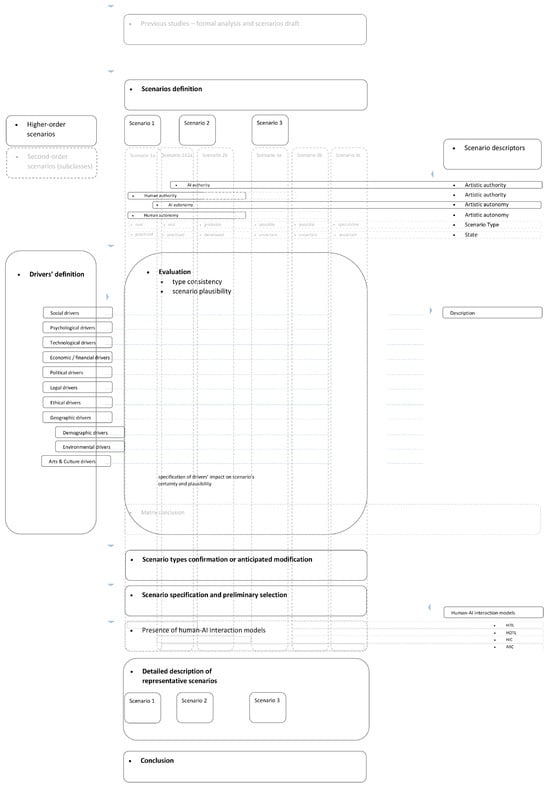
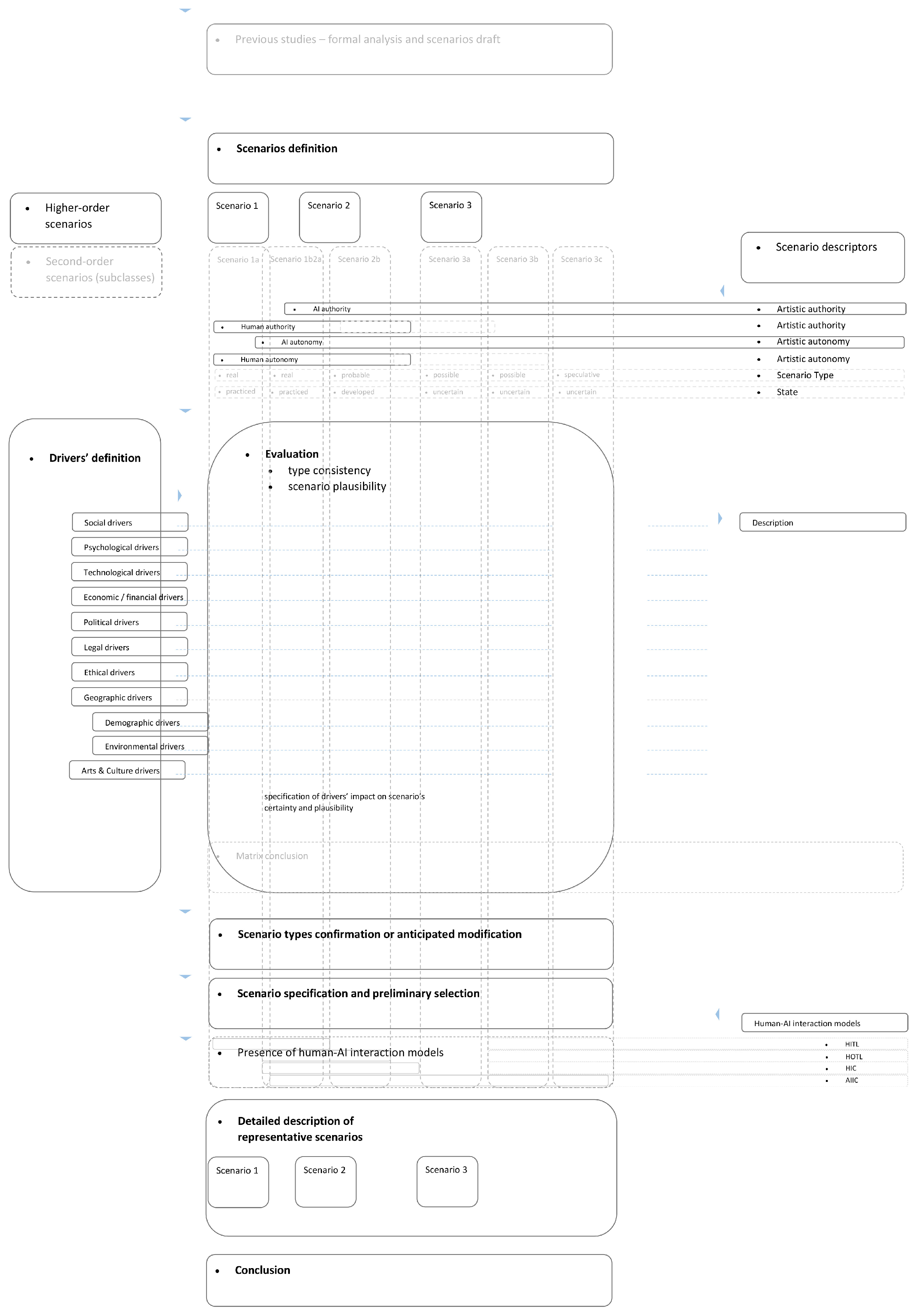
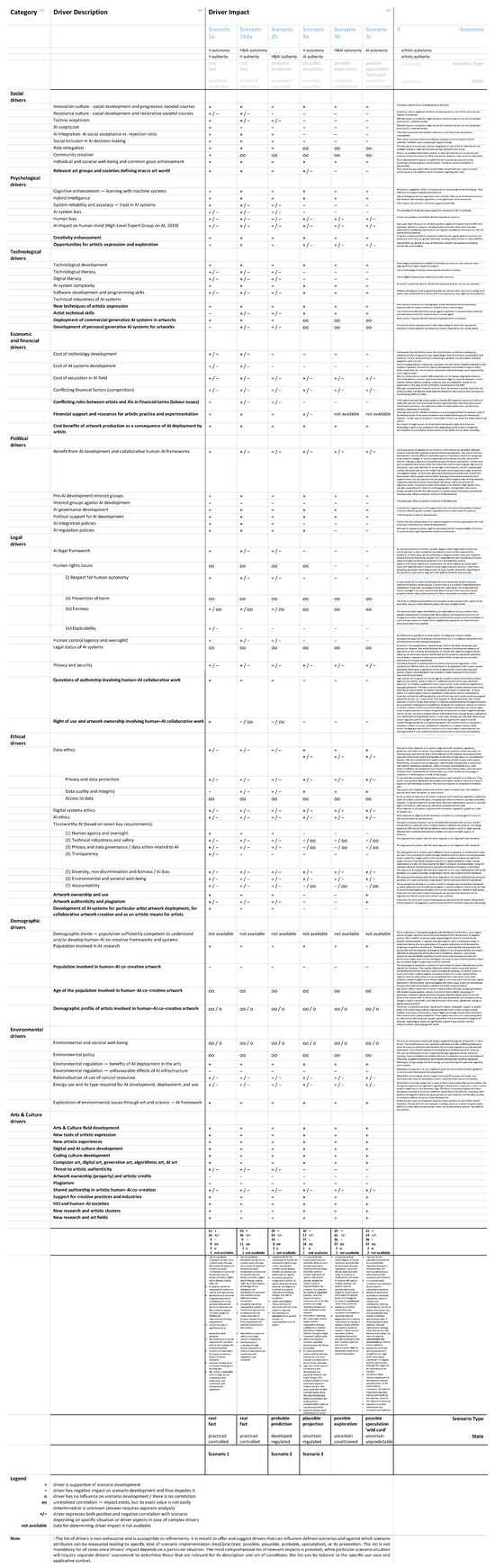
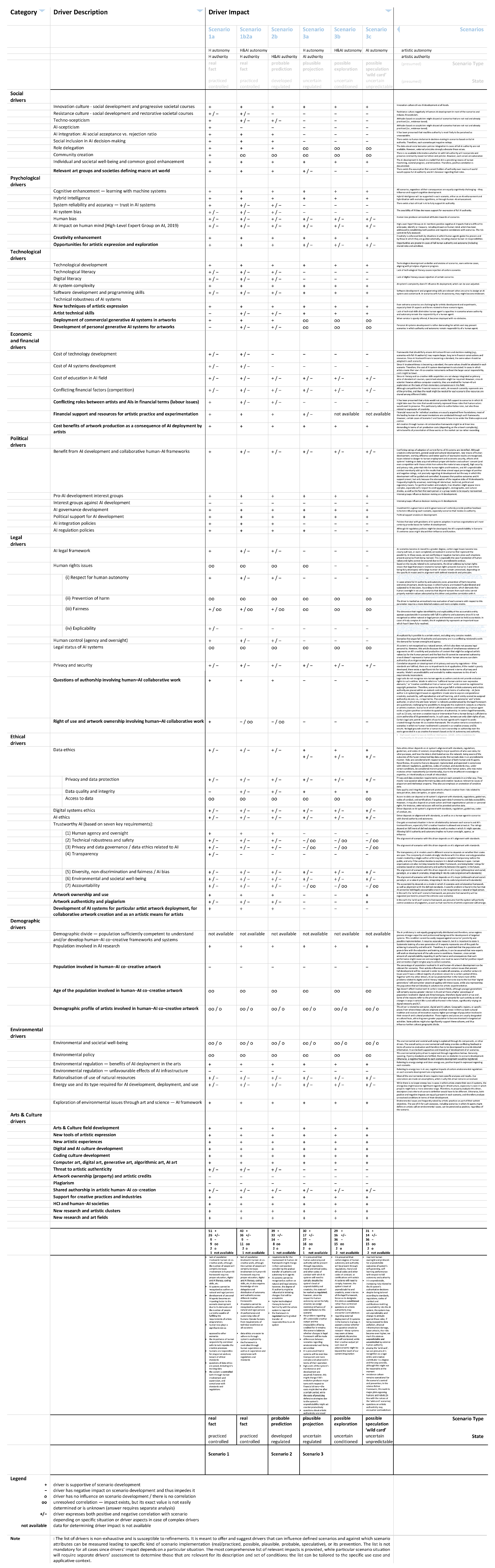



Disclaimer/Publisher’s Note: The statements, opinions and data contained in all publications are solely those of the individual author(s) and contributor(s) and not of MDPI and/or the editor(s). MDPI and/or the editor(s) disclaim responsibility for any injury to people or property resulting from any ideas, methods, instructions or products referred to in the content. |
© 2026 by the authors. Licensee MDPI, Basel, Switzerland. This article is an open access article distributed under the terms and conditions of the Creative Commons Attribution (CC BY) license.