


Abstract
The nineteenth century witnessed a significant transnational movement of European musicians and their pedagogical traditions across continents. Among the figures who contributed to this process, the Belgian flutist and composer Mathieu-André Reichert (1830–1880) occupies a distinctive position—trained in the Franco-Belgian tradition, he emigrated to Brazil, where he introduced the Boehm-system flute and produced pedagogical materials that continue to be used in flute education across a range of national traditions. This study examines Reichert’s method, 7 Exercices Journaliers pour la Flûte, Op. 5, from dual perspectives: a structural–pedagogical analysis of the seven exercises and a cultural–historical contextualization of the method’s transnational circulation. Designed as a qualitative research study, this work employed document analysis as the data collection tool and thematic analysis as the method for data analysis and interpretation. The B. Schott’s Söhne (Mainz) edition of the method was examined as the primary source; secondary data was obtained from articles, theses, books, and digital sources. Each exercise was examined in terms of structural characteristics—including meter, metronome speed, melodic patterns, and harmonic structure—and the technical demands and potential pedagogical applications associated with articulation, tongue–finger coordination, lip flexibility, and breath control. The findings reveal that the method possesses a distinctive structural organization that systematically cycles through all keys, employs a different melodic pattern in each exercise, and consistently embeds technical demands within harmonic and melodic contexts. Beyond its pedagogical content, the study traces the method’s cultural trajectory—from its composition in nineteenth-century Brazil through its adoption by French school luminaries, such as Marcel Moyse, Michel Debost, and Trevor Wye, to its current use in music education programs across diverse cultural contexts, including Türkiye. The convergence of structural–pedagogical and cultural–historical analysis suggests that the method’s continued relevance across diverse teaching traditions reflects not only its coherent structural design but also broader processes of cultural transfer, the mobility of musicians and their pedagogical ideas, and the formation of transnational pedagogical networks in instrumental music education.
1. Introduction
1.1. Cultural Mobility and the Transnational Circulation of Instrumental Pedagogy
The nineteenth century witnessed an unprecedented movement of European musicians across continents, driven by professional ambition, institutional patronage, and broader patterns of cultural migration. As these musicians settled in new environments, they carried with them not only their performance traditions but also pedagogical knowledge embedded in methods, etudes, and exercise books. These materials functioned as tangible vehicles of cultural transfer, encoding specific technical philosophies, aesthetic ideals, and educational practices that originated in one tradition and were subsequently adopted, adapted, and reinterpreted in others (Heile 2024). The movement of Western art music and its pedagogical apparatus into new cultural settings has been theorized extensively in the literature on cultural transfer and the circulation of musical knowledge (Born and Hesmondhalgh 2000; Nettl 2005). As Nettl (2005) argues, the transmission of musical systems across cultural boundaries rarely amounts to simple replication; instead, it involves processes of selection, reinterpretation, and institutional embedding through which imported practices acquire new meanings in their host contexts. Rather than following simple center-to-periphery models of cultural diffusion, the circulation of instrumental methods reveals a more dynamic pattern of exchange, in which pedagogical knowledge moves across cultural boundaries, is reinterpreted by successive generations of practitioners, and frequently returns—transformed—to its point of origin. Within the domain of flute education, this process of transnational circulation is particularly visible. The development of the modern flute is inseparable from these institutional and technological transformations: the metal, cylindrical Boehm-system flute, perfected in 1847, fundamentally reshaped both the instrument’s technical possibilities and the pedagogy built around it (Boehm [1871] 1964; Powell 2002). As Powell (2002) documents in his history of the instrument, the diffusion of the Boehm flute across Europe and beyond was closely bound to the circulation of players, teachers, and printed methods. The consolidation of the French flute school at the Paris Conservatoire during the second half of the nineteenth century produced a systematic pedagogical tradition centered on the Boehm-system flute. Methods developed by figures such as Joseph Henri Altès, Paul Taffanel, Philippe Gaubert, and later Marcel Moyse established a coherent technical and musical framework that, through publication, translation, and the mobility of trained flutists, gradually transcended national boundaries and became widely influential in flute instruction across Europe, the Americas, and Asia (Turgay 2021; Dahmer 2017; Kara and Özeke 2013).
As Turgay (2021) observes, “the practice methods developed by flute pedagogues such as Trevor Wye, which incorporate practical approaches drawn from the past, have been organized in a highly systematic manner to guide daily practice and, having been translated into many languages, have accelerated the formation of a common language in flute education” (p. 224). This “common language” is itself a product of cultural globalization—a pedagogical heritage that, while rooted in specific European traditions, now belongs to a global community of practitioners.
Among the figures who contributed to this transnational pedagogical heritage, the Belgian flutist and composer Mathieu-André Reichert (1830–1880) occupies a distinctive position. Unlike Taffanel, Gaubert, or Moyse, whose careers were anchored in the institutional framework of the Paris Conservatoire, Reichert’s professional trajectory took him from the concert stages of Europe to the Imperial Court of Brazil, where he spent much of his career and produced his most enduring pedagogical work. His method 7 Exercices Journaliers pour la Flûte, Op. 5, first published around 1872–1873 by B. Schott’s Söhne in Mainz, thus represents a unique case: a pedagogical text written by a European-trained musician working in a South American cultural context, which was subsequently disseminated through European publishing networks and taken up in flute teaching across several national traditions (as discussed in Section 3.2). The biography and legacy of this method offer a compelling lens through which to examine the dynamics of cultural transfer, pedagogical globalization, and heritage preservation in instrumental music education.
1.2. Reichert’s Transatlantic Career and the Boehm System in Brazil
Mathieu-André Reichert was born in Belgium and trained within the tradition of the Franco-Belgian flute school. He gained recognition as a virtuoso performer across European concert halls before emigrating to Brazil in 1859, where he served as principal flutist with the National Theater Orchestra in Rio de Janeiro (Dias 1990; Silva and Falleiros 2019). Contemporary accounts attest to his extraordinary musicianship: one critic described how “the moment he stepped onto the stage, his flute filled the space with a divine breeze, evoking exquisite emotions and causing the audience to wildly applaud this man who played with such captivating originality, a robust tone, and a masterful and profound interpretation” (Leporello, 1880), as cited in (Dias 1990, p. 81). His colleagues noted his disciplined approach to practice: “His friends would often find him practicing passages consisting of four or five very high notes, always accompanied by a metronome, until he gave them a clear, silvery, and unique timbre” (Dias 1990, p. 83).
Reichert’s significance extends beyond his performance career. As Dahmer (2017) emphasizes, “Reichert introduced the Boehm-system flute to Brazil and also played a significant role in the creation of pedagogical materials that are still used not only in Brazil but in schools around the world” (p. 1). This act of introducing a specific technological and pedagogical system—the Boehm flute and its associated technical demands—into a new cultural environment constitutes a concrete instance of what the broader literature describes as cultural transfer in music education (Bartleet et al. 2020; Zhan 2025). The Boehm system itself embodied a distinct set of technical and acoustical principles that its inventor articulated in detail (Boehm [1871] 1964); introducing this system to Brazil therefore meant transmitting not merely an object but an entire framework of fingering, tone production, and practice methodology. This transfer took place within a Brazilian musical environment that, by the mid-nineteenth century, was actively engaging with European art music while sustaining its own performance traditions (Béhague 1979). According to Amorim (2022), Reichert’s influence on nineteenth-century Brazilian music and flute practice possesses a “foundational” quality, encompassing a broad spectrum ranging from technical innovations to cultural synthesis. Reichert did not merely replicate European practices in Brazil; the wide interval leaps and melodic characteristics of his compositions have been suggested to reflect an engagement with the musical environment he inhabited—though, as discussed in Section 3.2, this connection remains a plausible interpretive hypothesis rather than a demonstrated finding.
The 7 Exercices Journaliers pour la Flûte, Op. 5, composed during the peak of Reichert’s career in Brazil and published in Germany, embodies this transnational trajectory. It is a pedagogical text shaped by European technical traditions, written in a South American context, and disseminated through a German publishing house to an increasingly global audience. As Silva and Falleiros (2019) note, “this method is still regarded today as an indispensable educational resource in professional circles due to its unique structure and the profound knowledge it offers regarding flute technique. Alongside the etudes of Taffanel and Moyse, Reichert’s exercises have become an integral part of 20th-century flute pedagogy” (p. 56).
1.3. The Pedagogical Role of Daily Exercises in Flute Education
Instrumental training constitutes one of the most important elements of music education, with its primary goal being the strengthening of the student’s musical expression through the development of technical skills. As Esen and Şenol Sakin (2021) observe, “instrumental training is an educational process designed by experts and requiring systematic practice” (p. 55). Systematic exercise methods play a significant role in acquiring the intended skills in flute education. As Étienne (1988) notes, among the first names that come to mind when discussing daily exercise methods in flute education are P. Taffanel and P. Gaubert, Marcel Moyse, Trevor Wye, and Henri Altès. As Turgay (2021) observes, “every flute school and the instructors trained within these schools have daily practice methods with very different names but similar content” (p. 228).
In addition to these widely recognized methods, Reichert’s 7 Exercices Journaliers pour la Flûte, Op. 5 stands out as one of the most systematic exercise books in the field. Aytemur and Şirin (2022) highlight that “M. A. Reichert is a composer who possesses very important exercises that develop flute technique. He has composed various technical etudes in all keys” (p. 62). The pedagogical value attributed to such daily exercise collections is grounded in a broader body of research on instrumental practice, which emphasizes that structured, systematic daily work supports the gradual automatization of technical skills and the development of self-regulated practice strategies (Hallam 1997; Jørgensen 2004). As Jørgensen (2004) notes, the way in which practice material is organized—rather than merely the quantity of practice—shapes the efficiency of skill acquisition, a principle that helps explain the enduring appeal of methodically designed exercise books such as that of Reichert.
1.4. Problem Statement, Research Objective, and Significance
Although Reichert’s 7 Exercices Journaliers pour la Flûte, Op. 5 has been widely adopted across diverse cultural and educational contexts worldwide—from Brazilian conservatories to French master classes, from Turkish music education faculties to international flute curricula—neither the structural–pedagogical characteristics that underpin its enduring relevance nor the cultural dynamics of its transnational circulation have been systematically examined. A review of the flute education literature reveals that existing studies have primarily focused on the daily exercise-based methods of Taffanel and Gaubert, M. Moyse, and T. Wye, while research addressing both the internal structure and the broader cultural significance of Reichert’s method remains limited. This gap constitutes the central problem of the present study.
The purpose of this study is twofold: first, to evaluate the seven exercises included in Reichert’s method in terms of their structural characteristics and potential pedagogical applications; second, to situate this analysis within the broader context of the method’s cultural circulation. The two analytical dimensions are hierarchically related: the structural–pedagogical analysis of the exercises constitutes the primary analytical contribution of the study, while the cultural–historical contextualization serves as an interpretive framework that situates those findings within a broader transnational perspective.
At the practical level, the study aims to provide flute students and teachers with a deeper understanding of the method’s technical demands and potential pedagogical applications. By documenting the method’s adoption in Turkish music education programs (Kara and Özeke 2013; Şenol Sakin and Öztürk 2016; Bilgin and Şentürk 2019; Önal 2022; Karalı and Şentürk 2024), the study contributes to understanding the ongoing process of pedagogical globalization in contemporary flute education.
2. Results
Several technical terms are used consistently throughout this section and are defined here for clarity. Melodic minor and harmonic minor refer to the two standard forms of the minor scale in Western tonal practice: the melodic minor raises both the sixth and seventh scale degrees ascending and restores them descending; the harmonic minor raises only the seventh scale degree in both directions. Embouchure (lip) flexibility denotes the capacity to adjust aperture, muscular tension, and angle of the embouchure in response to changes in register, dynamic level, and intervallic direction (Karalı and Şentürk 2024; Turgay 2021; Toff 2012). Homogeneous tone production refers to the maintenance of consistent tonal quality, color, and projection across the full range of the instrument (Toff 2012). Proper phrasing refers to the musical shaping of a notated phrase through coherent dynamic contour, breath support, and articulation in accordance with the phrase’s harmonic and melodic structure. The term musical context refers to the embedding of technical demands within harmonic progressions and melodic phrase structures. Throughout this section, Reichert’s original notated instructions are clearly distinguished from pedagogical adaptations proposed by the present authors; the latter are consistently introduced with formulations such as “practitioners may consider” or “as a pedagogical adaptation.”
2.1. Exercise No. 1
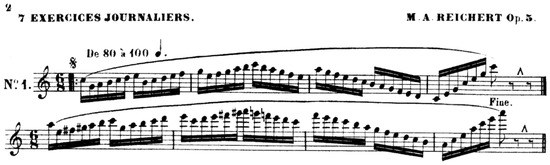
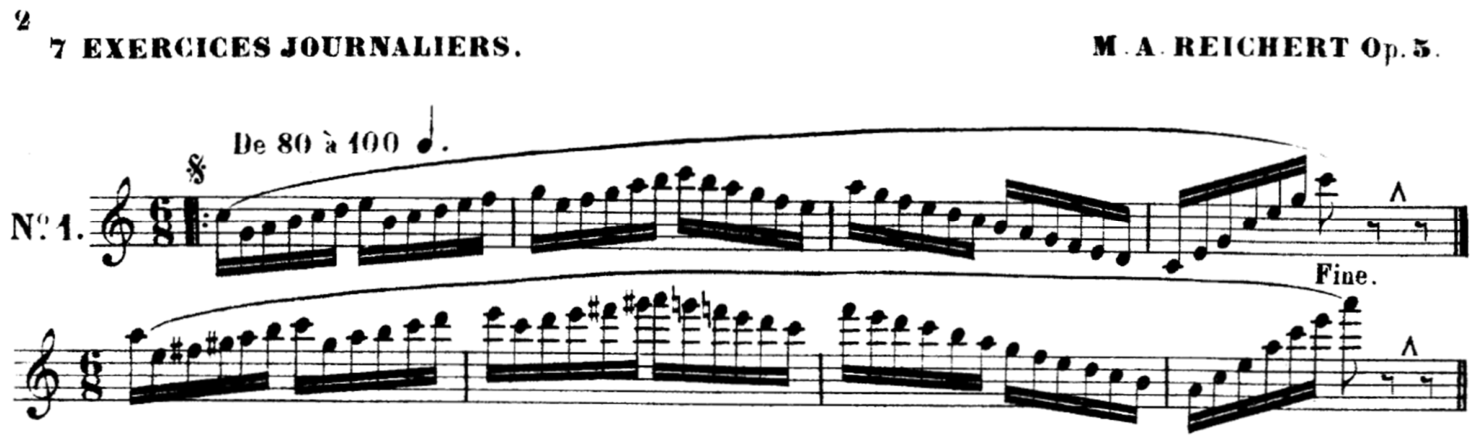
This exercise is a two-octave scale study written in 6/8 m. It concludes with a two-octave ascending arpeggio in the final measure. It is the exercise with the simplest melodic pattern among all the exercises in the book. The melodic pattern for each key consists of 4 measures. All of the minor exercises in Exercise No. 1 are “melodic” in character (i.e., they employ the melodic form of the minor scale). Reichert recommends playing these exercises at a tempo of ♩. = 80–100 metronome beats per minute using legato technique in a single breath. The structure of each line in the exercise guides the performer to play with musical understanding and proper phrasing. Potential pedagogical applications include the development of finger dexterity, homogeneous tone, breath control, and the ability to play legato. The technical and musical competencies gained in this way support the skills required to perform works in the flute repertoire. As a pedagogical adaptation, practitioners may consider playing at a slower tempo than the metronome speed suggested by the composer and using articulations other than legato, as determined by the instructor or the student. Other articulation suggestions for this exercise, aside from legato, may include single tonguing, double tonguing, two-note slurs, staccato, and two-note slurs with four tongues. The arpeggio in the final measure can be practiced separately from the other measures, using different rhythmic combinations, tempos, and articulations, to support homogeneity between the notes and maintain lip flexibility (Figure 1).
Figure 1.
Exercise No. 1 from 7 Exercices Journaliers pour la Flûte, Op. 5 (Reichert 1872, p. 2).
2.2. Exercise No. 2
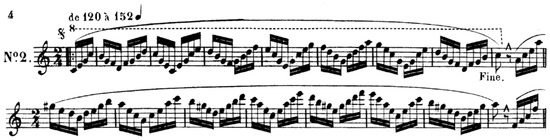
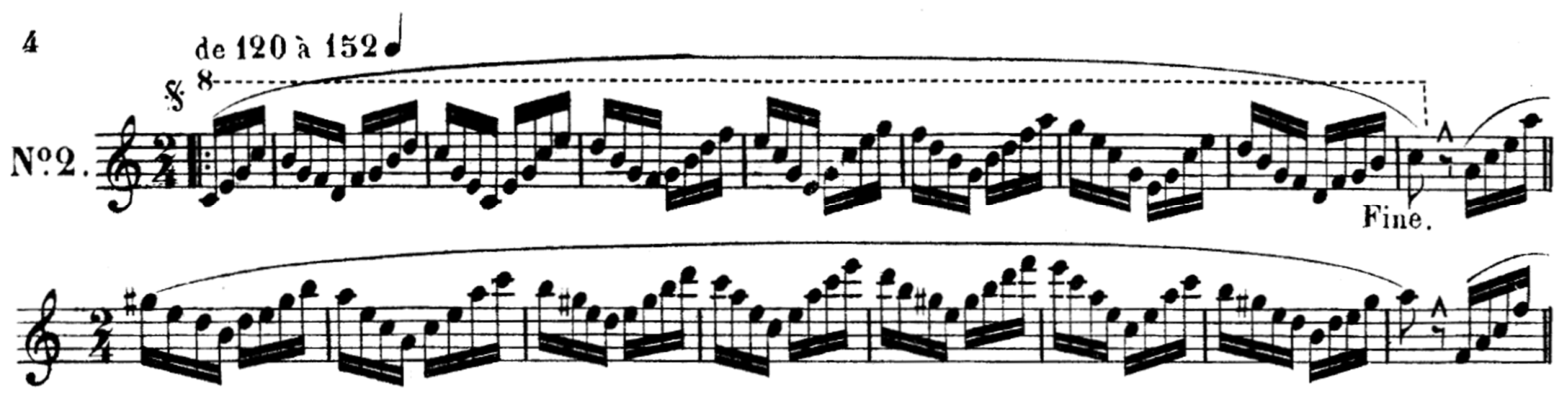
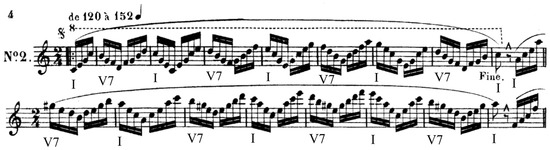
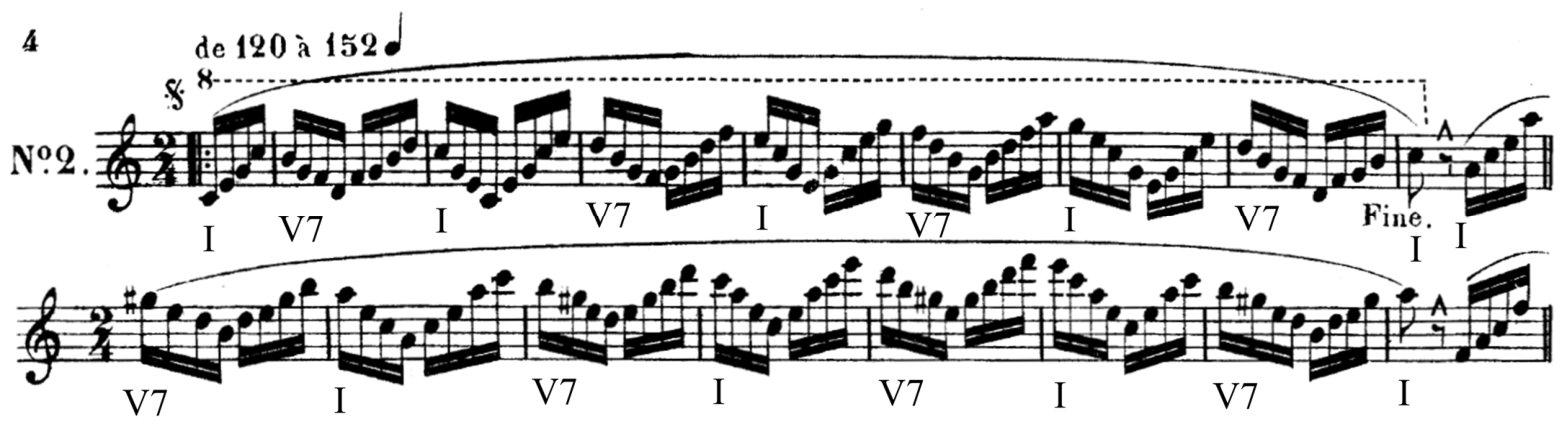
This exercise features a more challenging pattern than the first exercise. Both the major and minor scales consist of arpeggio patterns that harmonically progress between the I and V7 degrees. It is written in 2/4 m and begins with an anacrusis. Each melodic pattern consists of eight measures. The range is narrower than in Exercise 1. Five of the exercises are written to be played an octave higher (8va). Unlike Exercise 1, all the minor exercises in this set have a “harmonic” character (i.e., they employ the harmonic form of the minor scale). The composer recommends playing these exercises at a tempo of ♩ = 120–152, using legato technique and in a single breath. This exercise is structured as an arpeggio, not a scale—the notes leap rather than move stepwise. Through this exercise, flute students may develop awareness of how air pressure and lip opening must change across registers. In terms of intonation control, the priority should be preventing bursts or drops in sound during transitions between notes (Figure 2).
Figure 2.
Exercise No. 2 from 7 Exercices Journaliers pour la Flûte, Op. 5 (Reichert 1872, p. 4).
As a pedagogical adaptation, practitioners may consider playing it with piano accompaniment due to its melodic nature (Figure 3). Since the exercise consists of harmonic transitions between the I and V7 degrees, the piano accompaniment increases the student’s harmonic awareness and contributes to correct intonation and phrasing (piano accompaniment is a pedagogical addition proposed by the authors; it is not indicated in Reichert’s original score).
Figure 3.
Chord degrees for Exercise No. 2 for piano accompaniment (Reichert 1872. p. 4).
2.3. Exercise No. 3
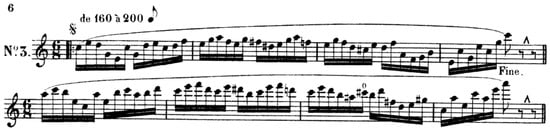
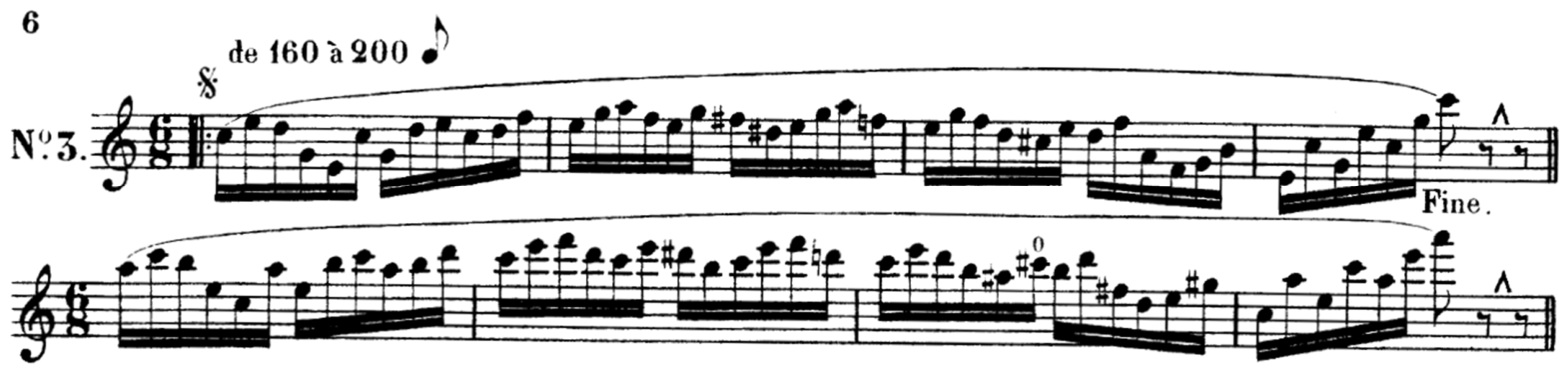
Written in 6/8 m, this exercise features wider intervals compared to the previous two exercises. The melodic pattern for each key consists of four measures. The minor exercises in Exercise No. 3 have a “melodic” character (melodic minor form). The wide range of notes and the chromatic alteration of certain notes increase the difficulty. Despite the wide intervals, it requires playing each note with correct intonation and clarity. Reichert recommends playing this exercise at a tempo of ♩. = 160–200 using legato technique. As a pedagogical adaptation, practitioners may find that playing at a slower tempo and applying staccato technique can illuminate the exercise’s technical demands more clearly. One of the most common challenges when playing the flute is achieving tongue–finger coordination. This exercise, consisting of rapid groups of sixteenth notes, presents demands on tongue–finger coordination and may support the development of the agility required for fast passages in musical works (Figure 4).
Figure 4.
Exercise No. 3 from 7 Exercices Journaliers pour la Flûte, Op. 5 (Reichert 1872, p. 6).
2.4. Exercise No. 4
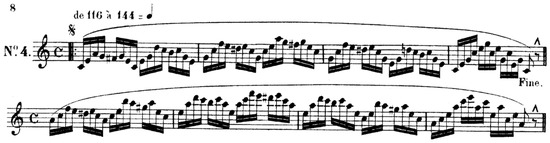
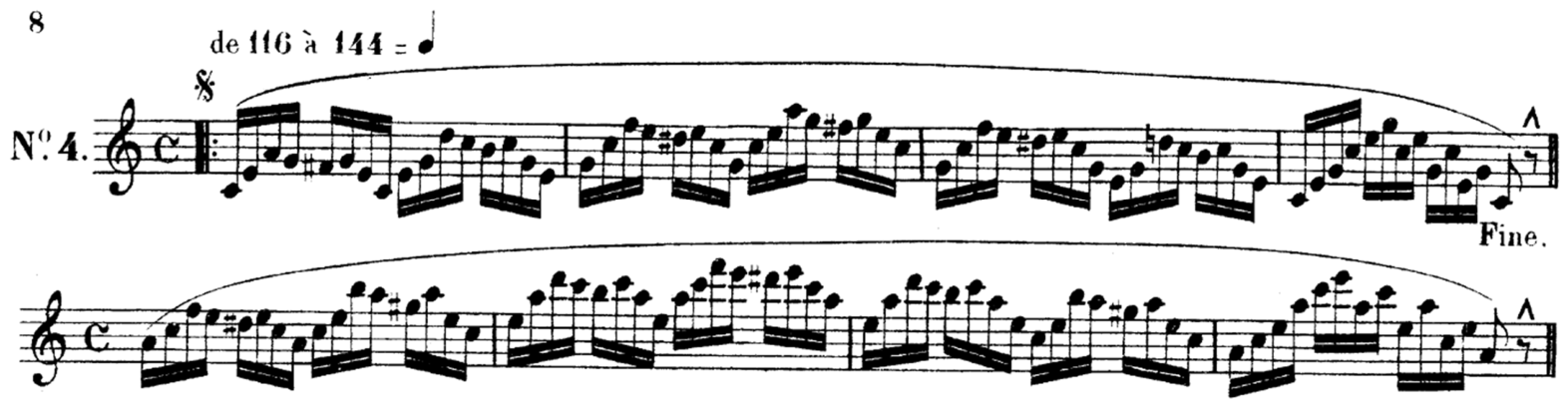
Written in 4/4 m, the pattern of this exercise is more fluid than that of Exercise No. 3. This exercise includes arpeggios of the tonic chord, played in sixteenth notes moving successively upward and downward. The arpeggios are structured in the following order: root position, first inversion, second inversion, and back to root position. Either the upper or lower neighbor note has been added between each arpeggio; some of these have been altered chromatically. The recommended metronome speed is ♩ = 116–144. All of the minor exercises have a “harmonic” character (harmonic minor form). The arpeggios move upward, reaching a peak in the middle of each line. This highly melodic structure may invite the student to perform crescendo–decrescendo throughout, though this is one possible interpretation of the melodic contour rather than an instruction notated by Reichert. When playing chromatic intervals on the flute, care should be taken not to lift the fingers too much, to stay close to the keys, and to make small movements. The potential pedagogical applications of this exercise include the development of finger independence and smoothness in chromatic transitions (Figure 5).
Figure 5.
Exercise No. 4 from 7 Exercices Journaliers pour la Flûte, Op. 5 (Reichert 1872, p. 8).
2.5. Exercise No. 5
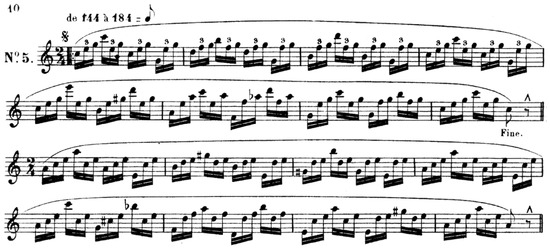
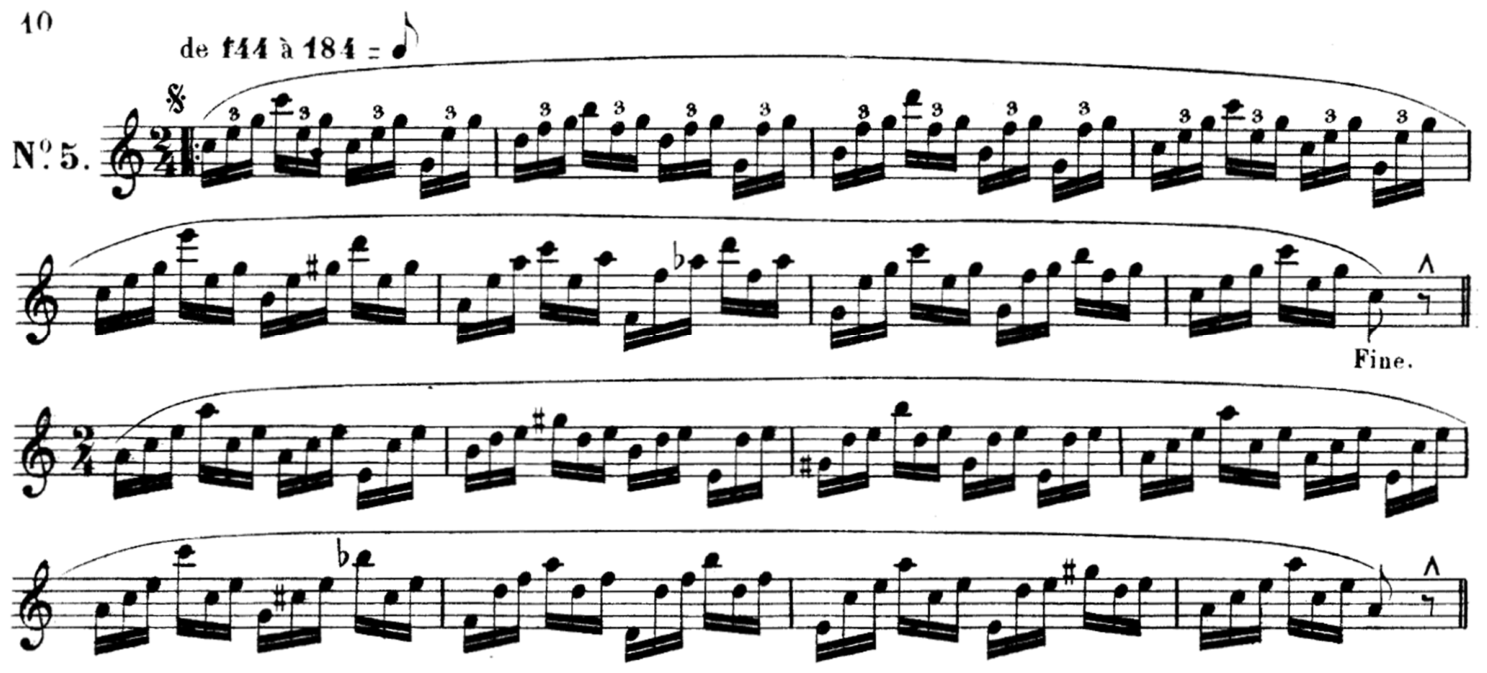
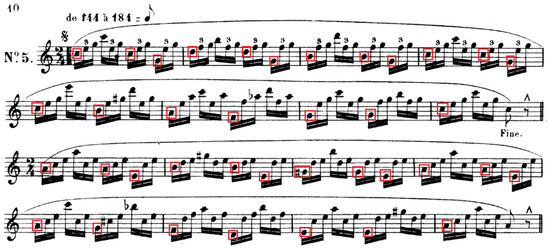
Written in 2/4 m, Exercise No. 5 consists of triplets of sixteenth notes. Compared to the other six exercises, this exercise is twice as long in form. The melodic pattern for each key consists of eight measures. The flexibility observed in Exercise No. 2 reappears here within broader chord structures and at a faster tempo (♩ = 144–184). As a pedagogical adaptation, practitioners may find it advantageous to proceed in stages: first playing without the tongue using diaphragmatic attacks (breath-initiated tone onsets using diaphragmatic support, without tonguing), then with tonguing at a slower metronome speed, and only then applying the recommended articulation and tempo (Figure 6).
Figure 6.
Exercise No. 5 from 7 Exercices Journaliers pour la Flûte, Op. 5 (Reichert 1872, p. 10).
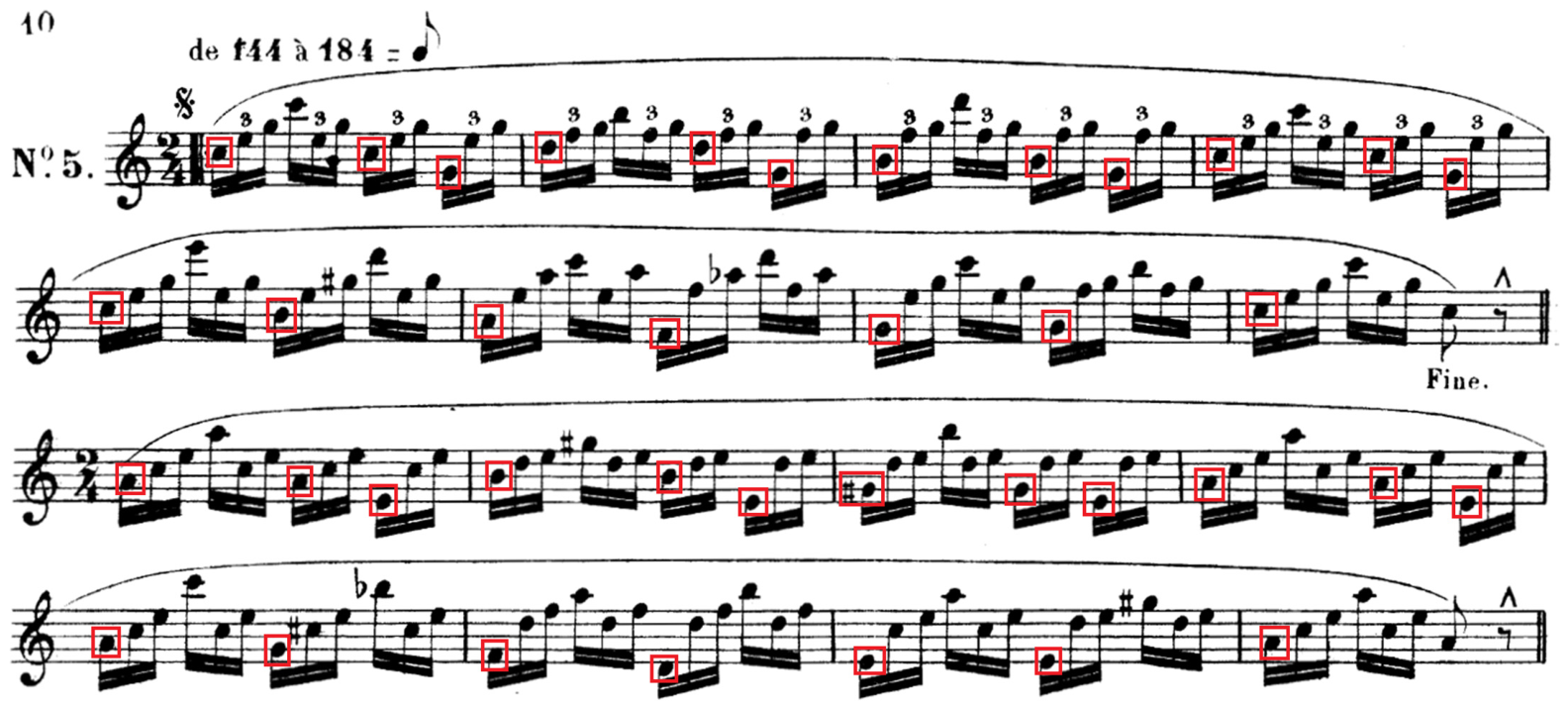
While practicing, the melodic structure of the bass notes should be brought to the forefront (Figure 7). This exercise primarily involves wide interval leaps and arpeggio structures in different keys, presenting potential for the development of melodic and harmonic awareness.
Figure 7.
Visual representation of the bass notes in Exercise No. 5 (Reichert 1872, p. 10). Red boxes indicate the bass notes referenced in the accompanying text.
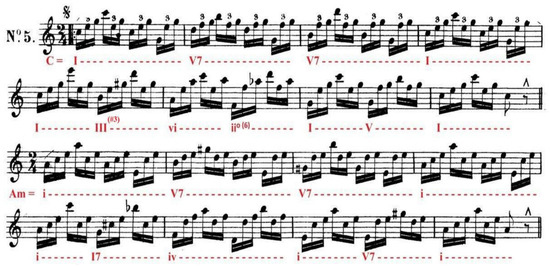
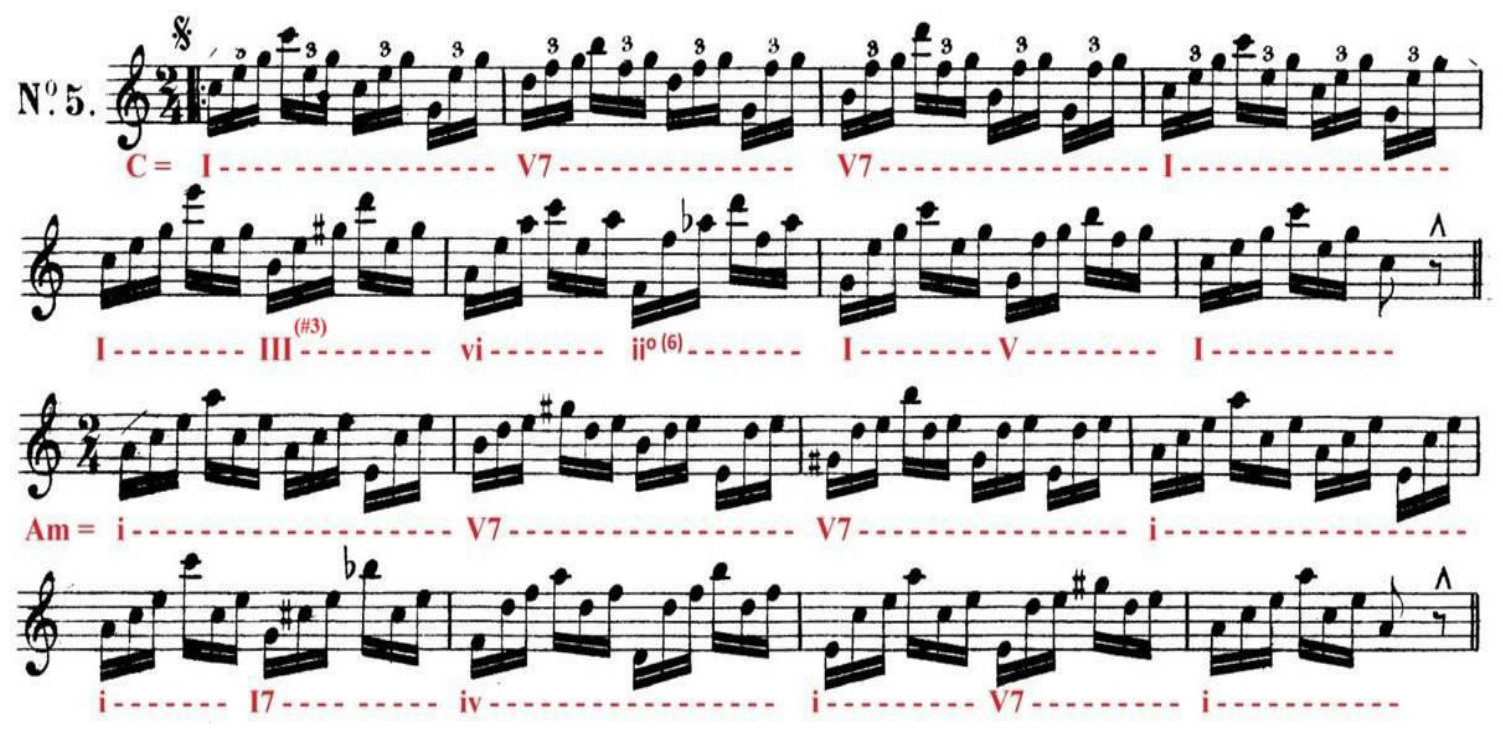
As a further pedagogical adaptation, practitioners may consider playing it with piano accompaniment, which may contribute to fluidity, intonation, phrasing, and harmonic awareness (Figure 8). (Piano accompaniment is not indicated in Reichert’s original score; it is a pedagogical addition proposed by the authors).
Figure 8.
Chord degrees for Exercise No. 5 for piano accompaniment (Reichert 1872, p. 10).
2.6. Exercise No. 6
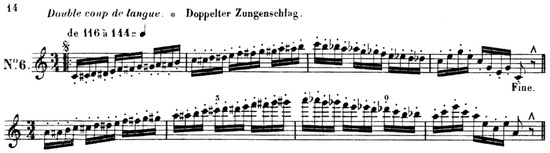
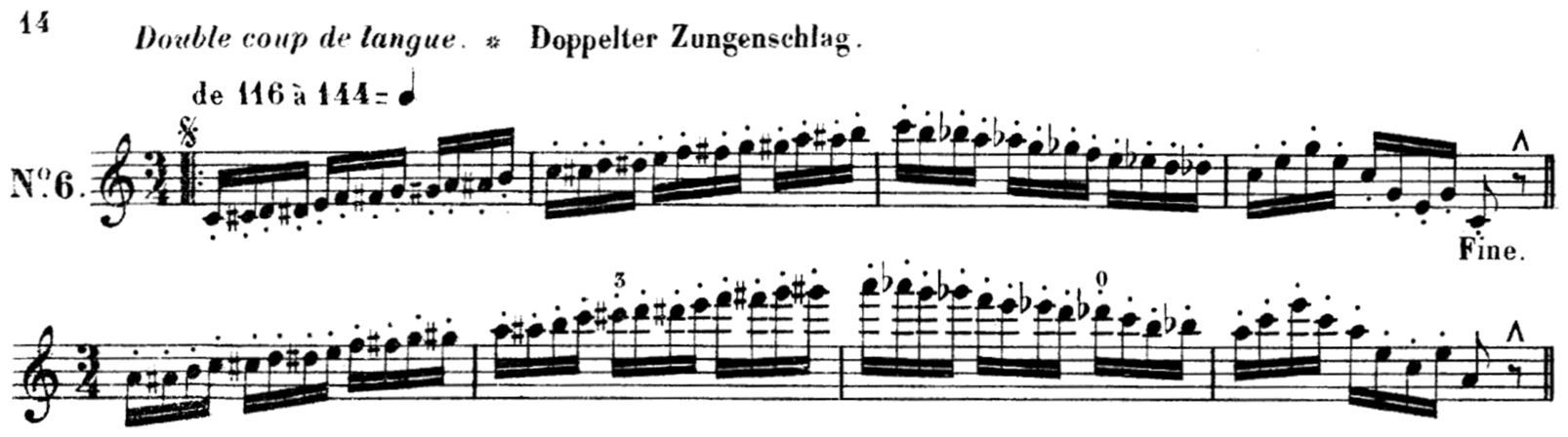
Written in 3/4 m, Exercise No. 6 consists of a two-octave chromatic scale and a tonic arpeggio in the final measure. The melodic pattern for each key spans four measures. The recommended metronome speed is ♩ = 116–144. In this method, Reichert specifies a different playing technique for the first time: double tonguing. This articulation is executed by rapidly striking the tongue in a “tu-ku”, “tü-kü”, “du-gu” or “dü-gü” pattern. The exercise’s wide registral range and the requirement to play it as double-tongued staccato elevate it to an advanced technical level. As a pedagogical adaptation, practitioners may consider starting at a slower metronome tempo using single-tongued staccato before applying double tonguing. The potential pedagogical applications of this exercise include the development of finger–tongue coordination and finger dexterity, as well as mastery of the subtle nuances of tone (Figure 9).
Figure 9.
Exercise No. 6 from 7 Exercices Journaliers pour la Flûte, Op. 5 (Reichert 1872, p. 14).
2.7. Exercise No. 7
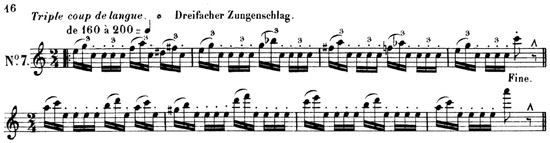
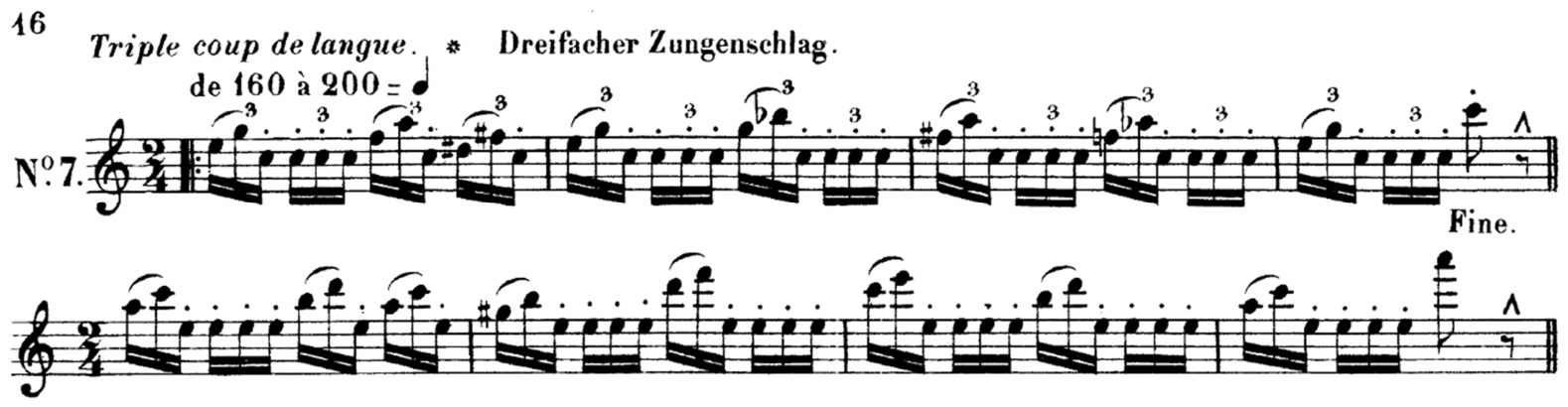
Exercise No. 7, written in 2/4 m (♩ = 116–144), consists of groups of sixteenth notes designed to practice the triple-tonguing technique, performed by playing syllables tu-ku-tu, tü-kü-tü, du-gu-du, or dü-gü-dü in sequence. The melodic pattern for each key consists of 4 measures. All of the minor exercises have a harmonic character (harmonic minor form). A fixed note is repeated continuously, functioning as the tonic in major keys and as the dominant in minor keys, accompanying the third intervals that form the melodic line. Although written for triple-tonguing, practitioners may consider beginning at a slower tempo using single tonguing. The priority should be clean transitions between wide intervals and avoiding bursts or fading in repeated notes. With its long phrasing structure, it contributes to breath control, lip flexibility, and coordination skills. This final exercise extends the work on multiple articulation techniques developed in Exercise 6, and in doing so contributes to the student’s overall technical and musical preparedness (Figure 10).
Figure 10.
Exercise No. 7 from 7 Exercices Journaliers pour la Flûte, Op. 5 (Reichert 1872, p. 16).
2.8. Summary of Structural Characteristics
Table 1 summarizes the principal structural characteristics identified across the seven exercises, including meter, recommended metronome speed, articulation, formal length, melodic pattern, and minor scale form. This overview allows the structural features discussed individually in Section 2.1, Section 2.2, Section 2.3, Section 2.4, Section 2.5, Section 2.6 and Section 2.7 to be compared systematically across the full set of exercises.
Table 1.
Summary of structural characteristics for each exercise.
3. Discussion
3.1. Structural and Pedagogical Coherence of the Method
The structural analysis of the seven exercises reveals three principal features that collectively distinguish Reichert’s Op. 5 as a pedagogically coherent daily exercise method.
First, the method systematically cycles through the complete major–minor tonal cycle. Each exercise begins in C major, progresses to the relative minor, and advances through keys with increasing flats (one to six) before descending through sharps (five to one) and returning to C major. This tonally comprehensive organization ensures that the same technical demands are encountered across all key signatures, providing consistent reinforcement of muscle memory and intonation awareness. As Fitzgerald (2018) notes, the cadence structure at the end of each line allows any single key group to be practiced as a self-contained unit.
Second, the method follows a progressive articulation sequence: Exercises 1 through 5 develop legato control across scales, arpeggios, and wide intervals; Exercise 6 introduces double-tonguing applied to a chromatic scale pattern; and Exercise 7 extends this to triple-tonguing combined with interval leaps and a repeated bass note. This articulation progression—from sustained legato to increasingly rapid multiple-tonguing—reflects a recognized developmental sequence in flute pedagogy (Karalı and Şentürk 2024; Étienne 1988).
Third, the technical demands in each exercise are consistently embedded within harmonic and melodic structures. Exercises 2 and 5 are constructed on I–V7 harmonic progressions; Exercise 4 presents tonic arpeggios in root position, first inversion, and second inversion in succession; and Exercise 6 presents chromatic scales within a harmonically framed four-measure pattern.
By way of structural comparison, Taffanel and Gaubert’s 17 Grands Exercices Journaliers de Mécanisme more frequently presents scalar and chromatic material as sequential patterns that prioritize finger independence and velocity as relatively isolated technical demands. Reichert’s exercises, by contrast, consistently provide the student with harmonic orientation within the technical task. It should be noted that this structural observation does not constitute a qualitative ranking: Taffanel and Gaubert’s extended exercises develop specific technical capacities that Reichert’s briefer patterns do not address with equivalent depth. Rather, the distinction identifies a different pedagogical priority. The two methods are widely used in complementary fashion in professional pedagogy (Clayton 2023; Dahmer 2017).
The potential pedagogical applications of these structural features include the development of embouchure flexibility across wide intervals (Exercises 3, 5, 7), tongue–finger coordination in rapid note groups (Exercises 3, 6, 7), harmonic and tonal awareness through I–V7 progressions (Exercises 2, 5), articulation variety (Exercises 6–7), and breath control within extended phrase structures (Exercises 1, 5, 7). It is emphasized, however, that these represent inferences from the structural properties of the exercises and from the established flute pedagogy literature; the present study does not include performance data, student participants, or experimental evidence and therefore cannot demonstrate actual learning outcomes.
The method’s applicability across student levels should also be qualified. Exercises 1 and 2 present moderate technical demands and are accessible to intermediate students; Exercises 6 and 7 require established double- and triple-tonguing technique and are more appropriately assigned at an advanced level. Adaptations—including reduced tempos, single-tonguing substitution, and the application of varied articulation patterns—can expand the method’s applicability, but these represent practitioner adaptations rather than features of Reichert’s original text. As M. Dreese, a student of Moyse, has noted, “We worked with Reichert’s Seven-Day Exercise to achieve specific colors and dynamics; we never played fast, so we ensured a soft legato connection between notes” (The Marcel Moyse Society 2015, p. 8).
3.2. Cultural Circulation: From Brussels to Brazil, and Back to Europe
The transnational trajectory of Reichert’s Op. 5 can be understood on two distinct levels: dissemination—the availability of the method across national contexts through its publication by B. Schott’s Söhne in Mainz—and reception, which involves the active adoption and integration of the method’s exercises into the pedagogical practice of individual musicians and institutions. The distinction is analytically important: establishing cultural circulation in the stronger sense requires evidence of adaptation and reinterpretation across traditions, beyond the fact of international availability.
The primary mechanism of dissemination was the German publishing network. B. Schott’s Söhne, one of the foremost European music publishers of the nineteenth century, distributed its catalog through an extensive continental network, ensuring that Op. 5 reached professional flutists across Europe and beyond regardless of its Brazilian point of composition. The evidence currently available suggests that the method entered European pedagogical circulation primarily through this publishing channel rather than through a direct institutional line of transmission from Brazilian to French pedagogical centers.
The clearest documented instance of active reception is the adoption of Reichert’s exercises by Marcel Moyse. Moyse’s (1974) final pedagogical collection, How I Stayed in Shape (1974), incorporates material derived from Exercises 3 and 5 of Op. 5, and pedagogical accounts from his students record that Moyse used the exercises specifically to develop tonal color, dynamic nuance, and legato flexibility (The Marcel Moyse Society 2015). This reception demonstrates that the exercises were valued by the French school not for their scalar structure—which was amply provided by Taffanel and Gaubert—but for the tonal and expressive possibilities afforded by their harmonic embedding and wide intervallic writing. Through Moyse’s influence, Op. 5 was integrated into the pedagogical tradition from which Reichert’s own training had originated, constituting the most clearly documented circuit of reception in the method’s history. The circulation continued beyond France: Michel Debost and Trevor Wye, among other prominent flutists, have incorporated Reichert’s exercises as reference points in their own publications (Dahmer 2017).
Regarding the connection between Reichert’s extended residence in Brazil and the intervallic characteristics of Op. 5, it must be acknowledged that wide interval leaps and registral breadth are features common to nineteenth-century European flute repertoire and cannot be attributed to Brazilian influence on the basis of structural analysis alone. Amorim (2022) suggests the possibility of such influence as a historical–interpretive hypothesis; however, establishing this connection would require comparative compositional analysis of Reichert’s pre-emigration and post-emigration works and lies beyond the scope of the present study. This connection is accordingly presented here as a plausible hypothesis rather than an analytical finding.
The method’s systematic organization across the complete major–minor tonal cycle—more precisely described as tonally comprehensive across the full major–minor cycle rather than “key-neutral,” since the exercises remain firmly grounded in Western tonal practice—creates a technical framework that is readily transferable across Western conservatory and flute-teaching traditions. This structural characteristic, combined with the method’s internal articulation progression and harmonic embedding, may help account for its documented reception in contexts as different as the French school and contemporary Turkish music education, though confirming this causal relationship would require comparative research on reception history.
3.3. Reichert’s Method in Contemporary Global Contexts: The Case of Türkiye
The contemporary institutional presence of Reichert’s Op. 5 in Turkish flute education provides a concrete case through which to examine the method’s ongoing transnational relevance. Research conducted in Turkish higher education institutions documents the regular use of the method in individual flute instruction at the undergraduate level, in both Music Education Departments within Faculties of Education and Music Departments within Faculties of Fine Arts (Kara and Özeke 2013; Şenol Sakin and Öztürk 2016; Bilgin and Şentürk 2019; Önal 2022; Karalı and Şentürk 2024).
The available evidence indicates that Turkish flute instructors employ Reichert’s exercises specifically for the development of tonguing techniques (Karalı and Şentürk 2024), intonation (Bilgin and Şentürk 2019), and technical fluency (Önal 2022), consistent with the technical demands identified in the present structural analysis. The method’s systematic tonal coverage and integrated articulation sequence correspond to the technical and musical competencies identified in the Turkish flute pedagogy literature as core objectives of undergraduate flute instruction (Karalı and Şentürk 2024, p. 176).
This institutional presence should be understood within the broader context of Turkish music education policy. Since the establishment of conservatory-level training on Western European models in the early Republican period, Turkish higher music education has incorporated the major methods of the French flute school as standard curricular resources. The mechanisms through which such European pedagogical materials are transmitted and reproduced within institutional settings have been examined in the ethnographic literature on conservatory and music-school culture, which highlights the central role of the individual lesson, the master–apprentice relationship, and the shared canon of study materials in perpetuating a musical tradition (Kingsbury 1988; Nettl 1995). Viewed through this lens, the standardized presence of Reichert’s method in Turkish flute studios reflects not merely a curricular choice but the wider institutional dynamics through which a Western conservatory tradition reproduces itself across national boundaries. The adoption of Reichert’s method is consistent with this broader pattern of institutional reception and reflects the wider process through which European pedagogical materials have been integrated into a distinct educational and cultural context. That a method written by a Belgian flutist in nineteenth-century Brazil now functions as a standard pedagogical resource in twenty-first-century Turkish music faculties illustrates the remarkable reach of cultural dissemination in instrumental music education.
The available studies do not yet provide detailed evidence regarding how the method is adapted, supplemented, or reinterpreted within Turkish pedagogical practice—whether it is used in its complete form or selectively, at which stage of undergraduate study it is introduced, or whether any contextual adaptations are made. These questions represent a productive direction for future empirical research, including interview-based studies with Turkish flute instructors and curriculum analyses across institutions.
4. Materials and Methods
This study follows a qualitative research model. The document analysis method was used for data collection, and thematic analysis was employed during the data processing and interpretation phases. “Document analysis is a systematic method used to examine and evaluate all documents, including both printed and electronic materials. Like other methods used in qualitative research, document analysis requires the examination and interpretation of data to derive meaning, establish an understanding of the relevant topic, and develop empirical knowledge” (Corbin and Strauss 2008). “Thematic analysis is a useful and ‘fundamental’ method suitable for various research fields and theoretical perspectives” (Çarıkçı et al. 2024, p. 131).
The analytical framework combines document analysis with a structured thematic coding procedure informed by the reflexive thematic analysis model of Braun and Clarke (2006). It is acknowledged that reflexive thematic analysis was originally developed for discourse-based and interview data; its application to a musical–pedagogical score therefore requires methodological justification. In the present study, the thematic coding procedure serves primarily as a transparency and systematization mechanism rather than as a claim that observable musical features constitute emergent thematic categories in the phenomenological sense. The coding process operated on two distinct levels. At the first level, descriptive codes were assigned to directly observable structural features of the score:, for example, “arpeggio structure,” “chromatic alteration,” “6/8 m,” or “V7 harmonic function.” At the second level, interpretive codes were derived from those structural features in light of the established flute pedagogy literature:, for example, “demands on embouchure flexibility due to wide interval leaps,” or “potential for tongue–finger coordination development through sixteenth-note groupings.” This two-level distinction is maintained throughout the Section 2 and is intended to make explicit the inferential step from structural observation to pedagogical interpretation.
The primary data collection tool for this study is M. A. Reichert’s 7 Exercices Journaliers pour la Flûte, Op. 5 method. The edition used for notation is the “B. Schott’s Söhne, Mainz” edition. This edition was chosen because it is a widely used and reliable source in international flute education, with reputable reprints available. Contextual data related to the subject were obtained from secondary sources, including articles, theses, books, videos, and other online resources.
The data analysis process was conducted within the framework of the six-stage reflective thematic analysis method proposed by Braun and Clarke (2006). In the first stage, each exercise in the method was read and played multiple times, and the recordings and videos were listened to. Notes were taken regarding the harmonic structure, melodic progression, articulation, metronome speeds, and general musical character of the exercises. In the second stage, codes were created for each exercise based on descriptive or interpretive characteristics such as “wide intervals”, “lip flexibility”, “arpeggio structure”, and “requirement for proper phrasing”. To ensure coding consistency, each exercise was coded independently on two separate occasions, and the resulting codes were compared; discrepancies were resolved through re-examination of the primary source and consultation of the secondary pedagogical literature. In the third phase, the created codes were compiled to identify two main thematic areas: “structural characteristics” and “potential pedagogical applications”. Subthemes were identified for each exercise. In the fourth phase, the alignment of the codes with the themes was reviewed; some subthemes were merged, while others were eliminated. In the fifth phase, the themes were finalized with clear headings. In the final stage, the data was supported by musical notation examples and integrated with interpretations.
In addition to the two primary thematic areas identified through the coding process—structural characteristics and potential pedagogical applications—the analysis also attended to the cultural–historical context of the method’s production and circulation. Drawing on secondary sources documenting Reichert’s biography, his role in Brazilian flute pedagogy, and the method’s subsequent adoption by prominent flutists and educators across different national traditions, the study situates the structural–pedagogical findings within a broader framework of cultural transfer and pedagogical globalization in instrumental music education. This contextual dimension does not constitute a separate thematic analysis of the primary source material but rather provides an interpretive lens through which the pedagogical significance of the method’s structural features can be more fully understood. The study deliberately focuses on the method as a textual–musical artifact rather than on its reception through performance data or teacher/student interviews; this design choice reflects the study’s aim to analyze the inherent structural and pedagogical properties of the exercises themselves. Future research employing interview or experimental methods could complement the present findings.
For each exercise in the method, within the scope of structural features:, the number of measures, metronome speed, playing technique, harmonic structure, melodic pattern, and the structure forming the melodic pattern (scale, arpeggio, and interval structures); and) were assessed; moreover, within the potential pedagogical applications framework for each exercise, skills such as articulation, tongue–finger coordination, finger dexterity, lip position (embouchure), intonation, air pressure and breath control, phrasing, and homogeneous tone production were examined and interpreted, and recommendations were provided.
Limitations
This research is limited to the structural and pedagogical analysis of all seven exercises in Reichert’s 7 Exercices Journaliers pour la Flûte, Op. 5, using the B. Schott’s Söhne (Mainz) edition as the sole primary source. Other available editions were not included; while the use of a single authoritative edition ensures analytical consistency, it precludes the identification of editorial variations that may exist across different reprints.
The study does not include performance data, student participants, or teacher and student interviews. Accordingly, the pedagogical observations presented in this study describe potential applications and technical demands inferred from the structural properties of the exercises, and cannot be taken as evidence of actual learning outcomes or pedagogical effectiveness. The assessment of whether and how these exercises produce specific skills in learners would require experimental or longitudinal research designs beyond the scope of the present document analysis.
The coding procedure draws on reflexive thematic analysis (Braun and Clarke 2006) as an organizational framework, but does not include formal inter-rater reliability procedures. Although each exercise was coded independently on two occasions and discrepancies were resolved through re-examination of the primary source and the secondary literature, the analytical process remains interpretive and cannot claim the level of methodological rigor associated with quantitative reliability measures.
The cultural–historical analysis is based on available secondary sources and does not include archival research, reception history studies, or curricular documentation from the institutions discussed. Claims regarding the method’s transnational circulation are accordingly based on documented secondary evidence rather than on primary archival or institutional data.
5. Conclusions
This study examined the seven exercises in Reichert’s 7 Exercices Journaliers pour la Flûte, Op. 5, from dual perspectives: a structural–pedagogical analysis of each exercise’s technical content and a cultural–historical contextualization of the method’s transnational trajectory.
The structural analysis revealed that the method possesses a distinctive structural organization that systematically cycles through all keys, employs a different melodic pattern in each exercise, and consistently embeds technical demands within harmonic and melodic contexts. The exercises present structured demands relating to breath and air pressure control, articulation variety, correct intonation, homogeneous tone production, finger dexterity, tongue–finger coordination, and lip flexibility. The method’s distinctive quality lies in its consistent integration of technical demands within harmonic progressions, melodic phrase structures, and dynamic contour. It should be emphasized, however, that the characterization of Reichert’s exercises as more “musical” and less “mechanical” than other daily exercise methods is not offered here as a categorical or evaluative judgment. In this study, the term “musical context” is used in a specific and limited structural sense—namely, the embedding of technical patterns within identifiable harmonic functions (such as the I–V7 progressions of Exercises 2 and 5) and phrase structures—rather than as a claim that other methods lack musical value. Methods such as Taffanel and Gaubert’s 17 Grands Exercices Journaliers de Mécanisme prioritize different but equally legitimate pedagogical goals, particularly the isolation of finger mechanism and velocity, and are widely used in complementary fashion with Reichert’s exercises. A definitive comparative claim regarding the relative “musicality” of these methods would require a systematic side-by-side analysis of their harmonic, melodic, and phrase structures, together with empirical evidence of their pedagogical effects—an undertaking beyond the scope of the present study. Accordingly, the present findings identify a distinct structural priority in Reichert’s approach rather than asserting its superiority.
The cultural–historical analysis demonstrated that Reichert’s Op. 5 represents a compelling case of pedagogical heritage across borders. The method’s trajectory—from its origins in a Belgian musician’s training, through its composition in nineteenth-century Brazil, its dissemination by a German publishing firm, and its documented adoption by French school pedagogues, to its current institutional use in music education programs from Türkiye to the Americas—traces a pattern of cultural circulation that transcends simple models of center-to-periphery diffusion. The most clearly documented instance of active reception remains Marcel Moyse’s incorporation of Exercises 3 and 5 into his own final pedagogical collection, which demonstrates that the exercises were valued for their tonal and expressive possibilities rather than as purely mechanical drills.
The convergence of these two analytical perspectives suggests that the enduring relevance of Reichert’s method cannot be attributed solely to its pedagogical content, however well-designed. Its global adoption is also a function of historical processes of cultural dissemination, the mobility of musicians and their pedagogical ideas, and the formation of transnational pedagogical networks. It is acknowledged, however, that demonstrating actual pedagogical effectiveness or tracing the precise mechanisms of cultural adaptation across traditions would require empirical and archival research beyond the present study’s design.
In future research, different editions of this method could be examined comparatively. Experimental studies focused on performance could be conducted with flute students. Comparative studies examining how the method is used, adapted, or supplemented in different educational traditions—for instance, comparing its role in Brazilian, French, Turkish, and North American flute curricula—would further illuminate the dynamics of cultural circulation in instrumental music education. Interview-based studies with flute instructors in these contexts would provide the empirical grounding that the present document analysis cannot supply.
Author Contributions
Conceptualization, S.S.N.; methodology, S.S.N. and K.A.T.; writing—original draft preparation, S.S.N. and K.A.T.; writing—review and editing, S.S.N. and K.A.T. All authors have read and agreed to the published version of the manuscript.
Funding
This research received no external funding.
Institutional Review Board Statement
Not applicable.
Informed Consent Statement
Not applicable.
Data Availability Statement
No new data were created in this study. The analysis was based on document analysis of a publicly available musical score—Reichert, M. A. (1872). 7 Exercices Journaliers pour la Flûte, Op. 5. Mainz: B. Schott’s Söhne—together with secondary sources listed in the References section.
Conflicts of Interest
The authors declare no conflicts of interest.
References
- Amorim, Humberto. 2022. Mathieu-André Reichert (1830–1880) and the Transitions of a “Magic Flute” in Nineteenth-Century Brazil. Musica Hodie 22: e69204. [Google Scholar] [CrossRef] [Scilit]
- Aytemur, Begüm, and Cengizhan Şirin. 2022. Leh, Macar ve Türk flüt metotlarının ulusalcı yaklaşım çerçevesinde incelenmesi. Journal of Arts 5: 53–70. [Google Scholar] [CrossRef] [Scilit]
- Bartleet, Brydie-Leigh, Catherine Grant, Charulatha Mani, and Vanessa Tomlinson. 2020. Global mobility in music higher education: Reflections on how intercultural music-making can enhance students’ musical practices and identities. International Journal of Music Education 38: 161–76. [Google Scholar] [CrossRef] [Scilit]
- Béhague, Gerard. 1979. Music in Latin America: An Introduction. Englewood Cliffs: Prentice-Hall. [Google Scholar]
- Bilgin, Ümit Bircan, and Nezihe Şentürk. 2019. Öğretim elemanlarının flüt eğitiminde entonasyon hakkındaki görüşleri. İdil Art and Language Journal 59: 845–50. [Google Scholar] [CrossRef] [Scilit]
- Boehm, Theobald. 1964. The Flute and Flute-Playing in Acoustical, Technical, and Artistic Aspects. Translated by Dayton Clarence Miller. New York: Dover Publications, Originally published as 1871. [Google Scholar]
- Born, Georgina, and David Hesmondhalgh, eds. 2000. Western Music and Its Others: Difference, Representation, and Appropriation in Music. Berkeley: University of California Press. [Google Scholar]
- Braun, Virginia, and Victoria Clarke. 2006. Using Thematic Analysis in Psychology. Qualitative Research in Psychology 3: 77–101. [Google Scholar] [CrossRef] [Scilit]
- Clayton, April. 2023. Reichert Seven Daily Exercises—Flute Tube, Episode 92 [Video]. YouTube. Available online: https://www.youtube.com/watch?v=ZyCzh5AsO1s (accessed on 19 February 2026).
- Corbin, Juliet, and Anselm Strauss. 2008. Basics of Qualitative Research. Thousand Oaks: Sage. [Google Scholar]
- Çarıkçı, Kezban, Hatice Meral, Sinem Berkil, Abdullah Çalışır, Lokman Önala, and Özgür Arslan. 2024. Thematic analysis in qualitative research. Socrates Journal of Interdisciplinary Social Studies 10: 127–40. [Google Scholar] [CrossRef]
- Dahmer, Fabiana Magrinelli Rocha. 2017. The Influences of the French Flute School on Brazilian Flute Pedagogy. Doctoral dissertation, The University of Southern Mississippi, Hattiesburg, MS, USA. [Google Scholar]
- Dias, Odette Ernest. 1990. M.A. Reichert: A Belgian Flutist at the Court of Rio de Janeiro. Brasília: Editora Universidade de Brasília. [Google Scholar]
- Esen, Yusuf, and Ajda Şenol Sakin. 2021. Müzik öğrencilerinin çalgı çalışma süreçlerinde pomodoro tekniği kullanımına yönelik görüşleri. ARTS: Artuklu Journal of Arts and Humanities 6: 413–46. [Google Scholar] [CrossRef] [Scilit]
- Étienne, David Eugene. 1988. A Comparison and Application of Select Teaching Methods for the Flute. Doctoral dissertation, Louisiana State University, Baton Rouge, LA, USA. [Google Scholar]
- Fitzgerald, Lannah. 2018. Recycling Music of the 1800s: An Analysis of the Potential for M.A. Reichert’s 7 Daily Exercises for Flute to Serve as a Technique Book for Saxophone. Undergraduate Review 14: 65–71. [Google Scholar]
- Hallam, Susan. 1997. Approaches to instrumental music practice of experts and novices: Implications for education. In Does Practice Make Perfect? Current Theory and Research on Instrumental Music Practice. Edited by Jørgensen Harald and Andreas C. Lehmann. Oslo: Norges Musikkhøgskole, pp. 89–108. [Google Scholar]
- Heile, Björn. 2024. Musical Modernism in Global Perspective. Cambridge: Cambridge University Press. [Google Scholar]
- Jørgensen, Harald. 2004. Strategies for individual practice. In Musical Excellence: Strategies and Techniques to Enhance Performance. Edited by Aaron Williamon. Oxford: Oxford University Press, pp. 85–103. [Google Scholar]
- Kara, Zehra Ezgi, and Sezen Özeke. 2013. A comparison of flute education in Turkey and the USA. Procedia—Social and Behavioral Sciences 141: 313–18. [Google Scholar] [CrossRef] [Scilit]
- Karalı, Merve, and Gülce Coşkun Şentürk. 2024. A situation analysis on teaching tongue techniques in flute education. Art Vision 30: 175–86. [Google Scholar] [CrossRef] [Scilit]
- Kingsbury, Henry. 1988. Music, Talent, and Performance: A Conservatory Cultural System. Philadelphia: Temple University Press. [Google Scholar]
- Moyse, Marcel. 1974. How I Stayed in Shape. Mineola: Moeck. [Google Scholar]
- Nettl, Bruno. 1995. Heartland Excursions: Ethnomusicological Reflections on Schools of Music. Urbana: University of Illinois Press. [Google Scholar]
- Nettl, Bruno. 2005. The Study of Ethnomusicology: Thirty-one Issues and Concepts, 2nd ed. Urbana: University of Illinois Press. [Google Scholar]
- Önal, M. Ayça. 2022. A research on the content of the flute education course carried out in faculty of education music teacher education departments and faculty of fine arts music departments in Turkey. International Education Studies 15: 59–68. [Google Scholar] [CrossRef] [Scilit]
- Powell, Ardal. 2002. The Flute. New Haven: Yale University Press. [Google Scholar]
- Reichert, Mathieu-André. 1872. 7 Daily Exercises for the Flute, Op. 5. Mainz: B. Schott’s Söhne. [Google Scholar]
- Silva, Felipe dos Santos, and Manuel Silveira Falleiros. 2019. Notes on the life and work of Mathieu-André Reichert in Brazil. In Proceedings of the CDMC 30th Anniversary Symposium. Campinas: CDMC, pp. 51–60. [Google Scholar]
- Şenol Sakin, Ajda, and Ferda Gürgan Öztürk. 2016. Scales and exercises with aksak meters in flute education: A study with Turkish and Italian students. Educational Research and Reviews 11: 883–90. [Google Scholar]
- The Marcel Moyse Society. 2015. To the Gym with Marcel Moyse. MMS Newsletter, v. 17. Available online: https://moysesociety.org/newsletter/ (accessed on 19 February 2026).
- Toff, Nancy. 2012. The Flute Book: A Complete Guide for Students and Performers, 3rd ed. New York: Oxford University Press. [Google Scholar]
- Turgay, Halit. 2021. Flüt çalışma teknikleri ve kişisel çalışma yöntemlerinin geliştirilmesi. İnönü University Journal of Culture and Arts 7: 216–37. [Google Scholar] [CrossRef] [Scilit]
- Zhan, Haiyun. 2025. Music education from a cross-cultural perspective: Comparing music teaching methods in different countries. SHS Web of Conferences 213: 5. [Google Scholar] [CrossRef] [Scilit]

Disclaimer/Publisher’s Note: The statements, opinions and data contained in all publications are solely those of the individual author(s) and contributor(s) and not of MDPI and/or the editor(s). MDPI and/or the editor(s) disclaim responsibility for any injury to people or property resulting from any ideas, methods, instructions or products referred to in the content. |
© 2026 by the authors. Licensee MDPI, Basel, Switzerland. This article is an open access article distributed under the terms and conditions of the Creative Commons Attribution (CC BY) license.