


Abstract
The Makara, a potent hybrid guardian figure from Indian architectural sculpture, poses a question for the study of artistic exchange: how did this complex motif travel across Asia and transform into a simplified painted emblem on Chinese export ceramics? We address this question by analyzing a corpus of textual sources, sculptural reliefs, and ceramic assemblages, with a focused case study on ninth-century Changsha kiln production and the pivotal evidence from the Belitung shipwreck. The analysis reveals a profound morphological and functional shift. In stone, the Makara appears as a powerful, three-dimensional guardian in complex crocodilian or elephantine forms. In contrast, on mass-produced Changsha bowls, it is abbreviated to a stylized, two-dimensional head, often paired with a pearl. We argue that this transformation was not a simple degradation but a sophisticated act of modular translation. The shift in medium from stone carving to swift underglaze painting and the demands of a global market forced a functional reinvention: the static, architectural guardian became a portable, commercial emblem. Ultimately, the analysis frames the Changsha artisan as an active cultural translator and the Makara bowls as an early, successful example of customized export design for a global audience.
1. Introduction
“Makara” is a Sanskrit term denoting a mythical “sea monster,” typically depicted with a composite anatomy: animal-form foreparts, often elephant, crocodile, or other terrestrial beasts, and an aquatic hindquarter ending in a fish tail. Modern scholarship has variously approximated the Makara as a “sea monster,” “crocodile,” “dolphin,” “sea-elephant,” “water-elephant,” “rhinoceros,” or “tapir,” reflecting the instability of its composite form (Tan 2022, p. 339). Early scholarship generally interpreted the Makara as crocodilian, although its precise zoological prototype remains uncertain (Coomaraswamy 1931, p. 49).
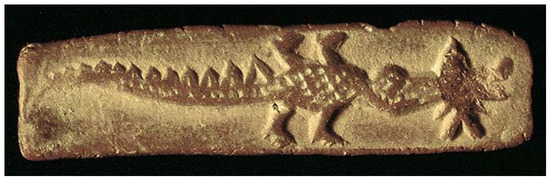
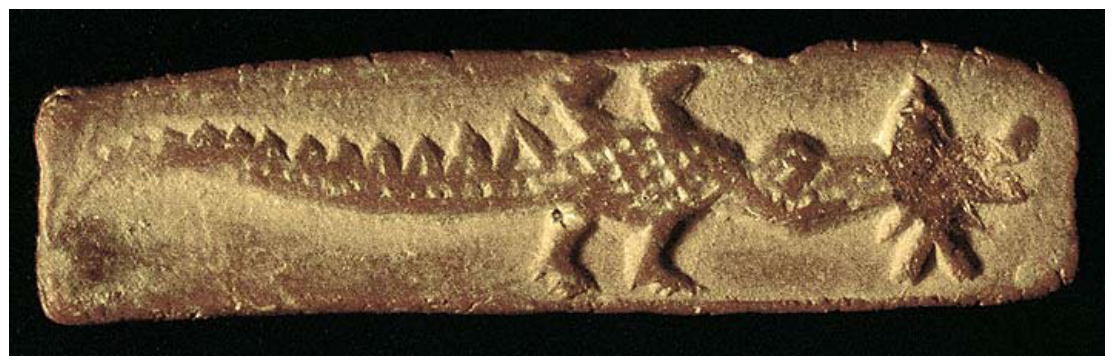
The initial emphasis on a crocodilian form is observed in the archaeological record of the Indus Valley Civilization. As illustrated in Figure 1, steatite seals from Mohenjo-daro depict aquatic creatures, especially the gharial (Gavialis gangeticus), with distinctive saw-like jaws and, in some cases, a fish held in the mouth. This iconographic base establishes a proto-Makara form that emphasizes the creature’s predatory and aquatic nature.
Figure 1.
Steatite seal depicting a gharial with a fish in its jaws (an early proto-Makara form), Mohenjo-daro, Indus Valley Civilization, c. 2500–1900 BCE. Courtesy of Harappa.com (Photograph by J.M. Kenoyer).
Across South and East Asia, the Makara appears in various registers, including Buddhist and Brahmanical literature, cave-temple reliefs, architectural spouts, and ceramics. In Indian contexts, it functions as a threshold guardian and as the vāhana (vehicle) of water deities like Gaṅgā and Varuṇa (Tan 2022, pp. 341, 343). Beyond its architectural role, the Makara can also be understood as part of a protective visual repertoire associated with water, movement, and safe passage. In the context of ninth-century maritime exchange, a Makara-adorned bowl may therefore have carried meanings beyond ordinary containment, even if its precise reception by individual users cannot be reconstructed. The consistent association with water and protection underscores its sacred status before its movement across regions and media.
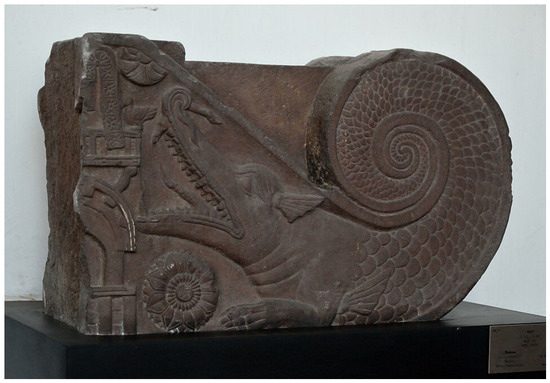
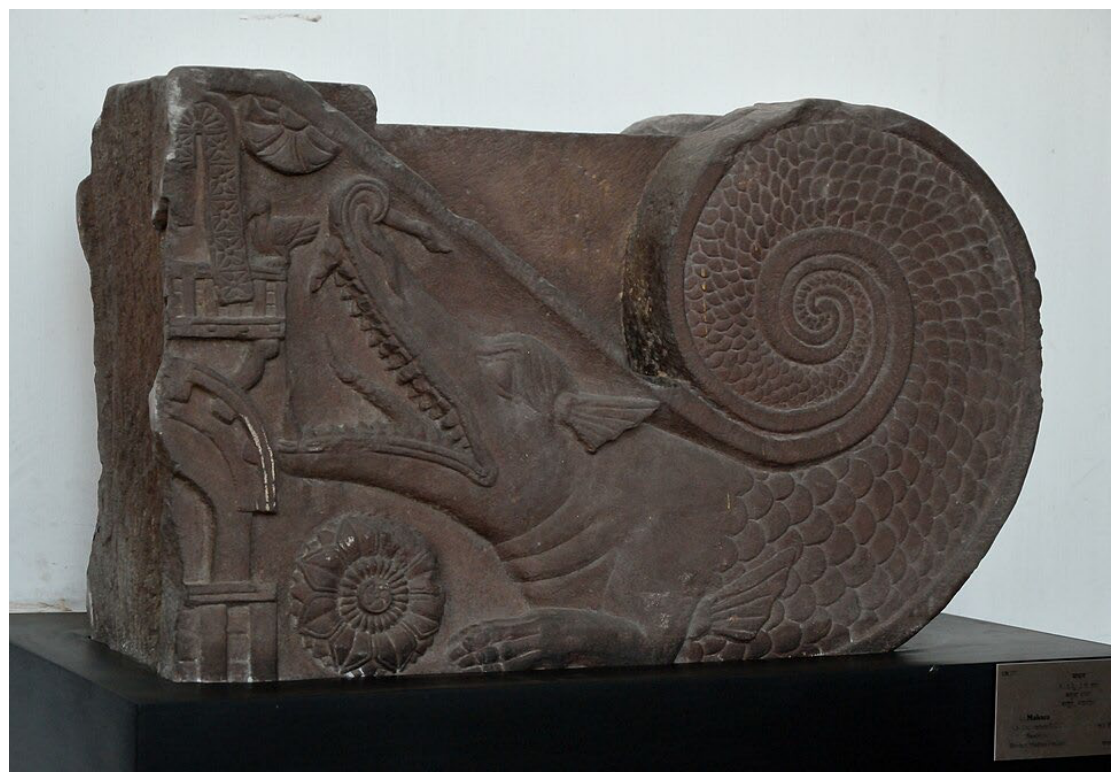
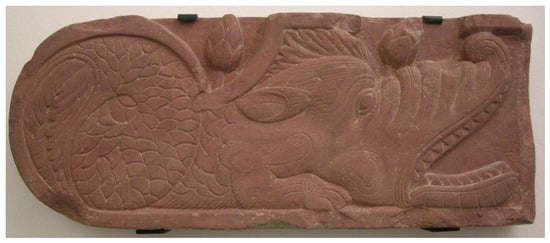
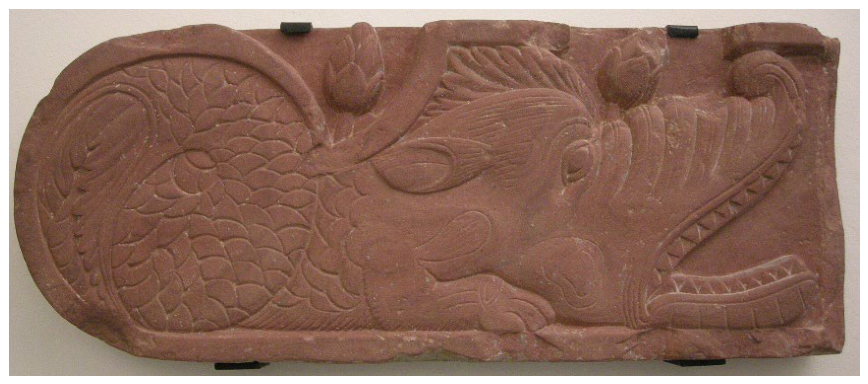
Material evidence helps trace this iconographic development through early architectural and sculptural contexts, including the Lomas Rishi cave (third century BCE) and the railings of the Bharhut Stupa (second century BCE) (Coomaraswamy 1931, pp. 47–48). In the Bharhut medallions, the Makara achieves a mature iconographic form, characterized by its scaled body and distinctive spiraling tail (Figure 2). This trajectory parallels the transformation of other materials along the Silk Roads, such as the adaptation of liuli from gemstone to glass and ceramic glaze, as noted by Zheng and Guo (2025, p. 1). Furthermore, analyzing the Makara involves a comparable form of cross-media approach (Arcidiacono 2023, p. 1), in which the static, sculptural grammar of Indian architecture was adapted into the fluid, calligraphic gestures of Chinese ceramic painting (Figure 2).
Figure 2.
Makara medallion from the railing of the Bharhut Stupa, India, Shunga period, c. 2nd century BCE. Sandstone. Courtesy of the Indian Museum, Kolkata. Photograph by Biswarup Ganguly (CC BY 3.0).
The relationship between China and India facilitated the movement of Makara terminology and imagery. Chinese textual traditions attest to forms such as mo-jie (摩竭) and yu-long (魚龍, “fish-dragon”), which associated the Makara with Chinese fish-dragon imagery (Shen 2013, p. 273). Huilin’s (737–820 CE) Buddhist lexicon, the Yiqiejing yinyi 一切經音義, further documents Makara terminology within Chinese Buddhist lexical traditions, defining mo-jie 摩竭 as a giant sea fish that devours aquatic creatures and swallows boats and ships (Huilin 1928, T no. 2128, 54:577a24; Sin 2024, pp. 25–26). More specifically, twelfth-century Goryeo celadon incorporated a range of auspicious and hybrid beasts into vessels associated with courtly and elite contexts, providing a comparative context for Makara-like forms in ceramic media (Kim 2021, p. 85). Materially, Makara forms appear in Northern Wei silverware, Liao ceramics, and notably on Tang-period Changsha ceramics. Scholars have linked these Chinese fish-dragon images to the Indian Makara, noting that its elephantine trunk was shortened into a distinctive upturned snout in Chinese Buddhist contexts (Salviati 2000, pp. 239–41).
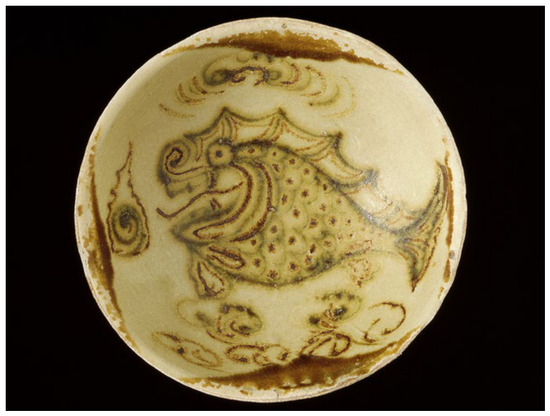
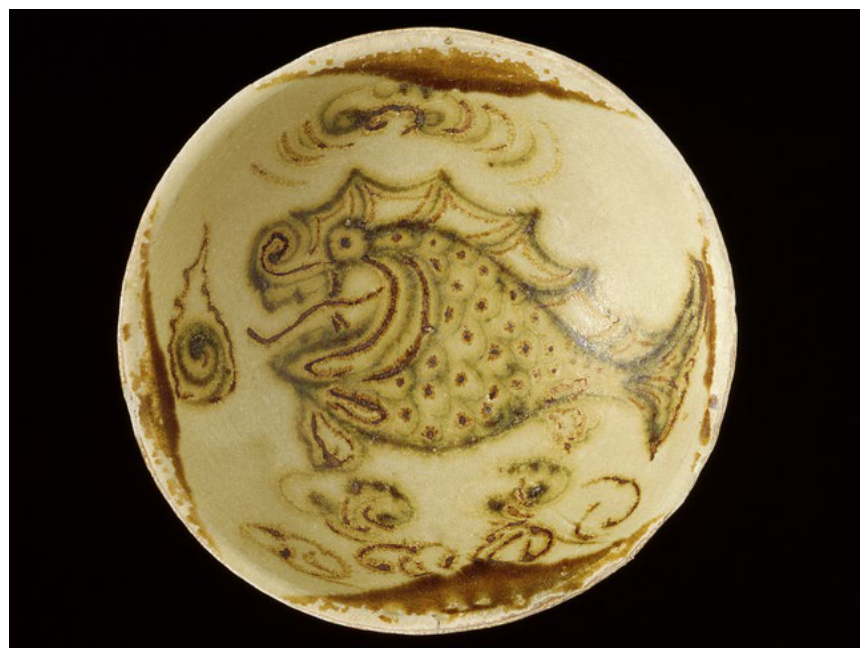
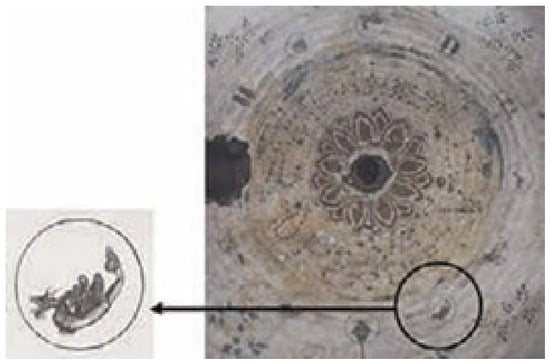
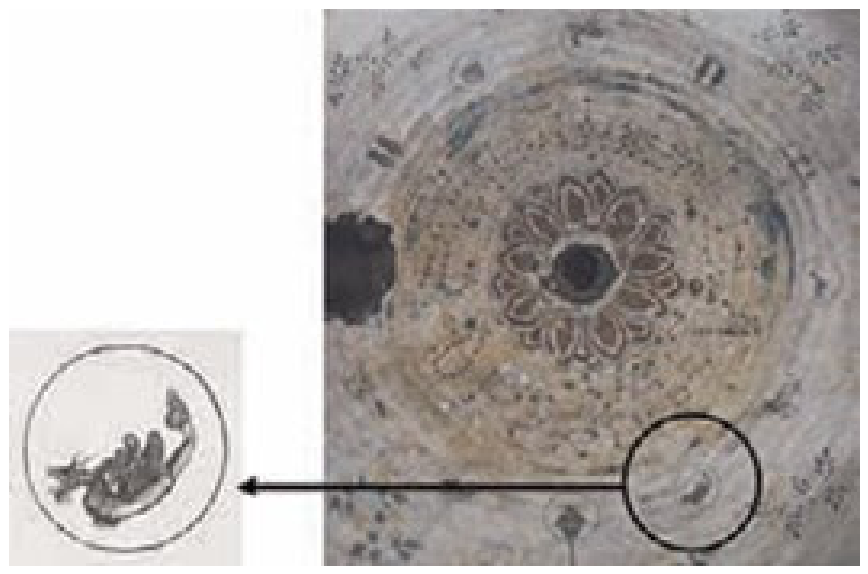
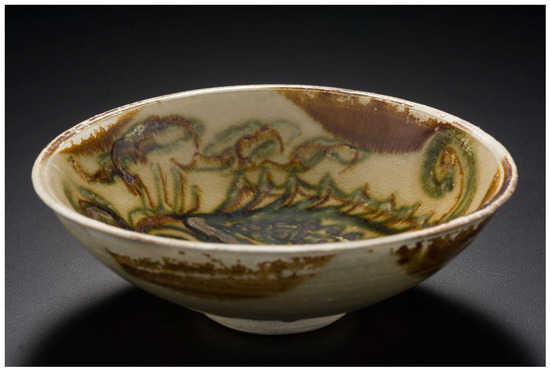
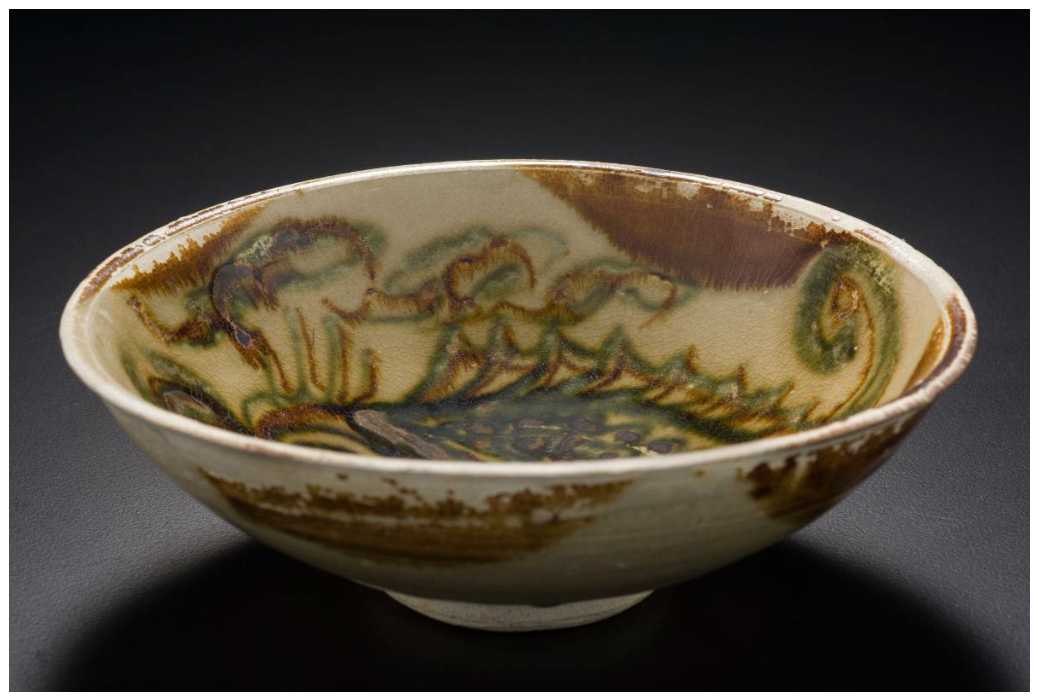
The Belitung shipwreck, a ninth-century vessel recovered off the coast of Indonesia, provides a pivotal archaeological context for the long-distance circulation of Changsha ceramics (Stargardt 2014, p. 35). Its cargo contained more than 50,000 pieces of Chinese ceramics, including large quantities of Changsha ware and bowls decorated with painted aquatic and hybrid motifs, among them Makara-like forms (Yang 2015, pp. 120–25). As shown in Figure 3, this Belitung example illustrates how a Makara-like motif could appear in simplified painted form on Changsha export ceramics. Rather than proving a single intended meaning for these motifs, the Belitung assemblage demonstrates the large-scale movement of Changsha wares through Indian Ocean trade routes and provides material evidence for studying how simplified painted motifs could circulate beyond the Chinese domestic market.
Figure 3.
Bowl with painted Makara motif, Changsha kilns, China, Tang dynasty, early 9th-century. Recovered from the Belitung shipwreck. Courtesy of the National Museum of Asian Art, Smithsonian Institution (CC0).
This Changsha bowl, painted with a stylized Makara-like motif, was produced in the context of industrial-scale ceramic manufacture and export circulation. The Belitung cargo does not by itself prove that particular motifs were designed for a single consumer group, but it does show that Changsha painted wares moved in very large numbers through maritime trade networks connecting China, Southeast Asia, and the western Indian Ocean (Stargardt 2014, p. 35; Yang 2015, pp. 120–25).
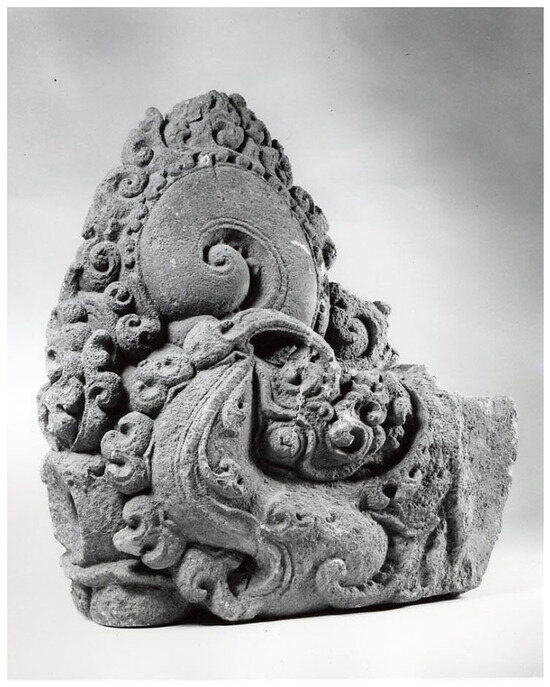
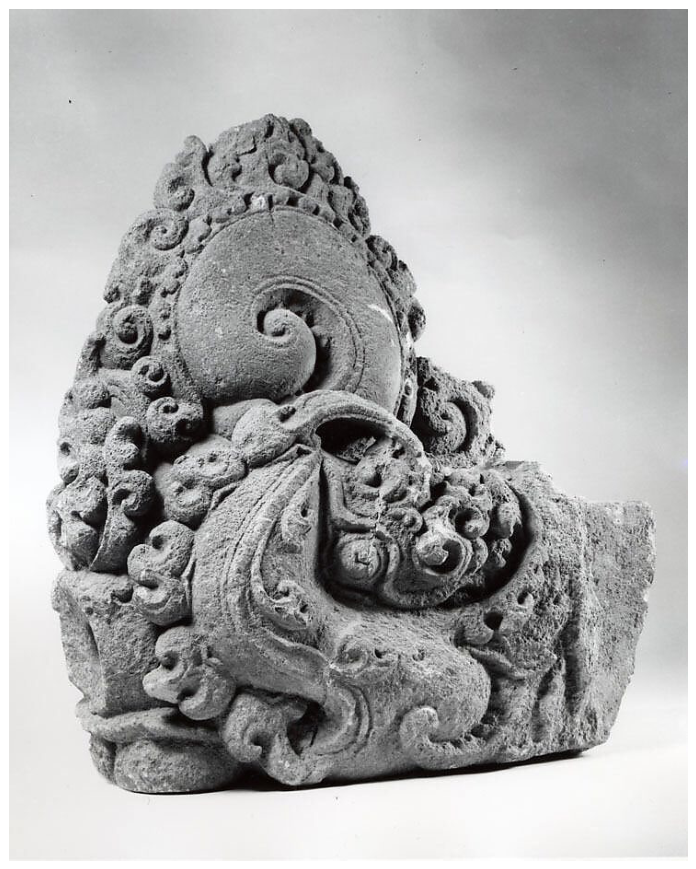
In the context of mass production and export circulation, the stylistic simplification of the Makara can be understood as a medium-specific adaptation. Artisans translated the motif from labor-intensive sculpture into rapid gestural painting. In these painted ceramics, the Makara’s cranial profile remains legible even as the body is abbreviated, signaling a shift from architectural threshold function toward surface ornament. This adaptation also recalls the proverbial association between courage and extracting a pearl from a Makara’s jaws, which helps explain the recurrent pairing of the Makara with the pearl (Coomaraswamy 1931, pp. 49–50). This protective pairing is frequently observed in architectural waterspouts (Pranala) from the same period, where the pearl or floral motifs emerge from the creature’s gaping jaw (Figure 4). Ruiz Sánchez and Rodríguez (2024, p. 13) discuss the circulation of luminescent pearls across Eurasian exchange networks, providing a broader comparative context for the circulation of pearls in long-distance trade.
Figure 4.
Makara waterspout (Pranala) showing the open jaw issuing pearls and floral motifs, Central or Eastern Java, c. 9th–10th century CE. Andesite. Courtesy of the Metropolitan Museum of Art, New York (Public Domain).
We therefore focus on the moment of material translation in which the Makara’s visual grammar and social meaning were reconfigured through Changsha kiln production. Drawing on textual references, Indian architectural examples, and the Belitung ceramic record, we argue that Changsha manufacture provides a useful case for examining how a motif could be transformed by medium, production practice, and market context. The analysis focuses on the relationship between morphological change and functional reassignment across different media and cultural settings, and on how mass production at the Changsha kilns encouraged a modular approach to the motif’s diagnostic features.
2. Materials and Methods
To ensure a transparent analytical framework and avoid selection bias, our corpus was systematically selected based on two primary criteria: morphological continuity and contextual provenance. For the Indian sculptural examples, we selected foundational representations from established architectural sites that clearly define the traditional Makara iconography. For the Chinese ceramics, the primary dataset is derived from the Belitung shipwreck cargo, which provides a securely dated (826 CE), quantitatively significant, and closed archaeological context. This allows us to analyze the motif not as isolated anomalies, but as representative samples of large-scale export production.
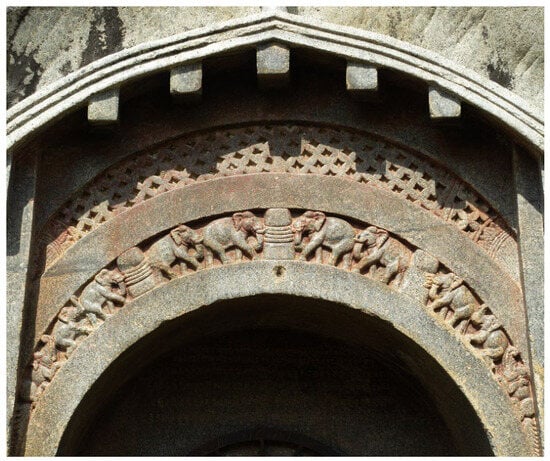
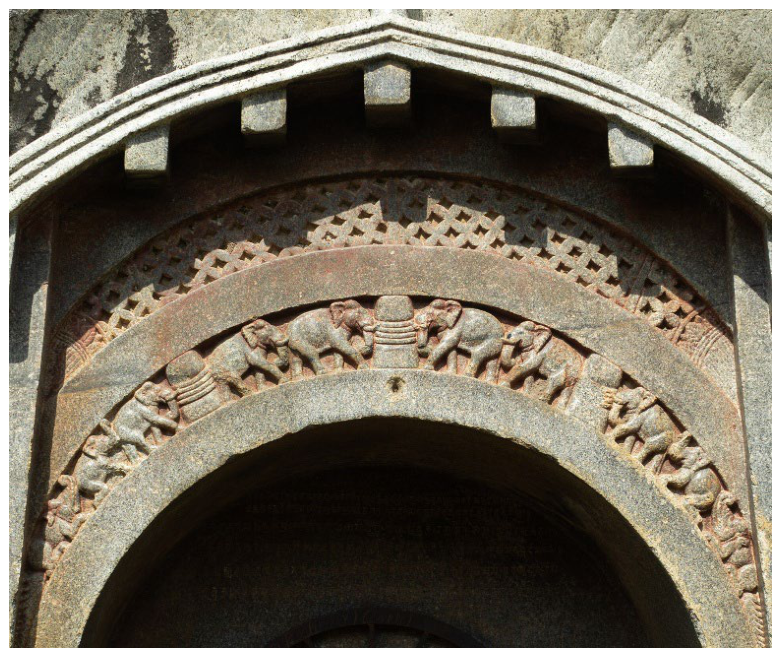
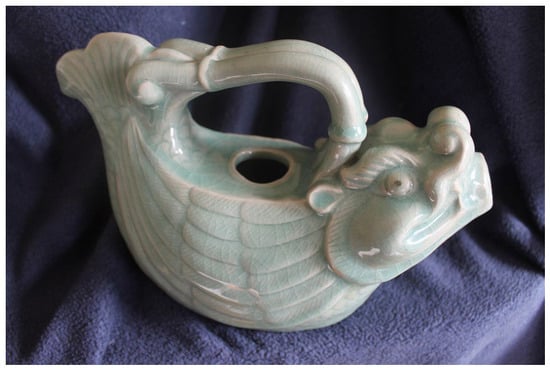
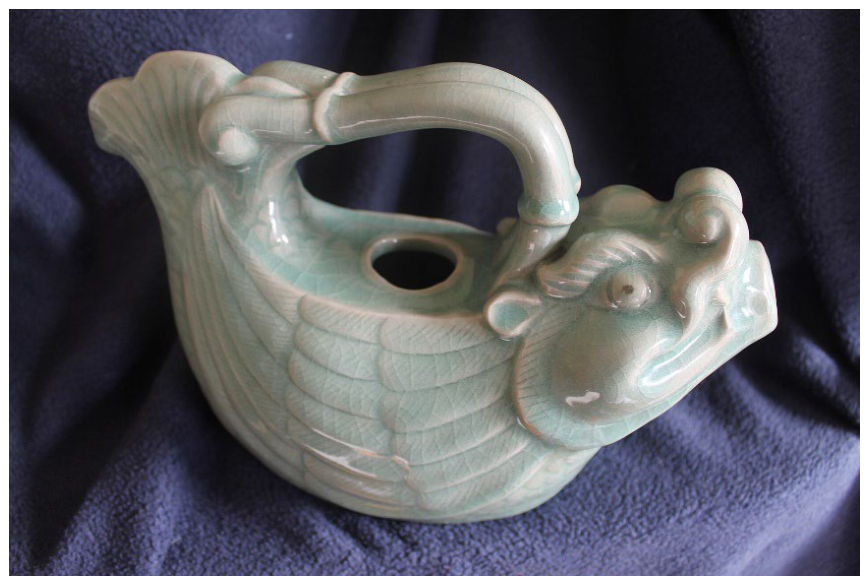
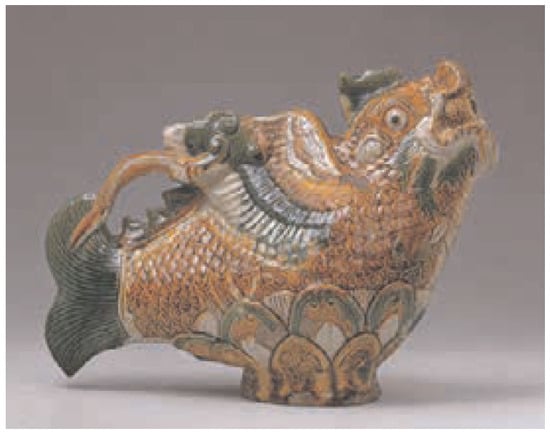
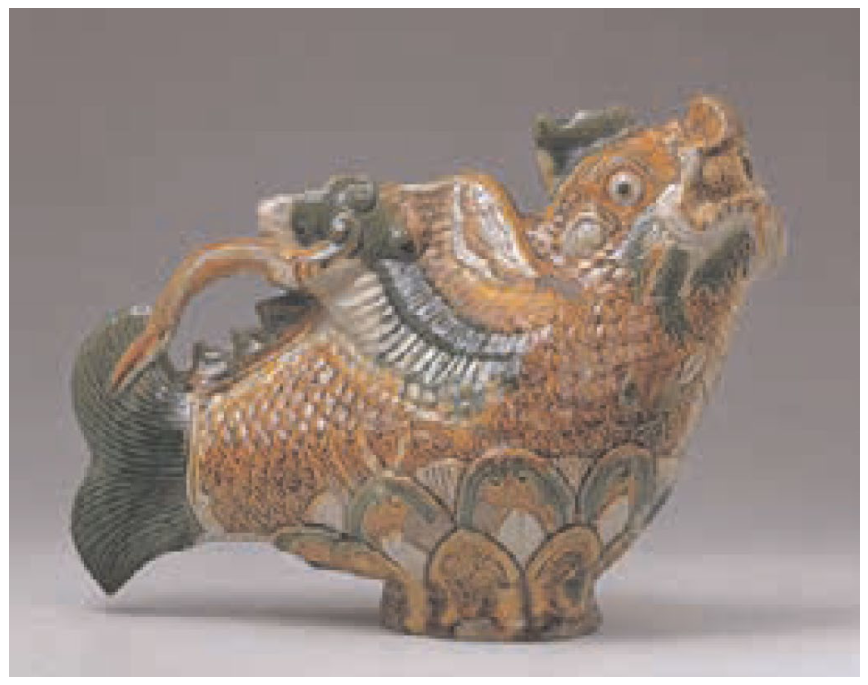
The primary visual corpus includes Indian architectural reliefs such as the entrance to the Lomas Rishi cave (Figure 5), where the architrave features a refined frieze of elephants and proto-Makara creatures. This early Mauryan example provides a critical benchmark for tracing the transition from timber-inspired stone carving to regional adaptations. To document the motif’s assimilation into Chinese material culture, the corpus further incorporates elite artifacts such as the fish-dragon (Makara) shaped ewers from the Liao Dynasty (Shen 2006, p. 350, no. 113; Figure 6). These high-status objects represent a crucial intermediary stage where the sculptural guardian began its transition into decorative ceramic forms.
Figure 5.
Entrance to Lomas Rishi cave, Barabar Hills, India, c. 3rd century BCE. The architrave features a frieze of elephants and proto-Makara creatures. Courtesy of Sumitsurai (CC BY-SA 4.0).
Figure 6.
Glazed pottery ewer in the form of a fish-dragon (Makara), Liao Dynasty (907–1125 CE). This type of elite vessel demonstrates the integration of the Makara motif into Chinese ceramic traditions. Courtesy of Wikimedia Commons (CC BY-SA 4.0).
The central case study then focuses on Tang-period Changsha kiln ceramics recovered from the Belitung cargo and museum holdings. These objects are selected for their explicit Makara imagery and their relevance to the motif’s morphological and semantic transformation across media and regions.
To contextualize the Chinese examples, we draw on Salviati’s chronological survey of Makara and fish-dragon imagery across Chinese metalwork, ritual vessels, and architectural decoration (Salviati 2000, pp. 239–50). The Belitung Changsha bowls are dated to shortly after 826 CE, with an underglaze inscription providing a secure terminus ante quem, corroborated by radiocarbon assays from organic materials recovered with the cargo. Furthermore, Yang’s analysis of the approximately 55,000 Changsha bowls in the cargo emphasizes the diversity of painted designs within industrial-scale export production (Yang 2015, pp. 120–25).
Textual sources include early mentions in the Rigveda, Atharvaveda, and later Vedic literature, alongside Buddhist lexica and sutra glosses (e.g., transliterations such as mo-jie 摩竭 and fish-dragon compounds yu-long 魚龍). Huilin’s lexicographical glosses in the Yiqiejing yinyi (Huilin 1928, T no. 2128, 54: 577a24) and the Candragarbha-Parivarta zodiac list, which preserves the Sanskrit–Chinese correspondence for Makara as the tenth sign, are also used to trace the motif’s conceptual transmission (Table 1).
Table 1.
The Candragarbha-Parivarta is an early Chinese Buddhist text that includes the twelve zodiac signs in phonetic transliteration from Sanskrit (Kotyk 2017, p. 61).
2.1. Typological Framework and Diagnostic Features
Inspired by methodologies that trace ethnic and stylistic origins through minor formal attributes, we adopt a framework centered on identifying the “Diagnostic Features” of the Makara motif. This approach does not seek a single point of origin but rather aims to isolate the core visual traits that constitute the Makara’s identity across different cultural and material translations.
The central argument is that despite significant simplification, abstraction, or hybridization, a persistent “Visual DNA” ensures the motif remains recognizable. We identify the upturned snout, often curled into a spiral, as the most resilient of these diagnostic features (Figure 7). As seen in the Kushan-period sandstone reliefs, this cranial anchor persists even when other anatomical details are modified to suit different materials.
Figure 7.
Sandstone plaque of a Makara, Mathura, India, Kushan period, c. 2nd century CE. The prominent, upturned snout serves as a stable iconographic anchor. Courtesy of Wikimedia Commons (CC BY-SA 4.0).
2.2. Typological Coding and Morphological Analysis
The Makara’s cranial profile, recurved snout, bulging eyes, open mouth, and the pearl motif are treated as the primary diagnostic features across media. This visual anchor enables recognition even when the body is abbreviated or omitted. Body-type categories are defined as follows (Table 2). For the feature matrix, five representative examples were coded as M-01 to M-05 in order to make the comparative procedure explicit and reproducible within the limits of the selected corpus.
Table 2.
Representative Makara examples utilized in the feature matrix analysis.
- Fishlike: Early and rare; elongated fins and snout, rounded eyes (e.g., Mathura and Nālandā).
- Crocodilian: Most prevalent in the Indian sequence; scaled bodies, coiled tails, saw-like jaws (e.g., Bharhut, Amaravati).
- Elephantine: Pachyderm forequarters with a trunk-like snout and serpent or fish hindquarters (e.g., Bharhut, Sanchi, Kushāṇa medallions).
To ensure a systematic analysis, our visual corpus was curated by focusing on three distinct ceramic clusters: Fishlike, Crocodilian, and Elephantine. Each specimen was coded based on its morphological diagnostic features—specifically the cranial profile, snout configuration, and aquatic/liminal attributes. This standardized coding framework allows us to distinguish between mass-produced export wares and high-status ritual items, providing the necessary empirical basis for our comparative study.
2.3. From Morphology to Functionality
A core component of the methodology is the analysis of how changes in form (morphology) lead to changes in use (functionality). As a comparative art-historical example of functional reassignment in craft objects, Silva Santa-Cruz’s study of the Taifa “perfume bottle” or canteen provides a useful methodological parallel; however, the morphology of the Makara in Changsha ware followed its own medium-specific trajectory (Silva Santa-Cruz 2025, p. 1). Its wide mouth and trunk-like snout, while iconographically significant, were often reimagined by potters as functional elements. For instance, on mass-produced export ewers (Figure 8), these features frequently became practical spouts, turning the “mythical guardian” into a “dispenser of fluids.” This methodological lens allows us to analyze how ritual iconography merged with daily utility, demonstrating a key principle of material translation in a mass-production context.
Figure 8.
Ewer in the form of a makara. Dimensions: 30 cm in length × 22.3 cm in height. Collection of Tongliao Municipal Museum. “Reproduced with permission from Hsueh-Man Shen, ‘Indian Makara or Chinese Dragon-Fish? Textual Translation and Visual Transformation of Makara in China’, Art in Translation, Vol. 5, Issue 2 (2013); reprinted by permission of Informa UK Limited, trading as Taylor & Francis Group, www.tandfonline.com”.
2.4. Comparative and Contextual Reading
We compare the painted Makara motifs on Changsha ceramics with three bodies of evidence: Indian sculptural and architectural examples, Chinese metalwork and mural programs, and textual attestations such as lexical glosses, Buddhist poems, and zodiac lists. This comparison is carried out in the typological and functional analyses that follow, with the specific aim of identifying which features remain stable across media and which features change when the motif enters ceramic production and maritime circulation. Textual sources are therefore used to clarify iconographic functions, such as aquatic association, guardian role, and zodiacal placement, rather than to impose a retrospective biological identification (Figure 9).
Figure 9.
Mural of a map of stars, and a detail (reproduction) of the zodiac sign Makara. Liao dynasty, 1116. From the ceiling of the rear room of tomb IM1 in Xuanhua, Hebei province. Liao Tombs in Report of the Excavations Conducted in 1974–1993 (Beijing: Wenwu chubanshe, 2001). Reproduced with permission from Hsueh-Man Shen, ‘Indian Makara or Chinese Dragon-Fish? Textual Translation and Visual Transformation of Makara in China’, Art in Translation, Vol. 5, Issue 2 (2013); reprinted by permission of Informa UK Limited, trading as Taylor & Francis Group, www.tandfonline.com.
2.5. Limitations and Critical Stance
This method acknowledges several constraints: reliance on published finds, absence of new archaeometric analysis, and variable preservation. Following warnings from maritime archaeological studies, we treat the Belitung cargo as a significant but not exhaustive sample and avoid overgeneralizing from it to the entirety of maritime ceramic trade. This caution is supported by Manguin’s observation that a single wreck represents one specific shipment rather than the entire ceramic trade network (Manguin 2020, p. 439). Interpretive claims therefore prioritize patterns visible within the selected corpus and avoid speculative assertions not grounded in the evidence discussed above.
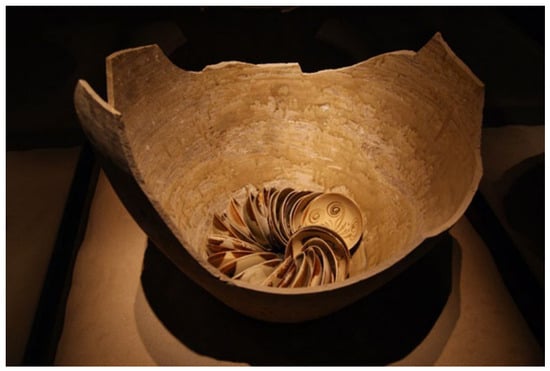
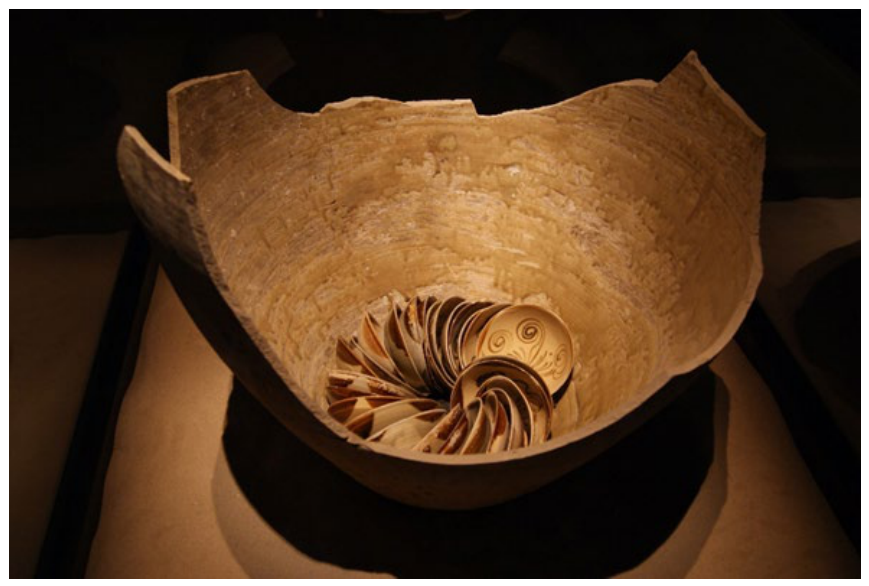
Within these limitations, theoretical concepts are used only as supporting tools rather than as separate explanatory models. The terms “materiality” and “object biography” are used here in a limited sense: to clarify how the Makara motif changed when it moved from carved architectural settings to rapidly painted export ceramics. The emphasis therefore remains on observable formal change, production conditions, and maritime circulation, rather than on fully reconstructing historical intention or reception. The packing of stacked Changsha bowls inside large Guangdong storage jars (Figure 10) illustrates this material shift from an immovable architectural context to a portable ceramic form embedded in long-distance trade.
Figure 10.
A fragment of a Guangdong ‘Dusun’ storage jar containing stacked Changsha bowls, illustrating the modular packing method for long-distance maritime trade. Courtesy of the Asian Civilizations Museum, Singapore (CC BY-SA 3.0).
3. Results
The results are presented in four connected stages: first, the diagnostic visual grammar of the Makara is identified; second, its pre-Changsha architectural, sculptural, and elite material contexts are summarized; third, the Changsha ceramic transformation is analyzed through form, placement, and market context; and fourth, the main material divergences are synthesized comparatively.
3.1. The Visual Grammar of the Makara: Morphological Types
Across the corpus, the Makara’s head emerges as the most consistent and diagnostic element, characterized by a recurved snout, bulging eyes, a wide-open mouth, and prominent dentition. This cranial anchor enables recognition even when the body is abbreviated, abstracted, or omitted entirely.
We identify three primary body-type clusters. Following a hybrid typological approach that considers the degree of stylistic mixing, we can define these types as follows:
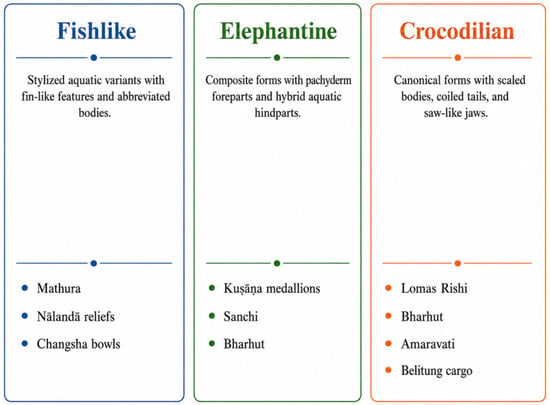
- Type I: The Canonical Crocodilian. Well-attested in the Indian sequence, featuring scaled bodies, coiled tails, and saw-like jaws. Bharhut and Amaravati provide key parallels, where the Makara appears as a threshold guardian with aggressive, carnivorous features.
- Type II: The Composite Elephantine. These variants exhibit pachyderm forequarters with a trunk-like snout and serpent or fish hindquarters. Noted at Bharhut, Sanchi, and Kushāṇa medallions, they emphasize a fusion of terrestrial strength with aquatic symbolism, representing a more complex hybrid form.
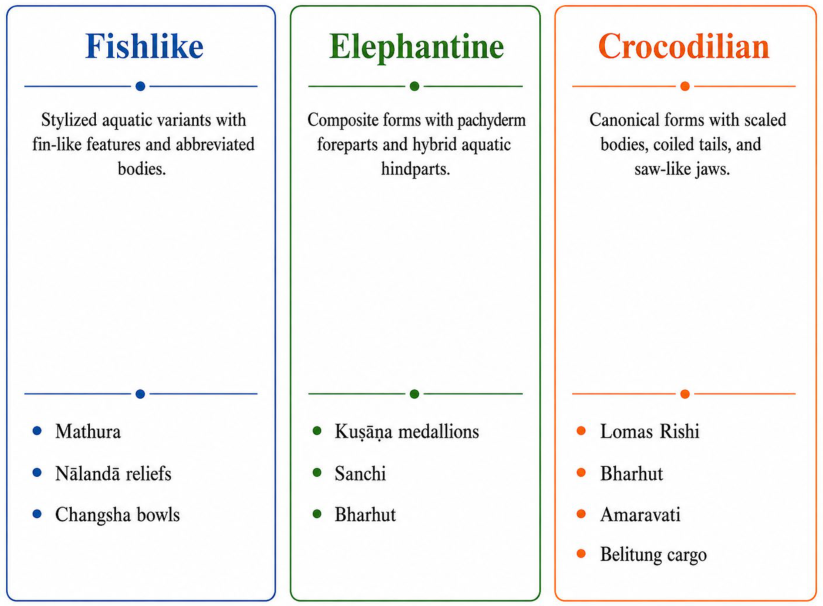
- Type III: The Stylized Aquatic (Fishlike). Attested in selected early examples, these forms have elongated fins, a snout, and rounded eyes. Associated with Mathura and Nālandā, they reflect a stronger emphasis on aquatic features and can be seen as a step towards greater abstraction. Figure 11 schematically summarizes these three body-type clusters with selected representative examples.
Figure 11.
Schematic typological summary of the three Makara body-type clusters discussed here (Fishlike, Elephantine, and Crocodilian) with selected representative examples. The figure is illustrative rather than statistical and does not represent a frequency count of the full corpus.
These three categories are used here as operational clusters for the selected corpus. A shared invariant across all three clusters is the elongated, upturned trunk or snout. This feature recurs across periods and regions, validating the head as a stable iconographic anchor. Tan (2022, p. 358) discusses an eleventh-century Makara stone at Melaka as part of a broader transregional itinerary of the motif, offering a useful comparative context for interpreting maritime motifs on export wares.
3.2. Form and Function in Pre-Changsha Contexts: Guardian and Ornament
The evidence documents a clear trajectory of Makara imagery in Indian and early Chinese contexts where form is intrinsically linked to function.
- Makara in Indian Architectural and Sculptural Contexts: In Indian contexts, the Makara routinely functions as a three-dimensional, architectural guardian, appearing as waterspouts (Pranala), Torana adornments, and balustrade terminations. These placements anchor thresholds and ritual access points, reinforcing the Makara’s role as a liminal protector (Figure 4). Its ornamentation, such as necklaces of beads, often signals its chthonic associations.
- Makara in Chinese Material Contexts: Chinese reception of the Makara is documented from the fifth century on Northern Wei silverware and Buddhist cave reliefs at Yungang and Longmen. Here, its function diversifies. On objects like Liao ewers, it becomes a ritual or utilitarian ornament, sometimes acting as a spout or handle. In funerary contexts, such as the Liao tomb ceiling of Zhang Shiqing (1116), the Makara is integrated into a cosmological schema as the tenth zodiac sign, shifting its role from guardian to an astral symbol.
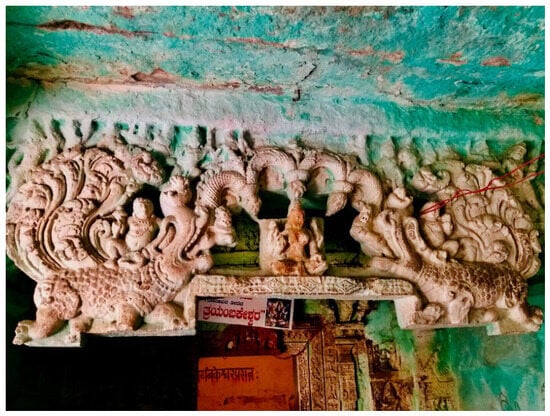
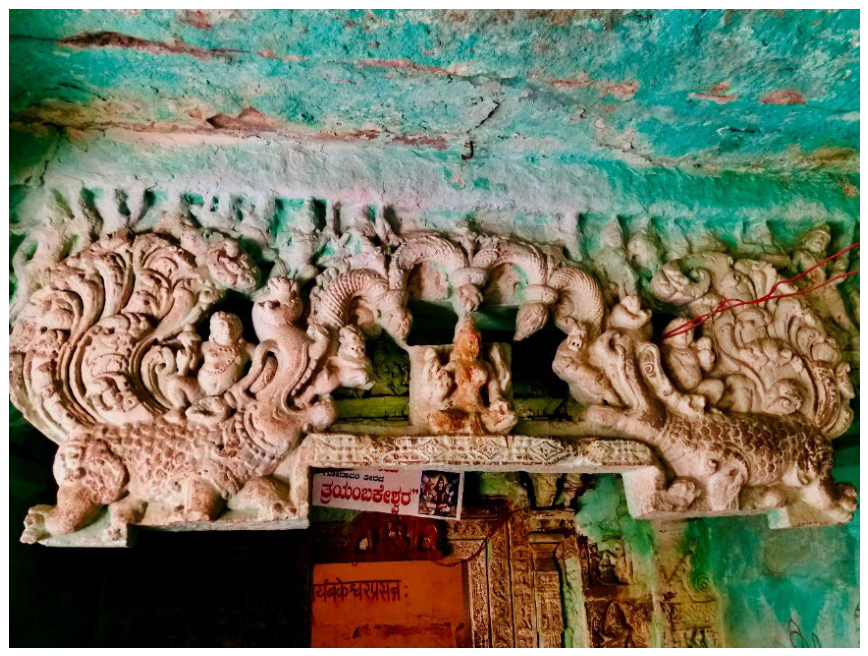
A clear architectural example of this established Indian tradition can be seen in the Navalinga temple (Figure 12). Located in Kukkanur, northern Karnataka, this 9th-century structure demonstrates how the Makara was fully integrated into the temple’s structural and symbolic vocabulary as a guardian figure. This serves as a representative model of the motif’s original terrestrial context before its subsequent maritime adaptation and translation in Southeast Asia and China.
Figure 12.
9th-century Navalinga temple located in Kukkanur village in northern Karnataka, India. Architrave with Makara motifs. Photograph by P. Madhusudan, Wikimedia Commons, File: Architrave_at_Navalinga_Temple_at_Kukkanur.jpg (accessed on 24 October 2025; CC BY-SA 3.0).
3.3. The Elite Context: Tang Metalwork and the “Fish-Dragon” Hybrid
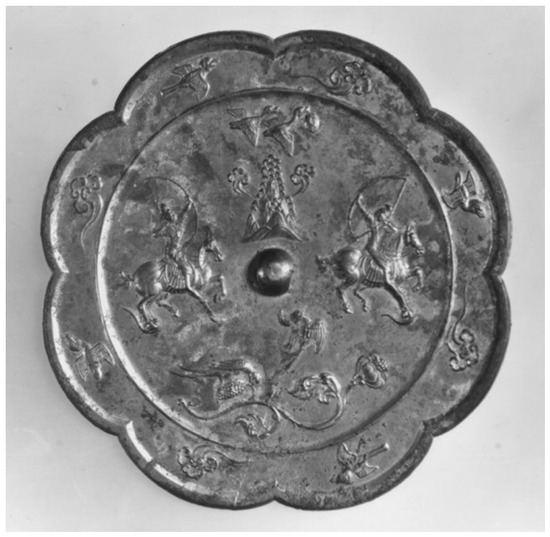
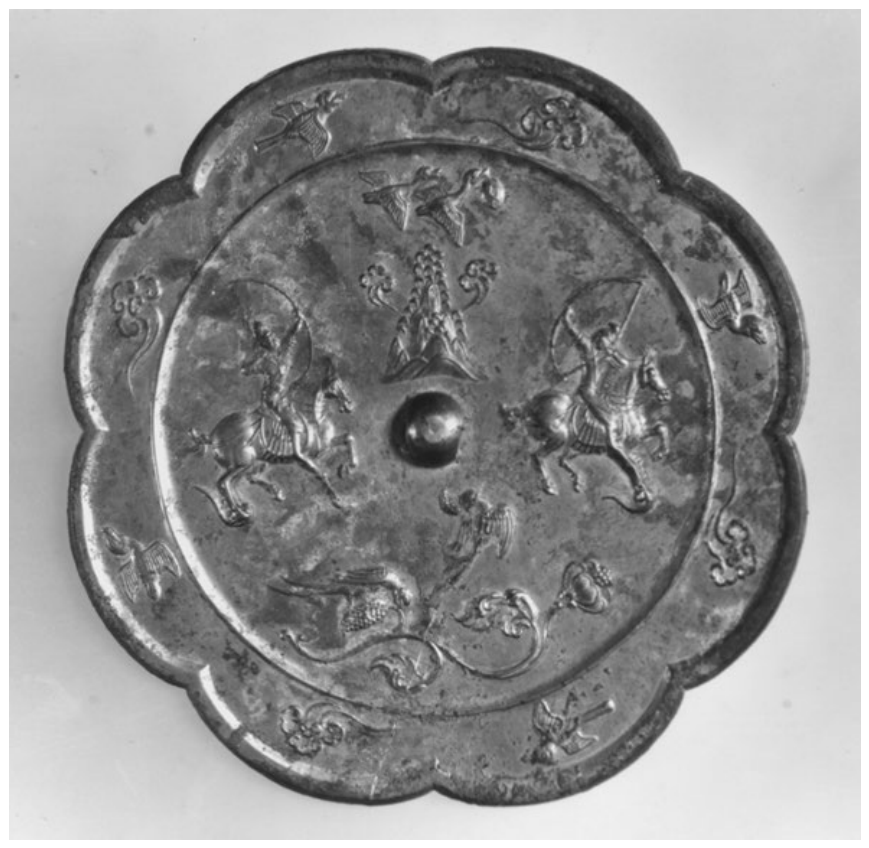
During the cosmopolitan Tang Dynasty, the motif became a feature of elite material culture, particularly on sophisticated metalwork. Its appearance on valuable items, such as the bronze mirror illustrated in Figure 13, demonstrates its use as an auspicious and decorative symbol in major trade centers. In these pre-Changsha contexts, the Makara was typically a complex, high-status motif found on precious materials, often visually and conceptually fused with the indigenous dragon to create a hybrid “fish-dragon” (yú-lóng) that was legible to a Chinese audience while retaining its exotic prestige. This history of elite, often sacred, use provides the crucial backdrop against which the radical simplification and mass-market commodification of the motif at the Changsha kilns can be fully understood.
Figure 13.
Bronze mirror with two phoenixes and two ‘fish-dragons’ (makaras), China, Tang dynasty, 8th century. This high-status object exemplifies the complex, elite context of the motif before its transition to mass-produced ceramics. Courtesy of the Metropolitan Museum of Art (CC0).
3.4. Comparative Case: The Makara’s Sacred and Architectural Role in Southeast Asia
The adaptation of the Makara in China was part of a broader regional pattern of creative reinterpretation. In Central Java, the motif remained embedded in sacred architecture. At Borobudur, the Makara formed part of the kala–makara gateway, marking the threshold between sacred and profane space; Javanese examples also show lions and other figures emerging from its mouth (Tan 2022, pp. 343–47). This comparison shows that regional artisans modified the motif while preserving its monumental architectural role.
A related adaptation occurred in Khmer art, where the imported Javanese arrangement of divergent Makaras was transformed through a fusion of Makara, dragon, and Nāga forms. By the twelfth century, Khmer pediments could show a Makara-dragon disgorging a Nāga (de Coral-Rémusat 1936, p. 431). In both the Javanese and Khmer cases, the Makara remained a monumental and immobile element of sacred architecture, in contrast to its later transformation at Changsha into a portable, two-dimensional commercial emblem.
3.5. From Temple to Bowl: The Makara in Maritime Trade
This section presents the core empirical focus of the manuscript: the transformation of the Makara in the context of Changsha kiln production and maritime circulation.
Unlike official kilns more closely bound to courtly or ritual conventions, Changsha production operated within a more flexible commercial environment. This context allowed artisans to adapt the Makara motif for visual appeal, rapid brushwork, and export circulation rather than strict iconographic accuracy. This production setting is central to understanding the formal and functional shifts discussed below.
3.5.1. Formal Traits and Visual Assemblage on Changsha Wares
Painted Makara motifs on Changsha bowls are stylized and abbreviated. Heads retain their diagnostic features (recurved snout, bulging eyes, open mouth with a pearl), but bodies are frequently reduced to scrolls or omitted entirely. The brushwork is expressive and variable, reflecting mass production by multiple painters.
Crucially, the meaning of the Makara is shaped by its visual assemblage. Just as Han dynasty reliefs utilized animal combinations to pacify dangerous realms, the pairing of the Makara with pearls, auspicious clouds, or foliage on Changsha wares creates a visual syntax of “auspicious protection” for the user. The motif is not an isolated monster but part of a curated, safe, and marketable seascape.
3.5.2. Placement and a New Rotational Grammar
On the bowls, Makara motifs occur on interiors and rims, functioning as surface ornaments. This signals a shift from spatial guardians to portable decorative emblems. Furthermore, this placement creates a “rotational visual grammar.” Borrowing from the syntax of visual movement, the placement of the Makara on the curved interior of the bowl compels a rotational reading. The viewer does not confront the guardian statically (as in architecture) but interacts with it dynamically, mimicking the swirling motion of water and activating the design through use.
3.5.3. Strategic Ambiguity for a Global Audience
The simplification of the Makara, especially the “Stylized Aquatic” (Fishlike) type, can be interpreted as an act of “strategic ambiguity.” In the context of the Belitung cargo, which was calibrated for Middle Eastern consumer preferences, artisans may have intentionally rendered the Makara in a more generic, fish-like form. This polysemic nature would make the motif visually appealing without carrying specific or potentially alienating Buddhist iconography, thus maximizing its marketability across different cultural and religious spheres.
3.6. Archaeological Corroboration from Abbasid Markets: The View from Siraf (Iran)
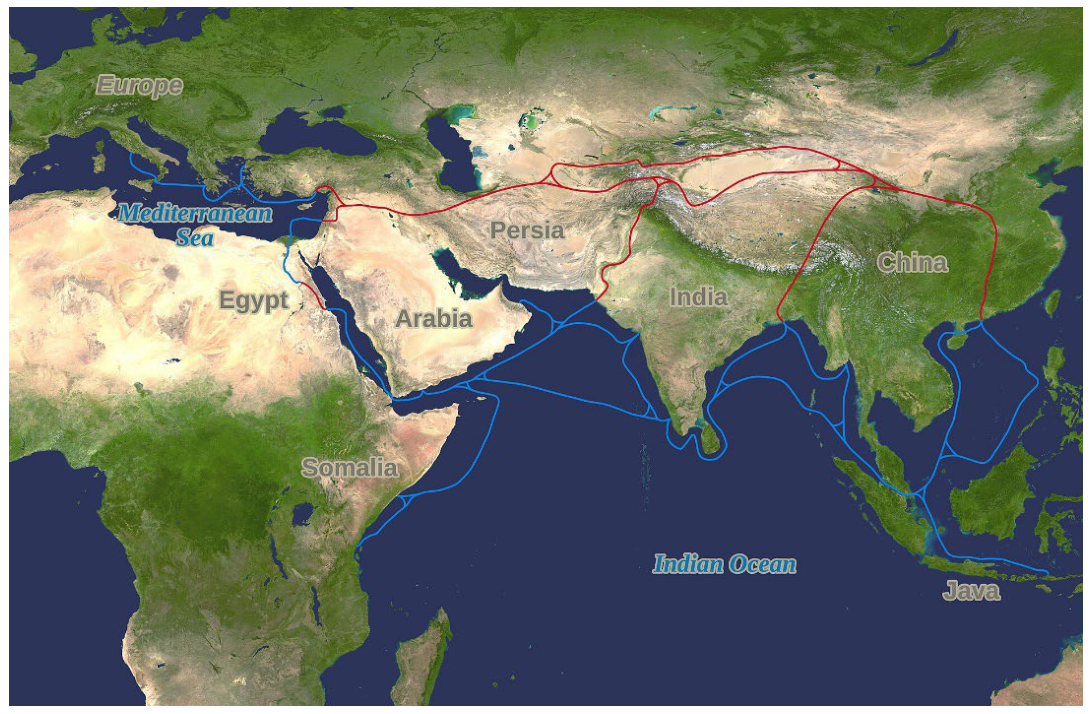
The broader maritime-market context for the Changsha Makara motif is supported by evidence for ninth- and tenth-century Indian Ocean trade in Chinese ceramics (Stargardt 2014, p. 35). More specific archaeological evidence comes from Abbasid sites such as Samarra and Siraf, where Chinese ceramics have been documented in excavated assemblages (Sarre 1925, pp. 57–58; Whitehouse 1973, pp. 248–49; Figure 14). Recent archaeological syntheses of ceramic assemblages from Siraf, combined with cargo-composition data from the Belitung wreck, provide an independent context for evaluating the circulation of Changsha wares. These datasets do not prove a specific intention behind each motif, but they show that simplified and standardized painted designs circulated within the distribution patterns and consumption contexts of the Abbasid market. Siraf, as a major entrepôt on the maritime route, therefore offers important evidence for the trade environment in which such ceramics were received.
Figure 14.
Map of the Silk Roads, illustrating the terrestrial and maritime trade routes connecting East Asia with the Persian Gulf and the Mediterranean. Courtesy of Wikimedia Commons/Sémhur (CC BY-SA 4.0).
Excavations at Siraf have yielded Tang-period Chinese ceramics, including painted Changsha stoneware (Whitehouse 1973, pp. 248–49).
As illustrated in the map of trade routes (Figure 14), the presence of Changsha, Yue, and Xing wares indicates a diverse and sustained ceramic market. The Siraf ceramic assemblage therefore shows that Chinese ceramics, including Changsha wares with simplified painted decoration, entered the material life of the Abbasid world. Their strategic ambiguity may have helped them circulate across varied cultural and religious contexts, including settings shaped by Islamic visual preferences. This archaeological evidence supports a cautious interpretation of the Makara’s transformation as an export-oriented adaptation within the Indian Ocean trade network, rather than as an isolated stylistic change.
3.7. Comparative Material Contexts: A Summary of Divergences
Taken together, the results highlight a clear divergence in the Makara’s form and function across different material contexts:
- Architecture (India): Makara as a three-dimensional, integrated threshold guardian.
- Metalwork and Ewers (China, Liao/Tang): Makara as a functional, utilitarian ornament (spout, handle).
- Mural/Astral (Liao Tomb): Makara as a two-dimensional, cosmological symbol.
- Ceramics (Changsha): Makara as a two-dimensional, painted, and portable decorative emblem, designed with stylistic liberty and strategic ambiguity for a global, mass-market audience.
Table 3 summarizes these divergences across selected material contexts and clarifies how the Makara’s visual form, dominant function, and symbolic role shift from stone architecture and metalwork to Changsha ceramics and mural/astral settings.
Table 3.
Comparative summary of the Makara motif across selected material contexts, including material setting, typical visual form, dominant function, and symbolic role.
4. Discussion
This paper frames the Makara’s journey not as an instance of problematic cultural appropriation, but as a case of creative cultural exchange. We argue that the 9th-century adaptation of the Makara motif is a process in which the motif’s meaning and form were actively re-negotiated within the global network of the Maritime Silk Road.
4.1. Historiographical Framing: Beyond Diffusion to Modular Translation
The assembled evidence demands a reading that privileges symbolic systems over retrospective biological classification. The analysis rejects diffusionist models that treat motif movement as unidirectional transmission. Instead, it posits the Makara’s journey as a process of modular translation, where the motif’s core components are selectively adapted, reconfigured, or abandoned based on the constraints and opportunities of new media, patronage, and market conditions. The critical shift from a three-dimensional stone guardian in architecture to a two-dimensional painted emblem on ceramics is not a degradation of the image, but a successful translation of its function from a static protector to a mobile, commercial commodity.
This approach aligns with recent scholarship on the cross-regional adaptation of iconographic motifs. As Salviati documents, Chinese representations of the Makara retained recognizable features such as the upturned snout (Salviati 2000, pp. 241, 244). Similarly, Shen distinguishes phonetic transliterations such as mo-jie from semantic renderings such as yu-long (“fish-dragon”), which enabled different visual associations in China (Shen 2013, p. 273).
4.2. Cranial Continuity as Visual Anchor and Modular Adaptability
Across India and China, the Makara’s cranial profile remains its most stable module. This “visual anchor” preserves identity even when the body is reconfigured. In Changsha painted wares, this modularity supports efficient production. The rapid, gestural brushwork used for the Makara motif was not merely a stylistic choice but also a response to the constraints of ceramic production. This reduction of the form to its essential cranial markers can be understood as an adaptation to high-volume export production, where technique, speed, and visual recognizability had to work together. The abbreviated Makara reflects the speed and economy of Changsha brushwork, translating the static icon into a rhythmic, gestural mark.
4.3. The Changsha Kiln: A Confluence of Technology, Market, and Meaning
Changsha production translated the Makara from monumental contexts into portable, mass-produced ceramics. This translation involves three interlocking transformations.
4.3.1. Technological Determination
The morphological shift was strongly shaped by the Changsha kiln’s signature underglaze painting technique. Unlike slow stone carving, the rapid absorption of pigment into the porous body required swift, calligraphic brushwork. This technical constraint forced the reduction of the complex Makara to a set of fluid, gestural lines, demonstrating how materiality shapes iconography. It is also necessary to acknowledge a simpler commercial explanation: Changsha production was driven by speed, repetition, and responsiveness to changing market demand. The simplification of the Makara-like motif may therefore reflect the industrial logic of large-scale export production as much as any deliberate program of cultural translation. For this reason, we do not claim that each potter consciously negotiated the motif’s symbolic meaning. Rather, we argue more cautiously that the repeated retention of selected diagnostic features—especially the recurved snout, open mouth, and aquatic association—allows the motif to be read as a commercially adapted form that still preserves a limited morphological connection to the Makara tradition.
4.3.2. Audience Modulation and Merchant Mediation
The Belitung cargo shows that Changsha wares were produced for long-distance circulation and reached consumers beyond the Chinese domestic market. This context makes it plausible that foreign demand, merchant mediation, and export taste influenced the selection and repetition of certain decorative motifs. However, the available evidence does not allow us to reconstruct a direct instruction from Arab or Persian merchants to Changsha potters, nor does it prove a fully conscious program of symbolic translation. The role of merchants is therefore treated more cautiously here: they may have helped shape the commercial environment in which simplified, visually ambiguous, and easily repeatable aquatic motifs became desirable export designs. As documented by Schafer (1963, p. 15), foreign merchants resided in designated quarters known as fan fang (蕃坊), where they acted as intermediaries between Tang China and the wider maritime world. This historical setting supports the possibility of cultural and economic brokerage without requiring a claim of direct control over individual motifs. The commercial infrastructure of Tang maritime trade, including foreign merchant quarters and urban banking centers, therefore provides a context for indirect market mediation, but it does not allow us to reconstruct specific instructions given to potters for individual Makara designs (Schafer 1963, pp. 15, 17).
4.3.3. From Sacred Motif to Export Ornament
As a repeated painted motif on Changsha export wares, the Makara became a recognizable sign associated with distant maritime cultures. In export contexts, such a motif may have signaled participation in long-distance exchange rather than devotional use alone. The motif, therefore, moved from a primarily sacred visual tradition into the commercial and decorative context of export ceramics.
4.4. The Makara Bowl in Maritime Context
The interpretation of the Makara should be considered in relation to its maritime context along the Maritime Silk Road. Rather than functioning only as surface decoration, the Makara image can be read as part of a broader maritime visual vocabulary. In this setting, the bowl’s aquatic imagery could have supported protective or auspicious associations without requiring a single fixed meaning.
Drawing on traditions in which water marks a liminal or protective domain, the Makara on Changsha wares can be read not only as decoration, but also as an aquatic and protective motif. Its presence on export ceramics may therefore have evoked protection and safe passage without proving a specific ritual or talismanic use.
Chinese textual traditions such as the Classic of Mountains and Seas (Shanhaijing) provide one context for understanding how strange or hybrid beings could be imagined in relation to lands within and beyond the seas (Strassberg 2002, pp. 28, 32–33, 54–55). Its accounts of hybrid creatures and distant regions suggest an imaginative field in which the sea could be associated with foreignness, uncertainty, and nonhuman beings. Within such a context, the Makara-like image on a Changsha bowl could be read alongside other hybrid aquatic beings. The broader Chinese association of dragons with water, rain, and protective power also provides a relevant comparative background for understanding how aquatic hybrid imagery could be interpreted within Chinese visual traditions (Ranjan and Zhou 2011, pp. 67, 70).
Arabic and Persian maritime traditions also imagined the sea as a space of danger, wonder, and monstrous beings. Within such maritime imaginaries, the ambiguous fish-like form of the Makara could have been associated more broadly with sea creatures, danger, and protection, rather than with a single fixed iconographic identity. Although these traditions differed in detail, Bassett’s comparative collection documents maritime beliefs concerning sea dangers, supernatural beings, and ritual offerings across different seafaring cultures (Bassett 1885, pp. 9, 55, 379).
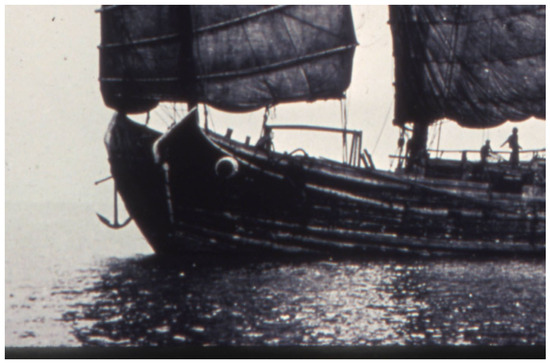
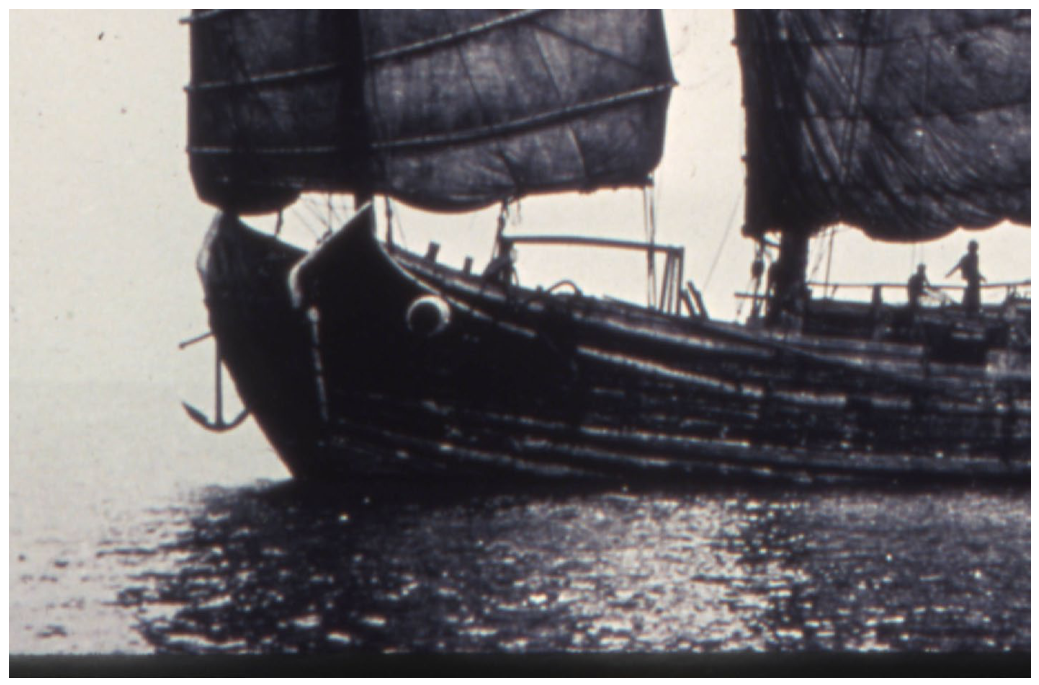
In response to maritime uncertainty, seafaring communities often used protective images and portable objects. Examples include apotropaic images placed on ships, such as the eyes painted on the prows of Chinese junks (Figure 15), as well as portable objects associated with safety at sea. The Changsha Makara bowl may be understood more cautiously within this broader field of maritime protective imagery. Unlike a prow image fixed to a vessel, the bowl’s portable ceramic format allowed such protective associations to circulate with the object. Its ambiguous aquatic form could therefore support different protective or auspicious readings within maritime circulation, without requiring a single fixed interpretation.
Figure 15.
Detail of a sea-going Chinese junk with an eye painted on the bow, Changde, Hunan, China, ca. 1900–1919. The image provides a historical example of the eye motif used on Chinese vessels. Photographer unidentified. International Mission Photography Archive, Yale Divinity Library Special Collections; via Wikimedia Commons (Public Domain; cropped from the original).
4.5. Cultural Assimilation and the Persistence of Foreignness
Ultimately, the Makara’s reception in China illustrates partial assimilation. Its foreignness is moderated through visual affinities with the indigenous dragon idiom, yet the motif never becomes wholly naturalized. Changsha ceramics exemplify this: potters grafted Makara features onto local decorative vocabularies (clouds, pearls), producing images that were legible within Chinese visual grammar while retaining a hint of foreign origin. The result is a softened foreignness rather than full appropriation (Figure 16). The Makara remained a mutable sign that Chinese artisans could adapt in response to form, function, and market demand, illustrating the interplay of local creativity and long-distance exchange on the Maritime Silk Road.
Figure 16.
Changsha bowl with underglaze painted decoration of a Makara and cloud scrolls, 9th century. From the Tang Shipwreck (Belitung) collection. This piece exemplifies the visual integration of the foreign motif into the Chinese decorative idiom. Courtesy of the Asian Civilisations Museum, Singapore, Accession No. 2005-100251.
While tracing this transformation from ritual iconography to practical commercial usage, it is necessary to distinguish between cultural identity and morphological lineage. In the Changsha context, the painted motif should not be treated as an unchanged Indian religious Makara. Its specific ritual function was largely displaced as the motif entered a Chinese ceramic and export-commercial setting, where it could be read more broadly as an auspicious aquatic or “dragon-fish” form (yu-long 魚龍). Nevertheless, the motif remains analytically connected to the Makara tradition through a persistent “Visual DNA”: the recurved snout, open mouth, ocular emphasis, and aquatic association. Therefore, we do not argue that the Changsha image remained an Indian Makara in ritual function; rather, we argue that it became a Chinese export adaptation of the Makara, recognizable through selected morphological features.
4.6. The Makara Bowl and the Art Nexus: A Limited Interpretive Model
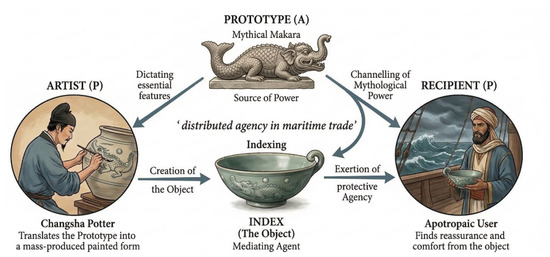
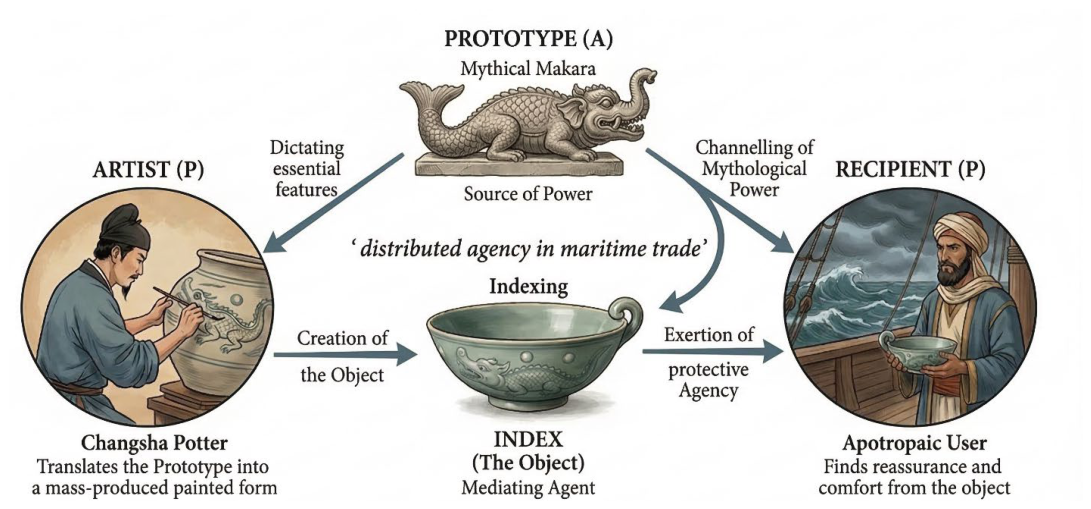
Alfred Gell’s theory of Art and Agency is used here only as a limited interpretive model, not as proof that the Changsha Makara bowl possessed actual agency or produced a recoverable psychological effect (Gell 1998, pp. 27–28). The model is useful because it helps clarify the relationships among image, maker, prototype, and potential recipient, but these relationships must be read cautiously through the material and archaeological evidence already discussed.
In this restricted sense, the Changsha bowl can be understood as an object that mediated several relationships: the potter who translated the motif into a rapidly painted ceramic form; the Makara prototype, whose diagnostic features remained recognizable; and the maritime users or consumers who encountered the object within Indian Ocean exchange networks. The bowl should therefore not be treated as direct evidence of sailors’ beliefs or ritual practice. Rather, it provides material evidence for how an aquatic and protective motif could be reformatted into a portable ceramic image suitable for long-distance circulation.
Figure 17 visualizes this limited analytical relationship. It should be read as a heuristic diagram of possible interpretive positions, not as an archaeological demonstration of intention, reception, or efficacy. The diagram is therefore retained as a visual summary of possible relational positions, while the argument itself remains grounded in material form, production practice, maritime circulation, and cautious interpretation.
Figure 17.
Conceptual diagram applying Alfred Gell’s “Art Nexus” as a limited interpretive model for the Changsha Makara bowl (Gell 1998, p. 28). The diagram visualizes possible relationships among the potter, the Makara prototype, the bowl, and potential maritime recipients.
4.7. Semantics and Aesthetics of the Makara Bowl
To understand how the Makara bowl could be interpreted as carrying protective associations, it is useful to consider the semantic and aesthetic dimensions that Morphy identifies as central to the social effects of visual objects (Morphy 2009, p. 5). Gell’s framework helps outline the relational structure, while Morphy helps clarify the motif’s semantic and aesthetic effects.
First, the bowl’s potential meaning was partly semantic. The painted image was meaningful because the Makara was already a recognizable aquatic symbol within the cultural vocabulary of the Maritime Silk Road. For viewers familiar with Indic or Southeast Asian traditions, it could recall an aquatic guardian, while in other maritime contexts its fish-like form could evoke broader sea-creature imagery. Its interpretation therefore depended on the cultural knowledge and associations that viewers brought to it.
Second, the bowl’s visual effect was aesthetic. The swift, calligraphic brushwork of Changsha painting was not merely suited to mass production; it also gave the motif a sense of dynamism and life. The swirling creature within the circular space of the bowl created a visual effect that contributed to its impact. This combination of semantic association and visual effect helps explain how the bowl could carry protective associations while remaining visually appealing as an export ceramic.
4.8. From Temple Motif to Export Commodity
The journey of the Makara from temple to bowl can be read, in a limited sense, through what Appadurai (2012, p. 76) terms the “social life of things.” In its original Indic setting, the Makara did not function primarily as a commodity. As a three-dimensional stone carving integrated into a temple’s architecture, it formed part of a sacred architectural setting, its value defined by its religious function.
The critical shift occurred at the Changsha kilns, where the motif moved from a sacred architectural setting into mass-produced export ceramics. This transition can be considered in relation to Appadurai’s (2012, p. 88) discussion of the different forms of knowledge associated with producing and consuming commodities. Producers and potential viewers may not have shared the same iconographic knowledge. Changsha potters worked within the technical constraints of underglaze painting, while viewers outside Indic traditions may have encountered the motif without its full earlier iconographic context. This difference in iconographic knowledge may have supported the motif’s flexibility in export contexts. The simplified “fish-dragon” could therefore be read beyond a single original context and associated with broader aquatic or auspicious imagery. Within the commercial conditions of maritime exchange, the motif’s value depended less on religious authenticity than on its adaptability as a portable auspicious image. As Hoskins (2006, p. 74) elaborates, this biographical approach can help clarify how objects acquire changing meanings across contexts. The distinction between a “biographical object” and a standardized “protocol object” is useful here only in a limited sense (Morin 1969, p. 136). The Makara’s journey can be read as a shift between these two states. On a temple wall, it formed part of a sacred architectural setting, a biographical object for its community. At the Changsha kilns, it became part of mass-produced export ceramics. In circulation, however, the same motif could acquire new associations as an auspicious image on a portable ceramic object.
4.9. Creative Misunderstanding: The Makara and Dürer’s Rhinoceros
The simplification of the Makara on Changsha wares can be understood not as a degradation, but as a form of “creative misunderstanding” in the history of cross-regional artistic exchange. Changsha potters were likely working at a considerable remove from earlier three-dimensional architectural Makara forms. The resulting stylized, graphic “fish-dragon” may have departed from earlier iconographic conventions, but it remained visually and commercially legible. It retained the recognizable idea of an aquatic guardian while being adapted to the medium of underglaze painting and the conditions of export circulation. The Changsha Makara therefore shows how an image could remain meaningful without being a faithful copy, functioning instead as an adaptive visual translation.
4.10. From Stone to Portable Ceramic Form
The transformation of the Makara at the Changsha kilns can be understood through the shift in medium and material form. As Keane argues, signs are not merely the “garb of meaning”; their material properties shape their social function. The move from stone to ceramic was not only a change in medium, but also a change in the motif’s material conditions (Keane 2005, pp. 182–86).
In its architectural form, the Makara was associated with the properties of stone: permanence, immobility, and three-dimensional monumentality. Its function was tied to a specific, sacred place. On a Changsha bowl, however, the motif entered a new ceramic context defined by portability, fragility, a glazed surface, and a utilitarian function. This change in material context helped allow the Makara to move from a sacred architectural context into mass-produced export ceramics.
This material shift also enabled the motif’s visual openness. The constraints of underglaze painting on a curved surface demanded simplification. This produced a stylized “fish-dragon” that was open to multiple interpretations. Its resemblance to earlier Makara forms was just one of many possible readings. For viewers across maritime contexts, it could simultaneously resemble a Chinese dragon, a generic sea monster, or simply an elegant, swirling design. This combination of portability and visual openness helps explain the wider circulation and adaptability of the Changsha Makara motif on export ceramics.
5. Conclusions
We have traced the Makara’s transformation from a three-dimensional architectural and sculptural guardian into a portable, painted motif on Chinese export ceramics. The results support this argument through three connected observations. First, the Makara’s recurved snout, open mouth, ocular emphasis, and aquatic associations provide a stable visual anchor across different media. Second, the shift from stone architecture and elite objects to underglaze-painted Changsha bowls changed the motif’s scale, technique, placement, and function. Third, the Belitung cargo and comparative evidence from Abbasid-market contexts such as Samarra and Siraf show that such painted ceramics circulated within long-distance maritime trade networks.
These findings support a cautious model of adaptation rather than a claim that the motif preserved a single stable ritual meaning across all contexts. In Indian and Southeast Asian architectural settings, the Makara functioned primarily as a threshold guardian and protective figure. In Chinese metalwork, mural, and ceramic contexts, its form was reconfigured through local visual systems, including fish-dragon associations. On Changsha ceramics, the motif was further condensed into a graphic emblem suited to rapid brushwork, portable use, and export circulation. This transformation should therefore not be understood as simple degradation, but as a medium-specific and commercially responsive adaptation.
The argument therefore frames Changsha artisans not as passive copyists, but as participants in a process of visual and material translation. The evidence does not require assuming that every producer or consumer recognized the Makara’s earlier religious associations. It shows more modestly that selected diagnostic features remained legible enough to support new auspicious, aquatic, or decorative readings in maritime trade. In this sense, the ninth-century Changsha Makara offers an early example of export-oriented design shaped by artistic agency, technological constraints, and commercial circulation.
Author Contributions
Conceptualization, R.H. and M.R.; methodology, M.R.; investigation, M.R.; resources, M.R.; data curation, R.H.; writing—original draft preparation, M.R.; writing—review and editing, R.H.; visualization, M.R.; supervision, R.H.; project administration, R.H. All authors have read and agreed to the published version of the manuscript.
Funding
This research received no external funding.
Institutional Review Board Statement
Not applicable.
Informed Consent Statement
Not applicable.
Data Availability Statement
No new data were created or analyzed in this study. Data sharing is not applicable to this article.
Acknowledgments
The authors gratefully acknowledge the support of Hunan University.
Conflicts of Interest
The authors declare no conflicts of interest.
References
- Appadurai, Arjun. 2012. Commodities and the politics of value. In Interpreting Objects and Collections. Edited by Susan M. Pearce. London and New York: Routledge, pp. 76–91. [Google Scholar] [CrossRef] [Scilit]
- Arcidiacono, Giulia. 2023. Arts, Artworks and Manuscripts in Sicily between the 12th and 13th Centuries: Interactions and Interchanges at the Mediterranean Crossroads. Arts 12: 104. [Google Scholar] [CrossRef] [Scilit]
- Bassett, Fletcher S. 1885. Legends and Superstitions of the Sea and of Sailors in All Lands and at All Times. London: Sampson Low, Marston, Searle & Rivington. [Google Scholar]
- Coomaraswamy, Ananda Kentish. 1931. Yakṣas: Part II, with 50 Plates. Washington, DC: Freer Gallery of Art, Smithsonian Institution. [Google Scholar]
- de Coral-Rémusat, Gilberte. 1936. Animaux fantastiques de l’Indochine, de l’Insulinde et de la Chine. Bulletin de l’École française d’Extrême-Orient 36: 427–35. [Google Scholar] [CrossRef] [Scilit]
- Gell, Alfred. 1998. Art and Agency: An Anthropological Theory. Oxford: Clarendon Press. [Google Scholar]
- Hoskins, Janet. 2006. Agency, biography and objects. In Handbook of Material Culture. Edited by Christopher Tilley, Webb Keane, Susanne Küchler, Mike Rowlands and Patricia Spyer. London: SAGE Publications, pp. 74–84. [Google Scholar]
- Huilin 慧琳. 1928. Yiqiejing yinyi 一切經音義. In Taishō shinshū daizōkyō 大正新脩大藏經. Edited by Takakusu Junjirō 楠順次郎 and Watanabe Kaigyoku 渡邊海旭. Tokyo: Taishō Issaikyō Kankōkai, vol. 54, no. 2128. [Google Scholar]
- Keane, Webb. 2005. Signs Are Not the Garb of Meaning: On the Social Analysis of Material Things. In Materiality. Edited by Daniel Miller. Durham: Duke University Press, pp. 182–205. [Google Scholar] [CrossRef] [Scilit]
- Kim, Yunjeong. 2021. The Emergence and Iconography of Seosu (Auspicious Beasts) in the Twelfth-century Goryeo Celadon. The Review of Korean Studies 24: 85–126. [Google Scholar] [CrossRef]
- Kotyk, Jeffrey. 2017. Buddhist Astrology and Astral Magic in the Tang Dynasty. Doctoral thesis, Leiden University, Leiden, The Netherlands. Available online: https://hdl.handle.net/1887/54858 (accessed on 21 July 2026).
- Manguin, Pierre-Yves. 2020. Ceramics from Indonesian underwater sites. Bulletin de l’École Française d’Extrême-Orient 106: 435–51. [Google Scholar] [CrossRef] [Scilit]
- Morin, Violette. 1969. L’objet biographique. Communications 13: 131–39. [Google Scholar] [CrossRef] [Scilit]
- Morphy, Howard. 2009. Art as a mode of action: Some problems with Gell’s Art and Agency. Journal of Material Culture 14: 5–27. [Google Scholar] [CrossRef] [Scilit]
- Ranjan, Dharma Keerthi Sri G. D., and Chang C. Zhou. 2011. The Chinese dragon concept as a spiritual force of the masses. Sabaragamuwa University Journal 9: 65–80. [Google Scholar] [CrossRef] [Scilit]
- Ruiz Sánchez, Antonio, and Sebastián Uribe Rodríguez. 2024. The Giant’s Trail: Mobility and Exchange of Whales and Their By-Products in Antiquity (1st Century BC–5th Century AD). Journal of Ancient History and Archaeology 11: 13–24. [Google Scholar] [CrossRef] [Scilit]
- Salviati, Filippo. 2000. The “Fish-dragon”: The Makara Motif in Chinese Art and Architectural Decoration. In Trails to the East: Essays in Memory of Paolo Cuneo. Edited by Maria Vittoria Fontana and Bruno Genito. Naples: Università degli Studi di Napoli “L’Orientale”, pp. 238–51. [Google Scholar]
- Sarre, Friedrich. 1925. Die Keramik von Samarra. In Die Ausgrabungen von Samarra. Berlin: Dietrich Reimer, vol. 2. [Google Scholar]
- Schafer, Edward H. 1963. The Golden Peaches of Samarkand: A Study of T’ang Exotics. Berkeley and Los Angeles: University of California Press. [Google Scholar]
- Shen, Hsueh-Man, ed. 2006. Gilded Splendor: Treasures of China’s Liao Empire (907–1125). New York: Asia Society. Milan: 5 Continents. [Google Scholar]
- Shen, Hsueh-Man. 2013. Indian Makara or Chinese Dragon-Fish? Textual Translation and Visual Transformation of Makara in China. Art in Translation 5: 273–95. [Google Scholar] [CrossRef] [Scilit]
- Silva Santa-Cruz, Noelia. 2025. Reassigning Functionalities: On the Taifa “Perfume Bottle” or Canteen from Albarracin, Teruel. Arts 14: 8. [Google Scholar] [CrossRef] [Scilit]
- Sin, Wŏnch’ŏl. 2024. The Propagation to Korea and Reintroduction to China of Huilin’s Yiqiejing yinyi. In Korea and the “Others”: Studies on Korean Actions and Reactions Towards the Rest of the World. Edited by Maurizio Riotto. Berlin and Boston: De Gruyter, pp. 25–38. [Google Scholar] [CrossRef] [Scilit]
- Stargardt, Janice. 2014. Indian Ocean Trade in the Ninth and Tenth Centuries: Demand, Distance, and Profit. South Asian Studies 30: 35–55. [Google Scholar] [CrossRef] [Scilit]
- Strassberg, Richard E., ed. and trans. 2002. A Chinese Bestiary: Strange Creatures from the Guideways Through Mountains and Seas. Berkeley and Los Angeles: University of California Press. [Google Scholar]
- Tan, Zi Hao. 2022. The Chimeric Trace: The Makara and Other Connections to Come. Art in Translation 14: 338–70. [Google Scholar] [CrossRef] [Scilit]
- Whitehouse, David. 1973. Chinese Stoneware from Siraf: The Earliest Finds. In South Asian Archaeology: Papers from the First International Conference of South Asian Archaeologists Held in the University of Cambridge. Edited by Norman Hammond. London: Duckworth, pp. 241–55. [Google Scholar]
- Yang, Liu. 2015. Innovative Design in Belitung Wreck Ceramics. Bulletin of the Oriental Ceramic Society of Hong Kong 15: 120–25. [Google Scholar]
- Zheng, Yanyan, and Guikun Guo. 2025. From Gem to Glass: Liuli’s Long Transformation and the Remaking of Chinese Decorative Arts. Arts 14: 147. [Google Scholar] [CrossRef] [Scilit]

Disclaimer/Publisher’s Note: The statements, opinions and data contained in all publications are solely those of the individual author(s) and contributor(s) and not of MDPI and/or the editor(s). MDPI and/or the editor(s) disclaim responsibility for any injury to people or property resulting from any ideas, methods, instructions or products referred to in the content. |
© 2026 by the authors. Licensee MDPI, Basel, Switzerland. This article is an open access article distributed under the terms and conditions of the Creative Commons Attribution (CC BY) license.