You are currently viewing a new version of our website. To view the old version click .

Insects, Volume 16, Issue 9

September 2025 - 121 articles

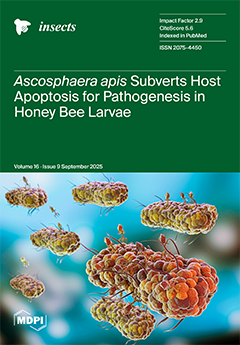
Cover Story: Honey bee populations face a severe threat from chalkbrood, a lethal disease caused by Ascosphaera apis. Our study identified a key molecular mechanism underlying this infection: the pathogen hijacked the larval apoptotic pathway to induce fatal tissue damage. The fungal infection markedly increased the expression of host pro-apoptotic genes and meanwhile reduced the anti-apoptotic gene expression, triggering extensive cell death. Importantly, pharmacological inhibition of apoptosis significantly enhanced larval survival and decreased the fungal Ste11-like expression. Conversely, artificially inducing apoptosis exacerbated disease progression. These results demonstrate that A. apis actively exploits host apoptosis to promote its own virulence, highlighting the apoptotic pathway as a promising target for therapeutic interventions. View this paper
  • Issues are regarded as officially published after their release is announced to the table of contents alert mailing list .
  • You may sign up for email alerts to receive table of contents of newly released issues.
  • PDF is the official format for papers published in both, html and pdf forms. To view the papers in pdf format, click on the "PDF Full-text" link, and use the free Adobe Reader to open them.

Articles (121)

  • Article
  • Open Access
1 Citations
732 Views
20 Pages

Segmentation of Young Polish Consumers in Relation to Product Attributes and Willingness to Consume Food Containing Edible Insects

  • Anna Platta,
  • Anna Mikulec,
  • Monika Radzymińska,
  • Karolina Mikulec and
  • Stanisław Kowalski

19 September 2025

This study investigated consumer segmentation regarding insect-based foods among Polish Generation Z students. Data from 947 respondents were analyzed using exploratory factor analysis (EFA) followed by k-means clustering. Two segmentation solutions...

  • Article
  • Open Access
609 Views
13 Pages

Developmental Biology and Seasonal Damage of the Grape Borer Xylotrechus pyrrhoderus in Grapevines

  • Ganyu Zhang,
  • Yuying Jia,
  • Haibin Wu,
  • Yong Zhang,
  • Murad Ghanim,
  • Yanan Ma and
  • Ruihong Sun

19 September 2025

Xylotrechus pyrrhoderus Bates (Coleoptera: Cerambycidae) is a major viticultural pest whose larval feeding damages grapevine canes and reduces yields, yet its internal development and damage progression are poorly understood. Using field surveys comb...

  • Article
  • Open Access
708 Views
16 Pages

19 September 2025

The drastic surge in Sardine landings in Korea underscores the urgent need for sustainable upcycling strategies. However, research on the feasibility of using sardine (SD) in food waste (FW)-based substrates during the cultivation of black soldier fl...

  • Article
  • Open Access
1,036 Views
21 Pages

Integrative Study of the Crane Fly Genus Brithura Edwards, 1916 (Diptera: Tipulidae) in East Asia: First Larval Descriptions of the Genus and Insights from Adult Morphology and DNA Barcoding

  • Virginija Podeniene,
  • Sigitas Podenas,
  • Dalius Butkauskas,
  • Donatas Sneideris,
  • Jin Whoa Yum,
  • Neung-Ho Ahn,
  • Soen Yi Kim,
  • Jisoo Kim and
  • Pavel Starkevich

18 September 2025

Brithura Edwards, 1916 (Diptera: Tipulidae) is a small genus of crane flies currently comprising 16 described species distributed across the East Palaearctic and Oriental regions. Although the adults of this genus rank among the largest representativ...

  • Article
  • Open Access
963 Views
14 Pages

18 September 2025

Various types of sensilla are densely distributed on the antennal surfaces of insects. The specialization of perception and ecological adaptability of antennae in detecting external environmental signals are reflected in the morphology, function, num...

  • Article
  • Open Access
748 Views
13 Pages

17 September 2025

Bemisia tabaci MED is one of the most invasive and destructive agricultural pests worldwide, posing a serious threat to crop production and biosecurity. Understanding its spatiotemporal population dynamics and genetic structure is critical for early...

  • Article
  • Open Access
712 Views
26 Pages

17 September 2025

The genus Homidia contains 84 species of which 60 have been reported from China. The sequence of COI for ten Homidia species are provided and a neighbour-joining tree is presented. Three new species of Homidia are described from Chongqing Municipalit...

  • Article
  • Open Access
751 Views
17 Pages

17 September 2025

Cycads are being endangered by several anthropogenic threats, and invasions of non-native herbivores are among those threats. Various country invasions by the cycad blue butterfly Luthrodes pandava have threatened the local horticulture cycad trade a...

  • Article
  • Open Access
1,579 Views
20 Pages

17 September 2025

The fortification of bakery products with alternative protein sources, including edible insects, offers a promising approach to improving nutritional quality while addressing sustainability challenges. This study evaluated graded replacement of type...

  • Article
  • Open Access
620 Views
13 Pages

17 September 2025

Paracoccus marginatus (Hemiptera: Pseudococcidae) poses a significant threat to over 200 plant species, severely impacting agricultural productivity. Diomus guilavoguii (Coleoptera: Coccinellidae) is a natural predator of P. marginatus. To develop an...

of 13

Get Alerted

Add your email address to receive forthcoming issues of this journal.

XFacebookLinkedIn
Insects - ISSN 2075-4450