You are currently viewing a new version of our website. To view the old version click .

Insects, Volume 11, Issue 5

May 2020 - 63 articles

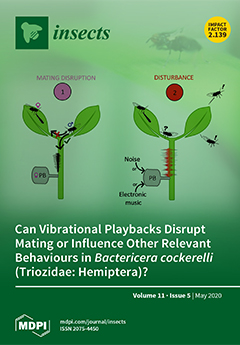
Cover Story: Artificial vibrations can affect the behaviour of insect pests and contribute to controlling their populations. The psyllid Bactericera cockerelli is a pest of numerous crops and uses vibrational signals for mate-finding. Thus, we hypothesised that the transmission of selected vibrations could affect its behaviour. In the first test, we observed a reduction of mating success by playing the female signal back into a host plant. In another test, we treated the psyllids with either one of two unspecific noises. While the transmission of broadband noises reduced the males’ signalling activity, the males treated with electronic music were not affected. However, none of the noises decreased the number of matings when compared to a silent control. We concluded that artificial vibrations have the potential to be used to manipulate B. cockerelli behaviour if selected for certain features. View this paper.
  • Issues are regarded as officially published after their release is announced to the table of contents alert mailing list .
  • You may sign up for email alerts to receive table of contents of newly released issues.
  • PDF is the official format for papers published in both, html and pdf forms. To view the papers in pdf format, click on the "PDF Full-text" link, and use the free Adobe Reader to open them.

Articles (63)

  • Article
  • Open Access
32 Citations
4,639 Views
12 Pages

16 May 2020

Candidatus Liberibacter asiaticus (CLas) is a phloem-limited bacterium that is associated with the Huanglongbing (HLB) disease of citrus and transmitted by the psyllid, Diaphorina citri. There are no curative methods to control HLB and the prevention...

  • Article
  • Open Access
22 Citations
5,625 Views
10 Pages

Insecticidal Activity of Bacillus thuringiensis Strains on the Nettle Caterpillar, Euprosterna elaeasa (Lepidoptera: Limacodidae)

  • Angelica Plata-Rueda,
  • Hughes Antonio Quintero,
  • José Eduardo Serrão and
  • Luis Carlos Martínez

15 May 2020

In the present work, we evaluated the insecticidal activity of Bacillus thuringiensis (Bt) strains on Euprosterna elaeasa as an alternative for the organophosphate insecticide use in oil palm plantations in the Americas. The toxic effects of four Bt-...

  • Article
  • Open Access
22 Citations
4,093 Views
9 Pages

Biochemical Mechanisms, Cross-resistance and Stability of Resistance to Metaflumizone in Plutella xylostella

  • Jun Shen,
  • Zhao Li,
  • Dongyang Li,
  • Rumeng Wang,
  • Shuzhen Zhang,
  • Hong You and
  • Jianhong Li

15 May 2020

The diamondback moth, Plutella xylostella (L.) is an important pest of cruciferous crops worldwide. It has developed resistance to many conventional and novel insecticide classes. Metaflumizone belongs to the new chemical class of semicarbazone insec...

  • Article
  • Open Access
48 Citations
5,352 Views
17 Pages

Habitat and Seasonality Affect Mosquito Community Composition in the West Region of Cameroon

  • Marie Paul Audrey Mayi,
  • Roland Bamou,
  • Borel Djiappi-Tchamen,
  • Albin Fontaine,
  • Claire L. Jeffries,
  • Thomas Walker,
  • Christophe Antonio-Nkondjio,
  • Anthony John Cornel and
  • Timoléon Tchuinkam

15 May 2020

To identify potential sylvatic, urban and bridge-vectors that can be involved in current or future virus spillover from wild to more urbanised areas, entomological field surveys were conducted in rural, peri-urban and urban areas spanning the rainy a...

  • Review
  • Open Access
36 Citations
8,398 Views
29 Pages

15 May 2020

The stable fly, Stomoxys calcitrans (L.) (Diptera: Muscidae), remains a significant economic pest globally in situations where intensive animal production or horticultural production provide a suitable developmental medium. Stable flies have been rec...

  • Article
  • Open Access
50 Citations
7,068 Views
16 Pages

Asteraceae Paradox: Chemical and Mechanical Protection of Taraxacum Pollen

  • Maryse Vanderplanck,
  • Hélène Gilles,
  • Denis Nonclercq,
  • Pierre Duez and
  • Pascal Gerbaux

14 May 2020

Excessive pollen harvesting by bees can compromise the reproductive success of plants. Plants have therefore evolved different morphological structures and floral cues to narrow the spectrum of pollen feeding visitors. Among “filtering” m...

  • Article
  • Open Access
51 Citations
5,822 Views
16 Pages

An Insight into the Role of Trissolcus mitsukurii as Biological Control Agent of Halyomorpha halys in Northeastern Italy

  • Davide Scaccini,
  • Martina Falagiarda,
  • Francesco Tortorici,
  • Isabel Martinez-Sañudo,
  • Paola Tirello,
  • Yazmid Reyes-Domínguez,
  • Andreas Gallmetzer,
  • Luciana Tavella,
  • Pietro Zandigiacomo and
  • Carlo Duso
  • + 1 author

14 May 2020

Sustainable strategies such as classical or augmentative biological control are currently being evaluated for the long-term management of the alien invasive pest Halyomorpha halys (Stål) (Hemiptera: Pentatomidae). A three-year study carried out...

  • Article
  • Open Access
13 Citations
5,785 Views
12 Pages

KASP Genotyping as a Molecular Tool for Diagnosis of Cassava-Colonizing Bemisia tabaci

  • Everlyne N. Wosula,
  • Wenbo Chen,
  • Massoud Amour,
  • Zhangjun Fei and
  • James P. Legg

14 May 2020

Bemisia tabaci is a cryptic species complex that requires the use of molecular tools for identification. The most widely used approach for achieving this is the partial sequencing of the mitochondrial DNA cytochrome oxidase I gene (COI). A more relia...

  • Article
  • Open Access
4 Citations
4,143 Views
9 Pages

14 May 2020

(1) Dengue is the most spread mosquito-borne viral disease in the world, and vector control is the only available means to suppress its prevalence, since no effective treatment or vaccine has been developed. A biological control program using copepod...

  • Article
  • Open Access
13 Citations
3,668 Views
14 Pages

Transcriptomic Analysis of Mating Responses in Bemisia tabaci MED Females

  • Zhijia Huo,
  • Yating Liu,
  • Jinjian Yang,
  • Wen Xie,
  • Shaoli Wang,
  • Qingjun Wu,
  • Xuguo Zhou,
  • Baoping Pang and
  • Youjun Zhang

14 May 2020

Mating triggers substantial changes in gene expression and leads to subsequent physiological and behavioral modifications. However, postmating transcriptomic changes responding to mating have not yet been fully understood. Here, we carried out RNA se...

of 7

Get Alerted

Add your email address to receive forthcoming issues of this journal.

XFacebookLinkedIn
Insects - ISSN 2075-4450