

You are currently viewing a new version of our website. To view the old version click .

Minerals, Volume 11, Issue 5

May 2021 - 110 articles

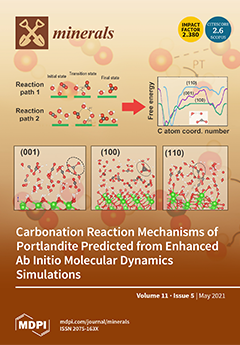
Cover Story: Geological carbon capture and sequestration (CCS) can reduce the overall carbon footprint of human activities. One important issue affecting the long-term success of CCS operations is the degradation of cement wellbore casings due to carbonation reactions in the underground CO2 storage environment. We use ab initio molecular dynamic (AIMD) simulations to quantitatively explore the reactivity of supercritical CO2 with the surfaces of portlandite—a model hydrated cement phase. CO2 undergoes a concerted reaction with H2O and surface –OH groups to form bicarbonate complexes. The free-energy barriers of their formation are controlled by the molecular structure of the surface water layer, which is, in turn, dictated by the surface chemistry and the degree of nanoconfinement. View this paper
  • Issues are regarded as officially published after their release is announced to the table of contents alert mailing list .
  • You may sign up for email alerts to receive table of contents of newly released issues.
  • PDF is the official format for papers published in both, html and pdf forms. To view the papers in pdf format, click on the "PDF Full-text" link, and use the free Adobe Reader to open them.

Articles (110)

  • Erratum
  • Open Access
1 Citations
2,191 Views
1 Page
  • Article
  • Open Access
10 Citations
3,737 Views
15 Pages

Mechanical Performance of Concrete Exposed to Sewage—The Influence of Time and pH

  • Justyna Czajkowska,
  • Maciej Malarski,
  • Joanna Witkowska-Dobrev,
  • Marek Dohojda and
  • Piotr Nowak

20 May 2021

Contact of concrete with aggressive factors, technological structures, reduces their durability through microstructural changes. This work presents the results of research on determining the influence of post grit chamber sewage and sewage from the a...

  • Article
  • Open Access
7 Citations
4,099 Views
13 Pages

Tamuraite, Ir5Fe10S16, a New Species of Platinum-Group Mineral from the Sisim Placer Zone, Eastern Sayans, Russia

  • Andrei Y. Barkov,
  • Nadezhda D. Tolstykh,
  • Robert F. Martin and
  • Andrew M. McDonald

20 May 2021

Tamuraite, ideally Ir5Fe10S16, occurs as discrete phases (≤20 μm) in composite inclusions hosted by grains of osmium (≤0.5 mm across) rich in Ir, in association with other platinum-group minerals in the River Ko deposit of the Sisim Placer Zone, sout...

  • Feature Paper
  • Article
  • Open Access
8 Citations
3,781 Views
7 Pages

Lead Recovery from Solid Residues of Copper Industry Using Triethylenetetramine Solution

  • Mateusz Ciszewski,
  • Andrzej Chmielarz,
  • Zbigniew Szołomicki,
  • Michał Drzazga and
  • Katarzyna Leszczyńska-Sejda

20 May 2021

Industrial processing of mineral ores and concentrates generates large amounts of solid residues, which can be landfilled or further processed to recover selected elements depending on its economical profitability. Pressure leaching is a technology e...

  • Article
  • Open Access
2,986 Views
25 Pages

20 May 2021

Phlogopite flakes strewn on the soil of Caldara di Manziana (Italy) display multiple minute perforations. The site is a caldera linked to recent volcanism (90 ka to 0.8 Ma) with present emanations of CO2 (~150 t d−1) and H2S (~2.55 t d−1). Stereomicr...

  • Article
  • Open Access
5 Citations
6,195 Views
17 Pages

Simulation-Based Analysis of Hydrometallurgical Processes. Case Study: Small-Scale Gold Mining in Ecuador

  • Santiago D. Salas,
  • Yris González,
  • Pamela Cango,
  • Jean Carlos Gómez,
  • Ronald Koepke and
  • Elizabeth Peña-Carpio

19 May 2021

In this work, two hydrometallurgical processes for gold recovery are explored for a small-scale gold mining case study located at Ponce Enriquez, Azuay, Ecuador. The hydrometallurgical systems consider the use of sodium cyanide and sodium thiosulfate...

  • Article
  • Open Access
8 Citations
2,948 Views
17 Pages

19 May 2021

Lacustrine mudrocks are composed of minerals and organic matter (OM). The origin and preservation of OM are two controlling factors of the hydrocarbon generation capacity of mudrocks. It is a key method in source rock research to study the deposition...

  • Article
  • Open Access
8 Citations
4,879 Views
17 Pages

~25 Ma Ruby Mineralization in the Mogok Stone Tract, Myanmar: New Evidence from SIMS U–Pb Dating of Coexisting Titanite

  • Di Zhang,
  • Shun Guo,
  • Yi Chen,
  • Qiuli Li,
  • Xiaoxiao Ling,
  • Chuanzhou Liu and
  • Kyaing Sein

19 May 2021

Ruby (red corundum) is one of the most prominent colored gemstones in the world. The highest-quality ruby (“pigeon blood” ruby) comes from marbles of the Mogok Stone Tract in central Myanmar. Although Mogok ruby has been exploited since the 6th centu...

  • Article
  • Open Access
6 Citations
3,981 Views
19 Pages

Long-Term Arsenic Sequestration in Biogenic Pyrite from Contaminated Groundwater: Insights from Field and Laboratory Studies

  • Alicia Fischer,
  • James Saunders,
  • Sara Speetjens,
  • Justin Marks,
  • Jim Redwine,
  • Stephanie R. Rogers,
  • Ann S. Ojeda,
  • Md Mahfujur Rahman,
  • Zeki M. Billor and
  • Ming-Kuo Lee

19 May 2021

Pumping groundwater from arsenic (As)-contaminated aquifers exposes millions of people, especially those in developing countries, to high doses of the toxic contaminant. Previous studies have investigated cost-effective techniques to remove groundwat...

  • Feature Paper
  • Article
  • Open Access
9 Citations
3,880 Views
13 Pages

Growth Interruptions in Arctic Rhodoliths Correspond to Water Depth and Rhodolith Morphology

  • Moritz Schlüter,
  • Ines Pyko,
  • Max Wisshak,
  • Christian Schulbert and
  • Sebastian Teichert

19 May 2021

Coralline algae that form rhodoliths are widespread globally and their skeletal growth patterns have been used as (paleo-) environmental proxies in a variety of studies. However, growth interruptions (hiati) within their calcareous skeletons are rega...

of 11

Get Alerted

Add your email address to receive forthcoming issues of this journal.

XFacebookLinkedIn
Minerals - ISSN 2075-163X