


You are currently on the new version of our website. Access the old version .

Polymers, Volume 16, Issue 15

August-1 2024 - 139 articles

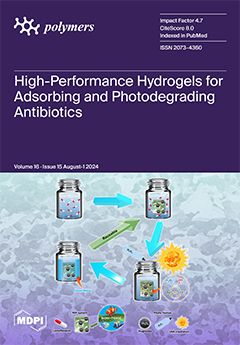
Cover Story: Water is the primary source of flora, fauna, and human life; considering this undeniable fact, it should be clear that unintentionally or purposely introduced synthetic molecules, which are not part of the natural water cycle, could severely impact all life forms. A HEMA hydrogel molecularly imprinted with magnetite nanoparticles was created to remove and degrade antibiotics like Lomefloxacin and Ciprofloxacin selectively. It uses magnetite for magnetic removal and photo-Fenton reactions for degradation, confirmed through chemical characterization. The material can be reused for up to three cycles and is ecologically safe. View this paper
  • Issues are regarded as officially published after their release is announced to the table of contents alert mailing list .
  • You may sign up for email alerts to receive table of contents of newly released issues.
  • PDF is the official format for papers published in both, html and pdf forms. To view the papers in pdf format, click on the "PDF Full-text" link, and use the free Adobe Reader to open them.

Articles (139)

  • Article
  • Open Access
8 Citations
2,347 Views
13 Pages

Response Surface Methodology to Explore the Influence Mechanism of Fiber Diameter in a New Multi-Needle Electrospinning Spinneret

  • Jianmin Jiang,
  • Xiaojie Chen,
  • Han Wang,
  • Weicheng Ou,
  • Jiayi He,
  • Maolin Liu,
  • Zehui Lu,
  • Jingyi Hu,
  • Gaofeng Zheng and
  • Dezhi Wu

5 August 2024

Multi-needle electrospinning is an efficient method for producing nanofiber membranes. However, fluctuations in the fluid flow rate during the process affect membrane quality and cause instability, an issue that remains unresolved. To address this, a...

  • Article
  • Open Access
2 Citations
2,829 Views
14 Pages

4 August 2024

Distinguished from traditional vulcanized rubber, which is not reusable, thermoplastic elastomer (TPV) is a material that possesses both the excellent resilience of traditional vulcanized rubber and the recyclability of thermoplastic, and TPVs have b...

  • Review
  • Open Access
23 Citations
12,052 Views
39 Pages

4 August 2024

As the demand for silicone polymers continues to grow across various industries, the need for effective recycling methods has become increasingly important, because recycling silicone products reduces landfill waste, conserves resources, and uses les...

  • Article
  • Open Access
2 Citations
3,041 Views
21 Pages

Hot Embossing to Fabricate Parylene-Based Microstructures and Its Impact on the Material Properties

  • Florian Glauche,
  • Franz Selbmann,
  • Markus Guttmann,
  • Marc Schneider,
  • Stefan Hengsbach,
  • Yvonne Joseph and
  • Harald Kuhn

3 August 2024

This study aims to establish and optimize a process for the fabrication of 3D microstructures of the biocompatible polymer Parylene C using hot embossing techniques. The different process parameters such as embossing temperature, embossing force, dem...

  • Article
  • Open Access
5 Citations
2,148 Views
15 Pages

Recycling of Commercially Available Biobased Thermoset Polyurethane Using Covalent Adaptable Network Mechanisms

  • Edoardo Miravalle,
  • Gabriele Viada,
  • Matteo Bonomo,
  • Claudia Barolo,
  • Pierangiola Bracco and
  • Marco Zanetti

3 August 2024

Until recently, recycling thermoset polyurethanes (PUs) was limited to degrading methods. The development of covalent adaptable networks (CANs), to which PUs can be assigned, has opened novel possibilities for actual recycling. Most efforts in this a...

  • Article
  • Open Access
1,666 Views
11 Pages

3 August 2024

Polyacrylonitrile (PAN) nanofibers have specific characteristics such as thermal insulation, weatherproofing, and sunlight resistance and therefore are appropriate to be applied as insulation materials for various industries, especially in greenhouse...

  • Article
  • Open Access
2 Citations
2,432 Views
17 Pages

Development and Manufacturing of a Fibre Reinforced Thermoplastic Composite Spar Produced by Oven Vacuum Bagging

  • Helena Rocha,
  • Agnieszka Rocha,
  • Joana Malheiro,
  • Bruno Sousa,
  • Andreia Vilela,
  • Filipa Carneiro and
  • Paulo Antunes

3 August 2024

The limited recyclability of fibre-reinforced thermoset composites has fostered the development of alternative thermoplastic-based composites and their manufacturing processes. The most common thermoplastic-based composites are often costly due to th...

  • Article
  • Open Access
1,919 Views
12 Pages

Composites Based on Eucalyptus Nitens Leaves and Natural Rubber as a Valuable Alternative for the Development of Elastomeric Materials with Low Microbiological Impact

  • Héctor Aguilar-Bolados,
  • Natacha Rosales-Charlin,
  • Claudia Pérez-Manríquez,
  • Solange Torres-Galan,
  • Mohamed Dahrouch,
  • Raquel Verdejo,
  • Marianella Hernández Santana and
  • Jose Becerra

3 August 2024

The forest industry produces several low-value by-products, such as bark, sawdust, limbs, and leaves, that are not ultimately disposed of and remain in the forests and sawmill facilities. Among these by-products are leaves, which contain not only cel...

  • Article
  • Open Access
14 Citations
3,425 Views
12 Pages

FTIR Monitoring of Polyurethane Foams Derived from Acid-Liquefied and Base-Liquefied Polyols

  • Yuliya Dulyanska,
  • Luísa Cruz-Lopes,
  • Bruno Esteves,
  • Raquel Guiné and
  • Idalina Domingos

3 August 2024

Polyalcohol liquefaction can be performed by acid or base catalysis, producing polyols with different properties. This study compared the mechanical properties of foams produced using polyols from liquefied Cytisus scoparius obtained by acid and base...

  • Article
  • Open Access
4 Citations
1,659 Views
12 Pages

2 August 2024

The development of environmentally friendly technology is vital to effectively address the issues related to environmental deterioration. This work integrates ZnO-decorated MoS2 (MZ) to create a high-performing PVDF-based PVDF/MoS2-ZnO (PMZ) hybrid p...

of 14

Get Alerted

Add your email address to receive forthcoming issues of this journal.

XFacebookLinkedIn
Polymers - ISSN 2073-4360