

You are currently viewing a new version of our website. To view the old version click .

Pharmaceutics, Volume 15, Issue 3

March 2023 - 316 articles

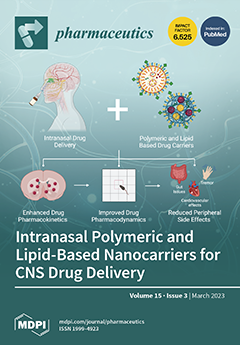
Cover Story: The delivery of many drugs to the brain is limited by the blood–brain barrier (BBB). Nanoparticle (NP) technologies may be developed to provide targeted drug delivery with controlled release. Polymeric and lipid-based NPs have emerged as versatile and biocompatible materials that provide requisite protection for drugs and improve drug entry to the brain at the BBB. Intranasal drug delivery has been found to bypass the BBB. The details of the pharmacokinetic and pharmacodynamics of drugs associated with drug delivery via intranasal drug-loaded polymeric and lipid-based NPs are emerging from preclinical studies. A combinatory approach of nose-to-brain administration and drug-loaded polymeric and lipid-based NPs is a promising strategy for enhancing drug targeting to the brain. View this paper
  • Issues are regarded as officially published after their release is announced to the table of contents alert mailing list .
  • You may sign up for email alerts to receive table of contents of newly released issues.
  • PDF is the official format for papers published in both, html and pdf forms. To view the papers in pdf format, click on the "PDF Full-text" link, and use the free Adobe Reader to open them.

Articles (316)

  • Article
  • Open Access
6 Citations
2,688 Views
15 Pages

Block Copolymer Micelles Encapsulating Au(III) Bis(Dithiolene) Complexes as Promising Nanostructures with Antiplasmodial Activity

  • Joana F. Santos,
  • Raquel Azevedo,
  • Miguel Prudêncio,
  • Fernanda Marques,
  • Yann Le Gal,
  • Dominique Lorcy and
  • Célia Fernandes

Block copolymer micelles (BCMs) can be used to improve the solubility of lipophilic drugs and increase their circulation half-life. Hence, BCMs assembled from MePEG-b-PCL were evaluated as drug delivery systems of gold(III) bis(dithiolene) complexes...

  • Review
  • Open Access
14 Citations
3,796 Views
16 Pages

Apelin Is a Prototype of Novel Drugs for the Treatment of Acute Myocardial Infarction and Adverse Myocardial Remodeling

  • Sergey V. Popov,
  • Leonid N. Maslov,
  • Alexandr V. Mukhomedzyanov,
  • Boris K. Kurbatov,
  • Alexandr S. Gorbunov,
  • Michail Kilin,
  • Viacheslav N. Azev,
  • Maria S. Khlestkina and
  • Galina Z. Sufianova

In-hospital mortality in patients with ST-segment elevation myocardial infarction (STEMI) is 5–6%. Consequently, it is necessary to develop fundamentally novel drugs capable of reducing mortality in patients with acute myocardial infarction. Ap...

  • Article
  • Open Access
6 Citations
3,113 Views
14 Pages

Antiviral Mechanisms of N-Phenyl Benzamides on Coxsackie Virus A9

  • Mira Laajala,
  • Kerttu Kalander,
  • Sara Consalvi,
  • Olivier Sheik Amamuddy,
  • Özlem Tastan Bishop,
  • Mariangela Biava,
  • Giovanna Poce and
  • Varpu Marjomäki

Enteroviruses are one of the most abundant groups of viruses infecting humans, and yet there are no approved antivirals against them. To find effective antiviral compounds against enterovirus B group viruses, an in-house chemical library was screened...

  • Article
  • Open Access
7 Citations
5,352 Views
17 Pages

Development and Characterization of Pullulan-Based Orodispersible Films of Iron

  • Maram Suresh Gupta,
  • Tegginamath Pramod Kumar,
  • Dinesh Reddy,
  • Kamla Pathak,
  • Devegowda Vishakante Gowda,
  • A. V. Naresh Babu,
  • Alhussain H. Aodah,
  • El-Sayed Khafagy,
  • Hadil Faris Alotaibi and
  • Amr Selim Abu Lila
  • + 2 authors

Iron deficiency is the principal cause of nutritional anemia and it constitutes a major health problem, especially during pregnancy. Despite the availability of various non-invasive traditional oral dosage forms such as tablets, capsules, and liquid...

  • Article
  • Open Access
15 Citations
3,271 Views
16 Pages

Caveolin-Mediated Internalization of Fmoc-FF Nanogels in Breast Cancer Cell Lines

  • Giovanni Smaldone,
  • Elisabetta Rosa,
  • Enrico Gallo,
  • Carlo Diaferia,
  • Giancarlo Morelli,
  • Mariano Stornaiuolo and
  • Antonella Accardo

Introduction: Hydrogel nanoparticles, also known as nanogels (NGs), have been recently proposed as alternative supramolecular vehicles for the delivery of biologically relevant molecules like anticancer drugs and contrast agents. The inner compartmen...

  • Review
  • Open Access
135 Citations
27,612 Views
22 Pages

Nanotechnology in Cancer Diagnosis and Treatment

  • Noor Alrushaid,
  • Firdos Alam Khan,
  • Ebtesam Abdullah Al-Suhaimi and
  • Abdelhamid Elaissari

Traditional cancer diagnosis has been aided by the application of nanoparticles (NPs), which have made the process easier and faster. NPs possess exceptional properties such as a larger surface area, higher volume proportion, and better targeting cap...

  • Review
  • Open Access
12 Citations
3,760 Views
18 Pages

The Potential Use of Exosomes in Anti-Cancer Effect Induced by Polarized Macrophages

  • Chizumi Abe,
  • Maharshi Bhaswant,
  • Teruo Miyazawa and
  • Taiki Miyazawa

The rapid development of aberrant cells outgrowing their normal bounds, which can subsequently infect other body parts and spread to other organs—a process known as metastasis—is one of the significant characteristics of cancer. The main...

  • Article
  • Open Access
4 Citations
2,961 Views
18 Pages

An Enhanced Dissolving Cyclosporin-A Inhalable Powder Efficiently Reduces SARS-CoV-2 Infection In Vitro

  • Davide D’Angelo,
  • Eride Quarta,
  • Stefania Glieca,
  • Giada Varacca,
  • Lisa Flammini,
  • Simona Bertoni,
  • Martina Brandolini,
  • Vittorio Sambri,
  • Laura Grumiro and
  • Giulia Gatti
  • + 6 authors

This work illustrates the development of a dry inhalation powder of cyclosporine-A for the prevention of rejection after lung transplantation and for the treatment of COVID-19. The influence of excipients on the spray-dried powder’s critical qu...

  • Article
  • Open Access
1 Citations
2,941 Views
13 Pages

Does Cytokine-Release Syndrome Induced by CAR T-Cell Treatment Have an Impact on the Pharmacokinetics of Meropenem and Piperacillin/Tazobactam in Patients with Hematological Malignancies? Findings from an Observational Case-Control Study

  • Chun Liu,
  • Pier Giorgio Cojutti,
  • Maddalena Giannella,
  • Marcello Roberto,
  • Beatrice Casadei,
  • Gianluca Cristiano,
  • Cristina Papayannidis,
  • Nicola Vianelli,
  • Pier Luigi Zinzani and
  • Pierluigi Viale
  • + 2 authors

Chimeric antigen receptor (CAR) T-cell therapy is a promising approach for some relapse/refractory hematological B-cell malignancies; however, in most patients, cytokine release syndrome (CRS) may occur. CRS is associated with acute kidney injury (AK...

  • Article
  • Open Access
15 Citations
3,235 Views
14 Pages

Design, Synthesis, Characterization, and Evaluation of the Anti-HT-29 Colorectal Cell Line Activity of Novel 8-Oxyquinolinate-Platinum(II)-Loaded Nanostructured Lipid Carriers Targeted with Riboflavin

  • Tugce Boztepe,
  • Sebastián Scioli-Montoto,
  • Rocio C. Gambaro,
  • María Esperanza Ruiz,
  • Silvia Cabrera,
  • José Alemán,
  • Germán A. Islan,
  • Guillermo R. Castro and
  • Ignacio E. León

Colorectal cancer is occasionally called colon or rectal cancer, depending on where cancer begins to form, and is the second leading cause of cancer death among both men and women. The platinum-based [PtCl(8-O-quinolinate)(dmso)] (8-QO-Pt) compound h...

of 32

Get Alerted

Add your email address to receive forthcoming issues of this journal.

XFacebookLinkedIn
Pharmaceutics - ISSN 1999-4923