


You are currently viewing a new version of our website. To view the old version click .

Pharmaceutics, Volume 15, Issue 3

March 2023 - 316 articles

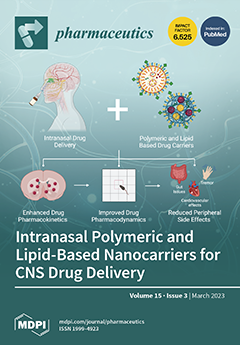
Cover Story: The delivery of many drugs to the brain is limited by the blood–brain barrier (BBB). Nanoparticle (NP) technologies may be developed to provide targeted drug delivery with controlled release. Polymeric and lipid-based NPs have emerged as versatile and biocompatible materials that provide requisite protection for drugs and improve drug entry to the brain at the BBB. Intranasal drug delivery has been found to bypass the BBB. The details of the pharmacokinetic and pharmacodynamics of drugs associated with drug delivery via intranasal drug-loaded polymeric and lipid-based NPs are emerging from preclinical studies. A combinatory approach of nose-to-brain administration and drug-loaded polymeric and lipid-based NPs is a promising strategy for enhancing drug targeting to the brain. View this paper
  • Issues are regarded as officially published after their release is announced to the table of contents alert mailing list .
  • You may sign up for email alerts to receive table of contents of newly released issues.
  • PDF is the official format for papers published in both, html and pdf forms. To view the papers in pdf format, click on the "PDF Full-text" link, and use the free Adobe Reader to open them.

Articles (316)

  • Article
  • Open Access
5 Citations
3,482 Views
13 Pages

Impaired transport activity of hepatic OATP1B1 and OATP1B3 due to drug–drug interactions (DDIs) often leads to increased systemic exposure to substrate drugs (e.g., lipid-lowering statins). Since dyslipidemia and hypertension frequently coexist...

  • Review
  • Open Access
72 Citations
6,271 Views
22 Pages

Carbon Dots: Opportunities and Challenges in Cancer Therapy

  • Tanima Bhattacharya,
  • Gye Hwa Shin and
  • Jun Tae Kim

Recently, carbon dots (CDs) have been actively studied and reported for their various properties. In particular, the specific characteristics of carbon dots have been considered as a possible technique for cancer diagnosis and therapy. This is also a...

  • Article
  • Open Access
3 Citations
3,586 Views
17 Pages

Bacterial Lectin FimH and Its Aggregation Hot-Spots: An Alternative Strategy against Uropathogenic Escherichia coli

  • Georgia I. Nasi,
  • Konstantina I. Georgakopoulou,
  • Marilena K. Theodoropoulou,
  • Nikos C. Papandreou,
  • Evangelia D. Chrysina,
  • Paraskevi L. Tsiolaki and
  • Vassiliki A. Iconomidou

Type I fimbriae are the main adhesive organelles of uropathogenic Escherichia coli (UPEC), consisting of four different subunits. Their component with the most important role in establishing bacterial infections is the FimH adhesin located at the fim...

  • Review
  • Open Access
23 Citations
3,950 Views
24 Pages

Bone regeneration is a comprehensive process that involves different stages, and various growth factors (GFs) play crucial roles in the entire process. GFs are currently widely used in clinical settings to promote bone repair; however, the direct app...

  • Article
  • Open Access
4 Citations
3,034 Views
12 Pages

Leukemia remains incurable partly due to difficulties in reaching and maintaining therapeutic drug concentrations in the target tissues and cells. Next-generation drugs targeted to multiple cell checkpoints, including the orally active venetoclax (Bc...

  • Article
  • Open Access
3 Citations
2,229 Views
17 Pages

Sinonasal Stent Coated with Sustained-Release Varnish of Mometasone Furoate Inhibits Pro-Inflammatory Cytokine Release from Macrophages: An In Vitro Study

  • Alessandra Cataldo Russomando,
  • Doron Steinberg,
  • Irith Gati,
  • Ronit Vogt Sionov,
  • Ron Eliashar,
  • Michael Friedman and
  • Menachem Gross

The aim of the study was to develop a sustained-release varnish (SRV) containing mometasone furoate (MMF) for sinonasal stents (SNS) to reduce mucosa inflammation in the sinonasal cavity. The SNS’ segments coated with SRV-MMF or an SRV-placebo...

  • Editorial
  • Open Access
4 Citations
3,496 Views
4 Pages

Personalized/precision medicine (PM) originates from the application of molecular pharmacology in clinical practice, representing a new era in healthcare that aims to identify and predict optimum treatment outcomes for a patient or a cohort with simi...

  • Communication
  • Open Access
5 Citations
2,926 Views
11 Pages

Mesoporous Organosilica Nanoparticles with Tetrasulphide Bond to Enhance Plasmid DNA Delivery

  • Yue Zhang,
  • He Xian,
  • Ekaterina Strounina,
  • Kimberley S. Gunther,
  • Matthew J. Sweet,
  • Chen Chen,
  • Chengzhong Yu and
  • Yue Wang

Cellular delivery of plasmid DNA (pDNA) specifically into dendritic cells (DCs) has provoked wide attention in various applications. However, delivery tools that achieve effective pDNA transfection in DCs are rare. Herein, we report that tetrasulphid...

  • Article
  • Open Access
8 Citations
6,534 Views
19 Pages

Intragastric Carbon Dioxide Release Prolongs the Gastric Residence Time of Postprandially Administered Caffeine

  • Stefan Senekowitsch,
  • Constantin Foja,
  • Toni Wildgrube,
  • Philipp Schick,
  • Christoph Rosenbaum,
  • Julius Krause,
  • Friederike Brokmann,
  • Marie-Luise Kromrey,
  • Stefan Engeli and
  • Werner Weitschies
  • + 1 author

Sparkling water is said to increase gastric motility by the release of carbon dioxide, thereby potentially affecting the pharmacokinetics of orally administered drugs. The hypothesis of the present work was that the induction of gastric motility by i...

  • Article
  • Open Access
17 Citations
5,835 Views
17 Pages

DLin-MC3-Containing mRNA Lipid Nanoparticles Induce an Antibody Th2-Biased Immune Response Polarization in a Delivery Route-Dependent Manner in Mice

  • Altan Yavuz,
  • Céline Coiffier,
  • Cynthia Garapon,
  • Serra Gurcan,
  • Claire Monge,
  • Jean-Yves Exposito,
  • Danielle Campiol Arruda and
  • Bernard Verrier

mRNA-based vaccines have made a leap forward since the SARS-CoV-2 pandemic and are currently used to develop anti-infectious therapies. If the selection of a delivery system and an optimized mRNA sequence are two key factors to reach in vivo efficacy...

of 32

Get Alerted

Add your email address to receive forthcoming issues of this journal.

XFacebookLinkedIn
Pharmaceutics - ISSN 1999-4923