

You are currently viewing a new version of our website. To view the old version click .

Pharmaceutics, Volume 11, Issue 12

December 2019 - 70 articles

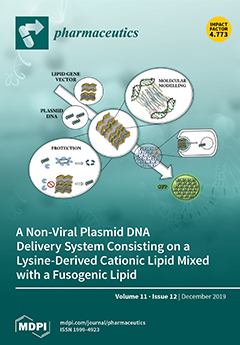
Cover Story: A C12-cationic lipid that incorporates a lysine-derived moiety (LYCl) is combined with a fusogenic helper lipid (DOPE) and evaluated as a potential vehicle to transfect two plasmid DNAs (encoding GFP and luciferase) into COS-7 cells. A multidisciplinary approach (that includes potential, gel electrophoresis, SAXS, cryo-TEM, FACS, luminometry and cytotoxicity experiments, and an MM and MD computational study) indicates that LYCl/DOPE nanocarriers are stable and capable of compacting and protecting both pDNAs against DNase I degradation. The lipid formulations with 20% of LYCl content are able to complete the transfection process efficiently and cell-safely, improving the outcomes of the control Lipo2000*. View this paper.
  • Issues are regarded as officially published after their release is announced to the table of contents alert mailing list .
  • You may sign up for email alerts to receive table of contents of newly released issues.
  • PDF is the official format for papers published in both, html and pdf forms. To view the papers in pdf format, click on the "PDF Full-text" link, and use the free Adobe Reader to open them.

Articles (70)

  • Article
  • Open Access
21 Citations
4,978 Views
16 Pages

High Molecular Weight Chitosan-Complexed RNA Nanoadjuvant for Effective Cancer Immunotherapy

  • Jin Joo Choi,
  • Quoc-Viet Le,
  • Dongho Kim,
  • Young Bong Kim,
  • Gayong Shim and
  • Yu-Kyoung Oh

Nucleic acid-based adjuvants have recently emerged as promising candidates for use in cancer vaccines to induce tumor-suppressing immune cells. In this study, we tested whether complexation of a nucleic acid-based adjuvant with chitosan (CTS) modulat...

  • Article
  • Open Access
27 Citations
5,148 Views
21 Pages

Microwave-Assisted Freeze-Drying of Monoclonal Antibodies: Product Quality Aspects and Storage Stability

  • Julian Hendryk Gitter,
  • Raimund Geidobler,
  • Ingo Presser and
  • Gerhard Winter

In order to overcome the downside of long conventional freeze-drying (CFD) process times for monoclonal antibody formulations, microwave-assisted freeze-drying (MFD) was introduced. Recently, the general applicability and potential shortening of dryi...

  • Article
  • Open Access
13 Citations
5,094 Views
20 Pages

Hyaluronan Graft Copolymers Bearing Fatty-Acid Residues as Self-Assembling Nanoparticles for Olanzapine Delivery

  • Marco Paolino,
  • Mariano Licciardi,
  • Cristina Savoca,
  • Gaetano Giammona,
  • Laura Modica De Mohac,
  • Annalisa Reale,
  • Germano Giuliani,
  • Hartmut Komber,
  • Alessandro Donati and
  • Gemma Leone
  • + 3 authors

In order to evaluate the potential of a technology platform based on hyaluronan copolymers grafted with propargylated ferulate fluorophores (HA-FA-Pg) in the development of drug delivery systems, the propargyl groups of HA-FA-Pg derivatives were empl...

  • Article
  • Open Access
19 Citations
7,073 Views
18 Pages

Synergy of Phospholipid—Drug Formulations Significantly Deactivates Profibrogenic Human Hepatic Stellate Cells

  • Gina Valentino,
  • Cristina Zivko,
  • Florian Weber,
  • Lorine Brülisauer and
  • Paola Luciani

The pivotal role of hepatic stellate cells (HSCs) in orchestrating the bidirectional process of progression and regression of liver fibrosis makes them an ideal target for exploring new antifibrotic therapies. Essential phospholipids (EPLs), with the...

  • Article
  • Open Access
17 Citations
6,403 Views
22 Pages

Transcriptome-Guided Drug Repositioning

  • Arsen Arakelyan,
  • Lilit Nersisyan,
  • Maria Nikoghosyan,
  • Siras Hakobyan,
  • Arman Simonyan,
  • Lydia Hopp,
  • Henry Loeffler-Wirth and
  • Hans Binder

Drug repositioning can save considerable time and resources and significantly speed up the drug development process. The increasing availability of drug action and disease-associated transcriptome data makes it an attractive source for repositioning...

  • Article
  • Open Access
28 Citations
6,702 Views
21 Pages

Bi-Layered Polymer Carriers with Surface Modification by Electrospinning for Potential Wound Care Applications

  • Mirja Palo,
  • Sophie Rönkönharju,
  • Kairi Tiirik,
  • Laura Viidik,
  • Niklas Sandler and
  • Karin Kogermann

Polymeric wound dressings with advanced properties are highly preferred formulations to promote the tissue healing process in wound care. In this study, a combinational technique was investigated for the fabrication of bi-layered carriers from a blen...

  • Article
  • Open Access
22 Citations
8,173 Views
12 Pages

3D-Printed Solid Dispersion Drug Products

  • Suet Li Chew,
  • Laura Modica de Mohac and
  • Bahijja Tolulope Raimi-Abraham

With the well-known advantages of additive manufacturing methods such as three-dimensional (3D) printing in drug delivery, it is disappointing that only one product has been successful in achieving regulatory approval in the past few years. Further r...

  • Article
  • Open Access
8 Citations
6,845 Views
16 Pages

In Vitro and In Vivo Assessment of Metabolic Drug Interaction Potential of Dutasteride with Ketoconazole

  • Seong-Wook Seo,
  • Jin Woo Park,
  • Dong-Gyun Han,
  • Ji-Min Kim,
  • Sanghyun Kim,
  • Taeuk Park,
  • Kyung-Hwa Kang,
  • Min Hye Yang and
  • In-Soo Yoon

Dutasteride (DUT) is a selective, potent, competitive, and irreversible inhibitor of both type-1 and type-2 5α-reductase (5AR) commonly used in the treatment of benign prostatic hyperplasia and androgenetic alopecia. In the present study, we de...

  • Article
  • Open Access
9 Citations
5,629 Views
15 Pages

In this study, a self-emulsifying drug delivery system (SEDDS) was employed to prepare novel squalene oil-based emulsion adjuvants. Deionized water, 0.01% and 0.02% (w/v) carbomer solutions of C-971P NF and C-940 grades were used to prepare emulsions...

  • Article
  • Open Access
16 Citations
7,508 Views
13 Pages

Topical Delivery of Niacinamide: Influence of Binary and Ternary Solvent Systems

  • Yanling Zhang,
  • Chin-Ping Kung,
  • Bruno C. Sil,
  • Majella E. Lane,
  • Jonathan Hadgraft,
  • Michael Heinrich and
  • Balint Sinko

Niacinamide (NIA) is the amide form of vitamin B3 and has been widely used in pharmaceutical and personal care formulations. Previously, we reported a comparative study of NIA permeation from neat solvents using the Skin Parallel Artificial Membrane...

of 7

Get Alerted

Add your email address to receive forthcoming issues of this journal.

XFacebookLinkedIn
Pharmaceutics - ISSN 1999-4923