



Diversity, Volume 17, Issue 11 (November 2025) – 67 articles
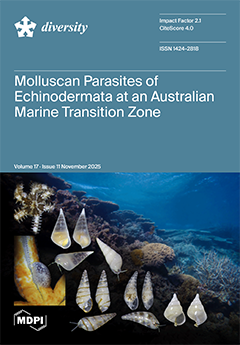
Cover Story (view full-size image):
Eulimidae is a hyperdiverse family of marine gastropods, containing species that specifically parasitise Echinodermata. Eulimids are globally distributed but undersampled in many regions. We conducted the first survey for eulimids at the Houtman Abrolhos Islands off the coast of Western Australia (WA)—a well-known tropical-temperature transition zone with numerous potential hosts. Twenty-three eulimids and sixteen hosts, representing all echinoderm classes, were identified from newly collected and legacy museum specimens. Of these, two are new records for Australia and three are new records for WA. Eulimids with similar shells often differed in host choice and position on the host or live appearance, highlighting the contributions that such information can make to resolving taxonomic uncertainties in this group. View this paper
- Issues are regarded as officially published after their release is announced to the table of contents alert mailing list.
- You may sign up for e-mail alerts to receive table of contents of newly released issues.
- PDF is the official format for papers published in both, html and pdf forms. To view the papers in pdf format, click on the "PDF Full-text" link, and use the free Adobe Reader to open them.
Previous Issue
Next Issue