Article

Prezygotic and Postzygotic Reproductive Incompatibilities Complement Each Other in the Formation of a Cryptic Amphipod Species: The Example of a Lake Baikal Species Complex Eulimnogammarus verrucosus


1
Institute of Biology, Irkutsk State University, Irkutsk 664025, Russia
2
Baikal Research Centre, Irkutsk 664011, Russia
*
Authors to whom correspondence should be addressed.
Diversity 2025, 17(11), 781; https://doi.org/10.3390/d17110781
Submission received: 14 October 2025 / Revised: 1 November 2025 / Accepted: 2 November 2025 / Published: 6 November 2025
(This article belongs to the Section Animal Diversity)

Abstract

Reproductive barriers to gene flow play a key role in speciation. However, as it is not always feasible to study them directly, most studies rely on genetic divergence to infer species delimitation. In order to correlate genetic distances to reproductive incompatibilities, compact groups of closely related species are needed. In this work, we explored a species complex of Baikal amphipods (Crustacea: Amphipoda: Gammaroidea), Eulimnogammarus verrucosus. Three biological species (W, S, and E), geographically isolated in Baikal, had been found to have interspecific differences exceeding the patristic distance threshold of 0.16, and a postzygotic incompatibility had been confirmed for the closest pair, W and S. Here, we expanded our knowledge on geographical distribution of the species, discovering that secondary contact between the W and S species already occurs in natural conditions near the source of the Angara River. Our experiments have shown that the three species within the E. verrucosus species complex are separated by both prezygotic and postzygotic barriers. While neither of these barriers is absolute, their combination can ensure reproductive isolation upon secondary contact of the species. The experimental system we have developed in this and previous works can provide support for testing species delimitation hypotheses based on sequencing data and further extend these results to related species for which such experiments are unfeasible.

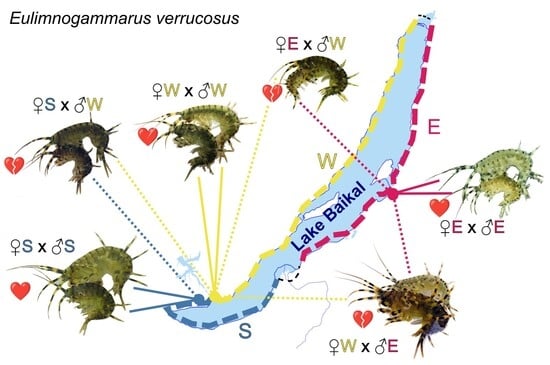
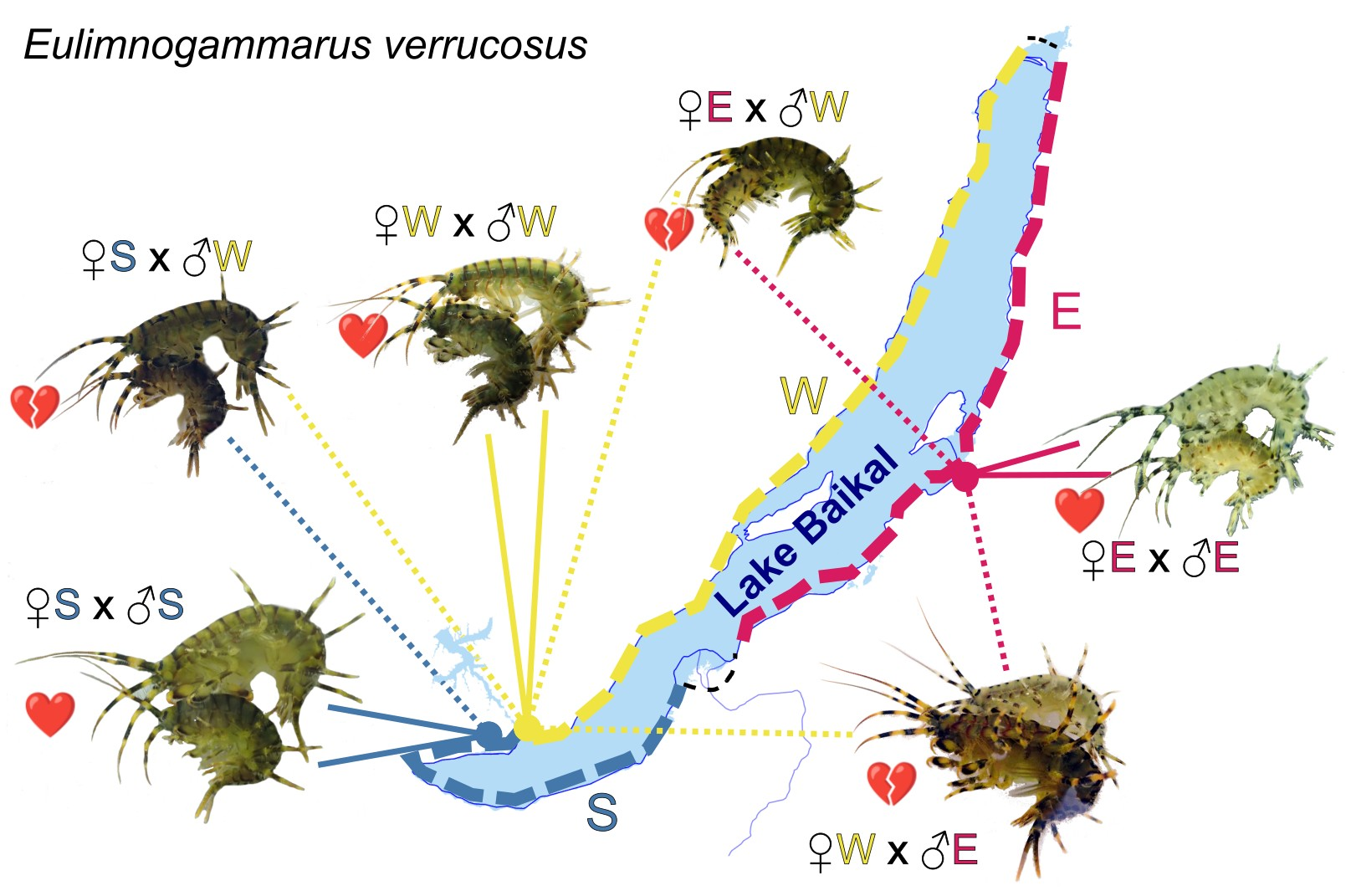
Graphical Abstract

1. Introduction

The process of speciation has fascinated biologists for centuries. The advent of sequencing and use of molecular delimitation methods have revealed an initially surprising number of cryptic species and lineages [1]. There is no single best and universally accepted concept or definition of species, but the usage of species as a unit of biological diversity mostly relies on specifying that it comprises a group of interbreeding populations that is reproductively isolated from other such groups [2,3]. Therefore, it is clear that reproductive barriers to gene flow play a key role in speciation [4]. However, in most cases, it is unrealistic to study reproductive isolation directly, so different approximations have been used. Originally, species delimitation has been based on morphological traits with support of others, including reproductive-related ones when possible. More recently, the level of genetic or genomic divergence was adopted to approximate the number of cryptic species within a species complex, which along with other traits is used in integrative taxonomy [5]. However, there are many ways to perform the delimitation process based on the same set of sequences [6]. Unfortunately, they can produce conflicting results and can underestimate or overestimate the number of species, especially with insufficient sampling to estimate interspecific diversity [7]. Thus, it is customary (and logical) to use molecular operational taxonomic units (MOTUs) as a simplified working approach to species [8].
Obviously, adequate sampling is not possible for every species due to various objective difficulties. Thus, the question of how large a genetic difference needs to be in order to qualify for different species is open (and the answers might of course be group-specific). However, there have been efforts in establishing such a threshold for particular taxa. For example, such a study has been performed for crustaceans, and a threshold level of patristic distance of 0.16 substitutions/site was proposed as a level to distinguish species of most crustacean groups [9]. Patristic distance is the sum of the lengths of the branches that link two nodes in a phylogenetic tree [10]. However, it is easier and thus customary to provide information on pairwise distances (without reconstituting the phylogeny). In most cases, either uncorrected distances, i.e., Hamming dissimilarities, or corrected according to a substitution model, frequently Kimura 2-parameter (K2P), are provided [9]. At the same time, this threshold was proposed based on the intraspecific and interspecific distances in known and described species, creating a vicious circle.
A way out could be to find correlation between genetic divergence and reproductive incompatibility—it could provide an opportunity to calibrate the threshold divergence level. Here we propose that amphipods (Crustacea: Amphipoda) could be a convenient object for this research, given that experimental testing of reproductive compatibility is feasible due to some peculiarities of their reproductive and evolutionary processes. In many amphipods, the reproductive process begins with precopulatory mate-guarding, or the formation of amplexus, which features a male using the first pair of gnathopods to grasp the female. This stage can last for days, weeks, or even months, depending on the species and tends to become longer at lower temperatures. After fertilization, the male and female separate, but the eggs remain in the brooding chamber of the female until the release of the juveniles [11]. Thus, the efficiency of amplexus formation is a convenient measure of prezygotic compatibility, and the successfulness of embryo development can be used to assess postzygotic barriers (Figure 1A).
Regarding evolutionary patterns, amphipods readily make species flocks, including cryptic species [13,14,15,16,17]. One of the largest amphipod species flocks is represented by the gammaroid amphipods of the ancient Lake Baikal. It includes over 350 morphological species and subspecies [18], about a dozen of which have been studied in terms of intraspecific diversity with at least 10 published COI sequences per species [17]. Of those, intraspecific variability in COI has been shown to reach 11–13% in terms of uncorrected pairwise distance [19,20].
Earlier, multiple attempts have been made to assess reproductive (in)compatibility in different amphipod species complexes from different flocks. Meijering [21] and Kolding [22] found that some distinct morphological species of Gammarus species, such as Gammarus locusta (Linnaeus, 1758)/Gammarus zaddachi Sexton, 1912, Gammarus salinus Spooner, 1942/G. zaddachi, as well as Gammarus pulex (Linnaeus, 1758)/Gammarus fossarum Koch, 1836, formed interspecific amplexuses. However, since no sequencing data had been available at the moment, it is difficult to interpret these results in terms of species delimitation. Fortunately, several species complexes with known interspecific differences in COI have also been studied in this regard. Sutherland et al. found random amplexus formation for populations with up to 19% divergences (uncorrected pairwise distances) and non-random choice in population pairs with at least 21.5% divergences within the Paracalliope fluviatilis (Thompson, 1879) species complex [23]. Cothran et al. [24] found rare interspecific pairing in both no-choice experiments (<5%) and choice experiments (0.04%) between species of the Hyalella azteca (Saussure, 1858) complex separated by 17–19% K2P distances. Lagrue et al. [25], working with G. pulex/G. fossarum species complex, found that amplexus formation was rare for MOTUs diverging by over 4% (K2P distance) but still possible up to 16%. Similarly, Galipaud et al. [26] showed that males of G. fossarum in most combinations avoided pairing with females distant by 17% (K2P distance) but were equally likely to mate with females genetically distant by 3.5% and females of their own MOTU [26]. Hupało et al. found random amplexus formation between Echinogammarus sicilianus G.S. Karaman & Tibaldi, 1973 MOTUs with up to ~12% K2P distance [27]. Unfortunately, most of these studies did not follow embryo development up to hatching and thus could not assess postzygotic reproductive barriers.
Finally, we tested two species of Eulimnogammarus Bazikalova, 1945 from Lake Baikal. As a baseline, for Eulimnogammarus cyaneus (Dybowsky, 1874) neither prezygotic nor postzygotic incompatibility was found for populations presumably separated by the source of the Angara river approximately 60,000 years ago [28]. These populations do not have COI differences [20] but differ in allozyme frequencies [29]. In the case of Eulimnogammarus verrucosus (Gerstfeldt, 1858), the object of this study, it was found that this species comprised a number of cryptic lineages. Three genetic lineages, geographically isolated in Baikal, were found to have species-level differences of up to 13% (uncorrected pairwise distance) [20]. These values exceed the patristic distance threshold of 0.16 suggested by [9] (Figure 1B). Importantly, the delimitation of these species by COI sequences is corroborated by 18S rRNA sequences [20], mitochondrial gene sets [12] (Figure 1C), and nuclear allozyme markers [30]. Moreover, at least two of these lineages meet directly, downstream the source of the Angara River, the only outflow of the lake [31]. Furthermore, we observed postzygotic reproductive incompatibility even between the two closest cryptic species, the western (W) and southern (S) ones: amplexuses formed with a similar frequency, but embryo development stalled, and no juveniles hatched [12].
In this work, we aimed at expanding our knowledge of reproductive barriers between the three biological species widespread and geographically isolated in Baikal. Here, we updated our experimental scheme to check all possible combinations of three species and checking for the presence of not only postzygotic but also prezygotic reproductive barriers. We updated the setup in crossing experiments by adding devices for collecting eggs released from the brood pouches, which allowed us to substantially increase our sample of analyzed embryos. In general, our conclusion from the preliminary experiments about the presence of a postzygotic reproductive barrier in the form of developmental arrest in hybrid embryos [12] were confirmed. In addition, we found prezygotic barriers in no-choice experiments, further supporting the hypothesis of separate biological species in this species complex, and expanded our understanding of geographical distribution of the species, discovering that secondary contact between the W and S species occurs naturally in the source area of the Angara river.

2. Materials and Methods

2.1. Study Object, Animal Sampling, and Experimental Design

In this work, we concentrate on one of the most conspicuous and easy-to-study morphological species complexes, Eulimnogammarus verrucosus (Gerstfeldt, 1858). One of the first Baikal amphipods to be described, it is widespread throughout the shallow-water zone of the lake [32]. Recently, it was found to comprise at least three biological species in Lake Baikal [12,20]. This species is relatively large; sexually mature animals are characterized by body lengths from 9 to 39 mm [33]. Adult males and females do not have significant size differences (at least in the population near the Angara River source) or visible differences in their appendages, except for the external sexual organs, i.e., male papillae and female oostegites [32,34]. It reproduces in the fall–winter season: first amplexuses appear in September; first ovigerous females are recorded in late October; eggs develop throughout the winter; and most juveniles are released from the end of May to the end of July [33,34,35].
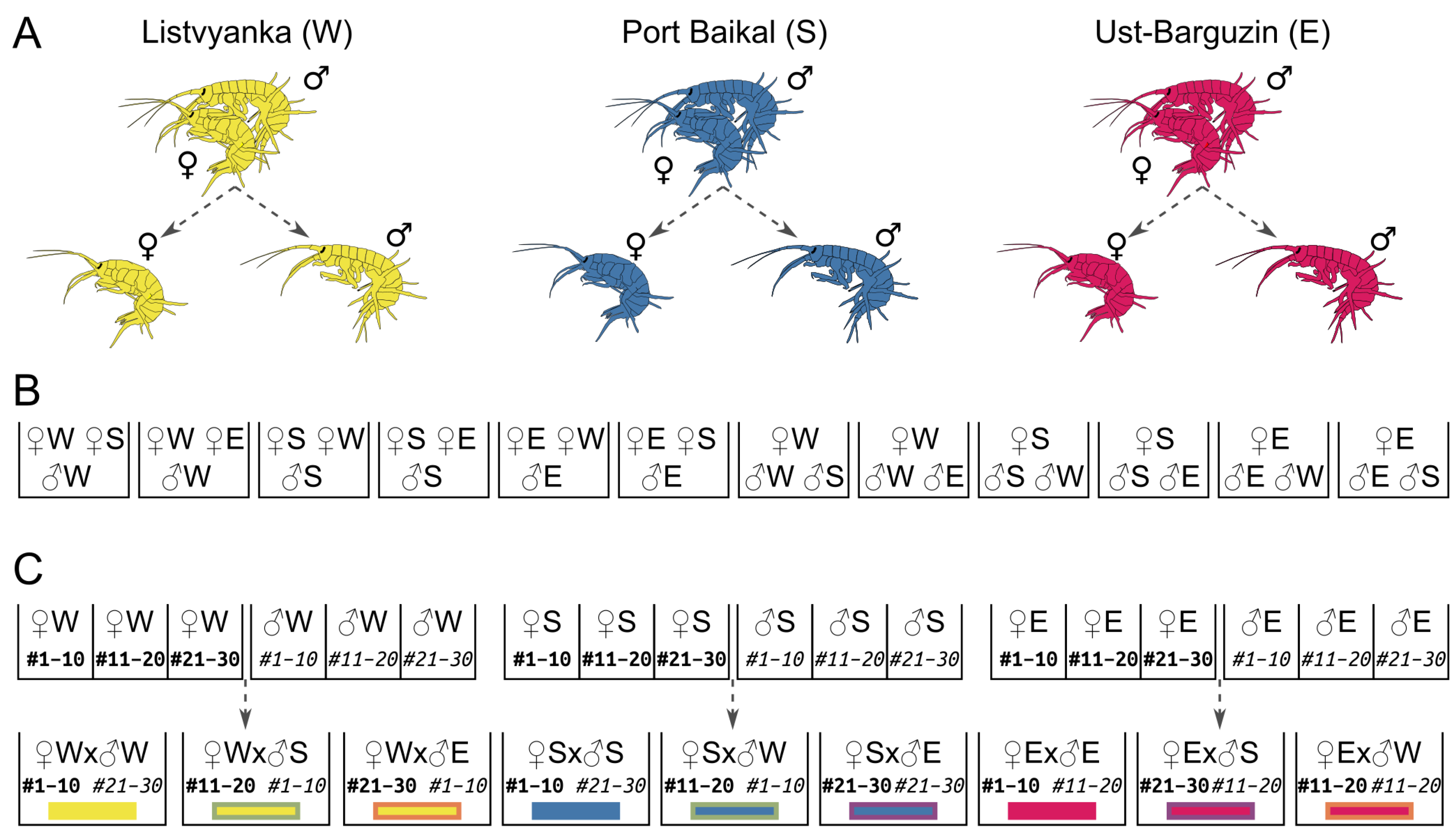
The animals in amplexus were collected via kick-sampling at the depth of 0–1 m on 10 October 2022, near Listvyanka village (the W species; 51.87058° N 104.82827° E; the temperature at sampling was 7.4 °C) and Port Baikal (the S species; 51.87069° N 104.81164° E; the temperature at sampling was 7.6 °C) and on 9 October 2022 near Ust-Barguzin village (the E species; 53.37488° N 108.97519° E; the temperature at sampling was 6.7 °C). The sampling points are shown on a map in (Figure 1D). The amplexuses were separated on spot, and every ten animals of one sex were placed in a separate tank (see Figure 2). The animals were transported to the laboratory in insulated containers and either acclimated for 4–7 days before mating choice trials or mixed in the desired combinations for crossing experiments. Additionally, animals were sampled at the same spot nearby the Listvyanka village throughout the summer–fall period of 2024 for genotyping; in this case, both individual animals and amplexuses were sampled.
The mating choice trials to assess the prezygotic barrier were performed with animals from separated amplexuses after 5–7-day preacclimation period. Each trial involved one of 12 possible combinations of three animals (see Figure 2B). Each animal was randomly selected from the corresponding tank. In total, 31 trials were conducted; some of the animals were reused after at least 24 h of rest due to the uneven number of individuals in different groups. Before the start of the actual trial, the three animals were photographed individually, and their individual features—such as shortened or missing appendages, size, and coloration—were recorded. Subsequently, the animals were released into a plastic container containing 200 mL of Baikal water at the temperature of 10 °C and monitored hourly for at least 6 h or until the amplexus was formed. Once an amplexus was observed, it was recorded and carefully separated, and the animals were returned into separate tanks designated for each species and sex combination.
Crossing experiments to assess the postzygotic barrier were performed with animals that were not used for mate choice trials. The animals were mixed in the desired combinations (control WxW, SxS, and ExE, as well as experimental combinations WxS, SxW, ExS, WxE, SxE, and ExW; the first letter corresponds of the species of the females; see Figure 2C) with ten females and ten males on 10th October, 2022 (the day of catching for the W and S species and in one day after catching for the E species). The animals were maintained in 2.2 L containers (food-grade polypropylene) with approximately 2 L of Baikal water and two sterilized stones from the Baikal littoral, with constant aeration. The temperature was initially set at 7.0 °C, then lowered by 0.2 °C per day until it reached 6 °C and then kept at this temperature for the rest of the experiment. These conditions do not reproduce the natural conditions at which the embryos of this species develop, as the temperatures in winter drop almost to 0 °C [36,37], but allow for successful development [12] and are more convenient. The value of 6 °C is close to the mean annual temperature in the littoral of the lake [37,38] and the preferred temperature of adult E. verrucosus (W) [39].
In comparison to the experiment conducted earlier [12], the experimental design was supplemented to allow for collection of eggs released from the brood pouches of females. Specifically, a thinner, smaller polypropylene container with approximately 2.5 mm holes in the bottom was used. These holes allowed the eggs to drop but prevented the adult animals from swimming through and consuming the eggs. Water was exchanged once every 3–5 days; at the same time, the animals were fed ad libitum with a dried and ground mix of amphipods (predominantly E. verrucosus) and macrophytes (Elodea canadensis (Mixch., 1803)) from the littoral of Lake Baikal. The following categories were counted at each water exchange: total animals; amplexuses; females with eggs in the brood pouch, noting the color of eggs when possible; eggs at the bottom of the tank; free-swimming juveniles. Eggs from the bottom and free juveniles were collected and fixed for further analysis (see below). Moreover, since the E species exhibit an easily detectable difference from the other two (intermittent black stripes at the dorsal parts of the segments), the number of males and females was also counted at each water exchange in all combinations of the E species with one of the other species. In all the other cases, where animals of different sexes were not distinguishable by naked eye, sexing was performed after the end of the experiment on fixed samples (see below). The research was conducted in accordance with the guidelines of EU Directive 2010/63/EU for animal experiments and has been approved by the Animal Subjects Research Committee of Institute of Biology at Irkutsk State University (protocol #2022/9).

2.2. Photographic and Microscopic Examination

Animal length was measured from rostrum to telson, inclusive, in live animals using photographs taken during the mate choice trials and right after mixing for experimental crossing with ImageJ v1.54f [40]. Only the animals photographed from the side with a relaxed body position (slightly curved body), which is the typical rest position in this species, were measured.
The eggs found at the bottom of the tanks were collected, photographed with a CELENA S digital imager (Logos Biosystems, Anyang, Republic of Korea) with brightfield imaging and in DAPI (excitation 375/28 nm; emission 460/50 nm), EGFP (excitation 470/30 nm; emission 530/50 nm) and RFP (excitation 530/40 nm; emission 605/55 nm) channels to record autofluorescence, then fixed in 100 μL acetone for 1–3 min and stained with propidium iodide (50 ppm) in the modified Galbraith buffer with RNAse A [41] at +4 °C for at least 5 h and up to 3 days. Then, fluorescence patterns at the same channels (RFP channel for PI-stained structures and other channels for any changes in autofluorescence) were recorded and used to compare to those of Parhyale hawaiensis (Dana, 1853) according to [42], which provides the most detailed classification of embryonic development stages published for amphipods. If more than 10 eggs were found in the same tank, only a subset (3–5) were stained.
Sexing was performed on individuals fixed in 96% ethanol under a stereo microscope SPM0880 (Altami, St. Petersburg, Russia) by the characteristic morphology of male papillae and female oostegites [32,43].

2.3. Genotyping with PCR and Sanger Sequencing

In order to check the genetic origin in cases where a methodological error could have been suspected (in the case of interspecific mating or hybrid offspring), we genotyped the animals in question. For of adult animals, we used a PCR-based genotyping system based on characteristic substitutions in the cytochrome oxidase I (COI) subunit gene or 18S rRNA gene. For of juvenile animals from hybrid crosses, we performed Sanger sequencing of the COI and 18S rRNA gene fragments.
DNA was extracted from several appendages (for PCR genotyping of adult animals) or from the whole body fixed in ethanol (for juvenile animals) using the S-sorb kit (Syntol, Moscow, Russia). Sample tissue was placed into a tube containing two stainless steel beads (3 mm and 5 mm in diameter) in it and then homogenized with TissueLyser (Qiagen, Hilden, Germany) at 50 rotations per second for 2 min. Then the beads were removed, and DNA extraction was performed according to the manufacturer’s instructions.
For PCR-based genotyping, we amplified COI fragments with primers Eve_F3 (F3; AGAATAATCGGTACCTCTATAAGG) and Eve_R3 (R3; GATTATGCCGAATGCAGGGAGGATG) [20], which are specific for the W species and amplify a product of ~750 bp, as well as COI_EveS_F9 (F9; CATGGTTATGCCTATTATGATTGG) and COI_EveS_R9 (R9; CAAAACTGGCAATGATAGAAG), which are specific for the S species and amplify a product of ~450 bp. For some samples in which neither F3R3 nor F9R9 yielded a product, W-specific Eve_R4 (TGTGAAGTAAGCTCGGGTAT) [44] was used instead of F3, and F3R4 resulted in amplification. In some cases, the origin of animals was additionally checked by analyzing the 18S allele using the primer 18S700R (CGCGGCTGCTGGCACCAGAC), which is universal for most crustaceans [45], paired with either 18S_Eve_F (GGCTTGCTTGTCTTGCCCTGCC) amplifying both W- and S-type sequences or 18S_EveS_F (GGTTCGCGCTCTCTTGTT) specific for the S species. This procedure was performed either as endpoint PCR with gel-based visualization or as real-time PCR. For endpoint PCR, we used 5× ScreenMix (Evrogen, Moscow, Russia) and 2 pmol of each primer per 10-μL reaction. The amplification program was as follows: denaturation at 95 °C for 5 min; 30 cycles of 95 °C for 30 s, 56 °C for 1 min, 72 °C for 1 min; and a final elongation step at 72 °C for 5 min. The resulting PCR products were visualized using gel electrophoresis in 1% agarose gel containing 1 μg/L ethidium bromide and run in 1× TAE buffer. For real-time PCR, 5× qPCRmix-HS SYBR + HighROX (Evrogen), 4 pmol of each primer and 0.7 μL of DNA was used per 10-μL reaction. The cycling program was as follows: 95 °C for 10 min; then (95 °C 15 s; 60 °C 15 s; 72 °C 45 s) × 40 cycles; and melt curve (95 °C 15 s; 60 °C 1 min; 95 °C 15 s). The presence of amplification product was confirmed by a peak of >80 °C at the melt curve and difference of threshold cycles between the two primer pairs. Some of the samples were also visualized with agarose gel electrophoresis after real-time PCR, and the results were consistent with the melt curve analysis.
For sequencing-based genotyping, the 18S gene fragment was amplified with the primers 18SF (CCTACTGGTTGATCCTGCCAGT) and 18700R (CGCGGCTGCTGGCACCAGAC) [45]. The COI fragment was amplified with Eve_F1 (TCTCTACTAATCATAAAGATATCGG) and Eve_R5 (TGCCAGTAGGAACTGCGATA). Both primer sets have been previously tested for the studied species complex [20,31]. The same cycling conditions were used. The obtained PCR products were purified with ColGen purification kit (Syntol) in the case of 18S and with CleanUp Standard Purification kit (Evrogen) in the case of COI. Sequencing reactions were performed in both directions using standard cycle sequencing protocols (BigDye Terminator v3.1 Cycle Sequencing kit; Life Technologies, Waltham, MA, USA), with the exception of dye and dye buffer dilution (1 μL dye by 2 μL buffer dye per reaction), using the same primers, and analyzed with a Nanophor 05 sequencer (Institute for Analytical Instrumentation RAS, St. Petersburg, Russia) [46,47].

2.4. Data Analysis

The sequencing data were basecalled using Mutation Surveyor (SoftGenetics, State College, PA 16803, USA). Then, 18S reads were aligned to a sequence of E. verrucosus of the W species with NCBI GenBank identifier AY926773.1 [48], and differences from the reference (substitutions and double peaks) were recorded manually using the ‘Sanger read alignment’ tool and the user interface of UGENE v44 [49]. In the case of COI sequences, a part of the reference mitochondrial genome for E. verrucosus W, accessible from NCBI GenBank under the accession number NC_023104.1 [50], was used as a reference for the Sanger read alignment procedure. Then, the alignment was manually curated, and consensus was submitted to the SpeCOIdent app [31] to identify the haplogroup.
For the analysis of COI nucleotide divergence (Figure 1C), 18 sequences (6 sequences × 3 sampling spots) for each biological species (W, S, and E) were chosen from previously published data [20], and the Penaeus monodon Fabricius, 1798 COI gene (NCBI accession: AF217843:1465..3003) [51] was added to identify the coordinates of the 5′ COI fragment used by [9]. The sequences were aligned with MAFFT v7.490 [52] and manually trimmed to positions 100 to 580 of the P. monodon sequence in UGENE. The resulting alignment (without the P. monodon sequence) was used to calculate uncorrected p-distance and K2P distance with MEGA11 [53], as well as patristic distances. To calculate the patristic distances, a maximum likelihood phylogeny was reconstructed using IQ-TREE v2.0.7 under the GTR+I+G model, and the resulting Newick (.iqtree) file was analyzed with Patristic v1.0 [10] (downloaded from https://www.bioinformatics.org/patristic/, accessed on 1 June 2025) to retrieve patristic distances.
All plots were generated in the R programming environment v4.1.2 [54] and edited or combined with other photographs with Inkscape v1.1 (inkscape.org) wherever necessary. The following R packages were used: dplyr v1.1.4 [55], ggbeeswarm v0.7.2 [56], ggplot2 v3.5.2 [57], ggpubr v0.6.0 [58], ggrepel v0.9.6 [59], maptiles v0.9.0 [60], matrixcalc v1.0.6 [61], openxlsx v4.2.8 [62], reshape2 v1.4.4 [63], ggmap v4.0.1 [64] with map tiles produced by Stamen Design and distributed by Stadia Maps (https://stadiamaps.com/, accessed on 1 June 2025), scales v1.4.0 [65], sf v1.0.20 [66], tidyterra v0.7.2 [67], and waffle v1.0.2 [68]. Reproducible code for all analyzes is available at https://github.com/drozdovapb/EveWES_git (accessed on 1 November 2025).

3. Results

3.1. Three Biological Species Within the E. verrucosus Complex Differ in Size but Have Compatible Mating Seasons

The studied species complex E. verrucosus inhabits a significant part of the littoral zone in Lake Baikal, which is shaped like an elongated crescent with a length of 636 km and a mean width of 49 km [69]. The presence of several cryptic species within a morphological species complex is not unusual. However, it is very important to note that the vast majority of the studies on the physiology of E. verrucosus have been conducted on animals sampled from either of two close locations, Listvyanka or Bolshie Koty in southwestern Baikal [35,36,50,70,71,72,73,74,75], both of which are inhabited by the W species [20]. The biology of other species remained less studied, including the fact that even the reproductive period of the E species was previously unknown. We found that the majority of animals of this species in Ust-Barguzin were indeed in amplexus state in the beginning of October, when the other two species were also in amplexus. So, the reproductive seasons of the three species at least overlap.
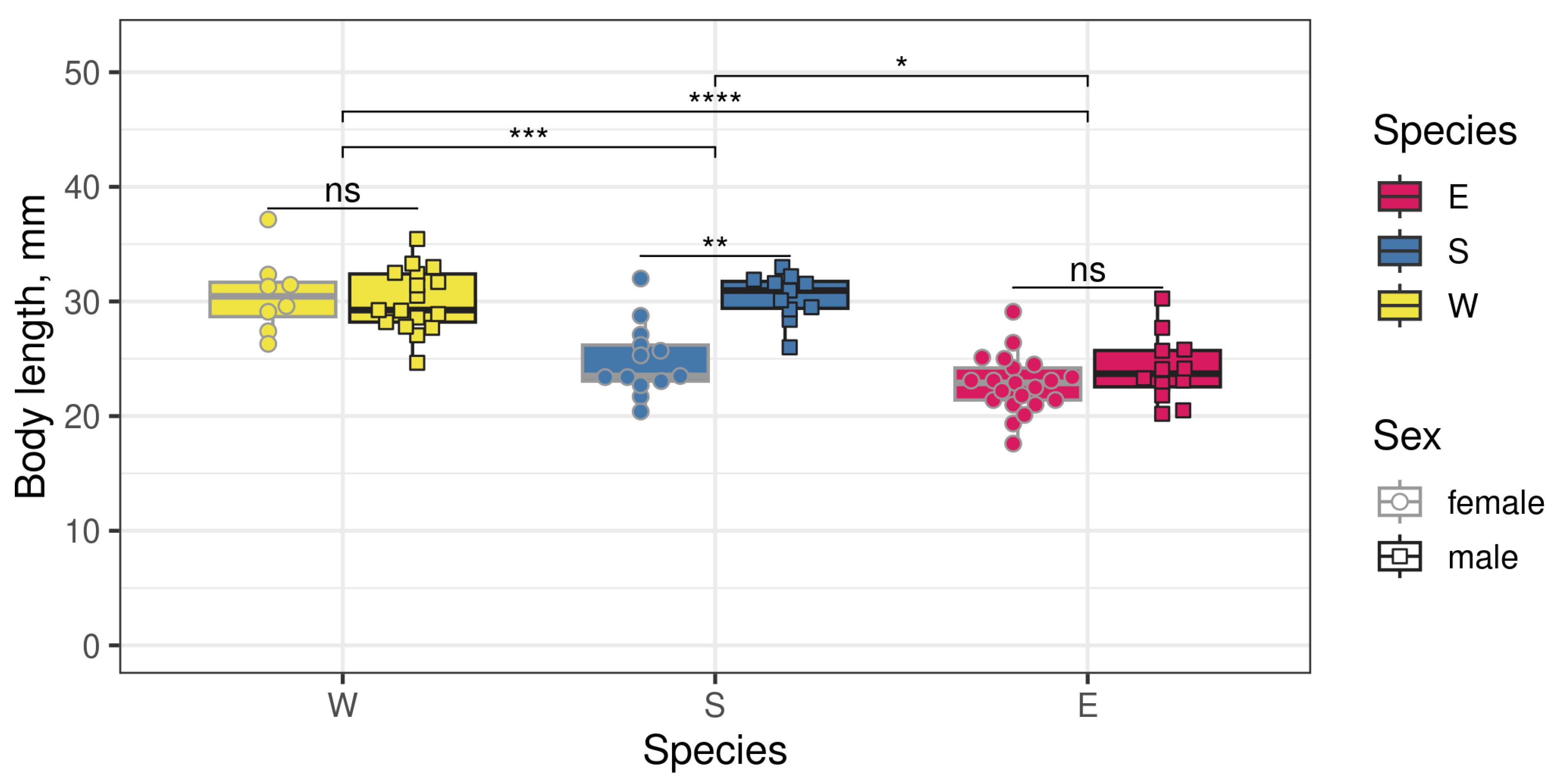
Moreover, the animals from Ust-Barguzin appeared to be slightly smaller. To verify the apparent size differences, we quantified animal lengths from photographs taken during the mate choice trials and immediately after mixing for experimental crossing (Figure 3). The lengths were indeed significantly different between all pairs of species, with W being the largest and E the smallest. Moreover, while the males and females did not differ in length within the W and E species, the S males were larger than the S females. Further studies are needed to determine whether this sexual dimorphism is characteristic of the particular species, the population from Port Baikal, or even the specific October sample.

3.2. Mate Choice Trials Show Assortative Mating

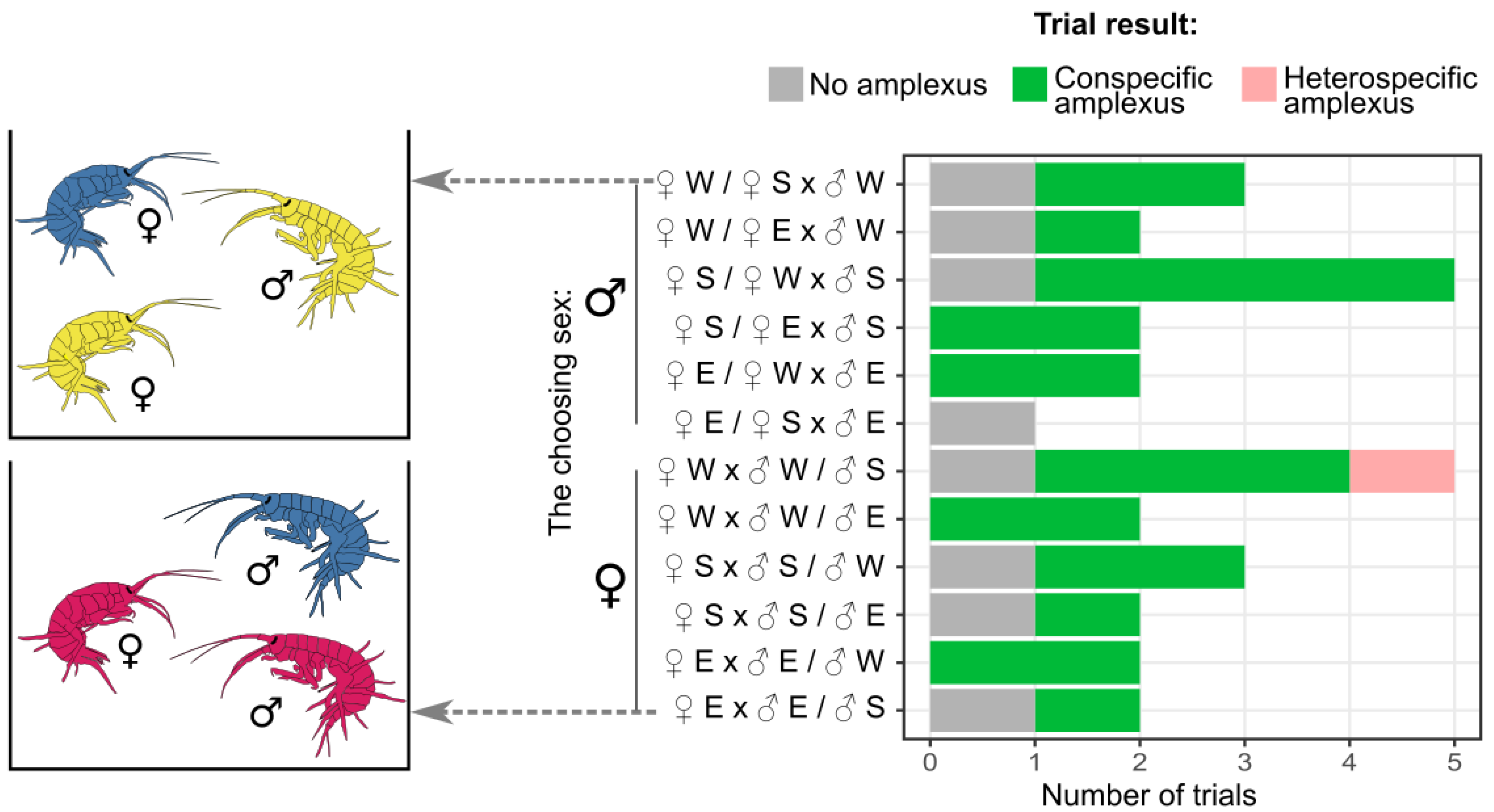
In order to assess the presence of a prezygotic reproductive barrier, we performed mate choice trials with groups of three animals across all possible 12 combinations (Figure 4; Table S2). A total of 31 trials were conducted. In 22 cases, representatives of the same species formed an amplexus (median time until amplexus formation was 2 h); in 8 cases, no choice was made within 6 h; in one case, a heterospecific amplexus formed (female W × male S). In the last case, the genetic origin of both animals (COI haplogroup) was checked by PCR genotyping to exclude a methodological error, and the barcoding of the species confirmed their species identity. In total, the formation of 22 conspecific and 1 heterospecific amplexus confirms non-random mating (p < 0.0001 in a χ2 test). Thus, the results unequivocally demonstrate that the three studied biological species are separated by a prezygotic reproductive barrier, although rare interspecific mating can occur.

3.3. No-Choice Mating Shows That Amplexus Formation Inversely Correlates with Genetic Difference

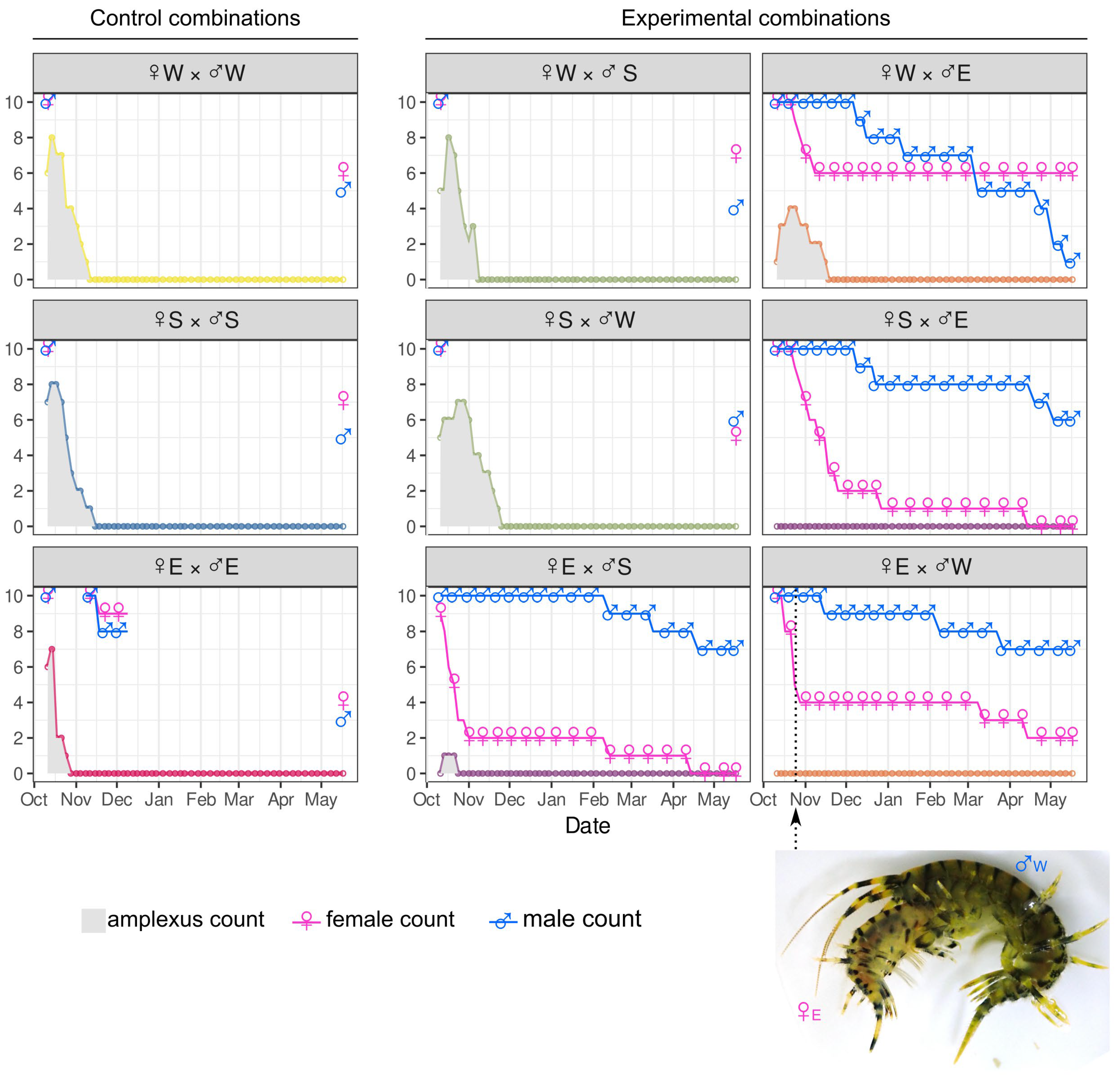
Within this study, we conducted crossing experiments on the representatives of the three biological species. In these experiments, the mating was no-choice, i.e., the animals were mixed in the desired combinations (9 possible crosses, WxW, WxS, WxE, SxS, SxW, SxE, ExE, ExS, and ExW; 10 females and 10 males in each tank). In all crosses of the W and S species (both control and experimental combinations), 5–7 out of a maximum of 10 amplexuses formed relatively rapidly (within 24 h; the first point in Figure 5). The same applied to the control ExE cross. However, in the experimental crosses involving the E species, which was the first to diverge from the common ancestor, with any of the remaining species, amplexuses formation was delayed (after 3 days). Amplexuses were observed only in two out of four combinations (ExS and WxE; the first letter corresponds to the females, and the second designates males), and the number of amplexuses formed simultaneously never exceeded four.
Moreover, we noticed a negative correlation between amplexus formation and survival of one of the sexes. The animals of the E species also appeared yellower and exhibited characteristic intermittent stripes on the dorsal part of their metasome segments (see also [57]), which allowed us to easily distinguish them from the other two species. In all experiments where amplexus formation was less frequent or completely absent we saw rapid decrease in the number of females (SxE, ExS, and ExW) or females and subsequently males (WxE). The number of the individuals of the inhibited sex dropped to 0–2 by the end of the experiment. Moreover, we evidenced the process of a W male consuming an E female (Figure 5). At the same time, in all other crosses (control combinations WxW, SxS, and ExE, as well as experimental ones, WxS and SxW) the number of males and females at the end of the experiment was close to a 1:1 ratio (we could not estimate it during the experiment, as in these cases there were no morphological differences between the males and females, except for the case when all females were ovigerous) (Figure 5).

3.4. Development of Embryos from Hybrid Crosses Reveals Postzygotic Reproductive Incompatibility Between Species

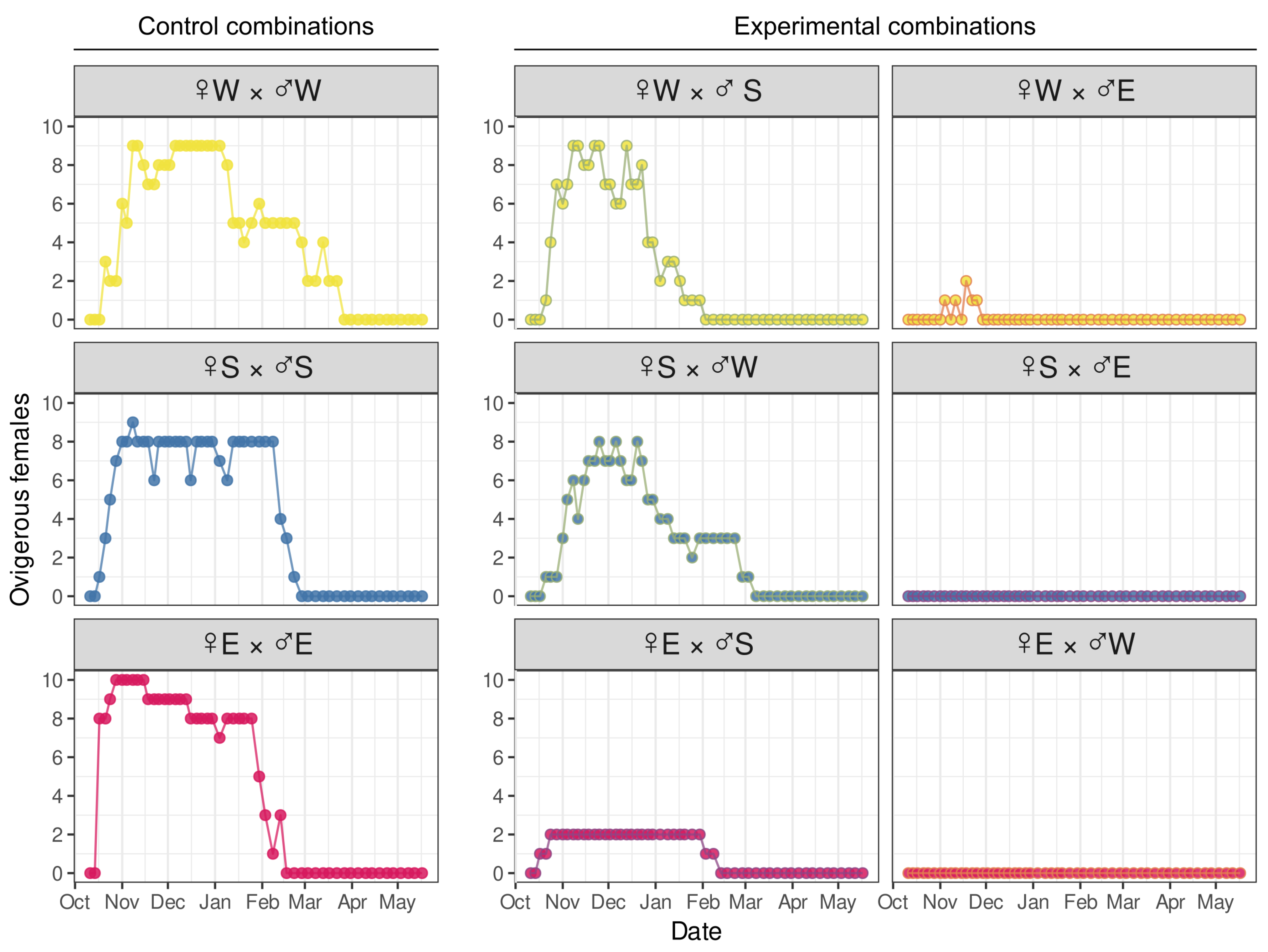
At the next stage, in all the crosses where amplexuses formed, females with eggs in the brood pouch appeared accordingly (Figure 6). In the control combinations, as well as in the experimental crosses of two most closely related species (WxS and SxW), the number of ovigerous females reached 8–10. In the ExS and WxE crosses, two such females appeared. In the combinations where no amplexuses were present, no such females were recorded.
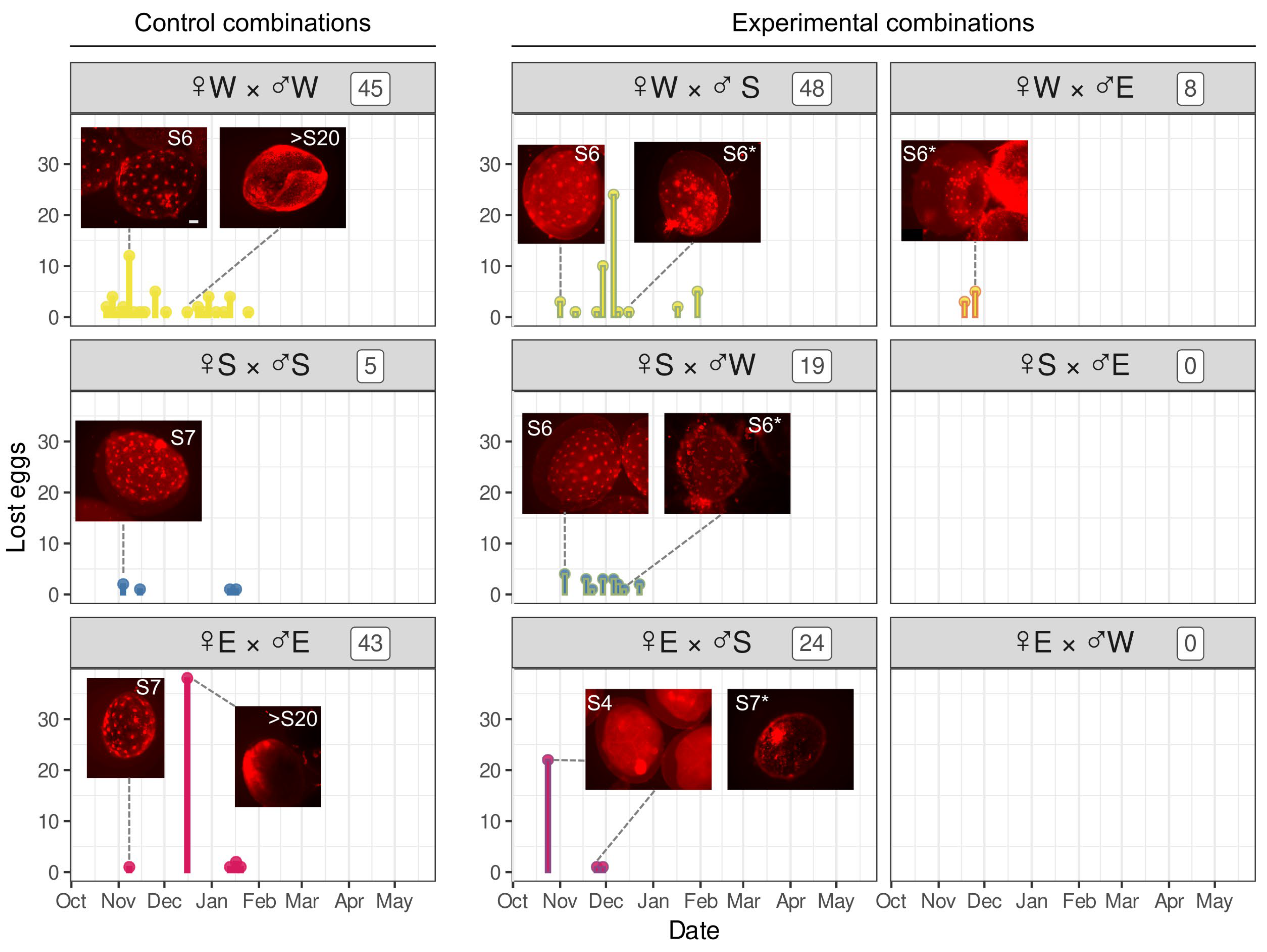
Earlier, we observed that the hybrid eggs (WxS and SxW) were lost and most likely consumed by the animals, as we did not find any at water exchange [12]. To obtain more detailed information on the developmental stage of such eggs, we installed a container for egg collection in this experimental setup. The eggs were collected from the bottom of the tanks at each water exchange and stained with PI to assess their developmental stages. In total, over 190 eggs were collected.
Importantly, in all crosses where ovigerous females occurred, lost eggs were found at the bottom of the tanks. It is worth noting that the number of lost eggs was considerable (up to 45), even in the control crosses, which suggests that this process could take place in natural populations. However, we observed a qualitative difference between experimental and control crosses regarding developmental stages. While embryos at different stages were found in the control combinations (up to almost fully developed embryos with red eyespot, stage S27), no eggs that passed stage S7 (~128-celled blastula) according to [42] were found in any experimental combinations (Table S4; Figure 7). This information corroborates the results obtained earlier in a similar experiment [12].

3.5. Juvenile Release Reveals That Postzygotic Reproductive Incompatibility Is Not Absolute and That the Secondary Contact of Separated Species Already Occurs in Nature

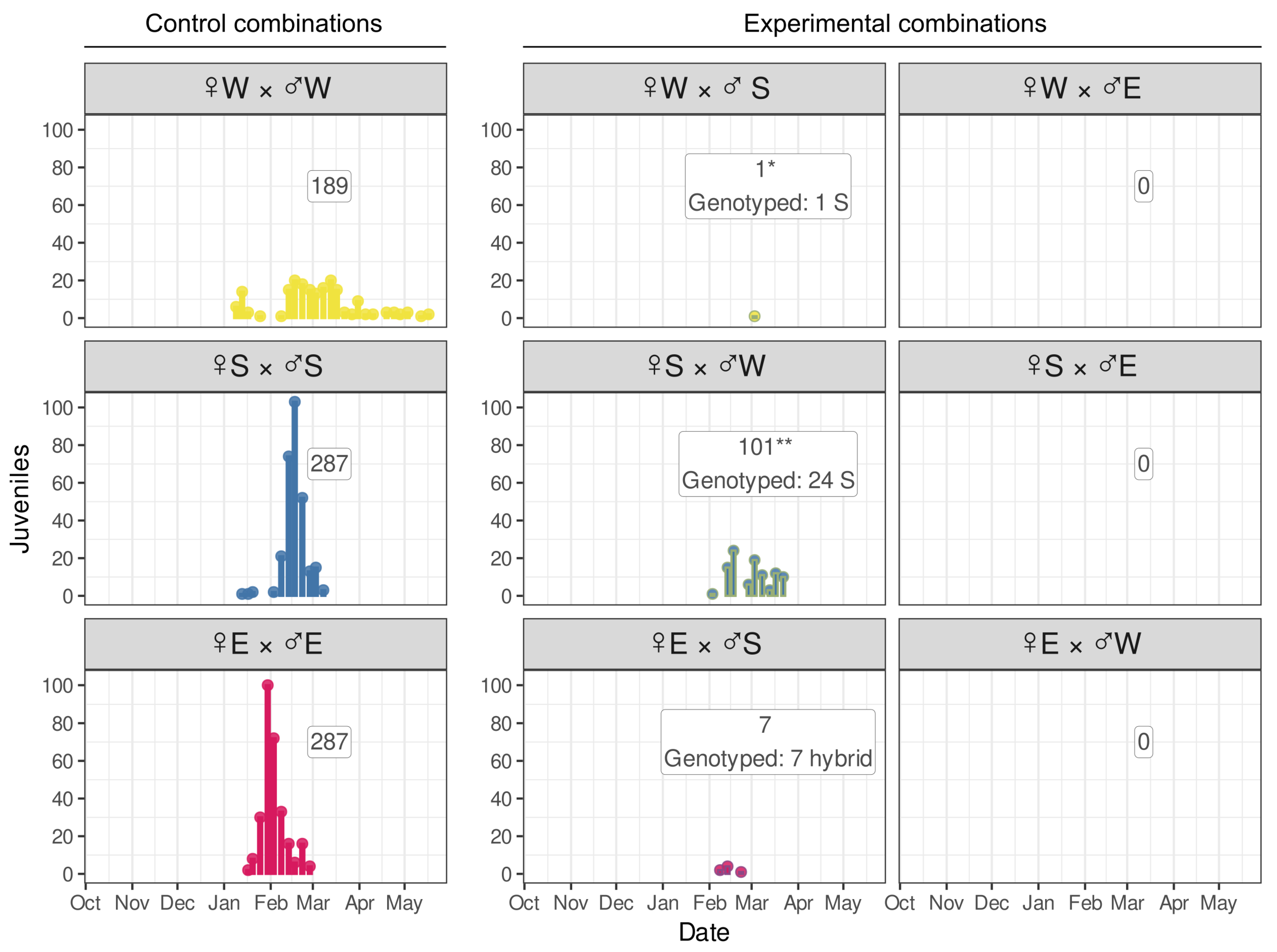
Despite a considerable loss of eggs, juveniles emerged from the brood pouches, as expected, in all control crosses. Interestingly, the dynamics of juvenile release were slightly different. While the WxW cross had the most prolonged period (from the 90th to the 218th day of the experiment; median 143 days) without pronounced peaks but slightly shifted to later dates, the ExE cross had the shortest time until juvenile release (from 98th to the 139th day of the experiment; median 115 days) and the SxS was characterized by intermediate values (from the 94th to the 148th day of the experiment; median 129 days) with a sharp peak recording over 100 juveniles at one time point (Figure 8, left column).
Moreover, some experimental combinations also resulted in juvenile release, even though the number of recorded juveniles was smaller than in the corresponding control crosses (101 in SxW and 1 in WxS vs. 287 in SxS and 189 in WxW; 7 in ExS vs. 287 in ExE and SxS). To rule out methodological error, we sequenced the marker COI and 18S rRNA fragments in 24 SxW, the only WxS, and 7 ExS juvenile individuals (Figure 8; Table S5). The juveniles from the ExS cross presented a hybrid 18S haplotype and E COI haplotype (inherited maternally, as expected), indicating that they were hybrid and that the postzygotic reproductive barrier is not absolute.
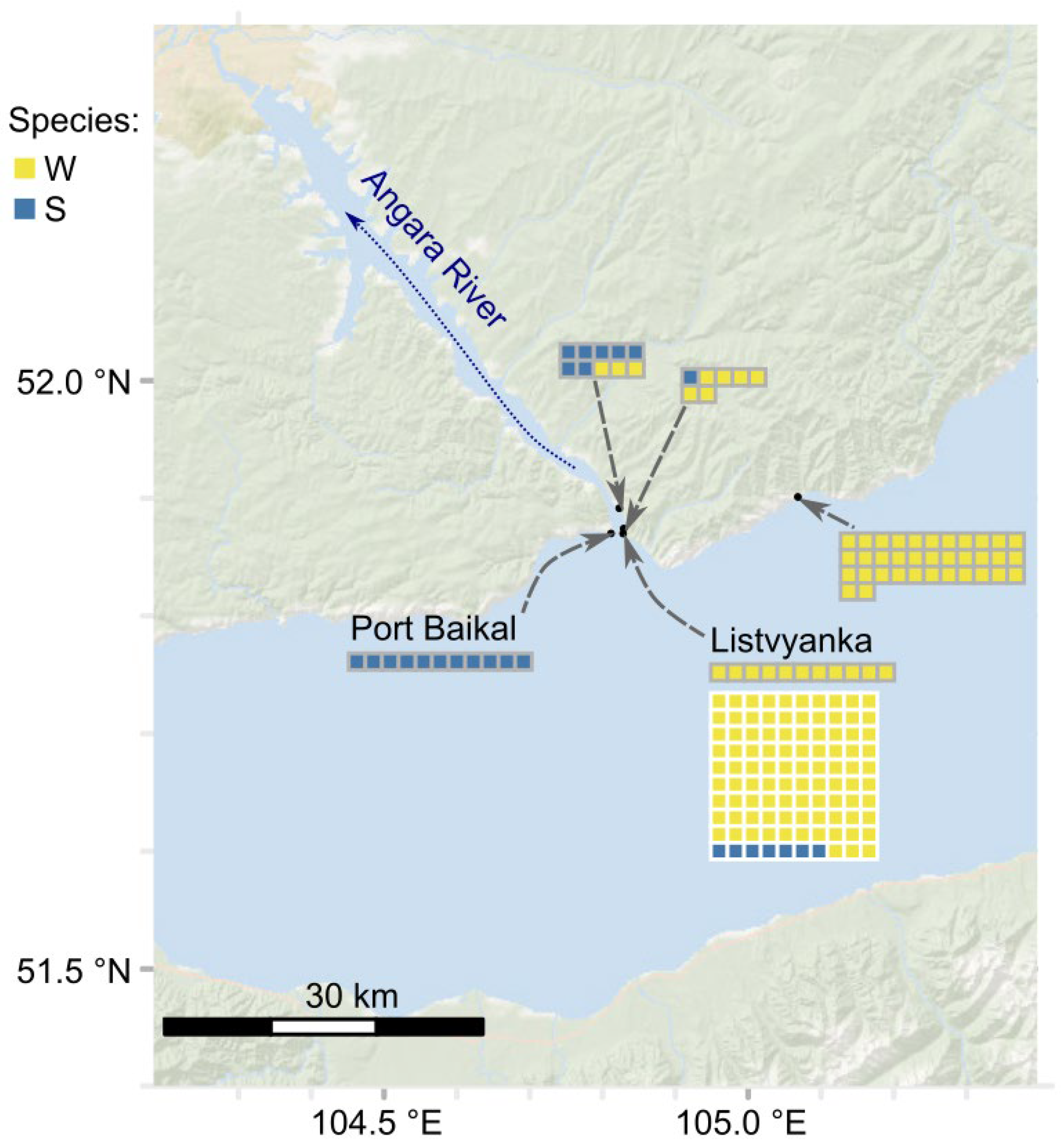
However, we found that in the SxW and WxS juveniles, both markers belonged to the S species, indicating that these offspring were not hybrid. In the case of the only juvenile in the WxS cross we suspect contamination from another tank, as there were no ovigerous females present in this cross at the time. The presence of S species juveniles in the SxW cross could be explained by an unexpected presence of S male(s) in this tank. The design of the experiment made a partial mix-up unlikely; however, it could be possible that the sampling spot of the W species in Listvyanka was inhabited by both W and S species. To check this hypothesis, we first sexed and genotyped all adult animals from these crosses (WxW, WxS, SxW) surviving until the end of the experiment (11 animals in each case). These analyses did not provide any useful information, as all of them corresponded to the designated genetic group (Table S6). However, they could be explained if the animals of the wrong population died earlier. Therefore, we performed a more in-depth analysis with a larger sample by genotyping 100 animals from Listvyanka (W sampling place), sampled separately from the main experiment. This analysis returned 93 animals belonging to the W species and 7 animals belonging to the S species (Figure 9; Table S6), providing a plausible explanation for the presence of S juveniles in the hybrid SxW cross. Genotyping results were consistent for both markers (COI and 18S fragments) for each animal, offering indirect evidence that the S species animals sampled from nature were not hybrids.

4. Discussion

In this work, we experimentally examined the presence of prezygotic and postzygotic reproductive barriers of the three species of the E. verrucosus complex in order to estimate the degree of their reproductive isolation. Moreover, this experiment allowed us to study some aspects of their geographical distribution, reproduction and interspecific relationships. This enables us to make predictions about the potential consequences of secondary contact between representatives of different species.

4.1. New Data on the Geographic Distribution of the Species of the E. verrucosus Species Complex

In this experiment, we observed results that initially seemed contradictory to those obtained earlier, specifically the presence of juveniles in the cross between S females and W males (Figure 8). However, genotyping of these juveniles and a sample of animals from the W sampling point in Listvyanka revealed that these juveniles most likely resulted from the unexpected presence of S animals in this spot. At the time of sampling, we only had sequence information for a sample of 11 individuals from this particular site, but it seemed logical to assume that it was inhabited by the W species, based on the visible division by the Angara River source and clear geographical division between species of the E. verrucosus complex in general [20]. However, later we discovered that only 300 m downstream by the right bank of the Angara River, individuals of the S species, which inhabits the source of the river at the left bank, started to appear, and in 700 m downstream they even dominated the sample [31]. This new information complicates the interpretation of the crossing results, but at the same it shows that our experiments modeling the secondary contact of the W and S species are not just theoretical. Instead, they reflect a real situation occurring even in Baikal near the source of the Angara River. This contact indicates that these two closely related species compete at this point, likely sharing identical or almost identical ecological niches. It is worth noting that the total number of juveniles released in the WxW cross was fewer than in the SxS combination (Figure 8) both here and in a similar independent experiment described earlier [12], despite comparable numbers of ovigerous females (Figure 6). If this difference indeed reflects reduced fecundity of the W species or specifically the population from Listvyanka, it might contribute to the displacement of the W species by the S species near to the source of the Angara river observed earlier [31]. However, it is important to consider that this reduced fecundity might have also been influenced by the fact that some animals from the Listvyanka population (~7%) belong to the S species, so after experimental mixing the number of males and females of the correct species may have been imbalanced. However, we still consider it unlikely to cause the observed one-third reduction in the number of offspring.

4.2. How Much Genetic Divergence Is Needed for Isolation?

Since prezygotic isolation is easier to check and document, it has been assessed for multiple amphipod species complexes taking into account the genetic distance between different lineages. The results have been variable, with difficulties in amplexus formation starting to appear at 4% to >20% divergence (see Introduction). Our results are consistent with those observed in the G. pulex/G. fossarum species complex. In this system, random amplexus formation was observed up to approximately 4% K2P distance in COI and rare amplexus formation in the laboratory was observed up to approximately 17% K2P distance [25,26]. We also observed non-random but still possible amplexus formation in most interspecific combinations in our experiments (10–12% K2P distances).
However, it is hard to interpret together the results obtained from choice and no-choice trials, as well with those with the amplexuses found in nature (also with choice but with varying ratios of homospecific and heterospecific potential mates). They are often different, with much more divergent animals forming amplexuses in the lab without choice than in the nature [25]. Our experiments also corroborated these observations. Mate choice trials showed an almost perfect barrier (Figure 4). However, when not given any choice, animals of the closer W and S species formed a comparative number of amplexuses to the control (homospecific) crosses (Figure 5), the number of amplexuses formed between any of these species and the more distant E species was already lower, even without a choice. In this work, we did not check for the presence and frequency of heterospecific amplexuses in nature. However, since the beginning of this project we found a secondary contact zone for the W and S species, it can be done in future to compare the behavior in laboratory experiments and natural conditions.
It is interesting to note that the amplexus formation in no-choice setup was not completely mirrored in reciprocal crosses, with formation of more amplexuses in the crosses with W or S males and E females than in the reciprocal crosses with E males and W or S females (Figure 5). Aside from purely random reasons, this could be explained by size-related preferences (animals of the E species are smaller than those from the other two) or if the W males were more aggressive than the corresponding females, as well as other behavioral differences between sexes. In other amphipod species, both male competition and female choice have been found to influence amplexus formation [76,77]. The simple design of our mate-choice trials did not allow us to distinguish between these types of behavior, but we did not observe active fighting between males, which suggests that mate choice is more important than active competition. Amphipods rely on chemical cues in many communication-related behaviors, but so far there has been no data on particular chemicals that might underlie mate choice [78]. Given that genetic differences between cryptic species in a complex are relatively low, they can serve as models to search for species-discriminating signals with combination of genomics and metabolomics.
Another unexpected result in our crossing experiments was the preferential mortality of one of the sexes in the cases when the least closely related species (E and one of the others) were crossed (Figure 5). This effect correlated with absence or small number of amplexuses formed. These results might indicate that aggressive behavior is present specifically when the representatives of a related species are not perceived as potential mating partners. It might even be a mechanism promoting speciation. However, additional experiments are required to test this hypothesis, such as direct behavioral trials recording interaction between males of different species.
Based on our overall results, we can say that the patristic distance threshold of 0.16 suggested earlier [9] holds steady. An interesting direction for future work would be to identify the lower limit of prezygotic incompatibility for Baikal and other gammaroid amphipods. The experimental system we have developed in this and previous works allows for testing other species complexes with varying degrees of genetic divergence and provide insights into what determines the correspondence between genetic divergence and reproductive incompatibility.

4.3. The Fate of the Hybrid Embryos and the Physiology of Postzygotic Isolation

Previously, we found that the hybrid crosses between the W and S species of E. verrucosus failed to provide viable offspring. We suggested that these embryos stopped development, but this conclusion was based on the embryos of one female per cross at one time point [12]. Thus, we could not trace the fate of the embryos that presumably fell out of the brood pouches throughout the experiment, as these eggs disappeared (they were supposedly consumed by the adult animals). Here, we upgraded the experimental design by adding a device that allowed us to collect eggs. Interestingly, we found that eggs were lost in all crosses (both control and experimental), but while in the control crosses various developmental stages could be found, the experimental combinations presented either early developmental stages up to S7 according to [42] or presumably unfertilized eggs without visible nuclei, but highly developed embryos were never observed (Figure 7). These results corroborate the hypothesis about developmental arrest suggested earlier.
Moreover, these results align with the behavior described in earlier studies on crosses between different Gammarus species, in which eggs generally failed to develop after early gastrulation (reviewed in [11]). In reciprocal crosses between G. pulex and G. fossarum, eggs developed to the morula stage in some interspecific crosses with G. pulex females but in none with G. fossarum females [21]. In amphipods, gastrulation begins around stage S6–S7 to S8 [79], which coincides with the stage at which most hybrid embryos paused their development in E. verrucosus (Figure 7).
However, we found that while the prezygotic and postzygotic barriers correlate, in some cases, the development of hybrid embryos at least until hatching is also possible, and even in the more distant ExS cross (Figure 8). Interestingly, a very similar rare case was observed in a cross between female G. salinus and male G. locusta; in this case, the development was observed, and these juveniles died during their first moult [22].
Taken together, the results on prezygotic and postzygotic reproductive incompatibility show that neither of the barriers is absolute. Therefore, incompatibility is complex and probably cannot be described as a simple presence/absence statement. However, relatively simple experiments with species complexes available for easy collection and maintenance under laboratory conditions can still provide very important support to check species delimitation hypotheses suggested using sequencing data and further extend these results to related species for which such experiments are unfeasible.

5. Conclusions

Our experiments have shown that three species within the E. verrucosus species complex are separated by both prezygotic and postzygotic reproductive barriers. While neither of these barriers is absolute, their combination can ensure reproductive isolation upon secondary contact of the species, which are normally geographically isolated.

Supplementary Materials

The following supporting information can be downloaded at: https://www.mdpi.com/article/10.3390/d17110781/s1, Table S1: Lengths of male and female animals belonging to different biological species (raw data for Figure 3); Table S2: Results of mate choice trials (raw data for Figure 4); Table S3: Results of the crossing experiments (raw data for Figure 5, Figure 6, Figure 7 and Figure 8); Table S4: Embryo development stages for eggs lost by females in the crossing experiment (raw data for Figure 7); Table S5: Genotyping results for juveniles (raw data for Figure 8); Table S6: Genotyping results for adult animals (raw data for Figure 9).

Author Contributions

Conceptualization, P.D., A.G. and M.T.; methodology, P.D., Z.S., E.T., A.G. and M.T.; software, P.D.; validation, A.M. and E.Z.; formal analysis, P.D.; investigation, P.D., Z.S., E.T., A.S. and E.Z.; resources, A.G. and A.M.; data curation, P.D.; writing—original draft preparation, P.D.; writing—review and editing, P.D., Z.S., E.T., A.G., A.S., A.M., E.Z. and M.T.; visualization, P.D.; supervision, P.D. and M.T.; project administration, P.D. and M.T.; funding acquisition, P.D. All authors have read and agreed to the published version of the manuscript.

Funding

This work was financed by the Russian Science Foundation, project number 22-14-00128-P (https://rscf.ru/en/project/22-14-00128/, accessed on 1 November 2025).

Institutional Review Board Statement

The animal study protocol was approved by the Animal Subjects Research Committee of the Institute of Biology at Irkutsk State University (protocol #9/2022).

Data Availability Statement

The original data presented in the study are openly available in GitHub at Reproducible code for all analyzes is available at https://github.com/drozdovapb/EveWES_git (accessed on 13 October 2025) and in the Supplementary Materials.

Acknowledgments

The authors are grateful to Nadezhda Bolbat, Uliana Vasilyeva, and Ekaterina Shchapova for help with sampling and to the team of the Institute of Biology at Irkutsk State University for helpful discussions.

Conflicts of Interest

The authors declare that no conflict of interest exists.

References

  1. Emerson, B.C. Delimiting Species—Prospects and Challenges for DNA Barcoding. Mol. Ecol. 2025, 34, e17677. [Google Scholar] [CrossRef]
  2. Mayr, E. What Is a Species, and What Is Not? Philos. Sci. 1996, 63, 262–277. [Google Scholar] [CrossRef]
  3. Stankowski, S.; Cutter, A.D.; Satokangas, I.; Lerch, B.A.; Rolland, J.; Smadja, C.M.; Segami Marzal, J.C.; Cooney, C.R.; Feulner, P.G.D.; Domingos, F.M.C.B.; et al. Toward the Integration of Speciation Research. Evol. J. Linn. Soc. 2024, 3, kzae001. [Google Scholar] [CrossRef]
  4. Peichel, C.L.; Bolnick, D.I.; Brännström, Å.; Dieckmann, U.; Safran, R.J. Speciation. Cold Spring Harb. Perspect. Biol. 2025, 17, a041735. [Google Scholar] [CrossRef] [PubMed]
  5. Karbstein, K.; Kösters, L.; Hodač, L.; Hofmann, M.; Hörandl, E.; Tomasello, S.; Wagner, N.D.; Emerson, B.C.; Albach, D.C.; Scheu, S.; et al. Species Delimitation 4.0: Integrative Taxonomy Meets Artificial Intelligence. Trends Ecol. Evol. 2024, 39, 771–784. [Google Scholar] [CrossRef] [PubMed]
  6. Miralles, A.; Puillandre, N.; Vences, M. DNA Barcoding in Species Delimitation: From Genetic Distances to Integrative Taxonomy. In DNA Barcoding: Methods and Protocols; DeSalle, R., Ed.; Springer: New York, NY, USA, 2024; pp. 77–104. ISBN 978-1-07-163581-0. [Google Scholar]
  7. Phillips, J.D.; Gillis, D.J.; Hanner, R.H. Lack of Statistical Rigor in DNA Barcoding Likely Invalidates the Presence of a True Species’ Barcode Gap. Front. Ecol. Evol. 2022, 10, 859099. [Google Scholar] [CrossRef]
  8. Blaxter, M.L. The Promise of a DNA Taxonomy. Philos. Trans. R. Soc. Lond. Ser. B Biol. Sci. 2004, 359, 669–679. [Google Scholar] [CrossRef]
  9. Lefébure, T.; Douady, C.J.; Gouy, M.; Gibert, J. Relationship between Morphological Taxonomy and Molecular Divergence within Crustacea: Proposal of a Molecular Threshold to Help Species Delimitation. Mol. Phylogenetics Evol. 2006, 40, 435–447. [Google Scholar] [CrossRef]
  10. Fourment, M.; Gibbs, M.J. PATRISTIC: A Program for Calculating Patristic Distances and Graphically Comparing the Components of Genetic Change. BMC Evol. Biol. 2006, 6, 1. [Google Scholar] [CrossRef]
  11. Sutcliffe, D. Reproduction in Gammarus (Crustacea, Amphipoda): Basic Processes. Freshw. Forum 1992, 2, 102–128. [Google Scholar]
  12. Drozdova, P.; Saranchina, A.; Madyarova, E.; Gurkov, A.; Timofeyev, M. Experimental Crossing Confirms Reproductive Isolation between Cryptic Species within Eulimnogammarus verrucosus (Crustacea: Amphipoda) from Lake Baikal. Int. J. Mol. Sci. 2022, 23, 10858. [Google Scholar] [CrossRef] [PubMed]
  13. Cristescu, M.E.; Adamowicz, S.J.; Vaillant, J.J.; Haffner, D.G. Ancient Lakes Revisited: From the Ecology to the Genetics of Speciation. Mol. Ecol. 2010, 19, 4837–4851. [Google Scholar] [CrossRef] [PubMed]
  14. Chenuil, A.; Saucède, T.; Hemery, L.G.; Eléaume, M.; Féral, J.-P.; Améziane, N.; David, B.; Lecointre, G.; Havermans, C. Understanding Processes at the Origin of Species Flocks with a Focus on the Marine Antarctic Fauna. Biol. Rev. 2018, 93, 481–504. [Google Scholar] [CrossRef] [PubMed]
  15. Bowen, B.W.; Forsman, Z.H.; Whitney, J.L.; Faucci, A.; Hoban, M.; Canfield, S.J.; Johnston, E.C.; Coleman, R.R.; Copus, J.M.; Vicente, J.; et al. Species Radiations in the Sea: What the Flock? J. Hered. 2020, 111, 70–83. [Google Scholar] [CrossRef]
  16. Copilaș-Ciocianu, D.; Sidorov, D. Taxonomic, Ecological and Morphological Diversity of Ponto-Caspian Gammaroidean Amphipods: A Review. Org. Divers. Evol. 2022, 22, 285–315. [Google Scholar] [CrossRef]
  17. Drozdova, P.B.; Madyarova, E.V.; Gurkov, A.N.; Saranchina, A.E.; Romanova, E.V.; Petunina, J.V.; Peretolchina, T.E.; Sherbakov, D.Y.; Timofeyev, M.A. Lake Baikal Amphipods and Their Genomes, Great and Small. Vavilov J. Genet. Breed. 2024, 28, 317–325. [Google Scholar] [CrossRef]
  18. Takhteev, V.V. On the current state of taxonomy of the Baikal Lake amphipods (Crustacea, Amphipoda) and the typological ways of constructing their system. Arthropoda Sel. 2019, 28, 374–402. [Google Scholar] [CrossRef]
  19. Daneliya, M.E.; Väinölä, R. Five Subspecies of the Dorogostaiskia parasitica Complex (Dybowsky) (Crustacea: Amphipoda: Acanthogammaridae), Epibionts of Sponges in Lake Baikal. Hydrobiologia 2014, 739, 95–117. [Google Scholar] [CrossRef]
  20. Gurkov, A.; Rivarola-Duarte, L.; Bedulina, D.; Fernández Casas, I.; Michael, H.; Drozdova, P.; Nazarova, A.; Govorukhina, E.; Timofeyev, M.; Stadler, P.F.; et al. Indication of Ongoing Amphipod Speciation in Lake Baikal by Genetic Structures within Endemic Species. BMC Evol. Biol. 2019, 19, 138. [Google Scholar] [CrossRef]
  21. Meijering, M.P.D. Physiologische Beiträge Zur Frage Der Systematischen Stellung von Gammarus pulex (L.) Und Gammarus fossarum Koch (Amphipoda). Crustaceana 1972, 313–325. [Google Scholar]
  22. Kolding, S. Interspecific Competition for Mates and Habitat Selection in Five Species of Gammarus (Amphipoda: Crustacea). Mar. Biol. 1986, 91, 491–495. [Google Scholar] [CrossRef]
  23. Sutherland, D.L.; Hogg, I.D.; Waas, J.R. Phylogeography and Species Discrimination in the Paracalliope fluviatilis Species Complex (Crustacea: Amphipoda): Can Morphologically Similar Heterospecifics Identify Compatible Mates? Biol. J. Linn. Soc. 2010, 99, 196–205. [Google Scholar] [CrossRef][Green Version]
  24. Cothran, R.D.; Stiff, A.R.; Chapman, K.; Wellborn, G.A.; Relyea, R.A. Reproductive Interference via Interspecific Pairing in an Amphipod Species Complex. Behav. Ecol. Sociobiol. 2013, 67, 1357–1367. [Google Scholar] [CrossRef]
  25. Lagrue, C.; Wattier, R.; Galipaud, M.; Gauthey, Z.; Rullmann, J.-P.; Dubreuil, C.; Rigaud, T.; Bollache, L. Confrontation of Cryptic Diversity and Mate Discrimination within Gammarus pulex and Gammarus fossarum Species Complexes. Freshw. Biol. 2014, 59, 2555–2570. [Google Scholar] [CrossRef]
  26. Galipaud, M.; Gauthey, Z.; Turlin, J.; Bollache, L.; Lagrue, C. Mate Choice and Male–Male Competition among Morphologically Cryptic but Genetically Divergent Amphipod Lineages. Behav. Ecol. Sociobiol. 2015, 69, 1907–1916. [Google Scholar] [CrossRef]
  27. Hupało, K.; Copilaș-Ciocianu, D.; Leese, F.; Weiss, M. Morphology, Nuclear SNPs and Mate Selection Reveal That COI Barcoding Overestimates Species Diversity in a Mediterranean Freshwater Amphipod by an Order of Magnitude. Cladistics 2023, 39, 129–143. [Google Scholar] [CrossRef]
  28. Drozdova, P.; Shatilina, Z.; Mutin, A.; Saranchina, A.; Gurkov, A.; Timofeyev, M. The Curious Case of Eulimnogammarus cyaneus (Dybowsky, 1874): Reproductive Biology of a Widespread Endemic Littoral Amphipod from Lake Baikal. J. Exp. Zool. Part A Ecol. Integr. Physiol. 2025, 343, 285–293. [Google Scholar] [CrossRef]
  29. Mashiko, K.; Kamaltynov, R.; Morino, H.; Sherbakov, D.Y. Genetic Differentiation among Gammarid (Eulimnogammarus cyaneus) Populations in Lake Baikal, East Siberia. Arch. Hydrobiol. 2000, 148, 249–261. [Google Scholar] [CrossRef]
  30. Väinölä, R.; Kontula, T.; Mashiko, K.; Kamaltynov, R.M. Congruent and Hierarchical Intra-Lake Subdivisions from Nuclear and Mitochondrial Data of a Lake Baikal Shoreline Amphipod. Diversity 2024, 16, 706. [Google Scholar] [CrossRef]
  31. Saranchina, A.; Mutin, A.; Govorukhina, E.; Rzhechitskiy, Y.; Gurkov, A.; Timofeyev, M.; Drozdova, P. Genetic Diversity in a Baikal Species Complex Eulimnogammarus verrucosus (Amphipoda: Gammaroidea) in the Angara River, the Only Outflow of Lake Baikal. Zool. Scr. 2024, 53, 867–879. [Google Scholar] [CrossRef]
  32. Bazikalova, A.Y. Amphipods of Lake Baikal; Proceedings of the Baikal Limnological Station; Publishing House of the USSR Academy of Sciences: Moscow, Russia; Saint Petersburg, Russia, 1945. [Google Scholar]
  33. Govorukhina, E.B. Biology of Reproduction, Seasonal and Daily Dynamics of Littoral and Sublittoral Amphipod Species of Lake Baikal. Ph.D. Thesis, Irkutsk State University, Irkutsk, Russia, 2005. (In Russian). [Google Scholar]
  34. Bazikalova, A.Y. On the Growth of Some Amphipods from Baikal and Angara. Proc. Baikal Limnol. Stn. 1951, 13, 206–216. (In Russian) [Google Scholar]
  35. Lipaeva, P.; Drozdova, P.; Vereshchagina, K.; Jakob, L.; Schubert, K.; Bedulina, D.; Luckenbach, T. How to Reproduce in the Siberian Winter: Proteome Dynamics Reveals the Timing of Reproduction-Related Processes in an Amphipod Species Endemic to Lake Baikal. Ecol. Evol. 2025, 15, e71675. [Google Scholar] [CrossRef]
  36. Lipaeva, P.; Vereshchagina, K.; Drozdova, P.; Jakob, L.; Kondrateva, E.; Lucassen, M.; Bedulina, D.; Timofeyev, M.; Stadler, P.; Luckenbach, T. Different Ways to Play It Cool: Transcriptomic Analysis Sheds Light on Different Activity Patterns of Three Amphipod Species under Long-Term Cold Exposure. Mol. Ecol. 2021, 30, 5735–5751. [Google Scholar] [CrossRef] [PubMed]
  37. Fedotov, A.P.; Khanaev, I.V. Annual Temperature Regime of the Shallow Zone of Lake Baikal Inferred from High-Resolution Data from Temperature Loggers. Limnol. Freshw. Biol. 2023, 4, 119–125. [Google Scholar] [CrossRef]
  38. Moore, M.V.; Hampton, S.E.; Izmest’eva, L.R.; Silow, E.A.; Peshkova, E.V.; Pavlov, B.K. Climate Change and the World’s “Sacred Sea”—Lake Baikal, Siberia. BioScience 2009, 59, 405–417. [Google Scholar] [CrossRef]
  39. Timofeyev, M.; Shatilina, J.; Stom, D. Attitude to Temperature Factor of Some Endemic Amphipods from Lake Baikal and Holarctic Gammarus lacustris Sars, 1863: A Comparative Experimental Study. Arthropoda Sel. 2001, 10, 93–101. [Google Scholar]
  40. Schneider, C.A.; Rasband, W.S.; Eliceiri, K.W. NIH Image to ImageJ: 25 Years of Image Analysis. Nat. Methods 2012, 9, 671–675. [Google Scholar] [CrossRef]
  41. DeSalle, R.; Gregory, T.R.; Johnston, J.S. Preparation of Samples for Comparative Studies of Arthropod Chromosomes: Visualization, in situ Hybridization, and Genome Size Estimation. In Molecular Evolution: Producing the Biochemical Data; Methods in Enzymology; Academic Press: Cambridge, MA, USA, 2005; Volume 395, pp. 460–488. [Google Scholar]
  42. Browne, W.E.; Price, A.L.; Gerberding, M.; Patel, N.H. Stages of Embryonic Development in the Amphipod Crustacean, Parhyale Hawaiensis. Genesis 2005, 42, 124–149. [Google Scholar] [CrossRef]
  43. Jourdan, J.; Piro, K.; Weigand, A.; Plath, M. Small-Scale Phenotypic Differentiation along Complex Stream Gradients in a Non-Native Amphipod. Front. Zool. 2019, 16, 29. [Google Scholar] [CrossRef]
  44. Shirokova, Y.A.; Saranchina, A.E.; Shatilina, Z.M.; Kashchuk, N.D.; Timofeyev, M.A. Comparison of Olfactory Sensilla Structure in Littoral and Deep-Water Amphipods from the Baikal Region. Inland Water Biol. 2023, 16, 873–883. [Google Scholar] [CrossRef]
  45. Englisch, U.; Coleman, C.O.; Wägele, J.W. First Observations on the Phylogeny of the Families Gammaridae, Crangonyctidae, Melitidae, Niphargidae, Megaluropidae and Oedicerotidae (Amphipoda, Crustacea), Using Small Subunit rDNA Gene Sequences. J. Nat. Hist. 2003, 37, 2461–2486. [Google Scholar] [CrossRef]
  46. Alekseev, Y.I.; Belov, D.A.; Alekseev, Y.V. Multichannel Capilary Genetic Analyzer. Russian Patent RU 2693583 C1, 2 July 2019. (In Russian). [Google Scholar]
  47. Bocharova, D.V.; Alekseev, Y.I.; Volkov, A.A.; Lavrov, G.S.; Plugov, A.G.; Volkov, I.A.; Chemigov, A.A.; Bardin, B.V.; Kurochkin, V.E. Determination of the Maximum Length of DNA in a Polymer Based on Linear Poly(N,N-Dimethylacrylamide) Decoded with an Accuracy of 99% by Capillary Gel Electrophoresis with Laser-Induced Fluorescence. J. Anal. Chem. 2021, 76, 1408–1413. [Google Scholar] [CrossRef]
  48. Macdonald III, K.S.; Yampolsky, L.; Duffy, J.E. Molecular and Morphological Evolution of the Amphipod Radiation of Lake Baikal. Mol. Phylogenetics Evol. 2005, 35, 323–343. [Google Scholar] [CrossRef] [PubMed]
  49. Okonechnikov, K.; Golosova, O.; Fursov, M. Unipro UGENE: A Unified Bioinformatics Toolkit. Bioinformatics 2012, 28, 1166–1167. [Google Scholar] [CrossRef] [PubMed]
  50. Rivarola-Duarte, L.; Otto, C.; Jühling, F.; Schreiber, S.; Bedulina, D.; Jakob, L.; Gurkov, A.; Axenov-Gribanov, D.; Sahyoun, A.H.; Lucassen, M.; et al. A First Glimpse at the Genome of the Baikalian Amphipod Eulimnogammarus verrucosus. J. Exp. Zool. Part B Mol. Dev. Evol. 2014, 322, 177–189. [Google Scholar] [CrossRef]
  51. Wilson, K.; Cahill, V.; Ballment, E.; Benzie, J. The Complete Sequence of the Mitochondrial Genome of the Crustacean Penaeus Monodon: Are Malacostracan Crustaceans More Closely Related to Insects than to Branchiopods? Mol. Biol. Evol. 2000, 17, 863–874. [Google Scholar] [CrossRef]
  52. Katoh, K.; Standley, D.M. MAFFT Multiple Sequence Alignment Software Version 7: Improvements in Performance and Usability. Mol. Biol. Evol. 2013, 30, 772–780. [Google Scholar] [CrossRef]
  53. Tamura, K.; Stecher, G.; Kumar, S. MEGA11: Molecular Evolutionary Genetics Analysis Version 11. Mol. Biol. Evol. 2021, 38, 3022–3027. [Google Scholar] [CrossRef]
  54. R Core Team. R: A Language and Environment for Statistical Computing. Available online: https://www.r-project.org/ (accessed on 1 June 2025).
  55. Wickham, H.; François, R.; Henry, L.; Müller, K.; Vaughan, D.; Posit Software, PBC. Dplyr: A Grammar of Data Manipulation; Posit Software, PBC: Boston, MA, USA, 2023. [Google Scholar]
  56. Clarke, E.; Sherrill-Mix, S.; Dawson, C. Ggbeeswarm: Categorical Scatter (Violin Point) Plots. Available online: https://CRAN.R-project.org/package=ggbeeswarm (accessed on 1 June 2025).
  57. Wickham, H. Ggplot2: Elegant Graphics for Data Analysis; Use R! Springer: Cham, Switzerland, 2016; ISBN 978-3-319-24277-4. [Google Scholar]
  58. Kassambara, A. Ggpubr: “ggplot2” Based Publication Ready Plots. Available online: https://CRAN.R-project.org/package=ggpubr (accessed on 1 June 2025).
  59. Slowikowski, K.; Schep, A.; Hughes, S.; Dang, T.K.; Lukauskas, S.; Irisson, J.-O.; Kamvar, Z.N.; Ryan, T.; Christophe, D.; Hiroaki, Y.; et al. Ggrepel: Automatically Position Non-Overlapping Text Labels with “Ggplot2”. Available online: https://CRAN.R-project.org/package=ggrepel (accessed on 1 June 2025).
  60. Giraud, T. Maptiles: Download and Display Map Tiles. Available online: https://github.com/riatelab/maptiles (accessed on 1 June 2025).
  61. Novomestky, F. Matrixcalc: Collection of Functions for Matrix Calculations. Available online: https://CRAN.R-project.org/package=matrixcalc (accessed on 1 June 2025).
  62. Schauberger, P.; Walker, A.; Braglia, L.; Sturm, J.; Garbuszus, J.M.; Barbone, J.M.; Zimmermann, D.; Kainhofer, R. Openxlsx: Read, Write and Edit Xlsx Files. Available online: https://CRAN.R-project.org/package=openxlsx (accessed on 1 June 2025).
  63. Wickham, H. Reshaping Data with the Reshape Package. J. Stat. Softw. 2007, 21, 1–20. [Google Scholar] [CrossRef]
  64. Kahle, D.; Wickham, H. Ggmap: Spatial Visualization with Ggplot2. R J. 2013, 5, 144–161. [Google Scholar] [CrossRef]
  65. Wickham, H.; Pedersen, T.L.; Seidel, D. Scales: Scale Functions for Visualization. Available online: https://CRAN.R-project.org/package=scales (accessed on 1 June 2025).
  66. Pebesma, E.; Bivand, R. Spatial Data Science: With Applications in R, 1st ed.; Chapman and Hall/CRC: New York, NY, USA, 2023; ISBN 978-0-429-45901-6. [Google Scholar]
  67. Hernangómez, D. Using the Tidyverse with Terra Objects: The Tidyterra Package. J. Open Source Softw. 2023, 8, 5751. [Google Scholar] [CrossRef]
  68. Rudis, B.; Gandy, D. Waffle: Create Waffle Chart Visualizations. Available online: https://CRAN.R-project.org/package=waffle (accessed on 1 June 2025).
  69. Arzhannikov, S.G.; Ivanov, A.V.; Arzhannikova, A.V.; Demonterova, E.I.; Jansen, J.D.; Preusser, F.; Kamenetsky, V.S.; Kamenetsky, M.B. Catastrophic events in the Quaternary outflow history of Lake Baikal. Earth-Sci. Rev. 2018, 177, 76–113. [Google Scholar] [CrossRef]
  70. Rueckert, S.; Simdyanov, T.G.; Aleoshin, V.V.; Leander, B.S. Identification of a Divergent Environmental DNA Sequence Clade Using the Phylogeny of Gregarine Parasites (Apicomplexa) from Crustacean Hosts. PLoS ONE 2011, 6, e18163. [Google Scholar] [CrossRef] [PubMed]
  71. Bedulina, D.S.; Evgen’ev, M.B.; Timofeyev, M.A.; Protopopova, M.V.; Garbuz, D.G.; Pavlichenko, V.V.; Luckenbach, T.; Shatilina, Z.M.; Axenov-Gribanov, D.V.; Gurkov, A.N.; et al. Expression Patterns and Organization of the Hsp70 Genes Correlate with Thermotolerance in Two Congener Endemic Amphipod Species (Eulimnogammarus cyaneus and E. verrucosus) from Lake Baikal. Mol. Ecol. 2013, 22, 1416–1430. [Google Scholar] [CrossRef]
  72. Fedoseeva, E.V.; Stom, D.I. Effect of Hydrogen Peroxide on Behavioural Reactions and Survival of Various Lake Baikal Amphipods and Holarctic Gammarus Lacustris G. O. Sars, 1863. Crustaceana 2013, 86, 1139–1154. [Google Scholar] [CrossRef]
  73. Madyarova, E.V.; Adelshin, R.V.; Dimova, M.D.; Axenov-Gribanov, D.V.; Lubyaga, Y.A.; Timofeyev, M.A. Microsporidian Parasites Found in the Hemolymph of Four Baikalian Endemic Amphipods. PLoS ONE 2015, 10, e0130311. [Google Scholar] [CrossRef]
  74. Jakob, L.; Axenov-Gribanov, D.V.; Gurkov, A.N.; Ginzburg, M.; Bedulina, D.S.; Timofeyev, M.A.; Luckenbach, T.; Lucassen, M.; Sartoris, F.J.; Pörtner, H.-O. Lake Baikal Amphipods under Climate Change: Thermal Constraints and Ecological Consequences. Ecosphere 2016, 7, e01308. [Google Scholar] [CrossRef]
  75. Drozdova, P.; Rivarola-Duarte, L.; Bedulina, D.; Axenov-Gribanov, D.; Schreiber, S.; Gurkov, A.; Shatilina, Z.; Vereshchagina, K.; Lubyaga, Y.; Madyarova, E.; et al. Comparison between Transcriptomic Responses to Short-Term Stress Exposures of a Common Holarctic and Endemic Lake Baikal Amphipods. BMC Genom. 2019, 20, 712. [Google Scholar] [CrossRef]
  76. Sutherland, D.L.; Hogg, I.D.; Waas, J.R. Is Size Assortative Mating in Paracalliope fluviatilis (Crustacea: Amphipoda) Explained by Male–Male Competition or Female Choice? Biol. J. Linn. Soc. 2007, 92, 173–181. [Google Scholar] [CrossRef]
  77. Iyengar, V.K.; Starks, B.D. Sexual Selection in Harems: Male Competition Plays a Larger Role than Female Choice in an Amphipod. Behav. Ecol. 2008, 19, 642–649. [Google Scholar] [CrossRef]
  78. Beermann, J.; Dick, J.T.A.; Thiel, M. Social Recognition in Amphipods: An Overview. In Social Recognition in Invertebrates: The Knowns and the Unknowns; Aquiloni, L., Tricarico, E., Eds.; Springer International Publishing: Cham, Switzerland, 2015; pp. 85–100. ISBN 978-3-319-17599-7. [Google Scholar]
  79. Chaw, R.C.; Patel, N.H. Independent Migration of Cell Populations in the Early Gastrulation of the Amphipod Crustacean Parhyale hawaiensis. Dev. Biol. 2012, 371, 94–109. [Google Scholar] [CrossRef]
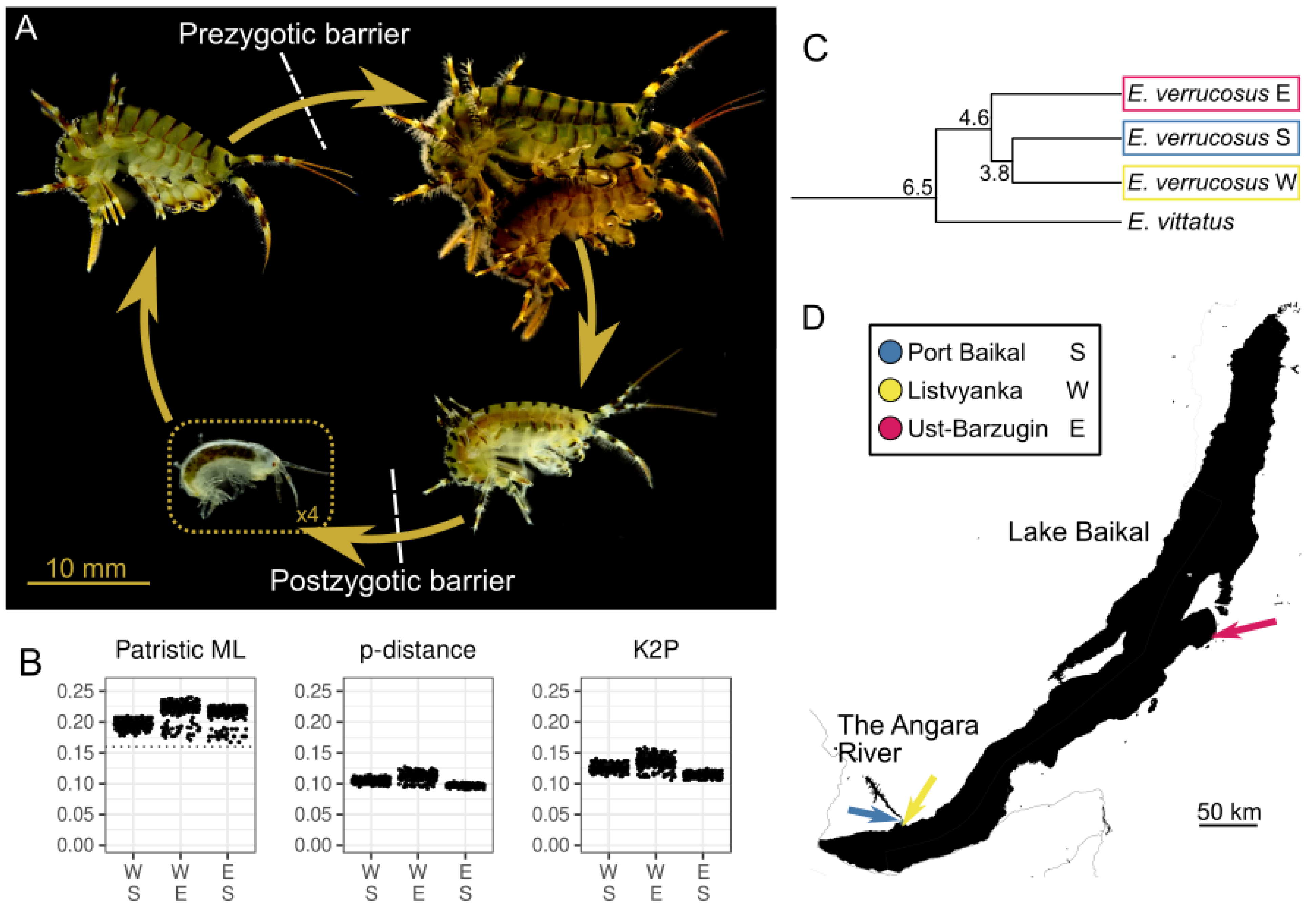
Figure 1. Object of the study: life cycle (A), genetic diversity (B), phylogeny (C), and sampling geography (D). (A) life cycle of gammaroid amphipods as exemplified by E. verrucosus species complex. All three cryptic species are shown: the juvenile and adult animals in the left part of the figure belong to the W species; the amplexus belongs to the S species; and the ovigerous female is E. The image of the juvenile is shown with four-fold magnification relative to the other animals (indicated as ×4 on the figure). (B) Nucleotide divergence of the 5′ mitochondrial cytochrome C oxidase I (COI) gene fragment assessed as patristic distance on a maximum likelihood tree (left); uncorrected proportion of differences, or p-distance (center); and Kimura 2-parameter (K2P) distance (right). The threshold value of 0.16 is highlighted for the patristic distance. (C) A simplified tree of 15 concatenated nucleotide sequences of mitochondrial genes (13 protein-coding genes and 2 rRNA genes) calibrated based on the known mutation rate of COI in gammarids. The numbers above the internal nodes correspond to mean last common ancestor age. E. vittatus was used as an outgroup. Redrawn from [12]. (D) Sampling spots for the three cryptic species.
Diversity 17 00781 g001
Figure 2. Design of the sampling procedure and experimental manipulations. (A) Sampling. The animals were sampled in amplexus state; the amplexuses were separated on spot, and each ten animals of one sex were placed in a separate tank. (B) Combinations for the mate choice trials used to check for prezygotic reproductive barriers. (C) Design of the crossing experiment to assess postzygotic reproductive barriers. The numbers after the # sign indicate the amplexuses from which each animal originated. The animals were mixed in such combinations so that none could re-form an amplexus with their original mating partner at the time sampling.
Diversity 17 00781 g002
Figure 3. Comparative body lengths of males and females of the three cryptic species within E. verrucosus. *, p < 0.05; **, p < 0.01; ***, p < 0.001; ****, p < 0.0001; ns, not significant (Wilcoxon–Mann–Whitney test with Holm’s correction for multiple comparisons). For raw data see Table S1.
Diversity 17 00781 g003
Figure 4. Results of the mate choice trials. Schematics on the left side show examples of two out of 12 trial types (listed along the vertical axis of the graph). See Table S2 for full information on each trial.
Diversity 17 00781 g004
Figure 5. The dynamics of amplexus formation and the number of males and females during the experiment. In cases where one of the crossed species was E, we were able to distinguish them by naked eye and thus monitor the number of males and females at each water exchange. In other cases, the counts of males and females were identified microscopically after fixation at the end of the experiment. See Table S3 for complete data set.
Diversity 17 00781 g005
Figure 6. The dynamics of the number of ovigerous females in each crossing combination. The reversible decreases in the counts might in some cases be related to underestimation of females with a few eggs and/or dark coloration, as the time of assessment was kept to a minimum to minimize handling and its potential effects on the animals. See Table S3 for complete data set.
Diversity 17 00781 g006
Figure 7. Lost eggs found in the tanks throughout the experiment. The numbers next to the panel titles correspond to the total number of lost eggs found in this tank. The photographs show example eggs stained with PI, with putative developmental stages according to [42]. The 38 eggs found in the ExE tank on December 26 were associated with a death of an ovigerous female. The asterisks sign marks the cases where the most similar stage was indicated, but the egg seemed already decaying. The scale bar is 100 μm. See Table S4 for complete data set.
Diversity 17 00781 g007
Figure 8. The dynamics of juvenile release in different crosses. Release of juveniles was observed in all control combinations and in three experimental combinations. The numbers in boxes correspond to the count of released juveniles. Genotyping results for the 18S marker fragments are provided below, where applicable. *, suspected contamination from another tank. **, suspected contamination with animals from a different species in the beginning of the experiment. See Tables S3 and S5 for complete data set.
Diversity 17 00781 g008
Figure 9. Distribution of the W and S species in the vicinity of the Angara River Source. Each square represents one animal and is filled according to the genotyping result (either with COI sequencing or qPCR genotyping for COI and 18S). Squares with gray borders correspond to the data obtained earlier [20,31], while those with white borders depict the data obtained in this study.
Diversity 17 00781 g009
Disclaimer/Publisher’s Note: The statements, opinions and data contained in all publications are solely those of the individual author(s) and contributor(s) and not of MDPI and/or the editor(s). MDPI and/or the editor(s) disclaim responsibility for any injury to people or property resulting from any ideas, methods, instructions or products referred to in the content.