You are currently viewing a new version of our website. To view the old version click .

Molecules, Volume 25, Issue 10

May-2 2020 - 196 articles

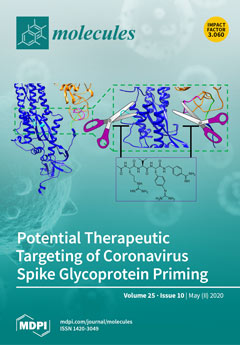
Cover Story: In a process called priming, coronavirus strains require cleavage of their spike glycoprotein at various sites by human host proteases to initiate the invasion of host cells. Low pathogenic coronavirus strains depend on the trypsin-like protease TMPRSS2 for priming. However, in the highly pathogenic SARS-CoV2, causative of COVID-19, the priming site is also recognized by the serin protease furin. Unlike TMPRSS2, furin is ubiquitously expressed in several organs, which may contribute to the increased pathogenicity of SARS-CoV2. Hence, we propose the development of either pan-serine protease inhibitors or inhibitor cocktails to target SARS-CoV2 and potentially to ward off future pandemics that could develop because of additional mutations in the S-protein priming sequences in coronaviruses. View this paper.
  • Issues are regarded as officially published after their release is announced to the table of contents alert mailing list .
  • You may sign up for email alerts to receive table of contents of newly released issues.
  • PDF is the official format for papers published in both, html and pdf forms. To view the papers in pdf format, click on the "PDF Full-text" link, and use the free Adobe Reader to open them.

Articles (196)

  • Review
  • Open Access
27 Citations
7,400 Views
40 Pages

The World of Cyclic Dinucleotides in Bacterial Behavior

  • Aline Dias da Purificação,
  • Nathalia Marins de Azevedo,
  • Gabriel Guarany de Araujo,
  • Robson Francisco de Souza and
  • Cristiane Rodrigues Guzzo

The regulation of multiple bacterial phenotypes was found to depend on different cyclic dinucleotides (CDNs) that constitute intracellular signaling second messenger systems. Most notably, c-di-GMP, along with proteins related to its synthesis, sensi...

  • Article
  • Open Access
24 Citations
4,911 Views
17 Pages

Experimental Data Based Machine Learning Classification Models with Predictive Ability to Select in Vitro Active Antiviral and Non-Toxic Essential Oils

  • Manuela Sabatino,
  • Marco Fabiani,
  • Mijat Božović,
  • Stefania Garzoli,
  • Lorenzo Antonini,
  • Maria Elena Marcocci,
  • Anna Teresa Palamara,
  • Giovanna De Chiara and
  • Rino Ragno

In the last decade essential oils have attracted scientists with a constant increase rate of more than 7% as witnessed by almost 5000 articles. Among the prominent studies essential oils are investigated as antibacterial agents alone or in combinatio...

  • Article
  • Open Access
6 Citations
4,657 Views
18 Pages

β2-Homo-Amino Acid Scan of µ-Selective Opioid Tetrapeptide TAPP

  • Dagmara Tymecka,
  • Piotr F. J. Lipiński,
  • Piotr Kosson and
  • Aleksandra Misicka

TAPP (H-Tyr-d-Ala-Phe-Phe-NH2) is a potent, µ-selective opioid ligand. In order to gain further insights into pharmacophoric features of this tetrapeptide, we have performed a β2-Homo-amino acid (β2hAA) scan of the TAPP sequence. To t...

  • Article
  • Open Access
6 Citations
4,949 Views
13 Pages

The scope and limitations of a tandem N-allylation/[2,3]-rearrangement protocol are investigated through the incorporation of a variety of functional groups within an allylic phosphate precursor. This method uses readily accessible N,N-dimethylglycin...

  • Article
  • Open Access
21 Citations
5,028 Views
11 Pages

Study on Different Water-Based Binders for Li4Ti5O12 Electrodes

  • Christina Toigo,
  • Catia Arbizzani,
  • Karl-Heinz Pettinger and
  • Maurizio Biso

In this study, Li4Ti5O12 (LTO) electrodes with different types of water-soluble binders are successfully coated upon aluminum foil. Electrodes containing solely sodium alginate (SA) as a binder or a mixed PVDF/carboxymethyl cellulose (CMC) binder sho...

  • Review
  • Open Access
27 Citations
7,306 Views
19 Pages

Anti-aggregation Effects of Phenolic Compounds on α-synuclein

  • Kenjiro Ono,
  • Mayumi Tsuji,
  • Tritia R. Yamasaki and
  • Giulio M. Pasinetti

The aggregation and deposition of α-synuclein (αS) are major pathologic features of Parkinson’s disease, dementia with Lewy bodies, and other α-synucleinopathies. The propagation of αS pathology in the brain plays a key...

  • Article
  • Open Access
21 Citations
6,007 Views
13 Pages

A simple, rapid, and accurate HPLC-UV method was developed for the determination of creatinine in pig urine. Usually, it is determined in urine in biomonitoring of xenobiotics to correct for variations in dilutions of urine samples. The colorimetric...

  • Review
  • Open Access
33 Citations
6,781 Views
37 Pages

Polymer materials offer several advantages as supports of biosensing platforms in terms of flexibility, weight, conformability, portability, cost, disposability and scope for integration. The present study reviews the field of electrochemical biosens...

  • Feature Paper
  • Article
  • Open Access
27 Citations
5,045 Views
19 Pages

This study applied an untargeted–targeted (UT) fingerprinting approach, based on comprehensive two-dimensional gas chromatography-time-of-flight mass spectrometry (GC×GC-TOF MS), to assess the effects of rainfall and temperature (both sea...

  • Review
  • Open Access
52 Citations
12,648 Views
27 Pages

Second-Generation Androgen Receptor Antagonists as Hormonal Therapeutics for Three Forms of Prostate Cancer

  • Pravien Rajaram,
  • Alyssa Rivera,
  • Kevin Muthima,
  • Nicholas Olveda,
  • Hubert Muchalski and
  • Qiao-Hong Chen

Enzalutamide is the first second-generation nonsteroidal androgen receptor (AR) antagonist with a strong binding affinity to AR. Most significantly, enzalutamide can prolong not only overall survival time and metastatic free survival time for patient...

of 20

Get Alerted

Add your email address to receive forthcoming issues of this journal.

XFacebookLinkedIn
Molecules - ISSN 1420-3049