
- Article

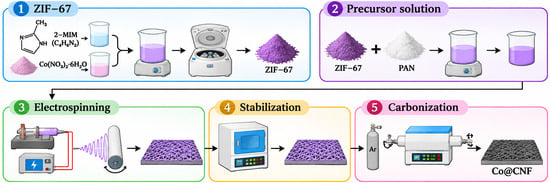
The development of lightweight, broadband microwave-absorbing materials is essential for mitigating increasing electromagnetic pollution. In this study, polyacrylonitrile and ZIF-67 were used as dual precursors to fabricate cobalt-coated carbon nanofiber composites via electrospinning followed by high-temperature carbonization. The effects of pyrolysis temperature on the phase composition, microstructural evolution, and electromagnetic wave (EMW) absorption performance of the composites were systematically investigated. The results reveal that regulating the pyrolysis temperature effectively tailors the porous structure and electromagnetic loss characteristics of the composites. Among the prepared samples, C-800 exhibited the optimal overall EMW absorption performance, achieving a minimum reflection loss of −18.53 dB at a matching thickness of 1.87 mm and a broad effective absorption bandwidth of 6.63 GHz at a thickness of 2.24 mm. The favorable EMW absorption performance of C-800 is mainly attributed to its optimized impedance matching and the synergistic contribution of multiple dielectric loss mechanisms. Specifically, abundant Co/C heterointerfaces, nitrogen-doped defects, and fiber–air interfaces promote interfacial and dipolar polarization, while conductive loss facilitates the attenuation of incident EMWs within the absorber. Furthermore, the favorable EMW attenuation capability of the optimized composite suggests its potential for electromagnetic environmental-regulation-related scenarios such as smart building systems.
24 November 2026