


Abstract
Pharmaceuticals are continually discharged into aquatic environments, where they can cause ecotoxicity, promote antimicrobial resistance, and generate harmful transformation products. Existing reviews often assess treatment technologies individually and provide limited guidance for selecting integrated treatment trains according to contaminant properties and treatment objectives. This review links pharmaceutical occurrence, environmental fate, and ecotoxicological risk with the performance of conventional biological treatment, adsorption, membrane filtration, advanced oxidation processes (AOPs), constructed wetlands, and hybrid systems. It compares the principal removal mechanisms of biodegradation, adsorption, size exclusion, and oxidative transformation and the operating factors that influence efficiency, energy demand, by-product formation, and scalability. No single technology reliably removes the full diversity of pharmaceutical micropollutants. Hybrid treatment trains that combine complementary mechanisms provide broader removal, greater process resilience, and better suitability for water reuse. A practical decision framework is therefore proposed that relates pharmaceutical physicochemical properties, wastewater-matrix characteristics, treatment goals, and process limitations to suitable treatment sequences. This review converts evidence on pharmaceutical fate, ecotoxicity, antimicrobial resistance, and treatment performance into a compound-property-based framework for selecting complementary wastewater treatment trains. It identifies when biological, adsorptive, membrane, oxidative, or nature-based barriers should be combined and specifies residual-risk checks needed for safe discharge and water reuse. Priority research needs include full-scale validation, standardized performance metrics, transformation-product and long-term toxicity assessment, and techno-economic and life-cycle evaluation.
1. Introduction
1.1. The Pharmaceutical Pollution Paradigm
Over the past 30 years, pharmaceuticals and personal care products (PPCPs) have shifted from environmental trace contaminants to pollutants of ecological and public-health concern [1,2]. Global pharmaceutical use is increasing because of population aging, the rising prevalence of non-communicable diseases, and expanded human, veterinary, and aquaculture applications [2,3]. Continuous inputs from wastewater effluent, sludge application, agricultural runoff, and direct discharge can maintain pseudo-persistent concentrations even when individual compounds undergo partial attenuation [4,5].
Pharmaceutical micropollutants are distinctive because they are designed to exert biological effects at low concentrations, and many molecular targets—such as receptors, enzymes, and hormone pathways—are conserved across vertebrate taxa [6,7]. Concentrations ranging from nanograms to micrograms per liter have been measured in wastewater treatment plant (WWTP) receiving waters and can affect non-target organisms [1,8]. Feminization of wild fish populations was first documented downstream of effluent discharges in England, with similar endocrine-related effects subsequently reported elsewhere [9].
Antibiotic residues are additionally linked to antimicrobial resistance (AMR). Sub-inhibitory concentrations can impose selection pressure, facilitate horizontal gene transfer, and increase the abundance of antibiotic-resistant bacteria and resistance genes, potentially compromising clinical treatment [10]. AMR therefore provides a One Health endpoint that connects human, animal, and environmental health [11]. This review integrates pharmaceutical occurrence and environmental fate, ecological and human-health risks, the performance of individual treatment technologies, and evidence for hybrid treatment-train design. As illustrated in Figure 1, multiple source categories converge at common treatment and receiving-water nodes; consequently, no single process is expected to address the full diversity of compounds and exposure pathways.
Figure 1.
Major pharmaceutical input routes through wastewater treatment and into receiving waters, soil, and biota.
1.2. Major Sources and Environmental Entry Routes
To focus intervention at “points of greatest leverage,” knowledge of the location of pharmaceuticals in water is important. Human consumption is the dominant input in the form of parent compounds, and metabolites excreted in urine and feces, reaching receiving waters either via WWTP effluent, where they are only partially removed, or through direct discharge into receiving waters [12,13,14,15]. This pathway accounts for most cases; therefore, upgrading of municipal wastewater treatment would be the largest population level intervention possible. The effluents from hospitals are concentrated point sources, and health-care facilities can contribute more than 80% of some antibiotics and cytostatics to the municipal sewer during low flow conditions [16,17,18]. Pharmaceutical manufacturing is a catastrophic point source, especially in the industrialized areas of India, China, and emerging economies in general [19]. Bacterial levels within effluent from plants used in the bulk manufacture of antibiotics in the vicinity of Hyderabad, India, have been reported to be in the order of many magnitudes higher than the MIC of most of the bacteria present; and, one of these plants was reported to produce up to tens of kilograms of antibiotics daily, a level of localized selection pressure not seen in conventional municipal effluents [19]. This burden is unevenly distributed: pharmaceutical pollution is concentrated in areas with poor governance capacity to respond—for example, parts of Africa, Bangladesh and China—whereas this capacity is stronger in others [20].
Pharmaceuticals used in veterinary medicine, such as antibiotics, anti-parasitic agents and growth promoters in livestock and aquaculture are a significant diffuse source of agriculture. Administered compounds are mainly excreted in their parent form and deposited into the soil via manure application and subsequently leached to surface water and groundwater systems [21,22]. Antibiotics and disinfectants are released directly to receiving waters from aquaculture pens in coastal and freshwater environments with little treatment. The leachates from landfills (particularly if the municipal solid waste (MSW) contains pharmaceutical waste) can also be expected to be a groundwater pharmaceutical load [23]. These are agricultural and veterinary effluents which enter the municipal WWTPs along with human and industrial effluents and contribute to the need of more focused advanced treatments [23].
1.3. Environmental Fate and Behavior
The environmental fate of pharmaceuticals is a structured partitioning process, based on the properties of the compound. The partitioning of the water/sediment occurs as a function of hydrophobicity (log Kow), ionization state (pKa and pH), and sediment organic carbon (OC) content control partitioning between water and sediment [24,25]. Hydrophobic neutral compounds (e.g., propranolol), and hydrophilic ionizable species (e.g., atenolol and metformin), tend to remain in the water column and/or partition to the organic sediments, thus leading to a reservoir effect and a long-term diffuse water contamination [25,26,27].
Photolysis (direct and indirect (sensitized)) is a major abiotic degradation process in surface waters where light reaches the water. Aromatic chromophores such as tetracyclines, fluoroquinolones, and diclofenac can be photodegraded to produce transformation products that can exhibit the bioactivity of the parent compound or increased bioactivity [28]. Clonazepam, on the other hand, is very photostable and has been suggested as a conservative tracer of anthropogenic wastewater inputs into surface waters [29]. The differences in biodegradation under aerobic, anaerobic, and nitrifying conditions are extremely compound-dependent, such as the fact that easily metabolized molecules (e.g., ibuprofen, acetaminophen) are readily removed in river systems, while structurally complex compounds (e.g., carbamazepine, oxazepam, some sulfonamides) are not easily metabolized and are found in sediment profiles [30,31,32].
In particular, transformation products (TPs) and metabolites should be the focus of attention as they may be more persistent, mobile or toxic than the parent compounds. For instance, estrogen glucuronides are excreted as nontoxic conjugates which can be deconjugated to toxic estrogens by microbial enzymes in wastewater and sediments at biologically relevant concentrations [9]. This concern extends to amine-containing pharmaceuticals in general, with the identification of activated sludge products that have toxicological properties quite different from the parent drug by high-resolution mass spectrometry [33]. TP loads can be greater than parent-compound loads in final effluent at full scale [34], and the loads of photodegradation products like chlorinated acridanone derivatives are known to be ecotoxicological concerns [28]. Systematic identification and risk assessment of TPs are still a main gap [35].
1.4. Ecological and Human Health Risks: A One Health Perspective
Pharmaceutical pollution is different from traditional chemical pollution in two aspects: firstly, the effects are sub-lethal and mechanism-specific; secondly, the levels are orders of magnitude lower than those traditionally used in toxicological testing. Natural and synthetic estrogens and certain types of hormone-based medicines are known endocrine disrupting compounds (EDCs) that affect reproductive success, sex ratios and developmental programming in fish, amphibians and invertebrates at sub-lethal concentrations [36]. These effects may not be measurable in standard acute toxicity tests that are used in most environmental risk assessment and compounds considered to be acceptable may still cause measurable effects in population scale, such as the renal failure causing near-extinction of vultures in South Asia due to diclofenac, or the alteration of predator-avoidance behavior in fathead minnows by fluoxetine at environmentally relevant concentrations. Franco et al. [37] compiled a list of the environmental impacts of antidepressants, such as bioaccumulation in fish tissues and behavioral disturbance at environmentally relevant concentrations [38].
AMR then shifts this regional environmental issue to the most pressing public health challenge of the 21st century. Sub-inhibitory concentrations of antibiotics within the water column of rivers, groundwater and coastal waters exert selection pressure on the environmental microbiomes, selecting for an enrichment of resistant phenotypes and the facilitation of horizontal gene transfer, which in turn results in the environmental resistome as a reservoir of clinically relevant antibiotic resistance genes entering human reservoirs via water, food and direct contact [10,39,40,41,42]. The widely cited projection of 10 million deaths per annum by 2050, reiterated in the United Nations Environment Programme (UNEP) environmental AMR assessment [43] was criticized for its overly simple linear projections, but the trend is supported by empirical surveillance: AMR directly caused an estimated 1.27 million deaths and contributed to 4.95 million deaths worldwide in 2019 [44], a burden the World Health Organization continues to track in its global surveillance system [45,46]. Besides clinical and agricultural transmission, there are environmentally relevant horizontal gene transfer in surface water and wastewater treatment plants (WWTP) as shown by reviews of resistome dynamics in environmental reservoirs [10,47,48,49]. This highlights the governance gap in this review; a systematic connection of policy on pharmaceutical production and consumption with the aquatic resistome is missing. The compound classes with the highest reported influent concentrations and inconsistent removal and systematic monitoring gaps are that of NSAIDs and analgesics, the largest drug groups globally [50]. The risk to health from pharmaceutical contamination of drinking-water sources is still being assessed: chronic low-level exposure to mixtures poses little risk of acute toxicity, but there remains uncertainty over the effects of cumulative endocrine disruption, sensitization in immunocompromised individuals and promotion of AMR in human gut microbiome [51,52,53,54]. The toxicity of mixtures is particularly an issue because pharmaceuticals are seldom found individually in environmental samples, and risk assessment for individual chemicals may underestimate environmental risk [55,56,57].
This critical integrative review has three objectives: (i) identify the pharmaceutical properties and aquatic exposure or risk endpoints that matter for treatment selection; (ii) compare the mechanisms and constraints of conventional biological treatment, adsorption, membranes, advanced oxidation, and nature-based processes in wastewater and receiving-water contexts; and (iii) synthesize evidence for sequencing complementary barriers and checking residual risk. Section 3 and Section 4 establish occurrence, transformation, and limitations of conventional treatment; Section 5, Section 6, Section 7, Section 8 and Section 9 assess individual process families; Section 10 and Section 11 compare hybrid sequences and operating trade-offs. The selection framework is a qualitative synthesis of prior studies, not a newly validated optimization model or a universal prescription.
The novelty of this review lies in the integration rule, not in claiming a new treatment technology. First, it uses compound properties as the entry point for process selection rather than treating technology classes as interchangeable. Second, it expands the performance endpoint from parent-compound disappearance to residual mixture toxicity, transformation products, AMR markers, and residual-stream management. Third, it separates evidence-supported treatment archetypes by matrix, treatment objective, scale, and resource context. This structure exposes where published removal percentages are not comparable and where additional barriers or validation are required.
2. Review Methods
A structured literature search was conducted in Web of Science, Scopus, PubMed, and Google Scholar, supplemented by seminal earlier publications needed for disciplinary context. Search terms combined pharmaceutical contaminants with occurrence, aquatic fate, ecological risk, antimicrobial resistance, adsorption, biochar, membrane bioreactors, advanced oxidation, constructed wetlands, hybrid treatment, and wastewater removal. Peer-reviewed primary studies and review articles were eligible when they reported at least one of the following: (i) pharmaceutical occurrence in an aquatic matrix; (ii) environmental fate or transformation; (iii) ecological or human-health risk; or (iv) treatment performance with sufficient process context for interpretation. Book chapters and conference proceedings were excluded unless no peer-reviewed alternative was available. In total, 180 cited sources informed the review. Extracted information was organized by compound class, matrix, concentration range, study scale, treatment technology, operating conditions, removal efficiency, mechanistic interpretation, and reported limitations.
This work is a critical integrative review rather than a preregistered systematic review or meta-analysis. Study heterogeneity in influent concentration, analytical recovery, matrix composition, reactor scale, contact time, and reporting of energy and residual toxicity prevented quantitative pooling. Accordingly, numerical ranges in the tables are interpreted as context-dependent evidence envelopes, not universal design values. Technology recommendations are therefore based on mechanistic complementarity and consistency across evidence types; pilot testing remains necessary before site-specific design or regulatory use.
3. Pharmaceutical Occurrence, Properties, and Transformation in Aquatic Systems
3.1. Classification by Therapeutic Category and Physicochemical Properties
The environmental fate of a pharmaceutical compound is not random and is a predictable outcome of the physicochemical properties of the compound and the physical, chemical, and biological properties of each environmental compartment that it encounters. These factors—hydrophobic partitioning to suspended solids/sediment, charge state controlled by pKa (for electrostatic sorption and membrane rejection), molecular weight and hydrogen bonding capacity (for biodegradability), and susceptibility to photolysis (for the potential for meaningful natural attenuation via transformation by sunlight)—are important [57]. Table 1 summarizes the concentration ranges that underpin ecological risk assessment. It translates this principle by mapping major pharmaceutical classes to their key physicochemical parameters, observed environmental concentrations, main ecological risk endpoints, and relative biodegradability. More importantly, the table shows that the properties most strongly associated with pharmaceutical properties are the same properties that make pharmaceuticals persist in the environment and biologically active at low concentrations, and optimization of the process alone is unlikely to solve this inherent trade-off. Recent systematic reviews of the performance of treatment technology demonstrate that this tension is observed consistently within each technology class: technology platforms that performed best according to metabolic-stability-derived treatability indices performed worst based on removal efficiency [58,59], and the same physicochemical descriptors that predict low removal rate correlate with high occurrence in freshwater in receiving ecosystems [60,61,62,63].
Table 1.
Major pharmaceutical classes detected in aquatic environments: physicochemical properties, occurrence concentrations, ecological risks, and biodegradability.
3.2. Concentration Ranges in Wastewater and Receiving Surface Waters
The concentration data collected in Table 1, far from being descriptive epidemiology of pharmaceutical pollution, embed the evidence of exposure on which ecological risk assessments are based, and the patterns they expose are both diagnostically relevant and often misinterpreted. Antibiotics, like ciprofloxacin and norfloxacin, are found in hospital effluents at several hundred micrograms per liter [18,70]; pharmaceuticals are found in WWTP influents at 10 ng/L to 100 μg/L; surface waters that receive WWTP discharge at the receiving point will be present at low ng/L up to several μg/L depending upon dilution and the persistence of the compound [1,32]. For risk assessment, it is not the absolute concentration that is important, but rather how it relates to lower concentrations that do not yield any effects on aquatic organisms: concentrations commonly found in WWTP effluents are within a factor of 10–100 of no-observed-effect concentrations (NOECs) for several classes of antibiotics and synthetic estrogens, meaning that such concentrations are in the range where mixture effects and chronic sub-lethal exposure become relevant with respect to toxicity [71,72]. This gradient is made explicit in Table 1, which shows that the most frequently detected compounds at high concentration may not necessarily be the greatest concern for ecological risk; instead, the detection of these high-volume compounds has led to a systematic shift towards neglecting high-potency compounds.
3.3. Transformation Products and Metabolites
One of the most important gaps in the science of environmental risk assessment is not the lack of information on transformation products (TPs) and metabolites, but the fact that these are routinely overlooked in risk assessments, where they are never taken into account, even though their metabolites may be more persistent and biologically active than the regulated parent compound [73,74]. The apparent detoxification provided by hepatic conjugation is partially reversed in sewers and receiving waters through the activities of microbial β-glucuronosidase and sulfatase, which liberate the parent compounds [36], resulting in the release of the parent compound that is recognized by the receptor for the therapeutic molecule. The antidepressant drug fluoxetine is a good example of this phenomenon because its metabolite norfluoxetine has the same serotonin reuptake inhibitory activity as the parent compound but is more persistent in the environment than fluoxetine [37,66]. An even more striking example of metabolite dominance is in the case of the metabolite O-desmethylvenlafaxine, which has been found in German surface waters at concentrations up to six times higher than the parent compound [8], and the risk assessment based on venlafaxine alone therefore systematically underestimates the real serotonergic load to receiving waters by a factor of 10 [75,76]. In the case of certain compounds, oxidative treatment may produce TPs that are more toxic or persistent than the parent molecules [67,77]. Standardized reporting frameworks are necessary because hundreds of TPs have been found by high-resolution mass spectrometry (HRMS) suspect and non-target screening in WWTP effluents that are not monitored routinely.
4. Conventional Wastewater Treatment and Its Limitations for Pharmaceuticals
Traditional wastewater treatment is not failing with regard to pharmaceuticals; it is simply that it was designed for a different purpose. Conventional municipal WWTPs were designed to achieve a reduction in biochemical oxygen demand (BOD), suspended solids, and pathogen loads in three stages: primary (sedimentation, screening), secondary (biological oxidation using activated sludge), and tertiary (sand filtration, UV disinfection, chlorination) [78,79]. This design brief was never for the removal of pharmaceutical micropollutants, but rather incidental, variable, and entirely dependent on coincidental physicochemical compatibility with processes designed for different targets. Conventional treatment performance must instead be reported by compound and matrix. For example, even 80% parent-compound removal leaves 20% of the influent mass in the effluent when flow and loading are otherwise unchanged; its ecological significance depends on absolute concentration, discharge, dilution, potency, and the resulting transformation products [12,15,33]. The removal that does take place is influenced by the compound’s biodegradability, sorption to sludge, and volatilization properties, all of which are found to occur to a similar extent as removal by processes with a totally different purpose. The primary mechanistic issue of conventional biological treatment is not a process problem that can be overcome by process optimization, but rather it is an intrinsic consequence of the inverse relationship between the design objectives of a pharmaceutical and the environmental treatability of the same. Metabolically stable molecules have stable half-lives that would be clinically useful, as well as being resistant to degradation by the microbial enzymes that degrade labile organic carbon [33]. The longer sludge is retained in an extended sludge retention time (SRT; for example, 20–25 days), the more the microbial community becomes dominated by slow-growing specialized degraders, and the more energy-intensive and complicated the system becomes. However, more sludge volume is generated, and more energy is consumed by the system to get the same benefit of co-metabolic transformation by the nitrifying bacteria, which is a characteristic diminishing-returns dynamic of trying to stretch a technology beyond its mechanistic envelope [33]. Seasonal vulnerability is another consideration: colder winter results in reduced microbial activity, while simultaneously the higher flows result in shorter hydraulic residence time, leading to performance failure at the time it is needed most for regulatory compliance [33]. The most significant finding in this evidence is that, rather than an end, it is the beginning of discussions around designing treatment systems: pharmaceutical breakthrough at compliant WWTPs is not a system failure. It is the purposeful result of infrastructure that is designed to cater to another class of concern [4,23,33]. This conclusion is supported by comprehensive reviews of the fate and transformation of emerging contaminants, which find that conventional secondary treatment is the rate-limiting step in either regional regulatory regime [80], and by occurrence surveys of pharmaceuticals in groundwater and surface waters downstream of compliant treatment facilities that demonstrate that persistent pharmaceutical breakthrough is the norm rather than the exception in both high-income and low-income contexts [31,81,82,83]. This reframing has a policy implication, wherein incremental improvements in traditional infrastructure cannot bridge the pharmaceutical removal gap, and investments need to be targeted towards fundamentally different cleanup mechanisms.
5. Biological Treatment Mechanisms and Technologies
5.1. Activated Sludge Systems and Process Configurations
Biological treatment is not just the starting point for pharmaceutical removal, it is the starting point for any economically viable treatment train because the economics of pharmaceutical wastewater management would dictate that, for the full organic load of municipal effluent, energy-intensive chemical or physical processes would be employed first, only after the extraordinary catalytic capacity of microbial communities is tapped. The removal of pharmaceuticals in conventional activated sludge (CAS) systems has been attributed to three main processes: (i) biotransformation and mineralization by nitrifying and heterotrophic bacteria; (ii) sorption to extracellular polymeric substances (EPS) and biomass, leading to the transfer of compounds to the sludge phase; and (iii) co-metabolism, where pharmaceuticals are oxidized incidentally during the metabolism of primary substrates [84]. Ul Islam et al. [84] have reviewed the activated sludge process and its variants—sequential batch reactors (SBR), integrated fixed-film activated sludge (IFAS), and moving bed biofilm reactors (MBBR), revealing that the activated sludge process is superior when it comes to eco-friendliness, and that it yields good quality effluents for biodegradable pharmaceuticals such as antibiotics, hormones, and antidepressants [85,86]. The main parameters affecting removal are hydraulic retention time (HRT) and SRT. Longer SRTs (>15 d) promote the growth of slow-growing nitrifiers and specialized degraders that can mineralize recalcitrant compounds by co-metabolism [84]. The removal of 17α-ethinylestradiol (EE2), estrone, and some antibiotics is significantly improved in an extended aeration system with an SRT greater than 20 d than in the classic configuration with an SRT of 5–10 d [4,87]. However, CAS is not effective in consistently removing >50% of carbamazepine, gabapentin, iopromide, and metformin under actual operating conditions, thus requiring additional treatment stages [67,88]. Figure 2 introduces these mechanisms before the individual biological configurations are considered.
Figure 2.
Principal biological mechanisms relevant to pharmaceutical treatment: aerobic biodegradation, co-metabolism, enzymatic oxidation, biosorption, plant-associated uptake, and anaerobic transformation. The pathways differ by compound and process; parent removal does not by itself establish detoxification.
5.2. Membrane Bioreactors
Membrane bioreactors (MBRs) retain biomass and can operate at longer sludge retention times (SRTs) than conventional activated sludge (CAS), which may improve removal for some compounds [3,28,89]. Reported removal is higher for sulfonamides (60–95% versus 20–70%) and macrolides (50–90% versus 20–60%) in the studies summarized here [90,91]. Performance remains compound dependent: carbamazepine and trimethoprim show only a limited advantage over CAS in some comparisons [91]. Biomass retention therefore does not guarantee removal of recalcitrant molecules, and an MBR may need a downstream adsorptive or oxidative polishing step.
5.3. Enzymatic and Fungal Treatments
The conceptually important alternative to the conventional biological treatment is the radical-mediated oxidation of the aromatic pharmaceutical compounds (which is also the way that the structural complexity of lignin is degraded). The latter is performed by the ligninolytic fungi, which have evolved to degrade lignin, and which utilize non-specific radical-mediated oxidation to degrade the aromatic pharmaceutical compounds that would otherwise not be biodegradable. Under laboratory conditions, the removal rates for estrogens, carbamazepine, diclofenac, and bisphenol A are over 90% using oxidoreductase enzymes, such as laccases and manganese peroxidases, produced by Trametes versicolor and Phanerochaete chrysosporium [25,92,93]. Mechanistically, the lack of induction pathways is compound independent, i.e., these enzymes are structurally very broad-spectrum [94,95]. Enzymes can be immobilized on carrier materials (silica, chitosan, metal–organic frameworks) which leads to highly stable laccases and to a continuous operation of the reactors [93]. Laccase-based treatment systems have been combined in hybrid systems such as laccase/photo-Fenton sequential trains with outstanding performance in the elimination of persistent pharmaceuticals [96]. Enzyme production cost, enzyme sensitivity to real wastewater matrices (pH, salinity, inhibitory compounds), and the production of oxidative coupling products that need further treatment are key drawbacks for a potential full-scale deployment [97].
5.4. Bioaugmentation and Microbial Consortia
The compound-specificity problem of biological treatment is solved by targeted ecological engineering (bioaugmentation), which refers to the intentional inoculation of specific bacteria into the activated sludge system that are able to degrade specific pharmaceuticals. When CAS systems rely on the naturally occurring microbial community, the question is whether the performance of the desired microbial communities can be systematically further optimized via enrichment beyond their natural abundance. The results are tentatively positive: Enrichment of Sphingomonadales, Rhodococcus spp. and Pseudomonas spp. from pharmaceutical contaminated environments showed 20–40% improvements in the removal of sulfonamides and tetracyclines with CAS inoculation. The activated sludge community has been proposed to become pharmaceutical resistant by horizontal gene transfer–activated sludge itself is the substrate, and over time, more and more pharmaceutical degradative genotypes will be selected. Another emerging field of application that has gained momentum in the past few years, both in the field of practical design and optimization, is that of pharmaceutical degrading communities, which can be studied through metagenomic and metatranscriptomic techniques in a full-scale WWTF [98,99].
6. Adsorbent Materials and Their Use in Treatment Trains
6.1. Powdered and Granular Activated Carbon
Activated carbon is one of the most critical and important activated adsorbents in the treatment technology arena for the pharmaceutical industry: it is at the same time the most tested activated carbon and the reference point for any other adsorbent. A near ideal surface for interacting with the aromatic chromophores of pharmaceuticals through hydrophobic and π–π stacking interactions, which is earned by the surface area of 500–2500 m2/g, its hierarchical pore structure and π-electron-rich graphene basal planes [3,100]. Diclofenac and estrogens can be effectively removed by adding 10 to 20 mg/L in the biological treatment stages, or by adding new powdered activated carbon (PAC) as a tertiary polishing stage, with more than 90% removal efficiency [101,102,103].
6.2. Biochar and Engineered Biochar Adsorbents
Biochar’s rise to the status of a pharmaceutical adsorbent is a move toward considering materials a little more seriously from a cost perspective: in addition to asking if a material can have acceptable removal capabilities, researchers now ask whether it can have this ability at a cost that can be sustained for deployment in low- and middle-income country applications where agricultural residues are abundant and treatment capacity is under-resourced. The physicochemical properties of biochar are not fixed but can be designed by altering feedstock and/or pyrolysis conditions, such as surface area (50–600 m2/g), tunable pore structure, surface functional groups (carboxyl, hydroxyl, amino) and mineral content. The higher the pyrolysis temperature, between 400 and 700 °C, the more likely the resulting product is to be aromatic and have a high surface area (downside is that it is even less likely to be hydrophobic enough for pharmaceutical adsorption), but also less likely to be electrostatically attractive to ionizable compounds (downside is that it may be hydrophilic). The practical implication here is that biochar is not a uniform material; e.g., a rice husk biochar pyrolyzed at 400 °C is not necessarily a sewage sludge biochar pyrolyzed at 700 °C, and they have different functions as adsorbents and need to be evaluated differently [104]. A significant milestone for engineered biochars is the inclusion of metal doping (Fe, Zn, Al), chemical activation (KOH, ZnCl2), and magnetic modification (Fe3O4 incorporation for magnetic separation from treated water) systems that break from the traditional view that activated carbon is the limiting factor in the performance of pharmaceutical adsorptive treatment [105]. Ferfera-Harrar et al. showed this with a magnetic carboxymethyl cellulose/Fe3O4 composite that was able to effectively remove ciprofloxacin using a Langmuir model, combining adsorption and photocatalysis, which defies both the cost-performance assumption of current adsorption system design and the assumption that the regeneration cost of the GAC would be the major cost driver within hybrid treatment system configurations [77,106]. Table 2 presents a comparison that is relevant to decision-making: instead of arranging adsorbents by capacity, each material class is compared to its target compound class, optimal conditions, regenerabilities, and key limitations, which reflect the multi-dimensional trade-offs that determine if a high-performing lab material is deployable in real treatment systems. Table 2 should be consulted in advance by readers wishing to choose an adsorption stage for a hybrid treatment train because the type of adsorbent used will dictate the percentage of the pharmaceutical load that is captured and the amount of the load that will be delivered to the subsequent oxidative or biological stage.
Table 2.
Comparative performance of key adsorbent materials for pharmaceutical removal: capacity, optimal conditions, regeneration, and limitations.
6.3. Nano Adsorbents and Metal–Organic Frameworks
The literature on nano-adsorbents is one of the most “performance intensive” in the field of drug therapy research, and one of the most “deployment remote”. Metal–organic frameworks (MOFs), carbon nanotubes, graphene oxide composites, and magnetic nanoparticles regularly have adsorption capacities for fluoroquinolones and tetracyclines that are an order of magnitude more than those of activated carbon, and MOFs, in particular, have a surface area of more than 7000 m2/g. While these results are real, the barriers to their implementation, which the lab literature has tended to overlook, are the following: synthesis cost, nanoparticle ecotoxicity, aggregation in actual wastewater matrices, scalability of regeneration, and no demonstration of full-scale deployment. This challenge is not to increase the performance number further (as this is already beyond any reasonable demand on the treatment), but to find out which nano-adsorbent geometry, synthesis pathway, and operational conditions can make the leap from lab to municipal scale. To make this performance-cost trade-off explicit, Table 2 presents adsorption capacity data for each of the classes of adsorbents, showing that the highest capacity adsorbents are always the most distant from deployment [111].
7. Advanced Oxidation Processes (AOPs)
7.1. Principles and Hydroxyl Radical Chemistry
Advanced oxidation processes (AOPs) may be distinguished from other separation technologies (biological and physical) by their common mechanistic logic, which involves the creation of reactive radical species, primarily hydroxyl radicals (HO•, +2.80 V vs. NHE) and sulfate radicals (SO4•−, +2.40 V), that oxidize organic molecules non-selectively by hydrogen abstraction, radical addition, and electron transfer [91]. The non-selectivity is at the same time AOPs’ most powerful property and greatest operational limitation—its ability to interact with essentially any organic molecule, and not distinguish it from the species of dissolved organic matter, carbonate and bicarbonate that tend to dominate real wastewater matrices. This radical scavenging effect is the reason why every time AOP is tested in a clean lab, the performance is superior to what is achieved in a field application, which is a systematic optimism bias that can have consequences in decisions on technology adoption if not properly understood. In contrast with biological treatment, in theory, AOPs can completely mineralize the recalcitrant pharmaceuticals, but in practice, the aim is to break down the pharmaceuticals to non-toxic and biodegradable intermediates, as full mineralization would require high levels of energy input.
7.2. Ozonation and Ozone-Based Processes
Consequently, the widespread use of ozonation for pharmaceutical removal, despite the fact that laboratory research on the use of AOP for pharmaceutical removal is in its infancy [112], is a result of a combination of factors that are frequently overlooked: unlike most other AOPs, there are no chemicals involved that need to be transported and stored; ozone can be generated on-site, either from air or oxygen, without the need for chemical supply chains; and decades of experience in drinking water treatment have led to the development of well-known engineering and safety protocols. Ozone is selective in its reaction with electron-rich functional groups such as activated aromatic rings, C=C double bonds, and tertiary amines, and through the formation of HO• radicals from ozone decomposition. This selectivity is strategically beneficial as all the antibiotics, antidepressants, and steroid hormones have such functional groups, which can be efficiently converted at the dose of 0.5–1.0 mg O3/mg DOC. But this selectivity is the reason why the functional groups found in a compound are absent, such as in metformin, some X-ray contrast agents, and perfluorinated compounds with short carbon chains, the compounds must be treated with supplemental methods. The formation of transformation products, such as potentially genotoxic nitrosamines and bromate, is the biggest risk associated with the use of ozone and needs to be incorporated into treatment performance evaluation and not an add-on task [113].
The most significant drawback of ozonation is not the energy requirement or the capital cost, but the fact that the same radical oxidation reaction that eliminates pharmaceutical compounds also results in the formation of a new population of transformation products, such as aldehydes, carboxylic acids, and in the presence of bromide ions in the water, bromate (regulated by EU drinking water standards at ≤10 micrograms per liter), which can have greater toxicity than the pharmaceutical mixture being targeted [67]. This is not to say that ozonation is not an option; it simply is a new engineering dilemma. The key observation is that the intermediates formed during the process of ozone decomposition become biodegradable under the action of the biological active filtration (BAF), thus using the by-product problem as the design opportunity of the system—sequential ozonation and biologically active filtration (BAF) could give an ozone mineralization efficiency level that neither one process alone could reach, and the toxicity of the by-products and the assimilable organic carbon (AOC) are removed in the biologically active filtration stage [67]. This O3–BAF configuration is now being deployed at full scale in Switzerland and has been validated in practice with a micropollutant removal rate of more than 80% for most of the monitored compounds—this is the most convincing proof in the current literature of the hybrid treatment concept. An alternative modification to the peroxone system (O3/H2O2), which increases HO• production by 2–4 times, further extends removal to electron-poor compounds with ozone resistance, while simultaneously providing some bromate mitigation benefits, is available [110]. Recent comparative studies of catalytic ozonation have shown that using heterogeneous catalysts is a way to obtain a higher yield of radicals (without proportional increase in energy cost) and to achieve a better mineralization rate and less formation of by-products than conventional ozonation [114,115]. It is noteworthy that, within the AOP category, the choice of technology for the degradation of diclofenac and ibuprofen is also dependent on the structure of the compound, with no single technology prevailing for the entire range of NSAID structures [67], further highlighting the multi-criteria approach outlined in Table 3.
7.3. UV-Based AOPs
UV/H2O2 has a unique place in the AOP portfolio: UV/H2O2 is superior to ozonation for UV absorbing compounds and is less affected by radical scavenging from carbonate species that inhibit the indirect oxidation with ozone [110]. The quantum yield for the production of HO• upon photolysis of H2O2 is ~0.5 mol/mol, and the rate constants for reactions of HO• with target pharmaceuticals typically range from 108 to 1010 M−1 s−1 [67]. The energy costs of 500–1000 mJ/cm2 and the chemical costs in the form of H2O2 in the range of 10 mg/L for >90% reduction in resistant compounds are considerable, and the cost of failure to achieve this effect must be taken into account to justify the use of these energy and chemical inputs. The cost/benefit analysis clearly supports investment in UV/H2O2 systems in water reuse applications, but in applications involving municipal WWTP effluent discharge where the receiving water has considerable dilution capacity, selected and specific investment may not be justified for most compounds. This context-dependency is exactly why the decision framework developed is needed: UV/H2O2 is not a universally relevant AOP, but rather one that should be applied on a compound-by-compound basis as well as context-by-context [116].
Semiconductor catalysts (mainly TiO2, ZnO, and modified TiO2 and ZnO active under visible-light irradiation) can produce both HO• and superoxide radicals upon UV or solar light irradiation, which can mineralize pharmaceutical compounds [106,112]. In tropical and subtropical developing countries where solar radiation levels are high and energy prices are a significant obstacle to the effectiveness of treatment, solar photocatalytic reactors are an attractive option. Mestre and Carvalho [106], reviewed the performance and reaction mechanism of TiO2-based photocatalysis for degradation of pharmaceuticals, reporting on the role of semiconductor/carbon composites (mainly TiO2-based) in improving the degradation of recalcitrant pharmaceuticals like carbamazepine, diclofenac, and sulfamethoxazole under sunlight, with CO2 and water as the main end products.
7.4. Electro-Oxidation and Electro-Fenton
Electrochemical oxidation techniques are based on a different engineering principle than the photolytic and ozonation techniques for the elimination of pharmaceutical residues—no chemicals are added to the water, but oxidants are formed in situ at the surfaces of electrodes, with potential for modular, reagent-free treatment systems driven by renewable electricity. BDD anodes are especially efficient because they produce HO• at a greater density than other electrode materials, which allows drugs to be directly anodically oxidized in parallel with indirect oxidation occurring in the bulk phase by electrogenerated H2O2 and persulfate. This is further enhanced by the electro-Fenton process, which generates Fe2+ in the bulk solution along with electro-generated H2O2 to activate the HO• in the bulk solution to reduce mass transfer limitations for the direct anodic process. The most interesting use for electrochemical AOPs is the treatment of effluents from pharmaceutical factories with high organic loads and highly complex effluents from concentrated hospital wastewater, where the matrix and the organic load of the wastewater could be inhibitory to the photolytic process [117] and where there is no central sewer connection, making decentralized, modular technology appealing. The most restrictive factor in the electrochemical AOP scale-up is energy consumption: current efficiencies for pharmaceutical mineralization remain low compared with those of ozone-based systems, and electrode costs and lifetimes need to be reduced to make the technology economically competitive at the municipal scale. Table 3 shows a trend of systematic compromises in the various AOP configurations that cannot be clearly reduced to a single performance ranking: the most energetically favorable AOPs (ozonation) have the highest risk of by-product production; the most complete mineralization processes (electro-Fenton and electro-oxidation) have the highest energy consumption and lowest technology readiness level; and the solar-driven processes have promising energy efficiency, but with performance variability dependent on matrix and solar irradiance. This inverse correlation between selectivity and energy demand, and by-product profile, is not a coincidence, but a direct result of the fundamental chemistry of radical-mediated oxidation and forms the multi-criteria optimization problem that hybrid treatment design has to solve.
Table 3.
Comparative assessment of advanced oxidation processes (AOPs) for pharmaceutical removal: target compounds, energy, removal efficiency, by-products, and technology readiness.
8. Membrane-Based Separation Technologies
8.1. Nanofiltration and Reverse Osmosis
Nanofiltration (NF) and reverse osmosis (RO) are called pressure-driven membrane processes and have a unique place in the hierarchy of pharmaceutical treatments: They are the only processes that come close to being compound-independent and are therefore essential in water reuse applications where no or only limited information on the pharmaceutical contaminants in the influent is available with which to design the treatment. The mechanisms of rejection are size exclusion, charge repulsion and hydrophobic adsorption to the membrane polymer, the relative importance of which depends greatly on compound class, membrane material and operating conditions, which cannot be captured by single parameter characterization of rejection. Pharmaceuticals are near-absolutely rejected (>95–99%) by RO membranes (with an effective pore radius < 0.5 nm); they are the best single barrier to remove micropollutants in potable reuse applications. The rejection of compounds is typically 70–99% on NF membranes (0.5–2 nm pore radii), depending on the MW and charge of the compound, with an important exception being that the neutral low MW molecules like some carbamazepine metabolites can be rejected at a much lower level [119,120,121]. Important NF/RO limitations are not its removal capabilities but rather the management of the concentrate: each molecule that does not pass through the membrane is concentrated in a fraction of the feed, usually 15–25%, which is disposed of without additional treatment, thereby displacing the contamination issue to the concentrate.
8.2. Membrane Fouling and Operational Challenges
Membrane fouling is not only an operational nuisance, but it is also how the economics of NF/RO pharmaceutical treatment is determined. Particulates, colloids, natural organic matter, and biofilms are deposited on surfaces of the membranes, which contributes to increased TMP, decreased permeate flux, and accelerated membrane degradation, necessitating chemical cleaning cycles to restore the membranes, where acids, bases, and biocides required for the cleaners result in a counterbalancing environmental impact [122]. Pharmaceutical-laden matrices from hospital effluents and pharmaceutical manufacturing wastewaters are especially prone to fouling due to high organic loading and surfactant content, creating a paradox in which the matrices that most need membrane treatment are those that make membrane operation most operationally challenging [122,123]. A direct implication of the mitigation strategy, pretreatment by coagulation-flocculation, UF or biological treatment upstream of the membrane [124] will have on the system design is that NF/RO cannot be considered as a stand-alone technology, but as the final step in a treatment train whose configuration upstream of NF/RO will determine the sustainability or intermittent performance of the membrane. The integrated hybrid approach is one of the most compelling reasons for a systems dependency.
9. Nature-Based Solutions (NBS) for Pharmaceutical Removal
9.1. Constructed Wetlands
Constructed wetlands (CWs) are a fundamentally new treatment paradigm compared to the engineered chemical and physical treatment systems, where treatment is achieved by applying focused energy or chemical input to the pharmaceuticals to drive transformation; instead, CWs take advantage of the three-dimensional spatial structure of a natural ecosystem, which consists of three distinct zones—air/canopy, water column, and substrate—to achieve six parallel mechanisms of treatment at low operating cost. Structurally, as shown in Figure 3, each zone has its own pathways: pharmaceuticals that are UV-labile are removed by photolysis, and those that have low log-H are removed by volatilization in the air and water column; uptake and translocation are the main removal routes for pharmaceuticals in above-ground biomass; while rhizosphere biodegradation, substrate adsorption, and filtration/sedimentation are the primary removal processes in the soil zone [125]. It is CWs’ greatest strength but is also a cause for their performance variability; compounds that are resistant to one pathway may still be susceptible to another, and the overall removal efficiency (40–95%) is an integrated result of the efficacy of the six mechanisms involved in degradation for the specific compound mixture present. The implications for the design of the treatment plants are clear: CWs are best suited to serve as a post-primary and post-secondary treatment system to remove the remaining pharmaceutical fraction that the primary and secondary treatment systems have missed. A comprehensive comparative study of removal mechanisms for the various constructed wetland configurations confirms that variations in performance can be explained by a significant interaction between the compound class and the type of design (surface-flow vs. subsurface-flow vs. hybrid). Surface-flow systems appear to have an advantage for hydrophobic compounds because they allow for more contact with the substrate, while subsurface systems have an advantage for photolabile compounds because they have direct exposure to UV [109,126,127]. The multi-mechanism logic is extended further in algae-based nature-based systems: in addition to pharmaceutical removal by biosorption, biodegradation, and photolysis, water column chemistry is also influenced by the presence of the microalgae, which can increase the efficiency of the removal process in the way described, with the additional benefit of valorizing the biomass, thus reducing the operating costs, especially in the case of systems being deployed in a resource-constrained setting as highlighted throughout this review [122]. Earlier work on the topic had produced a series of very useful, if somewhat dated, reviews of CW performance in terms of their ability to remove various classes of pharmaceuticals. Taken together, these efforts have enabled us now to confidently state that removal rates fall within a narrow window of efficacy ranging from 40 up toward nearly complete (95%) removal capabilities. Notably, though, there remains significant heterogeneity among reported data stemming largely from differences in hydraulic retention times plus seasonal temperatures experienced by individual sites studied [128,129,130,131].
Figure 3.
Constructed wetland pharmaceutical removal pathway diagram showing the integration of photolysis in the water column, plant uptake and translocation, rhizosphere biodegradation by specialized microbial communities, adsorption to organic matter and mineral substrates, and filtration/sedimentation.
Overall pharmaceutical removal efficiency ranges from 40 to 95% depending on compound class, hydraulic retention time (HRT), plant species, and seasonal temperature variation. There is a high compound-specific and seasonal variance of removal efficiencies in CWs. With proper design and sufficient HRT, easily biodegradable compounds such as ibuprofen, acetaminophen, and estrone can be removed by more than 90% in CWs [131]. Some of the compounds (carbamazepine, gabapentin, and diclofenac) have low removals (<40%) in most of the CW configurations, demonstrating their biological recalcitrance [131]. A combination of these types of treatment methods, such as activated carbon filters, solar disinfection, or ozone dosing, has been used in hybrid CW designs to show a significant improvement in these recalcitrant compounds [109]. Algal-bacterial symbiosis enhances the removal of a wider range of pharmaceuticals by utilizing CO2 fixation for algae to maintain high oxygen levels and to support special heterotrophic degraders of pharmaceuticals in CWs [107,132,133].
9.2. High-Rate Algal Ponds and Phycoremediation
High-rate algal ponds are one of the least explored treatment paradigms in the literature of pharmaceutical removal (not because they are bad, but because the research community has been slow to realize that the mechanisms of action are fundamentally multi-modal single-mechanism technologies cannot be replicated). The microalgae take advantage of the high dissolved oxygen (from photosynthesis), the high pH (8.5–10), and the high intensity of solar UV, which synergistically degrade pharmaceutical compounds by biodegradation, alkaline hydrolysis, photolysis, and biosorption. Estrogens are taken up by algae, removing them; Antibiotics are removed by pH-driven hydrolysis and by co-co-metabolism with bacteria in algal-bacterial consortium; analgesics are removed by biodegradation. The practical case for HRAPs in LMIC contexts is strong: in the absence of land, the most significant constraint, the use of HRAPs as an energy and chemical cost-effective alternative to expensive engineered systems is more practical in the presence of land than when it is not. Algal biomass is also a valuable co-product in land-based systems [134]. However, one of the challenges in the field is the seasonal variation in performance, with solar irradiance that is conducive to photolysis in summer not available in the winter, which puts performance gaps in the system design.
9.3. Soil Aquifer Treatment and Bank Filtration
Society needs more analysis of how soil aquifer treatment (SAT) and riverbank filtration (RBF) can achieve something that no engineered technology can: continued, progressive pharmaceutical attenuation over a spatially distributed treatment zone whose capacity increases over time as adapted microbial communities colonize the zone. The mechanism is physical filtration, aerobic and redox-variable biodegradation, and sorption to soil organic matter and mineral surfaces, which occur with an effective energy cost of zero, in addition to the energy cost required for the aquifer recharge or river-bank infiltration [135]. In Germany, the Netherlands, and in the central part of Europe, bank filtration, a pre-treatment method for drinking water supplies, removes 50–99% of most pharmaceuticals with travel distances of 10–100 m, and travel time (residence time in the subsurface) is the most important performance driver [135,136]. The limitation is site specificity (geology, aquifer hydraulics, local redox conditions), which limits their use of SAT/bank filtration, as they are enablers when conditions are favorable and are not necessarily deployable technologies. They are suitable to serve as a low-cost passive polishing step to further reduce the pharmaceutical load of treated effluents for which the pharmaceutical load has already been significantly lowered by engineering carried out upstream.
10. Integrated Hybrid Treatment Trains
10.1. Rationale for Hybrid Approaches
The diversity of the pharmaceutical micropollutants, the complexity of the mixtures, the variability of the occurring source matrices and the lack of a technology capable of providing complete removal of the full range of pharmaceutical micropollutants are the most fundamental challenges of the pharmaceutical micropollutant challenge. The main consensus of the scholars, as represented by Tapera et al. [50], Ul Islam et al. [84], and others, is that more advanced systems with more than one treatment mechanism in an integrated treatment train are needed to consistently achieve >90% pharmaceutical removal with acceptable by-product profiles. Hybrid treatment trains take advantage of the complementarity of various removal mechanisms: biological degradation for easily biodegradable compounds, adsorption for hydrophobic recalcitrant compounds, AOPs for the transformation of selected recalcitrant compounds, followed by polishing to address transformation products, and membranes for an absolute physical barrier. Target compound properties and treated water quality goals determine and guide the strategic sequencing of these mechanisms, which forms the optimization problem for treatment train design [33,65,137,138,139,140].
10.2. Evidence-Based Best-Practice Treatment Trains
There is no single technology to solve the pharmaceutical micropollutant challenge; selecting the most promising technology will not suffice. What exists are complementarities of mechanisms that, when intentionally utilized, can result in multi-barrier systems that can remove a wide range of the physicochemical diversity of occurring compounds. The biological treatment is not sufficient for complete pharmaceutical removal, but it is optimal for the high-volume biodegradable fraction, treating it at a lower unit energy and cost, and conditioning the effluent for subsequent polishing steps at a much lower cost than it would be to condition it by means of advanced oxidation or membrane separation for the whole untreated load. Figure 2 clarifies why this is a biological anchor: all six mechanisms that are found in biological systems represent both the capability and the ceiling of biological treatment; explicit identification of which compound classes need to be enhanced is provided by these six mechanisms. This synthesis identifies four illustrative hybrid configurations with published examples; their performance remains dependent on feed composition, operating conditions, and scale.
(i) The most widely applicable and cost-effective hybrid train applicable to an upgrade of a municipal WWTF is the MBR + GAC polishing treatment. The MBR feeds a consistent high- quality feed to the GAC stage, reducing fouling and maximizing adsorption efficiency, while the GAC removes hydrophobic recalcitrant molecules that cannot be biodegraded [112,141].
(ii) Ozonation + biologically active filtration (BAF): This process combines the excellent oxidation ability of ozone for numerous pharmaceutical classes with BAF for the mineralization of biodegradable intermediates and TPs generated by the reaction with ozone. This train has been deployed at full scale in Switzerland for the removal of pharmaceuticals from WWTP effluent; high removal rates (>80%) for most of the micropollutants measured [115,116] have been reported.
(iii) Constructed wetland + solar AOP: It is a hybrid train that combines the simplicity of operation and co-benefits of CWs with a basic solar AOP (solar/H2O2 or solar/TiO2) for polishing treatment and is appropriate for low-resource zones, decentralized treatment and applications in the developing world. The CW stage is used to remove biodegradable and adsorbable fractions to lower the AOP chemical consumption and enhance the performance of the solar reactor [56,142].
(iv) NF/RO + AOP for concentrate: For potable water reuse (drinking water quality standards), the NF/RO can achieve the necessary removal efficiency, and the concentrate can be treated by AOP prior to safe disposal. It is capital-intensive but can easily meet the most difficult reuse situations [35].
10.3. Decision Framework for Treatment Train Selection
Figure 4 translates the descriptors in Table 1 into a qualitative sequence of decisions: first consider relative parent removal under biological treatment, ionization state (pKa at the wastewater pH), and hydrophobicity (log Kow); then assess the actual wastewater matrix and the discharge or reuse target. The class-level values in Table 1 are screening information, not reliable compound-specific design thresholds. Readily biotransformed compounds can enter biological treatment; adsorbable compounds may benefit from activated carbon or suitable biochar; membrane choice depends on charge, molecular size, and reuse requirements. For a compound that remains recalcitrant after the initial barrier, oxidation is an intermediate transformation step and must lead to biological or adsorptive polishing, followed by checks for parent compounds, transformation products, and relevant bioactivity. Pilot testing is needed to confirm the sequence for each mixture and matrix [33,65,137,138,139,140,141,142,143,144].
Figure 4.
Qualitative treatment train screening informed by Table 1. Biodegradability or parent removal, pKa relative to wastewater pH, and log Kow inform the first barrier, while matrix composition and treatment goal constrain the sequence. Advanced oxidation is an intermediate step for recalcitrant compounds and is followed by biological or adsorptive polishing and residual-risk checks. Branches are illustrative rather than validated design rules. AOP = advanced oxidation process; CAS = conventional activated sludge; GAC = granular activated carbon; MBR = membrane bioreactor; NF–RO = nanofiltration–reverse osmosis; TP = transformation product.
Table 4 summarizes a practical process-selection framework linking pharmaceutical characteristics, wastewater conditions, and treatment objectives with appropriate primary and polishing technologies. The framework facilitates the rational design of integrated treatment trains based on contaminant properties, process performance, and operational requirements.
Table 4.
Illustrative process sequences by compound and wastewater characteristics; polishing and residual-risk verification are required.
11. Comparative Performance Evaluation
The decision tree indicates which mechanism to use for a particular compound, while Table 5 shows what this entails in terms of cost and return. The removal efficiencies of compound properties alone are not enough to conclude whether or not a 10-fold increase in energy demand is warranted or if the lower capital cost of a nature-based system is offset by its higher land-area requirements and seasonal variations in performance—these are economic and operational trade-offs that can only be answered with a systematic comparative dataset. This information is provided in Table 5 and compares individual and hybrid technologies in terms of removal efficiency, CAPEX, OPEX, energy demand, by-product concerns, and scalability. The key insights from examining this table as follows: firstly, the difference in performance between individual and hybrid configurations can become quite large for the most difficult compound mixtures, thus justifying the capital premiums of multi-barrier systems, rather than relying solely on the efficiency data; secondly, the cost-per-cubic-meter spread can be two orders of magnitude wide among technology classes, so that economic analysis is essential to the total system design and cannot be an afterthought; and thirdly, when designing the high-efficiency process, one should not ignore the environmental co-effects of the process, such as the concentrated reject streams from the NF/RO units, transformation products from the ozonation units, etc., but include them in the total system design.
Table 5.
Comparative technology assessment: pharmaceutical removal efficiency, capital and operating costs, energy demand, by-product concerns, scalability, and best-fit applications across individual and hybrid treatment configurations.
There are three major analytical observations from this comparison. In the first place, there is no universal technology—carbamazepine can be completely removed by ozone (>95%), and poorly by biological treatment (<20%) or by GAC under normal GAC contact times, while ionizable hydrophilic compounds like atenolol and metformin can be poorly retained by GAC and well removed by MBR under long SRT. Second, cost efficiency trade-offs depend on the context; for water-scarce areas with high-value reuse targets, the investment in NF/RO + AOP can be well worth it; for water-rich rural applications, CW-based systems can provide good performance at orders-of-magnitude lower cost. Third, environmental co-effects such as the sludge produced, energy consumed, and chemical procurement footprint should be taken into account during technology assessment, along with pharmaceutical removal efficiency, by using life cycle analysis (LCA) [68,144,145].
12. Antimicrobial Resistance as a Treatment Outcome Metric
A measurable public health result of this conceptual lag is the continued use of parent compound concentration reduction as the preferred pharmaceutical treatment effectiveness metric, despite the proliferation and dissemination of antibiotic-resistant pathogens being a microbial and ecological issue that is the most serious downstream impact of wastewater treatment. If the activated sludge conditions in a treatment system are conducive to conjugal plasmid transfer among dense metabolically active microbial communities, the treatment system can also be used as a resistance amplification bioreactor that removes ciprofloxacin by 95%. Comprehensive treatment performance evaluation should therefore go beyond concentrations of the parent compound and include the reduction of antibiotic resistance genes (ARGs), mobile genetic elements (MGEs) that facilitate resistance gene transfer, and antibiotic-resistant bacteria (ARB) in treatment effluents, which are not automatically captured by approaches optimized for chemical removal [146,147,148,149]. A key technical gap identified as an opportunity to bridge the gap between treatment performance data and what is actually protecting the public is the development of standardized and validated monitoring approaches for the biological endpoints, similar to the approach used for chemical endpoints in pharmaceuticals. ARG elimination can be ineffective with conventional and even advanced treatment. Horizontal gene transfer is a hotspot, particularly in activated sludge with high biomass loads and the close contact of a variety of bacterial populations in aeration tanks, e.g., conjugal plasmid transfer may exacerbate the ARG burden in comparison with the influent [150,151,152,153,154]. Both chlorination and UV disinfection are effective in inactivating ARB cell viability but are not effective in eliminating ARGs in the extracellular matrix of ARB cells bound to particles [147]. Ozonation, on the other hand, exerts an oxidative effect on both bacterial cells and DNA and has been proven to reduce ARGs by 1–3 log in full-scale systems, thus providing a dual advantage for the removal of pharmaceuticals and AMR [47,49]. The incorporation of AMR outcome measures into global AMR action plans, as well as into scientific and regulatory assessments of pharmaceutical treatment effectiveness, is both a scientific and regulatory priority in keeping with the values of One Health and action plans for combating AMR [11,155].
13. Challenges, Knowledge Gaps, and Future Research Directions
13.1. Transformation Products and Regrettable Substitution
There is the possibility for the formation of ‘regrettable’ transformation products that are more toxic or persistent than the parent drugs during AOP treatment [156,157]. In order to avoid the substitution of known pharmaceuticals with less well-characterized and perhaps more toxic chemical mixtures, toxicity bioassay integration into treatment performance evaluation is paramount. Based on non-target chemical screening and a battery of bioassays (Ames test, endocrine disruption assay, algal growth inhibition), effect-directed analysis (EDA) frameworks can be used to characterize effluents beyond the scope of compound-specific monitoring [154,158,159].
13.2. Mixture Toxicity and Real Wastewater Complexity
The typical pharmaceutical removal scenarios for laboratory testing are single-compound model solutions that do not resemble the compound mixtures that are found in the complex, real wastewater streams [56]. Data on the toxicity of mixtures have consistently shown that combined effects (synergistic, additive, or antagonistic) cannot be anticipated from data on the toxicity of single compounds [145]. Further studies are recommended to systematically assess treatment performance in the presence of realistic pharmaceutical concentrations and mixture compositions, as well as authentic wastewater matrices, such as those containing co-occurring pharmaceuticals, EDCs, heavy metals, microplastics and NOM [143]. An important knowledge gap is the development of validated mixture risk assessment models, using actual wastewater composition data, which have important regulatory implications [144,145,160].
13.3. Standardized Reporting and Comparability
There is a high level of heterogeneity of experimental design, reporting metrics, and data quality in the literature on pharmaceutical treatment, which makes an accurate comparison between different studies and meta-analysis difficult [33,139]. Parameters such as the initial pharmaceutical concentration, water matrix (distilled water, natural water, real wastewater), contact time, temperature, competitor concentration, and analytical detection limits are not consistently reported. The use of a standard reporting form similar to PRISMA designed for systematic reviews (specifying required reporting parameters for experiments, analytical quality, and statistical reporting) would significantly enhance the evidence base for technology comparison and selection [139,161,162].
13.4. Monitoring, Suspect Screening, and Effect-Based Methods
The trend towards non-target HRMS screening is greatly increasing the number of known pharmaceutical contaminants that are being uncovered in water matrices, including hundreds of previously unreported pharmaceutical TPs, veterinary drugs, and illegal compounds [163,164]. In vitro bioassays calibrated to specific mechanisms of action (estrogenic, androgenic, glucocorticoid, thyroid, and cytotoxic) offer a mechanism-informed alternative to chemical monitoring to better reflect mixture effects and are more directly linked to ecological and health risk [165]. Integrating effect-based trigger values into water quality monitoring programs, as proposed for the EU Water Framework Directive watch list, is a great step forward and should be implemented as quickly as possible [166,167,168].
13.5. Policy Integration and Regulatory Development
To achieve effective governance of pharmaceutical pollution, upstream measures beyond end-of-pipe treatment are necessary. Green pharmacy concepts are represented by the design of pharmaceuticals that are intrinsically more biodegradable or environmentally removable and represent the most sustainable long-term solution [78]. Policy instruments such as mandatory take-back programs for unused drugs, preferential regulation of the formulation of ionizable drugs and biodegradable drugs, and extended producer responsibility schemes with the embedded environmental costs of pharmaceutical pollution in drug pricing are policy instruments that are shown to have an effect, but are not yet well implemented globally [19,78]. Pretreatment in hospital-concentrated pharmaceutical streams is cost-effective compared to retrofitting/upgrading of centralized WWTPs and has been required in a number of European jurisdictions [18,169,170,171]. Pharmaceutical monitoring data under WWTP discharge permit conditions and within pharmaceutical regulatory frameworks are crucial components in closing the regulatory loop between pharmaceutical prescribing and environmental protection [165,172].
14. Conclusions
Pharmaceutical contamination of aquatic systems is no longer an “emerging concern” but is now a definite, measurable, and in some cases, irreversible environmental problem. The evidence collected here not only demonstrates a pollution issue but a governance failure as well; the use of pharmaceuticals has increased globally, and funding for the infrastructure that helps catch the pollution has not been commensurate. Five conclusions follow:
Pharmaceuticals are found in the majority of the 1052 sites surveyed from 104 countries, at pharmacologically relevant concentrations, and are found at the highest concentrations where wastewater infrastructure is the least developed [1]. The problem is not isolated or directly proportional to the complexity of regulation, since detection in finished drinking water [173], and at many orders of magnitude higher concentration near manufacturing plants [32,50,174], demonstrates that the problem is not local or scale-dependent of sophistication of regulations [108,175,176]. NSAIDs and analgesics are among the highest reported influent concentrations [50], and are at the heart of the treatment challenge.
AMR and transformation products as non-negotiable outcome metrics: resistance endpoints must be used to assess treatment, not removal of the parent compound. In a One Health context, ozonation provides a 1–3 log reduction of pharmaceuticals and ARGs, in contrast to activated sludge, which can repackage the problem of resistance [11,177]. Two technical priorities follow: firstly, the need for standardized and validated ARG monitoring at WWTP scale, and secondly, the need for routine characterization of the toxicity of the transformation products, as the oxidative and biological steps can generate more persistent or bioavailable products than the parent compounds.
Conventional treatment is, by design, not adequate: failure to remove metabolically stable, structurally complex molecules is not operational but by design, since the goals of conventional systems are BOD and nutrients, which are orthogonal to the removal of metabolically stable, structurally complex molecules. The biological stability, which is a desirable property for therapeutic effect, is also responsible for the presence of these substances in WWTPs at near-influent concentrations, since they are not readily broken down. The policy implication is clear: an incremental optimization of the biological processes will not close the removal gap, but only fundamentally different mechanisms, adsorptive, oxidative, membrane, or nature-based.
Hybrid treatment trains, the evidence-based standard: hybrid treatment trains, which are a combination of biological and chemical processes, perform better than single technologies in most pharmaceutical classes studied and are not simply additive [139]. The gain is both qualitative and quantitative as hybrid trains make use of mechanistic complementarity: the biological stage conditions the feed to a downstream adsorber, thereby extending its life and the utilization of the contact time; the ozonation-mineralization of intermediates by ozonation that are not mineralized by biofiltration alone. The four configurations identified—MBR + GAC polishing, ozonation + BAF, CW + solar AOP, and NF/RO + AOP for concentrate—represent this synergy in different resource and regulatory environments [56,67,84,112,178,179]. The diversity is itself a conclusion: because there is no dominant configuration, a hybrid design has to be context-specific and compound property-based, rather than prescriptive.
The knowledge gaps and monitoring priorities are closely linked aspects of the same issue: risk and treatment frameworks designed for a simpler contamination paradigm that do not reflect the chemical complexity of real wastewater or the biological complexity of mixture response. Governance innovation is required as much as the investment in research; upstream approaches like the mandatory take-back schemes, hospital effluent standards, and extended producer responsibility are more cost-effective in the long term than the end-of-pipe treatment [78,172,180]. The message in the middle is also the simplest: Pharmaceutical pollution is manageable, but it takes engineering skills, regulatory ambition, and industry accountability to do so. This review provides the treatment-train selection framework and comparative performance data to help inform the One Health response, which needs to involve treatment engineering, environmental monitoring, ecological risk assessment, and governance reform.
Author Contributions
G.A.A., T.A., A.A. (Ahmed Alsayafi), and A.A. (Abdulrahman Alahmed): writing—original draft preparation, software, validation, and data curation; A.R.: conceptualization, methodology, formal analysis, writing—review and editing, and funding acquisition. All authors have read and agreed to the published version of the manuscript.
Funding
The authors gratefully acknowledge the financial support provided by the Deanship of Scientific Research, Vice Presidency for Graduate Studies and Scientific Research at King Faisal University, Saudi Arabia, under the Student Researcher Track—Review Articles Annual Grants (Grant No. KFU266174).
Institutional Review Board Statement
Not applicable because this study does not involve humans or animals.
Informed Consent Statement
Not applicable as the study does not involve humans.
Data Availability Statement
All the data used in this study are presented within the article. Therefore, data sharing does not apply to this article.
Acknowledgments
Special thanks are due to the Deanship of Scientific Research and the College of Clinical Pharmacy, King Faisal University, for the necessary support and encouragement. The authors used ChatGPT (GPT-6) (https://chatgpt.com, accessed on 15 August 2026), Grammarly Premium (https://www.grammarly.com, accessed on 15 August 2026), and QuillBot Premium (https://www.quillbot.com, accessed on 15 August 2026) solely for language editing, proofreading, and improving the clarity and readability of the manuscript. The final manuscript preparation remains the responsibility of the authors.
Conflicts of Interest
The authors declare no conflicts of interest.
References
- Wilkinson, J.L.; Boxall, A.B.A.; Kolpin, D.W.; Leung, K.M.Y.; Lai, R.W.S.; Galban-Malagon, C.; Adell, A.D.; Mondon, J.; Metian, M.; Marchant, R.A.; et al. Pharmaceutical pollution of the world’s rivers. Proc. Natl. Acad. Sci. USA 2022, 119, e2113947119. [Google Scholar] [CrossRef] [Scilit]
- IQVIA Institute for Human Data Science. The Global Use of Medicines 2022: Outlook Through 2026; IQVIA Institute: Parsippany, NJ, USA, 2022; Available online: https://www.iqvia.com/insights/the-iqvia-institute/reports-and-publications/reports/the-global-use-of-medicines-2022 (accessed on 1 July 2026).
- Patel, M.; Kumar, R.; Kishor, K.; Mlsna, T.; Pittman, C.U.; Mohan, D. Pharmaceuticals of emerging concern in aquatic systems: Chemistry, occurrence, effects, and removal methods. Chem. Rev. 2019, 119, 3510–3673. [Google Scholar] [CrossRef] [Scilit]
- Kumar, M.; Jaiswal, S.; Sodhi, K.K.; Shree, P.; Singh, D.K.; Agrawal, P.K.; Shukla, P. Antibiotics bioremediation: Perspectives on its ecotoxicity and resistance. Environ. Int. 2019, 124, 448–461. [Google Scholar] [CrossRef] [Scilit]
- Daughton, C.G. The Matthew Effect and widely prescribed pharmaceuticals lacking environmental monitoring: Case study of an exposure-assessment vulnerability. Sci. Total Environ. 2014, 466–467, 315–325. [Google Scholar] [CrossRef] [Scilit]
- Gunnarsson, L.; Snape, J.R.; Verbruggen, B.; Owen, S.F.; Kristiansson, E.; Margiotta-Casaluci, L.; Österlund, T.; Hutchinson, T.H.; Häggblom, M.M.; Woodley, C.M.; et al. Pharmacology beyond the patient: The environmental risks of human drugs. Environ. Int. 2019, 129, 320–332. [Google Scholar] [CrossRef] [Scilit]
- Boxall, A.B.A.; Brooks, B.W. Pharmaceuticals and personal care products in the environment: What progress has been made in addressing the big research questions? Environ. Toxicol. Chem. 2024, 43, 481–487. [Google Scholar] [CrossRef] [Scilit]
- Yang, W.; Bu, Q.; Shi, Q.; Zhao, R.; Huang, H.; Yang, L.; Tang, J.; Ma, Y. Emerging contaminants in the effluent of wastewater should be regulated: Which and to what extent? Toxics 2024, 12, 309. [Google Scholar] [CrossRef] [Scilit]
- Adeel, M.; Song, X.; Wang, Y.; Francis, D.; Yang, Y. Environmental impact of estrogens on human, animal and plant life: A critical review. Environ. Int. 2017, 99, 107–119. [Google Scholar] [CrossRef] [Scilit]
- Larsson, D.G.J.; Flach, C.F. Antibiotic resistance in the environment. Nat. Rev. Microbiol. 2022, 20, 257–269. [Google Scholar] [CrossRef] [Scilit]
- Manaia, C.M.; Rocha, J.; Scaccia, N.; Marano, R.; Radu, E.; Biancullo, F.; Cerqueira, F.; Fortunato, G.; Iakovides, I.C.; Zammit, I.; et al. Antibiotic resistance in wastewater treatment plants: Tackling the black box. Environ. Int. 2018, 115, 312–324. [Google Scholar] [CrossRef] [Scilit]
- Tran, N.H.; Reinhard, M.; Gin, K.Y.H. Occurrence and fate of emerging contaminants in municipal wastewater treatment plants from different geographical regions—A review. Water Res. 2018, 133, 182–207. [Google Scholar] [CrossRef] [Scilit]
- Gaffney, V.D.J.; Cardoso, V.V.; Rodrigues, A.; Ferreira, E.; Benoliel, M.J.; Almeida, C.M.M. Occurrence and behaviour of pharmaceutical compounds in a Portuguese wastewater treatment plant: Removal efficiency through conventional treatment processes. Environ. Sci. Pollut. Res. 2017, 24, 14717–14734. [Google Scholar] [CrossRef] [Scilit]
- Tiwari, B.; Sellamuthu, B.; Ouarda, Y.; Drogui, P.; Tyagi, R.D.; Buelna, G. Review on fate and mechanism of removal of pharmaceutical pollutants from wastewater using biological approach. Bioresour. Technol. 2017, 224, 1–12. [Google Scholar] [CrossRef] [Scilit]
- Petrie, B.; Barden, R.; Kasprzyk-Hordern, B. A review on emerging contaminants in wastewaters and the environment: Current knowledge, understudied areas and recommendations for future monitoring. Water Res. 2015, 72, 3–27. [Google Scholar] [CrossRef] [Scilit]
- Aydin, S.; Aydin, M.E.; Ulvi, A.; Kilic, H. Antibiotics in hospital effluents: Occurrence, contribution to urban wastewater, removal in a wastewater treatment plant, and environmental risk assessment. Environ. Sci. Pollut. Res. 2019, 26, 544–558. [Google Scholar] [CrossRef] [Scilit]
- Verlicchi, P.; Zambello, E. Predicted and measured concentrations of pharmaceuticals in hospital effluents: Examination of the strengths and weaknesses of the two approaches through the analysis of a case study. Sci. Total Environ. 2016, 565, 82–94. [Google Scholar] [CrossRef] [Scilit]
- Khan, M.T.; Shah, I.A.; Ihsanullah, I.; Naushad, M.; Ali, S.; Shah, S.H.A.; Mohammad, A.W. Hospital wastewater as a source of environmental contamination: An overview of management practices, environmental risks, and treatment processes. J. Water Process Eng. 2021, 41, 101990. [Google Scholar] [CrossRef] [Scilit]
- Larsson, D.G.J.; Flach, C.F.; Laxminarayan, R. Sewage surveillance of antibiotic resistance holds both opportunities and challenges. Nat. Rev. Microbiol. 2023, 21, 213–214. [Google Scholar] [CrossRef] [Scilit]
- Tahar, A.; Tiedeken, E.J.; Clifford, E.; Cummins, E.; Rowan, N. Development of a semi-quantitative risk assessment model for evaluating environmental threat posed by the first EU watch-list pharmaceuticals to urban wastewater treatment plants: An Irish case study. Sci. Total Environ. 2017, 603–604, 627–638. [Google Scholar] [CrossRef] [Scilit]
- Tang, K.L.; Caffrey, N.P.; Nóbrega, D.B.; Cork, S.C.; Ronksley, P.E.; Barkema, H.W.; Polachek, A.J.; Ganshorn, H.; Sharma, N.; Kellner, J.D.; et al. Restricting the use of antibiotics in food-producing animals and its associations with antibiotic resistance in food-producing animals and human beings: A systematic review and meta-analysis. Lancet Planet. Health 2017, 1, e316–e327. [Google Scholar] [CrossRef] [Scilit]
- Tasho, R.P.; Cho, J.Y. Veterinary antibiotics in animal waste, its distribution in soil and uptake by plants: A review. Sci. Total Environ. 2016, 563–564, 366–376. [Google Scholar] [CrossRef] [Scilit]
- Manamsa, K.; Crane, E.; Stuart, M.; Talbot, J.; Lapworth, D.; Hart, A. A national-scale assessment of micro-organic contaminants in groundwater of England and Wales. Sci. Total Environ. 2016, 568, 712–726. [Google Scholar] [CrossRef] [Scilit]
- Paíga, P.; Correia, M.; Fernandes, M.J.; Silva, A.; Carvalho, M.; Vieira, J.; Jorge, S.; Gonçalves, J.F.; Delerue-Matos, C. Assessment of 83 pharmaceuticals in WWTP influent and effluent samples by UHPLC-MS/MS: Hourly variation. Sci. Total Environ. 2019, 648, 582–600. [Google Scholar] [CrossRef] [Scilit]
- Sehonova, P.; Svobodova, Z.; Dolezelova, P.; Vosmerova, P.; Faggio, C. Effects of waterborne antidepressants on non-target animals living in the aquatic environment: A review. Sci. Total Environ. 2018, 631–632, 789–794. [Google Scholar] [CrossRef] [Scilit]
- Gworek, B.; Kijeńska, M.; Wrzosek, J.; Graniewska, M. Pharmaceuticals in the soil and plant environment: A review. Water Air Soil Pollut. 2021, 232, 145. [Google Scholar] [CrossRef] [Scilit]
- Selvaraj, K.K.; Sundaramoorthy, G.; Ravichandran, P.K.; Girijan, G.K.; Sampath, S.; Ramaswamy, B.R. Phthalate esters in water and sediments of the Kaveri River, India: Environmental levels and ecotoxicological evaluations. Environ. Geochem. Health 2015, 37, 83–96. [Google Scholar] [CrossRef] [Scilit]
- Lonappan, L.; Brar, S.K.; Das, R.K.; Verma, M.; Surampalli, R.Y. Diclofenac and its transformation products: Environmental occurrence and toxicity—A review. Environ. Int. 2016, 96, 127–138. [Google Scholar] [CrossRef] [Scilit]
- Hai, F.I.; Yang, S.; Asif, M.B.; Sencadas, V.; Shawkat, S.; Sanderson-Smith, M.; Gorman, J.; Xu, Z.Q.; Yamamoto, K. Carbamazepine as a possible anthropogenic marker in water: Occurrences, toxicological effects, regulations and removal by wastewater treatment technologies. Water 2018, 10, 107. [Google Scholar] [CrossRef] [Scilit]
- Caracciolo, A.B.; Topp, E.; Grenni, P. Pharmaceuticals in the environment: Biodegradation and effects on natural microbial communities. A review. J. Pharm. Biomed. Anal. 2015, 106, 25–36. [Google Scholar] [CrossRef] [Scilit]
- Margot, J.; Rossi, L.; Barry, D.A.; Holliger, C. A review of the fate of micropollutants in wastewater treatment plants. Wiley Interdiscip. Rev. Water 2015, 2, 457–487. [Google Scholar] [CrossRef] [Scilit]
- aus der Beek, T.; Weber, F.A.; Bergmann, A.; Hickmann, S.; Ebert, I.; Hein, A.; Küster, A. Pharmaceuticals in the environment—Global occurrences and perspectives. Environ. Toxicol. Chem. 2016, 35, 823–835. [Google Scholar] [CrossRef] [Scilit]
- Krzeminski, P.; Tomei, M.C.; Karaolia, P.; Langenhoff, A.; Almeida, C.M.R.; Felis, E.; Gritten, F.; Andersen, H.R.; Fernandes, T.; Manaia, C.M.; et al. Performance of secondary wastewater treatment methods for the removal of contaminants of emerging concern implicated in crop uptake and antibiotic resistance spread: A review. Sci. Total Environ. 2019, 648, 1052–1081. [Google Scholar] [CrossRef] [Scilit]
- Beretsou, V.G.; Psoma, A.K.; Gago-Ferrero, P.; Aalizadeh, R.; Fenner, K.; Thomaidis, N.S. Identification of biotransformation products of citalopram formed in activated sludge. Water Res. 2016, 103, 205–214. [Google Scholar] [CrossRef] [Scilit]
- Gulde, R.; Meier, U.; Schymanski, E.L.; Kohler, H.P.E.; Helbling, D.E.; Derrer, S.; Rentsch, D.; Fenner, K. Systematic exploration of biotransformation reactions of amine-containing micropollutants in activated sludge. Environ. Sci. Technol. 2016, 50, 2908–2920. [Google Scholar] [CrossRef] [Scilit]
- Boix, C.; Ibáñez, M.; Sancho, J.V.; Parsons, J.R.; de Voogt, P.; Hernández, F. Biotransformation of pharmaceuticals in surface water and during waste water treatment: Identification and occurrence of degradation products of selected compounds. J. Hazard. Mater. 2016, 302, 175–187. [Google Scholar] [CrossRef] [Scilit]
- Georgin, J.; Schumacher de Oliveira, J.; Dehmani, Y.; El Messaoudi, N.; de Albuquerque Carvalho, M.; Meili, L.; Ramos, C.G.; Franco, D.S.P. From prescription to pollution: Assessing the ecological impact and treatment technologies for antidepressant contaminants. Sustainability 2025, 17, 9752. [Google Scholar] [CrossRef] [Scilit]
- Richmond, E.K.; Rosi, E.J.; Walters, D.M.; Fick, J.; Hamilton, S.K.; Brodin, T.; Sundelin, A.; Grace, M.R. A diverse suite of pharmaceuticals contaminates stream and riparian food webs. Nat. Commun. 2018, 9, 4491. [Google Scholar] [CrossRef] [Scilit]
- Bengtsson-Palme, J.; Larsson, D.G.J. Concentrations of antibiotics predicted to select for resistant bacteria: Proposed limits for environmental regulation. Environ. Int. 2016, 86, 140–149. [Google Scholar] [CrossRef] [Scilit]
- Singer, A.C.; Shaw, H.; Rhodes, V.; Hart, A. Review of antimicrobial resistance in the environment and its relevance to environmental regulators. Front. Microbiol. 2016, 7, 1728. [Google Scholar] [CrossRef] [Scilit]
- Lien, L.T.Q.; Hoa, N.Q.; Chuc, N.T.K.; Thoa, N.T.M.; Phuc, H.D.; Diwan, V.; Dat, N.T.; Tamhankar, A.J.; Lundborg, C.S. Antibiotics in wastewater of a rural and an urban hospital before and after wastewater treatment, and the relationship with antibiotic use—A one-year study from Vietnam. Int. J. Environ. Res. Public Health 2016, 13, 588. [Google Scholar] [CrossRef] [Scilit]
- Van Boeckel, T.P.; Brower, C.; Gilbert, M.; Grenfell, B.T.; Levin, S.A.; Robinson, T.P.; Teillant, A.; Laxminarayan, R. Global trends in antimicrobial use in food animals. Proc. Natl. Acad. Sci. USA 2015, 112, 5649–5654. [Google Scholar] [CrossRef] [Scilit]
- United Nations Environment Programme. Bracing for Superbugs: Strengthening Environmental Action in the One Health Response to Antimicrobial Resistance; UNEP: Nairobi, Kenya, 2023; Available online: https://wedocs.unep.org/handle/20.500.11822/41684 (accessed on 1 July 2026).
- Murray, C.J.; Ikuta, K.S.; Sharara, F.; Swetschinski, L.; Robles Aguilar, G.; Gray, A.; Han, C.; Bisignano, C.; Rao, P.; Wool, E.; et al. Global burden of bacterial antimicrobial resistance in 2019: A systematic analysis. Lancet 2022, 399, 629–655. [Google Scholar] [CrossRef] [Scilit]
- World Health Organization. Global Antimicrobial Resistance and Use Surveillance System (GLASS) Report; WHO: Geneva, Switzerland, 2024; Available online: https://www.who.int/publications/b/78945 (accessed on 1 July 2026).
- Yang, Y.; Song, W.; Lin, H.; Wang, W.; Du, L.; Xing, W. Antibiotics and antibiotic resistance genes in global lakes: A review and meta-analysis. Environ. Int. 2018, 116, 60–73. [Google Scholar] [CrossRef] [Scilit]
- Bürgmann, H.; Frigon, D.; Gaze, W.H.; Manaia, C.M.; Pruden, A.; Singer, A.C.; Smets, B.F.; Zhang, T. Water and sanitation: An essential battlefront in the war on antimicrobial resistance. FEMS Microbiol. Ecol. 2018, 94, fiy101. [Google Scholar] [CrossRef] [Scilit]
- Pärnänen, K.M.M.; Narciso-da-Rocha, C.; Kneis, D.; Berendonk, T.U.; Cacace, D.; Do, T.T.; Elpers, C.; Fatta-Kassinos, D.; Henriques, I.; Jaeger, T.; et al. Antibiotic resistance in European wastewater treatment plants mirrors the pattern of clinical antibiotic resistance prevalence. Sci. Adv. 2019, 5, eaau9124. [Google Scholar] [CrossRef] [Scilit]
- Tiedje, J.M.; Wang, F.; Manaia, C.M.; Virta, M.; Sheng, H.; Ma, L.; Zhang, T.; Topp, E. Antibiotic resistance genes in the human-impacted environment: A one health perspective. Pedosphere 2019, 29, 273–282. [Google Scholar] [CrossRef] [Scilit]
- Tapera, M.; Chokwe, R.C.; Munonde, T.S.; Mamba, G.; Madikizela, L.M. Pharmaceutical pollutants in wastewater treatment plants: A global review of occurrence, treatment efficiency, and implications for receiving water bodies. Next Res. 2026, 6, 101430. [Google Scholar] [CrossRef] [Scilit]
- Papagiannaki, D.; Morgillo, S.; Bocina, G.; Calza, P.; Binetti, R. Occurrence and human health risk assessment of pharmaceuticals and hormones in drinking water sources in the metropolitan area of Turin in Italy. Toxics 2021, 9, 88. [Google Scholar] [CrossRef] [Scilit]
- Lapworth, D.J.; Das, P.; Shaw, A.; Mukherjee, A.; Civil, W.; Petersen, J.O.; Gooddy, D.C.; Wakefield, O.; Finlayson, A.; Krishan, G.; et al. Deep urban groundwater vulnerability in India revealed through the use of emerging organic contaminants and residence time tracers. Environ. Pollut. 2018, 240, 938–949. [Google Scholar] [CrossRef] [Scilit]
- Paulus, G.K.; Hornstra, L.M.; Alygizakis, N.; Slobodnik, J.; Thomaidis, N.; Medema, G. The impact of on-site hospital wastewater treatment on the downstream communal wastewater system in terms of antibiotics and antibiotic resistance genes. Int. J. Hyg. Environ. Health 2019, 222, 635–644. [Google Scholar] [CrossRef] [Scilit]
- Wee, S.Y.; Aris, A.Z. Endocrine disrupting compounds in drinking water supply system and human health risk implication. Environ. Int. 2017, 106, 207–233. [Google Scholar] [CrossRef] [Scilit]
- Le Page, G.; Gunnarsson, L.; Snape, J.; Tyler, C.R. Integrating human and environmental health in antibiotic risk assessment: A critical analysis of protection goals, species sensitivity and antimicrobial resistance. Environ. Int. 2017, 109, 155–169. [Google Scholar] [CrossRef] [Scilit]
- Praveena, S.M.; Shaifuddin, S.N.M.; Sukiman, S.; Nasir, F.A.M.; Hanafi, Z.; Kamarudin, N.; Ismail, T.H.T.; Aris, A.Z. Pharmaceuticals residues in selected tropical surface water bodies from Selangor (Malaysia): Occurrence and potential risk assessments. Sci. Total Environ. 2018, 642, 230–240. [Google Scholar] [CrossRef] [Scilit]
- Xiang, Y.; Wu, H.; Li, L.; Ren, M.; Qie, H.; Lin, A. A review of distribution and risk of pharmaceuticals and personal care products in the aquatic environment in China. Ecotoxicol. Environ. Saf. 2021, 213, 112044. [Google Scholar] [CrossRef] [Scilit]
- Rodriguez-Narvaez, O.M.; Peralta-Hernandez, J.M.; Goonetilleke, A.; Bandala, E.R. Treatment technologies for emerging contaminants in water: A review. Chem. Eng. J. 2017, 323, 361–380. [Google Scholar] [CrossRef] [Scilit]
- Yang, Y.; Ok, Y.S.; Kim, K.H.; Kwon, E.E.; Tsang, Y.F. Occurrences and removal of pharmaceuticals and personal care products (PPCPs) in drinking water and water/sewage treatment plants: A review. Sci. Total Environ. 2017, 596–597, 303–320. [Google Scholar] [CrossRef] [Scilit]
- Vasilachi, I.C.; Asiminicesei, D.M.; Fertu, D.I.; Gavrilescu, M. Occurrence and fate of emerging pollutants in water environment and options for their removal. Water 2021, 13, 181. [Google Scholar] [CrossRef] [Scilit]
- Gogoi, A.; Mazumder, P.; Tyagi, V.K.; Tushara Chaminda, G.G.; An, A.K.; Kumar, M. Occurrence and fate of emerging contaminants in water environment: A review. Groundw. Sustain. Dev. 2018, 6, 169–180. [Google Scholar] [CrossRef] [Scilit]
- Tijani, J.O.; Fatoba, O.O.; Babajide, O.O.; Petrik, L.F. Pharmaceuticals, endocrine disruptors, personal care products, nanomaterials and perfluorinated pollutants: A review. Environ. Chem. Lett. 2016, 14, 27–49. [Google Scholar] [CrossRef] [Scilit]
- Ebele, A.J.; Abdallah, M.A.E.; Harrad, S. Pharmaceuticals and personal care products (PPCPs) in the freshwater aquatic environment. Emerg. Contam. 2017, 3, 1–16. [Google Scholar] [CrossRef] [Scilit]
- Zhang, Q.Q.; Ying, G.G.; Pan, C.G.; Liu, Y.S.; Zhao, J.L. Comprehensive evaluation of antibiotics emission and fate in the river basins of China: Source analysis, multimedia modeling, and linkage to bacterial resistance. Environ. Sci. Technol. 2015, 49, 6772–6782. [Google Scholar] [CrossRef] [Scilit]
- Polianciuc, S.I.; Gurzău, A.E.; Kiss, B.; Ștefan, M.G.; Loghin, F. Antibiotics in the environment: Causes and consequences. Med. Pharm. Rep. 2020, 93, 231–240. [Google Scholar] [CrossRef] [Scilit]
- Couto, C.F.; Lange, L.C.; Amaral, M.C.S. A critical review on membrane separation processes applied to remove pharmaceutically active compounds from water and wastewater. J. Water Process Eng. 2018, 26, 156–175. [Google Scholar] [CrossRef] [Scilit]
- Aziz, K.H.H.; Miessner, H.; Mueller, S.; Kalass, D.; Moeller, D.; Khorshid, I.; Rashid, M.A.M. Degradation of pharmaceutical diclofenac and ibuprofen in aqueous solution, a direct comparison of ozonation, photocatalysis, and non-thermal plasma. Chem. Eng. J. 2017, 313, 1033–1041. [Google Scholar] [CrossRef] [Scilit]
- La Merrill, M.A.; Vandenberg, L.N.; Smith, M.T.; Goodson, W.; Browne, P.; Patisaul, H.B.; Guyton, K.Z.; Kortenkamp, A.; Cogliano, V.J.; Woodruff, T.J.; et al. Consensus on the key characteristics of endocrine-disrupting chemicals as a basis for hazard identification. Nat. Rev. Endocrinol. 2020, 16, 45–57. [Google Scholar] [CrossRef] [Scilit]
- Loos, R.; Marinov, D.; Sanseverino, I.; Napierska, D.; Lettieri, T. Review of the 1st Watch List Under the Water Framework Directive and Recommendations for the 2nd Watch List; EUR 29173 EN, JRC111198; European Commission: Brussels, Belgium, 2018. [Google Scholar] [CrossRef]
- Hernández, F.; Castiglioni, S.; Covaci, A.; de Voogt, P.; Emke, E.; Kasprzyk-Hordern, B.; Ort, C.; Reid, M.; Sancho, J.V.; Thomas, K.V.; et al. Mass spectrometric strategies for the investigation of biomarkers of illicit drug use in wastewater. Mass Spectrom. Rev. 2018, 37, 258–280. [Google Scholar] [CrossRef] [Scilit]
- Pereira, A.M.P.T.; Silva, L.J.G.; Meisel, L.M.; Lino, C.M.; Pena, A. Environmental impact of pharmaceuticals from Portuguese wastewaters: Geographical and seasonal occurrence, removal and risk assessment. Environ. Res. 2015, 136, 108–119. [Google Scholar] [CrossRef] [Scilit]
- Mandaric, L.; Diamantini, E.; Stella, E.; Cano-Paoli, C.; Valle-Sistac, J.; Molins-Delgado, D.; Bellin, A.; Chiogna, G.; Majone, B.; Diaz-Cruz, M.S.; et al. Contamination sources and distribution patterns of pharmaceuticals and personal care products in Alpine rivers strongly affected by tourism. Sci. Total Environ. 2017, 590–591, 484–494. [Google Scholar] [CrossRef] [Scilit]
- Yang, S.; McDonald, J.; Hai, F.I.; Price, W.E.; Khan, S.J.; Nghiem, L.D. Effects of thermal pre-treatment and recuperative thickening on the fate of trace organic contaminants during anaerobic digestion of sewage sludge. Int. Biodeterior. Biodegrad. 2017, 124, 146–154. [Google Scholar] [CrossRef] [Scilit]
- Gonzalez-Gil, L.; Papa, M.; Feretti, D.; Ceretti, E.; Mazzoleni, G.; Steimberg, N.; Pedrazzani, R.; Bertanza, G.; Lema, J.M.; Carballa, M. Is anaerobic digestion effective for the removal of organic micropollutants and biological activities from sewage sludge? Water Res. 2016, 102, 211–220. [Google Scholar] [CrossRef] [Scilit]
- Sousa, J.C.G.; Ribeiro, A.R.; Barbosa, M.O.; Pereira, M.F.R.; Silva, A.M.T. A review on environmental monitoring of water organic pollutants identified by EU guidelines. J. Hazard. Mater. 2018, 344, 146–162. [Google Scholar] [CrossRef] [Scilit]
- Petrie, B.; Youdan, J.; Barden, R.; Kasprzyk-Hordern, B. Multi-residue analysis of 90 emerging contaminants in liquid and solid environmental matrices by ultra-high-performance liquid chromatography tandem mass spectrometry. J. Chromatogr. A 2016, 1431, 64–78. [Google Scholar] [CrossRef] [Scilit]
- Ferfera-Harrar, H.; Sadi, A.; Benhalima, T. Magnetic recyclable carboxymethyl cellulose/gelatin/citrate@Fe3O4 photo-nanocomposite beads for ciprofloxacin removal via hybrid adsorption/photocatalysis process under solar light as a renewable energy source. Int. J. Biol. Macromol. 2024, 282, 136854. [Google Scholar] [CrossRef] [Scilit]
- Daughton, C.G. Pharmaceuticals and the Environment (PiE): Evolution and impact of the published literature revealed by bibliometric analysis. Sci. Total Environ. 2016, 562, 391–426. [Google Scholar] [CrossRef] [Scilit]
- Zhao, S.; Liu, X.; Cheng, D.; Liu, G.; Liang, B.; Cui, B.; Bai, J. Temporal–spatial variation and partitioning prediction of antibiotics in surface water and sediments from the intertidal zones of the Yellow River Delta, China. Sci. Total Environ. 2016, 569–570, 1350–1358. [Google Scholar] [CrossRef] [Scilit]
- Wilkinson, J.; Hooda, P.S.; Barker, J.; Barton, S.; Swinden, J. Occurrence, fate and transformation of emerging contaminants in water: An overarching review of the field. Environ. Pollut. 2017, 231, 954–970. [Google Scholar] [CrossRef] [Scilit]
- Couto, C.F.; Lange, L.C.; Amaral, M.C.S. Occurrence, fate and removal of pharmaceutically active compounds (PhACs) in water and wastewater treatment plants—A review. J. Water Process Eng. 2019, 32, 100927. [Google Scholar] [CrossRef] [Scilit]
- K’oreje, K.O.; Vergeynst, L.; Ombaka, D.; De Wispelaere, P.; Okoth, M.; Van Langenhove, H.; Demeestere, K. Occurrence patterns of pharmaceutical residues in wastewater, surface water and groundwater of Nairobi and Kisumu city, Kenya. Chemosphere 2016, 149, 238–244. [Google Scholar] [CrossRef] [Scilit]
- Khasawneh, O.F.S.; Palaniandy, P. Occurrence and removal of pharmaceuticals in wastewater treatment plants. Process Saf. Environ. Prot. 2021, 150, 532–556. [Google Scholar] [CrossRef] [Scilit]
- Taheran, M.; Brar, S.K.; Verma, M.; Surampalli, R.Y.; Zhang, T.C.; Valero, J.R. Membrane processes for removal of pharmaceutically active compounds (PhACs) from water and wastewaters. Sci. Total Environ. 2016, 547, 60–77. [Google Scholar] [CrossRef] [Scilit]
- Wang, J.; Wang, S. Removal of pharmaceuticals and personal care products (PPCPs) from wastewater: A review. J. Environ. Manag. 2016, 182, 620–640. [Google Scholar] [CrossRef] [Scilit]
- Cydzik-Kwiatkowska, A.; Zielińska, M. Bacterial communities in full-scale wastewater treatment systems. World J. Microbiol. Biotechnol. 2016, 32, 66. [Google Scholar] [CrossRef] [Scilit]
- Trinh, T.; van den Akker, B.; Coleman, H.M.; Stuetz, R.M.; Drewes, J.E.; Le-Clech, P.; Khan, S.J. Seasonal variations in fate and removal of trace organic chemical contaminants while operating a full-scale membrane bioreactor. Sci. Total Environ. 2016, 550, 176–183. [Google Scholar] [CrossRef] [Scilit]
- Cetecioglu, Z.; Ince, B.; Gros, M.; Rodriguez-Mozaz, S.; Barceló, D.; Ince, O.; Orhon, D. Biodegradation and reversible inhibitory impact of sulfamethoxazole on the utilization of volatile fatty acids during anaerobic treatment of pharmaceutical industry wastewater. Sci. Total Environ. 2015, 536, 667–674. [Google Scholar] [CrossRef] [Scilit]
- Khan, S.; Naushad, M.; Govarthanan, M.; Iqbal, J.; Alfadul, S.M. Emerging contaminants of high concern for the environment: Current trends and future research. Environ. Res. 2022, 207, 112609. [Google Scholar] [CrossRef] [Scilit]
- Phan, H.V.; Hai, F.I.; Zhang, R.; Kang, J.; Price, W.E.; Nghiem, L.D. Bacterial community dynamics in an anoxic-aerobic membrane bioreactor—Impact on nutrient and trace organic contaminant removal. Int. Biodeterior. Biodegrad. 2016, 109, 61–72. [Google Scholar] [CrossRef] [Scilit]
- Liang, B.; Kong, D.; Qi, M.; Yun, H.; Li, Z.; Ji, M.; Kang, R.; Vangnai, A.S.; Wang, A. Anaerobic biodegradation of trimethoprim with sulfate as an electron acceptor. Front. Environ. Sci. Eng. 2019, 13, 84. [Google Scholar] [CrossRef] [Scilit]
- Wang, J.; Wang, S. Microbial degradation of sulfamethoxazole in the environment. Appl. Microbiol. Biotechnol. 2018, 102, 3573–3582. [Google Scholar] [CrossRef] [Scilit]
- Sá, H.; Michelin, M.; Tavares, T.; Silva, B. Current challenges for biological treatment of pharmaceutical-based contaminants with oxidoreductase enzymes: Immobilization processes, real aqueous matrices and hybrid techniques. Biomolecules 2022, 12, 1489. [Google Scholar] [CrossRef] [Scilit]
- Bilal, M.; Rasheed, T.; Iqbal, H.M.N.; Yan, Y. Peroxidases-assisted removal of environmentally related hazardous pollutants with reference to the reaction mechanisms of industrial dyes. Sci. Total Environ. 2018, 644, 1–13. [Google Scholar] [CrossRef] [Scilit]
- Yang, J.; Lin, Y.; Yang, X.; Ng, T.B.; Ye, X.; Lin, J. Degradation of tetracycline by immobilized laccase and the proposed transformation pathway. J. Hazard. Mater. 2017, 322, 525–533. [Google Scholar] [CrossRef] [Scilit]
- Klanovicz, N.; Khurana, P.; Ramos, B.; Treichel, H.; Brar, S.K.; Teixeira, A.C.S.C. Efficient degradation of carbamazepine in continuous and batch modes by laccase-photo-Fenton-intensified hybrid treatment. ACS EST Water 2025, 5, 7253–7266. [Google Scholar] [CrossRef] [Scilit]
- Bilal, M.; Adeel, M.; Rasheed, T.; Zhao, Y.; Iqbal, H.M.N. Emerging contaminants of high concern and their enzyme-assisted biodegradation—A review. Environ. Int. 2019, 124, 336–353. [Google Scholar] [CrossRef] [Scilit]
- Li, D.C.; Gao, J.F.; Zhang, S.J.; Gao, Y.Q.; Sun, L.X. Emergence and spread patterns of antibiotic resistance genes during two different aerobic granular sludge cultivation processes. Environ. Int. 2020, 137, 105540. [Google Scholar] [CrossRef] [Scilit]
- Stadler, L.B.; Delgado Vela, J.; Jain, S.; Dick, G.J.; Love, N.G. Elucidating the impact of microbial community biodiversity on pharmaceutical biotransformation during wastewater treatment. Microb. Biotechnol. 2018, 11, 995–1007. [Google Scholar] [CrossRef] [Scilit]
- Pereira, A.M.P.T.; Silva, L.J.G.; Lino, C.M.; Meisel, L.M.; Pena, A. Assessing environmental risk of pharmaceuticals in Portugal: An approach for the selection of the Portuguese monitoring stations in line with Directive 2013/39/EU. Chemosphere 2016, 144, 2507–2515. [Google Scholar] [CrossRef] [Scilit]
- Saucier, C.; Adebayo, M.A.; Lima, E.C.; Cataluno, R.; Thue, P.S.; Prola, L.D.T.; Puchana-Rosero, M.J.; Machado, F.M.; Pavan, F.A.; Dotto, G.L. Microwave-assisted activated carbon from cocoa shell as adsorbent for removal of sodium diclofenac and nimesulide from aqueous effluents. J. Hazard. Mater. 2015, 289, 18–27. [Google Scholar] [CrossRef] [Scilit]
- Sophia, A.C.; Lima, E.C. Removal of emerging contaminants from the environment by adsorption. Ecotoxicol. Environ. Saf. 2018, 150, 1–17. [Google Scholar] [CrossRef] [Scilit]
- Kyzas, G.Z.; Bikiaris, D.N. Recent modifications of chitosan for adsorption applications: A critical and systematic review. Mar. Drugs 2015, 13, 312–337. [Google Scholar] [CrossRef] [Scilit]
- Patel, M.; Kumar, R.; Pittman, C.U.; Mohan, D. Ciprofloxacin and acetaminophen sorption onto banana peel biochars: Environmental and process parameter influences. Environ. Res. 2021, 201, 111218. [Google Scholar] [CrossRef] [Scilit]
- Yu, F.; Tian, F.; Zou, H.; Ye, Z.; Peng, C.; Huang, J.; Zheng, Y.; Zhang, Y.; Yang, Y.; Wei, X.; et al. ZnO/biochar nanocomposites via solvent free ball milling for enhanced adsorption and photocatalytic degradation of methylene blue. J. Hazard. Mater. 2021, 415, 125511. [Google Scholar] [CrossRef] [Scilit]
- Mestre, A.S.; Carvalho, A.P. Photocatalytic degradation of pharmaceuticals carbamazepine, diclofenac, and sulfamethoxazole by semiconductor and carbon materials: A review. Molecules 2019, 24, 3702. [Google Scholar] [CrossRef] [Scilit]
- Mansouri, F.; Chouchene, K.; Roche, N.; Ksibi, M. Removal of pharmaceuticals from water by adsorption and advanced oxidation processes: State of the art and trends. Appl. Sci. 2021, 11, 6659. [Google Scholar] [CrossRef] [Scilit]
- Rathi, B.S.; Kumar, P.S.; Show, P.L. A review on effective removal of emerging contaminants from aquatic systems: Current trends and scope for further research. J. Hazard. Mater. 2021, 409, 124413. [Google Scholar] [CrossRef] [Scilit]
- Kumar, S.; Pratap, B.; Dubey, D.; Kumar, A.; Shukla, S.; Dutta, V. Constructed wetlands for the removal of pharmaceuticals and personal care products (PPCPs) from wastewater: Origin, impacts, treatment methods, and SWOT analysis. Environ. Monit. Assess. 2022, 194, 885. [Google Scholar] [CrossRef] [Scilit]
- Chandra, S.; Jagdale, P.; Medha, I.; Tiwari, A.K.; Bartoli, M.; De Nino, A.; Olivito, F. Biochar-supported TiO2-based nanocomposites for the photocatalytic degradation of sulfamethoxazole in water—A review. Toxics 2021, 9, 313. [Google Scholar] [CrossRef] [Scilit]
- Lonappan, L.; Rouissi, T.; Das, R.K.; Brar, S.K.; Ramirez, A.A.; Verma, M.; Surampalli, R.Y.; Valero, J.R. Adsorption of methylene blue on biochar microparticles derived from different waste materials. Waste Manag. 2016, 49, 537–544. [Google Scholar] [CrossRef] [Scilit]
- Sgroi, M.; Roccaro, P.; Korshin, G.V.; Greco, V.; Sciuto, S.; Anumol, T.; Snyder, S.A.; Vagliasindi, F.G.A. Use of fluorescence EEM to monitor the removal of emerging contaminants in full scale wastewater treatment plants. J. Hazard. Mater. 2017, 323, 367–376. [Google Scholar] [CrossRef] [Scilit]
- Sgroi, M.; Vagliasindi, F.G.A.; Snyder, S.A.; Roccaro, P. N-nitrosodimethylamine (NDMA) and its precursors in water and wastewater: A review on formation and removal. Chemosphere 2018, 191, 685–703. [Google Scholar] [CrossRef] [Scilit]
- Wang, J.; Chen, H. Catalytic ozonation for water and wastewater treatment: Recent advances and perspective. Sci. Total Environ. 2020, 704, 135249. [Google Scholar] [CrossRef] [Scilit]
- Ribeiro, A.R.; Nunes, O.C.; Pereira, M.F.R.; Silva, A.M.T. An overview on the advanced oxidation processes applied for the treatment of water pollutants defined in the recently launched Directive 2013/39/EU. Environ. Int. 2015, 75, 33–51. [Google Scholar] [CrossRef] [Scilit]
- Miklos, D.B.; Remy, C.; Jekel, M.; Linden, K.G.; Drewes, J.E.; Hübner, U. Evaluation of advanced oxidation processes for water and wastewater treatment—A critical review. Water Res. 2018, 139, 118–131. [Google Scholar] [CrossRef] [Scilit]
- Mohapatra, D.P.; Brar, S.K.; Tyagi, R.D.; Picard, P.; Surampalli, R.Y. Analysis and advanced oxidation treatment of a persistent pharmaceutical compound in wastewater and wastewater sludge—Carbamazepine. Sci. Total Environ. 2014, 470–471, 58–75. [Google Scholar] [CrossRef] [Scilit]
- Mirzaei, A.; Chen, Z.; Haghighat, F.; Yerushalmi, L. Removal of pharmaceuticals from water by homo/heterogonous Fenton-type processes: A review. Chemosphere 2017, 174, 665–688. [Google Scholar] [CrossRef] [Scilit]
- Garcia-Ivars, J.; Martella, L.; Massella, M.; Carbonell-Alcaina, C.; Alcaina-Miranda, M.I.; Iborra-Clar, M.I. Nanofiltration as tertiary treatment method for removing trace pharmaceutically active compounds in wastewater from wastewater treatment plants. Water Res. 2017, 125, 360–373. [Google Scholar] [CrossRef] [Scilit]
- Verliefde, A.R.D.; Cornelissen, E.R.; Heijman, S.G.J.; Verberk, J.Q.J.C.; Amy, G.L.; Van der Bruggen, B.; van Dijk, J.C. The role of electrostatic interactions on the rejection of organic solutes in aqueous solutions with nanofiltration. J. Membr. Sci. 2008, 322, 52–66. [Google Scholar] [CrossRef] [Scilit]
- Foureaux, A.F.S.; Reis, E.O.; Lebron, Y.; Moreira, V.; Santos, L.V.; Amaral, M.C.S.; Lange, L.C. Rejection of pharmaceutical compounds from surface water by nanofiltration and reverse osmosis. Sep. Purif. Technol. 2019, 212, 171–179. [Google Scholar] [CrossRef] [Scilit]
- Hena, S.; Gutierrez, L.; Croué, J.P. Removal of pharmaceutical and personal care products (PPCPs) from wastewater using microalgae: A review. J. Hazard. Mater. 2021, 403, 124041. [Google Scholar] [CrossRef] [Scilit]
- Meng, F.; Zhang, S.; Oh, Y.; Zhou, Z.; Shin, H.S.; Chae, S.R. Fouling in membrane bioreactors: An updated review. Water Res. 2017, 114, 151–180. [Google Scholar] [CrossRef] [Scilit]
- Fujioka, T.; Nghiem, L.D. Fouling control of a ceramic microfiltration membrane for direct sewer mining by backwashing with ozonated water. Sep. Purif. Technol. 2015, 142, 268–273. [Google Scholar] [CrossRef] [Scilit]
- Chen, J.; Liu, Y.S.; Deng, W.J.; Ying, G.G. Removal of steroid hormones and biocides from rural wastewater by an integrated constructed wetland. Sci. Total Environ. 2019, 660, 358–365. [Google Scholar] [CrossRef] [Scilit]
- Hu, X.; Xie, H.; Zhuang, L.; Zhang, J.; Hu, Z.; Liang, S.; Feng, K. A review on the role of plant in pharmaceuticals and personal care products (PPCPs) removal in constructed wetlands. Sci. Total Environ. 2021, 780, 146637. [Google Scholar] [CrossRef] [Scilit]
- Vymazal, J.; Březinová, T.D. The use of constructed wetlands for removal of pesticides from agricultural runoff and drainage: A review. Environ. Int. 2015, 75, 11–20. [Google Scholar] [CrossRef] [Scilit]
- Masi, F.; Rizzo, A.; Bresciani, R.; Conte, G. Constructed wetlands for combined sewer overflow treatment: Ecosystem services at Gorla Maggiore, Italy. Ecol. Eng. 2017, 98, 427–438. [Google Scholar] [CrossRef] [Scilit]
- Ávila, C.; Bayona, J.M.; Martín, I.; Salas, J.J.; García, J. Emerging organic contaminant removal in a full-scale hybrid constructed wetland system for wastewater treatment and reuse. Ecol. Eng. 2015, 80, 108–116. [Google Scholar] [CrossRef] [Scilit]
- Lopez, F.J.; Pitarch, E.; Botero-Coy, A.M.; Fabregat-Safont, D.; Ibáñez, M.; Marin, J.M.; Peruga, A.; Ontañón, N.; Martínez-Morcillo, S.; Olalla, A.; et al. Removal efficiency for emerging contaminants in a WWTP from Madrid (Spain) after secondary and tertiary treatment and environmental impact on the Manzanares River. Sci. Total Environ. 2022, 812, 152567. [Google Scholar] [CrossRef] [Scilit]
- Vymazal, J.; Březinová, T.D.; Kozeluh, M.; Kule, L. Occurrence and removal of pharmaceuticals in four full-scale constructed wetlands in the Czech Republic: The first year of monitoring. Ecol. Eng. 2017, 98, 354–364. [Google Scholar] [CrossRef] [Scilit]
- Huang, X.; Zheng, J.; Liu, C.; Liu, L.; Liu, Y.; Fan, H. Removal of antibiotics and resistance genes from swine wastewater using vertical flow constructed wetlands: Effect of hydraulic flow direction and substrate type. Chem. Eng. J. 2017, 308, 692–699. [Google Scholar] [CrossRef] [Scilit]
- Auvinen, H.; Havran, I.; Hubau, L.; Vanseveren, L.; Gebhardt, W.; Linnemann, V.; Van Oirschot, D.; Du Laing, G.; Rousseau, D.P.L. Removal of pharmaceuticals by a pilot aerated sub-surface flow constructed wetland treating municipal and hospital wastewater. Ecol. Eng. 2017, 100, 157–164. [Google Scholar] [CrossRef] [Scilit]
- Villar-Navarro, E.; Baena-Nogueras, R.M.; Paniw, M.; Perales, J.A.; Lara-Martín, P.A. Removal of pharmaceuticals in urban wastewater: High-rate algae pond (HRAP) based technologies as an alternative to activated sludge based processes. Water Res. 2018, 139, 19–29. [Google Scholar] [CrossRef] [Scilit]
- Hellauer, K.; Mergel, D.; Ruhl, A.S.; Filter, J.; Hübner, U.; Jekel, M.; Drewes, J.E. Advancing sequential managed aquifer recharge technology (SMART) using different intermediate oxidation processes. Water 2017, 9, 221. [Google Scholar] [CrossRef] [Scilit]
- Sui, Q.; Cao, X.; Lu, S.; Zhao, W.; Qiu, Z.; Yu, G. Occurrence, sources and fate of pharmaceuticals and personal care products in the groundwater: A review. Emerg. Contam. 2015, 1, 14–24. [Google Scholar] [CrossRef] [Scilit]
- Taheran, M.; Naghdi, M.; Brar, S.K.; Verma, M.; Surampalli, R.Y. Emerging contaminants: Here today, there tomorrow! Environ. Nanotechnol. Monit. Manag. 2018, 10, 122–126. [Google Scholar] [CrossRef] [Scilit]
- Bui, X.T.; Vo, T.P.T.; Ngo, H.H.; Guo, W.S.; Nguyen, T.T. Multicriteria assessment of advanced treatment technologies for micropollutants removal at large-scale applications. Sci. Total Environ. 2016, 563–564, 1050–1067. [Google Scholar] [CrossRef] [Scilit]
- Ahmed, M.B.; Zhou, J.L.; Ngo, H.H.; Guo, W.; Thomaidis, N.S.; Xu, J. Progress in the biological and chemical treatment technologies for emerging contaminant removal from wastewater: A critical review. J. Hazard. Mater. 2017, 323, 274–298. [Google Scholar] [CrossRef] [Scilit]
- Khan, A.A.; Hossain, M.E.; Bhatti, S.A.; Tanoli, W.A.; Rahman, A.; Yusuf, M. Sustainable pharmaceutical wastewater remediation: A critical review of conventional, advanced, and solar-hybrid technologies. Int. Biodeterior. Biodegrad. 2026, 214, 106395. [Google Scholar] [CrossRef] [Scilit]
- Mendoza, A.; Aceña, J.; Pérez, S.; López de Alda, M.; Barceló, D.; Gil, A.; Valcárcel, Y. Pharmaceuticals and iodinated contrast media in a hospital wastewater: A case study to analyse their presence and characterise their environmental risk and hazard. Environ. Res. 2015, 140, 225–241. [Google Scholar] [CrossRef] [Scilit]
- Nguyen, P.Y.; Carvalho, G.; Reis, M.A.M.; Oehmen, A. A review of the biotransformations of priority pharmaceuticals in biological wastewater treatment processes. Water Res. 2021, 188, 116446. [Google Scholar] [CrossRef] [Scilit]
- Escher, B.I.; Stapleton, H.M.; Schymanski, E.L. Tracking complex mixtures of chemicals in our changing environment. Science 2020, 367, 388–392. [Google Scholar] [CrossRef] [Scilit]
- Backhaus, T. Medicines, shaken and stirred: A critical review on the ecotoxicology of pharmaceutical mixtures and the regulatory gaps they expose. Philos. Trans. R. Soc. Lond. B Biol. Sci. 2014, 369, 20130585. [Google Scholar] [CrossRef] [Scilit]
- Altenburger, R.; Scholze, M.; Busch, W.; Escher, B.I.; Jakobs, G.; Krauss, M.; Krüger, J.; Neale, P.A.; Ait-Aissa, S.; Almeida, A.C.; et al. Mixture effects in samples of multiple contaminants—An inter-laboratory study with manifold bioassays. Environ. Int. 2018, 114, 95–106. [Google Scholar] [CrossRef] [Scilit]
- Zhang, A.N.; Gaston, J.M.; Dai, C.L.; Zhao, S.; Poyet, M.; Groussin, M.; Yin, X.; Li, L.G.; van Loosdrecht, M.C.M.; Topp, E.; et al. An omics-based framework for assessing the health risk of antimicrobial resistance genes. Nat. Commun. 2021, 12, 4765. [Google Scholar] [CrossRef] [Scilit]
- Karkman, A.; Do, T.T.; Walsh, F.; Virta, M.P.J. Antibiotic-resistance genes in waste water. Trends Microbiol. 2018, 26, 220–228. [Google Scholar] [CrossRef] [Scilit]
- Schymanski, E.L.; Singer, H.P.; Slobodnik, J.; Ipolyi, I.M.; Oswald, P.; Krauss, M.; Schulze, T.; Haglund, P.; Letzel, T.; Grosse, S.; et al. Non-target screening with high-resolution mass spectrometry: Critical review using a collaborative trial on water analysis. Anal. Bioanal. Chem. 2015, 407, 6237–6255. [Google Scholar] [CrossRef] [Scilit]
- Richardson, S.D.; Kimura, S.Y. Water analysis: Emerging contaminants and current issues. Anal. Chem. 2016, 88, 546–582. [Google Scholar] [CrossRef] [Scilit]
- Czekalski, N.; Sigdel, R.; Birtel, J.; Matthews, B.; Bürgmann, H. Does human activity impact the natural antibiotic resistance background? Abundance of antibiotic resistance genes in 21 Swiss lakes. Environ. Int. 2015, 81, 45–55. [Google Scholar] [CrossRef] [Scilit]
- Zhu, Y.G.; Zhao, Y.; Li, B.; Huang, C.L.; Zhang, S.Y.; Yu, S.; Chen, Y.S.; Zhang, T.; Gillings, M.R.; Su, J.Q. Continental-scale pollution of estuaries with antibiotic resistance genes. Nat. Microbiol. 2017, 2, 16270. [Google Scholar] [CrossRef] [Scilit]
- Karkman, A.; Pärnänen, K.; Larsson, D.G.J. Fecal pollution can explain antibiotic resistance gene abundances in anthropogenically impacted environments. Nat. Commun. 2019, 10, 80. [Google Scholar] [CrossRef] [Scilit]
- Su, J.Q.; Wei, B.; Ou-Yang, W.Y.; Huang, F.Y.; Zhao, Y.; Xu, H.J.; Zhu, Y.G. Antibiotic resistome and its association with bacterial communities during sewage sludge composting. Environ. Sci. Technol. 2015, 49, 7356–7363. [Google Scholar] [CrossRef] [Scilit]
- Neale, P.A.; Ait-Aissa, S.; Brack, W.; Creusot, N.; Denison, M.S.; Deutschmann, B.; Hilscherová, K.; Hollert, H.; Krauss, M.; Novák, J.; et al. Linking in vitro effects and detected organic micropollutants in surface water using mixture toxicity modeling. Environ. Sci. Technol. 2015, 49, 14614–14624. [Google Scholar] [CrossRef] [Scilit]
- Kookana, R.S.; Drechsel, P.; Jamwal, P.; Vanderzalm, J. Urbanisation and emerging economies: Issues and potential solutions for water and food security. Sci. Total Environ. 2020, 732, 139057. [Google Scholar] [CrossRef] [Scilit]
- Segura, P.A.; Takada, H.; Correa, J.A.; El Saadi, K.; Koike, T.; Onwona-Agyeman, S.; Ofosu-Anim, J.; Sabi, E.B.; Wasonga, O.V.; Mghalu, J.M.; et al. Global occurrence of anti-infectives in contaminated surface waters: Impact of income inequality between countries. Environ. Int. 2015, 80, 89–97. [Google Scholar] [CrossRef] [Scilit]
- Jeong, T.Y.; Kim, H.Y.; Kim, S.D. Multi-generational effects of propranolol on Daphnia magna at different environmental concentrations. Environ. Pollut. 2015, 206, 188–194. [Google Scholar] [CrossRef] [Scilit]
- Hollender, J.; van Bavel, B.; Dulio, V.; Farmen, E.; Furtmann, K.; Koschorreck, J.; Krauss, M.; Slobodnik, J.; Stroomberg, G.; Ternes, T.; et al. High-resolution mass spectrometry-based non-target screening can support regulatory environmental monitoring and chemicals management. Environ. Sci. Eur. 2019, 31, 42. [Google Scholar] [CrossRef] [Scilit]
- Gago-Ferrero, P.; Krettek, A.; Fischer, S.; Wiberg, K.; Ahrens, L. Suspect screening and regulatory databases: A powerful combination to identify emerging micropollutants. Environ. Sci. Technol. 2018, 52, 6881–6894. [Google Scholar] [CrossRef] [Scilit]
- Geissen, V.; Mol, H.; Klumpp, E.; Umlauf, G.; Nadal, M.; van der Ploeg, M.; van de Zee, S.E.A.T.M.; Ritsema, C.J. Emerging pollutants in the environment: A challenge for water resource management. Int. Soil Water Conserv. Res. 2015, 3, 57–65. [Google Scholar] [CrossRef] [Scilit]
- Krzeminski, P.; Schwermer, C.; Wennberg, A.; Langford, K.; Vogelsang, C. Occurrence of UV filters, fragrances and organophosphate flame retardants in municipal WWTP effluents and their removal during membrane post-treatment. J. Hazard. Mater. 2017, 323, 166–176. [Google Scholar] [CrossRef] [Scilit]
- Ibáñez, M.; Borova, V.; Boix, C.; Aalizadeh, R.; Bade, R.; Thomaidis, N.S.; Hernández, F. UHPLC-QTOF MS screening of pharmaceuticals and their metabolites in treated wastewater samples from Athens. J. Hazard. Mater. 2017, 323, 26–35. [Google Scholar] [CrossRef] [Scilit]
- Tousova, Z.; Oswald, P.; Slobodnik, J.; Blaha, L.; Muz, M.; Hu, M.; Brack, W.; Krauss, M.; Di Paolo, C.; Tarcai, Z.; et al. European demonstration program on the effect-based and chemical identification and monitoring of organic pollutants in European surface waters. Sci. Total Environ. 2017, 601–602, 1849–1868. [Google Scholar] [CrossRef] [Scilit]
- Gago-Ferrero, P.; Bletsou, A.A.; Damalas, D.E.; Aalizadeh, R.; Alygizakis, N.A.; Singer, H.P.; Hollender, J.; Thomaidis, N.S. Wide-scope target screening of >2000 emerging contaminants in wastewater samples with UPLC-Q-ToF-HRMS/MS and smart evaluation of its performance through the validation of 195 selected representative analytes. J. Hazard. Mater. 2020, 387, 121712. [Google Scholar] [CrossRef] [Scilit]
- Brack, W.; Aissa, S.A.; Backhaus, T.; Dulio, V.; Escher, B.I.; Faust, M.; Hilscherova, K.; Hollender, J.; Hollert, H.; Müller, C.; et al. Effect-based methods are key. The European Collaborative Project SOLUTIONS recommends integrating effect-based methods for diagnosis and monitoring of water quality. Environ. Sci. Eur. 2019, 31, 10. [Google Scholar] [CrossRef] [Scilit]
- European Commission. Commission Implementing Decision (EU) 2020/1161 establishing a watch list of substances for Union-wide monitoring in the field of water policy. Off. J. Eur. Union 2020, 257, 32–35. [Google Scholar]
- Carmona, E.; Andreu, V.; Picó, Y. Multi-residue determination of 47 organic compounds in water, soil, sediment and fish—Turia River as case study. J. Pharm. Biomed. Anal. 2017, 146, 117–125. [Google Scholar] [CrossRef] [Scilit]
- Loos, R.; Tavazzi, S.; Mariani, G.; Suurkuusk, G.; Paracchini, B.; Umlauf, G. Analysis of emerging organic contaminants in water, fish and suspended particulate matter (SPM) in the Joint Danube Survey using solid-phase extraction followed by UHPLC-MS-MS and GC-MS analysis. Sci. Total Environ. 2017, 607–608, 1201–1212. [Google Scholar] [CrossRef] [Scilit]
- Charuaud, L.; Jardé, E.; Jaffrézic, A.; Liotaud, M.; Goyat, Q.; Mercier, F.; Le Bot, B. Veterinary pharmaceutical residues in water resources and tap water in an intensive husbandry area in France. Sci. Total Environ. 2019, 664, 605–615. [Google Scholar] [CrossRef] [Scilit]
- Verlicchi, P.; Al Aukidy, M.; Zambello, E. What have we learned from worldwide experiences on the management and treatment of hospital effluent? An overview and a discussion on perspectives. Sci. Total Environ. 2015, 514, 467–491. [Google Scholar] [CrossRef] [Scilit]
- Escolà Casas, M.; Chhetri, R.K.; Ooi, G.; Hansen, K.M.S.; Litty, K.; Christensson, M.; Kragelund, C.; Andersen, H.R.; Bester, K. Biodegradation of pharmaceuticals in hospital wastewater by a hybrid biofilm and activated sludge system (Hybas). Sci. Total Environ. 2015, 530–531, 383–392. [Google Scholar] [CrossRef] [Scilit]
- Brack, W.; Dulio, V.; Ågerstrand, M.; Allan, I.; Altenburger, R.; Brinkmann, M.; Bunke, D.; Burgess, R.M.; Cousins, I.; Escher, B.I.; et al. Towards the review of the European Union Water Framework Directive: Recommendations for more efficient assessment and management of chemical contamination in European surface water resources. Sci. Total Environ. 2017, 576, 720–737. [Google Scholar] [CrossRef] [Scilit]
- Aristizabal-Ciro, C.; Botero-Coy, A.M.; López, F.J.; Peñuela, G.A. Monitoring pharmaceuticals and personal care products in reservoir water used for drinking water supply. Environ. Sci. Pollut. Res. 2017, 24, 7335–7347. [Google Scholar] [CrossRef] [Scilit]
- Paíga, P.; Santos, L.H.M.L.M.; Ramos, S.; Jorge, S.; Silva, J.G.; Delerue-Matos, C. Presence of pharmaceuticals in the Lis river (Portugal): Sources, fate and seasonal variation. Sci. Total Environ. 2016, 573, 164–177. [Google Scholar] [CrossRef] [Scilit]
- Yadav, M.K.; Short, M.D.; Gerber, C.; Awad, J.; van den Akker, B.; Saint, C.P. Removal of emerging drugs of addiction by wastewater treatment and water recycling processes and impacts on effluent-associated environmental risk. Sci. Total Environ. 2019, 680, 13–22. [Google Scholar] [CrossRef] [Scilit]
- Boix, C.; Ibáñez, M.; Fabregat-Safont, D.; Morales, E.; Pastor, L.; Sancho, J.V.; Sánchez-Ramírez, J.E.; Hernández, F. Behaviour of emerging contaminants in sewage sludge after anaerobic digestion. Chemosphere 2016, 163, 296–304. [Google Scholar] [CrossRef] [Scilit]
- Yin, X.; Jiang, X.T.; Chai, B.; Li, L.; Yang, Y.; Cole, J.R.; Tiedje, J.M.; Zhang, T. ARGs-OAP v2.0 with an expanded SARG database and Hidden Markov Models for enhancement characterization and quantification of antibiotic resistance genes in environmental metagenomes. Bioinformatics 2018, 34, 2263–2270. [Google Scholar] [CrossRef] [Scilit]
- Ávila, C.; Pelissari, C.; Sezerino, P.H.; Sgroi, M.; Roccaro, P.; García, J. Enhancement of total nitrogen removal through effluent recirculation and fate of PPCPs in a hybrid constructed wetland system treating urban wastewater. Sci. Total Environ. 2017, 584–585, 414–425. [Google Scholar] [CrossRef] [Scilit]
- Bunke, D.; Moritz, S.; Brack, W.; Herráez, D.L.; Posthuma, L.; Nuss, M. Developments in society and implications for emerging pollutants in the aquatic environment. Environ. Sci. Eur. 2019, 31, 32. [Google Scholar] [CrossRef] [Scilit]
- Rahman, A.; Shinu, P.; Rahman, M.M.; Khan, A.A.; Bhatti, S.A.; Haque, A.; Rahman, M.; Rushd, S. Sustainable Biomass-Derived Catalysts and Hybrid Materials for the Removal of Emerging Pharmaceuticals and Personal Care Products from Aquatic Environments. Catalysts 2026, 16, 795. [Google Scholar] [CrossRef] [Scilit]
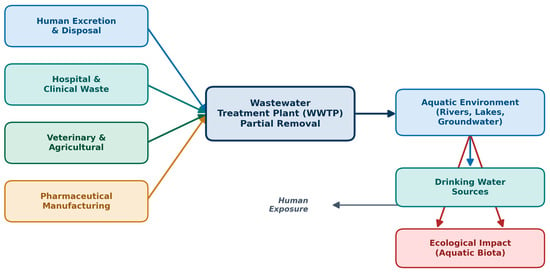
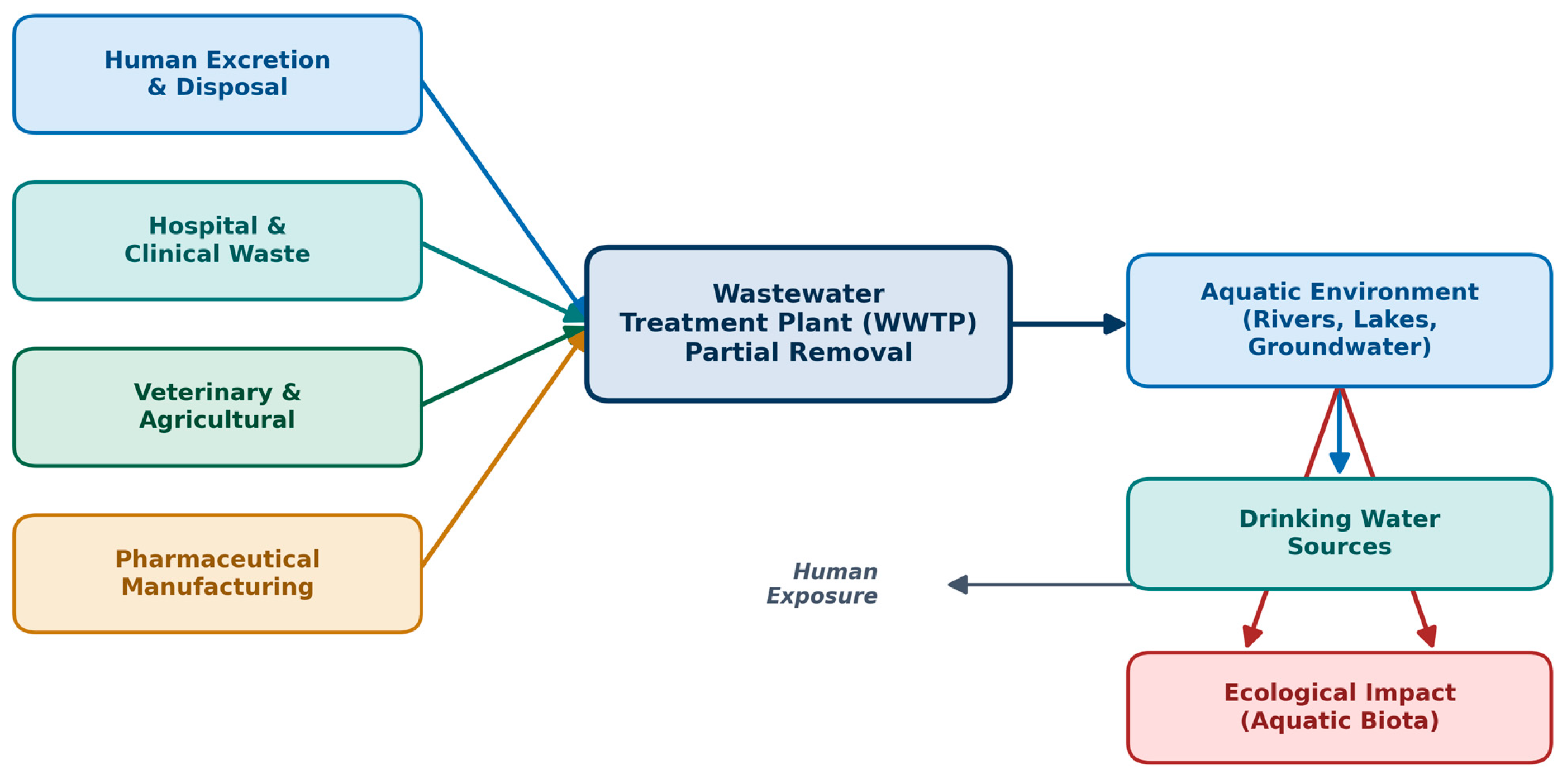
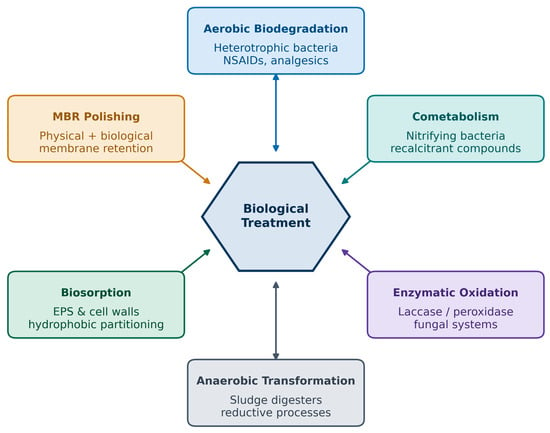
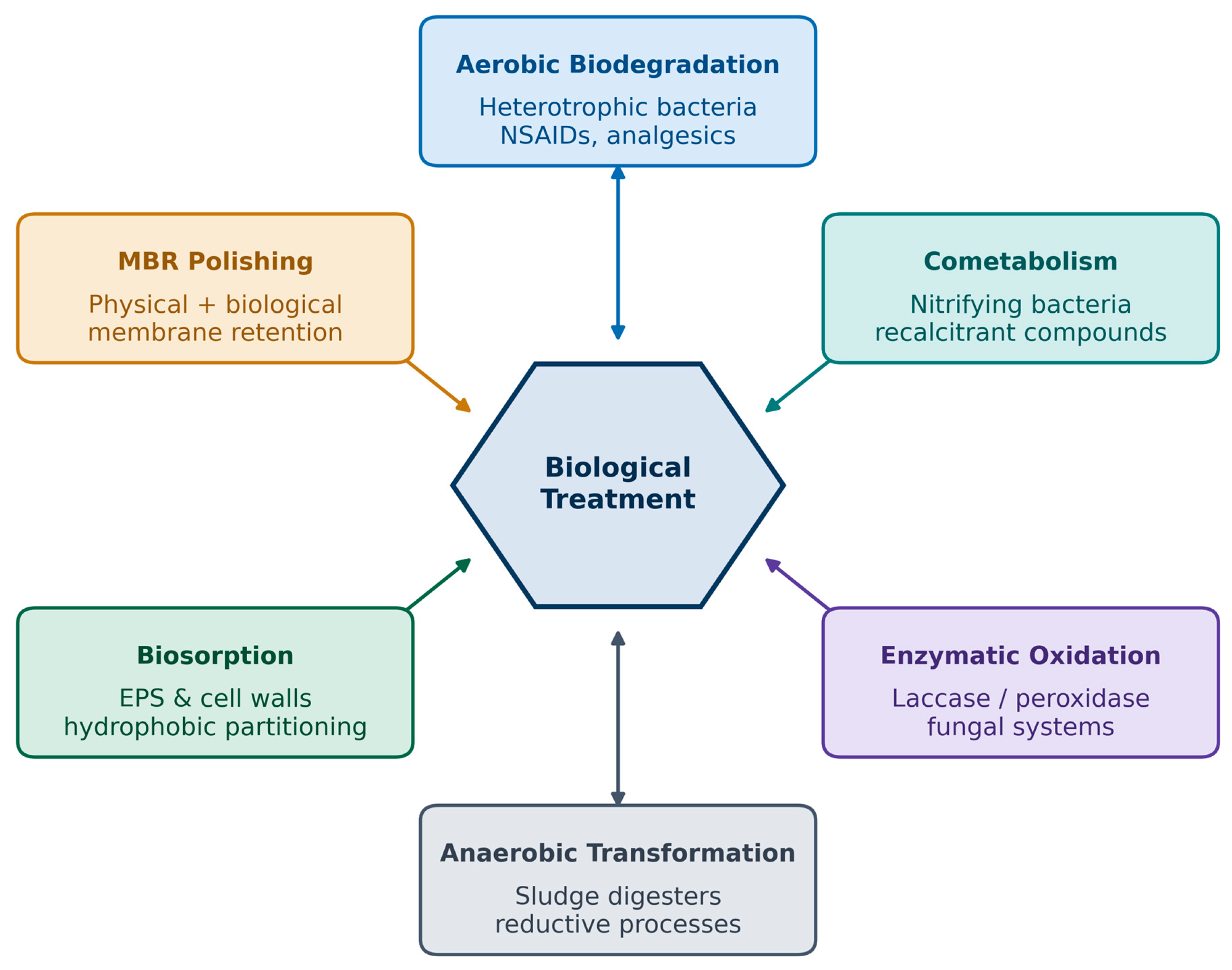
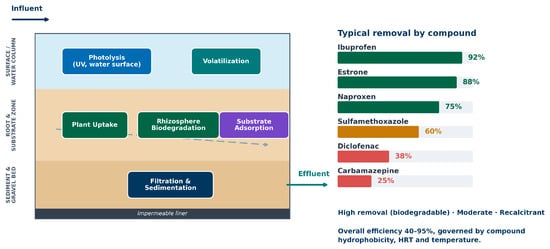
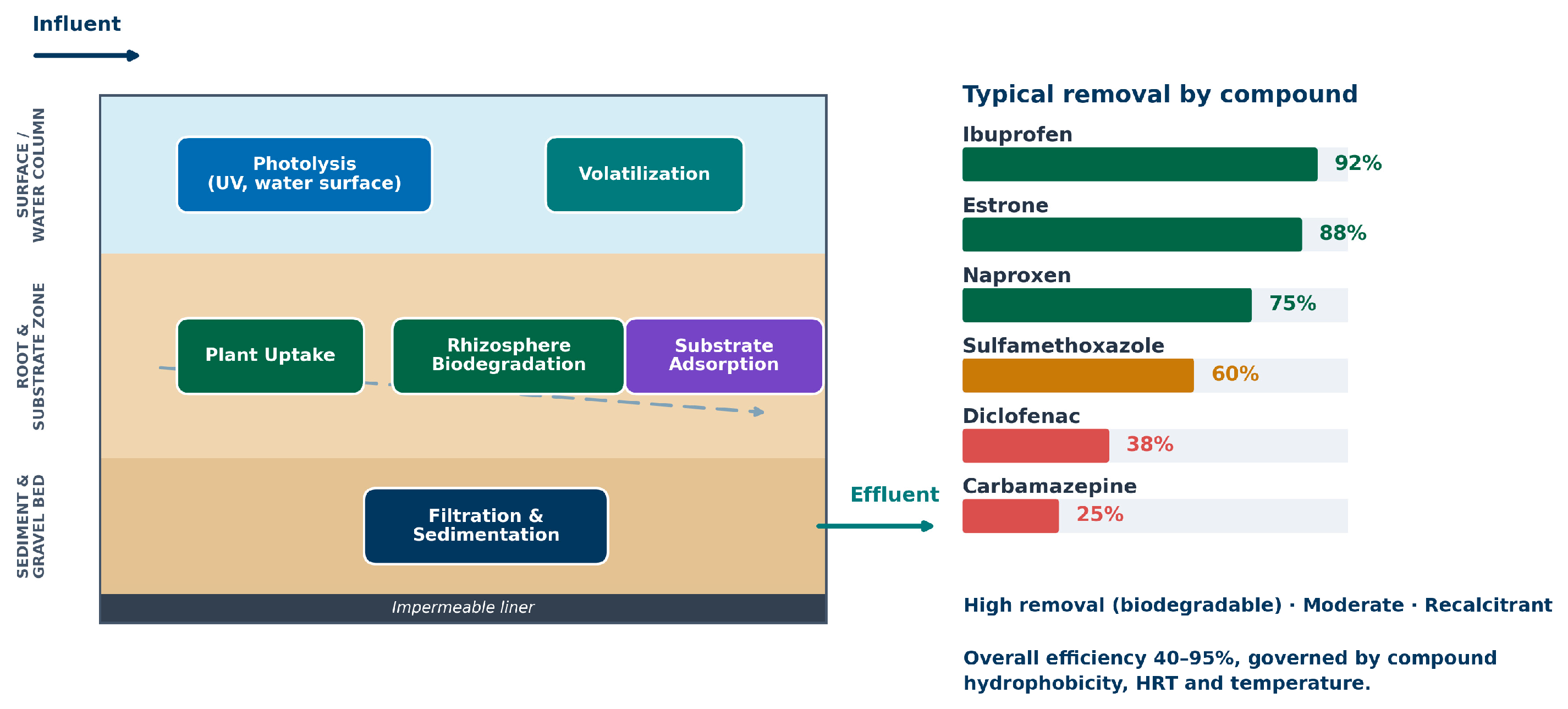
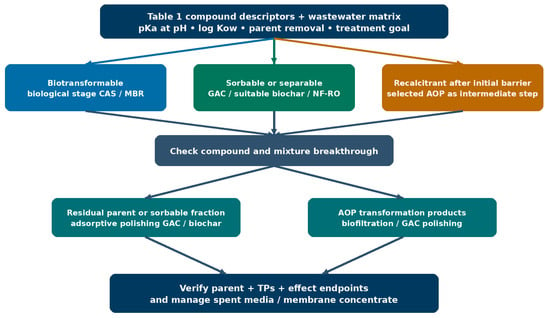
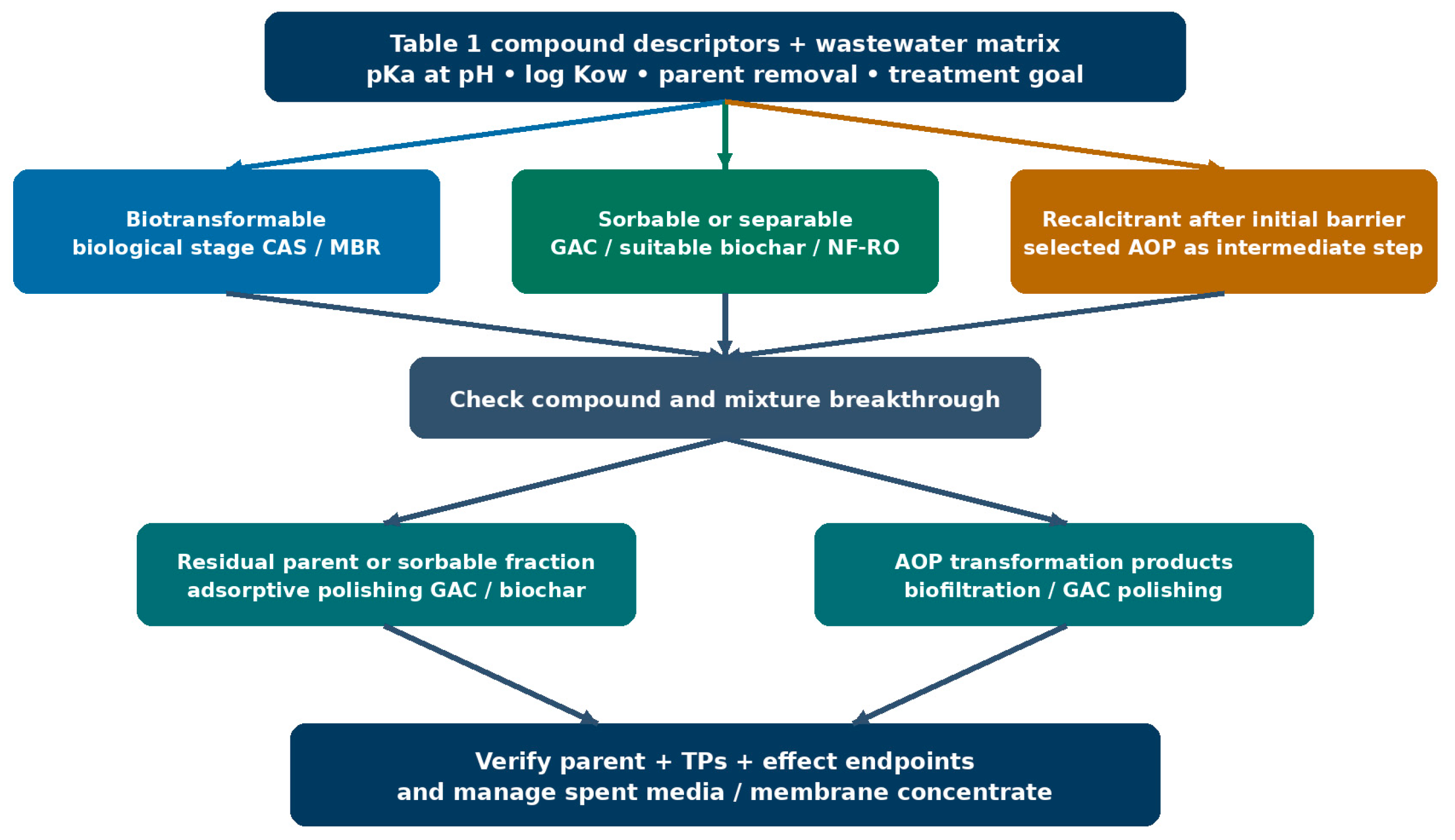

Disclaimer/Publisher’s Note: The statements, opinions and data contained in all publications are solely those of the individual author(s) and contributor(s) and not of MDPI and/or the editor(s). MDPI and/or the editor(s) disclaim responsibility for any injury to people or property resulting from any ideas, methods, instructions or products referred to in the content. |
© 2026 by the authors. Licensee MDPI, Basel, Switzerland. This article is an open access article distributed under the terms and conditions of the Creative Commons Attribution (CC BY) license.