


Abstract
Amine-functionalized solid sorbents are a leading low-temperature route for direct air capture (DAC). Material-level studies have established their ability to capture CO2 at atmospheric partial pressures. However, once these sorbents are incorporated into practical contactors, cyclic performance becomes sensitive to mass-transfer path length, active-phase loading, support heat capacity, and air-side pressure drop. Long-term operation introduces further constraints associated with water co-adsorption, the oxidative degradation of amines, structural stability, and batch-to-batch reproducibility. This review follows these scale-dependent effects across low-partial-pressure adsorption and kinetics, structured sorbent fabrication, temperature swing adsorption (TSA), temperature–vacuum swing adsorption (TVSA), steam-assisted regeneration, and the progression from kg-scale test units to outdoor trials and early commercial systems. Across the reported studies, equilibrium adsorption capacity alone does not predict engineering performance. Dynamic mass transfer, pressure drop, regeneration demand, and sorbent degradation jointly affect contactor sizing, energy consumption, and annual CO2 capture. Comparisons among reported systems remain difficult because humidity, face velocity, vacuum conditions, cycle configuration, and system boundaries are not reported on a consistent basis, while long-duration field data remain limited. Accordingly, the available evidence is organized by development stage, with particular attention to the gaps that directly affect sorbent screening, contactor design, and process scale-up. Distinct from reviews organized mainly by sorbent class or individual process step, this review uses a scale-linked engineering framework to connect material performance with shaping, cyclic operation, integrated testing, and field deployment.
1. Introduction
Direct air capture (DAC) removes CO2 directly from ambient air and can address residual and historical emissions [1]. At an atmospheric CO2 mole fraction of approximately 4.3 × 10⁻⁴ (about 428 ppm) [2], capturing a unit mass of CO2 therefore requires a very large air throughput, while the gas-phase driving force remains small, making air-moving energy highly sensitive to pressure drops; outdoor operation also has to accommodate variations in humidity and temperature [3,4]. These conditions make DAC scale-up fundamentally a gas-solid contacting and cyclic-process problem, rather than simply a question of whether a material shows measurable uptake near 400 ppm.
Amine-functionalized solid sorbents exploit reversible chemical interactions between amine sites and CO2 and therefore retain high affinity at ultralow CO2 partial pressures. Many systems can be regenerated at 60–120 °C by temperature swing adsorption (TSA), temperature–vacuum swing adsorption (TVSA), or steam-assisted regeneration [5,6]. Research has expanded from powders to honeycombs, fibers, coatings, and other structured contactors [7,8], while kg scale continuous units and outdoor field tests have also been reported [9,10]. Scale-up exposes constraints that are less evident in static material tests: active-phase loading influences mass-transfer resistance, while co-adsorbed water and the shaped support affect cyclic thermal demand [5,8]. Long-term operation adds oxidative degradation and durability constraints [11,12].
Numerous recent reviews have addressed DAC sorbent materials, process engineering, scale-up, and techno-economic performance [13,14]. By contrast, the transfer of material-level metrics through shaping and cyclic operation to equipment-level performance remains fragmented across the literature. For an industrial unit, equilibrium capacity is only a starting point. Equally important are the working capacity available within a specified adsorption time, the mass-transfer rate, contactor volumetric productivity, pressure drop, and the retention of these properties during extended operation. Even accurate values are difficult to compare when reported at different air humidities, face velocities, regeneration vacuum levels, or energy system boundaries. As solid-sorbent DAC moves into field trials and early commercial deployment, the more informative comparison is therefore how performance is transferred across the material–contactor–cycle chain, rather than which material reports the highest isolated equilibrium capacity. The distinctive contribution of this review is to treat material, contactor, cycle, pilot, and field data as a continuous engineering evidence chain, identifying where performance losses and reporting gaps emerge during scale-up.
This review focuses on amine-functionalized solid sorbents; non-amine solid routes are included only where needed to define technology boundaries. The discussion begins with low-partial-pressure adsorption and mass transfer, and then examines structured sorbent fabrication, TSA/TVSA and steam-assisted regeneration, continuous operation, and field systems. Productivity, pressure drop, thermal and electrical energy demand, lifetime, and availability are considered within a common engineering context. This review further identifies the additional evidence required as a material progresses toward structured contactors, continuous test rigs, and outdoor demonstrations. Rather than proposing universal scale-up thresholds, the aim is to identify the data gaps and performance-loss mechanisms that most often limit translation from material screening to process design.
Throughout this review, energy and cost metrics retain the system boundary used by the original source. Thermal energy denotes supplied process heat when separately reported, whereas electrical energy covers the electrical loads included by the source, such as air movement, vacuum generation, and CO2 compression. Total specific energy is used when heat and electricity are aggregated, while regeneration energy refers specifically to the desorption/regeneration step. The net removal cost uses the net CO2 removed, after the life-cycle emissions are included within the stated boundary, as the denominator.
2. Amine-Functionalized Solid Sorbents: From Material Performance to Structured Forms
2.1. Engineering Context of Solid-Sorbent DAC Routes and Amine-Based Systems
Solid sorbents considered for DAC include amine-functionalized porous materials, zeolites, selected ultramicroporous metal–organic frameworks (MOFs), alkali–metal carbonates, and moisture-swing ion-exchange materials. These classes differ substantially in their low-partial-pressure affinity mechanisms and regeneration requirements (Table 1). Zeolites and many other physisorbents can adsorb and desorb rapidly under dry conditions, but competitive water adsorption often suppresses their low-partial-pressure CO2 capacity. Carbonate and moisture-swing systems reduce reliance on high-temperature regeneration, but impose different requirements for water management and cyclic operation [4,15]. Amine-based sorbents retain strong chemical affinity at approximately 400 ppm and can be coupled with low-temperature TSA/TVSA cycles and structured contactors. Therefore, they form the main focus of the scale-up discussion in this review [5,7].
Table 1.
Engineering characteristics of major solid-sorbent DAC routes.
The following sections do not review all solid-sorbent routes in equal depth. Non-amine systems are used only as reference points when comparing contactors, regeneration boundaries, or industrial development pathways.
2.2. Coupling Among Capacity, Kinetics, Humidity, and Lifetime
Higher amine loading is not necessarily advantageous. Increasing the amount of active amine can raise the low-partial-pressure equilibrium uptake, but may also reduce pore accessibility, increase diffusion resistance within the polymer phase, and alter the heat of adsorption. Dynamic studies by Bollini et al. showed that open pore structures shorten the breakthrough front, whereas excessive polyamine loading produces pronounced slow-diffusion tails [16,17]. For engineering screening, the reproducible working capacity accessible within a specified adsorption time is therefore more informative than the mmol·g−1 value measured only after prolonged equilibration.
Under ultradilute feed conditions, adsorption rates may be controlled simultaneously by external gas–film transfer, macro-/mesopore diffusion, and diffusion-reaction within the amine phase. The simplified kinetic model developed by Liu et al. describes the effects of temperature, flow rate, and humidity on breakthrough curves for supported amine sorbents and shows that humidity can increase equilibrium uptake while broadening the breakthrough front [18]. Grossmann and Mazzotti further showed that pore structure and contactor geometry alter the apparent mass-transfer coefficient in pellet and monolith configurations [19]. Adsorption rates obtained from static thermogravimetric analysis (TGA) are therefore not equivalent to dynamic breakthrough behavior in a practical contactor; engineering evaluation requires breakthrough data collected at face velocities and humidities close to the intended operating range.
The effect of water vapor on amine-based DAC depends on amine chemistry, support properties, and timescale. At 400 ppm CO2 and 25 °C, Ferru et al. observed that 50% relative humidity (RH) increased CO2 uptake by approximately 30% and 70% for two structured amine sorbents, respectively [8]. The co-adsorbed water, however, must subsequently be handled during heating, evacuation, or steam regeneration and can increase thermal duty and extend the cycle. Binary CO2/H2O adsorption measurements by Gebald et al., together with the comparison of support pore structure and chemical environment by Rim et al., show that water equilibrium uptake and adsorption rate do not vary in parallel with CO2 uptake [20,21]. Results obtained by Wang et al. over different temperature and humidity conditions likewise indicate that a single “wet capacity” value is insufficient to represent year-round operating performance [22].
Sorbent lifetime is particularly important for DAC using amine-functionalized solid sorbents. Under dry CO2, some primary amines can form urea species and lose activity, whereas water vapor can suppress this pathway under certain conditions [23,24]. In oxygen-containing atmospheres, polyethyleneimine (PEI) may undergo radical autoxidation, and the effect of water is not uniformly beneficial [11]. Oxidative stability can be improved through amine-structure design [25], yet substantial differences remain among sorbents subjected to long-term cycling under DAC-relevant conditions. Hunt et al., for example, reported a 31.2% capacity loss for Lewatit VP OC 1065 after 180 cycles, compared with a 2.79% loss for the crosslinked polyamine CA-1 after 500 cycles [12]. These values are not a direct head-to-head ranking because sorbent chemistry, cycling protocols, and regeneration environments differ between the studies. Recent studies further show that support compatibility can affect sorbent degradation and that trace Fe, Cu, and Ni contamination can alter stability [26,27]. Lifetime assessment should therefore report not only capacity retention, but also amine loss, mechanical integrity, changes in pressure drop, and batch-to-batch variation.
2.3. Structured Sorbent Fabrication and Engineering Evaluation Metrics
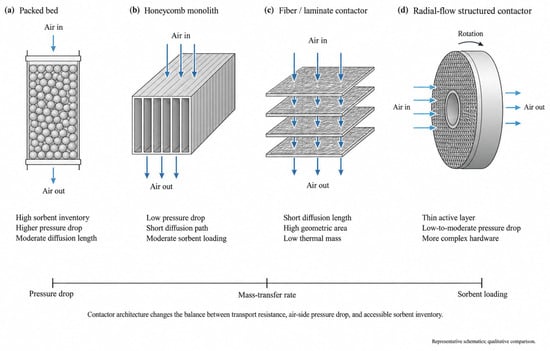
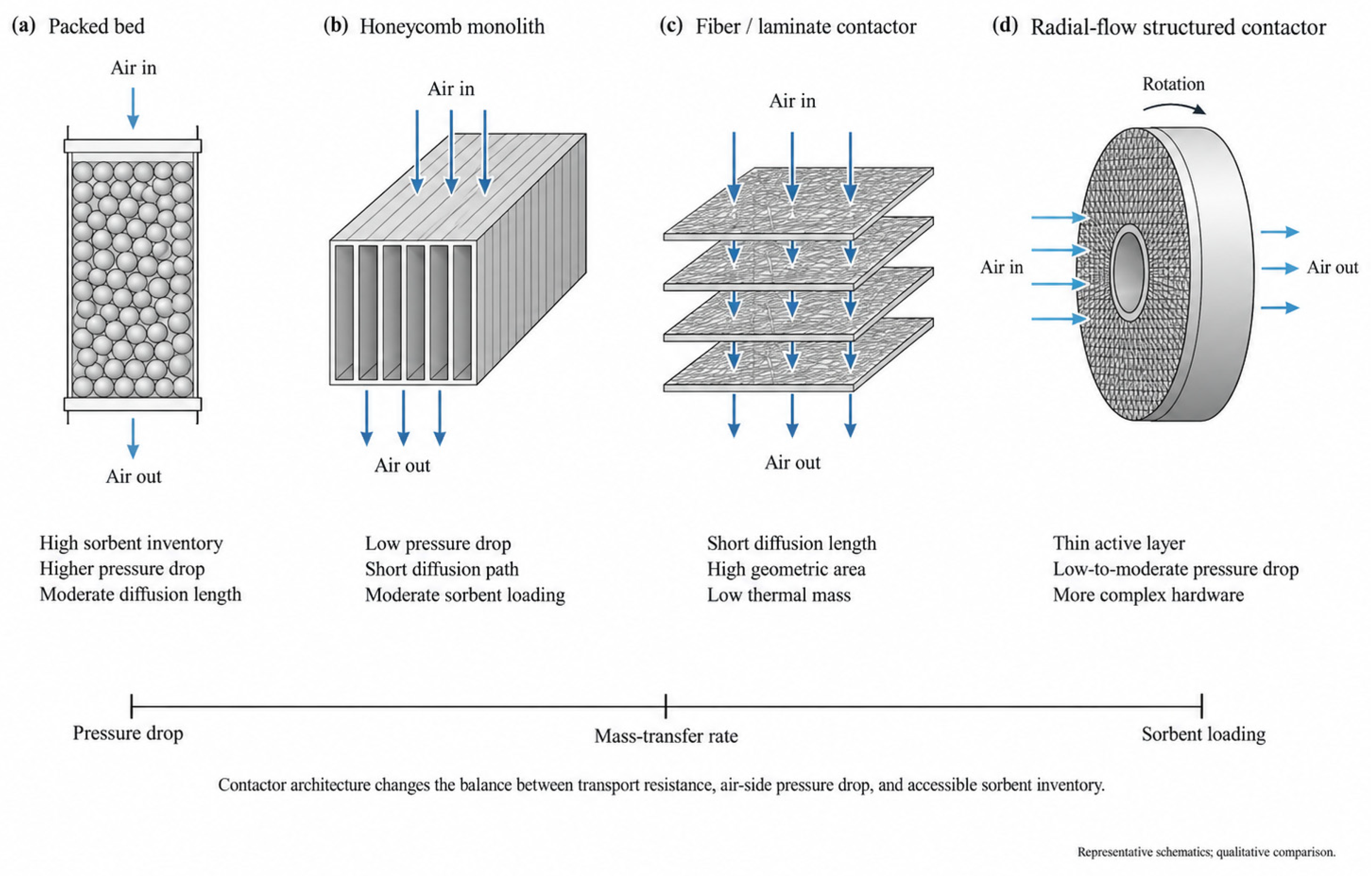
Shaping changes how a sorbent performs in an operating device. Packed beds of pellets are straightforward to load and replace, but increasing bed depth or face velocity raises the air-side pressure drop. Honeycombs, laminated coatings, fibers, and rotary structures shorten diffusion paths and provide open flow channels, but introduce additional issues associated with coating uniformity, sealing, support heat capacity, and mechanical lifetime [13,14]. Grossmann et al. compared amine-grafted alumina pellets with wash-coated honeycomb monoliths at similar dry capacities. The monolith exhibited a linear-driving-force coefficient of about one order of magnitude higher and a pressure drop of about one order of magnitude lower at comparable adsorption productivity [7]. Ferru et al. further showed that substrate density and coating loading affect effective capacity and regeneration sensible heat, respectively [8].
Recent studies increasingly evaluate sorbent shaping and dynamic DAC performance within the same experimental framework. Amine-functionalized MIL-101(Cr) fibers prepared by Song et al. supported rapid TVSA cycles of approximately 25 min at sub-ambient temperatures [28], while Wang et al. formed amine-loaded MOFs into monoliths and evaluated their low-temperature DAC performance [29]. Narayanan et al. produced self-supporting PEI monoliths using inverse-template 3D printing and ice templating; under ambient air at 45.5% RH, the monoliths achieved a dynamic uptake of 0.96 mmol·g−1 together with low pressure drop and elastic deformation behavior [30]. These results are not sufficient to define a universal optimum geometry, but they do show that active-layer thickness, channel dimensions, volumetric packing fraction, and mechanical properties must be characterized alongside mass transfer and pressure drop.
More comparable contactor studies report more than adsorption capacity alone. They also provide adsorption/desorption times, CO2/H2O co-adsorption, pressure drop–face velocity relationships, effective heat capacity, structural stability, and cyclic productivity normalized by sorbent mass or contactor volume [7,8]. When these boundary conditions are reported together, material data can be used more reliably for equipment sizing and energy estimates.
Contactor configurations differ in their effects on gas–solid mass transfer, air-side pressure drop, active-sorbent loading, and thermal inertia. Figure 1 summarizes the main engineering trade-offs for representative packed beds, honeycomb monoliths, fiber/laminate contactors, and radial-flow or rotary structured contactors reported in the literature.
Figure 1.
Representative contactor configurations and principal engineering trade-offs for amine-based solid-sorbent DAC: (a) packed bed; (b) honeycomb monolith; (c) fiber/laminate contactor; and (d) radial-flow/rotary structured contactor. The descriptions of pressure drop, mass-transfer path length, and sorbent loading are qualitative summaries of published studies; actual performance depends on material properties, structural dimensions, and operating face velocity [13,14]. These qualitative trade-offs should not be interpreted as normalized quantitative rankings among contactor configurations.
3. Engineering Scale-Up, Process Intensification, and Industrial Demonstration
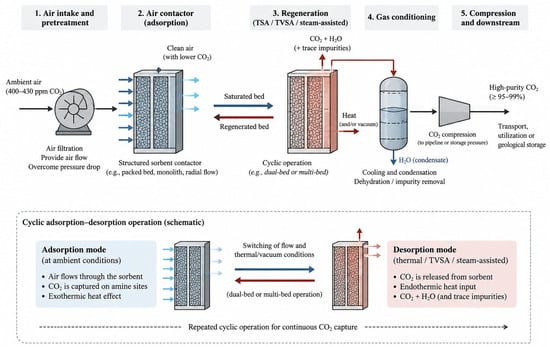
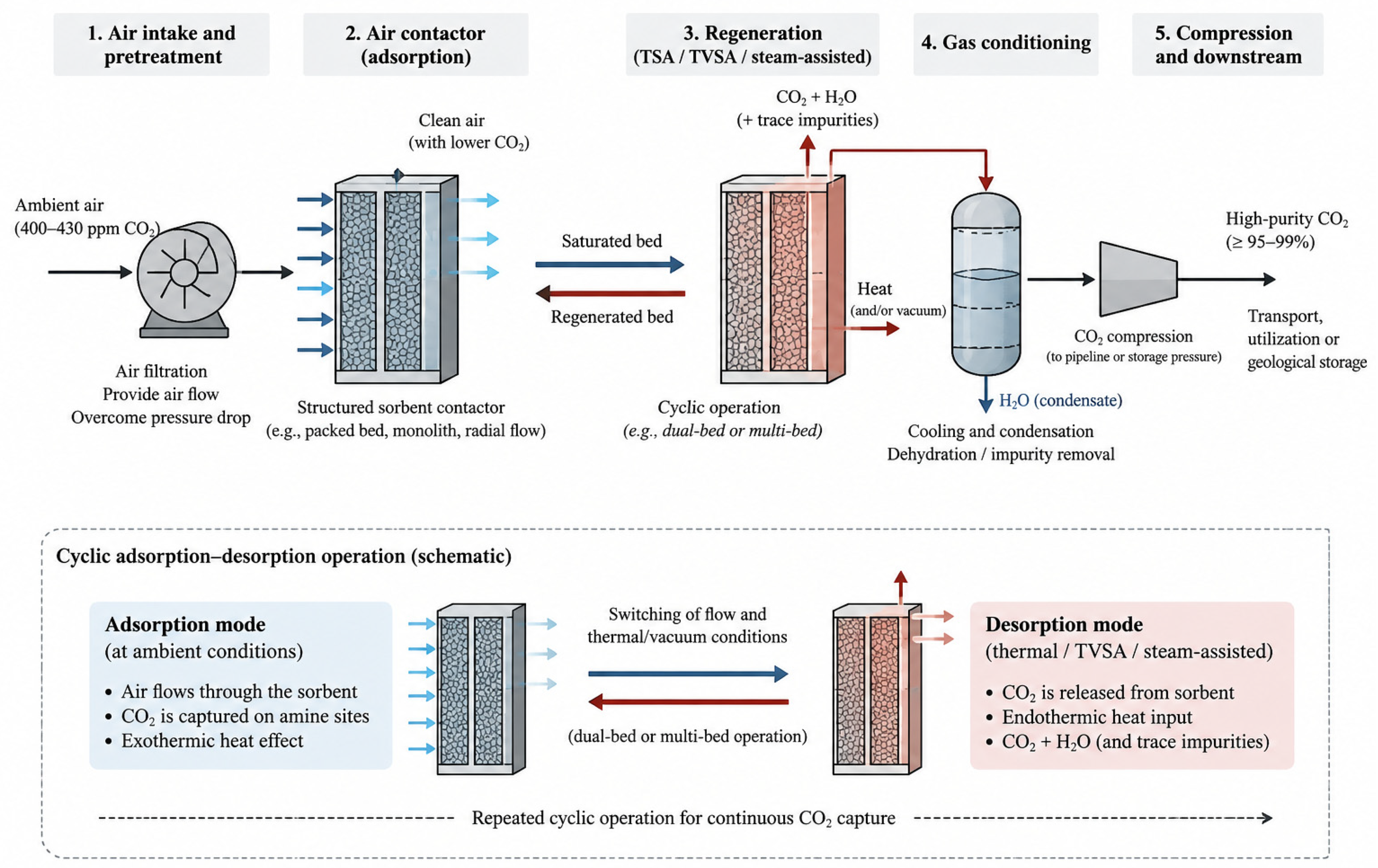
At the equipment level, DAC using amine-functionalized solid sorbents is not a single adsorber but an integrated system comprising air handling and pretreatment, cyclic adsorption-regeneration, product-gas conditioning, and CO2 compression. A representative process flow and the relationship between adsorption and regeneration in dual-bed or multi-bed operation are shown in Figure 2.
Figure 2.
Representative process flow and cyclic adsorption–regeneration operation for DAC using amine-functionalized solid sorbents. A typical system includes air handling and pretreatment, adsorption in a structured contactor, TSA/TVSA or steam-assisted regeneration, product-gas cooling and condensation followed by dehydration/purification, CO2 compression, and subsequent transport, utilization, or storage. Practical units commonly use dual-bed or multi-bed switching to achieve quasi-continuous operation [9,31]. The figure is a generic composite schematic synthesized from representative process concepts and does not reproduce a single published system.
3.1. Air Contactors and Structured Adsorbers
Air contactors require a trade-off among throughput, pressure drop, active-sorbent loading, and heat-transfer distance. Early modeling by Kulkarni and Sholl showed that sensible heating of the sorbent and support can account for a substantial fraction of regeneration energy [32]. For an approximately 2 kg radial-flow thin bed, Yu and Brilman estimated air-contacting energy to be 0.7–1.5 GJ·t−1 CO2, illustrating the benefit of shortening the airflow path [33]. Continuous operation does not invariably improve capture performance for the same contactor concept. Under the conditions studied by Schellevis et al., continuous moving-bed operation gave capture efficiencies 15–25% lower than batch operation [34]. The value of continuous operation must therefore be assessed by balancing mass-transfer losses introduced by solids motion against the equipment-level benefits of continuous production.
Research on structured contactors has moved from geometry-only optimization toward the joint design of the material, contactor, and cycle. Stampi-Bombelli and Mazzotti compared packed beds and monoliths in TVSA in terms of specific exergy, sorbent requirement, and equipment volume [35]. Under the assumptions of their model, the spiral-channel monolith proposed by Tegeler et al. reduced sorbent requirement by about 35% and process cost by about 30% [36]. These reductions depend on the specific material, cycle, and geometric assumptions and should be interpreted as design trends rather than universal cost reductions. At a minimum, contactor evaluation should report channel dimensions, active-layer thickness, volumetric loading, face velocity, pressure drop, and effective heat capacity.
3.2. Regeneration, Heat and Mass Transfer, and Continuous Operation
DAC using amine-functionalized solid sorbents commonly employs temperature swing adsorption (TSA), temperature–vacuum swing adsorption (TVSA), or steam-assisted temperature–vacuum swing adsorption (s-TVSA). Heating weakens CO2 binding at amine sites, vacuum lowers the CO2 partial pressure on the desorption side, and steam provides both heat transfer and displacement [6,31]. The combination of these driving forces determines working capacity, product purity, and cycle time, as well as the loads on heating, vacuum, and water-handling equipment. Regeneration should therefore be optimized over the complete cycle: simply increasing temperature or deepening the vacuum can create disadvantages in terms of energy consumption, equipment cost, or sorbent degradation.
Regeneration strategy also affects CO2 enrichment and the downstream compression duty. Vannak et al. studied an externally heated and cooled amine-functionalized solid-sorbent TSA process with air purge, showing that staged adsorption and reflux can be used to trade recovery against enrichment [37]. Ravuru et al. directly incorporated kinetic parameters for an amine-grafted alumina monolith into TVSA process evaluation [38]. Both studies point to the same requirement: contactor geometry and regeneration steps should be evaluated jointly within a complete cycle rather than optimized separately using material capacity and single-step desorption rate.
Continuous and semi-continuous tests provide energy data closer to the equipment scale. In a four-bed parallel fixed-bed system, Schellevis and Brilman produced 1.3 kg CO2·d−1 under the baseline condition at a total energy demand of 14.5 MJ·kg−1 CO2. Sensible heat was identified as the dominant contribution, and the authors estimated that heat-management and operating improvements could reduce the total to 5.1 MJ·kg−1 [9]. In modeling work, Balasubramaniam et al. performed multi-objective TVSA optimization for five sorbents. The minimum thermal duty ranged from 6.25 to 30.4 MJth·kg−1 CO2, while the maximum volumetric productivity ranged from 0.01 to 0.15 t CO2·d−1·m−3; the ranking of process performance did not follow the ranking of equilibrium capacity [39]. Larger skid-mounted and rotary prototypes have begun to report pressure drop, steam-assistance effects, and product purity [40,41], although the values must still be interpreted within their respective system boundaries. Because the included unit operations and energy-accounting conventions differ among these studies, these values should be treated as source-specific engineering evidence rather than directly comparable energy intensities.
3.3. Comparability of Engineering Performance and Scale-Specific Evidence
Energy consumption, productivity, and purity reported in the DAC literature are not directly comparable. Some studies include only the adsorber or regeneration section, whereas others include fans, vacuum pumps, or even CO2 compression. Inlet humidity, face velocity, vacuum level, and cycle time also vary substantially. Table 2 therefore retains the original boundary of each study and reports unreported quantities as NR, without imposing a common ranking. Low-temperature heat and electricity must also be distinguished because they differ in energy quality, price, and carbon intensity; a single MJ·kg−1 value with an unspecified heat/electricity composition is not sufficient for comparison.
Table 2.
Key operating conditions and performance metrics reported in representative engineering studies of amine-based solid-sorbent DAC.
Published studies now span material stability, structured sorbent fabrication, kg scale cyclic units, outdoor skid-mounted systems, and field demonstrations, but each scale resolves a different set of questions. Material and structured-sorbent studies primarily identify working capacity, mass transfer, thermal inertia, and stability [7,12]. Kg scale and skid-mounted tests begin to expose cycle switching, pressure drop, and heat management constraints [9,40], whereas field and commercial operation increasingly reveal availability and the propagation of material-performance deviations to annual output [10,43]. The scale categories used here describe changes in the type of public evidence available; they are not intended as universal technology-readiness-level thresholds or fixed scale-up criteria.
For clarity, the scale terms used here describe the type of engineering evidence rather than fixed capacity or TRL thresholds. Material-level studies establish adsorption, kinetics, and stability; structured-sorbent studies add mass transfer, pressure drop, loading, and thermal inertia; bench cyclic units integrate repeated adsorption-regeneration cycles; pilot or skid-mounted systems integrate air handling, regeneration, and product conditioning; and field/commercial systems provide evidence on availability, maintenance, seasonal response, sorbent replacement, and reported CO2 output.
3.4. Field Demonstrations and Commercial Systems
For deployment-scale reporting, design or nameplate capacity denotes nominal performance under stated design assumptions; gross capture denotes CO2 captured before life-cycle deductions; net removal denotes CO2 remaining after the emissions and losses included within the stated accounting boundary; and actual operating output denotes measured or reported production over a defined operating period. These quantities are treated separately below.
Field demonstrations first reveal operating problems that are difficult to reproduce under laboratory conditions. In 2024, NETL/NCCC reported outdoor DAC testing of a PEI honeycomb contactor integrated with vacuum, steam desorption, and heat recovery. The project accumulated 3300 h of testing, while NETL reported 137,000 system cycles, 94% operating availability, and >95% gaseous CO2 purity [10]. The public documentation does not define how the 137,000 cycles were counted at the level of an individual adsorption module; this value is therefore treated here only as an indicator of system-level operating intensity and is not used to infer sorbent lifetime. Compared with nameplate capacity alone, such operating data provide a more direct measure of the maturity of controls, heat integration, and continuous operation.
Operational disclosures from Climeworks’ Orca plant provide a different form of engineering evidence. Orca was designed for a gross capture capacity of 4000 t·a−1 and a net removal capacity of about 3000 t·a−1. The company later reported that CO2 uptake by the first sorbent batches was 10–20% below design expectations, with performance variation of up to 20% among some production batches. On this basis, the nameplate capture capacity was reassessed at approximately 3000–3100 t·a−1, corresponding to a maximum achievable annual carbon removal capacity of approximately 2400–2500 t·a−1 [43]. These reassessed values remain company-reported estimates and are not treated here as independently verified annual operating output. They illustrate how sorbent-manufacturing variability affects module throughput and potential annual removal. Mammoth has a nominal design capacity of up to 36,000 t·a−1, but remained in operational ramp-up as of September 2026 [44]; its design capacity should therefore be reported separately from actual annual output.
Company disclosures are useful for tracing technology pathways and scale-up direction, but they are not equivalent to third-party field measurements and should not be pooled without qualification. Climeworks/Svante reported more than 1300 cycles of Gen 3 structured adsorbents under real-world conditions between May 2024 and January 2025, together with performance improvements relative to the previous generation [45]. In a company-issued press release, Global Thermostat described its approximately 1000 t·a−1 K-Series and smaller T-Series products [46]. Among non-amine routes, Removr uses zeolite-based sorbents, whereas Carbyon emphasizes rapid-cycling solid adsorption [47,48]. Table 3 summarizes these public disclosures while retaining their source type; company-reported data are used to indicate development direction rather than as independent performance benchmarks.
Table 3.
Representative industrial development of solid-sorbent DAC systems.
4. Techno-Economic Performance and Constraints on Scale-Up
4.1. Cost Definitions and System Boundaries
Published DAC cost estimates vary widely, and much of the spread arises from system boundaries rather than from the capture technology alone. Capital annualization, energy prices, sorbent lifetime, plant scale, and the choice of gross captured CO2 or net removed CO2 as the denominator all affect the unit cost [49,50]. This review distinguishes gross capture cost from the levelized cost of net removal. The latter relates annualized capital and operating expenditures to annual net removal after accounting for life-cycle greenhouse-gas emissions from energy supply, sorbent manufacture, CO2 conditioning, and associated operations. The IEA’s 2022 assessment estimated future large-scale DAC costs at approximately USD 125–335 t−1 CO2 and discussed the possibility of long-term costs below USD 100 t−1 [51]. The U.S. Department of Energy’s Carbon Negative Shot sets an R&D target below USD 100 per net tonne CO2e around 2032 [52]. Neither figure represents a measured average cost for current commercial plants. Using technology characteristics and experience curves, Sievert et al. projected a median net-removal cost of approximately USD 374 t−1 for solid-sorbent direct air capture with carbon storage (DACCS) at 1 Gt CO2·yr−1 cumulative deployment capacity, with a 90% interval of USD 281–579 t−1 [53], illustrating the remaining uncertainty in future costs.
Techno-economic models are sensitive to assumptions about both material properties and operation. Lilonfe et al. integrated manufacturing, techno-economic analysis (TEA), and life-cycle assessment (LCA) for five classes of solid sorbents across more than 150 scenarios. Plant scale, energy source, adsorption rate, and adsorption time all had substantial effects on cost and greenhouse-gas performance [50]. Holmes et al. further incorporated experimentally derived capacity-decay functions into an economic model and showed that sorbent degradation changes the optimal replacement interval, annual production, and cost [49]. Lifetime and kinetics therefore cannot be treated in TEA as fixed parameters independent of the process. Representative TEA and LCA studies, together with the key variables, principal findings, and system boundaries that affect their comparability, are summarized in Table 4.
Table 4.
Representative techno-economic and life-cycle assessment studies.
4.2. Effects of Material and Process Parameters on Equipment KPIs and Cost
Material and process parameters usually affect cyclic performance and equipment size before their effects appear in cost. Dynamic working capacity, mass-transfer rate, and cycle time determine the required sorbent inventory and number of modules [39,49]. Air-side pressure drop governs air-moving electricity, while support heat capacity and vacuum conditions influence regeneration duty and equipment size [32,35]. Sorbent lifetime affects replacement frequency, downtime, and life-cycle performance [49,50]. A given improvement in material properties can therefore have very different economic consequences when transferred to a different contactor or cycle.
Several studies have shown that the performance ranking of a material can change when the contactor or cycle is changed. In the contactor model of Tegeler et al., geometric changes altered both sorbent requirement and process cost [36]. In the TVSA multi-objective optimization of Balasubramaniam et al., the preferred operating solutions also shifted with process objectives and constraints [39]. Recent structured-contactor studies further show that active-layer thickness, pore structure, and contactor geometry affect apparent mass-transfer rates [19,38]. Material performance considered without cycle time, flow conditions, and regeneration boundary therefore has limited value for equipment design.
4.3. Regeneration Energy Breakdown and System Boundaries
Comparison of regeneration energy requires explicit reporting of both energy quality and system boundary. Low-temperature heat should be reported in MJth·kg−1 CO2 together with the supply temperature, while electricity for fans, vacuum pumps, and CO2 compression should be reported separately in MJe or kWhe·kg−1. If equivalent work or primary-energy metrics are used, the conversion efficiency and inclusion of drying, compression, transport, and other units should also be stated. Modeling by Kulkarni and Sholl and kg scale experiments by Schellevis show that sensible heating of the sorbent and support can represent a major share of regeneration duty [9,32]. Low-heat-capacity supports, short heat-transfer paths, and heat recovery are therefore process-design variables of comparable importance to adsorption capacity.
4.4. Long-Term Operation, Manufacturing Consistency, and Site Constraints
Outdoor operation exposes sorbents to oxygen and varying humidity and temperature, while particulate accumulation in air filters can increase flow resistance. Oxidative degradation under atmospheric conditions and sensitivity to trace transition-metal contaminants have been documented for amine-based sorbents [11,27]. Ambient conditions can also alter capture performance and energy use, but long-duration field data across climates remain limited [42,56]. Representative lifetime testing should combine adsorption from real air under the intended regeneration conditions with mechanistically defined accelerated aging, rather than simply increasing the number of short cycles in an inert atmosphere.
As laboratory formulations are transferred to batch production, manufacturing consistency can become a new limiting factor. Orca’s disclosure of early sorbent underperformance and batch variation [43] indicates that scale-up of the formulation requires control of raw-material variability, impregnation or grafting uniformity, drying/curing windows, and coating thickness. Quality control for serial production should be linked directly to equipment KPIs, for example by measuring dynamic working capacity, pressure drop, and mechanical integrity at specified face velocity and contact time, and by tracking their evolution with cycling.
Site conditions define the net-removal boundary beyond the capture unit itself. Wiegner et al. showed that ambient temperature, humidity, and renewable-energy availability affect the production rate and energy demand of solid-sorbent DAC [56]. A European analysis by Terlouw et al. further showed that electricity price and carbon intensity, low-temperature heat supply, climate, and CO2 transport distance jointly influence the net-removal cost of DACCS [55]. At scales from hundreds to tens of thousands of tonnes per year, the capture unit should therefore be evaluated together with energy supply, CO2 drying/compression, transport, storage, and monitoring, reporting, and verification (MRV); an energy advantage measured in the laboratory does not necessarily translate into a net-removal advantage.
5. Research Priorities and Engineering Outlook
5.1. Material Evaluation and Data Comparability
Future material evaluation should emphasize reproducible dynamic performance under defined DAC-relevant boundary conditions. Even sorbents with similar equilibrium capacities can show markedly different cyclic performance at different humidities, face velocities, adsorption times, and regeneration conditions. Studies of optimized TVSA cycles and structured-contactor mass transfer show that performance rankings can change when material, structure, or cycle conditions change [19,39]. Engineering screening therefore requires dynamic testing under air compositions close to practical conditions, with working capacity interpreted together with pressure drop, water loading, and cycle time.
Inconsistent test conditions and system boundaries remain the principal obstacle to cross-study comparison. Material studies use different relative humidities, contact times, and regeneration atmospheres; contactor studies report face velocity and pressure drop in different ways; and process studies often adopt different boundaries for thermal duty, electricity, and CO2 conditioning. At a minimum, laboratory-to-process studies should report face velocity, inlet RH, adsorption and desorption times, CO2/H2O co-adsorption or water loading, pressure drop, cyclic working capacity, cyclic productivity, and thermal and electrical energy separately, together with the corresponding system boundary [7,39]. At the field stage, operating availability, sorbent replacement, CO2 recovery losses, and seasonal response become additional requirements [10,43]. Public data from NCCC and Orca provide examples of continuous field testing and deviations during commercial operation, respectively, but comparable long-duration datasets remain scarce.
5.2. Modular Validation and Commercial Scale-Up
Replicating modules can increase the throughput of solid-sorbent DAC, but it is not equivalent to simple linear scale-up; plant complexity rises with module count. In addition to the adsorbers themselves, fans, vacuum or steam systems, heat recovery, valve manifolds, and control systems must be coordinated across modules. The increasing number of seals, vacuum interfaces, and maintenance points may offset part of the benefit of standardization. Mammoth and newer structured-sorbent platforms provide opportunities to observe module replication and operational ramp-up, but their engineering value ultimately depends on long-term availability, sorbent replacement frequency, and actual annual net removal [44,45].
The next stage requires continuous operating data that can identify the origin of performance loss more than it requires larger nominal capacity. Sorbent lifetime studies should combine exposure to real air with mechanistically defined accelerated oxidation tests. Structured contactors should measure pressure drop, cyclic productivity, and thermal load simultaneously in the same device. At demonstration scales of hundreds to thousands of tonnes per year, keeping the sorbent formulation, contactor, and cycle architecture reasonably stable during scale-up makes it easier to distinguish manufacturing effects from operation and maintenance or site effects. If the material, contactor, and cycle architecture are all changed in a single scale-up step, the cause of any subsequent performance deviation becomes difficult to identify.
6. Conclusions
Research on amine-functionalized solid sorbents has progressed from adsorption measurements near 400 ppm to structured contactors, continuous cycling, and outdoor systems. The key scale-up question is increasingly how effectively material properties are retained after shaping and during cyclic operation. Once the material is incorporated into a contactor, mass-transfer distance, pressure drop, and support heat capacity alter cyclic performance; long-term operation adds water co-adsorption, oxidative degradation, mechanical stability, and manufacturing consistency. Bench-scale and field data can now identify these effects, but system boundaries and the extent of public reporting still differ substantially among studies.
The evidence required for evaluation changes with scale. Structured-sorbent studies need to establish how much material performance is retained after shaping; continuous units need to report productivity, thermal/electrical energy demand, and product purity over complete cycles; and outdoor or commercial systems increasingly require data on availability, sorbent replacement, seasonal response, and actual CO2 recovery. The purpose of this review is not to prescribe a universal industrial scale-up threshold, but to identify the validation evidence that is most often missing at each scale and the main points at which performance is lost. For amine-based solid-sorbent DAC, the credibility of future technology comparisons will increasingly depend on process data with clearly defined boundaries, demonstrated reproducibility, and sufficient duration to capture long-term operation.
Author Contributions
Conceptualization, W.C., J.Y. and B.W.; Investigation, W.C., H.Z., Y.H., Q.L., J.H. and Z.W.; Data Curation, W.C., H.Z. and Y.H.; Writing—Original Draft Preparation, W.C. and J.Y.; Writing—Review and Editing, W.C., J.Y., H.Z., Y.H., Q.L., J.H., Z.W. and B.W.; Visualization, W.C. and H.Z.; Supervision, J.Y. and B.W. All authors have read and agreed to the published version of the manuscript.
Funding
This research received no external funding.
Data Availability Statement
No new data were created or analyzed in this study. Data sharing is not applicable to this article.
Conflicts of Interest
Authors Wenhao Cao, Jie Yu, Hengrui Zhang, Qi Liu, Jun He, and Zhenyuan Wu were employed by China Petroleum Engineering & Construction Corporation Southwest Company. The remaining authors declare that the research was conducted in the absence of any commercial or financial relationships that could be construed as a potential conflict of interest.
References
- Sanz-Pérez, E.S.; Murdock, C.R.; Didas, S.A.; Jones, C.W. Direct Capture of CO2 from Ambient Air. Chem. Rev. 2016, 116, 11840–11876. [Google Scholar] [CrossRef] [Scilit]
- NOAA Global Monitoring Laboratory. Trends in Globally-Averaged CO2: Global Monthly Mean CO2. Available online: https://gml.noaa.gov/ccgg/trends/global.html (accessed on 19 September 2026).
- Erans, M.; Sanz-Pérez, E.S.; Hanak, D.P.; Clulow, Z.; Reiner, D.M.; Mutch, G.A. Direct Air Capture: Process Technology, Techno-Economic and Socio-Political Challenges. Energy Environ. Sci. 2022, 15, 1360–1405. [Google Scholar] [CrossRef] [Scilit]
- Wu, X.; Krishnamoorti, R.; Bollini, P. Technological Options for Direct Air Capture: A Comparative Process Engineering Review. Annu. Rev. Chem. Biomol. Eng. 2022, 13, 279–300. [Google Scholar] [CrossRef] [Scilit]
- Panda, D.; Kulkarni, V.; Singh, S.K. Evaluation of Amine-Based Solid Adsorbents for Direct Air Capture: A Critical Review. React. Chem. Eng. 2023, 8, 10–40. [Google Scholar] [CrossRef] [Scilit]
- Elfving, J.; Kauppinen, J.; Jegoroff, M.; Ruuskanen, V.; Järvinen, L.; Sainio, T. Experimental Comparison of Regeneration Methods for CO2 Concentration from Air Using Amine-Based Adsorbent. Chem. Eng. J. 2021, 404, 126337. [Google Scholar] [CrossRef] [Scilit]
- Grossmann, Q.; Stampi-Bombelli, V.; Yakimov, A.; Docherty, S.; Copéret, C.; Mazzotti, M. Developing Versatile Contactors for Direct Air Capture of CO2 through Amine Grafting onto Alumina Pellets and Alumina Wash-Coated Monoliths. Ind. Eng. Chem. Res. 2023, 62, 13594–13611. [Google Scholar] [CrossRef] [Scilit]
- Ferru, N.; Bischof, M.; Saporito, M.; Büchner, D.; Grossmann, Q.; Dufour-Décieux, V.; Pini, R.; Bardow, A.; Mazzotti, M. Structured Sorbents for Direct Air Capture: The Impact of Materials and Chemicals on Performance. AIChE J. 2026, 72, e70513. [Google Scholar] [CrossRef] [Scilit]
- Schellevis, H.M.; Brilman, D.W.F. Experimental Study of CO2 Capture from Air via Steam-Assisted Temperature-Vacuum Swing Adsorption with a Compact kg-Scale Pilot Unit. React. Chem. Eng. 2024, 9, 910–924. [Google Scholar] [CrossRef] [Scilit]
- National Energy Technology Laboratory. NETL, Partners Complete First Direct Air Capture Field Test at National Carbon Capture Center. Available online: https://netl.doe.gov/node/14325 (accessed on 19 September 2026).
- Carneiro, J.S.A.; Innocenti, G.; Moon, H.J.; Guta, Y.; Proaño, L.; Sievers, C.; Sakwa-Novak, M.A.; Ping, E.W.; Jones, C.W. Insights into the Oxidative Degradation Mechanism of Solid Amine Sorbents for CO2 Capture from Air: Roles of Atmospheric Water. Angew. Chem. Int. Ed. 2023, 62, e202302887. [Google Scholar] [CrossRef] [Scilit]
- Hunt, R.; Gillbanks, J.; Czapla, J.; Wan, Z.; Karmelich, C.; White, C.; Wood, C. Representative Longevity Testing of Direct Air Capture Materials. Chem. Eng. J. 2024, 481, 148901. [Google Scholar] [CrossRef] [Scilit]
- Kaur, N.; Al-Bodour, A.; Aparicio, S.; Atilhan, M. A Review on Direct Air Capture of Carbon Dioxide: Sorbent Materials, Process Engineering, Industrial Scale-Up, and Future Perspectives. Energy Fuels 2026, 40, 14426–14454. [Google Scholar] [CrossRef] [Scilit]
- Hassan, M.; Shin, C.; Lee, T.; Lee, S.; Chowdhury, S.; Kwon, H.T.; Kang, S.G.; Ahn, S.; Chung, Y.G. Direct Air Capture with Solid Sorbents: Adsorbent Design, Process Engineering, and CO2 Conversion. Chem. Eng. J. 2026, 534, 175117. [Google Scholar] [CrossRef] [Scilit]
- Zhu, X.; Xie, W.; Wu, J.; Miao, Y.; Xiang, C.; Chen, C.; Ge, B.; Gan, Z.; Yang, F.; Zhang, M.; et al. Recent Advances in Direct Air Capture by Adsorption. Chem. Soc. Rev. 2022, 51, 6574–6651. [Google Scholar] [CrossRef] [Scilit]
- Bollini, P.; Brunelli, N.A.; Didas, S.A.; Jones, C.W. Dynamics of CO2 Adsorption on Amine Adsorbents. 1. Impact of Heat Effects. Ind. Eng. Chem. Res. 2012, 51, 15145–15152. [Google Scholar] [CrossRef] [Scilit]
- Bollini, P.; Brunelli, N.A.; Didas, S.A.; Jones, C.W. Dynamics of CO2 Adsorption on Amine Adsorbents. 2. Insights into Adsorbent Design. Ind. Eng. Chem. Res. 2012, 51, 15153–15162. [Google Scholar] [CrossRef] [Scilit]
- Liu, H.; Lin, H.; Dai, S. Minimal Kinetic Model of Direct Air Capture of CO2 by Supported Amine Sorbents in Dry and Humid Conditions. Ind. Eng. Chem. Res. 2024, 63, 5871–5879. [Google Scholar] [CrossRef] [Scilit]
- Grossmann, Q.; Mazzotti, M. Mass Transfer of CO2 in Amine-Functionalized Structured Contactors in Ultra-Dilute Conditions. Ind. Eng. Chem. Res. 2025, 64, 2339–2353. [Google Scholar] [CrossRef] [Scilit]
- Gebald, C.; Wurzbacher, J.A.; Borgschulte, A.; Zimmermann, T.; Steinfeld, A. Single-Component and Binary CO2 and H2O Adsorption of Amine-Functionalized Cellulose. Environ. Sci. Technol. 2014, 48, 2497–2504. [Google Scholar] [CrossRef] [Scilit]
- Rim, G.; Priyadarshini, P.; Song, M.; Wang, Y.; Bai, A.; Realff, M.J.; Lively, R.P.; Jones, C.W. Support Pore Structure and Composition Strongly Influence the Direct Air Capture of CO2 on Supported Amines. J. Am. Chem. Soc. 2023, 145, 7190–7204. [Google Scholar] [CrossRef] [Scilit]
- Wang, Y.; Liu, Y.; Wang, Y.; Miao, Y.; Hagio, T.; Qiao, X.; Li, X.; Huang, Z. Solid Amine Adsorbent with Surfactant Modification for Direct Air Capture (DAC) under Different Temperature and Humidity Conditions. Gas Sci. Eng. 2024, 131, 205453. [Google Scholar] [CrossRef] [Scilit]
- Sayari, A.; Belmabkhout, Y. Stabilization of Amine-Containing CO2 Adsorbents: Dramatic Effect of Water Vapor. J. Am. Chem. Soc. 2010, 132, 6312–6314. [Google Scholar] [CrossRef] [Scilit]
- Sayari, A.; Belmabkhout, Y.; Da’na, E. CO2 Deactivation of Supported Amines: Does the Nature of Amine Matter? Langmuir 2012, 28, 4241–4247. [Google Scholar] [CrossRef] [Scilit]
- Min, K.; Choi, W.; Kim, C.; Choi, M. Oxidation-Stable Amine-Containing Adsorbents for Carbon Dioxide Capture. Nat. Commun. 2018, 9, 726. [Google Scholar] [CrossRef] [Scilit]
- Wang, Y.; Marreiros, J.; Thompson, J.A.; Toops, T.J.; Campbell, Z.S.; Kidder, M.K.; Janke, C.J.; Leow, J.Q.; Sholl, D.S.; Lively, R.P. Performance Degradation of Amine-Infused Fiber Sorbents for Direct Air Capture: Mechanisms and Solutions. Ind. Eng. Chem. Res. 2025, 64, 13512–13518. [Google Scholar] [CrossRef] [Scilit]
- Kuspangaliyeva, B.; Lively, R.P.; Jones, C.W. Influence of Transition Metal Ion Contaminants on the Performance of Amine-Based Solid Sorbents in Direct Air Capture. Environ. Sci. Technol. 2026, 60, 14912–14923. [Google Scholar] [CrossRef] [Scilit]
- Song, M.; Rim, G.; Wang, Y.; Borne, I.; Jones, C.W.; Lively, R.P. Amine-Functionalized MIL-101(Cr) Fibers for Direct Air Capture at Cold Temperatures Using Rapid Temperature Vacuum Swing Adsorption. Chem. Eng. J. 2023, 477, 147135. [Google Scholar] [CrossRef] [Scilit]
- Wang, Y.; Rim, G.; Song, M.; Holmes, H.E.; Jones, C.W.; Lively, R.P. Cold Temperature Direct Air CO2 Capture with Amine-Loaded Metal–Organic Framework Monoliths. ACS Appl. Mater. Interfaces 2024, 16, 1404–1415. [Google Scholar] [CrossRef] [Scilit]
- Narayanan, P.; Kim, S.-Y.; Alhazmi, D.; Jones, C.W.; Lively, R.P. Self-Supported Branched Poly(ethylenimine) Monoliths from Inverse Template 3D Printing for Direct Air Capture. ACS Appl. Mater. Interfaces 2025, 17, 10696–10709. [Google Scholar] [CrossRef] [Scilit]
- Stampi-Bombelli, V.; van der Spek, M.; Mazzotti, M. Analysis of Direct Capture of CO2 from Ambient Air via Steam-Assisted Temperature–Vacuum Swing Adsorption. Adsorption 2020, 26, 1183–1197. [Google Scholar] [CrossRef] [Scilit]
- Kulkarni, A.R.; Sholl, D.S. Analysis of Equilibrium-Based Temperature Swing Adsorption Processes for Direct Capture of CO2 from Air. Ind. Eng. Chem. Res. 2012, 51, 8631–8645. [Google Scholar] [CrossRef] [Scilit]
- Yu, Q.; Brilman, W. A Radial Flow Contactor for Ambient Air CO2 Capture. Appl. Sci. 2020, 10, 1080. [Google Scholar] [CrossRef] [Scilit]
- Schellevis, M.; Jacobs, T.; Brilman, W. CO2 Capture from Air in a Radial Flow Contactor: Batch or Continuous Operation? Front. Chem. Eng. 2020, 2, 596555. [Google Scholar] [CrossRef] [Scilit]
- Stampi-Bombelli, V.; Mazzotti, M. Exploring Geometric Properties and Cycle Design in Packed Bed and Monolith Contactors Using Temperature-Vacuum Swing Adsorption Modeling for Direct Air Capture. Ind. Eng. Chem. Res. 2024, 63, 19728–19743. [Google Scholar] [CrossRef] [Scilit]
- Tegeler, E.; Cui, Y.; Masoudi, M.; Bahmanpour, A.M.; Colbert, T.; Hensel, J.; Balakotaiah, V. A Novel Contactor for Reducing the Cost of Direct Air Capture of CO2. Chem. Eng. Sci. 2023, 281, 119107. [Google Scholar] [CrossRef] [Scilit]
- Vannak, H.; Osaka, Y.; Tsujiguchi, T.; Kodama, A. Air-Purge Regenerative Direct Air Capture Using an Externally Heated and Cooled Temperature-Swing Adsorber Packed with Solid Amine. Separations 2023, 10, 415. [Google Scholar] [CrossRef] [Scilit]
- Ravuru, S.S.; Nistala, S.H.; Sawada, J.A.; Rajendran, A. Synthesis, Characterization, and Process Evaluation of an Amine-Grafted Monolith for Temperature Vacuum Swing Adsorption-Based Direct Air Capture. Energy Fuels 2026, 40, 11349–11368. [Google Scholar] [CrossRef] [Scilit]
- Balasubramaniam, B.M.; Thierry, P.-T.; Lethier, S.; Pugnet, V.; Llewellyn, P.; Rajendran, A. Process-Performance of Solid Sorbents for Direct Air Capture (DAC) of CO2 in Optimized Temperature-Vacuum Swing Adsorption (TVSA) Cycles. Chem. Eng. J. 2024, 485, 149568. [Google Scholar] [CrossRef] [Scilit]
- Wang, K.; Zhao, J.; Chen, Y.; Xu, J.; Pan, Q.; Ge, T. Experimental Investigation and Optimization of a Skid-Mounted Direct Air Capture Utilizing Temperature Vacuum Swing. Appl. Therm. Eng. 2025, 279, 127554. [Google Scholar] [CrossRef] [Scilit]
- Wu, J.; Chen, Y.; Wang, K.; Huo, Y.; Chen, Y.; Pan, Q.; Ge, T. Rapid Steam-Assisted Temperature Swing Adsorption for Direct Air Capture Using a Rotary Adsorber. Adv. Sci. 2026, 13, e21499. [Google Scholar] [CrossRef] [Scilit]
- Bajamundi, C.J.E.; Koponen, J.; Ruuskanen, V.; Elfving, J.; Kosonen, A.; Kauppinen, J.; Ahola, J. Capturing CO2 from Air: Technical Performance and Process Control Improvement. J. CO2 Util. 2019, 30, 232–239. [Google Scholar] [CrossRef] [Scilit]
- Climeworks. The Reality of Deploying Carbon Removal via Direct Air Capture in the Field: Orca Operational Disclosure. Available online: https://climeworks.com/news/the-reality-of-deploying-direct-air-capture-in-the-field (accessed on 19 September 2026).
- Climeworks. Mammoth: Our Newest Direct Air Capture and Storage Facility. Available online: https://climeworks.com/plant-mammoth (accessed on 19 September 2026).
- Climeworks. Real-World Testing Proves Climeworks’ Gen 3 Efficiency Leap with Svante’s Structured Adsorbents. Available online: https://climeworks.com/press-release/real-world-testing-proves-gen3-efficiency-leap-with-svantes-structure (accessed on 19 September 2026).
- Global Thermostat. Global Thermostat Commissions First Containerized T-Series System for Multi-Tonne Direct Air Capture of Carbon Dioxide. Available online: https://www.prnewswire.com/news-releases/global-thermostat-commissions-first-containerized-t-series-system-for-multi-tonne-direct-air-capture-of-carbon-dioxide-302049890.html (accessed on 19 September 2026).
- Removr. Direct Air Capture Technology and Project Portfolio. Available online: https://www.removr.com/ (accessed on 19 September 2026).
- Carbyon. Carbyon Unveils World’s Fastest Direct Air Capture (DAC) Machine. Available online: https://www.carbyon.com/news/carbyon-unveils-worlds-fastest-direct-air-capture-dac-machine (accessed on 19 September 2026).
- Holmes, H.E.; Banerjee, S.; Vallace, A.; Lively, R.P.; Jones, C.W.; Realff, M.J. Tuning Sorbent Properties to Reduce the Cost of Direct Air Capture. Energy Environ. Sci. 2024, 17, 4544–4559. [Google Scholar] [CrossRef] [Scilit]
- Lilonfe, S.; Rodgers, S.; Abdul-Manan, A.F.N.; Dimitriou, I.; McKechnie, J. Technical, Economic and Lifecycle Greenhouse Gas Emissions Analyses of Solid Sorbent Direct Air Capture Technologies. Carbon Capture Sci. Technol. 2025, 15, 100380. [Google Scholar] [CrossRef] [Scilit]
- International Energy Agency. Direct Air Capture 2022. Available online: https://www.iea.org/reports/direct-air-capture-2022 (accessed on 19 September 2026).
- U.S. Department of Energy. Carbon Negative Shot Strategy. Available online: https://www.energy.gov/documents/strategy-carbon-negative-shot (accessed on 19 September 2026).
- Sievert, K.; Schmidt, T.S.; Steffen, B. Considering Technology Characteristics to Project Future Costs of Direct Air Capture. Joule 2024, 8, 979–999. [Google Scholar] [CrossRef] [Scilit]
- Deutz, S.; Bardow, A. Life-Cycle Assessment of an Industrial Direct Air Capture Process Based on Temperature–Vacuum Swing Adsorption. Nat. Energy 2021, 6, 203–213. [Google Scholar] [CrossRef] [Scilit]
- Terlouw, T.; Pokras, D.; Becattini, V.; Mazzotti, M. Assessment of Potential and Techno-Economic Performance of Solid Sorbent Direct Air Capture with CO2 Storage in Europe. Environ. Sci. Technol. 2024, 58, 10567–10581. [Google Scholar] [CrossRef] [Scilit]
- Wiegner, J.F.; Grimm, A.; Weimann, L.; Gazzani, M. Optimal Design and Operation of Solid Sorbent Direct Air Capture Processes at Varying Ambient Conditions. Ind. Eng. Chem. Res. 2022, 61, 12649–12667. [Google Scholar] [CrossRef] [Scilit]

Disclaimer/Publisher’s Note: The statements, opinions and data contained in all publications are solely those of the individual author(s) and contributor(s) and not of MDPI and/or the editor(s). MDPI and/or the editor(s) disclaim responsibility for any injury to people or property resulting from any ideas, methods, instructions or products referred to in the content. |
© 2026 by the authors. Licensee MDPI, Basel, Switzerland. This article is an open access article distributed under the terms and conditions of the Creative Commons Attribution (CC BY) license.