materials-logo

Journal Browser

Journal Browser

Advanced Materials for Heritage and Archaeology (Third Edition)

A Special Issue of Materials (ISSN 1996-1944) belonging to the section "Advanced Materials Characterization".

Deadline for manuscript submissions: 20 December 2026 | Viewed by 1162

Editors


E-Mail Website
Guest Editor
CNR-ISPC (Italian National Research Council—Institute of Heritage Sciences), 73100 Lecce, Italy
Interests: cultural heritage; stone materials; chemical-mineralogical, petrophysical, and mechanical characterization; archaeometric study; durability and mechanisms of decay; diagnosis and research of correlations between DT and NDT; products and methods for stone conservation
Special Issues, Collections and Topics in MDPI journals

E-Mail Website
Guest Editor
CNR-SPIN (SuPerconducting and Other INnovative Materials and Devices Institute), 84084 Fisciano, Italy
Interests: nanomaterials; multifunctional coatings; durability of polymers; construction materials; stone conservation; cultural heritage; eco-efficient materials for sustainable constructions
Special Issues, Collections and Topics in MDPI journals

Special Issue Information

Dear Colleagues,

The Special Issue intends to provide an international, open-access forum for archeologists and scientists with different scientific backgrounds who share a common interest in developing and applying advanced materials and methods to archeology and heritage research, namely in the context of heritage science. Heritage science is an interdisciplinary research domain, which crosses over the arts, humanities and sciences to address the study of cultural heritage in terms of enhanced understanding and preservation, as well as sustainable use and management. Significant advances in heritage-related research come from the increasing contribution of scientific disciplines such as chemistry, physics, mechanics, engineering and computer science to the analysis and investigation of cultural heritage assets.

Throughout the years, many analytical techniques have been well developed for cultural heritage studies, and nowadays, a large spectrum of advanced technologies, especially material technologies, can be applied to archeology and heritage buildings. These technologies are able to respond to archeometric issues (e.g., dating, provenancing and attribution), as well as better understand material behavior under the exposure contexts, in order to support conservation interventions and preventive strategies. For example, a variety of spectroscopic techniques—e.g., Raman, X-ray fluorescence or absorption, high-resolution GC-MS, etc.—are applied at an increasing rate to investigate organic/inorganic materials of archeological objects or artworks like ceramics, potteries, glasses, organic and inorganic pigments and their degradation products, binding media, varnishes, conservation treatments, etc. Many of the current available analytical techniques allow investigations to be carried out non-destructive or micro-destructive ways, often allowing the digital mapping of the investigated parameters; they have also been implemented in portable configurations, making non-invasive investigations in situ possible. On the other hand, thanks to new material technologies, advanced coatings for the protection of stone materials have been developed.

We welcome the submission of original manuscripts including, but not limited to, the following topics:

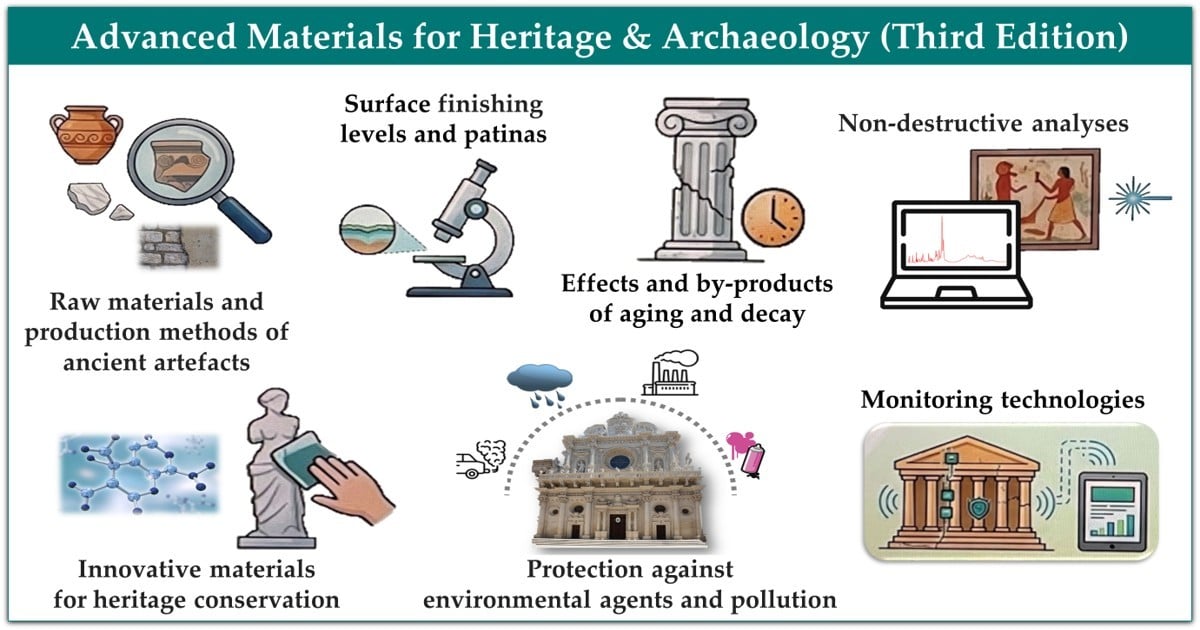
  • Investigation of raw materials and production methods of past technologies, such as ceramics, potteries, painted plasters and ancient marble artifacts, etc.;
  • Characterization of building surface finishing levels or patinas;
  • Analysis of residues in archeological remains;
  • Advancement of non-destructive or micro-destructive material characterization techniques applied to a comprehensive analysis of cultural heritage materials such as stones, mortars and plasters, ancient ceramics, potteries, glasses and wall paintings;
  • Integrated investigations and analyses of materials’ behavior in relation to aging and decay processes;
  • Identification of surface conservation treatments used in past decades and their residual characteristics and performance;
  • Heritage building protection to face climate changes and urban pollution effects.
  • Research covering materials science or materials engineering aspects, including nanoscience and nanotechnology, for the development of new conservation products;
  • Applications of innovative surface-coating materials, products for consolidation and restoration and their related issues;
  • Understanding of the relationship between structure, properties and functions of materials to improve their performance in conservation actions.
  • Monitoring of heritage buildings.

Dr. Angela Calia
Dr. Mariateresa Lettieri
Guest Editors

Manuscript Submission Information

Manuscripts should be submitted online at www.mdpi.com by registering and logging in to this website. Once you are registered, click here to go to the submission form. Manuscripts can be submitted until the deadline. All submissions that pass pre-check are peer-reviewed. Accepted papers will be published continuously in the journal (as soon as accepted) and will be listed together on the special issue website. Research articles, review articles as well as short communications are invited. For planned papers, a title and short abstract (about 250 words) can be sent to the Editorial Office for assessment.

Submitted manuscripts should not have been published previously, nor be under consideration for publication elsewhere (except conference proceedings papers). All manuscripts are thoroughly refereed through a single-anonymized peer-review process. A guide for authors and other relevant information for submission of manuscripts is available on the Instructions for Authors page. Materials is an international peer-reviewed open access semimonthly journal published by MDPI.

Please visit the Instructions for Authors page before submitting a manuscript. The Article Processing Charge (APC) for publication in this open access journal is 2600 CHF (Swiss Francs). Submitted papers should be well formatted and use good English. Authors may use MDPI's English editing service prior to publication or during author revisions.

Keywords

  • archeology and heritage buildings
  • non-destructive or micro-destructive analysis of cultural heritage plasters, ceramics, potteries and glasses
  • non-destructive techniques for surface characterization
  • residue analysis
  • investigation of raw materials and production methods of ancient technologies
  • investigation of weathering effects
  • material conservation technologies
  • heritage building protection
  • nanomaterials
  • monitoring technologies

Benefits of Publishing in a Special Issue

  • Ease of navigation: Grouping papers by topic helps scholars navigate broad scope journals more efficiently.
  • Greater discoverability: Special Issues support the reach and impact of scientific research. Articles in Special Issues are more discoverable and cited more frequently.
  • Expansion of research network: Special Issues facilitate connections among authors, fostering scientific collaborations.
  • External promotion: Articles in Special Issues are often promoted through the journal's social media, increasing their visibility.
  • Reprint: MDPI Books provides the opportunity to republish successful Special Issues in book format, both online and in print.

Further information on MDPI's Special Issue policies can be found here.

Published Papers (2 papers)

Order results
Result details
Select all
Export citation of selected articles as:

Research

19 pages, 7947 KB  
Article
Research on the Composition and Manufacturing Technology of the Single-Eared Octagonal Gold Cup Unearthed from the Turki Mountain Tomb in Inner Mongolia
by Yawei Zhang, Lijuan Dong, Weidong Hu, Lei Yang and Li Li
Materials 2026, 19(14), 3082; https://doi.org/10.3390/ma19143082 - 17 Jul 2026
Viewed by 319
Abstract
The Turki Mountain Tomb, one of the three most representative Liao Dynasty tombs, has yielded numerous exquisite gold and silver artifacts during excavation that have drawn global attention for their superb craftsmanship and distinctive ethnic and period characteristics. However, their manufacturing technology had [...] Read more.
The Turki Mountain Tomb, one of the three most representative Liao Dynasty tombs, has yielded numerous exquisite gold and silver artifacts during excavation that have drawn global attention for their superb craftsmanship and distinctive ethnic and period characteristics. However, their manufacturing technology had seldom been studied. In this paper, alloy composition analysis and surface microscopic observation were performed on the single-eared octagonal gold cup unearthed from the Turki Mountain Tomb, utilizing portable X-ray fluorescence spectroscopy (p-XRF) and an ultra-depth field microscope. The composition results at different base material locations of the gold cup were similar, with gold content ranging from 84% to 88% and silver content ranging from 10% to 13%. The p-XRF spectra at the exact center of the ring foot, as well as the pearl roundel on the abdominal ridge and rim, showed dominant Au with minor Ag content. Therefore, it could be concluded that the material of the gold cup was made of Au-Ag alloy. Microscopic observation preliminarily revealed that the manufacturing process involved casting, engraving, and welding. The single-eared octagonal gold cup exhibited numerous conspicuous shrinkage cavities, and it was inferred that the gold cup was formed using casting technology. After the cup body, ring foot, and finger pad were cast separately, they were welded together to form the complete gold cup. In addition, green solder and insufficient fusion of welding material were found between the weld seam of the cup body and the ring foot. The exterior surface of the gold cup was adorned with patterns, such as fish-toe circle, upward lotus motif, and pearl roundels. The average diameter of the fish-toe circle was 303 μm. By examining the overlapping conditions of engraving, it could be inferred that the proposed engraving sequence was to engrave the fish-toe circle first, followed by the flower patterns. As a representative of the exquisite artifacts from the Turki Mountain Tomb, the research of the composition and manufacturing technology of the gold cup provides reference data for the scientific analysis of Liao Dynasty gold and silver artifacts. Full article
(This article belongs to the Special Issue Advanced Materials for Heritage and Archaeology (Third Edition))
Show Figures

Figure 1

20 pages, 3929 KB  
Article
Multi-Technique Characterization of Historic Blue Bricks from Beijing: Compositional Grouping, Weathering Assessment, and Conservation Implications
by Zhaoyang Zhu, Rui Hu and Bo Zhang
Materials 2026, 19(12), 2666; https://doi.org/10.3390/ma19122666 - 21 Jun 2026
Cited by 1 | Viewed by 391
Abstract
Historic blue bricks are fundamental to Beijing’s architectural heritage, yet cross-site compositional data for guiding material-compatible restoration remain scarce. This study applies WD-XRF, XRD, SEM, thermal expansion measurement, and physical property testing to 21 blue brick specimens from four Beijing-area sites spanning the [...] Read more.
Historic blue bricks are fundamental to Beijing’s architectural heritage, yet cross-site compositional data for guiding material-compatible restoration remain scarce. This study applies WD-XRF, XRD, SEM, thermal expansion measurement, and physical property testing to 21 blue brick specimens from four Beijing-area sites spanning the Tang through Qing dynasties, with PCA and K-means clustering used to explore compositional grouping structures. Within this exploratory dataset, a compositional distinction separates the Ming and Qing Great Wall bricks: CaO falls from 7.7 to 1.5 wt.% as anorthite gives way to albite, while Qing specimens are denser (1.79 vs. 1.65 g·cm−3) with lower water absorption (15.9% vs. 20.9%). Two Wanping City bricks are strongly sulfate-enriched (SO3 up to 9.8%), and WP-SE3 additionally carries a heavy chloride load (Cl 2.1%), masking their original clay signatures and illustrating how unrecognized weathering can distort compositional grouping and source-related interpretation from bulk chemistry. K-means clustering yields compositional types that overlap only partially with site boundaries, capturing raw material variation rather than site-specific manufacturing fingerprints. Despite constraints in sample size and physical property coverage, the integrated dataset offers preliminary compositional benchmarks and limited performance data to inform period-specific brick replacement at these heritage sites. Full article
(This article belongs to the Special Issue Advanced Materials for Heritage and Archaeology (Third Edition))
Show Figures

Figure 1

Back to TopTop