


Responsive, Adaptable, Reconfigurable and Tunable Phononic Crystals and Metamaterials
This special issue belongs to the section "Optical and Photonic Materials".
Special Issue Information
Dear Colleagues,
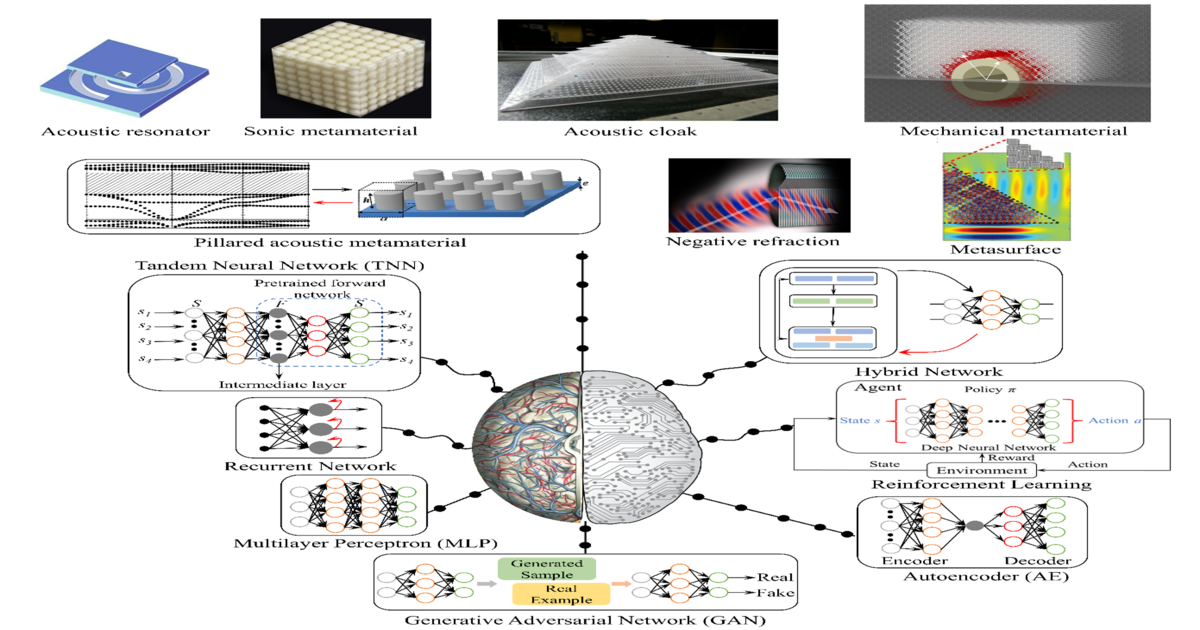
Phononic crystals and metamaterials are artificially engineered structures with exceptional mechanical and dynamic properties, including negative effective medium properties, acoustic properties, vibration damping, shape morphing, and invisibility cloaks, that are impossible in natural materials. These fantastic properties are derived from the design strategies for various phononic crystals and metamaterial configurations and they are constantly evolving. The current state-of-the-art research in the field goes beyond physical intuition and extends to mimicking living materials inspired from biology and biomimetic approaches, advanced computation and manufacturing, and artificial-intelligence-based inverse design methods, etc. The scope of this Special Issue is to highlight the latest trends in the design of phononic crystals and metamaterials that enable practically relevant configurations, multifunctional properties, and/or other sophisticated new characteristics.
Simultaneously, the field of phononic crystals and metamaterials benefits from rapid progress in the development of advanced additive manufacturing methods, including advanced lithography, nano-printing, optical 3D printing, and multi-photon 4D printing. The other scope of this Special Issue is, thus, to feature recent advancements in the fabrication of phononic crystals and metamaterials that enable experimental breakthroughs and uncover the high potential of metamaterials for engineering applications.
Topics covered include, but are not limited to:
- Phononic crystals;
- Acoustic metamaterials;
- Elastic metamaterials;
- Seismic metamaterials;
- Mechanical metamaterials/architected materials;
- Topological phononics;
- Shape morphing metamaterials;
- Origami/Kirigami;
- Meta-structures;
- 3D-printed materials;
- Responsive materials;
- Adaptable materials;
- Bio-inspired materials;
- Acoustic materials.
Dr. Muhammad
Guest Editor
Manuscript Submission Information
Manuscripts should be submitted online at www.mdpi.com by registering and logging in to this website. Once you are registered, click here to go to the submission form. Manuscripts can be submitted until the deadline. All submissions that pass pre-check are peer-reviewed. Accepted papers will be published continuously in the journal (as soon as accepted) and will be listed together on the Special Issue website. Research articles, review articles as well as short communications are invited. For planned papers, a title and short abstract (about 250 words) can be sent to the Editorial Office for assessment.
Submitted manuscripts should not have been published previously, nor be under consideration for publication elsewhere (except conference proceedings papers). All manuscripts are thoroughly refereed through a single-anonymized peer-review process. A guide for authors and other relevant information for submission of manuscripts is available on the Instructions for Authors page. Materials is an international peer-reviewed open access semimonthly journal published by MDPI.
Please visit the Instructions for Authors page before submitting a manuscript. The Article Processing Charge (APC) for publication in this open access journal is 2600 CHF (Swiss Francs). Submitted papers should be well formatted and use good English. Authors may use MDPI's English editing service prior to publication or during author revisions.
Keywords
- phononic crystals
- acoustic metamaterials
- elastic metamaterials
- mechanical metamaterials
- architected materials
- acoustic materials
- responsive materials
- 3D-printed materials
- bio-inspired materials
Benefits of Publishing in a Special Issue
- Ease of navigation: Grouping papers by topic helps scholars navigate broad scope journals more efficiently.
- Greater discoverability: Special Issues support the reach and impact of scientific research. Articles in Special Issues are more discoverable and cited more frequently.
- Expansion of research network: Special Issues facilitate connections among authors, fostering scientific collaborations.
- External promotion: Articles in Special Issues are often promoted through the journal's social media, increasing their visibility.
- Reprint: MDPI Books provides the opportunity to republish successful Special Issues in book format, both online and in print.
Published Papers


Materials - ISSN 1996-1944