



Clinical Advances and Challenges in Abdominal Imaging and Intervention
This special issue belongs to the section "Nuclear Medicine & Radiology".
Special Issue Information
Dear Colleagues,
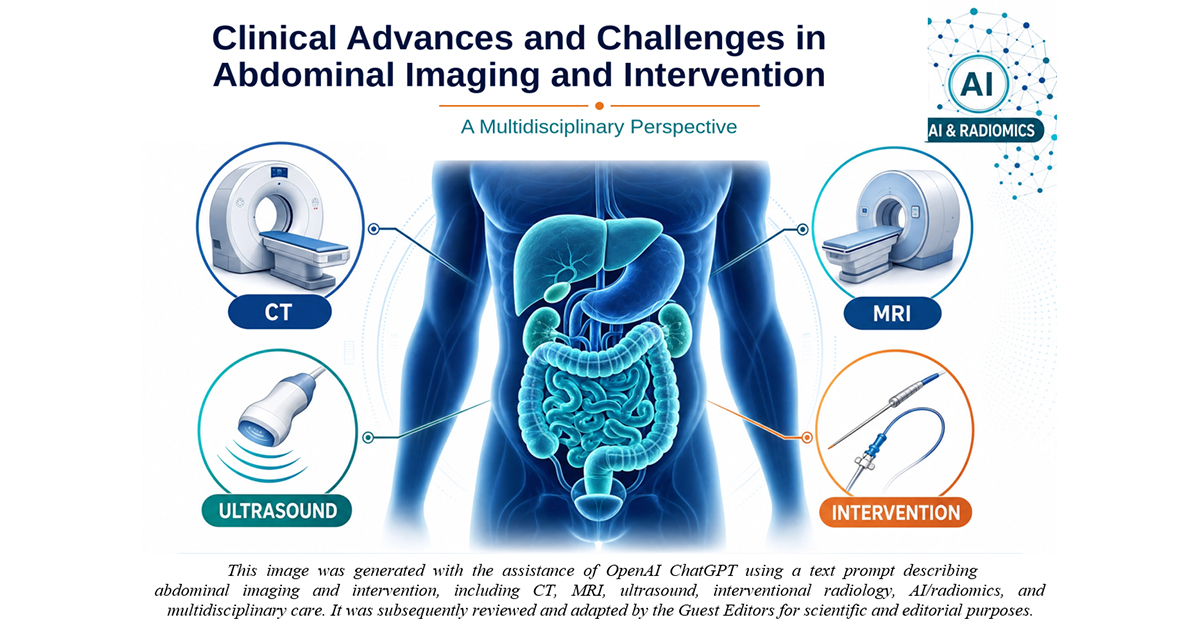
Abdominal imaging has become a cornerstone of modern medicine, playing a decisive role in the diagnosis, treatment planning, and follow-up of a broad spectrum of gastrointestinal, hepatobiliary, genitourinary, and vascular diseases. The rapid evolution of imaging technologies, including multi-detector computed tomography (CT), multiparametric magnetic resonance imaging (MRI), and advanced ultrasound techniques, provides clinicians across many disciplines with powerful tools to detect and characterize abdominal pathologies with remarkable precision. The growing integration of artificial intelligence (AI) and radiomics into clinical workflows is further reshaping diagnostic pathways, offering new opportunities to enhance accuracy, streamline shared decision-making, and ultimately improve patient outcomes.
Alongside these advances, important challenges persist across the entire clinical pathway. They include managing the increasing volume and complexity of imaging data, optimizing protocols to balance diagnostic quality with radiation dose and resource use, and addressing the diagnostic dilemmas of acute abdominal conditions, where rapid and accurate decisions are critical. At the same time, image-guided abdominal intervention is expanding rapidly, delivering minimally invasive therapeutic options that increasingly depend on close collaboration among the specialists involved in patient care.
This Special Issue aims to present and disseminate the most recent advances related to abdominal imaging and image-guided interventions, with a deliberately multidisciplinary perspective. We welcome contributions of interest to the broad community of physicians and surgeons engaged in the management of abdominal diseases.
Topics of interest for publication include, but are not limited to, the following:
- Recent advancements in CT and MRI techniques for abdominal and pelvic imaging;
- The role of ultrasound and contrast-enhanced ultrasound (CEUS) in abdominal emergencies;
- Artificial intelligence and radiomics applications in abdominal medicine;
- Image-guided interventional procedures in the management of abdominal disorders;
- Multidisciplinary approaches to acute abdominal pain, trauma, and emergency care;
- Optimization of imaging protocols and radiation dose reduction strategies;
- Advances in oncologic imaging, tumor staging, and treatment response assessment;
- Imaging-based collaboration across surgery, gastroenterology, urology, and oncology.
Dr. Marco Di Serafino
Dr. Francesca Iacobellis
Guest Editors
Manuscript Submission Information
Manuscripts should be submitted online at www.mdpi.com by registering and logging in to this website. Once you are registered, click here to go to the submission form. Manuscripts can be submitted until the deadline. All submissions that pass pre-check are peer-reviewed. Accepted papers will be published continuously in the journal (as soon as accepted) and will be listed together on the special issue website. Research articles, review articles as well as short communications are invited. For planned papers, a title and short abstract (about 250 words) can be sent to the Editorial Office for assessment.
Submitted manuscripts should not have been published previously, nor be under consideration for publication elsewhere (except conference proceedings papers). All manuscripts are thoroughly refereed through a single-anonymized peer-review process. A guide for authors and other relevant information for submission of manuscripts is available on the Instructions for Authors page. Journal of Clinical Medicine is an international peer-reviewed open access semimonthly journal published by MDPI.
Please visit the Instructions for Authors page before submitting a manuscript. The Article Processing Charge (APC) for publication in this open access journal is 2600 CHF (Swiss Francs). Submitted papers should be well formatted and use good English. Authors may use MDPI's English editing service prior to publication or during author revisions.
Keywords
- abdominal imaging
- computed tomography (CT)
- magnetic resonance imaging (MRI)
- emergency medicine
- interventional radiology
- multidisciplinary management
- artificial intelligence in medicine
- ultrasound
Benefits of Publishing in a Special Issue
- Ease of navigation: Grouping papers by topic helps scholars navigate broad scope journals more efficiently.
- Greater discoverability: Special Issues support the reach and impact of scientific research. Articles in Special Issues are more discoverable and cited more frequently.
- Expansion of research network: Special Issues facilitate connections among authors, fostering scientific collaborations.
- External promotion: Articles in Special Issues are often promoted through the journal's social media, increasing their visibility.
- Reprint: MDPI Books provides the opportunity to republish successful Special Issues in book format, both online and in print.
Published Papers


J. Clin. Med. - ISSN 2077-0383