



Clinical Advances in Drug Safety and Polypharmacy
This special issue belongs to the section "Pharmacology".
Special Issue Information
Dear Colleagues,
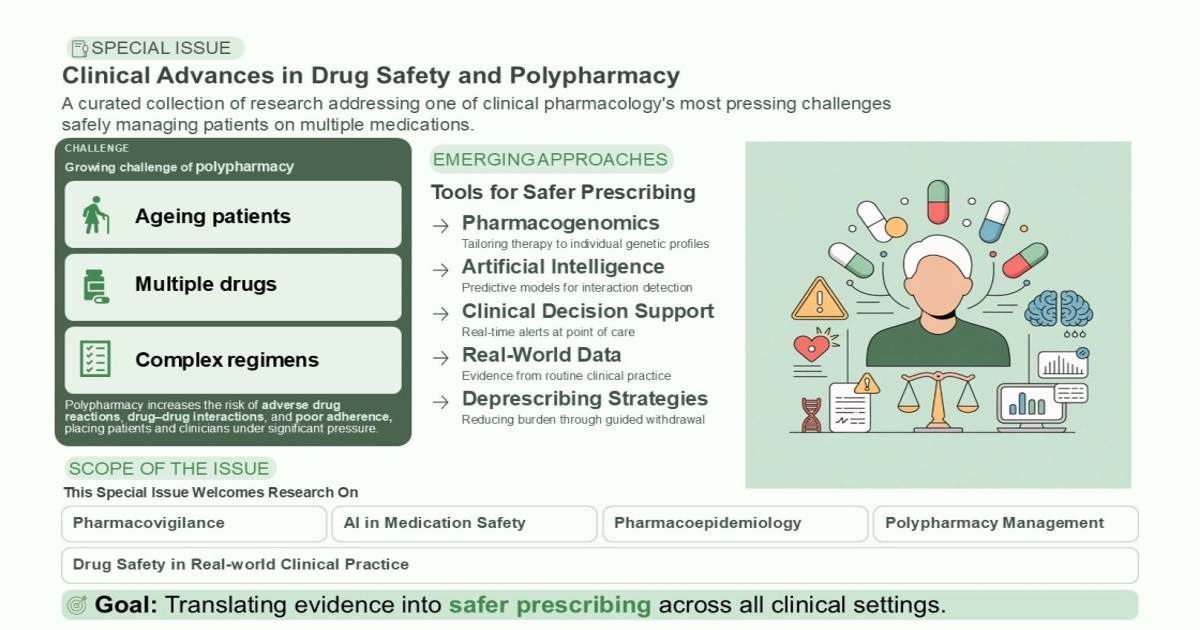
Polypharmacy has become an increasingly prevalent phenomenon in modern healthcare, which has largely been driven by the global population aging, the rising burden of chronic diseases, and the growing complexity of therapeutic strategies. While the use of multiple medications is often necessary to achieve optimal disease management, it also introduces significant safety challenges. Polypharmacy is strongly associated with an increased risk of adverse drug reactions, drug–drug interactions, and reduced treatment adherence. These issues are particularly relevant in vulnerable populations such as older adults, patients with multiple comorbidities, and individuals receiving long-term or complex therapeutic regimens. Consequently, ensuring drug safety in the context of polypharmacy represents a critical priority for clinicians, researchers, and healthcare systems worldwide.
In recent years, advances in clinical pharmacology, pharmacovigilance, and real-world data analysis have presented new opportunities to better understand and mitigate medication-related risks. Emerging approaches such as personalized medicine, pharmacogenomics, clinical decision support systems, and structured deprescribing strategies are helping clinicians to balance the therapeutic benefits with potential harm. Moreover, the growing integration of artificial intelligence (AI) and machine learning into healthcare is creating new possibilities to improve medication safety. AI-based tools can support clinicians in identifying potential drug–drug interactions, predicting adverse drug reactions, analyzing large healthcare datasets, and optimizing prescribing practices in complex polypharmacy scenarios. In parallel, the increasing availability of real-world evidence from healthcare databases and pharmacovigilance systems is providing valuable insights into prescribing patterns, medication safety, and patient outcomes across diverse clinical settings. These developments highlight the urgent need for multidisciplinary research aimed at improving medication safety and optimizing therapeutic strategies in patients who are exposed to multiple treatments.
This Special Issue aims to present and disseminate the most recent advances related to drug safety and polypharmacy in clinical practice. We welcome contributions addressing pharmacological, clinical, epidemiological, and technological aspects that may improve the safe and rational use of medications in patients receiving multiple therapies. Submissions may include original research articles and literature reviews that provide novel insights into medication safety and optimization.
Topics of interest for publication include, but are not limited to, the following:
- Adverse drug reactions associated with polypharmacy.
- Drug–drug interactions and their clinical management.
- Polypharmacy in multimorbid patients.
- Deprescribing strategies and medication optimization.
- Pharmacovigilance and real-world evidence in drug safety.
- Artificial intelligence and machine learning applications in medication safety.
- Medication adherence and patient-centered approaches.
Dr. Alfredo Vannacci
Dr. Giada Crescioli
Guest Editors
Manuscript Submission Information
Manuscripts should be submitted online at www.mdpi.com by registering and logging in to this website. Once you are registered, click here to go to the submission form. Manuscripts can be submitted until the deadline. All submissions that pass pre-check are peer-reviewed. Accepted papers will be published continuously in the journal (as soon as accepted) and will be listed together on the special issue website. Research articles, review articles as well as short communications are invited. For planned papers, a title and short abstract (about 250 words) can be sent to the Editorial Office for assessment.
Submitted manuscripts should not have been published previously, nor be under consideration for publication elsewhere (except conference proceedings papers). All manuscripts are thoroughly refereed through a single-anonymized peer-review process. A guide for authors and other relevant information for submission of manuscripts is available on the Instructions for Authors page. Journal of Clinical Medicine is an international peer-reviewed open access semimonthly journal published by MDPI.
Please visit the Instructions for Authors page before submitting a manuscript. The Article Processing Charge (APC) for publication in this open access journal is 2600 CHF (Swiss Francs). Submitted papers should be well formatted and use good English. Authors may use MDPI's English editing service prior to publication or during author revisions.
Keywords
- polypharmacy
- medication safety
- adverse drug reactions
- drug–drug interactions
- pharmacovigilance
- artificial intelligence in healthcare
- precision medicine
- deprescribing
- pharmacoepidemiology
Benefits of Publishing in a Special Issue
- Ease of navigation: Grouping papers by topic helps scholars navigate broad scope journals more efficiently.
- Greater discoverability: Special Issues support the reach and impact of scientific research. Articles in Special Issues are more discoverable and cited more frequently.
- Expansion of research network: Special Issues facilitate connections among authors, fostering scientific collaborations.
- External promotion: Articles in Special Issues are often promoted through the journal's social media, increasing their visibility.
- Reprint: MDPI Books provides the opportunity to republish successful Special Issues in book format, both online and in print.
Published Papers


J. Clin. Med. - ISSN 2077-0383