

Need Help?
Announcements
11 September 2026
MDPI Webinar | MDPI Topic Editor Club 2026—Life Sciences Session, 18 September 2026

MDPI warmly invites you to the MDPI Topic Editor Club 2026 webinar series. This global platform connects worldwide Topic Editors, featuring emerging research themes, practical editorial experience sharing and academic communication. MDPI Topics are interdisciplinary thematic paper collections published across multiple MDPI journals. Led by professional Topic Editor teams and supported by MDPI’s efficient open access publishing workflow, they facilitate academic collaboration and help research reach broader global audiences.
Focusing on “Life Sciences”, this session brings together Topic Editors to showcase editorial work, discuss the successes and challenges of topic development, and share innovative strategies for building high-impact topics. It offers a great chance for peer learning and cross-disciplinary collaboration to advance open access research in this field.
We welcome your participation in the MDPI Topic Editor Club 2026 and look forward to your insights and questions during the live Q&A session.
Date: 18 September 2026 at 1:00 p.m. CEST | 7:00 a.m. EDT | 7:00 p.m. CST Asia
Webinar ID: 891 1771 1569
Landing Page: https://sciforum.net/event/MTEC2026-LS
Register now for free!

Program:
| Speaker | Presentation Title | Time in CEST | Time in EDT | Time in CST Asia |
| Ms. Lavinia Dumitrela Cozma | MDPI Introduction | 1:00–1:10 p.m. | 7:00–7:10 a.m. | 7:00–7:10 p.m. |
| Dr. Alina Rodríguez Mallon | Special Topics: From Idea to Impact | 1:10–1:30 p.m. | 7:10–7:30 a.m. | 7:10–7:30 p.m. |
| Dr. Alejandro Cabezas-Cruz | From a Topic to a Scientific Community: Lessons from Ticks and Tick-Borne Pathogens | 1:30–1:50 p.m. | 7:30–7:50 a.m. | 7:30–7:50 p.m. |
| Ms. Lavinia Dumitrela Cozma | Introduction of MDPI Topics | 1:50–2:10 p.m. | 7:50–8:10 a.m. | 7:50–8:10 p.m. |
| Q&A Session | 2:10–2:25 p.m. | 8:10–8:25 a.m. | 8:10–8:25 p.m. | |
| Ms. Lavinia Dumitrela Cozma | Closing of Webinar | 2:25–2:30 p.m. | 8:25–8:30 a.m. | 8:25–8:30 p.m. |
After registering, you will receive a confirmation email containing information on how to join the webinar. Registrations with academic institutional email addresses will be prioritized.
Unable to attend? Register anyway and we’ll let you know when the recording is available to watch.
Webinar Speakers:
- Dr. Alina Rodríguez Mallon, Havana University in Cuba, Havana, Cuba;
- Dr. Alejandro Cabezas-Cruz, INRAE, Maisons-Alfort, France.
Relevant Topic:
“Ticks and Tick-Borne Pathogens: 2nd Edition”
Topic Editors: Alina Rodriguez-Mallon and Alejandro Cabezas-Cruz
Manuscript submission deadline: 31 March 2027
11 September 2026
Arthropoda | Most Viewed Papers Published in 2023–2024 (I)

Arthropoda (ISSN 2813-3323) is an open access journal, providing free and unlimited access to the full texts of all articles. We invite you to explore our most-viewed articles, which are listed below.
1. “Startle Responses of Jorō Spiders (Trichonephila clavata) to Artificial Disturbance”
by Andrew K. Davis and Amitesh V. Anerao
Arthropoda 2023, 1(2), 60-67; https://doi.org/10.3390/arthropoda1020009
Available online: https://www.mdpi.com/2813-3323/1/2/9

2. “How Urban-Tolerant Are They? Testing Prey–Capture Behavior of Introduced Jorō Spiders (Trichonephila clavata) Next to Busy Roads”
by Andrew K. Davis, Kade Stewart, Caitlin Phelan and Alexa Schultz
Arthropoda 2024, 2(1), 55-65; https://doi.org/10.3390/arthropoda2010004
Available online: https://www.mdpi.com/2813-3323/2/1/4

3. “Review of the Spider Genus Linothele (Mygalomorphae, Dipluridae) from Ecuador—An Exceptional Case of Speciation in the Andes”
by Nadine Dupérré, Elicio Tapia and Jason E. Bond
Arthropoda 2023, 1(3), 68-341; https://doi.org/10.3390/arthropoda1030010
Available online: https://www.mdpi.com/2813-3323/1/3/10

4. “Composition, Distribution, and Biodiversity of Zooplanktons in Tropical Lentic Ecosystems with Different Environmental Conditions”
by Wahidah Ahmad Dini Umi, Fatimah M. Yusoff, Zetty Norhana Balia Yusof, Norulhuda Mohamed Ramli, Artem Y. Sinev and Tatsuki Toda
Arthropoda 2024, 2(1), 33-54; https://doi.org/10.3390/arthropoda2010003
Available online: https://www.mdpi.com/2813-3323/2/1/3
5. “New Cases of Teratology, Albinism, Abnormal Pigmentation, Gynandromorphism, and Injury Healing in Scorpions (Arachnida: Scorpiones)”
by Danniella Sherwood, Victoria Tang, Julien Tchilinguirian, Ludivine Lamare, Seth Croffy, Mark Stockmann, Jay Keller and Valerio Gerace
Arthropoda 2024, 2(4), 226-249; https://doi.org/10.3390/arthropoda2040017
Available online: https://www.mdpi.com/2813-3323/2/4/17

6. “Lethal and Sub-Lethal Effects of Spirotetramat on Red Spider Mite, Tetranychus macfarlanei Baker and Pritchard (Acari: Tetranychidae)”
by Farhana Afrose Swarna, Tasfia Hayder, Shreema Mandal Barsa, Powlomee Mondal, Tetsuo Gotoh and Mohammad Shaef Ullah
Arthropoda 2024, 2(3), 212-225; https://doi.org/10.3390/arthropoda2030016
Available online: https://www.mdpi.com/2813-3323/2/3/16

7. “Description of the Early Larval Development in Freshwater Shrimp Atya lanipes Holthuis, 1963 (Decapoda: Caridea: Atyidae) from Puerto Rico”
by Stefani Cruz-Rosa, Ángel S. Estruche-Santos and Omar Pérez-Reyes
Arthropoda 2024, 2(2), 169-180; https://doi.org/10.3390/arthropoda2020013
Available online: https://www.mdpi.com/2813-3323/2/2/13

8. “Three New Species of the Freshwater Shrimp Genus Caridina from Australia”
by Werner Klotz, Thomas von Rintelen and Kristina von Rintelen
Arthropoda 2024, 2(1), 99-118; https://doi.org/10.3390/arthropoda2010008
Available online: https://www.mdpi.com/2813-3323/2/1/8
9. “Phylogeography of a Widely Distributed Atlantic Species: The Case of the Ghost Crab Ocypode quadrata (Fabricius, 1787) (Decapoda: Brachyura: Ocypodidae)”
by Ana Francisca Tamburus, Ivana Miranda, Bárbara Benati Naves and Fernando Luis Mantelatto
Arthropoda 2024, 2(2), 130-148; https://doi.org/10.3390/arthropoda2020010
Available online: https://www.mdpi.com/2813-3323/2/2/10

10. “Survival and Growth of Asellus aquaticus on Different Food Sources from Drinking Water Distribution Systems”
by Nikki van Bel, J. Hein M. van Lieverloo, Antonie M. Verschoor, Leonie Pap-Veldhuizen, Wim A. M. Hijnen, Edwin T. H. M. Peeters and Julia Wunderer
Arthropoda 2024, 2(3), 192-211; https://doi.org/10.3390/arthropoda2030015
Available online: https://www.mdpi.com/2813-3323/2/3/15
10 September 2026
Arthropoda | Most Viewed Papers Published in 2023–2024 (II)

Arthropoda (ISSN 2813-3323) is an open access journal, providing free and unlimited access to the full texts of all articles. We invite you to explore our most-viewed articles, which are listed below.
1. “Investigating Path Integration Cues in Sand Scorpion Homing Behavior”
by Alexis B. Merchant and Douglas D. Gaffin
Arthropoda 2023, 1(2), 49-59; https://doi.org/10.3390/arthropoda1020008
Available online: https://www.mdpi.com/2813-3323/1/2/8
2. “On a Remarkable New Genus and Species of Alpheid Shrimps (Malacostraca: Decapoda: Caridea) from the Tropical Western Atlantic”
by Arthur Anker
Arthropoda 2023, 1(4), 398-414; https://doi.org/10.3390/arthropoda1040016
Available online: https://www.mdpi.com/2813-3323/1/4/16
3. “Evolutionary Conservation and Diversification of Five Pax6 Homologs in the Horseshoe Crab Species Cluster”
by Tanay Dakarapu and Markus Friedrich
Arthropoda 2024, 2(1), 85-98; https://doi.org/10.3390/arthropoda2010007
Available online: https://www.mdpi.com/2813-3323/2/1/7
4. “Lithoscaptus aquarius sp. nov. (Decapoda: Cryptochiridae) Described from a Catalaphyllia jardinei (Scleractinia) out of the Aquarium Trade”
by Sancia E. T. van der Meij
Arthropoda 2023, 1(3), 350-358; https://doi.org/10.3390/arthropoda1030012
Available online: https://www.mdpi.com/2813-3323/1/3/12

5. “The Prevalence of Egg Parasitoids of Two Cobweb Spiders in a Tropical Urban Gradient”
by Natalia Jiménez-Conejo, Paul E. Hanson, Eduardo Chacón-Madrigal and Geovanna Rojas-Malavasi
Arthropoda 2024, 2(4), 250-263; https://doi.org/10.3390/arthropoda2040018
Available online: https://www.mdpi.com/2813-3323/2/4/18

6. “The Dynamics of Soil Mesofauna Communities in a Tropical Urban Coastal Wetland: Responses to Spatiotemporal Fluctuations in Phreatic Level and Salinity”
by Gloria Ortiz-Ramírez, Elix Hernández, Solimar Pinto-Pacheco and Elvira Cuevas
Arthropoda 2024, 2(1), 1-27; https://doi.org/10.3390/arthropoda2010001
Available online: https://www.mdpi.com/2813-3323/2/1/1

7. “Description of Limb Anomalies Resulting from Molt Irregularities in Ammothea hilgendorfi (Pycnogonida: Ammotheidae)”
by Antoine Flandroit, Louis Simon and Guillaume Caulier
Arthropoda 2024, 2(2), 156-168; https://doi.org/10.3390/arthropoda2020012
Available online: https://www.mdpi.com/2813-3323/2/2/12

8. “Long-Jawed Spider Moves across Water with and without the Use of Silk”
by John Gould and Jose W. Valdez
Arthropoda 2023, 1(4), 415-419; https://doi.org/10.3390/arthropoda1040017
Available online: https://www.mdpi.com/2813-3323/1/4/17

9. “Acarological Risk of Infection with Borrelia burgdorferi, the Lyme Disease Agent, in Staten Island, New York City”
by Liyang Zhou, Leonid Tsynman, Kamesan Kanapathipillai, Zahir Shah and Waheed Bajwa
Arthropoda 2024, 2(3), 181-191; https://doi.org/10.3390/arthropoda2030014
Available online: https://www.mdpi.com/2813-3323/2/3/14
10. “Age-Resilient Stickiness of Capture Threads”
by Marco Meyer and Anna-Christin Joel
Arthropoda 2023, 1(3), 342-349; https://doi.org/10.3390/arthropoda1030011
Available online: https://www.mdpi.com/2813-3323/1/3/11

10 September 2026
Meet Us at the Entomological Conference 2027—Arthropod Decline and Non-Destructive Methods, 28 September–1 October, Budapest, Hungary

We are proud to invite you to attend the event organized by the journal Insects (ISSN 2075-4450, IF:3.0), which will take place in Budapest, Hungary, from 28 September to 1 October 2027.
Conference Chair:
- Prof. Gábor L. Lövei, 1 Department of Agroecology, Aarhus University, Flakkebjerg Research Centre, Denmark; 2 Anthropocene Ecology Research Group, Department of Ecology, University of Debrecen, Hungary.
Topics of interest:
S1. Arthropod Decline (AD);
S2. Non-destructive Methods in Entomology: Current Situation and Prospects;
S3. Pest Management, Pesticide Resistance, and Toxicology;
S4. Biodiversity, Climate Change, Conservation, Ecology, and Evolution;
S5. Ethical Issues in Entomology;
S6. General Topics.
Important dates:
Abstract submission deadline: 9 April 2027;
Abstract acceptance notification: 7 May 2027;
Early Bird registration deadline: 9 July 2027;
Regular registration deadline: 10 September 2027.
Guide for authors:
To submit your abstract, please click on the following link: https://sciforum.net/submissions/ENTOMO2027/1.
To register for the event, please click on the following link: https://sciforum.net/registration/entomo2027/tickets.
For details regarding Abstract Submission, Poster and Slide Submission, and Publication Opportunities, you may refer to the “Instructions for Authors” section: https://sciforum.net/event/entomo2027/instructions-for-authors.
For any enquiries regarding the event, please contact entomo@mdpi.com.
We look forward to seeing you at the Entomological Conference 2027 in Hungary.
8 September 2026
Arthropoda | Aims and Scope Update
To further clarify the scope of Arthropoda (ISSN 2813-3323), under the guidance of our Editor-in-Chief, Dr. Juan Antonio Baeza, the journal has updated and revised its aims and scope. The original scope and the updated version are listed below:
|
Aims (old version): |
Aims (new version): |
|
Arthropoda (ISSN 2813-3323) is an international, peer-reviewed, open access journal specializing in the study of arthropods, with a focus on non-insect arthropods, published quarterly online by MDPI. |
Arthropoda (ISSN 2813-3323) is an international, peer-reviewed, open access journal specializing in the study of arthropods, with a focus on non-insect arthropods, published quarterly online by MDPI. |
|
Scope (old version): |
Scope (new version): |
|
The scope of this journal covers all topics related to non-insect arthropods, running the spectrum from molecules through to populations and individual species, to ecosystem studies. Specific fields of interest include, but are not limited to, the following:
|
The scope of this journal covers all topics related to non-insect arthropods, running the spectrum from molecules through to populations and individual species to ecosystem studies. Specific fields of interest include, but are not limited to, the following:
|
For more detailed information, please visit the following link: https://www.mdpi.com/journal/arthropoda/about.
Arthropoda Editorial Office
1 September 2026
MDPI INSIGHTS: The CEO’s Letter #38 – 2 Million Published Articles, Outstanding Reviewers, Michele Parrinello Award, AIS 2026 & WSF-12

Welcome to the MDPI Insights: The CEO's Letter.
In these monthly letters, I will showcase two key aspects of our work at MDPI: our commitment to empowering researchers and our determination to facilitating open scientific exchange.
Opening Thoughts

MDPI Reaches 2 million Published Articles
This month, MDPI reached an important milestone: the publication of our two-millionth article.
It is a number that would have been difficult to imagine in 1996, when MDPI’s first journal, Molecules, published its first volume of 74 papers. It took 25 years to reach our first million published articles in December 2022, and less than four years to reach the second million in August 2026.
From 74 Papers to Two Million Articles
The milestone also comes during our 30th anniversary year, providing another opportunity to reflect on how both MDPI and Open Access publishing have developed over the past three decades. Today, more than half of the world’s published research is Open Access, while MDPI has grown into a portfolio of journals supported by more than 70,000 Editorial Board Members. In 2025 alone, articles published in MDPI journals received 1.9 billion views and downloads.
While two million is an impressive number, what matters most is what sits behind it. Every article represents research conducted and shared by authors, editorial decisions made by academic editors, expertise contributed by reviewers, and the work of colleagues across MDPI supporting the publication and dissemination of research.
Many of the stories in this month’s CEO Letter reflect these communities. We recognize the contributions of the more than 209,000 reviewers who supported MDPI journals in 2025, celebrate scientific excellence through the inaugural Michele Parrinello Award, and look at how communities continue to develop through AIS 2026 and the 12th World Sustainability Forum.
“In 2025 alone, articles published in MDPI journals received 1.9 billion views and downloads”
Publishing at Scale, with Purpose
Reaching two million articles is an important milestone in MDPI’s history, but it is also a reminder of the responsibility that comes with publishing at this scale. As we look ahead, our focus remains on quality, research integrity, strong editorial standards, and providing researchers with reliable and efficient ways to share their work openly with the world.
Thank you to our authors, editors, reviewers, institutional partners, and colleagues around the world who have contributed to this journey.
Impactful Research

Recognizing Scientific Excellence: The Michele Parrinello Award
Supporting researchers means more than publishing and disseminating scientific work. It also means recognizing the researchers, editors, reviewers, and scholars whose contributions advance their fields.
I’m pleased to highlight the inaugural Michele Parrinello Award, which has been awarded to Prof. Ursula Röthlisberger of the École Polytechnique Fédérale de Lausanne (EPFL), Switzerland. Prof. Röthlisberger was recognized for her contributions to computational chemistry and molecular simulation, particularly her pioneering work in ab initio molecular dynamics and quantum mechanical/molecular mechanical (QM/MM) multiscale simulation methods.
Prof. Röthlisberger leads the Laboratory of Computational Chemistry and Biochemistry at EPFL, developing computational approaches to understand complex chemical, biological, and materials systems at the atomic level. Her work also extends to next-generation photovoltaic materials, demonstrating the interdisciplinary reach of computational science.
The Michele Parrinello Award was established in 2025 to honor Prof. Michele Parrinello's pioneering contributions to atomistic simulation and computational science. Presented biennially, it recognizes senior researchers who have made significant contributions across physics, chemistry, and materials science. The recipient receives a EUR 50,000 prize, commemorative medal, and certificate.
Awarding Scientific Excellence
The selection was overseen by an international Award Committee, chaired by Prof. Dr. Xin-Gao Gong of Fudan University and a group of researchers from institutions in China, Italy, the UK, and the USA. Nominations were evaluated based on rigor, integrity, and academic excellence. In announcing the winner, Prof. Gong highlighted the impact of Prof. Röthlisberger’s research across multiple scientific disciplines, alongside her contributions to education and leadership within the international research community.
Recognizing Contributions Across the Research Community
The Michele Parrinello Award is part of MDPI’s broader commitment to recognizing excellence across different disciplines, contributions, and career stages.
Our journal awards include:
- Best Paper Awards – recognizing outstanding published research
- Young Investigator Awards – supporting exceptional early-career researchers
- Best PhD Thesis Awards – recognizing promising emerging scholars
- Outstanding Reviewer Awards – acknowledging the essential contribution of peer reviewers
- Travel Awards – helping early-career researchers participate in international conferences
- Editor of Distinction Awards – recognizing exceptional contributions from Editorial Board Members.
Alongside these journal awards, MDPI supports flagship initiatives including the Tu Youyou Award, the World Sustainability Award, the Emerging Sustainability Leader Award, and now the Michele Parrinello Award.
Learn More:
Inside MDPI

Recognizing the People Behind Peer Review: MDPI’s 2025 Outstanding Reviewer Awards
Behind every published article is a network of people contributing their expertise to the scholarly record. Among them, reviewers play an essential role, providing independent assessment, feedback, and subject expertise that help editors make informed decisions and authors build on their research.
In 2025, more than 209,000 individuals contributed their expertise as reviewers for MDPI journals. This represents an enormous contribution of time and knowledge from researchers around the world, occurring often alongside their own research, teaching, and professional responsibilities.
I’m pleased to share the recipients of MDPI’s 2025 Outstanding Reviewer Awards, recognizing reviewers who have shown great dedication, expertise, and responsiveness throughout the peer-review process.
Outstanding Reviewers
As at July 2026, 181 MDPI journals have presented Outstanding Reviewer Awards to 412 recipients, highlighting their work across disciplines ranging from biology, chemistry, engineering, and medicine to environmental sciences, public health, and the social sciences. To learn more about the list of outstanding reviewers, please visit the following pages:
- Biology and Life Sciences;
- Business and Economics;
- Chemistry and Materials Science;
- Computer Science and Mathematics;
- Engineering;
- Environmental and Earth Sciences;
- Medicine and Pharmacology;
- Physical Sciences;
- Public Health and Healthcare;
- Social Sciences, Arts and Humanities.
While these awards highlight a select group of outstanding contributors, they also create an opportunity to acknowledge our entire reviewer community. Peer review depends on researchers sharing their knowledge and experience with others. Their feedback can improve manuscripts, support editors in making informed decisions, and contribute to maintaining the quality and integrity of the scientific record.
“Reviewers play an essential role, providing independent assessment, feedback, and subject expertise”
Supporting the Academic Community
The Outstanding Reviewer Awards are part of MDPI’s awards program, through which our journals recognize contributions across the academic community, including those from researchers, early-career scholars, reviewers, and Editorial Board Members.
Bringing these contributions to the forefront is important because much of the work that supports scholarly publishing happens behind the scenes. The time, expertise, and critical feedback provided by reviewers are essential to a rigorous and constructive peer-review process.
As MDPI celebrates its 30th anniversary, I would like to thank the more than 209,000 reviewers who contributed to our journals in 2025 and to congratulate the 412 Outstanding Reviewer Award recipients recognized for going above and beyond in supporting their respective research communities.
Coming Together for Science

AIS 2026: Growing a Community Around AI and Sensor Research
One of the most rewarding aspects of our conference program is seeing scientific communities develop over time. A conference may begin by bringing together researchers around an emerging field, but with each edition it can create new relationships, collaborations, and opportunities for researchers to reconnect and exchange ideas.
The 3rd International Conference on AI Sensors and Transducers (AIS 2026) is a good example of this growth.

“What stands out is the community developing around AIS”
This year’s conference took place from 2 to 7 August in Jeju, South Korea, welcoming over 560 participants – an increase of 225 attendees compared with 2025 and 160 compared with the inaugural conference of 2024. Across the program, participants contributed 373 presentations and 109 poster displays, including four plenary presentations, 52 keynote speeches, 192 invited talks, and 125 oral presentations.
Building an International Research Community
Beyond the numbers, what stands out is the community developing around AIS. Many researchers have now participated in all three editions of the conference, with delegates already expressing their intention to return for AIS 2027. The program also brought together established researchers from across the field for discussions on AI sensors and emerging sensing technologies.
 |
 |
Building Engagement in South Korea
This year’s conference reflects our continued engagement with the research community in South Korea. AIS 2026 welcomed 150 participants from the Korean academic community and strengthened our cooperation with the Korean Sensors Society.

This is an important part of what our conferences can achieve. By bringing researchers together in person, we create opportunities to present the latest research and build relationships between scholars, institutions, societies, and at MDPI that can continue after an event concludes.
Looking Ahead
With this momentum, AIS 2027 is planned for 29 July to 3 August 2027 in Kunming, Yunnan, China, with the participation of an international group of Conference Chairs already confirmed from institutions in Europe, North America, and Asia-Pacific.
Three editions into AIS, the continued growth of this conference shows what is possible when we invest consistently in scientific communities. The objective is not simply to organize larger conferences each year but to create spaces where researchers return, new collaborations develop, and scientific communities become stronger.
Many thanks to the Conference Chairs, speakers, sponsors, supporting organizations, participants, and all MDPI colleagues who contributed to AIS 2026. Growing an international event takes years of relationship-building and considerable work behind the scenes, and this year’s conference reflects that collective effort.

Closing Thoughts

World Sustainability Forum 12: Coming Together for a More Sustainable Future
Sustainability challenges rarely sit within a single discipline, institution, or country. Addressing them requires researchers, policymakers, industry, and communities to exchange ideas and work across traditional boundaries.
This is one of the ideas behind the World Sustainability Forum (WSF), which has now reached its 12th edition.
 |
 |
From 21 to 24 August, the 12th World Sustainability Forum (WSF-12) took place in Hong Kong, bringing together more than 300 experts, scholars, policymakers, and industry representatives from over 100 universities and research institutions across 53 countries and regions. The Forum received 543 abstract submissions, showcasing international interest in sustainability research.
Connecting Research, Policy, and Industry
Across four days, the scientific program featured 230 onsite presentations, including plenary, keynote, invited and oral presentations, together with 53 poster presentations. The program also included a plenary panel discussion, Connecting Sustainability Solutions Across Sectors, presenting perspectives from academia, government, and industry.
 |
 |
This interdisciplinary exchange is particularly important in sustainability research. Challenges relating to our cities, environment, energy systems, economies, and societies are increasingly interconnected, and progress depends on creating opportunities for different disciplines and sectors to learn from one another.
WSF-12 also generated opportunities for industry participation. As a Strategic Partner, the China National Petroleum Corporation (CNPC) E-Light International Communication Brand contributed to industry engagement throughout the Forum.

MDPI Sustainability Foundation Awards
Another highlight of WSF-12 was the presentation of three MDPI Sustainability Foundation Awards, celebrating the 2025 and 2026 winners of the World Sustainability Award and the 2026 winner of the Emerging Sustainability Leader Award.
 |
 |
 |
Recognizing researchers and emerging leaders in their fields is an important part of supporting scientific communities. These awards are an opportunity to celebrate individual achievements and highlight research that contributes to a more sustainable future.
Looking Ahead to WSF-13
After twelve editions, WSF is a great example of how a scientific community can develop over time. This is also what we hope to achieve through MDPI’s broader conference program. Scientific meetings should be more than individual events: by investing consistently in research communities, we can create spaces where people return, new relationships develop, different perspectives meet, and collaboration continues beyond the conference itself.

The next chapter is already taking shape. The 13th World Sustainability Forum(WSF-13) will take place from 8 to 11 June 2027 in Nice, France. Chaired by Prof. Dr. Adel Ben Youssef and organized by MDPI and the journal Sustainability in collaboration with Université Côte d’Azur, WSF-13 will continue the Forum’s interdisciplinary approach across the natural sciences, engineering, and social sciences.
Thank You
Many thanks to the Conference Chairs, speakers, strategic partners, sponsors, supporting organizations, participants, and all MDPI colleagues who contributed to WSF-12. Events of this scale require considerable coordination and collaboration behind the scenes, and the continued growth of WSF reflects the collective efforts of the MDPI Conference Department and a global community committed to sustainability research, innovation, and collaboration.

Chief Executive Officer
MDPI AG
19 August 2026
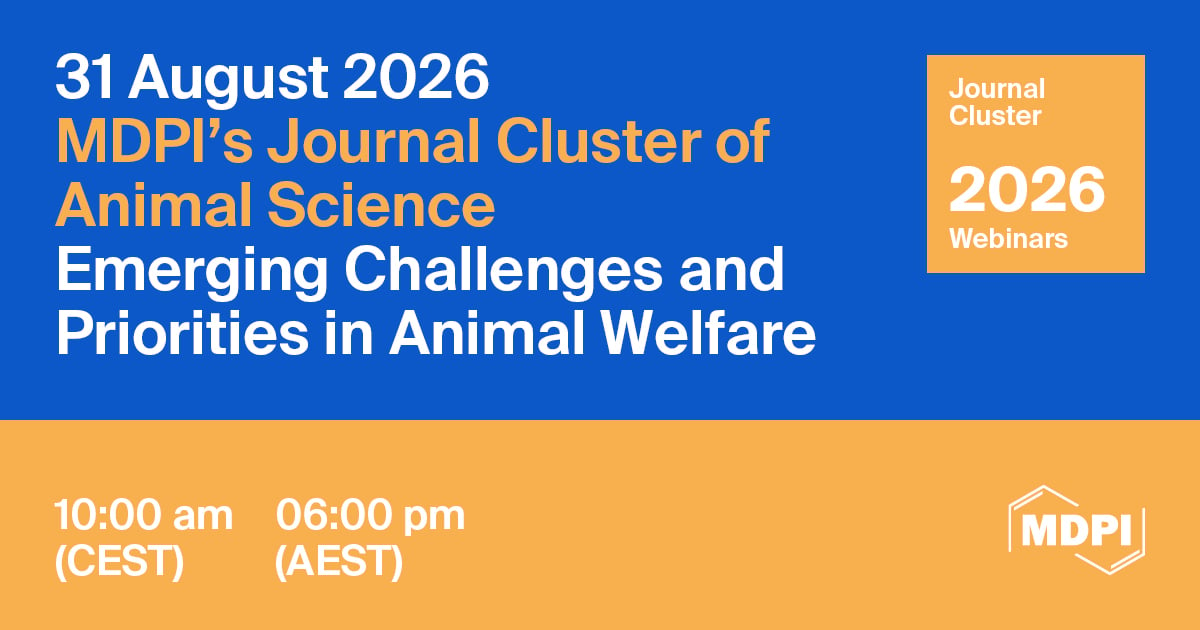
MDPI’s Journal Cluster of Animal Science Webinar | Emerging Challenges and Priorities in Animal Welfare, 31 August 2026
Message from the webinar Chair:
In this webinar, we would like to discuss new areas of welfare concern—areas that have not been discussed sufficiently in the past or are re-emerging in 2026 for renewed consideration. We would love for you to attend to hear talks on such issues and to raise questions with our expert presenters. We wish to raise awareness and maintain dialogue on varied animal welfare issues.
Date: 31 August at 10:00 a.m. CEST | 9:00 a.m. BST | 6:00 p.m. AEST | 4:00 p.m. CST Asia
Webinar ID: 890 1930 4928
Webinar webpage: https://sciforum.net/event/Cluster-15
Register now for free!

Program:
| Speaker | Presentation Title | Time in CEST | Time in BST | Time in AEST | Time in CST Asia |
| Dr. Mandy Paterson (Chair) | Chair Introduction | 10:00–10:10 a.m. | 9:00–9:10 a.m. | 6:00–6:10 p.m. | 4:00–4:10 p.m. |
| Prof. Dr. Andrew Knight | Sustainable Pet Food: Implications for Animal Welfare and the Environment | 10:10–10:30 a.m. | 9:10–9:30 a.m. | 6:10–6:30 p.m. | 4:10–4:30 p.m. |
| Prof. Dr. Dan O’Neill | Extreme Conformation as a Welfare Priority in Domesticated Animals | 10:30–10:50 a.m. | 9:30–9:50 a.m. | 6:30–6:50 p.m. | 4:30–4:50 p.m. |
| Dr. Karen Rickards | The Use of Welfare Assessments to Inform Good Welfare Practices for Equines in Sanctuary Care | 10:50–11:10 a.m. | 9:50–10:10 a.m. | 6:50–7:10 p.m. | 4:50–5:10 p.m. |
| Prof. Dr. David J. Mellor | COMPASS Guidelines for Welfare Focused Research | 11:10–11:30 a.m. | 10:10–10:30 a.m. | 7:10–7:30 p.m. | 5:10–5:30 p.m. |
| Dr. Joe Collins | Equine Identification & Traceability Underpin Equine Welfare, Responsible Ownership, and Use of Medicines | 11:30–11:50 a.m. | 10:30–10:50 a.m. | 7:30–7:50 p.m. | 5:30–5:50 p.m. |
| Q&A Session | 11:50–12:05 a.m. | 10:50–11:05 a.m. | 7:50–8:05 p.m. | 5:50–6:05 p.m. | |
| Dr. Mandy Paterson | Closing of Webinar | 12:05–12:10 a.m. | 11:05–11:10 a.m. | 8:05–8:10 p.m. | 6:05–6:10 p.m. |
After registering, you will receive a confirmation email containing information on how to join the webinar. Registrations with academic and institutional email addresses will be prioritized.
Unable to attend? Register anyway, and we will let you know when the recording is available to watch.
Webinar Chair and Keynote Speakers:
- Dr. Mandy Paterson, University of Queensland, and the Royal Society for the Prevention of Cruelty to Animals, Queensland, Australia;
- Prof. Dr. Andrew Knight, Murdoch University, Western Australia;
- Prof. Dr. Dan O’Neill, The Royal Veterinary College, UK;
- Dr. Karen Rickards, The Donkey Sanctuary, UK;
- Prof. Dr. David J. Mellor, Massey University, New Zealand;
- Dr. Joe Collins, Federation of European Equine Veterinary Associations, Belgium.
17 August 2026
Meet Us at the Aquaculture Europe 2026, 28 September–1 October 2026, Ljubljana, Slovenia

Conference: Aquaculture Europe 2026
Date: 28 September–1 October 2026
Place: Ljubljana, Slovenia
Conference website: https://www.aquaeas.org/
We are pleased to announce that MDPI will be participating as an exhibitor at the Aquaculture Europe 2026, which will be held from 28 September to 1 October 2026 in Ljubljana, Slovenia.
Driven by global warming, food- and aquaculture systems face growing climate-related pressures. Shifting water temperature, oxygen, salinity, and sea-level conditions, alongside disease risks, invasive species, and harmful algal blooms, threaten aquaculture output, disproportionately impacting small-to-medium operators. Challenges also bring new possibilities—species diversification, site adjustment, multi-species farming, and carbon-credit mechanisms for aquatic ecosystem services. Hosted in Ljubljana, Slovenia, AE2026 centres on climate adaptation, species adaptive capacity, and related health, welfare, nutrition, and breeding research. Positioned in central-southern Europe, the conference serves as a regional hub for both inland and marine aquaculture innovation.
As part of our commitment to supporting high-quality research in these fields, MDPI is proud to sponsor the event through the participation of the following journals:
- Animals;
- Fishes;
- Hydrobiology;
- Water;
- Antioxidants;
- Limnological Review;
- JMSE;
- Arthropoda;
- Aquaculture Journal;
- Coasts.
Our editorial team will be available on site and would be delighted to meet with attendees. If you are attending the conference, feel free to stop by our booth to learn more about our open access publishing opportunities, ongoing Special Issues, and how we support researchers in advancing their work.
We cordially invite you to participate in this momentous meeting and look forward to meeting you in Ljubljana!
17 August 2026
Arthropoda | Highly Cited Papers in 2024–2025

Arthropoda (ISSN 2813-3323) is an international, peer-reviewed, open-access journal specializing in the study of arthropods, with a focus on non-insect arthropods.
Arthropoda publishes research on all topics related to non-insect arthropods, spanning the spectrum from molecules, populations, and individual species to ecosystem studies, which include arachnids, myriapods, pycnogonids, horseshoe crabs, and crustaceans.
For more details about Arthropoda, please visit https://www.mdpi.com/journal/arthropoda.
The following is a list of highly cited papers published in Arthropoda from 2024 to 2025:
1. “Composition, Distribution, and Biodiversity of Zooplanktons in Tropical Lentic Ecosystems with Different Environmental Conditions”
by Wahidah Ahmad Dini Umi, Fatimah M. Yusoff, Zetty Norhana Balia Yusof, Norulhuda Mohamed Ramli, Artem Y. Sinev and Tatsuki Toda
Arthropoda 2024, 2(1), 33–54; https://doi.org/10.3390/arthropoda2010003
Available online: https://www.mdpi.com/2813-3323/2/1/3
2. “How Urban-Tolerant Are They? Testing Prey–Capture Behavior of Introduced Jorō Spiders (Trichonephila clavata) Next to Busy Roads”
by Andrew K. Davis, Kade Stewart, Caitlin Phelan and Alexa Schultz
Arthropoda 2024, 2(1), 55–65; https://doi.org/10.3390/arthropoda2010004
Available online: https://www.mdpi.com/2813-3323/2/1/4
3. “An Indo-West Pacific Distribution for the Coral-Dwelling Gall Crab Lithoscaptus doughnut (Decapoda: Cryptochiridae)”
by Jorn R. Claassen, Yosephine Tuti and Sancia E. T. van der Meij
Arthropoda 2024, 2(1), 66–75; https://doi.org/10.3390/arthropoda2010005
Available online: https://www.mdpi.com/2813-3323/2/1/5
4. “Three New Species of the Freshwater Shrimp Genus Caridina from Australia”
by Werner Klotz, Thomas von Rintelen and Kristina von Rintelen
Arthropoda 2024, 2(1), 99–118; https://doi.org/10.3390/arthropoda2010008
Available online: https://www.mdpi.com/2813-3323/2/1/8
5. “Phylogeography of a Widely Distributed Atlantic Species: The Case of the Ghost Crab Ocypode quadrata (Fabricius, 1787) (Decapoda: Brachyura: Ocypodidae)”
by Ana Francisca Tamburus, Ivana Miranda, Bárbara Benati Naves and Fernando Luis Mantelatto
Arthropoda 2024, 2(2), 130–148; https://doi.org/10.3390/arthropoda2020010
Available online: https://www.mdpi.com/2813-3323/2/2/10
6. “Description of Limb Anomalies Resulting from Molt Irregularities in Ammothea hilgendorfi (Pycnogonida: Ammotheidae)”
by Antoine Flandroit, Louis Simon and Guillaume Caulier
Arthropoda 2024, 2(2), 156–168; https://doi.org/10.3390/arthropoda2020012
Available online: https://www.mdpi.com/2813-3323/2/2/12
7. “Lethal and Sub-Lethal Effects of Spirotetramat on Red Spider Mite, Tetranychus macfarlanei Baker and Pritchard (Acari: Tetranychidae)”
by Farhana Afrose Swarna, Tasfia Hayder, Shreema Mandal Barsa, Powlomee Mondal, Tetsuo Gotoh and Mohammad Shaef Ullah
Arthropoda 2024, 2(3), 212–225; https://doi.org/10.3390/arthropoda2030016
Available online: https://www.mdpi.com/2813-3323/2/3/16
8. “Trilobite Eyes and Their Evolution”
by Brigitte Schoenemann
Arthropoda 2025, 3(1), 3; https://doi.org/10.3390/arthropoda3010003
Available online: https://www.mdpi.com/2813-3323/3/1/3
9. “A Review of the Biology and Taxonomy of Freshwater Shrimps of the South American Genus Pseudopalaemon Sollaud, 1911 (Decapoda: Palaemonidae)”
by Thaís Arrais Mota, Sammy De Grave and Fabrício Lopes Carvalho
Arthropoda 2025, 3(1), 4; https://doi.org/10.3390/arthropoda3010004
Available online: https://www.mdpi.com/2813-3323/3/1/4
10. “Viruses and Ticks: An Integrative Review of Virological Findings in Ticks”
by Lucas Henrique da Silva e Silva, Fábio Silva da Silva, Daniel Damous Dias, Sâmia Luzia Sena da Silva, Lucia Aline Moura Reis, Hanna Carolina Farias Reis, Bruna Laís Sena do Nascimento and Joaquim Pinto Nunes Neto
Arthropoda 2025, 3(4), 16; https://doi.org/10.3390/arthropoda3040016
Available online: https://www.mdpi.com/2813-3323/3/4/16
5 August 2026
Summary of the MDPI Academic Publishing Workshop at Naresuan University Held on 20 July 2026

MDPI was pleased to partner with the Faculty of Agriculture, Natural Resources and Environment, Naresuan University in Phitsanulok on 20 July 2026 for an Academic Publishing Workshop dedicated to strengthening research capacity and academic publishing skills. The event was officially opened by Asst. Prof. Dr. Chanin Umpornsatira, Dean of the Faculty of Agriculture, Natural Resources and Environment, who welcomed the MDPI speaker team and highlighted the faculty’s commitment to advancing research quality and international publication among its faculty members and students.

Asst. Prof. Dr. Chanin Umpornsatira, Dean of the Faculty of Agriculture, Natural Resources and Environment, Naresuan University, delivered the opening remarks for the training workshop. He welcomed the MDPI team and highlighted the value of the workshop in providing researchers with practical guidance on manuscript submission and the publishing process. He noted that many faculty members have published with MDPI and emphasized that publications in MDPI journals are recognized for academic promotion and student graduation requirements. As each publisher has its own peer-review process and submission system, he expressed his hope that the workshop would provide participants with useful insights, practical submission techniques, and an introduction to relevant journals. He concluded by encouraging attendees to make the most of the session and gain valuable knowledge to support their future publications.

The first session was delivered by Dr. Siriporn Tantiwatcharothai, Regional Engagement Editor at the MDPI Bangkok Office. She introduced MDPI and highlighted that 42 MDPI journals are currently indexed as Tier 1 journals in the Scopus database, many of which align well with the university’s research strengths and faculty expertise. She also shared insights into current trends in open access publishing and presented an overview of Naresuan University’s publication profile. In addition, she introduced several MDPI journals that may be of particular interest to the audience, including the Animal Science and Aquatic Sciences journal clusters, highlighting them as valuable platforms for both publishing and accessing high-quality research in these fields.

The session, “How to Write Scientific Papers”, was delivered by Dr. Juthathip Poofery, Editorial Team Leader and Regional Engagement Editor. The presentation provided practical guidance on preparing a publishable scientific manuscript, highlighting the importance of a clear manuscript structure, effective scientific writing, and the accurate presentation of research. Participants were introduced to key elements of manuscript preparation, including title and abstract development, keyword selection, and the ethical and transparency statements required to support research integrity. The session concluded with an interactive discussion, during which participants sought advice on several aspects of the publication process. Questions focused on whether authors should use institutional or personal email addresses for manuscript submission, factors to consider when selecting an appropriate journal for their research, and the availability of article processing charge (APC) support and discount opportunities. These discussions provided attendees with practical guidance for making informed decisions throughout the publication process.

The third session, titled “How to Respond to Peer Reviewers and Reasons for Rejection during Pre-Check”, was presented by Ms. Hathaipat Kittirojana, a Regional Engagement Editor. She discussed the peer-review process at MDPI and guided the audience through how to revise the manuscript professionally. This session also included the common reasons for rejection at pre-check. She also offered practical advice for responding to reviewers and shared insights into the types of feedback authors may face during revisions. In conclusion, she encouraged the audience to remain positive, open-minded, and professional when replying to reviewers.

The workshop concluded with an engaging session on “Artificial Intelligence (AI) in Scientific Publishing”, presented by Ms. Ploy Assavajamroon, Regional Engagement Editor at MDPI's Bangkok office. The session highlighted the rapid advancement of AI technologies and their transformative impact on research and scholarly publishing. Attendees gained insight into the opportunities and challenges associated with generative AI, particularly the use of large language models in supporting academic work. Emphasis was placed on the need to validate AI-generated information and to apply these tools responsibly in research activities. Additionally, the session introduced the ethical framework governing AI use in publishing, including guidance from the Committee on Publication Ethics (COPE) and MDPI’s policies on transparency and disclosure. The presentation concluded with demonstrations of MDPI’s AI-powered tools, showcasing their potential to improve efficiency and facilitate a more seamless publishing process for the academic community.

The workshop offered researchers, graduate students, and academic staff at Naresuan University a valuable opportunity to deepen their understanding of academic publishing, from manuscript preparation through peer review and the responsible use of AI in research writing. By combining practical training with direct engagement with MDPI’s editorial team, the event marked a meaningful step in supporting the Faculty of Agriculture, Natural Resources and Environment’s efforts to enhance the quality and global visibility of its research output.
