

Journal Menu
► ▼ Journal Menu-
- Algorithms Home
- Aims & Scope
- Editorial Board
- Reviewer Board
- Topical Advisory Panel
- Instructions for Authors
- Special Issues
- Topics
- Sections & Collections
- Article Processing Charge
- Indexing & Archiving
- Editor’s Choice Articles
- Most Cited & Viewed
- Journal Statistics
- Journal History
- Journal Awards
- Society Collaborations
- Conferences
- Editorial Office
Journal Browser
► ▼ Journal BrowserNeed Help?
Announcements
4 March 2026
MDPI’s 2025 Best Paper Awards—Award-Winning Papers Announced
MDPI is honored to announce the recipients of the 2025 Best Paper Awards, celebrating exceptional research for its scientific merit and broad impact. After a rigorous evaluation process conducted by Academic Editors, this year’s awards showcase papers that stand out for their innovation, relevance, and high-quality presentation.
Out of a highly competitive pool, 396 winning papers have been recognized for their exceptional contributions. We congratulate these authors for pushing the boundaries of their respective disciplines.
At MDPI, we are dedicated to broadening the reach of innovative science. To learn more about the award-winning papers and explore research projects in your field of study, please visit the following links:
- Biology and Life Sciences;
- Business and Economics;
- Chemistry and Materials Sciences;
- Computer Sciences and Mathematics;
- Engineering;
- Environmental and Earth Sciences;
- Medicine and Pharmacology;
- Social Sciences, Arts and Humanities;
- Physical Sciences;
- Public Health and Healthcare.
About MDPI Awards:
To reward the global research community and enhance academic dialogue, MDPI journals regularly host award programs across diverse scientific disciplines. These awards, serving as a source of inspiration and recognition, help raise the influence of talented individuals who have been credited with outstanding achievements and whose work drives the advancement of their fields.
Explore the Best Paper Awards open for participation, please click here.
2 April 2026
2026 Tu Youyou Award—Open for Nominations
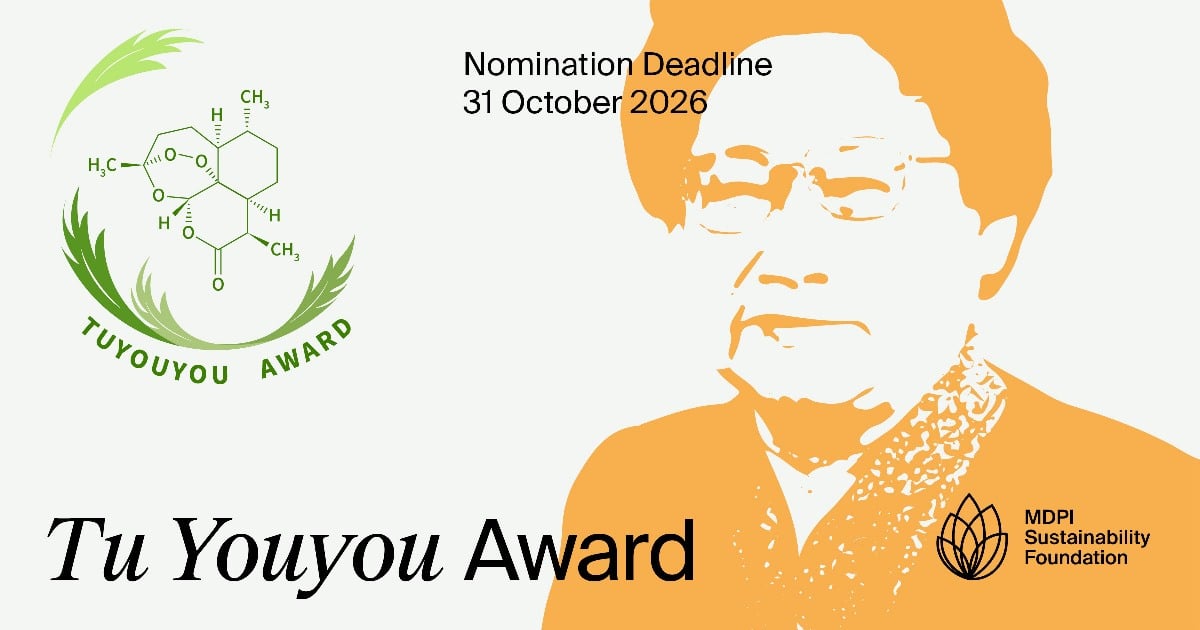
We are delighted to announce that nominations are now open for the 2026 Tu Youyou Award. Named after Nobel Laureate Tu Youyou, whose discovery of artemisinin has saved millions of lives, this award recognizes researchers whose work advances the fields of natural products chemistry and medicinal chemistry, while also contributing to human health.
Prize
– CHF 100,000;
– A medal;
– A certificate.
The monetary prize will be shared equally should there be multiple recipients.
Who May Be Nominated?
– Scientists with outstanding achievements and contributions in the fields of natural products chemistry and medicinal chemistry.
Nominees must be individuals; team or group nominations are not permitted. Nominations are valid only for the current award cycle.
Who May Submit a Nomination?
– The director of the nominee’s host research institution or recognized scientists within the field.
Self-nominations will not be considered.
Nomination Materials
– A biographical sketch;
– A detailed description of the nominee’s contributions;
– 5–10 representative academic publications;
– A list of academic honors, awards, and funded projects;
– A nomination letter signed by two nominators.
How to Submit?
Submit nominations online via the following link: https://tuyouyouprize.org/nomination
Important Dates
– Nomination Deadline: 31 October 2026
– Winner Announcement: March 2027
For further information, please visit the Tu Youyou Award website (https://tuyouyouprize.org/). For any inquiries, please contact the Tu Youyou Award Team at tuyouyouaward@mdpi.com.
31 March 2026
MDPI INSIGHTS: The CEO’s Letter #33 - 2025 Annual Report, Preprints.org, IWD, Recapping Viruses 2026 & Romania Salon

Welcome to the MDPI Insights: The CEO's Letter.
In these monthly letters, I will showcase two key aspects of our work at MDPI: our commitment to empowering researchers and our determination to facilitating open scientific exchange.
Opening Thoughts

Scaling Open Access with Integrity: MDPI Annual Report 2025
I am pleased to share the release of MDPI’s 2025 Annual Report, reflecting our continued progress as one of the world’s leading open access publishers. The report highlights not only our growth, but also the continued evolution of our publishing model and our commitment to quality, transparency, and collaboration.
You can explore the full report here: https://mdpi-res.com/data/mdpi_annual_report_2025_0401.pdf?1775045421
Or visit the interactive page: https://www.mdpi.com/annual-report-2025/
A Year of Growth and Responsibility
2025 was a year of significant growth for MDPI. We received over 669,000 manuscript submissions, the highest in our history, while maintaining a rejection rate above 60%, reinforcing our commitment to both scale and quality.
We published 261,576 peer-reviewed open access articles across a portfolio of 500 journals, supported by a global community of more than 68,000 Editorial Board Members and 209,000 reviewers.
Scaling with Integrity
Growth alone is not the objective; how we grow matters.
Our 2025 Annual Report, Scaling Open Access with Integrity, reflects our continued focus on building the systems and processes that support reliable and trustworthy publishing. As submission volumes increase globally, so too does the importance of robust editorial workflows, research integrity frameworks, and the infrastructure required to support them.
In 2025, we continued to invest in:
- Research integrity and quality assurance processes
- Editorial support and reviewer engagement
- Transparency across the publishing workflow
These efforts ensure that scale does not come at the expense of rigor, but rather reinforces it.
Validation Through Indexing and Visibility
As MDPI continues to grow, validation of quality remains essential.
In 2025, the number of MDPI journals indexed in the Web of Science Core Collection increased from 298 to 329, while Scopus coverage reached 355 journals, including 45 new acceptances. Coverage in major biomedical databases (PMC/Medline/PubMed) expanded to 95 journals, and indexing in Ei Compendex increased significantly.
These milestones reflect the strength of our editorial processes and the trust placed in our journals by independent indexing bodies.
Importantly:
- 96% of all MDPI articles are indexed in Web of Science databases
- More than 1.75 million articles are indexed, with an average of 13 citations per article
Recognition through Journal Citation Reports also continues to grow:
- 298 journals received Impact Factors
- 65% ranked in the top half of their categories
- 61 journals achieved top-quartile positions
These developments demonstrate that growth and quality are advancing together, supported by strong editorial oversight and consistent performance across our journal portfolio.
Strengthening Partnerships and Community
Open access is a collaborative endeavor.
In 2025, we expanded our institutional partnerships to more than 1,000 IOAP agreements, helping simplify publishing for researchers and institutions worldwide.
We also hosted 60 in-person conferences and virtual events, bringing together more than 28,000 participants to exchange ideas, share research, and strengthen connections across the global scientific community.
At the heart of everything we do is this community of authors, editors, reviewers, and partners who make open science possible.
Looking Ahead
Open access continues to move toward becoming the standard model for sharing research globally. With that growth comes increased responsibility.
Our focus moving forward is to continue building a publishing ecosystem that is:
- Collaborative, to serve the research community
- Rigorous, to ensure quality
- Transparent, to support trust
- Scalable, to meet global demand
We believe that open access, when combined with strong editorial standards and integrity, is the most effective way to accelerate scientific progress.
Thank you to all the scholarly community who collaborated with us and our MDPI staff for your continued dedication and contributions in making 2025 a successful year.
Impactful Research

Celebrating Ten Years of Preprints.org: Accelerating Open Research
In 2026, MDPI’s preprints server Preprints.org marked its 10th anniversary as a platform dedicated to accelerating the dissemination of research. Since its launch, Preprints.org has grown into a global platform that hosts more than 120,000 preprints contributed by hundreds of thousands of researchers worldwide, generating tens of millions of views and downloads and demonstrating the value of sharing research openly and rapidly.
At MDPI, we are proud to celebrate ten years of Preprints.org supporting the mission of open science. Over the past decade, we have seen how early sharing of research can accelerate collaboration and help ideas move more quickly from discovery to impact.
The Evolution of Preprints
While Preprints.org launched in 2016, the idea behind it has deeper roots. The concept of rapid research dissemination has existed for decades, with early preprint servers showing how open sharing can accelerate scientific progress.
Over the past decade, preprints have become an increasingly important part of scholarly communication. Researchers across disciplines are looking at faster ways to share their discoveries, exchange ideas, and receive feedback from the global scientific community.
Preprints in a Growing Research Ecosystem
The global preprint landscape has expanded significantly over the past decade, with multiple platforms serving different research communities. The figure below (sourced from James Butcher newsletter), based on data from Dimensions (Digital Science), shows the growth of preprint outputs across several major platforms over time.

Among these platforms, arXiv (the pioneering preprint server) has experienced great growth in recent years. At the same time, other platforms have continued to expand their reach across disciplines, capturing increasing global interest in early research sharing.
Preprints.org contributes to this evolving ecosystem by providing a multidisciplinary platform that works in synergy with academic journals, helping researchers bridge the gap between rapid dissemination and the formal publication process.
Celebrating the First Decade
To commemorate this milestone, Preprints.org launched a 10th Anniversary celebration hub highlighting the impact of preprints and the researchers who contribute to them.

One of the central initiatives is the Popular Preprints of the Decade Award, recognizing influential preprints published between 2016 and 2026 across multiple research fields. Through community voting, the award will recognize research that has generated high engagement and visibility within the global research community.
Looking Ahead: The Next Decade of Preprints
As research communication continues to evolve, preprints will continue to play an important role in enabling faster collaboration, improving transparency, and expanding access to knowledge. The next decade may bring further integration between preprint platforms and journals, new tools for discovery and evaluation, and greater global participation in open science.
At MDPI, we remain committed to supporting researchers through platforms that encourage the open exchange of ideas. The success of Preprints.org over the past ten years reflects the engagement and trust of the global research community – authors, readers, reviewers, and collaborators who believe in the value of sharing knowledge openly.
Congratulations to everyone involved in the development and growth of Preprints.org over the past decade!
Inside MDPI

Beyond International Women’s Day: Supporting Women in Research
International Women’s Day (IWD) offers an opportunity to recognize the achievements of women around the world and reflect on how we can continue building a more inclusive future. In research and academia, this conversation carries particular importance, as scientific progress depends on diverse perspectives, and supporting women in science is essential to strengthening the global research ecosystem.
For MDPI, IWD is an opportunity to celebrate the achievements of women in research and highlight the initiatives, conversations, and collaborations that help support researchers across disciplines and career stages.
Highlighting Women in Science Across MDPI
This year, MDPI marked International Women’s Day with a global campaign highlighting research, awards, and perspectives that support women in science. Throughout the week, our teams shared content across MDPI’s social media channels sharing the work of women researchers and encouraging engagement across the academic community.

As part of this initiative, MDPI published several blog articles exploring important themes related to gender equity in research. One article, Give Support, Gain Progress: Retaining Women in Science, discusses the importance of mentorship, institutional support, and inclusive research environments in helping women build sustainable scientific careers.
Another featured article, Bridging the Gap in Women’s Health Research, highlights the ongoing need to address disparities in health research and ensure that women’s health receives the scientific attention and investment it deserves.
These topics capture the notion that supporting women in science benefits not only individual researchers but the entire scientific community. When researchers from diverse backgrounds can contribute their perspectives and ideas, the scope and impact of scientific discovery expand.
Creating Spaces for Dialogue
Beyond online content, MDPI is also supporting conversations about women in research through community engagement.

On 10 March, MDPI UK hosted the “Women in Research” event, bringing together researchers and professionals to share experiences and discuss the opportunities and challenges women face throughout their scientific careers. Events like these are an opportunity for open dialogue, mentorship, and networking to create more inclusive research communities.
Looking Beyond a Single Day
While IWD is an important moment of recognition, progress requires ongoing effort.
Supporting women in research involves many forms of engagement: from mentorship and collaboration to creating inclusive environments in which diverse voices are heard and valued. Publishers, institutions, and researchers all play a role in building this ecosystem.
At MDPI, we remain committed to supporting the global research community and to promoting open access publishing as a foundation for accessible and inclusive knowledge-sharing.
As we reflect on IWD this year, we recognize the many women who contribute to research as authors, reviewers, editors, mentors, and educators; we also recognize the impact they continue to have on the advancement of science. The influence of women in research extends far beyond a single day of recognition, reminding us that supporting them is a commitment that continues throughout the year.
Coming Together for Science

Highlights from Viruses 2026 – New Horizons in Virology (11–13 March)
Through 11–13 March, we successfully delivered the Viruses 2026 – New Horizons in Virology MDPI conference in Barcelona, bringing together an international community of researchers, editors, and partners dedicated to advancing the field of virology.
Conference Highlights
Viruses 2026 in numbers:
- 198 total registrations, with 171 attendees on site
- 233 submissions, with 122 accepted
- 42 short talks, 9 flash talks, and 80 posters
- 13 invited speakers and 1 keynote speaker

The strong level of participation and quality of submissions once again demonstrate the relevance of the Viruses community.
A standout moment was the keynote lecture by Dr. Ho, which also attracted an NBC documentary film crew, highlighting the broader impact of the research being presented.
Scientific Programme
The conference programme covered areas across modern virology, including viral replication, pathogenesis, immunology, and public health. Sessions explored topics on antiviral therapeutics and vaccines, innate immunity, virus–host interactions, and the structure and mechanisms of virus replication.
Together, these discussions highlighted both the fundamental biology of viruses and the translational challenges of addressing emerging infectious diseases, reflecting the breadth and continued importance of virology research in a global context. The programme also included a sponsored workshop on research data management in virology, further emphasizing the importance of data practices in advancing the field.
Thank You
Feedback from participants has been very positive, and I would like to thank the Conference team for the organization and delivery of this year’s event.

Thank you to our Viruses journal team and all colleagues involved behind the scenes in supporting the delivery of the event. As noted by Dr. Eric Freed (EiC of Viruses), the success of this edition gives us strong momentum as we look ahead to the next conference in 2028, with opportunities to further expand participation and engagement.
Closing Thoughts

Recap from MDPI Romania Salon in Cluj-Napoca (24 March)
On 24 March, we had the opportunity to meet with members of the Romanian research community in Cluj-Napoca at our MDPI Romania Salon. The event was a space for presentations, open discussion, and the exchange of perspectives on publishing and the research landscape in Romania.

We welcomed 39 participants, including 27 researchers from institutions across Romania, representing cities such as Cluj-Napoca, Timișoara, and Reșița. Among them were Editorial Board Members, Associate Editors, and Guest Editors, all of whom play an important role in collaborating with MDPI and shaping the quality and direction of academic publishing.
|
|
|
|



A Shared Commitment to Research Excellence
These events reflect MDPI’s commitment to connecting with and supporting researchers by means of transparency, dialogue, and collaboration. During the day, MDPI colleagues shared a series of presentations covering different parts of our publishing ecosystem:
- MDPI’s presence in Romania – Anamaria Vartolomei (Journal Relationship Specialist (JRS), Section Managing Editor (ME))
- MDPI’s performance, growth, and impact in Romania – Stefan Tochev (CEO)
- Academic services, initiatives, and projects supporting researchers – Ioana Preda (JRS, Section ME)
- Best practices and standards in publication ethics – Lavinia Rogojina (Research Integrity Manager)
- Panel session on ethics, AI, and peer review – Lavinia Rogojina, Ioana Preda, Doris Larisa Albu (JRS, Section ME), Cristina Georgiana Spelmezan (JRS, Section ME)
- Closing remarks – Lavinia Dumitrela Cozma (Operations Manager, Section ME)

Feedback from participants was very positive, particularly regarding the quality of discussions, the relevance of the topics, and the opportunity to engage directly with MDPI colleagues. What stood out most was the openness of the discussion. These events are important not only for the purposes of presenting what we do, but also as an opportunity to listen, understand concerns, and continue to build alignment with the research community.
Romania and the Growth of Open Access Publishing
The Romanian research landscape continues to show growth in open access (OA) publishing.
In 2025:
- 72% of all publications in Romania were published as OA
- Of these, 74% were Gold Open Access
Over the past five years, Romania has produced more than 109,000 publications, with approximately 71% available openly, highlighting a sustained shift toward accessibility and knowledge-sharing.
Within this landscape, MDPI continues to play a significant role:

- MDPI is the leading OA publisher in Romania, contributing 42% of all OA publications in 2025
- More than 37,000 articles have been published with MDPI by Romanian institutions since 1996
- This figure includes over 7,500 publications in 2025 alone
- More than 400 Editorial Board Members from Romania collaborate with MDPI across disciplines
These trends show the growth of OA and the strength of collaboration between MDPI and the Romanian research community.
Looking Ahead
As academic publishing continues to evolve, maintaining open and transparent communication with researchers is essential. Events such as our Salons and Summits provide great opportunities to exchange perspectives and to build trust and collaboration.
Thank you to all participants who joined us in Cluj, and to our teams in Romania for delivering a successful event. A special thank-you to Alina-Florina Agafitei (Marketing Specialist) for her care and attention to detail in delivering the Salon.
Chief Executive Officer
MDPI AG
25 March 2026
Acknowledging the Contributions of Our Reviewers in 2025

As a pioneer in open access publishing, MDPI maintains rigorous publication standards. This mission relies on the dedication and expertise of our reviewers, who invest their time and knowledge to ensure the quality and integrity of the research we publish.
In 2025, over 209,000 reviewers contributed to the peer-review process at MDPI, providing more than 1.3 million review reports for our journals. To express our gratitude, MDPI’s Reviewer Recognition Program highlights reviewers across over 400 journals, featuring those who have assessed at least one manuscript and agreed to be acknowledged.
In addition, MDPI has identified its Top 1000 Reviewers of 2024 to recognize those whose expertise, dedication, and thoughtful evaluations were particularly outstanding.
Many journals have also established Outstanding Reviewer Awards to honor our reviewers’ commitment to publication excellence. Together with the Exceptional Reviewer List, we showcase the importance of reviewers’ work and their time and dedication.
These initiatives serve to express our deepest appreciation and gratitude towards the whole reviewer community. In recognition of their contributions, we also welcome new researchers to join this community. If you would like to contribute to open access publishing, learn more about the reviewers’ benefits and sign up to join us.
23 March 2026
Meet Us at the IEEE World Conference on Computational Intelligence (IEEE WCCI), 21–26 June 2026, Maastricht, the Netherlands

MDPI will attend the IEEE World Conference on Computational Intelligence (IEEE WCCI) as an exhibitor. This meeting will be held in Maastricht, The Netherlands, from 21 to 26 June 2026.
WCCI 2026 will take place in the beautiful and historic city of Maastricht and will offer a unique opportunity to connect, learn, and shape the future of our field. This congress brings together the three flagship conferences of the IEEE Computational Intelligence Society:
- The International Joint Conference on Neural Networks (IJCNN);
- The IEEE International Conference on Fuzzy Systems (FUZZ-IEEE);
- The IEEE Congress on Evolutionary Computation (IEEE CEC).
The following open access journals will be represented:
- Mathematical and Computational Applications;
- Computation;
- Algorithms;
- AI;
- Computers;
- Logistics;
- Information;
- Cryptography;
- Journal of Cybersecurity and Privacy;
- Technologies;
- Modelling;
- Applied Sciences;
- Machine Learning and Knowledge Extraction;
- Biomimetics;
- AppliedMath;
- Digital;
- Data;
- Future Internet;
- Big Data and Cognitive Computing;
- Robotics;
- Games;
- Mathematics.
If you are attending this conference, please feel free to start an online conversation with us. Our delegates look forward to meeting you in person at our booth and answering any questions you may have. For more information about the conference, please visit the following website: https://attend.ieee.org/wcci-2026/.
13 March 2026
Entropy 2026 in Barcelona—Abstract Submission Extended
Due to a large amount of interest and numerous requests from the global academic community, we are pleased to announce that the abstract submission deadline for Entropy 2026: Exploring Complexity and Information in Science has been extended to 1 April 2026. This extension provides the last opportunity for scholars to present their latest research at this premier interdisciplinary event in Barcelona, Spain.
Updated important dates:
Abstract submission deadline: 1 April 2026;
Acceptance notification deadline: 17 April 2026;
Early Bird registration deadline: 22 April 2026;
Registration deadline: 15 June 2026;
Conference dates: 1–3 July 2026.
Why join Entropy 2026?
1. Renowned Chairs:
The conference is led by Prof. Dr. Miguel Rubi (University of Barcelona) and Prof. Dr. Kevin H. Knuth (University at Albany).
2. Distinguished guests:
Supported by a Scientific Committee of 30+ international experts, the conference will feature a lineup of renowned speakers and pioneers in the field, including Prof. Dr. Ralf Metzler (University of Potsdam), Prof. Dr. Olivier Rioul (Institut Polytechnique de Paris), Prof. Dr. Signe Kjelstrup (NTNU), and many others from top-tier research centers worldwide.
To view the full speaker lineup, please click here.
3. A global academic hub:
This conference has already garnered submissions from world-leading institutions, including Harvard University, Princeton University, the University of Cambridge, Tsinghua University, and the Max Planck Institute, ensuring a substantive intellectual exchange.
4. Publication and recognition:
- Special Issue: Full manuscripts may be submitted to a dedicated Special Issue of the journal Entropy (ISSN: 1099-4300; IF 2.0) with a 20% APC discount;
- Proceedings: Extended papers (4–8 pages) can be published free of charge in the Physical Sciences Forum (ISSN: 2673-9984);
- Awards: This conference will present Best Oral and Best Poster Awards to recognize outstanding scientific contributions.
Topics of interest:
S1. Complex Systems and Network Science;
S2. Information Theory, Data Science, and Artificial Intelligence;
S3. Quantum Information and Quantum Computing;
S4. Thermodynamics and Energy Systems;
S5. Non-Equilibrium Systems and Entropy Production;
S6. Statistical Physics and Stochastic Processes;
S7. Soft and Living Matter;
S8. Applications of Entropy in Science and Engineering.
For any enquiries, please contact the secretariat via entropy2026@mdpi.com. We look forward to welcoming you to Barcelona!
Submit Your Abstract here: https://sciforum.net/user/submission/create/1433.
To register now, please visit the following link: https://sciforum.net/event/Entropy2026?section=#registration.
28 February 2026
MDPI INSIGHTS: The CEO’s Letter #32 - MDPI China and Thailand, China Science Daily, 1,000 Partnerships, R2R
Welcome to the MDPI Insights: The CEO's Letter.
In these monthly letters, I will showcase two key aspects of our work at MDPI: our commitment to empowering researchers and our determination to facilitating open scientific exchange.
Opening Thoughts

Reflections from China: Year-End-Celebrations and Open Access Publishing
In February, I had the pleasure of joining over a thousand colleagues from our Tongzhou and Haidian offices at their end-of-year annual celebration in Beijing.
Spending time with our teams in China is also a powerful reminder of the scale and complexity of MDPI as a global organization. Our colleagues in Beijing, Wuhan, and across the country play a significant role in our day-to-day operations and long-term development. I’m grateful for the hospitality, collaboration, and commitment shown by our managers and teams in China, alongside colleagues worldwide, who have helped steadily build MDPI, brick by brick, over the years.
Below are some data on Open Access (OA) publishing in China and our collaboration in this important research market.
Open Access Publishing in China
China has been the world’s leading country in research and review article publication volume since 2019, exceeding one million publications in 2025. Over the past five years, the gap between China and the second-ranked country, the United States, has continued to widen.
In 2025:
- 47% of China’s research output was published Open Access
- Of those OA publications, 76% were Gold Open Access (approximately 382,930 articles)
- The overall OA distribution remained stable compared with 2024, with Gold OA increasing by 1%
Over the past five years (2021–2025):
- China published 4,398,050 research and review articles
- Approximately 48% of this output was OA
According to Dimensions, when comparing the top 20 countries by publication volume (2021–2025):
- China ranks 1st worldwide in publication volume
- China ranks 9th in citation performance within this group (for comparison, the US ranks 2nd in publication volume and 10th in citation ranking)
- Average citations per article: 12.51
Among the top 10 universities globally by publication volume, six are Chinese institutions, alongside Harvard University (USA), the University of São Paulo (Brazil), the University of Toronto (Canada), and the University of Oxford (UK).

MDPI and China
China is an important and long-standing part of MDPI’s global publishing ecosystem:
- In 2025, MDPI was the largest fully Open Access publisher in China
- MDPI published 22% of China’s Gold Open Access output (82,133 papers)
- We received 290,999 submissions from China-affiliated authors and published 82,133 articles
- There are 8,500+ active Editorial Board Members based in China
- 64% (5,438) have an H-index above 26
- MDPI works with:
- 117 Editors-in-Chief
- 103 Section Editors-in-Chief
- 71 China-based institutions currently hold IOAP agreements with MDPI, seven of which rank among the top 10 Chinese institutions by publication volume
China's scale in research output means that the publishing platforms chosen by Chinese scholars will continue to influence the direction of scholarly publishing. At the same time, MDPI’s strength comes from its international collaboration, with colleagues, editors, reviewers, and authors working together across regions and disciplines.
Thank you to all our colleagues in China, and around the world, who support MDPI’s publishing activities across departments and help advance open access research every day.
Impactful Research

“Progress in open science is built through trust, dialogue, and relationships”
Behind the Scenes: A Conversation with China Science Daily
During my trip to Beijing, I also had the opportunity to visit China Science Daily and take part in an interview and broader exchange with their team in Beijing. Visits like this matter because progress in open science is built not only through platforms and infrastructure, but also through trust, dialogue, and relationships across research communities and regions.
China Science Daily: History Museum
As part of the visit, I was given a tour of their History Museum, which offers a thorough perspective on the evolution of China’s first science and technology newspaper, established in 1959. The exhibition highlights how the organization developed into a trusted institution connecting research with the public and policymakers. It was a helpful reminder that at the core of publishing is stewardship, credibility, and long-term public engagement with science.

An Open Exchange on Open Science
During the visit, I met with Dr. Zhao Yan, Editor-in-Chief of ScienceNet. We had an open and engaging conversation about MDPI’s role in Open Access, the evolution of open science globally, and the potential for more collaboration going forward. He especially appreciated the candid and personal nature of our exchange, noting that this kind of dialogue feels important in a landscape where trust and transparency matter.

Interview on Open Access
I also participated in an interview with Ms. Yan Jie, from the Online Media Center and Editor-in-Chief of ScienceNet, China Science Daily. Our discussion covered the growth of Open Access over the past 30 years, MDPI’s mission and values, academic integrity, collaboration with the Chinese research community, and MDPI’s own 30th anniversary milestone. It was a great opportunity to reflect on how open science has matured, and where shared responsibility across publishers, institutions, and researchers continues to matter most.
“Progress in open science is built by more than scale and infrastructure”
I’m sharing a few photos from the visit as a glimpse behind the scenes. The full interview will be published by China Science Daily in due course, and I look forward to sharing it when it is available.

More broadly, visits like this reinforce something I’ve always believed in: progress in open science is built not only through scale and infrastructure, but also through continued dialogue, mutual respect, collaboration, and a willingness to listen across regions and perspectives. That remains central to our work, especially as MDPI reflects on 30 years of publishing, built together.
Inside MDPI

Bangkok Visit: Growth, Partnership, and Local Impact
In February, I also had the opportunity to visit our Bangkok office for the second time in two years to support their local meetings and deliver a training session on how we present MDPI at a corporate level.
It’s easy to spend time with our colleagues in Thailand. From Editorial and Production to Conferences, Marketing, Design, and our Regional Journal Relations Specialist (RJRS), the team continues to grow in scale and professionalism. I’d also like to recognize our local management and admin teams, who have been steadily expanding our office and supporting more than 500 colleagues on the ground.
Academic Partnerships
During the visit, we met with the Engineering Department at King Mongkut’s Institute of Technology Ladkrabang (KMITL). Our discussion focused on the recent MDPI developments, Institutional Open Access Program (IOAP) opportunities, Author Publishing Workshops (APW), and the potential use of JAMS to support their institutional journal.

“MDPI is the third-largest OA publisher in Thailand”
We also shared insights into the growth of Open Access (OA) in Thailand and KMITL’s own publishing trends. These conversations matter because institutions are looking for sustainable ways to support their researchers. Our IOAP agreements are one simple example of how we can provide value in this area while maintaining accessibility for authors.
Thailand and MDPI: 2025 Snapshot
Our Bangkok office, officially launched in 2022, has been growing to support over 500 staff members while continuing to expand its engagement in scholar visits, workshops, and conference collaborations. As at 2025, Thailand submissions to MDPI have increased about 21% and publications by about 25%, maintaining a rejection rate close to the company average. MDPI is the third-largest OA publisher in Thailand, publishing 15% of all Gold OA output in 2025.
Representing MDPI Externally
During the visit, I delivered a training session on how we present MDPI at external events.

This session covered topics related to:
- Our aim and guiding principles
- High-level company milestones and Indexing facts and figures
- Industry partnerships and collaborations
- Market trends in OA and subscription publishing
- Country-specific publishing data and collaborations with MDPI
- Insights from our Voice of Community report
I find that while many colleagues are very familiar with the specific journal for which they have responsibility, fewer have visibility into the broader MDPI ecosystem and the company’s global positioning. These sessions help build alignment, confidence, and consistency in how we represent the company.
What stands out most is that MDPI’s growth is not abstract: it’s visible in the people, the partnerships, and the professionalism developing across our offices.
Coming Together for Science

1,000 Institutional Partners: A Milestone Built on Trust
This month, we reached an important milestone: more than 1,000 institutions worldwide are now part of MDPI’s Institutional Open Access Program (IOAP). On paper, that is a number. In practice, it represents trust.
This milestone symbolizes thousands of conversations with libraries and institutions. It stands for negotiations, renewals, consortium expansions, and, most importantly, relationships built over time. It reflects the work of colleagues across publishing, institutional partnerships, marketing, editorial, finance, and many other teams who contribute to making these agreements operational.
In 2025 alone, more than 61,300 research articles benefited from article processing charge (APC) discounts through IOAP agreements. Tens of thousands of authors were able to publish through a simplified and structured process. At the same time, institutional administrators gained clearer oversight and streamlined workflows.

Why IOAP Matters
When we launched IOAP, the objective was straightforward: to reduce barriers for researchers while supporting institutions in navigating the evolving OA landscape. Over the past decade, the research ecosystem has changed. Funder mandates, national policies, and Plan S–aligned requirements have accelerated the transition to OA.
Institutions need publishing partners who provide transparency, scalability, and operational efficiency. IOAP was designed to support that reality.
For colleagues who would like to better understand the program, this blog-post overview of MDPI’s IOAP provides additional context, including common questions around the transition to OA and how our institutional partnerships are structured.
“Institutions need publishing partners who provide transparency, scalability, and operational efficiency”
Recent Examples
Our agreements continue to evolve across regions:
- In Sweden, MDPI signed a national Open Access publishing agreement with 96 institutions, enabling affiliated researchers to publish without managing individual APC payments.
- In Spain, we extended our flat-fee agreement with Universidad Católica de Valencia, reinforcing institutional support for OA publishing.
These examples show that institutions seek structured, predictable models that support their researchers at scale.
Looking Ahead
Crossing the threshold of 1,000 partners tells us that institutions see MDPI not just as a publisher but as a reliable operational partner in advancing open science. This milestone is not a finish line. It is a reminder that the work continues.
Thank you to the entire IOAP team and to all colleagues who contributed to reaching this achievement.
P.S. You can read about this milestone across industry outlets, including STM Publishing News, ALPSP, Research Information, EurekAlert, Brightsurf, among others. You can also read about the coverage in Poland (e.g., media-room, bomega) Korea (newstap), and Romania (EduLike).
Closing Thoughts

Reflections from the Researcher to Reader Conference
During 24–25 February, I attended the 2026 Researcher to Reader Conference in London, UK. Leaders from across scholarly publishing, research infrastructure, libraries, and technology gathered to discuss AI and research integrity, peer review reform, metadata and infrastructure, community engagement, open research policy, and the evolving role of publishers in a rapidly shifting ecosystem.
The conversations were open and honest, and at times uncomfortable – exactly what we need at times. Below are a few reflections that stayed with me.
The Battle for Knowledge: What Becomes Accepted as ‘True’?
One recurring theme was not whether science evolves but whether our infrastructure is resilient enough to sustain trust at scale. Science does not promise certainty: it promises process. As publishing systems grow more complex and become more technologically mediated, the question is how intentionally we design, monitor, and strengthen that process.
Peer Review: Speed, Credentials, and Structural Loops
Researchers consistently call for faster peer review. At the same time, reviewer credentials are often tied to publication records. This creates a structural loop. Publishing history opens reviewing opportunities, reviewing strengthens credentials, and those without early access remain outside the cycle.
There is a need for us to reflect on how opportunity circulates within our systems: we should ask how we create more inclusive pathways for researchers globally to participate in peer review.
Community Engagement Workshop
One of the highlights of R2R was the workshop format, whereby small groups met repeatedly over two days and moved from ideas to tangible strategies.
I joined the Community Engagement workshop led by Lou Peck (CEO at The International Bunch) and Godwyns Onwuchekwa (Principal Consultant at Global Tapestry Consulting). We explored two deceptively simple questions: What is a community? and What does engagement truly mean?
“Engagement requires shared design and shared responsibility”
Too often, organizations equate communication with engagement. The framework discussed mapped a maturity spectrum – from enablement (broadcasting, informing and consulting) to true engagement (collaborating and co-creating).
It was a useful reminder of the fact that if we want trust and loyalty, engagement must go beyond announcements and surveys. It requires shared design and shared responsibility.
AI: Democratization or Digital Colonialism?
I especially enjoyed the thought-provoking presentation from Nikesh Gosalia (Chief Partnership Officer at Cactus Communications), which highlighted an uncomfortable reality:

- 93% of AI-generated content is in English
- Approximately 2% is in French
- Approximately 2% is in German
- More than 7,000 languages are represented in less than 5% of the content within large AI systems
The implications are profound. Is AI democratizing access to scholarly publishing (making it easier for researchers everywhere to participate in global knowledge production)? Or are we encoding colonialism at scale (entrenching linguistic and structural hierarchies, and making it harder for voices from the Global South to be heard)?
AI is already reshaping how research is created, reviewed, discovered, and shared. Its potential is enormous. But its impact depends not only on capability, but on governance, design, and intentionality. Publishers, funders, and researchers all share responsibility in shaping how these systems evolve.
Ethicality in practice (Lightening Talk)

It was also great to have our colleague Dr Miloš Čučulović (Head of Technology Innovation at MDPI) present MDPI’s Ethicality platform during a lightning talk.
“Technology alone is not the answer”
Ethicality embeds AI-driven checks directly into the submission workflow, supporting editors proactively rather than reacting after publication. As we scale, tools like this help balance trust, efficiency, and research integrity.
This goes back into the underlying theme of the conference that technology alone is not the answer. However, technology embedded thoughtfully within clear governance frameworks can strengthen confidence in the editorial process.
Final thought
The question is no longer whether technology will transform research infrastructure: it is already doing so. The real question is what role each of us will play in shaping that transformation deliberately, with structural maturity, inclusive governance, and engagement that moves from informing to co-creating.
Science needs to evolve, responsibly. And that responsibility extends not only to what we publish, but also to how the systems behind publication are designed. Some important topics to continue reflecting on both internally and within our broader community.
Chief Executive Officer
MDPI AG
20 February 2026
MDPI Virtual Academic Publishing Workshop (New Harvest), 25 February 2026

This Academic Publishing Workshop will be led by MDPI Regional Journal Relations Specialist, Dr. Sally Wu, on “Author Training”. Participants will receive practical advice on essential aspects of writing academic articles. Participants will leave with a clearer understanding of the academic publishing landscape and how to successfully contribute to it.
Date: 25 February 2026
Time: 11:30 a.m.–1:30 p.m. EST
Schedule:
|
Speaker |
Program |
Time in EST |
|
Dr. Sally Wu |
Introduction |
11:30–11:40 a.m. |
|
Dr. Sally Wu |
Tips for Writing Great Research Papers
|
11:40 a.m.–12:15 p.m. |
|
Dr. Sally Wu |
How to Respond to Peer Reviewers
|
12:15–12:50 p.m. |
|
Dr. Sally Wu |
AI in Publishing: Challenges and Opportunities
|
12:50–13:30 p.m. |
Speakers:
|
|
Dr. Sally Wu received a PhD in medical science from the University of Toronto in the fall of 2025. She joined MDPI in February 2025 as an Assistant Editor for Cells. She was recently promoted to Regional Journal Relations Specialist position in August. In this role, she works with many journals, liaising with authors, board members, and EiCs. She has attended several conferences across North America, hosted scholar visits, and taken part in other outreach events. |

18 February 2026
MDPI’s Open Access Program Reaches 1,000 Institutions Worldwide

MDPI has surpassed the milestone of 1,000 partners within the Institutional Open Access Program (IOAP). The agreements span 59 countries, covering North and South America, Europe, Asia, Africa, and Oceania.
Last year alone, more than 150 new libraries and academic institutions joined MDPI’s IOAP. With the expansion of an existing consortium deal in Sweden we welcomed a further 75 partners to the program in January 2026, enabling us to surpass the 1,000-partners milestone.
The IOAP supports affiliated researchers by streamlining submission processes, reducing administrative burdens, and offering discounted Article Processing Charges (APCs). Through IOAP membership, more than 61,300 research articles received APC discounts in 2025, driving greater visibility and accessibility for partner institutions and global research communities alike.
"This milestone marks a significant step towards expanding MDPI’s global impact," said Stefan Tochev, MDPI's CEO. "Reaching 1,000 IOAP partnerships is a true testament to the growing trust and collaboration we’ve built with universities, libraries, and research organizations worldwide. We are proud to lead the way in Open Access publishing, ensuring researchers have the support they need to reach global audiences." "The success of our program is reflected in the growing global demand for Open Science and quality publishing services," said Becky Castellon, MDPI institutional partnerships manager. "Equally, institutions are increasingly seeking Open Access publishing options that support funder and national mandates. Joining the IOAP makes compliance simple."
13 February 2026
Acknowledgment to the Reviewers of Algorithms in 2025

The editorial office of Algorithms would like to extend its sincere gratitude to all reviewers who contributed to the improvement of the journal quality by providing their expert opinion and evaluation of the submitted research.
We appreciate that thorough peer review demands considerable time and intellectual investment from our reviewers. In 2025, Algorithms received 4622 review reports from contributors across 85 countries and territories, demonstrating the breadth of international expertise and scholarly engagement that has strengthened our publication standards.
The reviewers who agreed to have their names published this year are listed below in alphabetical order by first name. The editorial team acknowledges with gratitude all reviewers, named and anonymous alike, for their vital role in maintaining the scholarly standards of Algorithms.
| A. M. Mahmud Chowdhury | Gilberto Huesca | Olga G. Andrianova |
| Abayomi Olusola Agbeyangi | Giovanni Battista Gaggero | Olga Ibryaeva |
| Abdallah Namoun | Giovanni Murano | Olga Mikhailovna Bazanova |
| Abdelali Hadir | Gleb Guskov | Olimpia Neagu |
| Abdelouahad Achmamad | Gloria Cerasela Crisan | Olympia Roeva |
| Abdelwahhab Khatir | Gopal Narayan Srivastava | Omar Darwish |
| Abdo Abdullah Ahmed Gassar | Goran Janackovic | Omar S. Sonbul |
| Abdulbast A. Abushgra | Gorazd Bombek | Omer Soysal |
| Abdullahi Abubakar Mas’ud | Gordon Dash | Onur Dogan |
| Abdulrahman K. Alnaim | Guangda Chen | Orlando Sousa |
| Abeer Dyoub | Guannan Tang | Panagiotis D. Michailidis |
| Abolfazl Baghbani | Guennady Ougolnitsky | Paolo Pagliuca |
| Abraham Alem Kebede | Guilherme Sousa Bastos | Paris Mastorocostas |
| Adam P. Niewiadomski | Gustavo Mendes Platt | Paul A. Valle |
| Adnan Arshad | Guy Mélard | Pavel Vladimirovich Ilyushin |
| Adnan Ibrahim | Hadi Taghavifar | Pedro F. S. Rodrigues |
| Adnan Tahir | Haitham Abu Ghazaleh | Pedro Miranda-Romagnoli |
| Adolfo Maza | Haiyan Shi | Pedro Tadeu |
| Adrian Gligor | Haiyan Wang | Pei-Chun Lin |
| Adriana Berdich | Hamada Esmaiel | Peng Zhang |
| Adriano N. Raposo | Hamadjam Abboubakar | Pengcheng Cao |
| Agbotiname Lucky Imoize | Hamed Nozari | Penghui Chen |
| Ahlam H. Tolba | Hamid Bentarzi | Petar Curkovic |
| Ahmad Ghiaskar | Hamid Mukhtar | Peter A. Gloor |
| Ahmad Manasrah | Hamoud Aljamaan | Peter Kokol |
| Ahmad R. Pratama | Han Wu | Petra Grošelj |
| Ahmadjan Muhammadhaji | Hana Dobrovolny | Petro Pukach |
| Ahmed Abdellatif Hamed Ibrahim | Haochen Sun | Pingfan Hu |
| Ahmed Ginidi | Hassan Harb | Piotr Nowak |
| Ahmed K. Abu-Nab | Héctor Montes | Pouya Taraghi |
| Ahmed Mohamed Fahmy Yousef | Hector Obrien Kaschel | Pouyan Fakharian |
| Aichen Wang | Herbert Kimura | Prabhu Sethuramalingam |
| Aishwarya Gondane | Heung-Shik Lee | Pramod Shinde |
| Akash Kumar | Hicri Yavuz | Preeti Rani |
| Akhmad Habibi | Himanshu Buckchash | Qi Li |
| Alan Carrasco-Carballo | Hiram Calvo | Qingsheng Li |
| Alejandro Medina Santiago | Hoi Leong Lee | Qingtai Xiao |
| Aleksandr Rakhmangulov | Hongjun Li | Quan Qian |
| Aleksandr Romanov | Horia Alexandru Modran | Quanbo Lu |
| Aleksandr Tynda | Hossam Nabwey | Radovan S. Petrović |
| Aleksandr V. Bobrovskikh | Hossein Azgomi | Radu Vasiu |
| Aleksandra Figurek | Hossein Lotfi | Raffaele Marino |
| Aleksey Filippov | Hossein Rostami Najafabadi | Ragul Ravi |
| Alessandro Aliberti | Hsin-Wei Hsu | Rajiv Kumar Gill |
| Alessandro Gabrielli | Hsin-Yuan Chen | Raman Kumar |
| Alessio Staffini | Huaizhong Li | Ramazan Esmeli |
| Alexander Feoktistov | Huanjie Tao | Ramesh Chingle |
| Alexander Kazakov | Hubert Szczepaniuk | Ramūnas Deltuva |
| Alexander Kocian | Hugo Cruz-Suárez | Rastislav Róka |
| Alexander Maravas | Hui Wang | Rasul Kochkarov |
| Alexander Meigal | Humaira Nisar | Ravikumar Sanapala |
| Alexander Valentinovich Khoperskov | Hyun Kwon | Ravipudi Venkata Rao |
| Alexey Bormotov | I. G. Burova | Ravish Shailendra Dubey |
| Alexey Bykovsky | Igor Gluhih | Remus Creţan |
| Alexey Fomin | Igor Kalmykov | Renhai Feng |
| Alexey G. Voloboy | Igor L. Fururin | Ricardo Pires |
| Alexey Mikhailovich Vulfin | Igor Vujović | Rishabh Das |
| Alfonso Santagata | Ikhlef Jebbor | Robert Burdett |
| Ali Abdullah S. Alqahtani | Ilaria Baffo | Robert Ryszard Chodorek |
| Ali Eltamaly | Ilaria Cacciari | Roberto Giovanni Ramírez-Chavarría |
| Ali Habeeb Askar | Ilya Galaktionov | Rodrigo Paredes |
| Ali Juma Alnaqbi | Iman Janghorban Esfahani | Rogerio Leone Buchaim |
| Ali Wagdy Mohamed | Iman Malmir | Rolandas Urbonas |
| Alireza Tabrizikahou | Imran Iqbal | Roman Mylostyvyi |
| Aman Garg | Iqbal Ahmad | Ronghua Ji |
| Amare Mulatie Dehnaw | Irena Valova | Rosella Cataldo |
| Ambreen Shafqat | Irina Meghea | Rui Araújo |
| Amin Naemi | Irina Cristea | Rui Dong |
| Amin Talei | Irina G. Burova | Rui Zhong |
| Amir Emir Seyyedabbasi | Irina Razveeva | Runyuan Guo |
| Ana Maria Da Palma Moreira | Irina Saur-Amaral | Ruslan Gibadullin |
| Anacleto Silva De Souza | Isaac Machorro Cano | Ruslan Shevchuk |
| Anam Nawaz Khan | Ismail Naci Cangul | S. Ramkumar |
| Anas Mohammad Ramadan Alsobeh | Ivan A. Blokhin | Saâd Soulaimani |
| Andranik S. Akopov | Ivan A. Parinov | Saber Arabi Nowdeh |
| André Andrade Longaray | Ivan Kozitsin | Sabino Maggi |
| Andrea Zanela | Ivan Lipuzhin | Sachin Kumar |
| Andreas Kanavos | Ivan Matveev | Sadataka Furui |
| Andrei V. Panteleev | Ivan Rozhnov | Sagit Valeev |
| Andrejs Kovalovs | Ivan Stojšić | Sahar Ebadinezhad |
| Andrey Romanenko | Ivan Toplica Ciric | Said Mesloub |
| Andrey V. Lychev | Ivo Draganov | Saidjon Shiralievich Tavarov |
| Andrzej Pacana | Jacek Izydorczyk | Sajid Ali |
| Andrzej Sioma | James Chung-Wai Cheung | Sajjad Ahmad |
| Andrzej Skoczen | Jamolbek Mattiev | Sakib Shahriar |
| Angelo Cardellicchio | Janko Diminic | Sally Mcclean |
| Angelo Lorusso | Janusz Miśkiewicz | Salman Ijaz |
| Anna Glazkova | Jason T. Smith | Sameer Ahmad Bhat |
| Anna Jodejko-Pietruczuk | Jerzy Rosłon | Samer Aabdulateef Waheeb |
| Anna Tatarczak | Jesús García Díaz | Sami H. Saif |
| Anton Antonov | Jesús María López-Lezama | Sami M. Ibn Shamsah |
| Anton Iliev | Jiajia Shi | Sandra Vilas Boas Jardim |
| Anton Murzin | Jia-Lang Xu | Santidan Biswas |
| Anton Romanov | Jian Wang | Saqib Qamar |
| Antonio Gaspar-Cunha | Jian Zhang | Saqib Saeed |
| Antonio Lorenzo Lara-Galera | Jianbo Shen | Saroj Kumar Panigrahy |
| António Mário Almeida | Jianchu Lin | Saurabh A. Pahune |
| Antonio Salis | Jiapeng Chen | Saurabh Agarwal |
| An-Yi Chang | Jiaqi Fang | Sayed Saber |
| Arda Burak Ekmen | Jiaquan Xie | Sebastian Raubitzek |
| Ariel Teles | Jiawei Xiong | Sebelan Danishvar |
| Arif Hussain Magsi | Jiawen Li | Sedelnikov Andry |
| Aristeidis Karras | Jie Zhang | Sen Lin |
| Arkadiusz Banasik | Joel Sanchez-Mondragon | Seppo Karrila |
| Arkadiusz Biernacki | John Grable | Sergey Gataullin |
| Armando Jesús Martínez Chacón | Johnson Dhanasekaran | Sergey Muravyov |
| Artem Obukhov | Jorge A. Ruiz-Vanoye | Sergey Pereselkov |
| Arvind Mukundan | Jorge Alberto Márquez | Sergey V. Panin |
| Asimina Dimara | Jorge De Andrés-Sánchez | Sergey Lazarenko |
| Atul Kumar | Jorge Luis Zambrano-Martinez | Serhii Semenov |
| Aurea Soriano-Vargas | Jorge Oliveira | Seyed Hamed Godasiaei |
| Aurelio Guevara-Escobar | Jorge Salas Herranz | Shadfar Davoodi |
| Avelina Alejo-Reyes | José Ángel Sánchez-Fernández | Shakhnoza Muksimova |
| Aymen Akremi | José Barateiro | Shan-Jen Cheng |
| Azhar Iqbal Kashif Butt Butt | José Gabriel Gonçalves Lins | Sharizal Ahmad Sobri |
| Babak Omranpour Shahreza | José Luiz Rybarczyk-Filho | Shengyu Duan |
| B. S. Harish | José Ramón Trillo | Shengyu Terence Tao |
| Baidaa Mutasher Rashed | Josie Esteban Rodriguez Condia | Sherry Zhou |
| Baihao Qiao | Josipa Kern | Shiva Shankar Reddy |
| Barbara Probierz | Juan Manuel Solano-Altamirano | Shuang Fu |
| Basheer Wasef Shaheen | Junkai Wang | Shubham Singh |
| Basheera M. Mahmmod | Junxiang Chen | Shujat Ali |
| Beata Szetela | Junyi Zou | Shuqi Wang |
| Belmiro Pereira Duarte | K. Hemant Kumar Reddy | Shuvodeep De |
| Benjamin Voellger | Kadir Sabanci | Sina Sarfarazi |
| Beny Neta | Ka-Hou Chan | Siong Thye Goh |
| Bernardo Sotto-Maior Peralva | Kalliopi Kastampolidou | Siqi Chen |
| Bertha Mazon-Olivo | Kamila Jankowska | R. Siva Subramanian |
| Biao Wang | Karina Anaya | Sohail Muhammad |
| Bin Li | Kendall Hartley | Soodamani Ramalingam |
| Binfeng Yin | Kibae Lee | Soumyadeep Ghosh |
| Biswaranjan Acharya | Klaus Reiner Schenk-Hoppé | Spyros T. Halkidis |
| Bo Wang | Konrad Zajkowski | Stanisław Drożdż |
| Bogdan Andrei Dumitrescu | Konstantin Kozlov | Stanislaw Flaga |
| Bogdan Florin Iliescu | Konstantin Rybakov | Stefan Kuhn |
| Bogdan Oancea | Konstantinos Gkyrtis | Stefano Innamorati |
| Bohdan Kopchak | Konstantinos Modis | Stefano Masoli |
| Bojan Žlahtič | Krzysztof Gdawiec | Stefanos Balaskas |
| Boris Aberšek | Krzysztof Wołk | Štefica Mrvelj |
| Bożena Woźna-Szcześniak | Lakhlifa Sadek | Steliana Rodino |
| Brett Bligh | Lambert Spaanenburg | Stelios Zimeras |
| Broos Maenhout | Laszlo Barna Iantovics | Stylianos A. Papazis |
| Byron Wladimir Oviedo Bayas | Laurent Donzé | Subham Roy |
| Calin Corciova | Lavrentii Danilov | Suganthi Ramasamy |
| Carla Manuela Pinto | Lenka Lhotska | Sujata Goswami |
| Carlo Spampinato | Leonardo Hernán Talero-Sarmiento | Sultan Shoaib |
| Carlos Diaz Delgado | Leonardo Ornella | Sumedha Nitin Prabhu |
| Carlos José Lopes Balsas | Leyun Feng | Sung-Wook Park |
| Carson Leung | Lijana Maskeliūnaitė | Suo Gao |
| Cass Dykeman | Liliana Ibeth Barbosa-Santillán | Susana Henriques |
| Celal Cakiroglu | Lincoln Faria Da Silva | Syed Farah Naz |
| Changshuo Wang | Lipu Zhang | Syed Ibrar Hussain |
| Changyou Wang | Liying Cao | Syed Quadir Moinuddin |
| Chao Zheng | Longhui Zou | Tae-Sul Seo |
| Charalambos Gnardellis | Lu Yang | Takashi Kusaka |
| Chen-Chiung Hsieh | Lucas Miguel De Carvalho | Takele Ferede Agajie |
| Cheng Ning Loong | Lucija Brezočnik | Tamara Kyrylych |
| Chengyu Wu | Luigi Bibbò | Tamara Zivkovic |
| Chen-Hua Fu | Luigi De Napoli | Tamer Abdelkader |
| Chenliang Wang | Luis Alberto Morales Rosales | Tamer F. Abdelmaguid |
| Chenyang Zhang | Łukasz Knypiński | Tania Pencheva |
| Cheonshik Kim | Lukasz Orman | Tao Ma |
| Chia Hung Kao | M Mishkatur Rahman | Taskin Kavzoglu |
| Chia-Hung Wang | Magdi El-Bannany | Tatiana A. Litvinova |
| Chih-Yu Lin | Maggie Mashaly | Tatiana P. Moschovou |
| Chilingaryan Kamo | Maha Driss | Taylan Demir |
| Mangali Chinna Chinnaiah | Mahdi Roozbeh | Thomas M. Koutsos |
| Chitta Ranjan Das | Mahmood Mohamed | Tian Aiqing |
| Chivon Choeung | Mahmoud Abdelwahab Fathy Sayed | Tianqi Chen |
| Chi-Yi Tsai | Mahmoud Heshmat | Tien Anh Tran |
| Chuang Liu | Majid H. Alsulami | Tiziana Crovella |
| Chungsoo Lim | Małgorzata Geszke-Moritz | Todor Tagarev |
| Chunjiong Zhang | Malik Muhmmad Anas | Tomas Ruzgas |
| Chun-Wei Yang | Mansoor Hayat | Tomasz Górecki |
| Claudia Marzi | Manuel Alberto M. Ferreira | Tomasz Hachaj |
| Claudia N. Sanchez | Manuel B. Garcia | Tong Liu |
| Claudio Delrieux | Manuel De La Sen | Tong Wang |
| Congjie Wei | Manuel F. M. Costa | Tony Wong |
| Constantin Daniel Oancea | Manuel Fernández-Veiga | Touseef Tahir |
| Cristian Felipe Ramirez-Gutierrez | Manuela Panoiu | Trung Nguyen |
| Cristian Paul Chioncel | Maram Bani Younes | Tsuyoshi Usagawa |
| Cristiana Piccioni | Marcin Nowak | Tuoyuan Cheng |
| Da He | Marcio Poletti Laurini | Uroš Durlević |
| Dadmehr Rahbari | Marco Mammetti | Urszula Joanna Błaszczak |
| Dagoberto Castellanos-Nieves | Marcos Jesús Villaseñor-Aguilar | Vadim Kramar |
| Daher Sayfeddine | Marek Góźdź | Vahdettin Demir |
| Daisy Aparecida Do Nascimento Rebelatto | Marek Šolc | Vahid Arabzadeh |
| Dalia Čalnerytė | Marek Wozniak | Vahid Hajihashemi |
| Dan Vilenchik | Maria João Félix | Valdivino Alexandre De Santiago Júnior |
| Daniel Cristobal Andrade Girón | Maria Valtcheva Nenova | Valentin Oleynikov |
| Daniel Schneider | Mariana Alves Londe | Valentyna Stanytsina |
| Daniele Grechi | Mariana Dumitrescu | Valerio Frascolla |
| Daniele Manerba | Mariana Falco | Valeriy Andreev |
| Daniele Portelli | Marina Barulina | Vasiliy Alchakov |
| Dan-Marius Dobrea | Mário Rui Domingues Ferreira Da Cruz | Veraldo Liesenberg |
| Darin Ulness | Marjan Mernik | Veselina Bureva |
| Dario Javier Benavides Padilla | Marko Mišić | Vesna Zeljkovic |
| David Fernando Muñoz | Marko Orošnjak | Vesselin G. Gueorguiev |
| David Harries | Martin Hering-Bertram | Vetlugin Beibelaev |
| David Kieda | Martin Kenyeres | Viktor Khavalko |
| Davis Montenegro | Martin Weis | Vilmar Steffen |
| De Rosal Ignatius Moses Setiadi | Marwan T. Mezher | Vishwanath Saragadam |
| Deepalakshmi Perumalsamy | Masoumeh Hashemi | Vitaliy Korendiy |
| Delia Velasco-Montero | Massimiliano Kaucic | Vladica Stojanović |
| Denis Losik | Mateus Mendes | Vladimir Katić |
| Di Wu | Maxim Bakaev | Vladimir Kodnyanko |
| Diego F. S. Paschoal | Maxim Kalinin | Vladimir Shakhov |
| Dieter Hayn | Maxim Polyakov | Vladimir Sudakov |
| Dilli P. Sharma | Maxim Sakharov | Vladimir Tsurkov |
| Dillip Das | Maxim Sergeevich Logachev | Wafa Ben Hassen |
| Dimitri Thomopulos | Mehdi Foumani | Waheed Sabry |
| Dimitrios Kotsifakos | Mehmet Kaya | Waleed Ali |
| Dimitrios Ι. Doukas | Mehran Pourvahab | Wanrun Li |
| Dimitris Kyriazanos | Meiqi Wang | Washington Ramírez Montalvan |
| Dingding Yang | Meng Zhang | Watheq J. Al-Mudhafar |
| Dmitrii Tverdyi | Messaoud Berkal | Wei Feng |
| Dmitry Devyatkin | Mfonobong Uko | Wei-Jen Chen |
| Dmitry Lukyanenko | Pavle Dakić | Wei Li |
| Dmitry Ryumin | Michael Leighton | Wei Song |
| Domenico De Carlo | Michael Thies | Wei Wang |
| Dominique Persano Adorno | Michał Tomaszewski | Wei Xu |
| Donglin Zhu | Michel Paindavoine | Wei-Kai Cheng |
| Dragan Marinkovic | Michel Planat | Weixu Liu |
| Dulani Meedeniya | Michele Ianni | Wen Zhang |
| Easa Alalwany | Mihai Caramihai | Wenxiao Chen |
| Eben Maré | Mikhail Kolev | Wilson Cheong Hin Hong |
| Edina Molnár | Miled El Hajji | Wojciech Gołębiowski |
| Edmund Widl | Milos Seda | Wojciech Skarka |
| Edouard Ivanjko | Ming Wu | Xiaojun Fu |
| Eduardo Ferro Dos Santos | Mingpeng Yang | Xiaolei Chu |
| Eduardo Oliveira Freire | Minming Gu | Xiaoliang Chen |
| Eisuke Hanada | Mohamed A. Barakat | Xiaoling Liang |
| Ekaterina Kopets | Mohamed Ahmed Ali | Xiaopeng Wang |
| Elena Almaraz Luengo | Mohamed Alngar | Xiaorui Dong |
| Elena Solovyeva | Mohamed Mousa Ahmed | Xiaoxi Hu |
| Elisabetta Sciacca | Mohamed Trabia | Xidong Wang |
| Elochukwu Ukwandu | Mohammad Alamgir Hossain | Xing Yang |
| Elvin Ugonna Eziama | Mohammad Alauthman | Xinshan Zhu |
| Elvis Hozdić | Mohammad Hamad Al-Khresheh | Xinting Ding |
| Emad S. Hassan | Mohammad Meysami | Xu Sun |
| Qazi Emad Ul Haq | Mohammad Reza Maghami | Xuhang Chen |
| Emil Pricop | Mohammed Al-Khresheh | Yan Zhou |
| Emili Besalú | Mohammed Idriss | Yang Thee Quek |
| Enguo Rong | Mohammed M. Mabkhot | Yaobing Zhao |
| Enrico Aymerich | Mohcin Mekhfioui | Yaoguang Sun |
| Enrique Casarejos | Mohd Nadeem | Ye Ji |
| Erel Avineri | Mohd Sayeed | Yichuan X. Ma |
| Erina Paul | Mohsen Brahmi | Yingchao Luo |
| Erricos Ventouras | Mostafa Esmaeilishayan | Yiqing Wang |
| Eugen Constant Ionescu | Mostafa Zaman | Yirui Wang |
| Eugenia I. Toki | Muayad Habashneh | Yongjie Zhuang |
| Eun Lee | Muhammad Abas | Yoshio Josue Rubio Higuera |
| Evgenii Kurkin | Muhammad Asad Arshed | Young Im Cho |
| Evgeny Nikulchev | Muhammad Ayaz | Yu Chen |
| Fabio Caldarola | Muhammad Farhan | Yuan Shi |
| Fabio Rocha Barbosa | Muhammad Liaquat Raza | Yuanbin Mo |
| Fabrice Auzanneau | Muhammad Nadeem | Yuer Yang |
| Faïçal Ndaïrou | Muhammad Shoaib Arif | Yugang He |
| Fan Zhao | Muhammed Elayadeth Meethal | Yulian Cao |
| Fangni Chen | Muharman Lubis | Yunfeng Wu |
| Fangyuan Li | Muntean Calin | Yuping Shang |
| Farzad Ghafoorian | Mustafa M. Hasaballah | Yuri Matveev |
| Fatih Ozaydin | Mustafa M. Nasr | Yurii Kynash |
| Fayez Alanazi | Mustapha Bouallala | Yuriy L. Orlov |
| Federico Luis Del Blanco García | Muteb Faraj Alharthi | Yuriy Syerov |
| Felipe Jimenez | Myo Thida | Yury Selyutskiy |
| Felipe Santos Loureiro | Myroslav Komar | Yves Roggo |
| Feng Gao | Nadeem Javaid | Zahra Ziran |
| Fernando Moreira | Nadezhda Vladimirovna Nagul | Zakaria Alomari |
| Fhazhil Said Wamalwa | Naeem Akhtar | Zeashan Khan |
| Filipe Pereira | Najib Ben Aoun | Zeenat Mirza |
| Flavio Bertini | Nasser Alreshidi | Željko Stević Stević |
| Fnu Neha | Muhammad Nawaz | Zeyan Zhou |
| Francesco Filippi | Neda Asgarkhani | Zhai Cong |
| Francisco Cuevas De La Rosa | Nevin Darwish | Zhen Sun |
| Francisco Javier Delgado-Cepeda | Nikita Osintsev | Zheng Hong-Xing |
| Francisco Javier García-Sánchez | Niko Radulović | Zhengliang Xiang |
| Francisco Novoa-Muñoz | Nikola Komatina | Zheyi Chen |
| Franklin Parrales Bravo | Nikola Mirkov | Zhi Pei |
| Galina Malykhina | Nikolaos Theodorakatos | Zhihai Wang |
| Ganyane L. Beklaryan | Nikolay Teslya | Zhiqiang Ma |
| Garima Sharma | Niranjika Wijesooriya | Zhiqiang Tong |
| Gbanaibolou Jombo | Nizar Faisal Alkayem | Zhonglin Lin |
| George Floros | Nizar Polat | Zhongqiang Luo |
| George Karabatsos | Nuno Costa | Zhou Xu |
| George Simonelli | Nuno Miguel Fonseca Ferreira | Ziang Wei |
| Georgе Petkov | Nuriye Sancar | Zihang Weng |
| Gerardo L. Febres | Oscar Casanova-Carvajal | Ziheng Chen |
| Gergana Vacheva | Odiel Estrada-Molina | Zipeng Qin |
| Gia Khanh Tran | Oleh Basystiuk | Zuocheng Li |
| Giacomo Bergami | Olesia Koroteeva | Zuojian Zhou |