

You are currently on the new version of our website. Access the old version .

Journal of Fungi, Volume 8, Issue 9

September 2022 - 94 articles

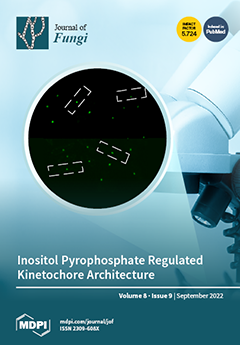
Cover Story: The precise transmission of chromosomes during eukaryotic cell division depends on a several-mega-dalton-big molecular machine named the kinetochore. This structure connects chromosomes to spindle microtubules and in yeasts comprises more than 60 proteins organized in subcomplexes such as the CCAN. This paper uncovers inositol pyrophosphates (IPPs) as regulators for the kinetochore association of CCAN members. IPPs are highly energetic signaling molecules affecting numerous cellular processes. Specific IPPs generated by the Schizosaccharomyces pombe PPIP5K enzyme member modulate kinetochore association of CCAN proteins such as Mal2CENP-O in an inversely correlated manner. Thus, IPPs can alter kinetochore architecture which might impact chromosome transmission fidelity. View this paper
  • Issues are regarded as officially published after their release is announced to the table of contents alert mailing list .
  • You may sign up for email alerts to receive table of contents of newly released issues.
  • PDF is the official format for papers published in both, html and pdf forms. To view the papers in pdf format, click on the "PDF Full-text" link, and use the free Adobe Reader to open them.

Articles (94)

  • Article
  • Open Access
23 Citations
5,029 Views
26 Pages

Unveiling the Secretome of the Fungal Plant Pathogen Neofusicoccum parvum Induced by In Vitro Host Mimicry

  • Forough Nazar Pour,
  • Bruna Pedrosa,
  • Micaela Oliveira,
  • Cátia Fidalgo,
  • Bart Devreese,
  • Gonzalez Van Driessche,
  • Carina Félix,
  • Nuno Rosa,
  • Artur Alves and
  • Ana Sofia Duarte
  • + 1 author

17 September 2022

Neofusicoccum parvum is a fungal plant pathogen of a wide range of hosts but knowledge about the virulence factors of N. parvum and host–pathogen interactions is rather limited. The molecules involved in the interaction between N. parvum and Eu...

  • Article
  • Open Access
9 Citations
3,397 Views
9 Pages

Performance of Multiplex PCR and β-1,3-D-Glucan Testing for the Diagnosis of Candidemia

  • Özlem Koc,
  • Harald H. Kessler,
  • Martin Hoenigl,
  • Johannes Wagener,
  • Sebastian Suerbaum,
  • Sören Schubert and
  • Karl Dichtl

17 September 2022

Bloodstream infections caused by Candida yeasts (candidemia) are associated with high morbidity and mortality. Diagnosis remains challenging, with the current gold standard—isolation from blood culture (BC)—being limited by low sensitivit...

  • Article
  • Open Access
7 Citations
3,841 Views
17 Pages

Alternative CUG Codon Usage in the Halotolerant Yeast Debaryomyces hansenii: Gene Expression Profiles Provide New Insights into Ambiguous Translation

  • Daniel Ochoa-Gutiérrez,
  • Anya M. Reyes-Torres,
  • Ileana de la Fuente-Colmenares,
  • Viviana Escobar-Sánchez,
  • James González,
  • Rosario Ortiz-Hernández,
  • Nayeli Torres-Ramírez and
  • Claudia Segal-Kischinevzky

16 September 2022

The halotolerant yeast Debaryomyces hansenii belongs to the CTG-Ser1 clade of fungal species that use the CUG codon to translate as leucine or serine. The ambiguous decoding of the CUG codon is relevant for expanding protein diversity, but little is...

  • Article
  • Open Access
13 Citations
4,188 Views
18 Pages

Root Colonization by Fungal Entomopathogen Systemically Primes Belowground Plant Defense against Cabbage Root Fly

  • Catalina Posada-Vergara,
  • Katharina Lohaus,
  • Mohammad Alhussein,
  • Stefan Vidal and
  • Michael Rostás

16 September 2022

Entomopathogenic fungi infect insects via spores but also live inside plant tissues as endophytes. Frequently, colonization by entomopathogens provides plants with increased resistance against insects, but the mechanisms are little understood. This s...

  • Article
  • Open Access
11 Citations
3,799 Views
15 Pages

Insights on KP4 Killer Toxin-like Proteins of Fusarium Species in Interspecific Interactions

  • Isabel Vicente,
  • Giuseppe Quaratiello,
  • Riccardo Baroncelli,
  • Giovanni Vannacci and
  • Sabrina Sarrocco

16 September 2022

KP4 killer toxins are secreted proteins that inhibit cell growth and induce cell death in target organisms. In Fusarium graminearum, KP4-like (KP4L) proteins contribute to fungal virulence in wheat seedling rot and are expressed during Fusarium head...

  • Article
  • Open Access
9 Citations
4,477 Views
11 Pages

Multicenter Collaborative Study of the Interaction of Antifungal Combinations against Candida Spp. by Loewe Additivity and Bliss Independence-Based Response Surface Analysis

  • Joseph Meletiadis,
  • David R. Andes,
  • Shawn R. Lockhart,
  • Mahmoud A. Ghannoum,
  • Cindy C. Knapp,
  • Luis Ostrosky-Zeichner,
  • Michael A. Pfaller,
  • Vishnu Chaturvedi and
  • Thomas J. Walsh

16 September 2022

Combination antifungal therapy is widely used but not well understood. We analyzed the spectrophotometric readings from a multicenter study conducted by the New York State Department of Health to further characterize the in vitro interactions of the...

  • Article
  • Open Access
5 Citations
3,528 Views
22 Pages

Taxonomic and Phylogenetic Reassessment of Pyrgidium (Mycocaliciales) and Investigation of Ascospore Morphology

  • Vinodhini Thiyagaraja,
  • Damien Ertz,
  • Robert Lücking,
  • Dhanushka N. Wanasinghe,
  • André Aptroot,
  • Marcela Eugenia da Silva Cáceres,
  • Kevin D. Hyde,
  • Wanaporn Tapingkae and
  • Ratchadawan Cheewangkoon

15 September 2022

Mycocaliciales comprise non-lichenized either saprotrophic or lichenicolous fungi which occur in temperate and tropical regions. The mazaediate, saprotrophic and monospecific genus, Pyrgidium, is currently assigned to this order, yet the phylogenetic...

  • Article
  • Open Access
22 Citations
4,723 Views
18 Pages

Biotransformation of the Fluoroquinolone, Levofloxacin, by the White-Rot Fungus Coriolopsis gallica

  • Amal Ben Ayed,
  • Imen Akrout,
  • Quentin Albert,
  • Stéphane Greff,
  • Charlotte Simmler,
  • Jean Armengaud,
  • Mélodie Kielbasa,
  • Annick Turbé-Doan,
  • Delphine Chaduli and
  • David Navarro
  • + 8 authors

15 September 2022

The wastewater from hospitals, pharmaceutical industries and more generally human and animal dejections leads to environmental releases of antibiotics that cause severe problems for all living organisms. The aim of this study was to investigate the c...

  • Review
  • Open Access
34 Citations
8,270 Views
27 Pages

Research Progress on Elements of Wild Edible Mushrooms

  • Shuai Liu,
  • Honggao Liu,
  • Jieqing Li and
  • Yuanzhong Wang

15 September 2022

Wild edible mushrooms are distributed all over the world and are delicious seasonal foods, rich in polysaccharides, amino acids, vitamins, and other components. At the same time, they contain many essential trace elements and are highly enriched in h...

  • Article
  • Open Access
10 Citations
3,893 Views
18 Pages

Biofilm Formation by Chromoblastomycosis Fungi Fonsecaea pedrosoi and Phialophora verrucosa: Involvement with Antifungal Resistance

  • Ingrid S. Sousa,
  • Thaís P. Mello,
  • Elaine P. Pereira,
  • Marcela Q. Granato,
  • Celuta S. Alviano,
  • André L. S. Santos and
  • Lucimar F. Kneipp

15 September 2022

Patients with chromoblastomycosis (CBM) suffer chronic tissue lesions that are hard to treat. Considering that biofilm is the main growth lifestyle of several pathogens and it is involved with both virulence and resistance to antimicrobial drugs, we...

of 10

Get Alerted

Add your email address to receive forthcoming issues of this journal.

XFacebookLinkedIn
J. Fungi - ISSN 2309-608X