You are currently viewing a new version of our website. To view the old version click .

ISPRS International Journal of Geo-Information, Volume 11, Issue 2

February 2022 - 79 articles

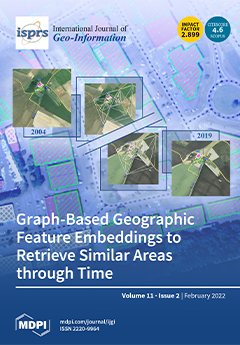
Cover Story: Historical visual sources are essential records of the successive states of a territory over time, which makes it possible to retrace its evolution. For this purpose, a first step is to find out which area of the territory is covered by each source. However, this can be difficult if they are poorly documented. Leveraging the visual content of images to compare them with current geographical reference datasets is a common solution to identify which areas they correspond to. In practice, the various choices of map legends and the evolution of landscapes over time for all the historical sources generate heterogeneous visual contents, even for sources representing the same area. Taking advantage of the relative locations and properties of the geographical features represented on the historical visual sources is a promising way to better characterize and identify the represented area. View this paper
  • Issues are regarded as officially published after their release is announced to the table of contents alert mailing list .
  • You may sign up for email alerts to receive table of contents of newly released issues.
  • PDF is the official format for papers published in both, html and pdf forms. To view the papers in pdf format, click on the "PDF Full-text" link, and use the free Adobe Reader to open them.

Articles (79)

  • Article
  • Open Access
9 Citations
5,176 Views
16 Pages

In this article researchers examined the differences that may characterise selected groups of gamers with regard to age and time spent on playing a survival game, Valheim, confronted with their interpretation of map symbols used in the game. The Valh...

  • Article
  • Open Access
3 Citations
3,806 Views
18 Pages

Semantic Integration of Raster Data for Earth Observation on Territorial Units

  • Ba-Huy Tran,
  • Nathalie Aussenac-Gilles,
  • Catherine Comparot and
  • Cassia Trojahn

Semantic technologies have proven their relevance in facilitating the interpretation of Earth Observation (EO) data through formats such as RDF and reusable models, especially for the representation of space and time. While rasters are the usual data...

  • Article
  • Open Access
16 Citations
6,286 Views
26 Pages

Agent-based modeling has the potential to deal with the ever-growing complexity of transport systems, including future disrupting mobility technologies and services, such as automated driving, Mobility as a Service, and micromobility. Although differ...

  • Article
  • Open Access
3 Citations
3,545 Views
20 Pages

Language Modeling on Location-Based Social Networks

  • Juglar Diaz,
  • Felipe Bravo-Marquez and
  • Barbara Poblete

The popularity of mobile devices with GPS capabilities, along with the worldwide adoption of social media, have created a rich source of text data combined with spatio-temporal information. Text data collected from location-based social networks can...

  • Article
  • Open Access
2 Citations
4,012 Views
11 Pages

Space-Time Dynamics of Land Use in the Municipality of Goianésia Do Pará, Brazil

  • Andrés Velastegui-Montoya,
  • Aline de Lima and
  • Marcos Adami

Hydroelectric energy generates more than 50% of all renewable electricity in the world. The Amazon is home to a large part of these ventures, promoted as a strategy of energy independence in order to reduce greenhouse gas emissions in the countries o...

  • Article
  • Open Access
15 Citations
6,088 Views
15 Pages

Assessing Reliability of Chinese Geotagged Social Media Data for Spatiotemporal Representation of Human Mobility

  • Lingbo Liu,
  • Ru Wang,
  • Weihe Wendy Guan,
  • Shuming Bao,
  • Hanchen Yu,
  • Xiaokang Fu and
  • Hongqiang Liu

Understanding the space-time dynamics of human activities is essential in studying human security issues such as climate change impacts, pandemic spreading, or urban sustainability. Geotagged social media posts provide an open and space-time continuo...

  • Article
  • Open Access
13 Citations
4,524 Views
22 Pages

Volunteered Geographical Information and Recreational Uses within Metropolitan and Rural Contexts

  • Teresa Santos,
  • Ricardo Nogueira Mendes,
  • Estela I. Farías-Torbidoni,
  • Rui Pedro Julião and
  • Carlos Pereira da Silva

Data obtained through Volunteered Geographical Information (VGI) have gradually been used to monitor and support planning mainly in urban contexts. Regarding recreational activities in peri-urban green and natural areas, VGI has been used to map, mea...

  • Article
  • Open Access
29 Citations
8,369 Views
18 Pages

Data Analytics Process over Road Accidents Data—A Case Study of Lisbon City

  • Joao Mesquitela,
  • Luis B. Elvas,
  • Joao C Ferreira and
  • Luis Nunes

Traffic accidents in urban areas lead to reduced quality of life and added pressure in the cities’ infra-structures. In the context of smart city data is becoming available that allows a deeper analysis of the phenomenon. We propose a data fusi...

  • Article
  • Open Access
5 Citations
4,001 Views
21 Pages

Evaluation of Drifting Snow Susceptibility Based on GIS and GA-BP Algorithms

  • Bohu He,
  • Mingzhou Bai,
  • Binglong Liu,
  • Pengxiang Li,
  • Shumao Qiu,
  • Xin Li and
  • Lusheng Ding

Drifting snow, the flow of dispersed snow particles near ground level under the action of wind, is a major form of snow damage. When drifting snow occurs on railways, highways, and other transportation lines, it seriously affects their operational sa...

  • Feature Paper
  • Article
  • Open Access
12 Citations
6,121 Views
17 Pages

The development of a European Spatial Data Infrastructure (SDI) officially started with the entry into force of the INSPIRE Directive in 2007. INSPIRE’s implementation phase should be completed by the European Union (EU) and its member states a...

of 8

Get Alerted

Add your email address to receive forthcoming issues of this journal.

XFacebookLinkedIn
ISPRS Int. J. Geo-Inf. - ISSN 2220-9964