



Robotics, Volume 15, Issue 1 (January 2026) – 29 articles
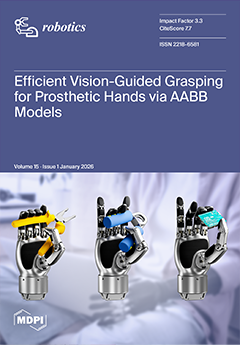
Cover Story (view full-size image):
This paper introduces a vision-guided grasping pipeline designed to enhance the autonomy and dexterity of prosthetic hands. A camera captures the scene and an Axis-Aligned Boundary Box (AABB)-based segmentation method extracts a lightweight geometric model of the target object. Using this representation, the system generates grasp candidates through Rapidly-exploring Random Tree star (RRT*) trajectories and selects fingertip poses by evaluating their distance to the object’s point cloud. Each finger is planned independently, enabling adaptive, object-specific configurations. A Damped Least Square (DLS)-based inverse kinematics solver computes joint angles for real-time execution on the Linker Hand O7. The approach is demonstrated in simulation and integrated experimentally on the platform, highlighting its feasibility for efficient prosthetic manipulation. View this paper
- Issues are regarded as officially published after their release is announced to the table of contents alert mailing list.
- You may sign up for e-mail alerts to receive table of contents of newly released issues.
- PDF is the official format for papers published in both, html and pdf forms. To view the papers in pdf format, click on the "PDF Full-text" link, and use the free Adobe Reader to open them.
Previous Issue
Next Issue
