Article

Compact LET Arrays for Origami-Based Mechanisms

by
Luke Q. Gardner
*,
Katie Varela
,
Larry L. Howell
and
Spencer P. Magleby
Compliant Mechanisms & Robotics Research Group, Department of Mechanical Engineering, Brigham Young University, Provo, UT 84602, USA
*
Author to whom correspondence should be addressed.
Robotics 2026, 15(1), 1; https://doi.org/10.3390/robotics15010001
Submission received: 16 May 2025 / Revised: 25 November 2025 / Accepted: 15 December 2025 / Published: 19 December 2025
(This article belongs to the Section Aerospace Robotics and Autonomous Systems)

Abstract

Lamina Emergent Torsional (LET) arrays can be used to replace creases in origami-based mechanisms. They can be made of planar materials, which makes them compatible with many designs. However, LET arrays can take up a lot of area and can exhibit significant parasitic motion, which makes them less ideal for some applications, such as in origami-based robotics and deployable space structures. This work presents a compact variation of the conventional LET array, which resolves these issues. An experimental method for fabricating these compact LET arrays, or C-LET arrays, from carbon fiber-reinforced polymer is given. Deflection models for C-LET array torsion segments, with and without interference with other torsion segments, are given. Bending stress and shear stress equations are provided, and the deflection models are combined into a final model that can solve for the deflections of multiple torsion segments in series. The concepts described are demonstrated in a prototype origami-based deployable reflectarray incorporating C-LET arrays. The prototype demonstrates that C-LET arrays provide the desired motion while maximizing the usable area of the deployable reflectarray.

1. Introduction

One of the many issues engineers face when designing origami-based robotics and deployable space structures arises from the hinges used to join panels together [1]. Given the large number of panels often used in origami-based design, traditional hinges are likely to bind if installed with even slight misalignment. Additionally, when used in space, traditional hinges can cause problems with cold welding, binding due to thermal expansion, and degradation of lubricants [2]. Research into replacing the hinges with compliant mechanisms may help reduce or avoid these complications [3]. The principles of compliant mechanism design involve modifying the mechanism’s geometry, materials, and end conditions to tailor its stiffness, thereby allowing it to bend without breaking.
Many varieties of compliant joints suitable for origami-based robotics and deployable space structures have been developed [4]. Commonly used configurations are Lamina Emergent Torsional (LET) joints [5] and arrays of LET joints, called LET arrays [6,7,8,9], shown in Figure 1. LET arrays can be added, much like the folds of origami, to sheet goods. This allows origami-based mechanisms to be made from a single panel, with LET arrays cut into it, rather than by connecting many panels with hinges. Experimental and finite element analysis validates the performance of LET arrays as they allow bending of thick panels [10,11,12].
LET arrays are usually made of planar material and have motion that emerges from that plane [13]. LET arrays provide focused or regional compliance to rigid materials, allowing them to flex through both bending of thin connecting regions and torsion of long beams [7,12,14]. These arrays have been used in many applications, including deployable reflectarrays [15,16].
There are many variations of these LET arrays, including membrane-enhanced, curved, and outside-deployed LET arrays, as well as other surrogate fold types that can act as hinges [4,17,18,19,20,21,22]. A complication with surrogate folds (in particular, LET arrays) is that they sometimes allow parasitic or unintended motion, twisting in ways that are normally constrained by traditional hinges. Additionally, LET arrays often take up valuable real estate on the surface of deployable space structures.
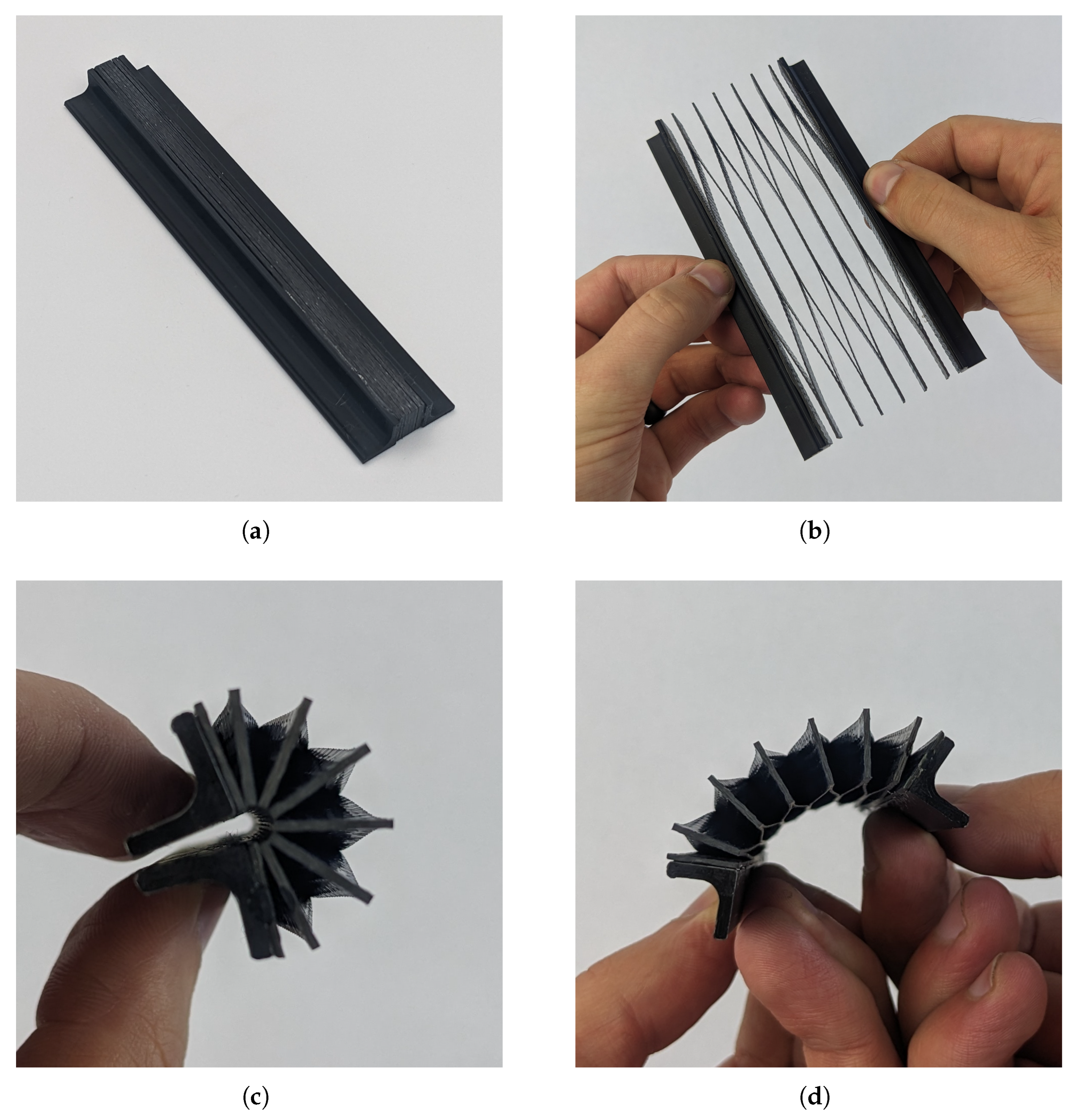
The Compact Lamina Emergent Torsional (C-LET) arrays featured in this work function similarly to conventional LET arrays in that they provide motion predominantly through torsion. An example of one of these C-LET arrays is shown in Figure 2. The characteristic that differentiates a C-LET array from a regular LET array is primarily geometric, as the C-LET array has torsion segments that have a high height-to-thickness ratio and the absence of a bending segment as defined by Pehrson et al. [14] (though the torsion segments themselves still experience bending). Additionally, while planar LET arrays can be made from a single lamina by subtractive manufacturing, C-LET arrays lend themselves to fabrication by bonding together multiple layers of torsion segments.
Utilizing these C-LET arrays as hinges could benefit origami-based robotics and deployable space structures because of their reduced parasitic motion and area consumed (compared to planar LET arrays), and lack of lubricants (compared to traditional hinges). Specifically, this work was intended to aid in the design of origami-based robotics and deployable space structures such as deployable reflectarrays, as described later.
The objective of this work is to highlight the benefits of these C-LET arrays, namely, that they take up less area than conventional LET arrays and reduce parasitic motion. Here, we introduce the design and an experimental means of fabricating C-LET arrays from carbon fiber-reinforced polymer and present deflection and stress models to aid in their design.

2. Materials and Methods

In this section, we introduce C-LET arrays fabricated from carbon fiber and explain the experimental fabrication method utilized, noting that it currently lacks the maturity of a production-ready process, but serves as a foundation for future process refinements. We later define the deflection and stress models for C-LET array torsion segments, with and without interference with other torsion segments. Here, bending stress, shear stress, and the combined effect equations, as well as the deflection model are incorporated into a final model that can solve deflections of multiple torsion segments in series.

2.1. LET Array Terminology

This work uses the convention given by Pehrson et al. [14] for describing LET array topology:
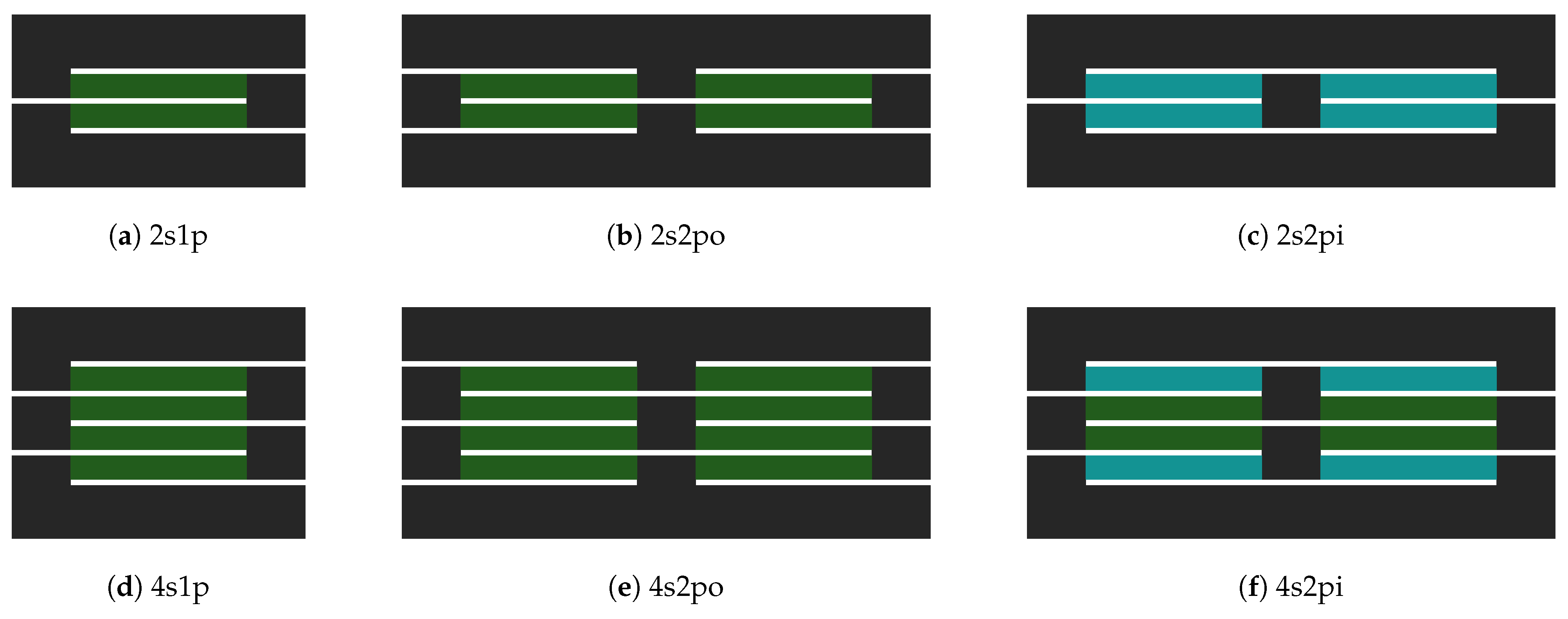
LET array topologies will be referred to here using the following convention: SsPpc. S is the number of torsion segments in series, P is the number of torsion segments in parallel, and c is the configuration (whether the topology resembles an Inside or Outside LET joint, when applicable)… The Outside/Inside option is only available to even S and even P designations.
Example LET array configurations are demonstrated in Figure 3. Subfigures (b) and (e) are outside LET arrays, while Subfigures (c) and (f) are inside LET arrays. Most of the torsion segments in these LET arrays have fixed-guided boundary conditions (shown in green), but, for 2p LET arrays, the inside configuration imposes fixed-clamped boundary conditions on the outermost torsion segments (shown in blue) making them stiffer in bending. For higher parallel numbers, more analysis must be done to determine which torsion segments have fixed-clamped boundary conditions.

2.2. Fabrication

In going from conventional LET arrays to C-LET arrays, the primary challenge was to reduce the thickness of the torsion segments and of the gaps between them. Different approaches were explored, including CO2 laser cutting and FDM printing, but those methods were only available with materials that are not space-worthy. Steel strips, spot-welded together into a LET array, were difficult to manufacture and had poor fatigue resistance; the same steel strips folded into series arrays handled fatigue better but were not able to effectively resist parasitic motion, since they were limited to series (1p) arrays.
This work introduces C-LET arrays fabricated from carbon fiber-reinforced polymer (CFRP), a composite material typically utilized for its high strength and stiffness [23,24,25]. This material has been previously considered for applications in space-based compliant mechanisms. It has been used in self-deployable composite booms consisting of tubular segments connected by tape springs [26,27,28] and in simple hinges consisting of pairs of symmetric tape springs secured opposite each other [29]. Others have achieved self-deployable composite booms by bonding together opposing “omega-shaped” carbon fiber tape springs, which could be flattened and spooled onto a hub for stowing, and unspooled for deployment as ultralight, stiff boom structures [30,31]. Similar results have been achieved with coiled tape springs [32].
The present work makes use of CFRP primarily because of the processing methods available for that material, rather than for its stiffness. Indeed, what differentiates the successful C-LET arrays from those attempted previously is the use of composites processing techniques. Specifically, rather than welding or forming steel strips, this method makes use of prepreg (reinforcement fabric which has been pre-impregnated with b-staged resin) and release film, which, in addition to its conventional use in preventing consumables from permanently bonding to the composite part, can also be used to prevent plies of prepreg from bonding to each other in targeted areas.
This method of fabrication comes with notable downsides. Firstly, the options for materials are limited to those available as prepregs, meaning that isotropic materials such as metals, which are easier to analyze, may not be used. Additionally, this fabrication method is resource-intensive, and available only as a batch process. We therefore recommend further investigation into alternative fabrication methods to enhance the manufacturability of C-LET arrays and to enable their fabrication from metals. The prepreg fabrication method developed for this research is, of course, appropriate for low-rate production scenarios.
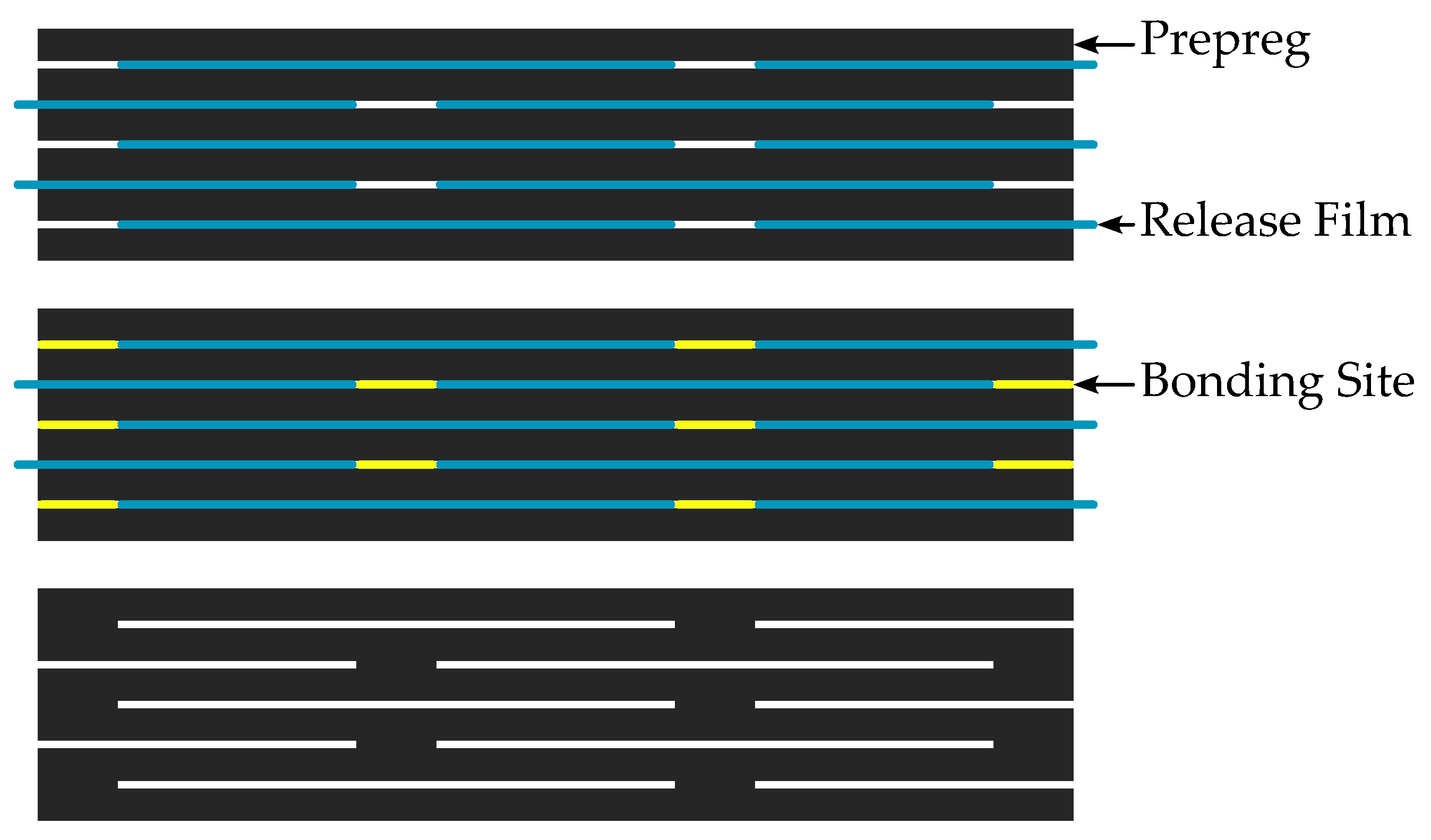
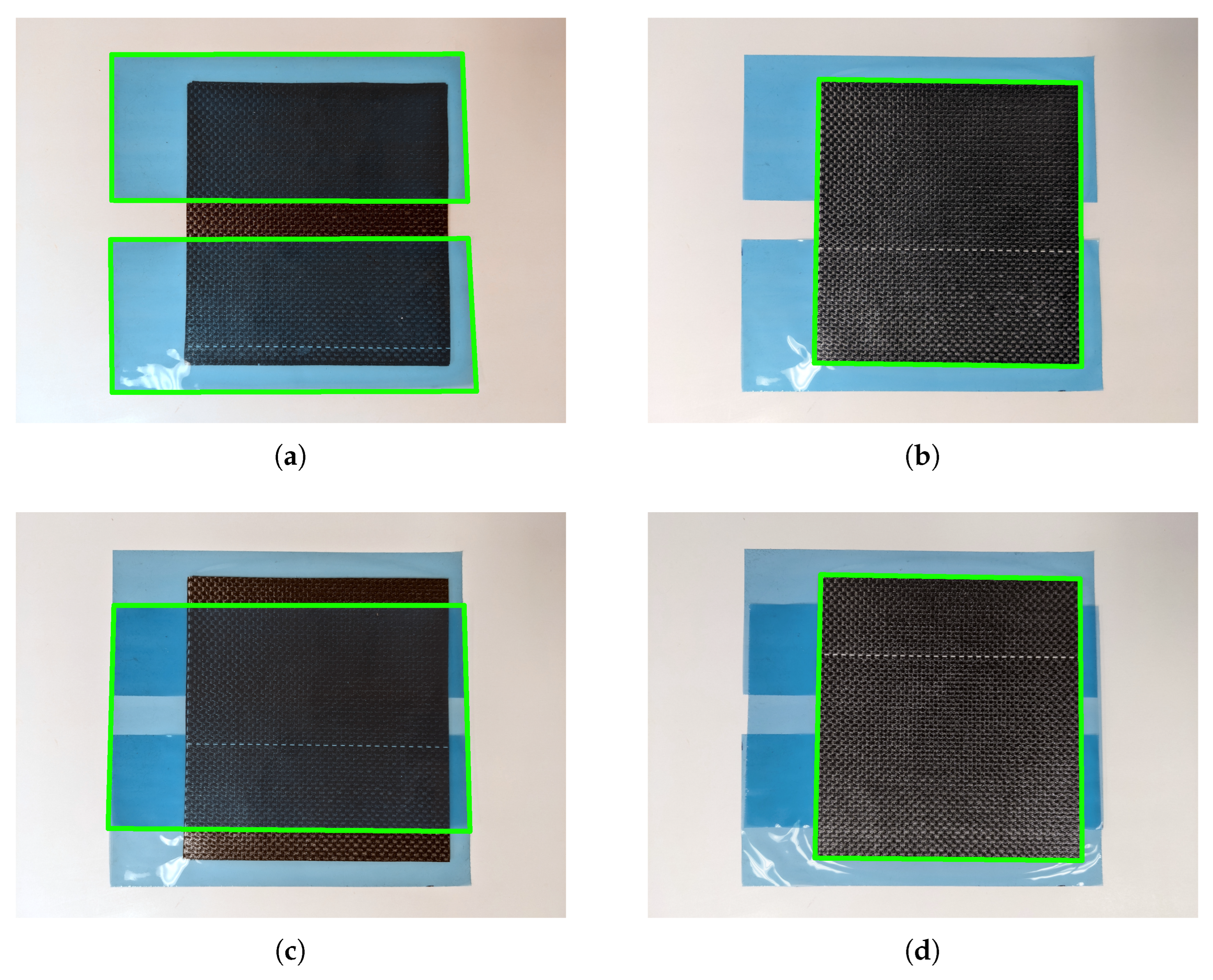
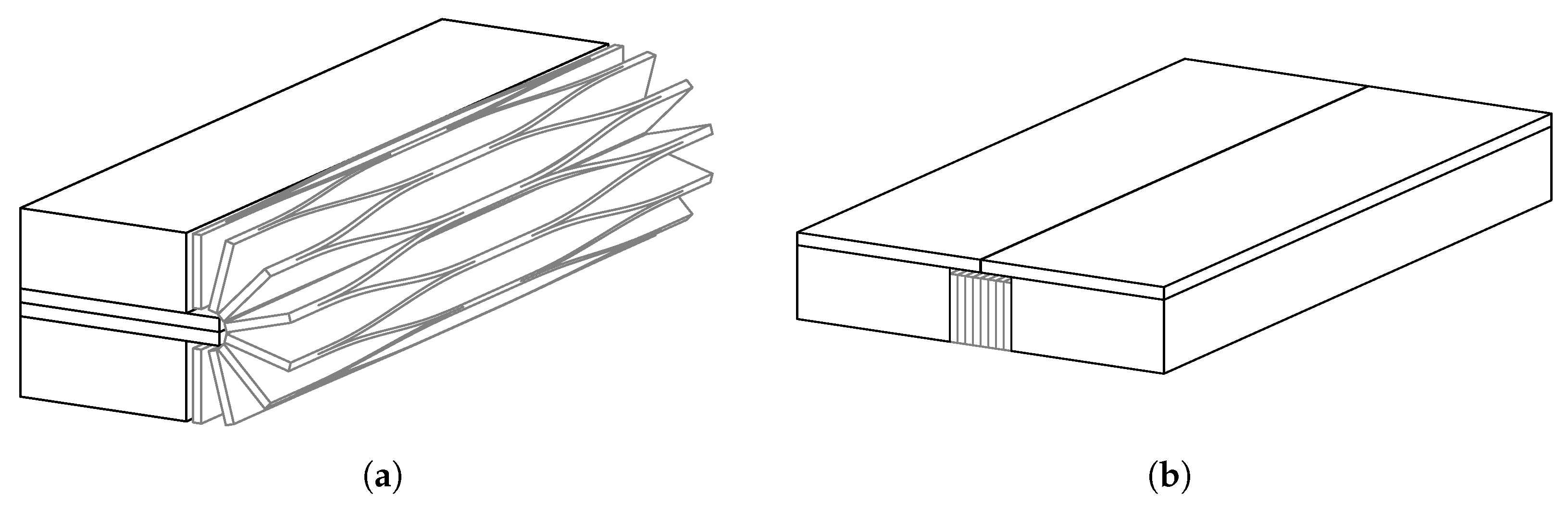
To begin, plies of prepreg are layered together, with appropriately-sized pieces of release film staggered in between, as seen in the schematic of Figure 4. This leads to extremely compact arrays with nearly nonexistent bending segments. The inclusion of the release film between plies of prepreg causes selective delamination of those plies once cured, permitting the resulting torsion segments to separate from each other. Figure 5 shows the process of laying up the C-LET array laminate for a 2p C-LET array.
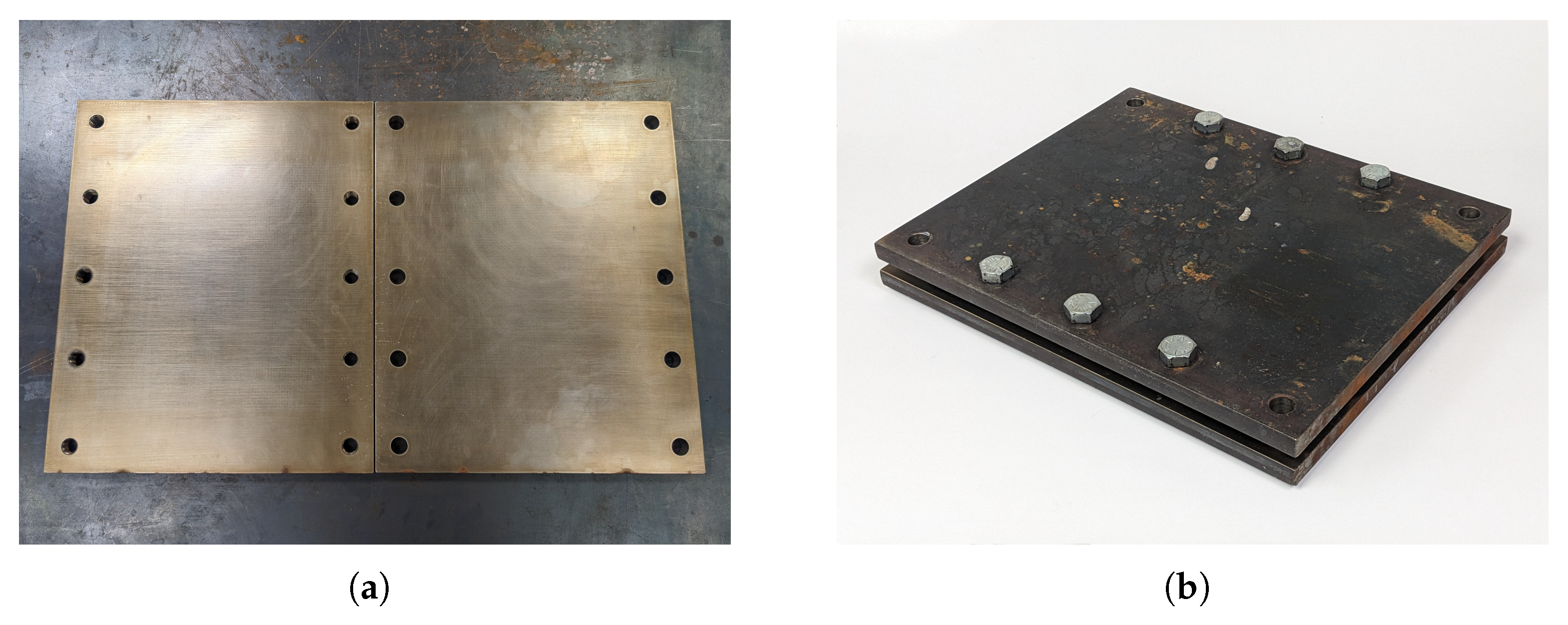
Once all plies have been laid up, the C-LET array laminate is consolidated to remove entrapped air, then cured at a high temperature. Consolidation and high-temperature curing are typically achieved simultaneously by either pressing the C-LET array laminate against a one-sided mold using a vacuum bag and autoclave, or by squeezing the C-LET array laminate in a two-sided mold in a heated press. The two-sided mold used for this research is shown in Figure 6. With the C-LET array laminate clamped inside, the mold is placed in an oven while the prepreg cures.
After curing is complete, the various pieces of release film can be removed from the C-LET array laminate, which is then trimmed to size. While the gaps between torsion segments on a subtractively-manufactured conventional LET array can be no smaller than the cutting tool used to produce them, the gaps between the torsion segments of a C-LET array made using this method are only as wide as the thickness of the release film, which commonly has a thickness on the order of 0.05 mm. This is the reason for the bending segments being nearly non-existent.
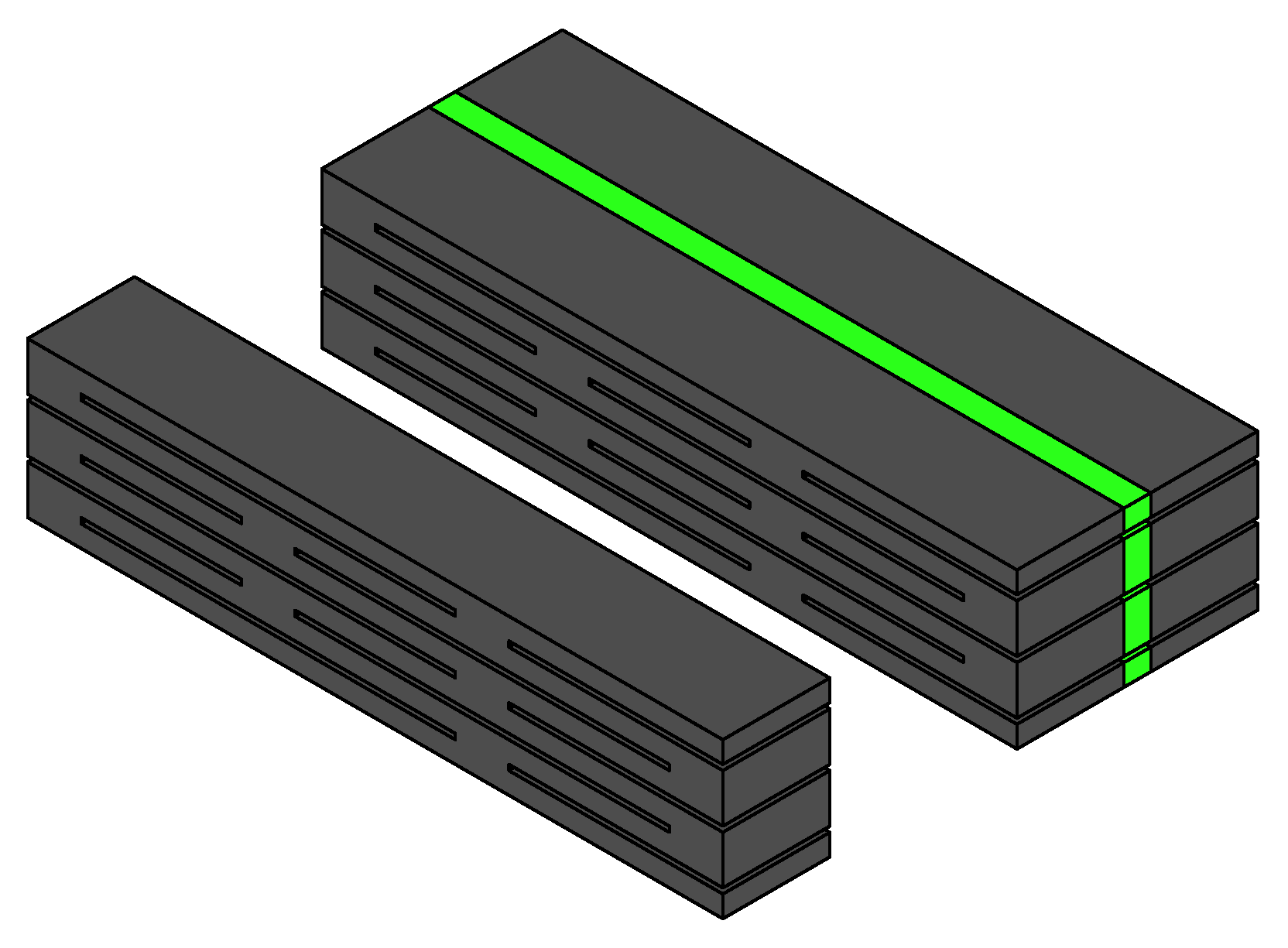
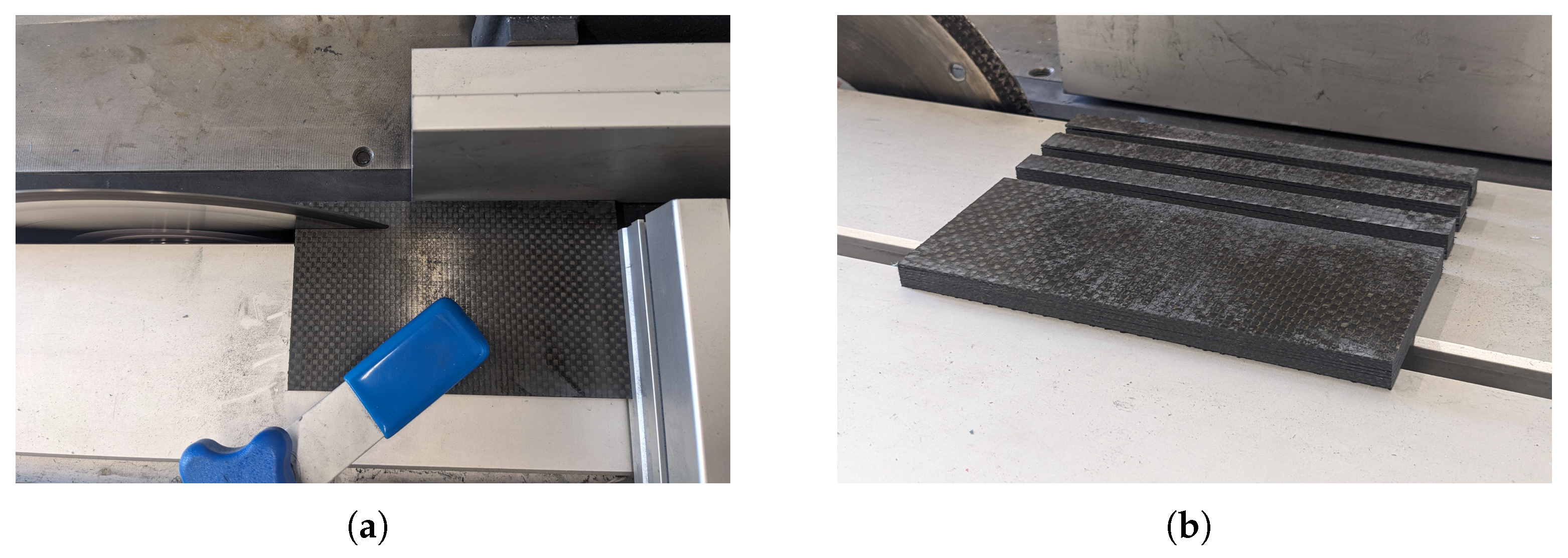
Depending on its width, a single C-LET array laminate may yield many C-LET arrays when cut, as shown in the schematic of Figure 7. Figure 8 shows the cutting process used for this research. Once cut, the C-LET array can be bonded on its outer faces to attachment flanges and flexed, or deflected, as shown in Figure 2.
When compared to conventional LET arrays, C-LET arrays generally require more height for the same stiffness. They are also difficult to cut from sheet materials, since the gaps between series-adjacent torsion segments, which would need to be created using a cutting tool, are so small. They also have low stiffness in extension relative to torsional stiffness about the axis of rotation. Additionally, when near their closed or collapsed state, little effort is required to deflect them in desirable directions, while great effort is required to deflect them in most of the undesirable directions associated with parasitic motion. Implementing these C-LET arrays in an origami-based deployable reflectarray alongside permanent magnets [33] allows the deployment motion to be constrained by the C-LET arrays, while the magnets provide stability in the deployed state, when the C-LET arrays are fully collapsed.

2.3. Modeling

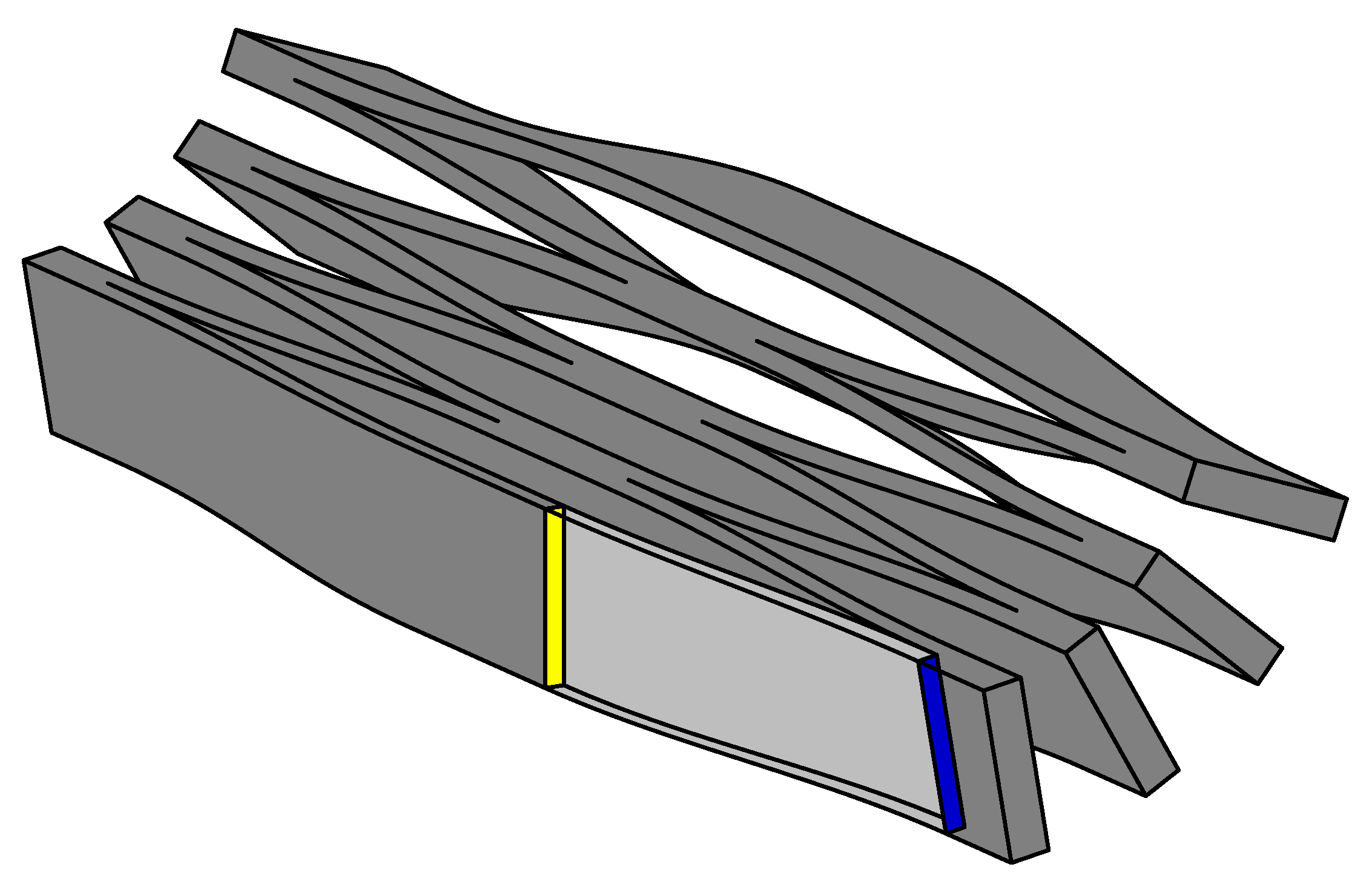
To design specific C-LET arrays to join panels of an origami-based mechanism, a static model for calculating the deflections and stresses for isotropic C-LET array torsion segments was developed and later scaled to 1p (and outside 2p) C-LET arrays. Figure 9 shows a torsion segment in the context of a complete C-LET array.
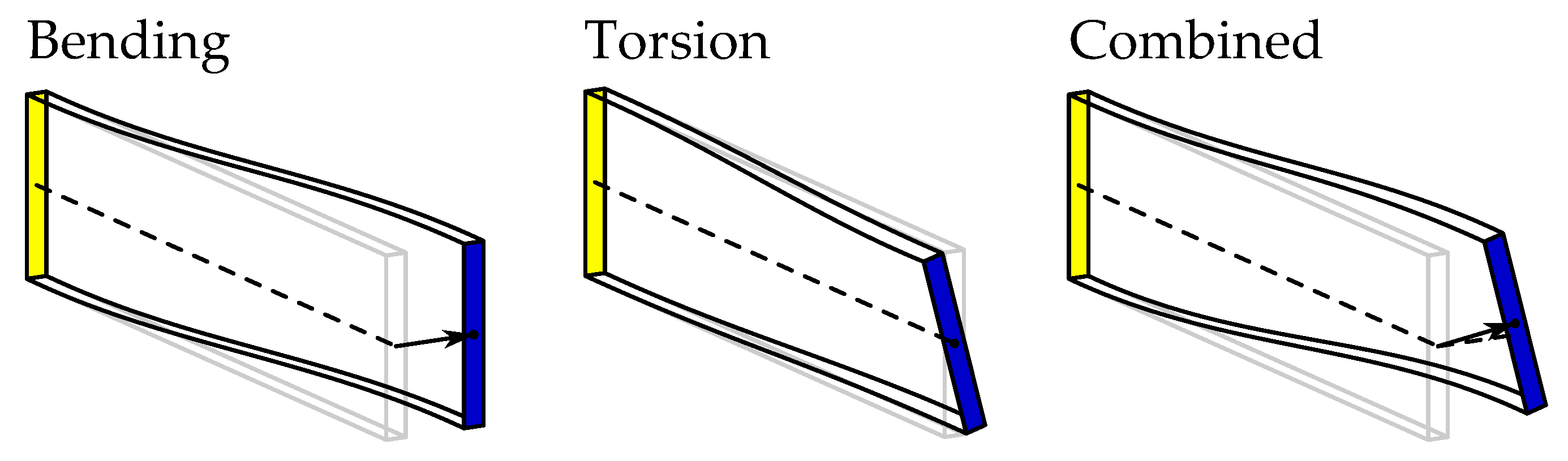
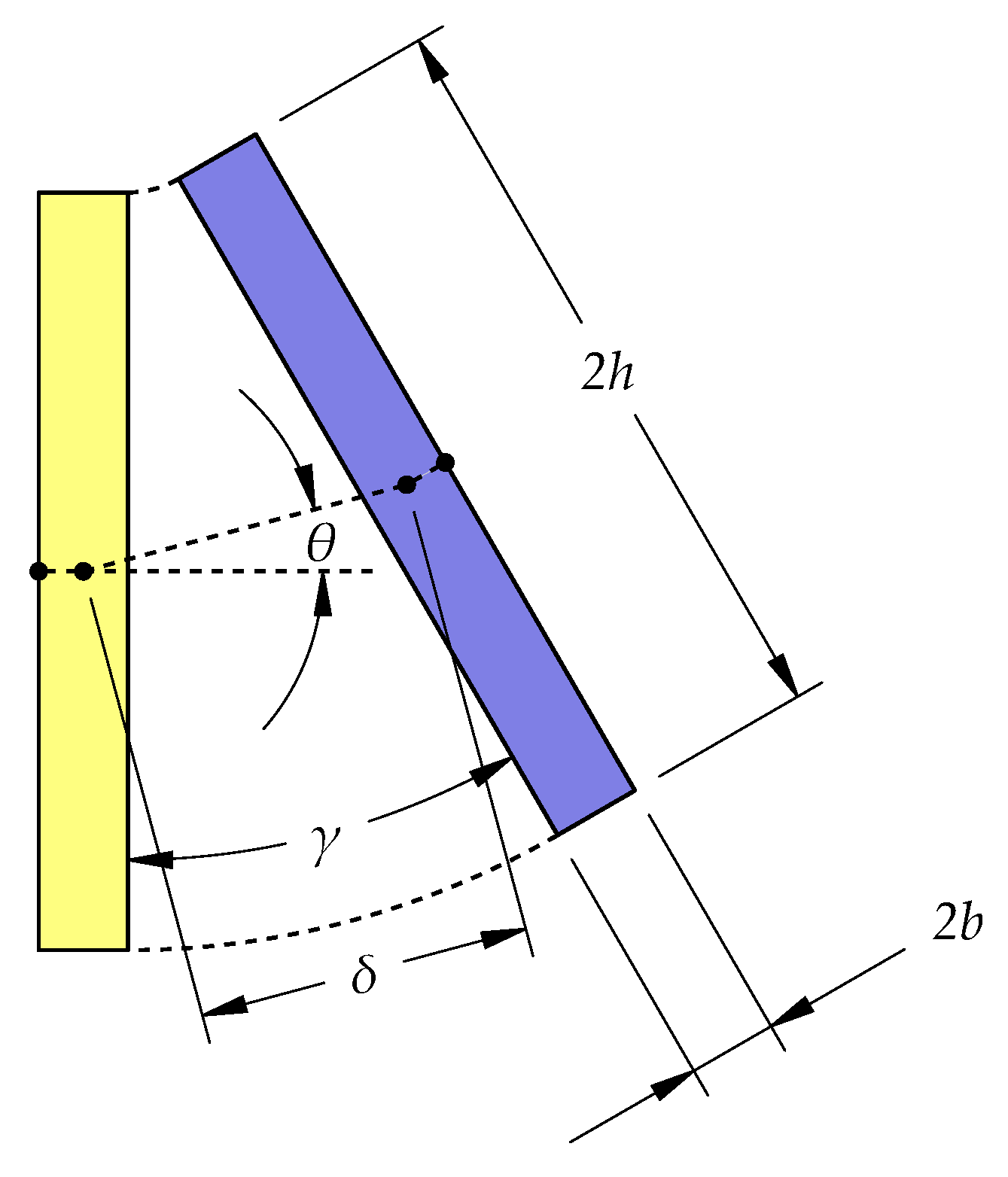
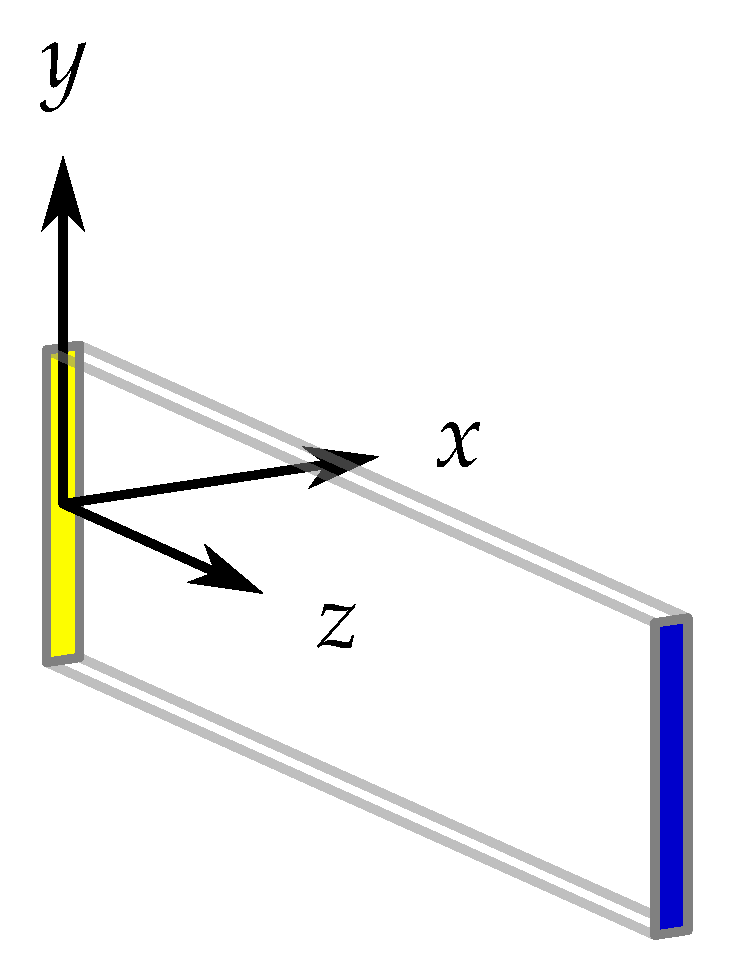
The torsion segment was modeled by superimposing both bending and torsional loads onto each torsion segment within the array, as shown in Figure 10. Observe that the front cross-section experiences both linear ( δ ) and angular ( γ ) deflection relative to the rear one, as shown in Figure 11. The axes used for this model are shown in Figure 12.
Here we assume that any deflection of the torsion segment maintains symmetry between the front and rear cross-sections. As a result of this assumption, we find that the angles γ and θ in Figure 11 are related by
γ = 2 θ .
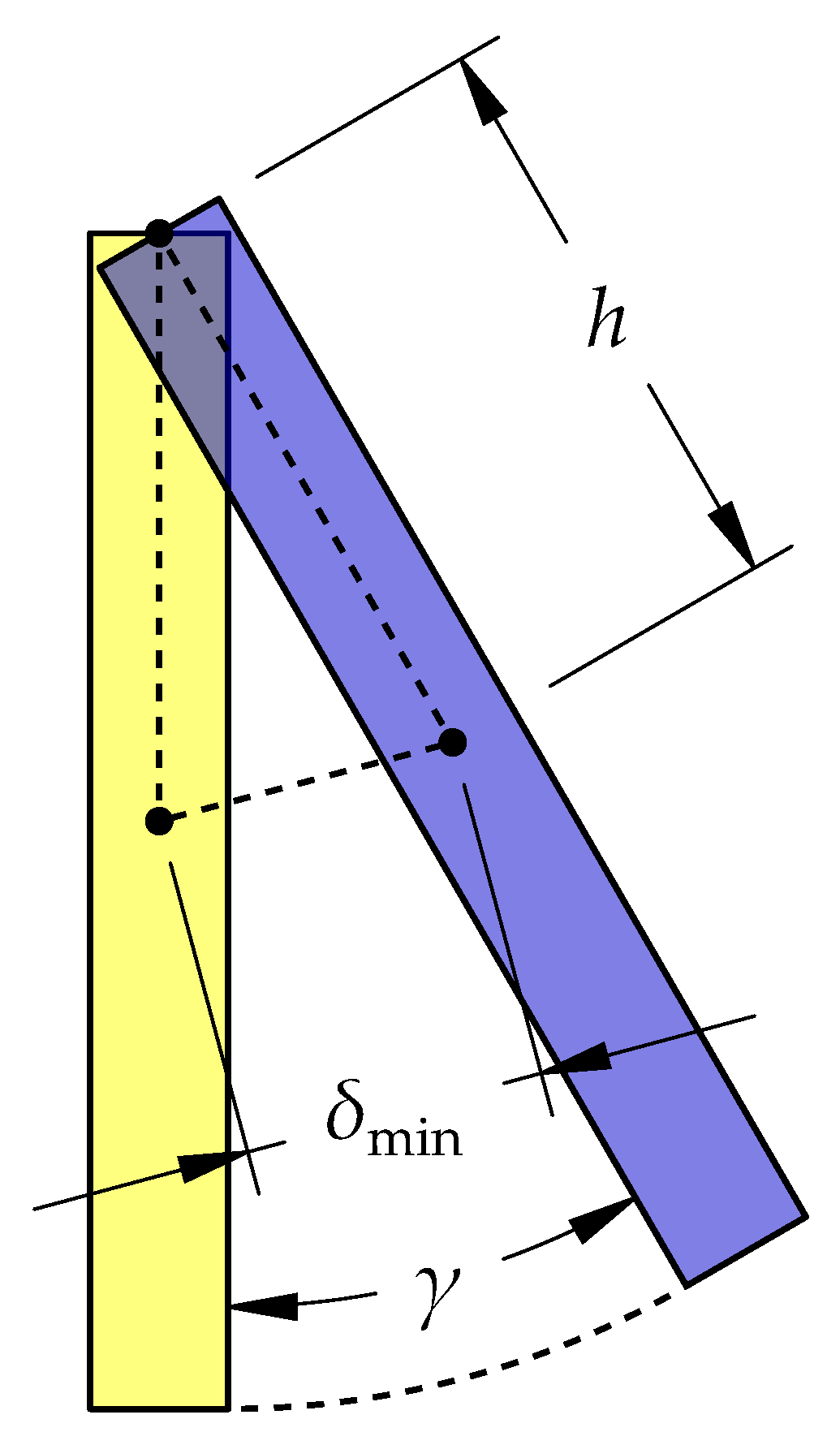
Though the linear and angular deflections δ and γ can occur independently, δ has a lower bound determined by γ due to interference with the edges of series-adjacent torsion segments when the angular deflection increases faster than the linear deflection (see Subfigure (c) of Figure 2). From Figure 13, it can be shown using the law of cosines and Equation (1) that
δ min = 2 h sin | θ | ,
where the absolute value of θ is taken since δ min cannot be negative, again due to interference with series-adjacent torsion segments. Instead, when θ is negative, the effective pivot switches from the top edge of the torsion segment to the bottom edge.
For each torsion segment, the deflection can follow one of two models: the first model where no interference occurs as in Figure 11, or the second model where the top or bottom edge of the torsion segment interferes with series-adjacent torsion segments as in Figure 13.
For each of these models, it will be assumed that the reaction load is known and that the deflections and applied load are to be computed from them.

2.3.1. Deflection Model with No Interference

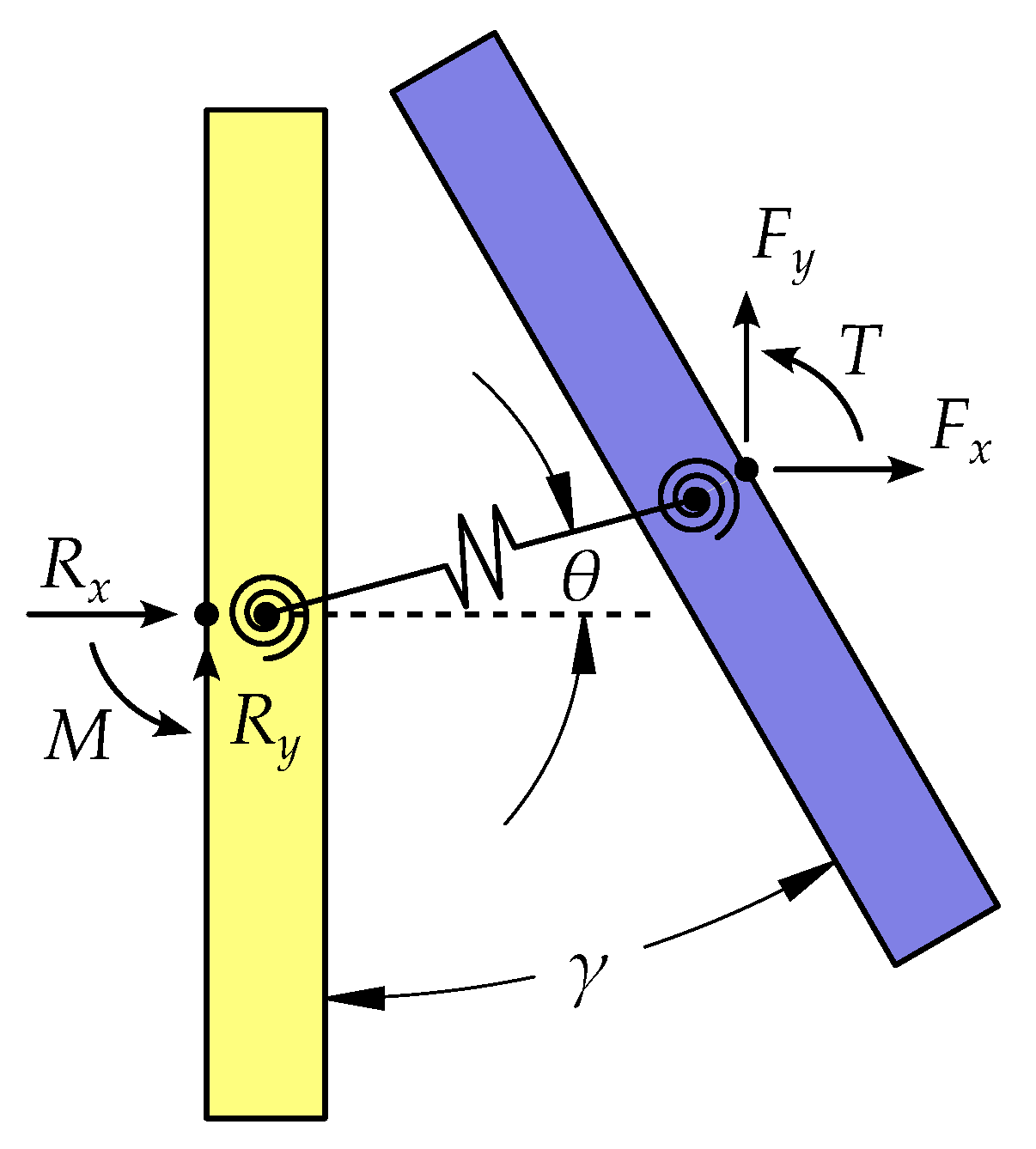
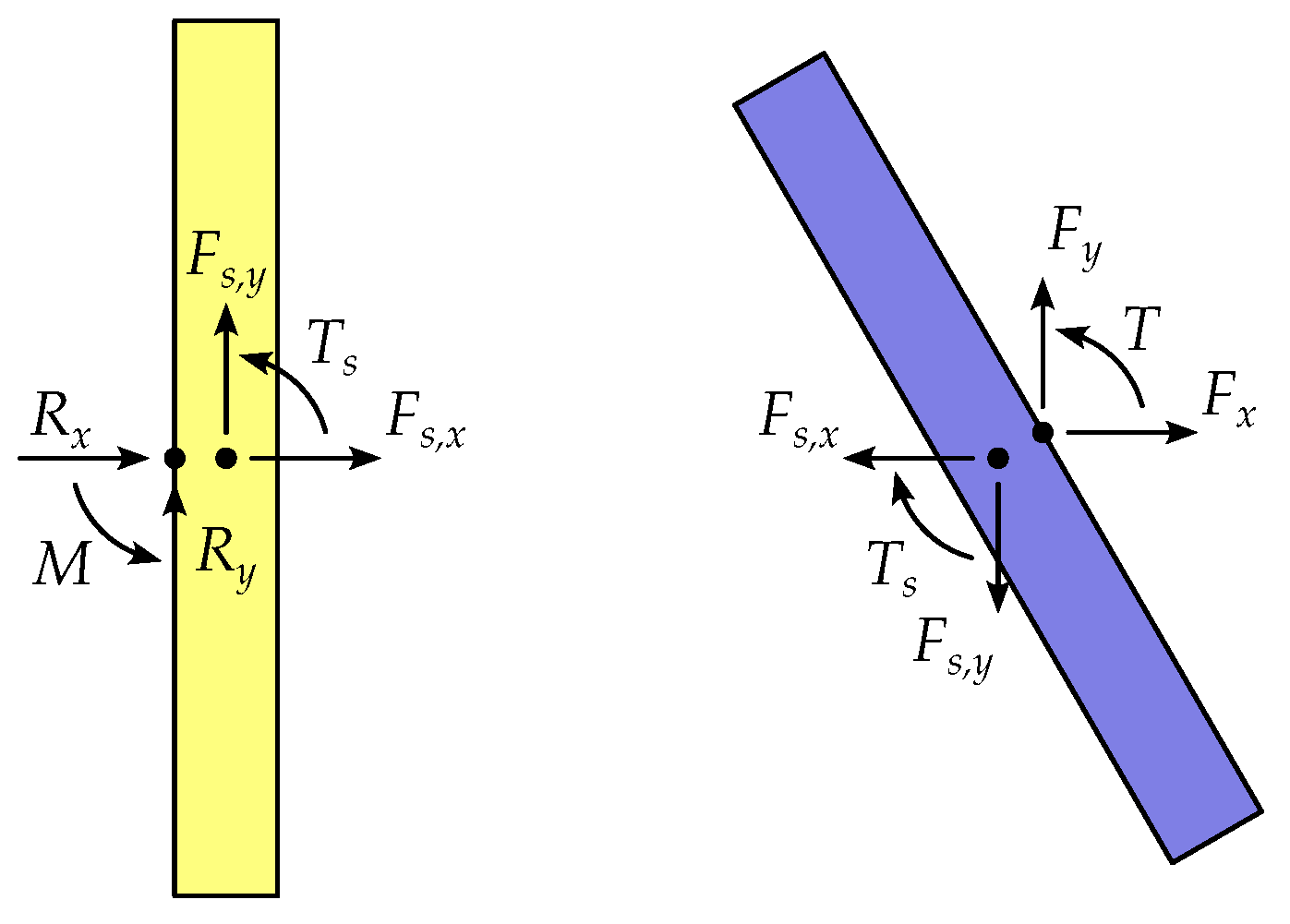
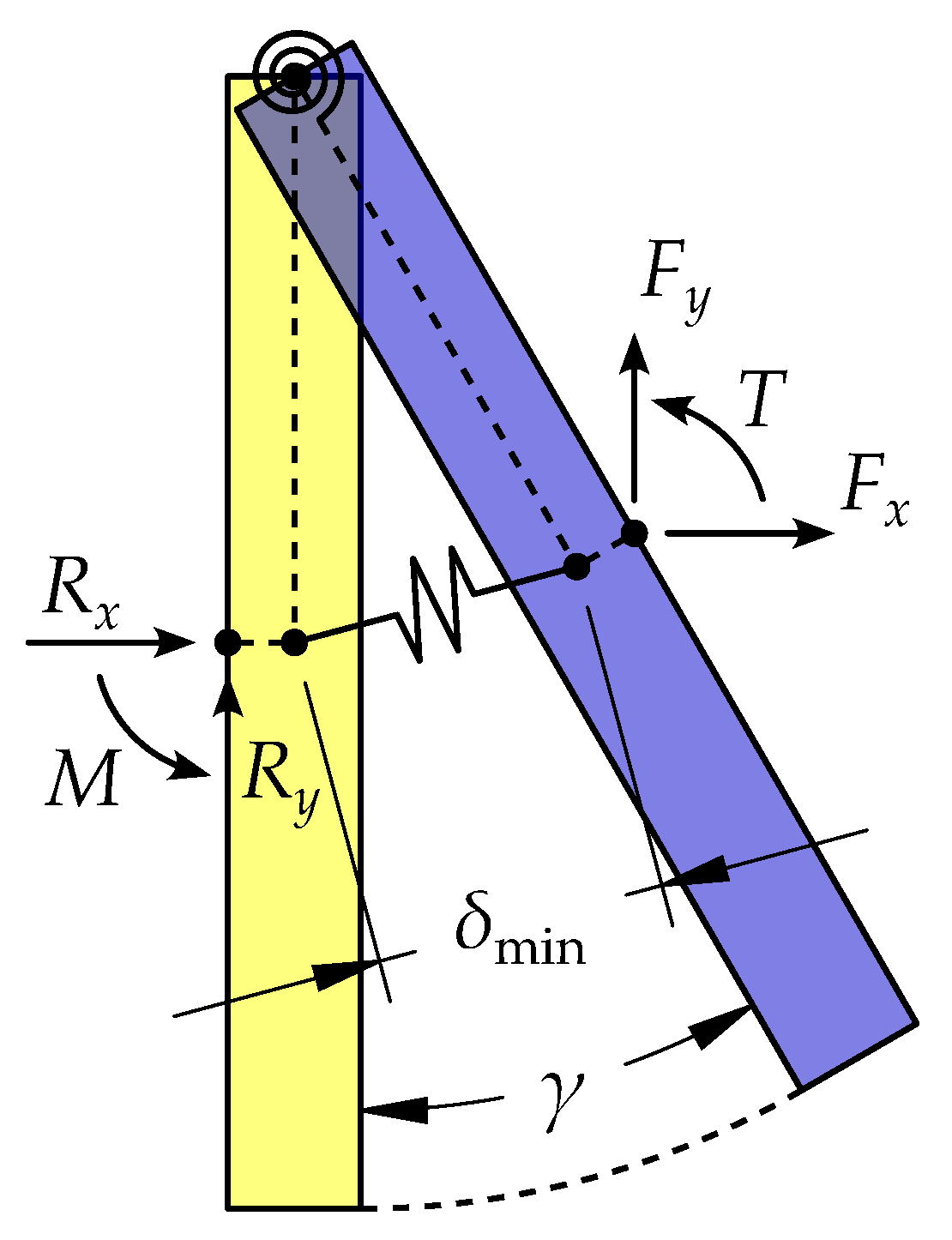
The model used to compute the deflection of a torsion segment in the case of no interference at its edges is shown in Figure 14 and Figure 15. The torsion segment is modeled with its front and rear cross-sections connected by a linear spring and a torsional spring. The linear spring represents the force resulting from the bending of the torsion segment, while the torsional spring accounts for the torque resulting from the twisting of the torsion segment.
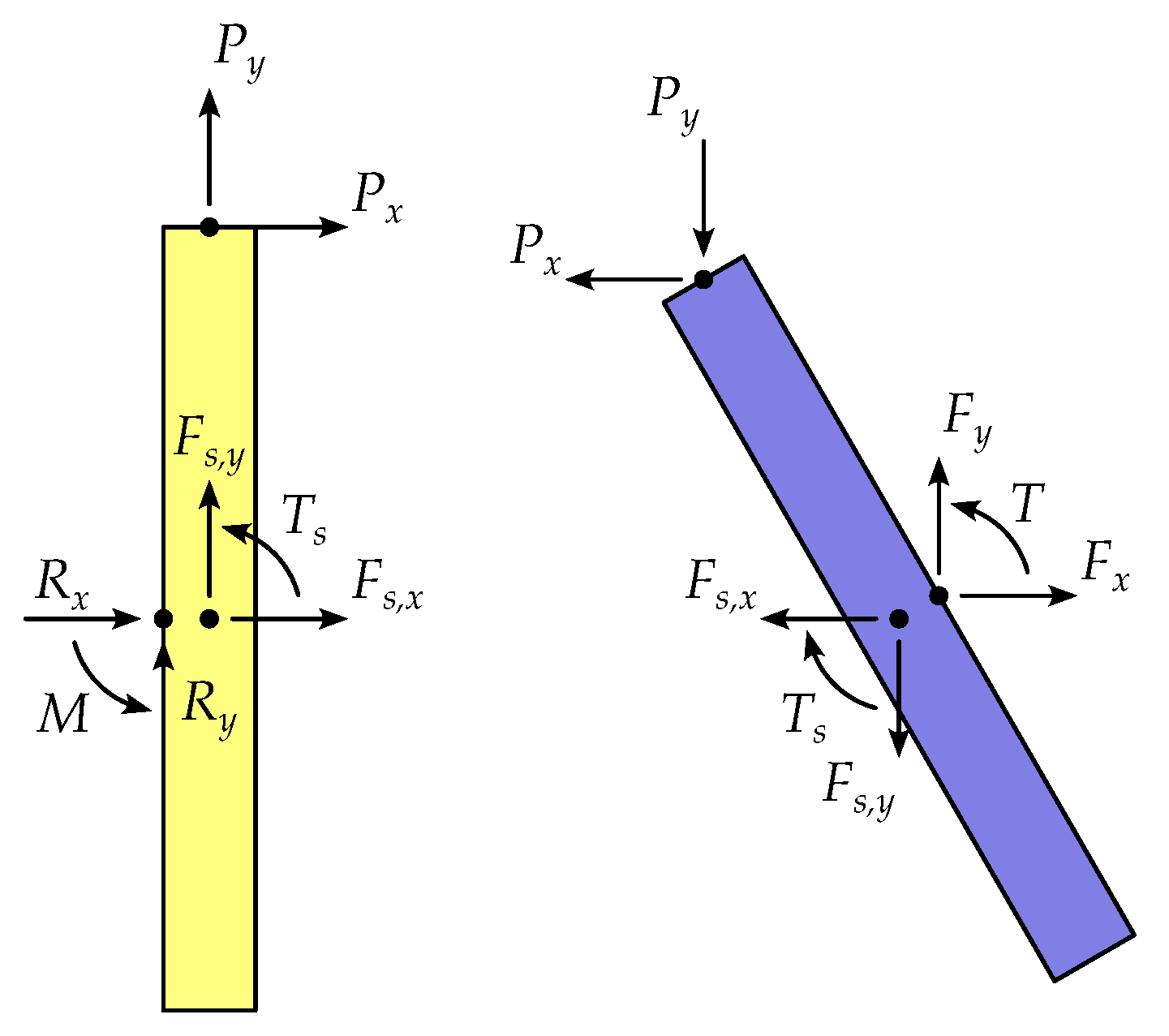
In this model, R x , R y , and M are the reaction force components and moment, respectively, of the rear cross-section. F x , F y , and T are the force components and torque applied to the front cross-section. F s x , F s y , and T s are the force components and torque exerted by the linear and torsional springs, respectively. The governing equations are
0 = R x + F x
0 = R y + F y
0 = F s , x + R x
0 = F s , y + R y
0 = M + T s R y b
θ = T s k t
0 = F y b cos 2 θ F x b sin 2 θ T s + T
δ = k b F s , x cos θ + F s , y sin θ .
Here, k b and k t are the effective spring constants of the modeled linear and torsional springs, given in Section 2.3.3 and Section 2.3.4 as Equations (33) and (41).
Given a reaction load ( R x , R y , and M), this system of equations can be solved analytically by computing each unknown in the sequence given by Equations (11) through (18).
F x = R x
F y = R y
F s , x = R x
F s , y = R y
T s = R y b M
θ = T s k t
T = F x b sin 2 θ F y b cos 2 θ + T s
δ = k b F s , x cos θ + F s , y sin θ

2.3.2. Deflection Model with Interference Included

The model used to compute the deflection of a torsion segment accounting for interference with series-adjacent torsion segments is shown in Figure 16 and Figure 17. The torsion segment is once again modeled with its front and rear cross-sections connected by a linear spring and a torsional spring, as in Section 2.3.1.
In addition to all the forces, torques, and moments of the previous model, we also include the two components of the contact force at the interfering edge, P x and P y . The governing equations for this case are
δ = 2 h sin | θ |
0 = F x + R x
0 = F y + R y
0 = M + R x b sin 2 θ + δ sin θ R y b cos 2 θ + b + δ cos θ + T
0 = F s , x + P x + R x
0 = F s , y + P y + R y
0 = M + T s P x h R y b
0 = F x b sin 2 θ + F y b cos 2 θ T s + P x h cos 2 θ + P y h sin 2 θ + T
δ = k b F s , x cos θ + F s , y sin θ
θ = T s k t .
Once again, k b and k t are the effective spring constants of the modeled linear and torsional springs given in Section 2.3.3 and Section 2.3.4 as Equations (33) and (41).
Since P x and P y change location when θ is negative, modified forms of Equations (25) and (26) need to be used if such is the case:
0 = M + T s + P x h R y b
0 = F x b sin 2 θ + F y b cos 2 θ T s P x h cos 2 θ P y h sin 2 θ + T .
No analytic solution was found for this system of equations, but, given a reaction load ( R x , R y , and M), a numeric solution can be computed reliably using seed values from the no-interference model (Section 2.3.1). In the authors’ software implementation, these equations are solved using the fsolve function available via version 1.15.2 of the SciPy Python module. The x0 argument is set to the values previously determined using the no-interference model, with the exception of P x and P y , whose initial values are set at zero. The xtol argument is the solver’s convergence criterion. Whenever the relative difference between two consecutive solutions falls below this amount, the solver terminates. In the authors’ implementation, it is set to 10 9 , though increasing it will lead to faster, less accurate, solutions.

2.3.3. Bending Stress in the Torsion Segment

Assuming isotropy, the deflection of a fixed-guided beam by an externally applied force F is given by
δ = F L 3 12 E I y ,
where I y is given by
I y = 2 b 3 2 h 12 .
The effective linear spring constant of the torsion segment, k b , can be found by solving Equation (31) for δ / F :
k b = L 3 12 E I y .
The corresponding moment required to maintain the fixed-guided condition is
M y = F L 2 .
The moment M y is constant throughout the beam. The force F produces an additional moment in the beam, which follows the relation
M F = F L z .
Adding together the moments produced by M y and F results in
M z = M F + M y = F L 2 z .
The general formula for bending stress in a beam is σ = M x I , where M is the moment about the bending axis, x is the distance of the point of interest from the neutral axis, with a second moment of area about the bending axis of I. Substituting the formula for the total moment into this expression gives
σ z x , z = F L 2 z x I y .
This can be expanded further by solving Equation (31) for F and substituting. This gives
σ z x , z = δ 12 E L 2 z x L 3 ,
which can be used to compute the bending stress at any location within a torsion segment given the displacement, δ .

2.3.4. Shear Stress from Torsion in the Torsion Segment

Assuming isotropy, the angular deflection γ for a rectangular cross-section beam with thickness 2 b , height 2 h , length L, flexural modulus G, and loaded with a torque T, is given by [34]
γ = T L G k 1 2 h 2 b 3 ,
where h is the length of the longer side, and
k 1 = 1 3 1 192 π 5 b h n = 1 , 3 , 5 , 1 n 5 tanh n π h 2 b .
The effective torsional spring constant of the torsion segment, k t , can be found by substituting γ for 2 θ in Equation (39) and solving for θ / T :
k t = L 2 G k 1 2 h 2 b 3 .
For a deflection γ , the shear stresses in a given cross-section are [34]
σ z x x , y = 16 G γ b L π 2 n = 1 , 3 , 5 , 1 n 1 2 cos n π x 2 b sinh n π y 2 b n 2 cosh n π h 2 b
σ z y x , y = 2 G γ x L 16 G γ b L π 2 n = 1 , 3 , 5 , 1 n 1 2 sin n π x 2 b cosh n π y 2 b n 2 cosh n π h 2 b .
Using these two equations, the shear stress at any location in the torsion segment can be computed if γ is known.

2.3.5. Combining Bending and Torsional Stresses

For C-LET arrays made from isotropic materials, the stresses computed in Equations (38), (42), and (43) can be combined to find the von Mises stress at any point x , y , z within the torsion segment. For anisotropic materials, alternate methods of computing and combining the bending and torsional stresses must be employed.

2.3.6. Solving Deflections of Multiple Torsion Segments in Series

The overall deflection of a series (1p) C-LET array can be found by sequentially computing the deflection of each torsion segment in the array. Knowing the reaction load of the first torsion segment in the array, the deflection and applied load of that torsion segment can be computed. This applied load can then be negated, rotated into the coordinate frame of the second torsion segment, and treated as its reaction load. This process of solving for the applied load of one torsion segment, negating and rotating it, and treating it as the reaction load of the next, continues until the deflection and applied load of the last torsion segment are computed. Then, the individual deflections can be combined to obtain the overall deflection of the C-LET array.
Each torsion segment is initially assumed to have a linear displacement, δ , greater than δ min , which corresponds to the no-interference model of Section 2.3.1. After computing the linear and angular deflections of the torsion segment using that model, this assumption is checked by comparing the computed linear deflection, δ , with δ min (Equation (2)). If this condition fails, then there must in actuality be interference at the torsion segment edges, and the linear and angular deflections must be computed again using the model of Section 2.3.2.
This method is laid out in Algorithm 1. Note that lines 23 and 24 make use of the signum function, which compensates for the sign changes necessary in Equations (25) and (26) when θ is negative.
Algorithm 1 C-LET Array Deflection Computation
  1:
Compute k b and k t for torsion segment cross-section from Equations (33) and (41).
  2:
Pick R x 1 , R y 1 and M 1 for C-LET array.
  3:
for   i = 1 to N do
  4:
    Compute deflection using no-interference model (Section 2.3.1):
  5:
     F x i = R x i
  6:
     F y i = R y i
  7:
     F s , x i = R x i
  8:
     F s , y i = R y i
  9:
     T s i = R y i b M i
10:
     θ i = T s i k t
11:
     T i = F x i b sin 2 θ i F y i b cos 2 θ i + T s i
12:
     δ i = k b F s , x i cos θ i + F s , y i sin θ i
13:
    Compute δ min :
14:
     δ min = 2 h sin | θ i |
15:
    if δ i < δ min then
16:
          Compute deflection using interference model (Section 2.3.2):
17:
           δ i = 2 h sin | θ i |
18:
           0 = F x i + R x i
19:
           0 = F y i + R y i
20:
           0 = M i + R x i b sin 2 θ i + δ i sin θ i
                              R y i b cos 2 θ i + b + δ i cos θ i + T i
21:
           0 = F s , x i + P x i + R x i
22:
           0 = F s , y i + P y i + R y i
23:
           0 = M i + T s i sgn θ P x i h R y i b
24:
           0 = F x i b sin 2 θ i + F y i b cos 2 θ i
                              T s i + sgn θ P x i h cos 2 θ i + P y i h sin 2 θ i + T i
25:
           δ i = k b F s , x i cos θ i + F s , y i sin θ i
26:
           θ i = T s i k t
27:
    end if
28:
     R x i + 1 = F x i
29:
     R y i + 1 = F y i
30:
    Rotate R i + 1 by 2 θ i .
31:
     M i + 1 = T i
32:
end for
This algorithm can be used to compute the applied load and deflection at the free end of a C-LET array needed to produce the given reaction load at the fixed end. However, if it is desired to know the deflection of a C-LET array given an applied load, then Algorithm 1 can be wrapped in an optimizer, and a numerical approach taken to find a reaction load which produces the desired applied load.
Once the deflections δ and γ of all torsion segments have been computed using Algorithm 1, Equations (38), (42) and (43) can be used to compute the bending and shear stresses anywhere within a given torsion segment.
These stresses can be combined, as explained in Section 2.3.5, and the resulting von Mises stress can be compared with the yield strength of the C-LET array. If the desired deflection is achieved, but the maximum von Mises stress within the C-LET array is too high, then the design must be altered to compensate. A non-exhaustive list of options for accomplishing this includes: adding more torsion segments in series; reducing the thickness, 2 b , of the torsion segments; reducing the height, 2 h , of the torsion segments; and increasing the length, L, of the torsion segments. The compromises associated with each of these options present an opportunity for further research into developing methods of optimizing C-LET arrays for specific scenarios.
Since this model assumes isotropy, it is recommended for use with C-LET arrays made from isotropic materials. However, as can be seen in Section 3.1, the model is capable of predicting the deflected shape of C-LET arrays, even when made from orthotropic materials such as CFRP. Nevertheless, it is recommended that further study be devoted to rigorously extending the model to orthotropic materials.
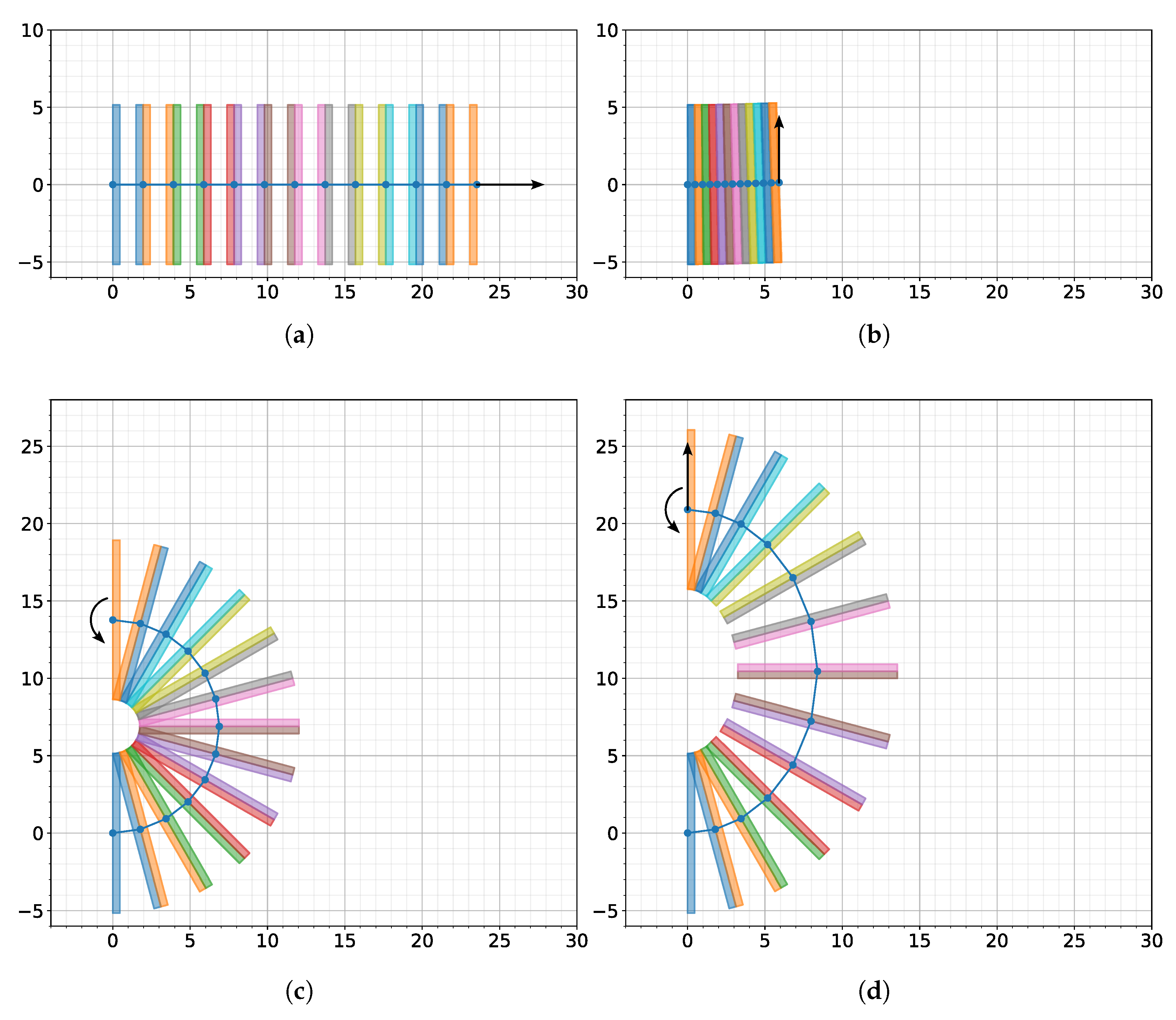
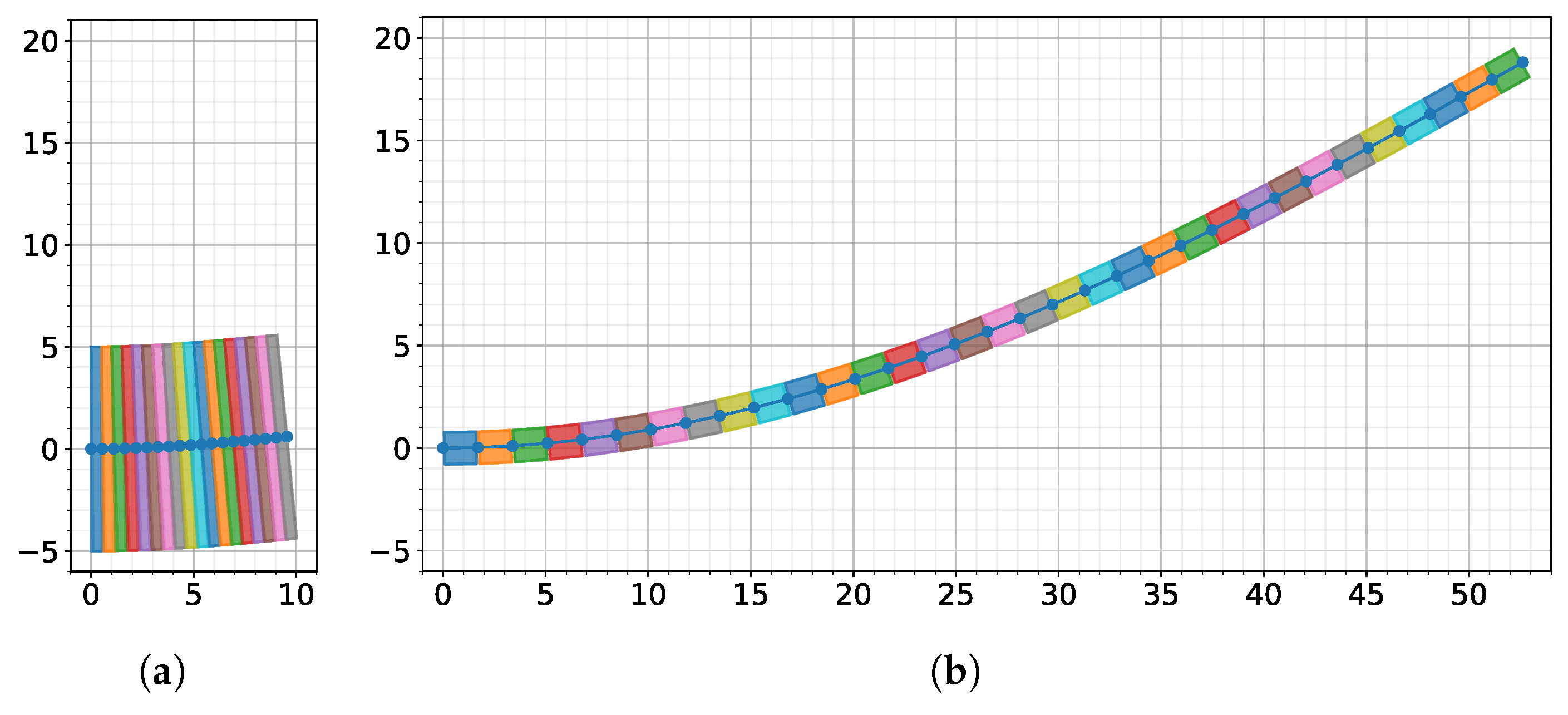
This solution method was implemented in the Python programming language as a GUI application (see the Data Availability Statementat the end of this paper), which was used to simulate C-LET arrays. Figure 18 shows the simulated deflection of a 12s2po C-LET array subjected to various loads.

2.4. Comparison of C-LET and LET Arrays

The model developed for C-LET arrays can also be used for conventional LET arrays by making a slight adjustment to the equations for the no-interference model of Section 2.3.1, and assuming that the gap between torsion segments is sufficient to prevent adjacent torsion segments from ever coming into contact, eliminating the need for the interference model of Section 2.3.2. This model comes with the same limitations as the C-LET model, namely that it is valid only for 1p and 2po LET arrays due to the fixed-clamped boundary conditions of some of the torsion segments of higher parallel numbered LET arrays. However, when loaded only in torsion, this limitation doesn’t apply to conventional LET arrays, since the torsion segments experience no bending in that case.
The adjustments are made to Equations (15) and (17), and are required to take into account the additional moment arm of the reaction and applied forces. If we denote the width of the gap between adjacent torsion segments as w, then this gives
T s = R y b + w 2 M
T = F x b + w 2 sin 2 θ F y b + w 2 cos 2 θ + T s .
These new equations simply replace Equations (15) and (17), and the model is used as before without checking for interference of adjacent torsion segments.
This allows us to compare the performance of conventional LET arrays and C-LET arrays. To do so, we choose dimensions and material properties for a C-LET torsion segment, determine the number of torsion segments in series necessary to undergo a target angular deflection without over-stressing the torsion segments, calculate the torque necessary for this deflection, and then design an “equivalent” LET array that deflects the same amount, given the same torque, without over-stressing its torsion segments. Then we can compare the width of the arrays as well as their susceptibility to parasitic motion.
First, we choose a material for the arrays. Then we arbitrarily choose dimensions for the C-LET array, and simulate the angular deflection of the array in response to an input torque. Knowing this deflection, we can calculate the maximum bending and shear stresses using Equations (38) and (43).
The maximum bending stress occurs at either extreme of the torsion segment where z = 0 or z = L , and on the faces normal to the x-axis where x = b .
The maximum shear stress in a rectangular cross-section occurs at the midpoints of the two longest edges. For cross-sections which are taller in the y-direction than the x-direction, this coincides with the face on which the maximum bending stress occurs, at x , y = b , 0 .
From these stresses, we can compute the maximum von Mises stress in the torsion segment. Using a numerical optimizer, such as SciPy’s minimize function, we can find the torque and associated deflection such that the maximum von Mises stress equals the yield stress of the material.
Then we choose a target deflection amount. Taking the ceiling of the target deflection divided by the angular deflection of a single torsion segment, we arrive at the number of torsion segments necessary to deflect the target amount without over-stressing the torsion segments. This finalizes the C-LET design for this demonstration.
Next, we need to find a LET array capable of the same angular deflection, given the same applied torque, without being over-stressed.
We assume that the cross-sections of the torsion segments are square, with a side length s such that
s = 2 h = 2 b .
Substituting these into Equation (39) and simplifying, we get
γ = T L G k 1 s 4 .
The maximum shear stress occurs at x , y = b , 0 . We substitute this and Equation (46) into Equation (43) and simplify:
σ z y , max = G γ s L 1 8 π 2 n = 1 , 3 , 5 , 1 n 2 cosh n π 2 .
Combining Equations (47) and (48) and canceling, we get
σ z y , max = T k 1 s 3 1 8 π 2 n = 1 , 3 , 5 , 1 n 2 cosh n π 2 ,
which we can solve for s:
s = T k 1 σ z y , max 1 8 π 2 n = 1 , 3 , 5 , 1 n 2 cosh n π 2 3 .
According to the von Mises failure theory, the shear stress that will yield a material in pure shear is
σ z y , yield = S y 3 .
Substituting this into Equation (50) gives
s = T 3 k 1 S y 1 8 π 2 n = 1 , 3 , 5 , 1 n 2 cosh n π 2 3 .
From Equation (52), we can calculate the side length given a target torque, T, and the yield stress, S y . Substituting (46) into Equation (40) and canceling, we find that k 1 doesn’t depend on s:
k 1 = 1 3 1 192 π 5 n = 1 , 3 , 5 , 1 n 5 tanh n π 2 .
As with the C-LET array, we take the ceiling of the target deflection divided by the angular deflection of a single torsion segment, arriving at the number of torsion segments necessary to deflect the target amount without over-stressing the torsion segments. For the following comparison, we used the parameters in Table 1.
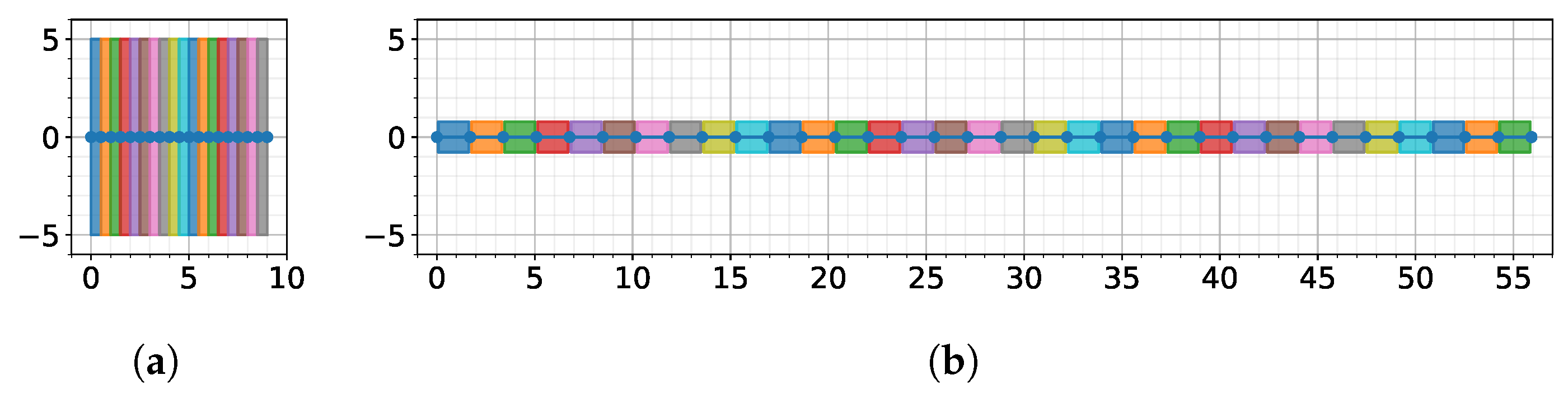
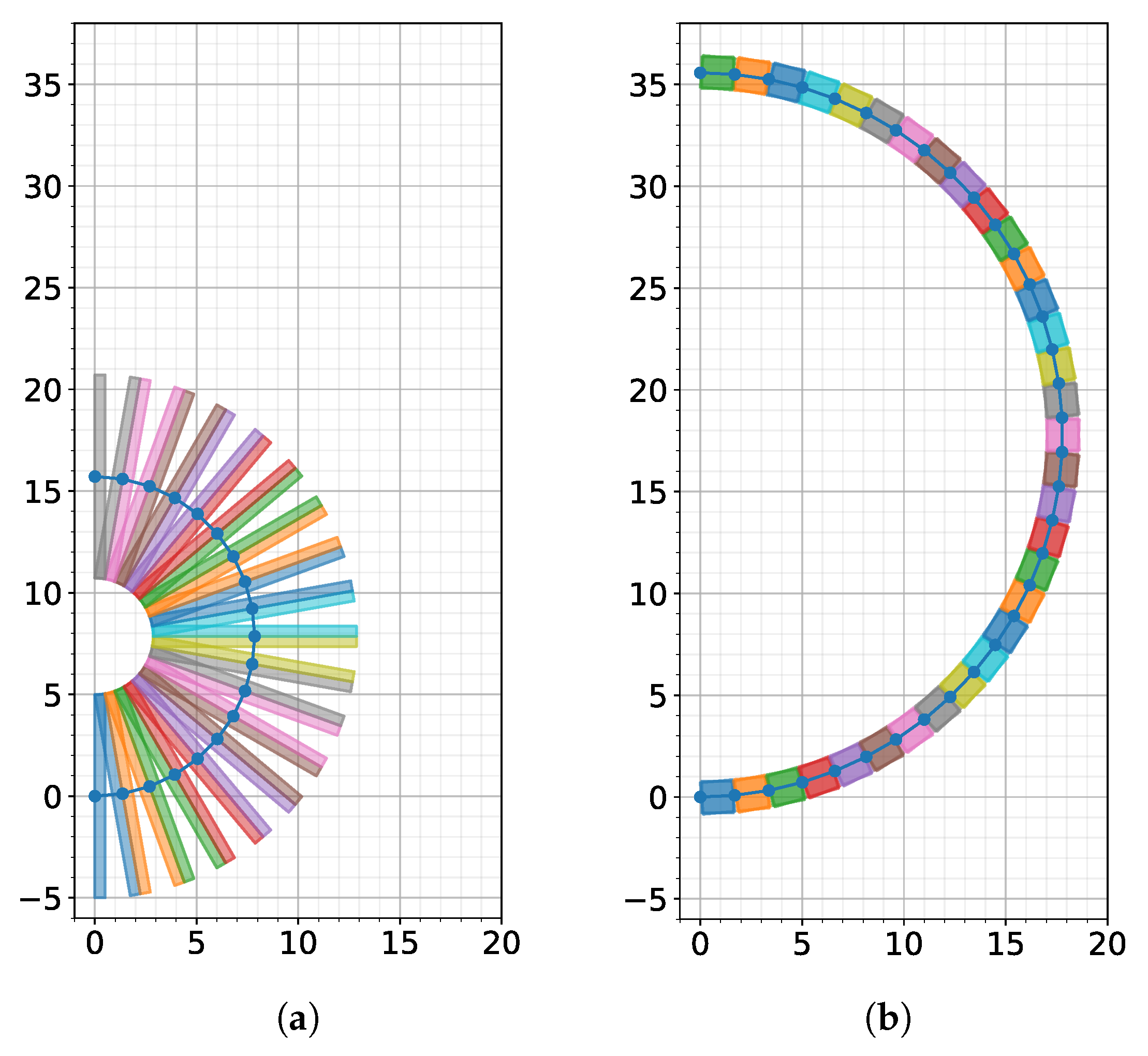
The following figures visually compare these two arrays in various ways. Figure 19 shows the undeflected arrays, giving an impression of the space consumed by each. Figure 20 shows the arrays deflected 180 degrees. Finally, Figure 21 shows each array with a 1 N upward force applied at its end to illustrate each type’s resistance to parasitic motion.
In this example, we can see that, when designed with the same effective torsional spring constant and range of motion, the C-LET array consumes less horizontal space, though more vertical space than the LET array when undeflected. When deflected 180 degrees, the C-LET array consumes less vertical space as well. Finally, we observe that when collapsed, the C-LET array resists parasitic motion better than the LET array does. Further research is required to determine to what extent these conclusions apply to C-LET arrays generally.

3. Discussion

This section addresses the initial assessment of the deflection model accuracy and demonstrates these C-LET arrays in use in a prototype deployable reflectarray design.

3.1. Model Accuracy and Utility

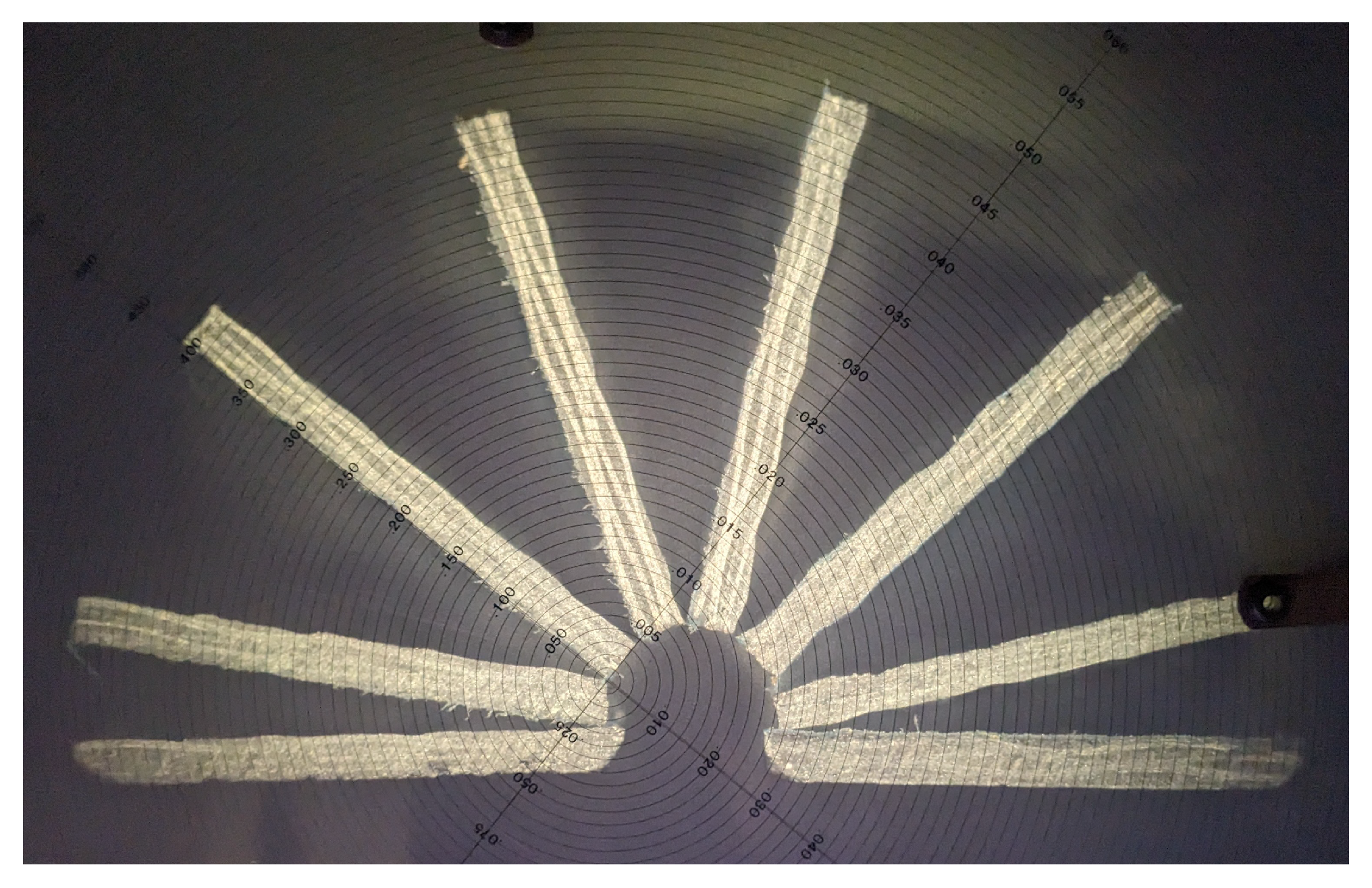
While full model validation has yet to be performed, initial steps to access the accuracy of the model are presented here. For this assessment, two outside 12s2p C-LET arrays were fabricated and fixtured in two different deflected states and placed in an optical comparator. Using surface mode, the positions of the vertices of each visible cross-section (seen in Figure 22) were measured and recorded. The vertex locations were used to determine the centroid position and rotation angle of each cross-section. This process was performed for each C-LET array, resulting in measurements gathered for two tests, A and B.
In parallel with these two tests, modeled C-LET arrays with the same nominal dimensions as the physical arrays were simulated, each with the same total deflection at the free end of the C-LET array as one of the tests, using the methods of Section 2.3.6. The centroid positions and rotation angles of each model cross-section were determined.
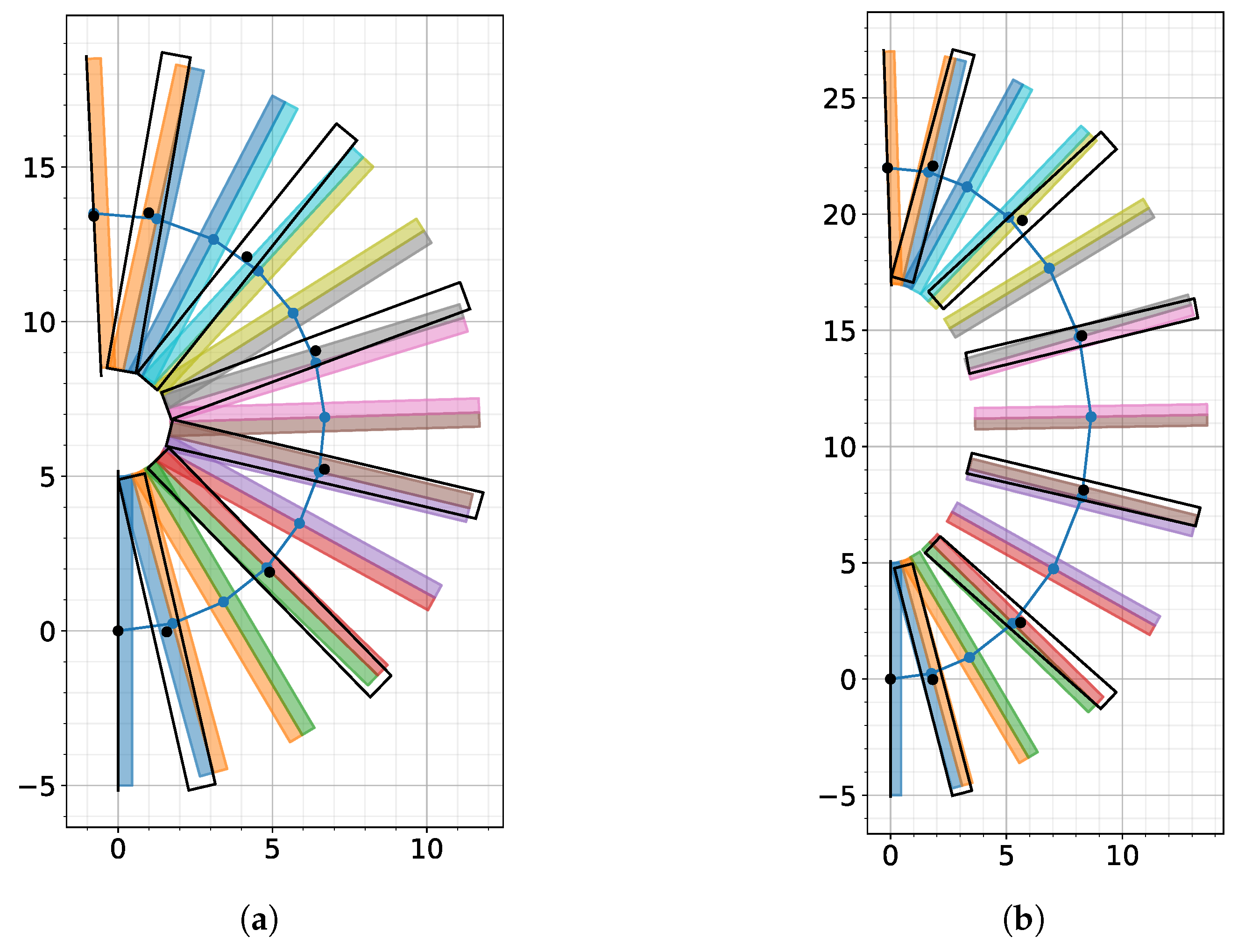
The measured and modeled deflections were compared to find the positional and angular differences between them. This comparison is shown visually in Figure 23. This figure shows the front and rear cross-sections of each torsion segment, as calculated using the C-LET array model (colored-in rectangles), but the optical comparator isn’t capable of taking measurements of internal geometry. As a result, the comparison of the measured deflection to the modeled deflection is done only for the cross-sections visible from the end of the C-LET array using the optical comparator, which is why the measured cross-sections (rectangles outlined in black) overlap only with every other cross-section in Figure 23. The results of this comparison are summarized in Table 2.
The model error calculated from these tests indicates that the model has predictive potential but requires additional testing using a wider range of deflections to strengthen model confidence. Additionally, since these tests were performed by setting the position of the free end of the C-LET array rather than applying a specific load, they cannot be used to confirm that the force/torque-deflection relationships implied by the model are accurate. We therefore recommend that further research be done to comprehensively validate the model.

3.1.1. Sources of Error

Here we explore some potential sources of the error seen in the deflection tests and acknowledge that it has not yet been experimentally determined to what degree these sources contribute to the measured error.
It can be seen in Figure 22 and Figure 23 that the torsion segments closest to the fixed and free faces of the C-LET array are deflecting about the local x-axis by a small amount, introducing error. One possible source of this error is the assumption made in the model that the torsion segments are perfectly stiff in bending about the x-axis (see Figure 12). While the second moment of area of the beam about this axis is indeed much larger than that about the y-axis, perhaps bending about this axis ought not to be neglected.
The C-LET array model also uses small-deflection equations, which assume linear force/torque-deflection relationships. A portion of the error observed could be a result of the large deflections seen in the torsion segments.
Another source of error may come from the inaccurate fixturing of the C-LET arrays in the optical comparator. Each C-LET array tested was fitted on its fixed and free faces with fixturing tabs that could be held in a vise. However, when the vise jaws were closed, any imperfect alignment of these tabs may have introduced forces along the z-axis and torques about the x-axis, which are not accounted for in the C-LET array model, which only accounts for forces in the x y -plane and torques about the z-axis.
Additionally, as can be seen in Figure 22, there are many irregularities in the cross-sections of the physical C-LET array which differ from the uniform, rectangular cross-sections of the model. The waviness observed in the torsion segment edges seems to arise from the weave pattern of the carbon fiber fabric used, and it is not known to what extent it changes the stiffness of the torsion segments.
The measurements of the C-LET arrays also indicated variations in the thickness of the torsion segments. The cross-sections visible from the optical comparator show the combined thickness of two adjacent torsion segments, so by dividing the measured thickness of these cross-sections in half, we get an estimate of the thicknesses of the torsion segments themselves. Across both C-LET arrays measured, the standard deviation in the thickness was 0.052 mm, or 5.71% relative to the mean thickness. This variation in thickness could result in considerable deflection error.
Lastly, since the model assumes that the C-LET arrays are made from an isotropic material, it is reasonable to attribute some of the error seen in the deflection tests to the orthotropic properties of the CFRP used to fabricate the C-LET arrays.

3.1.2. Model Utility

Not only does the model produce deflections qualitatively similar to those seen on physical C-LET arrays (see Figure 2), but it also results in reasonably low quantitative error. It proved useful for designing C-LET arrays for use on the deployable space structure covered in Section 3.2, where it was used to estimate the stresses expected in the C-LET arrays and to adjust the torsion segment dimensions and series numbers accordingly.

3.2. Applications

Origami-based mechanisms have enticing advantages when applied to robotics [35,36,37] and have been used in some medical robotics applications [38,39]. Origami-based mechanisms that are made from materials other than foldable membranes need joints to replace the creases in the origami pattern. The C-LET arrays described here are good candidates for those robotics applications.
They also have promising applications for deployable space structures. With the constant and rapid evolution of satellite technology, there is an ever-increasing need for satellite-mounted antennas. They are used for communication, remote sensing, weather forecasting, navigation, and other scientific research [40,41]. This has encouraged the proliferation of small satellites, which can be utilized in configured constellations [42,43,44,45]. To allow for many satellites to be put into orbit at the same time, it is often necessary for their antennas to stow compactly during launch and later deploy into a larger surface area [46]. Much research has been performed with the goal of enabling deployable space structures, such as flexible reflectors [47,48], deployable truss structures [49,50,51], hinged deployable antennas [52], extensible composite booms [53,54], and passively actuated radiators [55,56]. Often, these efforts utilize principles from origami [57,58,59,60], exploring various fold patterns [61,62,63], thickness accomodation methods [64,65,66], and optimization strategies [67].
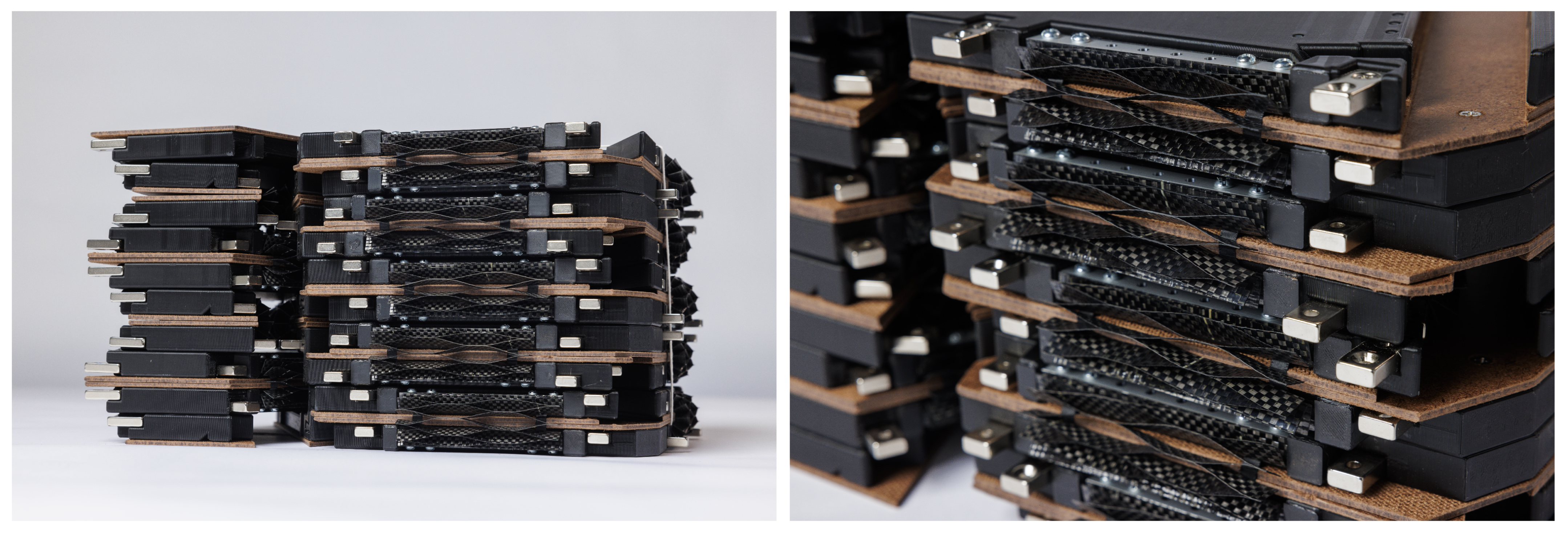
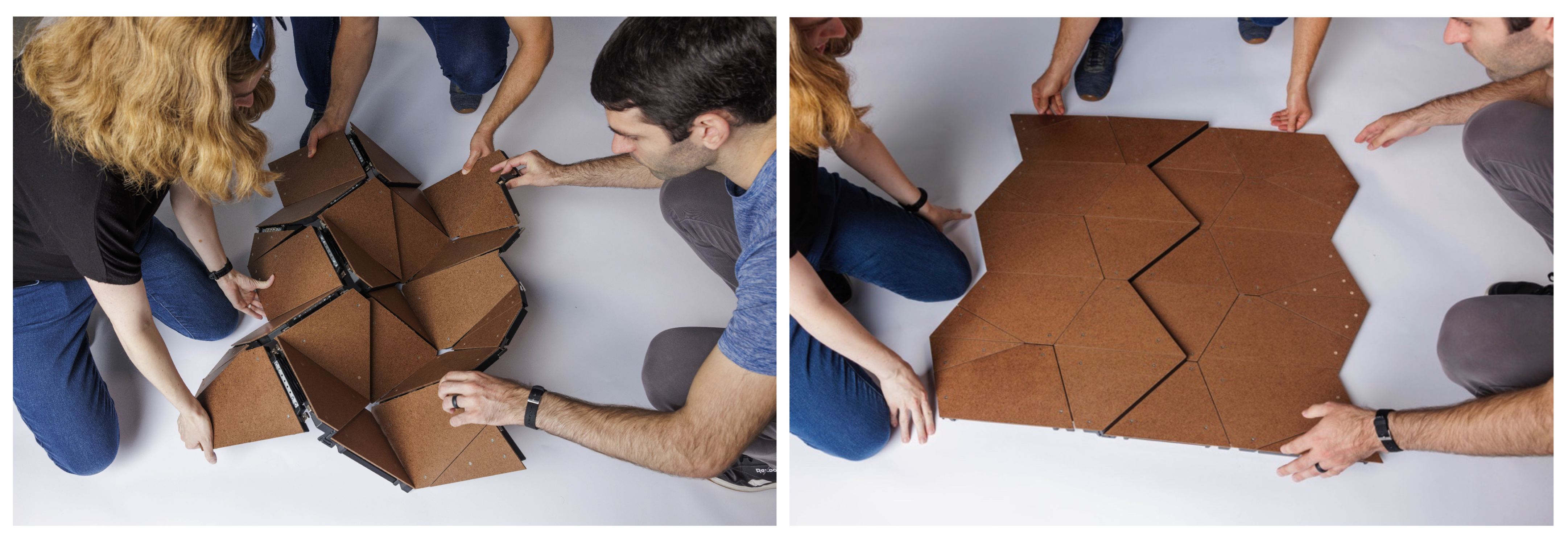
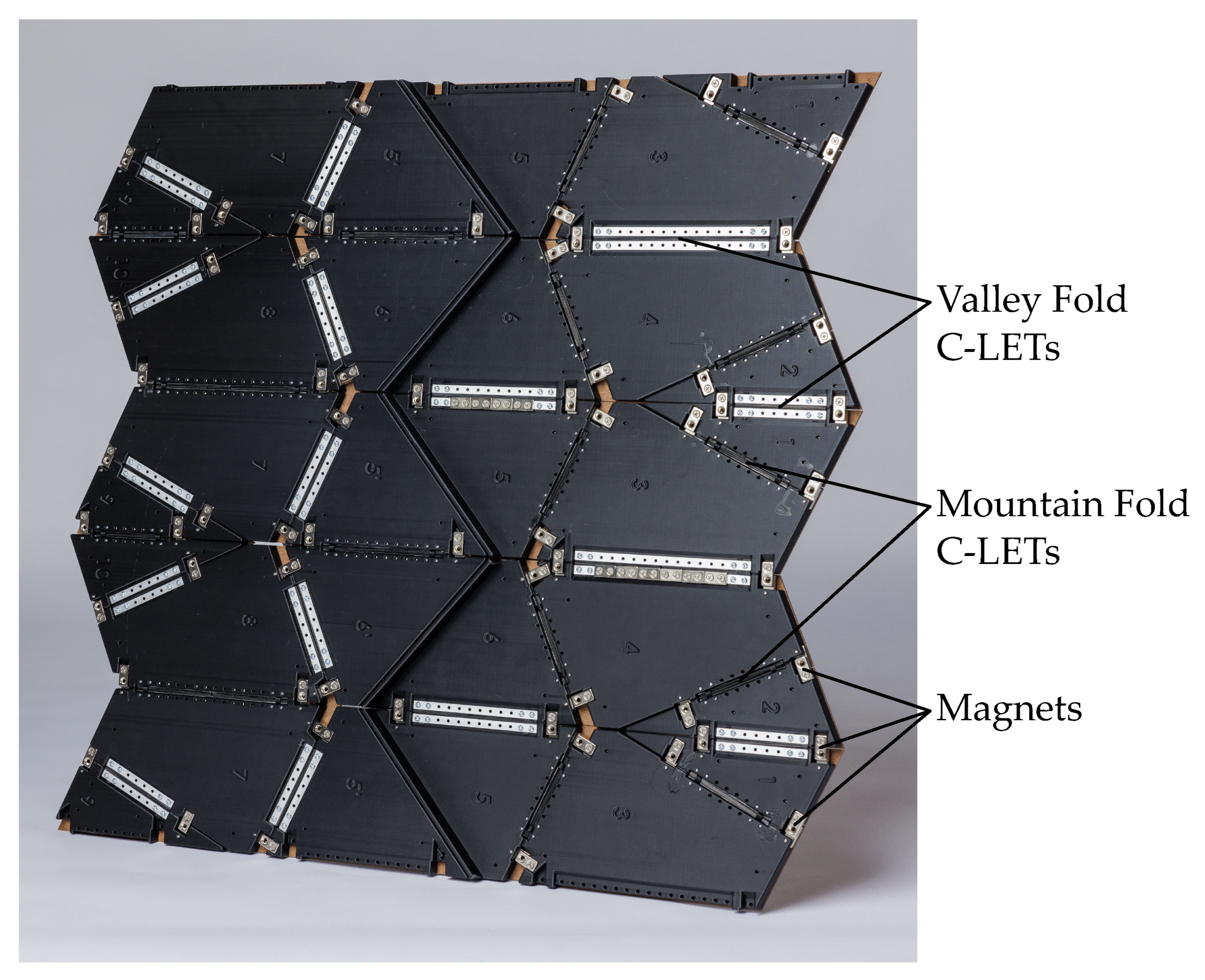
Carbon fiber C-LET arrays were implemented in a prototype Volume-Efficient Miura-Ori (VEMO) deployable reflectarray to demonstrate their utility in such an application [64]. This prototype had requirements of being self-deploying, self-stabilizing, and flat, with no metal exposed. The C-LET arrays act as surrogate folds and aid in the self-deployment process, together with strategically-placed permanent magnets. Figure 24, Figure 25 and Figure 26 show the reflectarray and the C-LET arrays in different stages (folded, partially deployed, and fully deployed).
For this prototype, each of the C-LET arrays was bonded to 90° angled aluminum flanges, which were then screwed to the adjoining edges of the panels of the reflectarray. Because the stowed configuration of the reflectarray involves the C-LET arrays being extended and strained in torsion, they act as springs that pull the panels back together into the reflectarray’s deployed or flat state, i.e., the minimum energy state for the C-LET arrays. Magnets were strategically placed to stabilize the reflectarray and ensure flatness, as shown in Figure 24.
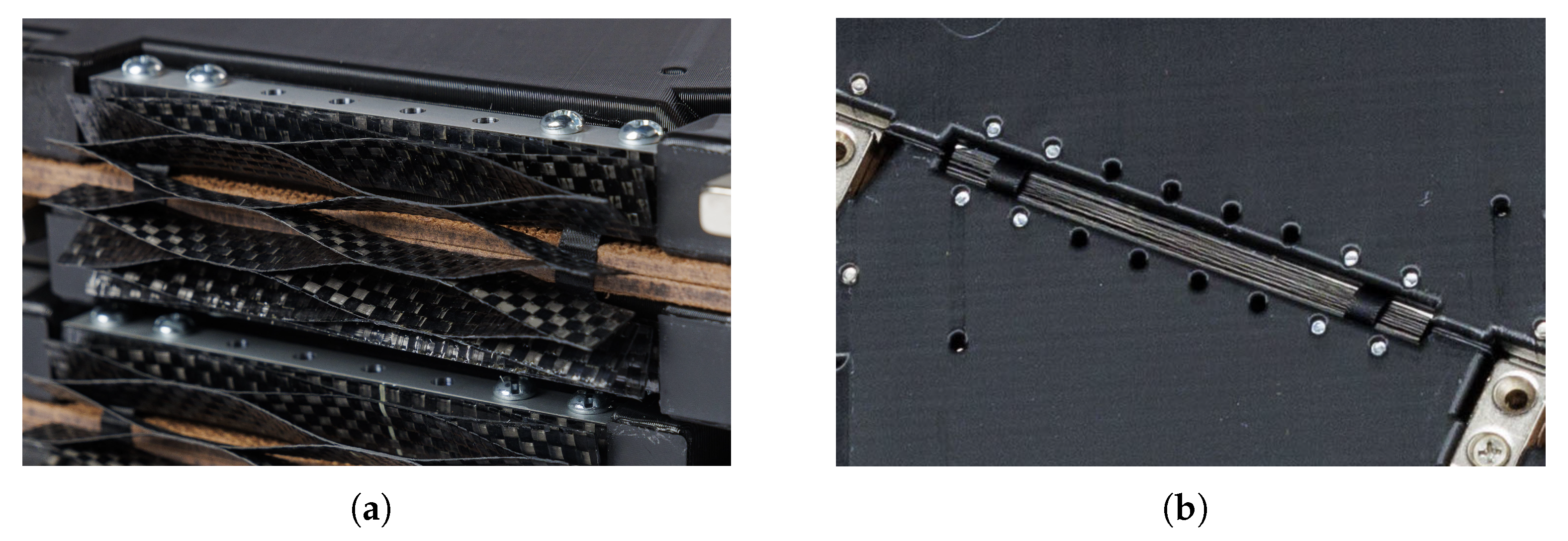
Due to the dynamic loads present during the deployment sequence, on their own, the C-LET arrays experience significant extension. To mitigate this, each C-LET array was fitted with a pair of thin nylon straps, as shown in Figure 27. These prevent the C-LET arrays from over-extending during deployment, while otherwise bearing negligible load.
In Figure 24, Figure 25 and Figure 26, the pressboard surface is a stand-in for the intended reflectarray patch surface. Figure 25 demonstrates how minimally the C-LET arrays affect the area of the reflectarray. Although there is metal (aluminum flanges, magnets) used to attach the C-LET arrays to the reflectarray prototype, no metal other than the heads of the screws securing the pressboard to the reflectarray structure is exposed on the top surface, because it can all be hidden behind the stand-in reflectarray patch surface.

4. Conclusions

This work introduced the C-LET array, which is beneficial for origami-based robotics and deployable space structures in that it consumes less area and exhibits reduced parasitic motion compared to conventional LET arrays.
We showed that due to their reduced thickness when compared to conventional LET arrays, C-LET arrays are more compact and have a smaller footprint. As a result, deployable space structures made using C-LET arrays rather than conventional LET arrays have more useful surface area available. Since higher gain is achieved with increased surface area [64], deployable reflectarrays utilizing C-LET arrays should out-perform those using conventional LET arrays.
C-LET arrays are also effective at reducing certain types of parasitic motion, such as out-of-plane shear, when fully collapsed (as demonstrated previously in Figure 21). It was observed that, as a result of this increased resistance to out-of-plane shear at low extensions, C-LET arrays exhibit a “self-centering” behavior, such that they tend to force their two outermost faces to come into alignment as they collapse.
One type of parasitic motion that C-LET arrays are less resistant to is extension, shown previously in Subfigure (b) of Figure 2 and Subfigure (a) of Figure 18. As a consequence, C-LET arrays are vulnerable to being over-extended. This can be mitigated by restraining the C-LET array with a strap (or similar) to limit the C-LET array’s range of motion. On the other hand, this high flexibility in extension allows C-LET arrays to be stretched around portions of the panels they join, as seen in Figure 28. If designed after this pattern, deployable space structures can be made with arbitrarily small gaps between panels, using the available area in the most effective manner.
With these advantages, C-LET arrays, once mature, stand to enable the design of higher-performance origami-based robotics and deployable space structures. Future research into C-LET array fabrication, modeling, and optimization is therefore encouraged.

Author Contributions

Conceptualization, L.Q.G., K.V., and S.P.M.; methodology, L.Q.G.; software, L.Q.G.; validation, L.Q.G.; formal analysis, L.Q.G.; investigation, L.Q.G.; resources, L.L.H. and S.P.M.; data curation, L.Q.G.; writing—original draft preparation, L.Q.G. and K.V.; writing—review and editing, L.Q.G., K.V., L.L.H., and S.P.M.; visualization, L.Q.G. and K.V.; supervision, S.P.M.; project administration, L.L.H. and S.P.M.; funding acquisition, L.L.H. and S.P.M. All authors have read and agreed to the published version of the manuscript.

Funding

This research was funded by the Utah NASA Space Grant Consortium and the Air Force Office of Scientific Research under grant FA9550-19-1-0290 through Florida International University.

Data Availability Statement

The original data and software code presented in the study are openly available on GitHub at https://github.com/BYUCMR/C-LET_simulation (accessed on 14 December 2025).

Acknowledgments

Thanks to Hunter Pruett, Fisk Lungreen, Collin Klomp, Lais Oliveira, Trevor Carter, Corinne Jackson, and Terri Bateman for their contributions.

Conflicts of Interest

The authors declare no conflicts of interest. The funders had no role in the design of the study; in the collection, analyses, or interpretation of data; in the writing of the manuscript; or in the decision to publish the results.

Abbreviations

The following abbreviations are used in this manuscript:
LETLamina emergent torsional (array)
C-LETCompact lamina emergent torsional (array)
VEMOVolume-efficient Miura-ori
#p# of torsion segments in parallel within the LET array
#s# of torsion segments in series within the LET array

References

  1. Pehrson, N.A.; Ames, D.C.; Smith, S.P.; Magleby, S.P.; Arya, M. Self-deployable, self-stiffening, and retractable origami-based arrays for spacecraft. AIAA J. 2020, 58, 3221–3228. [Google Scholar] [CrossRef]
  2. Rivera, A.; Stewart, A. Study of spacecraft deployables failures. In Proceedings of the 19th European Space Mechanisms and Tribology Symposium (ESMATS) 2021, Online, 20–24 September 2021. [Google Scholar]
  3. Hao, G.; Yu, J.; Li, H. A brief review on nonlinear modeling methods and applications of compliant mechanisms. Front. Mech. Eng. 2016, 11, 119–128. [Google Scholar] [CrossRef]
  4. Running, I.; Ramsdell, P.; Wright, C.; Howell, L.; Magleby, S. The surrogate fold catalog: A design tool for origami-inspired mechanical systems. In Proceedings of the 2024 6th International Conference on Reconfigurable Mechanisms and Robots (ReMAR), Chicago, IL, USA, 23–26 June 2024; IEEE: Piscataway, NJ, USA, 2024; pp. 113–120. [Google Scholar]
  5. Qiu, L.; Yu, Y.; Liu, Y. Design and analysis of lamina emergent joint (LEJ) based on origami technology and mortise-tenon structure. Mech. Mach. Theory 2021, 160, 104298. [Google Scholar] [CrossRef]
  6. Jacobsen, J.O.; Chen, G.; Howell, L.L.; Magleby, S.P. Lamina emergent torsional (LET) joint. Mech. Mach. Theory 2009, 44, 2098–2109. [Google Scholar] [CrossRef]
  7. Wilding, S.E.; Howell, L.L.; Magleby, S.P. Introduction of planar compliant joints designed for combined bending and axial loading conditions in lamina emergent mechanisms. Mech. Mach. Theory 2012, 56, 1–15. [Google Scholar] [CrossRef]
  8. Lee, M.; Tachi, T. Design and Evaluation of Compliant Hinges For Deployable Thick Origami Structures. J. Int. Assoc. Shell Spat. Struct. 2024, 65, 238–247. [Google Scholar] [CrossRef]
  9. Nichols, M.W.; Gonzalez, A.; Alwan, E.A.; Volakis, J.L. An accordion-folding series-fed patch array with finite thickness: A folding technique for CubeSat arrays. IEEE Antennas Propag. Mag. 2023, 65, 77–82. [Google Scholar] [CrossRef]
  10. Qiu, L.; Yin, S.; Xie, Z. Failure analysis and performance comparison of Triple-LET and LET flexure hinges. Eng. Fail. Anal. 2016, 66, 35–43. [Google Scholar] [CrossRef]
  11. Alfattani, R.; Lusk, C. A lamina-emergent frustum using a bistable collapsible compliant mechanism. J. Mech. Des. 2018, 140, 125001. [Google Scholar] [CrossRef]
  12. Bai, R.; Chen, G. Modeling large spatial deflections of slender beams of rectangular cross sections in compliant mechanisms. J. Mech. Robot. 2021, 13, 011021. [Google Scholar] [CrossRef]
  13. Jacobsen, J.O.; Winder, B.G.; Howell, L.L.; Magleby, S.P. Lamina emergent mechanisms and their basic elements. ASME J. Mech. Robot. 2010, 2, 011003. [Google Scholar] [CrossRef]
  14. Pehrson, N.A.; Bilancia, P.; Magleby, S.; Howell, L. Load–displacement characterization in three degrees-of-freedom for general lamina emergent torsion arrays. J. Mech. Des. 2020, 142, 093301. [Google Scholar] [CrossRef]
  15. Islam, M.R.; Carvalho, M.; Venkatakrishnan, S.B.; Volakis, J.L. Packable and readily deployable tightly coupled dipole array (TCDA) with integrated planar balun. IEEE Open J. Antennas Propag. 2022, 3, 1206–1217. [Google Scholar] [CrossRef]
  16. Hwang, M.; Kim, G.; Kim, S.; Jeong, N.S. Origami-inspired radiation pattern and shape reconfigurable dipole array antenna at C-band for CubeSat applications. IEEE Trans. Antennas Propag. 2020, 69, 2697–2705. [Google Scholar] [CrossRef]
  17. Ma, B.; Qiu, L.; Liu, B.; Yu, Y.; Liu, N.; Chen, G. Design and Performance Analysis of Lamina Emergent Torsional Joints Based on Double-Laminated Material Structure. Appl. Sci. 2022, 12, 2642. [Google Scholar] [CrossRef]
  18. Seymour, K.; Bilancia, P.; Magleby, S.; Howell, L. Hinges and curved lamina emergent torsional joints in cylindrical developable mechanisms. J. Mech. Robot. 2021, 13, 031002. [Google Scholar] [CrossRef]
  19. Xie, Z.; Qiu, L.; Yang, D. Design and analysis of outside-deployed lamina emergent joint (OD-LEJ). Mech. Mach. Theory 2017, 114, 111–124. [Google Scholar] [CrossRef]
  20. Chen, G.; Ma, F.; Hao, G.; Zhu, W. Modeling large deflections of initially curved beams in compliant mechanisms using chained beam constraint model. J. Mech. Robot. 2019, 11, 011002. [Google Scholar] [CrossRef]
  21. Trease, B.P.; Moon, Y.M.; Kota, S. Design of large-displacement compliant joints. J. Mech. Des. 2005, 127, 788–798. [Google Scholar] [CrossRef]
  22. Zhang, H.; Zhang, X.; Zhu, B. A novel flexural lamina emergent spatial joint. Mech. Mach. Theory 2019, 142, 103582. [Google Scholar] [CrossRef]
  23. Huang, X. Fabrication and properties of carbon fibers. Materials 2009, 2, 2369–2403. [Google Scholar] [CrossRef]
  24. Newcomb, B.A. Processing, structure, and properties of carbon fibers. Compos. Part A Appl. Sci. Manuf. 2016, 91, 262–282. [Google Scholar] [CrossRef]
  25. Ho, Y.C.; Sasayama, H.; Yanagimoto, J. Mechanical properties and drawing process of multilayer carbon-fiber-reinforced plastic sheets with various prepreg thicknesses. Adv. Mech. Eng. 2017, 9, 1687814017692695. [Google Scholar] [CrossRef]
  26. Yee, J.; Pellegrino, S. Composite tube hinges. J. Aerosp. Eng. 2005, 18, 224–231. [Google Scholar] [CrossRef]
  27. Soykasap, Ö. Deployment analysis of a self-deployable composite boom. Compos. Struct. 2009, 89, 374–381. [Google Scholar] [CrossRef]
  28. Piovesan, D.; Zaccariotto, M.; Bettanini, C.; Pertile, M.; Debei, S. Design and validation of a carbon-fiber collapsible hinge for space applications: A deployable boom. J. Mech. Robot. 2016, 8, 031007. [Google Scholar] [CrossRef]
  29. Murphey, T.W.; Francis, W.; Davis, B.; Mejia-Ariza, J.M. High strain composites. In Proceedings of the 2nd AIAA Spacecraft Structures Conference, Kissimmee, FL, USA, 5–9 January 2015; p. 0942. [Google Scholar]
  30. Herbeck, L.; Leipold, M.; Sickinger, C.; Eiden, M.; Unckenbold, W. Development and test of deployable ultra-lightweight cfrp-booms for a solar sail. In Proceedings of the Spacecraft Structures, Materials and Mechanical Testing, Noordwijk, The Netherlands, 29 November–1 December 2001; Volume 468, p. 107. [Google Scholar]
  31. Block, J.; Straubel, M.; Wiedemann, M. Ultralight deployable booms for solar sails and other large gossamer structures in space. Acta Astronaut. 2011, 68, 984–992. [Google Scholar] [CrossRef]
  32. De Zanet, G.; Viquerat, A.; Aglietti, G. Predicted thermal response of a deployable high-strain composite telescope in low-Earth orbit. Acta Astronaut. 2023, 205, 127–143. [Google Scholar] [CrossRef]
  33. Pruett, H.; Magleby, S. Magnetically-Stabilized LET Joints for Origami-Based Space Arrays. In Proceedings of the 2023 Utah NASA Space Grant Consortium, Ogden, UT, USA, 8 May 2023. [Google Scholar]
  34. Boresi, A.; Schmidt, R. Advanced Mechanics of Materials, 6th ed.; John Wiley & Sons: Hoboken, NJ, USA, 2003; pp. 224–225. [Google Scholar]
  35. Rus, D.; Tolley, M.T. Design, fabrication and control of origami robots. Nat. Rev. Mater. 2018, 3, 101–112. [Google Scholar] [CrossRef]
  36. Choi, H.; Park, T.; Hwang, G.; Ko, Y.; Lee, D.; Lee, T.; Park, J.O.; Bang, D. Fabrication of origami soft gripper using on-fabric 3D printing. Robotics 2023, 12, 150. [Google Scholar] [CrossRef]
  37. Sivaperuman Kalairaj, M.; Cai, C.J.; S, P.; Ren, H. Untethered origami worm robot with diverse multi-leg attachments and responsive motions under magnetic actuation. Robotics 2021, 10, 118. [Google Scholar] [CrossRef]
  38. Sargent, B.; Butler, J.; Seymour, K.; Bailey, D.; Jensen, B.; Magleby, S.; Howell, L. An origami-based medical support system to mitigate flexible shaft buckling. J. Mech. Robot. 2020, 12, 041005. [Google Scholar] [CrossRef]
  39. Kim, T.H.; Vanloo, J.; Kim, W.S. 3D origami sensing robots for cooperative healthcare monitoring. Adv. Mater. Technol. 2021, 6, 2000938. [Google Scholar] [PubMed]
  40. Maini, A.K.; Agrawal, V. Satellite Technology: Principles and Applications; John Wiley & Sons: Hoboken, NJ, USA, 2011. [Google Scholar]
  41. Chetty, P. Satellite Technology and Its Applications; Notion Press: Chennai, India, 2023. [Google Scholar]
  42. Kopacz, J.R.; Herschitz, R.; Roney, J. Small satellites an overview and assessment. Acta Astronaut. 2020, 170, 93–105. [Google Scholar] [CrossRef]
  43. Curzi, G.; Modenini, D.; Tortora, P. Large constellations of small satellites: A survey of near future challenges and missions. Aerospace 2020, 7, 133. [Google Scholar] [CrossRef]
  44. Crisp, N.H.; Smith, K.; Hollingsworth, P. Launch and deployment of distributed small satellite systems. Acta Astronaut. 2015, 114, 65–78. [Google Scholar] [CrossRef]
  45. Radhakrishnan, R.; Edmonson, W.W.; Afghah, F.; Rodriguez-Osorio, R.M.; Pinto, F.; Burleigh, S.C. Survey of inter-satellite communication for small satellite systems: Physical layer to network layer view. IEEE Commun. Surv. Tutor. 2016, 18, 2442–2473. [Google Scholar] [CrossRef]
  46. Sauder, J.; Gebara, C.; Reddy, N.H.; García-Mora, C.J. A framework for small satellite deployable structures and how to deploy them reliably. Commun. Eng. 2024, 3, 72. [Google Scholar] [CrossRef]
  47. Kang, D.S.; Keum, D.H.; Choi, J.H.; Lee, M.H.; Park, K.; Jung, H.Y.; Kang, D.S.; Yun, J.H.; Lee, J.W.; Roh, J.H. Flexible Surface Reflector Antenna for Small Satellites. Aerospace 2025, 12, 414. [Google Scholar] [CrossRef]
  48. Arya, M.; Hodges, R.; Sauder, J.F.; Horst, S.; Mobrem, M.; Pedivellano, A.; Wen, A.; Truong, A.; Pellegrino, S. Lightweight composite reflectarray that can be flattened, folded, and coiled for compact stowage. In Proceedings of the AIAA Scitech 2022 Forum, San Diego, CA, USA, 3–7 January 2022; p. 1886. [Google Scholar]
  49. Cammarata, A.; Sinatra, R.; Rigato, R.; Maddio, P.D. Tie-system calibration for the experimental setup of large deployable reflectors. Machines 2019, 7, 23. [Google Scholar] [CrossRef]
  50. Cammarata, A.; Sinatra, R.; Rigano, A.; Lombardo, M.; Maddio, P.D. Design of a large deployable reflector opening system. Machines 2020, 8, 7. [Google Scholar] [CrossRef]
  51. Cao, W.a.; Cheng, P. Design and kinematic analysis of a novel deployable antenna mechanism for synthetic aperture radar satellites. J. Mech. Des. 2022, 144, 114502. [Google Scholar] [CrossRef]
  52. Islam, M.T.; Cho, M.; Samsuzzaman, M.; Kibria, S. Compact antenna for small satellite applications [Antenna Applications Corner]. IEEE Antennas Propag. Mag. 2015, 57, 30–36. [Google Scholar] [CrossRef]
  53. Ma, X.; An, N.; Cong, Q.; Bai, J.B.; Wu, M.; Xu, Y.; Zhou, J.; Zhang, D.; Zhang, T.; Guo, R.; et al. Design, modeling, and manufacturing of high strain composites for space deployable structures. Commun. Eng. 2024, 3, 78. [Google Scholar] [CrossRef]
  54. Tresoldi, A.; Shore, J.; Austin, A.C.; Aglietti, G.S. Development of a deployable Synthetic Aperture Radar antenna for a nanosatellite conceptual design. Acta Astronaut. 2023, 210, 488–497. [Google Scholar] [CrossRef]
  55. Cannon, J.R.; Mulford, R.B.; Iverson, B.D. Triangular fin array passively actuated by bimetallic coils for CubeSat thermal control. Appl. Therm. Eng. 2024, 240, 122239. [Google Scholar] [CrossRef]
  56. Cannon, J.R.; Havey, K.N.; Housley, N.S.; Mulford, R.B.; Iverson, B.D. Internally stowed, radially deployed radiator panels for passive CubeSat thermal control. Appl. Therm. Eng. 2025, 270, 126281. [Google Scholar] [CrossRef]
  57. Russo, A.; Barakali, B.; Kitsu, K.I.; Baudet, L.; Yang, J.; Zhong, Y. Origami-inspired self-deployable reflectarray antenna. Acta Astronaut. 2023, 213, 240–251. [Google Scholar] [CrossRef]
  58. Kaddour, A.S.; Zekios, C.L.; Georgakapoulos, S.V. A reconfigurable origami reflectarray. In Proceedings of the 2020 14th European Conference on Antennas and Propagation (EuCAP), Copenhagen, Denmark, 15–20 March 2020; IEEE: Piscataway, NJ, USA, 2020; pp. 1–4. [Google Scholar]
  59. Deleo, A.A.; O’Neil, J.; Yasuda, H.; Salviato, M.; Yang, J. Origami-based deployable structures made of carbon fiber reinforced polymer composites. Compos. Sci. Technol. 2020, 191, 108060. [Google Scholar] [CrossRef]
  60. Williams, D.E.; Dorn, C.; Pellegrino, S.; Hajimiri, A. Origami-inspired shape-changing phased array. In Proceedings of the 2020 50th European Microwave Conference (EuMC), Utrecht, The Netherlands, 12–14 January 2021; IEEE: Piscataway, NJ, USA, 2021; pp. 344–347. [Google Scholar]
  61. Wang, Y.; Zhao, Y.; Han, B.; Dong, J.; Han, M.; Yao, J. Biomimetic Origami: Planar Single-Vertex Multi-Crease Mechanism Design and Optimization. Machines 2025, 13, 240. [Google Scholar] [CrossRef]
  62. Gu, Y.; Hao, L.; Zhao, J.; Xing, W.; Ke, S.; Yu, Y.; Zhang, T.; Zhang, C. A Review of Geometric Modeling Design and Deployment Mechanism of Flasher-Based Origami. J. Mech. Des. 2025, 147, 090801. [Google Scholar] [CrossRef]
  63. Xing, D.; You, Z. Origami Claw Tessellation and Its Stacked Structure. J. Mech. Robot. 2024, 16, 011001. [Google Scholar] [CrossRef]
  64. Pruett, H.T.; Kaddour, A.S.; Georgakopoulos, S.V.; Howell, L.L.; Magleby, S.P. Optimizing geometry for EM performance to design volume-efficient Miura-ori for reflectarray antennas. Extrem. Mech. Lett. 2022, 56, 101889. [Google Scholar] [CrossRef]
  65. Yang, J.; You, Z. Folding Miura-Ori of Uniform Thickness With One Degree-of-Freedom. J. Mech. Robot. 2024, 16, 111004. [Google Scholar] [CrossRef]
  66. Jia, G.; Li, B.; Dai, J.S. Oriblock: The origami-blocks based on hinged dissection. Mech. Mach. Theory 2024, 203, 105826. [Google Scholar] [CrossRef]
  67. Fuchi, K.; Buskohl, P.R.; Bazzan, G.; Durstock, M.F.; Reich, G.W.; Vaia, R.A.; Joo, J.J. Origami actuator design and networking through crease topology optimization. J. Mech. Des. 2015, 137, 091401. [Google Scholar] [CrossRef]
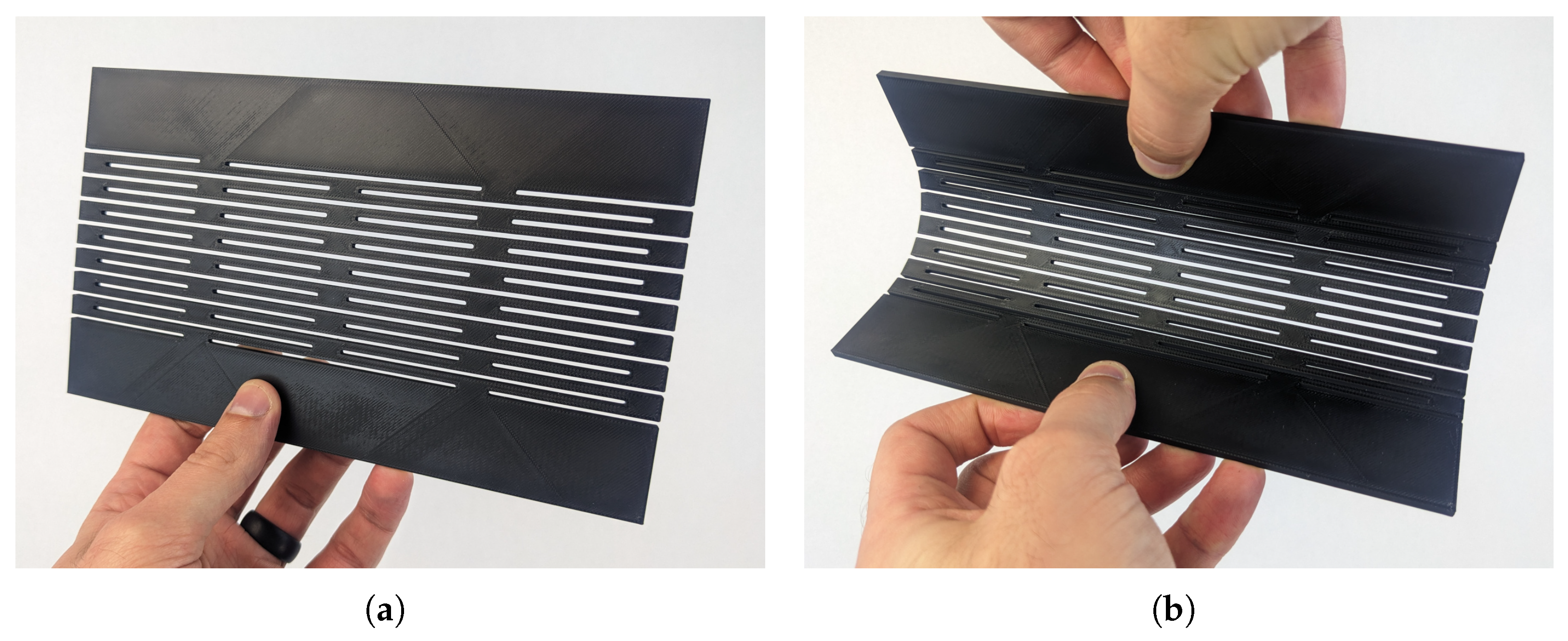
Figure 1. An example LET array in the (a) flat state and (b) flexed state.
Robotics 15 00001 g001
Figure 2. A carbon fiber-reinforced polymer 12s2po C-LET array mounted to plastic flanges, shown in various deflected states. (a) No deflection. (b) Extension. (c) Torsion. (d) Extension and torsion.
Robotics 15 00001 g002
Figure 3. LET arrays with various series and parallel numbers. Torsion segments highlighted in green (fixed-guided) and blue (fixed-clamped).
Robotics 15 00001 g003
Figure 4. Cross-sections of the fabrication process of a C-LET array. (Above) Plies of carbon fiber prepreg (black) layered with release film (blue). (Middle) During curing, areas not separated by release film bond together (yellow). (Below) Finished C-LET array with release film removed.
Robotics 15 00001 g004
Figure 5. Four step process of laying up the C-LET array laminate for producing 2p C-LET arrays, with the materials added in each step outlined in green. Steps (a) through (d) are repeated until the desired series number is achieved. (a) First pieces of release film placed on the bottom group of prepreg plies. (b) Next group of prepreg plies layered onto the C-LET array laminate. (c) More release film layered onto the C-LET array laminate, offset from the previous pieces. (d) Another group of prepreg plies added to the C-LET array laminate.
Robotics 15 00001 g005
Figure 6. The two-sided mold used for this research, consisting of two steel plates which are clamped together with bolts around their perimeter. The smoothened inside surfaces have been treated with a mold release agent. Mold shown (a) open, and (b) closed and clamped with bolts.
Robotics 15 00001 g006
Figure 7. A schematic of a cured C-LET array laminate with one C-LET array already cut from it. The green area indicates where another cut could be made to create two more C-LET arrays.
Robotics 15 00001 g007
Figure 8. A C-LET array laminate shown during the process of cutting C-LET arrays from it using a composites table saw. (a) C-LET array laminate shown mid-cut. (b) C-LET array laminate alongside three C-LET arrays cut from it.
Robotics 15 00001 g008
Figure 9. C-LET array torsion segment shown within an 8s2po C-LET array, with front and rear cross-sections of the torsion segment highlighted in blue and yellow, respectively. Note that the structure of the C-LET array extends past the cross-sections of the torsion segment. These bonding segments connect adjacent torsion segments but do not themselves experience any deformation.
Robotics 15 00001 g009
Figure 10. Schematic of a torsion segment shown with separate bending and torsional loads and with both loads combined. The undeflected neutral axes are shown with dotted lines, and the arrows indicate the displacement of the end of the beam. The blue and yellow rectangles represent the front and rear cross-sections, respectively.
Robotics 15 00001 g010
Figure 11. C-LET array torsion segment (deflected) as seen looking down its length. The blue and yellow rectangles represent the front and rear cross-sections, respectively. The torsion segment has thickness 2 b , height 2 h , and length L. As it is extended and/or twisted, it experiences translational deflection δ (measured at the centroid of the cross-section) and torsional deflection γ .
Robotics 15 00001 g011
Figure 12. An undeflected torsion segment shown with the x, y, and z axes labeled. The blue and yellow rectangles represent the front and rear cross-sections, respectively.
Robotics 15 00001 g012
Figure 13. Diagram showing relationship between δ min and γ . The blue and yellow rectangles represent the front and rear cross-sections, respectively.
Robotics 15 00001 g013
Figure 14. Diagram depicting the torsion segment model of the no-interference case. Model features both a linear and torsional spring. The torsional spring is represented as two springs solely to visually convey that each torsion segment cross-section rotates relative to the linear spring by the same amount. The blue and yellow rectangles represent the front and rear cross-sections, respectively.
Robotics 15 00001 g014
Figure 15. The diagram of Figure 14 with the cross-sections isolated to reveal the force components and torque produced by the modeled springs (indicated by an s subscript). The blue and yellow rectangles represent the front and rear cross-sections, respectively.
Robotics 15 00001 g015
Figure 16. Diagram depicting the torsion segment model accounting for interference at its edges with series-adjacent torsion segments. Torsion segment modeled again with both linear and torsional spring elements. The blue and yellow rectangles represent the front and rear cross-sections, respectively.
Robotics 15 00001 g016
Figure 17. The torsion segment model of Figure 16 with the top and bottom cross-sections separated to reveal the spring force components and torque, and the contact force components caused by the interference ( P x and P y ). The blue and yellow rectangles represent the front and rear cross-sections, respectively.
Robotics 15 00001 g017
Figure 18. Simulation output of a 12s2po C-LET array with various loads. Each pair of like-colored rectangles represents the front and rear cross-sections of the same torsion segment. Horizontal and vertical axis labels in millimeters. Arrows indicate the direction of the applied force or torque. (a) 0.8 N horizontal applied force. (b) 0.8 N vertical applied force. (c) 0.216 N-m clockwise applied torque. (d) 1.5 N vertical applied force and 0.217 N-m clockwise applied torque.
Robotics 15 00001 g018
Figure 19. (a) C-LET and (b) LET arrays shown with no external load applied. Each pair of like-colored rectangles represents the front and rear cross-sections of the same torsion segment. The arrays consume 9.00 and 55.92 mm of horizontal space, respectively. Horizontal and vertical axis labels in millimeters.
Robotics 15 00001 g019
Figure 20. (a) C-LET and (b) LET arrays shown with applied torques of 0.158 and 0.156 N-m. Each pair of like-colored rectangles represents the front and rear cross-sections of the same torsion segment. In this configuration, they consume 25.72 and 37.13 mm of vertical space, respectively. Horizontal and vertical axis labels in millimeters.
Robotics 15 00001 g020
Figure 21. (a) C-LET and (b) LET arrays shown with 1 N upward force. Each pair of like-colored rectangles represents the front and rear cross-sections of the same torsion segment. Applied loads result in vertical deflections of 0.60 and 18.80 mm, respectively. Horizontal and vertical axis labels in millimeters.
Robotics 15 00001 g021
Figure 22. View port of the optical comparator showing the cross-sections at the end of a deflected C-LET array.
Robotics 15 00001 g022
Figure 23. Measured deflection (solid black) overlaid onto the modeled deflection for each test. Each pair of like-colored rectangles represents the front and rear cross-sections of the same torsion segment. Horizontal and vertical axis labels in millimeters. (a) Test A with the C-LET array in torsion. (b) Test B with the C-LET array in both torsion and extension.
Robotics 15 00001 g023
Figure 24. Views of the many carbon fiber C-LET arrays in the folded state, implemented in the reflectarray.
Robotics 15 00001 g024
Figure 25. The reflectarray being deployed by the authors. Note that the array is capable of deploying rapidly on its own due to the potential energy stored by the C-LET arrays, but it was deployed slowly by hand to capture these photographs.
Robotics 15 00001 g025
Figure 26. The back of the reflectarray with the C-LET arrays and magnets visible. Note that the aluminum flanges bonded to the C-LET arrays are not visible on all of the fold lines, as they are secured to opposite sides of the reflectarray for valley and mountain folds.
Robotics 15 00001 g026
Figure 27. Close up views of the nylon straps preventing the C-LET arrays from being over-extended during deployment. (a) Straps for a valley fold C-LET array in the stowed configuration. (b) Straps for a mountain fold C-LET array in the deployed configuration.
Robotics 15 00001 g027
Figure 28. C-LET array shown joining two panels of a deployable space structure. (a) Stowed configuration with C-LET array extended. (b) Deployed configuration with C-LET array collapsed.
Robotics 15 00001 g028
Table 1. Parameters chosen for comparison of C-LET and LET arrays. Driven parameters shown in bold.
C-LET ArrayLET Array
E (GPa)200200
G (GPa)8080
S y (MPa)350350
L (mm)4040
γ target (deg)180180
h (mm)5.000.78
b (mm)0.250.78
w (mm)0.000.14
N1833
Table 2. Root-mean-square positional ( ϵ x y ) and angular ( ϵ θ ) error between the physical and modeled C-LET arrays from tests A and B. The positional error is also given in a non-dimensionalized form ϵ x y / 2 h . The torsion segments of this array had length L = 50 mm, width 2 h = 10 mm, and thickness 2 b = 0.46 mm.
RMS Positional ErrorRMS Angular ErrorRMS Positional Error
(mm)(deg)(Dimensionless)
Test A0.3602.6700.036
Test B0.3602.2770.036
Disclaimer/Publisher’s Note: The statements, opinions and data contained in all publications are solely those of the individual author(s) and contributor(s) and not of MDPI and/or the editor(s). MDPI and/or the editor(s) disclaim responsibility for any injury to people or property resulting from any ideas, methods, instructions or products referred to in the content.