Previous Article in Journal
HGTA: A Hexagonal Grid-Based Task Allocation Method for Multi-Robot Coverage in Known 2D Environments
error_outline You can access the new MDPI.com website here. Explore and share your feedback with us.
 
 
Article

Kinematic Analysis and Workspace Evaluation of a New Five-Axis 3D Printer Based on Hybrid Technologies


by
Azamat Mustafa
1,
Rustem Kaiyrov
2,†,
Yerik Nugman
1,*,
Mukhagali Sagyntay
1,†,
Nurtay Albanbay
3,
Algazy Zhauyt
4,
Zharkynbek Turgunov
1,
Ilyas Dyussebayev
1 and
Yang Lei
1
1
Department of Mechanical Engineering, Satbayev University, Almaty 050000, Kazakhstan
2
Laboratory of Applied Mechanics and Robotics, Karaganda Buketov University, Karaganda 100001, Kazakhstan
3
Department of Cybersecurity, Information Processing and Storage, Satbayev University, Almaty 050000, Kazakhstan
4
Department of Aerospace and Electronic Engineering, Almaty University of Power Engineering and Telecommunications, Almaty 050013, Kazakhstan
*
Author to whom correspondence should be addressed.
These authors contributed equally to this work.
Robotics 2026, 15(1), 16; https://doi.org/10.3390/robotics15010016
Submission received: 29 November 2025 / Revised: 31 December 2025 / Accepted: 4 January 2026 / Published: 7 January 2026
(This article belongs to the Section Industrial Robots and Automation)

Abstract

Additive manufacturing technologies for metals are developing rapidly. Among them, wire arc additive manufacturing (WAAM) has become widespread due to its accessibility. However, parts produced using WAAM require surface post-processing; therefore, hybrid technologies have emerged that combine additive and subtractive processes within a single compact manufacturing complex. Such systems make it possible to organize single-piece and small-batch production, including for the repair and restoration of equipment in remote areas. For this purpose, hybrid equipment must be lightweight, compact for transportation, provide sufficient workspace, and be capable of folding for transport. This paper proposes the concept of a multifunctional metal 3D printer based on hybrid technology, where WAAM is used for printing, and mechanical post-processing is applied to obtain finished parts. To ensure both rigidity and low mass, a 3-UPU parallel manipulator and a worktable with two rotational degrees of freedom are employed, enabling five-axis printing and machining. The printer housing is foldable for convenient transportation. The kinematics of the proposed 3D printer are investigated as an integrated system. Forward and inverse kinematics problems are solved, the velocities and accelerations of the moving platform center are calculated, singular configurations are analyzed, and the workspace of the printer is determined.

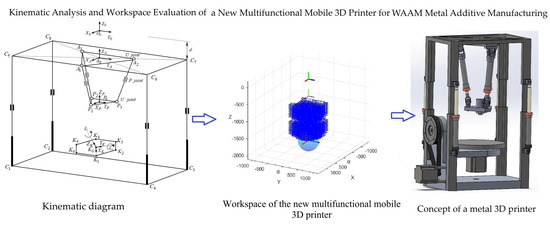
Graphical Abstract

1. Introduction

In recent decades, three-dimensional printing technology has developed rapidly and has become an integral part of modern manufacturing and scientific research. This development has led to numerous new methods and devices that expand the capabilities of 3D printing. One of the newest and most promising technologies is Metal Additive Manufacturing. This approach enables the production of medium- and large-scale metallic components with complex geometry for various industries, including aerospace, mechanical engineering, shipbuilding, and defense [1].
There are many types of Metal Additive Manufacturing, but according to the types of materials used, they can be broadly divided into two main types: powder-based 3D printing [2] and wire-based 3D printing [3]. Metal powder for 3D printing is a relatively expensive material [4]. Wire-based 3D printing can use standard and commercially available welding wires of various types and diameters as a material, which makes it an accessible and low-cost material for 3D printing [5]. In wire-based 3D printing, the most widespread is wire arc additive manufacturing (hereinafter referred to as WAAM) technology [6,7]. Compared to traditional manufacturing methods, WAAM can reduce production time by 40–60%, depending on the size of the component [8].
The WAAM technology provides a high material deposition rate suitable for large-scale components but has limitations, including low accuracy, poor surface quality, and porosity issues [9,10], which require post-processing [5]. Currently, most industrial WAAM 3D printers [11,12,13,14] do not provide integrated post-processing and therefore require additional machining equipment. To address these challenges, a new approach has emerged: hybrid technology. Hybrid systems combine additive manufacturing with subtractive processes, offering significant advantages over traditional manufacturing methods. This approach overcomes the limitations of surface quality and dimensional accuracy through the integration of subtractive methods [15]. The environmental advantages of hybrid manufacturing include material savings of 40–70% and a reduction in environmental impact by 12–47% compared with conventional Computer Numerical Control (hereinafter referred to as CNC) milling [16]. Hybrid manufacturing is widely used in the aerospace and engineering industries due to its advantages, including rapid prototyping, weight reduction of components, and geometric freedom [17,18,19].
In hybrid systems, conventional CNC machines are used, which provide high rigidity but are bulky and heavy, whereas typical metal 3D printers are lightweight but lack sufficient stiffness for post-processing of metallic components [20,21], which limits their mobility. To achieve both mobility and subsequent finishing operations, an intermediate level of rigidity is required—higher than that of standard 3D printers, but lower than that of full-scale CNC machines.
For the effective operation of hybrid metalworking technology, the manipulator, which is the main working unit, must meet several requirements. First, it must ensure high positioning accuracy [22]. Second, it must be sufficiently rigid to operate under high loads during mechanical post-processing, while also being lightweight and compact for convenient transportation [23]. However, in WAAM-based metal 3D printing, serial manipulators (industrial robot arms) are usually used as the main motion system [24]. Although serial manipulators provide a large workspace and high maneuverability, Neugebauer R. [25] reported that their payload capacity is limited by their cantilevered structural configuration. J. P. Merlet [26], Z. Z. Baigunchekov [27], X. J. Liu [28], and P. R. McAree [29] note that, compared with serial manipulators with open kinematic chains, parallel manipulators possess higher load-carrying capacity, greater structural rigidity, superior positioning accuracy, lower moving mass, and more favorable dynamic characteristics.
The use of parallel manipulators as the supporting kinematics for a spindle is a widely adopted practice. There are commercial companies such as Metrom that, based on pentapods, design and manufacture CNC machines of various configurations, including mobile manufacturing complexes with and without a rotary worktable [30]. Although a pentapod has five degrees of freedom (hereinafter referred to as DoF) and a worktable adds one more degree of freedom, this is still insufficient for high-quality 3D printing without supports. In WAAM technologies, during five-axis printing without supporting structures, it is crucial that the deposited surface is oriented parallel to the ground and the nozzle is perpendicular to it, which enables effective use of gravity [31]. Therefore, a worktable with two axes is required; in that case, the five DoF of the pentapod for the printing head become redundant. For the same reason, the use of a 3-UPS (six DoF) parallel manipulator is also not reasonable [32].
As is well known, in robotic systems, positioning inaccuracies are mainly caused by the flexibility of links and joint connections. An increase in the number of DoF and kinematic redundancy inevitably leads to a greater number of links and joints, which in turn reduces positioning accuracy and the overall structural stiffness of the system. This limitation becomes especially critical during milling and post-processing operations [33]. Mechanisms of the “three-leg landing gear mechanisms” type demonstrate a hybrid kinematic structure that combines serial and parallel elements [34]. Such an architecture is unable to provide a sufficient level of stiffness and stability.
In this context, alternative parallel kinematic solutions may be considered, including the 3-UPR (three DoF) parallel manipulator [35] and the 3-UPU (three DoF) translational parallel manipulator [36,37], which have the minimum required three degrees of freedom for the printing head, plus two degrees of freedom of a two-axis rotary worktable for the printed part, i.e., a total of 3 + 2 degrees of freedom.
Thus, under the conditions under consideration, more promising solutions are parallel manipulators with a limited number of degrees of freedom, such as 3-UPR and 3-UPU, since they provide an optimal compromise between structural stiffness, positioning accuracy, and kinematic simplicity. However, when installing a spindle on the moving platform, the 3-UPR manipulator exhibits certain structural limitations: the “legs” of the manipulator do not allow the spindle to be located at the center of the moving platform, which requires an additional fixture beneath the moving platform, thereby increasing overall dimensions and reducing the workspace. At the same time, the 3-UPU manipulator, under the same conditions, provides a more compact placement of the spindle due to the characteristics of its kinematic scheme and the greater flexibility of the connections between the platform and the “legs”.
Consequently, the 3-UPU parallel manipulator together with a worktable having two rotational degrees of freedom can ensure high-quality 3D printing using the WAAM technology, since the worktable, by rotating, keeps the printed surface parallel to the ground, while the moving platform moves the printing head perpendicular to it. Mechanical machining after 3D printing of the part in five axes is performed according to the same principle. Therefore, such equipment based on hybrid technologies can constitute a compact manufacturing complex capable of producing single or small-batch finished metallic products of complex shape [18].
Such compact manufacturing complexes based on hybrid technologies can be designed as mobile systems for transportation and use in the fabrication of broken parts of equipment and/or machinery in remote locations, such as oil and gas extraction sites, mining operations, ships in the open sea [38], or near the battlefield [39], where damaged parts must be rapidly replaced with new ones or where logistics are difficult. They may also be used as remote mobile manufacturing units connected via the Internet [40].
To ensure compactness and ease of transportation of mobile manufacturing complexes based on hybrid technologies, the equipment design must allow for a change in overall dimensions—at least in height—while providing compact arrangement of all components inside the housing. This work considers the concept of a multifunctional mobile metal 3D printer whose design includes a folding (height-adjustable) frame and integrates 3 + 2-axis WAAM technology with subsequent machining in a single system. For the full functionality of such equipment, it is necessary to perform kinematic calculations of the system providing motion along the Z axis, as well as of the 3-UPU parallel manipulator and the worktable (3 + 2 DoF). Determining the workspace, taking into account the structural constraints and kinematic capabilities of the 3D printer during vertical movement of the frame, requires the corresponding kinematic analysis. In the present article, the forward and inverse kinematic problems of the 3-UPU parallel manipulator are solved, its workspace and main structural parameters are determined, and the velocities and accelerations of the center of the moving platform are calculated, taking into account the specified structural features of the system.

2. Materials and Methods

The concept of a New Multifunctional Mobile 3D printer for WAAM Metal Additive Manufacturing is proposed (Figure 1). Figure 1 shows the 3D model designed in SolidWorks 2022. Conceptually, the manipulator, serving as the primary actuating unit of the metal 3D printer, provides 3 translational degrees of freedom, while the worktable contributes two rotational degrees of freedom. Thus, the total number of degrees of freedom of the 3D printer is five (3 + 2). For ease of transport and to extend the workspace, the 3D printer structure moves along the Z axis using actuators.
According to the proposed concept, the workflow is organized as follows. The part is fabricated on the worktable (1) using a printing head in the form of a welding torch (2). A flat metal removable plate is installed under the component to be printed. Both the welding torch (2) and the spindle (3) are installed on the movable platform (4) of the parallel manipulator (5). Metal wire is used as the feedstock material, and a conventional welding power source (6), adapted for additive manufacturing, is employed to melt the wire during the printing process. Linear actuators (7) enable vertical motion of the machine housing along the Z axis, thereby expanding the available working volume during fabrication (Figure 1a). The closed configuration is shown in Figure 1b; this configuration corresponds to the transportation state of the printer.
The 3D printing is performed on five axes, eliminating poor inter-layer bonding typically observed in conventional 3D printing. After the printing is complete, the printing head is replaced with a spindle, and mechanical post-processing (turning, milling, drilling, and grinding) is carried out, with appropriate tool changes as required. The finished part is then cut from the platform using a mechanized saw and transferred for installation on machinery or equipment.
The metal 3D printer consists of 3 subsystems: (1) the manipulator system (3 DoF), (2) a worktable system (2 DoF), which operates in conjunction with the manipulator, and (3) a vertical lifting system along the Z axis. The third system is independent and can operate when the first two systems are inactive. For the metal 3D printer, the kinematics of the first two systems are calculated jointly (3 + 2 degrees of freedom), while the kinematics of the third motion system along the Z axis are considered separately.

2.1. Geometry and Mobility

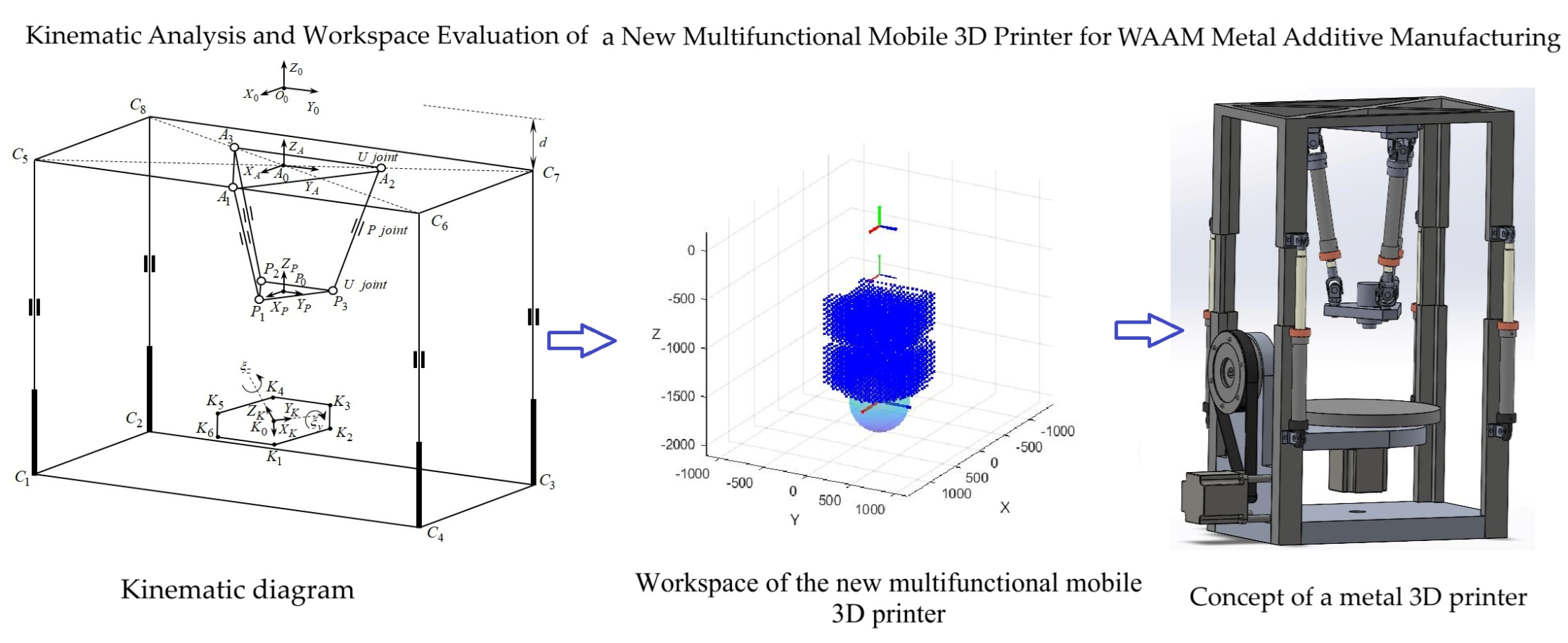
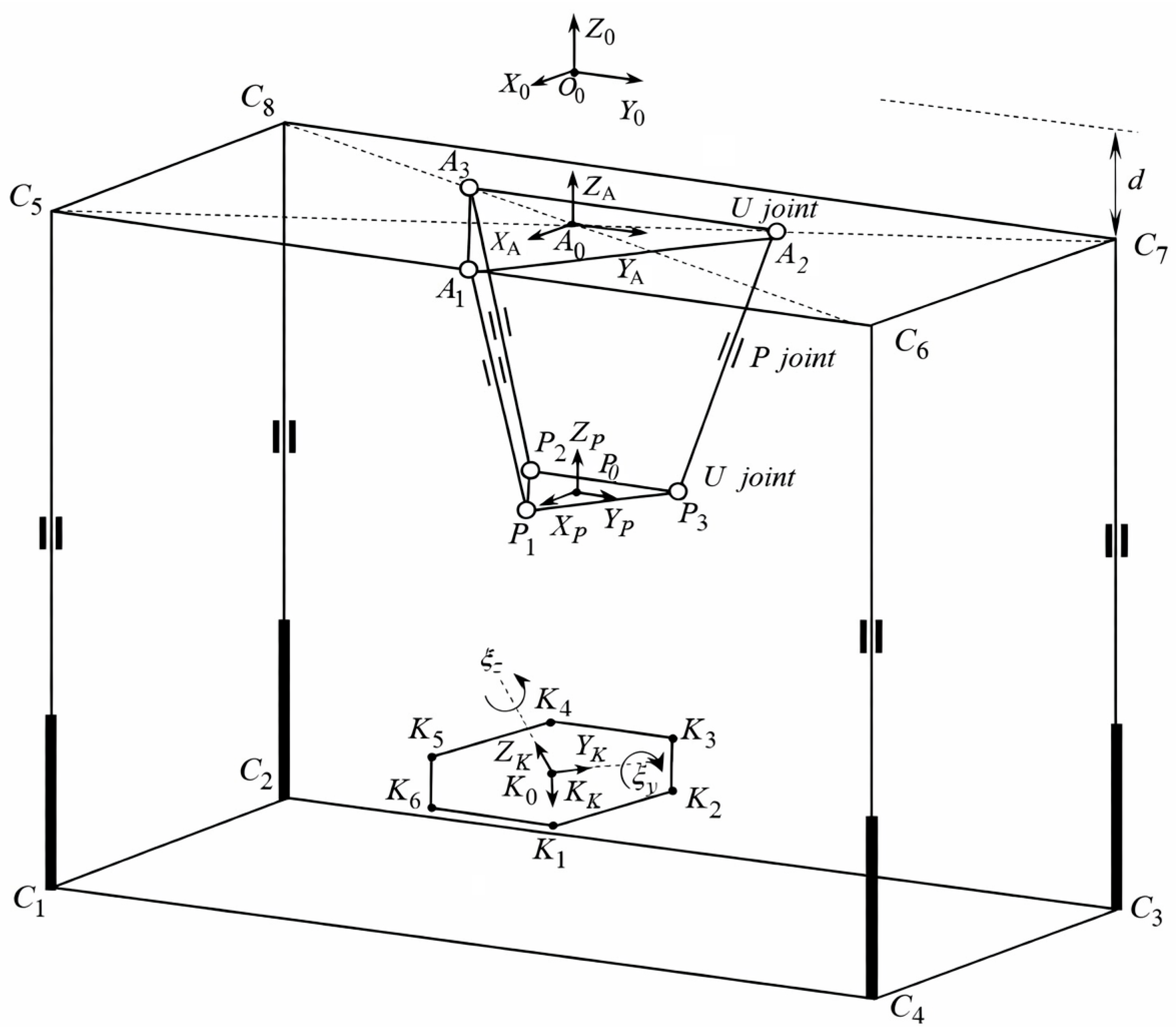
The 3-UPU+2 parallel manipulator (hereinafter referred to as PM) (Figure 2) serves as the actuating mechanism of the metal 3D printer. It consists of a 3-UPU PM, where U denotes passive universal joints and P represents active prismatic joints. Each limb of the 3-UPU manipulator contains a universal–prismatic–universal (UPU) chain, where the prismatic joint is actuated, and the universal joints are passive. The prismatic actuators generate platform motion, while the universal joints impose geometric constraints that suppress undesired rotations. This manipulator is a tripod with 3 translational DoF. It is well established that the moving platform exhibits purely translational motion if the two outer revolute joint axes in each limb are mutually parallel and the two inner revolute joint axes are likewise parallel to each other [41].
To avoid ambiguity, all coordinate systems used in the derivations are introduced here before presenting equations. This allows the reader to follow how each vector is transformed physically. The moving platform K i   ( i = 1 , 2 , , 6 ) (Figure 2) moves relative to the fixed point K 0 and has 2 rotational DoF around the axes X k and Y k of the local coordinate system K 0 X k Y k Z k . A spindle and welding torch will be installed at the center P 0 of the moving platform P j   ( j = 1 , 2 , 3 ) of the 3-UPU manipulator, for depositing material onto a workpiece positioned at the center K 0 of the worktable with 2 DoF K i   ( i = 1 , 2 , , 6 ) .
The fixed platform A 1 A 2 A 3 , in the shape of an equilateral triangle, is attached to a rectangular prism-shaped frame. The diagonals C 5 C 7 and C 6 C 8 of the upper rectangle C 5 C 6 C 7 C 8 are connected by metal beams. The passive universal joints of a 3-UPU tripod are attached to these beams at points A 2 ,   A 3 and to the edge C 5 C 6 at point A 1 . The local coordinate system A 0 X A Y A Z A is fixed at the center of the 3 passive universal joints A 1 , A 2 , A 3 . The local coordinate system P 0 X P Y P Z P is attached to the center P 0 of the moving platform P 1 P 2 P 3 of a 3-UPU tripod, at the intersection of 3 other passive universal joints. Similarly, another local coordinate system K 0 X K Y K Z K is attached to the center K 0 of the moving platform K i   ( i = 1 , 2 , , 6 ) , which has two rotational DoF. All local coordinate systems move together with the bodies to which they are attached.
The absolute coordinate system O 0 X 0 Y 0 Z 0 is fixed at the highest point where the local coordinate system A 0 X A Y A Z A can be positioned, i.e., at the maximum extension of the four hydraulic cylinders C 1 C 5 ,   C 2 C 8 ,   C 3 C 7 ,   C 4 C 6 . These four hydraulic cylinders are used to adjust the distance between the parallel 3-UPU robot and the moving platform K i with two degrees of freedom. The relationship between the absolute coordinate system O 0 X 0 Y 0 Z 0 and the local coordinate systems is established based on homogeneous transformation matrices using the Denavit–Hartenberg convention [42].

2.2. Inverse Kinematics Problem

The inverse kinematics problem is formulated as follows: Given the desired position of the tool center point on the moving platform, determine the required prismatic actuator strokes and the configuration of the limbs. In physical terms, this corresponds to aligning the deposited bead with the welding torch during printing. When solving the inverse kinematics problem, the position of the moving platform K i with two rotational degrees of freedom is specified, along with the coordinates of a point relative to the absolute coordinate system, where the gripper mounted on the moving platform of a 3-UPU tripod needs to be directed.
Next, the inverse kinematics problem of a 3-UPU tripod is solved to ensure the alignment of the printed bead with the gripper. The relationship between the absolute coordinate system O 0 X 0 Y 0 Z 0 and the local coordinate system K 0 X K Y K Z K is established as follows:
X K i Y K i Z K i 1 = t 11 t 12 t 13 X K 0 t 21 t 22 t 23 Y K 0 t 31 t 32 t 33 Z K 0 0 0 0 1 U K i V K i W K i 1
where X K 0 , Y K 0 , Z K 0 are coordinates of the center K 0 of the local coordinate system K 0 X K Y K Z K relative to the absolute coordinate system O 0 X 0 Y 0 Z 0 , X K i , Y K i , Z K i are the coordinates of the point K i of the moving platform with two degrees of freedom relative to the absolute coordinate system O 0 X 0 Y 0 Z 0 , and U K i , V K i , W K i are the coordinates of the point X K i , Y K i , Z K i relative to the local coordinate system K 0 X K Y K Z K . They are determined as follows:
U K i = a k cos ψ i ,   V K i = a k sin ψ i ,   W K i = 0
where a k are the distances from the center K 0 to the vertices K i of the hexagonal moving platform, and ψ i is correspondingly equal to 0°, 60°, 120°, 180°, 240°, and 300°.
The elements of the rotation matrix t i j   ( i , j = 1 , 2 , 3 ) in Equation (1) are defined as follows:
R = t 11 t 12 t 13 t 21 t 22 t 23 t 31 t 32 t 33 = 1 0 0 0 cos ξ z sin ξ z 0 sin ξ z cos ξ z cos ξ y 0 sin ξ y 0 1 0 sin ξ y 0 cos ξ y
where ξ z ,   ξ y are the rotation angles of the local coordinate system K 0 X K Y K Z K around the X k and Y k axes, respectively.
Thus, based on Equation (1), taking into account (2) and (3), it is possible to determine the coordinates of any point of the part mounted on the moving platform K i with two degrees of freedom relative to the absolute coordinate system O 0 X 0 Y 0 Z 0 and direct the gripper of a 3-UPU tripod mounted on the moving platform P 1 P 2 P 3 to that point.
A 3-UPU tripod consists of a base A 1 , A 2 , A 3 and a moving platform P 1 P 2 P 3 , connected by 3 closed kinematic chains of the UPU type. The local coordinate system A 0 X A Y A Z A is attached to the center of the 3 universal joints A 1 , A 2 , A 3 , which are located on the fixed base, while the local coordinate system P 0 X P Y P Z P is fixed at the center of the universal joints connecting the legs to the moving platform P 1 P 2 P 3 and moves along with it.
The 3-UPU parallel mechanism has 3 translational degrees of freedom along the axes of the absolute coordinate system O 0 X 0 Y 0 Z 0 and does not change its orientation, meaning that the two platforms, A 1 , A 2 , A 3 and P 1 P 2 P 3 , always remain parallel to each other [43].
The coordinates of the center of the first universal joint A 1 , which connects the legs of the 3-UPU parallel mechanism to the fixed platform, relative to the absolute coordinate system O 0 X 0 Y 0 Z 0 are equal to
X A 1 = r a cos θ i ,   Y A 1 = r a sin θ i ,   Z A 1 = d
where r a is a constant parameter, representing the distance from the center of the triangular fixed platform of the 3-UPU parallel mechanism to the centers of the universal joints, and d is a variable parameter that determines the stroke of the four hydraulic cylinders C 1 C 5 ,   C 2 C 8 ,   C 3 C 7 ,   C 4 C 6 . The parameter θ i is equal to 0°, 120°, and 240°, respectively.
As previously discussed, to set the coordinates of the centers of the other two universal joints, A 2 and A 3 , on the beams connecting the diagonals of the upper rectangle C 7 C 8 C 5 C 6 of the fixed frame, it is necessary to choose the coordinates of the frame vertices as follows:
C 7 x = r a ,   C 7 y = 3 r a ,   C 8 x = r a ,   Y 8 y = 3 r a , C 5 x = + r a ,   C 5 y = 3 r a ,   C 6 x = + r a ,   C 6 y = + 3 r a , C 7 z = C 8 z = C 5 x = C 6 x = d
The determination of the dimensional relationships between the triangular fixed platform of the tripod and the frame on which it will be mounted is given by Formula (5). This is necessary to assemble the structure as illustrated in Figure 1, ensuring that the rectangle C 7 C 8 C 5 C 6 and the triangle A 1 A 2 A 3 make contact at 3 points.
To solve the inverse kinematics problem of the 3-UPU parallel mechanism, it is necessary to determine S i   ( i = 1 , 2 , 3 ) , the lengths and orientations of the 3 legs of the mechanism, for a given position of the moving platform P 1 P 2 P 3 . The closure loop equations of the vector loops for the 3-UPU manipulator are defined as follows:
A 0 P 0 + P 0 h i = A 0 A i + S i ,   i = 1 , 2 , 3
Both sides of Equation (6), if the displacement vector d of the four hydraulic cylinders is added, which determines the vertical movement of the 3-UPU parallel mechanism, are equal to the coordinates of the centers of the universal joints connecting the legs of the mechanism to the moving platform. The vector d with coordinates [0, 0, d]T was omitted since it was present on both sides of the vector equality (6).
In the inverse kinematics problem, the given values are the sum of the vectors d + A 0 P 0 + P 0 h i , which are determined based on the relationship between the coordinate systems O 0 X 0 Y 0 Z 0 and P 0 X P Y P Z P .
X P i Y P i Z P i 1 = 1 0 0 X P 0 0 1 0 Y P 0 0 0 1 d + Z P 0 0 0 0 1 U P i V P i W P i 1 ,   i = 1 , 2 , 3
where U P i , V P i , W P i are the coordinates of points P i in the local coordinate system P 0 U P V P W P ; they are determined as follows:
U P i V P i W P i 1 = r b cos ( ζ i ) r b sin ( ζ i ) 0 1 ,   ζ i = 0 ° , 120 ° , 240 °
where r b is the distance between the center of the triangle and the centers of the universal joints of the moving platform P 1 P 2 P 3 .
To determine the sum of the vectors d + A 0 A i + S i , the following homogeneous transformation matrices were formulated:
(1)
O 0 X 0 Y 0 Z 0 O 1 X 1 Y 1 Z 1
T 01 , i = cos θ i 0 sin θ i r A cos θ i sin θ i 0 cos θ i r A sin θ i 0 1 0 d 0 0 0 1 ,   i = 1 , 2 , 3 , θ i = 0 ° , 120 ° , 240 °
(2)
O 1 X 1 Y 1 Z 1 O 2 X 2 Y 2 Z 2
T 02 , i = T 01 , i T 12 , i
where
T 12 , i = cos φ 1 , i sin φ 1 , i 0 0 sin φ 1 , i cos φ 1 , i 0 0 0 0 1 0 0 0 0 1 ,   i = 1 , 2 , 3
(3)
O 2 X 2 Y 2 Z 2 O 3 X 3 Y 3 Z 3
T 03 , i = T 02 , i T 23 , i
where
T 23 , i = 0 0 1 0 1 0 0 0 0 1 0 0 0 0 0 1
(4)
O 3 X 3 Y 3 Z 3 O 4 X 4 Y 4 Z 4
T 04 , i = T 03 , i T 34 , i
where
T 34 , i = cos φ 2 , i sin φ 2 , i 0 S 1 cos φ 2 , i sin φ 2 , i cos φ 2 , i 0 S 1 sin φ 2 , i 0 0 1 0 0 0 0 1 ,   i = 1 , 2 , 3
The coordinates of the universal joints are determined from the T 04 , i matrix as follows:
X P i Y P i Z P i 1 = 0 0 0 1 T 04 , i ,   i = 1 , 2 , 3
From Equation (16), taking into account Equation (7), the coordinates of the moving platform center P 0 are determined:
X P 0 = r cos θ i + S i sin θ i sin φ 2 i S i cos θ i cos φ 2 i sin φ 1 i , Y P 0 = r sin θ i S i cos θ i sin φ 2 i S i sin θ i cos φ 2 i sin φ 1 i , Z P 0 = d + S i cos φ 1 i cos φ 2 i
where r = r A r B , S i are the input parameters of the linear actuators stroke, and φ 1 i , φ 2 i are the angles determining the orientation of the 3 legs of the PM 3-UPU.
Adding the first and second equations of system (17), after multiplying them by cos θ i and sin θ i , respectively, we obtain
X P 0 sin θ i Y P 0 cos θ i = S i sin φ 2 i
The system of Equation (17) is written as follows:
X P 0 r cos θ i S i sin θ i sin φ 2 i = S i cos θ i cos φ 2 i sin φ 1 i , Y P 0 r sin θ i + S i cos θ i sin φ 2 i = S i sin θ i cos φ 2 i sin φ 1 i , Z P 0 d = S i cos φ 1 i cos φ 2 i
From the sum of the squares of the 3 equations of system (19), taking into account Equation (18), we obtain
2 ( X P 0 sin θ i Y P 0 cos θ i ) 2 S i 2 2 S i 2 ( X P 0 sin θ i Y P 0 cos θ i ) 2 + + r 2 + X P 0 2 + Y P 0 2 + Z P 0 2 + d 2 2 Z P 0 d 2 r ( X P cos θ i + Y P sin θ i ) = 0
Solving Equation (20) for the variables S i , we obtain
S i = ± r 2 + X P 0 2 + Y P 0 2 + Z P 0 2 2 Z P 0 d + d 2 2 r ( X P 0 cos θ i + Y P 0 sin θ i )
In this problem, the moving platform is located in the negative direction of the Z 0 axis, so only negative values of S i will be used for calculations.
Solving Equation (18) for the variables φ 2 i , we obtain the following two solutions:
φ 2 i ( 1 ) = arcsin X P sin θ i Y P cos θ i S i ,   φ 2 i ( 2 ) = π arcsin X P sin θ i Y P cos θ i S i
Solving the third equation of system (19) for the variable φ 1 i , we obtain the following solutions:
φ 1 i ( 1 ) = + arccos Z P 0 d S i cos φ 2 i ,   φ 1 i ( 2 ) = arccos Z P 0 d S i cos φ 2 i
When solving the inverse kinematics problem of the 3-UPU parallel robot, the position, i.e., the coordinates of the moving platform center X P 0 , Y P 0 , Z P 0 , is given, while the coordinates of the passive universal joints X P i , Y P i , Z P i attached to the moving platform are determined by Equation (7). Based on Equations (21)–(23), the variable parameters φ 1 i ,   φ 2 i , and S i are determined, respectively, along with the positions of all moving links.

2.3. Direct Kinematics Problem

In the forward kinematics problem, the situation is the opposite: given the actuator strokes, one finds the Cartesian position of the platform. In practice, this corresponds to determining the current tool position from measured displacements. When solving the forward kinematics problem of the 3-UPU parallel mechanism, the positions of the moving platform X P i , Y P i , Z P i are determined for given link lengths of the 3 input hydraulic cylinders S i . The 3 legs of the 3-UPU tripod move along a spherical surface according to the following equations:
A i P i = S i ,   i = 1 , 2 , 3
From (22), taking into account (7) and (8), the following system of equations is obtained:
( X P 0 r cos θ 1 ) 2 + ( Y P 0 r sin θ 1 ) 2 + ( Z P 0 d ) 2 = S 1 2 , ( X P 0 r cos θ 2 ) 2 + ( Y P 0 r sin θ 2 ) 2 + ( Z P 0 d ) 2 = S 2 2 , ( X P 0 r cos θ 3 ) 2 + ( Y P 0 r sin θ 3 ) 2 + ( Z P 0 d ) 2 = S 3 2
Expanding the brackets from system (25), we obtain
r 2 2 Z P 0 d + X P 0 2 + Y P 0 2 + Z P 0 2 + d 2 2 X P 0 r cos θ 1 2 Y P 0 r sin θ 1 = S 1 2 , r 2 2 Z P 0 d + X P 0 2 + Y P 0 2 + Z P 0 2 + d 2 2 X P 0 r cos θ 2 2 Y P 0 r sin θ 2 = S 2 2 , r 2 2 Z P 0 d + X P 0 2 + Y P 0 2 + Z P 0 2 + d 2 2 X P 0 r cos θ 3 2 Y P 0 r sin θ 3 = S 3 2
To eliminate the quadratic terms from the first equation of system (26), we sequentially subtract the second and third equations, resulting in
( cos θ 1 cos θ 2 ) X P 0 + ( sin θ 1 sin θ 2 ) Y P 0 = S 2 2 S 1 2 2 r , ( cos θ 1 cos θ 3 )   X P 0 + ( sin θ 1 sin θ 3 ) Y P 0 = S 3 2 S 1 2 2 r
From system (27), we obtain the following solutions:
X P 0 Y P 0 T = A 1 B
where
A = cos θ 1 cos θ 2 sin θ 1 sin θ 2 cos θ 1 cos θ 3 sin θ 1 sin θ 3 ,   B = 1 2 r S 2 2 S 1 2 S 3 2 S 1 2
Solving the third equation of system (26) for the variable Z P 0 , we obtain the following two solutions:
Z P 0 ( 1 ) = 0.5 ( 2 d + D )   &   Z P 0 ( 2 ) = 0.5 ( 2 d D )
where D = 4 d 2 4 ( r 2 + X P 0 2 + Y P 0 2 + d 2 2 X P 0 r cos θ 3 2 Y P 0 r sin θ 3 S 3 2 ) .
To determine the orientation of each leg of a 3-UPU tripod, two angles are required. Thus, for 3 given input parameters S i , six angles φ 1 i ,   φ 2 i ,   i = 1 , 2 , 3 need to be determined. However, the 3-UPU parallel mechanism has only 3 translational degrees of freedom, meaning that the orientation of the moving platform X P i , Y P i , Z P i in space remains unchanged, and there is no rotation around the vertical axis Z 0 . Therefore, given the known coordinates of the moving platform center X P 0 ,   Y P 0 ,   Z P 0 , the six angles that define the orientation of each tripod leg can be determined from the geometry of the parallel mechanism using Equations (18) and (19).

2.4. Jacobian Matrices and Velocity Analysis

We introduce the following notations: S ˙ = [ S ˙ 1   S ˙ 2   S ˙ 3 ] T ,   V P 0 = [ X ˙ P 0   Y ˙ P 0   Z ˙ P 0 ] T ( S ˙ and V P 0 are and the center P0 of the moving platform and the velocity vectors of the input linear actuators of the parallel mechanism). To determine the Jacobian matrices that relate the velocities of the moving and fixed platforms of the 3-UPU parallel mechanism, we take the time derivative of the system of Equation (20) and express it in the following matrix form:
J q S ˙ = J x V P 0
where
J x = X P 0     r cos θ 1 Y P 0     r sin θ 1 Z P 0 d   X P 0     r cos θ 2 Y P 0     r sin θ 2 Z P 0 d X P 0     r cos θ 3 Y P 0     r sin θ 3 Z P 0 d ,   J q = S 1 0 0 0 S 2 0 0 0 S 3
From the matrix Equation (31), the inverse velocity problem can be solved as follows:
S = J q 1 J x V

2.5. Singular Configurations

It is well known that the workspace of parallel manipulators is significantly reduced when singular configurations are taken into account. However, in the case under consideration, the 3-UPU+2 type mechanism practically does not contain singular configurations.
Let us consider the singular configurations of matrix J x , that is, the singular configurations of the first type; to this end, we determine the corresponding determinant.
det ( J x ) = 3 3 r 2 ( Z P 0 d )
Formally, a Type-I singular configuration arises when the condition ( Z P 0 d ) = 0 is satisfied; however, the design of the manipulator does not allow such a relative arrangement of the base and the mobile platform due to the constraint Z P 0 ( d ) and limitation S i S m i n . Therefore, this singularity does not belong to the workspace and does not affect the controllability or stiffness of the mechanism.
Furthermore, the determinant of matrix J q is equal to
det ( J q ) = S 1 S 2 S 3
In this case, none of the expressions in S i can vanish; consequently, the Type-II singular configuration is also eliminated.

3. Results and Discussion

3.1. Numerical Results of Solving the Inverse and Direct Kinematics Problems

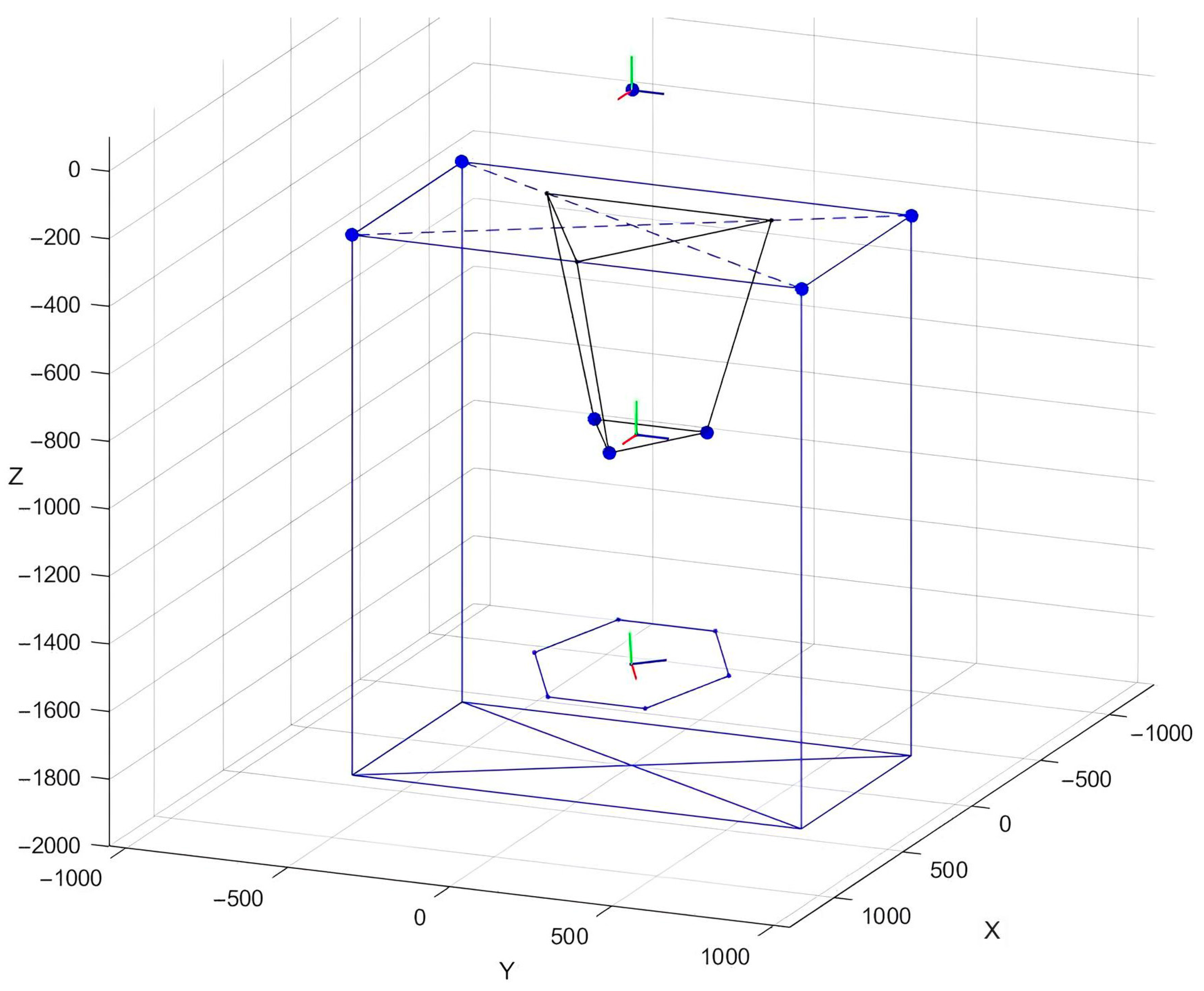
The following constant parameters are given in Table 1. A program was developed that automatically selects the solutions of Equations (17)–(19) to correctly determine the positions of the tripod. This program was implemented in MATLAB/Simulink (2023a). Figure 3 shows the assembled mechanism based on the solution to the inverse kinematics problem.
The following parameters were specified for solving the direct kinematics problem, as summarized in Table 1, which lists the constant parameters used in the analysis. From Equations (29) and (31), the following solutions for X P 0 = 0 ,   Y P 0 = 0 ,   Z P 0 ( 1 ) = 565.6854 ,   Z P 0 ( 2 ) = 565.6854 were obtained. These values were verified based on the solution to the inverse kinematics problem.

3.2. Workspace of the Multifunctional Mobile 3D Printer for Metal Printing

In the kinematic analysis performed, the workspace was evaluated with regard to several practical constraints inherent to the real mechanical system. In particular, the computations incorporated the limitation on the maximum operating angle of the universal joints, taken as 45° in accordance with DIN 808 [44], the occurrence of potential singular configurations, as well as the requirement to avoid collisions between structural components, the spindle, and the tool. The spindle is mounted on the 3-UPU moving platform and may potentially come into contact with the universal joints; to mitigate this risk, the dimensions of the moving platform were increased, taking into account the geometric characteristics and angular limitations of the universal joints. In addition, an additional clearance of 160 mm along the Z-axis was considered to accommodate the spindle and the tool, which consequently leads to a further reduction in the available workspace.
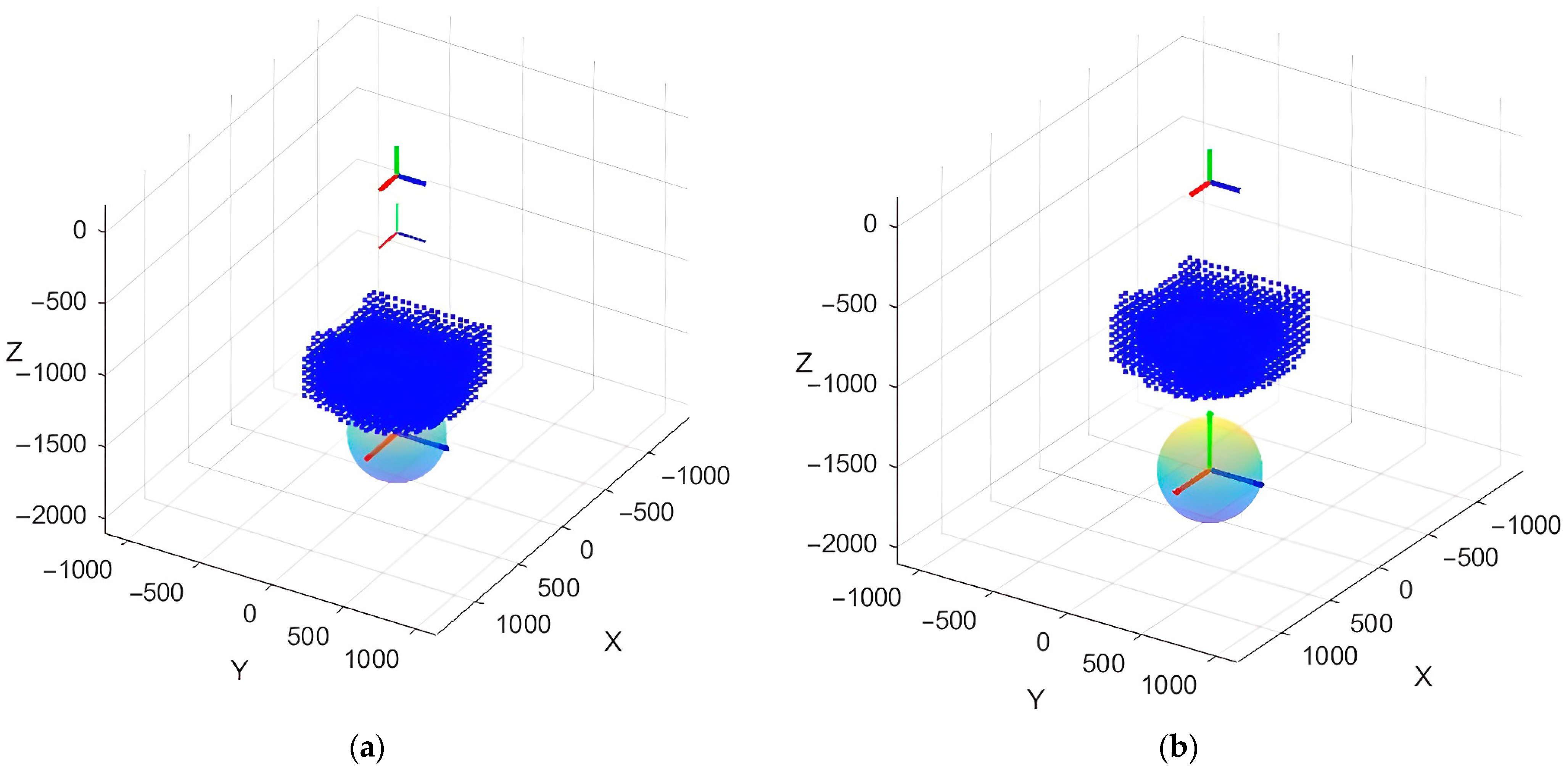
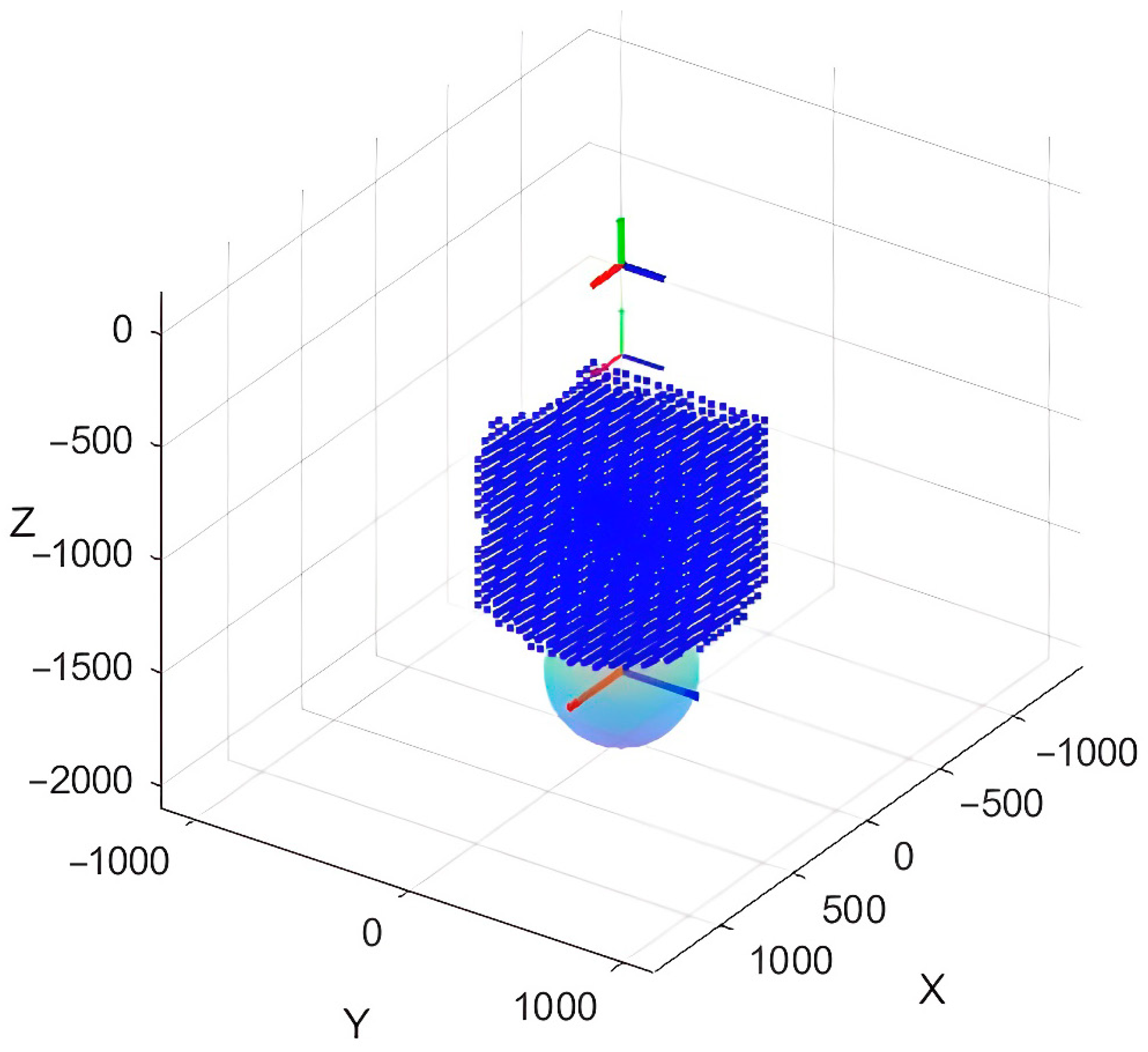
The workspace was determined using the inverse kinematics approach. The workspace of the worktable is approximated as a spherical volume, while the workspace of the 3-UPU manipulator is analyzed in two configurations: workspace in the closed (assembled) configuration and workspace in the open configuration (Figure 4). In the closed (assembled) configuration, the Z-axis range spans from –1700 mm to 1300 mm, whereas in the open configuration it ranges from –1300 mm to 900 mm.
In addition, Figure 5 shows the combined workspace, which is illustrated in Figure 4.
Extending the vertical travel of the mobile platform along the Z-axis nearly doubles the accessible workspace of the multifunctional mobile 3D printer. The 3-UPU manipulator provides an XY translational workspace of ±400 mm, while the integrated two-axis worktable enhances the system’s orientation capabilities.
To account for the rotational angle limitations of the universal joints, the deviations of each leg from the vertical direction were used.
α i = tan 1 ( X P i A i x ) 2 + ( Y P i A i y ) 2 Z P i d
where A i ( A i x , A i y , A i z ) and P i ( X P i , Y P i , Z P i ) are, respectively, the coordinates of the universal joints connecting the base and the moving platform. If the allowable angle of the universal joint with respect to each axis is ±45°, then, under simultaneous rotation about two axes, the resulting inclination angle of the leg from the vertical may exceed 45°. However, in the present work, for the sake of simplification, we limited the inclination angle of each leg with respect to the vertical to ±45°, without taking this circumstance into account. Thus, in calculating the workspace, conical constraints were assumed for each leg.

3.3. Numerical Examples of Solving the Inverse and Direct Velocity Problems

The constant parameters used in the analysis are given in Table 1. In the inverse velocity problem, the components of the linear velocity V P 0 of the moving platform center are given, X ˙ P 0 ,   Y ˙ P 0 ,   Z ˙ P 0 , and the values of the linear actuator velocities S ˙ = [ S ˙ 1   S ˙ 2   S ˙ 3 ] T required to achieve the specified velocity of the moving platform center P 0 of the tripod are determined. It is assumed that the positions of the four hydraulic cylinders C 1 C 5 ,   C 2 C 8 ,   C 3 C 7 ,   C 4 C 6 and the orientation of the moving platform Ki with two degrees of freedom are fixed. That is, when a 3-UPU tripod operates, other moving parts of the actuator mechanism are temporarily halted.
Table 2 presents the numerical results of solving the inverse kinematics problem of the tripod. Specifically, certain positions of the moving platform center X P 0   Y P 0   Z P 0 and the components of the velocity vector of the moving platform center X ˙ P 0 ,   Y ˙ P 0 ,   Z ˙ P 0 were given. Based on Equation (33), the velocity magnitudes of the linear actuators S ˙ 1   S ˙ 2   S ˙ 3 were determined to ensure the specified motion.
Additionally, using Equation (31), the components of the linear velocity X ˙ P 0 ,   Y ˙ P 0 ,   Z ˙ P 0 can be found for given values of the linear actuator velocities S ˙ 1   S ˙ 2   S ˙ 3 .
The results of this study show that the proposed multifunctional mobile WAAM printer significantly increases the workspace compared with typical WAAM systems. Standard prototypes usually have moderate dimensions, e.g., 200 × 200 × 200 mm, except for large-scale structures such as diagonal lattice columns (height 2000 mm) or the MX3D bridge (span 12 m) [45]. In comparison, commercially available desktop systems, such as the Meltio M450, offer a workspace of only 145 × 168 × 390 mm, with overall dimensions of 560 × 600 × 1400 mm and a weight of 250 kg [45]. While suitable for laboratory or small-scale industrial parts, these systems are limited in size and mobility, restricting large-scale Metal Additive Manufacturing.
In the proposed approach, the workspace of the 3-UPU manipulator was analyzed in two configurations: closed (assembled) and open (open configuration), while the worktable workspace was approximated as a spherical volume (Figure 4). In the closed configuration, the Z-axis range spans from –1700 mm to 1300 mm, and in the open configuration, from –1300 mm to 900 mm. The manipulator provides XY translational motion of ±400 mm, and the integrated two-axis worktable adds orientation capabilities, enabling multi-directional layer deposition and fabrication of parts with complex geometries.
Mounting the WAAM system on a mobile platform with a hybrid five-DoF manipulator (three translational + two rotational DoF) allows layer deposition in multiple directions without supports, reducing anisotropy caused by strictly parallel layer stacking. This is particularly important for producing complex geometries and structural components in aerospace and construction applications, where both mobility and post-processing capability are critical. The hybrid system’s intermediate stiffness—higher than that of desktop 3D printers but lower than full-size CNC machines—provides sufficient stability for deposition and finishing while keeping the system lightweight and transportable.
Overall, these comparisons highlight the value of mobile hybrid WAAM systems as a bridge between small laboratory printers and large stationary CNC machines, offering geometric flexibility and the possibility of on-site industrial deployment.

4. Conclusions

In the present study, a comprehensive kinematic analysis of a multifunctional mobile metal 3D printer was carried out. The system includes a 3-UPU parallel manipulator, a two-axis worktable, and a foldable housing. The forward and inverse kinematics problems were considered within a unified framework, which made it possible to determine the workspace of the system and to identify regions of potential singular configurations. The obtained results show that all components of the system ensure compact arrangement in the transportation state and do not experience collisions at any stage of deployment. It was established that the motion trajectories do not intersect singular configurations, and the workspace determined from the kinematic analysis does not contain singularities. This confirms the kinematic feasibility of the proposed design and its suitability for practical implementation.
The workspace was determined with respect to the reference point of the spindle and did not take into account the geometric dimensions of the printing head and cutting tools. It was demonstrated that the overhang length of the printing head does not exceed that of standard cylindrical end mills; therefore, the reduction in the effective workspace is insignificant. Consequently, the workspace obtained from the kinematic analysis can be directly used in slicers and CAM systems, which, taking into account the tool geometry, are capable of automatically generating motion trajectories.
The formulated inverse kinematics equations can be employed in the development of post-processors for CAM systems and/or slicers, thereby enabling automation of the control of the multifunctional 3D printer.

Author Contributions

Conceptualization, A.M. and M.S.; methodology, R.K., A.M. and M.S.; software, N.A. and Y.L.; validation, A.Z.; formal analysis, Y.N., N.A., A.Z. and I.D.; data curation, A.M. and Z.T.; writing—original draft preparation, A.M., R.K. and M.S.; writing—review and editing, M.S., Y.N. and A.Z.; visualization, A.Z., Y.N. and Y.L.; supervision, A.M.; project administration, A.M. All authors have read and agreed to the published version of the manuscript.

Funding

This research was funded by Science Committee of the Ministry of Science and Higher Education of the Republic of Kazakhstan (Grant No. AP23487120 (2024-2026)).

Data Availability Statement

Data are contained within the article.

Acknowledgments

This work has been supported financially by the research project AP23487120 of the Science Committee of the Ministry of Science and Higher Education of the Republic of Kazakhstan (2024–2026) and was performed at the Mechanical Engineering Department, Satbayev University, which is gratefully acknowledged by the authors.

Conflicts of Interest

The authors declare no conflicts of interest.

References

  1. Shah, A.; Aliyev, R.; Zeidler, H.; Krinke, S. A Review of the Recent Developments and Challenges in Wire Arc Additive Manufacturing (WAAM) Process. J. Manuf. Mater. Process. 2023, 7, 97. [Google Scholar] [CrossRef]
  2. Alami, A.H.; Olabi, A.G.; Alashkar, A.; Alasad, S.; Aljaghoub, H.; Rezk, H.; Abdelkareem, M.A. Additive Manufacturing in the Aerospace and Automotive Industries: Recent Trends and Role in Achieving Sustainable Development Goals. Ain Shams Eng. J. 2023, 14, 102516. [Google Scholar] [CrossRef]
  3. Aziz, M.; El Hassan, A.; Hussein, M.; Zaneldin, E.; Al-Marzouqi, A.H.; Ahmed, W. Characteristics of antenna fabricated using additive manufacturing technology and the potential applications. Heliyon 2024, 10, e27785. [Google Scholar] [CrossRef]
  4. Renderos, M.; Girot, F.; Lamikiz, A.; Torregaray, A.; Saintier, N. Ni-Based Powder Reconditioning and Reuse for LMD Process. Phys. Procedia 2016, 83, 769–777. [Google Scholar] [CrossRef]
  5. Frazier, W.E. Metal Additive Manufacturing: A Review. J. Mater. Eng. Perform. 2014, 23, 1917–1928. [Google Scholar] [CrossRef]
  6. Gibson, B.S.I.; Rosen, D. Additive Manufacturing Technologies, 2nd ed.; Springer: New York, NY, USA, 2015. [Google Scholar]
  7. Çam, G. Prospects of Producing Aluminum Parts by Wire Arc Additive Manufacturing (WAAM). Mater. Today Proc. 2022, 62, 77–85. [Google Scholar] [CrossRef]
  8. Zahidin, M.R.; Yusof, F.; Rashid, S.H.A.; Mansor, S.; Raja, S.; Jamaludin, M.F.; Manurung, Y.H.; Adenan, M.S.; Hussein, N.I.S. Research Challenges, Quality Control and Monitoring Strategy for Wire Arc Additive Manufacturing. J. Mater. Res. Technol. 2023, 24, 2769–2794. [Google Scholar] [CrossRef]
  9. Zahid, M.; Hai, K.; Khan, M.; Shekha, A.; Pervaiz, S.; Ali, S.M.; Abdul-Latif, O.; Salman, M. Wire Arc Additive Manufacturing (WAAM): Reviewing Technology, Mechanical Properties, Applications and Challenges. In Proceedings of the ASME International Mechanical Engineering Congress and Exposition, Virtual, Online, 16–19 November 2020; ASME: Pittsburgh, PA, USA, 2020; Volume 84485, p. V02AT02A042. [Google Scholar]
  10. Ribeiro, F. 3D Printing with Metals. Comput. Control Eng. J. 1998, 9, 31–38. [Google Scholar] [CrossRef]
  11. Glashier, T.; Kromanis, R.; Buchanan, C. Temperature-Based Measurement Interpretation of the MX3D Bridge. Eng. Struct. 2024, 305, 116736. [Google Scholar] [CrossRef]
  12. Catalano, A.R.; Pagone, E.; Martina, F.; Priarone, P.C.; Settineri, L. Wire Arc Additive Manufacturing of Ti-6Al-4V Components: Effects of Deposition Rate on Cradle-to-Gate Economic and Environmental Performance. Procedia CIRP 2023, 116, 269–274. [Google Scholar] [CrossRef]
  13. Martina, F. What Happens When You Take the Powder out of AM? Charting the Rise of Wire-Based DED with WAAM3D. Metal AM 2022, 8, 4. [Google Scholar]
  14. Dharmendra, C.; Amirkhiz, B.S.; Lloyd, A.; Ram, G.J.; Mohammadi, M. Wire-Arc Additive Manufactured Nickel Aluminum Bronze with Enhanced Mechanical Properties Using Heat-Treatment Cycles. Addit. Manuf. 2020, 36, 101510. [Google Scholar] [CrossRef]
  15. Xin, H.; Correia, J.A.; Veljkovic, M.; Zhang, Y.; Berto, F.; de Jesus, A.M. Probabilistic Strain-Fatigue Life Performance Based on Stochastic Analysis of Structural and WAAM-Stainless Steels. Eng. Fail. Anal. 2021, 127, 105495. [Google Scholar] [CrossRef]
  16. Reis, R.C.; Kokare, S.; Oliveira, J.P.; Matias, J.C.; Godina, R. Life Cycle Assessment of Metal Products: A Comparison Between Wire Arc Additive Manufacturing and CNC Milling. Adv. Ind. Manuf. Eng. 2023, 6, 100117. [Google Scholar] [CrossRef]
  17. Pragana, J.P.M.; Sampaio, R.F.; Bragança, I.M.F.; Silva, C.M.A.; Martins, P.A.F. Hybrid Metal Additive Manufacturing: A state–of–the-art review. Adv. Ind. Manuf. Eng. 2021, 2, 100032. [Google Scholar] [CrossRef]
  18. Freitas, B.; Richhariya, V.; Silva, M.; Vaz, A.; Lopes, S.F.; Carvalho, Ó. A review of hybrid manufacturing: Integrating subtractive and additive manufacturing. Materials 2025, 18, 4249. [Google Scholar] [CrossRef] [PubMed]
  19. Sebbe, N.P.; Fernandes, F.; Sousa, V.F.; Silva, F.J. Hybrid manufacturing processes used in the production of complex parts: A comprehensive review. Metals 2022, 12, 1874. [Google Scholar] [CrossRef]
  20. Heinrich, L.; Feldhausen, T.; Saleeby, K.S.; Saldana, C.; Kurfess, T.R. Prediction of Thermal Conditions of DED with FEA Metal Additive Simulation. In Proceedings of the ASME 2021 16th International Manufacturing Science and Engineering Conference, Virtual, Online, 21–25 June 2021; p. V001T01A022. [Google Scholar]
  21. Liu, J.; Huang, J.; Zheng, Y.; Hou, S.; Xu, S.; Ma, Y.; Li, L. Challenges in Topology Optimization for Hybrid Additive–Subtractive Manufacturing: A Review. Comput.-Aided Des. 2023, 161, 103531. [Google Scholar] [CrossRef]
  22. Wang, Z.; Liu, R.; Chen, X.; Sparks, T.; Liou, F. Industrial robot trajectory stiffness mapping for hybrid manufacturing process. Int. J. Robot. Autom. Technol. 2016, 3, 28–39. [Google Scholar] [CrossRef]
  23. Dunaj, P.; Dolata, M.; Powałka, B.; Pawełko, P.; Berczyński, S. Design of an ultra-light portable machine tool. IEEE Access 2021, 9, 43837–43844. [Google Scholar] [CrossRef]
  24. Li, B.; Nagaraja, K.M.; Zhang, R.; Malik, A.; Lu, H.; Li, W. Integrating Robotic Wire Arc Additive Manufacturing and Machining: Hybrid WAAM Machining. Int. J. Adv. Manuf. Technol. 2023, 129, 3247–3259. [Google Scholar] [CrossRef]
  25. Neugebauer, R. (Ed.) Parallelkinematische Maschinen: Entwurf, Konstruktion, Anwendung; Springer: Berlin/Heidelberg, Germany, 2006. [Google Scholar]
  26. Merlet, J.P. Parallel Robots; Chapter 3; Kluwer Academic Publishers: Dordrecht, The Netherlands, 2000; pp. 48–62. [Google Scholar]
  27. Baigunchekov, Z.Z.; Kaiyrov, R.A. Direct Kinematics of a 3-PRRS Type Parallel Manipulator. Int. J. Mech. Eng. Robot. Res. 2020, 9, 967–972. [Google Scholar] [CrossRef]
  28. Liu, X.J.; Wang, J.S. Parallel Kinematics: Type, Kinematics, and Optimal Design; Chapters 1 and 2; Springer: Berlin/Heidelberg, Germany, 2014; pp. 3–77. [Google Scholar]
  29. McAree, P.R.; Selig, J.M. Constrained Robot Dynamics II: Parallel Machines. J. Robot. Syst. 1999, 16, 487–498. [Google Scholar] [CrossRef]
  30. Russo, M.; Zhang, D.; Liu, X.J.; Xie, Z. A review of parallel kinematic machine tools: Design, modeling, and applications. Int. J. Mach. Tools Manuf. 2024, 196, 104118. [Google Scholar] [CrossRef]
  31. Coutinho, F.; Lizarralde, N.; Lizarralde, F. Coordinated motion control of a Wire Arc Additive Manufacturing robotic system for multi-directional building parts. arXiv 2025, arXiv:2505.14858. [Google Scholar] [CrossRef]
  32. Lu, Y.; Wang, P.; Hou, Z.; Hu, B.; Sui, C.; Han, J. Kinetostatic analysis of a novel 6-DoF 3UPS parallel manipulator with multi-fingers. Mech. Mach. Theory 2014, 78, 36–50. [Google Scholar] [CrossRef]
  33. Abadi, B.N.R.; Vakilzadeh, M. Natural frequency analysis of a planar parallel mechanism with task space redundancy for high-precision milling. J. Braz. Soc. Mech. Sci. Eng. 2025, 47, 439. [Google Scholar] [CrossRef]
  34. Tang, H.; Zhang, D.; Tian, C. An approach for modeling and performance analysis of three-leg landing gear mechanisms based on the virtual equivalent parallel mechanism. Mech. Mach. Theory 2022, 169, 104617. [Google Scholar] [CrossRef]
  35. Russo, M.; Herrero, S.; Altuzarra, O.; Ceccarelli, M. Kinematic analysis and multi-objective optimization of a 3-UPR parallel mechanism for a robotic leg. Mech. Mach. Theory 2018, 120, 192–202. [Google Scholar] [CrossRef]
  36. Hassani, A.; Khalilpour, S.A.; Bataleblu, A.; Taghirad, H.D. Full Dynamic Model of 3-UPU Translational Parallel Manipulator for Model-Based Control Schemes. Robotica 2022, 40, 2815–2830. [Google Scholar] [CrossRef]
  37. Tsai, L.W.; Joshi, S. Kinematics and optimization of a spatial 3-UPU parallel manipulator. J. Mech. Des. 2000, 122, 439–446. [Google Scholar] [CrossRef]
  38. Petro, P.; Shi, X.; Wang, J.; Li, Z.; Yin, B.; Zhou, H.; Zhou, Y.; Yu, B.; Wang, Z. Enhancing Wire Arc Additive Manufacturing for Maritime Applications: Overcoming Operational Challenges in Marine and Offshore Environments. Appl. Sci. 2025, 15, 9070. [Google Scholar] [CrossRef]
  39. Rautio, S.; Valtonen, I. Supporting Military Maintenance and Repair with Additive Manufacturing. J. Mil. Stud. 2022, 11, 23–36. [Google Scholar] [CrossRef]
  40. Mann, S.; Wirtz, A.; Becker, J.; Aurich, J.C.; Brecher, C. Connected, Digitalized Wire Arc Additive Manufacturing: Utilizing Data in the Internet of Production to Enable Industrie 4.0. Sci. Rep. 2025, 15, 20771. [Google Scholar] [CrossRef]
  41. Tsai, L.-W. Kinematics of a Three-DoF Platform with Three Extensible Limbs. In Recent Advances in Robot Kinematics; Springer: Dordrecht, The Netherlands, 1996; pp. 401–410. [Google Scholar] [CrossRef]
  42. Fu, K.S.; Gonzales, R.C.; Lee, C.S.G. Robotics: Control, Sensing, Vision, and Intelligence; McGraw-Hill: New York, NY, USA, 1987; p. 580. [Google Scholar]
  43. Raspall, F.; Araya, S.; Pazols, M.; Valenzuela, E.; Castillo, M.; Benavides, P. Wire Arc Additive Manufacturing for Widespread Architectural Application: A Review Informed by Large-Scale Prototypes. Buildings 2025, 15, 906. [Google Scholar] [CrossRef]
  44. DIN 808: Universal Joints with Needle or Friction Bearings, Technical Specification (PDF). Available online: https://www.elesa-ganter.com/siteassets/PDF/EN/DIN%20808.pdf (accessed on 20 December 2025).
  45. Huang, K.H.; Menon, N.; Jamieson, C.D.; Basak, A. Probabilistic Knowledge Transfer of Melt Pool Properties Between Wire- and Powder-Based Laser-Directed Energy Deposition. Int. J. Adv. Manuf. Technol. 2025, 138, 315–338. [Google Scholar] [CrossRef]
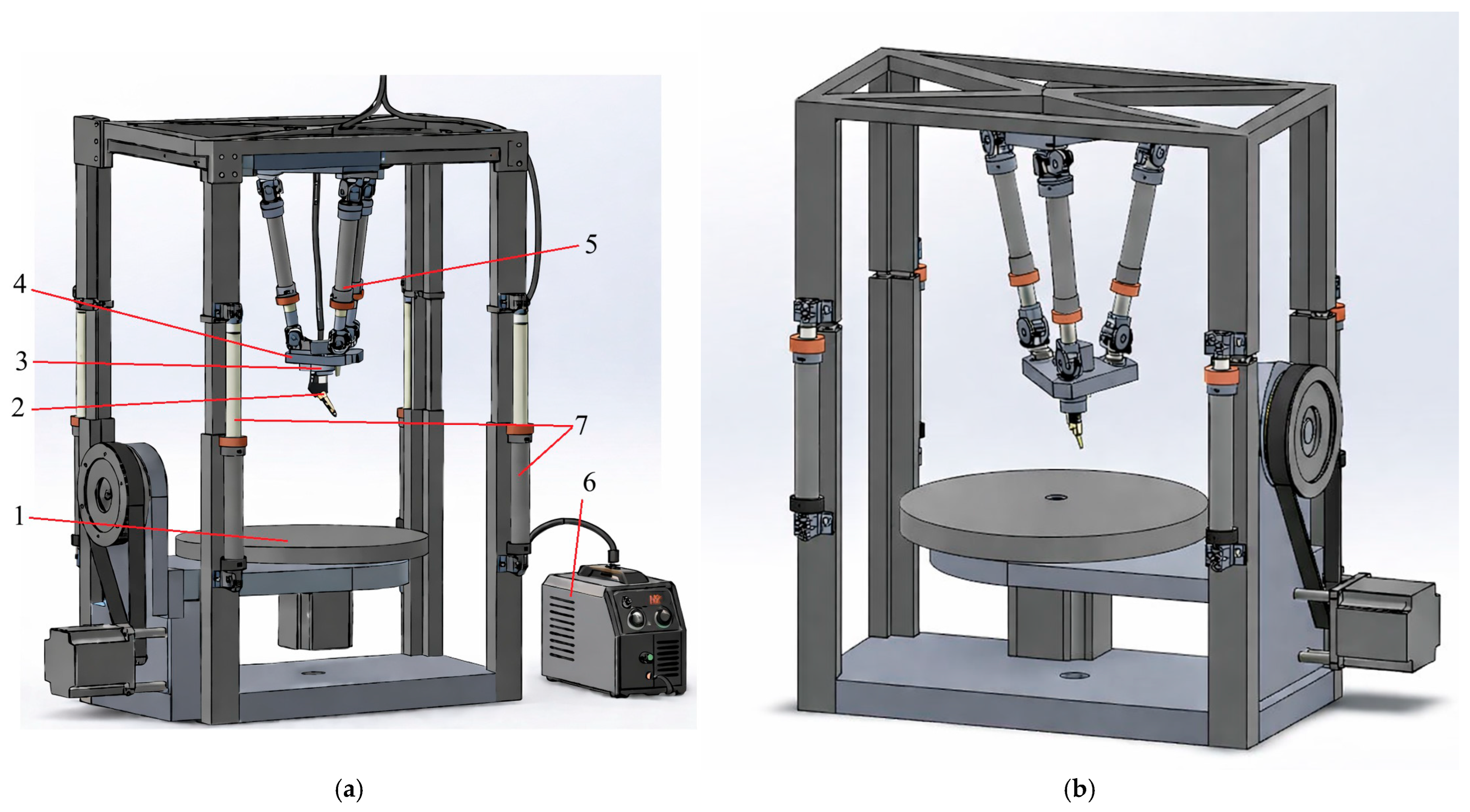
Figure 1. Concept of a metal 3D printer: (a) open view; (b) closed view.
Robotics 15 00016 g001
Figure 2. Kinematic diagram of the actuating mechanism.
Robotics 15 00016 g002
Figure 3. Solution to the inverse kinematics problem of the 3-UPU+2 actuator mechanism.
Robotics 15 00016 g003
Figure 4. The workspace results for the multifunctional mobile 3D printer: (a) Workspace in the closed (assembled) configuration. (b) Workspace in the open configuration.
Robotics 15 00016 g004
Figure 5. The combined workspace results for the multifunctional mobile 3D printer.
Robotics 15 00016 g005
Table 1. Constant parameters used in the analysis.
ParameterSymbolValueUnit
Radius A r a 400mm
Radius B   r b 200mm
Initial X coordinate X P 0   100mm
Initial Y coordinate Y P 0   100mm
Initial Z coordinate Z P 0   −1000mm
Angle 1 θ 1 0°
Angle 2 θ 2 120°
Angle 3 θ 3 240°
Offsetd−400mm
Rotation angle Y ξ y 10°
Rotation angle Z ξ z 30°
Length 1 actuator S 1 600mm
Length 2 actuator S 2 600mm
Length 3 actuator S 3 600mm
X coordinate of point K X k 0mm
Y coordinate of point K Y k 0mm
Z coordinate of point K   Z k −1700mm
Parameter a k a k 300mm
Table 2. Velocity analysis.
X P 0  (mm) Y P 0 (mm) Z P 0  (mm) X ˙ P 0  (mm/s) Y ˙ P 0  (mm/s) Z ˙ P 0  (mm/s) S ˙ 1  (mm/s) S ˙ 2  (mm/s) S ˙ 3  (mm/s)
1300300−100000−5088.465281.947969.5644
2300300−1000−50−50−5058.976845.973118.9444
3300300−1000505050−58.9768−45.9731−18.9444
4−300300−1000505050−83.6660−98.6919−58.6662
5−300300−1000−505050−23.9046−67.6861−33.3462
6−300300−10005000−29.8807−15.5029−12.6600
7−300300−1000050017.92849.828429.9539
8−300−300−1000−50−50−50119.5229118.5741118.3488
9−300−300−1000+50+50−5023.904633.346267.6861
10−300−300−1000−50−50+50−23.9046−33.3462−67.6861
1100−100000−5094.868394.868394.8683
Disclaimer/Publisher’s Note: The statements, opinions and data contained in all publications are solely those of the individual author(s) and contributor(s) and not of MDPI and/or the editor(s). MDPI and/or the editor(s) disclaim responsibility for any injury to people or property resulting from any ideas, methods, instructions or products referred to in the content.