
Article

Discrete-Time Computed Torque Control with PSO-Based Tuning for Energy-Efficient Mobile Manipulator Trajectory Tracking

by
Patricio Galarce-Acevedo
1,* and
Miguel Torres-Torriti
2
1
Department of Electricity, Universidad Tecnológica Metropolitana, Santiago 7800002, Chile
2
Department of Electrical Engineering, Pontificia Universidad Católica de Chile, Santiago 7820436, Chile
*
Author to whom correspondence should be addressed.
Robotics 2026, 15(1), 19; https://doi.org/10.3390/robotics15010019
Submission received: 30 November 2025 / Revised: 31 December 2025 / Accepted: 5 January 2026 / Published: 9 January 2026

Abstract

Mobile manipulator robots have an increasing number of applications in industry because they extend the workspace of a fixed base manipulator mounted on a mobile platform, making it important to further investigate their control and optimization. This paper presents an implementation proposal for a coupled base–arm dynamics computed torque controller (CTC) for trajectory tracking of a differential-drive mobile manipulator, which considers the dynamics of the fixed base manipulator and the mobile base in a coupled way and compares its performance with that of a Proportional Derivative (PD) controller. Both controllers are tuned using Particle Swarm Optimization (PSO) with a cost function that aims to simultaneously reduce the control energy and the end-effector tracking error for different types of trajectories, and they operate in discrete time, thus accounting for inherent process delays. Simulation and laboratory implementation results show the superior performance of the CTC in both cases: in simulation, the average end-effector positioning error is reduced by 51.55% and the average RMS power by 46.44%; in the laboratory experiments, the average end-effector positioning error is reduced by 43.29% and the average RMS power by 53.49%, even in the presence of possible model uncertainties and system disturbances.

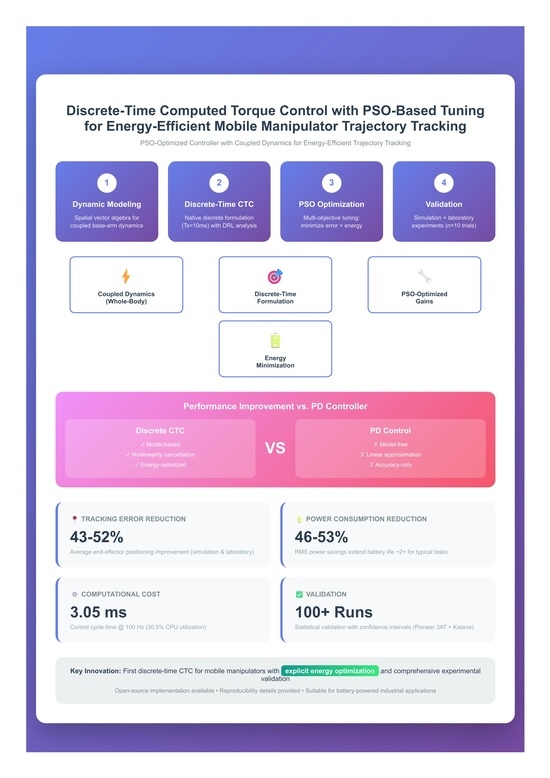
Graphical Abstract

1. Introduction

Mobile manipulator (MM) robots have gained increasing relevance in advanced automation by combining the mobility of wheeled platforms with the dexterity of one or more manipulators, thereby enabling logistics, assembly, inspection, and human-robot collaboration in industrial and service environments [1,2,3]. Recent applications in industry and precision agriculture demonstrate that MMs can significantly enhance flexibility and productivity in dynamic and partially structured environments, while simultaneously highlighting the need for robust and energy-efficient control strategies to ensure accurate trajectory tracking and safety [1,4].
From a control standpoint, MMs are nonlinear, strongly coupled systems subject to nonholonomic constraints, whose performance is affected by parametric uncertainties, wheel slippage, and external disturbances [3,5]. Several works have shown that treating the mobile base and the manipulator separately, or relying solely on kinematic models with PID/PD-type controllers, limits the ability to compensate for the coupled dynamics and may degrade end-effector accuracy under fast motions or physical interaction with the environment [1,6,7,8], whereas whole-body dynamic control approaches that explicitly account for base–arm coupling have demonstrated improved trajectory tracking and robustness in collaborative MMs and constrained interaction scenarios [9,10,11,12].
The practical implementation of such strategies is inherently discrete-time, due to the digital nature of sensors, actuators, and processing units, as well as communication and computation delays in embedded control systems [13,14,15,16]. For fixed base manipulators, it has been shown that designing the controller directly in discrete time allows one to explicitly account for sampling and delays while preserving stability and robustness properties in the presence of model uncertainties [13,17,18]. However, for mobile manipulators with coupled dynamics and nonholonomic constraints, published works have focused predominantly on continuous-time formulations that are subsequently discretized for implementation, whereas fully coupled whole-body dynamic formulations posed directly in discrete time appear less frequently in the recent surveyed literature [1,3].
In practice, computed torque and other inverse-dynamics-based controllers are executed on digital hardware under sampling, zero-order hold (ZOH) actuation, and non-negligible computation/communication delays. These effects introduce structured discretization errors and additional phase lag that prevent exact cancelation of nonlinear dynamics, even when the continuous-time model is accurate. Moreover, for mobile manipulators, coupled base–arm dynamics and constraint handling increase the computational burden, which may limit the achievable sampling rate and amplify the impact of discretization on end-effector accuracy [13,16].
Moreover, the tuning of model-based controllers often relies on manual adjustments or heuristic methods (e.g., Ziegler–Nichols type rules), which can be suboptimal in terms of tracking error and control effort, especially for redundant and nonlinear systems such as MMs [19,20]. Combining the full dynamic model including torque-based schemes, predictive control, and robust control with artificial intelligence or optimization techniques such as neural networks, fuzzy logic, and metaheuristics enables systematic parameter tuning to improve tracking accuracy while reducing control effort and energy consumption [19,21,22,23,24]. These contributions illustrate a clear trend towards replacing purely empirical tuning with automatic adjustment schemes grounded on the dynamic model and on cost functions that jointly encode performance and efficiency criteria [19,25].
This work addresses the above gap by combining coupled whole-body dynamics, explicit discrete-time execution considerations, and systematic gain tuning under energy-aware criteria. Unlike prevalent approaches that formulate nonlinear controllers in continuous time and then discretize them for deployment, we focus on a discrete-time computed torque implementation for a coupled nonholonomic mobile manipulator and explicitly analyze how sampling and ZOH actuation affect cancelation and tracking errors. This work does not claim novelty in computed torque control per se; instead, it contributes a fully coupled whole-body CTC implementation formulated directly in discrete time—with sampling and zero-order hold (ZOH) effects made explicit—together with a discrete-time cancelation/error analysis and an energy-aware PSO-based gain tuning and experimental validation pipeline [26,27].
This paper addresses the practical gap between continuous-time whole-body inverse-dynamics control formulations and their deployment on digital platforms by presenting a discrete-time computed torque control (CTC) methodology for a coupled nonholonomic mobile manipulator, explicitly incorporating sampling and zero-order hold (ZOH) actuation effects [1,3,13,16]. Rather than introducing a new inverse-dynamics principle, the focus is on deployable discrete-time whole-body implementation and on quantifying the tracking limitations that arise from discretization when cancelation is performed on digital hardware [13,26,27]. The contributions are summarized as follows:
  • A coupled whole-body CTC implementation for a differential-drive mobile manipulator, accounting for base–arm dynamic coupling and nonholonomic constraints [5,11,12]. Unlike decentralized schemes that ignore dynamic interactions, this formulation explicitly compensates for coupling forces to improve tracking accuracy.
  • A discrete-time cancelation and tracking error analysis under sampling and ZOH actuation, characterizing the non-idealities that prevent exact compensation of nonlinear dynamics in practice [13,16]. This analysis bridges the gap often overlooked by continuous-time designs that are simply discretized without accounting for sampling artifacts.
  • A multiobjective PSO-based gain tuning procedure that jointly minimizes end-effector tracking error and control energy metrics, providing a systematic alternative to heuristic/manual tuning [19,24]. By shifting the optimization burden offline, this approach avoids the heavy online computational cost of predictive controllers (MPC) [28] while achieving optimized performance.
  • A comparative evaluation against a discrete-time PD baseline in simulation and laboratory experiments, including a computational-cost assessment to support real-time feasibility at the selected sampling period [14,16].
The remainder of this article is organized as follows. Section 2 presents the coupled discrete-time dynamic model of the considered mobile manipulator and the whole-body formulation used to describe the base–arm interaction. Section 3 details the design of the discrete-time computed torque controller, the definition of the cost function, and the PSO-based gain tuning procedure, including the formulation of the discrete-time PD reference controller. Section 4 reports simulation and experimental trajectory tracking results, comparing end-effector tracking error and control energy metrics between the proposed and reference controllers, while Section 5 summarizes the main conclusions and outlines directions for future work.

2. State of the Art

The dynamic modeling of mobile manipulators has evolved from formulations that treat the base and the manipulator separately to coupled models that describe the system as a high degree of freedom robot subject to holonomic and nonholonomic constraints [5,29]. These coupled models capture inertia, Coriolis, friction, and contact forces between the base and the arm with higher fidelity, which is particularly relevant for demanding trajectory tracking tasks in the presence of external disturbances [3,29]. More recently, approaches based on differentiable dynamic models for mobile manipulators have been proposed that rely on recursive Featherstone type algorithms, further underscoring the importance of complete dynamic models in the design of control laws [30,31].
In trajectory tracking for mobile manipulators, one line of research relies on inverse kinematics formulations combined with PID/PD controllers or intelligent variants that generate velocity commands for the base and the arm without explicitly exploiting the coupled dynamics [6,32,33,34]. A recent high level overview on accuracy in mobile manipulators confirms that such decoupled kinematic architectures, often augmented with PID/PD loops and neural or fuzzy compensators, remain prevalent due to their simplicity and low computational cost, although model-based controllers considering coupled base–arm dynamics have consistently demonstrated superior tracking accuracy and robustness under uncertainties and strong base–arm coupling [3,10,11,12,35,36].
A second line of research builds on the continuous-time dynamic model of the MM and employs whole-body dynamic control strategies, including model predictive control (MPC) and robust schemes [10,11,35]. While whole-body MPC is highly effective for handling constraints and multiple objectives, it typically requires solving a numerical optimization problem at each time step, which can impose a significant computational burden [35,37]. In contrast, computed torque control (CTC) structures provide a closed-form control law that, although requiring the evaluation of the full dynamic model, avoids online iterative optimization, offering a computationally efficient alternative for trajectory tracking when constraints are addressed via tuning or planning [11,12,38], as well as works addressing nonholonomic mobile manipulators under dynamic uncertainties and external torque disturbances [39].
Whole-body model predictive control (MPC) for mobile manipulators has become a prominent paradigm due to its systematic handling of constraints and multi-objective criteria over a receding horizon. For instance, MPC-based strategies have been reported for autonomous mobile manipulators, including formulations that combine predictive optimization with adaptive fuzzy techniques to cope with partially unknown dynamics within the optimization loop [35].Whole-body MPC has also been validated on dynamically stable mobile manipulators, demonstrating hardware performance in demanding behaviors such as end-effector tracking and door opening [37]. While MPC approaches can be highly effective, they typically require solving an optimization problem online at each time step, which may impose a substantial computational burden compared to closed-form inverse-dynamics control laws.
Beyond manual and heuristic tuning, systematic multiobjective tuning through evolutionary optimization has been advocated as a methodology to select tuning parameters in advanced controllers under competing objectives. In predictive-control settings, multiobjective evolutionary algorithms have been used to tune controller parameters by explicitly exploring trade-offs among performance-related indices [28]. While this line of work provides a strong foundation for systematic multiobjective tuning, predictive schemes usually entail a nontrivial online computational cost, whereas inverse-dynamics controllers can preserve a closed-form structure and shift the multiobjective search to an offline stage.
In parallel, the robot control community has advanced nonlinear controllers formulated directly in discrete time, mainly for fixed-base manipulators and mobile robots, including discrete-time sliding-mode control, repetitive control, and nonlinear predictive variants [13,14,15,16,18,40]. These works emphasize that explicit discrete-time design enables capturing sampling, delays, and quantization effects while maintaining stability and robustness guarantees [13,15,16].
Learning-based components, including reinforcement learning (RL), have been increasingly considered in mobile manipulation tasks, particularly in contact-rich behaviors where modeling is challenging. For example, recent mobile manipulator door-opening systems have reported RL-based strategies alongside classical adaptive control pipelines [41]. In parallel, hybrid learning/model-based approaches have been proposed to preserve a physics-consistent control backbone while improving robustness to modeling errors, such as online dynamics estimation integrated into a computed-torque structure [42]. These trends motivate gray-box alternatives where model-based torque generation is retained while systematic optimization is used to tune gains under competing objectives.
Recent work has continued to develop inverse-dynamics-based controllers with enhanced robustness and convergence properties for uncertain manipulators, including robust fixed-time inverse dynamic control formulations [43]. However, for coupled nonholonomic mobile manipulators, the combination of (i) whole-body inverse-dynamics control executed under realistic sampling/ZOH constraints, (ii) explicit discretization-error analysis of cancellation limitations, and (iii) energy-aware multiobjective gain tuning with experimental validation under embedded computational constraints remains comparatively under-explored, motivating the present work.
Regarding controller tuning, several recent works exploit optimization and artificial intelligence techniques to adjust parameters of model-based controllers, with the aim of improving tracking accuracy while reducing control effort and energy consumption [19,21,22,23,24]. In the specific context of MMs, intelligent energy management frameworks have been proposed monitoring and optimizing MM energy consumption using machine learning techniques, reinforcing the growing interest in incorporating energy criteria into controller design and tuning [25].
Taken together, these contributions reveal a clear trend towards the use of coupled dynamic models and optimization or artificial intelligence techniques to improve both trajectory tracking accuracy and energy behavior in complex robotic systems [1,19,25]. Nevertheless, the reviewed literature indicates that, although various whole-body dynamic control strategies for MMs and multiple optimization-based schemes for model-based controllers have been investigated, the combination of (i) a whole-body dynamic controller formulated directly in discrete time for an MM with nonholonomic constraints and (ii) automatic gain tuning via metaheuristics explicitly aimed at reducing both end-effector tracking error and control energy has received limited attention and remains an open research direction [10,36].

3. Dynamic Model of the Mobile Manipulator

The dynamic model of the MM was obtained using the spatial vector algebra formalism proposed by [30]. As previously mentioned, this formulation considers a floating base with six degrees of freedom (DoF) and non-permanent wheel contact, such as slippage occurring on one or more wheels or uneven ground surfaces, along with one or more manipulator arms mounted on this floating base.

3.1. Fordward Dynamics of the Mobile Manipulator

The equations of the forward dynamic model, which relate the accelerations of the mobile base and those of the manipulator joints, can be summarized as follows:
a 1 = I 1 1 f 1 c + I 1 1 i = 2 N X i 1 f i c a 1 c I 1 1 i = 2 N X i 1 f i ext a 1 / i ext I 1 1 f 1 ext a lext
q ¨ i = τ i S i T f i I i S i X 1 i a 1 + c i S i T I i S i 1
where a 1 is the spatial acceleration of the mobile base, q ¨ i denotes the acceleration of the i-th joint body of the manipulator, S i is the motion subspace matrix of the i-th joint, I i represents the spatial inertia of body i, and I 1 refers to the total articulated (composite) spatial inertia seen at the floating base body 1, i.e., including the inertias of the base and all its descendant bodies in the kinematic tree. The matrices X i j and X i j represent, respectively, the transformation matrices of motion and force from link i to link j. The term c i corresponds to the spatial acceleration of the i-th joint due to velocity-product terms, f 1 c is the spatial force associated with the same velocity-product effects, and f 1 e x t is the external force acting on the base. Similarly, external forces acting on the i-th link of the manipulator are denoted by f i , while τ i represents the torque applied to the i-th joint. The traction and normal reaction forces exerted on the wheels are included in f 1 e x t . For further details, see [29].
Equations (1) and (2) are written using spatial vector algebra and the articulated-body formalism. In this notation, X i j denotes the 6 × 6 spatial motion (Plücker) transform that maps spatial motion quantities (twists/accelerations) expressed in frame i into frame j, while X i j denotes the corresponding spatial force transform that maps spatial wrenches from frame i into frame j. These transforms are dual operators induced by the same rigid-body transform and satisfy the standard relationship X = ( X 1 ) T . A detailed, term-by-term definition of the spatial transforms and the ABA quantities employed here (e.g., I i , S i , c i , and the recursion for a 1 and q ¨ i ) can be found in [29].
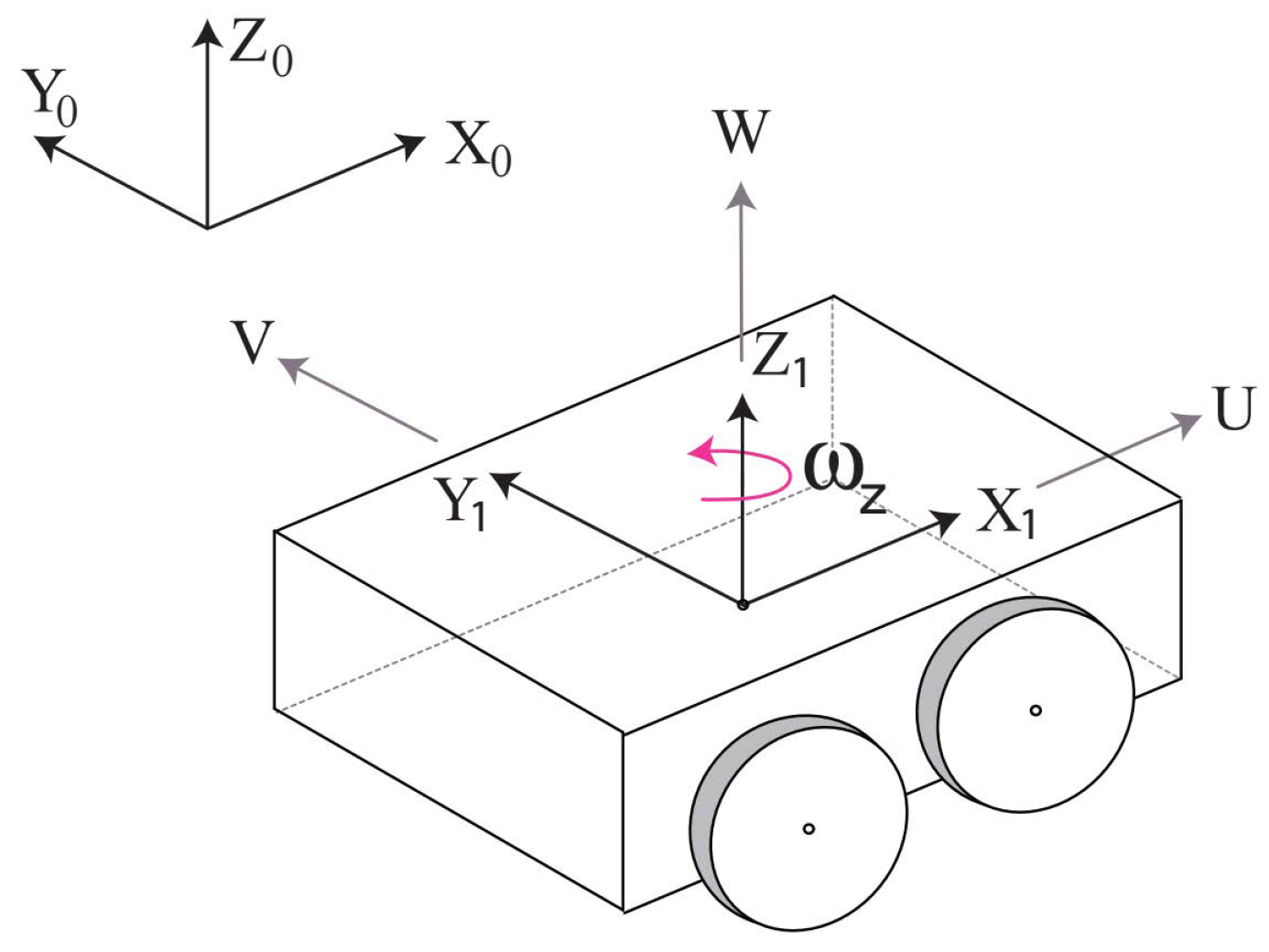
As previously described and depicted in Figure 1, the mobile base has six DoF, characterized by the angular acceleration vector α b = [ ω ˙ x ω ˙ y ω ˙ z ] T and the linear acceleration vector a b = [ u ˙ v ˙ w ˙ ] T , expressed in the base reference frame X b , Y b , and Z b . For simulation and laboratory implementation purposes, the floating base was simplified and modeled as a three DoF planar base, allowing rotation and translation in the Cartesian plane, that is, α b = [ 0 0 ω ˙ z ] T and a b = [ u ˙ v ˙ g ] T , where g denotes gravitational acceleration.
Although the coupled dynamics in (1) and (2) are derived for a 6-DoF floating base, the experimental platform operates on a flat indoor floor and employs differential-drive locomotion. Therefore, roll/pitch and vertical base dynamics are neglected and the base is modeled as a 3-DoF planar rigid body (translation in XY and yaw about Z), which is consistent with the experimental conditions. This simplification reduces model complexity but limits fidelity under uneven terrain, significant wheel slip, or aggressive maneuvers where out-of-plane dynamics and wheel–ground interactions become non-negligible.
Considering this simplification, the dynamic model equations of the mobile base are as follows:
u ˙ v ˙ w ˙ = S θ b ω z 2 p y + C θ b ω z 2 p x S θ b ω z u + C θ b ω z v S θ b ω z 2 p x + C θ b ω z 2 p y S θ b ω z v C θ b ω z u g +   f 1 ext x m b f 1 ext y m b 0
ω ˙ z = τ 1 e x t z I 1 z z τ 1 e x t z / a r m I 1 z z
Subject to the differential-drive no-slip constraint (zero lateral velocity in the body frame), v ( t ) = 0 . Assuming v ( 0 ) = 0 , enforcing v ˙ ( t ) = 0 yields
v ˙ = S θ b ω z 2 p x + C θ b ω z 2 p y S θ b ω z v C θ b ω z u + f 1 ext y m b = 0
where θ b = ω z d t , S θ b and C θ b denote the sine and cosine of θ b , respectively; p x = U d t and p y = V d t represent the position of the base along the X 1 and Y 1 axes; f 1 ext x and f 1 ext y are the external forces acting along the X 1 and Y 1 axes; m b is the mass of the base; I 1 z z denotes the base inertia about the Z 1 axis; τ 1 e x t z is the external torque applied around the Z 1 axis; and τ 1 e x t z / a r m represents the torque generated by the manipulator that affects the base.
Equation (5) is the acceleration-level form of the differential-drive no-slip constraint. In particular, the lateral base velocity in the body frame must satisfy v ( t ) = 0 ; assuming v ( 0 ) = 0 , enforcing v ˙ ( t ) = 0 ensures v ( t ) 0 and can be interpreted as imposing the corresponding lateral contact reaction (through f 1 ext y ) required to prevent side slip. Hence, initial conditions and reference trajectories must be consistent with the constraint in order to avoid infeasible states and numerical drift during time stepping. In addition, the reference generation procedure in Algorithm 1 relies on a Newton–Raphson inverse-kinematics update and can become ill-conditioned near kinematic singularities; in practice, robustness can be improved by employing a Moore–Penrose pseudoinverse for J k computed with a singular-value tolerance (truncated pseudoinverse regularization), together with step-size limiting and saturation. Finally, because the controller is implemented in discrete time, state sampling, ZOH actuation, and numerical integration of accelerations introduce bounded discretization/integration errors, which motivates the error terms and discussion provided in Section 6.2 for discrete-time computed-torque control.
Algorithm 1: Simplified pseudocode for trajectory generation
Robotics 15 00019 i001
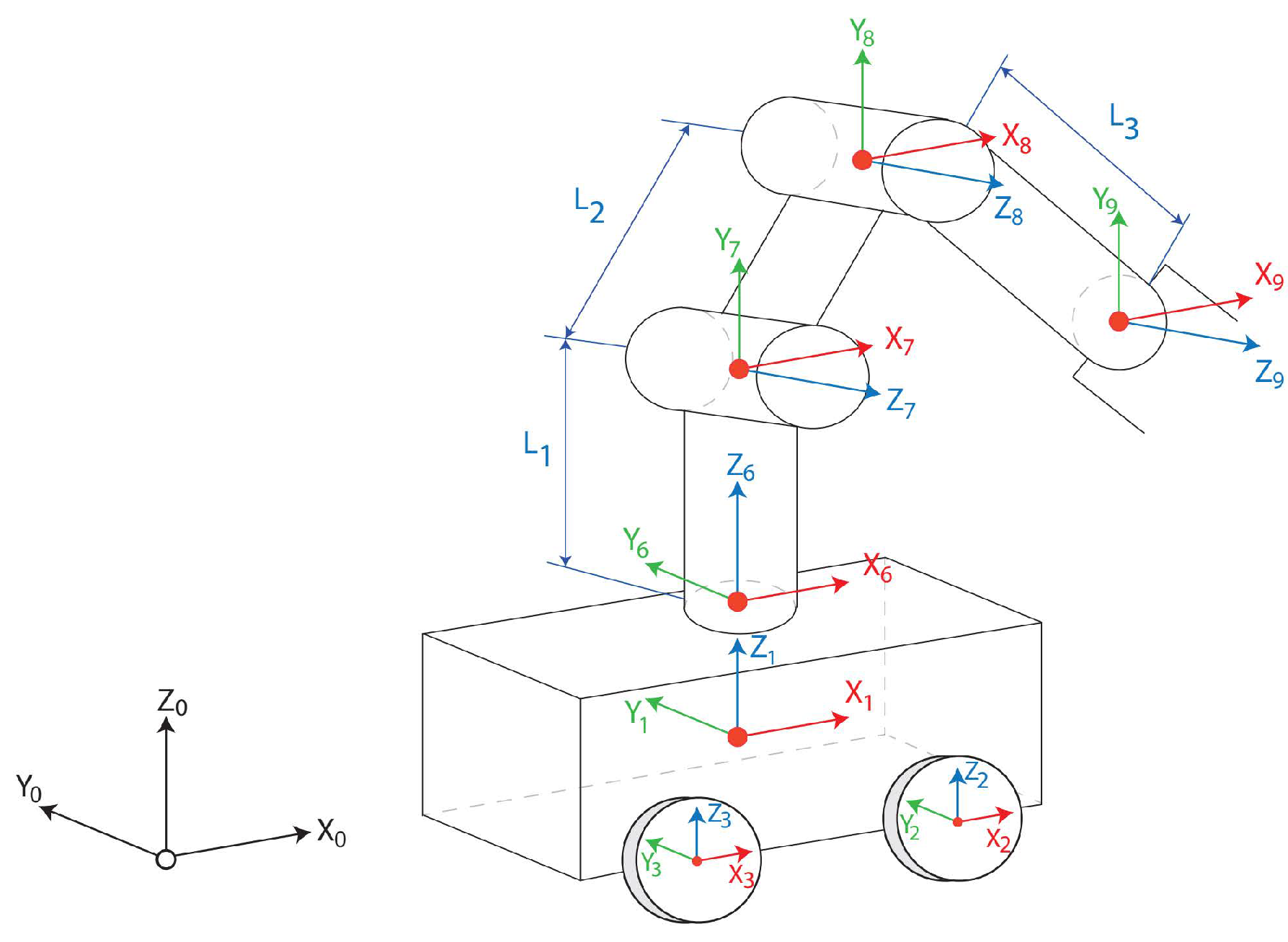
To derive the dynamic model of MM, the arm mounted on the base was modeled as a 3-DoF robotic arm with motion in the waist, shoulder, and elbow joints. Figure 2 illustrates the reference frames used. As discussed previously, the algorithm used to obtain the dynamic model of the MM accounts for the mutual coupling between the base and the manipulator: the accelerations of the mobile base influence the motion of the arm’s waist joint, while the dynamics of the base are, in turn, affected by the reaction forces generated by the motion of the arm. This formulation enables the integration of the mobile base dynamics and the fixed base–arm dynamics into a unified dynamic model of the MM.

3.2. Inverse-Dynamics of the Mobile Manipulator

The forward dynamics Equations (1) and (2) can be arranged to obtain the inverse-dynamics of the mobile manipulator, separating the joint variables corresponding to the rigid mobile base from that of the articulated robotic manipulator rigidly mounted on the base [30]. To this end, let the generalized configuration vector be defined as
q = q b q m R n b + n m ,
where q b R n b denotes the generalized coordinates of the mobile base (e.g., planar position and orientation), and q m R n m denotes the joint coordinates of the manipulator.
The corresponding generalized velocity and acceleration vectors are denoted by q ˙ and q ¨ , respectively.

3.2.1. Coupled Dynamics

The full-body dynamics of the mobile manipulator are described by the Euler–Lagrange equations
M ( q ) q ¨ + C ( q , q ˙ ) q ˙ + g ( q ) = τ + J ( q ) λ ,
where
  • M ( q ) R ( n b + n m ) × ( n b + n m ) is the symmetric positive definite inertia matrix;
  • C ( q , q ˙ ) q ˙ represents Coriolis and centrifugal effects;
  • g ( q ) is the gravity vector;
  • τ = τ b τ m is the vector of generalized actuation forces;
  • J ( q ) is the Jacobian associated with kinematic constraints or task-space interactions;
  • λ denotes the corresponding constraint or contact forces.
The inertia matrix satisfies the standard properties of robotic systems: M ( q ) is uniformly bounded and positive definite, and M ˙ ( q ) 2 C ( q , q ˙ ) is skew-symmetric [44].

3.2.2. Partitioned Form

For analysis purposes, the dynamics in (7) are partitioned as
M b b M b m M m b M m m q ¨ b q ¨ m + h b h m = τ b τ m + J b J m λ ,
where h ( q , q ˙ ) = C ( q , q ˙ ) q ˙ + g ( q ) .
The off-diagonal inertia terms M b m and M m b capture the dynamic coupling between base and manipulator motions.

3.2.3. Nonholonomic Base Constraints

For wheeled mobile bases, nonholonomic velocity constraints are commonly present and can be expressed as
A ( q b ) q ˙ b = 0 .
Such constraints are handled either by introducing Lagrange multipliers in (7) or by projecting the dynamics onto a reduced set of admissible velocities. After constraint elimination, the reduced-order dynamics take the form
M r ( ξ ) ξ ¨ + h r ( ξ , ξ ˙ ) = τ r ,
where ξ denotes the vector of independent generalized coordinates.

4. Computed Torque Control Strategy

Given a desired generalized acceleration q ¨ d , the inverse-dynamics problem consists of computing the actuation forces
τ = M ( q ) q ¨ d + C ( q , q ˙ ) q ˙ + g ( q ) J ( q ) λ .
Equation (11) forms the basis of computed torque control (CTC) strategies for mobile manipulators [26,45]. More specifically, the ideal computed torque control law is defined as follows:
τ c t c = M ( q ) v + C ( q , q ˙ ) q ˙ + g ( q ) J ( q ) λ ,
with
v = q ¨ d + K d q ˜ ˙ + K p q ˜ ,
where q ˜ = q d q is the position tracking error, q ˜ ˙ = q ˙ d q ˙ is the velocity tracking error, and K p , K d 0 are the controller’s adjustable proportional and derivative gains, defined as positive definite diagonal gain matrices of size ( n b + n m ) × ( n b + n m ) .
The ideal computed torque control law (12) applied to the mobile manipulator system with nominal dynamics (7) ideally cancels the nonlinear Coriolis, centrifugal, gravity, and constraint terms, reducing the closed-loop system dynamics to
q ˜ ¨ + K v q ˜ ˙ + K p q ˜ = 0 .
Although the term K d q ˜ ˙ + K p q ˜ in (14) resembles a proportional-derivative (PD) controller, it is not a PD controller because the CTC control law multiplies this term by the nonlinear inertia matrix M ( q d q ˜ ) = M ( q ) . Therefore, this constitutes a nonlinear control scheme, since M ( q ) is inherently nonlinear [46]. The computed torque control technique is based on designing a control law (12) that cancels the nonlinearities of the system (7). The CTC law is the simplest form of feedback linearization [26]. Other variants of feedback linearization involve coordinate transformations in addition to defining a nonlinear feedback law [27]. Although perfect cancelation is not achievable in practice due to model uncertainties, external disturbances, and control signals time-discretization, the system (7) can be stabilized with bounded tracking errors and can be approximated by a linear model locally about the operating trajectory, as shown in the next section, which presents the stability analysis of the discrete-time computed torque control for mobile manipulators. Furthermore, unlike a conventional PD controller, the CTC scheme explicitly incorporates desired velocity and acceleration inputs. This, in principle, allows for a more accurate tracking of the desired trajectory.

5. Stability Analysis of the Discrete-Time Computed Torque Control for Mobile Manipulators

The theoretical results concerning the stability and convergence guarantees of the sampled computed torque control law for mobile manipulators under bounded cancelation errors (bounded disturbance and sampling period) are presented. The robust stability of the continuous-time CTC law is shown first, before presenting that of the discretized CTC law and the input-to-state stability (ISS) analysis for the closed-loop sampled system with the exact zero-order hold discretization.

5.1. Basic Definitions

Definition 1 
(Zero-Order Hold Operator). Let { t k } k Z 0 be a uniform sampling sequence with sampling period T s > 0 , i.e., t k = k T s . Let u : Z 0 R m be a discrete-time signal. The zero-order hold (ZOH) operator Z T s maps u to a continuous-time signal u h : R 0 R m defined by
u h ( t ) = ( Z T s u ) ( t ) : = u ( k ) , t [ t k , t k + 1 ) , k Z 0 .
That is, the ZOH operator holds each discrete-time sample constant over the entire sampling interval until the next update.
Definition 2 
(ZOH-Induced Continuous-Time Signal). Let u [ k ] : = u ( k T s ) denote a sampled signal. The z-operator with zero-order hold reconstruction is defined as
u h ( t ) = Z T s { u [ k ] } = u [ k ] , t [ k T s , ( k + 1 ) T s ) .
Remark 1 
(Properties of the ZOH Operator). The zero-order hold operator is linear, causal, and piece-wise constant. It is the standard interconnection mechanism between digital controllers and continuous-time plants and induces discretization errors that scale linearly with the sampling period T s under bounded derivatives [47,48].
It is to be noted that the digital controller computes values only at sampling instants u [ k ] = u ( k T s ) , and the zero-order hold (ZOH) converts the discrete sequence u [ k ] into a continuous-time signal u ( t ) = u [ k ] , t [ k T s , ( k + 1 ) T s ) applied to the plant. The z-variable arises only in the discrete-time domain, as a formal representation of one-step time shifts in the sampled sequence. Recall the Z transform for a discrete time signal x [ k ] , which Z { x [ k ] } = X ( z ) = k = 0 x [ k ] z k , introduces the complex variable z, and Z 1 z X ( z ) = x [ k + 1 ] ; therefore, z can be interpreted as a one-step time shift of the sampled sequence. The ZOH determines how discrete-time signals are reconstructed in continuous time and does not define the z-variable, but it determines the discrete plant model that appears in the z-domain. A discrete-time transfer function G ( z ) representing some plant depends explicitly on the hold mechanism used between samples. With ZOH, the connection between the continuous-time and the discrete-time plant is
G ( z ) = Z L 1 G ( s ) s 1 e s T s t = k T s

5.2. Stability Preliminary Notions

Lemma 1 
(Boundedness of Inertia Mismatch). Let M ( q ) and M ^ ( q ) denote the true and modeled inertia matrices of a mobile manipulator. Suppose that q ( t ) evolves in a compact set Q and that there exist constants m max , m ^ max < such that
M ( q ) m max , M ^ ( q ) m ^ max , q Q .
Then the inertia mismatch M ( q ) M ^ ( q ) is uniformly bounded, and in particular
M ( q ) M ^ ( q )   m max + m ^ max , q Q .
Proof. 
The result follows directly from the triangle inequality of induced matrix norms:
M M ^ M + M ^ .
Substituting the assumed bounds completes the proof.    □
Lemma 2 
(Boundedness of Coriolis/Centrifugal Mismatch). Let C ( q , q ˙ ) and C ^ ( q , q ˙ ) denote the true and modeled Coriolis/centrifugal matrices of a mobile manipulator. Suppose that ( q ( t ) , q ˙ ( t ) ) evolves in a compact set Q × V and that there exist constants c max , c ^ max < such that
C ( q , q ˙ ) c max , C ^ ( q , q ˙ ) c ^ max , ( q , q ˙ ) Q × V .
Then the Coriolis/centrifugal mismatch C ( q , q ˙ ) C ^ ( q , q ˙ ) is uniformly bounded, and in particular
C ( q , q ˙ ) C ^ ( q , q ˙ ) c max + c ^ max , ( q , q ˙ ) Q × V .
Proof. 
The Coriolis/centrifugal matrix depends smoothly on q and linearly on q ˙ [30,49]. Compactness of Q × V implies boundedness of both C and C ^ . The result then follows from the triangle inequality:
C C ^ C + C ^ .
 □
Lemma 3 
(Boundedness of Gravity Mismatch). Let g ( q ) and g ^ ( q ) denote the true and modeled gravity vectors of a mobile manipulator. Suppose that q ( t ) evolves in a compact set Q and that there exist constants g max , g ^ max < such that
g ( q ) g max , g ^ ( q ) g ^ max , q Q .
Then the gravity mismatch g ( q ) g ^ ( q ) is uniformly bounded, and in particular
g ( q ) g ^ ( q ) g max + g ^ max , q Q .
Proof. 
The gravity vector g ( q ) is a smooth function of q arising from the potential energy of rigid bodies [27,49]. Smoothness implies boundedness on compact sets. The conclusion follows directly from the triangle inequality.    □
Lemma 4 
(Boundedness of Jacobian Mismatch). Let J ( q ) and J ^ ( q ) denote the true and modeled geometric Jacobian matrices of a rigid-body mobile manipulator. Suppose that the generalized configuration q ( t ) evolves in a compact set Q R n that excludes kinematic singularities. Assume further that there exist constants j max , j ^ max < such that
J ( q ) j max , J ^ ( q ) j ^ max , q Q .
Then the Jacobian mismatch
J ( q ) J ^ ( q )
is uniformly bounded on Q , and in particular satisfies
J ( q ) J ^ ( q ) j max + j ^ max , q Q .
Proof. 
The geometric Jacobian of a rigid-body system is a smooth function of the configuration variables and consists of trigonometric and geometric terms [50]. Smoothness implies boundedness on compact sets, and exclusion of kinematic singularities ensures that both J ( q ) and J ^ ( q ) remain finite over Q . The result then follows directly from the triangle inequality:
J J ^ J + J ^ .
Remark 2 
(Boundedness of the Inertia Matrix, the Jacobian, and the Coriolis and gravity terms). For a rigid-body mobile manipulator (fixed or floating base), the inertia matrix M ( q ) satisfies the classical properties of symmetry and positive definiteness, smoothness, and uniform boundedness on compact configuration sets [30,49]. This assumption is standard because M ( q ) is constructed from rigid-body masses and inertia tensors, which are finite and configuration-independent. Configuration dependence arises only through Jacobians and rotations, which are bounded on compact sets. On the other hand, all real mobile manipulators operate within bounded joint ranges and bounded base velocities/poses. This makes the compactness of the configuration space Q a natural assumption, not a mathematical artifice. Last but not least, every classical stability proof for computed torque control [27,49,51] implicitly assumes this boundedness to ensure well-defined inverse-dynamics and uniform Lyapunov bounds. The same reasoning applies to the Jacobian J ( q ) , Coriolis C ( q , q ˙ ) , and gravity g ( q ) terms, which are also bounded in practice on compact configuration spaces, giving rise to the boundedness of the mistmatch of the corresponding terms.
Lemma 5 
(Bounds on Sampling Errors). Let q ( t ) R n be a twice continuously differentiable signal sampled at times t k = k T s , with sampling period T s > 0 . Define the sampling errors over the interval [ t k , t k + 1 ) as
ϵ 1 ( t ) : = q ( t ) q ( t k ) , ϵ 2 ( t ) : = q ˙ ( t ) q ˙ ( t k ) .
Assume that the velocity and acceleration are uniformly bounded, i.e., as follows:
q ˙ ( t ) q ˙ max , q ¨ ( t ) q ¨ max , t 0 .
Then, for all t [ t k , t k + 1 ) , the sampling errors satisfy
ϵ 1 ( t ) T s q ˙ max , ϵ 2 ( t ) T s q ¨ max .
Proof. 
For any t [ t k , t k + 1 ) , the fundamental theorem of calculus yields
q ( t ) q ( t k ) = t k t q ˙ ( τ ) d τ .
Taking norms and using the velocity bound gives
ϵ 1 ( t ) t k t q ˙ ( τ ) d τ q ˙ max ( t t k ) q ˙ max T s .
Similarly
q ˙ ( t ) q ˙ ( t k ) = t k t q ¨ ( τ ) d τ ,
which implies
ϵ 2 ( t ) t k t q ¨ ( τ ) d τ q ¨ max ( t t k ) q ¨ max T s .
This completes the proof.    □
Remark 3 
(Conservatism of the Sampling Error Bounds over T s ). The bounds in Lemma 5 scale linearly with the sampling period T s and are conservative in the sense that they do not exploit higher-order smoothness. Tighter bounds of order O ( T s 2 ) can be obtained under additional assumptions on higher-order derivatives; however, the present bounds suffice for ISS and practical stability analyses that follow.
These bounds are widely used in sampled data control and discretization analyses for both linear and nonlinear systems [27,47,48].
Theorem 1 
(Robust Stability of Computed Torque Control). Consider the mobile manipulator dynamics (7), where M ( q ) is symmetric positive definite and satisfies the standard skew-symmetry property M ˙ 2 C .
Let the control input be given by the computed torque law (12) and (13).
Assume the lumped model mismatch
Δ = ( M ^ M ) v + ( C ^ C ) q ˙ + ( g ^ g ) + ( J ^ ( q ) J ( q ) ) λ
is uniformly bounded, i.e., as follows:
Δ Δ ¯ , t 0 ,
for some constant Δ ¯ > 0 .
Then the closed-loop tracking error system is uniformly ultimately bounded. In particular, the velocity tracking error q ˜ ˙ converges to the compact set
B q ˙ = q ˜ ˙ R n b + n m : q ˜ ˙ 2 Δ ¯ λ min ( K d ) ,
and the position tracking error q ˜ remains bounded.
Proof. 
Substituting (12) and (13) into the true dynamics (7) yields the closed-loop error dynamics
M ( q ) q ˜ ¨ + C ( q , q ˙ ) q ˜ ˙ + K d q ˜ ˙ + K p q ˜ = Δ .
Consider the Lyapunov function candidate
V = 1 2 q ˜ ˙ M ( q ) q ˜ ˙ + 1 2 q ˜ K p q ˜ ,
which is positive definite and radially unbounded.
Taking the time derivative of V along trajectories of (20) and using the skew-symmetry property of M ˙ 2 C yields
V ˙ = q ˜ ˙ K d q ˜ ˙ + q ˜ ˙ Δ .
Applying the Cauchy–Schwarz inequality and the bound (18), we obtain
V ˙ λ min ( K d ) q ˜ ˙ 2 + Δ ¯ q ˜ ˙ .
For all q ˜ ˙ 2 Δ ¯ λ min ( K d ) , the right-hand side of (23) is strictly negative, implying that V ˙ is negative outside the compact set B q ˙ defined in (19).
Therefore, the closed-loop system is uniformly ultimately bounded, with q ˜ ˙ converging to B q ˙ and q ˜ remaining bounded for all initial conditions.    □

5.3. Discrete-Time Computed Torque Control Stability Analysis

5.3.1. Discrete-Time Stability Under Imperfect Inverse-Dynamics

Consider the mobile manipulator dynamics discretized with sampling period T s > 0 under zero-order hold actuation. Let q k , q ˙ k denote the generalized coordinates and velocities at sampling instant k, and let q d , k , q ˙ d , k denote the desired trajectory.
Define the tracking errors
q ˜ k = q d , k q k , q ˜ ˙ k = q ˙ d , k q ˙ k ,
and the stacked error state
e k = q ˜ k q ˜ ˙ k R 2 ( n b + n m ) .

5.3.2. Discrete-Time Error Dynamics

Under computed torque control with imperfect model cancelation, the closed-loop error dynamics can be expressed in discrete time as
e k + 1 = A e k + B Δ k ,
where
  • A is the nominal closed-loop state matrix determined by K p , K d , and T s , and is assumed to be Schur stable.
  • B is a bounded input matrix.
  • Δ k is the lumped discrete-time modeling and linearization error.
Assumption 1 
(Bounded Discrete-Time Model Error). There exists a constant Δ ¯ > 0 such that
Δ k Δ ¯ , k 0 .
This term captures parametric uncertainty, unmodeled dynamics, and discretization effects.

5.3.3. Lyapunov Stability Analysis

Theorem 2 
(Discrete-Time Robust Stability of Computed Torque Control). Consider the discrete-time error dynamics (26) under Assumption 1. If the nominal matrix A is Schur stable, then the closed-loop tracking error system is uniformly ultimately bounded. Specifically, there exists a compact set
B e = e R 2 ( n b + n m ) : e c Δ ¯ ,
for some constant c > 0 , such that
lim sup k e k c Δ ¯ .
Proof. 
Since A is Schur stable, for any symmetric matrix Q = Q 0 there exists a unique solution P = P 0 to the discrete-time Lyapunov equation
A P A P = Q .
Define the Lyapunov function candidate
V k = e k P e k .
The Lyapunov difference along trajectories of (26) satisfies
Δ V k = V k + 1 V k = ( A e k + B Δ k ) P ( A e k + B Δ k ) e k P e k .
Using (30), this expression reduces to
Δ V k = e k Q e k + 2 e k A P B Δ k + Δ k B P B Δ k .
Applying norm inequalities and Assumption 1 yields
Δ V k λ min ( Q ) e k 2 + 2 A P B e k Δ ¯ + B P B Δ ¯ 2 .
Therefore, there exists a constant r > 0 such that Δ V k < 0 for all e k r . This implies that the error state e k converges to and remains within a compact neighborhood of the origin whose size is proportional to Δ ¯ .
Hence, the closed-loop discrete-time system is uniformly ultimately bounded.    □

5.4. Exact ZOH Discretization and ISS Analysis

5.4.1. Continuous-Time Error Dynamics

Consider the mobile manipulator dynamics under computed torque control with imperfect model cancelation. The closed-loop tracking error dynamics can be written as
M ( q ) q ˜ ¨ + C ( q , q ˙ ) q ˜ ˙ + K d q ˜ ˙ + K p q ˜ = Δ ( t ) ,
where q ˜ = q d q is the tracking error, K p , K d 0 , and Δ ( t ) denotes the lumped model cancelation error.
Define the error state
e ( t ) = q ˜ ( t ) q ˜ ˙ ( t ) .
Using standard manipulator properties and boundedness of M 1 , (35) can be written in control-affine form as
e ˙ ( t ) = A c ( q , q ˙ ) e ( t ) + B c ( q ) Δ ( t ) ,
where
A c = 0 I M 1 K p M 1 K d , B c = 0 M 1 .
For K p , K d 0 , the matrix A c is Hurwitz.

5.4.2. Exact Zero-Order Hold Discretization

Let the system be sampled with period T s > 0 under zero-order hold on the disturbance Δ ( t ) , i.e., as follows:
Δ ( t ) = Δ k , t [ k T s , ( k + 1 ) T s ) .
The exact ZOH discretization of (37) is given by
e k + 1 = A d e k + B d Δ k ,
where
A d = e A c T s , B d = 0 T s e A c τ B c d τ .
Since A c is Hurwitz, A d is Schur stable for all T s > 0 .
Assumption 2 
(Bounded Cancelation Error). There exists a constant Δ ¯ > 0 such that
Δ k Δ ¯ , k 0 .

5.4.3. ISS Lyapunov Analysis

Because A d is Schur stable, for any matrix Q = Q 0 there exists a unique solution P = P 0 to the discrete-time Lyapunov equation
A d P A d P = Q .
Define the Lyapunov function
V k = e k P e k .
Along trajectories of (40)
V k + 1 V k = ( A d e k + B d Δ k ) P ( A d e k + B d Δ k ) e k P e k = e k Q e k + 2 e k A d P B d Δ k + Δ k B d P B d Δ k .
Using norm inequalities and Assumption 2, there exist constants c 1 , c 2 > 0 such that
V k + 1 V k λ min ( Q ) e k 2 + c 1 e k Δ ¯ + c 2 Δ ¯ 2 .

5.4.4. Discrete-Time ISS Result

Theorem 3 
(Discrete-Time ISS Under Exact ZOH Discretization [49,51,52]). Consider the ZOH-discretized tracking error dynamics of a mobile manipulator under inverse-dynamics (computed torque) control
e k + 1 = A d e k + B d Δ k ,
where A d = e A c T s and B d = 0 T s e A c τ B c d τ denote the exact ZOH discretization of the continuous-time linearized error dynamics [47,48].
Assume the following:
1.
The continuous-time closed-loop matrix A c is Hurwitz, which is guaranteed by positive definite feedback gains K p , K d in the computed torque controller [49,51].
2.
The cancelation error Δ k is bounded as Δ k Δ ¯ .
Then the discrete-time error system is input-to-state stable (ISS) with respect to Δ k in the sense of [52,53]. In particular, there exist class- KL and class- K functions β ( · , · ) and γ ( · ) such that
e k β ( e 0 , k ) + γ ( Δ ¯ ) ,
where the steady-state bound γ ( Δ ¯ ) is linear in Δ ¯ and vanishes as T s 0 .
Proof. 
From (46), there exists a radius r > 0 such that V k + 1 V k < 0 whenever e k r . Standard discrete-time ISS arguments then imply that e k converges to and remains within a compact neighborhood of the origin whose size is proportional to Δ ¯ . The existence of functions β and γ follows directly from the quadratic bounds on V k and the Schur stability of A d .    □

5.4.5. Explicit ISS Gain Bound

Consider the discrete-time ZOH error dynamics
e k + 1 = A d e k + B d Δ k ,
with Δ k Δ ¯ and A d Schur stable.
Let P = P 0 solve
A d P A d P = Q , Q = Q 0 .
Define the Lyapunov function
V k = e k P e k .
Using standard norm inequalities, the Lyapunov difference satisfies
V k + 1 V k λ min ( Q ) e k 2 + 2 A d P B d e k Δ ¯ + B d P B d Δ ¯ 2 .
Define the constants
α : = λ min ( Q ) , β : = 2 A d P B d , δ : = B d P B d .
Then (52) can be written as
V k + 1 V k α e k 2 + β e k Δ ¯ + δ Δ ¯ 2 .
The right-hand side of (54) is negative whenever
e k r : = β + β 2 + 4 α δ 2 α Δ ¯ .
Thus, all trajectories enter and remain within the compact set
B e = e : e r .
Using the quadratic bounds
λ min ( P ) e k 2 V k λ max ( P ) e k 2 ,
we obtain the explicit ISS estimate
e k λ max ( P ) λ min ( P ) A d k e 0 + γ ( Δ ¯ ) ,
where the disturbance-to-state gain is given explicitly by
γ ( Δ ¯ ) = λ max ( P ) λ min ( P ) β + β 2 + 4 α δ 2 α Δ ¯
with
α = λ min ( Q ) , β = 2 A d P B d , δ = B d P B d .

5.4.6. Sampling Time-Explicit ISS Gain Bounds

We now make the disturbance-to-state gain γ ( Δ ¯ ) explicitly dependent on the sampling period T s , following standard sampled data analysis techniques [27,48].
Recall the exact ZOH discretization of the continuous-time error dynamics [47]
A d = e A c T s , B d = 0 T s e A c τ B c d τ ,
where A c is Hurwitz due to the positive definite feedback gains K p , K d in the inverse-dynamics controller [49,51].
Let · denote the induced Euclidean norm. Since A c is Hurwitz, there exist constants M 1 and λ > 0 such that
e A c t M e λ t , t 0 ,
a classical result for exponentially stable linear systems [27,54].
  • Bound on A d .
Using (61)
A d = e A c T s M e λ T s .
Bound on B d .
Similarly
B d 0 T s e A c τ B c d τ M B c 0 T s e λ τ d τ = M B c 1 e λ T s λ ,
which is standard in ZOH discretization error analysis [47,48].

5.4.7. Sampling Time Dependence of ISS Gain

The use of ISS Lyapunov functions in this context follows the discrete-time ISS framework of [52,53].
Recall the constants
α = λ min ( Q ) , β = 2 A d P B d , δ = B d P B d .
Using submultiplicativity and symmetry of P
β 2 A d P B d ,
δ P B d 2 .
Substituting (62) and (63)
β 2 M 2 P B c e λ T s ( 1 e λ T s ) λ ,
δ M 2 P B c 2 ( 1 e λ T s ) 2 λ 2 .
Substituting these expressions into the ISS gain [52]
γ ( Δ ¯ ) = λ max ( P ) λ min ( P ) β + β 2 + 4 α δ 2 α Δ ¯ ,
yields the explicit sampling time-dependent bound
γ ( Δ ¯ ) c P M ( 1 e λ T s ) λ c 1 e λ T s + c 2 Δ ¯ ,
where c P , c 1 , c 2 > 0 are constants independent of T s .
For sufficiently small T s , using 1 e λ T s = λ T s + O ( T s 2 )
γ ( Δ ¯ ) = O ( T s Δ ¯ ) , T s 0 ,
which confirms consistency with the continuous-time ISS result [53].
Remark 4 
(Discretization Conservatism). The bound (68) is conservative due to the use of induced-norm bounds on the matrix exponential and the ZOH integral [48]. Such conservatism is well known in sampled data stability analysis of robot manipulators [49,51]. Nevertheless, the bound correctly captures the qualitative dependence on the sampling period, and (69) rigorously shows that the discrete-time ISS gain vanishes linearly with T s , ensuring convergence to the continuous-time ISS behavior as T s 0 .

6. Discrete-Time Control of the Mobile Manipulator Implementation

To implement the discrete control of the MM, a discrete root locus (DRL) analysis was first carried out to determine the gain ranges for the PD and CTC controllers that ensure system stability. Once these ranges were established, gain optimization was performed using the PSO technique, as explained in Section 6.4. The analysis conducted for each control strategy is detailed below.

6.1. Discrete PD Controller

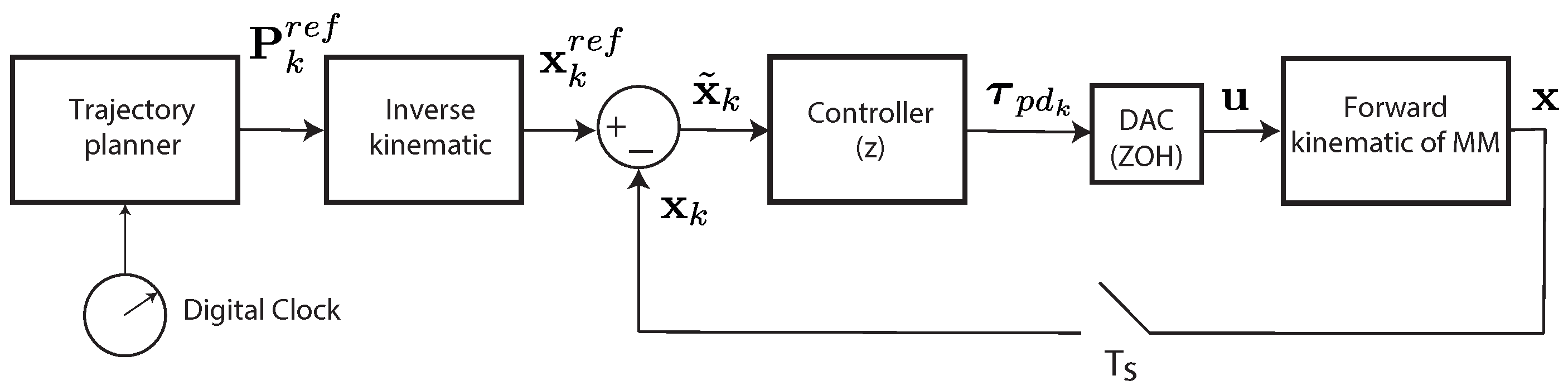
The discrete PD controller was implemented based on the simplified scheme shown in Figure 3, using the parameters of the laboratory MM listed in Table 1. In the control scheme, x denotes the state vector defined as x = q q ˙ T . For the DRL analysis, we introduce an auxiliary input vector u ¯ = τ b F b τ 6 τ 7 τ 8 T , where τ b and F b denote the equivalent yaw torque and longitudinal force at the mobile base COM, and τ 6 , τ 7 , τ 8 are the arm joint torques. This auxiliary parametrization is consistent with standard differential-drive command abstractions (linear/angular motion), while the implementation remains torque-driven.
The operation of this controller is as follows: the trajectory planner (described in Section 6.3) generates the end-effector reference position vector P k r e f = x k r e f e e y k r e f e e z k r e f e e T , which is processed by an inverse kinematics routine to compute the reference state vector x k r e f = q k r e f q ˙ k r e f T . This reference is compared against the actual state x k to obtain the error vector x ˜ k . Based on this error, the discrete PD controller computes the torque vector τ p d k , which is applied to the robot through a zero-order hold (ZOH).
For the DRL analysis, the dynamic model of the MM was linearized around an operating point using q = θ b p x q 6 q 7 q 8 T and the auxiliary input u ¯ = τ b F b τ 6 τ 7 τ 8 T , with f ( x , u ¯ ) = q ˙ q ¨ T . In the implementation, the conversion from ( τ b , F b ) to wheel torques is used only as an internal actuation-allocation layer; at the laboratory implementation level, the control signal remains expressed in terms of the equivalent COM-level longitudinal force and yaw torque, while the conversion to wheel torques is carried out inside the actuation block.
Assuming wheel separation L and wheel radio R r and R l , the internal mapping is given by
τ 2 τ 3 = 1 2 R r 2 R r L R l 2 R l L F b τ b ,
which is linear and invertible for nonzero wheel radio.
Regarding the operating point, several configurations were analyzed; however, this paper presents the results for x e = 0 , which corresponds to the robot being at rest with the arm fully extended horizontally forward. This operating point was selected because it is a physically consistent static equilibrium under the planar base assumption and the nonholonomic constraint, and it is representative of reaching/grasping postures. From this configuration, stability, controllability, and DRL analyses were carried out to determine suitable controller gain ranges.
To establish stability and controllability, the A and B matrices of the linearized model were computed as (the resulting numerical matrices at x e = 0 are reported in Appendix A):
A i , j = f x , u ¯ i x j and B i , j = f x , u ¯ i u ¯ j ,
where the matrix C was defined to extract the outputs with respect to the generalized coordinate vector q , and D was set to zero. To verify system controllability, the determinant of C o = B A B A 2 B A 3 B A 4 B was computed. Similarly, observability was verified by calculating the determinant of O b = C C A C A 2 C A 3 C A 4 T . The results showed that these determinants were nonzero for the chosen operating point, indicating that the system is completely controllable and observable for the given output vector.
Next, to determine the controller gain ranges, a DRL analysis of the transfer functions derived from the linearized model was performed. The controller used for this analysis was defined as follows:
P D z = K ^ p + K ^ v · z 1 z = K ^ p · 1 + K ^ v K ^ p · z 1 z = K ^ p · 1 + γ · z 1 z
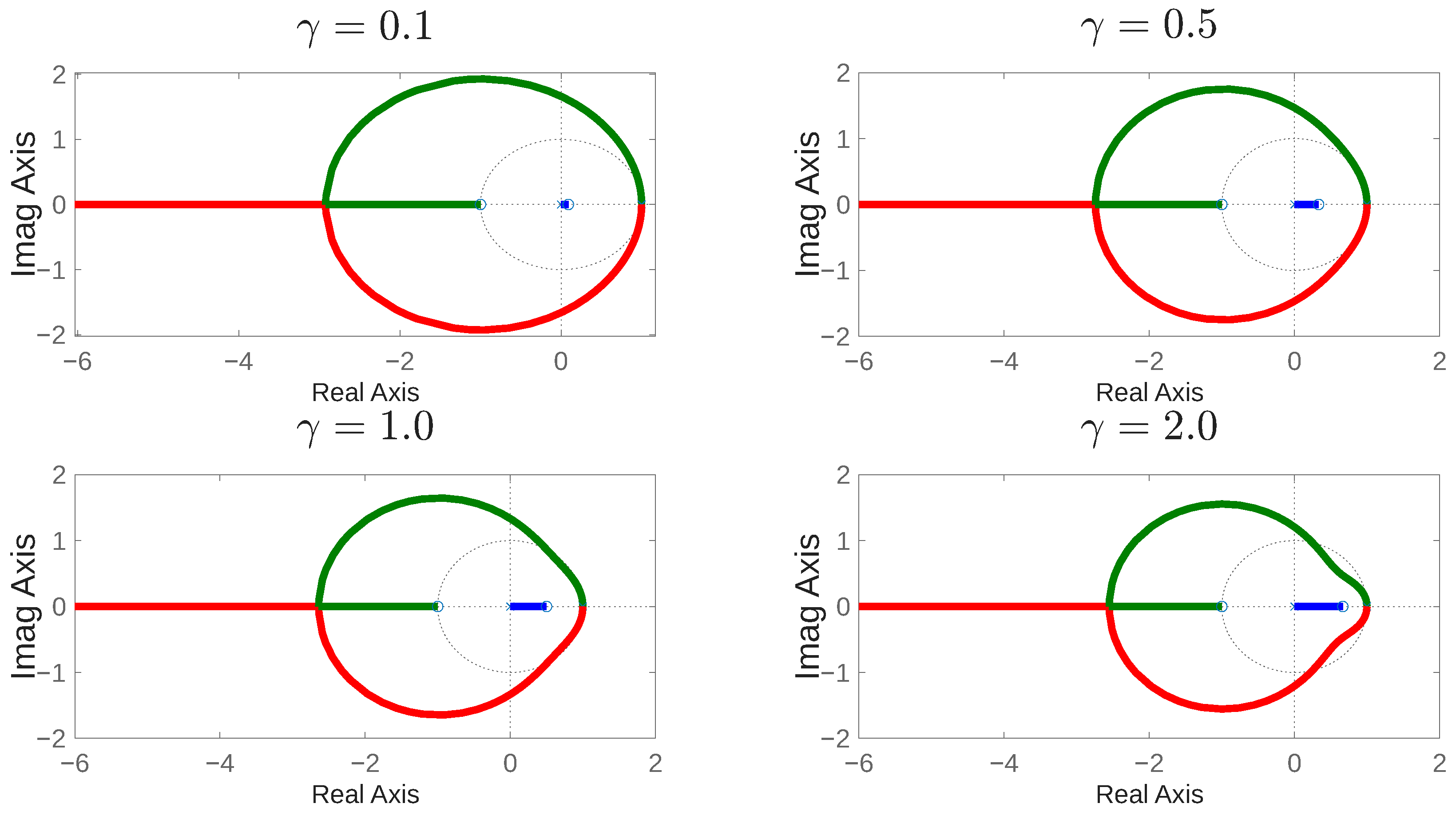
where γ is defined as the ratio between the derivative and proportional gains of the controller, and it is used to establish their relative tuning range. As an example, Equation (71) shows the discrete transfer function for the base rotation with respect to its center of mass (C.O.M.). For stability and convergence testing, γ was set to 0.1, 0.5, 1, 2, and 5. The behavior of the corresponding DRL is shown in Figure 4.
F T ϕ b = 2 . 794 5 z + 2 . 794 5 z 2 2 z + 1
The DRL in Figure 4 shows the motion of the closed-loop poles associated with the discrete-time base rotation transfer function in (71) in the z-plane as the gain ratio γ = K ^ v / K ^ p of the PD controller is varied. The plot shows the two poles and single zero of the system; the blue pole–zero pair corresponds to a representative stable operating point of the MM for a particular choice of K ^ p and K ^ v , whereas the green–red branch illustrates the trajectory of one of these poles as K ^ p is swept while keeping γ fixed, i.e., with K ^ v = γ K ^ p . For γ < 1 , this pole branch remains outside the unit circle over the entire explored range of proportional gains, so no value of K ^ p in that range yields all closed-loop poles inside the unit circle and the linearized, discretized system is unstable for such gain ratios. Conversely, for γ 1 , the DRL reveals a non-empty interval of proportional gains for which both closed-loop poles lie strictly inside the unit circle, implying that the system is stabilizable in discrete time. As γ increases, the stable portions of the root locus branches move deeper inside the unit circle, i.e., the associated poles exhibit smaller magnitudes | z | , which is associated with faster decay and improved damping of the discrete-time response for suitably chosen gains, although excessively large gains cause these branches to cross the unit circle again and render the system unstable. Based on this analysis, the admissible gain ranges for the discrete-time PD controller were defined by taking the worst-case stabilizable condition ( K ^ p = K ^ v , i.e., γ = 1 ) as a lower bound and restricting the subsequent PSO search space to those K ^ p and K ^ v intervals that keep the closed-loop poles inside the unit circle while satisfying the torque and speed limits of the actuators in the experimental platform.

6.2. Discrete Computed Torque Controller

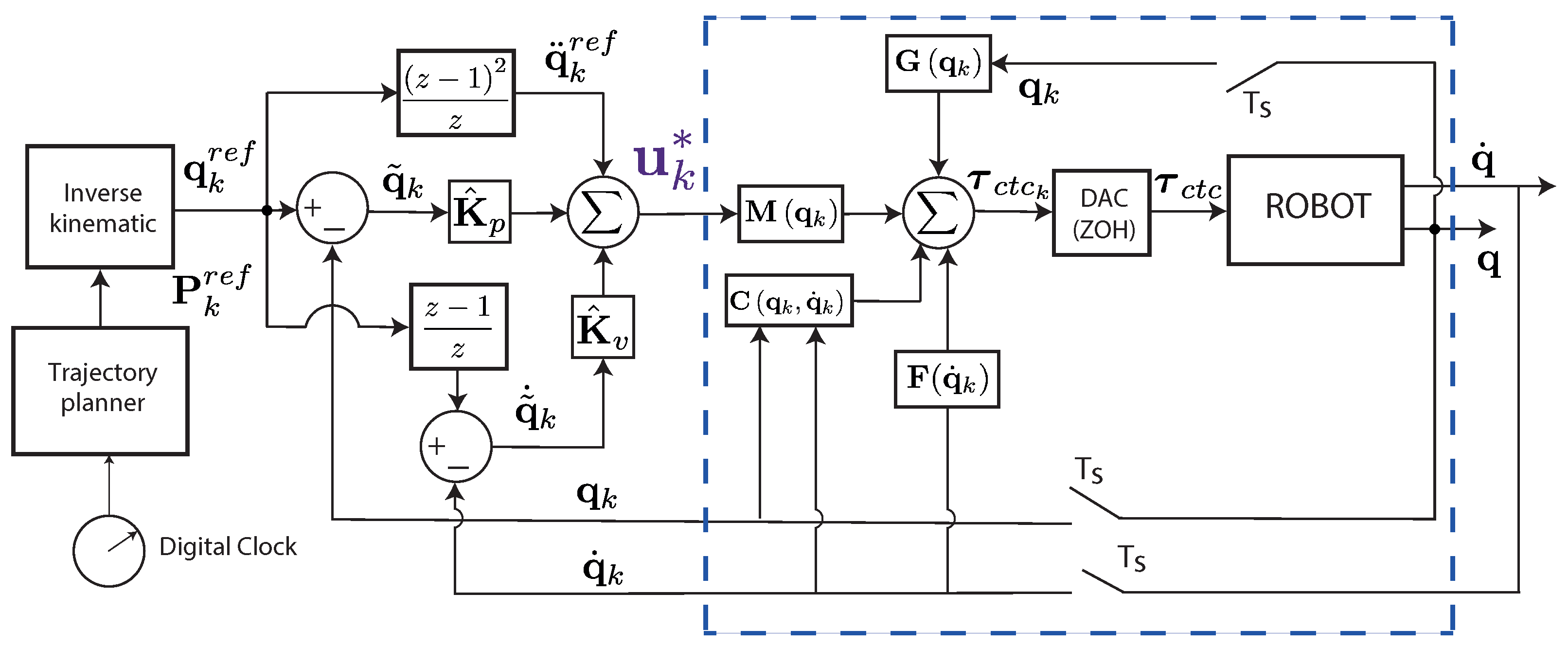
The discrete-time CTC was implemented following the scheme shown in Figure 5, where the blue dashed box represents the plant to which the control signal u k is applied.
As explained in Lemma 5 and Remark 3, the relationship between continuous and discrete variables introduces errors ϵ 1 = q q k and ϵ 2 = q ˙ q ˙ k that arise from (i) zero-order hold effects on the control input; (ii) sampling of continuous state variables; and (iii) numerical integration of accelerations. For a sampling period T s , the sampling errors are bounded by the bounded joint velocities and accelerations, i.e., ϵ 1 T s q ˙ m a x , ϵ 2 T s q ¨ m a x ; see Lemma 5.
On the other hand, by Lemmas 1–4, which establish bounds on the mismatch of the dynamics due to imperfect cancelation, parameter uncertainty, and disturbances, the closed-loop equation can be rewritten as follows:
M ( q ) q ¨ + Δ C ( ϵ 1 , ϵ 2 ) + Δ G ( ϵ 1 ) + Δ F ( ϵ 2 ) = M ( q k ) u k
where Δ C ( ϵ 1 , ϵ 2 ) , Δ G ( ϵ 1 ) and Δ F ( ϵ 2 ) represent the modeling errors due to discretization, model uncertainty, and disturbances. Here Δ F ( ϵ 2 ) includes the Jacobian mismatch (see Lemma 4) errors and bounded disturbance forces arising from wheel–ground interaction, i.e., intermittent contact forces and varying traction conditions (e.g., slippage, skidding).
By Lemmas 1–4, for sufficiently small T s relative to the system dynamics (specifically, T s 1 / ω n where ω n is the natural frequency of the highest frequency mode), these error terms remain bounded and satisfy
Δ C ( ϵ 1 , ϵ 2 )   k C · T s , Δ G ( ϵ 1 )   k G · T s , Δ F ( ϵ 2 ) k F · T s ,
where k C , k G , and k F are Lipschitz constants of the respective model terms.
Under these bounded error conditions, the dominant closed-loop behavior can be approximated as
M ( q ) q ¨ M ( q k ) u k O ( T s )
where O ( T s ) represents higher-order discretization terms. This justifies the design of the discrete-time joint controllers based on the simplified transfer function obtained by the zero-order hold discretization of the double integrator:
q i ( s ) u i ( s ) 1 s 2 q i , k ( z ) u i , k ( z ) T s 2 2 z + 1 ( z 1 ) 2
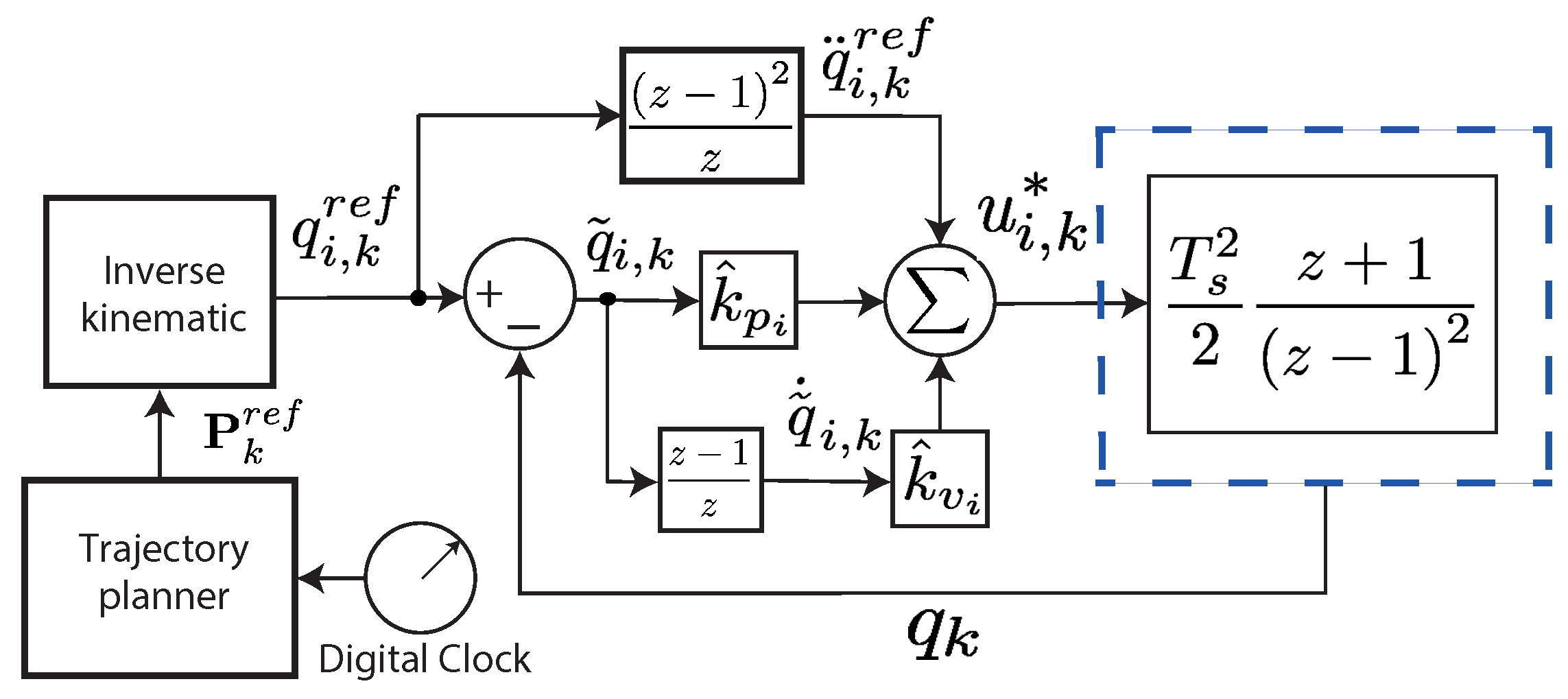
where the z-variable can be interpreted as a one-step shift of the sampled signal; see Definitions 1 and 2 and Remark 1 for the precise definition of zero-order hold, and a brief discussion concerning the connection between the z-variable, its interpretation as a one-step time-shift, and the zero-order hold operation that “lifts”, the discrete sequence of a sampled-signal into a continuous signal.
Regarding the discrete-time stability analysis of the CTC, given the equivalent model in (75), the regulation part of u k has exactly the same P D z structure (with K ^ p and γ = K ^ v / K ^ p ) acting on the ZOH-discretized double integrator. Hence, the stability of the dominant CTC closed-loop behavior can be assessed through a DRL study of the open-loop
L ( z ) = K ^ p 1 + γ z 1 z · T s 2 2 z + 1 ( z 1 ) 2 .
In our case, the resulting stabilizing gain regions from (76) are consistent with those used for the P D z controller in Section 6.1; therefore, the same DRL-based gain ranges are reused as initial bounds for the PSO search (an additional DRL figure is omitted for brevity due to its redundancy).
For the mobile manipulator parameters used in the experiments (see Table 1 in Section 7), the smallest mechanical time constant is approximately T m e c h 0.10 s (arm dynamics). Following the Nyquist criterion and requiring at least 10 samples per fastest mode period for adequate control
T s T m e c h / 10 10 m s .
In our implementation, T s = 10 m s was selected, providing a 100 H z sampling rate, and q ˙ m a x = 3 rad/s and q ¨ m a x = 10 rad / s 2 , with discretization error bounds for the arm joints of ϵ 1   0.01 · 3 = 0.03 rad , ϵ 2   0.01 · 10 = 0.1 rad / s . The mobile base has linear and angular velocities v m a x = 1 m / s and v ˙ m a x = 5 m / s 2 , and linear and angular accelerations ω m a x = 4 rad / s and ω ˙ m a x = 20 rad / s 2 , with corresponding discretization error bounds ϵ 1   0.01 · 1 = 0.01 m , ϵ 2   0.01 · 5 = 0.05 m / s and ϵ 1   0.01 · 4 = 0.04 rad , ϵ 2   0.01 · 20 = 0.2 rad / s for the linear and angular displacement and speed errors.
The PSO-tuned gains (Section 6.4) implicitly account for the bounded discretization errors by optimizing performance on the actual discrete-time system. This explains why the discrete CTC maintains performance advantages over the PD controller despite the imperfect cancelation of nonlinearities due to discretization.
The resulting control signal u k is defined as
u k = q ˜ k K ^ p + K ^ v · z 1 z + q k r e f ( z 1 ) 2 z = q ˜ k K ^ p · 1 + K ^ v K ^ p · z 1 z + q k r e f ( z 1 ) 2 z = q ˜ k K ^ p · 1 + γ · z 1 z + q k r e f ( z 1 ) 2 z
As observed in Equation (78), the structure resembles that of the discrete PD controller. Therefore, the same gain ranges obtained from the DRL analysis in Section 6.1 were used as initial bounds for the PSO optimization, with the understanding that the CTC’s nonlinearity cancelation, though imperfect due to discretization, still provides significant performance improvements as validated in Section 7 and Section 8. The corresponding closed-loop block diagram for the discrete-time joint controller is illustrated in Figure 6, and the resulting control signal u k is expressed in (78).

6.3. Trajectory Planner

The trajectory planner is based on the Newton–Raphson method [55,56,57], which generates the reference joint coordinate values q ^ r e f considering the equivalent kinematic chain of the MM [58,59,60]. Algorithm 1 provides a simplified pseudocode of the process, which operates as follows: (i) parameters are set, including the interpolation time Δ t for each point along the desired end-effector path ( x d ), the maximum allowed position error ϵ between the desired point x d k and the computed point x k , and the learning rate δ ; (ii) within an iterative loop, the error e k between x d k and x k is computed and passed to the inverse kinematics routine; and (iii) this routine is repeated until the absolute error e k between the desired end-effector point x d k (defined by the task-space path at t k ) and the forward-kinematics point x k ( q k ) falls below ϵ , or the maximum number of iterations N t r a j m a x is reached.
  • To improve numerical robustness near kinematic singularities (ill-conditioned Jacobian), the pseudoinverse J k is computed as the Moore–Penrose pseudoinverse (SVD-based in practice) using a singular-value tolerance so that sufficiently small singular values are treated as zero. This truncated pseudoinverse regularization mitigates numerical issues near singular configurations. The update is applied as Δ q k = δ J k e k , followed by joint-limit saturation and step limiting to prevent excessively large joint excursions. Finally, q k + 1 is obtained by applying the Newton–Raphson update, i.e., q k + 1 = q k + Δ q k . The resulting vector is then projected onto the admissible differential-drive manifold by enforcing the nonholonomic condition of zero lateral base velocity ( V = 0 ). This post-processed solution is stored as the reference configuration q ^ k r e f .

6.4. Tuning

The tuning of the controllers was carried out by minimizing the cost function defined in (81) (described later) using the Particle Swarm Optimization algorithm [24,61,62]. This stochastic heuristic optimization method iteratively searches for an optimal solution within a bounded search space, where potential solutions (called particles) move through the space following the best-performing particle while remembering their own best position. Each particle ( p i ) in the swarm of N p a r t elements has two attributes in the k-th iteration: a position θ i k and a velocity υ i k . The particle’s movement is determined by a velocity term that reflects attraction to its individual best-known position ( p b e s t i ) and the global best position of the entire swarm ( g b e s t ), updated N m a x times within the defined search space [63]. Specifically, particle velocity and position updates are defined as
υ i k = w υ i k 1 + c 1 r 1 · p b e s t i θ i k 1 + c 2 r 2 · g b e s t θ i k 1
and
θ i k = θ i k 1 + υ i k 1 ,
where c 1 and c 2 are positive acceleration coefficients, w is the inertia factor, and r 1 and r 2 are random numbers uniformly distributed in the range [ 0 , 1 ] .
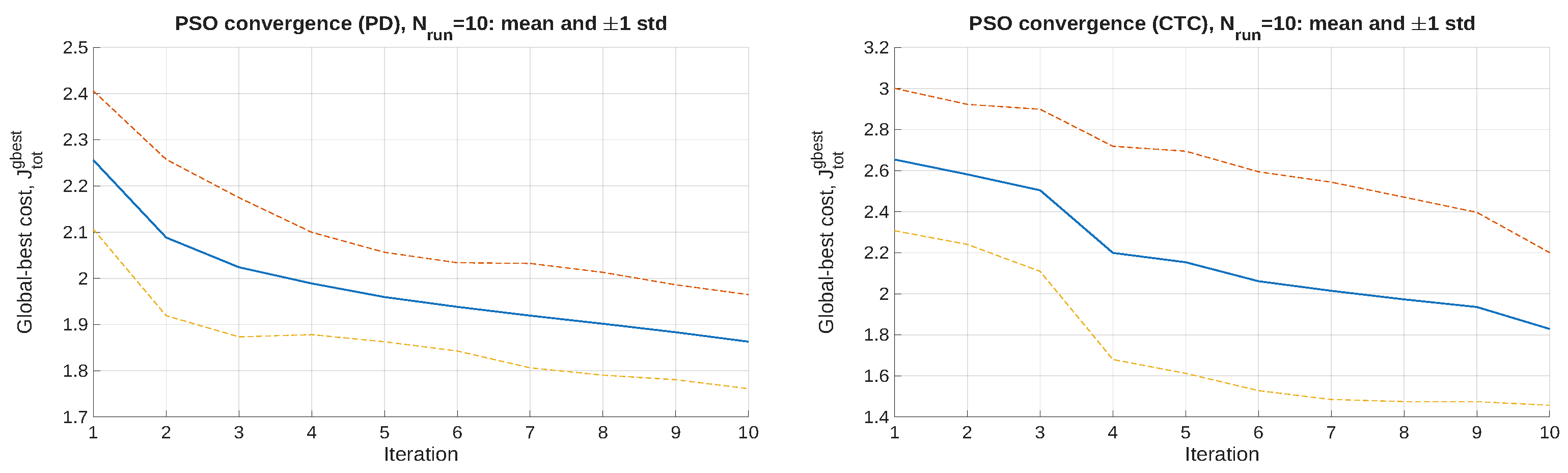
  • PSO hyperparameters, stopping criterion, bound handling, and stochastic variability. PSO was executed with a swarm size of N p a r t = 100 particles and a maximum of N m a x = 100 iterations. The inertia weight was decreased linearly from w m a x = 0.9 to w m i n = 0.2 (dimensionless), and the acceleration coefficients were set to c 1 = c 2 = 2 (dimensionless), which is a standard choice in linearly decreasing inertia PSO implementations. Particle velocities were clamped to υ [ υ m i n , υ m a x ] , with υ m a x = 0.2 ( u b l b ) and υ m i n = υ m a x , and particle positions were projected (saturated) onto the bounded search domain θ [ l b , u b ] (denoted generically as ( l d , l u ) in Algorithm 2) after each update. Here, the decision vector θ stacks the diagonal entries of K ^ p and K ^ v for both the mobile base inputs ( τ b , F b ) and the arm joint torques; hence, θ (and υ ) inherits the gain units component-wise (typically [ K ^ p ] = s 2 and [ K ^ v ] = s 1 ). The lower bounds were set to l b = 0 and the upper bounds u b were selected from the stabilizing gain ranges obtained from the discrete root locus analysis together with actuator limitations (torque/speed), to avoid infeasible candidates during simulation-based cost evaluation. A fixed-iteration stopping criterion was adopted due to the computational cost of evaluating J t o t via full discrete-time simulation. The cost weights in (81) were fixed following the practical weighting procedure described after Equation (82), so that the tracking error term and the energy-related term contribute comparable numerical magnitudes over representative trajectories and over the explored gain ranges, avoiding dominance due to unit scaling. Since PSO is stochastic, we include an illustrative convergence example based on N run = 10 independent PSO runs using a reduced configuration ( N p a r t = 10 , N m a x = 10 ). The global-best cost is defined as J t o t g b e s t ( k ) : = J t o t ( g b e s t k ) , and Figure 7 reports its mean and standard deviation across runs. The tuning results reported in this paper were obtained using the full configuration ( N run = 30 , N p a r t = 100 , N m a x = 100 ).
In this study, the tracking root-mean square (RMS) error and RMS energy consumption were minimized using the following respective cost functions:
J x i = e R M S = 1 N k = 1 N x k r e f i x k i 2 + y k r e f i y k i 2 + z k r e f i z k i 2
J u i = P R M S = 1 N k = 1 N u 1 , k i 2 + u 2 , k i 2 + u 3 , k i 2 + + u c , k i 2
where, for a given trajectory i, x k r e f , y k r e f , z k r e f , x k , y k , and z k represent the reference and measured end-effector positions at the k-th instant, while u c , k represents the control energy of the c-th joint, computed as the product of joint velocity and applied torque. The total cost function used for tuning is
J t o t i = α · J x i + β · J u i ,
where α and β are positive weighting coefficients used to ensure consistent scaling between the tracking error term (79) and the energy-related term (80). As a practical guideline, they can be obtained by normalization from representative ranges as
α = 1 e ¯ m a x e ¯ m i n and β = 1 u ¯ m a x u ¯ m i n .
where e ¯ m a x and e ¯ m i n denote representative upper and lower bounds of the average end-effector RMS position tracking error e R M S defined in (79), while u ¯ m a x and u ¯ m i n denote representative upper and lower bounds of the average control energy metric associated with (80). In this work, the weights were fixed (not optimized) to α = 10 and β = 0.01 and kept constant throughout all simulations and experiments to ensure a consistent tracking–energy trade-off and reproducibility.
  • Noise-aware cost evaluation (stochastic objective). During tuning, bounded additive disturbances are injected both in the actuation path and in the measurement path to evaluate robustness. The disturbances are modeled as uniform additive noise η k U ( δ , δ ) . The noise bounds δ were tuned to represent approximately 1 % of the maximum operating ranges of the experimental platform (Neuronics Katana 6M180 on Pioneer 3-AT). Specifically, this corresponds to position disturbances of ≈0.03 rad and torque disturbances proportional to the actuators’ capacity. This noise level serves as a stress test significantly larger than the quantization noise (< 10 3 rad). For computational tractability, each PSO objective evaluation uses a single noise realization. Post-tuning, performance statistics are computed over Ω = 10 independent repetitions for each trajectory to estimate the expected cost and its 95% confidence interval.
After defining the cost functions, Algorithm 2 was implemented to tune the controllers. It searches for the optimal discrete controller gains ( K ^ p and K ^ v ) for either C T C k or P D k , within bounded gain ranges ( l d , l u ) determined from the DRL analyses in Section 6.1 and the torque limits of each MM joint. The algorithm identifies the best gain set ( p b e s t j ) within the swarm of N p a r t particles that minimizes the cost function (81), iteratively updating the swarm over N m a x iterations.
Algorithm 2: Simplified pseudocode for controller tuning using PSO
Robotics 15 00019 i002
  • Finally, controller performance was evaluated by calculating the expected cost and its confidence interval for the function defined in (81). For the end-effector tracking error, and considering Ω repetitions of the same trajectory i, the expected tracking error was computed as
J Ω = E J x i = 1 Ω = 1 Ω J x i , ,
with variance
V J Ω = 1 Ω = 1 Ω J x i , J Ω 2 ,
and a 95% confidence interval
J Ω ± V J Ω Ω · 1.96

7. Simulation

Before performing the laboratory implementation of the CTC controller, end-effector tracking simulations were carried out on the MM for four trajectory types: a square path in the XY space, a square path in the YZ space, a helical path in the XY space, and a helical path in the YZ space. These trajectories were used to evaluate controller performance under abrupt trajectory changes (square trajectories) and smooth transitions (helical trajectories), as well as to assess performance under movements aligned with and against the gravity vector. Additionally, noise was added to both the manipulated variable (up to 1%) and sensor measurements (corresponding to three encoder counts for a 1024-count encoder). The simulation parameters correspond to those of the MM used in the laboratory implementation (as presented in Table 1). The results of the simulation experiments are shown in Figure 8 and summarized in Table 2.
The simulation results demonstrate that, in all cases, the discrete CTC controller outperformed the discrete PD controller. The plots in Figure 8 show that the CTC achieved a lower RMS tracking error, smaller variance, and confidence intervals that were comparable to or better than those of the PD controller. Regarding the RMS power plots, the CTC consistently exhibited lower power consumption across all trajectory points, with confidence intervals equal to or narrower than those of the PD controller, which indicates higher stability.
In the case of trajectories with abrupt direction changes (square-type), larger variations in RMS tracking error were observed compared to smooth trajectories (helical-type). The PD controller displayed similar RMS power values across all trajectories, while the CTC showed small but noticeable variations. As summarized in Table 2, the CTC exhibited superior performance in all evaluated metrics, including RMS tracking error, RMS power, closing error, and variance.
Specifically, in the best case (square trajectory in YZ space), the discrete CTC achieved a 2.6% lower RMS tracking error, 0.4% lower RMS power, 3.75% lower closing error, and 1 . 36 6 % lower variance (the latter corresponding to the square trajectory in XY space) compared with the discrete PD controller. In the worst case (helical trajectory in YZ space), the CTC still achieved 23.53% lower RMS tracking error, 1.6% lower RMS power, 28.76% lower closing error, and 0.247% lower variance (the latter corresponding to the helical trajectory in XY space).
These results confirm the superior performance of the discrete CTC controller over the discrete PD controller, even under the presence of sensor noise and actuator disturbances (as described earlier in this section). This performance improvement is particularly relevant given that such perturbations introduce additional unmodeled nonlinearities not accounted for in the discrete CTC control structure during simulation.

8. Experimental Validation

This section presents the experimental validation, including the experimental setup and methodology, the results and the discussion of simulation to reality performance differences, and finally the computational performance analysis.

8.1. Experimental Setup and Methodology

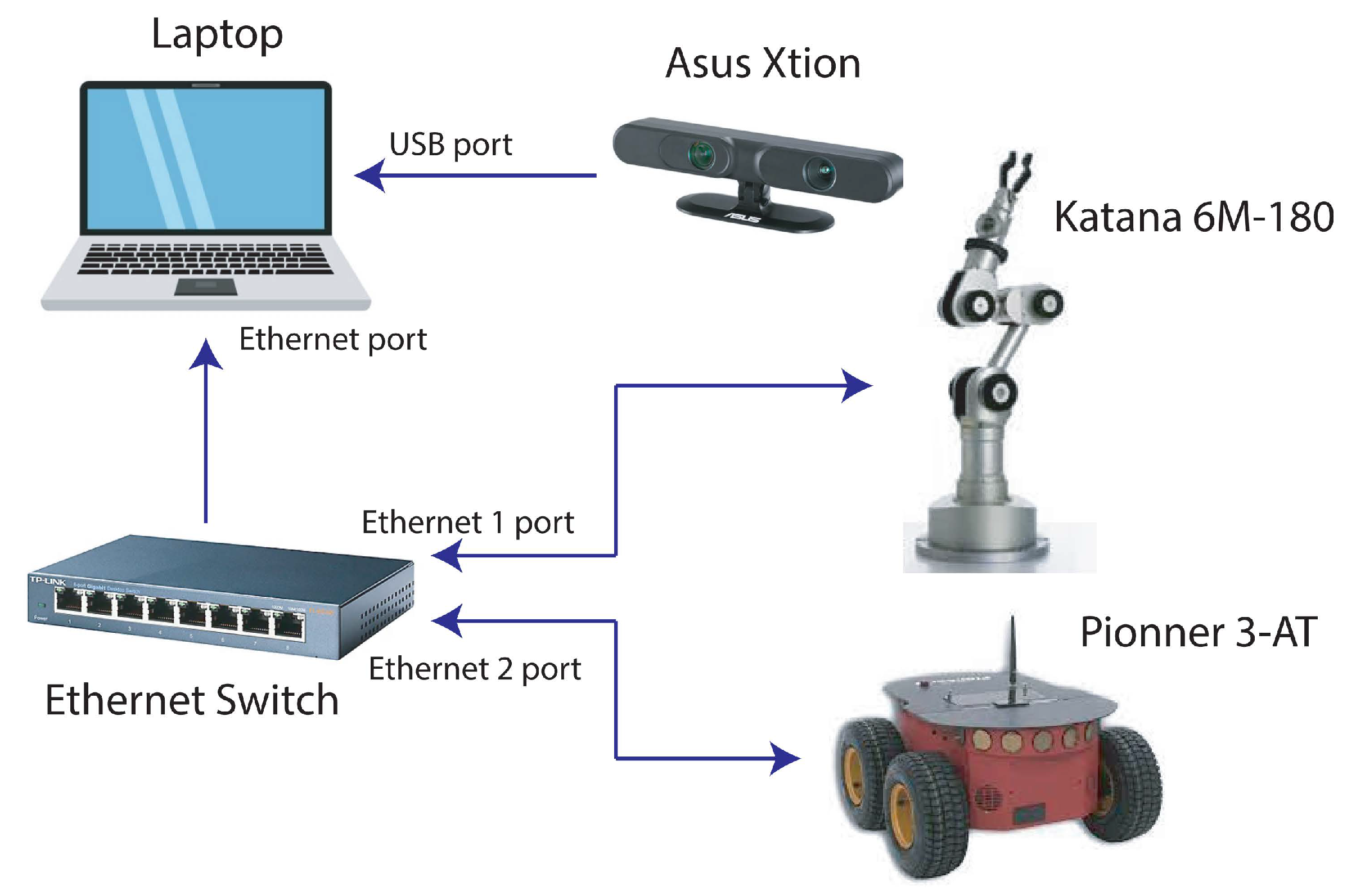
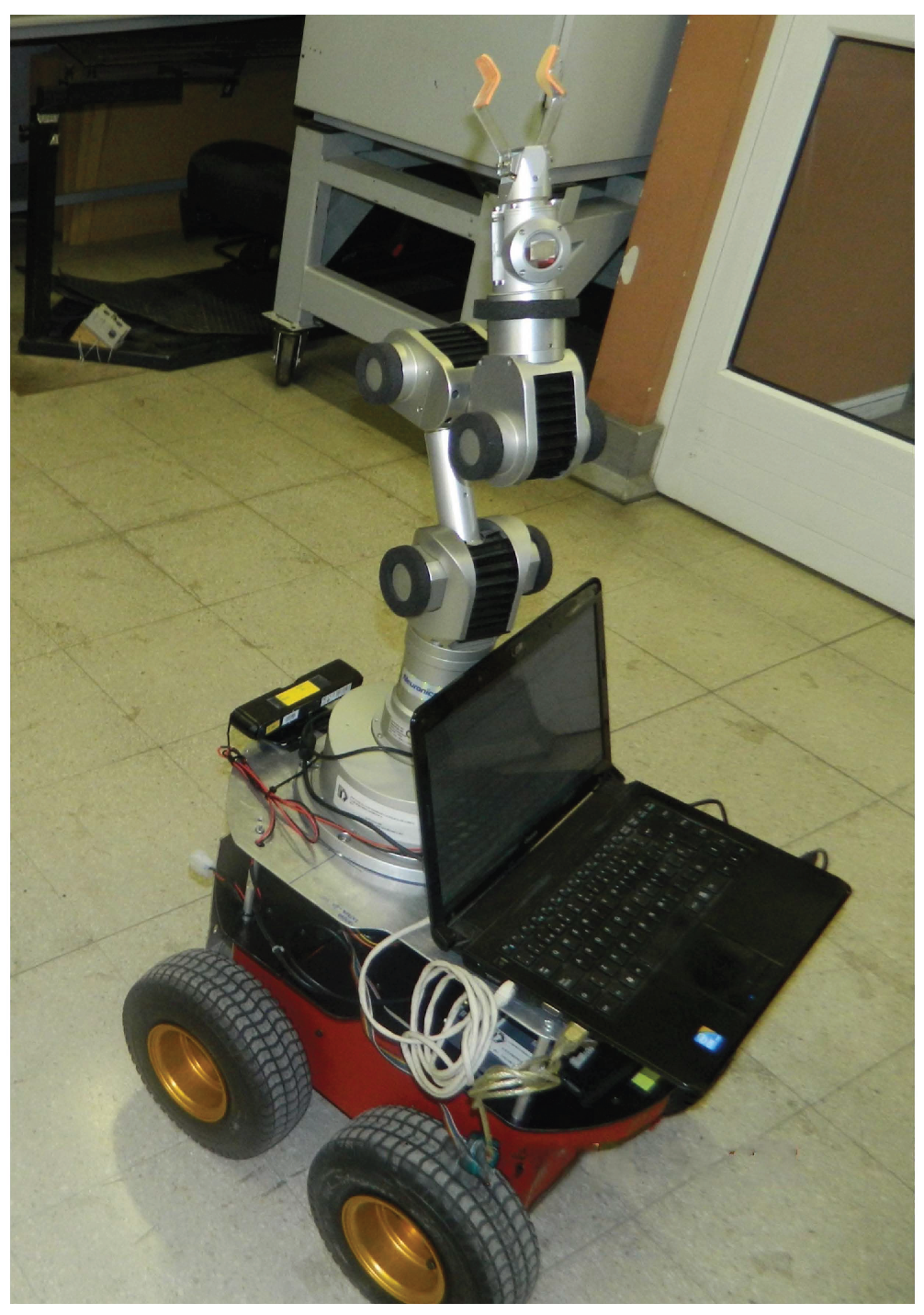
To implement the controllers, the simplified scheme shown in Figure 9 was used. The hardware setup consisted of a Pioneer 3AT mobile base, a Katana 6M-180 robotic arm, and an Asus Xtion camera. The controllers were implemented in a computer with an Intel Core i7-8550@1.8 GHz (4 cores), 16 GB DDR4 RAM. The code was implemented in C++ and the GSL library for mathematical computations to run on Windows 11 in a single core. Control loop cycle time was verified to be always smaller than T s = 10  ms. The experimental setup is presented in Figure 10. Two tests were performed (both in simulation and laboratory implementation).
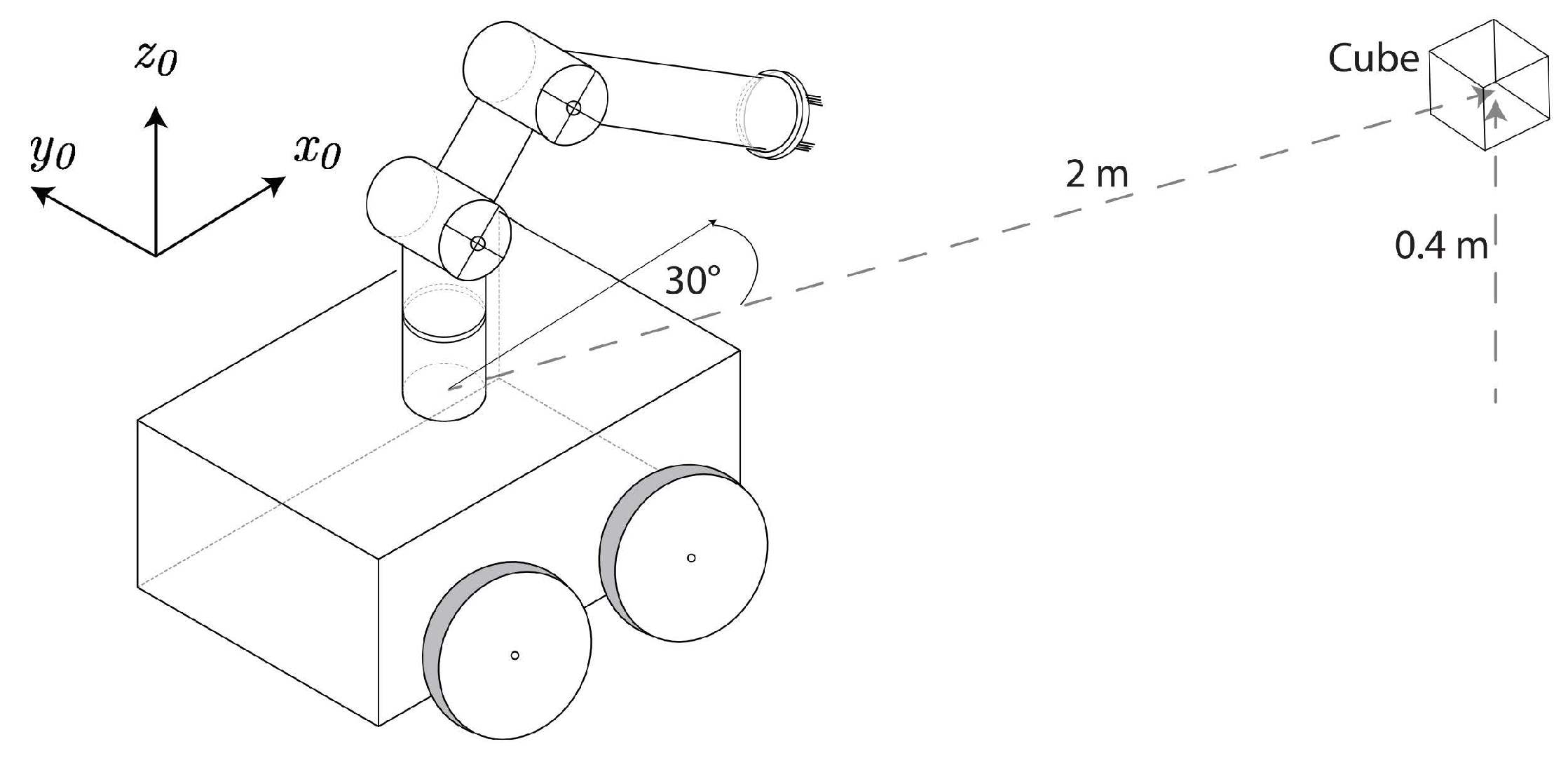
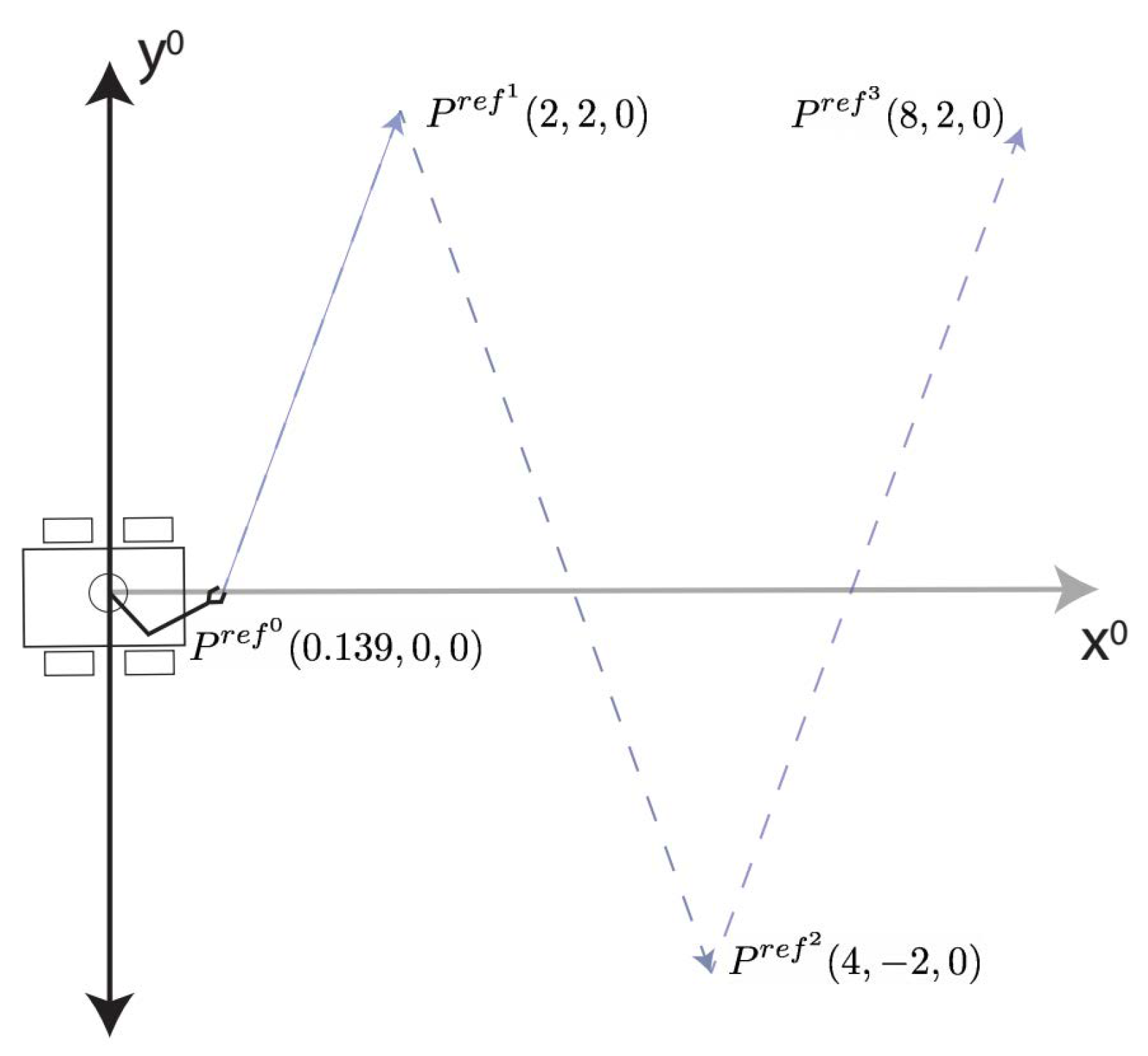
The first test consisted of positioning the manipulator at a distance of 2 m and a base inclination angle of 30° (maximum camera field of view angle) relative to a red cube. A reference illustration of this experiment is shown in Figure 11. The second test involved commanding the MM to follow a zigzag trajectory with different inclination angles at its vertices and varying forward displacement lengths, as depicted in Figure 12. Vision-based estimation and frame mapping. The Asus Xtion RGB-D camera provides synchronized RGB and depth streams. The target object is segmented in the HSV color space via color thresholding (inRange) to obtain a binary mask. To improve robustness against pixel-level noise, the mask is filtered using basic morphological operations (e.g., erosion and closing) and median smoothing. The object centroid ( u , v ) in image coordinates is then computed from the binary mask using image moments. The target depth is obtained from the RGB-D point-cloud map by reading the 3D point at the centroid pixel and taking its Z component as the depth in the camera frame. In our setup, the camera is rigidly mounted on the platform; therefore, the camera-to-robot relationship remains constant during the experiments. For control implementation, the visual measurement is mapped to the robot reference/command variables through an experimentally calibrated linear conversion (pixel-to-command gain and offset), which was sufficient for the reported laboratory tests. Standard camera geometry and rigid-body frame transformation conventions can be found in [64,65].
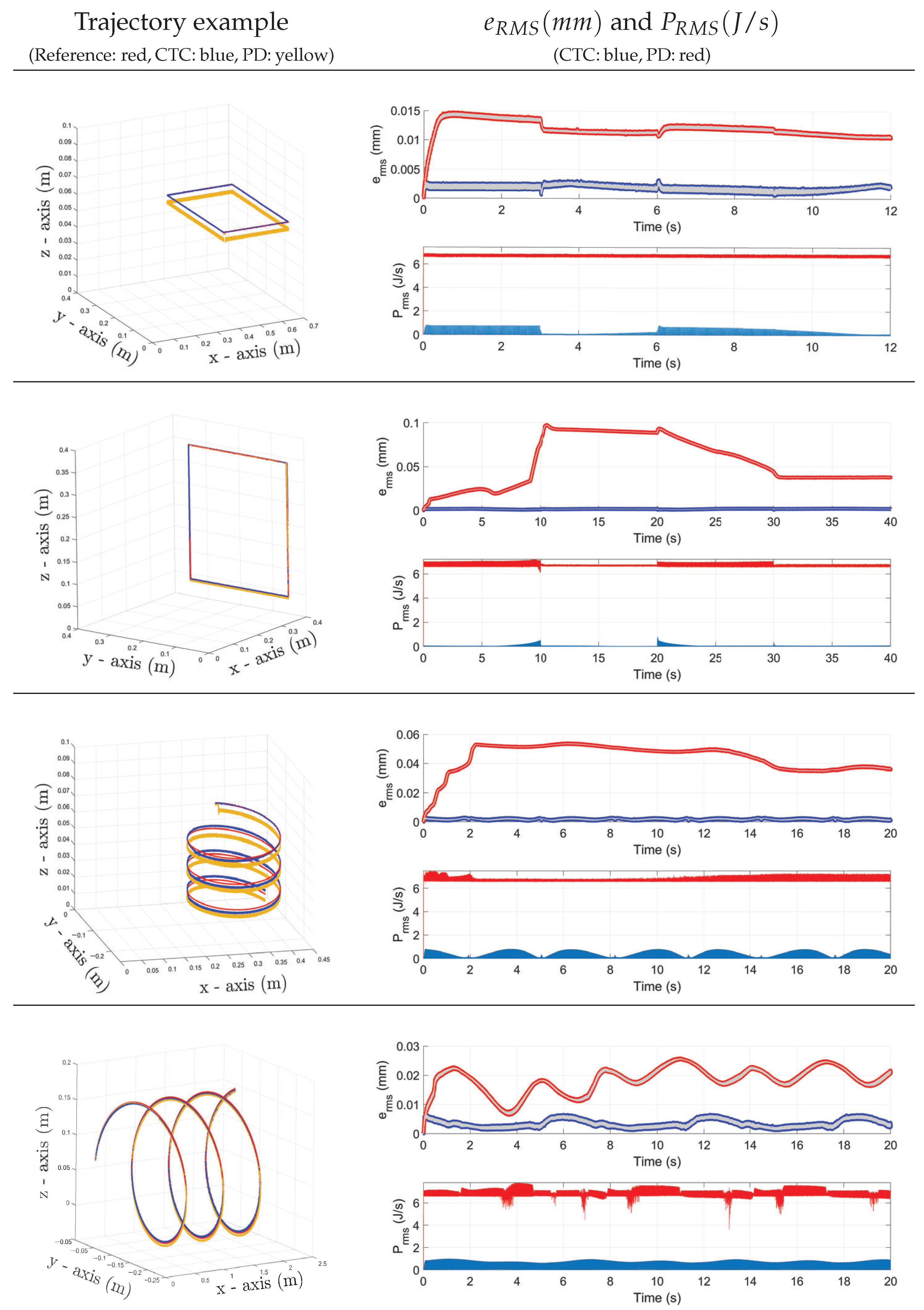
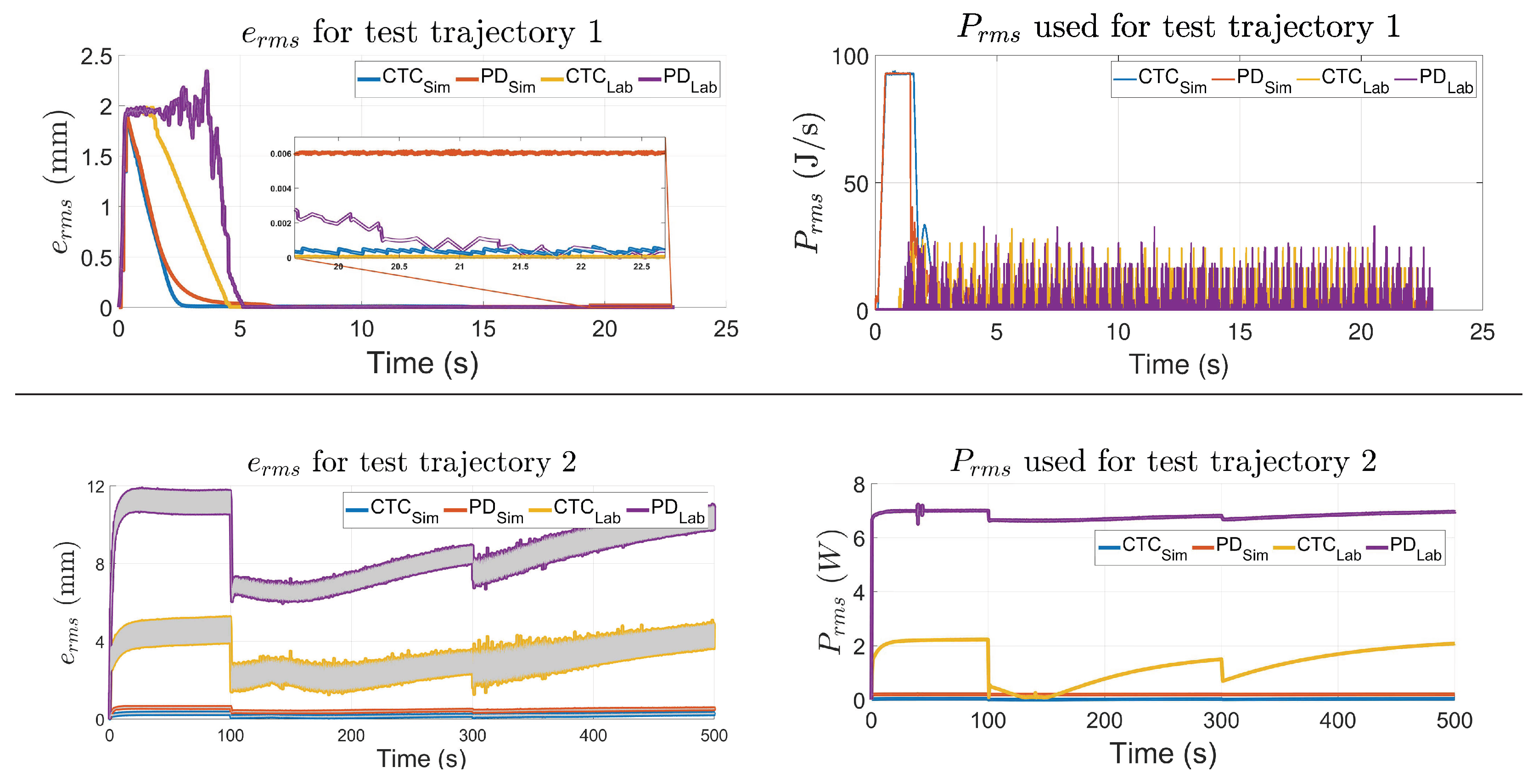
To compare the performance of both controllers, the following were obtained: ( i ) RMS tracking error and instantaneous RMS power plots of the end-effector (as shown in Figure 13), to verify minimization of the cost functions defined in (79) and (80); ( ii ) RMS power, closing error, RMS tracking error, variance, and confidence intervals (same parameters as defined in Section 7), with results summarized in Table 3; and ( iii ) the accumulated Integral Time Absolute Error ( I T A E q i = 0 t · | q ˜ i | d t ), computed for both the base’s translational displacement and rotation, as well as the I T A E norm of the arm joint angles, reported in Table 4.

8.2. Experimental Results

As shown in Figure 13, for both performed tests, the discrete CTC controller exhibited superior behavior compared to the discrete PD controller. The end-effector RMS tracking error of the CTC converged faster, with fewer oscillations and greater stability. In terms of RMS power consumption, for the first test, both controllers displayed similar behaviors in simulation and laboratory experiments; however, as shown in Table 3, the CTC consumed less RMS power than the PD. For the second test, the CTC consistently achieved lower RMS power both in simulation and implementation.
The results presented in Table 3 demonstrate that the CTC outperformed the PD controller in all tests, specifically by (i) consuming 38.78% and 54.1% less RMS power in simulation for tests 1 and 2, respectively, and 25.38% and 81.6% less in laboratory implementation; (ii) achieving 44.7% and 74.32% lower closing error in simulation, and 50.38% and 47.04% lower in laboratory implementation; (iii) achieving 35.08% and 68.01% lower average tracking error in simulation, and 24.17% and 62.41% lower in laboratory implementation; and (iv) exhibiting 52.88% and 88.17% lower variance in simulation, and 90.42% and 83.71% lower in laboratory tests.
Regarding the magnitude of the accumulated I T A E , Table 4 shows that, compared with the PD controller, the CTC achieved (i) 86.98% lower linear base positioning I T A E ; (ii) 87.98% lower rotational base positioning I T A E ; and (iii) 39.91% lower joint angle I T A E norm in simulation. In laboratory implementation, the CTC outperformed the PD by (i) 28.84% lower linear base positioning I T A E ; (ii) 76.71% lower rotational positioning I T A E ; and (iii) 15.44% lower joint angle I T A E norm.
These results indicate that the discrete CTC laboratory implementation mitigates the effect of the model nonlinear terms and base–arm coupling, thereby improving performance compared with the PD controller, which does not exploit the MM dynamic model. Exact nonlinear cancelation is not claimed due to discrete-time execution effects (sampling, zero-order hold actuation, and computation/communication delays), parameter uncertainties, and unmodeled dynamics, which introduce residual tracking errors.

8.3. Analysis of Simulation-to-Laboratory Performance Differences

Laboratory implementation shows 2–3× larger tracking errors compared to simulation predictions, which is consistent with typical simulation-to-reality gaps in mobile robotics. This difference is primarily attributed to the following:
  • Sensor noise and calibration errors: Camera localization uncertainty (±5 mm), encoder quantization ( 0 . 35 per count), and kinematic calibration errors ( ± 2 % in link lengths).
  • Unmodeled dynamics: Wheel slippage during acceleration, joint backlash (∼0.1° per joint), drag forces, and nonlinear friction characteristics not captured by the viscous and Coulomb model.
  • Environmental variations: Floor smoothness irregularities and battery voltage changes ( ± 8 % during discharge).
Critically, the relative improvement of CTC over PD control remains consistent between simulation (51.55% error reduction, 46.44% power reduction) and laboratory implementation (43.29% error reduction, 53.49% power reduction), demonstrating the robustness of the proposed controller to real-world uncertainties.

8.4. Computational Performance Analysis

An essential aspect of real-time control implementation is computational feasibility. This section analyzes the execution time and computational load of the proposed discrete-time CTC compared to the PD controller.
The computation time breakdown is presented in Table 5 and is estimated as the average execution time over 1000 control cycles for each controller component. The memory requirements of each controller are presented in Table 6.
The key findings can be summarized as follows:
  • Real-time Feasibility: Despite being 10.9 × slower than PD control, the CTC computation time (3.05 ms) remains well within the 10  ms control period, providing a 6.95 ms margin for other tasks (communication, logging, safety monitoring).
  • Dominant Cost: Inertia matrix M ( q ) computation accounts for 40.5% of the CTC cycle time. This is expected for a 6-DOF system in task-space (3-DOF base + 6-DOF arm in joint-space) requiring recursive spatial algebra.
  • Scalability: The computational complexity scales approximately as O ( n 2 ) for the inertia matrix and O ( n ) for other dynamic terms, where n is the number of DOF. For higher-DOF systems, efficient implementations (e.g., Featherstone’s ABA-algorithm) or hardware acceleration may be necessary.
  • Worst-Case Timing: Maximum observed cycle time over 10,000 iterations was 4.12 ms (worst case) for CTC and 0.35 ms (worst case) for PD. Both maintain real-time constraints with significant margin.
Concerning memory requirements, the CTC requires approximately 5.4 × more memory than PD, primarily for storing intermediate spatial matrices during recursive dynamics computation. This is acceptable for modern embedded controllers but may be a consideration for resource-constrained platforms.
The Energy Consumption vs. Computational Cost Trade-off While CTC requires 10.9 × more computation than PD, the control energy savings (53.49% reduction in RMS power; Table 3) far outweigh the additional energy consumption associated to the increased computational cost. Additional CPU power can be estimated to 3 W × ( 3 ms / 10 ms ) = 0.9 W on average, while the saved actuator power amounts to 7.18 J / s (Test 1) to 5.23 J / s (Test 2), which amounts to 5–7 W savings. Thus, the net energy benefit is approximately 5 × the additional computational cost, making CTC highly favorable for battery-powered mobile manipulators where actuator energy dominates total power consumption.
Several implementation optimizations were applied to achieve real-time performance. Geometric Jacobians are computed incrementally rather than from scratch each cycle. On the other hand, many spatial transformation matrices have a block-diagonal structure, reducing multiplication operations by  35% when exploiting the sparse matrix feature. Compiled code was optimized with -O3 -march=native flags, enabling SIMD vectorization. Finally, dynamic terms were stored in contiguous arrays to improve memory layout as much as possible to minimize cache operations. Without these optimizations, CTC cycle time was 6.8 ms, demonstrating that careful implementation is necessary for real-time performance.
The computational overhead of discrete-time CTC is acceptable for mobile manipulator applications operating at 100 Hz control rates. The 30.5% CPU utilization leaves ample margin for safety monitoring, path planning, and perception tasks while delivering substantial energy savings through improved control performance.

9. Conclusions and Future Work

This work presented a methodology for implementing a discrete-time computed torque controller (CTC) that accounts for the coupled base–arm dynamics of a mobile manipulator. This methodology was validated through a controlled comparison against a discrete-time PD controller, incorporating model discretization, a discrete root locus (DRL) analysis to define stabilizing gain ranges, and Particle Swarm Optimization (PSO) tuning to jointly minimize end-effector tracking error and an energy-related metric. The experimental results showed that, on average across all tests, the discrete CTC achieved the following, compared to the PD controller: (i) 43.29% lower end-effector tracking error; (ii) 53.49% lower RMS power consumption; (iii) 48.71% lower closing error; and (iv) 87.07% lower variance.
These results indicate that using a discrete-time CTC based on the coupled dynamic model significantly reduces tracking error and energy consumption relative to a PD scheme, even in the presence of sensor noise, disturbances, and simulation-to-laboratory discrepancies. It should be noted that, in real digital implementation, the compensation of nonlinear dynamics is inherently imperfect due to discrete-time execution effects (sampling, zero-order hold actuation, and computation delays), parameter uncertainties, and unmodeled dynamics (e.g., variable friction and wheel–ground interaction), which introduce residual tracking errors that the proposed controller mitigates but cannot completely eliminate.
From an implementation perspective, the computational cost analysis confirmed the real-time feasibility of the proposed scheme: the average CTC cycle time (3.05 ms) remains well within the 10 ms control period, leaving a 69.5% margin for communication and supervisory tasks. Furthermore, the energy efficiency analysis reveals a favorable trade-off, where the power savings in the actuators (approx. 5–7 W) far exceed the additional processing power consumption (approx. 0.9 W) required by the CTC algorithm. The methodology can be extended to mobile manipulators with n degrees of freedom, provided that the coupled model and real-time constraints are consistently managed.
These findings position the proposed discrete-time CTC as a balanced alternative to emerging strategies such as whole-body MPC or deep reinforcement learning (RL). While optimization-based methods (MPC) offer superior handling of explicit constraints at the cost of high online computational burden, and black-box methods (RL) require massive data training, our approach retains the transparency and runtime efficiency of physics-based control laws, bridging the performance gap through offline optimization-based tuning that is robust to the realities of digital implementation (sampling and delays).
Ongoing research focuses on incorporating adaptive control and reinforcement learning in the operational space to increase robustness against uncertainties and further reduce the impact of discretization and unmodeled effects. Additionally, future work aims to advance towards high-frequency torque control loops for mobile manipulators, extending their applicability in human–robot collaboration tasks in both indoor and outdoor environments.

Author Contributions

Conceptualization, P.G.-A. and M.T.-T.; Methodology, P.G.-A. and M.T.-T.; Software, P.G.-A. and M.T.-T.; Validation, P.G.-A. and M.T.-T.; Formal analysis, P.G.-A. and M.T.-T.; Investigation, P.G.-A. and M.T.-T.; Resources, M.T.-T.; Data curation, P.G.-A.; Writing—original draft, P.G.-A. and M.T.-T.;Writing—review & editing, P.G.-A. and M.T.-T.; Visualization, P.G.-A.; Supervision, M.T.-T.; Project administration, M.T.-T.; Funding acquisition, M.T.-T. All authors have read and agreed to the published version of the manuscript.

Funding

This project was supported by the National Agency of Research and Development (ANID) under grant Fondecyt 1220140 and grant “Centros de Investigación Aplicada 2025” CIA250006.

Data Availability Statement

The original source code and data presented in the research are openly available in GitHub at https://github.com/RAL-UC/MM_CTC (accessed on 4 January 2026).

Conflicts of Interest

The authors declare no conflicts of interest.

Appendix A. Linearized Model Matrices

This appendix reports the numerical state-space matrices A and B obtained by linearizing the MM dynamics around the operating point x e = 0 using the auxiliary input vector u ¯ = τ b F b τ 6 τ 7 τ 8 T (see Section 6.1).

Appendix A.1. State Matrix A

A = 0 0 0 0 0 1 0 0 0 0 0 0 0 0 0 0 1 0 0 0 0 0 0 0 0 0 0 1 0 0 0 0 0 0 0 0 0 0 1 0 0 0 0 0 0 0 0 0 0 1 0 0 0 0 0 2 0 0.24 0 0 0 0 0 0.0288599 0.00356357 0 0.00248165 0 0.00729186 0.0103606 0 0 1.8286 e 16 0 0 2 0 2.2812 0 0 0 0 0 16.8574 19.381 0 0.00425358 0 8.14983 24.8395 0 0 0 23.9517 86.4979 0 0.00604367 0 24.8395 99.3261

Appendix A.2. Input Matrix B

B = 0 0 0 0 0 0 0 0 0 0 0 0 0 0 0 0 0 0 0 0 0 0 0 0 0 2 0 2 0 0 0 0.0354522 0 0.0607655 0.0863382 2 0 19.01 0 0 0 0.0607655 0 67.9152 206.996 0 0.0863382 0 206.996 827.718

References

  1. Ghodsian, N.; Benfriha, K.; Olabi, A.; Gopinath, V.; Arnou, A. Mobile Manipulators in Industry 4.0: A Review of Developments for Industrial Applications. Sensors 2023, 23, 8026. [Google Scholar] [CrossRef]
  2. Gros, J.; Zatyagov, D.; Papa, M.; Colloseus, C.; Ludwig, S.; Aschenbrenner, D. Unlocking the Benefits of Mobile Manipulators for Small and Medium-Sized Enterprises: A Comprehensive Study. Procedia CIRP 2023, 120, 1339–1344. [Google Scholar] [CrossRef]
  3. Núñez-Calvo, N.; Sorrosal, G.; Cabanes, I.; Mancisidor, A.; Rodríguez-Guerra, J. Enhancing accuracy in Mobile Manipulators: Challenges, current solutions and future needs. Robot.-Comput.-Integr. Manuf. 2025, 96, 103041. [Google Scholar] [CrossRef]
  4. Khan, T.; Thomas, M.J. Soft autonomous mobile manipulators in agricultural automation—A review. Ind. Robot. Int. J. Robot. Res. Appl. 2025, 10, 162, 1–23. [Google Scholar] [CrossRef]
  5. Zhou, Z.; Yang, X.; Wang, H.; Zhang, X. Coupled dynamic modeling and experimental validation of a collaborative industrial mobile manipulator with human-robot interaction. Mech. Mach. Theory 2022, 176, 105025. [Google Scholar] [CrossRef]
  6. Hernandez-Barragan, J.; D. Rios, J.; Gomez-Avila, J.; Arana-Daniel, N.; Lopez-Franco, C.; Alanis, A.Y. Adaptive neural PD controllers for mobile manipulator trajectory tracking. PeerJ Comput. Sci. 2021, 7, e393. [Google Scholar] [CrossRef]
  7. Bayle, B.; Fourquet, J.Y.; Renaud, M. Kinematic modelling of wheeled mobile manipulators. In Proceedings of the 2003 IEEE International Conference on Robotics and Automation (Cat. No.03CH37422), Taipei, Taiwan, 14–19 September 2003; Volume 1, pp. 69–74. [Google Scholar] [CrossRef]
  8. Fruchard, M.; Morin, P.; Samson, C. A Framework for the Control of Nonholonomic Mobile Manipulators. I. J. Robotic Res. 2006, 25, 745–780. [Google Scholar] [CrossRef]
  9. Algrnaodi, M.; Saad, M.; Saad, M.; Fareh, R.; Kali, Y. Extended state observer–based improved non-singular fast terminal sliding mode for mobile manipulators. Trans. Inst. Meas. Control. 2023, 46, 785–798. [Google Scholar] [CrossRef]
  10. Aro, K.; Guevara, L.; Torres-Torriti, M.; Torres, F.; Prado, A. Robust Nonlinear Model Predictive Control for the Trajectory Tracking of Skid-Steer Mobile Manipulators with Wheel–Ground Interactions. Robotics 2024, 13, 171. [Google Scholar] [CrossRef]
  11. Ellekilde, L.P.; Christensen, H.I. Control of mobile manipulator using the dynamical systems approach. In Proceedings of the 2009 IEEE International Conference on Robotics and Automation, Kobe, Japan, 12–17 May 2009; pp. 1370–1376. [Google Scholar] [CrossRef]
  12. Li, Z.; Ge, S.; Adams, M.; Wijesoma, W. Robust adaptive control of uncertain force/motion constrained nonholonomic mobile manipulators. Automatica 2008, 44, 776–784. [Google Scholar] [CrossRef]
  13. Fossi, V.; Giantomassi, A.; Ippoliti, G.; Longhi, S.; Orlando, G.; Corradini, M.L. Discrete time sliding mode control of robotic manipulators: Development and experimental validation. In Proceedings of the ETFA2011, Toulouse, France, 5–9 September 2011; pp. 1–8. [Google Scholar] [CrossRef]
  14. Du, H.; Yu, X.; Chen, M.Z.; Li, S. Chattering-free discrete-time sliding mode control. Automatica 2016, 68, 87–91. [Google Scholar] [CrossRef]
  15. El-Sayyah, M.; Saad, M.R.; Saad, M. Nonlinear Model Predictive Control for Trajectory Tracking of Omnidirectional Robot Using Resilient Propagation. IEEE Access 2025, 13, 112642–112653. [Google Scholar] [CrossRef]
  16. Thoma, T.; Wu, X.; Dietrich, A.; Kotyczka, P. Symplectic Discrete-Time Control of Flexible-Joint Robots: Experiments with Two Links∗∗This paper was not presented at any IFAC meeting. IFAC-PapersOnLine 2021, 54, 1–7. [Google Scholar] [CrossRef]
  17. Zhang, N.; Zhang, F.; Wang, J.; Li, Y.; Yang, C.; Wang, C.; Li, K. Precision Trajectory Tracking of Robot Manipulator Using a Discrete-Time Learning-Based Neural Network Control With Prescribed Performance. IEEE Trans. Ind. Electron. 2025, 72, 10640–10650. [Google Scholar] [CrossRef]
  18. Rossomando, F. Identification and control of nonlinear dynamics of a mobile robot in discrete time using an adaptive technique based on neural PID. Neural Comput. Appl. 2014, 26, 1179–1191. [Google Scholar] [CrossRef]
  19. Djeffal, S.; Ghoul, A.; Morakchi, M.R.; Mahfoudi, C.; Belkedari, M. Optimized Computer Torque Control and Dynamic Model of a Spatial Single Section Continuum robot. Results Control. Optim. 2023, 12, 100264. [Google Scholar] [CrossRef]
  20. Gomez-Avila, J. Adaptive PID Controller Using a Multilayer Perceptron Trained With the Extended Kalman Filter for an Unmanned Aerial Vehicle. In Artificial Neural Networks for Engineering Applications; Alanis, A.Y., Arana-Daniel, N., López-Franco, C., Eds.; Academic Press: New York, NY, USA; Amsterdam, The Netherlands, 2019; pp. 55–63. [Google Scholar] [CrossRef]
  21. Sun, H.; Wang, H.; Xu, Y.; Yang, J.; Ji, Y.; Cheng, L.; Liu, C.; Zhang, B. Trajectory tracking control strategy of the gantry welding robot under the influence of uncertain factors. Meas. Control. 2022, 56, 442–455. [Google Scholar] [CrossRef]
  22. Şen, G.D.; Öke Günel, G. NARMA-L2–based online computed torque control for robotic manipulators. Trans. Inst. Meas. Control. 2023, 45, 2446–2458. [Google Scholar] [CrossRef]
  23. Li, J.; Su, J.; Yu, W.; Mao, X.; Liu, Z.; Fu, H. Recurrent neural network for trajectory tracking control of manipulator with unknown mass matrix. Front. Neurorobot. 2024, 18, 1451924. [Google Scholar] [CrossRef]
  24. Elsisi, M.; Zaini, H.G.; Mahmoud, K.; Bergies, S.; Ghoneim, S.S.M. Improvement of Trajectory Tracking by Robot Manipulator Based on a New Co-Operative Optimization Algorithm. Mathematics 2021, 9, 3231. [Google Scholar] [CrossRef]
  25. Antonelli, D.; Aliev, K. Intelligent energy management for mobile manipulators using machine learning. FME Trans. 2022, 50, 752–761. [Google Scholar] [CrossRef]
  26. Slotine, J.J.E.; Li, W. Applied Nonlinear Control; Prentice Hall: New Jersey, NY, USA, 1991. [Google Scholar]
  27. Khalil, H.K. Nonlinear Systems, 3rd ed.; Prentice Hall: Upper Saddle River, NJ, USA, 2002. [Google Scholar]
  28. Gutiérrez-Urquídez, R.; Valencia-Palomo, G.; Rodríguez-Elias, O.; Trujillo, L. Systematic selection of tuning parameters for efficient predictive controllers using a multiobjective evolutionary algorithm. Appl. Soft Comput. 2015, 31, 326–338. [Google Scholar] [CrossRef]
  29. Aguilera-Marinovic, S.; Torres-Torriti, M.; Auat-Cheein, F. General Dynamic Model for Skid-Steer Mobile Manipulators with Wheel–Ground Interactions. IEEE/ASME Trans. Mechatronics 2017, 22, 433–444. [Google Scholar] [CrossRef]
  30. Featherstone, R.; Orin, D.E. Dynamics. In Springer Handbook of Robotics; Siciliano, B., Khatib, O., Eds.; Springer: Berlin, Heidelberg, 2008; pp. 35–65. [Google Scholar] [CrossRef]
  31. Lu, Z.; Wang, Y. A differentiable dynamic modeling approach to integrated motion planning and actuator physical design for mobile manipulators. J. Field Robot. 2024, 42, 37–64. [Google Scholar] [CrossRef]
  32. Prada-Jimenez, V.; Nino-Suarez, P.A.; Portilla-Flores, E.A.; Mauledoux-Monroy, M.F. Tuning a PD+ Controller by Means of Dynamic Optimization in a Mobile Manipulator With Coupled Dynamics. IEEE Access 2019, 7, 124712–124726. [Google Scholar] [CrossRef]
  33. Khan, A.H.; Li, S.; Chen, D.; Liao, L. Tracking control of redundant mobile manipulator: An RNN based metaheuristic approach. Neurocomputing 2020, 400, 272–284. [Google Scholar] [CrossRef]
  34. De Luca, A.; Oriolo, G.; Giordano, P. Kinematic modeling and redundancy resolution for nonholonomic mobile manipulators. In Proceedings of the 2006 IEEE International Conference on Robotics and Automation, Orlando, FL, USA, 15–19 May 2006; pp. 1867–1873. [Google Scholar] [CrossRef]
  35. Yuan, W.; Liu, Y.H.; Su, C.Y.; Zhao, F. Whole-Body Control of an Autonomous Mobile Manipulator Using Model Predictive Control and Adaptive Fuzzy Technique. IEEE Trans. Fuzzy Syst. 2023, 31, 799–809. [Google Scholar] [CrossRef]
  36. Chaudhary, K.S.; Kumar, N. Robust fixed-time fractional-order hybrid position/force tracking control scheme for constrained mobile manipulators. Int. J. Dyn. Control. 2025, 13, 80. [Google Scholar] [CrossRef]
  37. Minniti, M.V.; Farshidian, F.; Grandia, R.; Hutter, M. Whole-Body MPC for a Dynamically Stable Mobile Manipulator. IEEE Robot. Autom. Lett. 2019, 4, 3687–3694. [Google Scholar] [CrossRef]
  38. Fareh, R.; Saad, M.R.; Saad, M.; Brahmi, A.; Bettayeb, M. Trajectory Tracking and Stability Analysis for Mobile Manipulators Based on Decentralized Control. Robotica 2019, 37, 1732–1749. [Google Scholar] [CrossRef]
  39. Boukattaya, M.; Jallouli, M.; Damak, T. On trajectory tracking control for nonholonomic mobile manipulators with dynamic uncertainties and external torque disturbances. Robot. Auton. Syst. 2012, 60, 1621–1630. [Google Scholar] [CrossRef]
  40. Nascimento, T.P.; Dórea, C.E.T.; Gonçalves, L.M.G. Nonlinear model predictive control for trajectory tracking of nonholonomic mobile robots: A modified approach. Int. J. Adv. Robot. Syst. 2018, 15, 1729881418760461. [Google Scholar] [CrossRef]
  41. Kang, G.; Seong, H.; Lee, D.; Shim, D.H. A versatile door opening system with mobile manipulator through adaptive position-force control and reinforcement learning. Robot. Auton. Syst. 2024, 180, 104760. [Google Scholar] [CrossRef]
  42. Kallel, H.; Iqbal, K. Online Estimation of Manipulator Dynamics for Computed Torque Control of Robotic Systems. Sensors 2025, 25, 6831. [Google Scholar] [CrossRef]
  43. Wang, Y.; Chen, M.; Song, Y. Robust Fixed-Time Inverse Dynamic Control for Uncertain Robot Manipulator System. Complexity 2021, 2021, 6664750. [Google Scholar] [CrossRef]
  44. Murray, R.M.; Sastry, S.S.; Zexiang, L. A Mathematical Introduction to Robotic Manipulation, 1st ed.; CRC Press, Inc.: NW Boca Raton, FL, USA, 1994. [Google Scholar]
  45. W., A.W. Recursive Solution to the Equations of Motion of an N-Link Manipulator. Proc. 5th World Congr. Theory Mach. Mech. 1979, 2, 1343. [Google Scholar]
  46. Kelly, R.; Santibáñez, V. Control de Movimiento de Robots Manipuladores; Automática Robótica, Pearson Educación: Madrid, Spain, 2003. [Google Scholar]
  47. Franklin, G.F.; Powell, J.D.; Workman, M.L. Digital Control of Dynamic Systems, 3rd ed.; Addison-Wesley: Menlo Park, CA, USA, 1998. [Google Scholar]
  48. Chen, T.; Francis, B.A. Optimal Sampled-Data Control Systems; Springer: London, UK, 1995. [Google Scholar]
  49. Spong, M.W.; Vidyasagar, M. Robot Dynamics and Control; John Wiley & Sons: New York, NY, USA, 1989. [Google Scholar]
  50. Siciliano, B.; Sciavicco, L.; Villani, L.; Oriolo, G. Robotics: Modelling, Planning and Control, 1st ed.; Advanced Textbooks in Control and Signal Processing; Springer: London, UK, 2009. [Google Scholar]
  51. Slotine, J.J.E.; Li, W. On the Adaptive Control of Robot Manipulators. Int. J. Robot. Res. 1987, 6, 49–59. [Google Scholar] [CrossRef]
  52. Jiang, Z.P.; Mareels, I.M.Y. A Small-Gain Control Method for Nonlinear Discrete-Time Feedback Systems. IEEE Trans. Autom. Control. 1997, 42, 292–308. [Google Scholar] [CrossRef]
  53. Sontag, E.D. Input to State Stability: Basic Concepts and Results. Lect. Notes Math. 2008, 1932, 163–220. [Google Scholar] [CrossRef]
  54. Desoer, C.A.; Vidyasagar, M. Feedback Systems: Input–Output Properties; Academic Press: New York, NY, USA, 1975. [Google Scholar]
  55. Safeea, M.; Béarée, R.; Neto, P. Collision Avoidance of Redundant Robotic Manipulators Using Newton’s Method. J. Intell. Robot. Syst. 2020, 99, 673–681. [Google Scholar] [CrossRef]
  56. Tong, Y.; Liu, J.; Liu, Y.; Yuan, Y. Analytical inverse kinematic computation for 7-DOF redundant sliding manipulators. Mech. Mach. Theory 2021, 155, 104006. [Google Scholar] [CrossRef]
  57. Parikh, P.; Trivedi, R.; Dave, J.; Joshi, K.; Adhyaru, D. Design and Development of a Low-Cost Vision-Based 6 DoF Assistive Feeding Robot for the Aged and Specially-Abled People. IETE J. Res. 2023, 70, 1716–1744. [Google Scholar] [CrossRef]
  58. López-Franco, C.; Hernández-Barragán, J.; Alanis, A.Y.; Arana-Daniel, N.; López-Franco, M. Inverse kinematics of mobile manipulators based on differential evolution. Int. J. Adv. Robot. Syst. 2018, 15, 1729881417752738. [Google Scholar] [CrossRef]
  59. Gao, X.; Yan, L.; Ren, M.; Che, H. Kinematics Modeling and Analysis for Mobile Manipulator. In Advances in Guidance, Navigation and Control; Yan, L., Duan, H., Deng, Y., Eds.; Springer Nature: Singapore, 2023; pp. 7106–7113. [Google Scholar]
  60. Salazar-Silva, G.; Moreno-Armendáriz, M.; Álvarez, J. Modeling and Control in Task-Space of a Mobile Manipulator with Cancellation of Factory-Installed Proportional-Derivative Control. Comput. Sist. 2012, 16, 409–419. [Google Scholar]
  61. Kazim, I.J.; Tan, Y.; Li, R. Comparison Study of the PSO and SBPSO on Universal Robot Trajectory Planning. Appl. Sci. 2022, 12, 1518. [Google Scholar] [CrossRef]
  62. Lin, Z.; Yue, M.; Chen, G.; Sun, J. Path planning of mobile robot with PSO-based APF and fuzzy-based DWA subject to moving obstacles. Trans. Inst. Meas. Control. 2022, 44, 121–132. [Google Scholar] [CrossRef]
  63. Liu, J.; Fang, H.; Xu, J. Online Adaptive PID Control for a Multi-Joint Lower Extremity Exoskeleton System Using Improved Particle Swarm Optimization. Machines 2022, 10, 21. [Google Scholar] [CrossRef]
  64. Hartley, R.; Zisserman, A. Multiple View Geometry in Computer Vision, 2nd ed.; Cambridge University Press: Cambridge, UK, 2004. [Google Scholar]
  65. Ma, Y.; Soatto, S.; Kosecka, J.; Sastry, S.S. An Invitation to 3-D Vision: From Images to Geometric Models; Springer: New York, NY, USA, 2004. [Google Scholar]
Figure 1. Simplified scheme used for the derivation of the dynamic model of the mobile base.
Robotics 15 00019 g001
Figure 2. Mobile manipulator reference frames.
Robotics 15 00019 g002
Figure 3. Simplified scheme of the discrete PD controller.
Robotics 15 00019 g003
Figure 4. Discrete root locus of the transfer function in Equation (71). Blue markers × are poles and ∘ are zeroes; green and red curves are the roots loci as K p varies while keeping γ fixed ( K v = γ K p ).
Robotics 15 00019 g004
Figure 5. Simplified scheme of the discrete CTC controller.
Robotics 15 00019 g005
Figure 6. Scheme used for the optimal gain search of the discrete CTC controller.
Robotics 15 00019 g006
Figure 7. PSO convergence behavior for PD vs. CTC controllers. Mean convergence curves (solid lines) and standard deviation bounds (dashed lines) computed over N run = 10 independent optimization runs.
Robotics 15 00019 g007
Figure 8. Simulation results for discrete controllers.
Robotics 15 00019 g008
Figure 9. Simplified scheme used in the laboratory implementation.
Robotics 15 00019 g009
Figure 10. Hardware setup of the mobile manipulator.
Robotics 15 00019 g010
Figure 11. Simplified scheme for the first laboratory test.
Robotics 15 00019 g011
Figure 12. Simplified scheme for the second laboratory test.
Robotics 15 00019 g012
Figure 13. e R M S and P R M S obtained for laboratory tests.
Robotics 15 00019 g013
Table 1. Parameters used for simulation.
Base ParametersValueSI Units
Mass12kg
Inertia0.5kg · m2
Rotational friction coefficient0.07kg · m2/s
Linear friction coefficient1kg/s
Arm parameters
Waist mass2.867kg
Shoulder mass0.633kg
Elbow mass0.79kg
Waist link length0.06m
Shoulder link length0.19m
Elbow link length0.139m
Waist motor friction coefficient0.42kg · m2/s
Shoulder motor friction coefficient0.42kg · m2/s
Elbow motor friction coefficient0.42kg · m2/s
Gravitational acceleration9.81m/s2
Table 2. Values obtained in simulations for the different test trajectories. Green values indicate the best performance, while red values indicate the worst performance for each metric.
Controller TypeTrajectory Type P ¯ RMS
(J/s)
Closing Error
(mm)
E J x
(mm)
V J Ω
(mm)2
Confidence Interval
(mm)
CTCSquare in XY space0.0571.81341.81530.0000051.8153 ± 0.00438
Square in YZ space0.0271.40771.61090.0000291.6109 ± 0.01055
Helix in XY space0.0581.47941.71530.0000191.7153 ± 0.00854
Helix in YZ space0.1083.35133.56690.0000963.5669 ± 0.01920
PDSquare in XY space6.72822.625721.6382365.391921.6382 ± 11.84774
Square in YZ space6.69537.491961.88210.43038161.8821 ± 1.28583
Helix in XY space6.66936.228944.93810.00767944.9381 ± 0.17175
Helix in YZ space6.75911.651715.15860.14661915.1586 ± 0.75050
Table 3. Comparison of simulation and laboratory implementation results for 10 repetitions of the test trajectories.
TestType of
Implementation
Controller
Type
P ¯ RMS
J / s
Closing Error
(mm)
E J x
(m)
V J Ω
(mm)2
Confidence Interval
(m)
Test 1SimulationCTC5.19346.60210.114041.93430.1140 ± 0.004014
PD8.482511.93830.175689.00000.1756 ± 0.005847
LaboratoryCTC7.17620.19550.513420.04560.5934 ± 0.002775
PD9.61640.39400.6770209.13910.6770 ± 0.008963
Test 2SimulationCTC0.110710.23130.140449.02310.1404 ± 0.0043
PD0.241239.84320.4389414.33590.4389 ± 0.0126
LaboratoryCTC1.176334.90133.611361.90523.6113 ± 0.0049
PD6.395674.20039.6060380.12189.6060 ± 0.0121
Table 4. Accumulated ITAE values in simulation and laboratory implementation for 10 repetitions of the test trajectories.
TestType of
Implementation
Controller
Type
ITAE ¯ Position
Base (m·s)
ITAE ¯ Angle
Base (rad·s)
ITAE Norm of Arm Joints
(rad·s)
Test 1SimulationCTC0.6224770.3168125.62784
PD4.7787002.6335409.36511
LaboratoryCTC8.97167011.624409.66125
PD12.6084049.9065011.4252
Test 2SimulationCTC1.799821.108140.190923
PD5.868476.704832.9406
LaboratoryCTC33.146539.49447.44953
PD77.44771.403810.4858
Table 5. Computational cost comparison.
Controller
Component
CTC
(μs)
PD
(μs)
Ratio
(CTC/PD)
State estimation1251251.0×
Error calculation45451.0×
Control law computation28477836.5×
M ( q ) computation1235--
C ( q , q ˙ ) computation892--
G ( q ) computation418--
F ( q ˙ ) computation156--
−Gain multiplication146781.9×
Actuator command32321.0×
Total cycle time304928010.9×
% of 10 ms budget30.5%2.8%-
Table 6. Memory requirements comparison.
ControllerCTCPD
RAM usage (kB)847156
Stack depth levels248
Disclaimer/Publisher’s Note: The statements, opinions and data contained in all publications are solely those of the individual author(s) and contributor(s) and not of MDPI and/or the editor(s). MDPI and/or the editor(s) disclaim responsibility for any injury to people or property resulting from any ideas, methods, instructions or products referred to in the content.