1. Introduction
According to the CDC [
1], about 795,000 Americans experience a stroke each year, with an approximate survival rate of 80% in the United States. Approximately half of this population becomes chronically impaired [
2], particularly in individuals over the age of 65 [
1]. As a result, stroke has been recognized as the third leading cause of impairment [
3]. The impaired patients usually suffer from one-sided weakness in their limbs, known as hemiparesis, and in extreme cases, they may experience one-sided paralysis, known as hemiplegia. It is estimated that nearly 80% of post-stroke patients experience some degree of weakness in their upper limb [
4].
Consistent rehabilitation can alleviate these conditions and notably help the hemiplegic patients regain at least some of their voluntary movement. However, due to the overall burden of the process for the therapist, who must perform tasks such as lifting and moving the patient’s hemiplegic body parts or resisting the movement of a hemiparetic patient, and the limited number of therapists relative to the number of patients, it is not always possible for patients to receive consistent therapy. Therefore, the use of robotic systems has been proposed as a solution and has been studied for over three decades, resulting in the development of commercially available therapy robots and their application in clinics.
In general, rehabilitation robots can be classified into two categories: end-effector-based robots and exoskeletons. End-effector-based robots connect to the patient’s arm at their end-effectors and can only provide assistance or guidance to the arm at the point of connection. Exoskeletons, on the other hand, have their structure run along the patient’s body, closely mimicking the movement of the arm segments. As a result, exoskeletons can provide assistance or guidance at each body segment. While exoskeletons, depending on the design, can control the movement of each individual joint and offer a better coverage of the full range of motion (ROM) for body segments, they also have their own shortcomings. Exoskeletons need to be adjusted for each individual patient and are generally relatively bulky and non-portable. As a result, end-effector-based robots, due to their lower cost, portability, and adjustability [
5], may be a more viable solution. This is further backed by [
6], where the surveyed therapists agreed that suitability for the home environment is “essential”; adjustability, compact size and portability are “important”; and low cost is “desirable”.
A number of review papers have been published exploring these robots. Ref. [
5] studies 15 end-effector-based as well as 15 exoskeleton rehabilitation robots and compares these two classes of robots. A systematic review [
7] categorizes these robots based on the joints that they target and briefly overviews the control method and actuation methods used by these robots. Ref. [
8] is another recent systematic review classifying robots based on categories such as control techniques, quantification and estimation methods used by the robots, and the integration of interactive interfaces. On the other hand, works such as [
9] or [
10] focus on exoskeleton robots.
This work aims to systematically analyze end-effector-based rehabilitation robots designed for the combined rehabilitation of the shoulder and elbow joints (proximal joints). We study their design, their interaction with the human arm, the training they can provide to the patient, their interface (where applicable), how they were tested and whether they were involved in clinical trials.
This study is focused on the rehabilitation of proximal joints as these joints are the main contributors to movement of the hand in the cartesian space, whereas the distal joints (forearm and wrist joints) mainly contribute to the orientation of the hand. Additionally, rehabilitation of distal joints requires a smaller workspace. As such, robots designed for stand-alone rehabilitation of distal joints have different design requirements when compared with those designed for proximal joints.
To ensure a comprehensive overview of the topic, a systematic literature search was conducted across the databases of IEEE Xplore and Google Scholar. The Google Scholar search was limited between 2019 and the end of 2024. Combinations of the following keywords were used to conduct this search: “Upper-body” OR “Arm” OR “Proximal Joints” OR “Upper-extremity” OR “Shoulder” AND “Rehabilitation” AND “Post-stroke” OR “Hemiplegia” OR “Hemiparesis” AND “Robotic” OR “Robot”. The results were manually filtered to exclude exoskeletons in order to avoid false negatives.
The primary criterion for inclusion was that a study must have developed and tested a tangible, physical robot, rather than a simulation. Commercial robots without relevant studies or published clinical trials were excluded. Backward citation tracking on included papers was conducted. Additionally previous review papers, such as [
5,
7,
8], were relied upon to close potential gaps. Later, other works undertaken by the authors of the included papers were researched to find follow-ups to their previous work or other relevant research.
This paper is structured as follows. In
Section 1.1,
Section 1.2 and
Section 1.3, preliminary knowledge regarding the movement of the human arm, stages of recovery for hemiplegic patients, and the measurement of impairment, as well as the training methods used as part of rehabilitation, will be disclosed, respectively. In
Section 2, the end-effector-based robots will be studied and categorized based on their planes of movement. In
Section 3, the observed trends and characteristics discussed in
Section 2 will be examined and compared.
1.1. Movements of the Human Arm
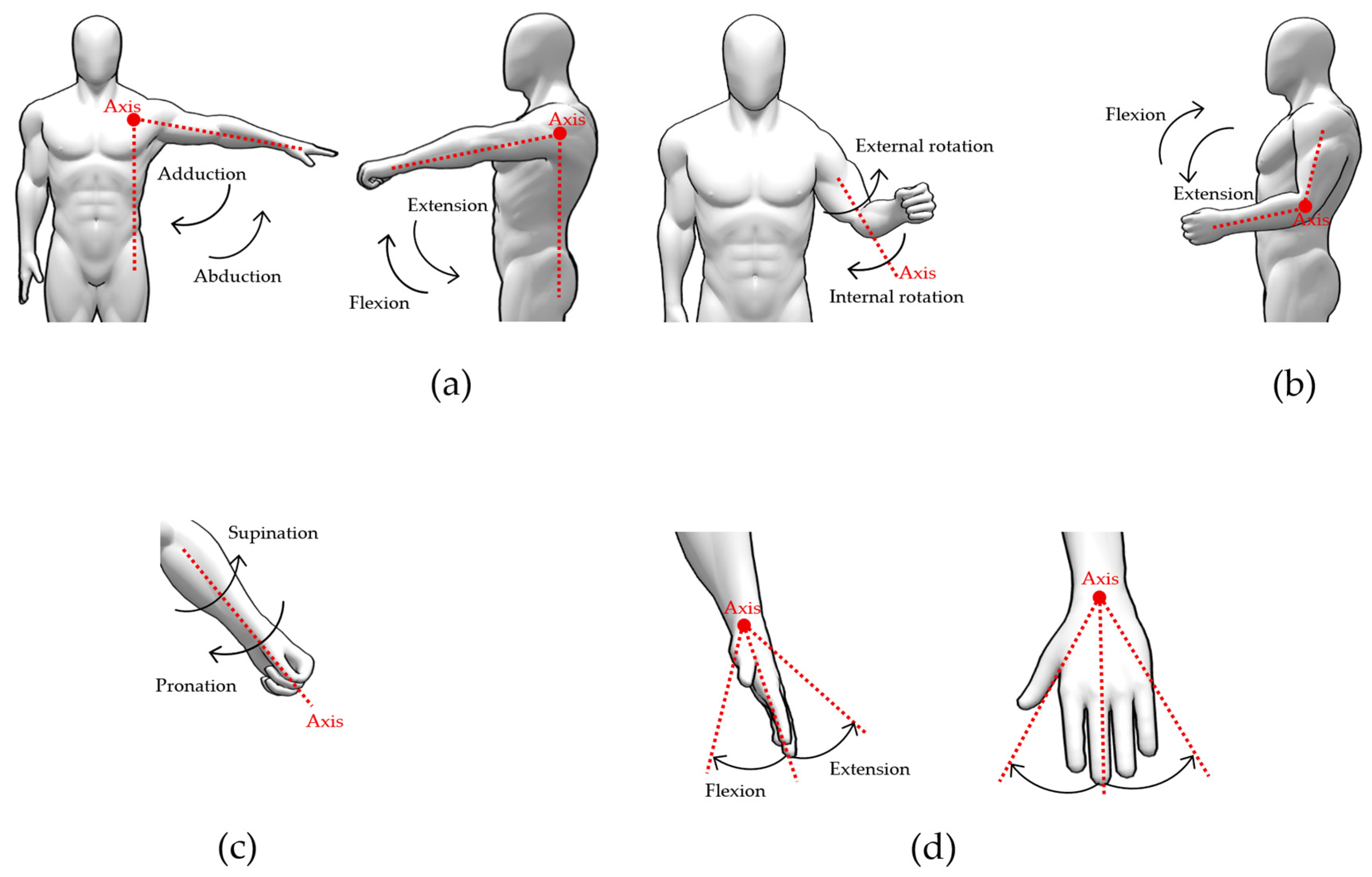
The human arm, excluding the fingers, consists of four joints, including the shoulder joint, elbow joint, forearm joint, and wrist joint. These joints provide a total of seven degrees of freedom (DoF) of movement to the arm, allowing it to cover a large workspace, with the ability to reach a single point in space from different angles. As seen in
Figure 1, and inspired by [
7], the shoulder has three DoF, including abduction/adduction, flexion/extension and internal/external rotation, the elbow has one DoF for flexion/extension, the forearm has one DoF related to supination/pronation, and the wrist has two DoF for flexion/extension and ulnar/radial deviation.
As the movement through the 3D space, including transition and rotation, only requires six DoF, it can be inferred that the arm has one redundant degree of freedom, meaning that when the hand holds a stationary point in space with a static rotation, the arm is still able to have some movement and its orientation in space is not fully defined.
While fully defining the arm orientation requires more complex controls and may lead to some level of discomfort, it may be necessary to overcome the basic limb synergies. Basic limb synergies refer to the stereotyped movement patterns that can be observed in hemiplegic patients and describe the abnormal and automatic grouping of muscles that may limit the isolated movement of joints [
11].
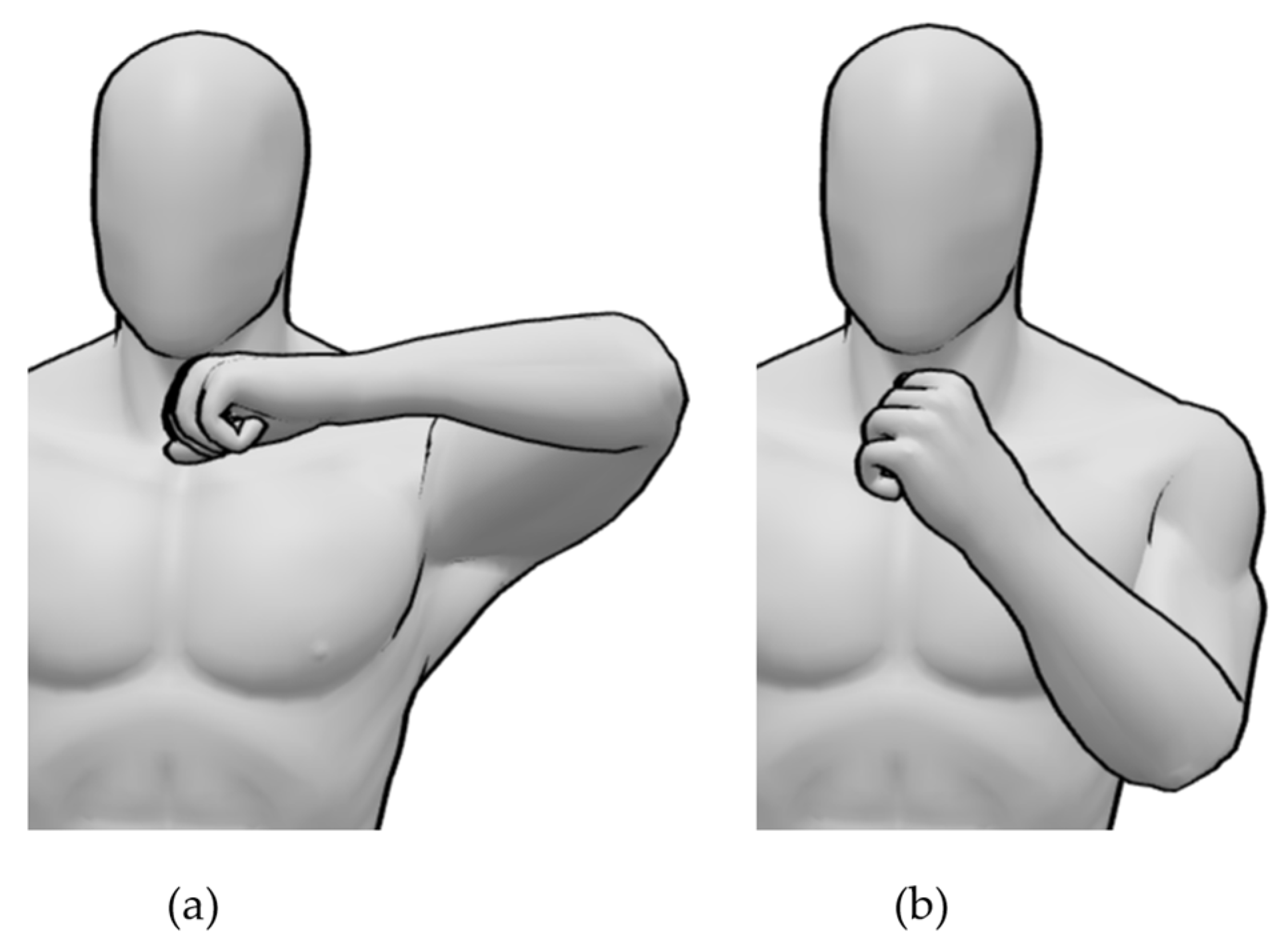
Figure 2 shows an example of the effect of such synergies on the movement of the arm. When the patient was asked to bring the hand to the mouth, the shoulder abducted as seen in (a). The correct movement is shown in (b) and was achieved by pressing the elbow against the body, thereby inhibiting shoulder abduction.
However, while the rotational movements of the arm are limited to seven DoF, the upper body is capable of movements that may affect the overall position and reach of the arm. For instance, while reaching forward to grab an object, part of the movement may be the result of the upper body leaning forward. In the context of upper limb therapy, these movements are often referred to as trunk compensation. As the base of the arm is attached to the shoulder joint, it can be assumed that the shoulder has three additional translational DoF.
Only a small number of end-effector-based robots can control the shoulder’s translational movement and the trunk compensation. Works that are incapable of directly controlling the shoulder translation may opt to either ignore such compensation or to use seatbelts and straps, fastening the upper body to the chair and restricting the shoulder movement.
In this study, for the purpose of classifying whether a robot is capable of fully defining the arm orientation, it will be assumed that the upper body’s movement has been restricted.
1.2. Stages of Recovery
A patient’s inability to perform tasks using their hemiplegic/hemiparetic arm cannot be directly measured; as such, multiple approaches have been suggested to categorize the stage of recovery and track the patient’s progress. In this section, some of the common measurement methods, including Brunnstrom’s stages [
11], Fugl–Meyer’s assessment (FMA) [
12], the Motor Status Scale (MSS) [
13], MRC’s Motor Power (MP) score [
14] and the Modified Ashworth Scale (MAS) [
15] will be briefly described.
Brunnstrom [
11] categorizes the post-stroke recovery into seven stages:
Stage 1. Immediately after the acute episode, the hemiplegic side is flaccid and no movement can be initiated.
Stage 2. As recovery begins, some reactionary movements and minimal voluntary movements may appear, and spasticity begins to develop.
Stage 3. The patient gains some voluntary control of basic movement synergies, while spasticity reaches its peak. In this stage, movement is semi-voluntary as the patient can initiate movement but cannot control the form of resulting movement, and it would adhere to the basic limb synergy.
Stage 4. Some non-synergistic movements are possible and gradually become easier. Spasticity begins to decline, but the effect on non-synergistic movements is still considerable.
Stage 5. Spasticity continues to decline, and more complex movements are mastered while the synergies lose their dominance.
Stage 6. Individual joint movements and near-normal coordination become possible. As spasticity disappears, full range of motion (ROM) gradually becomes possible.
Stage 7. Full recovery and normal motor function.
Brunnstrom’s stages can be roughly categorized as early stages, where movement is barely possible in stages 1 and 2; middle stages, where voluntary movement is possible, though bound by the synergies and may be inaccurate; and late stages, where the synergies lose effect and most movements are possible, although muscle weakness may be present.
Fugl–Meyer’s assessment (FMA) [
12], on the other hand, evaluates the motor recovery after a stroke by assessing the patient’s ability to perform certain tasks and giving them a score based on their performance. Patients will receive a score of 0 if they are not able to perform the task, a score of 1 for partial performance, and a score of 2 for full performance. The scores for each task relating to a limb are tallied up to arrive at a final score.
The FM assessment for the arm or upper extremity, also known as Fugl–Meyer’s assessment for upper extremity (FMA-UE), has a total of 66 points, with the shoulder and elbow (proximal joints) accounting for 36 points, and the wrist and hand (distal joints) accounting for 10 and 14 points, respectively. The remaining six points are given based on tasks that require coordination between the joints. It is important to note that, as FMA uses a three-point ordinal scale, it does not necessarily reflect all of the improvements achieved through training.
The Motor Status Scale (MSS) [
13] builds up on the foundation of FMA and offers a more precise grading for shoulder and elbow, using a five-point ordinal scale, and also assesses more isolated rotational movements for these joints.
MRC’s Motor Power (MP) score [
14] uses a six-point ordinal scale and assesses the contraction in muscle as well as whether the limb can perform movements that do not need to overcome the effect of gravity and whether it can move against the gravity and other resistances.
The Modified Ashworth Scale (MAS) [
15] evaluates muscle tone and spasticity through the range of motion (ROM) using a six-point ordinal scale.
1.3. Training Methods Used for Rehabilitation
Rehabilitation robots are designed to offer various training methods based on the recovery stage of hemiplegic patients, with the aim of mimicking the training and assistance provided by therapists. The trajectories or the tasks given to the patients during training are usually based on activities of daily living (ADL) and aim to help the patient regain the ability to perform these tasks on their own.
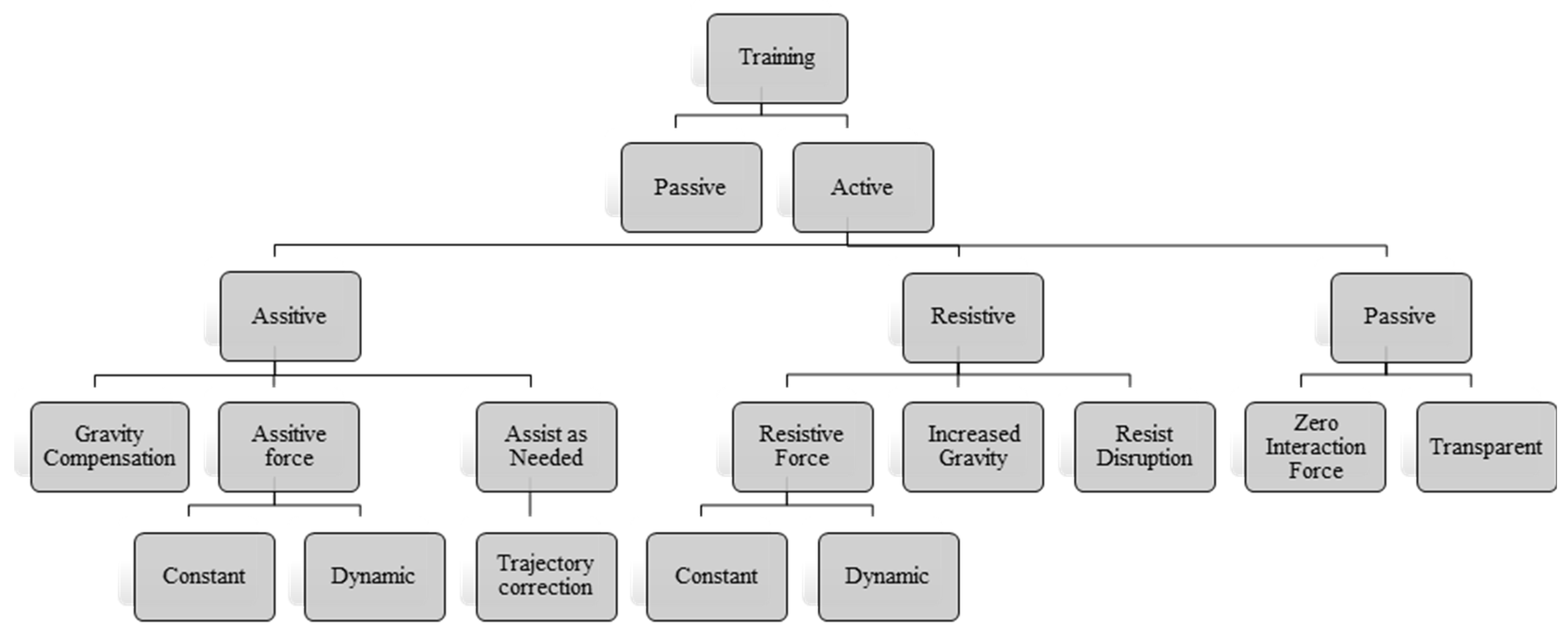
As illustrated in
Figure 3, these training modes can be divided into two main categories: Passive training, where the patient is passive while the therapist or robot moves their arm, and active training, where the patient has to put in varying degrees of effort. Active training can be further broken down into assistive training (active-Assist), where the patient actively tries to perform a task while the therapist or robot provides some form of assistance, and resistive training (active-resist), where the therapist or robot actively tries to resist the patient’s effort to complete a given task. Additionally, active training can be provided without any assistance or resistance, where the patient must move with minimal force interaction with the therapist or robot; this is referred to as active-passive training.
As mentioned in the previous section, the stages of recovery can be broken into early, middle, and late stages. Patients in the early stages, who have not yet recovered their motor function, benefit the most from passive training. On the other hand, patients in the middle stages, who have some of their motor functions back and are able to move their arm to some extent, benefit from assistive training, where they need to make some effort and the inaccuracies in their movements are corrected. For the patients in the later stages of their recovery, who have most of their motor function back but are experiencing some muscle weakness, resistive training can help them improve their muscle strength.
Different types of assistive training can be provided to the patient, including gravity compensation, where the effect of gravity is reduced on patient’s arm through an upward force; constant or dynamic assistive force, where an assistive force is provided in the direction of the trajectory; movement amplification, where the patient is required to initiate a movement before passively being guided on the trajectory or a portion of it; assist as needed (AAN), where assistive force is only provided when the patient is unable to complete the task or a portion of the trajectory; and trajectory correction, which can be considered a subset of AAN, where the robot resists movements outside the given trajectory. Trajectory correction is usually implemented using impedance control and creates a tunnel around the trajectory acting as a spring-dampener pair, applying a corrective force that increases the further the arm deviates from the path, guiding the arm back towards the desired trajectory.
Resistive training can be provided as constant or dynamic resistive force, where a force acts against the arm, resisting movements in any direction or on the trajectory. This constant force is usually paired with trajectory correction. Increased gravity, where the gravity applied to the hand is increased through a downward force, has also been suggested as a method of training. Another way to implement resistance training is by asking the patient to resist the movement of the robot by holding the end-effector stationery, known as resist disruption.
The dynamic assistive or resistive forces can be implemented based on different criteria, such as the distance from the initial point or to the goal, or based on the time elapsed.
Some robots, aiming to either act as a measurement apparatus to identify the patient’s ROM or to solely motivate the patient to partake in the exercise through their interface, have implemented zero interaction force (ZIF) or transparent mode. These training modes are part of active training. In ZIF mode the robot neither assists nor resists the patient’s movement and only provides enough force to account for its own weight and internal friction, allowing the patient to freely interact with the training interface by exhibiting just enough force to move their own arm. Similarly, in transparent mode no assistive or resistive force is applied at the end-effector; however, the patient has to overcome some of the internal forces and frictions of the robot on their own. For the purpose of classification, unless a work explicitly mentions the implementation of ZIF mode or that they have accounted for the robot’s internal forces, the training mode will be classified as transparent mode.
2. End-Effector-Based Rehabilitation Robots
The main characteristic of end-effector-based rehabilitation robots compared with exoskeletons is that they only have one point of connection to the patient’s arm. This point of connection could be through a handle held by the patient’s hand, a cuff on their wrist, or an orthosis that holds their hand and forearm simultaneously. These robots, based on their workspace, can be divided into two main groups, including planar robots (
Section 2.1) and three-dimensional robots (
Section 2.2). In this work,
Section 2.3 is dedicated to a subcategory of three-dimensional robots, namely dual end-effector robots. Dual end-effector robots typically have two separate arms with their own end-effectors, connected to different segments of the patient’s arm, and provide varying degrees of assistance to each segment.
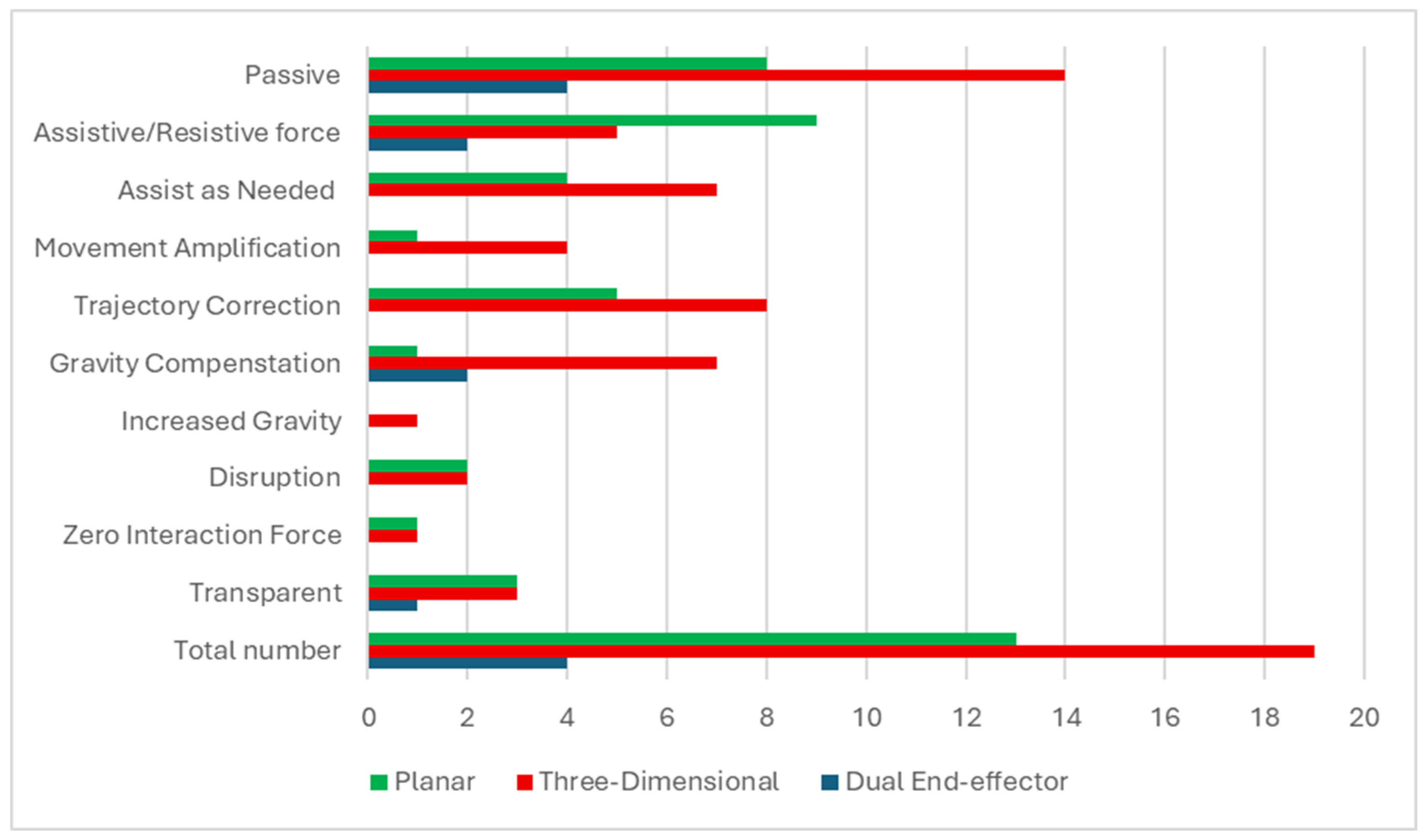
Table 1 and
Table 2 respectively disclose the planar and three-dimensional robots studied in this review. These tables provide information such as the connection point of the robot to the arm, robot’s degrees of freedom, the number of degrees of freedom that the robot controls on the arm (effective DoF), whether the arm orientation is defined, the training modes provided and control methods used to implement them, whether the robot was tested in a clinical setting, the method of actuation and whether commercial robots were used as part of the system, and, finally, the type of user interface provided by the robot and their portability.
The portability of these robots has been scored from 1 to 5. A score of 1 represents robots that are fully stationary and/or have been bolted down. Scores of 2 and 3 are assigned to bulky robots that can be moved around on wheels. A score of 4 represents robots that are suitable for home use and do not take up much space, such as robots that can be placed and used on a table without extra components, while a score of 5 means that the robot can easily be carried around. It should be noted that, while some robots with a portability score of 3 may appear as table-top robots, either the table may be part of the robot itself or there may be a need for extra components or heavy modifications to the workspace.
2.1. Planar Robots
As the name suggests, this class of robots is designed to move on a plane, easing the design and control constraints, increasing safety, and allowing them to be generally more portable. While these robots usually move on a horizontal plane, in some cases their workspace, or plane of movement, can be manually adjusted so that the end-effector movement takes place on a slanted plane. However, due to the constrained workspace, these robots cannot support the full range of motion for the human arm and practicing ADL that involves 3D movement, such as using a spoon, is not possible.
2.1.1. MIT-Manus
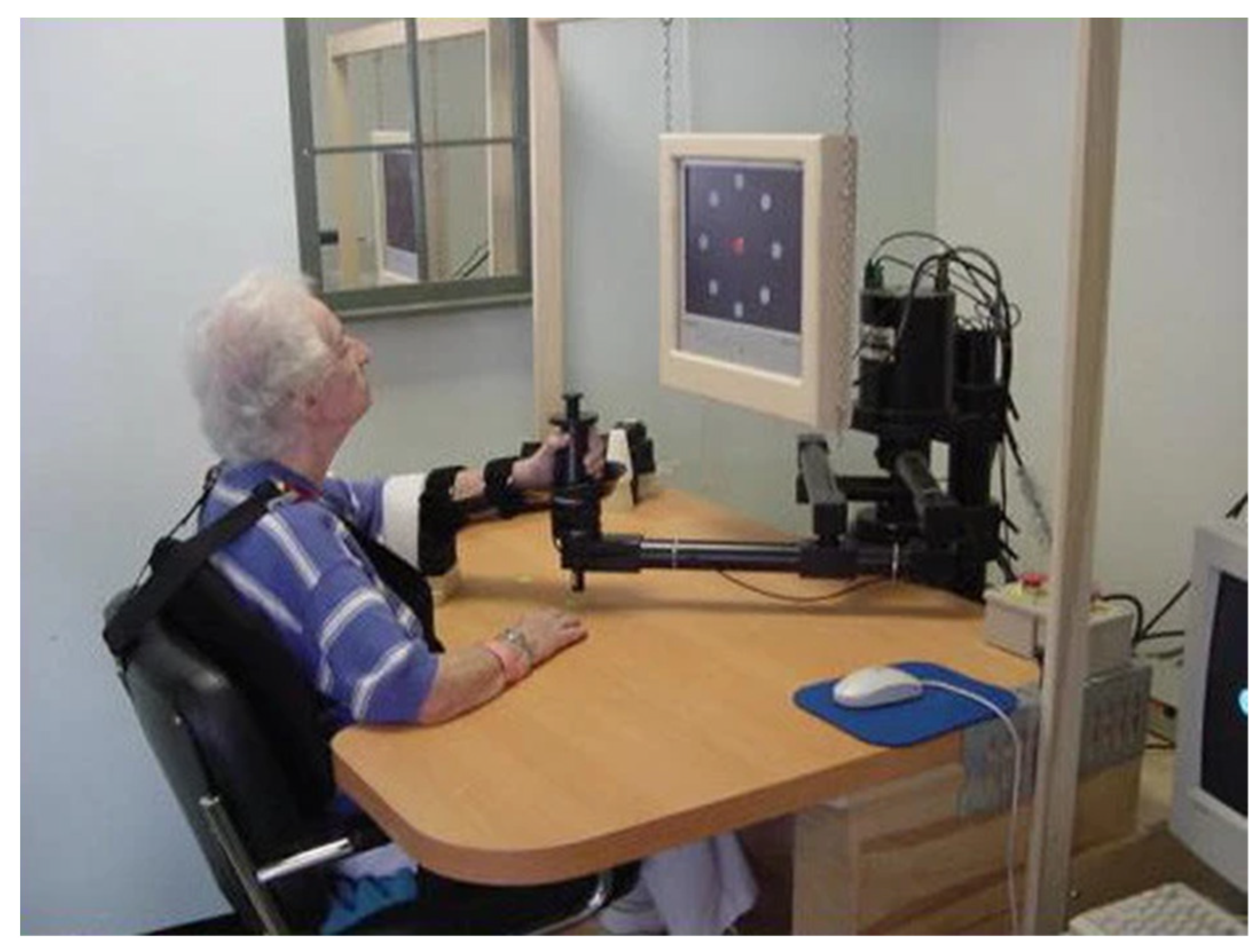
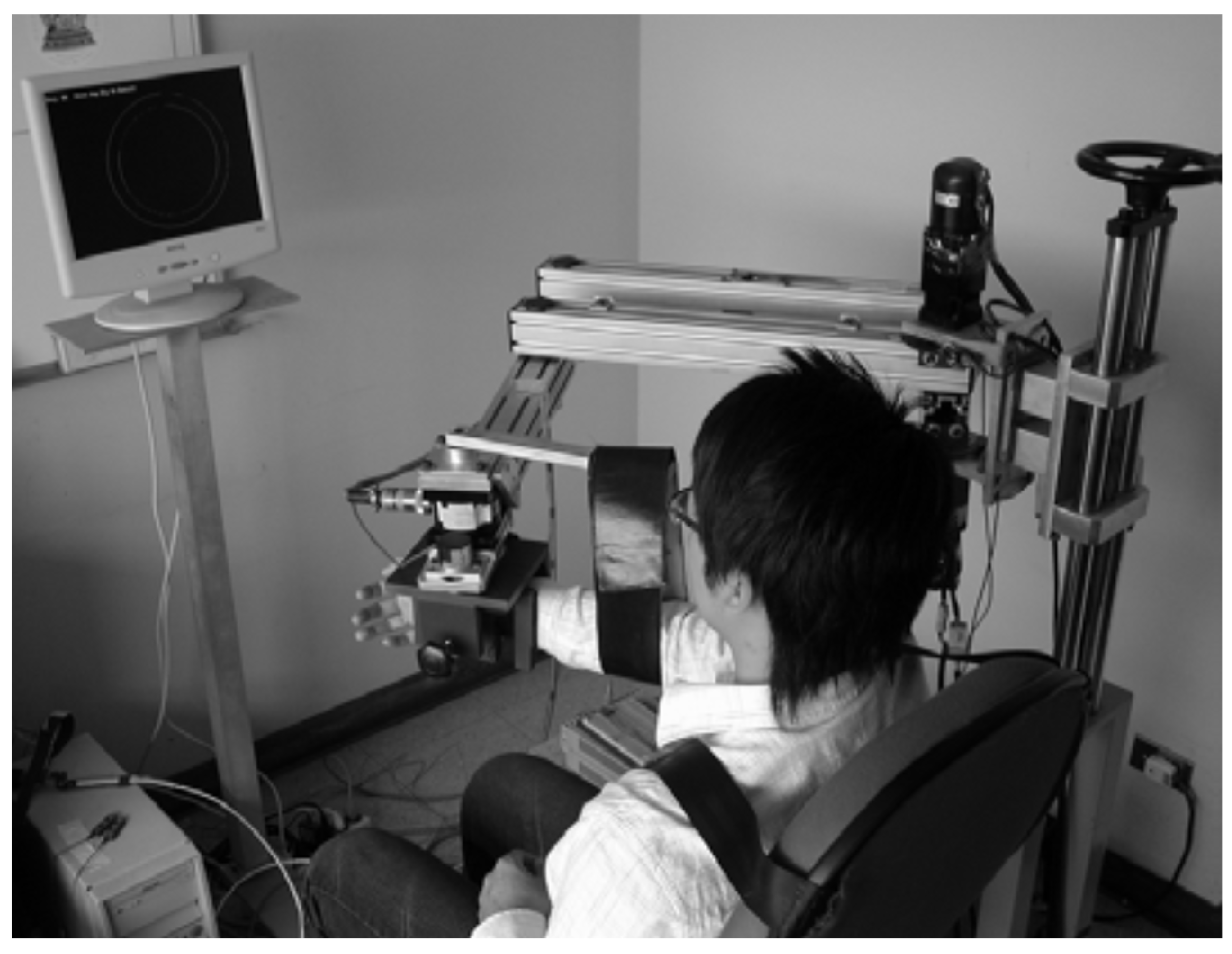
MIT-Manus [
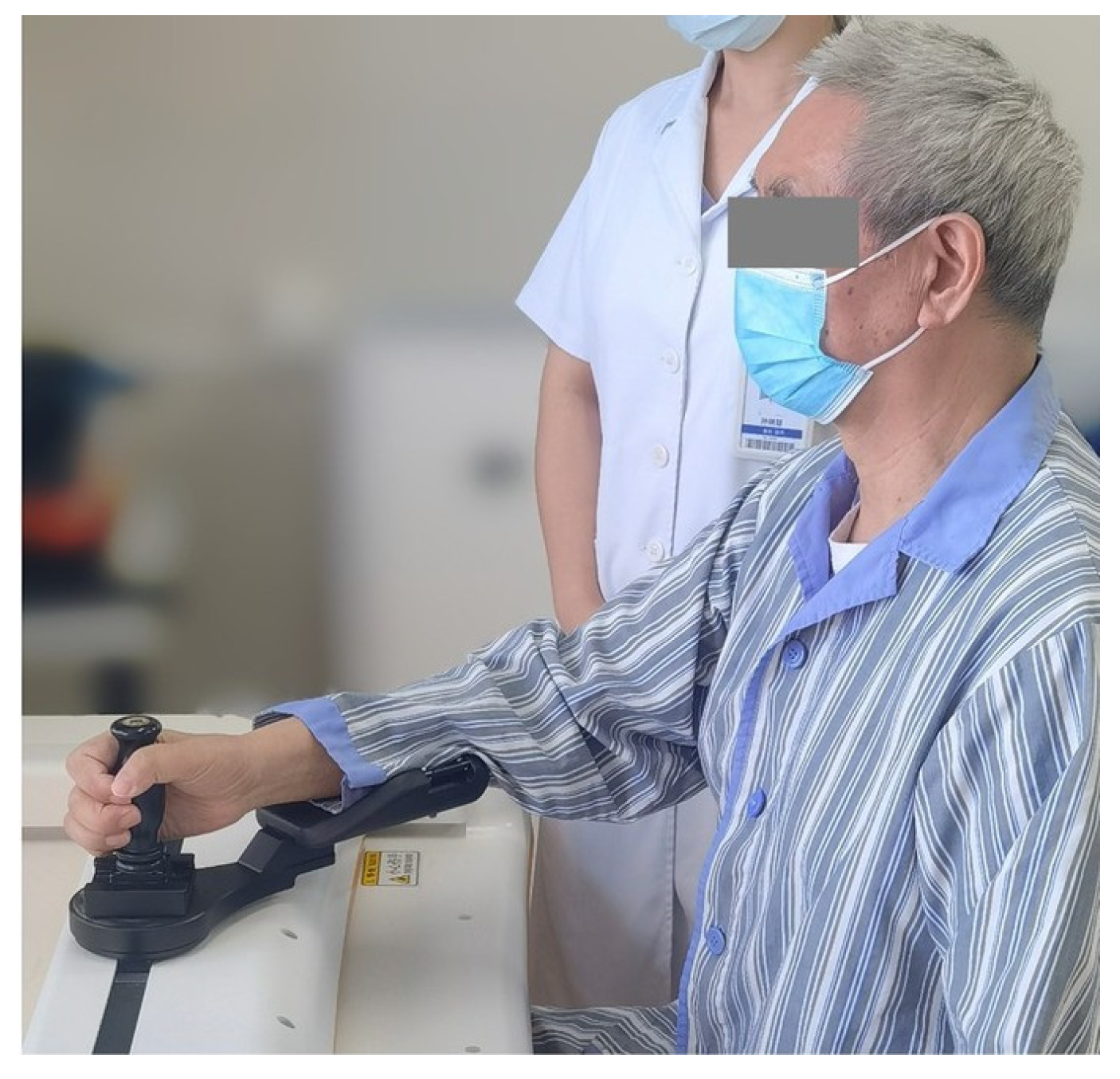
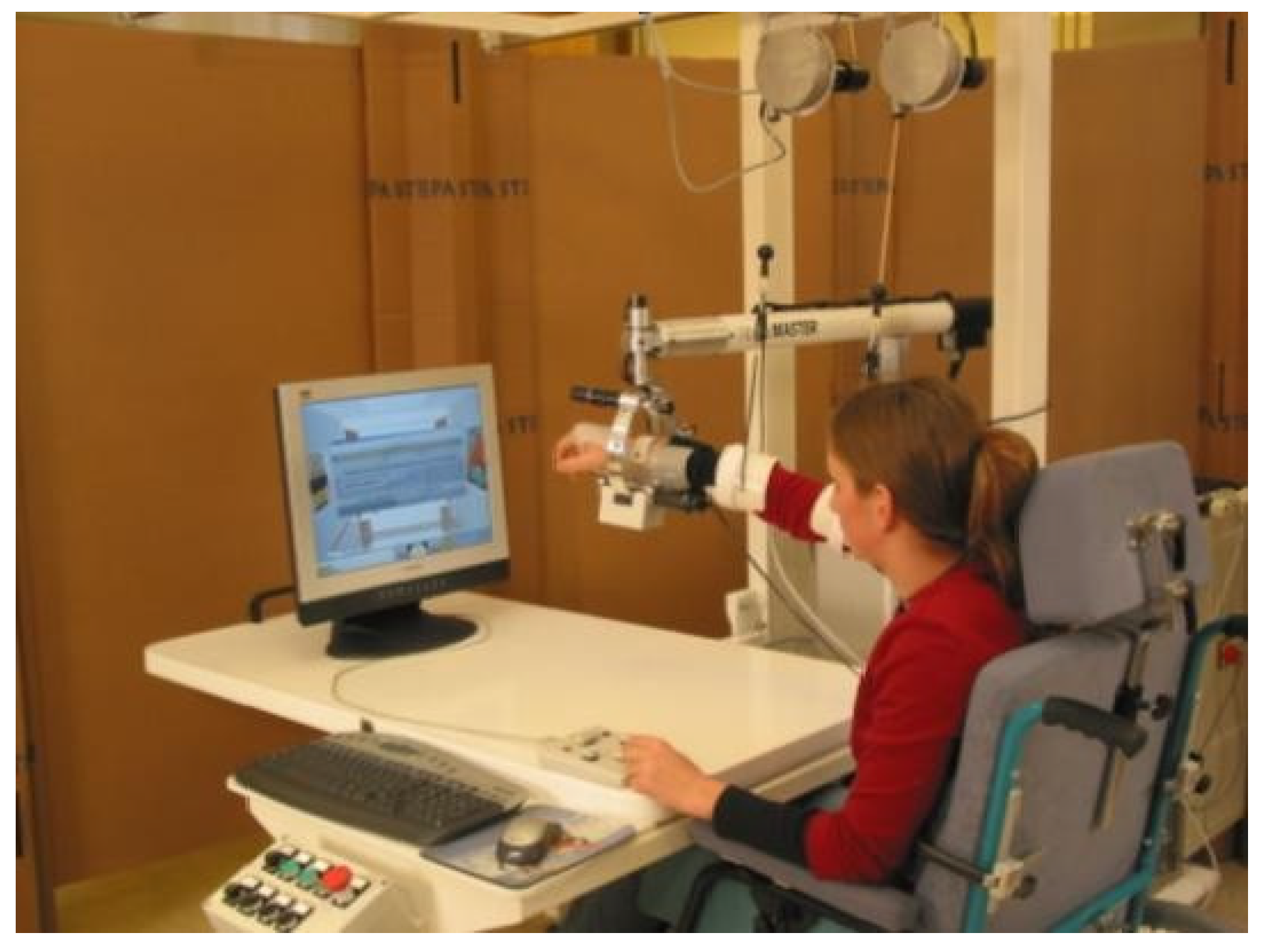
16], shown in
Figure 4, is one of the earliest rehabilitation robots made and accounts for five DoF of the human arm, while restricting another. MIT-Manus consists of a five-bar Scara mechanism, placed in front of the patient on a table, enabling a planar, two-DoF movement and a differential mechanism mounted at the end-effector in the form of a grip/brace combination, adding an additional three-DoF movement, allowing the system to control the rotation of the wrist and forearm joints. The patient’s forearm is braced to the end-effector while their hand holds the grip. While some minor passive vertical motion is possible at the end-effector, the height is considered fixed. As a result, one additional DoF can be restricted and thereby the robot can control the position of the arm with six DoF and engage the entire arm, with one free DoF, in exercise. This robot can be attached to a table with adjustable height, allowing different patients to use the device at optimal height. In [
17], a new wrist rehabilitation module was introduced and added to MIT-Manus.
Impedance control is used to assist the patient’s arm in moving through a given trajectory. Depending on the patient’s progress, the firmness of the controller can be adjusted so that either the patient’s hand moves passively, being pulled by the robot, or it is provided with some assistance or resistance through the trajectory. The therapist has to set the trajectory for the arm movement beforehand. Later, a resistance training mode was defined where the patient had to stop the end-effector from moving. In this mode, the robot randomly tries to move in a direction for a set period before switching to another.
Several clinical studies were performed [
18] for MIT-Manus, while limiting the movement of the robot to two DoF, focusing on the rehabilitation of the shoulder and elbow. A total of 76 patients were divided, such that 40 patients went through robot-assisted therapy and 36 patients were part of the control group. While both groups were receiving classic therapy, the robot therapy group received an additional 4–5 h of robot therapy. The control group was also given access to the same robot and game interface for an hour a week; however, the robot did not provide any assistance and, in case the patient was unable to complete the movement, they could either use their healthy hand or receive help from a therapist to aid their hemiparetic arm. The control group did not receive time-matched therapy. The results showed that the robot was able to operate safely without any adverse events during the approximate combined 2000 h of operation, and the robot therapy group exhibited a higher Fugl–Meyer(FM) score and a statistically significant improvement in both the Motor Power(MP) score and the Motor Status Scale (MSS) for shoulder/elbow [
18]. A total of 12 of the 20 patients involved in the initial study [
19] were assessed 3 years after hospital discharge, with 6 patients from each group. The patients in the robot-assisted therapy demonstrated that they have maintained their advantage in MP and MSS scores; however, both groups had similar FM scores.
Figure 4.
MIT-Manus [
20].
Figure 4.
MIT-Manus [
20].
A commercially available version of MIT-Manus, Bionik Lab’s InMotion Arm, has been employed in several clinics. InMotion Arm focuses on the recovery of the shoulder and elbow, and Bionik Lab provides separate modules for wrist and hand recovery as well.
2.1.2. MIME (PUMA-260)
The mirror image motion enabler [
21] robot allows the patient to control the position of their hemiplegic arm with their healthy arm. The first iteration of this robot used two arm supports that allowed planar movement of the forearm while supporting its weight, and used a base with an adjustable height to accommodate different patients. On the hemiplegic side, the arm support’s planar position was controlled by a PUMA-260. This setup allowed this robotic arm, which had a low force output, to move the arm without bearing its weight. Given the structure of this device, despite using a six-DoF commercial robot, the lower arm was only able to move on the horizontal plane, while its rotational and vertical movements were restricted. Therefore, it can be concluded that, ignoring the translational movement of the shoulder, the orientation of the arm was fully defined.
MIME could either passively guide the hemiplegic arm through a predefined trajectory or allow the healthy arm to control its position. Additionally, this robot could provide assistive force in the form of movement amplification, where, after detecting force activity, regardless of the direction of the force, the end-effector would move along the correct trajectory. A PID servo control was used to control the position of the end-effector.
The trial for this robot included 13 hemiplegia patients, but it aimed to validate the use of the robot rather than to measure its performance. While MIME was successfully able to guide the arm for 12 of the patients, it failed to passively guide the arm for a patient with high spasticity present in their muscles, as the spasticity was able to overpower the robot’s force.
Later iterations of this robot aimed to guide the arm through the three-dimensional space, and will be included in
Section 2.2.1.
2.1.3. NCKU’s Planar Robot
Ref. [
22],
Figure 5 present another robot with a five-bar mechanism controlling the planar movement of its end-effector while it is connected to the wrist. The base for this robot is located beside the patient’s shoulder on the hemiplegic side, and it controls the arm from above. The patient’s wrist is clamped to the end-effector, keeping the wrist at shoulder height and preventing the rotation of the forearm joint. Furthermore, the lower arm was strapped to a horizontal rotating beam connected above the end-effector, with one passive DoF, similarly positioning it at shoulder height, setting the minimum shoulder joint abduction to 90° and supporting the arm on a horizontal plane. However, while the elbow joint is prevented from moving downward as a result of the strap, it can still move upwards. It can be concluded that this robot controls two DoF and restricts three DoF, and therefore it fully defines the arm orientation at the wrist.
As the lower arm is strapped to the system, the robot passively provides gravity compensation to the patient’s arm. Additionally, the robot can move the patient’s arm passively or provide constant assistive or resistive forces at the end-effector. A hybrid position/force controller incorporating fuzzy logic was used to control the trajectory and apply the constant force.
Ref. [
23] states that a treatment protocol was developed and clinical tests on healthy subjects and patients had been performed using this robot between 1999~2007 at NCKU hospital. The results provided showed improvements in dynamic stiffness of the elbow and shoulder joints after 4 and 12 weeks. However, while the testing protocol was provided, no information was provided regarding the amount of training and the number of stroke patients involved.
2.1.4. MEMOS
The mechatronic system for motor recovery after stroke (MEMOS) [
24] is a two-DoF Cartesian robot allowing movement on the horizontal plane. The patient’s hand is strapped to the end-effector and, similar to MIT-Manus [
16], the vertical movement of the hand is restricted. Furthermore, by holding the handle with fixed orientation, forearm rotation is restrained as well. In total, four out of the seven DoF of the arm are controlled and therefore, the arm orientation cannot be fully defined.
MEMOS can assist the arm passively and move it through a set trajectory. Additionally, an interface is provided where the patient is given a starting point and a goal, and they can voluntarily move their arm to reach the goal in ZIF mode. The robot can be set to assist-as-needed mode, where it allows the patient to move their arm freely, but if they are not able to reach the goal provided after a certain amount of time, the robot moves the arm towards the goal.
A clinical trial was conducted where eight patients were provided forty minutes of robotic therapy twice a day, for three weeks as well as an additional 45 min of classic therapy a day. Although the patients showed improvements, the lack of a control group means the results do not necessarily reflect the effectiveness of the robot.
2.1.5. Braccio Di Ferro
Braccio di Ferro [
25,
26] uses a four-bar mechanism to enable two-DoF movement. The end-effector is held by the user’s hand, while their wrist is held straight with an orthosis and their forearm is supported on the table through a low-friction material, effectively restraining the wrist and forearm rotations as well as vertical movement.
This robot aims to integrate haptic feedback, achieved through impedance control, as a way of preparing patients for ADL. Objects, shown on a screen, can have attractive, resistive, repulsive or gravitational fields, meaning that the robot can provide constant or dynamic forces to assist or resist the movement. A perturbing field was defined as well, which could introduce disruptions along the path, offsetting the arm’s trajectory unless resisted by the patient. Additionally, the robot can provide assistance in the form of trajectory correction for reaching tasks, providing minimal assistance, through a constant force, in the direction of the goal while minimizing the offset from the path through resistance. A bimanual mode, where the patient is required to use both hands in coordination to complete the task, was also implemented.
Clinical trial [
27] involved 10 patients partaking in 10, 60 min-long sessions at the rate of one session per week. Patients had previously received at least 6 months of conventional therapy and continued to receive this therapy during the duration of robot therapy. The training tasks for robot therapy mainly included reaching tasks at different ranges of motion while receiving assistance and course correction forces. The results showed statistically significant improvement in the FMA score of the patients and they were able to retain these improvements as observed in the follow-up, 3 months after the conclusion of the trial. It can be observed that the follow-up score is virtually identical to the score at the end of the robot therapy.
2.1.6. PLEMO
PLEMO [
28] and Hybrid-PLEMO [
29] are two-DoF rehabilitation devices using a parallel linkage four-bar mechanism to control the position of an end-effector. Additionally, a table with a manually adjustable tilt is used to bring three-dimensional workspace variation to rehabilitation, hence why [
28] refers to PLEMO as a quasi-three-DoF robot. It should be noted that the movement occurs strictly on a plane. PLEMO forgoes the use of actuators and relies on an ER fluid brake system, where the brakes generate a torque against movement. On the other hand, Hybrid-PLEMO adds two ER actuators to the system to better adjust the direction of resistive force. The handle used allows the free rotation of the forearm joint and only restricts out-of-plane movement.
PLEMO can provide a passive, constant resistive force as a method of rehabilitation; this resistive force can also be dynamically adjusted based on the end-effector velocity. In this robot, the resistive force is omnidirectional. Hybrid-PLEMO can additionally produce an oscillatory force, helping the user correct the direction of their reaching motion. A computer game interface was used to show the desired trajectory to the subjects.
The initial clinical trial [
30] for the base PLEMO involved 6 stroke patients and 27 healthy individuals, and studied PLEMO as a device for evaluating the severity of disability. During the trial, the abnormal wrist flexion was noticed in those who were in the middle stages of recovery (stages 3 and 4 of Brunnstrom’s method).
2.1.7. Sophia-3
Sophia-3 and 4 are cable-based planar robots that were introduced and designed in [
31], later in [
32] a physical prototype of Sophia-3 was made. Numbers 3 and 4 in the robot’s name correlate with the number of cables used for the actuation of the end-effector. Sophia-4 used four pulley blocks placed at the corners of an isosceles trapezoid, with dimensions corresponding to standard biometric data, to control the position of the patient’s hand and the forces applied to it. Sophia-3 reduced the number of cables to three, having only one pulley block close to the body and ensuring that the cable connecting to it maintains its orientation (parallel to the Y axis on the table) by moving the pulley block on a linear path. This system can exhibit similar force manipulation behavior to Sophia-4 while reducing the interference between the patient’s hand and cables. Additionally, similar to PLEMO, Sophia-3 used a worktable with an adjustable slope that could manually change its tilt between 0 and 60 degrees, allowing a more complex workspace based on the patient’s needs. The patient holding the end-effector will have their out-of-plane movement, wrist ulnar/radial deviation, as well as their forearm rotation restricted. In other words, five out of seven DoF at the palm are controlled by the robot.
A display shows the current position of the end-effector and wires, as well as the target trajectory. Impedance control is used to prevent the end-effector from moving out of a predefined channel around the trajectory by providing assistive force when deviation happens. Additionally, dynamic assistive force, scaling linearly with the inverse of the distance from the correct trajectory and applied tangentially to the path, was used to assist the subject along the trajectory.
No clinical trials have been reported for this work. During the testing, 12 healthy subjects were involved, and it was concluded that the assistance provided by the robot can reduce the deviation while following a given trajectory and reduce the time required as well.
2.1.8. Other Works
Ref. [
33] uses a two-DoF robot actuated with two series servomotors, enabling movement on the horizontal plane. This robot offered four different postures for connecting the lower arm to its end effector, allowing a wider range of exercises. Regardless of the posture, the connector only allows rotation around the vertical axis, restricting the rotation of the forearm joint. Different assistive modes, such as passive movement, achieved by velocity control, and assistive and resistive modes, achieved through momentum control, were used by this robot. The clinical trial involved 30 patients receiving 1 h of robot therapy a day, for 30 days. The results are not fully disclosed, but the paper reports improvement in range of motion and velocity and a non-significant improvement in the FM score.
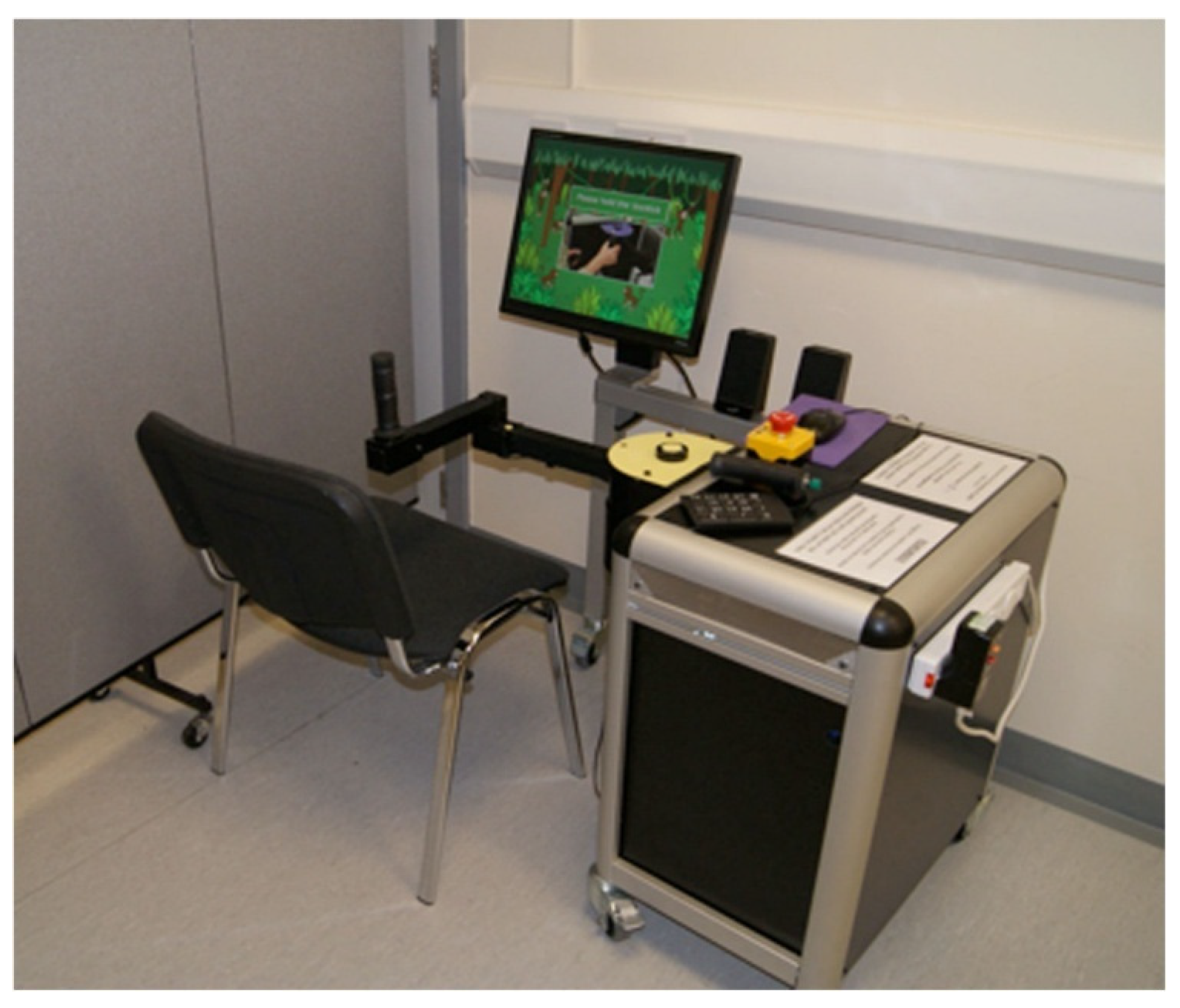
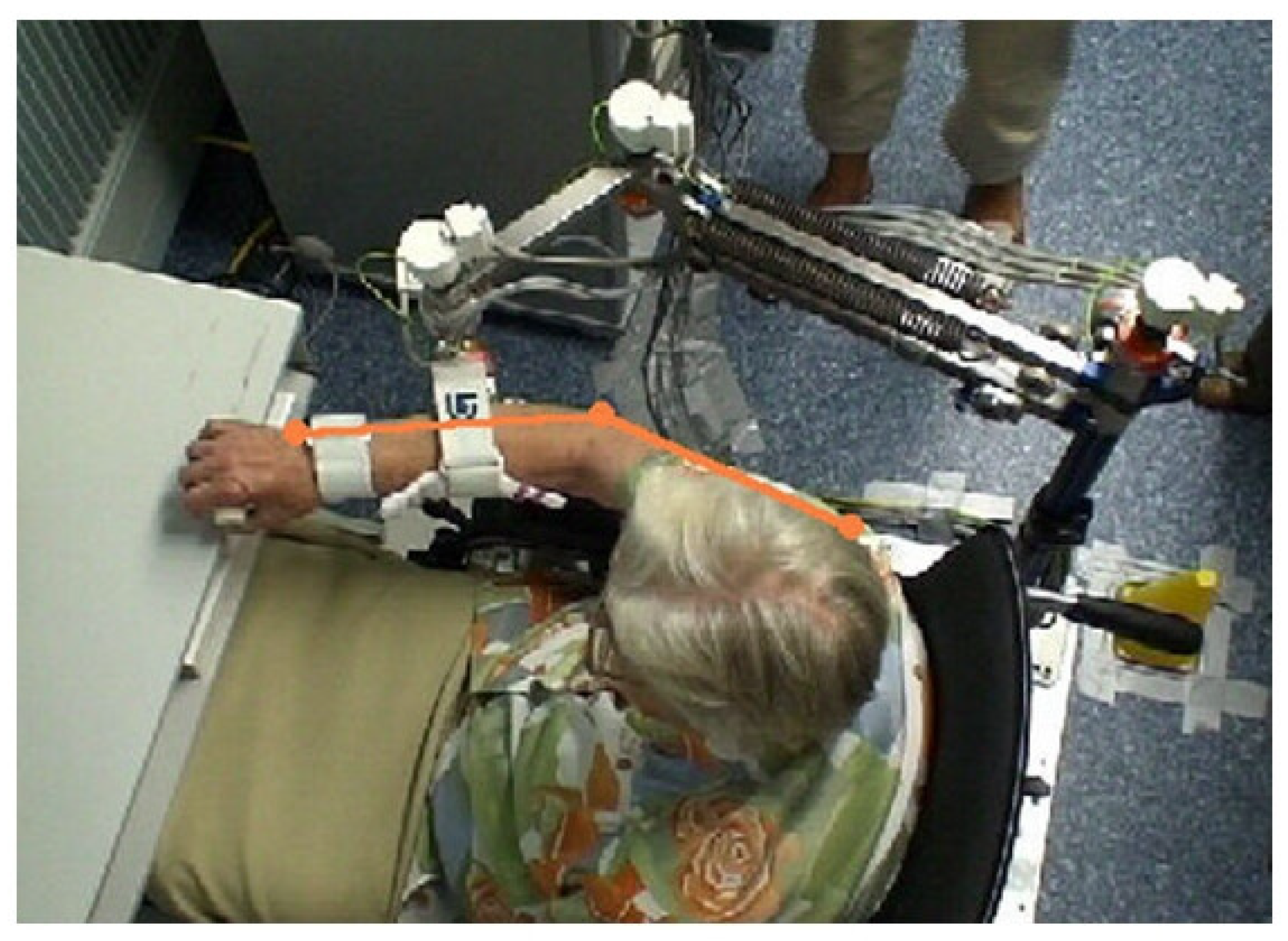
hCAAR [
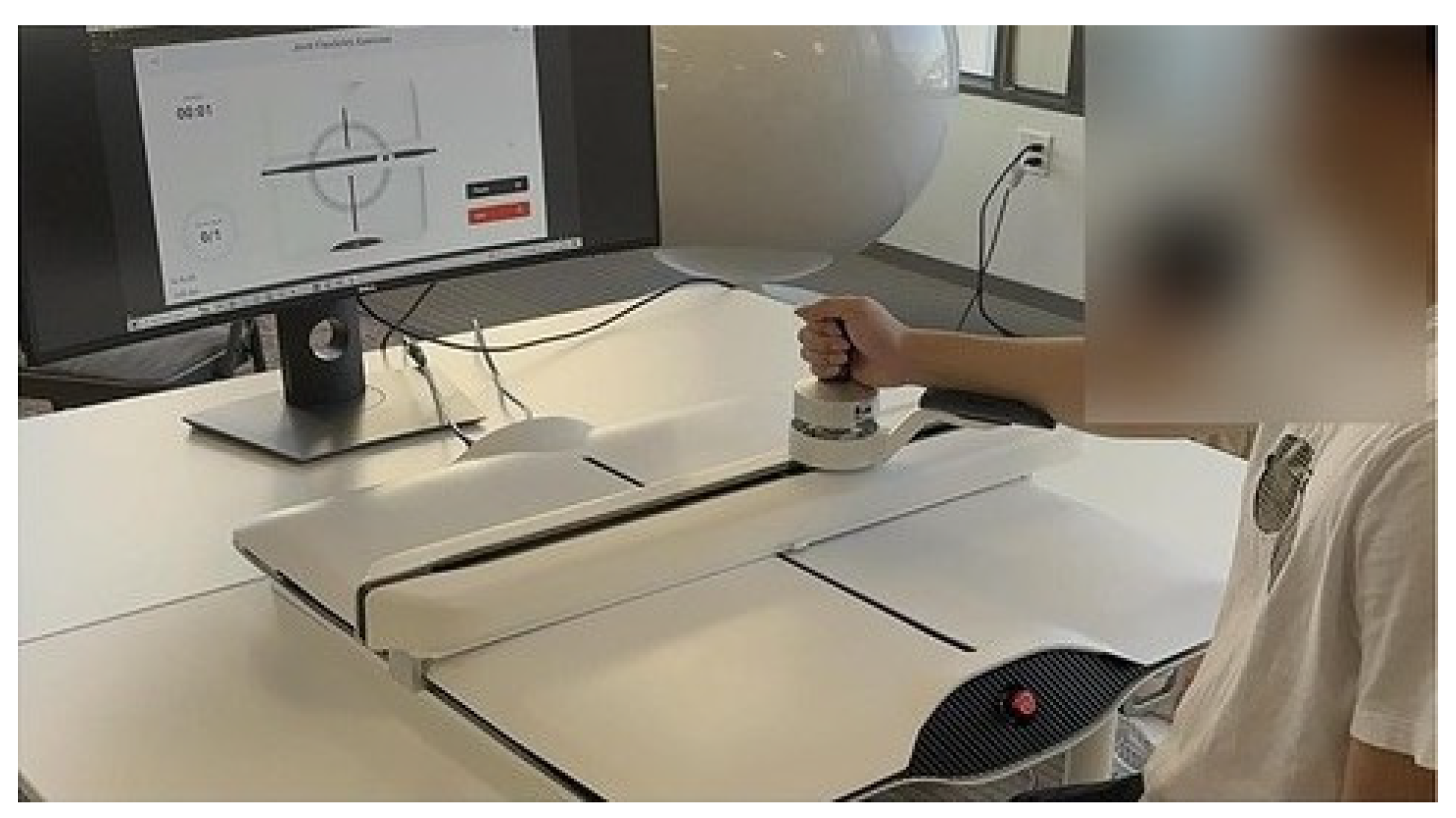
34], shown in
Figure 6, provides a highly portable two-DoF planar robot designed for home use. This robot consists of two links powered by gear motors. The end-effector, shaped like a joystick, was held by the patient’s hand and used to control games shown on a screen. Two assistive modes were defined for this robot, one allowing the user complete control without any assistance and the other providing some assistance in completing an objective when prompted through a button press by the healthy hand. To evaluate the robot, devices were set in patients’ homes. Of the 19 participants, 1 opted out due to reassessment of their home situation, and another was not able to move the joystick even with full assistance that the robot could provide. The remaining participants used the robot in their home for 8 weeks with no set time or frequency constraints, with a mean usage of 520 min (the lowest reported time was 12 min), in addition to receiving regular therapy. The patients demonstrated clinically insignificant improvement on average, while some of them achieved clinically significant improvements.
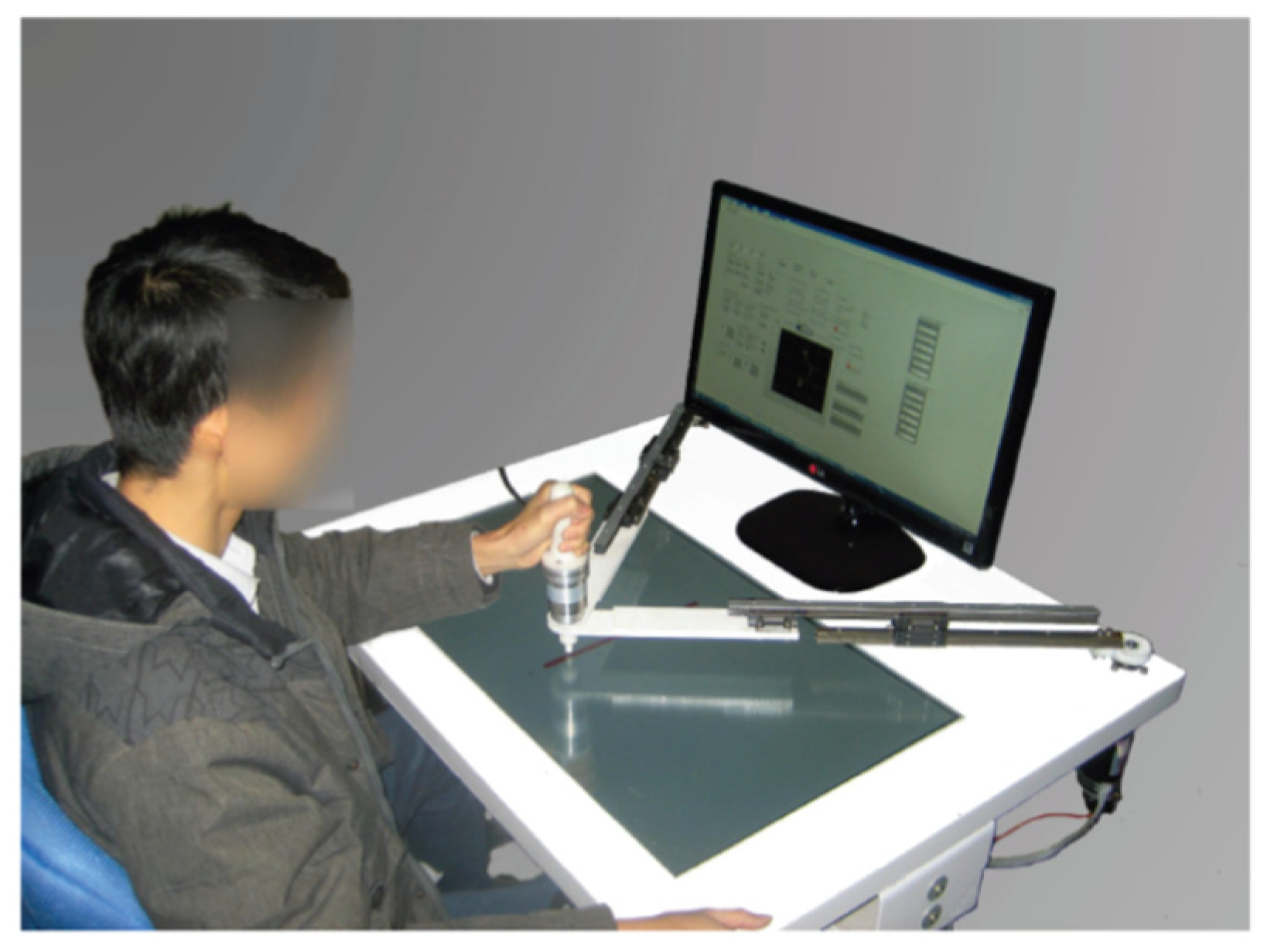
PARM [
35], shown in
Figure 7, is shaped like a triangle and has two DoF actuated by DC motors located at its base, on two of the triangle’s corners, with a fixed distance. The links connecting to the end-effector, located at the third corner, are prismatic linear rails that can passively change length during motion. The rotational movement of the forearm and vertical movement of the hand are restricted while using this robot. In addition to passive training, this robot offers trajectory correction as well as assistive or resistive forces along the trajectory. This device was evaluated through simulations and by testing on a healthy subject.
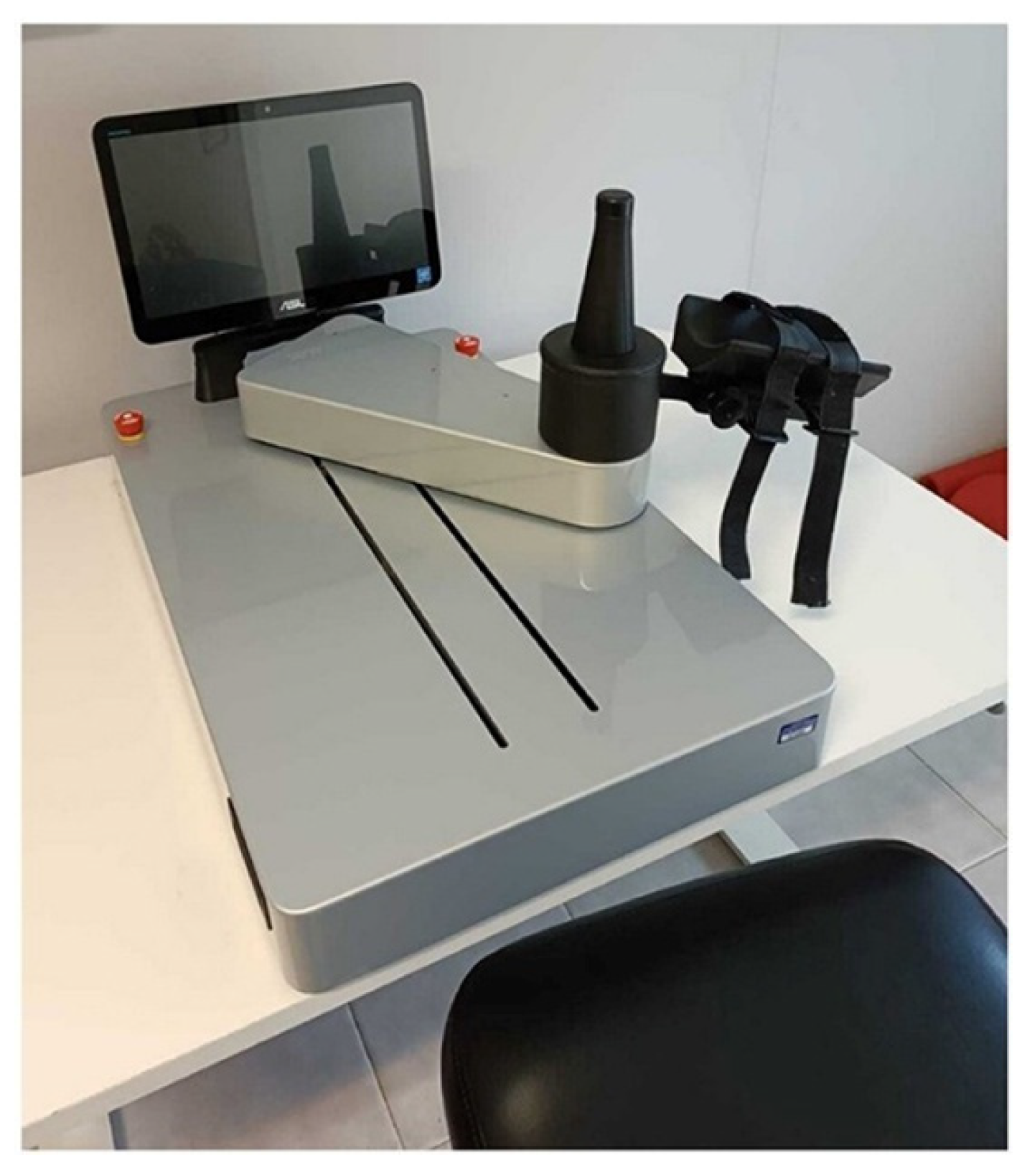
A commercial robot named iCONE [
36], shown in
Figure 8, was developed and studied for home use as well. The patient holds the end-effector in their hand while it is also strapped to their forearm, limiting the range of motion by preventing any rotational movements in the wrist and forearm as well as the vertical movement. iCONE offers three therapy modes, including assistive and resistive forces, and can assist as needed, in which case the robot provides an assistive force only when required. A 2D game interface is provided that shows the required movements. The patient’s training data are uploaded to the cloud, where it can be remotely accessed by a therapist, who can modify the training. A total of 13 patients participated in this study and completed the assessment, receiving 5 days of therapy a week for 2 weeks at home. Results showed a statistically non-significant increase in FMA-UE scores and Modified Ashworth Scale (MAS) scores, with only the MAS score for the elbow showing a statistically significant improvement.
ArmMotus™ M2 [
37], shown in
Figure 9, is another two-DoF commercial robot designed for clinical use. The patient holds the end-effector with their hand while their forearm rests on an orthosis. A variety of games are included with this robot and offer different rehabilitation modes, including passive, assistive and resistive training. A total of 53 patients participated in the clinical trial [
38] and 48 of them finished the 4-week intervention, with 24 patients in both the control and robot therapy groups. Subjects received 30 min of either robot therapy or conventional occupational therapy in addition to routine therapies. There was no statistically significant difference between the two groups on FMA-UE, Modified Barthel Index (MBI) [
39], and MAS scales. It is reported that, based on the FMA score, the robot therapy group exhibited accelerated recovery for their shoulder and elbow, but not the distal joints. It was noted that the patients in Brunnstrom recovery stage 3 saw more benefits from robot therapy compared with those in stages 2 and 4 of the recovery. For stage 4 patients, it was hypothesized that this may be attributed to the robot therapy protocol not being challenging enough.
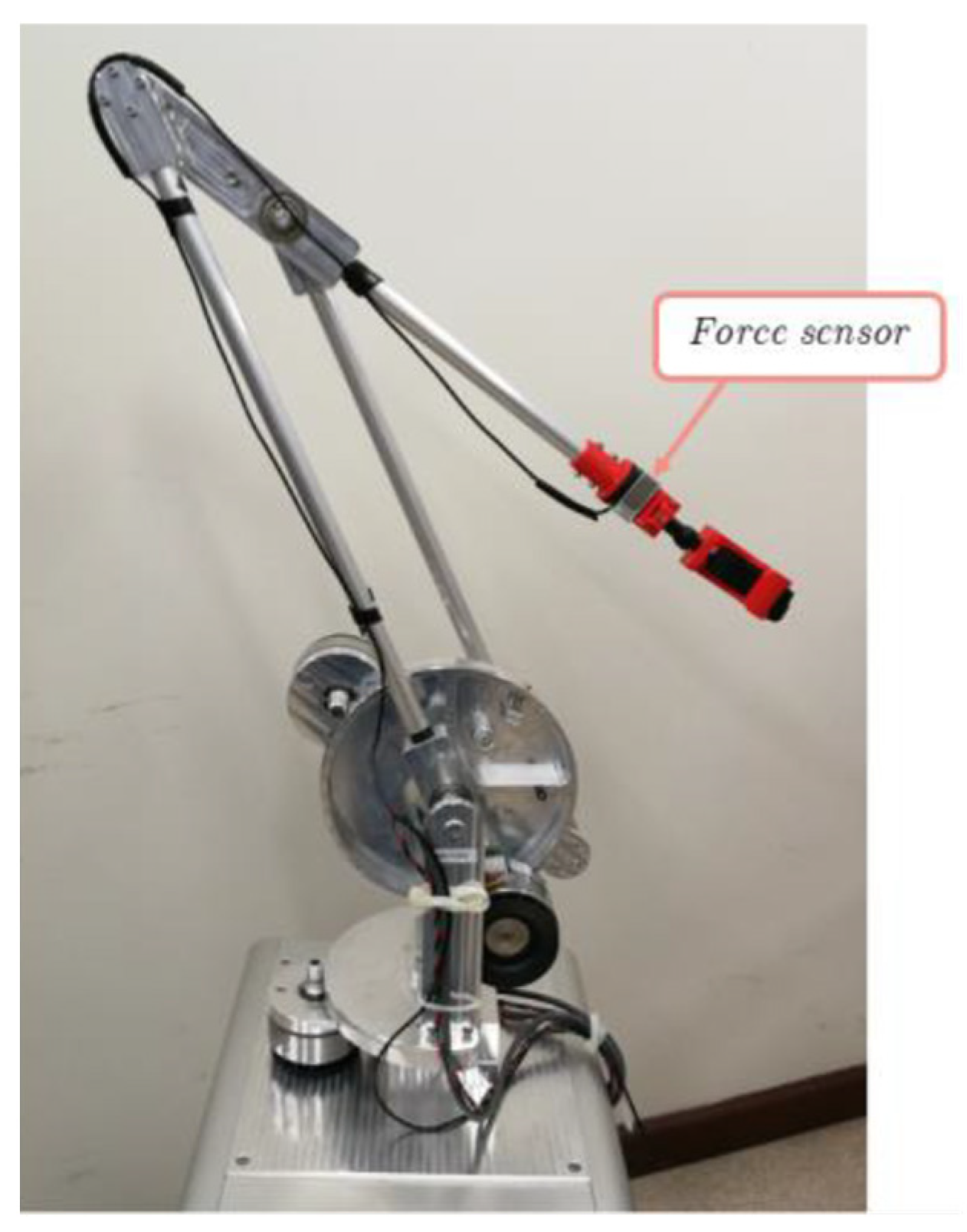
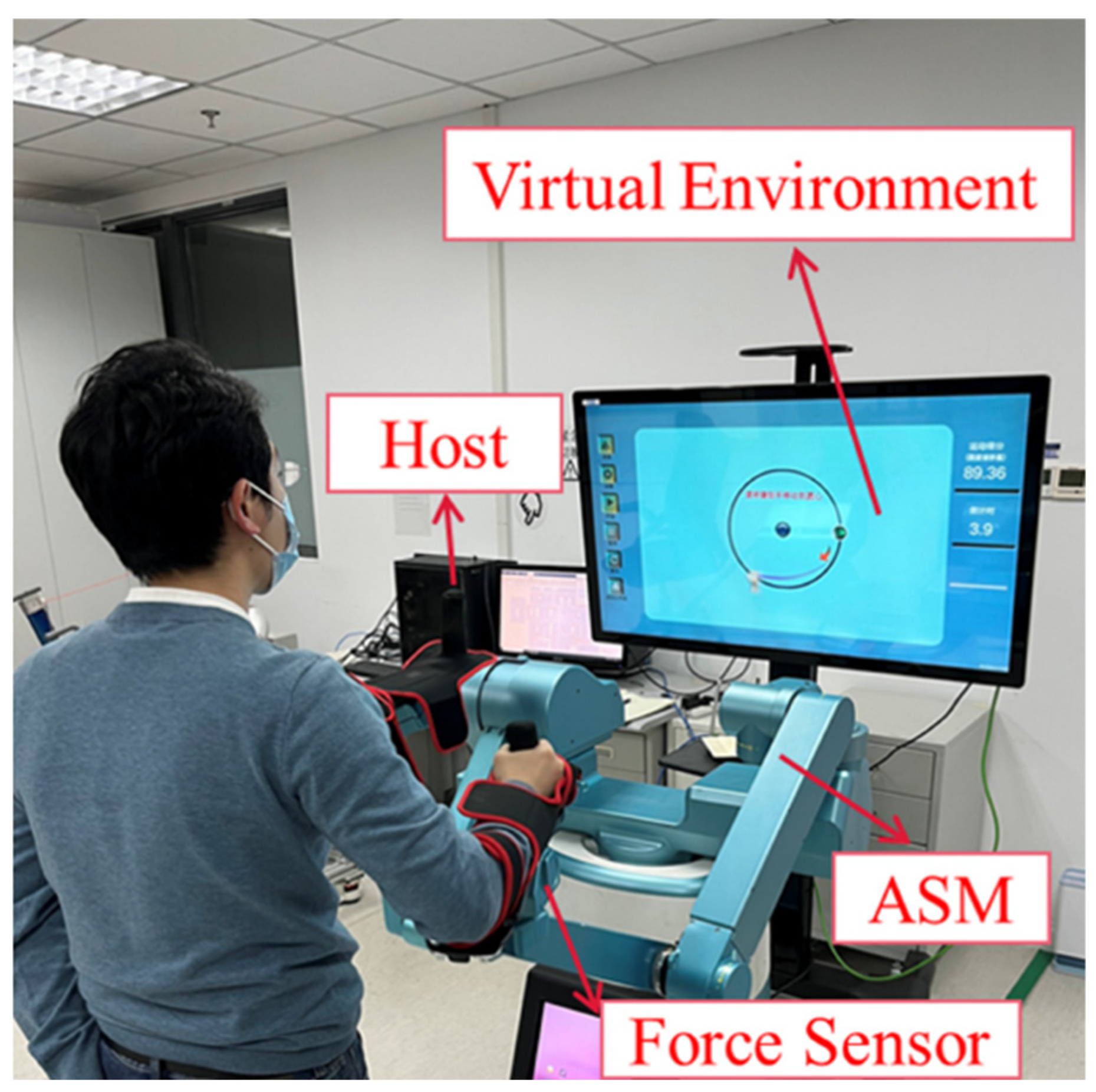
GARD [
40], shown in
Figure 10, claims to be the first robot of its kind to use non-backdrivable actuators, aiming to enhance stability, precision and flexibility during robotic rehabilitation. This robot has two DoF and uses rotary actuators coupled with ball screws to move the end-effector on the horizontal plane. Admittance virtual dynamics was used, simulating adjustable mass–friction–damper dynamics, to allow the natural movement of the end-effector. GARD offers passive training as well as an assist-as-needed (trajectory correction) mode, achieved by overlaying the admittance controller with an impedance controller. Additionally, implicit Euler velocity control (IEVC) is used to restrict the workspace and provide an assistive mode, where movement is only possible within the given trajectory. The user interface for this robot allows easy definition of new trajectories and offers some simple games. This robot was tested on healthy subjects.
2.2. Three-Dimensional End-Effector Robots
This class of robots allows more complex movements compared with their 2D counterparts, resulting in a better range of motion for the patient’s arm during therapy, while increasing the control complexity. Another advantage of 3D robots is that they can, in a sense, manipulate the gravity applied to the arm by adjusting the supportive force in the vertical direction. This may allow patients with weak motor functions to freely move their arms while connected to the robot and increase their range of motion. Three-dimensional robots can be categorized into two main groups: those that only move in Cartesian space and those that are capable of rotational movements at their end-effector as well.
2.2.1. MIME (PUMA-560)
MIME [
21], discussed in
Section 2.1.2., was improved to allow three-dimensional movement and increase the output force [
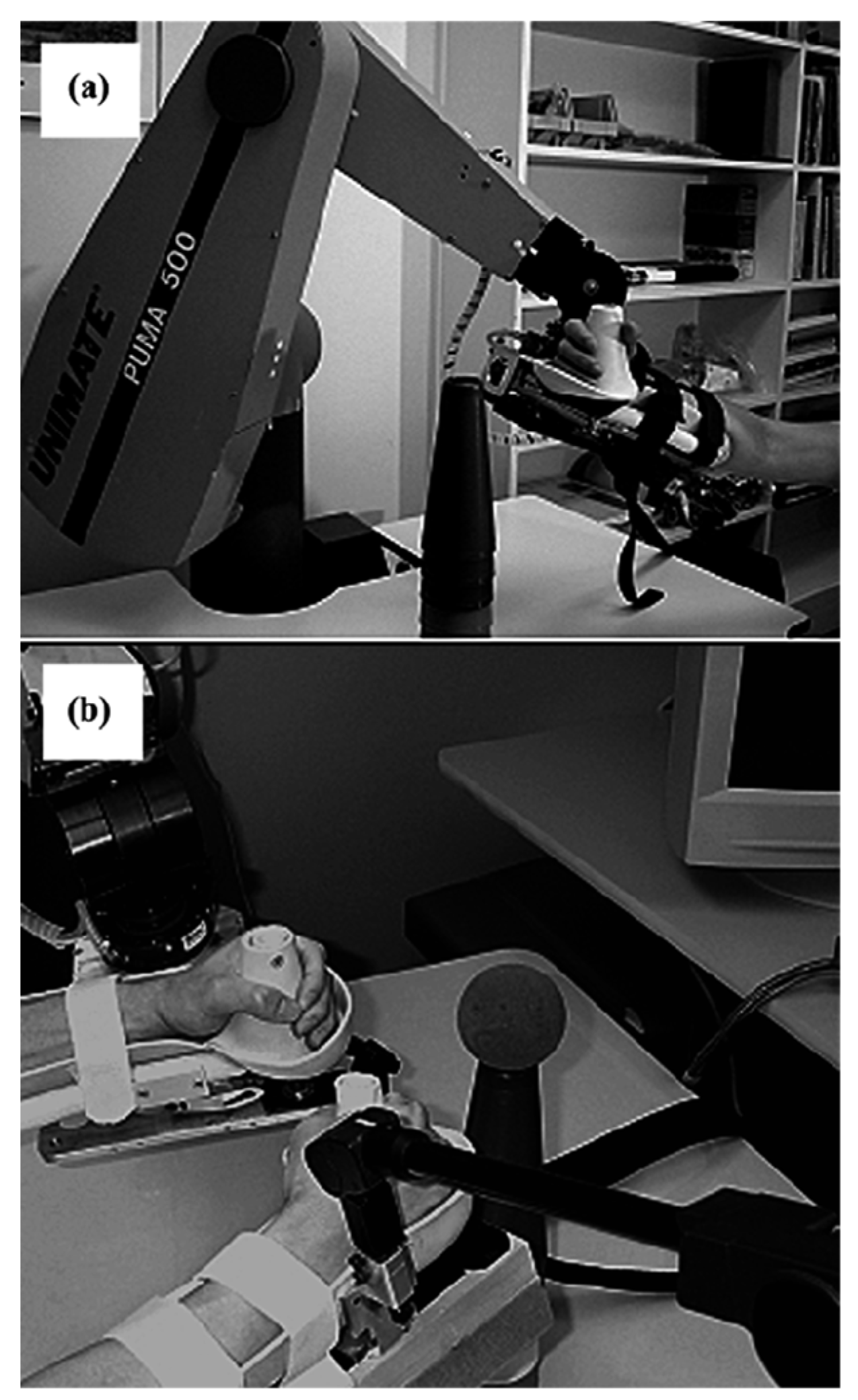
41], as shown in
Figure 11. This system similarly allows control of the hemiplegic arm using motion from the healthy arm. A PUMA-560 robotic arm is used to control the position and orientation of the lower arm by connecting the end-effector to a splint that holds the forearm and wrist, thereby preventing the rotational movement of the forearm joint. As the robotic arm can fully control both the position and orientation of the lower arm, it can be concluded that it fully defines the arm orientation.
This system [
41] could provide passive assistance, manual control using the position of the healthy arm, and movement amplification similar to [
21] but this time with the addition of vertical and rotational movement. Additionally, an impedance control-based trajectory correction mode was added, which provided resistance if the subject deviated from a predefined path.
Clinical trial [
42] involved 27 patients (<6 months), dividing them into a robot therapy group with 13 subjects and a control group with 14 subjects. Both groups continued their usual medical treatments and home exercise regimen and received additional therapy sessions involving 24 h-long sessions over 2 months. For the robot therapy group, these sessions consisted of 10 min of stretching and 50 min of robot therapy, whereas the control group received 55 min of traditional therapy (including 10 min of stretching) and 5 min of non-contact robot exposure. Results showed a comparatively significant improvement in the Fugl–Meyer (FM) score of the robot therapy group for the shoulder and elbow joints. However, 6 months after the end of therapy sessions, while the robot therapy group maintained their FM score with slight improvement, the control group demonstrated continued improvement, closing the gap with the robot therapy group to the point where the difference in FM score was not significant. Ref. [
42] suggests that this can be attributed to classic therapy, teaching and encouraging the patient to continue similar exercises at home. In contrast, the robot therapy group is more dependent on the robot. A later clinical trial [
43], corroborated these results and further suggested that, while solely focusing on the bilateral training might be less effective than unilateral training, it may reduce abnormal muscle synergies. Therefore, combined training, including a mix of unilateral and bilateral training, might offer a more comprehensive solution.
Figure 11.
MIME (PUMA-560) [
43]. Figure displays the unilateral (
a) and bilateral (
b) movements.
Figure 11.
MIME (PUMA-560) [
43]. Figure displays the unilateral (
a) and bilateral (
b) movements.
2.2.2. ARM Guide
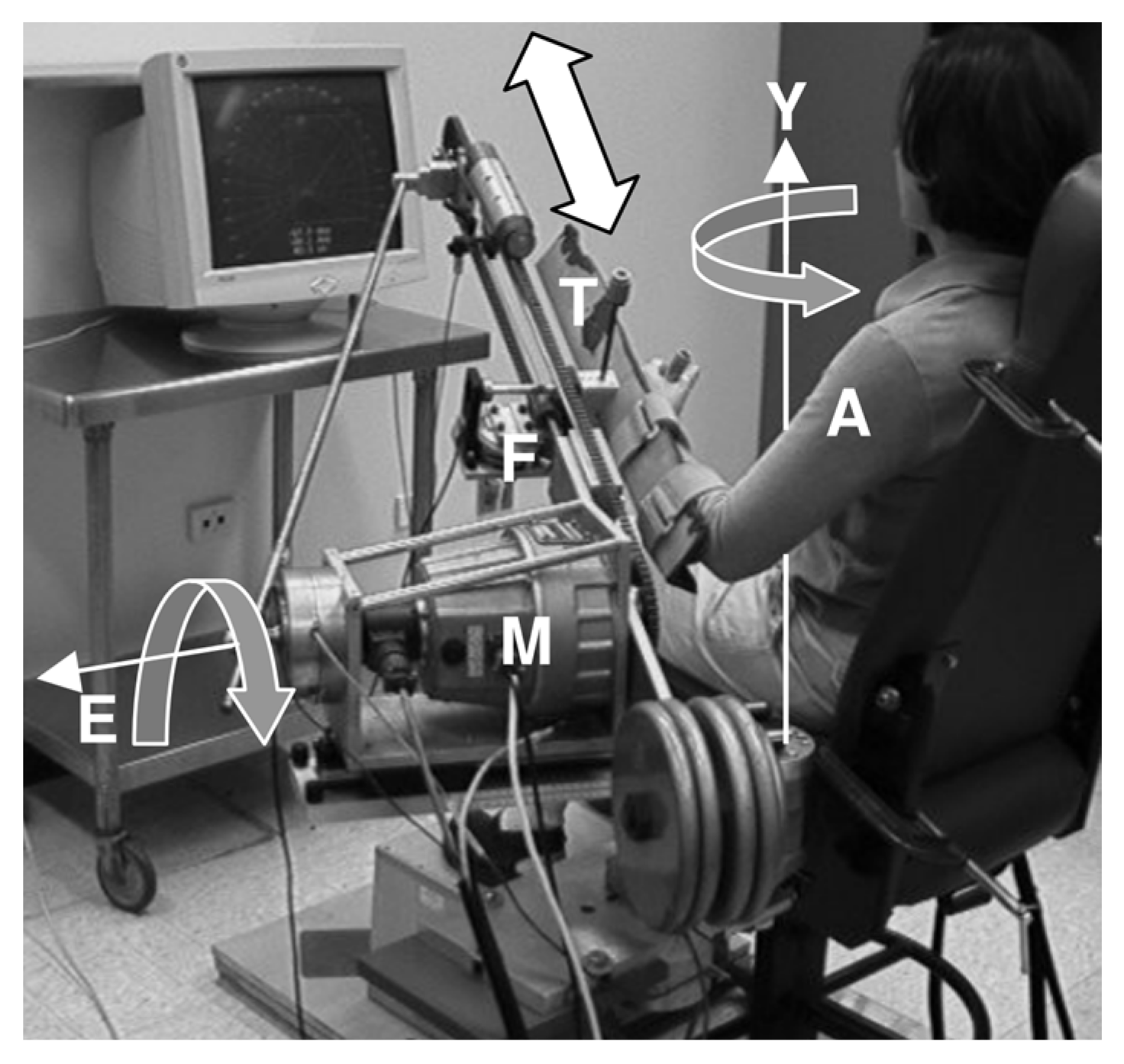
The Assisted Rehabilitation and Measurement (ARM) Guide [
44], shown in
Figure 12, has one active DoF and guides the lower arm through a linear path. This linear path can manually be adjusted so that the lower arm follows a linear trajectory with different orientations (through yaw and pitch adjustments). The philosophy behind this design was that most reaching hand motions follow an almost linear trajectory through space. The patient’s forearm is attached to a splint that is actuated along the linear path using a chain drive motor system. Passive compliance allowed the lower arm to rotate in the yaw and pitch directions with some measure of spring-like resistance. Overall, one DoF of the arm movement was controlled through the robot while another, a roll rotation corresponding to the forearm joint, was restricted.
Two methods of assistance were defined for this robot. The first was in order to provide a constant assistive force countering the effects of gravity and the adverse effects of muscle tone, thereby assisting the patient’s effort to move the arm independently. The other was to amplify the movement initiated by the patient, in which case, if the patient moves their arm by a set amount on their own, the robot will complete the full range of motion for them, achieved through a PD controller. This system measured the deviations in the yaw and pitch rotations of the arm to provide feedback of abnormal muscle synergies. This feedback was displayed on a screen, showing the deviation and encouraging the patient to adjust their arm posture. Ref. [
45] mentions that additional assistive modes were implemented, in which case, if a patient is too slow in their movement, they receive assistance, with the assistance increasing exponentially through the trajectory; alternately, if they had higher muscle function and were moving too fast, the device would resist them.
Evaluation of this system included three patients trying the first control method, constant assistive force, and demonstrating increased range of motion while using the device; however, they were not able to achieve their full range of motion with the assistance provided. In [
45], 14 patients were divided into robot therapy and control groups, with each group receiving 24 sessions of therapy over the course of 8 weeks. The control group received training with motions similar to those used by the robot therapy group. Both groups demonstrated significant improvements in the straightness of their voluntary reaching movements, with limited improvements in range, and transferred their skills to an unpracticed movement and showed improvements in timed performance of functional tasks. While there were no significant differences in the magnitude of improvements between the two groups, the robot therapy demonstrated smoother arm trajectories while performing tasks. This, however, was not a reliable metric, as [
46] contradicted this result, with the control group showing smoother movements. Ref. [
46] corroborated the rest of the results.
Figure 12.
ARM Guide [
46].
Figure 12.
ARM Guide [
46].
2.2.3. ARC-MIME
ARC-MIME [
47] aims to combine the strengths of MIME [
41] and the ARM Guide [
44] to provide an affordable and clinically and commercially viable alternative. ARC-MIME provides a bilateral rehabilitation device where the lower arm is connected to the end-effector through a splint that can freely rotate in all directions [
48]. Similar to the ARM Guide, the lower arm moves along a linear trajectory; however, this time, the robot could rotate the linear trajectory itself in the direction of yaw and pitch. This robot has three active DoF and, given that the splint can rotate freely, the robot is only guiding the Cartesian movements of the arm and is not able to fully define the arm orientation. ARC-MIME follows a similar control scheme to MIME and provides similar assistive modes as well.
Four patients participated in the clinical evaluation. Two movement trajectories were selected, and 10 trials were held where these trajectories were attempted using each of the four previously defined control modes. The same activities were repeated with MIME and compared. The subjects performed similarly on both systems. ARC-MIME demonstrated a slight positional lag, resulting in higher arm engagement, especially in bilateral mode.
2.2.4. NeReBot and MariBot
NeuroRehabilitation robot, NeReBot [
49], is a wire-driven robot that suspends the patient’s lower arm on a horizontally aligned orthotic splint and can be used in either supine(lying on back) or sitting positions. The splint is connected to three wires that can pull the splint upward in their given direction and are actuated using pulley and DC motor pairs located at the base of the robot. Given that gravity pulls the lower arm downwards, it can be concluded that four external forces are acting on the arm. As the wires can only pull in one direction, analyzing the DoF for this robot is more complicated. According to [
50], three unidirectional constraints are applied to the arm, resulting in the arm having two residual DoF and allowing it to float over an upward curved surface given constant cable lengths.
To define training exercises for the patient, the therapist moves the patient’s arm through the desired trajectory point by point while the motors apply a constant torque to keep the wires taut. The system learns from demonstration by storing the angular rotation of the motors at each point and processing them to generate a smooth trajectory, controlled by a switching PID position controller. The therapist can control the speed at which the robot replays this trajectory.
A clinical trial was conducted where 24 patients were evenly divided into a robot therapy group and a control group. Both groups received the same dose of classic therapy; the robot therapy group received 40 sessions of therapy consisting of two 25 min sessions per day, 5 times a week for 4 weeks. While the control group did not receive time-equivalent therapy, they were exposed to the robot twice a week for 30 min, using their healthy arm. The results were assessed 3 months after stroke and 7 weeks after the end of robot therapy. The robot therapy group demonstrated higher MRC motor power, Fugl–Meyer score, FIM [
51] and Motor Status Scale (MSS) for shoulder and elbow, with no adverse events reported.
The trial showed that the horizontal workspace provided by NeReBot was limited and could not satisfy the therapy requirements. MariBot [
50,
52] was developed to address this issue by adding two redundant degrees of freedom, achieved through a two-DoF serial arm, allowing the connection point that the orthotic splint is hung from to move horizontally and improving the possible range of motion for the patient’s arm. Another significant improvement from this redesign was that control of the shoulder flexion was much easier to achieve when compared with NeReBot. Furthermore, the base was replaced by a commercial patient handling machine, Marisa, resulting in lower weight and better portability while also allowing easy vertical adjustment if the robot’s height. No clinical trials for MariBot have been reported.
2.2.5. ACT 3D
The Arm Coordination Training 3D Device [
53] uses a three-DoF robot, HapticMaster, that can offer a near-zero interaction force. The patient’s forearm is fastened to a splint and attached to the end-effector. ACT 3D can control the Cartesian position of the lower arm while restricting its downward/upward rotation. Furthermore, the rotation of the forearm is restricted; therefore, the position of the arm is fully defined. However, while the robot is capable of vertical movement, it is mainly used for planar movement and the lower arm is usually kept at the shoulder level.
The primary method that ACT 3D provides for rehabilitation is through gravity manipulation. While using this robot, the patient has to move their arm to reach goals displayed on the screen by moving on the horizontal plane. The robot does not provide any assistance or resistance in the horizontal plane and the patient is freely able to move their arm. However, depending on the patient’s progress, this robot can provide assistance in the form of varying degrees of gravity compensation or can provide resistance by pulling the patient’s arm downwards. This gravity manipulation is achieved through the vertical movement of the end-effector.
Clinical trial [
54] was held with six stroke patients participating in robot therapy three sessions a week for eight weeks. Each session included 5 sets of 12 repetitions for 5 movement directions. The goal of the training was to gradually decrease the amount of support provided and increase the patients’ active participation. Results indicated an increase in the arm’s workspace in every gravity setting, and a statistically significant increase in the FM score for the arm. While [
55], with eight participants going through a similar program, demonstrated a similar increase in the arm’s workspace, the increase in the FM score was not statistically significant.
A later version of this robot, ACT-4D [
56], was developed focusing on quantification of the impairment. ACT-4D added a redundant joint solely manipulating the elbow rotation, allowing the robot to apply separate loads to the elbow and shoulder joints. This system also included EMG measurement as part of its admittance-based control scheme.
2.2.6. GENTLE/S
GENTLE/S [
57], shown in
Figure 13, uses the three-DoF HapticMaster as its main method of actuation, in a similar manner to ACT 3D. However, while ACT 3D supports the patient arm from below, GENTLE/S controls the wrist position from above and an elbow orthosis is used and suspended from a frame above the workspace in order to account for the weight of the arm. This device uses a gimbal with three passive DoF at its end-effector to connect to the wrist and allow it to rotate freely. It can be inferred that the robot only controls the Cartesian position of the lower arm and only affects the shoulder and elbow joints.
In addition to gravity compensation, this robot offers three main modes of rehabilitation, including passive therapy, assisting the patient in finishing a trajectory after they have initialized a movement and a corrective assistance mode where the device only prevents the patient from deviating from the given trajectory, and does not assist them in reaching the goal. A 3D interface was used to show the patient’s arm position relative to the starting point and the goal, as well as the trajectory. The therapist could set goals by manually moving the end-effector to the desired positions.
During the clinical trial, 31 patients received three 30 min sessions of robot therapy per week for three weeks (total of 4.5 h per patient) in addition to a similar dose of weight compensation therapy without a robot, which occurred either before or after three weeks of robot therapy. Subjects demonstrated greater improvement during weight compensation therapy compared with robot therapy.
2.2.7. ACRE
ACRE [
58], shown in
Figure 14, is a five-DoF robot focusing on the recovery of the shoulder and elbow joints. The patient’s arm is connected to a splint that has its position as well as the yaw and pitch rotations controlled by the robot, while restricting the rotation of the forearm joint. As the robot actively controls five DoF on forearm, which only has four DoF, there is one DoF of redundancy. This robot uses servo motors for actuation and has a spring mechanism with adjustable spring force (achieved through the use of a computer-controlled motor), providing gravity compensation and negating the weight of the mechanism itself.
Adjustable gravity compensation is the primary assistance provided by this robot. Additionally, impedance control is used [
59] to provide assistive force in the direction of movement when the patient is unable to reach the goal. A game interface shows the patient the movements required using a 3D display, allowing the patient to operate the device without a therapist present after the initial setup. The patient’s data, as well as the information regarding the exercise, can be stored in a database, allowing remote access over the internet, making remote treatment at home possible.
The clinical trial [
59], however, demonstrated that this device might not be effective enough. A total of 24 patients (<2 months) were included in the study, with 10 patients in the robot therapy group and 14 patients in the control group. Both groups received equal doses of conventional therapy, with the robot therapy group receiving three additional robot therapy sessions per week for 6 weeks, with each session lasting 10 to 30 min, and with different training regimens per individual based on their needs. The robot therapy group showed no significant improvement in their FM (total) or ARAT scores, whereas the control group did. This was mainly attributed to the patient distribution and low sample size.
2.2.8. EMUL and Robotherapist
EMUL [
60] uses ER fluid actuators and has three DoF, such that two DoF act in a similar manner to a planar parallel linkage robot moving on a vertical plane, while the third DoF, correlating with the robot’s base, allows this plane to rotate. This results in the robot being able to move in Cartesian space. The handle used at the end-effector allows two DoF of passive rotation and only restricts rotation in one direction. Robotherapist [
61,
62] improves on this design by allowing the system to control the rotation of the end-effector for a total of six DoF. The actuators rotating the handle are placed near the base of the robot and their actuation is transmitted using driving shafts and wire pulley systems.
These robots used 3D environments to show the user the desired trajectory or action. Robotherapist focuses on controlling the force applied to the hand; for instance, it can change the direction and magnitude of the force based on actions taken, or apply a force to the hand while demanding the patient to either keep their arm stationary or move in the direction of the force. It also utilizes a technique from proprioceptive neuromuscular facilitation (PNF), where a force is applied to the hand in the opposite direction of the desired movement, where the user learns to move their hand in the correct direction after resisting the force. EMUL, on the other hand, provides passive training, assistive force and a transparent mode. It is not explicitly mentioned whether Robotherapist inherits these training modes or not.
A clinical trial was conducted for EMUL in [
60], where six stroke patients participated in robot therapy three times a week for six weeks. It is claimed that all patients obtained good results, but only the results for two of the patients have been disclosed. Of the two patients, one had experienced their stroke eight months and the other eight years prior to the therapy. Both showed significant improvement in their FM score and Motricity Index.
2.2.9. MACARM
MACARM [
63] is a cable-based robot that suspends an end-effector, connected to the patient’s hand through a gimbal mechanism, in order to compensate for gravity. Eight cables and motors, placed on the corners of a cubic space, are used to actuate the end-effector. MACARM acts in the Cartesian three-DoF space; however, the paper claims that it is possible for this robot to extend its activity to six-DoF space, including rotational movements.
MACARM can provide passive training and gravity compensation modes. An admittance control mode was implemented as well, where the robot could amplify the subject’s movement; however, the admittance mode was not tested and according to [
64] might not have been viable in the reported state due to orientation errors.
Ref. [
63] reports that five patients with varying degrees of disability participated in testing the robot as part of a pilot study and exhibited an extended range of motion under the effect of gravity compensation. No record of their improvement after using the robot is available.
2.2.10. ReoGo
ReoGo is a commercially available robot with three DoF. The end-effector of this robot is at the end of a mast with adjustable height, when at a fixed height, the robot has two DoF of movement on a spherical surface. Additionally, the end-effector includes a passive, manually adjustable gimbal mechanism that can either allow or restrict the rotational movement of the arm. Depending on the patient’s needs, the point of connection can be adjusted to either a handle held by the patient or an orthosis that holds both the forearm and the hand. A newer and more compact version of this robot, named ReoGo-J [
65] is available in Japan.
The interface for this robot presents a variety of games with different difficulty settings, as well as a mode where the apparatus can be used as a mouse to browse the internet. Furthermore, therapists can manually guide the patient’s hand, while connected to the device, to generate new trajectories. The training provided by this robot can be either in passive mode or assistive mode. The assistive mode includes options such as a constant force in the given trajectory, while resisting deviation, and amplifying the patient’s movement after they initiate a movement.
Multiple randomized clinical tests have been conducted for ReoGo, the most recent one, using ReoGo-J [
66], involved 129 patients divided into three groups. A total of 42 patients were part of the control group receiving conventional therapy and undergoing self-training, 44 received robot self-training as well as conventional therapy, and 43 received robot therapy and constraint-induced movement therapy (CIMT). The robot therapy in this study is also in self-training mode, where the patient is unsupervised. The training program included 1 h sessions 3 times a week for 10 weeks, with conventional therapy for the first two groups and CIMT having a duration of 20 min, and robot therapy or self-training taking the remaining 40 min. The robot therapy group demonstrated a non-statistically significant advantage in FMA score for shoulder–elbow–forearm over the control group. It is also reported that, when limiting the data to the per-protocol subset of patients, thus only including patients who have attended at least 80% of the sessions, numbering 115, the observed advantage in FMA score for shoulder–elbow–forearm gained statistical significance.
2.2.11. Three-Dimensional Force Display Robot
Three-dimensional force display robot [
67] has three DoF, allowing translational movement of the end-effector in the 3D space, while forgoing rotational movements. This robot is developed using a rotating base, enabling horizontal movement to the sides, and a parallel mechanism, positioned such that the end-effector can move vertically and/or towards or away from the patient, and it is actuated by using three direct drive motors. The grip used on this robot can be changed depending on the given training task and can be either directly held by or connected to the patient’s hand. These grips include a bar used for tasks involving both hands, such as a sanding exercise. Ref. [
67] mainly focuses on the recovery of the shoulder and the elbow joints and it passively engages the wrist joint. However, due to its limited DoF it cannot engage all the joint movements involved and may need certain restrictions to be applied to the movement of the arm, such as placing the elbow on a flat surface for an arm-wrestling movement that involves internal/external rotation of the shoulder.
The main method of rehabilitation for this work is resistance provided to the patient’s arm through the movement. The therapist can define a training trajectory by moving the end-effector, which may already be connected to the patient’s hand, and recording the movement. The grip’s movement is restricted to a set trajectory using impedance control. This work also includes a manual muscle test (MMT) mode, where the patient attempts to move their arm in a set trajectory repeatedly and the robot gradually increases its resistive force until the movement is stopped. This robot was tested on healthy subjects and did not involve clinical trials.
2.2.12. PASCAL
PASCAL [
68,
69] is a three-DoF robot designed with the goal of being used in conjunction with lower-body rehabilitation devices. This robot would be mounted on the handrail of a gait rehabilitation device and connected to the patient’s arm through cuffs fixed to the forearm and upper arm. PASCAL has three DoF, consisting of a parallelogram mechanism moving the end effector on a vertical plane and a rotating base, resulting in movement in the Cartesian space. The end-effector offers two passive DoF, allowing free rotation of the lower arm in the directions of yaw and pitch while restricting forearm rotation.
As this robot would be replacing the use of handrails during gait rehabilitation, it should be able to support the patient when they lean on the robot, acting as gravity compensation. An assist-as-needed mode was defined for this robot where a virtual tunnel was established around the given trajectory, allowing the patient more freedom of movement for their arm and guiding them back if they deviate too much from the trajectory (by moving outside of a deadband). Additionally, a minimum speed was defined, where if the patient was unable to move their arm or move it fast enough, the robot would guide the arm along the way. Similarly, a maximum speed was set to prevent the patient from moving too fast. This robot was tested on healthy subjects.
2.2.13. 3DEE
3DEE [
70], shown in
Figure 15, uses a vertically mounted five-bar mechanism as well as a rotating base, actuated using brushless DC motors, to achieve three DoF and move in Cartesian space. The end-effector for this robot is in the form of a handle that is along the end-effector’s bar, passively restricting two DoF. This robot is highly portable and can be used when placed either in front of the patient or on the hemiparetic side, allowing it to compensate for its limited work range. Due to the variance in the human grip position, the frontal placement of the robot would result in more engagement from the wrist joint, while placing it on the side would engage the forearm joint when the end-effector rotates.
This robot offers multiple assistive modes including passive training, gravity compensation, an assist-as-needed mode where impedance control is used to guide the patient’s arm along the trajectory, and assistive force when the patient is not able to complete the path. Additionally, another trajectory control mode named “virtual spring-damper wall” was defined, where no assistance is provided along the trajectory, but forces will resist deviation from the path, and the end-effector cannot deviate beyond the “wall” which is a tunnel with a specified radius around the path. A 3D interface is provided where movement trajectories and activities are shown. In addition to pre-defined activities, the therapist can move the patient’s arm to define new trajectories. These assistive modes were tested on healthy subjects.
2.2.14. EULRR
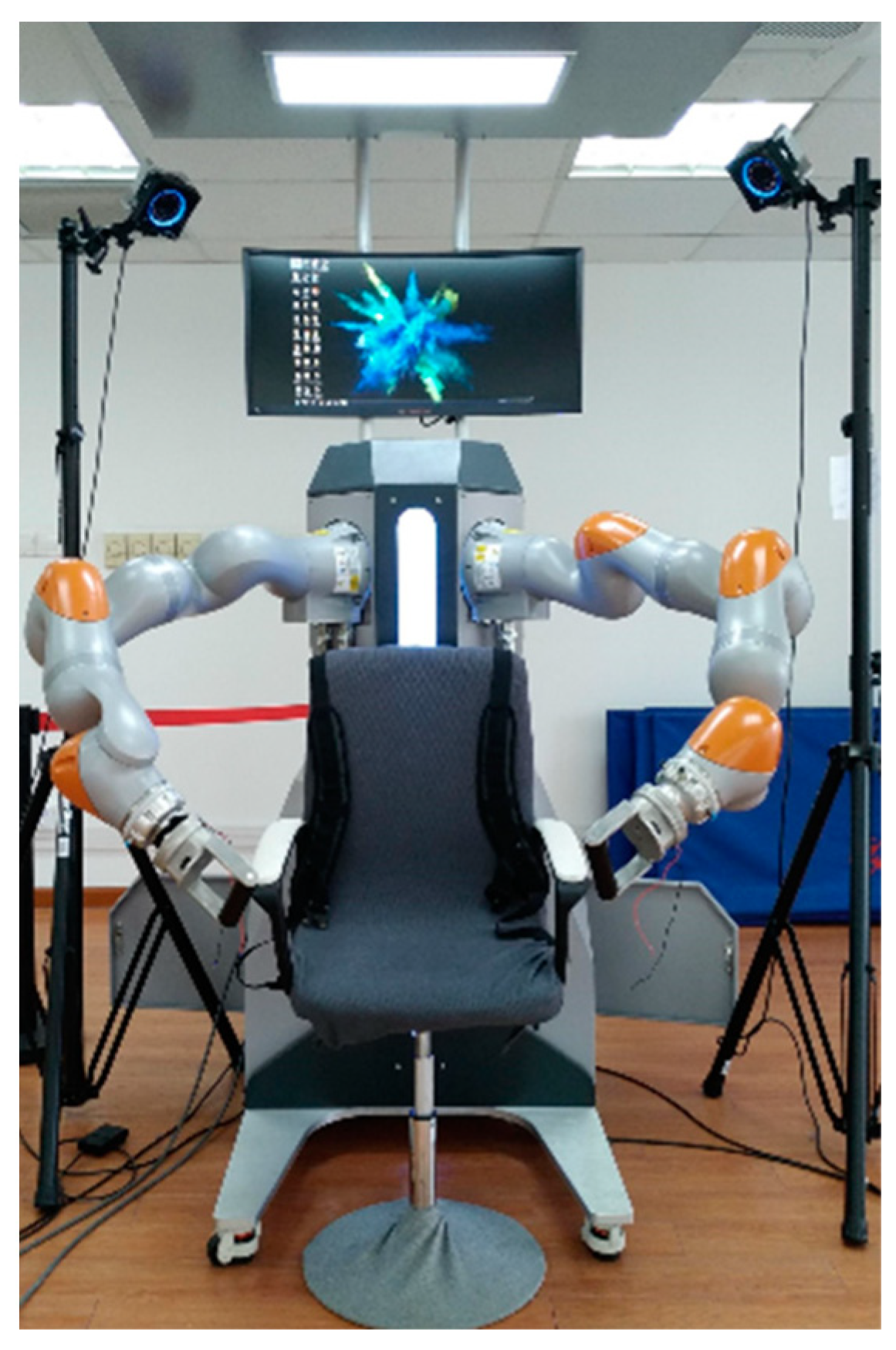
EULRR [
71], shown in
Figure 16, is an end-effector-based rehabilitation robot that allows the user to move their hand through the three-dimensional space. EULRR mainly consists of two commercial robotic arms with seven DoF (Kuka iiwa 7 r800) and a chair with adjustable height. The base of these robotic arms is positioned behind the patient’s shoulder, allowing the robot to more accurately mimic human arm motion. The robotic arm on the healthy side of the patient moves to a pre-defined rest position while the other robotic arm is engaged with the patient’s arm through a handle held by or strapped to the patient’s hand. Due to its structure, while EULRR can precisely control the position of the hand and despite having seven DoF, it is not able to completely control joint positions and overall orientation of the patient’s arm as a single contact area can only account for six DoF. A more precise control of the arm orientation would be possible if the end-effector were connected to the wrist instead of the hand.
This work proposes an assist-as-needed control strategy where, in addition to an impedance-based controller acting as a force field around the movement trajectory and applying more assistive force as the hand moves further away from the intended path, a virtual channel is defined around the trajectory and within the force field. This virtual channel allows a slight deviation from the intended path without any corrective force, and if the subject deviates outside the virtual channel, they enter the force field where the assistance is applied. This approach allows for more natural movement for the patient’s arm, as even healthy subjects are not able to follow a displayed trajectory perfectly.
The authors suggest that EULRR can also be used with other control methods, such as zero interaction force and resistive training, allowing the robot to be used for different stages of recovery [
72]. Furthermore, they have taken advantage of the secondary arm, on the healthy side of the patient, to implement a mirror therapy mode [
73] where the movement of the hemiparetic side is assisted by the healthy arm. In [
73], the healthy arm follows a given trajectory and, based on the actual movement of the healthy arm, the virtual channel and the forcefield for the hemiparetic arm are defined. However, the authors have only tested their work on healthy subjects and a clinical study of the effectiveness of the EULRR robot and the proposed control methods has not been performed.
2.2.15. Other
Ref. [
74] Is a three-DoF robot actuated by AC gear motors that moves its end-effector through Cartesian space. However, due to the design of the robot and the handle at the end-effector, this robot will passively rotate the patient’s hand around the vertical axis when the end-effector moves to either the left or right side. Additionally, this robot restricts the rotation of the forearm joint.
This robot offers multiple therapy modes and control schemes, including a passive mode, an active-assisted mode where force/impedance control is used to assist the patient along the trajectory while preventing deviation and correcting the movement through impedance, and an isometric training mode where the patient has to push against the robot as much as they can at set points.
No clinical trials have been reported for this work and, according to [
74], results were purely verified through simulation.
Ref. [
75], shown in
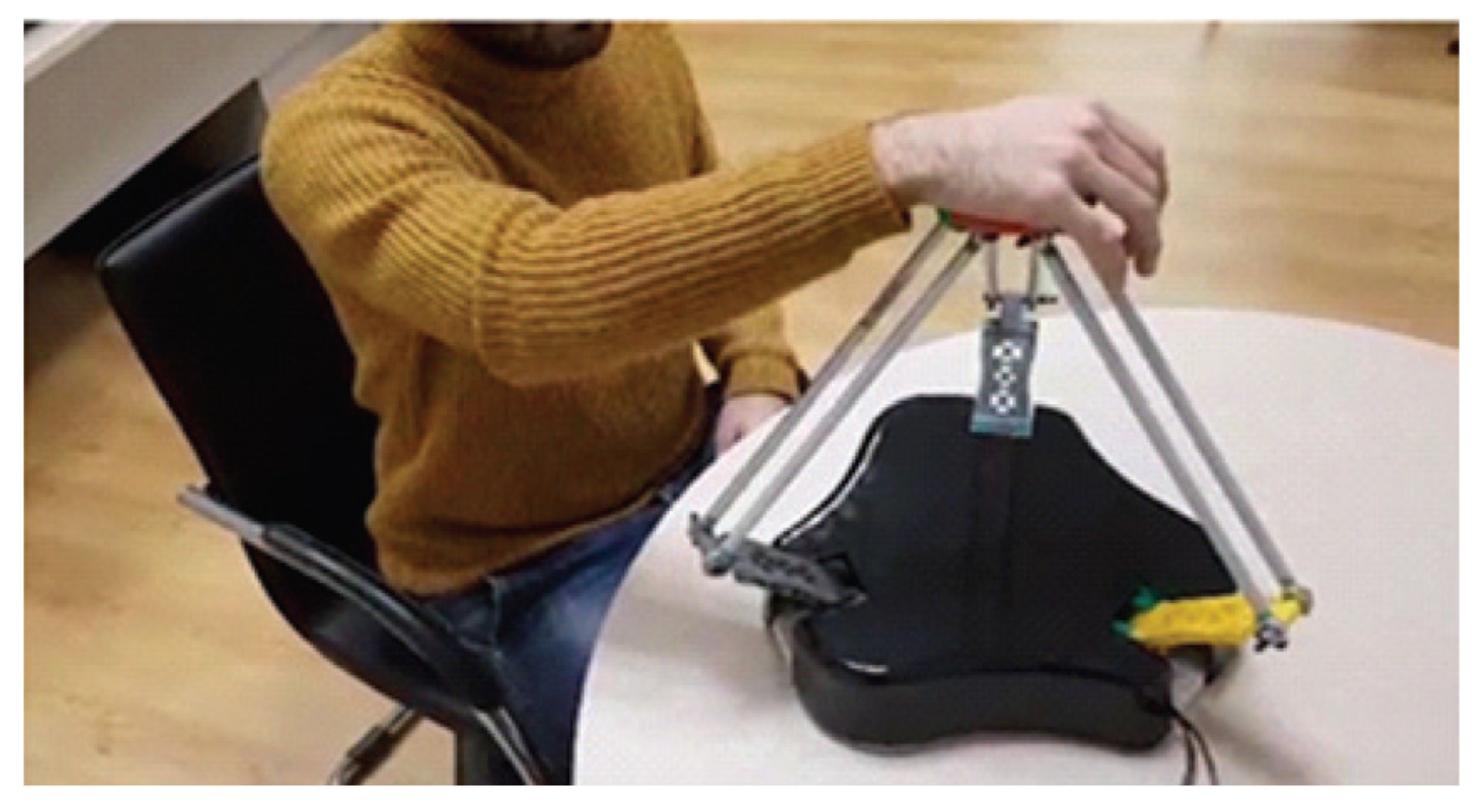
Figure 17, prototypes a low-cost linear delta robot with 3D-printed parts actuated by stepper motors, this robot weighs less than 1kg and allows movement in the Cartesian space. The goal of [
75] was to provide a similar workspace and payload to ReoGo at a lower cost and a more compact size. The design provided showed the subject holding the end-effector with their hand (passively restricting forearm rotation); however, the device could be modified to allow an orthosis, holding the forearm, to be connected to the end-effector as well, resulting in higher control on the arm orientation. Ref. [
75] claims that this robot can provide passive training as well as assistive or resistive force along pre-defined trajectories. Results were validated through simulation and by testing the prototype with healthy subjects.
EE-Robot [
76] aims to combine the strengths of end-effector- and exoskeleton-based robots. This robot consists of a six-DoF commercial robot, UR5, as well as a custom two-DoF exoskeleton orthosis module connected to its end-effector. The exoskeleton controls the elbow joint flexion/extension by connecting to the elbow. This approach allows the UR5 robot to completely control the shoulder orientation and trunk compensation. A motion tracking camera was used to detect trunk compensation and adaptive control was used to reduce it. EE-Robot offers gravity compensation, achieved through intention detection, and an assist-as-needed mode, where assistance is provided to prevent trunk compensation, by using admittance control. To validate the robot, 10 healthy subjects used the robot while having springs connected to their limbs to simulate the muscle weakness in stroke patients. It was noted that, while using the robot, their trunk compensation was significantly reduced, and their motion was smoother.
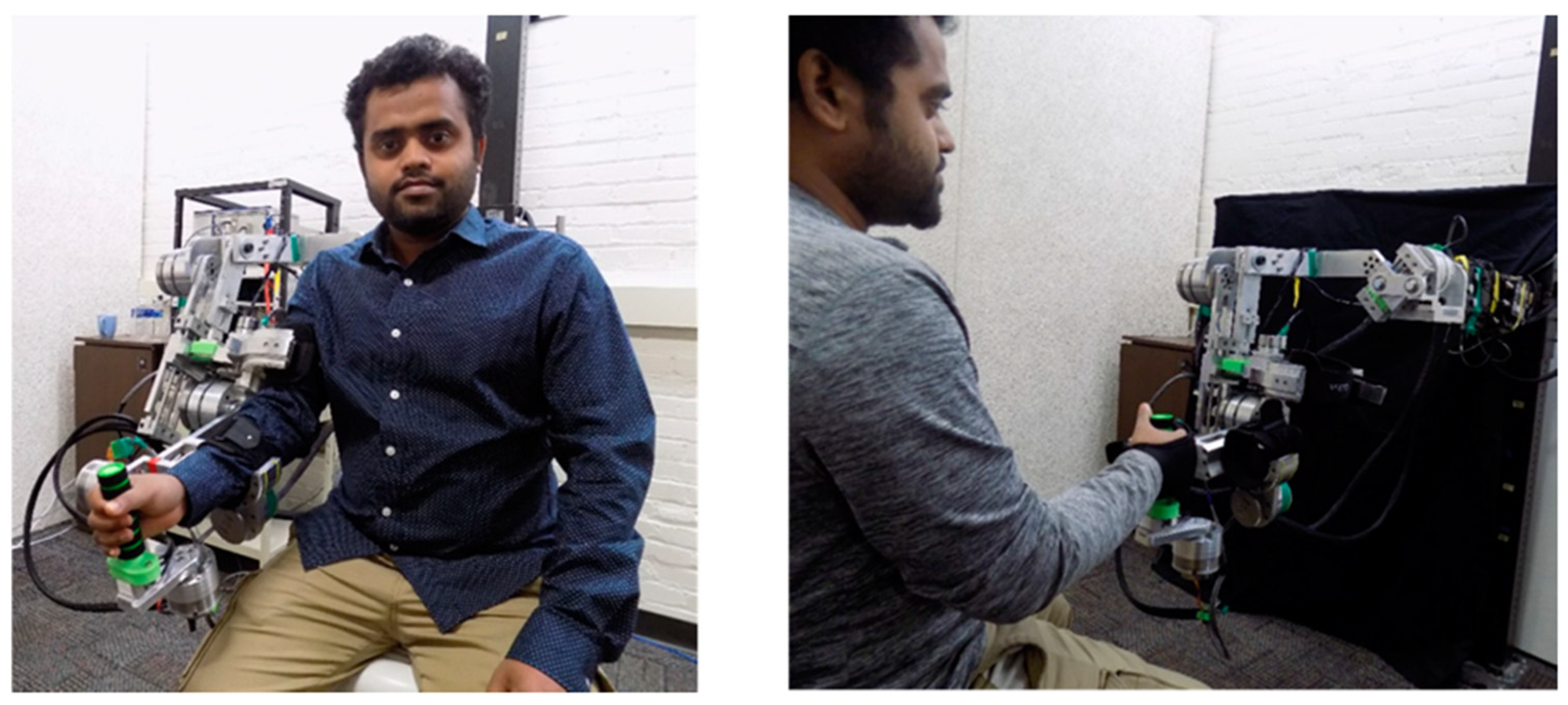
EBULRR [
77], shown in
Figure 18, is a bilateral three-DoF robot, primarily designed with mirror therapy in mind. Each arm consists of a two-link linkage mechanism with a rotating base, where the end effector is connected to a forearm orthosis through a passive rotating joint. This robot allows the forearm to move in Cartesian space while allowing free rotation in the pitch direction. A fuzzy adaptive passive controller was proposed and utilized to implement an assist-as-needed (trajectory correction) mode, where a potential field provided an assistive force to guide the patient back to the trajectory if they deviated. The proposed controller aimed to provide minimal assistance based on the patient’s performance and impulse (motor intention), giving the patient more initiative when compared with other controllers that focus solely on task performance. This device and control logic were validated by testing on healthy subjects.
u-Rob [
78], shown in
Figure 19, presents a seven-DoF robot that can act as both an end-effector- and an exoskeleton-based robot. In the end-effector mode, the patient holds the handle while sitting in front of the robot, while in the exoskeleton mode, the robot is placed behind the patient and their elbow and forearm are connected to the robot links while they hold the handle. Brushless motors with hall sensors were used to actuate this robot. This robot only provides passive training.
2.3. Dual End-Effector Robots
Dual end-effector robots usually consist of two individual robots with their end-effectors connected to the upper and lower arm in order to better define the arm orientation in space and allow more precise gravity compensation. However, controlling this class of rehabilitation robots is much more complex, as desynchronization between the two end-effectors may lead to further injuries. Therefore, these robots mainly offer passive training or gravity compensation.
2.3.1. REHAROB
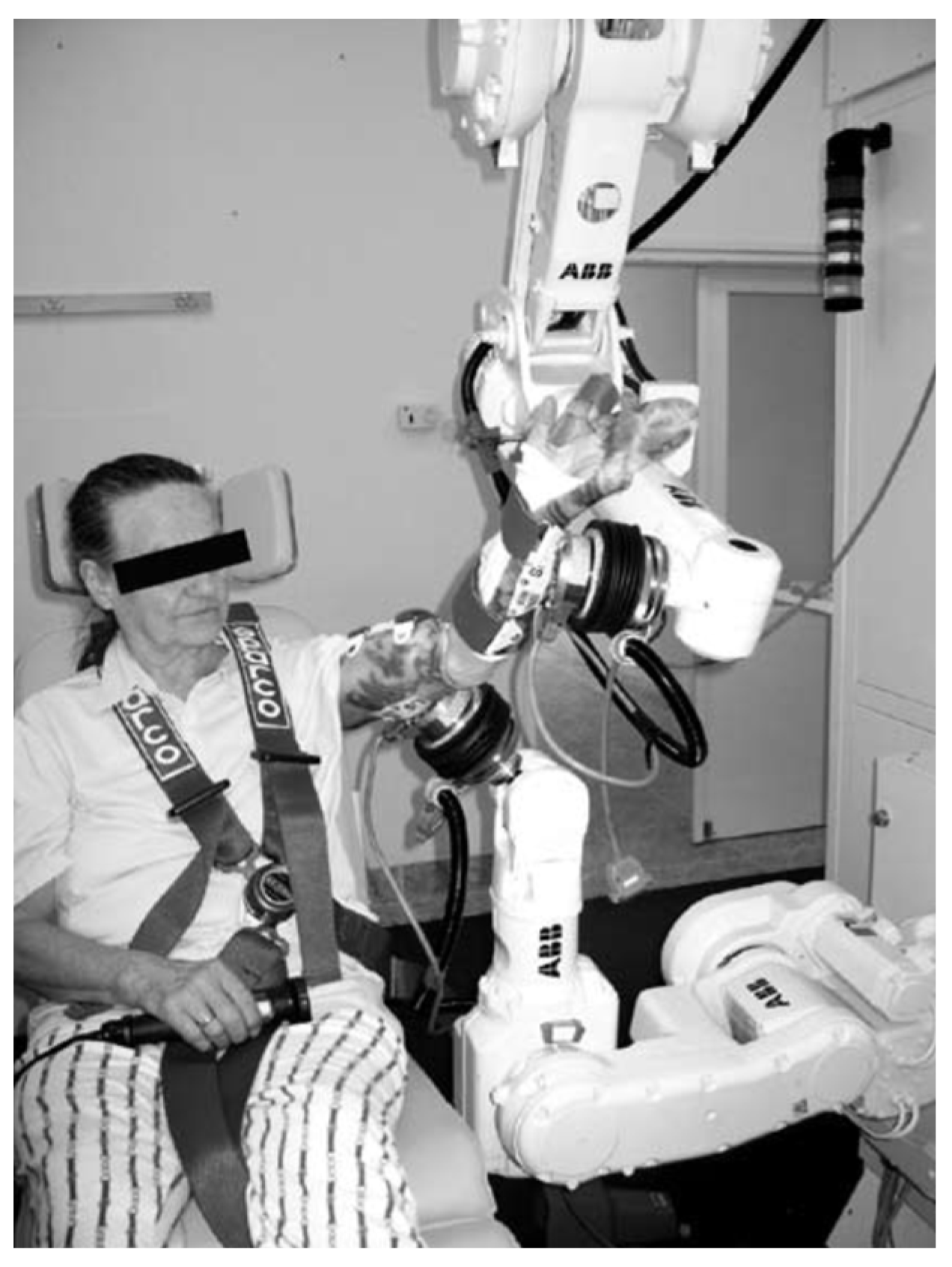
REHAROB [
79], shown in
Figure 20, was developed in 2003 and is the earliest work in this category. This robotic system utilized two wall-mounted six-DoF industrial robots with an ABB IRB 400 connected to the upper arm and an ABB IRB 1400H connected to the lower arm, without any passive degrees of freedom. This setup not only allows the full control of shoulder, elbow and forearm joints but also, due to the position and orientation of the upper arm being fully defined, it allows the robot to account for compensatory movements from the other body parts, allowing REHAROB to control seven DoF, while excluding the wrist joint.
This robot is used for passive training of the patient’s arm. The robot’s movement is defined by recording the therapist’s manual movement of the individual patient’s arm while it is connected to the end-effectors. The recorded movements are then repeated automatically through the therapy session.
Two clinical trials were reported on the performance of REHAROB. Ref. [
79] verifies the safety and feasibility of using this robot and, administering 30 min robotic exercises over the course of 20 consecutive workdays, seven of the eight patients involved displayed improvements in their range of motion as well as reduction in spasticity. However, as the patients were receiving classical physiotherapy during the same period, the results were inconclusive. In the second clinical test [
80], 30 patients were divided into two groups, with one group receiving 30 min of classical physiotherapy and the other group receiving an additional 30 min of robot therapy over the course of 20 consecutive workdays. The second group demonstrated a statistically significant improvement on the spasticity of their shoulder and elbow joints using the Modified Ashworth Scale.
2.3.2. iPAM and iPAM MkII
The intelligent Pneumatic Arm Movement (iPAM) [
81] aimed to provide a cheaper and more portable alternative to REHAROB [
79]. This robot consists of two pneumatic three-DoF robot arms connected to the patient’s upper and lower arm through separate orthoses. Each orthosis has three passive DoF, allowing them to align with the patient’s arm segment orientation regardless of the end-effector position. As a result, this robot is capable of controlling shoulder translation (caused as a result of the upper body movement rather than arm movement), shoulder rotation and elbow orientation.
Two assistive modes were developed for this robot, including passive mode and gravity compensation. In gravity compensation mode, the patient can freely move their arm while receiving varying degrees of assistance in the form of a lifting force depending on the arm orientation. A user interface was later developed [
82], with which the patients could complete given exercises with therapist-defined amounts of gravity compensation. Furthermore, ref. [
83] mentions the use of admittance control to provide assistive forces during training.
Clinical trials [
84] show that the robot is able to safely operate within the given parameters. Furthermore, it was observed that iPAM’s gravity compensation mode can result in an increased range of motion for patients with muscle weakness while using the device. However, this clinical trial does not study the general effectiveness of iPAM on the recovery of the patients.
An improved version of this robot, iPAM MkII [
83] was later developed, improving the comfort, safety, aesthetics and the user interface. A randomized clinical study [
85] investigated the effectiveness of this robot. A total of 51 patients participated in this trial, divided into two groups, with a group of 26 receiving robot therapy and a group of 25 acting as the control group. While both groups received classical therapy during the trial period, the control group received additional therapy time so that the therapy time matched between the two groups. While the outcomes are not publicly available, ref. [
85] claims that the outcome was a clinically meaningful response (3 points or greater improvement in Fugl–Meyer score) from baseline to 10 weeks post randomization and no adverse events recorded over the span of 12,500 exercise tasks.
2.3.3. AUPA (UMH RehaRob)
AUPA [
86] is another pneumatic dual-arm rehabilitation robot. Similar to iPAM [
81], this robot consists of two three-DoF arms, however, while one end-effector is connected to the upper arm, the other is held by the patient’s hand. The grip held by the patient only allows one passive rotational movement around its vertical axis and is oriented similar to a bus’s passenger handle. As a result, more redundancy can be observed in the orientation of the patient’s arm. The shoulder’s rotational movements are controlled by the robot, therefore the position of the elbow (three DoF) is fully defined. As the grip is freely able to rotate around its vertical axis, forearm and ulnar/radial movement of the wrist (a total of two DoF) are restricted to one combined passive DoF. Similarly, the elbow and wrist flexion/extension are restricted to one combined active DoF and the lower arm can demonstrate slight deviations in orientation as a result. It should be noted that AUPA is capable of assisting the patient whether they are in supine (lying on back) or sitting positions, therefore it is suitable for early stages of recovery.
Depending on the patient’s recovery, different forms of assistance, including passive movement, assistance, gravity compensation and resistance can be provided by AUPA. Furthermore, a 3D, game-like environment is provided where the patient is able to view a 3D presentation of their arm as well as objects that they can interact with. The amount of assistance or resistance applied to the arm can change depending on the object that they interact with.
According to [
86], after validating the device on healthy subjects a clinical trial was planned where 50 stroke patients would partake in robot therapy for 45 h across 3 months, however, no reports of this trial and whether it took place have been publicly disclosed.
2.3.4. DARR
The Dual-Arm Rehabilitation Robot (DARR) [
87] aims to replicate the hand of a therapist using two robot arms, with three actuated degrees of freedom, that are separately connected to the patient’s upper and lower arm on the hemiplegic side. Additionally, each arm has three passive DoF at the point where the end-effector is connected to the patient’s arm; this arrangement allows the system to control the position of each arm segment in the 3D space without actively controlling or obstructing its orientation. This robot is different from iPAM [
81] in that it uses brushless servomotors instead of pneumatic actuators. Furthermore, the authors claim that the combination of the two robotic arms allows this system to focus on the five DoF of the patient’s arm, including the rotational orientation of the shoulder joints as well as the elbow and forearm joints. However, it is not clear how the forearm joint’s orientation is being controlled, given the robot’s structure.
In this work, the patient’s arm is passive, and its position is fully controlled by the robot trajectory. This work was validated through simulations and tested on healthy subjects and does not include any clinical trials.
Table 1.
Planar rehabilitation robots. AAN and ZIF stand for assist-as-needed and zero interaction force, respectively.
Table 1.
Planar rehabilitation robots. AAN and ZIF stand for assist-as-needed and zero interaction force, respectively.
| | Connection Point | DoF | Effective DoF | Involved Joints | Defined Arm Orientation | Training Method | Control | Clinical
Testing | Commercial Robot Used | Actuation | User
Interface | Portability |
|---|
| 2.1.1. MIT-Manus [16] | Forearm, hand | 5 | 5 + 1 restricted | Entire arm | No | Passive, assistive/resistive force, trajectory correction, disruption | Impedance | Yes | N/A | Five-bar linkage driven by brushless motor | Game | 4 |
2.1.2. MIME
(PUMA-260) [21] | Forearm | 6 | 2 + 4 restricted | Shoulder,
elbow | Yes | Passive, movement amplification | PID position control | Yes | PUMA-260 | Stock | N/A | 3 |
| 2.1.3. NCKU’s planar robot [22] | Wrist | 2 | 2 + 2 restricted | Shoulder,
elbow | Yes | Gravity compensation, passive, constant assistive/resistive force, trajectory correction | Fuzzy PI force/position control | Yes | N/A | Five-bar linkage driven by AC motor | Minimal | 4 |
| 2.1.4. MEMOS [24] | Hand | 2 | 2 + 2 restricted | Shoulder,
elbow | No | Passive, ZIF, AAN | Impedance | Yes | N/A | DC motor | Game | 3 |
| 2.1.5. Braccio di Ferro [25,26] | hand | 2 | 2 + 4 restricted | Shoulder,
elbow | No | Constant or dynamic assistive/resistive force, disruption | Impedance | Yes | N/A | Brushless motor driving four bar | Game | 4 |
| 2.1.6. PLEMO [28,29] | Hand | 2 | 2 + 1 restricted | Shoulder,
elbow, wrist | No | Constant or dynamic resistive force | Force control | Yes | N/A | ER brake and actuators | Game | 3 |
| 2.1.7. Sophia-3 [32] | Hand | 2 | 2 + 3 restricted | Shoulder,
elbow, wrist | No | Trajectory correction, dynamic assistive force | Impedance | No | N/A | Cable/pully actuated by brushless AC motor, servomotor ball-screw system for linear movement | Minimal | 4 |
| 2.1.8. [33] | Forearm | 2 | 2 + 2 restricted | Shoulder,
elbow | No | Passive, constant assistive/resistive force | Velocity and moment control | Yes | N/A | Servo motors | N/A | 2 |
| 2.1.8. hCAAR [34] | Hand | 2 | 2 + 2 restricted | Shoulder,
elbow, wrist | No | Transparent, AAN | Unknown | Yes | N/A | Gear motors | Game | 5 |
| 2.1.8. PARM [35] | Hand | 2 | 2 + 2 restricted | Shoulder,
elbow, wrist | No | Passive, trajectory correction, assistive/resistive force | Impedance | No | N/A | Dc motor | Minimal | 4 |
| 2.1.8. iCONE [36] | Hand | 2 | 2 + 4 restricted | Shoulder,
elbow | No | Transparent, constant assistive/resistive force, AAN | Unknown | Yes | N/A | Unknown | Game | 5 |
| 2.1.8. ArmMotus M2 [37] | Hand | 2 | 2 + 3 restricted | Shoulder,
elbow | No | Passive, assistive/resistive force | Unknown | Yes | N/A | Unknown | Game | 3 |
| 2.1.8. GARD [40] | Hand | 2 | 2 + 2 restricted | Shoulder,
elbow | No | Passive, transparent, AAN (trajectory correction) | Admittance, velocity control, impedance | No | N/A | Rotary actuators coupled with ball screws | Game | 5 |
Table 2.
Three-dimensional rehabilitation robots. AAN and ZIF stand for assist-as-needed and zero interaction force, respectively.
Table 2.
Three-dimensional rehabilitation robots. AAN and ZIF stand for assist-as-needed and zero interaction force, respectively.
| | Connection Point | DoF | Effective DoF | Involved Joints | Defined Arm Orientation | Training Mode | Control | Clinical Testing | Commercial Robot Used | Actuation | User
Interface | Portability |
|---|
2.2.1. MIME
(PUMA-560) [41] | Forearm | 6 | 5 | Shoulder,
elbow | Yes | Passive, movement amplification, trajectory correction | PID position control, Impedance | Yes | PUMA-560 | Stock | N/A | 1 |
| 2.2.2. ARM Guide [44] | Forearm | 1 | 1 + 1 restricted + 2 compliant resistances | Shoulder,
elbow | No | Passive, constant assistive force, movement amplification, AAN | PD position control | Yes | N/A | Motor driving a chain drive | Minimal | 3 |
| 2.2.3. ARC-MIME [47] | Forearm | 3 | 3 | Shoulder,
elbow | No | Passive, movement amplification, trajectory correction | PID position control, Impedance | Evaluation | N/A | Servo motors | N/A | 4 |
| 2.2.4. NeReBot [49] | Forearm | 3 | 3 | Shoulder,
elbow | No | Passive | Switching PID position control | Yes | N/A | Direct drive pulley-motor (DC) | Minimal | 3 |
| 2.2.4. MariBot [50,52] | Forearm | 5 | 3 | Shoulder,
elbow | No | Passive | Switching PID position control | No | N/A | Brushless motors for serial robot, gear motors for wires | N/A | 3 |
| 2.2.5. ACT 3D [53] | Forearm | 3 | 3 + 1 restricted | Shoulder,
elbow | Yes | Gravity compensation, increased gravity | Admittance | Yes | HapticMaster | Stock | 3D interface | 3 |
| 2.2.6. GENTLE/S [57] | Wrist | 3 | 3 | Shoulder,
elbow | No | Gravity compensation, passive, movement amplification, trajectory correction | Unknown | Yes | HapticMaster | Stock | Game | 2 |
| 2.2.7. ACRE [58] | Forearm | 5 | 4 | Shoulder,
elbow | Yes | Gravity compensation, AAN | Impedance | Yes | N/A | Servo motors | Game | 5 |
| 2.2.8. EMUL [60] | Hand | 3 | 3 + 1 restricted | Shoulder,
elbow | No | Passive, assistive force, transparent | Force control | Yes | N/A | ER fluid actuators | Game | 3 |
| 2.2.8. Robotherapist [61,62] | Hand | 6 | 6 | Entire arm | No | Resistive, disruption, transparent | Force control | No | N/A | ER fluid actuators | Game | 3 |
| 2.2.9. MACARM [63] | Hand | 3 | 3 | Entire arm | No | Passive, gravity compensation | Position control, admittance | Evaluation | N/A | Cable driven by motor | 3D interface | 1 |
| 2.2.10. ReoGO [65] | Hand/forearm | 3 | 3 + 3 optional restrictions | Entire arm | Depends on setting | Passive, assistive force, trajectory correction, transparent, disruption | Unknown | Yes | N/A | Unknown | Game | 4 |
| 2.2.11. Three-dimensional force display robot [67] | Hand | 3 | 3 | Shoulder,
elbow, wrist | No | Resistive force, trajectory correction | Impedance | No | N/A | Direct drive motors | N/A | 3 |
| 2.2.12. PASCAL [68,69] | Forearm | 3 | 3 | Shoulder,
elbow | No | Gravity compensation, passive, trajectory correction, AAN | Position, Admittance | No | N/A | Brush-type dc motors with harmonic drive | N/A | 4 |
| 2.2.13. 3DEE [70] | Hand | 3 | 3 + 2 restricted | Entire arm | No | Passive, gravity compensation, trajectory correction, AAN | Impedance, PI position | No | N/A | Brushless motor, five bar mechanism | Game | 4 |
| 2.2.14. EULRR [71] | Hand | 7 | 6 | Entire arm | No | AAN, ZIF | Impedance | No | KUKA LBR iiwa 7 R800 | Stock | Minimal | 2 |
| 2.2.15. [74] | Hand | 3 | 3 + 2 restricted | Shoulder,
elbow | No | Passive, trajectory correction | Force control, position control, impedance | No | N/A | AC geared motors | Minimal | 3 |
| 2.2.15. [75] | Hand | 3 | 3 + 1 | Shoulder,
elbow, wrist | No | Passive, assistive/resistive force | Position control | No | N/A | Linear delta actuated by stepper motors | Minimal | 5 |
| 2.2.15. EE-Robot [76] | Elbow and Hand | 7 | 4 + 3 on trunk | Shoulder,
elbow | Yes | Gravity compensation, AAN | Admittance | No | UR5 | Stock + Bowden wire | Minimal | 4 |
| 2.2.15. EBULLR [77] | Forearm | 3 | 3 | Shoulder,
elbow | No | AAN | Fuzzy adaptive passive force control | No | N/A | Unknown motor | Minimal | 3 |
| 2.2.15. u-Rob [78] | Hand | 7 | 6 | Entire arm | No | Passive | PID | No | N/A | Brushless motor with Hall sensors | N/A | 3 |
| 2.3.1. REHAROB [79] | Forearm | 2 × 6 | 7 | Shoulder (including translation) elbow, forearm | Yes | Passive | Unknown | Yes | ABB IRB 400 and 1400H | Stock | N/A | 1 |
| 2.3.2. iPAM [81], iPAM MkII [83] | Forearm | 2 × 3 | 6 | Shoulder (including translation) elbow, forearm | Yes | Passive, transparent, assistive force, gravity compensation | Admittance | Yes | N/A | Pneumatic | Game | 3 |
2.3.3. AUPA–
UMH RehaRob [86] | Forearm | 2 × 3 | 4 + 1 restricted | Shoulder,
elbow, wrist | No | Passive, assistive/resistive force, gravity compensation | Unknown | Not Disclosed | N/A | Pneumatic | Game | 3 |
| 2.3.4. DARR [87] | Forearm | 2 × 3 | 5 | Shoulder,
elbow, forearm | Yes | Passive | Unknown | No | N/A | Brushless servomotor | N/A | 4 |
4. Conclusions and Recommendations
In this review, a comprehensive list of end-effector-based robots designed for the rehabilitation of the arm’s proximal joints has been studied. These robots were categorized based on their plane of movement and factors such as their design, including their DoF, their interaction with the human arm, the training they provide, their interface, and the clinical outcomes were included in the study.
It was noted that, while designing a rehabilitation robot and selecting the training methods offered, it is necessary to identify the stages of recovery that the system targets. While it is possible for a single system to provide the training required for multiple stages of recovery, design constraints such as the variation in required force output and the therapist’s involvement in the process should be considered. Additionally, in the early stages of recovery, systems that allow training in the supine position may be preferred.
Another important design decision is whether the robot’s end-effector will be moving on a plane or in 3D space. While the planar robots lack the extended workspace, they offer solutions that may be easier to control, safer and more compact. Simpler three-dimensional robots, without rotational movement at the end-effector, may similarly offer these advantages; however, visualization of the three-dimensional movement is more complex and less intuitive on a flat screen. Works that aim to control the cartesian position and rotation of the end-effector should be inspired by designs such as Robotherapist, as per
Section 2.2.8, where the cartesian movement and rotational movement are controlled separately, as opposed to using commercial six- or seven-DoF commercial robots where there are more uncertainties in the robot’s joint space.
However, there has not been a randomized clinical trial comparing the results from planar and three-dimensional robots and, given the different methodologies used by the reviewed trials, it is not possible to directly compare the outcomes. Future studies might benefit from trials that directly compare the outcomes of using a three-dimensional robot in planar mode and in the 3D space on two separate groups. Additionally, it would be of interest if such a study compared the results of simple planar robots to planar robots that allowed changing the orientation of the workspace.
Results from the randomized clinical trial and meta-analysis publications suggest that, while rehabilitation robots, given an equal dose of training, are not a significant improvement over conventional therapy, they may produce similar outcomes for the patient. This attribute might find significance for cases where a single therapist is supervising several patients or in remote therapy. Furthermore, it is clear that having a well-developed and engaging user interface is a necessity for works that aim to lower the involvement of the therapists, especially in the later stages of recovery.