You are currently viewing a new version of our website. To view the old version click .

Biology, Volume 11, Issue 2

February 2022 - 191 articles

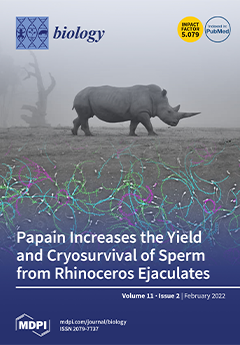
Cover Story: Successful artificial reproductive technologies (ARTs) are paramount for conservation programs, establishing biobanks for threatened species. While the use of ARTs in wildlife species has advanced in recent years, without efficient collection and cryopreservation of sperm, ARTs are limited. The highly viscous nature of the rhino ejaculate reduces the amount of usable semen, making the high-risk procedure of semen collection inefficient. Using papain, we reduced the viscosity of ejaculates, increased the yield of sperm collected, and improved sperm motility post-cryopreservation, without any detriment to membrane characteristics. This work offers a new protocol to improve cryopreservation of rhino semen, contributing toward improved fertility outcomes for the rhino and other threatened species. Top; Sth White rhino at Werribee Zoo, AUS.  Bottom; CASA motility output (CEROSII, IMV, FR) View this paper
  • Issues are regarded as officially published after their release is announced to the table of contents alert mailing list .
  • You may sign up for email alerts to receive table of contents of newly released issues.
  • PDF is the official format for papers published in both, html and pdf forms. To view the papers in pdf format, click on the "PDF Full-text" link, and use the free Adobe Reader to open them.

Articles (191)

  • Article
  • Open Access
24 Citations
3,648 Views
11 Pages

19 February 2022

Rice stripe virus (RSV) causes one of the most serious viral diseases of rice. RNA interference is one of the most efficient ways to control viral disease. In this study, we constructed an amiRNA targeting the RSV MP gene (amiR MP) based on the backb...

  • Article
  • Open Access
15 Citations
5,271 Views
15 Pages

Feeding Habits and the Occurrence of Anthropogenic Debris in the Stomach Content of Marine Fish from Pattani Bay, Gulf of Thailand

  • Kay Khine Soe,
  • Sukree Hajisamae,
  • Penjai Sompongchaiyakul,
  • Prawit Towatana and
  • Siriporn Pradit

19 February 2022

This study assessed the feeding habits and ingestion of anthropogenic debris in 34 marine fish species from the southern Gulf of Thailand. A total of 5478 fish samples of 12 families were categorised into seven groups: planktivore, Lucifer feeder, fi...

  • Article
  • Open Access
7 Citations
3,463 Views
11 Pages

Deadbug Bridging Performance in 6- to 15-Year-Old Competitive Alpine Skiers—A Cross-Sectional Study

  • Gerda Strutzenberger,
  • Lynn Ellenberger,
  • Björn Bruhin,
  • Walter O. Frey,
  • Johannes Scherr and
  • Jörg Spörri

18 February 2022

In competitive alpine skiing, a superior antirotation and rear-chain stabilization capacity is essential to constantly remain in dynamic equilibrium while skiing and to counteract the ski-specific adverse loading patterns of the back. As such, skiers...

  • Article
  • Open Access
4 Citations
8,316 Views
12 Pages

Dismemberment and Body Encasement—Case Report and an Empiric Study

  • Jana Matzen,
  • Benjamin Ondruschka,
  • Antonia Fitzek,
  • Klaus Püschel and
  • Eilin Jopp-van Well

18 February 2022

The mutilation and encasement of corpses are rare in daily forensic work, but when they occur, close cooperation between different disciplines, such as legal medicine and forensic anthropology, is necessary to obtain the most valuable results. One fo...

  • Article
  • Open Access
11 Citations
4,146 Views
25 Pages

18 February 2022

Diopatra Audouin & Milne-Edwards, 1833 is a species rich genus that is common in tropical and subtropical regions. The genus is readily identified by its striking, spiral branchiae, but species identification has historically been challenging due...

  • Review
  • Open Access
21 Citations
4,939 Views
15 Pages

Large-Scale Distribution of the European Seahorses (Hippocampus Rafinesque, 1810): A Systematic Review

  • Cataldo Pierri,
  • Tamara Lazic,
  • Michele Gristina,
  • Giuseppe Corriero and
  • Mauro Sinopoli

18 February 2022

Human pressures on marine ecosystems have caused extensive degradation of marine habitats and several local extinctions. Overexploitation and destructive fishing practices are responsible for biodiversity loss in many coastal ecosystems. The definiti...

  • Article
  • Open Access
7 Citations
3,968 Views
18 Pages

18 February 2022

Fusarium graminearum is the predominant causal agent of cereal Fusarium head blight disease (FHB) worldwide. The application of chemical fungicides such as azole antifungals is still the primary method for FHB control. However, to date, our knowledge...

  • Article
  • Open Access
10 Citations
4,593 Views
18 Pages

Identification of DPP4/CTNNB1/MET as a Theranostic Signature of Thyroid Cancer and Evaluation of the Therapeutic Potential of Sitagliptin

  • Sheng-Yao Cheng,
  • Alexander T. H. Wu,
  • Gaber El-Saber Batiha,
  • Ching-Liang Ho,
  • Jih-Chin Lee,
  • Halimat Yusuf Lukman,
  • Mohammed Alorabi,
  • Abdullah N. AlRasheedi and
  • Jia-Hong Chen

17 February 2022

In recent years, the incidence of thyroid cancer has been increasing globally, with papillary thyroid cancer (PTCa) being the most prevalent pathological type, accounting for approximately 80% of all cases. Although PTCa has been regarded to be slow...

  • Article
  • Open Access
6 Citations
4,156 Views
17 Pages

17 February 2022

In BALB/c mice, immobilization-increased plasma glucocorticoid (GC) levels are suppressed by extremely low frequency (ELF) electric fields (EF). The aim of this study was to advance our understanding of the biological effects of ELF-EF, using its sup...

of 20

Get Alerted

Add your email address to receive forthcoming issues of this journal.

XFacebookLinkedIn
Biology - ISSN 2079-7737