

You are currently viewing a new version of our website. To view the old version click .

Agriculture, Volume 10, Issue 5

May 2020 - 52 articles

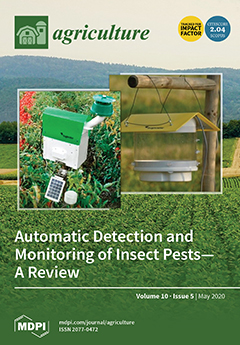
Cover Story: Increased prominence is being given to the use of precision agriculture tools in order to improve the management of insect pests in agricultural systems due to the urgent need to change practices in favor of environmental resilience. Concerns about the impact of pesticides on natural resources and human health along with rapid resistance development in many important pests worldwide are pushing scientists, companies, and farmers to invest in technology as a way to overcome those challenges. The aim of the present paper is to review the techniques and scientific state-of-the-art of the use of sensors for automatic detection and monitoring of insect pests in an integrated pest management (IPM) context, highlighting topics such as machine learning and the Internet of Things, as well as discussing the future trends of automatic traps and decision support systems.View this paper.
  • Issues are regarded as officially published after their release is announced to the table of contents alert mailing list .
  • You may sign up for email alerts to receive table of contents of newly released issues.
  • PDF is the official format for papers published in both, html and pdf forms. To view the papers in pdf format, click on the "PDF Full-text" link, and use the free Adobe Reader to open them.

Articles (52)

  • Article
  • Open Access
6 Citations
5,595 Views
21 Pages

In this study, we built a basic scenario for risk assessment of the introduction of Xantomonas citri (X. citri), an agent of bacterial citrus canker, through international trade activities. According to the international phytosanitary authority Europ...

  • Article
  • Open Access
23 Citations
7,168 Views
18 Pages

Phosphorus Availability and Potential Environmental Risk Assessment in Alkaline Soils

  • Heba Elbasiouny,
  • Fathy Elbehiry,
  • Hassan El-Ramady and
  • Eric C. Brevik

Soil phosphorus (P) is an essential element that is often limiting in ecosystems. Excessive use of P fertilizers has led to P loss from soil and introduction into the environment. However, the behavior and potential risk assessment of P in alkaline s...

  • Article
  • Open Access
40 Citations
8,490 Views
12 Pages

Monitoring Soil Enzymes Activity before and after Animal Manure Application

  • George F. Antonious,
  • Eric T. Turley and
  • Mohammad H. Dawood

Soil enzymes (urease, invertase, acid and alkaline phosphatase) activity in the rhizosphere of field-grown tomato plants were used to monitor the impact of soil amendments (SA) and SA mixed with biochar on soil microbial activity four months after ad...

  • Article
  • Open Access
8 Citations
4,277 Views
11 Pages

The Effect of Plant Water Status on the Chemical Composition of Pistachio Nuts (Pistacia vera L. Cultivar Bianca)

  • Adele Amico Roxas,
  • Giulia Marino,
  • Giuseppe Avellone,
  • Tiziano Caruso and
  • Francesco Paolo Marra

Pistachio nuts are worldwide appreciated for their chemical and organoleptic profiles. There are several studies on the influence of irrigation on pistachio productivity, whereas there are little available data on the influence on nut quality. In thi...

  • Article
  • Open Access
14 Citations
4,159 Views
14 Pages

Chamomile is a herbal plant of very high economic importance worldwide. Its organically grown raw material is particularly valuable. Under organic farming conditions, weeds and fungal diseases are an important problem in a chamomile plantation. Seeki...

  • Article
  • Open Access
7 Citations
3,927 Views
18 Pages

The aim of this research is to characterize the variation in the chemical composition of Tephrosia vogelii essential oils from different locations and to investigate the repellency of essential oils against Sitophilus zeamais. Chemical variability in...

  • Article
  • Open Access
16 Citations
4,926 Views
10 Pages

This paper presents the results of a study on the effects of red light treatment of sweet corn seeds on the quantity and quality of the subsequent yield (total and marketable), as well as the length of cobs and thousand kernel weight. The respective...

  • Article
  • Open Access
25 Citations
6,346 Views
15 Pages

Plants respond to root temperature stresses by producing antioxidants as a defense mechanism. Since a number of these are phytochemicals with enhancing effects on human health, we examined the effects of 4 root-zone temperature (RZT) treatments (10,...

  • Article
  • Open Access
8 Citations
4,379 Views
11 Pages

Field trials were conducted with preemergence dimethanamid-P + pendimethalin (D + P; 850 + 1000 g·ha−1) and reduced rates (637.5 + 750 g·ha−1 and 452 + 500 g·ha−1, 75% and 50% of label rate), followed by strongl...

  • Article
  • Open Access
44 Citations
10,388 Views
20 Pages

Mid-Term Impact of Climate Change on Hazelnut Yield

  • Nazan An,
  • Mustafa Tufan Turp,
  • Murat Türkeş and
  • Mehmet Levent Kurnaz

The impacts of climate change on hazelnut production in Turkey—the world’s largest producer and exporter—may significantly affect the global hazelnut market depending on production and yield change. In this paper, based on gridded c...

of 6

Get Alerted

Add your email address to receive forthcoming issues of this journal.

XFacebookLinkedIn
Agriculture - ISSN 2077-0472