

You are currently viewing a new version of our website. To view the old version click .

Antioxidants, Volume 13, Issue 6

June 2024 - 132 articles

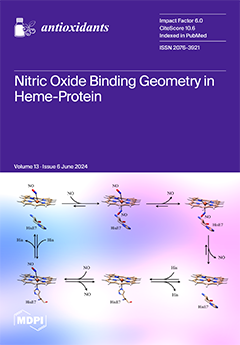
Cover Story: Nitric oxide (NO) synthesis, signaling, and scavenging is associated with relevant physiological and pathological events. In all tissues and organs, NO levels and related functions are regulated at different levels, with heme-proteins playing pivotal roles. Here, the different binding modes of NO to heme-Fe(II) are described, as well as the modulatory effects of this diatomic messenger on heme-protein functions. The ability of heme-proteins to bind NO at either the distal or proximal side of the heme and the transient interchanging of the binding site is reported. This sheds light on the regulation of O2 supply to tissues with high metabolic activity, such as the retina, where a precise regulation of blood flow is necessary to meet the demand of nutrients. View this paper
  • Issues are regarded as officially published after their release is announced to the table of contents alert mailing list .
  • You may sign up for email alerts to receive table of contents of newly released issues.
  • PDF is the official format for papers published in both, html and pdf forms. To view the papers in pdf format, click on the "PDF Full-text" link, and use the free Adobe Reader to open them.

Articles (132)

  • Article
  • Open Access
2 Citations
2,222 Views
21 Pages

Zearalenone (ZEN) is a common fungal toxin with reproductive toxicity in various grains. It poses a serious threat to ovine and other animal husbandry industries, as well as human reproductive health. Therefore, investigating the mechanism of toxicit...

  • Review
  • Open Access
33 Citations
7,864 Views
40 Pages

Potentials of Natural Antioxidants in Reducing Inflammation and Oxidative Stress in Chronic Kidney Disease

  • On Ying Angela Lee,
  • Alex Ngai Nick Wong,
  • Ching Yan Ho,
  • Ka Wai Tse,
  • Angela Zaneta Chan,
  • George Pak-Heng Leung,
  • Yiu Wa Kwan and
  • Martin Ho Yin Yeung

Chronic kidney disease (CKD) presents a substantial global public health challenge, with high morbidity and mortality. CKD patients often experience dyslipidaemia and poor glycaemic control, further exacerbating inflammation and oxidative stress in t...

  • Article
  • Open Access
7 Citations
2,582 Views
17 Pages

Feature-Based Molecular Network-Assisted Cannabinoid and Flavonoid Profiling of Cannabis sativa Leaves and Their Antioxidant Properties

  • Ling Chen,
  • Hong-Ling Li,
  • Hong-Juan Zhou,
  • Guan-Zhong Zhang,
  • Ying Zhang,
  • You-Mei Wang,
  • Meng-Yuan Wang,
  • Hua Yang and
  • Wen Gao

Cannabis sativa (C. sativa) leaves are rich in cannabinoids and flavonoids, which play important antioxidant roles. Since the environmental factors may influence the accumulation of antioxidants in herbal medicines, which affects their activity, this...

  • Article
  • Open Access
7 Citations
2,094 Views
19 Pages

Uncovering the Role of Selenite and Selenium Nanoparticles (SeNPs) in Adolescent Rat Adipose Tissue beyond Oxidative Balance: Transcriptomic Analysis

  • Fátima Nogales,
  • Eloísa Pajuelo,
  • Inés Romero-Herrera,
  • Olimpia Carreras,
  • Francisco Merchán,
  • José A. Carrasco López and
  • María Luisa Ojeda

Studies on adolescent rats, when body composition is changing deeply, reveal that the administration of sodium selenite and selenium nanoparticles (SeNPs), at the same dose, have opposite effects on adipogenesis in white adipose tissue (WAT). To inve...

  • Review
  • Open Access
17 Citations
8,916 Views
21 Pages

Melatonin and Vascular Function

  • Leandro Mendes,
  • Marcelo Queiroz and
  • Cristina M. Sena

The indolamine hormone melatonin, also known as N-acetyl-5-methoxytrypamine, is frequently associated with circadian rhythm regulation. Light can suppress melatonin secretion, and photoperiod regulates melatonin levels by promoting its production and...

  • Article
  • Open Access
5 Citations
3,274 Views
13 Pages

PAPLAL, a mixture of platinum (nPt) and palladium (nPd) nanoparticles, is widely used as a topical agent because of its strong antioxidant activity. Allergic contact dermatitis (ACD) is one of the most common occupational skin diseases worldwide. How...

  • Article
  • Open Access
8 Citations
3,855 Views
16 Pages

The prevalence of non-alcoholic fatty liver disease (NAFLD) has dramatically increased in recent years, and it is highly associated with metabolic diseases, as well as the development of hepatocellular carcinoma. However, effective therapeutic strate...

  • Article
  • Open Access
8 Citations
2,117 Views
16 Pages

Innovative Cosmeceutical Ingredients: Harnessing Selenosugar-Linked Hydroxycinnamic Acids for Antioxidant and Wound-Healing Properties

  • Giovanna Cimmino,
  • Mauro De Nisco,
  • Simona Piccolella,
  • Claudia Gravina,
  • Silvana Pedatella and
  • Severina Pacifico

Selenosugars are gaining growing interest due to their antioxidant efficacy, and their ability to inhibit glycosidases, repair skin tissue or reduce endothelial dysfunction. Among selenosugars, those in which selenium replaces heterocyclic oxygen in...

  • Review
  • Open Access
7 Citations
4,552 Views
17 Pages

GLS and GLS2 Glutaminase Isoenzymes in the Antioxidant System of Cancer Cells

  • Juan De los Santos-Jiménez,
  • José A. Campos-Sandoval,
  • Francisco J. Alonso,
  • Javier Márquez and
  • José M. Matés

A pathway frequently altered in cancer is glutaminolysis, whereby glutaminase (GA) catalyzes the main step as follows: the deamidation of glutamine to form glutamate and ammonium. There are two types of GA isozymes, named GLS and GLS2, which differ c...

  • Article
  • Open Access
4 Citations
3,019 Views
20 Pages

Administration of Bicarbonate Protects Mitochondria, Rescues Retinal Ganglion Cells, and Ameliorates Visual Dysfunction Caused by Oxidative Stress

  • Tonking Bastola,
  • Guy A. Perkins,
  • Viet Anh Nguyen Huu,
  • Saeyeon Ju,
  • Keun-Young Kim,
  • Ziyao Shen,
  • Dorota Skowronska-Krawczyk,
  • Robert N. Weinreb and
  • Won-Kyu Ju

Oxidative stress is a key factor causing mitochondrial dysfunction and retinal ganglion cell (RGC) death in glaucomatous neurodegeneration. The cyclic adenosine monophosphate (cAMP)/protein kinase A (PKA) signaling pathway is involved in mitochondria...

of 14

Get Alerted

Add your email address to receive forthcoming issues of this journal.

XFacebookLinkedIn
Antioxidants - ISSN 2076-3921