


You are currently viewing a new version of our website. To view the old version click .

Brain Sciences, Volume 9, Issue 7

July 2019 - 25 articles

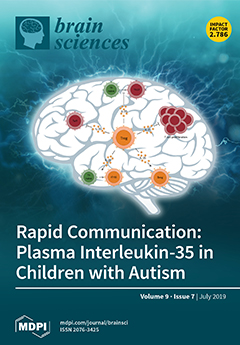
Cover Story: Immune dysfunction is often reported in autism spectrum disorders (ASD), however, the extent and type of inflammation has been reported with mixed and sometimes contradictory findings. One common component that may help to explain these different inflammatory profiles is deficits in immune regulation. We and others have previously found reductions in regulatory T cells (Tregs) and associated cytokines. Tregs, though they make up a small percentage of the body’s lymphocytes, provide the necessary signals required to control immune responses and bring the immune system back to homeostasis. In the current study we describe reduced plasma interluekin-35, a novel immunoregulatory cytokine produced primarily by Tregs, in children with ASD and discuss how deficits in immune regulation may contribute to etiology and aberrant behaviors associated with ASD. View this paper
  • Issues are regarded as officially published after their release is announced to the table of contents alert mailing list .
  • You may sign up for email alerts to receive table of contents of newly released issues.
  • PDF is the official format for papers published in both, html and pdf forms. To view the papers in pdf format, click on the "PDF Full-text" link, and use the free Adobe Reader to open them.

Articles (25)

  • Perspective
  • Open Access
11 Citations
5,250 Views
18 Pages

Neural Circuit and Clinical Insights from Intraoperative Recordings During Deep Brain Stimulation Surgery

  • Anand Tekriwal,
  • Neema Moin Afshar,
  • Juan Santiago-Moreno,
  • Fiene Marie Kuijper,
  • Drew S. Kern,
  • Casey H. Halpern,
  • Gidon Felsen and
  • John A. Thompson

Observations using invasive neural recordings from patient populations undergoing neurosurgical interventions have led to critical breakthroughs in our understanding of human neural circuit function and malfunction. The opportunity to interact with p...

  • Article
  • Open Access
11 Citations
5,559 Views
20 Pages

Reinforcement learning studies in rodents and primates demonstrate that goal-directed and habitual choice behaviors are mediated through different fronto-striatal systems, but the evidence is less clear in humans. In this study, functional magnetic r...

  • Article
  • Open Access
29 Citations
6,005 Views
11 Pages

Upregulation of IL-1 Receptor Antagonist in a Mouse Model of Migraine

  • Salvo Danilo Lombardo,
  • Emanuela Mazzon,
  • Maria Sofia Basile,
  • Eugenio Cavalli,
  • Placido Bramanti,
  • Riccardo Nania,
  • Paolo Fagone,
  • Ferdinando Nicoletti and
  • Maria Cristina Petralia

Migraine is a disorder characterized by attacks of monolateral headaches, often accompanied by nausea, vomiting, and photophobia. Around 30% of patients also report aura symptoms. The cause of the aura is believed to be related to the cortical spread...

  • Article
  • Open Access
29 Citations
7,676 Views
11 Pages

White Matter Hyperintensity Regression: Comparison of Brain Atrophy and Cognitive Profiles with Progression and Stable Groups

  • Omar M. Al-Janabi,
  • Christopher E. Bauer,
  • Larry B. Goldstein,
  • Richard R. Murphy,
  • Ahmed A. Bahrani,
  • Charles D. Smith,
  • Donna M. Wilcock,
  • Brian T. Gold and
  • Gregory A. Jicha

Subcortical white matter hyperintensities (WMHs) in the aging population frequently represent vascular injury that may lead to cognitive impairment. WMH progression is well described, but the factors underlying WMH regression remain poorly understood...

  • Article
  • Open Access
14 Citations
4,822 Views
13 Pages

Corticotropin releasing factor (CRF) signaling via limbic CRF1 and 2 receptors (CRF1R and CRF2R, respectively) is known to modulate binge-like ethanol consumption in rodents. Though CRF signaling in the medial prefrontal cortex (mPFC) has been shown...

  • Perspective
  • Open Access
16 Citations
6,777 Views
9 Pages

Alzheimer’s disease (AD) is a neurodegenerative disorder that occurs mainly in the elderly and presenile life stages. It is estimated that by the year 2050, 135 million people will be affected by AD worldwide, representing a huge burden to soci...

  • Article
  • Open Access
5 Citations
4,154 Views
20 Pages

Domain-Specific Expectations in Music Segmentation

  • Susana Silva,
  • Carolina Dias and
  • São Luís Castro

The acoustic cues that guide the assignment of phrase boundaries in music (pauses and pitch movements) overlap with those that are known for speech prosody. Based on this, researchers have focused on highlighting the similarities and neural resources...

  • Article
  • Open Access
11 Citations
5,152 Views
12 Pages

Marijuana Use among African American Older Adults in Economically Challenged Areas of South Los Angeles

  • Sharon Cobb,
  • Mohsen Bazargan,
  • James Smith,
  • Homero E. del Pino,
  • Kimberly Dorrah and
  • Shervin Assari

Purpose: This study explored demographic, social, behavioral, and health factors associated with current marijuana use (MU) among African American older adults who were residing in economically challenged areas of south Los Angeles. Methods: This com...

  • Article
  • Open Access
21 Citations
6,522 Views
16 Pages

Sex Differences in the Effect of Alcohol Drinking on Myelinated Axons in the Anterior Cingulate Cortex of Adolescent Rats

  • Elizabeth R. Tavares,
  • Andrea Silva-Gotay,
  • Wanette Vargas Riad,
  • Lynn Bengston and
  • Heather N. Richardson

Cognitive deficits associated with teenage drinking may be due to disrupted myelination of prefrontal circuits. To better understand how alcohol affects myelination, male and female Wistar rats (n = 7–9/sex/treatment) underwent two weeks of int...

  • Feature Paper
  • Article
  • Open Access
30 Citations
6,101 Views
14 Pages

Amyotrophic lateral sclerosis (ALS) is a devastating motor neuron (MN) disease with no cure. Accumulating evidence indicates ALS involves a complex interaction between central glia and the peripheral immune response and neuromuscular interface. Stem...

of 3

Get Alerted

Add your email address to receive forthcoming issues of this journal.

XFacebookLinkedIn
Brain Sci. - ISSN 2076-3425